EP4119604A1 - Flüssigkeitsabweisende struktur, herstellungsverfahren für eine flüssigkeitsabweisende struktur, beschichtungsflüssigkeit zur bildung einer flüssigkeitsabweisenden schicht und verpackungsmaterial - Google Patents
Flüssigkeitsabweisende struktur, herstellungsverfahren für eine flüssigkeitsabweisende struktur, beschichtungsflüssigkeit zur bildung einer flüssigkeitsabweisenden schicht und verpackungsmaterial Download PDFInfo
- Publication number
- EP4119604A1 EP4119604A1 EP21768162.6A EP21768162A EP4119604A1 EP 4119604 A1 EP4119604 A1 EP 4119604A1 EP 21768162 A EP21768162 A EP 21768162A EP 4119604 A1 EP4119604 A1 EP 4119604A1
- Authority
- EP
- European Patent Office
- Prior art keywords
- filler
- liquid
- liquid repellent
- mass
- fluorine
- Prior art date
- Legal status (The legal status is an assumption and is not a legal conclusion. Google has not performed a legal analysis and makes no representation as to the accuracy of the status listed.)
- Withdrawn
Links
Images

Classifications
-
- C—CHEMISTRY; METALLURGY
- C09—DYES; PAINTS; POLISHES; NATURAL RESINS; ADHESIVES; COMPOSITIONS NOT OTHERWISE PROVIDED FOR; APPLICATIONS OF MATERIALS NOT OTHERWISE PROVIDED FOR
- C09D—COATING COMPOSITIONS, e.g. PAINTS, VARNISHES OR LACQUERS; FILLING PASTES; CHEMICAL PAINT OR INK REMOVERS; INKS; CORRECTING FLUIDS; WOODSTAINS; PASTES OR SOLIDS FOR COLOURING OR PRINTING; USE OF MATERIALS THEREFOR
- C09D7/00—Features of coating compositions, not provided for in group C09D5/00; Processes for incorporating ingredients in coating compositions
- C09D7/40—Additives
- C09D7/66—Additives characterised by particle size
- C09D7/69—Particle size larger than 1000 nm
-
- C—CHEMISTRY; METALLURGY
- C09—DYES; PAINTS; POLISHES; NATURAL RESINS; ADHESIVES; COMPOSITIONS NOT OTHERWISE PROVIDED FOR; APPLICATIONS OF MATERIALS NOT OTHERWISE PROVIDED FOR
- C09D—COATING COMPOSITIONS, e.g. PAINTS, VARNISHES OR LACQUERS; FILLING PASTES; CHEMICAL PAINT OR INK REMOVERS; INKS; CORRECTING FLUIDS; WOODSTAINS; PASTES OR SOLIDS FOR COLOURING OR PRINTING; USE OF MATERIALS THEREFOR
- C09D5/00—Coating compositions, e.g. paints, varnishes or lacquers, characterised by their physical nature or the effects produced; Filling pastes
- C09D5/16—Antifouling paints; Underwater paints
- C09D5/1687—Use of special additives
-
- C—CHEMISTRY; METALLURGY
- C08—ORGANIC MACROMOLECULAR COMPOUNDS; THEIR PREPARATION OR CHEMICAL WORKING-UP; COMPOSITIONS BASED THEREON
- C08J—WORKING-UP; GENERAL PROCESSES OF COMPOUNDING; AFTER-TREATMENT NOT COVERED BY SUBCLASSES C08B, C08C, C08F, C08G or C08H
- C08J7/00—Chemical treatment or coating of shaped articles made of macromolecular substances
- C08J7/04—Coating
- C08J7/054—Forming anti-misting or drip-proofing coatings
-
- C—CHEMISTRY; METALLURGY
- C08—ORGANIC MACROMOLECULAR COMPOUNDS; THEIR PREPARATION OR CHEMICAL WORKING-UP; COMPOSITIONS BASED THEREON
- C08J—WORKING-UP; GENERAL PROCESSES OF COMPOUNDING; AFTER-TREATMENT NOT COVERED BY SUBCLASSES C08B, C08C, C08F, C08G or C08H
- C08J7/00—Chemical treatment or coating of shaped articles made of macromolecular substances
- C08J7/04—Coating
- C08J7/042—Coating with two or more layers, where at least one layer of a composition contains a polymer binder
-
- C—CHEMISTRY; METALLURGY
- C08—ORGANIC MACROMOLECULAR COMPOUNDS; THEIR PREPARATION OR CHEMICAL WORKING-UP; COMPOSITIONS BASED THEREON
- C08J—WORKING-UP; GENERAL PROCESSES OF COMPOUNDING; AFTER-TREATMENT NOT COVERED BY SUBCLASSES C08B, C08C, C08F, C08G or C08H
- C08J7/00—Chemical treatment or coating of shaped articles made of macromolecular substances
- C08J7/04—Coating
- C08J7/0427—Coating with only one layer of a composition containing a polymer binder
-
- C—CHEMISTRY; METALLURGY
- C08—ORGANIC MACROMOLECULAR COMPOUNDS; THEIR PREPARATION OR CHEMICAL WORKING-UP; COMPOSITIONS BASED THEREON
- C08J—WORKING-UP; GENERAL PROCESSES OF COMPOUNDING; AFTER-TREATMENT NOT COVERED BY SUBCLASSES C08B, C08C, C08F, C08G or C08H
- C08J7/00—Chemical treatment or coating of shaped articles made of macromolecular substances
- C08J7/04—Coating
- C08J7/043—Improving the adhesiveness of the coatings per se, e.g. forming primers
-
- C—CHEMISTRY; METALLURGY
- C08—ORGANIC MACROMOLECULAR COMPOUNDS; THEIR PREPARATION OR CHEMICAL WORKING-UP; COMPOSITIONS BASED THEREON
- C08L—COMPOSITIONS OF MACROMOLECULAR COMPOUNDS
- C08L33/00—Compositions of homopolymers or copolymers of compounds having one or more unsaturated aliphatic radicals, each having only one carbon-to-carbon double bond, and only one being terminated by only one carboxyl radical, or of salts, anhydrides, esters, amides, imides or nitriles thereof; Compositions of derivatives of such polymers
- C08L33/04—Homopolymers or copolymers of esters
- C08L33/14—Homopolymers or copolymers of esters of esters containing halogen, nitrogen, sulfur, or oxygen atoms in addition to the carboxy oxygen
- C08L33/16—Homopolymers or copolymers of esters containing halogen atoms
-
- C—CHEMISTRY; METALLURGY
- C09—DYES; PAINTS; POLISHES; NATURAL RESINS; ADHESIVES; COMPOSITIONS NOT OTHERWISE PROVIDED FOR; APPLICATIONS OF MATERIALS NOT OTHERWISE PROVIDED FOR
- C09D—COATING COMPOSITIONS, e.g. PAINTS, VARNISHES OR LACQUERS; FILLING PASTES; CHEMICAL PAINT OR INK REMOVERS; INKS; CORRECTING FLUIDS; WOODSTAINS; PASTES OR SOLIDS FOR COLOURING OR PRINTING; USE OF MATERIALS THEREFOR
- C09D133/00—Coating compositions based on homopolymers or copolymers of compounds having one or more unsaturated aliphatic radicals, each having only one carbon-to-carbon double bond, and at least one being terminated by only one carboxyl radical, or of salts, anhydrides, esters, amides, imides, or nitriles thereof; Coating compositions based on derivatives of such polymers
- C09D133/04—Homopolymers or copolymers of esters
- C09D133/14—Homopolymers or copolymers of esters of esters containing halogen, nitrogen, sulfur or oxygen atoms in addition to the carboxy oxygen
- C09D133/16—Homopolymers or copolymers of esters containing halogen atoms
-
- C—CHEMISTRY; METALLURGY
- C09—DYES; PAINTS; POLISHES; NATURAL RESINS; ADHESIVES; COMPOSITIONS NOT OTHERWISE PROVIDED FOR; APPLICATIONS OF MATERIALS NOT OTHERWISE PROVIDED FOR
- C09D—COATING COMPOSITIONS, e.g. PAINTS, VARNISHES OR LACQUERS; FILLING PASTES; CHEMICAL PAINT OR INK REMOVERS; INKS; CORRECTING FLUIDS; WOODSTAINS; PASTES OR SOLIDS FOR COLOURING OR PRINTING; USE OF MATERIALS THEREFOR
- C09D5/00—Coating compositions, e.g. paints, varnishes or lacquers, characterised by their physical nature or the effects produced; Filling pastes
- C09D5/16—Antifouling paints; Underwater paints
- C09D5/1606—Antifouling paints; Underwater paints characterised by the anti-fouling agent
-
- C—CHEMISTRY; METALLURGY
- C09—DYES; PAINTS; POLISHES; NATURAL RESINS; ADHESIVES; COMPOSITIONS NOT OTHERWISE PROVIDED FOR; APPLICATIONS OF MATERIALS NOT OTHERWISE PROVIDED FOR
- C09D—COATING COMPOSITIONS, e.g. PAINTS, VARNISHES OR LACQUERS; FILLING PASTES; CHEMICAL PAINT OR INK REMOVERS; INKS; CORRECTING FLUIDS; WOODSTAINS; PASTES OR SOLIDS FOR COLOURING OR PRINTING; USE OF MATERIALS THEREFOR
- C09D5/00—Coating compositions, e.g. paints, varnishes or lacquers, characterised by their physical nature or the effects produced; Filling pastes
- C09D5/16—Antifouling paints; Underwater paints
- C09D5/1656—Antifouling paints; Underwater paints characterised by the film-forming substance
- C09D5/1662—Synthetic film-forming substance
-
- C—CHEMISTRY; METALLURGY
- C09—DYES; PAINTS; POLISHES; NATURAL RESINS; ADHESIVES; COMPOSITIONS NOT OTHERWISE PROVIDED FOR; APPLICATIONS OF MATERIALS NOT OTHERWISE PROVIDED FOR
- C09D—COATING COMPOSITIONS, e.g. PAINTS, VARNISHES OR LACQUERS; FILLING PASTES; CHEMICAL PAINT OR INK REMOVERS; INKS; CORRECTING FLUIDS; WOODSTAINS; PASTES OR SOLIDS FOR COLOURING OR PRINTING; USE OF MATERIALS THEREFOR
- C09D5/00—Coating compositions, e.g. paints, varnishes or lacquers, characterised by their physical nature or the effects produced; Filling pastes
- C09D5/16—Antifouling paints; Underwater paints
- C09D5/1693—Antifouling paints; Underwater paints as part of a multilayer system
-
- C—CHEMISTRY; METALLURGY
- C09—DYES; PAINTS; POLISHES; NATURAL RESINS; ADHESIVES; COMPOSITIONS NOT OTHERWISE PROVIDED FOR; APPLICATIONS OF MATERIALS NOT OTHERWISE PROVIDED FOR
- C09D—COATING COMPOSITIONS, e.g. PAINTS, VARNISHES OR LACQUERS; FILLING PASTES; CHEMICAL PAINT OR INK REMOVERS; INKS; CORRECTING FLUIDS; WOODSTAINS; PASTES OR SOLIDS FOR COLOURING OR PRINTING; USE OF MATERIALS THEREFOR
- C09D7/00—Features of coating compositions, not provided for in group C09D5/00; Processes for incorporating ingredients in coating compositions
- C09D7/40—Additives
- C09D7/70—Additives characterised by shape, e.g. fibres, flakes or microspheres
-
- C—CHEMISTRY; METALLURGY
- C09—DYES; PAINTS; POLISHES; NATURAL RESINS; ADHESIVES; COMPOSITIONS NOT OTHERWISE PROVIDED FOR; APPLICATIONS OF MATERIALS NOT OTHERWISE PROVIDED FOR
- C09K—MATERIALS FOR MISCELLANEOUS APPLICATIONS, NOT PROVIDED FOR ELSEWHERE
- C09K3/00—Materials not provided for elsewhere
- C09K3/18—Materials not provided for elsewhere for application to surfaces to minimize adherence of ice, mist or water thereto; Thawing or antifreeze materials for application to surfaces
-
- B—PERFORMING OPERATIONS; TRANSPORTING
- B65—CONVEYING; PACKING; STORING; HANDLING THIN OR FILAMENTARY MATERIAL
- B65D—CONTAINERS FOR STORAGE OR TRANSPORT OF ARTICLES OR MATERIALS, e.g. BAGS, BARRELS, BOTTLES, BOXES, CANS, CARTONS, CRATES, DRUMS, JARS, TANKS, HOPPERS, FORWARDING CONTAINERS; ACCESSORIES, CLOSURES, OR FITTINGS THEREFOR; PACKAGING ELEMENTS; PACKAGES
- B65D2565/00—Wrappers or flexible covers; Packaging materials of special type or form
- B65D2565/38—Packaging materials of special type or form
- B65D2565/381—Details of packaging materials of special type or form
-
- B—PERFORMING OPERATIONS; TRANSPORTING
- B65—CONVEYING; PACKING; STORING; HANDLING THIN OR FILAMENTARY MATERIAL
- B65D—CONTAINERS FOR STORAGE OR TRANSPORT OF ARTICLES OR MATERIALS, e.g. BAGS, BARRELS, BOTTLES, BOXES, CANS, CARTONS, CRATES, DRUMS, JARS, TANKS, HOPPERS, FORWARDING CONTAINERS; ACCESSORIES, CLOSURES, OR FITTINGS THEREFOR; PACKAGING ELEMENTS; PACKAGES
- B65D65/00—Wrappers or flexible covers; Packaging materials of special type or form
- B65D65/38—Packaging materials of special type or form
- B65D65/42—Applications of coated or impregnated materials
-
- C—CHEMISTRY; METALLURGY
- C08—ORGANIC MACROMOLECULAR COMPOUNDS; THEIR PREPARATION OR CHEMICAL WORKING-UP; COMPOSITIONS BASED THEREON
- C08J—WORKING-UP; GENERAL PROCESSES OF COMPOUNDING; AFTER-TREATMENT NOT COVERED BY SUBCLASSES C08B, C08C, C08F, C08G or C08H
- C08J2367/00—Characterised by the use of polyesters obtained by reactions forming a carboxylic ester link in the main chain; Derivatives of such polymers
- C08J2367/02—Polyesters derived from dicarboxylic acids and dihydroxy compounds
-
- C—CHEMISTRY; METALLURGY
- C08—ORGANIC MACROMOLECULAR COMPOUNDS; THEIR PREPARATION OR CHEMICAL WORKING-UP; COMPOSITIONS BASED THEREON
- C08J—WORKING-UP; GENERAL PROCESSES OF COMPOUNDING; AFTER-TREATMENT NOT COVERED BY SUBCLASSES C08B, C08C, C08F, C08G or C08H
- C08J2433/00—Characterised by the use of homopolymers or copolymers of compounds having one or more unsaturated aliphatic radicals, each having only one carbon-to-carbon double bond, and only one being terminated by only one carboxyl radical, or of salts, anhydrides, esters, amides, imides, or nitriles thereof; Derivatives of such polymers
- C08J2433/04—Characterised by the use of homopolymers or copolymers of compounds having one or more unsaturated aliphatic radicals, each having only one carbon-to-carbon double bond, and only one being terminated by only one carboxyl radical, or of salts, anhydrides, esters, amides, imides, or nitriles thereof; Derivatives of such polymers esters
- C08J2433/14—Characterised by the use of homopolymers or copolymers of compounds having one or more unsaturated aliphatic radicals, each having only one carbon-to-carbon double bond, and only one being terminated by only one carboxyl radical, or of salts, anhydrides, esters, amides, imides, or nitriles thereof; Derivatives of such polymers esters of esters containing halogen, nitrogen, sulfur, or oxygen atoms in addition to the carboxy oxygen
- C08J2433/16—Homopolymers or copolymers of esters containing halogen atoms
-
- C—CHEMISTRY; METALLURGY
- C08—ORGANIC MACROMOLECULAR COMPOUNDS; THEIR PREPARATION OR CHEMICAL WORKING-UP; COMPOSITIONS BASED THEREON
- C08K—Use of inorganic or non-macromolecular organic substances as compounding ingredients
- C08K2201/00—Specific properties of additives
- C08K2201/002—Physical properties
- C08K2201/005—Additives being defined by their particle size in general
-
- C—CHEMISTRY; METALLURGY
- C08—ORGANIC MACROMOLECULAR COMPOUNDS; THEIR PREPARATION OR CHEMICAL WORKING-UP; COMPOSITIONS BASED THEREON
- C08K—Use of inorganic or non-macromolecular organic substances as compounding ingredients
- C08K2201/00—Specific properties of additives
- C08K2201/002—Physical properties
- C08K2201/006—Additives being defined by their surface area
-
- C—CHEMISTRY; METALLURGY
- C08—ORGANIC MACROMOLECULAR COMPOUNDS; THEIR PREPARATION OR CHEMICAL WORKING-UP; COMPOSITIONS BASED THEREON
- C08K—Use of inorganic or non-macromolecular organic substances as compounding ingredients
- C08K7/00—Use of ingredients characterised by shape
Definitions
- the present disclosure relates to liquid repellent structures, methods for producing liquid repellent structures, liquid repellent layer-forming coating liquids, and packaging materials.
- PTL 1 discloses a single-layer water-repellent heat seal film containing a thermoplastic resin and hydrophobic particles.
- the liquid repellent structure according to the present disclosure is a liquid repellent structure including a surface to which liquid repellency is to be imparted (hereinafter, sometimes referred to as a "treatment surface"), and a liquid repellent layer formed on the surface, wherein the liquid repellent layer contains a binder resin containing a fluorine-containing resin and a filler dispersed in the binder resin.
- the filler contains a first filler having a BET specific surface area M of 100 m 2 /g to 400 m 2 /g, and a ratio M/F of the BET specific surface area M of the first filler to a mass F (mass%) of the fluorine-containing resin relative to a total mass of the liquid repellent layer is 1.5 to 4.0.
- the liquid repellent layer in the liquid repellent structure has excellent liquid repellency to water and oil, and can maintain liquid repellency especially to water for a long period of time.
- the present inventors consider the reason why the above effect is obtained to be as follows. That is, in order to exhibit liquid repellency to a liquid having a high surface tension, such as water, it is necessary to firmly form micro-asperities by the first filler.
- the shape and strength of the micro-asperities are determined by the ratio (M/F) of the BET specific surface area of the first filler to the mass of the fluorine-containing resin. If M/F is within the above range, firm and micro-asperities can be efficiently formed, leading to excellent liquid repellency and maintaining the liquid repellency for a long period of time.
- the first filler may have a structure in which a plurality of primary particles are connected in a bead-like manner.
- the bead-like structure of the bead-like filler which has a three-dimensional structure, is likely to impart flexibility to the liquid repellent layer, and can maintain the liquid repellency for a longer period of time.
- the fluorine-containing resin may contain a fluorine-acrylic copolymer. Due to the fluorine-acrylic copolymer being contained, the liquid repellency can be maintained for a longer period of time.
- the filler may contain a scale-like filler. Due to the scale-like filler being contained in the liquid repellent layer, the liquid repellent layer can efficiently form asperities on the surface and easily maintain liquid repellency to water for a long period of time.
- the above liquid repellent structure may further include a primer layer interposed between the surface and the liquid repellent layer, wherein the primer layer may contain a binder resin and a third filler having an average primary particle size of 5 ⁇ m to 60 ⁇ m. Accordingly, rough asperities can be formed on the liquid repellent structure. Since the rough asperities facilitate point contact between the liquid repellent layer and the contents, deterioration of the liquid repellency can be further suppressed.
- the above liquid repellent structure may have a surface roughness Sa of 1.5 ⁇ m to 15.0 ⁇ m so that the effect of holding the contents by point contact can be easily achieved.
- the present disclosure provides a packaging material including the above liquid repellent structure on a side that comes into contact with substances.
- the liquid repellent layer in the liquid repellent structure has excellent liquid repellency to water for a long period of time. Therefore, the packaging material can be applied to substances containing water.
- the present disclosure provides a method for producing a liquid repellent structure.
- the above liquid repellent structure is produced through following steps of forming a liquid repellent layer. That is, the method for producing the liquid repellent structure includes the steps of: preparing a coating liquid containing a binder resin containing a fluorine-containing resin, and a filler; forming a coating film of the coating liquid on a surface to which liquid repellency is to be imparted; and forming a liquid repellent layer by drying and curing the coating film.
- the filler contains a first filler having a BET specific surface area M of 100 m 2 /g to 400 m 2 /g, and a ratio M/F of the BET specific surface area M of the first filler to a mass F (mass%) of the fluorine-containing resin relative to a total mass of a solid content contained in the coating liquid is 1.5 to 4.0.
- the liquid repellent structure of the present disclosure having the above effects can be produced.
- the present disclosure provides a liquid repellent layer-forming coating liquid used in the method for producing the liquid repellent structure.
- the liquid repellent layer-forming coating liquid is a coating liquid that contains a binder resin containing a fluorine-containing resin, and a filler, the filler containing a first filler having a BET specific surface area M of 100 m 2 /g to 400 m 2 /g, and a ratio M/F of the BET specific surface area M of the first filler to a mass F (mass%) of the fluorine-containing resin relative to a total mass of a solid content contained in the coating liquid is 1.5 to 4.0.
- the liquid repellent structure of the present disclosure having the above effects can be produced.
- a liquid repellent structure having liquid repellency to water for a long period of time is provided. Furthermore, according to the present disclosure, there are provided a method for producing the liquid repellent structure, a liquid repellent layer-forming coating liquid, and a packaging material having the liquid repellent structure on a side that comes into contact with substances.
- Fig. 1 is a schematic cross-sectional view illustrating an embodiment of a liquid repellent structure according to the present disclosure.
- a liquid repellent structure 10A includes a substrate 1 having a treatment surface 1a (surface to which liquid repellency is to be imparted), and a liquid repellent layer 3A formed on the treatment surface 1a.
- the substrate 1 is not particularly limited as long as it has a surface to which liquid repellency is to be imparted and serves as a support.
- the substrate 1 may be a film-like substrate (thickness: about 10 ⁇ m to 200 ⁇ m) or a plate-like substrate (thickness: about 1 mm to 10 mm).
- the film-like substrate include paper, resin films, metal foil, and the like.
- Examples of the paper include high-quality paper, special high-quality paper, coated paper, art paper, cast-coated paper, imitation paper, kraft paper, and the like.
- Examples of the resin include polyolefins, acid-modified polyolefins, polyesters (e.g., polyethylene terephthalate (PET)), polyethylenes (PE), polypropylenes (PP), polyamides (PA), polyvinyl chlorides (PVC), cellulose acetates, cellophane resins, and the like.
- Examples of the metal include aluminum, nickel, and the like.
- the substrate 1 is a film
- the substrate 1 is preferably thermally fusible with the liquid repellent layer 3.
- the substrate 1 is preferably thermally fusible with the primer layer.
- the melting point of the substrate 1 is preferably 170°C or lower.
- the melting point of the substrate 1 is more preferably 150°C or lower.
- the melting point of the substrate 1 can be measured by differential scanning calorimetry.
- the liquid repellent layer 3A is a layer having liquid repellency, and contains a first filler 5f and a binder resin 5b.
- the liquid repellent layer 3A is formed to partially or entirely cover the surface of the substrate 1.
- Liquid repellency is a concept including both water repellency and oil repellency, and specifically refers to properties of repelling liquid, semi-solid, or gel-like aqueous or oily materials. Examples of the aqueous or oily materials include foods, such as water, oil (salad oil or the like), yogurt, curry, dairy cream, jelly, pudding, syrup, porridge and soup; detergents, such as hand soap, body soap, shampoo and hair conditioner; cosmetics, such as hand creams and milky lotions; pharmaceuticals; and chemicals.
- the liquid repellent layer 3A forms the innermost layer or the outermost layer that is in direct contact with these materials.
- the liquid repellent layer according to the present embodiment can maintain liquid repellency (liquid repellent durability) especially to water, among the above materials, for a long period of time.
- the liquid repellent layer 3A contains the first filler 5f.
- the first filler 5f may have, for example, a spherical shape, and an average primary particle size thereof is preferably 3 nm to 1,000 nm, more preferably 5 nm to 100 nm, and still more preferably 5 nm to 20 nm.
- the average primary particle size of the first filler refers to the average of the values obtained by measuring the major axis and minor axis of each of 10 particles of the first filler in an SEM or TEM field of view and dividing the sum of each of them by 2.
- Examples of the material constituting the first filler 5f include silica, titanium oxide, aluminum oxide, mica, talc, calcium carbonate, barium sulfate, zinc oxide, smectite, zeolite and acrylic resin, or the like.
- the first filler 5f may be a bead-like filler having a structure in which a plurality of primary particles are connected in a bead-like manner.
- the bead-like structure of the bead-like filler may include, in addition to the structure in which spherical particles are connected in a bead-like manner, a branched structure in which spherical particles are connected in a chain form.
- the bead-like structure which has a three-dimensional structure, is likely to impart flexibility to the liquid repellent layer. Due to the bead-like filler being used, the liquid repellent layer is likely to maintain liquid repellency not only to water but also to liquid materials containing water for a long period of time.
- the bead-like filler can also be referred to as a pearl necklace type filler.
- the bead-like filler preferably has an average particle size (average secondary particle size) of 50 nm to 1,000 nm, more preferably 100 nm to 400 nm, and still more preferably 100 nm to 200 nm.
- average particle size average secondary particle size
- the bead-like filler has the average particle size of 50 nm or more, the bead-like filler is likely to easily impart its flexibility to the liquid repellent layer.
- the bead-like filler has the average particle size of 1,000 nm or less, the bead-like filler is likely to easily form micro-asperities.
- the average particle size of the bead-like filler refers to the average of the values obtained by measuring the major axis and minor axis of each of 10 particles of the bead-like filler in a TEM field of view and dividing the sum of each of them by 2.
- the first filler 5f has a BET specific surface area M of 100 m 2 /g to 400 m 2 /g.
- the BET specific surface area M is 100 m 2 /g or more, micro-asperities sufficient to obtain liquid repellency can be formed, and when the BET specific surface area M is 400 m 2 /g or less, micro-asperities can be formed without the first filler being buried in the fluorine-containing resin.
- the BET specific surface area M of the first filler 5f is preferably 130 m 2 /g to 300 m 2 /g, and more preferably 200 m 2 /g to 300 m 2 /g. The BET specific surface area of the filler is measured by the BET method.
- the content of the first filler 5f in the liquid repellent layer 3A may be, for example, 20 mass% to 80 mass% relative to the total mass of the liquid repellent layer, preferably 30 mass% to 75 mass%, and more preferably 30 mass% to 50 mass%.
- the content of the first filler 5f is within the above range, it is possible to easily prevent the first filler 5f from detaching, and to form sufficient asperities on the liquid repellent layer 3A. Accordingly, excellent liquid repellency due to the first filler 5f can be easily achieved.
- the first filler 5f commercially available products can be used.
- the commercially available products of silica filler include AEROSIL (AEROSIL 130, 200, 300, 380, and the like) manufactured by Nippon Aerosil Co., Ltd., REOLOSIL (QS-10, 20 and 40) manufactured by Tokuyama Corporation, Spherical-Silica Fine Particles QSG manufactured by Shin-Etsu Chemical Co., Ltd., and SNOWTEX series (SNOWTEX ST-30, and the like) manufactured by Nissan Chemical Corporation.
- Examples of the commercially available products of aluminum oxide filler include AEROXIDE Alu manufactured by Evonik Degussa.
- examples of the commercially available products of the bead-like filler include the HDK series (HDK V15, N20, T30, T40, and the like) manufactured by Wacker Asahikasei Silicone Co., Ltd., and SNOWTEX series (SNOWTEX PS-S-PO, and the like) manufactured by Nissan Chemical Corporation.
- HDK series HDK V15, N20, T30, T40, and the like
- SNOWTEX series SNOWTEX PS-S-PO, and the like
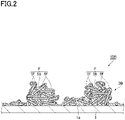
- Fig. 2 is a schematic cross-sectional view illustrating another embodiment of a liquid repellent structure according to the present disclosure.
- a liquid repellent structure 10B includes a substrate 1 having a treatment surface 1a and a liquid repellent layer 3B formed on the treatment surface 1a.
- the liquid repellent layer 3B may further contain a second filler 6f in addition to the first filler 5f and the binder resin 5b.
- the second filler 6f has a scale-like (flake-like) shape, and can be referred to as a scale-like (flake-like) filler.
- the liquid repellent layer 3B may contain an aggregate F of the first filler 5f and the second filler 6f.
- the first filler 5f, the second filler 6f and the aggregate F form asperities on a surface of the liquid repellent layer 3B.
- the aggregate F is composed of the first filler 5f, the second filler 6f and the binder resin 5b covering these fillers.
- the liquid repellent layer 3B having the above configuration can further efficiently form asperities on the surface and easily maintain liquid repellency to water (water repellency) for a long period of time. Further, the liquid repellent layer 3B can easily maintain liquid repellency not only to water but also to liquid materials containing water for a long period of time.
- the liquid repellent layer 3B can easily maintain liquid repellency to substances containing alcohol in addition to water, such as a lotion, over a longer period of time.
- the second filler 6f can be present in the form of primary particles, secondary aggregates or tertiary aggregates thereof.
- the secondary aggregates are formed of a plurality of overlapped primary particles of the second filler 6f in a parallel orientation.
- the tertiary aggregates of the second filler 6f are formed by crystal growth in each direction due to the irregular stacking of the primary particles and the secondary aggregates.
- the second filler 6f preferably has an average particle size of 0.1 ⁇ m to 6 ⁇ m, and more preferably 0.1 ⁇ m to 4 ⁇ m or 4 ⁇ m to 6 ⁇ m.
- the average particle size of the second filler refers to the average of the values obtained by measuring the major axis and minor axis of each of 10 particles of the second filler in an SEM field of view and dividing the sum of each of them by 2.
- Examples of the material constituting the second filler 6f include silica, mica, aluminum oxide, talc, titanium oxide, calcium carbonate, barium sulfate, zinc oxide, smectite, zeolite, and the like.
- Examples of commercially available products of scale-like silica include SUNLOVELY manufactured by AGC Si-Tech Co., Ltd.
- Examples of commercially available products of scale-like mica include Repco Mica manufactured by Repco Inc.
- Examples of commercially available products of scale-like aluminum oxide include Cerasur manufactured by Kawai Lime Industry Co., Ltd.
- the second filler 6f may not be necessarily subjected to hydrophobic treatment or liquid repellency treatment.
- the content of the second filler 6f in the liquid repellent layer 3B may be, for example, 5 parts by mass to 100 parts by mass, preferably 5 parts by mass to 75 parts by mass, and more preferably 5 parts by mass to 50 parts by mass, relative to 100 parts by mass of the first filler 5f.
- the content of the second filler 6f is within the above range, it is possible to more sufficiently prevent the formation of excessively large aggregates due to excessive stacking (aggregation) of the primary particles of the second filler 6f, and excellent liquid repellency due to the first filler 5f and the second filler 6f can be easily obtained.
- a plurality of aggregates F may be separate from each other in the liquid repellent layer 3B. That is, the plurality of aggregates F may be arranged in islands. Alternatively, a large number of aggregates F may be continuously formed to form a porous layer composed of the aggregates F in the liquid repellent layer 3B.
- the aggregates F have a complex shape derived from the complex and fine shape of the second filler 6f. That is, the aggregates F have a pleated surface and voids formed by the pleats because a plurality of primary particles (e.g., particles having an average primary particle size of 0.1 ⁇ m to 6 ⁇ m) of the second filler 6f are aggregated in random arrangement. According to the study by the present inventors, when the size ((major axis + minor axis)/2) of a single aggregate F is 4 ⁇ m or more, the aggregates F greatly contribute to improving the liquid repellency of the liquid repellent layer.
- the binder resin 5b contains at least a fluorine-containing resin.
- the binder resin 5b may further contain one or both of a thermoplastic resin and a crosslinking agent.
- the binder resin 5b in the liquid repellent layer 3 may have a crosslinked structure in which the fluorine-containing resin and the thermoplastic resin are crosslinked through a crosslinking agent.
- the fluorine-containing resin is not particularly limited, and a resin having a perfluoroalkyl, perfluoroalkenyl or perfluoropolyether structure or the like can be used as appropriate.
- the fluorine-containing resin preferably contains a fluorine-acrylic copolymer from the viewpoint of further improving the liquid repellency of the liquid repellent layer 3.
- the fluorine-acrylic copolymer is a copolymer composed of a fluorine-containing monomer and an acrylic monomer.
- the fluorine-acrylic copolymer may be a block copolymer or a random copolymer. The use of the fluorine-acrylic copolymer makes it possible to improve the weather resistance, water resistance, chemical resistance, and film-forming properties of the liquid repellent layer 3.
- the fluorine content of the fluorine-containing resin may be, for example, 30 mass% to 60 mass%, and preferably 40 mass% to 50 mass%.
- the fluorine content refers to the ratio of the mass of fluorine atoms to the total mass of the atoms constituting the fluorine-containing resin.
- fluorine-based coating agents can be used as the fluorine-containing resin.
- the commercially available fluorine-based coating agents include AsahiGuard manufactured by AGC Inc., SFcoat manufactured by AGC Seimi Chemical Co., Ltd., Ftergent manufactured by Neos Co., Ltd., Fluorolink manufactured by Solvay, Unidyne manufactured by Daikin Industries Ltd., the H-3539 series manufactured by DKS Co. Ltd., and Modiper F series manufactured by NOF Corporation.
- the fluorine-containing resin may not necessarily contain structural units derived from pyrrolidone or derivatives thereof (pyrrolidones).
- pyrrolidones include N-vinyl-2-pyrrolidone, N-vinyl-3-methyl-2-pyrrolidone, N-vinyl-5-methyl-2-pyrrolidone, and N-vinyl-3,3-dimethyl-2-pyrrolidone.
- fluorine-containing resins that do not contain structural units derived from pyrrolidones include AsahiGuard AG-E060, AGE070, AG-E082 and AG-E090 manufactured by AGC Inc., and Unidyne TG-8111 manufactured by Daikin Industries, Ltd.
- thermoplastic resin is not particularly limited, and examples thereof include low density polyethylenes, medium density polyethylenes, high density polyethylenes, ethylene-a olefin copolymers, homo, block or random polypropylenes, propylene-a olefin copolymers, ethylene-vinyl acetate copolymers, and the like.
- ethylene-a olefin copolymers may be a block copolymers or random copolymers of propylene and ⁇ olefins.
- the ⁇ -olefin components include ethylene, 1-butene, 1-pentene, 1-hexene, 1-heptene, 1-octene, 4-methyl-1-pentene, and the like.
- the melting point of the thermoplastic resin may be, for example, 50°C to 135°C.
- the fluorine-containing resin can easily bleed out on the surface of the liquid repellent layer. Due to the fluorine-containing resin bleeding out on the surface, the surface free energy can be lowered, whereby the surface of the liquid repellent layer can exhibit excellent liquid repellency. Bleed-out of the fluorine-containing resin can be promoted by drying at a high temperature. However, if the melting point of the thermoplastic resin is too high, a corresponding high temperature is required, which may cause damage such as deformation of the substrate 1.
- the melting point of the thermoplastic resin is more preferably 60°C to 120°C.
- the thermoplastic resin may be a modified polyolefin modified with a predetermined acid.
- the modified polyolefin may be obtained by, for example, graft-modifying a polyolefin with an unsaturated carboxylic acid derivative component derived from an unsaturated carboxylic acid, an unsaturated carboxylic acid anhydride or an unsaturated carboxylic acid ester.
- a modified polyolefin such as hydroxyl group-modified polyolefin or acrylic-modified polyolefin can be used as the polyolefin.
- modified polyolefin resin examples include Auroren manufactured by Nippon Paper Industries Co., Ltd., Zaikthene manufactured by Sumitomo Seika Chemicals Co., Ltd., Unistole manufactured by Mitsui Chemicals, Inc., Arrowbase manufactured by Unitika Ltd., and the like.
- the above modified polyolefins are preferred from the viewpoint of easily reacting with a crosslinking agent to form a crosslinked structure since they have a functional group introduced therein.
- the functional group include a carboxyl group, a hydroxyl group, a (meth)acryloyl group, an amino group, and the like.
- the crosslinking agent preferably has a functional group that reacts with a fluorine-containing resin.
- the crosslinking agent include crosslinking agents having a functional group such as an aziridine group, an isocyanate group, a carbodiimide group or an amino group.
- Examples of commercially available crosslinking agents include Chemitite manufactured by Nippon Shokubai Co., Ltd., Takenate manufactured by Mitsui Chemicals, Inc., Carbodilite manufactured by Nisshinbo Chemical Inc., Meikanate manufactured by Meisei Chemical Works, Ltd., and Cymel manufactured by Cytec Industries Japan LLC.
- the fluorine-containing resin is generally used as an aqueous dispersion dispersed in water. Therefore, many fluorine-containing resins have hydrophilic groups, such as hydroxyl groups and amino groups, in order to enhance the affinity with water. Due to the use of a crosslinking agent having functional groups that react with the fluorine-containing resin, these functional groups of the fluorine-containing resin react with the functional groups of the crosslinking agent to form a crosslinked structure in the liquid repellent layer. Further, these functional groups of the fluorine-containing resin decrease by reaction with the crosslinking agent, and thus the functional groups remaining in the liquid repellent layer decrease.
- the fluorine-containing resin when used as a dispersion dispersed in a solvent other than water, the fluorine-containing resin may have a structure (for example, a hydrocarbon chain) for enhancing the affinity with the solvent used.
- a ratio M/F of the BET specific surface area M of the first filler 5f to the mass F (mass%) of the fluorine-containing resin in the liquid repellent layer relative to the total mass of the liquid repellent layer is 1.5 to 4.0.
- the inventors have found that it is not sufficient to focus only on the mass of the first filler and the mass of the fluorine-containing resin in order to form a liquid repellent layer that maintains liquid repellency to water for a long period of time, and that it is important to adjust the mass of the fluorine-containing resin according to the BET specific surface area of the first filler.
- M/F value is within the above range, liquid repellency to water (water repellency) can be maintained for a long period of time. From this perspective, M/F is preferably 2.0 to 4.0, and more preferably 3.0 to 4.0.
- the content of the fluorine-containing resin in the binder resin 5b (relative to the mass of the binder resin 5b) may be, for example, 5 mass% or more, preferably 15 mass% or more, and more preferably 50 mass% or more. Although the content of the fluorine-containing resin in the binder resin 5b may be 100 mass%, the content of the fluorine-containing resin when the binder resin 5b contains a thermoplastic resin or a crosslinking agent may be 99 mass% or less, and preferably 75 mass% or less.
- the liquid repellent layer can easily exhibit excellent liquid repellency, and when the content of the fluorine-containing resin is 99 mass% or less, it is possible to ensure a sufficient content of the thermoplastic resin and the crosslinking agent, thereby preventing the filler from detaching from the liquid repellent layer and enhancing durability of the liquid repellent layer.
- the content of the thermoplastic resin in the binder resin 5b (relative to the mass of the binder resin 5b) may be, for example, 5 mass% to 90 mass%, preferably 10 mass% to 50 mass%, and more preferably 20 mass% to 30 mass%.
- the content of the thermoplastic resin in the binder resin 5b is 5 mass% or more, it is possible to sufficiently prevent detachment of the filler from the liquid repellent layer, and when the content of the thermoplastic resin is 90 mass% or less, it is possible to ensure a sufficient content of the fluorine-containing resin and the crosslinking agent, thereby causing the liquid repellent layer to easily exhibit excellent liquid repellency and durability.
- a ratio W C /W J of a mass Wc of the crosslinking agent contained in the binder resin 5b to a mass W J of the fluorine-containing resin contained in the binder resin 5b may be, for example, 0.01 to 0.5, preferably 0.05 to 0.3, and more preferably 0.1 to 0.2.
- the ratio W C /W J is 0.01 or more, it is possible to sufficiently prevent the filler from detaching from the liquid repellent layer and sufficiently enhance durability of the liquid repellent layer.
- the ratio W C /W J is 0.5 or less, it is possible to ensure a sufficient content of the fluorine-containing resin, which can sufficiently bleed out on the surface of the liquid repellent layer, thereby exhibiting excellent liquid repellency.
- a ratio W B /W S of a mass W B of the binder resin 5b to a mass Ws of the filler contained in the liquid repellent layer may be 0.1 to 5, preferably 0.2 to 2, and more preferably 0.3 to 1.
- the mass W B of the binder resin 5b corresponds to the total mass of the mass W J of the fluorine-containing resin, the mass W P of the thermoplastic resin contained as necessary, and the mass Wc of the crosslinking agent contained as necessary.
- the filler is prevented from detaching from the liquid repellent layer, and both the liquid repellency due to the filler and the liquid repellency due to the fluorine-containing resin contained in the binder resin 5b can be achieved. Further, since the mass Ws of the filler does not substantially change during combustion, the value of the ratio W B /W S can be calculated by measuring changes in the mass of the liquid repellent layer 3 due to combustion.
- the mass per unit area of the liquid repellent layer may be, for example, 0.3 g/m 2 to 10.0 g/m 2 , preferably 1.0 g/m 2 to 3.0 g/m 2 , and more preferably 1.5 g/m 2 to 2.5 g/m 2 .
- the mass per unit area of the liquid repellent layer is 0.3 g/m 2 or more, excellent liquid repellency due to the fluorine-containing resin can be achieved.
- the mass per unit area of the liquid repellent layer is 10.0 g/m 2 or less, asperities and the liquid repellent effect due to the fluorine-containing resin can be efficiently obtained.
- the liquid repellent layer may contain other additive as needed within a range that does not impair the liquid repellent function.
- other additives include flame retardants, slip agents, anti-blocking agents, antioxidants, photostabilizers, tackifiers, and the like.
- the liquid repellent layer may not necessarily contain structural units derived from pyrrolidones. Specifically, structural units derived from pyrrolidones may need to be contained neither in the fluorine-containing resin nor in other components forming the liquid repellent layer.
- the presence of structural units derived from pyrrolidones in the liquid repellent layer can be determined by infrared spectroscopy, nuclear magnetic resonance spectroscopy, pyrolysis GC-MS, or the like.
- the above embodiments illustrate examples in which the liquid repellent layer is formed directly on the treatment surface 1a of the substrate 1.
- the primer layer is a layer interposed between the substrate 1 and the liquid repellent layer, and can be formed to partially or entirely cover the surface of the substrate 1 (treatment surface 1a). Due to the primer layer being interposed between the substrate 1 and the liquid repellent layer, adhesion between the substrate 1 and the liquid repellent layer can be enhanced. Further, due to the primer layer being provided, liquid repellency of the liquid repellent structure can be further improved.
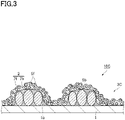
- Fig. 3 is a schematic cross-sectional view illustrating still another embodiment of a liquid repellent structure according to the present disclosure.
- a liquid repellent structure 10C includes a substrate 1 having a treatment surface 1a, a primer layer 2 formed on the treatment surface 1a, and a liquid repellent layer 3C formed on the primer layer 2.
- the primer layer contains a binder resin 7b and a third filler 7f.
- the liquid repellent layer 3C may contain the first filler 5f and the binder resin 5b as shown in Fig 1 , or may further contain the second filler 6f in addition to the first filler 5f and the binder resin 5b as shown in Fig. 2 .
- Fig. 3 illustrates the former configuration as an example.
- the liquid repellent layer 3C can efficiently form asperities on the surface and easily maintain liquid repellency for a long period of time.
- the liquid repellent layer 3C can easily maintain liquid repellency to substances containing alcohol in addition to water, such as lotions, over a longer period of time.
- the primer layer contains a binder resin.
- the primer layer can be made of the same resin as the thermoplastic resin used for the liquid repellent layer. Specific examples of the thermoplastic resin are as described above.
- the primer layer may be made of a thermosetting resin. Examples of the thermosetting resin include a urethane resin, an epoxy resin, a phenol resin, and the like. By using a thermosetting resin, further enhanced adhesion between the substrate and the liquid repellent layer can be easily achieved. Examples of the urethane resin include BURNOCK manufactured by DIC Corporation, TAKELAC and TAKENATE manufactured by Mitsui Chemicals, Inc, and the like. Examples of the epoxy resin include EPICLON manufactured by DIC Corporation, and the like.
- the primer layer may contain a third filler having an average primary particle size of 5 ⁇ m to 60 ⁇ m.
- the material constituting the third filler include inorganic materials such as silica, talc, mica, titanium oxide, calcium carbonate, barium sulfate, zinc oxide, smectite, zeolite and aluminum oxide; and resin materials such as silicone, acrylic resins, urethane resins and polyolefin resins (polypropylene and polyethylene). Due to the third filler being contained in the primer layer, rough asperities can be formed on the surface of the primer layer. Accordingly, since the liquid repellent layer is formed on the primer layer, the liquid repellent structure can have rough and complex asperities.
- an average primary particle size of the third filler may be 10 ⁇ m to 50 ⁇ m, and preferably 20 ⁇ m to 50 ⁇ m.
- the primary particle size of the third filler may be 5 ⁇ m to 30 ⁇ m.
- Examples of the third filler include SUNSPHERE (silica) (manufactured by AGC Si-Tech Co., Ltd.), Silicone Powder KMP series (silicone) manufactured by Shin-Etsu Chemical Co., Ltd., GANZPEARL (acrylic resin) manufactured by Aica Kogyo Company, Limited., ART PEARL (acrylic resin) manufactured by Negami Chemical Industrial Co., Ltd., ART PEARL (urethane resin) manufactured by Negami Chemical Industrial Co., Ltd., FLO-BEADS (polyethylene resin) manufactured by Sumitomo Seika Chemicals Co., Ltd., FLO-BEADS (polypropylene resin) manufactured by Sumitomo Seika Chemicals Co., Ltd., MIPELON (ultra-high molecular weight polyethylene) manufactured by Mitsui Chemicals, Inc, and the like.
- SUNSPHERE silicon
- Silicone Powder KMP series silicone manufactured by Shin-Etsu Chemical Co., Ltd.
- the primer layer can increase the roughness of the asperities of the liquid repellent structure. Since the rough asperities facilitate point contact between the liquid repellent layer and the contents, deterioration of the liquid repellency can be further suppressed.
- the liquid repellent structure may have a surface roughness Sa of 1.5 ⁇ m to 15.0 ⁇ m, preferably 2.0 ⁇ m to 14.0 ⁇ m, and more preferably 5.0 ⁇ m to 14.0 ⁇ m, from the viewpoint of sufficiently achieving the effect of point contact and preventing the contents from being easily captured in the recess.
- a ratio W BU /W SU of a mass W BU of the binder resin to a mass Wsu of the third filler contained in the primer layer may be 0.1 to 1, and preferably 0.2 to 0.5.
- the value of the ratio W BU /W SU can be easily adjusted by the added amount of the coating agent.
- the value of the ratio W BU /W SU can be calculated by measuring changes in the mass of the primer layer due to combustion.
- the mass per unit area of the primer layer may be, for example, 1.0 g/m 2 to 20.0 g/m 2 , and preferably 3.0 g/m 2 to 10.0 g/m 2 .
- the mass per unit area of the primer layer is 1.0 g/m 2 or more, excellent liquid repellency can be easily achieved.
- the mass per unit area of the primer layer is 20.0 g/m 2 or less, the effect of point contact can be sufficiently obtained.
- the production method according to the present embodiment includes the steps of: preparing a liquid repellent layer-forming coating liquid; forming a coating film of the coating liquid on a treatment surface of a substrate; and forming a liquid repellent layer by drying and curing the coating film. Each step will be described below.
- a coating liquid containing a filler, a fluorine-containing resin, a solvent, a thermoplastic resin if necessary, and a crosslinking agent if necessary is prepared.
- the filler contains a first filler having a BET specific surface area M of 100 m 2 /g to 400 m 2 /g.
- the solvent include water, alcohol, organic solvents, and the like.
- the content (solid content) of each component in the coating liquid may be appropriately adjusted so that the content of each component in the liquid repellent layer becomes as described above.
- the coating liquid is adjusted so that the ratio M/F of the BET specific surface area M of the first filler to the mass F (mass%) of the fluorine-containing resin relative to the total mass of the solid content contained in the coating liquid becomes 1.5 to 4.0.
- the thermoplastic resin may be in the form of an emulsion dispersed in water, alcohol, or the like.
- Such a polyolefin emulsion may be prepared by a method of emulsifying a polymer manufactured by a polymerization reaction of a corresponding monomer, or may be prepared by emulsion polymerization of a corresponding monomer.
- the obtained coating liquid is applied to the substrate.
- Known coating methods can be used without particular limitation, and examples of the methods include an immersion method (dipping method), and methods using a sprayer, a coater, a printer, a brush, or the like.
- Examples of the types of coaters and printers used in these methods include a gravure coater, a reverse-roll coater, a micro gravure coater, a chamber doctor coater, an air-knife coater, a dip coater, a bar coater, a comma coater, a die coater, and the like.
- Examples of the coating techniques used in these methods include direct gravure coating, reverse gravure coating, kiss reverse gravure coating, offset gravure coating, and the like.
- the coating amount of the coating liquid can be appropriately adjusted so that the above-mentioned mass per unit area of the liquid repellent layer can be achieved.
- the coating film formed on the substrate is dried and cured by heating.
- a liquid repellent structure including a substrate and a liquid repellent layer provided on the substrate can be obtained.
- the coating liquid contains a crosslinking agent
- the liquid repellent layer has a crosslinked structure composed of the fluorine-containing resin and an optionally used thermoplastic resin and crosslinking agent.
- the heating conditions are not limited as long as the solvent can be evaporated and a crosslinking reaction can occur. For example, heating can be carried out at 60°C to 100°C for 0.5 minutes to 5 minutes.
- the production method includes the steps of: preparing a primer layer-forming coating liquid and a liquid repellent layer-forming coating liquid; forming a coating film of the primer layer-forming coating liquid on a treatment surface of a substrate; forming a primer layer by drying and curing the coating film; forming a coating film of the liquid repellent layer-forming coating liquid; and forming a liquid repellent layer by drying and curing the coating film.
- the preparation and application of the primer layer-forming coating liquid and the drying and curing of the coating film can be performed according to the description of the preparation and application of the liquid repellent layer-forming coating liquid and the drying and curing of the coating film.
- the liquid repellent layer-forming coating liquid is prepared in the step of preparing a liquid repellent layer-forming coating liquid. That is, the liquid repellent layer-forming coating liquid is a coating liquid that contains a binder resin containing a fluorine-containing resin, and a filler, the filler containing a first filler having a BET specific surface area M of 100 m 2 /g to 400 m 2 /g, and the ratio M/F of the BET specific surface area M of the first filler to the mass F (mass%) of the fluorine-containing resin relative to the total mass of the solid content contained in the coating liquid is 1.5 to 4.0.
- the packaging material according to the present embodiment has the liquid repellent structure on the side that comes into contact with substances.
- the packaging material according to the present embodiment can be applied to substances containing water (e.g., water, beverages, yogurt and lotion) and substances containing oil (e.g., salad oil, curry and dairy cream), and can also be applied to substances containing a surfactant, such as one selected from the group consisting of milky lotion, hand soap, body soap, shampoo and hair conditioner.
- a surfactant such as one selected from the group consisting of milky lotion, hand soap, body soap, shampoo and hair conditioner.
- the packaging material according to the present embodiment can maintain liquid repellency especially to water, among the above materials, for a long period of time.
- Specific examples of the packaging material include retort pouches for curry or pasta sauces, containers and lids for yogurt and pudding, containers or refill pouches for toiletries such as hand soap, shampoo and hair conditioner, and tubes for toothpaste and pharmaceuticals.
- PET Polyethylene terephthalate
- each component was added to an alcohol solvent so that the composition of the liquid repellent layer became as shown in Tables 1 to 5.
- the resulting mixture was sufficiently stirred to prepare a liquid repellent layer-forming coating liquid, and the coating liquid was applied with a bar coater to a substrate made of a PET film. Subsequently, the applied coating liquid was dried and cured by heating at 80°C for 1 minute to form a liquid repellent layer on the substrate.
- the coating amount was adjusted so that the mass per unit area of the liquid repellent layer became 1.8 g/m 2 .
- the F/Si ratio in the table was a ratio of the mass F (mass%) of the fluorine-containing resin to the mass Si (mass%) of the silica filler relative to the total mass of the liquid repellent layer, and corresponded to the value of the W B /W S described above.
- the compounding ratio of the first filler and the second filler was as follows. [Table 4] Exp. Ex. No. 1st filler Ws1 2nd filler Ws2 Formulation ratio Ws2/Ws1 Mass (mass part(s)) of 2nd filler relative to 100 mass parts of 1st filler 76 AEROSIL 200 SUNLOVELY 0.5 50 77 0.5 50 78 0.3 30 79 0.3 30 80 0.2 20 81 0.2 20 82 0.1 10 83 HDK N20 0.5 50 84 0.5 50 85 0.3 30 86 0.3 30 87 0.2 20 88 0.2 20 89 0.1 10 [Table 5] 1st filler 2nd filler F-cont. resin F/Si ratio BET sp. sur.
- each component was added to an alcohol solvent or an ester solvent (ester solvent when A525/A52 was used) so that the composition of the primer layer became as shown in Table 6.
- the resulting mixture was sufficiently stirred to prepare a primer layer-forming coating liquid, and the coating liquid was applied with a bar coater to a substrate made of a PET film. Subsequently, the applied coating liquid was dried and cured by heating at 80°C for 1 minute to form a primer layer on the substrate.
- the coating amount was adjusted so that the mass per unit area of the primer layer became 5.00 g/m 2 .
- the ratio W BU /W SU of the mass W BU of the binder resin to the mass Wsu of the third filler contained in the primer layer was 0.2.
- a liquid repellent layer was formed on the primer layer in the same manner as in the case without primer layer.
- the compounding ratio Ws2/Ws1 between the first filler and the second filler was 0.5 (the mass of the second filler was 50 parts by mass relative to 100 parts by mass of the first filler).
- the liquid repellent structure was placed flat with the liquid repellent layer upward, and 2 ⁇ L of each of the following liquids was dropped with a dropper on the liquid repellent layer. Subsequently, the liquid repellent structure was allowed to stand vertically and left in that state for 30 seconds. Then, the state of the dropped liquid was visually observed.
- the liquid repellency was evaluated from the observation results based on the following evaluation criteria. It can be said that there is no practical problem if the evaluation results are 2 to 5. It is desirable that the evaluation results are 3 to 5.
- the liquid repellent structure was cut into a size of a width of 50 mm and a length of 100 mm to prepare a test piece.
- 150 ml of each liquid was poured into a 200-ml beaker, and the test piece was dipped in the liquid to half of the length thereof and allowed to stand at room temperature (25°C) for 5 days. After being allowed to stand, the test piece was pulled out from the liquid, and the state of adhesion of each liquid to a surface of the liquid repellent layer of the liquid repellent structure in the dipped portion was visually observed. Then, the durability (liquid repellency after being in contact with each liquid for a long period of time) was evaluated based on the following evaluation criteria.
Landscapes
- Chemical & Material Sciences (AREA)
- Organic Chemistry (AREA)
- Engineering & Computer Science (AREA)
- Materials Engineering (AREA)
- Life Sciences & Earth Sciences (AREA)
- Wood Science & Technology (AREA)
- Medicinal Chemistry (AREA)
- Health & Medical Sciences (AREA)
- Chemical Kinetics & Catalysis (AREA)
- Polymers & Plastics (AREA)
- Nanotechnology (AREA)
- Combustion & Propulsion (AREA)
- Mechanical Engineering (AREA)
- Laminated Bodies (AREA)
Applications Claiming Priority (2)
| Application Number | Priority Date | Filing Date | Title |
|---|---|---|---|
| JP2020042791 | 2020-03-12 | ||
| PCT/JP2021/005911 WO2021182044A1 (ja) | 2020-03-12 | 2021-02-17 | 撥液性構造体、撥液性構造体の製造方法、撥液層形成用塗液及び包装材 |
Publications (2)
| Publication Number | Publication Date |
|---|---|
| EP4119604A1 true EP4119604A1 (de) | 2023-01-18 |
| EP4119604A4 EP4119604A4 (de) | 2023-08-30 |
Family
ID=77672251
Family Applications (1)
| Application Number | Title | Priority Date | Filing Date |
|---|---|---|---|
| EP21768162.6A Withdrawn EP4119604A4 (de) | 2020-03-12 | 2021-02-17 | Flüssigkeitsabweisende struktur, herstellungsverfahren für eine flüssigkeitsabweisende struktur, beschichtungsflüssigkeit zur bildung einer flüssigkeitsabweisenden schicht und verpackungsmaterial |
Country Status (6)
| Country | Link |
|---|---|
| US (1) | US20230014365A1 (de) |
| EP (1) | EP4119604A4 (de) |
| JP (1) | JP7746983B2 (de) |
| KR (1) | KR20220152570A (de) |
| CN (1) | CN115279822A (de) |
| WO (1) | WO2021182044A1 (de) |
Families Citing this family (3)
| Publication number | Priority date | Publication date | Assignee | Title |
|---|---|---|---|---|
| JP7825402B2 (ja) * | 2021-10-01 | 2026-03-06 | 大和製罐株式会社 | 撥液膜およびこれを備えた包装材 |
| WO2023189866A1 (ja) * | 2022-03-30 | 2023-10-05 | 東洋アルミニウム株式会社 | 積層体 |
| JPWO2024195690A1 (de) * | 2023-03-19 | 2024-09-26 |
Family Cites Families (16)
| Publication number | Priority date | Publication date | Assignee | Title |
|---|---|---|---|---|
| JP3777478B2 (ja) * | 2001-12-19 | 2006-05-24 | 平岡織染株式会社 | 雨筋汚れ防止効果に優れた防汚性防水シート |
| JP2006143866A (ja) * | 2004-11-19 | 2006-06-08 | Kansai Paint Co Ltd | 撥水剤、その撥水剤を用いた撥水性被膜形成方法及びその撥水性被膜形成物 |
| JP5436480B2 (ja) * | 2011-03-11 | 2014-03-05 | 三菱電機株式会社 | 撥水膜形成用コーティング組成物及びその製造方法、並びに撥水性部材 |
| JP5814771B2 (ja) * | 2011-12-13 | 2015-11-17 | 日華化学株式会社 | 撥水性コーティング膜の製造方法、それに用いる下地膜形成用組成物及び撥水性コーティング膜を備えた機能性材料 |
| JP5242841B1 (ja) * | 2012-10-13 | 2013-07-24 | 日本アエロジル株式会社 | 撥水・撥油性塗膜及びその塗膜を含む物品 |
| US9528020B2 (en) * | 2013-01-07 | 2016-12-27 | Mitsubishi Electric Corporation | Coating composition, method for producing same, and coated article |
| JP2015209493A (ja) * | 2014-04-25 | 2015-11-24 | 三菱電機株式会社 | 撥水性部材及びその製造方法、空気調和機の室外機、並びに換気扇 |
| JP6667183B2 (ja) * | 2016-01-25 | 2020-03-18 | フタムラ化学株式会社 | 撥水構造体及びその製造方法 |
| JP6368331B2 (ja) | 2016-03-04 | 2018-08-01 | 桜宮化学株式会社 | 撥水性ヒートシール膜、撥水性ヒートシール構造体、撥水性ヒートシール膜の製造方法、および撥水性ヒートシール構造体の製造方法 |
| KR102253424B1 (ko) * | 2016-03-14 | 2021-05-18 | 덴카 주식회사 | 발액성 수지 시트 및 그것을 사용한 물품 |
| JP6941597B2 (ja) * | 2016-03-14 | 2021-09-29 | デンカ株式会社 | 撥液性樹脂シート及びそれを用いた物品 |
| DE112017007058T5 (de) * | 2017-02-14 | 2019-10-24 | Mitsubishi Electric Corporation | Wasserabweisende beschichtung und produkt mit einer solchen |
| JP7068650B2 (ja) * | 2018-03-26 | 2022-05-17 | 大日本印刷株式会社 | 撥水撥油性積層体 |
| JP2019210392A (ja) * | 2018-06-06 | 2019-12-12 | 凸版印刷株式会社 | 撥液性表面およびその作製方法 |
| EP3812147A4 (de) * | 2018-06-20 | 2021-12-15 | Toppan Printing Co., Ltd. | Flüssigkeitsabweisende struktur, herstellungsverfahren dafür, verpackungsmaterial und trennfolie |
| JP6522841B6 (ja) * | 2018-09-27 | 2019-07-17 | 大和製罐株式会社 | 撥液性フィルムまたはシート、およびそれを用いた包装材 |
-
2021
- 2021-02-17 KR KR1020227035330A patent/KR20220152570A/ko not_active Withdrawn
- 2021-02-17 CN CN202180019779.XA patent/CN115279822A/zh active Pending
- 2021-02-17 JP JP2022505871A patent/JP7746983B2/ja active Active
- 2021-02-17 WO PCT/JP2021/005911 patent/WO2021182044A1/ja not_active Ceased
- 2021-02-17 EP EP21768162.6A patent/EP4119604A4/de not_active Withdrawn
-
2022
- 2022-09-07 US US17/939,206 patent/US20230014365A1/en not_active Abandoned
Also Published As
| Publication number | Publication date |
|---|---|
| JPWO2021182044A1 (de) | 2021-09-16 |
| KR20220152570A (ko) | 2022-11-16 |
| EP4119604A4 (de) | 2023-08-30 |
| US20230014365A1 (en) | 2023-01-19 |
| CN115279822A (zh) | 2022-11-01 |
| JP7746983B2 (ja) | 2025-10-01 |
| WO2021182044A1 (ja) | 2021-09-16 |
Similar Documents
| Publication | Publication Date | Title |
|---|---|---|
| US11969977B2 (en) | Liquid-repellent structure, production method thereof, wrapping material, and separation sheet | |
| US20230013834A1 (en) | Liquid repellent structure, method of producing liquid repellent structure, liquid repellent layer-forming coating liquid, and packaging material | |
| US20230014365A1 (en) | Liquid repellent structure, method for producing liquid repellent structure, liquid repellent layer-forming coating liquid, and packaging material | |
| JP7452250B2 (ja) | 撥液性構造体及びその製造方法並びに包装材 | |
| US20100092621A1 (en) | Multi-layer plastic container for non-oily contents | |
| JP2019214692A (ja) | 撥液層形成用樹脂組成物、並びに、それを用いた撥液性フィルム、撥液性積層体、包装材及び容器 | |
| US11939485B2 (en) | Liquid-repellent structure, production method therefor, packaging material, and separation sheet | |
| US20210284410A1 (en) | Super-hydrophobic thermoplastic films for packaging | |
| JP2022094525A (ja) | 撥液性構造体及び包装材 | |
| JP2023023025A (ja) | 撥液性樹脂容器の製造方法 | |
| JP7619033B2 (ja) | 撥液性構造体及び包装材 | |
| JP2022180027A (ja) | 撥液性構造体、包装材および包装容器 | |
| US11365038B2 (en) | Packaging material | |
| JP2023001609A (ja) | 液体収納容器 | |
| JP2025156035A (ja) | 塩基性カルシウム含有積層体 |
Legal Events
| Date | Code | Title | Description |
|---|---|---|---|
| STAA | Information on the status of an ep patent application or granted ep patent |
Free format text: STATUS: THE INTERNATIONAL PUBLICATION HAS BEEN MADE |
|
| PUAI | Public reference made under article 153(3) epc to a published international application that has entered the european phase |
Free format text: ORIGINAL CODE: 0009012 |
|
| STAA | Information on the status of an ep patent application or granted ep patent |
Free format text: STATUS: REQUEST FOR EXAMINATION WAS MADE |
|
| 17P | Request for examination filed |
Effective date: 20220808 |
|
| AK | Designated contracting states |
Kind code of ref document: A1 Designated state(s): AL AT BE BG CH CY CZ DE DK EE ES FI FR GB GR HR HU IE IS IT LI LT LU LV MC MK MT NL NO PL PT RO RS SE SI SK SM TR |
|
| DAV | Request for validation of the european patent (deleted) | ||
| DAX | Request for extension of the european patent (deleted) | ||
| A4 | Supplementary search report drawn up and despatched |
Effective date: 20230801 |
|
| RIC1 | Information provided on ipc code assigned before grant |
Ipc: B65D 65/42 20060101ALN20230726BHEP Ipc: C08J 7/043 20200101ALI20230726BHEP Ipc: C08L 33/16 20060101ALI20230726BHEP Ipc: C09D 5/16 20060101ALI20230726BHEP Ipc: C08J 7/054 20200101ALI20230726BHEP Ipc: C08J 7/04 20200101AFI20230726BHEP |
|
| STAA | Information on the status of an ep patent application or granted ep patent |
Free format text: STATUS: THE APPLICATION IS DEEMED TO BE WITHDRAWN |
|
| 18D | Application deemed to be withdrawn |
Effective date: 20240301 |