EP4119726B1 - Bauverwaltungssystem und asphaltfertiger - Google Patents
Bauverwaltungssystem und asphaltfertiger Download PDFInfo
- Publication number
- EP4119726B1 EP4119726B1 EP21768656.7A EP21768656A EP4119726B1 EP 4119726 B1 EP4119726 B1 EP 4119726B1 EP 21768656 A EP21768656 A EP 21768656A EP 4119726 B1 EP4119726 B1 EP 4119726B1
- Authority
- EP
- European Patent Office
- Prior art keywords
- dump truck
- paving material
- weight
- information
- asphalt finisher
- Prior art date
- Legal status (The legal status is an assumption and is not a legal conclusion. Google has not performed a legal analysis and makes no representation as to the accuracy of the status listed.)
- Active
Links
Images



Classifications
-
- E—FIXED CONSTRUCTIONS
- E01—CONSTRUCTION OF ROADS, RAILWAYS, OR BRIDGES
- E01C—CONSTRUCTION OF, OR SURFACES FOR, ROADS, SPORTS GROUNDS, OR THE LIKE; MACHINES OR AUXILIARY TOOLS FOR CONSTRUCTION OR REPAIR
- E01C19/00—Machines, tools or auxiliary devices for preparing or distributing paving materials, for working the placed materials, or for forming, consolidating, or finishing the paving
- E01C19/48—Machines, tools or auxiliary devices for preparing or distributing paving materials, for working the placed materials, or for forming, consolidating, or finishing the paving for laying-down the materials and consolidating them, or finishing the surface, e.g. slip forms therefor, forming kerbs or gutters in a continuous operation in situ
-
- G—PHYSICS
- G06—COMPUTING OR CALCULATING; COUNTING
- G06Q—INFORMATION AND COMMUNICATION TECHNOLOGY [ICT] SPECIALLY ADAPTED FOR ADMINISTRATIVE, COMMERCIAL, FINANCIAL, MANAGERIAL OR SUPERVISORY PURPOSES; SYSTEMS OR METHODS SPECIALLY ADAPTED FOR ADMINISTRATIVE, COMMERCIAL, FINANCIAL, MANAGERIAL OR SUPERVISORY PURPOSES, NOT OTHERWISE PROVIDED FOR
- G06Q10/00—Administration; Management
- G06Q10/06—Resources, workflows, human or project management; Enterprise or organisation planning; Enterprise or organisation modelling
- G06Q10/063—Operations research, analysis or management
- G06Q10/0631—Resource planning, allocation, distributing or scheduling for enterprises or organisations
-
- G—PHYSICS
- G06—COMPUTING OR CALCULATING; COUNTING
- G06Q—INFORMATION AND COMMUNICATION TECHNOLOGY [ICT] SPECIALLY ADAPTED FOR ADMINISTRATIVE, COMMERCIAL, FINANCIAL, MANAGERIAL OR SUPERVISORY PURPOSES; SYSTEMS OR METHODS SPECIALLY ADAPTED FOR ADMINISTRATIVE, COMMERCIAL, FINANCIAL, MANAGERIAL OR SUPERVISORY PURPOSES, NOT OTHERWISE PROVIDED FOR
- G06Q10/00—Administration; Management
- G06Q10/08—Logistics, e.g. warehousing, loading or distribution; Inventory or stock management
-
- G—PHYSICS
- G06—COMPUTING OR CALCULATING; COUNTING
- G06Q—INFORMATION AND COMMUNICATION TECHNOLOGY [ICT] SPECIALLY ADAPTED FOR ADMINISTRATIVE, COMMERCIAL, FINANCIAL, MANAGERIAL OR SUPERVISORY PURPOSES; SYSTEMS OR METHODS SPECIALLY ADAPTED FOR ADMINISTRATIVE, COMMERCIAL, FINANCIAL, MANAGERIAL OR SUPERVISORY PURPOSES, NOT OTHERWISE PROVIDED FOR
- G06Q50/00—Information and communication technology [ICT] specially adapted for implementation of business processes of specific business sectors, e.g. utilities or tourism
- G06Q50/08—Construction
Definitions
- the present disclosure relates to a construction management system for managing construction of roads and to an asphalt finisher.
- Patent Document 1 a system capable of transmitting and receiving data between a plant and an asphalt finisher through a server is known (see Patent Document 1).
- the plant is configured to transmit, to the asphalt finisher via the server, information about the temperature and the amount of paving material produced and the point in time at which a specified amount of paving material has been loaded into a dump truck.
- a construction management system including a plant, a plurality of dump trucks, and a paving machine, wherein the production of paving material and the loading of the dump trucks at a desired time is optimized in order to reduce idling time at the paving site but still maintaining an adequate supply of paving material so that the paving machines remain productive (see Patent Document 2).
- the asphalt finisher is not configured to calculate a weight of the paving material supplied to the asphalt finisher based on the information about the weight of the paving material transmitted from the dump truck and to prompt maintenance of the asphalt finisher in response to determining that the calculated weight becomes equal to or more than a predetermined value.
- the manager of the asphalt finisher can timely be informed of the replacement timing of consumable parts such as the screed plate or the conveyor plate.
- FIG. 1 is a drawing illustrating a configuration example of a construction management system SYS.
- the construction management system SYS mainly includes an asphalt finisher 100, a dump truck 200, and a plant 300.
- the asphalt finisher 100 is a machine used for paving roads and the like. Specifically, the asphalt finisher 100 mainly includes a tractor 1, a hopper 2, and a screed 3.
- the tractor 1 is a mechanism for running the asphalt finisher 100.
- the tractor 1 moves the asphalt finisher 100 by rotating rear wheels 5 with a rear wheel traveling motor and rotating front wheels 6 with a front wheel traveling motor.
- the rear wheel traveling motor and the front wheel traveling motor are hydraulic motors which are rotated by receiving supply of hydraulic oil from a hydraulic pump.
- the tractor 1 may have crawlers instead of wheels.
- a controller C1 and a communication device T1 are provided on the tractor 1.
- the controller C1 and the communication device T1 may be integrated into a portable device such as a tablet PC or a smartphone.
- the portable device such as a tablet PC or a smartphone may be a device possessed by an operator of the asphalt finisher 100, a worker working around the asphalt finisher 100, or a manager of the construction site thereof.
- the controller C1 is a control device provided on the asphalt finisher 100.
- the controller C1 is a computer including a CPU, a volatile storage device, and a nonvolatile storage device, and is provided on the tractor 1.
- the controller C1 is configured to control the movement of the asphalt finisher 100.
- Various functions of the controller C1 are implemented, for example, by the CPU executing a program stored in the nonvolatile storage device.
- the various functions implemented by the controller C1 include, for example, a function for controlling the discharge amount of the hydraulic pump for discharging hydraulic oil for driving hydraulic actuators, and a function for controlling the flow of hydraulic oil between the hydraulic actuators and the hydraulic pump.
- the hydraulic actuators include a hydraulic cylinder and a hydraulic motor.
- the various functions implemented by the controller C1 include a function of recognizing the dump truck 200 based on the output of a space recognition apparatus M1 and a function of requesting the dump truck 200 to transmit predetermined information via wireless communication.
- the controller C1 is a control device designed especially for the function of exchange of information between the asphalt finisher 100 and the dump truck 200.
- the communication device T1 is configured to control communication between the asphalt finisher 100 and an external device.
- the communication device T1 is configured to control radio communication with a communication device T2 provided on the dump truck 200.
- the communication device T1 may be a reception device having only a receiving function. In this case, the communication device T1 functions as a device for receiving information transmitted from the dump truck 200.
- the hopper 2 is a mechanism for receiving a paving material.
- the paving material is, for example, an asphalt mixture.
- the hopper 2 is provided on the front side of the tractor 1 and is configured to be opened and closed in the vehicle width direction by a hopper cylinder 2c.
- the asphalt finisher 100 normally receives the paving material discharged from the loading platform 50b of the dump truck 200 while the hopper 2 is fully opened.
- the asphalt finisher 100 can continue traveling while pushing the dump truck 200 forward via push rollers 2b even when receiving the paving material discharged from the loading platform of the dump truck 200.
- the space recognition apparatus M1 for monitoring the state in front of the tractor 1 is attached to the tractor 1.
- the space recognition apparatus M1 is, for example, a monocular camera, a stereo camera, a millimeter wave radar, an ultrasonic sensor, a laser radar, or a LIDAR device.
- the space recognition apparatus M1 is a monocular camera for capturing an image in front of the tractor 1.
- the controller C1 can determine, for example, whether the dump truck 200 is approaching the asphalt finisher 100 or whether the dump truck 200 is in contact with the asphalt finisher 100 based on an image captured by the monocular camera that serves as the space recognition apparatus M1.
- the screed 3 is a mechanism for leveling the paving material.
- the screed 3 mainly includes a main screed and a telescopic screed.
- the telescopic screed includes a left telescopic screed and a right telescopic screed.
- the main screed, the left telescopic screed, and the right telescopic screed are arranged with a shift in position in the longitudinal direction.
- the left telescopic screed is disposed behind the main screed
- the right telescopic screed is disposed behind the left telescopic screed.
- the screed 3 is a floating screed pulled by the tractor 1 and connected to the tractor 1 via a leveling arm 3a.
- the screed 3 is moved vertically together with the leveling arm 3a by the extension and retraction of a screed lift cylinder 3b.
- the dump truck 200 is an example of a transport vehicle for transporting paving materials supplied into the hopper 2 of the asphalt finisher 100.
- the dump truck 200 is a special dump truck with a movable bumper that is designed especially for transporting paving materials.
- the dump truck 200 mainly includes a driver's compartment 50a and a loading platform 50b.
- a controller C2 and a communication device T2 are provided on the dump truck 200.
- the controller C2 and the communication device T2 may be integrated into a portable device such as a tablet PC or a smartphone.
- the portable device such as a tablet PC or a smartphone may be a device possessed by the driver of the dump truck 200.
- the controller C2 is a control device provided on the dump truck 200.
- the controller C2 is a computer including a CPU, a volatile storage device, and a nonvolatile storage device, and is provided in the driver's compartment 50a.
- the controller C2 is configured to control the movement of the dump truck 200.
- Various functions of the controller C2 are implemented, for example, by the CPU executing a program stored in the nonvolatile storage device.
- the various functions implemented by the controller C2 include, for example, a function of transmitting information to the asphalt finisher 100 in response to a request from the asphalt finisher 100, and a function of storing information received from the plant 300 in a nonvolatile storage device.
- the controller C2 may be a control device designed especially for the function of exchanging information between the asphalt finisher 100 or the plant 300 and the dump truck 200.
- the communication device T2 is configured to control communication between the dump truck 200 and the external device.
- the communication device T2 is configured to control wireless communication between the communication device T1 provided on the asphalt finisher 100 or the communication device T3 provided on the plant 300.
- the communication device T2 may be a reception device having only a receiving function.
- the communication device T2 functions as a device for receiving information transmitted from the plant 300.
- the communication device T2 may be a transmission device having only a transmission function.
- the communication device T2 functions as a device for transmitting information to the asphalt finisher 100.
- the transmitted information may be stored in the storage device of the controller C2 through a data reader (not illustrated) such as a memory card reader provided in the driver's compartment 50a.
- the plant 300 is an example of a paving material production facility.
- the plant 300 mainly includes a mixer 80, a trolley 81, a hot silo 82, and the like.
- the mixer 80 is a device for uniformly mixing aggregate, filler (stone powder), asphalt, and the like.
- the trolley 81 is a device for conveying the mixture discharged from the mixer 80 to the hot silo 82.
- the hot silo 82 is a device for storing and warming the mixture produced by the mixer 80.
- the controller C3 is a control device provided on the plant 300.
- the controller C3 is a computer including a CPU, a volatile storage device, and a nonvolatile storage device, and is situated in a building attached to the plant 300.
- the controller C3 is configured to control the space recognition apparatus M3 and the communication device T3.
- Various functions of the controller C3 are implemented, for example, by the CPU executing a program stored in the nonvolatile storage device.
- the various functions implemented by the controller C3 include, for example, functions for controlling the movement of the mixer 80, the trolley 81, the hot silo 82, and the like.
- the various functions implemented by the controller C3 include a function of recognizing the dump truck 200 based on the output of the space recognition apparatus M3 and a function of transmitting predetermined information to the dump truck 200 via wireless communication.
- the controller C3 may be a control device designed especially for the functions related to exchange of information between the dump truck 200 and the plant 300.
- the space recognition apparatus M3 is configured to monitor the state of the dump truck 200 that loads the paving material at the plant 300.
- the space recognition apparatus M3 is, for example, a monocular camera, a stereo camera, a millimeter wave radar, an ultrasonic sensor, a laser radar, or a LIDAR device.
- the space recognition apparatus M3 may be configured to transmit a large number of signals (for example, laser light or the like) to an object and receive the reflected signals.
- the space recognition apparatus M3 may be configured to detect the distance between the space recognition apparatus M3 and the object, and detect the direction of the object as seen from the space recognition apparatus M3 from the reflected signal.
- the space recognition apparatus M3 When the space recognition apparatus M3 is configured to receive a reflected signal of a signal transmitted by a LIDAR device or the like, the space recognition apparatus M3 may identify the dump truck 200 by recognizing characters indicated on the license plate based on irregularities on the surface of the license plate of the dump truck 200. Thus, the controller C3 can determine the position, shape, and type of the dump truck 200 by using the space recognition apparatus M3.
- the space recognition apparatus M3 may include a combination of two or more devices, such as a combination of a monocular camera and a LIDAR device.
- the space recognition apparatus M3 is a monocular camera for capturing an image of the dump truck 200 parked under the mixer 80.
- the controller C3 can recognize the vehicle registration number of the dump truck 200 indicated on the license plate of the dump truck 200 based on the image captured by the monocular camera that serves as the space recognition apparatus M3.
- the communication device T3 is configured to control communication between the plant 300 and an external device.
- the communication device T3 is configured to control radio communication with the communication device T2 provided on the dump truck 200.
- the communication device T3 may be a transmission device having only a transmission function.
- FIG. 2 is an explanatory diagram of a scene in which information is transmitted from the plant 300 to a dump truck 200.
- FIG. 2 illustrates a scene in which a dump truck 200A, i.e., an example of the dump truck 200, is parked under the mixer 80 and a dump truck 200B, i.e., another example of the dump truck 200, is parked under the hot silo 82.
- FIG. 3 is a flowchart showing a flow of an example of the first transmission processing.
- the controller C3 provided on the plant 300 repeatedly executes the first transmission processing with predetermined control intervals.
- the following explanation relates to the case where information is transmitted from the plant 300 to the dump truck 200A, but the following explanation is also applicable to the case where information is transmitted from the plant 300 to the dump truck 200B.
- the controller C3 determines whether the dump truck 200A has been detected (step ST1). In this embodiment, the controller C3 determines whether the dump truck 200A is parked at a predetermined position under the mixer 80 based on the output of the space recognition apparatus M3.
- the controller C3 terminates the first transmission processing currently executed.
- the controller C3 can recognize the vehicle registration number of the dump truck 200A as an identification number by performing image recognition processing on the image of the front license plate 50c captured by the monocular camera that serves as the space recognition apparatus M3. Note that the controller C3 may recognize the vehicle registration number of the dump truck 200A as an identification number by performing image recognition processing on the image of a rear license plate 50d captured by the monocular camera.
- the controller C3 may use a device other than the space recognition apparatus M3 to acquire the identification number of the dump truck 200A.
- the controller C3 may use the communication device T3 to acquire the vehicle registration number of the dump truck 200A as an identification number.
- the controller C3 may transmit a transmission request to the controller C2 of the dump truck 200A via the communication device T3 to cause the controller C2 to transmit information about the vehicle such as the vehicle registration number stored in the controller C2.
- the controller C3 collates the acquired identification number with the identification number previously stored in the nonvolatile storage device. Through this collation, the controller C3 can determine whether the dump truck 200 is a registered dump truck 200, so that, for example, the paving material can be prevented from being loaded into an unregistered dump truck 200. Alternatively, the controller C3 can prevent the paving material that is to be loaded into a particular dump truck 200 from being loaded into another dump truck 200. Alternatively, the controller C3 can prevent an excess or deficiency between the weight of the paving material that is to be loaded into the dump truck 200 and the weight of the paving material actually loaded into the dump truck 200.
- the controller C3 determines whether the loading of the paving material has been completed (step ST3). In this embodiment, the controller C3 determines that loading of the paving material onto the loading platform 50b of the dump truck 200A is completed in response to detecting that the paving material of a predetermined weight is discharged from the mixer 80 based on the information from the mixer 80.
- the plant 300 is a batch plant that is configured to produce, for example, 1 ton of paving material in a single batch process.
- the weight of the paving material to be loaded on the loading platform 50b of the dump truck 200A is previously set in association with the identification number of the dump truck 200A. Therefore, for example, in a case where the controller C3 is configured to load 9 tons of paving material into the dump truck 200, the controller C3 can determine that loading of paving material is completed in response to detecting that the batch process has been performed 9 times based on information from the mixer 80.
- the controller C3 may determine whether the loading of the paving material is completed based on information other than the information from the mixer 80. For example, the controller C3 may recognize that the paving material has been dropped from the mixer 80 toward the loading platform 50b of the dump truck 200A, i.e., the batch process has been completed, by performing image recognition processing on the image captured by the monocular camera that serves as the space recognition apparatus M3. The controller C3 may determine that loading of the paving material has been completed in response to detecting that the batch process has been performed for a predetermined number of times.
- the controller C3 may determine whether loading of the paving material has been completed based on the output of a weight measuring device such as a weighbridge. In this case, the controller C3 may calculate the weight of the paving material loaded on the loading platform 50b of the dump truck 200 based on the output of the weight measuring device.
- the controller C3 transmits information about the loaded weight to the communication device T2 provided on the dump truck 200A via the communication device T3.
- the information about the loaded weight may include information about the type of paving material, information about the temperature of the paving material, and the like.
- the information transmitted from the plant 300 to the dump truck 200 may also include the current time, date, the current location, or an identification number of the plant 300.
- the controller C3 provided on the plant 300 can transmit information about the weight of the paving material loaded on the loading platform 50b of the dump truck 200 to the controller C2 provided on the dump truck 200.
- the dump truck 200 can store information about the weight of the paving material in the non-volatile storage device in the controller C2. Therefore, when the dump truck 200 subsequently supplies the paving material to the hopper 2 of the asphalt finisher 100, information about the weight of the paving material can be directly transmitted to the asphalt finisher 100.
- the dump truck 200 can directly transmit information about the weight of the paving material to the asphalt finisher 100 via short-range wireless communication using Bluetooth (registered trademark) or Wi-Fi (registered trademark) or the like.
- Bluetooth registered trademark
- Wi-Fi registered trademark
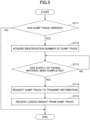
- FIG. 5 is a flowchart showing an example of the second transmission processing.
- the controller C1 provided on the asphalt finisher 100 repeatedly executes the second transmission processing with predetermined control intervals.
- the controller C1 determines whether the dump truck 200 has arrived at a predetermined position (step ST11) .
- the controller C1 determines whether the dump truck 200 has arrived at the predetermined position in front of the asphalt finisher 100 based on the output of the space recognition apparatus M1.
- the controller C1 can recognize that the dump truck 200 has arrived at the predetermined position by applying image recognition processing to an image captured by the monocular camera that serves as the space recognition apparatus M1.
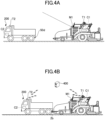
- the predetermined position is, for example, the position of the dump truck 200 when the rear tires of the dump truck 200 come into contact with the push rollers 2b of the asphalt finisher 100, i.e., when the asphalt finisher 100 comes into contact with the dump truck 200 as illustrated in FIG. 4B .
- the predetermined position may be a position of the dump truck 200 when the distance between the front end of the asphalt finisher 100 and the rear end of the dump truck 200 is less than a predetermined distance, i.e., a position of the dump truck 200 before the asphalt finisher 100 and the dump truck 200 come into contact with each other as illustrated in FIG. 4A .
- the controller C1 ends the second transmission processing.
- the controller C1 acquires an identification number of the dump truck 200 (step ST12).
- the identification number of the dump truck 200 is the vehicle registration number indicated on the rear license plate 50d of the dump truck 200.
- the controller C1 can recognize the vehicle registration number of the dump truck 200 as an identification number by performing image recognition processing on the image of the rear license plate 50d captured by the monocular camera that serves as the space recognition apparatus M1.
- the controller C1 may use a device other than the space recognition apparatus M1 to acquire the identification number of the dump truck 200.
- the controller C1 may acquire the vehicle registration number of the dump truck 200 as an identification number by using the communication device T1.
- the controller C1 may transmit a transmission request to the controller C2 of the dump truck 200 via the communication device T1 to cause the controller C2 to transmit information about the vehicle such as the vehicle registration number stored in the controller C2.
- the controller C1 determines whether the supply of the paving material has been completed (step ST13).
- the controller C1 can recognize that all of the paving materials loaded on the loading platform 50b of the dump truck 200 have been moved into the hopper 2 by performing image recognition processing on the image captured by the monocular camera that serves as the space recognition apparatus M1.
- the controller C1 can determine that the supply of the paving materials into the hopper 2 is completed, in response to recognizing that all of the paving materials have been moved.
- step ST13 the controller C1 repeats the determination in step ST13 until the determines that the supply of the paving material is completed.
- the controller C1 requests the dump truck 200 to transmit information (step ST14).
- the controller C1 transmits a transmission request to the controller C2 of the dump truck 200 via the communication device T1 to cause the controller C2 to transmit information about the loaded weight stored in the controller C2.
- the controller C1 receives the loaded weight from the dump truck 200 (step ST15).
- the controller C1 receives, via the communication device T1, information about the loaded weight transmitted by the controller C2 via the communication device T2.
- the controller C1 stores the received information about the loaded weight in the nonvolatile storage device.
- the controller C1 can calculate the supply weight.
- the supply weight is the total weight of the paving material supplied into the hopper 2 of the asphalt finisher 100.
- the controller C1 can calculate the supply weight by integrating the loaded weight transmitted by each of the plurality of dump trucks 200 for supplying the paving material into the hopper 2 of the asphalt finisher 100.
- the controller C1 may calculate a total weight of paving materials supplied into the hopper 2 after the asphalt finisher 100 is manufactured (hereinafter referred to as a "total weight after manufacture”), ae total weight of paving materials supplied into the hopper 2 after the most recent maintenance of a particular part (for example, a conveyor plate or a screed plate) (hereinafter referred to as a “total weight after maintenance”), or a total weight of paving materials supplied into the hopper 2 after the current construction has started (hereinafter referred to as a "total weight after start of construction”) as the supply weight.
- the controller C1 may calculate the total weight of paving materials supplied into the hopper 2 during any given period as the supply weight.
- the controller C1 may cause the controller C2 to transmit information about the loaded weight together with information about the vehicle.
- the controller C1 can receive information about the loaded weight from the dump truck 200 before the supply of the paving material from the dump truck 200 to the asphalt finisher 100 is completed.
- the information transmitted from the dump truck 200 to the asphalt finisher 100 may include the current time, date, or the current location.
- the controller C2 provided on the dump truck 200 can directly transmit information about the loaded weight, which is the weight of the paving material loaded on the loading platform 50b of the dump truck 200, to the controller C1 provided on the asphalt finisher 100.
- the dump truck 200 can directly transmit, to the asphalt finisher 100, information about the weight of the paving material supplied into the hopper 2. Therefore, even in a place where a satellite communication network or a cellular telephone communication network or the like cannot be used, the dump truck 200 can directly transmit information about the weight of the paving material to the asphalt finisher 100 via short-range wireless communication using Bluetooth (registered trademark) or Wi-Fi (registered trademark) or the like.
- Bluetooth registered trademark
- Wi-Fi registered trademark
- the construction management system SYS can move the data of the paving material stored in the nonvolatile storage device of the controller C2 provided on the dump truck 200 to the nonvolatile storage device of the controller C1 provided on the asphalt finisher 100. Therefore, the asphalt finisher 100 can accurately acquire data of the paving material supplied to the asphalt finisher 100 together with the paving material even if the order of arrival of the dump trucks 200 at the construction site is changed due to, for example, road conditions. Furthermore, direct communication between the dump truck 200 and the asphalt finisher 100 can achieve reliable communication even at a construction site, such as in a tunnel, where communication with the outside is impossible.
- the controller C1 can calculate the supply weight, which is the total weight of the paving material supplied into the hopper 2 of the asphalt finisher 100, based on the information about the loaded weight received from each of the plurality of dump trucks 200. Therefore, for example, the operator of the asphalt finisher 100 can easily check the supply weight and the like for each day of construction or for each construction site by using the screen of an on-board display device (not illustrated).
- the on-vehicle display device is, for example, a display device provided on the tractor 1 or the screed 3.
- the controller C1 may also transmit, to the management apparatus 400 (see Fig. 4B ) via the communication device T1, information including, e.g., information about the loaded weight received from each of the plurality of dump trucks 200.
- the management apparatus 400 is a server device installed in a facility such as a communication center.
- the management apparatus 400 is a computer including a CPU, a volatile storage device, and a nonvolatile storage device, and is connected to each of the communication devices T1 to T3 through a communication network such as the Internet.
- the manager of the asphalt finisher 100, the manufacturer of the asphalt finisher 100, or the like can acquire various information through a communication network such as the Internet, and therefore, the manager or the manufacturer can confirm, in real time, for example, the supply weight per day of construction, the total weight after manufacture, the total weight after maintenance, or the total weight after the start of construction for each of the plurality of asphalt finishers 100.
- the manager, the manufacturer, or the like can confirm the supply weight of each construction site in real time.
- the manager of the asphalt finisher 100 can estimate the replacement time of consumable parts such as the screed plate or the conveyor plate by confirming the total weight after maintenance at the present time.
- the above-described configuration has the effect of facilitating the maintenance and management of the asphalt finisher 100.
- the controller C1 may notify the operator of the asphalt finisher 100 in response to determining that the total weight after maintenance with respect to the screed plate, which is an example of the supply weight, exceeds a predetermined weight. This is because the wear of the screed plate depends on the total weight after maintenance with respect to the screed plate.
- the total weight after maintenance with respect to the screed plate is, for example, the total weight of the paving material supplied into the hopper 2 after the screed plate is replaced. This is also applicable to the conveyor plate.
- the supply weight may be corrected according to the type of paving material supplied until then. This is because the wear of components such as the screed plate or the conveyor plate also depends on the type of paving material.
- the controller C1 may display image information such as a text message prompting replacement or maintenance of the screed plate on the screen of the on-board display device.
- the controller C1 may cause a sound output device (not illustrated) to output a voice prompting replacement or maintenance of the screed plate.
- the sound output device is, for example, an on-vehicle speaker provided in the tractor 1 or the screed 3.
- the construction management system SYS is configured to control the transmission of information about the weight of the paving material from the plant 300 to the dump truck 200.
- each dump truck can acquire information about the paving material from the plant 300.
- the information about the paving material includes information about the weight of the paving material loaded on the loading platform 50b.
- each dump truck can communicate information about the weight of the paving material directly to the asphalt finisher 100.
- the asphalt finisher 100 can calculate the weight of the paving material supplied to the asphalt finisher 100 in real time.
- the driver of each dump truck can view information about the weight of the paving material loaded on the loading platform 50b on the screen of the display device provided in the driver's compartment 50a. Therefore, the driver of each dump truck can more reliably prevent overloading of the paving material.
- the information about the paving material may also include information about the type of paving material.
- the driver of each dump truck can view information about the type of paving material loaded on the loading platform 50b on the screen of the display device installed in the driver's compartment 50a. Therefore, the driver of each dump truck can more reliably prevent erroneous conveyance of the paving material.
- the construction management system SYS does not use printed paper, and therefore, the weight of the paving material supplied to the asphalt finisher 100 can be prevented from being inaccurate due to the loss of the printed paper or the erroneous input of the numbers printed on the paper.
- the construction management system SYS can calculate the supply weight of the paving material more accurately than the conventional configuration that estimates the supply weight of the paving material based on the rotation speed of the conveyor.
- the volume of the paving material conveyed by the conveyor is calculated based on the width of the conveyor, the height of the opening of the conveyor conveyance passage, and the conveying speed of the conveyor, and the weight of the paving material is calculated by multiplying the volume by the specific gravity of the paving material.
- the weight of the paving material calculated by the conventional configuration tends to involve large error and inaccuracy due to the fact that the conveyance efficiency is different for each type of paving material or the specific gravity is different for each type of paving material.
- the construction management system SYS does not need to perform such estimation, and therefore, can more accurately calculate the supply weight of the paving material.
- the construction management system SYS may be configured to recognize the identification number of the dump truck 200 with a camera provided on the plant 300 and associate the recognized identification number with information about the weight of the paving material.
- the information about the weight of the paving material is, for example, information calculated by the controller C3 in the plant 300. Specifically, the information about the weight of the paving material is information about the weight of the paving material loaded on the loading platform 50b of the particular dump truck 200.
- the information about the weight of the paving material is, for example, information about the weight of the paving material summed for each dump truck. Specifically, the information about the weight of the paving material is the weight of the paving material separately summed for each of the plurality of dump trucks 200.
- the construction management system SYS is configured to control the transmission of information about the weight of the paving material from the dump truck 200 to the asphalt finisher 100.
- This arrangement allows the asphalt finisher 100 to more accurately acquire information about the weight of the paving material supplied from the dump truck 200. This is because the asphalt finisher 100 can acquire information about the weight of the paving material directly and in real time from the dump truck 200 that has actually supplied the paving material into the hopper 2.
- the construction management system SYS may be configured to recognize the identification number of the dump truck 200 with a camera provided on the asphalt finisher 100.
- the asphalt finisher 100 can receive the supply of the paving material from the dump truck 200 after confirming that the dump truck 200 is a registered dump truck 200. Therefore, for example, the construction management system SYS can prevent the paving material that should not be supplied from being erroneously supplied into the hopper 2 of the asphalt finisher 100.
- the information about the weight of the paving material may also include information about the identification number of the dump truck 200.
- the construction management system SYS may be configured to collate the identification number of the dump truck 200 recognized by the camera with the identification number of the dump truck 200 transmitted from the dump truck 200.
- the asphalt finisher 100 can receive the supply of the paving material from the dump truck 200 after confirming that the vehicle registration number indicated on the license plate of the dump truck 200 matches the vehicle registration number stored in the controller C2 provided on the dump truck 200. Specifically, the asphalt finisher 100 can receive the supply of the paving material from the dump truck 200 after confirming whether the information stored in the controller C2 is accurate. Therefore, for example, the construction management system SYS can prevent the paving material that should not be supplied from being erroneously supplied into the hopper 2 of the asphalt finisher 100.
- the construction management system SYS is configured to calculate the weight of the paving material supplied to the asphalt finisher 100 based on information about the weight of the paving material transmitted from the dump truck 200, and to prompt maintenance of the asphalt finisher 100 in response to determining that the calculated weight becomes equal to or more than a predetermined value.
- the construction management system SYS can timely inform the manager of the asphalt finisher 100 of the replacement timing of consumable parts such as the screed plate or the conveyor plate.
Landscapes
- Business, Economics & Management (AREA)
- Engineering & Computer Science (AREA)
- Human Resources & Organizations (AREA)
- Economics (AREA)
- Strategic Management (AREA)
- Tourism & Hospitality (AREA)
- Physics & Mathematics (AREA)
- Theoretical Computer Science (AREA)
- General Physics & Mathematics (AREA)
- Marketing (AREA)
- Entrepreneurship & Innovation (AREA)
- General Business, Economics & Management (AREA)
- Operations Research (AREA)
- Development Economics (AREA)
- Quality & Reliability (AREA)
- Educational Administration (AREA)
- Game Theory and Decision Science (AREA)
- Health & Medical Sciences (AREA)
- General Health & Medical Sciences (AREA)
- Primary Health Care (AREA)
- Architecture (AREA)
- Civil Engineering (AREA)
- Structural Engineering (AREA)
- Road Paving Machines (AREA)
Claims (11)
- Bauverwaltungssystem (SYS), das einen Muldenkipper (200, 200A, 200B) und einen Asphaltfertiger (100) umfasst, wobei der Asphaltfertiger (100) eine erste Steuerung (C1) umfasst, die konfiguriert ist, Übertragung zu steuern von dem Muldenkipper (200, 220A, 200B) an den Asphaltfertiger (100), von Informationen über ein Gewicht eines Straßendeckenmaterials, dadurch gekennzeichnet, dass die erste Steuerung (C1) konfiguriert ist, ein Gewicht des dem Asphaltfertiger (100) zugeführten Straßendeckenmaterials auf der Grundlage der von dem Muldenkipper (200, 200A, 200B) übertragenen Informationen über das Gewicht des Straßendeckenmaterials zu berechnen, und
um Versorgung des Asphaltfertigers (100) zu veranlassen, als Reaktion auf Bestimmen, dass das berechnete Gewicht gleich oder größer als ein vorbestimmter Wert wird. - Bauverwaltungssystem (SYS) nach Anspruch 1, wobei der Asphaltfertiger (100) eine Kamera (M1) umfasst und konfiguriert ist, eine Identifikationsnummer des Muldenkippers (200, 200A, 200B) zu erkennen.
- Bauverwaltungssystem (SYS) nach Anspruch 2, wobei die Informationen über das Gewicht des Straßendeckenmaterials Informationen über die Identifikationsnummer des Muldenkippers (200, 200A, 200B) umfassen, und
die erste Steuerung konfiguriert ist, die erkannte Identifikationsnummer des Muldenkippers (200, 200A, 200B) der Identifikationsnummer des Muldenkippers (200, 200A, 200B), die von dem Muldenkipper (200, 200A, 200B) übertragen wurde, zuzuordnen. - Bauverwaltungssystem (SYS) nach Ansprüchen 1-3, ferner umfassend eine Anlage (300), wobei der Muldenkipper (200, 200A, 200B) eine zweite Steuerung (C2) umfasst, die konfiguriert ist, die Übertragung von der Anlage (300) zu dem Muldenkipper (200, 200A, 200B) an Informationen über ein Gewicht eines Straßendeckenmaterials zu steuern.
- Das Bauverwaltungssystem (SYS) nach Anspruch 4, wobei die Anlage (300) eine Kamera (M3) umfasst, unddas System so konfiguriert ist, dass es eine Identifikationsnummer des Muldenkippers (200, 200A, 200B) durch die an der Anlage (300) vorgesehene Kamera (M3) erkennt, unddie erkannte Identifikationsnummer mit den Informationen über das Gewicht des Straßendeckenmaterials in Verbindung bringt.
- Bauverwaltungssystem (SYS) nach Anspruch 5, wobei die Information über das Gewicht des Straßendeckenmaterials, das von der Anlage (300) an den Muldenkipper (299, 200A, 200b) übertragen wird, eine Information über ein Gewicht des Straßendeckenmaterials ist, das für jeden Muldenkipper (200, 200A, 200B) von mehreren Muldenkippern (200, 200A, 200B) summiert wird.
- Asphaltfertiger (100), umfassend:einen Traktor (1);einen Trichter (2), der an einer Vorderseite des Traktors (1) vorgesehen ist;einen Förderer, der so konfiguriert ist, dass er ein Straßendeckenmaterial in dem Trichter (2) zu einer Rückseite des Traktors (1) fördert;eine Schnecke, die so konfiguriert ist, dass sie das von dem Förderer geförderte und auf einer Straßenoberfläche aufgebrachte Straßendeckenmaterial in einer Fahrzeugbreitenrichtung verteilt;eine Bohle (3), die so konfiguriert ist, dass sie das von der Schnecke verteilte Straßendeckenmaterial an einer Rückseite der Schnecke nivelliert; undeine Kommunikationsvorrichtung (T1), die so konfiguriert ist, dass sie Informationen über ein Gewicht des Straßendeckenmaterials von einem Muldenkipper (200, 200A, 200B) empfängt,dadurch gekennzeichnet, dass der Asphaltfertiger (100) ferner eine erste Steuerung (C1) umfasst, wobei die erste Steuerung (C1) so konfiguriert ist, dass sie ein Gewicht des dem Asphaltfertiger (100) zugeführten Straßendeckenmaterials auf der Grundlage der Informationen über das Gewicht des Straßendeckenmaterials berechnet, die von der Kommunikationsvorrichtung (T1) von dem Muldenkipper (200, 200A, 200B) empfangen werden, und dass sie Versorgung des Asphaltfertigers (100) veranlasst, als Reaktion auf Bestimmen, dass das berechnete Gewicht gleich einem oder größer als ein vorbestimmter Wert wird.
- Asphaltfertiger (100) nach Anspruch 7, ferner umfassend:
eine Kamera (M1), die so konfiguriert ist, dass sie eine Identifikationsnummer des Muldenkippers (200, 200A, 200B) erkennt. - Asphaltfertiger (100) nach Anspruch 8, wobei die Informationen über das Gewicht des Straßendeckenmaterials Informationen über die Identifikationsnummer des Muldenkippers (200, 200A, 200B) umfassen, und
die erste Steuerung (C1) so konfiguriert ist, dass sie die erkannte Identifikationsnummer des Muldenkippers (200, 200A, 200B) mit der Identifikationsnummer des Muldenkippers (200, 200A, 200B), die durch den Muldenkipper (200, 200A, 200B) an die Kommunikationsvorrichtung (T1) übertragen wurde, vergleicht. - Asphaltfertiger (100) nach Anspruch 7, wobei die Informationen über das Gewicht des Straßendeckenmaterials Informationen sind, die von einer Anlage (300) an den Muldenkipper (200, 200A, 200B) übertragen werden.
- Asphaltfertiger (100) nach Anspruch 10, wobei die Informationen über das Gewicht des Straßendeckenmaterials Informationen über ein Gewicht des Straßendeckenmaterials sind, die für jeden Muldenkipper (200, 200A, 200B) von mehreren Muldenkippern (200, 200A, 200B) summiert werden.
Applications Claiming Priority (3)
| Application Number | Priority Date | Filing Date | Title |
|---|---|---|---|
| JP2020041584 | 2020-03-11 | ||
| JP2020041586 | 2020-03-11 | ||
| PCT/JP2021/009707 WO2021182556A1 (ja) | 2020-03-11 | 2021-03-11 | 施工管理システム及びアスファルトフィニッシャ |
Publications (3)
| Publication Number | Publication Date |
|---|---|
| EP4119726A1 EP4119726A1 (de) | 2023-01-18 |
| EP4119726A4 EP4119726A4 (de) | 2023-08-30 |
| EP4119726B1 true EP4119726B1 (de) | 2025-04-16 |
Family
ID=77670687
Family Applications (1)
| Application Number | Title | Priority Date | Filing Date |
|---|---|---|---|
| EP21768656.7A Active EP4119726B1 (de) | 2020-03-11 | 2021-03-11 | Bauverwaltungssystem und asphaltfertiger |
Country Status (4)
| Country | Link |
|---|---|
| EP (1) | EP4119726B1 (de) |
| JP (1) | JP7533828B2 (de) |
| CN (1) | CN114901907A (de) |
| WO (1) | WO2021182556A1 (de) |
Families Citing this family (1)
| Publication number | Priority date | Publication date | Assignee | Title |
|---|---|---|---|---|
| JP2025039344A (ja) * | 2023-09-08 | 2025-03-21 | 住友建機株式会社 | アスファルトフィニッシャ |
Family Cites Families (14)
| Publication number | Priority date | Publication date | Assignee | Title |
|---|---|---|---|---|
| JP4667635B2 (ja) * | 2001-04-25 | 2011-04-13 | 東急建設株式会社 | 運搬システム、運搬方法及び運搬管理装置 |
| JP2003346024A (ja) * | 2002-05-27 | 2003-12-05 | Ricoh Co Ltd | 受発注管理システム |
| JP5052468B2 (ja) * | 2008-09-19 | 2012-10-17 | 日立建機株式会社 | 施工管理システム |
| JP2011165146A (ja) * | 2010-02-15 | 2011-08-25 | Nec Software Kyushu Ltd | 車載装置、報知方法、車両照合システム及びコンピュータプログラム |
| PL2514873T3 (pl) * | 2011-04-18 | 2014-08-29 | Joseph Voegele Ag | Sposób i system do nanoszenia nawierzchni drogowej |
| US9611595B2 (en) * | 2015-08-25 | 2017-04-04 | Caterpillar Paving Products Inc. | System for communications between plant and machines |
| US9879386B2 (en) * | 2015-12-10 | 2018-01-30 | Caterpillar Paving Products Inc. | System for coordinating milling and paving machines |
| JP6199449B2 (ja) * | 2016-07-14 | 2017-09-20 | 株式会社小松製作所 | 施工管理システム |
| WO2018130993A2 (en) * | 2017-01-14 | 2018-07-19 | Invento Labs Pvt Ltd | Integrated project and equipment management system and method using iot devices and software applications |
| US20190188620A1 (en) * | 2017-12-14 | 2019-06-20 | Carerpillar Paving Products Inc. | System and method for location sensor association |
| US10669678B2 (en) * | 2017-12-14 | 2020-06-02 | Caterpillar Paving Products Inc. | System and method for generating a paving material map |
| JP2020041584A (ja) | 2018-09-10 | 2020-03-19 | Kyb株式会社 | 粒状体ダンパ |
| JP7122913B2 (ja) | 2018-09-10 | 2022-08-22 | 株式会社ミツバ | 減速機構、及び減速機付モータ |
| US10559208B1 (en) * | 2019-01-25 | 2020-02-11 | Caterpillar Paving Products Inc | System and method for controlling reporting frequency |
-
2021
- 2021-03-11 EP EP21768656.7A patent/EP4119726B1/de active Active
- 2021-03-11 WO PCT/JP2021/009707 patent/WO2021182556A1/ja not_active Ceased
- 2021-03-11 CN CN202180007519.0A patent/CN114901907A/zh active Pending
- 2021-03-11 JP JP2022507272A patent/JP7533828B2/ja active Active
Also Published As
| Publication number | Publication date |
|---|---|
| WO2021182556A1 (ja) | 2021-09-16 |
| JP7533828B2 (ja) | 2024-08-14 |
| CN114901907A (zh) | 2022-08-12 |
| EP4119726A1 (de) | 2023-01-18 |
| JPWO2021182556A1 (de) | 2021-09-16 |
| EP4119726A4 (de) | 2023-08-30 |
Similar Documents
| Publication | Publication Date | Title |
|---|---|---|
| CN111491005B (zh) | 用于控制报告频率的系统和方法 | |
| US9845578B2 (en) | System for wireless communications between machines | |
| US9611595B2 (en) | System for communications between plant and machines | |
| US9481964B1 (en) | System for communications between plant and machines | |
| US10949786B2 (en) | Cold planer material transport management system | |
| CN110656554B (zh) | 用于控制铺路机速度的系统和方法 | |
| US10323516B2 (en) | System and method for the tracking of milling material | |
| CN112950107B (zh) | 工单集成系统 | |
| EP4119726B1 (de) | Bauverwaltungssystem und asphaltfertiger | |
| AU2020372867A1 (en) | Systems and methods for material transport | |
| US11507902B2 (en) | System and method for vehicle project tracking | |
| CN110837910B (zh) | 用于确定拖运卡车到达的系统和方法 | |
| US10927513B2 (en) | System and method for the tracking of milling material | |
| CN114514352B (zh) | 用于摊铺机的定位系统 | |
| US20220042287A1 (en) | Method and system for controlling loading/unloading of a material | |
| EP4520868A1 (de) | Asphaltfertiger | |
| JP2022101485A (ja) | ダンププレート装置、ダンププレートシステム、およびダンププレート装置の取り扱い方法 |
Legal Events
| Date | Code | Title | Description |
|---|---|---|---|
| STAA | Information on the status of an ep patent application or granted ep patent |
Free format text: STATUS: THE INTERNATIONAL PUBLICATION HAS BEEN MADE |
|
| PUAI | Public reference made under article 153(3) epc to a published international application that has entered the european phase |
Free format text: ORIGINAL CODE: 0009012 |
|
| STAA | Information on the status of an ep patent application or granted ep patent |
Free format text: STATUS: REQUEST FOR EXAMINATION WAS MADE |
|
| 17P | Request for examination filed |
Effective date: 20220912 |
|
| AK | Designated contracting states |
Kind code of ref document: A1 Designated state(s): AL AT BE BG CH CY CZ DE DK EE ES FI FR GB GR HR HU IE IS IT LI LT LU LV MC MK MT NL NO PL PT RO RS SE SI SK SM TR |
|
| DAV | Request for validation of the european patent (deleted) | ||
| DAX | Request for extension of the european patent (deleted) | ||
| STAA | Information on the status of an ep patent application or granted ep patent |
Free format text: STATUS: EXAMINATION IS IN PROGRESS |
|
| A4 | Supplementary search report drawn up and despatched |
Effective date: 20230728 |
|
| RIC1 | Information provided on ipc code assigned before grant |
Ipc: G06Q 10/08 20230101ALI20230724BHEP Ipc: G06Q 10/06 20230101ALI20230724BHEP Ipc: E01C 19/48 20060101AFI20230724BHEP |
|
| 17Q | First examination report despatched |
Effective date: 20230816 |
|
| GRAP | Despatch of communication of intention to grant a patent |
Free format text: ORIGINAL CODE: EPIDOSNIGR1 |
|
| STAA | Information on the status of an ep patent application or granted ep patent |
Free format text: STATUS: GRANT OF PATENT IS INTENDED |
|
| INTG | Intention to grant announced |
Effective date: 20241008 |
|
| GRAS | Grant fee paid |
Free format text: ORIGINAL CODE: EPIDOSNIGR3 |
|
| GRAA | (expected) grant |
Free format text: ORIGINAL CODE: 0009210 |
|
| STAA | Information on the status of an ep patent application or granted ep patent |
Free format text: STATUS: THE PATENT HAS BEEN GRANTED |
|
| AK | Designated contracting states |
Kind code of ref document: B1 Designated state(s): AL AT BE BG CH CY CZ DE DK EE ES FI FR GB GR HR HU IE IS IT LI LT LU LV MC MK MT NL NO PL PT RO RS SE SI SK SM TR |
|
| REG | Reference to a national code |
Ref country code: GB Ref legal event code: FG4D |
|
| REG | Reference to a national code |
Ref country code: CH Ref legal event code: EP |
|
| REG | Reference to a national code |
Ref country code: IE Ref legal event code: FG4D |
|
| REG | Reference to a national code |
Ref country code: DE Ref legal event code: R096 Ref document number: 602021029287 Country of ref document: DE |
|
| REG | Reference to a national code |
Ref country code: NL Ref legal event code: MP Effective date: 20250416 |
|
| PG25 | Lapsed in a contracting state [announced via postgrant information from national office to epo] |
Ref country code: NL Free format text: LAPSE BECAUSE OF FAILURE TO SUBMIT A TRANSLATION OF THE DESCRIPTION OR TO PAY THE FEE WITHIN THE PRESCRIBED TIME-LIMIT Effective date: 20250416 |
|
| REG | Reference to a national code |
Ref country code: AT Ref legal event code: MK05 Ref document number: 1785751 Country of ref document: AT Kind code of ref document: T Effective date: 20250416 |
|
| PG25 | Lapsed in a contracting state [announced via postgrant information from national office to epo] |
Ref country code: PT Free format text: LAPSE BECAUSE OF FAILURE TO SUBMIT A TRANSLATION OF THE DESCRIPTION OR TO PAY THE FEE WITHIN THE PRESCRIBED TIME-LIMIT Effective date: 20250818 Ref country code: FI Free format text: LAPSE BECAUSE OF FAILURE TO SUBMIT A TRANSLATION OF THE DESCRIPTION OR TO PAY THE FEE WITHIN THE PRESCRIBED TIME-LIMIT Effective date: 20250416 Ref country code: ES Free format text: LAPSE BECAUSE OF FAILURE TO SUBMIT A TRANSLATION OF THE DESCRIPTION OR TO PAY THE FEE WITHIN THE PRESCRIBED TIME-LIMIT Effective date: 20250416 |
|
| REG | Reference to a national code |
Ref country code: LT Ref legal event code: MG9D |
|
| PG25 | Lapsed in a contracting state [announced via postgrant information from national office to epo] |
Ref country code: NO Free format text: LAPSE BECAUSE OF FAILURE TO SUBMIT A TRANSLATION OF THE DESCRIPTION OR TO PAY THE FEE WITHIN THE PRESCRIBED TIME-LIMIT Effective date: 20250716 Ref country code: GR Free format text: LAPSE BECAUSE OF FAILURE TO SUBMIT A TRANSLATION OF THE DESCRIPTION OR TO PAY THE FEE WITHIN THE PRESCRIBED TIME-LIMIT Effective date: 20250717 |
|
| PG25 | Lapsed in a contracting state [announced via postgrant information from national office to epo] |
Ref country code: PL Free format text: LAPSE BECAUSE OF FAILURE TO SUBMIT A TRANSLATION OF THE DESCRIPTION OR TO PAY THE FEE WITHIN THE PRESCRIBED TIME-LIMIT Effective date: 20250416 |
|
| PG25 | Lapsed in a contracting state [announced via postgrant information from national office to epo] |
Ref country code: BG Free format text: LAPSE BECAUSE OF FAILURE TO SUBMIT A TRANSLATION OF THE DESCRIPTION OR TO PAY THE FEE WITHIN THE PRESCRIBED TIME-LIMIT Effective date: 20250416 |
|
| PG25 | Lapsed in a contracting state [announced via postgrant information from national office to epo] |
Ref country code: HR Free format text: LAPSE BECAUSE OF FAILURE TO SUBMIT A TRANSLATION OF THE DESCRIPTION OR TO PAY THE FEE WITHIN THE PRESCRIBED TIME-LIMIT Effective date: 20250416 |
|
| PG25 | Lapsed in a contracting state [announced via postgrant information from national office to epo] |
Ref country code: AT Free format text: LAPSE BECAUSE OF FAILURE TO SUBMIT A TRANSLATION OF THE DESCRIPTION OR TO PAY THE FEE WITHIN THE PRESCRIBED TIME-LIMIT Effective date: 20250416 |
|
| PG25 | Lapsed in a contracting state [announced via postgrant information from national office to epo] |
Ref country code: RS Free format text: LAPSE BECAUSE OF FAILURE TO SUBMIT A TRANSLATION OF THE DESCRIPTION OR TO PAY THE FEE WITHIN THE PRESCRIBED TIME-LIMIT Effective date: 20250716 |
|
| PG25 | Lapsed in a contracting state [announced via postgrant information from national office to epo] |
Ref country code: IS Free format text: LAPSE BECAUSE OF FAILURE TO SUBMIT A TRANSLATION OF THE DESCRIPTION OR TO PAY THE FEE WITHIN THE PRESCRIBED TIME-LIMIT Effective date: 20250816 |
|
| PG25 | Lapsed in a contracting state [announced via postgrant information from national office to epo] |
Ref country code: LV Free format text: LAPSE BECAUSE OF FAILURE TO SUBMIT A TRANSLATION OF THE DESCRIPTION OR TO PAY THE FEE WITHIN THE PRESCRIBED TIME-LIMIT Effective date: 20250416 |
|
| PG25 | Lapsed in a contracting state [announced via postgrant information from national office to epo] |
Ref country code: SM Free format text: LAPSE BECAUSE OF FAILURE TO SUBMIT A TRANSLATION OF THE DESCRIPTION OR TO PAY THE FEE WITHIN THE PRESCRIBED TIME-LIMIT Effective date: 20250416 Ref country code: DK Free format text: LAPSE BECAUSE OF FAILURE TO SUBMIT A TRANSLATION OF THE DESCRIPTION OR TO PAY THE FEE WITHIN THE PRESCRIBED TIME-LIMIT Effective date: 20250416 |
|
| REG | Reference to a national code |
Ref country code: DE Ref legal event code: R097 Ref document number: 602021029287 Country of ref document: DE |
|
| PG25 | Lapsed in a contracting state [announced via postgrant information from national office to epo] |
Ref country code: CZ Free format text: LAPSE BECAUSE OF FAILURE TO SUBMIT A TRANSLATION OF THE DESCRIPTION OR TO PAY THE FEE WITHIN THE PRESCRIBED TIME-LIMIT Effective date: 20250416 |
|
| PG25 | Lapsed in a contracting state [announced via postgrant information from national office to epo] |
Ref country code: EE Free format text: LAPSE BECAUSE OF FAILURE TO SUBMIT A TRANSLATION OF THE DESCRIPTION OR TO PAY THE FEE WITHIN THE PRESCRIBED TIME-LIMIT Effective date: 20250416 |
|
| PG25 | Lapsed in a contracting state [announced via postgrant information from national office to epo] |
Ref country code: SK Free format text: LAPSE BECAUSE OF FAILURE TO SUBMIT A TRANSLATION OF THE DESCRIPTION OR TO PAY THE FEE WITHIN THE PRESCRIBED TIME-LIMIT Effective date: 20250416 |
|
| PLBE | No opposition filed within time limit |
Free format text: ORIGINAL CODE: 0009261 |
|
| STAA | Information on the status of an ep patent application or granted ep patent |
Free format text: STATUS: NO OPPOSITION FILED WITHIN TIME LIMIT |
|
| REG | Reference to a national code |
Ref country code: CH Ref legal event code: L10 Free format text: ST27 STATUS EVENT CODE: U-0-0-L10-L00 (AS PROVIDED BY THE NATIONAL OFFICE) Effective date: 20260225 |
|
| 26N | No opposition filed |
Effective date: 20260119 |
|
| PGFP | Annual fee paid to national office [announced via postgrant information from national office to epo] |
Ref country code: GB Payment date: 20260202 Year of fee payment: 6 |
|
| PGFP | Annual fee paid to national office [announced via postgrant information from national office to epo] |
Ref country code: DE Payment date: 20260128 Year of fee payment: 6 |
|
| PGFP | Annual fee paid to national office [announced via postgrant information from national office to epo] |
Ref country code: IT Payment date: 20260220 Year of fee payment: 6 |