EP4119989A1 - Verfahren zur bildung eines subpixel-gammabildes, das eine räumliche ungleichmässigkeit der empfindlichkeit berücksichtigt - Google Patents
Verfahren zur bildung eines subpixel-gammabildes, das eine räumliche ungleichmässigkeit der empfindlichkeit berücksichtigt Download PDFInfo
- Publication number
- EP4119989A1 EP4119989A1 EP22184628.0A EP22184628A EP4119989A1 EP 4119989 A1 EP4119989 A1 EP 4119989A1 EP 22184628 A EP22184628 A EP 22184628A EP 4119989 A1 EP4119989 A1 EP 4119989A1
- Authority
- EP
- European Patent Office
- Prior art keywords
- pixel
- pixels
- virtual
- interactions
- virtual pixel
- Prior art date
- Legal status (The legal status is an assumption and is not a legal conclusion. Google has not performed a legal analysis and makes no representation as to the accuracy of the status listed.)
- Granted
Links
Images




Classifications
-
- G—PHYSICS
- G06—COMPUTING OR CALCULATING; COUNTING
- G06T—IMAGE DATA PROCESSING OR GENERATION, IN GENERAL
- G06T12/00—Tomographic reconstruction from projections
- G06T12/10—Image preprocessing, e.g. calibration, positioning of sources or scatter correction
-
- G—PHYSICS
- G01—MEASURING; TESTING
- G01T—MEASUREMENT OF NUCLEAR OR X-RADIATION
- G01T1/00—Measuring X-radiation, gamma radiation, corpuscular radiation, or cosmic radiation
- G01T1/16—Measuring radiation intensity
- G01T1/161—Applications in the field of nuclear medicine, e.g. in vivo counting
- G01T1/164—Scintigraphy
- G01T1/1641—Static instruments for imaging the distribution of radioactivity in one or two dimensions using one or several scintillating elements; Radio-isotope cameras
- G01T1/1648—Ancillary equipment for scintillation cameras, e.g. reference markers, devices for removing motion artifacts, calibration devices
-
- G—PHYSICS
- G01—MEASURING; TESTING
- G01T—MEASUREMENT OF NUCLEAR OR X-RADIATION
- G01T1/00—Measuring X-radiation, gamma radiation, corpuscular radiation, or cosmic radiation
- G01T1/29—Measurement performed on radiation beams, e.g. position or section of the beam; Measurement of spatial distribution of radiation
- G01T1/2914—Measurement of spatial distribution of radiation
- G01T1/2921—Static instruments for imaging the distribution of radioactivity in one or two dimensions; Radio-isotope cameras
- G01T1/2935—Static instruments for imaging the distribution of radioactivity in one or two dimensions; Radio-isotope cameras using ionisation detectors
-
- G—PHYSICS
- G01—MEASURING; TESTING
- G01T—MEASUREMENT OF NUCLEAR OR X-RADIATION
- G01T1/00—Measuring X-radiation, gamma radiation, corpuscular radiation, or cosmic radiation
- G01T1/29—Measurement performed on radiation beams, e.g. position or section of the beam; Measurement of spatial distribution of radiation
- G01T1/2914—Measurement of spatial distribution of radiation
- G01T1/2921—Static instruments for imaging the distribution of radioactivity in one or two dimensions; Radio-isotope cameras
- G01T1/2928—Static instruments for imaging the distribution of radioactivity in one or two dimensions; Radio-isotope cameras using solid state detectors
-
- G—PHYSICS
- G06—COMPUTING OR CALCULATING; COUNTING
- G06T—IMAGE DATA PROCESSING OR GENERATION, IN GENERAL
- G06T12/00—Tomographic reconstruction from projections
- G06T12/20—Inverse problem, i.e. transformations from projection space into object space
-
- G—PHYSICS
- G06—COMPUTING OR CALCULATING; COUNTING
- G06T—IMAGE DATA PROCESSING OR GENERATION, IN GENERAL
- G06T2211/00—Image generation
- G06T2211/40—Computed tomography
- G06T2211/424—Iterative
Definitions
- the technical field of the invention is X or gamma imaging, and more particularly the reconstruction of the position of irradiating sources using an image acquired by a gamma camera.
- Gamma cameras are devices used to form an image to establish a map of irradiating sources in a given environment.
- a first application is the visualization of an irradiation source in an organism, for medical diagnostic purposes.
- Another application is the localization of an irradiating source in an installation, and in particular in a nuclear installation.
- gamma cameras in the medical field is relatively old. In the nuclear industry, this type of device was developed in the 1990s, and is tending to spread in nuclear installations, for the purposes of radiological characterization. The objective is to identify the main irradiating sources present in an installation. Indeed, the sources of irradiation are not distributed in a homogeneous manner. They are often concentrated locally, in the form of "hot spots", the usual term in the field of radiation protection. A gamma camera has the advantage of locating these hot spots remotely.
- Some gamma cameras consist of a two-dimensional matrix of pixels, connected to a detector material.
- the detector material is generally a semiconductor material, for example CdTe or CdZnTe.
- CdTe or CdZnTe under the effect of an interaction of ionizing radiation in the detector material, one or more pixels generate an electric pulse, the amplitude of which is correlated with the energy released by the radiation during the interaction.
- Each pixel is connected to an electronic pulse processing circuit.
- Each pixel is formed by an electrode, which usually acts as an anode.
- an electrode which usually acts as an anode.
- incident radiation interacts in the detector material, electrons are released into the detector material.
- Electrons are collected by an anode. The latter generates a pulse whose amplitude depends on the number of electrons collected by the anode, this number being generally proportional to an energy lost by the ionizing radiation in the detector material.
- each pixel extends over a few millimeters on a side.
- the matrix of pixels generally comprises one hundred, or a few hundreds, of pixels per line and per column.
- each pixel can be “sub-pixelated”, or “sub-pixelated”, ie subdivided into virtual pixels.
- Methods have already been developed, making it possible to associate, with each interaction, not a pixel, but a virtual pixel. Such methods exploit the fact that when an interaction occurs in the detector material, the charge carriers, migrating towards the matrix of anodes, generate a signal detectable by several adjacent pixels. Thus, these methods are based on a combination of the signals detected by several adjacent pixels.
- irradiating sources In nuclear installations, irradiating sources, called “out of field”, are located outside or at the limit of the field of observation. Such irradiating sources generate parasitic irradiation that can impact the image formed by the gamma camera.
- Gamma cameras have a collimator, defining the field of observation.
- the collimator is of the coded mask type, the image formed by the gamma camera undergoes reconstruction to take account of the presence of the coded mask.
- Irradiating sources positioned at the edge of the field of observation can generate artefacts during reconstruction.
- the collimator is a pinhole collimator, strongly irradiating sources located outside the field of observation can produce an inhomogeneous fog affecting the image acquired by the gamma camera.
- Another cause affecting the non-uniformity of the gamma camera is the presence of defects in the detector material, locally modifying the detection sensitivity.
- the invention described below addresses this problem, and makes it possible to reduce the spatial non-uniformities of a gamma camera.
- each group of pixels comprises pixels belonging to the same row or to the same column.
- Steps e-1), e-2), f-1) and f-2) previously described are implemented by being carried out in an analogous manner by considering columns or rows of pixels.
- the gamma camera may comprise a processing unit, configured to process the interactions stored in the memory.
- the method comprises a step h) of reconstructing a spatial distribution of the irradiating sources, in the field of observation, from the interactions stored during step c) and the weights assigned to each virtual pixel during the step f).
- the processing unit can normalize a number of interactions detected by each virtual pixel by the weight assigned to said virtual pixel.
- the gamma camera comprises a collimator defining the field of observation, in particular a coded mask collimator.
- the sub-pixelation unit is not necessary.
- the processing unit is configured to implement steps d) to f) of the variant of the first embodiment previously described in connection with the first object of the invention.
- the sub-pixelation unit when the pixels of the gamma camera are sufficiently small, the sub-pixelation unit is not necessary.
- the method implements a gamma camera without a sub-pixelation unit. Steps iii), iv) and v) are implemented by taking into account pixels instead of virtual pixels.
- the Figure 1A represents a gamma camera 1, allowing an implementation of the invention.
- the gamma camera 1 is configured to detect ionizing photons, of the X or gamma type, the energy of which is generally between 10 keV and 10 MeV, in an observation field ⁇ .
- the observation field ⁇ extends around a central axis ⁇ .
- the gamma camera 1 can be coupled to a visible camera, making it possible to form a visible image of the field of observation.
- the term gamma camera corresponds to an imager having an observation field and configured to form an object image O allowing irradiation sources to be located in the observation field ⁇ .
- the gamma camera 1 comprises a detector material 11, usually a semiconductor material allowing the creation of charge carriers (electron/hole pairs) during an interaction with X or gamma radiation. It may for example be CdTe or CdZnTe. In general, the detector material is conducive to interacting with ionizing photons, so as to generate charge carriers.
- the detector material is preferably a semiconductor material. Alternatively, it may be a scintillator material coupled to a photodetector.
- the gamma camera 1 comprises pixels 12 1 ...12 i ...12 l , distributed along a detection surface.
- the pixels are represented on the figure 1B .
- the index i represents a rank of each pixel 12 i .
- I is the number of pixels.
- the pixels 12 i are coplanar and distributed according to a two-dimensional matrix, preferably regular. The matrix can for example comprise a few tens or even hundreds of pixels.
- N xi corresponds to the number of pixels along the X axis and N Yi corresponds to the number of pixels along the Y axis.
- Each pixel 12 i is an elementary radiation detector. In the example described, each pixel is an anode, the polarization of which makes it possible to collect electrons produced during an interaction occurring in the detector material.
- each pixel 12 i can be relatively large, of the order of a few mm 2 .
- charge carriers for example electrons
- migrate towards one or more pixels the latter being affected pixels: each affected pixel is a pixel which collects charge carriers.
- An interaction may result in one or more affected pixels.
- the charge carriers generate a signal, usually referred to as an induced signal, on the adjacent pixels of the affected pixel or pixels.
- each interaction gives rise to the formation of a detection signal by at least one pixel, and most often several pixels.
- the detection signal can be a signal resulting from the collection of charge carriers by the pixel 12 i or a signal induced by the migration of charge carriers in the detector material 11.
- the gamma camera comprises a sub-pixelation unit 14, programmed to assign a position (x, y) of each interaction detected, parallel to the detection surface 12, from detection signals formed by several pixels 12 i following every interaction. In the remainder of the description, the position of an interaction corresponds to a position of the interaction parallel to the detection surface defined by the pixels 12 i .
- the gamma camera may include a collimator 10 to delimit the field of observation ⁇ likely to include irradiating sources 5.
- the pixels are exposed to irradiation, originating from the irradiating sources of the field of observation, during an acquisition period. During the acquisition period, the pixels acquire detection signals resulting from interactions of ionizing photons emitted by the irradiating sources located in the field of observation.
- the collimator 10 can be of the pinhole or coded mask type. In the following example, the collimator 10 is of the coded mask type.
- the gamma camera may be of the Compton gamma camera type, in which case the presence of a collimator is not necessary.
- a Compton gamma camera comprises a specific electronic circuit, making it possible to estimate the respective positions, in the detector material, of two temporally coincident interactions, and to estimate a direction of propagation of the incident radiation.
- the sub-pixelation unit 14 divides each pixel 12 i into virtual pixels (or sub-pixels) 13 i,j .
- the term “virtual pixel” designates the fact that a virtual pixel 13 i,j has no physical reality: it results from a virtual segmentation of each physical pixel 12 i .
- the index j is an integer corresponding to a rank of each virtual pixel 13 i,j in a pixel 12 i , with 1 ⁇ j ⁇ J .
- J is the number of virtual pixels in each pixel.
- the rank j of a virtual pixel 13 i,j defines the position of the virtual pixel in a pixel 12 i .
- the virtual pixels 13 i,j of the same rank are arranged at the same position relative to the pixel 12 i .
- J 9: each pixel is segmented into 9 virtual pixels.
- Sub-pixelation makes it possible to form a gamma image G comprising a number of virtual pixels 13 i,j equal to I ⁇ J .
- the virtual pixels 13 i,j are aligned along rows (parallel to an X axis) and columns (parallel to a Y axis).
- each virtual pixel 13 ij on the detection surface 12 is identified by coordinates ( x , y ).
- the link between each virtual pixel 13 ij and each position ( x , y ) is one-to-one, such that each position of coordinates (x, y) corresponds to a single virtual pixel 13 i,j , and vice versa.
- the gamma camera 1 can comprise a unit programmed to determine the depth of interaction in the detector material, from detection signals formed by several pixels.
- each pixel 12 i Under the effect of a collection of charge carriers, each pixel 12 i generates a pulse whose amplitude depends on the energy released, in the detector material, by an ionizing photon, during an interaction, this energy being usually referred to as "energy of the interaction".
- the gamma-camera 1 includes a spectrometry unit 15.
- the spectrometry unit 15 allows an estimation that is as precise as possible of the amplitude of the pulses resulting from the collection of charge carriers following an interaction.
- the spectrometry unit 15 may include both electronic means (pulse shaping circuit, multichannel analyzer, analog-to-digital converter) and software means.
- the estimation of the amplitude of a pulse makes it possible to estimate the energy of the interaction. This energy must be estimated as accurately as possible.
- the energy range addressed is generally between 10 keV and a few hundred keV, or even a few MeV. It is desirable that the accuracy of the energy be of the order of a %, or even less
- the spectrometry unit 15 makes it possible to obtain a spectrum of the radiation detected by each pixel.
- the spectrometry unit 15 makes it possible to select energy bands of interest, corresponding to non-scattered photons, that is to say photons which have not been deflected since their emission by the irradiation source. Their selection, in predetermined energy bands, makes it possible to eliminate noise corresponding to the scattered photons. Since the latter have been deflected since their emission, they do not provide useful information for locating the irradiating sources. Diffusion is therefore a source of noise, which spectrometry makes it possible to significantly limit.
- spectrometric gamma cameras Another advantage of spectrometric gamma cameras is that knowledge of the energy of the photons detected allows identification of the isotopes responsible for the irradiation. This is important information in the field of radiation protection, or in the management of radioactive waste, or even in the dismantling of nuclear facilities, or post-accident radiological characterization.
- the gamma camera 1 comprises a memory 16, configured to memorize a quantity of interactions G ( x,y ) respectively assigned to each virtual pixel 13 ij of position ( x,y ) .
- the gamma camera may comprise a processing unit 17 configured to form a gamma image G from the interactions positioned, by the sub-pixelation unit 14, in each virtual pixel 13 i,j .
- the gamma image G is defined according to coordinates ( x , y ), parallel to the detection surface 12, each coordinate ( x , y ) corresponding to a virtual pixel 13 i,j .
- Each point G ( x,y ) of the gamma image G corresponds to a quantity of interactions assigned, by the sub-pixelation unit 14, to a virtual pixel 13 i,j of coordinates ( x , y ) on the detection surface 12.
- the processing unit may include a microprocessor programmed to execute instructions to implement certain steps described below, in connection with the Figure 3A .
- the memory 16 can memorize a quantity of interactions G E ( x,y ) in several energy bands E respectively assigned to each virtual pixel of coordinates ( x , y ).
- the processing unit 17 can generate, from the same observation field, gamma images G E respectively representative of an energy band E. Knowing the emission spectrum of an isotope, it is also possible to combine different energy bands, so as to form a gamma image G k ( x,y ) corresponding to the isotope.
- the index k designates an isotope.
- the combination of the different energy bands is carried out according to the probabilities of energy emission of the isotope, the latter being known.
- the gamma camera 1 comprises a processing unit 18, configured to form an object image O from the gamma image G resulting from the sub-pixelation unit 14, or, more generally from a quantity of interactions detected by each virtual pixel, possibly by energy bands.
- the formation of the object image can follow a reconstruction algorithm, as described below.
- the inventors have observed that the segmentation into virtual pixels 13 ij is a source of non-uniformity in the sensitivity of the gamma camera.
- the figure 2A represents, for a pixel 12 l , a spatial response function of the sub-pixelation unit. This figure was obtained by simulation, taking into account a sub-pixelation unit as described in US9322937B2 , taking into account a 2.5 mm side pixel.
- the ordinate axis corresponds to the real position of an interaction, along a longitudinal axis X, inside a pixel.
- the abscissa axis corresponds to a "virtual" position assigned by the sub-pixelation unit 14.
- the pixel has been virtually subdivided into 100 increments along the X axis. Each increment corresponds to a spatial step of 25 ⁇ m.
- the level of gray corresponds to the value of a probability of allocation of the position marked on the abscissa axis while the actual position corresponds to the position marked on the ordinate axis.
- Each row of the matrix corresponds to a distribution of assignment probabilities of a position of an interaction, resulting from the sub-pixelation unit, knowing the real position of the interaction.
- Each column of the matrix corresponds to a probability distribution of the actual position of an interaction, knowing a position of the interaction resulting from the sub-pixelation unit.
- the figure 2A was simulated taking into account a photon energy of 122 keV.
- the figure 2A depends on the energy of the photons. The higher the energy, the narrower the probability distribution of assigning a position.
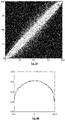
- the solid line curve corresponds to a projection of the figure 2A on the abscissa axis. This corresponds to an allocation probability distribution of each “virtual” position along the X axis during irradiation of a pixel with spatially homogeneous radiation.
- the abscissa axis corresponds to a position inside the pixel, the abscissa 0 corresponding to the center of the pixel and the abscissa 0.5 and -0.5 correspond to the left and right borders of the pixel.
- the ordinate axis corresponds to the probability that a virtual pixel, corresponding to the abscissa, is considered, by the sub-pixelation unit 14, as corresponding to the position of an interaction, whereas the spatial distribution of the irradiation is homogeneous. It is observed that the sub-pixelation unit 14 tends to overestimate the number of interactions considered as positioned at the center of the pixel, to the detriment of the number of interactions considered as positioned at the edge of each pixel. In other words, the central virtual pixels (ie at the center of a pixel) have a higher sensitivity than the peripheral virtual pixels (ie at the periphery of a pixel).
- the dotted line shows the probability distribution of the position assigned to each interaction in the case of a sub-pixelation unit exhibiting uniform spatial sensitivity.
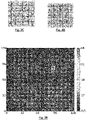
- the figures 2C and 2D represent part of a sub-pixelated gamma image, ie resulting from the sub-pixelation unit 14, a grid of black lines materializing the contours of different pixels.
- each virtual pixel corresponds to a point.
- the figures 2C and 2D result from simulations considering homogeneous irradiation.
- the Fig. 2C corresponds to the actual position of the interactions.
- the 2D figure shows the positions of the interactions by implementing the sub-pixelation unit 14. In these figures, the darker the level of gray, the greater the quantity of interactions detected.
- the sub-pixelation unit induces dithering of the gamma image: the virtual pixels located at the center of each pixel are overweighted, to the detriment of the virtual pixels located at the edge of the pixels. This is the consequence of the spatial distribution represented on the figure 2B .
- the figure 2E is a gamma G image of uniform radiation, mainly emitted by 60 Co, (1173 keV and 1332 keV). This is an image acquired on site, comprising a contribution of scattered radiation.
- the figures 2A to 2E reflect the fact that the sub-pixelation unit 14 is assigned a non-uniform spatial sensitivity function, the sensitivity of the virtual pixels at the center of each pixel being greater than the sensitivity of the peripheral virtual pixels, the latter being adjacent to the borders of each pixel.
- a first solution consists in exposing the gamma camera to homogeneous radiation, so as to form a calibration image, taking into account the response function.
- This is a technically simple solution, but difficult to implement.
- the spatial sensitivity function depends on the energy of the incident radiation.
- the energy of the incident radiation can vary, depending on the isotopes composing the irradiating sources.
- it is difficult to predict, in particular when the irradiating sources are composed of several isotopes, in variable and unknown proportions, and/or when the irradiation to which the gamma camera is exposed comprises a high proportion of scattered radiation.
- the inventor proposes a method for determining a spatial sensitivity function.
- the spatial sensitivity function allows correction of the non-homogeneous spatial response of the sub-pixelation unit 14.
- the correction can be implemented in the field, without recourse to homogeneous calibration radiation.
- a particularly important aspect is that the spatial sensitivity function can be deduced from the gamma image acquired by the gamma camera, and intended to be the subject of a reconstruction, so as to obtain the position of the irradiating sources in the field of 'observation.
- the method does not assume a calibration image previously acquired under laboratory conditions.
- the calibration image can be made from the gamma image acquired by the camera, in the field.
- the Figure 3A outlines the main stages of the process, the latter being described below.
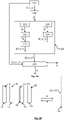
- the Figure 3B represents the different quantities used and schematizes the response functions, spatial or spectral, respectively associated with the collimator 10, with the sub-pixelation unit 14, and with the spectrometry circuit 15.
- Step 100 detection of interactions.
- the gamma camera 1 is placed in an observation field ⁇ potentially comprising irradiating sources 5.
- the sub-pixelation unit 14 assigns each detected interaction to a virtual pixel 13 i,j , of coordinate ( x , y ).
- G ( x,y ) of interactions assigned to each virtual pixel was obtained.
- Step 110 formation of a gamma G image.
- the quantities G ( x,y ) assigned to each pixel can be collected and ordered as a gamma G image.
- Each gamma G image is defined along rows and columns.
- the figure 4A is an example of a 128 x 128 pixel G-gamma image.
- the value G ( x,y ) of the gamma image, for each virtual pixel of position ( x,y ) corresponds to the number of interactions detected and positioned in the virtual pixel.
- Step 120 Determination of a weight H ( x,y ) for each virtual pixel.
- step 120 determines a weight H ( x,y ) for each virtual pixel.
- the weight H ( x,y ) is representative of a sensitivity of the gamma camera for each virtual pixel. In the example described, the higher the weight, the higher the sensitivity of the virtual pixel: this corresponds to the fact that the probability of assigning an interaction at the level of the virtual pixel is high.
- the weight H ( x,y ) is an estimate of a probability that an interaction, whose coordinates, on the detection surface 12, is assigned to said virtual pixel 13 ij with coordinates ( x , y ). When the spatial sensitivity function of the sub-pixelation unit 14 is homogeneous, the probability is equal for all the virtual pixels 13 ij .
- the calibration image H is defined for each virtual pixel 13 i,j .
- Each point H ( x,y ) of the calibration image H is a weight H ( x,y ) assigned to the virtual pixel with coordinates ( x , y ).
- a first embodiment is described in connection with sub-steps 121 to 123.
- a second embodiment is described in connection with sub-steps 125 to 126.
- Sub-step 121 formation of a first vector H X , representative of the total quantity of interactions G ( x,y ) detected in the virtual pixels of each column (same coordinate y ).
- a first vector H X is established.
- the first vector H X is determined for different columns of virtual pixels, which corresponds to different columns of the gamma image G.
- Each term H X ( y ) of the first vector is designated “first term”.
- Each first term H X ( y ) is associated with a column of virtual pixels.
- Each first term corresponds to a number of interactions assigned to virtual pixels of the same column.
- the dimension of H X is ( N y , 1), where N y is the number of columns of virtual pixels.
- the vector H X can be considered as a projection of the gamma image G, along the Y axis, onto the X axis.
- the figure 4B is a graphic representation of a first vector H X established according to the gamma image represented on the figure 4A .
- the abscissa axis corresponds to a rank of each term of the first vector H X , comprised between 1 and 128.
- the ordinate axis corresponds to the value of each first term of the first vector.
- Sub-step 122 formation of a second vector H Y , representative of the total quantity of interactions G ( x,y ) detected in the virtual pixels of each line (same x coordinate).
- a second vector H Y is established from the quantities of interaction G(x,y) detected by each virtual-pixel.
- the second vector H Y is determined for different lines of virtual pixels, which corresponds to different lines of the gamma image G.
- Each term H Y ( x ) of the second vector is designated “second term”.
- Each second term H Y ( x ) is associated with a line of virtual pixels.
- Each second term corresponds to a number of interactions assigned to virtual pixels of the same row.
- the dimension of H Y is (1, N x ) .
- the vector H Y can be considered as a projection of the gamma image G, along the X axis, onto the Y axis.
- the Fig. 4C is a graphic representation of a second vector H Y , established according to the gamma image represented on the figure 4A .
- the abscissa axis corresponds to a rank of each term of the vector H Y , between 1 and 128.
- the ordinate axis corresponds to the value of each term.
- Sub-step 123 Form sensitivity matrix
- H XY H X ⁇ H Y ⁇ is the “dyadic product” operator.
- the H XY matrix is preferably normalized by the mean H XY ⁇ x there of the set of terms H XY ( x, y).
- the sensitivity matrix H is of the same size as the gamma image G.
- Each term H ( x,y ) of the sensitivity matrix H corresponds to a weight, assigned to the virtual pixel of coordinates (x, y).
- the 4D figure shows a sensitivity matrix H established by combining the vectors H X and H Y . It can be observed that the sensitivity matrix H highlights the dithering of the gamma images discussed above.
- the sensitivity matrix H has horizontal or vertical dark lines, which correspond to areas in which the weight H ( x,y ) assigned to each virtual pixel is low.
- each group of virtual pixels brings together virtual pixels of the same rank.
- Sub-step 125 From the quantities of interaction G ( x,y ) detected by each virtual pixel, resulting from step 100, an average of the value of the virtual pixels of the same rank is calculated.
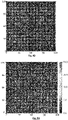
- the figure 5A shows another example of a gamma G image, acquired in the field, with a significant amount of scattered radiation.
- the figure 5B shows an average image H ′, each point of which corresponds to an average of the virtual pixels of the same rank of the gamma image G.
- the average image H′ comprises J points, J corresponding to the number of virtual pixels per pixel.
- mean is the mean operator.
- the figure 5B represents an average image H ′ obtained from the gamma image represented on the figure 5A .
- Sub-step 126 from the average image H′, formation of the calibration image H by concatenation of the average image: the average image H ′ is duplicated N Xi times along the axis X and N Yi times along the Y axis, N Xi and N Yi denoting the number of pixels 12 i per row and column respectively of the detection surface 12.
- a calibration image H of the same size as the gamma image G is thus obtained.
- Fig. 5C represents an example of a calibration image obtained by concatenation of an average image H′.
- the embodiment described in connection with sub-steps 125 and 126 assumes a certain spatial homogeneity of the radiation detected by the gamma camera. This embodiment is particularly suitable for correcting non-uniformities resulting from the sub-pixelation unit.
- Step 120 makes it possible to define, for each virtual pixel, a weight H ( x,y ) which is then used to process the quantities of interactions G ( x,y ) or G E ( x,y ) assigned to each pixel virtual during the exposure, and stored in the memory 16.
- the processing aims to form an object image O of the field of observation ⁇ .
- object image is meant a spatial distribution of irradiating sources in the observation field ⁇ .
- an image is formed object O k representative of a spatial distribution of irradiating sources comprising an isotope k .
- the processing carried out by the processing unit 18 is relatively simple. Indeed, the gamma image allows an immediate representation of the object image.
- the processing can be a simple normalization of the gamma image G by the calibration image H .
- the gamma camera 1 comprises a collimator 10 with a coded mask.
- This type of collimator is known to those skilled in the art. With this type of collimator, the image acquired by the imager does not allow a direct representation of the irradiating sources in the field of observation.
- the gamma image G undergoes processing, taking into account a response function of the camera, so as to make it possible to obtain an image of the field of observation, representative of the position of the sources in the field of observation ⁇ .
- the transition from the gamma image, representative of a quantity of interactions detected by each virtual pixel, after application of the spatial sensitivity function, to the image O of the observation field ⁇ is described below.
- the image O is discretized into different coordinates ( u , v ).
- Step 130 rebuild
- the general form of the spatial response function of the gamma camera is M ( x,y,u,v ) .
- the coordinates u , v are spatial coordinates.
- the coordinates u , v are angular coordinates, corresponding to the angles of incidence of the detected radiation.
- Expression (10) supposes that the field of observation is considered as a surface S ⁇ , called object surface, discretized according to coordinates ( u, v).
- the passage from the detection surface 12 to the object surface S ⁇ is a back-projection R, of the gamma image G, onto the object surface.
- the passage from the object surface S ⁇ to the detection surface 12 is a projection P of the object image O onto the detection surface 12.
- Expression (10) corresponds to a projection P.
- the objective of the reconstruction step is to estimate ⁇ k ( u, v ) from one or more gamma images G E , respectively determined in one or more energy bands E.
- the estimation of ⁇ k ( u,v ) assumes knowing the spatial response M, the spectral response S and the sensitivity matrix H, resulting from step 120, and representing the spatial sensitivity function.
- O ⁇ k a v ⁇ E , x , there p k , a , v
- E, x, y ) is a probability of presence of an isotope k at position ( u, v ) knowing a measure of an interaction in an energy band E by the virtual pixel (x, y).
- This probability can be estimated by applying Bayes' theorem p k , a , v
- E , x , there p E , x , there
- the estimation ⁇ k ( u, v ) can be performed iteratively.
- Each iteration, of rank n aims to estimate Oh k not + 1 a v from a previous estimate Oh k not a v .
- the initial estimate can for example be uniform distribution of the k isotope on the object surface.
- the iterations are carried out until an iteration stopping criterion is reached.
- the criterion for stopping the iterations can be a predetermined number of iterations or an error criterion considered to be sufficiently low.
- the error criterion can be an error between the acquired image G E and the projection ⁇ E of Oh k not a v on the detection surface, the projection ⁇ E being obtained from the expression (12). It may be a quadratic error or a kullback-Leibler divergence between the acquired image G E and the projection ⁇ E .
- S ( k , E l ) corresponds to an energy component of the probability w k.l. not while ⁇ a , v M a ⁇ x I , v ⁇ there I Oh k not a v corresponds to a spatial component of the probability w k.l. not .
- Equation (27) corresponds to a back projection of the relative error term ⁇ k not in the field of observation ⁇ , by convolution with the response function M of the collimator.
- Equation (26) is a spatial distribution update equation Oh k not a v of the isotope k in the observation field, at each iteration n.
- the previously described reconstruction process shows that the sensitivity matrix H is taken into account to compensate for the non-uniformity of the sensitivity of the gamma camera, following the sub-pixelation process.
- the weight H(x, y) thus makes it possible to weight the consideration of interactions positioned at the coordinates (x, y). So, depending on the value of H ( x,y), the lower the value of H ( x,y ), the greater the weight p k.l. not assigned to an interaction positioned at ( x, y ) is important. This allows an overweighting of interactions detected at coordinates at which the value of H ( x,y ) is low.
- steps 120 as well as 130 are carried out from the interactions detected during step 100.
- the reconstruction of the object image O is carried out using interactions G ( x, y ) detected having been used to form the sensitivity matrix H.
- the sensitivity matrix H is updated periodically. Between two updates, the gamma camera is exposed to different fields of observation. During each acquisition period, the object image is reconstructed using a previously determined sensitivity matrix H.
- the reconstruction step 130 can be implemented using previously established weights H ( x,y ), from a gamma image different from that on the basis of which the reconstruction step is carried out. It is however preferable to use a calibration function H determined by exposing the gamma camera to radiation comparable, from the energy point of view, to the radiation to which the gamma camera is exposed during the acquisition of the gamma image forming the object of reconstruction.
- a notable advantage of the invention is that the weights H ( x,y ) can be updated, during each acquisition of a gamma image, which makes it possible to take into account the uniformity of detection by taking into account take into account the conditions of acquisition. In particular, this makes it possible to take into account effects induced by irradiating sources located outside the field of observation, but which may have an influence on the acquired image.
- the sensitivity matrix, resulting from step 120 can be used to compensate for a non-uniform sensitivity resulting from the sub-pixelation unit, but also to compensate for an influence of out-of-field irradiating sources or another cause of non- - uniformity of sensitivity, for example a defect in the detector material.
- a gamma camera comprising a semiconductor detector of the CdZnTe type, with a thickness of 6 mm having a matrix of 16x16 pixels with a side of 2.5 mm, each pixel being sub-pixelated into 8x8 virtual pixels: the detection surface was segmented into 128x128 virtual pixels.
- the observation field consisted mainly of 60 Co sources, with a significant contribution of scattered radiation.
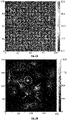
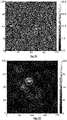
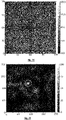
- the reconstructed image includes artifacts, marked by arrows on the figure 7B .
- the actual irradiating source is surrounded by dotted lines on the figure 7B .
- the 7D figures and 7F show that the implementation of the invention makes it possible to limit the presence of artefacts.
- the irradiating source is localized with a significantly improved signal to noise ratio.
- the invention allows a weighting of the quantity of interactions detected by each virtual pixel upstream of the reconstruction. It is particularly advantageous when the collimator is of the coded mask type, for which the non-uniformity of the detection sensitivity can generate reconstruction artifacts, as represented on the figure 7B .
- a notable advantage of the invention is that the weights assigned to each virtual pixel can be determined using detection signal acquisition while the gamma camera is deployed in the field, without requiring laboratory conditions, in which the irradiation of each virtual pixel is uniform. Since the spatial sensitivity function is liable to vary as a function of the energy of the radiation to which the gamma camera is exposed, the possibility of establishing a spatial sensitivity function as a function of the conditions actually encountered on the ground is particularly advantageous. Indeed, these conditions are difficult to predict and reproduce in the laboratory, in particular in the event of the presence of a strong contribution of scattered radiation.
- the weights assigned to each virtual pixel can be updated regularly, using gamma images acquired in the field.
- the same spatial sensitivity function H can be used to carry out a reconstruction of an object image from a gamma image acquired before or after the determination of the spatial sensitivity function.
- the radiation to which the gamma camera is exposed, during the acquisition of the gamma image be comparable, from the energy point of view, to the radiation having been detected during the establishment of the function of spatial sensitivity used during the reconstruction.
- the embodiment described in connection with steps 121 to 123 can be implemented on a gamma camera whose pixels are of small size, for example less than mm 2 . Subdivision into virtual pixels is not necessary.
- the sensitivity matrix H can be constituted by taking into account the interactions assigned to each pixel, and by grouping said pixels according to rows of pixels and columns of pixels. Expressions (1) and (2) are carried out by taking into account the pixels of the same column and of the same row respectively. A sensitivity matrix defined for each pixel is then obtained, a weight being determined for each pixel.
- the recourse to the sensitivity matrix can make it possible to take into account a non-uniform sensitivity of the gamma camera, due to the presence of out-of-field sources or of local defects of the detector material.
Landscapes
- Physics & Mathematics (AREA)
- General Physics & Mathematics (AREA)
- Health & Medical Sciences (AREA)
- Life Sciences & Earth Sciences (AREA)
- High Energy & Nuclear Physics (AREA)
- Molecular Biology (AREA)
- Spectroscopy & Molecular Physics (AREA)
- Engineering & Computer Science (AREA)
- Theoretical Computer Science (AREA)
- Biomedical Technology (AREA)
- Medical Informatics (AREA)
- Nuclear Medicine, Radiotherapy & Molecular Imaging (AREA)
- Optics & Photonics (AREA)
- General Health & Medical Sciences (AREA)
- Nuclear Medicine (AREA)
- Measurement Of Radiation (AREA)
- Photometry And Measurement Of Optical Pulse Characteristics (AREA)
- Investigating Or Analysing Materials By Optical Means (AREA)
- Studio Devices (AREA)
Priority Applications (1)
| Application Number | Priority Date | Filing Date | Title |
|---|---|---|---|
| EP24154554.0A EP4361684B1 (de) | 2021-07-14 | 2022-07-13 | Verfahren zur erzeugung eines gammabildes unter berücksichtigung einer räumlichen ungleichförmigkeit der empfindlichkeit |
Applications Claiming Priority (1)
| Application Number | Priority Date | Filing Date | Title |
|---|---|---|---|
| FR2107628A FR3125338B1 (fr) | 2021-07-14 | 2021-07-14 | Procédé de formation d’une image gamma sous-pixellisée, prenant en compte une non uniformité spatiale de la sensibilité. |
Related Child Applications (2)
| Application Number | Title | Priority Date | Filing Date |
|---|---|---|---|
| EP24154554.0A Division EP4361684B1 (de) | 2021-07-14 | 2022-07-13 | Verfahren zur erzeugung eines gammabildes unter berücksichtigung einer räumlichen ungleichförmigkeit der empfindlichkeit |
| EP24154554.0A Division-Into EP4361684B1 (de) | 2021-07-14 | 2022-07-13 | Verfahren zur erzeugung eines gammabildes unter berücksichtigung einer räumlichen ungleichförmigkeit der empfindlichkeit |
Publications (2)
| Publication Number | Publication Date |
|---|---|
| EP4119989A1 true EP4119989A1 (de) | 2023-01-18 |
| EP4119989B1 EP4119989B1 (de) | 2024-03-13 |
Family
ID=78827626
Family Applications (2)
| Application Number | Title | Priority Date | Filing Date |
|---|---|---|---|
| EP22184628.0A Active EP4119989B1 (de) | 2021-07-14 | 2022-07-13 | Verfahren zur bildung eines subpixel-gammabildes, das eine räumliche ungleichmässigkeit der empfindlichkeit berücksichtigt |
| EP24154554.0A Active EP4361684B1 (de) | 2021-07-14 | 2022-07-13 | Verfahren zur erzeugung eines gammabildes unter berücksichtigung einer räumlichen ungleichförmigkeit der empfindlichkeit |
Family Applications After (1)
| Application Number | Title | Priority Date | Filing Date |
|---|---|---|---|
| EP24154554.0A Active EP4361684B1 (de) | 2021-07-14 | 2022-07-13 | Verfahren zur erzeugung eines gammabildes unter berücksichtigung einer räumlichen ungleichförmigkeit der empfindlichkeit |
Country Status (4)
| Country | Link |
|---|---|
| US (1) | US12085683B2 (de) |
| EP (2) | EP4119989B1 (de) |
| CN (1) | CN115619885A (de) |
| FR (1) | FR3125338B1 (de) |
Citations (2)
| Publication number | Priority date | Publication date | Assignee | Title |
|---|---|---|---|---|
| US20110155918A1 (en) * | 2009-12-30 | 2011-06-30 | Jean-Paul Bouhnik | Systems and methods for providing a shared charge in pixelated image detectors |
| US20150260854A1 (en) * | 2012-10-08 | 2015-09-17 | Commissariat A L'energie Atomique Et Aux Energies Alternatives | Method and device for detecting ionising radiation using a pixelated photodetector |
Family Cites Families (1)
| Publication number | Priority date | Publication date | Assignee | Title |
|---|---|---|---|---|
| US9696440B2 (en) * | 2015-02-20 | 2017-07-04 | General Electric Company | Systems and methods for improving energy resolution by sub-pixel energy calibration |
-
2021
- 2021-07-14 FR FR2107628A patent/FR3125338B1/fr not_active Expired - Fee Related
-
2022
- 2022-07-13 EP EP22184628.0A patent/EP4119989B1/de active Active
- 2022-07-13 EP EP24154554.0A patent/EP4361684B1/de active Active
- 2022-07-14 CN CN202210834241.0A patent/CN115619885A/zh active Pending
- 2022-07-14 US US17/864,548 patent/US12085683B2/en active Active
Patent Citations (3)
| Publication number | Priority date | Publication date | Assignee | Title |
|---|---|---|---|---|
| US20110155918A1 (en) * | 2009-12-30 | 2011-06-30 | Jean-Paul Bouhnik | Systems and methods for providing a shared charge in pixelated image detectors |
| US20150260854A1 (en) * | 2012-10-08 | 2015-09-17 | Commissariat A L'energie Atomique Et Aux Energies Alternatives | Method and device for detecting ionising radiation using a pixelated photodetector |
| US9322937B2 (en) | 2012-10-08 | 2016-04-26 | Commissariat à l'énergie atomique et aux énergies alternatives | Method and device for detecting ionising radiation using a pixelated photodetector |
Non-Patent Citations (3)
| Title |
|---|
| MONTEMONT ET AL.: "Studying spatial resolution of CZT detectors using sub-pixel positioning for SPECT", IEEE TRANSACTIONS ON NUCLEAR SCIENCE, vol. 61, no. 5, October 2014 (2014-10-01), XP011561020, DOI: 10.1109/TNS.2014.2356293 |
| WARBURTON W.K, AN APPROACH TO SUB-PIXEL SPATIAL RESOLUTION IN ROOM TEMPERATURE X-RAY DETECTOR ARRAYS WITH GOOD ENERGY RESOLUTION |
| YUEFENG ZHU ET AL: "Sub-Pixel Position Sensing for Pixelated, 3-D Position Sensitive, Wide Band-Gap, Semiconductor, Gamma-Ray Detectors", IEEE TRANSACTIONS ON NUCLEAR SCIENCE, IEEE, USA, vol. 58, no. 3, 1 June 2011 (2011-06-01), pages 1400 - 1409, XP011355585, ISSN: 0018-9499, DOI: 10.1109/TNS.2011.2132738 * |
Also Published As
| Publication number | Publication date |
|---|---|
| FR3125338B1 (fr) | 2023-11-03 |
| US12085683B2 (en) | 2024-09-10 |
| EP4361684B1 (de) | 2026-05-06 |
| US20230016263A1 (en) | 2023-01-19 |
| CN115619885A (zh) | 2023-01-17 |
| EP4119989B1 (de) | 2024-03-13 |
| FR3125338A1 (fr) | 2023-01-20 |
| EP4361684A2 (de) | 2024-05-01 |
| EP4361684A3 (de) | 2024-06-19 |
Similar Documents
| Publication | Publication Date | Title |
|---|---|---|
| US9916656B2 (en) | Method for processing radiographic image and radiography system | |
| EP2397870B1 (de) | Photonendetektor, und Verfahren zur Dimensionierung und Benutzung eines solchen Detektors | |
| Muñoz et al. | A spectral reconstruction algorithm for two-plane Compton cameras | |
| US11783519B2 (en) | Collimators for medical imaging systems and image reconstruction methods thereof | |
| Daniel et al. | Application of a deep learning algorithm to Compton imaging of radioactive point sources with a single planar CdTe pixelated detector | |
| JP6656891B2 (ja) | X線ct装置、画像処理装置およびプログラム | |
| EP3828597B1 (de) | Verfahren zur schätzung einer dosisrate auf der grundlage eines spektralbilds | |
| EP4119989B1 (de) | Verfahren zur bildung eines subpixel-gammabildes, das eine räumliche ungleichmässigkeit der empfindlichkeit berücksichtigt | |
| US20220122300A1 (en) | Calibration method for a spectral computerized tomography system | |
| US20250069292A1 (en) | Method for forming and processing a gamma image | |
| EP3851837B1 (de) | Verfahren zur bestimmung einer funktion der spektralen empfindlichkeit eines röntgen- oder gammastrahlenmesssystems | |
| Marks et al. | Improving performance of a CdZnTe imaging array by mapping the detector with gamma rays | |
| FR3131393A1 (fr) | Procédé de formation d’une image gamma, par combinaison entre modalité d’imagerie compton et masque codé . | |
| Goodman et al. | Angular Detection and Shielding Characterization of Simulated 235U Using Time Encoded Imaging and 3D Position Sensitive CdZnTe Detectors | |
| EP3864624A1 (de) | Verfahren zur korrektur eines spektralbildes | |
| Nikolopoulou et al. | Improving Planar Imaging for Semi-Pixelated Scintillation Crystals | |
| Kim et al. | Pseudo-Random Pattern Design and Monte Carlo Evaluation of an Active Coded-Aperture Gamma-Ray Imager | |
| Roy et al. | Optimization of photon counting detector module arrangement to maximize CT image quality using measurement-based image synthesis model | |
| Conde et al. | Noise rejection in Monolithic PET detectors | |
| Polack et al. | Spectrum Isolation in Multi-Source Image Reconstruction Using a Dual-Particle Imager. | |
| FR2737580A1 (fr) | Images de camera a rayons gamma presentant des artefacts reduits | |
| FR2679089A1 (fr) | Images de camera a rayons gamma presentant des artefacts reduits. |
Legal Events
| Date | Code | Title | Description |
|---|---|---|---|
| PUAI | Public reference made under article 153(3) epc to a published international application that has entered the european phase |
Free format text: ORIGINAL CODE: 0009012 |
|
| STAA | Information on the status of an ep patent application or granted ep patent |
Free format text: STATUS: REQUEST FOR EXAMINATION WAS MADE |
|
| 17P | Request for examination filed |
Effective date: 20220713 |
|
| AK | Designated contracting states |
Kind code of ref document: A1 Designated state(s): AL AT BE BG CH CY CZ DE DK EE ES FI FR GB GR HR HU IE IS IT LI LT LU LV MC MK MT NL NO PL PT RO RS SE SI SK SM TR |
|
| GRAP | Despatch of communication of intention to grant a patent |
Free format text: ORIGINAL CODE: EPIDOSNIGR1 |
|
| STAA | Information on the status of an ep patent application or granted ep patent |
Free format text: STATUS: GRANT OF PATENT IS INTENDED |
|
| INTG | Intention to grant announced |
Effective date: 20230927 |
|
| GRAS | Grant fee paid |
Free format text: ORIGINAL CODE: EPIDOSNIGR3 |
|
| GRAA | (expected) grant |
Free format text: ORIGINAL CODE: 0009210 |
|
| STAA | Information on the status of an ep patent application or granted ep patent |
Free format text: STATUS: THE PATENT HAS BEEN GRANTED |
|
| AK | Designated contracting states |
Kind code of ref document: B1 Designated state(s): AL AT BE BG CH CY CZ DE DK EE ES FI FR GB GR HR HU IE IS IT LI LT LU LV MC MK MT NL NO PL PT RO RS SE SI SK SM TR |
|
| REG | Reference to a national code |
Ref country code: GB Ref legal event code: FG4D Free format text: NOT ENGLISH |
|
| REG | Reference to a national code |
Ref country code: CH Ref legal event code: EP |
|
| REG | Reference to a national code |
Ref country code: DE Ref legal event code: R096 Ref document number: 602022002341 Country of ref document: DE |
|
| REG | Reference to a national code |
Ref country code: IE Ref legal event code: FG4D Free format text: LANGUAGE OF EP DOCUMENT: FRENCH |
|
| PG25 | Lapsed in a contracting state [announced via postgrant information from national office to epo] |
Ref country code: LT Free format text: LAPSE BECAUSE OF FAILURE TO SUBMIT A TRANSLATION OF THE DESCRIPTION OR TO PAY THE FEE WITHIN THE PRESCRIBED TIME-LIMIT Effective date: 20240313 |
|
| REG | Reference to a national code |
Ref country code: LT Ref legal event code: MG9D |
|
| PG25 | Lapsed in a contracting state [announced via postgrant information from national office to epo] |
Ref country code: GR Free format text: LAPSE BECAUSE OF FAILURE TO SUBMIT A TRANSLATION OF THE DESCRIPTION OR TO PAY THE FEE WITHIN THE PRESCRIBED TIME-LIMIT Effective date: 20240614 |
|
| REG | Reference to a national code |
Ref country code: NL Ref legal event code: MP Effective date: 20240313 |
|
| PG25 | Lapsed in a contracting state [announced via postgrant information from national office to epo] |
Ref country code: HR Free format text: LAPSE BECAUSE OF FAILURE TO SUBMIT A TRANSLATION OF THE DESCRIPTION OR TO PAY THE FEE WITHIN THE PRESCRIBED TIME-LIMIT Effective date: 20240313 Ref country code: RS Free format text: LAPSE BECAUSE OF FAILURE TO SUBMIT A TRANSLATION OF THE DESCRIPTION OR TO PAY THE FEE WITHIN THE PRESCRIBED TIME-LIMIT Effective date: 20240613 |
|
| PG25 | Lapsed in a contracting state [announced via postgrant information from national office to epo] |
Ref country code: ES Free format text: LAPSE BECAUSE OF FAILURE TO SUBMIT A TRANSLATION OF THE DESCRIPTION OR TO PAY THE FEE WITHIN THE PRESCRIBED TIME-LIMIT Effective date: 20240313 |
|
| PG25 | Lapsed in a contracting state [announced via postgrant information from national office to epo] |
Ref country code: RS Free format text: LAPSE BECAUSE OF FAILURE TO SUBMIT A TRANSLATION OF THE DESCRIPTION OR TO PAY THE FEE WITHIN THE PRESCRIBED TIME-LIMIT Effective date: 20240613 Ref country code: NO Free format text: LAPSE BECAUSE OF FAILURE TO SUBMIT A TRANSLATION OF THE DESCRIPTION OR TO PAY THE FEE WITHIN THE PRESCRIBED TIME-LIMIT Effective date: 20240613 Ref country code: LT Free format text: LAPSE BECAUSE OF FAILURE TO SUBMIT A TRANSLATION OF THE DESCRIPTION OR TO PAY THE FEE WITHIN THE PRESCRIBED TIME-LIMIT Effective date: 20240313 Ref country code: HR Free format text: LAPSE BECAUSE OF FAILURE TO SUBMIT A TRANSLATION OF THE DESCRIPTION OR TO PAY THE FEE WITHIN THE PRESCRIBED TIME-LIMIT Effective date: 20240313 Ref country code: GR Free format text: LAPSE BECAUSE OF FAILURE TO SUBMIT A TRANSLATION OF THE DESCRIPTION OR TO PAY THE FEE WITHIN THE PRESCRIBED TIME-LIMIT Effective date: 20240614 Ref country code: FI Free format text: LAPSE BECAUSE OF FAILURE TO SUBMIT A TRANSLATION OF THE DESCRIPTION OR TO PAY THE FEE WITHIN THE PRESCRIBED TIME-LIMIT Effective date: 20240313 Ref country code: ES Free format text: LAPSE BECAUSE OF FAILURE TO SUBMIT A TRANSLATION OF THE DESCRIPTION OR TO PAY THE FEE WITHIN THE PRESCRIBED TIME-LIMIT Effective date: 20240313 Ref country code: BG Free format text: LAPSE BECAUSE OF FAILURE TO SUBMIT A TRANSLATION OF THE DESCRIPTION OR TO PAY THE FEE WITHIN THE PRESCRIBED TIME-LIMIT Effective date: 20240313 |
|
| REG | Reference to a national code |
Ref country code: AT Ref legal event code: MK05 Ref document number: 1666271 Country of ref document: AT Kind code of ref document: T Effective date: 20240313 |
|
| PG25 | Lapsed in a contracting state [announced via postgrant information from national office to epo] |
Ref country code: SE Free format text: LAPSE BECAUSE OF FAILURE TO SUBMIT A TRANSLATION OF THE DESCRIPTION OR TO PAY THE FEE WITHIN THE PRESCRIBED TIME-LIMIT Effective date: 20240313 Ref country code: LV Free format text: LAPSE BECAUSE OF FAILURE TO SUBMIT A TRANSLATION OF THE DESCRIPTION OR TO PAY THE FEE WITHIN THE PRESCRIBED TIME-LIMIT Effective date: 20240313 |
|
| PG25 | Lapsed in a contracting state [announced via postgrant information from national office to epo] |
Ref country code: NL Free format text: LAPSE BECAUSE OF FAILURE TO SUBMIT A TRANSLATION OF THE DESCRIPTION OR TO PAY THE FEE WITHIN THE PRESCRIBED TIME-LIMIT Effective date: 20240313 |
|
| PG25 | Lapsed in a contracting state [announced via postgrant information from national office to epo] |
Ref country code: NL Free format text: LAPSE BECAUSE OF FAILURE TO SUBMIT A TRANSLATION OF THE DESCRIPTION OR TO PAY THE FEE WITHIN THE PRESCRIBED TIME-LIMIT Effective date: 20240313 |
|
| PG25 | Lapsed in a contracting state [announced via postgrant information from national office to epo] |
Ref country code: IS Free format text: LAPSE BECAUSE OF FAILURE TO SUBMIT A TRANSLATION OF THE DESCRIPTION OR TO PAY THE FEE WITHIN THE PRESCRIBED TIME-LIMIT Effective date: 20240713 |
|
| PG25 | Lapsed in a contracting state [announced via postgrant information from national office to epo] |
Ref country code: SM Free format text: LAPSE BECAUSE OF FAILURE TO SUBMIT A TRANSLATION OF THE DESCRIPTION OR TO PAY THE FEE WITHIN THE PRESCRIBED TIME-LIMIT Effective date: 20240313 Ref country code: PT Free format text: LAPSE BECAUSE OF FAILURE TO SUBMIT A TRANSLATION OF THE DESCRIPTION OR TO PAY THE FEE WITHIN THE PRESCRIBED TIME-LIMIT Effective date: 20240715 |
|
| PG25 | Lapsed in a contracting state [announced via postgrant information from national office to epo] |
Ref country code: EE Free format text: LAPSE BECAUSE OF FAILURE TO SUBMIT A TRANSLATION OF THE DESCRIPTION OR TO PAY THE FEE WITHIN THE PRESCRIBED TIME-LIMIT Effective date: 20240313 Ref country code: CZ Free format text: LAPSE BECAUSE OF FAILURE TO SUBMIT A TRANSLATION OF THE DESCRIPTION OR TO PAY THE FEE WITHIN THE PRESCRIBED TIME-LIMIT Effective date: 20240313 |
|
| PG25 | Lapsed in a contracting state [announced via postgrant information from national office to epo] |
Ref country code: AT Free format text: LAPSE BECAUSE OF FAILURE TO SUBMIT A TRANSLATION OF THE DESCRIPTION OR TO PAY THE FEE WITHIN THE PRESCRIBED TIME-LIMIT Effective date: 20240313 |
|
| PG25 | Lapsed in a contracting state [announced via postgrant information from national office to epo] |
Ref country code: PL Free format text: LAPSE BECAUSE OF FAILURE TO SUBMIT A TRANSLATION OF THE DESCRIPTION OR TO PAY THE FEE WITHIN THE PRESCRIBED TIME-LIMIT Effective date: 20240313 |
|
| PG25 | Lapsed in a contracting state [announced via postgrant information from national office to epo] |
Ref country code: SK Free format text: LAPSE BECAUSE OF FAILURE TO SUBMIT A TRANSLATION OF THE DESCRIPTION OR TO PAY THE FEE WITHIN THE PRESCRIBED TIME-LIMIT Effective date: 20240313 |
|
| RAP4 | Party data changed (patent owner data changed or rights of a patent transferred) |
Owner name: COMMISSARIAT A L'ENERGIE ATOMIQUE ET AUX ENERGIESALTERNATIVES |
|
| PG25 | Lapsed in a contracting state [announced via postgrant information from national office to epo] |
Ref country code: SM Free format text: LAPSE BECAUSE OF FAILURE TO SUBMIT A TRANSLATION OF THE DESCRIPTION OR TO PAY THE FEE WITHIN THE PRESCRIBED TIME-LIMIT Effective date: 20240313 Ref country code: SK Free format text: LAPSE BECAUSE OF FAILURE TO SUBMIT A TRANSLATION OF THE DESCRIPTION OR TO PAY THE FEE WITHIN THE PRESCRIBED TIME-LIMIT Effective date: 20240313 Ref country code: RO Free format text: LAPSE BECAUSE OF FAILURE TO SUBMIT A TRANSLATION OF THE DESCRIPTION OR TO PAY THE FEE WITHIN THE PRESCRIBED TIME-LIMIT Effective date: 20240313 Ref country code: PT Free format text: LAPSE BECAUSE OF FAILURE TO SUBMIT A TRANSLATION OF THE DESCRIPTION OR TO PAY THE FEE WITHIN THE PRESCRIBED TIME-LIMIT Effective date: 20240715 Ref country code: PL Free format text: LAPSE BECAUSE OF FAILURE TO SUBMIT A TRANSLATION OF THE DESCRIPTION OR TO PAY THE FEE WITHIN THE PRESCRIBED TIME-LIMIT Effective date: 20240313 Ref country code: IS Free format text: LAPSE BECAUSE OF FAILURE TO SUBMIT A TRANSLATION OF THE DESCRIPTION OR TO PAY THE FEE WITHIN THE PRESCRIBED TIME-LIMIT Effective date: 20240713 Ref country code: EE Free format text: LAPSE BECAUSE OF FAILURE TO SUBMIT A TRANSLATION OF THE DESCRIPTION OR TO PAY THE FEE WITHIN THE PRESCRIBED TIME-LIMIT Effective date: 20240313 Ref country code: CZ Free format text: LAPSE BECAUSE OF FAILURE TO SUBMIT A TRANSLATION OF THE DESCRIPTION OR TO PAY THE FEE WITHIN THE PRESCRIBED TIME-LIMIT Effective date: 20240313 Ref country code: AT Free format text: LAPSE BECAUSE OF FAILURE TO SUBMIT A TRANSLATION OF THE DESCRIPTION OR TO PAY THE FEE WITHIN THE PRESCRIBED TIME-LIMIT Effective date: 20240313 |
|
| PG25 | Lapsed in a contracting state [announced via postgrant information from national office to epo] |
Ref country code: IT Free format text: LAPSE BECAUSE OF FAILURE TO SUBMIT A TRANSLATION OF THE DESCRIPTION OR TO PAY THE FEE WITHIN THE PRESCRIBED TIME-LIMIT Effective date: 20240313 |
|
| REG | Reference to a national code |
Ref country code: DE Ref legal event code: R097 Ref document number: 602022002341 Country of ref document: DE |
|
| PG25 | Lapsed in a contracting state [announced via postgrant information from national office to epo] |
Ref country code: IT Free format text: LAPSE BECAUSE OF FAILURE TO SUBMIT A TRANSLATION OF THE DESCRIPTION OR TO PAY THE FEE WITHIN THE PRESCRIBED TIME-LIMIT Effective date: 20240313 |
|
| PG25 | Lapsed in a contracting state [announced via postgrant information from national office to epo] |
Ref country code: DK Free format text: LAPSE BECAUSE OF FAILURE TO SUBMIT A TRANSLATION OF THE DESCRIPTION OR TO PAY THE FEE WITHIN THE PRESCRIBED TIME-LIMIT Effective date: 20240313 |
|
| PLBE | No opposition filed within time limit |
Free format text: ORIGINAL CODE: 0009261 |
|
| STAA | Information on the status of an ep patent application or granted ep patent |
Free format text: STATUS: NO OPPOSITION FILED WITHIN TIME LIMIT |
|
| PG25 | Lapsed in a contracting state [announced via postgrant information from national office to epo] |
Ref country code: DK Free format text: LAPSE BECAUSE OF FAILURE TO SUBMIT A TRANSLATION OF THE DESCRIPTION OR TO PAY THE FEE WITHIN THE PRESCRIBED TIME-LIMIT Effective date: 20240313 |
|
| PG25 | Lapsed in a contracting state [announced via postgrant information from national office to epo] |
Ref country code: MC Free format text: LAPSE BECAUSE OF FAILURE TO SUBMIT A TRANSLATION OF THE DESCRIPTION OR TO PAY THE FEE WITHIN THE PRESCRIBED TIME-LIMIT Effective date: 20240313 |
|
| 26N | No opposition filed |
Effective date: 20241216 |
|
| PG25 | Lapsed in a contracting state [announced via postgrant information from national office to epo] |
Ref country code: LU Free format text: LAPSE BECAUSE OF NON-PAYMENT OF DUE FEES Effective date: 20240713 |
|
| PG25 | Lapsed in a contracting state [announced via postgrant information from national office to epo] |
Ref country code: LU Free format text: LAPSE BECAUSE OF NON-PAYMENT OF DUE FEES Effective date: 20240713 |
|
| PG25 | Lapsed in a contracting state [announced via postgrant information from national office to epo] |
Ref country code: SI Free format text: LAPSE BECAUSE OF FAILURE TO SUBMIT A TRANSLATION OF THE DESCRIPTION OR TO PAY THE FEE WITHIN THE PRESCRIBED TIME-LIMIT Effective date: 20240313 Ref country code: BE Free format text: LAPSE BECAUSE OF NON-PAYMENT OF DUE FEES Effective date: 20240731 |
|
| REG | Reference to a national code |
Ref country code: BE Ref legal event code: MM Effective date: 20240731 |
|
| PG25 | Lapsed in a contracting state [announced via postgrant information from national office to epo] |
Ref country code: IE Free format text: LAPSE BECAUSE OF NON-PAYMENT OF DUE FEES Effective date: 20240713 |
|
| PGFP | Annual fee paid to national office [announced via postgrant information from national office to epo] |
Ref country code: DE Payment date: 20250722 Year of fee payment: 4 |
|
| PGFP | Annual fee paid to national office [announced via postgrant information from national office to epo] |
Ref country code: FR Payment date: 20250722 Year of fee payment: 4 |
|
| PG25 | Lapsed in a contracting state [announced via postgrant information from national office to epo] |
Ref country code: CY Free format text: LAPSE BECAUSE OF FAILURE TO SUBMIT A TRANSLATION OF THE DESCRIPTION OR TO PAY THE FEE WITHIN THE PRESCRIBED TIME-LIMIT; INVALID AB INITIO Effective date: 20220713 |
|
| REG | Reference to a national code |
Ref country code: CH Ref legal event code: H13 Free format text: ST27 STATUS EVENT CODE: U-0-0-H10-H13 (AS PROVIDED BY THE NATIONAL OFFICE) Effective date: 20260224 |
|
| PG25 | Lapsed in a contracting state [announced via postgrant information from national office to epo] |
Ref country code: HU Free format text: LAPSE BECAUSE OF FAILURE TO SUBMIT A TRANSLATION OF THE DESCRIPTION OR TO PAY THE FEE WITHIN THE PRESCRIBED TIME-LIMIT; INVALID AB INITIO Effective date: 20220713 |
|
| PG25 | Lapsed in a contracting state [announced via postgrant information from national office to epo] |
Ref country code: CH Free format text: LAPSE BECAUSE OF NON-PAYMENT OF DUE FEES Effective date: 20250731 |