EP4120075A1 - Vorrichtungen und verfahren zur netzwerkbezogenen ereignisverarbeitung - Google Patents
Vorrichtungen und verfahren zur netzwerkbezogenen ereignisverarbeitung Download PDFInfo
- Publication number
- EP4120075A1 EP4120075A1 EP21186013.5A EP21186013A EP4120075A1 EP 4120075 A1 EP4120075 A1 EP 4120075A1 EP 21186013 A EP21186013 A EP 21186013A EP 4120075 A1 EP4120075 A1 EP 4120075A1
- Authority
- EP
- European Patent Office
- Prior art keywords
- network
- events
- event
- data
- server
- Prior art date
- Legal status (The legal status is an assumption and is not a legal conclusion. Google has not performed a legal analysis and makes no representation as to the accuracy of the status listed.)
- Pending
Links
- 238000012545 processing Methods 0.000 title claims abstract description 98
- 238000000034 method Methods 0.000 title claims description 43
- 230000008859 change Effects 0.000 claims description 49
- 238000012544 monitoring process Methods 0.000 claims description 28
- 238000010801 machine learning Methods 0.000 claims description 13
- 230000001960 triggered effect Effects 0.000 claims description 6
- 230000002776 aggregation Effects 0.000 claims description 5
- 238000004220 aggregation Methods 0.000 claims description 5
- 230000006870 function Effects 0.000 description 42
- 239000003795 chemical substances by application Substances 0.000 description 36
- 238000003860 storage Methods 0.000 description 27
- 238000004891 communication Methods 0.000 description 26
- 238000007726 management method Methods 0.000 description 19
- 230000003287 optical effect Effects 0.000 description 19
- 238000010586 diagram Methods 0.000 description 14
- 230000008569 process Effects 0.000 description 14
- 238000004590 computer program Methods 0.000 description 10
- 239000013307 optical fiber Substances 0.000 description 9
- 238000005516 engineering process Methods 0.000 description 8
- 238000012517 data analytics Methods 0.000 description 7
- 230000005540 biological transmission Effects 0.000 description 6
- 238000013500 data storage Methods 0.000 description 5
- 238000012546 transfer Methods 0.000 description 5
- 238000012706 support-vector machine Methods 0.000 description 4
- 238000012549 training Methods 0.000 description 4
- 240000003864 Ulex europaeus Species 0.000 description 3
- 238000004458 analytical method Methods 0.000 description 3
- 230000003993 interaction Effects 0.000 description 3
- 230000004048 modification Effects 0.000 description 3
- 238000012986 modification Methods 0.000 description 3
- 238000005457 optimization Methods 0.000 description 3
- 238000001228 spectrum Methods 0.000 description 3
- 230000009471 action Effects 0.000 description 2
- 238000013528 artificial neural network Methods 0.000 description 2
- 238000003066 decision tree Methods 0.000 description 2
- 239000000835 fiber Substances 0.000 description 2
- 230000036541 health Effects 0.000 description 2
- 230000010354 integration Effects 0.000 description 2
- 238000012417 linear regression Methods 0.000 description 2
- 238000007477 logistic regression Methods 0.000 description 2
- 230000007774 longterm Effects 0.000 description 2
- 238000005259 measurement Methods 0.000 description 2
- 230000006855 networking Effects 0.000 description 2
- 230000002093 peripheral effect Effects 0.000 description 2
- 230000007704 transition Effects 0.000 description 2
- 241000700159 Rattus Species 0.000 description 1
- 230000006978 adaptation Effects 0.000 description 1
- 230000004931 aggregating effect Effects 0.000 description 1
- 238000013459 approach Methods 0.000 description 1
- 238000003491 array Methods 0.000 description 1
- 230000008901 benefit Effects 0.000 description 1
- 230000015556 catabolic process Effects 0.000 description 1
- 230000001413 cellular effect Effects 0.000 description 1
- 238000005352 clarification Methods 0.000 description 1
- 238000013480 data collection Methods 0.000 description 1
- 238000013499 data model Methods 0.000 description 1
- 230000009849 deactivation Effects 0.000 description 1
- 238000006731 degradation reaction Methods 0.000 description 1
- 238000012217 deletion Methods 0.000 description 1
- 230000037430 deletion Effects 0.000 description 1
- 238000001514 detection method Methods 0.000 description 1
- 239000000446 fuel Substances 0.000 description 1
- 230000004807 localization Effects 0.000 description 1
- 238000012423 maintenance Methods 0.000 description 1
- 230000007935 neutral effect Effects 0.000 description 1
- 230000008520 organization Effects 0.000 description 1
- 230000010287 polarization Effects 0.000 description 1
- 238000007781 pre-processing Methods 0.000 description 1
- 230000008054 signal transmission Effects 0.000 description 1
- 239000013589 supplement Substances 0.000 description 1
- 239000000725 suspension Substances 0.000 description 1
- 238000012360 testing method Methods 0.000 description 1
- 238000010200 validation analysis Methods 0.000 description 1
Images



Classifications
-
- H—ELECTRICITY
- H04—ELECTRIC COMMUNICATION TECHNIQUE
- H04L—TRANSMISSION OF DIGITAL INFORMATION, e.g. TELEGRAPHIC COMMUNICATION
- H04L43/00—Arrangements for monitoring or testing data switching networks
- H04L43/08—Monitoring or testing based on specific metrics, e.g. QoS, energy consumption or environmental parameters
-
- H—ELECTRICITY
- H04—ELECTRIC COMMUNICATION TECHNIQUE
- H04L—TRANSMISSION OF DIGITAL INFORMATION, e.g. TELEGRAPHIC COMMUNICATION
- H04L43/00—Arrangements for monitoring or testing data switching networks
- H04L43/20—Arrangements for monitoring or testing data switching networks the monitoring system or the monitored elements being virtualised, abstracted or software-defined entities, e.g. SDN or NFV
Definitions
- Various example embodiments relate generally to devices and methods for the processing of network-related events.
- a data network is a system designed to transfer data from one network element to one or more network elements via data switching, transmission media, and system controls.
- Hardware and/or software resources can be deployed in the data network for data storage and/or processing.
- Exemplary network elements in wireless data networks comprise user equipments, base stations, network controllers, gateways, core network elements, network management systems, and network automation systems.
- An event designates anything that happens or is contemplated as happening.
- network-related events include the events that happen at the network elements operable in the data networks and the events related to the operation of the data networks.
- network-related events can occur at the base stations, the network controllers, the gateways, or the core network elements or can characterize the functionning of such network elements.
- Network-related events may occur at a network element due to an internal process within the network element or due to an external actor that triggers an event on the network element. Such events can be triggered by the network management systems responsible for the management and orchestration of the network elements or by the network automation systems responsible for automating network optimization operations.
- Information provided by the network-related events is essential to take correct event-driven decisions and to provide insights that can be used for the optimization of the network for operational and cost efficiency.
- information provided by the network-related events can be critical in several applications where event-driven decisions and actions need to be taken in real-time to find out irregularities and prevent undesired scenarios.
- Data analytics enables converting analog raw data generated by network elements into insights that can be processed, interpreted and used for detailed analysis.
- the raw network data as generated by the network elements is collected and stored in large databases. Stored raw data is then loaded and used by network management services or functions or applications to derive insights and decisions. For example, in a typical wireless communication network, performance measurements and fault reports delivered by the wireless network elements are collected at the network management system and then copied to a centralized self organizing network system for processing.
- a first challenge relates to the information density of the stored row data. Indeed, the stored raw data has a low information density since only a small set of stored data includes the events of interest. Thus, a large amount of data needs to be stored to enable finding useful events, which requires huge storage resources that can impose huge financial burden on the network service provider.
- the second challenge relates to the events prediction accuracy that depends upon the amount and the kind of available historical data and requires storage and processing resources that increase as the amount of stored raw data increases.
- a network events processing agent configured to :
- a network events server configured to :
- the processing operation may comprise data aggregation, data de-duplication, and/or data categorisation.
- the processing operation may use a machine learning algorithm.
- the network-related event may be a metric threshold event generated when the network-related data comprises values of a measured metric that cross a predefined metric threshold.
- the network-related events configuration inputs associated with the metric threshold event may comprise information related to the network-related event and information related to the measured metric.
- the information related to the network-related event may comprise an event identifier and the network data sources on which the network-related event is monitored.
- the information related to the measured metric may comprise a monitored metric, a monitoring period, an event crossing condition, and a predefined metric threshold.
- the network-related event may be an object status change event generated when the network-related data indicate a status change on the network data source.
- the network events configuration inputs associated with the object status change event may comprise information related to the network-related event and information related to a status of said network-related event.
- the information related to the network-related event may comprise an event identifier and the network data sources on which the event is monitored.
- the information related to the status of the network-related event may comprise an event status indication type and an event status value, the event status indication type indicating if the event is detected or triggered.
- a network data source implementing a network events processing agent according to any preceding feature.
- the network data source may be operable in a wireless network, the network data source being a user equipment, a base station, a control station, a network management system, or a centralized self-organizing system.
- an events database configured to store processed reports on network-related events.
- the processed reports on network-related events are used as training data to train machine learning-based algorithms.
- a data structure for storage of data related to a metric threshold event within a computer system comprising:
- a ninth aspect there is provided a data structure for storage of data related to a status change event within a computer system, the data structure comprising :
- exemplary embodiments enable faster preprocessing, longer storage, and enhanced network-related events predictions.
- exemplary embodiments enable converting the raw network data generated by the network elements into reports on network-related events that have the same information value as the raw network data.
- exemplary embodiments enable facilitated storage of reports on network-related events for longer periods.
- exemplary embodiments enable better and larger system level events predictions and statistical insights generation.
- exemplary embodiments enable identifying and storing rich events information by discarding the unnecessary raw network data.
- the stored events information provide adequate historical information required by data analytics.
- the stored events information enable minimizing the amount of historical data needed to be stored for use as training data in machine learning-based data analytics.
- exemplary embodiments enable minimizing the storage and processing costs involved in network-related events management.
- Exemplary embodiments provide devices, methods, and computer program products enabling the generation and processing of reports on network-related events from raw network data generated in a data network by one or more network data sources.
- Devices, methods, and computer program products according to various exemplary embodiments may be implemented in many types of data networks used for data collection and/or storage and/or processing and/or transmission.
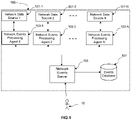
- FIG. 1 illustrates an exemplary data network 100 in which exemplary embodiments may be implemented.
- the data network 100 may be a digital system part of a communication system, a data processing system, or a data storage system.
- Exemplary digital systems comprise, without limitations:
- the data network 100 may be:
- the data network 100 may be a computer networking system in which one or more network data sources 101-i are configured to operate in a wired network.
- Exemplary network data sources 101-i adapted to such applications comprise computers, routers or switches connected to a small or large area wired network. Any type of physical cable may be used in such wired data network to ensure the transfer of data between the devices connected to the wired network comprising the one or more network data sources 101-i.
- the data network 100 may be any wireless network involving any type of wireless propagation medium suitable for this type of connectivity.
- Exemplary wireless communication networks comprise, without limitation, ad-hoc wireless networks used in local area communications, wireless sensor networks, and radio communication networks (e.g. Long Term Evolution or LTE, LTE-advanced, 3G/4G/5G and beyond).
- the one or more network data sources 101-i may be any type of fixed or mobile wireless device/system/object configured to operate in a wireless environment.
- the one or more network data sources 101-i may be remotely monitored and/or controlled.
- the one or more network data sources 101-i may be equipped with one or more transmit antennas and one or more receive antennas.
- the network data sources 101-i comprises, without limitations:
- Exemplary applications to wireless data networks comprise Machine-To-Machine (M2M), Device-To-Device (D2D) and loT (for example vehicle-to-everything communications) involving networks of physical devices, machines, vehicles, home alliances and many other objects connected to each other and provided with a connectivity to the Internet and the ability to collect and exchange data without requiring human-to-human or human-to-computer interactions.
- the data network 100 may be a wireless loT network representing low energy power-consumption/long battery life/low-latency/low hardware and operating cost/high connection density constraints such as low-power wide area networks and low-power short-range loT networks.
- the data network 100 may be any wireless network enabling loT in licensed or license-free spectrum.
- Exemplary wireless technologies used in such applications may comprise:
- Exemplary applications of M2M and loT applications comprise, without limitation:
- the one or more network data sources 101-i are any physical system/device/object provided with the required hardware and/or software technologies enabling wireless communications and transfer of data or operational signals or messages to one or more network elements in the data network 100.
- the data network 100 may be any data network in which any optical fiber link is designed to carry data over short or long distances.
- Exemplary applications using optical fiber links over short distances comprise high-capacity networks such as data center interconnections.
- Exemplary applications using optical fiber links over long distances comprise terrestrial and transoceanic transmissions.
- network data generated by the network elements operable in the network data 100 may be carried by optical signals polarized according to the different polarization states of the optical fiber. The optical signals propagate along the fiber-based link according to one or more propagation modes.
- Exemplary applications of optical fiber data networks comprise, without limitation, aerospace and avionics, data storage (e.g. in cloud computing systems, automotive, industry, and transportation). Such applications may involve transfer of voice (e.g. in telephony), data (e.g. data supply to homes and offices known as fiber to the home), images or video (e.g. transfer of internet traffic), or connection of networks (e.g. connection of switches or routers and data center connectivity in high-speed local area networks).
- the one or more network data sources 101-i may be any optical line terminal integrated for example at the provider's central office or an optical network terminal deployed at the customer premises.
- the data network 100 may comprise wireless and optical connectivities between the network elements operable in the data network 100.
- the data network 100 may be a hybrid optical-wireless access network in which a wireless base station sends data to a wireless gateway through an optical network unit.
- An exemplary architecture of a hybrid optical-wireless network comprises an integration of Ethernet Passive Optical Networks and wireless broadband communications based on WiMax (Worldwide Interoperability for Microwave Access) standardized in the IEEE 802.16 standards for access networks.
- the one or more network data sources 101-i may be any optical line terminal or optical network unit or any wireless device/system/sub-system/object.
- connectivity between the network elements operable in the data network 100 may use optical communication in which unguided visible, infrared, or ultraviolet light is used to carry the signals carrying exchanged data (including network-related data and reports on network-related events).
- Exemplary optical wireless communications technologies comprise visible light communications (VLC), free space optics (FSO) and optical camera communications (OCC).
- Exemplary applications of optical wireless data networks comprise Optical Internet of Things supported by 5G networks.
- the data network 100 comprises one or more network data sources 101-i (also referred to as 'NDS i'), with i varying from 1 to N, N designating a total number of network data sources.
- the network data source 101-i designates a network element operable in the data network 100 and on which one or more network-related events are to be monitored according to network-related events configuration settings.
- the monitored events at the network data sources 101-i include the network-related events that occur at the network data sources 101-i and the network-related events that are related to the operation of the network and are captured by the network data sources 101-i.
- a network-related event to be monitored is defined by a set of event attributes comprising at least an event identifier, an event type and the network data source 101-i on which the network-related event is to be monitored.
- Exemplary network-related events comprise, without limitation:
- the data network 100 further comprises one or more network events processing agents 103-i (also referred to as 'NEPA i'), with i varying from 1 to N such that each network data source 101-i is configured to communicate with a network events processing agent 103-i.
- network events processing agents 103-i also referred to as 'NEPA i'
- the network processing agent 103-i is implemented as a physical entity in the network data source 101-i.
- the network processing agent 103-i is integrated within the hardware structure of the network data source 101-i.
- the network processing agent 103-i is a physical entity implemented in the data network 100 outside the network data source 101-i.
- the network processing agent 103-i is implemented by data aggregation and processing functions.
- the data network 100 further comprises a network events server 105 (also referred to as 'NES') configured to communicate with the one or more network events processing agents 103-i, for i varying from 1 to N and to send data to an events database 107.
- a network events server 105 also referred to as 'NES'
- the network events server 105 is implemented as a standalone function or implemented into a data aggregation function.
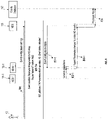
- FIG. 2 is a connection flow illustrating the communications between the various network elements operable in the data network 100 for the generation and the processing of reports on network-related events.
- a network operator 10 also referred to as an 'authorized user'
- the network-related events configuration settings may be defined by an events generator configured for example to automatically generate network-related events configuration settings for example during a testing or a validation phase of the data network 100.
- the network-related events configuration settings define and specify the different attributes of the network-related event(s) to be monitored.
- the network events server 105 is configured to manage the network-related events by configuring the one or more network events processing agents 103-i for i varying from 1 to N to identify and collect events and aggregating the reports generated by the one or more network events processing agents 103-i.
- the network events server 105 determines the network data sources 101-i on which the network-related events are to be monitored. Then the network events server 105 sends, at steps 201-i, the event configuration inputs to the network events processing agents 103-i associated with the network data sources 101-i on which the network-related events are to be monitored.
- the network events processing agent 103-i When the network events processing agent 103-i receives event configuration inputs from the network events server 105, it triggers a monitoring phase during which it monitors the network data source 101-i. During the monitoring phase, the network events processing agent 103-i receives, at step 202-i, network-related data from the network data source 101-i and identifies the occurrence of the monitored events based on the received network-related data and the event configuration inputs received from the network events server 105.
- the network events processing agent 103-i performs the monitoring until a monitoring stopping condition is reached according to the events configuration inputs.
- the monitoring stopping condition may correspond to the expiry of a monitoring period or to the identification of an event of interest specified in the events configuration inputs. Then, when the monitoring stopping condition is reached, the network events processing agent 103-i generates a report on the identified network-related events and sends the report on the network-related events to the network events server 105 at step 203-i.
- the network events server 105 is configured to receive the one or more reports on the identified network-related events at steps 203-i, with i varying between 1 and N.
- the network events server 105 performs one or more processing operations on the received one or more reports to provide processed reports on network-related events.
- the network events server 105 is configured to perform a processing operation comprising data aggregation, data de-duplication, and/or data categorization. Such processing operations are used for example to correlate and aggregate the events from two or more network events processing agents to avoid duplication or to mark one event as applicable to multiple network data sources even if it has been generated by one network data source.
- the processing operation uses a machine learning algorithm.
- the machine learning algorithm takes as input the reports on network-related events and delivers as output processed reports on network-related events.
- the machine learning algorithm is a supervised machine learning algorithm.
- supervised machine learning algorithms comprise, without limitation, Support Vector Machines (SVM), linear regression, logistic regression, na ⁇ ve Bayes, linear discriminant analysis, decision trees, k-nearest neighbor algorithm, neural networks, and similarity learning.
- the network events server 105 sends the processed reports on network-related events to an events database 107 at step 204.
- the events database 107 is configured to store the processed reports on network-related events.
- the events database 107 is accessed by any data analytics functions and/or applications and/or services to use the processed reports on network-related events to derive insights or determine event-driven actions.
- the network events server 105 is configured to send the processed reports on network-related events to any data analytics functions or services or applications requesting access to the processed reports on the identified network-related events.
- the reports on network-related events are used as training data to train machine learning-based algorithms.
- Exemplary machine learning-based algorithm comprise supervised machine learning algorithms that map input training data, derived from the processed reports on network-related events, to predicted data using a function that is determined based on labeled data.
- the supervised machine learning algorithm is, a support vector machine (SVM), a linear regression algorithm, a logistic regression algorithm, a na ⁇ ve Bayes algorithm, a linear discriminant analysis algorithm, a decision trees algorithm, a k-nearest neighbor algorithm, a neural network, or a similarity learning algorithm.
- the network-related event monitored on the network data source 101-i is a metric threshold event generated when the network-related data comprises values of a measured metric (also referred to as 'network metric') that cross a predefined metric threshold.
- a measured metric also referred to as 'network metric'
- Exemplary measured metrics comprise Key Performance Indicators (KPIs), uplink throughput, uplink SINR (Signal to Interference plus Noise Ratio), User Equipment power Headroom, downlink throughput, and downlink Channel Quality Indicator.
- KPIs Key Performance Indicators
- uplink throughput uplink SINR (Signal to Interference plus Noise Ratio)
- SINR Signal to Interference plus Noise Ratio
- User Equipment power Headroom downlink throughput
- downlink Channel Quality Indicator downlink Channel Quality Indicator.
- the network-related event monitored on the network data source 101-i is an object status change event that is generated when the network-related data indicate a status change on the network data source 101-i.
- the attributes of the network-related events and the network-related events configuration inputs associated with the network-related events depend on the type of the network-related event. For example, the attributes and the configuration inputs are different for metric threshold events or for object status change events.
- the storage of the attributes of the network-related events can use any available data storage technology such as data structures and software objects (e.g. data objects) according to any object-oriented technology.
- Data structures may be any data organization, management and storage format that enables access to and/or modification of stored data.
- Exemplary data structures comprise arrays, linked lists, records, and objects.
- FIG. 3 is a block diagram illustrating an exemplary data structure 300 used for storage of data (attributes) related to a metric threshold event (stored for example in a computer system).
- the metric threshold event data structure 300 comprises data fields (also referred to as 'data elements') in which information 301 related to the network-related event and information 303 related to the measured metric are specified. More specifically, the information 301 related to the network-related event comprise:
- the information 303 related to the measured metric comprise :
- the network-related events configuration inputs associated with such a metric threshold event may comprise the attributes related to the metric threshold event according to the data structure illustrated in FIG. 3 .
- FIG. 4 is a block diagram illustrating an exemplary data structure 400 used for storage of data (attributes) related to an object status change event (stored for example in a computer system).
- the object status change event data structure 400 comprises data fields in which information 401 related to the network-related event and information 403 related to the status change on the monitored network data source are specified. More specifically, the information 401 related to the network-related event comprise:
- the information 403 related to the object status change comprise :
- the event status indication type is a mandatory attribute that can be used by the network events server 105 to configure the event on one or more network events processing agents for which it applies.
- the event status value is optional. It may be used for some event status cases associated with a value.
- the software objects are defined as in the 3GPP TS28.622 standard specifications.
- the present disclosure specifies the semantics of information object class attributes used for metric threshold events and object status change events in a protocol and technology neutral way. It does not define their syntax and encoding.
- IOC Information Object Class
- MOI Managed Object Instance
- An Information Object Class represents the management aspect of a network resource. It describes the information that can be passed/used in management interfaces. IOC has attributes that represent the properties of the class of objects.
- a Managed Object Instance is an instance (software object instance) of a Managed Object Class (MOC) representing the management aspects of a network resource.
- the MOC is a class of a technology specific software objects.
- Exemplary Managed Object Instances in a data network for metric threshold events are MOI corresponding to the network elements like base stations, NodeB, eNodeB, gNodeB, cells, antennas, base station controllers (BSCs), and radio network controllers (RNCs).
- MOI corresponding to the network elements like base stations, NodeB, eNodeB, gNodeB, cells, antennas, base station controllers (BSCs), and radio network controllers (RNCs).
- the object class of metric threshold events is referred to as 'metric threshold events'. This object class represents the network-related events captured when network-related data comprise values of a measured metric that cross a predefined metric threshold.
- Inputs to the metric threshold events object class are the values/measurements on a measured metric that are captured at a Managed Object Instance.
- the information model for the metric threshold events captures a set of attributes comprising at least:
- metric threshold events captured in application to wireless data networks using the attributes as defined by the object class 'metric threshold events' are given in Table 1 below.
- Table 1 the following acronyms denote:
- the object class of object change status network events is referred to as 'object status change events'.
- This object class represents the network-related events captured when the network-related data comprise information indicating a status object change on the monitored Managed Object Instance.
- the status of a Managed Object Instance may change due to internal processes within the MOI or due to external actors acting on the MOI.
- the object status change event may be reported by the MOI or by a process supervising the MOI.
- Inputs to the object status change events class are the internal/external processes supervising the MOI.
- Exemplary Managed Object Instance in a data network for object status change events are MOI corresponding to the network elements like base stations, NodeB, eNodeB, gNodeB, cells, antennas, base station controllers, and radio network controllers.
- the information model for the object status change events object class captures a set of attributes comprising at least:
- the information mode for the object status change events object class comprises an attribute designated by an event status value and representing a value associated with the event status.
- Table 1 Examples of Metric Threshold Events Event-creator Function Event Name Event description Input/Metric MOI Threshold Condition Monitoring Period BTSs; NBs; eNBs; gNBs; BSC; RNC High Call Drop Rate event Call Drop Rate more than a configurable threshold Call Drop Rate Cell 2% greater than 15 minutes Low Availability KPIs event Availability KPIs dropping below a configurable threshold Availability Cell 99% less than 30 minutes Low Retainability KPIs event Retainability KPIs dropping below a configurable threshold Retainability Cell 98% less than 30 minutes High Traffic event Traffic greater than a configurable threshold Cell load / PRB Utilization Cell 80% greater than 15 minutes High Incoming call setup rate event Incoming call setup rate greater than a configurable threshold RACH Counters AND/OR Paging Counters Cell 20000 greater than 15 minutes High RRC Connection Attempt failure rate event RRC
- object status change events captured in application to wireless data networks using the attributes as defined by the object class 'object status change events' are given in Table 2 below.
- the object status change events may be defined as specific events or as events types where characteristics of the specific events may be taken as filter values in the events types. For example, instead of specifying a 'site BSC/RNC rehoming event' and a 'site OSS rehoming event', a 'site rehoming event' may be specified with two possible values (SBC/RNC and OSS) for the 'affected unit/parameter' attribute.
- An event type may be the 'MOI rehoming event' which would apply to other MOIs besides the sites, as illustrated in Table 2.
- Table 2 Examples of Object Status Change Events Event-creator Function Event Name Event description MOI Affected unit/parameter Change/ value BTSs; NBs; eNBs; gNBs; BSC; RNC; NMS HW Upgrade event System Module HW version upgraded BTS System Module, Radio Module, ... HW version SW Upgrade event System Software Upgraded BTS System Module, Radio Module, ... SW version Capability Enablement event A specific Capability Enabled on the MOI BTS Spectrum Sharing Spectrum Range for affected RATs New Sector Addition Event A new Sector getting added to a Site Cell Capacity and Coverage Number of Sectors / Cells NMS Parameter change event CM Parameter changes applied for specific network element Cell Configuration Parameter Parameter value Home status event MOI (e.g.
- 3GPP SA5 in TS28.622 specifies a threshold monitor which, when activated on a network element, monitors all the metrics on all managed objects under that network element. The threshold monitor then can trigger notifications for events that are captured on that network element. Such threshold monitor needs to be configured manually for each threshold crossing event on each network element.
- the Status Change Monitor class can be name-contained by Sub_Network, Managed Element, Managed Function, or Management Function.
- a Management Service (MnS) consumer In order to activate Status Change Monitoring, a Management Service (MnS) consumer creates a StatusChangeMonitor instance on the MnS producer. For ultimate deactivation of status change monitoring, the MnS consumer should delete the monitor to free up resources on the MnS producer.
- MnS Management Service
- the MnS consumer can manipulate the value of the administrative state attribute.
- the MnS producer may disable status change monitoring as well, for example in overload situations. This situation may be indicated by the MnS producer with setting the operational state attribute to disabled. When monitoring is resumed the operational state may be set again to enabled.
- the StatusChangeMonitor IOC includes attributes inherited from Top IOC defined in clause 4.3.29 in the TS28.622 specifications and includes new attributes comprising:
- the optional attributes 'objectlnstances' and 'rootObjectInstances' allow to restrict the scope for status changes. When the attribute 'objectlnstances' is present, only the object instances identified by this attribute are scoped. When the attribute 'rootObjectInstances' is present, then the subtrees whose root objects are identified by this attribute are scoped. Both attributes may be present at the same time meaning the total scope is equal to the sum of both scopes. Object instances may be scoped by both the 'objectlnstances' and r'ootObjectlnstances' attributes. This shall not be considered as an error by the MnS producer.
- Multiple status changes can be defined for multiple performance metric sets in a single monitor using the attribute 'StatusChangeEventList'.
- a status change is defined using the attribute 'StatusChangeValue'.
- a StatusChangeMonitor creation request shall be rejected if the attribute(s) requested to be monitored is/are not supported by the MnS producer.
- StatusChangeMonitor instances by MnS consumers is optional; when not supported, StatusChangeMonitor instances may be created and deleted by the system or be pre-installed.
- FIG. 5 is a flowchart depicting a method for generating a report on network-related events.
- step 500 network-related events configuration inputs are received from a network events server.
- network-related data are received from a network data source.
- one or more network-related events are identified based on the received network-related data and the network-related events configuration inputs.
- a report on network-related events is generated.
- the report on network-related events is sent to the network events server.
- FIG.6 is a flowchart depicting a method for generating processed reports on network-related events.
- step 600 network-related events configuration inputs are sent to one or more network event processing agents.
- one or more reports on network-related events are received from the one or more network event processing agents, the reports on network-related events being generated by the network event processing agents based on network-related data received from one or more network data sources and on the network-related events configuration inputs.
- step 604 one or more processing operations are performed on the one or more reports on network-related events to provide processed reports on network-related events.
- the method further comprises a step 606 for sending the processed reports on network-related events to an events database.
- a process may be terminated when its operations are completed, but may also have additional steps not included in the figure.
- a process may correspond to a method, function, procedure, subroutine, subprogram, etc. When a process corresponds to a function, its termination may correspond to a return of the function to the calling function or the main function.
- FIG. 7 is a connection flow illustrating an exemplary implementation of the methods for generating and processing reports on network-related events, according to some embodiments related to metric threshold events in a wireless data network.
- the network events processing agent 103-1 corresponds to a gNodeB (i.e. corresponds to the network virtual function replacing the gNodeB hardware structure when Network Virtualization is supported).
- event configuration settings and an event identifier are sent by the network operator 10 to the NEPA 103-1.
- the event configuration settings comprise :
- step 701 event configuration inputs are sent by the network events server 105 to the NEPA 103-1.
- monitoring of the event of interest specified in the event configuration inputs starts and stops according to the monitoring period specified in the event configuration inputs.
- the monitoring phase comprises identifying any event based on the network-data received from the corresponding Managed Object Instance and the event configuration inputs.
- an identified event is reported to the network events server 105. More specifically, the event 'call drop rate exceeded 2% in cell x' is reported to the events server 105.
- the network server 105 performs one or more operations on the received reports to determine processed reports an sends, at step 704, the processed reports to the events database 107 for storage.
- FIG. 8 is a connection flow illustrating an exemplary implementation of the methods for generating and processing reports on network-related events, according to other embodiments related to object status change events monitored by a network management system in a wireless data network.
- the network events processing agent 103-2 corresponds to a Network Management System (i.e. corresponds to the network virtual function replacing the Network Management System hardware structure when Network Virtualization is supported).
- event configuration settings are sent by the network operator 10 to the network events processing agent 103-1.
- the event configuration settings comprise :
- step 801-1 event configuration inputs are sent by the network events server 105 to the network events processing agent 103-1.
- monitoring of the event of interest specified in the event configuration inputs starts.
- the monitoring phase comprises identifying any event based on the network-data received from the corresponding Managed Object Instance and the event configuration inputs.
- an identified event is reported to the network events server 105. More specifically, the event 'Parameter changed to delay HO in cell X' is reported to the network events server 105.
- the network events server 105 performs one or more processing operations on the received reports on the identified events to determine processed reports and sends, at step 806 the processed reports to the events database.
- FIG. 9 is a connection flow illustrating an exemplary implementation of the methods for generating and processing reports on network-related events, according to some embodiments related to object status change events monitored by a centralized self-organizing network system in a wireless data network.
- the network events processing agent 103-1 corresponds to a Centralized-Self Organizing Network (i.e. corresponds to the network virtual function replacing the C-SON hardware structure when Network Virtualization is supported).
- event configuration settings are sent by the network operator 10 to the network events processing agent 103-1.
- the event configuration settings comprise :
- event configuration inputs are sent by the network events server 105 to the network events processing agent 103-1.
- the Event configuration inputs are derived from the event configuration settings received at step 900.
- monitoring of the event of interest starts.
- the monitoring phase comprises identifying any event based on the network-data received from the corresponding Managed Object Instance and the event configuration inputs.
- an identified event is reported to the network events server 105. More specifically, the event 'New site x integrated which is first tier neighbour for site y' is reported to the network events server 105.
- the network events server 105 performs one or more operations on the received reports to provide processed reports and sends, at step 904, the processed reports to the events database 107.
- Exemplary embodiments provide a program stored in a computer-readable non-transitory medium, the program comprising instructions stored on the computer-readable storage medium that, when executed by a processor, cause the processor to:
- any functions, engines, block diagrams, flow diagrams, state transition diagrams and/or flowcharts herein represent conceptual views of illustrative circuitry embodying the principles of the invention.
- any flow charts, flow diagrams, state transition diagrams, pseudo code, and the like represent various processes which may be substantially represented in computer readable medium and so executed by a computer or processing apparatus, whether such computer or processor is explicitly shown.
- Each described computation function, block, step can be implemented in hardware, software, firmware, middleware, microcode, or any suitable combination thereof. If implemented in software, the computation functions, blocks of the block diagrams and/or flowchart illustrations can be implemented by computer program instructions / software code, which may be stored or transmitted over a computer-readable medium, or loaded onto a general purpose computer, special purpose computer or other programmable processing apparatus and / or system to produce a machine, such that the computer program instructions or software code which execute on the computer or other programmable processing apparatus, create the means for implementing the functions described herein.
- the program code or code segments to perform the necessary tasks may be stored in a machine or computer readable medium such as a computer readable storage medium.
- a processor or processors will perform the necessary tasks.
- at least one memory may include or store computer program code
- the at least one memory and the computer program code may be configured to, with at least one processor, cause an apparatus to perform the necessary tasks.
- the processor, memory and example algorithms, encoded as computer program code serve as means for providing or causing performance of operations discussed herein.
- block denoted as "means configured to” perform a certain function shall be understood as functional blocks comprising circuitry that is adapted for performing or configured to perform a certain function.
- a means being configured to perform a certain function does, hence, not imply that such means necessarily is performing said function (at a given time instant).
- any entity described herein as “means”, may correspond to or be implemented as "one or more modules", “one or more devices”, “one or more units”, etc.
- the functions may be provided by a single dedicated processor, by a single shared processor, or by a plurality of individual processors, some of which may be shared.
- processor or “controller” should not be construed to refer exclusively to hardware capable of executing software, and may implicitly include, without limitation, digital signal processor (DSP) hardware, network processor, application specific integrated circuit (ASIC), field programmable gate array (FPGA), read only memory (ROM) for storing software, random access memory (RAM), and non-volatile storage.
- DSP digital signal processor
- ASIC application specific integrated circuit
- FPGA field programmable gate array
- ROM read only memory
- RAM random access memory
- non-volatile storage non-volatile storage.
- Other hardware conventional or custom, may also be included. Their function may be carried out through the operation of program logic, through dedicated logic, through the interaction of program control and dedicated logic, or even manually, the particular technique being selectable by the implementer as more specifically understood from the context.
- circuit or “circuitry” may refer to one or more or all of the following:
- circuitry also covers an implementation of merely a hardware circuit or processor (or multiple processors) or portion of a hardware circuit or processor and its (or their) accompanying software and/or firmware.
- circuitry also covers, for example and if applicable to the particular claim element, an integrated circuit for a network element or network node or any other computing device or network device.
- the term circuitry may cover digital signal processor (DSP) hardware, network processor, application specific integrated circuit (ASIC), field programmable gate array (FPGA), etc.
- DSP digital signal processor
- ASIC application specific integrated circuit
- FPGA field programmable gate array
- the "circuit” or “circuitry” may be or include, for example, hardware, programmable logic, a programmable processor that executes software or firmware, and/or any combination thereof (e.g. a processor, control unit/entity, controller) to execute instructions or software and control transmission and receptions of signals, and a memory to store data and/or instructions.
- the "circuit” or “circuitry” may also make decisions or determinations, generate frames, packets or messages for transmission, decode received frames or messages for further processing, and other tasks or functions described herein.
- the circuitry may control transmission of signals or messages over a radio network, and may control the reception of signals or messages, etc., via a radio network (e.g., after being down-converted by radio transceiver, for example).
- the term “storage medium,” “computer readable storage medium” or “non-transitory computer readable storage medium” may represent one or more devices for storing data, including read only memory (ROM), random access memory (RAM), magnetic RAM, core memory, magnetic disk storage mediums, optical storage mediums, flash memory devices and/or other tangible machine-readable mediums for storing information.
- ROM read only memory
- RAM random access memory
- magnetic RAM magnetic RAM
- core memory magnetic disk storage mediums
- optical storage mediums optical storage mediums
- flash memory devices and/or other tangible machine-readable mediums for storing information.
- the term “computer-readable medium” may include, but is not limited to, portable or fixed storage devices, optical storage devices, and various other mediums capable of storing, containing or carrying instruction(s) and/or data.
- the methods and devices described herein may be implemented by various means. For example, these techniques may be implemented in hardware, software, or a combination thereof.
- the processing elements of the different network elements operating in the data network 100 can be implemented for example according to a hardware-only configuration (for example in one or more FPGA, ASIC, or VLSI integrated circuits with the corresponding memory) or according to a configuration using both VLSI and Digital Signal Processor (DSP).
- DSP Digital Signal Processor
- FIG. 10 is a block diagram representing an exemplary hardware/software architecture of a device 1000 operating in data network 100 such as the network data sources 101-i, the network events processing agents 103-i and the network events server 105, according to some embodiments.
- the architecture may include various computing, processing, storage, communication, and displaying units comprising:
- the architecture of the device 1000 may further comprise one or more software and/or hardware units configured to provide additional features, functionalities and/or network connectivity.
- the methods described herein can be implemented by computer program instructions supplied to the processor of any type of computer to produce a machine with a processor that executes the instructions to implement the functions/acts specified herein.
- These computer program instructions may also be stored in a computer-readable medium that can direct a computer to function in a particular manner. To that end, the computer program instructions may be loaded onto a computer to cause the performance of a series of operational steps and thereby produce a computer implemented process such that the executed instructions provide processes for implementing the functions specified herein.
Landscapes
- Engineering & Computer Science (AREA)
- Environmental & Geological Engineering (AREA)
- Computer Networks & Wireless Communication (AREA)
- Signal Processing (AREA)
- Mobile Radio Communication Systems (AREA)
Priority Applications (1)
| Application Number | Priority Date | Filing Date | Title |
|---|---|---|---|
| EP21186013.5A EP4120075A1 (de) | 2021-07-16 | 2021-07-16 | Vorrichtungen und verfahren zur netzwerkbezogenen ereignisverarbeitung |
Applications Claiming Priority (1)
| Application Number | Priority Date | Filing Date | Title |
|---|---|---|---|
| EP21186013.5A EP4120075A1 (de) | 2021-07-16 | 2021-07-16 | Vorrichtungen und verfahren zur netzwerkbezogenen ereignisverarbeitung |
Publications (1)
| Publication Number | Publication Date |
|---|---|
| EP4120075A1 true EP4120075A1 (de) | 2023-01-18 |
Family
ID=77071248
Family Applications (1)
| Application Number | Title | Priority Date | Filing Date |
|---|---|---|---|
| EP21186013.5A Pending EP4120075A1 (de) | 2021-07-16 | 2021-07-16 | Vorrichtungen und verfahren zur netzwerkbezogenen ereignisverarbeitung |
Country Status (1)
| Country | Link |
|---|---|
| EP (1) | EP4120075A1 (de) |
Cited By (1)
| Publication number | Priority date | Publication date | Assignee | Title |
|---|---|---|---|---|
| WO2025184817A1 (en) * | 2024-03-06 | 2025-09-12 | Qualcomm Incorporated | Network selection based on network policy self-learning |
Citations (1)
| Publication number | Priority date | Publication date | Assignee | Title |
|---|---|---|---|---|
| WO2019157399A1 (en) * | 2018-02-08 | 2019-08-15 | Parallel Wireless, Inc. | Data pipeline for scalable analytics and management |
-
2021
- 2021-07-16 EP EP21186013.5A patent/EP4120075A1/de active Pending
Patent Citations (1)
| Publication number | Priority date | Publication date | Assignee | Title |
|---|---|---|---|---|
| WO2019157399A1 (en) * | 2018-02-08 | 2019-08-15 | Parallel Wireless, Inc. | Data pipeline for scalable analytics and management |
Non-Patent Citations (3)
| Title |
|---|
| "Tools for Monitoring Resources", 17 October 2020 (2020-10-17), XP002804949, Retrieved from the Internet <URL:https://kubernetes.io/docs/tasks/debug-application-cluster/resource-usage-monitoring/> * |
| ALI ESMAEILY ET AL: "Small-Scale 5G Testbeds for Network Slicing Deployment: A Systematic Review", ARXIV.ORG, CORNELL UNIVERSITY LIBRARY, 201 OLIN LIBRARY CORNELL UNIVERSITY ITHACA, NY 14853, 18 April 2021 (2021-04-18), XP081940335 * |
| DE JESUS MARTINS RAFAEL ET AL: "SWEETEN: Automated Network Management Provisioning for 5G Microservices-Based Virtual Network Functions", 2020 16TH INTERNATIONAL CONFERENCE ON NETWORK AND SERVICE MANAGEMENT (CNSM), IFIP, 2 November 2020 (2020-11-02), pages 1 - 9, XP033867605, DOI: 10.23919/CNSM50824.2020.9269063 * |
Cited By (1)
| Publication number | Priority date | Publication date | Assignee | Title |
|---|---|---|---|---|
| WO2025184817A1 (en) * | 2024-03-06 | 2025-09-12 | Qualcomm Incorporated | Network selection based on network policy self-learning |
Similar Documents
| Publication | Publication Date | Title |
|---|---|---|
| CN115462045B (zh) | 用于非实时ran智能控制器的功能架构和接口 | |
| US11451452B2 (en) | Model update method and apparatus, and system | |
| US12388717B2 (en) | Method and device for selecting service in wireless communication system | |
| US20240214859A1 (en) | Communication system | |
| Khujamatov et al. | Industry digitalization consepts with 5g-based iot | |
| EP4319302A1 (de) | Ran-knoten, benutzergerät und verfahren | |
| WO2023191682A1 (en) | Artificial intelligence/machine learning model management between wireless radio nodes | |
| US11357076B2 (en) | Radio resource parameter configuration | |
| WO2023006228A1 (en) | Analytics reporting control | |
| US12542837B2 (en) | Devices and methods for requests prediction | |
| EP4120075A1 (de) | Vorrichtungen und verfahren zur netzwerkbezogenen ereignisverarbeitung | |
| EP4161020A1 (de) | Vorrichtung, verfahren und computerprogramme | |
| US20220329506A1 (en) | System and method to reinforce fogging for latency critical iot applications in 5g | |
| US20240357380A1 (en) | Managing decentralized autoencoder for detection or prediction of a minority class from an imbalanced dataset | |
| CN120898406A (zh) | 响应于控制策略,基于网络的行为来执行闭环预测 | |
| CN118042482A (zh) | 通信方法、电子设备、通信系统、介质、芯片和程序产品 | |
| US20260106815A1 (en) | Systems and methods for key performance indicator reporting by user equipment devices in cellular wireless networks | |
| US12302132B2 (en) | Federated learning of growing neural gas models | |
| US20240256970A1 (en) | Radio network control | |
| EP4134848B1 (de) | Vorrichtungen und verfahren zur sicherheits- und betriebsverhaltensbewertung von software-diensten | |
| US20260006457A1 (en) | Digital twin enablers for open radio access networks | |
| EP4690715A1 (de) | Auswahl von maschinenlernmodellmerkmalen in einem kommunikationsnetz | |
| WO2023240592A1 (en) | Apparatus, methods, and computer programs | |
| WO2025113384A1 (zh) | 通信方法、装置及系统 | |
| WO2023061568A1 (en) | Devices and methods for root cause analysis in telecommunication networks |
Legal Events
| Date | Code | Title | Description |
|---|---|---|---|
| PUAI | Public reference made under article 153(3) epc to a published international application that has entered the european phase |
Free format text: ORIGINAL CODE: 0009012 |
|
| STAA | Information on the status of an ep patent application or granted ep patent |
Free format text: STATUS: THE APPLICATION HAS BEEN PUBLISHED |
|
| AK | Designated contracting states |
Kind code of ref document: A1 Designated state(s): AL AT BE BG CH CY CZ DE DK EE ES FI FR GB GR HR HU IE IS IT LI LT LU LV MC MK MT NL NO PL PT RO RS SE SI SK SM TR |
|
| STAA | Information on the status of an ep patent application or granted ep patent |
Free format text: STATUS: REQUEST FOR EXAMINATION WAS MADE |
|
| 17P | Request for examination filed |
Effective date: 20230703 |
|
| RBV | Designated contracting states (corrected) |
Designated state(s): AL AT BE BG CH CY CZ DE DK EE ES FI FR GB GR HR HU IE IS IT LI LT LU LV MC MK MT NL NO PL PT RO RS SE SI SK SM TR |