EP4123000B1 - Composé organométallique et dispositif électroluminescent organique l'incluant - Google Patents
Composé organométallique et dispositif électroluminescent organique l'incluant Download PDFInfo
- Publication number
- EP4123000B1 EP4123000B1 EP22177963.0A EP22177963A EP4123000B1 EP 4123000 B1 EP4123000 B1 EP 4123000B1 EP 22177963 A EP22177963 A EP 22177963A EP 4123000 B1 EP4123000 B1 EP 4123000B1
- Authority
- EP
- European Patent Office
- Prior art keywords
- group
- substituted
- unsubstituted
- formula
- alkyl
- Prior art date
- Legal status (The legal status is an assumption and is not a legal conclusion. Google has not performed a legal analysis and makes no representation as to the accuracy of the status listed.)
- Active
Links
Images

Classifications
-
- C—CHEMISTRY; METALLURGY
- C07—ORGANIC CHEMISTRY
- C07F—ACYCLIC, CARBOCYCLIC OR HETEROCYCLIC COMPOUNDS CONTAINING ELEMENTS OTHER THAN CARBON, HYDROGEN, HALOGEN, OXYGEN, NITROGEN, SULFUR, SELENIUM OR TELLURIUM
- C07F15/00—Compounds containing elements of Groups 8, 9, 10 or 18 of the Periodic Table
- C07F15/0006—Compounds containing elements of Groups 8, 9, 10 or 18 of the Periodic Table compounds of the platinum group
- C07F15/0086—Platinum compounds
-
- C—CHEMISTRY; METALLURGY
- C09—DYES; PAINTS; POLISHES; NATURAL RESINS; ADHESIVES; COMPOSITIONS NOT OTHERWISE PROVIDED FOR; APPLICATIONS OF MATERIALS NOT OTHERWISE PROVIDED FOR
- C09K—MATERIALS FOR MISCELLANEOUS APPLICATIONS, NOT PROVIDED FOR ELSEWHERE
- C09K11/00—Luminescent materials, e.g. electroluminescent or chemiluminescent
- C09K11/06—Luminescent materials, e.g. electroluminescent or chemiluminescent containing organic luminescent materials
-
- H—ELECTRICITY
- H10—SEMICONDUCTOR DEVICES; ELECTRIC SOLID-STATE DEVICES NOT OTHERWISE PROVIDED FOR
- H10K—ORGANIC ELECTRIC SOLID-STATE DEVICES
- H10K50/00—Organic light-emitting devices
- H10K50/10—OLEDs or polymer light-emitting diodes [PLED]
- H10K50/11—OLEDs or polymer light-emitting diodes [PLED] characterised by the electroluminescent [EL] layers
- H10K50/12—OLEDs or polymer light-emitting diodes [PLED] characterised by the electroluminescent [EL] layers comprising dopants
-
- H—ELECTRICITY
- H10—SEMICONDUCTOR DEVICES; ELECTRIC SOLID-STATE DEVICES NOT OTHERWISE PROVIDED FOR
- H10K—ORGANIC ELECTRIC SOLID-STATE DEVICES
- H10K85/00—Organic materials used in the body or electrodes of devices covered by this subclass
- H10K85/30—Coordination compounds
- H10K85/341—Transition metal complexes, e.g. Ru(II)polypyridine complexes
- H10K85/346—Transition metal complexes, e.g. Ru(II)polypyridine complexes comprising platinum
-
- C—CHEMISTRY; METALLURGY
- C09—DYES; PAINTS; POLISHES; NATURAL RESINS; ADHESIVES; COMPOSITIONS NOT OTHERWISE PROVIDED FOR; APPLICATIONS OF MATERIALS NOT OTHERWISE PROVIDED FOR
- C09K—MATERIALS FOR MISCELLANEOUS APPLICATIONS, NOT PROVIDED FOR ELSEWHERE
- C09K2211/00—Chemical nature of organic luminescent or tenebrescent compounds
- C09K2211/18—Metal complexes
- C09K2211/185—Metal complexes of the platinum group, i.e. Os, Ir, Pt, Ru, Rh or Pd
-
- H—ELECTRICITY
- H10—SEMICONDUCTOR DEVICES; ELECTRIC SOLID-STATE DEVICES NOT OTHERWISE PROVIDED FOR
- H10K—ORGANIC ELECTRIC SOLID-STATE DEVICES
- H10K2101/00—Properties of the organic materials covered by group H10K85/00
- H10K2101/10—Triplet emission
-
- H—ELECTRICITY
- H10—SEMICONDUCTOR DEVICES; ELECTRIC SOLID-STATE DEVICES NOT OTHERWISE PROVIDED FOR
- H10K—ORGANIC ELECTRIC SOLID-STATE DEVICES
- H10K2101/00—Properties of the organic materials covered by group H10K85/00
- H10K2101/30—Highest occupied molecular orbital [HOMO], lowest unoccupied molecular orbital [LUMO] or Fermi energy values
-
- H—ELECTRICITY
- H10—SEMICONDUCTOR DEVICES; ELECTRIC SOLID-STATE DEVICES NOT OTHERWISE PROVIDED FOR
- H10K—ORGANIC ELECTRIC SOLID-STATE DEVICES
- H10K2101/00—Properties of the organic materials covered by group H10K85/00
- H10K2101/40—Interrelation of parameters between multiple constituent active layers or sublayers, e.g. HOMO values in adjacent layers
-
- H—ELECTRICITY
- H10—SEMICONDUCTOR DEVICES; ELECTRIC SOLID-STATE DEVICES NOT OTHERWISE PROVIDED FOR
- H10K—ORGANIC ELECTRIC SOLID-STATE DEVICES
- H10K50/00—Organic light-emitting devices
- H10K50/10—OLEDs or polymer light-emitting diodes [PLED]
- H10K50/11—OLEDs or polymer light-emitting diodes [PLED] characterised by the electroluminescent [EL] layers
Definitions
- the present disclosure relates to organometallic compounds and organic light-emitting devices including the same.
- OLEDs are self-emissive devices that produce full-color images, and also have wide viewing angles, high contrast ratios, short response times, and excellent characteristics in terms of luminance, driving voltage, and response speed, compared to devices in the art.
- an organic light-emitting device includes an anode, a cathode, and an organic layer arranged between the anode and the cathode, wherein the organic layer includes an emission layer.
- a hole transport region may be arranged between the anode and the emission layer, and an electron transport region may be arranged between the emission layer and the cathode.
- Holes provided from the anode may move toward the emission layer through the hole transport region, and electrons provided from the cathode may move toward the emission layer through the electron transport region.
- the holes and the electrons recombine in the emission layer to produce excitons. These excitons transition from an excited state to a ground state, thereby generating light.
- organometallic compounds and organic light-emitting devices including the same.
- an organometallic compound in accordance with claim 1 provided is an organometallic compound in accordance with claim 1.
- an organic light-emitting device including: a first electrode; a second electrode; and an organic layer arranged between the first electrode and the second electrode, wherein the organic layer includes an emission layer, and wherein the organic layer further includes at least one organometallic compound represented by Formula 1.
- the FIGURE is a schematic cross-sectional view of an organic light-emitting device according to one or more embodiments.
- first, second, third etc. may be used herein to describe various elements, components, regions, layers, and/or sections, these elements, components, regions, layers, and/or sections should not be limited by these terms. These terms are only used to distinguish one element, component, region, layer, or section from another element, component, region, layer, or section. Thus, a first element, component, region, layer, or section discussed below could be termed a second element, component, region, layer, or section without departing from the teachings of the present embodiments.
- Exemplary embodiments are described herein with reference to cross section illustrations that are schematic illustrations of idealized embodiments. As such, variations from the shapes of the illustrations as a result, for example, of manufacturing techniques and/or tolerances, are to be expected. Thus, embodiments described herein should not be construed as limited to the particular shapes of regions as illustrated herein but are to include deviations in shapes that result, for example, from manufacturing. For example, a region illustrated or described as flat may, typically, have rough and/or nonlinear features. Moreover, sharp angles that are illustrated may be rounded. Thus, the regions illustrated in the figures are schematic in nature and their shapes are not intended to illustrate the precise shape of a region and are not intended to limit the scope of the present claims.
- an organometallic compound is represented by Formula 1:
- M 1 is a transition metal
- M 1 may be a Period 1 transition metal of the Periodic Table of Elements, a Period 2 transition metal of the Periodic Table of Elements, or a Period 3 transition metal of the Periodic Table of Elements.
- M 1 may be iridium (Ir), platinum (Pt), osmium (Os), titanium (Ti), zirconium (Zr), hafnium (Hf), europium (Eu), terbium (Tb), thulium (Tm), rhodium (Rh), palladium (Pd), or gold (Au).
- M 1 may be Pt, Pd, or Au.
- X 10 , X 11 , X 20 , X 30 , and X 40 are each independently C or N, provided that one of X 10 and X 11 is N, and the other of X 10 and X 11 is C.
- X 20 and X 30 may each be C, and X 40 may be N.
- two bonds of a bond between X 10 and M 1 , a bond between X 20 and M 1 , a bond between X 30 and M 1 , and a bond between X 40 and M 1 may be coordinate bonds, and the other two bonds may be covalent bonds.
- the organometallic compound represented by Formula 1 may be electrically neutral.
- a bond between X 10 and M 1 in Formula 1 may be a coordinate bond.
- one bond of a bond between X 20 and M 1 , a bond between X 30 and M 1 , and a bond between X 40 and M 1 may be a coordinate bond, and the other two bonds may be covalent bonds.
- a bond between X 20 M 1 and a bond between X 30 and M 1 may be covalent bonds
- a bond between X 40 and M 1 may be a coordinate bond.
- ring A 10 is present or absent, and each of C 1 and C 2 is C when ring A 10 is present, and C 1 is C(R 11 ) and C 2 is C(R 12 ) when ring A 10 is not present.
- ring A 11 which is a 5-membered ring including N, X 10 , X 11 , C 1 , and C 2 as ring members, is a pyrazole ring or an imidazole ring.
- ring A 10 may be absent, or ring A 10 may be a C 5 -C 30 carbocyclic group or a C 1 -C 30 heterocyclic group.
- ring A 20 , ring A 30 , and ring A 40 are each independently a C 5 -C 30 carbocyclic group or a C 1 -C 30 heterocyclic group.
- ring A 10 , ring A 20 , ring A 30 , and ring A 40 may each independently be i) a first ring, ii) a second ring, iii) a condensed ring in which two or more first rings are condensed with each other, iv) a condensed ring in which two or more second rings are condensed with each other, or v) a condensed ring in which one or more first rings and one or more second rings are condensed with each other,
- ring A 10 , ring A 20 , ring A 30 , and ring A 40 may each independently be a cyclopentane group, a cyclopentene group, a cyclohexane group, a cyclohexene group, a cyclohexadiene group, a benzene group, a naphthalene group, an anthracene group, a phenanthrene group, a triphenylene group, a pyrene group, a chrysene group, a cyclopentadiene group, a 1,2,3,4-tetrahydronaphthalene group, a thiophene group, a furan group, a borole group, a phosphole group, a germole group, a selenophene group, an indole group, a benzoborole group, a benzophosphole group, an indene group, a benzo
- ring A 20 in Formula 1 may be represented by one of Formulae A20(1) to A20(15): wherein, in Formulae A20(1) to A20(15),
- ring A 30 in Formula 1 may be represented by one of Formulae A30(1) to A30(12): wherein, in Formulae A30(1) to A30(12),
- ring A 30 in Formula 1 may be represented by Formula A30(1), and accordingly, a moiety represented by
- X 31 in Formula A30-1 may be a single bond.
- ring A 40 in Formula 1 may be represented by one of Formulae A40(1) to A40(34): wherein, in Formulae A40(1) to A40(34),
- R 10 to R 12 , R 10A , R 20 , R 30 , R 40 , R 51 , and R 52 are each independently be a group represented by Formula 2, hydrogen, deuterium, -F, -Cl, -Br, -I, -SF 5 , a hydroxyl group, a cyano group, a nitro group, an amidino group, a hydrazine group, a hydrazone group, a carboxylic acid group or a salt thereof, a sulfonic acid group or a salt thereof, a phosphoric acid group or a salt thereof, a substituted or unsubstituted C 1 -C 60 alkyl group, a substituted or unsubstituted C 2 -C 60 alkenyl group, a substituted or unsubstituted C 2 -C 60 alkynyl group, a substituted or unsubstituted C 1 -C 60 alkoxy group, a substituted or
- R 10 to R 12 , R 10A , R 20 , R 30 , R 40 , R 51 , and R 52 may each independently be:
- b10, b20, b30, and b40 each indicate the number of R 10 (s), the number of R 20 (s), the number of R 30 (s), and the number of R 40 (s), respectively, and are each independently an integer from 1 to 10.
- R 10 , R 11 , R 12 , R 20 , R 30 , or R 40 is a group represented by Formula 2:
- L 21 to L 24 in Formula 2 may each independently be:
- L 21 to L 24 in Formula 2 may each independently be: a benzene group, a naphthalene group, a carbazole group, a fluorene group, a dibenzothiophene group, or a dibenzofuran group, each unsubstituted or substituted with deuterium, -F, -Cl, -Br, -I, -SF 5 , -CD 3 , -CD 2 H, -CDH 2 , -CF 3 , -CF 2 H, -CFH 2 , a hydroxyl group, a cyano group, a nitro group, an amino group, an amidino group, a hydrazine group, a hydrazone group, a carboxylic acid group or a salt thereof, a sulfonic acid group or a salt thereof, a phosphoric acid group or a salt thereof, a C 1 -C 20 alkyl group, a C
- a21 to a24 re each independently an integer from 0 to 3.
- a21 to a24 may each independently be 0 or 1. In one or more embodiments, in Formula 2, a21 to a23 may each independently be 0, and a24 may be 0 or 1.
- R 201 to R 203 may each independently be a substituted or unsubstituted C 1 -C 60 alkyl group, a substituted or unsubstituted C 2 -C 60 alkenyl group, a substituted or unsubstituted C 2 -C 60 alkynyl group, a substituted or unsubstituted C 1 -C 60 alkoxy group, a substituted or unsubstituted C 1 -C 60 alkylthio group, a substituted or unsubstituted C 3 -C 10 cycloalkyl group, a substituted or unsubstituted C 1 -C 10 heterocycloalkyl group, a substituted or unsubstituted C 3 -C 10 cycloalkenyl group, a substituted or unsubstituted C 1 -C 10 heterocycloalkenyl group, a substituted or unsubstituted C 6 -C 60
- R 201 to R 203 may each independently be:
- R 201 to R 203 may each independently be:
- n21 is an integer from 1 to 5.
- n21 may be 1 or 2.
- a compound represented by Formula 2 may be represented by Formula 2(1): wherein, in Formula 2(1),
- L 24 may be a benzene group, a naphthalene group, a carbazole group, a fluorene group, a dibenzothiophene group, or a dibenzofuran group, each substituted or unsubstituted deuterium, -F, -Cl, -Br, -I, -SF 5 , -CD 3 , -CD 2 H, -CDH 2 , - CF 3 , -CF 2 H, -CFH 2 , a hydroxyl group, a cyano group, a nitro group, an amino group, an amidino group, a hydrazine group, a hydrazone group, a carboxylic acid group or a salt thereof, a sulfonic acid group or a salt thereof, a phosphoric acid group or a salt thereof, a C 1 -C 20 alkyl group, a C 1 -C 20 alkoxy
- a group represented by Formula 2 may be a group represented by one of Formulae 2-1 to 2-4: wherein, in Formulae 2-1 to 2-4,
- R 201 to R 203 may each independently be:
- n21 in Formula 2-2 may be 1 or 2, and n21 in Formulae 2-3 and 2-4 may be 1.
- each group represented by Formula 2 independently may be a group represented by one of Formulae 2-101 to 2-134: wherein, in Formulae 2-101 to 2-134,
- one of R 10 , R 11 , R 12 , R 20 , R 30 , and R 40 may be a group represented by Formula 2.
- the organometallic compound may be represented by one or more of Formulae 1A to 1D: wherein, in Formulae 1A to 1D,
- * and *' each indicate a binding site to a neighboring atom.
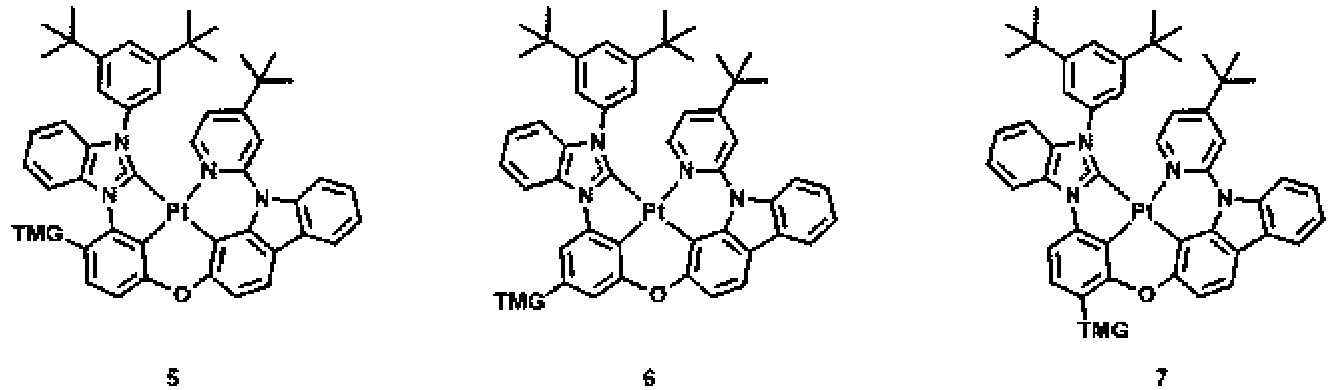
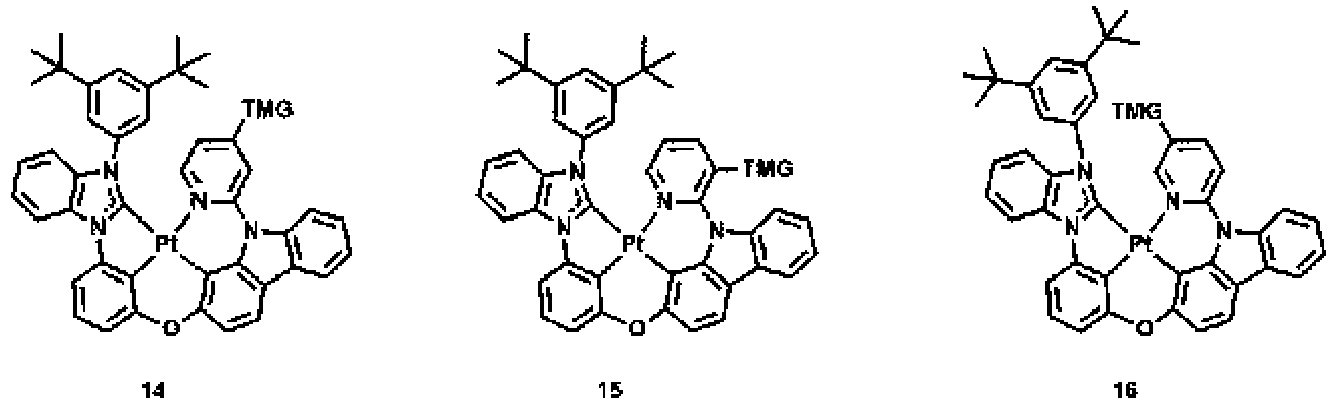
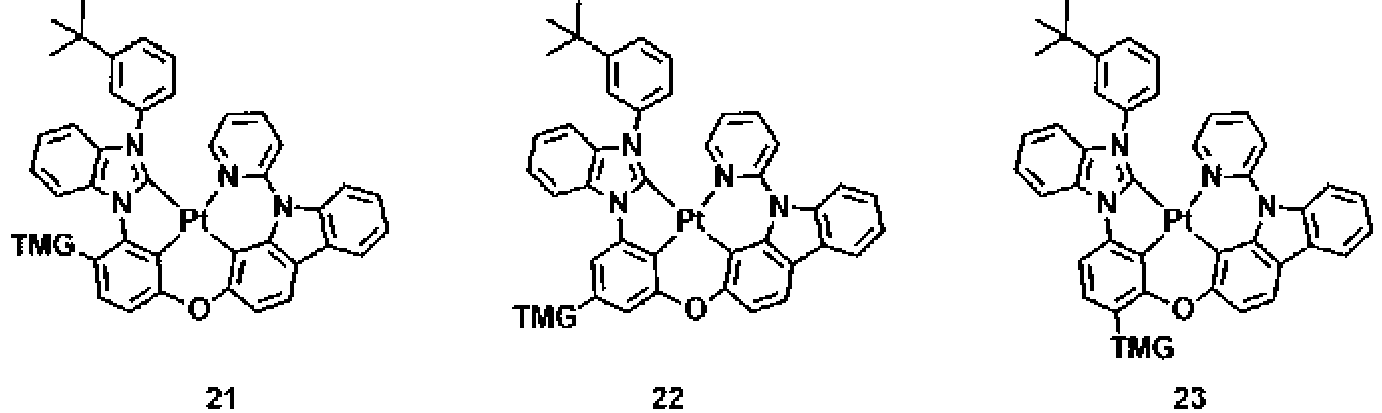
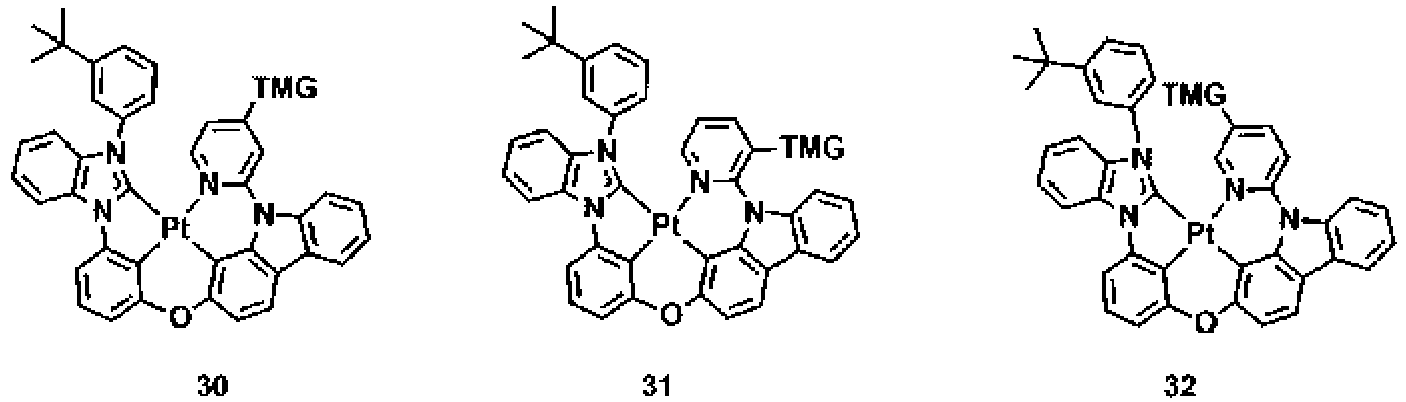
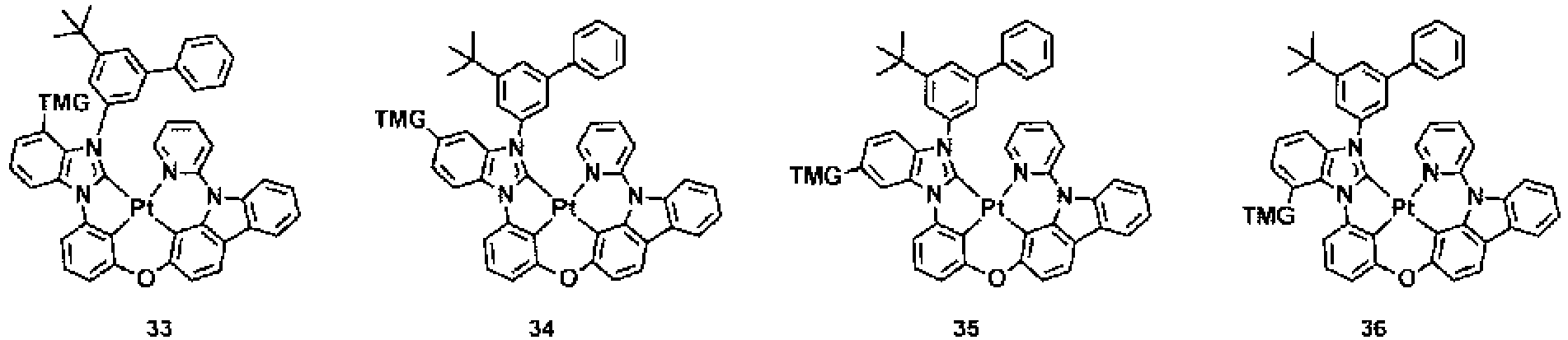
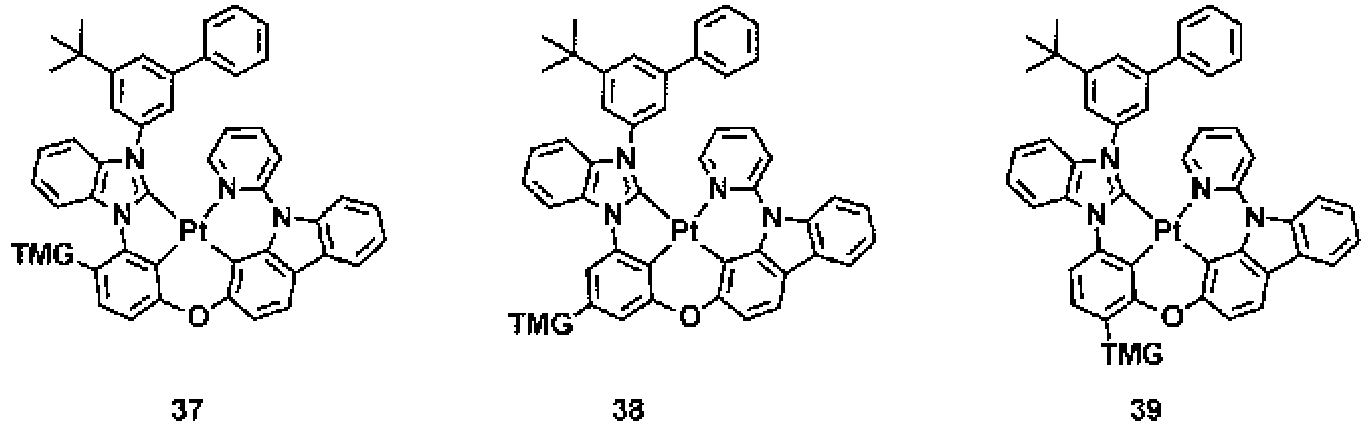
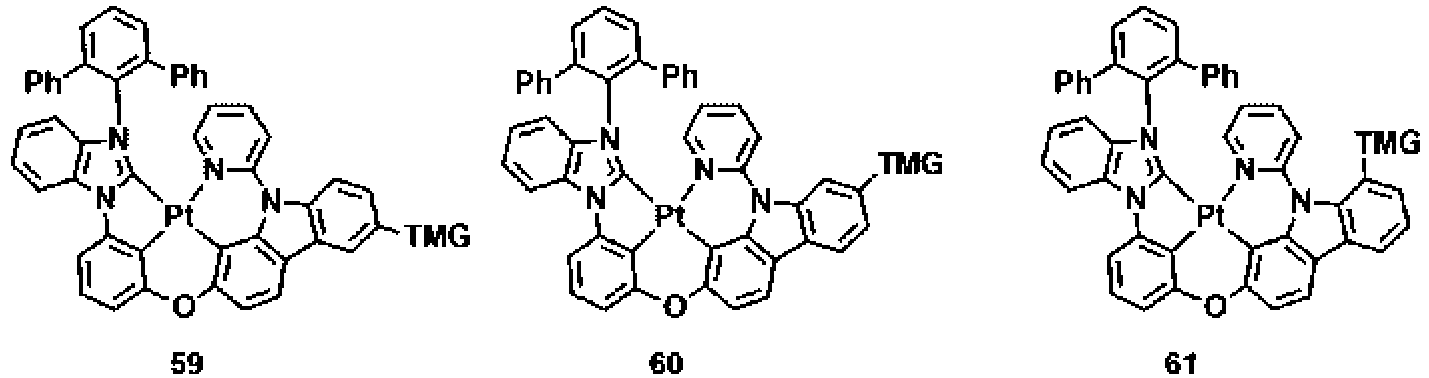
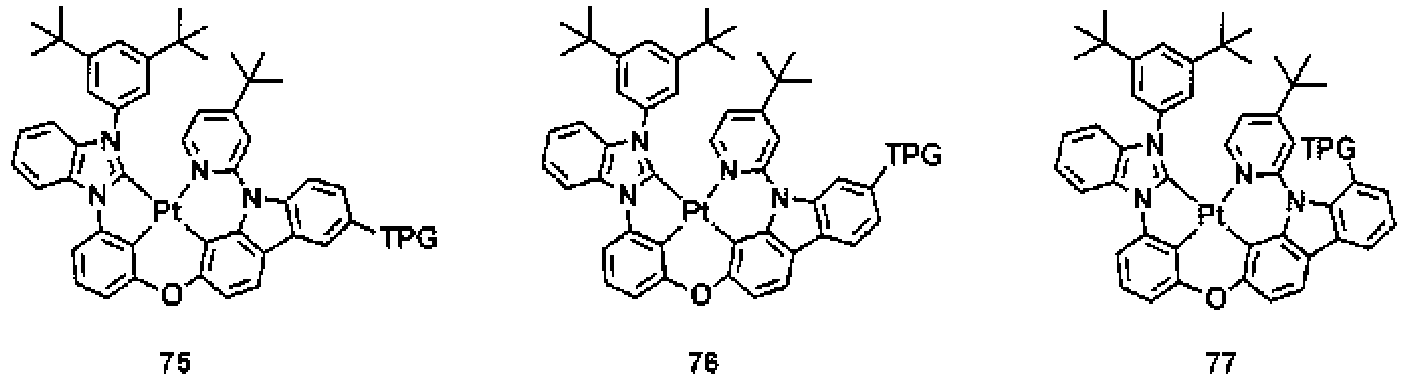
- the organometallic compound may be one or more of Compounds 1 to 218: wherein "TMG” is a trimethyl-germyl group, and "TPG” is a triphenyl-germyl group.
- the organometallic compound represented by Formula 1 may include, as a ligand substituent, at least one group represented by Formula 2.
- the organometallic compound may include a group represented by Formula 2 which is a bulky germanium (Ge)-containing substituent so that the emission waveform may be improved.
- the organometallic compound may exhibit an emission spectrum having a narrow full width at half maximum (FWHM) and a small second peak intensity. Accordingly, an organic light-emitting device including the organometallic compound may have improved color purity.
- the organometallic compound may have an electroluminescence (EL) and/or photoluminescence (PL) spectrum that includes a first peak and a second peak, wherein the maximum emission wavelength of the second peak is greater than the maximum emission wavelength of the first peak, and the intensity of the second peak may be less than the intensity of the first peak.
- EL electroluminescence
- PL photoluminescence
- the organometallic compound represented by Formula 1 when the organometallic compound represented by Formula 1 includes a bulky Ge-containing substituent and is used as an emitter of an emission layer, the formation of exciplex with a host molecule may be suppressed. Accordingly, a decrease in efficiency of an organic light-emitting device including the organometallic compound may be substantially suppressed, and thus high luminescence efficiency may be achieved.
- the organometallic compound according to one or more embodiments exhibits a relatively narrow FWHM compared to Comparative Compounds C1 to C5.
- the organometallic compound represented by Formula 1 may be suitable for use as a material for an organic layer of an organic light-emitting device, for example, a material for an emission layer of the organic layer.
- an organic light-emitting device including: a first electrode; a second electrode; and an organic layer arranged between the first electrode and the second electrode and including an emission layer, wherein the organic layer includes at least one organometallic compound represented by Formula 1.
- the organic light-emitting device may have, due to the inclusion of the organic layer including the organometallic compound represented by Formula 1, excellent external quantum efficiency, an emission waveform with a reduced second peak intensity, and excellent color purity.
- (an organic layer) includes at least one organometallic compound represented by Formula 1" as used herein may include a case in which "(an organic layer) includes identical organometallic compounds represented by Formula 1" and a case in which "(an organic layer) includes two or more different organometallic compounds represented by Formula 1".
- the organic layer may include, as the organometallic compound, only Compound 1.
- Compound 1 may be included in the emission layer of the organic light-emitting device.
- the organic layer may include, as the organometallic compound, Compound 1 and Compound 2.
- Compound 1 and Compound 2 may exist in an identical layer (for example, Compound 1 and Compound 2 may all exist in the emission layer).
- the at least one organometallic compound may be included in the emission layer of the organic light-emitting device.
- the emission layer may further include a host, and an amount of the host in the emission layer may be greater than that of the at least one organometallic compound in the emission layer.
- the emission layer may emit red light, green light, or blue light.
- the emission layer may emit blue light having a maximum emission wavelength of 410 nm to 490 nm.
- the emission layer may have a configuration as described in First exemplary configuration or the second exemplary configuration, but embodiments are not limited thereto.
- the emission layer may include the organometallic compound represented by Formula 1, and the organometallic compound represented by Formula 1 may serve as a phosphorescent emitter.
- a ratio of a luminescent component emitted from the organometallic compound with respect to all luminescent components of the emission layer may be 80 % or greater, or about 85 % or greater, or about 90 % or greater, or about 95 % or greater.
- light emitted from the organometallic compound may be blue light.
- the emission layer may include, in addition to the organometallic compound represented by Formula 1, a phosphorescent dopant, a fluorescent dopant, or a combination thereof, which is different from the organometallic compound.
- the organometallic compound may serve not as a phosphorescent emitter, but as a sensitizer or an auxiliary dopant.
- the emission layer may further include a fluorescent dopant, and the fluorescent dopant may be different from the organometallic compound.
- the ratio of a luminescent component emitted from the fluorescent dopant with respect to all luminescent components of the emission layer may be 80 % or greater, or about 85 % or greater, or about 90 % or greater, or about 95 % or greater.
- an amount of the fluorescent dopant may be, based on 100 parts by weight of the organometallic compound represented by Formula 1, in a range of about 1 part by weight to about 100 parts by weight, or about 5 parts by weight to about 50 parts by weight, or about 10 parts by weight to about 20 parts by weight.
- a total amount of the organometallic compound represented by Formula 1 and the fluorescent dopant may be, based on 100 parts by weight of the emission layer, in a range of about 1 part by weight to 30 parts by weight, or about 3 parts by weight to about 20 parts by weight, or about 5 parts by weight to about 15 parts by weight.
- the fluorescent dopant that may be used in the second embodiment may not include a transition metal.
- the emission layer may emit fluorescence generated while triplet excitons of the organometallic compound represented by Formula 1 are delivered to the fluorescent dopant and then transferred.
- the fluorescent dopant may include a compound represented by Formula 503-1 or 503-2: wherein, in Formulae 503-1 and 503-2,
- the first electrode may be an anode, which is a hole injection electrode
- the second electrode may be a cathode, which is an electron injection electrode
- the first electrode may be a cathode, which is an electron injection electrode
- the second electrode may be an anode, which is a hole injection electrode.
- the first electrode may be an anode
- the second electrode may be a cathode
- the organic layer may include a hole transport region between the first electrode and the emission layer and an electron transport region between the emission layer and the second electrode, wherein the hole transport region may include a hole injection layer, a hole transport layer, an electron blocking layer, a buffer layer, or a combination thereof, and the electron transport region may include a hole blocking layer, an electron transport layer, an electron injection layer, or a combination thereof.
- the organometallic compound may be included in at least one of the hole transport region and the electron transport region.
- organic layer refers to a single layer and/or a plurality of layers between the first electrode and the second electrode of the organic light-emitting device.
- the “organic layer” may include, in addition to an organic compound, an organometallic complex including metal.
- the FIGURE is a schematic cross-sectional view of an organic light-emitting device 10 according to one or more embodiments.
- the structure and manufacturing method of the organic light-emitting device 10 according to an exemplary embodiment will be described in further detail in connection with the FIGURE.
- the organic light-emitting device 10 of the FIGURE includes a first electrode 11, an organic layer 15, and a second electrode 19, which are sequentially stacked.
- a substrate may be additionally arranged under the first electrode 11 or above the second electrode 19.
- any substrate that is used in organic light-emitting devices of the related art may be used, and for example, a glass substrate or a transparent plastic substrate, each having excellent mechanical strength, thermal stability, transparency, surface smoothness, ease of handling, and water resistance, may be used.
- the first electrode 11 may be, for example, formed by depositing or sputtering a material for forming the first electrode 11 on the substrate.
- the first electrode 11 may be an anode.
- the material for forming the first electrode 11 may be selected from materials with a high work function to facilitate hole injection.
- the first electrode 11 may be a reflective electrode, a semi-transmissive electrode, or a transmissive electrode.
- the material for forming the first electrode 11 may be indium tin oxide (ITO), indium zinc oxide (IZO), tin oxide (SnO 2 ), or zinc oxide (ZnO).
- the material for forming the first electrode 11 may be metal, such as magnesium (Mg), aluminum (Al), silver (Ag), aluminum-lithium (Al-Li), calcium (Ca), magnesium-indium (Mg-In), or magnesium-silver (Mg-Ag).
- the first electrode 11 may have a single-layered structure or a multi-layered structure including two or more layers.
- the first electrode 11 may have a three-layered structure of ITO/Ag/ITO, but the structure of the first electrode 11 is not limited thereto.
- the organic layer 15 is arranged on the first electrode 11.
- the organic layer 15 may include a hole transport region, an emission layer, and an electron transport region.
- the hole transport region may be arranged between the first electrode 11 and the emission layer.
- the hole transport region may include at least one selected from a hole injection layer, a hole transport layer, an electron blocking layer, and a buffer layer.
- the hole transport region may include only either a hole injection layer or a hole transport layer.
- the hole transport region may have a hole injection layer/hole transport layer structure or a hole injection layer/hole transport layer/electron blocking layer structure, wherein constituting layers for each structure are sequentially stacked in this stated order from the first electrode 11.
- the hole injection layer may be formed on the first electrode 11 by using one or more suitable methods such as vacuum deposition, spin coating, casting, and/or Langmuir-Blodgett (L-B) deposition.
- suitable methods such as vacuum deposition, spin coating, casting, and/or Langmuir-Blodgett (L-B) deposition.
- the deposition conditions may vary according to a material that is used to form the hole injection layer, and the structure and thermal characteristics of the hole injection layer.
- the deposition conditions may include a deposition temperature in a range of about 100°C to about 500°C, a vacuum pressure in a range of about 10 -8 torr (1.333 ⁇ 10 -6 Pa) to about 10 -3 torr (0.1333 Pa), and a deposition rate in a range of about 0.01 angstroms per second ( ⁇ /sec) to about 100 ⁇ /sec.
- the deposition conditions are not limited thereto.
- the coating conditions may vary according to a material that is used to form the hole injection layer, and the structure and thermal properties of the hole injection layer.
- the coating conditions may include a coating speed in a range of about 2,000 revolutions per minute (rpm) to about 5,000 rpm and a heat treatment temperature for removing a solvent after coating in a range of about 80°C to about 200°C.
- the coating conditions are not limited thereto.
- Conditions for forming the hole transport layer and the electron blocking layer may be as the conditions for forming the hole injection layer.
- the hole transport region may include, for example, at least one of 4,4',4"-tris(3-methylphenylphenylamino)triphenylamine (m-MTDATA), 4,4',4"-tris(N,N-diphenylamino)triphenylamine (TDATA), 4,4',4"-tris ⁇ N-(2-naphthyl)-N-phenylamino ⁇ -triphenylamine (2-TNATA), N,N'-di(naphthalene-1-yl)-N,N'-diphenyl-benzidine (NPB), ⁇ -NPB, N,N'-bis(3-methylphenyl)-N,N'-diphenyl-[1,1-biphenyl]-4,4'-diamine (TPD), spiro-TPD, spiro-NPB, methylated NPB, 4,4'-cyclohexylidene bis[N,N-bis(4-methylphenyl)benz
- xa and xb may each independently be an integer from 0 to 5, or may each independently be 0, 1, or 2.
- xa may be 1, and xb may be 0, but xa and xb are not limited thereto.
- R 101 to R 108 , R 111 to R 119 , and R 121 to R 124 may each independently be:
- R 109 may be a phenyl group, a naphthyl group, an anthracenyl group, or a pyridinyl group, each unsubstituted or substituted with deuterium, -F, -Cl, -Br, -I, -SF 5 , a hydroxyl group, a cyano group, a nitro group, an amino group, an amidino group, a hydrazine group, a hydrazone group, a carboxylic acid group or a salt thereof, a sulfonic acid group or a salt thereof, a phosphoric acid group or a salt thereof, a C 1 -C 20 alkyl group, a C 1 -C 20 alkoxy group, a C 1-20 alkylthio group, a phenyl group, a naphthyl group, an anthracenyl group, a pyridinyl group, or a combination thereof.
- the compound represented by Formula 201 may be represented by Formula 201A: wherein, in Formula 201A, R 101 , R 111 , R 112 , and R 109 may respectively be as described herein.
- the hole transport region may include one of Compounds HT1 to HT20, or a combination thereof:
- a thickness of the hole transport region may be in a range of about 100 angstroms ( ⁇ ) to about 10,000 ⁇ , for example, about 100 ⁇ to about 1,000 ⁇ .
- a thickness of the hole injection layer may be in a range of about 100 ⁇ to about 10,000 ⁇ , for example, about 100 ⁇ to about 1,000 ⁇
- a thickness of the hole transport layer may be in a range of about 50 ⁇ to about 2,000 ⁇ , for example, about 100 ⁇ to about 1,500 ⁇ .
- the hole transport region may further include, in addition to these materials, a charge-generation material for the improvement of conductive properties.
- the charge-generation material may be homogeneously or non-homogeneously dispersed in the hole transport region.
- the charge-generation material may be, for example, a p-dopant.
- the p-dopant may include a quinone derivative, a metal oxide, a cyano group-containing compound, or a combination thereof, but embodiments of the present disclosure are not limited thereto.
- non-limiting examples of the p-dopant are a quinone derivative, such as tetracyanoquinodimethane (TCNQ), 2,3,5,6-tetrafluoro-tetracyano-1,4-benzoquinonedimethane (F4-TCNQ), or F6-TCNQ; a metal oxide, such as a tungsten oxide or a molybdenum oxide; or a cyano group-containing compound, such as Compounds HT-D1 and F12, but are not limited thereto:
- the hole transport region may further include a buffer layer.
- the buffer layer may compensate for an optical resonance distance according to a wavelength of light emitted from the emission layer, and thus, efficiency of the light-emitting device may be improved.
- the emission layer may be formed on the hole transport region by using methods such as vacuum deposition, spin coating, casting, and/or L-B deposition.
- the deposition or coating conditions may be similar to those applied in forming the hole injection layer although the deposition or coating conditions may vary according to a material that is used to form the hole transport layer.
- the hole transport region may further include an electron blocking layer.
- the electron blocking layer may include a material available in the art, for example, mCP, but embodiments of the present disclosure are not limited thereto:
- a thickness of the electron blocking layer may be about 50 ⁇ to about 1,000 ⁇ , for example about 70 ⁇ to about 500 ⁇ . When the thickness of the electron blocking layer is within the range described above, the electron blocking layer may have satisfactory electron blocking characteristics without a substantial increase in driving voltage.
- the emission layer may be patterned into a red emission layer, a green emission layer, and a blue emission layer.
- the emission layer may emit white light, and various modifications are possible.
- the emission layer may include the organometallic compound represented by Formula 1.
- the emission layer may include a host and a dopant, and the dopant may include the organometallic compound represented by Formula 1.
- the host may include 1,3,5-tri(1-phenyl-1H-benzo[d]imidazol-2-yl)phenyl (TPBi), 3-tert-butyl-9,10-di(naphth-2-yl)anthracene (TBADN), 9,10-di(naphthalene-2-yl)anthracene (ADN, also referred to as "DNA”), 4,4'-bis(N-carbazolyl)-1,1'-biphenyl (CBP), 4,4'-bis(9-carbazolyl)-2,2'-dimethyl-biphenyl (CDBP), TCP, mCP, Compound H50, Compound H51, Compound H52, or a combination thereof:
- the host may further include a compound represented by Formula 301: wherein, in Formula 301, Ar 111 and Ar 112 may each independently be:
- Ar 113 to Ar 116 may each independently be:
- g, h, i, and j may each independently be 0, 1, 2, 3, or 4, and for example, may each independently be 0, 1, or 2.
- Ar 113 to Ar 116 may each independently be:
- the host may include a compound represented by Formula 302: wherein, in Formula 302, Ar 122 to Ar 125 may each independently be as described in connection with Ar 113 in Formula 301.
- Ar 126 and Ar 127 may each independently be a C 1 -C 10 alkyl group (for example, a methyl group, an ethyl group, or a propyl group).
- k and l may each independently be 0, 1, 2, 3, or 4.
- k and I may each independently be 0, 1, or 2.
- an amount of the dopant may be in a range of about 0.01 parts by weight to about 20 parts by weight based on 100 parts by weight of the host, but embodiments of the present disclosure are not limited thereto. When the amount of the dopant is within the ranges above, emission without extinction phenomenon may be implemented.
- the organic layer of the organic light-emitting device may further include, in addition to the organometallic compound represented by Formula 1, a fluorescent dopant.
- the fluorescent dopant may be a condensation polycyclic compound, a styryl-based compound, or a combination thereof.
- the fluorescent dopant may include a naphthalene group, a fluorene group, a spiro-bifluorene group, a benzofluorene group, a dibenzofluorene group, a phenanthrene group, an anthracene group, a fluoranthene group, a triphenylene group, a pyrene group, a chrysene group, a naphthacene group, a picene group, a perylene group, a pentaphene group, an indenoanthracene group, a tetracene group, a group represented by one of Formulae 501-1 to 501-21, or a combination thereof:
- the fluorescent dopant may be a compound represented by Formula 501: wherein, in Formula 501,
- Ar 501 in Formula 501 may be:
- the fluorescent dopant may include a compound represented by one or more of Formulae 502-1 to 502-5:
- the fluorescent dopant may include a compound represented by one or more of Formula 503-1 or 503-2:
- the fluorescent dopant may include, for example, one of Compounds FD(16) and FD1 to FD17, or a combination thereof:
- a thickness of the emission layer may be in a range of about 100 ⁇ to about 1,000 ⁇ , for example, about 200 ⁇ to about 600 ⁇ . When the thickness of the emission layer is within these ranges, excellent luminescence characteristics may be obtained without a substantial increase in driving voltage.
- the electron transport region 5 is arranged on the emission layer.
- the electron transport region may include at least one selected from a hole blocking layer, an electron transport layer and an electron injection layer.
- the electron transport region may have a hole blocking layer/electron transport layer/electron injection layer structure or an electron transport layer/electron injection layer structure, but the structure of the electron transport region is not limited thereto.
- the electron transport layer may have a single-layered structure or a multi-layered structure including two or more different materials.
- Conditions for forming the hole blocking layer, the electron transport layer, and the electron injection layer which constitute the electron transport region may be as the conditions for forming the hole injection layer.
- the hole blocking layer may include, for example, at least one of 2,9-dimethyl-4,7-diphenyl-1,10-phenanthroline (BCP) or 4,7-diphenyl-1,10-phenanthroline (Bphen), but embodiments are not limited thereto:
- a thickness of the hole blocking layer may be in a range of about 20 ⁇ to about 1,000 ⁇ , for example, about 30 ⁇ to about 300 ⁇ . When the thickness of the hole blocking layer is within these ranges, excellent hole-blocking characteristics may be obtained without a substantial increase in driving voltage.
- the electron transport layer may include 2,9-dimethyl-4,7-diphenyl-1,10-phenanthroline (BCP), 4,7-diphenyl-1,10-phenanthroline (Bphen), 1,3,5-tris(N-phenylbenzimidazole-2-yl)benzene (TPBi), tris(8-hydroxyquinolino)aluminum (Alq 3 ), bis(2-methyl-8-quinolinolato-N1,O8)-(1,1'-biphenyl-4-olato)aluminum (Balq), 3-(4-biphenylyl)-4-phenyl-5-tert-butylphenyl-1,2,4-triazole (TAZ), 4-(naphthalen-1-yl)-3,5-diphenyl-4H-1,2,4-triazole (NTAZ), or a combination thereof:
- the electron transport layer may include at least one of Compounds ET1 to ET25, but embodiments are not limited thereto:
- a thickness of the electron transport layer may be in a range of about 100 ⁇ to about 1,000 ⁇ , for example, about 150 ⁇ to about 500 ⁇ . When the thickness of the electron transport layer is within these ranges, satisfactory electron transporting characteristics may be obtained without a substantial increase in driving voltage.
- the electron transport layer may include, in addition to the materials described above, a metal-containing material.
- the metal-containing material may include a Li complex.
- the Li complex may include, for example, Compound ET-D1 (lithium quinolate (LiQ)) or ET-D2:
- the electron transport region may also include an electron injection layer that promotes the flow of electrons from the second electrode 19 thereinto.
- the electron injection layer may include at least one of LiQ, LiF, NaCl, CsF, Li 2 O, or BaO.
- a thickness of the electron injection layer may be in a range of about 1 ⁇ to about 100 ⁇ , and, for example, about 3 ⁇ to about 90 ⁇ . When the thickness of the electron injection layer is within these ranges, satisfactory electron injection characteristics may be obtained without a substantial increase in driving voltage.
- the second electrode 19 is arranged on the organic layer 15.
- the second electrode 19 may be a cathode.
- a material for forming the second electrode 19 may be metal, an alloy, an electrically conductive compound, or a combination thereof, which has a relatively low work function.
- the material for forming the second electrode 19 may be lithium (Li), magnesium (Mg), aluminum (Al), silver (Ag), aluminum-lithium (Al-Li), calcium (Ca), magnesium-indium (Mg-In), or magnesium-silver (Mg-Ag).
- a transmissive electrode formed using ITO or IZO may be used as the second electrode 19.
- Another aspect of the present disclosure provides a diagnostic composition including at least one organometallic compound represented by Formula 1.
- the organometallic compound represented by Formula 1 provides high luminescence efficiency, and accordingly, the diagnostic composition including the at least one organometallic compound may have high diagnostic efficiency.
- the diagnostic composition may be used in various applications including a diagnosis kit, a diagnosis reagent, a biosensor, and a biomarker.
- C 1 -C 60 alkyl group refers to a linear or branched saturated aliphatic hydrocarbon monovalent group having 1 to 60 carbon atoms, and examples thereof are a methyl group, an ethyl group, a propyl group, an isobutyl group, a sec-butyl group, a tert-butyl group, a pentyl group, an isoamyl group, a hexyl group, and the like.
- C 1 -C 60 alkylene group refers to a divalent group having structure as the C 1 -C 60 alkyl group.
- C 1 -C 60 alkoxy group refers to a monovalent group represented by -OA 101 (wherein A 101 is the C 1 -C 60 alkyl group), and examples thereof are a methoxy group, an ethoxy group, an isopropyloxy group, and the like.
- C 1 -C 60 alkylthio group refers to a monovalent group represented by -SA 101 (wherein A 101 is the C 1 -C 60 alkyl group).
- C 2 -C 60 alkenyl group refers to a hydrocarbon group formed by substituting at least one carbon-carbon double bond in the middle or at the terminus of the C 2 -C 60 alkyl group, and examples thereof are an ethenyl group, a propenyl group, a butenyl group, and the like.
- C 2 -C 60 alkenylene group refers to a divalent group having the same structure as the C 2 -C 60 alkenyl group.
- C 2 -C 60 alkynyl group refers to a hydrocarbon group formed by substituting at least one carbon-carbon triple bond in the middle or at the terminus of the C 2 -C 60 alkyl group, and examples thereof are an ethynyl group, a propynyl group, and the like.
- C 2 -C 60 alkynylene group refers to a divalent group having the same structure as the C 2 -C 60 alkynyl group.
- C 3 -C 10 cycloalkyl group refers to a monovalent saturated hydrocarbon monocyclic group having 3 to 10 carbon atoms, and examples thereof are a cyclopropyl group, a cyclobutyl group, a cyclopentyl group, a cyclohexyl group, a cycloheptyl group, and the like.
- C 3 -C 10 cycloalkylene group refers to a divalent group having the same structure as the C 3 -C 10 cycloalkyl group.
- C 1 -C 10 heterocycloalkyl group refers to a monovalent saturated monocyclic group having at least one heteroatom selected from N, O, P, Si, Se, Ge, and S as a ring-forming atom and 1 to 10 carbon atoms, and examples thereof are a tetrahydrofuranyl group, a tetrahydrothiophenyl group, and the like.
- C 1 -C 10 heterocycloalkylene group refers to a divalent group having the same structure as the C 1 -C 10 heterocycloalkyl group.
- C 3 -C 10 cycloalkenyl group refers to a monovalent monocyclic group that has 3 to 10 carbon atoms and at least one carbon-carbon double bond in the ring thereof and no aromaticity, and examples thereof are a cyclopentenyl group, a cyclohexenyl group, a cycloheptenyl group, and the like.
- C 3 -C 10 cycloalkenylene group refers to a divalent group having the same structure as the C 3 -C 10 cycloalkenyl group.
- C 1 -C 10 heterocycloalkenyl group refers to a monovalent monocyclic group that has at least one heteroatom selected from N, O, P, Si, Se, Ge, and S as a ring-forming atom, 1 to 10 carbon atoms, and at least one carbon-carbon double bond in its ring.
- Examples of the C 1 -C 10 heterocycloalkenyl group are a 2,3-dihydrofuranyl group, a 2,3-dihydrothiophenyl group, and the like.
- C 1 -C 10 heterocycloalkenylene group refers to a divalent group having the same structure as the C 1 -C 10 heterocycloalkenyl group.
- C 6 -C 60 aryl group refers to a monovalent group having a carbocyclic aromatic system having 6 to 60 carbon atoms
- C 6 -C 60 arylene group refers to a divalent group having a carbocyclic aromatic system having 6 to 60 carbon atoms.
- Examples of the C 6 -C 60 aryl group are a phenyl group, a naphthyl group, an anthracenyl group, a phenanthrenyl group, a pyrenyl group, a chrysenyl group, and the like.
- the C 6 -C 60 aryl group and the C 6 -C 60 arylene group each include two or more rings, the two or more rings may be fused to each other.
- C 1 -C 60 heteroaryl group refers to a monovalent group having a carbocyclic aromatic system that has at least one heteroatom selected from N, O, P, Si, Se, Ge, and S as a ring-forming atom, and 1 to 60 carbon atoms.
- C 1 -C 60 heteroarylene group refers to a divalent group having a carbocyclic aromatic system that has at least one heteroatom selected from N, O, P, Si, Se, Ge, and S as a ring-forming atom, and 1 to 60 carbon atoms.
- Examples of the C 1 -C 60 heteroaryl group include a pyridinyl group, a pyrimidinyl group, a pyrazinyl group, a pyridazinyl group, a triazinyl group, a quinolinyl group, an isoquinolinyl group, and the like.
- the C 6 -C 60 heteroaryl group and the C 6 -C 60 heteroarylene group each include two or more rings, the two or more rings may be fused to each other.
- C 6 -C 60 aryloxy group refers to -OA 102 (wherein A 102 is the C 6 -C 60 aryl group), and the term “C 6 -C 60 arylthio group” as used herein refers to - SA 103 (wherein A 103 is the C 6 -C 60 aryl group).
- C 1 -C 60 heteroaryloxy group refers to -OA 102' (wherein A 102' is the C 1 -C 60 heteroaryl group), and the term “C 1 -C 60 heteroarylthio group” as used herein refers to -SA 103' (wherein A 103' is the C 1 -C 60 heteroaryl group).
- C 7 -C 60 alkyl aryl group refers to a C 6 -C 30 aryl group substituted with a C 1 -C 30 alkyl group.
- C 7 -C 60 aryl alkyl group refers to a C 1 -C 30 alkyl group substituted with a C 6 -C 30 aryl group.
- C 2 -C 60 alkyl heteroaryl group refers to a C 1 -C 30 heteroaryl group substituted with a C 1 -C 30 alkyl group.
- C 2 -C 60 heteroaryl alkyl group refers to a C 1 -C 30 alkyl group substituted with a C 1 -C 30 heteroaryl group.
- the term "monovalent non-aromatic condensed polycyclic group” as used herein refers to a monovalent group (for example, having 8 to 60 carbon atoms) having two or more rings condensed to each other, only carbon atoms as ring-forming atoms, and no aromaticity in its entire molecular structure. Examples of the monovalent non-aromatic condensed polycyclic group are a fluorenyl group and the like.
- divalent non-aromatic condensed polycyclic group refers to a divalent group having the same structure as the monovalent non-aromatic condensed polycyclic group described above.
- the term "monovalent non-aromatic condensed heteropolycyclic group” as used herein refers to a monovalent group (for example, having 2 to 60 carbon atoms) having two or more rings condensed with each other, a heteroatom selected from N, O, P, Si, Se, Ge, and S, other than carbon atoms, as a ring-forming atom, and no aromaticity in its entire molecular structure.
- Examples of the monovalent non-aromatic condensed heteropolycyclic group are a carbazolyl group and the like.
- divalent non-aromatic condensed heteropolycyclic group refers to a divalent group having the same structure as the monovalent non-aromatic condensed heteropolycyclic group described above.
- C 5 -C 30 carbocyclic group refers to a saturated or unsaturated cyclic group having, as a ring-forming atom, 5 to 30 carbon atoms only.
- the C 5 -C 30 carbocyclic group may be a monocyclic group or a polycyclic group.
- C 1 -C 30 heterocyclic group refers to a saturated or unsaturated cyclic group having, as a ring-forming atom, at least one heteroatom selected from N, O, P, Si, Se, Ge, and S other than 1 to 30 carbon atoms.
- the C 1 -C 30 heterocyclic group may be a monocyclic group or a polycyclic group.
- Q 1 to Q 9 , Q 11 to Q 19 , Q 21 to Q 29 , and Q 31 to Q 39 as used herein may each independently be:
- room temperature refers to a temperature of about 25°C.
- a biphenyl group, a terphenyl group, and a tetraphenyl group respectively refer to monovalent groups in which two, three, or four phenyl groups which are linked together via a single bond.
- a sample was prepared by diluting Compound 161 in toluene at a concentration of 1 ⁇ 10 -4 M.
- a PL spectrum of the sample was measured at room temperature (25°C) by using an ISC PC1 spectrofluorometer equipped with a Xenon lamp. Then, a similar process was repeated for each of Compound 130 and Comparative Compound C1, and a maximum PL emission wavelength ( ⁇ max , nm), full width at half maximum (FWHM, nm), and second peak intensity (arbitrary units, AU) of each compound are shown in Table 2.
- Table 2 Compound No. ⁇ max (nm) FWHM (nm) Second peak intensity (AU) 161 460 30 0.393 130 461 29 0.393 C1 460 32 0.419
- a glass substrate with a 500 ⁇ -thick indium tin oxide (ITO) electrode (first electrode, anode) formed thereon was cleaned by ultrasonication using DI water. After washing with DI water, ultrasonication was performed thereon using isopropyl alcohol, acetone, and methanol in this stated order, and then, the resultant glass substrate was dried and transferred to a plasma cleaner. The glass substrate was cleaned using oxygen plasma for 5 minutes, and then transferred to a vacuum laminator.
- ITO indium tin oxide
- Compound HT3 was vacuum-deposited on the ITO electrode surface of the glass substrate to form a first hole injection layer having a thickness of 3,500 ⁇
- Compound HT-D1 was vacuum-deposited on the first hole injection layer to form a second hole injection layer having a thickness of 300 ⁇
- TAPC was vacuum-deposited on the second hole injection layer to form an electron blocking layer having a thickness of 100 ⁇ , thereby forming a hole transport region.
- Compound H52 as a host and Compound 161 as an emitter were co-deposited at an emitter concentration of 13 wt% on the hole transport region to form an emission layer having a thickness of 300 ⁇ .
- Compound ET3 was vacuum-deposited on the emission layer to form an electron transport layer having a thickness of 250 ⁇ , ET-D1 (LiQ) was deposited on the electron transport layer to form an electron injection layer having a thickness of 5 ⁇ , and an Al second electrode (cathode) having a thickness of 1,000 ⁇ was formed on the electron injection layer, thereby completing the manufacture of an organic light-emitting device.
- ET-D1 LiQ
- Al second electrode cathode
- Organic light-emitting devices were manufactured in a similar manner as in Example 1, except that, in forming an emission layer, for use as an emitter, corresponding compounds shown in Table 3 were used instead of Compound 161.
- a maximum emission wavelength ( ⁇ max , nm), FWHM (nm), CIE color y-coordinate (CIEy), and external quantum efficiency (EQE, %) were evaluated, and results are shown in Table 3. Details for measuring the maximum emission wavelength and the EQE were as follows.
- the maximum emission wavelength results were obtained from electroluminescence (EL) spectra at luminance of 1,000 candela per square meter (cd/m 2 or nits) by using a luminance meter (Minolta Cs-1000A).
- the organic light-emitting devices of Examples 1 and 2 had narrow FWHM and small ClEy and improved EQE, as compared to the organic light-emitting device of Comparative Example 1 using a compound not including a Ge-containing group as an emitter. Accordingly, it was confirmed that the compound of the present disclosure had optical properties suitable for emission of deep blue light.
- An organic light-emitting device was manufactured in a similar manner as in Example 1, except that, in forming an emission layer, 1.5 wt% of FD17 was used as an emitter and 10 wt% of Compound 161 was used as a sensitizer.
- An organic light-emitting device was manufactured in a similar manner as in Example 1, except that, in forming an emission layer, 1.5 wt% of FD17 was used as an emitter and 10 wt% of Compound 130 was used as a sensitizer.
- An organic light-emitting device was manufactured in a similar manner as in Example 1, except that, in forming an emission layer, 1.5 wt% of FD17 was used as an emitter and 10 wt% of Compound C1 was used as a sensitizer.
- the organic light-emitting devices of Examples 3 and 4 using the organometallic compound according to one or more embodiments as a sensitizer in the emission layer had excellent ClEy color coordinates and slightly increased EQE, as compared to the organic light-emitting device of Comparative Example 2. Accordingly, it was found that, when the organometallic compound according one or more embodiments was applied to the emission layer, the energy transfer to a fluorescent dopant occurred smoothly so that the EQE could be improved.
- an organometallic compound represented by Formula 1 exhibits an emission spectrum having a narrow full width at half maximum and a small second peak intensity.
- emission of deep blue may be implemented by improving color purity.
Landscapes
- Chemical & Material Sciences (AREA)
- Organic Chemistry (AREA)
- Engineering & Computer Science (AREA)
- Materials Engineering (AREA)
- Crystallography & Structural Chemistry (AREA)
- Inorganic Chemistry (AREA)
- Physics & Mathematics (AREA)
- Optics & Photonics (AREA)
- Electroluminescent Light Sources (AREA)
Claims (15)
- Composé organométallique représenté par la Formule 1 :
 M1 est un métal de transition,X10, X11, X20, X30 et X40 sont chacun indépendamment C ou N, à condition que l'un de X10 et X11 soit N, et l'autre de X10 et X11 soit C,le cycle A10 est présent ou absent,lorsque le cycle A10 est présent, le cycle A10 est un groupe C5-C30 carbocyclique ou un groupe C1-C30 hétérocyclique, dans lequel chacun de C1 et C2 est C,lorsque le cycle A10 n'est pas présent, C1 est C(R11) et C2 est C(R12),le cycle A11 est un cycle pyrazole ou un cycle imidazole,le cycle A20, le cycle A30 et le cycle A40 sont chacun indépendamment un groupe C5-C30 carbocyclique ou un groupe C1-C30 hétérocyclique,T1 et T2 sont chacun indépendamment une liaison simple, *-N(R51)-*', *-B(R51)-*', *-P(R51)-*', *-C(R51)(R52)-*', *-Si(R51)(R52)-*', *-Ge(R51)(R52)-*', *-S-*', *-Se-*', *-O-*', *-C(=O)-*', *-S(=O)-*', *-S(=O)2-*', *-C(R51)=C(R52)-*', *-C(=S)-*' ou *-C=C-*',R10 à R12, R10A, R20, R30, R40, R51 et R52 sont chacun indépendamment un groupe représenté par la Formule 2, hydrogène, deutérium, -F, -Cl, -Br, -I, -SF5, un groupe hydroxyle, un groupe cyano, un groupe nitro, un groupe amidino, un groupe hydrazine, un groupe hydrazone, un groupe acide carboxylique ou un sel de celui-ci, un groupe acide sulfonique ou un sel de celui-ci, un groupe acide phosphorique ou un sel de celui-ci, un groupe C1-C60 alkyle substitué ou non substitué, un groupe C2-C60 alcényle substitué ou non substitué, un groupe C2-C60 alkynyle substitué ou non substitué, un groupe C1-C60 alkoxy substitué ou non substitué, un groupe C1-C60 alkylthio substitué ou non substitué, un groupe C3-C10 cycloalkyle substitué ou non substitué, un groupe C1-C10 hétérocycloalkyle substitué ou non substitué, un groupe C3-C10 cycloalcényle substitué ou non substitué, un groupe C1-C10 hétérocycloalcényle substitué ou non substitué, un groupe C6-C60 aryle substitué ou non substitué, un groupe C7-C60 alkyle aryle substitué ou non substitué, un groupe C7-C60 aryle alkyle substitué ou non substitué, un groupe C6-C60 aryloxy substitué ou non substitué, un groupe C6-C60 arylthio substitué ou non substitué, un groupe C1-C60 hétéroaryle substitué ou non substitué, groupe C2-C60 alkyle hétéroaryle substitué ou non substitué, un groupe C2-C60 hétéroaryle alkyle substitué ou non substitué, un groupe C1-C60 hétéroaryloxy substitué ou non substitué, un groupe C1-C60 hétéroarylthio substitué ou non substitué, un groupe polycyclique condensé non aromatique monovalent substitué ou non substitué, un groupe hétéropolycyclique condensé non aromatique monovalent substitué ou non substitué, -N(Q1)(Q2), -Si(Q3)(Q4)(Q5), -B(Q6)(Q7), -P(Q8)(Q9) ou -P(=O)(Q8)(Q9),au moins deux d'une pluralité de R10 sont éventuellement liés ensemble pour former un groupe C5-C30 carbocyclique substitué ou non substitué ou un groupe C1-C30 hétérocyclique substitué ou non substitué,au moins deux d'une pluralité de R20 sont éventuellement liés ensemble pour former un groupe C5-C30 carbocyclique substitué ou non substitué ou un groupe C1-C30 hétérocyclique substitué ou non substitué,au moins deux d'une pluralité de R30 sont éventuellement liés ensemble pour former un groupe C5-C30 carbocyclique substitué ou non substitué ou un groupe C1-C30 hétérocyclique substitué ou non substitué,au moins deux d'une pluralité de R40 sont éventuellement liés ensemble pour former un groupe C5-C30 carbocyclique substitué ou non substitué ou un groupe C1-C30 hétérocyclique substitué ou non substitué,au moins deux éléments voisins parmi R10, R10A, R20, R30, R40, R51 et R52 sont éventuellement liés ensemble pour former un groupe C5-C30 carbocyclique substitué ou non substitué ou un groupe C1-C30 hétérocyclique substitué ou non substitué,b10, b20, b30 et b40 sont chacun indépendamment un nombre entier de 1 à 10,au moins un élément parmi R10, R11, R12, R20, R30 ou R40 est un groupe représenté par la Formule 2,
 L21 à L24 sont chacun indépendamment un groupe C5-C60 carbocyclique substitué ou non substitué ou un groupe C1-C60 hétérocyclique substitué ou non substitué,a21 à a24 sont chacun indépendamment un nombre entier de 0 à 3,R201 à R203 sont chacun indépendamment un groupe C1-C60 alkyle substitué ou non substitué, un groupe C2-C60 alcényle substitué ou non substitué, un groupe C2-C60 alkynyle substitué ou non substitué, un groupe C1-C60 alkoxy substitué ou non substitué, un groupe C1-C60 alkylthio substitué ou non substitué, un groupe C3-C10 cycloalkyle substitué ou non substitué, un groupe C1-C10 hétérocycloalkyle substitué ou non substitué, un groupe C3-C10 cycloalcényle substitué ou non substitué, un groupe C1-C10 hétérocycloalcényle substitué ou non substitué, un groupe C6-C60 aryle substitué ou non substitué, un groupe C7-C60 alkyle aryle substitué ou non substitué, un groupe C7-C60 aryle alkyle substitué ou non substitué, un groupe C6-C60 aryloxy substitué ou non substitué, un groupe C6-C60 arylthio substitué ou non substitué, un groupe C1-C60 hétéroaryle substitué ou non substitué, un groupe C2-C60 hétéroaryle alkyle substitué ou non substitué, un groupe C1-C60 hétéroaryloxy substitué ou non substitué, un groupe C1-C60 hétéroarylthio substitué ou non substitué, un groupe polycyclique condensé non aromatique monovalent substitué ou non substitué ou un groupe hétéropolycyclique condensé non aromatique monovalent substitué ou non substitué,n21 est un nombre entier de 1 à 5,au moins un substituant du groupe C5-C60 carbocyclique substitué, le groupe C1-C60 hétérocyclique substitué, le groupe C1-C60 alkyle substitué, le groupe C2-C60 alcényle substitué, le groupe C2-C60 alkynyle substitué, le groupe C1-C60 alkoxy substitué, le groupe C1-C60 alkylthio substitué, le groupe C3-C10 cycloalkyle substitué, le groupe C1-C10 hétérocycloalkyle substitué, le groupe C3-C10 cycloalcényle substitué, le groupe C1-C10 hétérocycloalcényle substitué, le groupe C6-C60 aryle substitué, le groupe C7-C60 alkyle aryle substitué, le groupe C7-C60 aryle alkyle substitué, le groupe C6-C60 aryloxy substitué, le groupe C6-C60 arylthio substitué, le groupe C1-C60 hétéroaryle substitué, le groupe C2-C60 alkyle hétéroaryle substitué, le groupe C2-C60 hétéroaryle alkyle substitué, le groupe C1-C60 hétéroaryloxy substitué, le groupe C1-C60 hétéroarylthio substitué, le groupe polycyclique condensé non aromatique monovalent substitué et le groupe hétéropolycyclique condensé non aromatique monovalent substitué est :deutérium, -F, -Cl, -Br, -I, -SF5, -CD3, -CD2H, -CDH2, -CF3, -CF2H, -CFH2, un groupe hydroxyle, un groupe cyano, un groupe nitro, un groupe amidino, un groupe hydrazine, un groupe hydrazone, un groupe acide carboxylique ou un sel de celui-ci, un groupe acide sulfonique ou un sel de celui-ci, un groupe acide phosphorique ou un sel de celui-ci, un groupe C1-C60 alkyle, un groupe C2-C60 alcényle, un groupe C2-C60 alkynyle et un groupe C1-C60 alkoxy ou un groupe C1-C60 alkylthio ;un groupe C1-C60 alkyle, un groupe C2-C60 alcényle, un groupe C2-C60 alkynyle, un groupe C1-C60 alkoxy ou un groupe C1-C60 alkylthio, chacun étant non substitué ou substitué par au moins un élément parmi deutérium, -F, -Cl, -Br, -I, -SF5, -CD3, -CD2H, -CDH2, -CF3, -CF2H, -CFH2, un groupe hydroxyle, un groupe cyano, un groupe nitro, un groupe amidino, un groupe hydrazine, un groupe hydrazone, un groupe acide carboxylique ou un sel de celui-ci, un groupe acide sulfonique ou un sel de celui-ci, un groupe acide phosphorique ou un sel de celui-ci, un groupe C3-C10 cycloalkyle, un groupe C1-C10 hétérocycloalkyle, un groupe C3-C10 cycloalcényle, un groupe C1-C10 hétérocycloalcényle, un groupe C6-C60 aryle, un groupe C7-C60 alkyle aryle, un groupe C6-C60 aryloxy, un groupe C6-C60 arylthio, un groupe C1-C60 hétéroaryle, un groupe C2-C60 alkyle hétéroaryle, un groupe C1-C60 hétéroaryloxy, un groupe C1-C60 hétéroarylthio, un groupe polycyclique condensé non aromatique monovalent, un groupe hétéropolycyclique condensé non aromatique monovalent, -N(Q11)(Q12), -Si(Q13)(Q14)(Q15), -B(Q16)(Q17), -P(Q18)(Q19), - P(=O)(Q18)(Q19), ou une combinaison de ceux-ci ;un groupe C3-C10 cycloalkyle, un groupe C1-C10 hétérocycloalkyle, un groupe C3-C10 cycloalcényle, un groupe C1-C10 hétérocycloalcényle, un groupe C6-C60 aryle, un groupe C7-C60 alkyle aryle, un groupe C6-C60 aryloxy, un groupe C6-C60 arylthio, un groupe C1-C60 hétéroaryle, un groupe C2-C60 alkyle hétéroaryle, un groupe C1-C60 hétéroaryloxy, un groupe C1-C60 hétéroarylthio, un groupe polycyclique condensé non aromatique monovalent ou un groupe hétéropolycyclique condensé non aromatique monovalent, chacun étant non substitué ou substitué par au moins un élément parmi deutérium, -F, -Cl, -Br, -I, -SF5, -CD3, -CD2H, -CDH2, -CF3, - CF2H, -CFH2, un groupe hydroxyle, un groupe cyano, un groupe nitro, un groupe amidino, un groupe hydrazine, un groupe hydrazone, un groupe acide carboxylique ou un sel de celui-ci, un groupe acide sulfonique ou un sel de celui-ci, un groupe acide phosphorique ou un sel de celui-ci, un groupe C1-C60 alkyle, un groupe C2-C60 alcényle, un groupe C2-C60 alkynyle, un groupe C1-C60 alkoxy, un groupe C1-C60 alkylthio, un groupe C3-C10 cycloalkyle, un groupe C1-C10 hétérocycloalkyle, un groupe C3-C10 cycloalcényle, un groupe C1-C10 hétérocycloalcényle, un groupe C6-C60 aryle, un groupe C7-C60 alkyle aryle, un groupe C7-C60 aryle alkyle, un groupe C6-C60 aryloxy, un groupe C6-C60 arylthio, un groupe C1-C60 hétéroaryle, un groupe C2-C60 alkyle hétéroaryle, un groupe C2-C60 hétéroaryle alkyle, un groupe C1-C60 hétéroaryloxy, un groupe C1-C60 hétéroarylthio, un groupe polycyclique condensé non aromatique monovalent, un groupe hétéropolycyclique condensé non aromatique monovalent, -N(Q21)(Q22), -Si(Q23)(Q24)(Q25), - B(Q26)(Q27), -P(Q28)(Q29), -P(=O)(Q28)(Q29), ou une combinaison de ceux-ci ;-N(Q31)(Q32), -Si(Q33)(Q34)(Q35), -B(Q36)(Q37), -P(Q38)(Q39) ou -P(=O)(Q38)(Q39) ; ouune combinaison de ceux-ci,Q1 à Q9, Q11 à Q19, Q21 à Q29 et Q31 à Q39 sont chacun indépendamment hydrogène, deutérium, -F, -Cl, -Br, -I, -SF5, un groupe hydroxyle, un groupe cyano, un groupe nitro, un groupe amidino, un groupe hydrazine, un groupe hydrazone, un groupe acide carboxylique ou un sel de celui-ci, un groupe acide sulfonique ou un sel de celui-ci, un groupe acide phosphorique ou un sel de celui-ci, un groupe C1-C60 alkyle, un groupe C2-C60 alcényle, un groupe C2-C60 alkynyle, un groupe C1-C60 alkoxy, un groupe C1-C60 alkylthio, un groupe C3-C10 cycloalkyle, un groupe C1-C10 hétérocycloalkyle, un groupe C3-C10 cycloalcényle, un groupe C1-C10 hétérocycloalcényle, un groupe C6-C60 aryle, un groupe C7-C60 alkyle aryle, un groupe C7-C60 aryle alkyle, un groupe C6-C60 aryloxy, un groupe C6-C60 arylthio, un groupe C1-C60 hétéroaryle, un groupe C2-C60 alkyle hétéroaryle, un groupe C2-C60 hétéroaryle alkyle, un groupe C1-C60 hétéroaryloxy, un groupe C1-C60 hétéroarylthio, un groupe polycyclique condensé non aromatique monovalent ou un groupe hétéropolycyclique condensé non aromatique monovalent, chacun étant non substitué ou substitué par au moins un élément parmi deutérium, un groupe C1-C60 alkyle, un groupe C6-C60 aryle ou une combinaison de ceux-ci, et* et *' indiquent chacun un site de liaison à un atome voisin.
 - Composé organométallique selon la revendication 1, dans lequel une fraction est représentée par :
 dans la Formule 1 est représenté par l'une des Formules A10(1) à A10(4) :
 dans lequel, dans les Formules A10(1) à A10(4),le cycle A10 est un groupe C5-C30 carbocyclique ou un groupe C1-C30 hétérocyclique,R10A, R10 à R12, et b10 sont tels que définis selon la revendication 1,au moins deux d'une pluralité de R10 sont éventuellement liés ensemble pour former un groupe C5-C30 carbocyclique substitué ou non substitué ou un groupe C1-C30 hétérocyclique substitué ou non substitué,au moins deux éléments voisins parmi R10 et R10a sont éventuellement liés ensemble pour former un groupe C5-C30 carbocyclique substitué ou non substitué ou un groupe C1-C30 hétérocyclique substitué ou non substitué,* indique un site de liaison à M1, et*' indique un site de liaison au cycle A20.
 - Composé organométallique selon la revendication 1 ou 2, dans lequel une fraction est représentée par :
 dans la Formule 1 est représenté par les Formules A10-1, A10-2, A10(3) ou A10(4) :
 dans lequel dans les Formules A10-1, A10-2, A10(3) et A10(4),R10A, R11 et R12 sont définis selon la revendication 1,R13 et R14 sont chacun tels que définis en relation avec R10 selon la revendication 1,au moins deux éléments parmi Ru à R14, et R10a sont éventuellement liés ensemble pour former un groupe C5-C30 carbocyclique substitué ou non substitué ou un groupe C1-C30 hétérocyclique substitué ou non substitué,* indique un site de liaison à M1 dans la Formule 1, et*' indique un site de liaison au cycle A20 dans la Formule 1.
 - Composé organométallique selon l'une quelconque des revendications 1 à 3, dans lequel le cycle A20 dans la Formule 1 est représenté par l'une des Formules A20(1) à A20(15) :


 dans lequel, dans les Formules A20(1) à A20(15),X20 est C ou N,X21 est O, S, N(R26), C(R26)(R27) ou Si(R26)(R27), R26 et R27 étant tels que définis en relation avec R20 selon la revendication 1,* indique un site de liaison à M1 dans la Formule 1,*' indique un site de liaison à N dans la Formule 1, et*" indique un site de liaison à T1 dans la Formule 1 ; et/oudans lequel le cycle A30 dans la Formule 1 est représenté par l'une des Formules A30(1) à A30(12) :

 dans lequel, dans les Formules A30(1) à A30(12),X30 est C ou N,X31 est une liaison simple, O, S, N(R37), C(R37)(R38) ou Si(R37)(R38), R37 et R38 étant chacun tels que définis en relation avec R30 selon la revendication 1,* indique un site de liaison à M1 dans la Formule 1,*' indique un site de liaison à T2 dans la Formule 1, et*" indique un site de liaison à T1 dans la Formule 1.
 - Composé organométallique selon l'une quelconque des revendications 1 à 4, dans lequel le cycle A40 dans la Formule 1 est représenté par l'une des Formules A40(1) à A40(34) :


 dans lequel, dans les Formules A40(1) à A40(34),X40 est C ou N,X41 est une liaison simple, O, S, N(R47), C(R47)(R48) ou Si(R47)(R48), R47 et R48 étant chacun tels que définis en relation avec R40 selon la revendication 1,* indique un site de liaison à M1 dans la Formule 1, et*' indique un site de liaison à T2 dans la Formule 1 ; et/oudans lequel L21 à L24 dans la Formule 2 sont chacun indépendamment un groupe benzène, un groupe naphthalène, un groupe anthracène, un groupe phénanthrène, un groupe triphénylène, un groupe pyrène, un groupe chrysène, un groupe cyclopentadiène, un groupe 1,2,3,4-tétrahydronaphthalène, un groupe pyrrole, un groupe thiophène, un groupe furane, un groupe indole, un groupe indène, un groupe benzothiophène, un groupe benzofurane, un groupe carbazole, un groupe fluorène, un groupe dibenzofurane ou un groupe dibenzothiophène, chacun étant non substitué ou substitué par au moins un élément parmi deutérium, -F, -Cl, -Br, -I, -CD3, -CD2H, - CDH2, -CF3, -CF2H, -CFH2, un groupe hydroxyle, un groupe cyano, un groupe nitro, un groupe amino, un groupe amidino, un groupe hydrazine, un groupe hydrazone, un groupe acide carboxylique ou un sel de celui-ci, un groupe sulfonique ou un sel de celui-ci, un groupe acide phosphorique ou un sel de celui-ci, un groupe C1-C20 alkyle, un groupe C1-C20 alkoxy, un groupe C1-C20 alkylthio, un groupe cyclopentyle, un groupe cyclohexyle, un groupe cycloheptyle, un groupe cyclooctyle, un groupe adamantanyle, un groupe norbornanyle, un groupe norbornényle, un groupe cyclopentényle, un groupe cyclohexényle, un groupe cycloheptényle, un groupe phényle, un groupe biphényle, un groupe terphényle, un groupe naphthyle, un groupe fluorényle, un groupe phénanthrényle, un groupe anthracényle, un groupe fluoranthényle, un groupe triphénylényle, un groupe pyrényle, un groupe chrysényle, un groupe pyrrolyle, un groupe thiophényle, un groupe furanyle, un groupe imidazolyle, un groupe pyrazolyle, un groupe thiazolyle, un groupe isothiazolyle, un groupe oxazolyle, un groupe isoxazolyle, un groupe pyridinyle, un groupe pyrazinyle, un groupe pyrimidinyle, un groupe pyridazinyle, un groupe isoindolyle, un groupe indolyle, un groupe indazolyle, un groupe furanyle, un groupe quinolinyle, un groupe isoquinolinyle, un groupe benzoquinolinyle, un groupe quinoxalinyle, un groupe quinazolinyle, un groupe cinnolinyle, un groupe carbazolyle, un groupe phénanthrolinyle, un groupe benzoïmidazolyle, un groupe benzofuranyle, un groupe benzothiophényle, un groupe isobenzothiazolyle, un groupe benzoxazolyle, un groupe isobenzoxazolyle, un groupe triazolyle, un groupe tétrazolyle, un groupe oxadiazolyle, un groupe triazinyle, un groupe dibenzofuranyle, un groupe dibenzothiophényle, un groupe dibenzosilolyle, un groupe benzocarbazolyle, un groupe benzocarbazolyle, un groupe imidazopyridinyle, un groupe imidazopyrimidinyle, un groupe azacarbazolyle, un groupe azadibenzofuranyle, un groupe azadibenzothiophényle, - Si(Q33)(Q34)(Q35), ou une combinaison de ceux-ci, etQ33 à Q35 sont chacun indépendamment un groupe méthyle, un groupe éthyle, un groupe n-propyle, un groupe isopropyle, un groupe n-butyle, un groupe sec-butyle, un groupe isobutyle, un groupe tert-butyle, un groupe n-pentyle, un groupe tert-pentyle, un groupe néopentyle, un groupe isopentyle, un groupe sec-pentyle, un groupe 3-pentyle, un groupe sec-isopentyle, un groupe phényle, un groupe biphényle ou un groupe naphthyle, chacun étant non substitué ou substitué par au moins un élément parmi deutérium, -F, un groupe C1-C10 alkyle, un groupe phényle, ou une combinaison de ceux-ci.
 - Composé organométallique selon l'une quelconque des revendications 1 à 5, dans lequel a21 et a24 dans la Formule 2 sont chacun indépendamment 0 ou 1 ; et/ou
dans lequel R201 à R203 dans la Formule 2 sont chacun indépendamment :un groupe méthyle, un groupe éthyle, un groupe n-propyle, un groupe isopropyle, un groupe n-butyle, un groupe isobutyle, un groupe sec-butyle, un groupe tert-butyle, un groupe n-pentyle, un groupe isopentyle, un groupe sec-pentyle, un groupe tert-pentyle, un groupe n-hexyle, un groupe isohexyle, un groupe sec-hexyle, un groupe tert-hexyle, un groupe n-heptyle, un groupe isoheptyle, un groupe sec-heptyle, un groupe tert-heptyle, un groupe n-octyle, un groupe isooctyle, un groupe sec-octyle, un groupe tert-octyle, un groupe n-nonyle, un groupe isononyle, un groupe sec-nonyle, un groupe tertnonyle, un groupe n-décyle, un groupe isodécyle, un groupe sec-décyle ou un groupe tert-décyle, chacun étant non substitué ou substitué par au moins un élément parmi deutérium, -F, -Cl, -Br, -I, -CD3, -CD2H, -CDH2, -CF3, -CF2H, -CFH2, un groupe hydroxyle, un groupe cyano, un groupe nitro, un groupe amino, un groupe amidino, un groupe hydrazine, un groupe hydrazone, un groupe acide carboxylique ou un sel de celui-ci, un groupe acide sulfonique ou un sel de celui-ci, un groupe acide phosphorique ou un sel de celui-ci, un groupe C1-C20 alkoxy, un groupe C1-C20 alkylthio, un groupe cyclopentyle, un groupe cyclohexyle, un groupe cycloheptyle, un groupe cyclooctyle, un groupe adamantanyle, un groupe norbornanyle, un groupe norboményle, un groupe cyclopentényle, un groupe cyclohexényle, un groupe cycloheptényle, un groupe phényle, un groupe naphthyle, un groupe pyridinyle, un groupe pyrimidinyle, ou une combinaison de ceux-ci ; ouun groupe cyclopentyle, un groupe cyclohexyle, un groupe cycloheptyle, un groupe cyclooctyle, un groupe adamantanyle, un groupe norbornanyle, un groupe norbornényle, un groupe cyclopentényle, un groupe cyclohexényle, un groupe cycloheptényle, un groupe phényle, un groupe naphthyle, un groupe pyridinyle ou un groupe pyrimidinyle, chacun étant non substitué ou substitué par au moins un élément parmi deutérium, -F, -Cl, -Br, -I, -CD3, -CD2H, -CDH2, - CF3, -CF2H, -CFH2, un groupe hydroxyle, un groupe cyano, un groupe nitro, un groupe amino, un groupe amidino, un groupe hydrazine, un groupe hydrazone, un groupe acide carboxylique ou un sel de celui-ci, un groupe acide sulfonique ou un sel de celui-ci, un groupe acide phosphorique ou un sel de celui-ci, un groupe C1-C20 alkoxy, un groupe C1-C20 alkylthio, un groupe cyclopentyle, un groupe cyclohexyle, un groupe cycloheptyle, un groupe cyclooctyle, un groupe adamantanyle, un groupe norbornanyle, un groupe norboményle, un groupe cyclopentényle, un groupe cyclohexényle, un groupe cycloheptényle, un groupe phényle, un groupe naphthyle, un groupe pyridinyle, un groupe pyrimidinyle, ou une combinaison de ceux-ci. - Composé organométallique selon l'une quelconque des revendications 1 à 6, dans lequel un groupe représenté par la Formule 2 est représenté par la Formule 2(1) :
 dans lequel, dans la formule 2(1),L24, R201 à R203 et n21 sont tels que définis selon la revendication 1,a24 est 0 ou 1, et* indique un site de liaison à un atome voisin.
 - Composé organométallique selon l'une quelconque des revendications 1 à 7, dans lequel chaque groupe représenté par la Formule 2 est indépendamment un groupe représenté par l'une des Formules 2-1 à 2-4 :

 dans lequel, dans les Formules 2-1 à 2-4,R201 à R203 et n21 sont tels que définis selon la revendication 1, et* indique un site de liaison à un atome voisin.
 - Composé organométallique selon l'une quelconque des revendications 1 à 8, dans lequel chaque groupe représenté par la Formule 2 est indépendamment un groupe représenté par l'une des Formules 2-101 à 2-134 :





 dans lequel, dans les Formules 2-101 à 2-134,« TMG » est un groupe triméthyl-germyle,« TPG » est un groupe triphényl-germyle, et* indique un site de liaison à un atome voisin.
 - Composé organométallique selon l'une quelconque des revendications 1 à 9, ledit composé organométallique étant représenté par l'une des Formules 1A à 1D :


 dans lequel, dans les Formules 1A à 1D,M1, T1, R10A, R11 et R12 sont tels que définis selon la revendication 1,R13 et R14 sont chacun tels que définis en relation avec R10 selon la revendication 1,R21 à R23 sont chacun tels que définis en relation avec R20 selon la revendication 1,R31 à R36 sont chacun tels que définis en relation avec R30 selon la revendication 1,R41 à R44 sont chacun tels que définis en relation avec R40 selon la revendication 1, etau moins un élément parmi Ru à R14, R21 à R23, R31 à R36 et R41 à R44 dans les Formules 1A et 1B est un groupe représenté par la Formule 2, etau moins un élément parmi R11, R12, R21 à R23, R31 à R36 et R41 à R44 dans les Formules 1C et 1D est un groupe représenté par la Formule 2.
 - Composé organométallique selon la revendication 1, ledit composé organométallique étant représenté par un ou plusieurs des composés 1 à 218 :












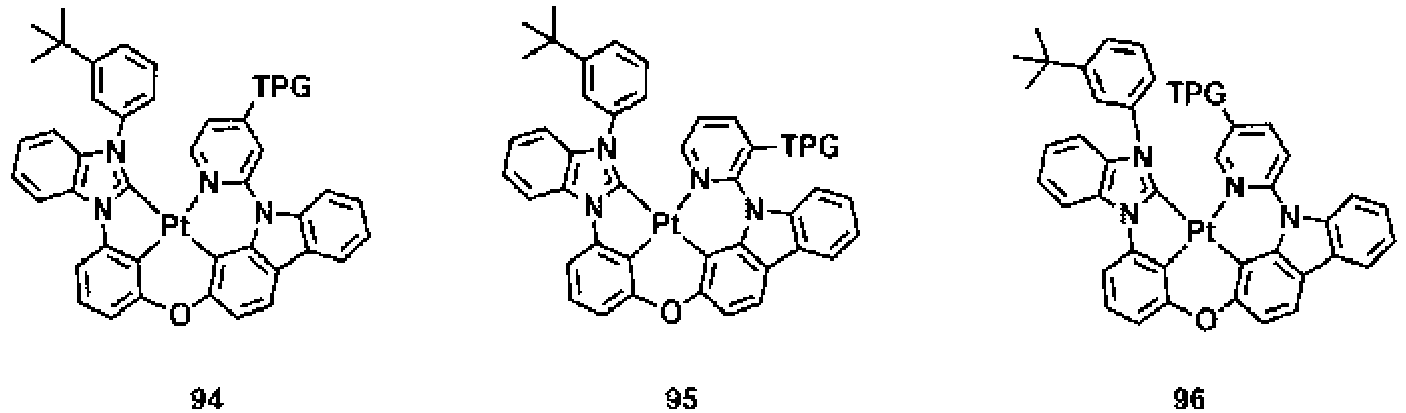

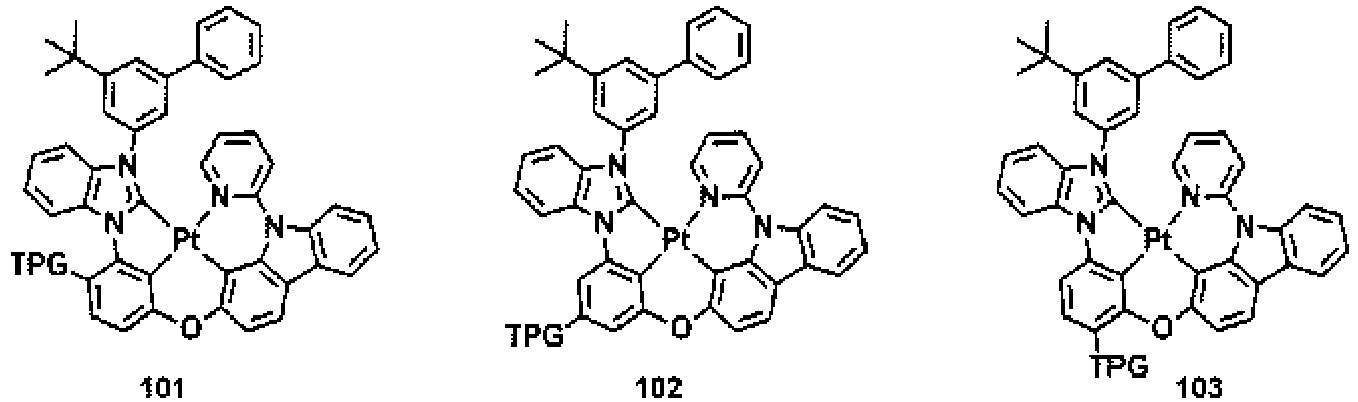


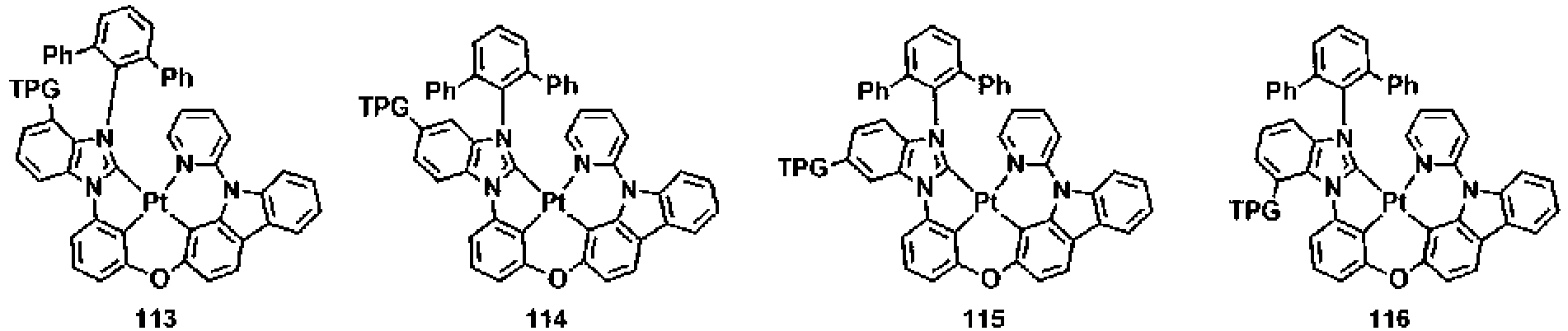


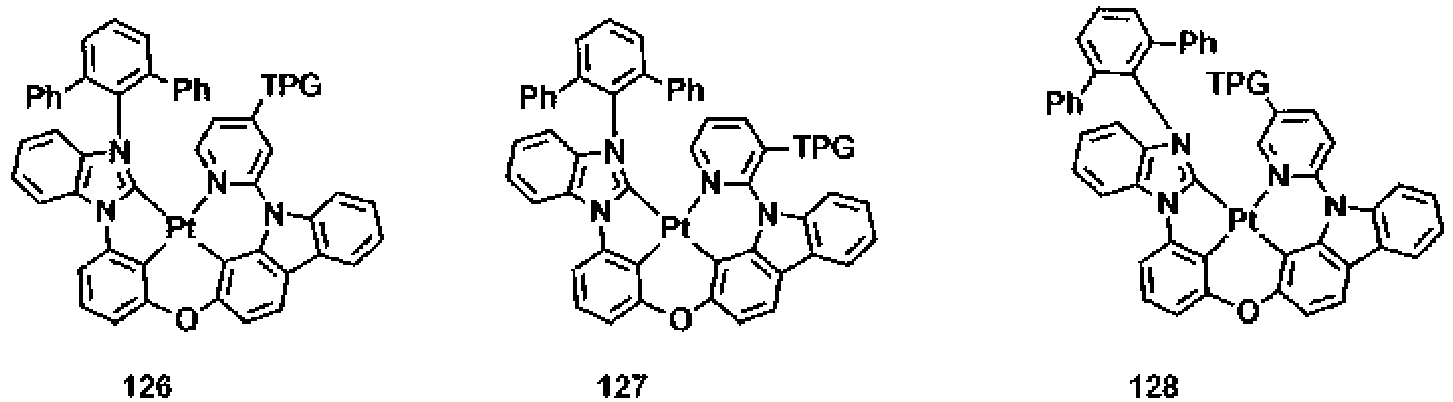













- Dispositif électroluminescent organique comprenant :une première électrode ;une deuxième électrode ; etune couche organique disposée entre la première électrode et la deuxième électrode,la couche organique comprenant une couche d'émission, etla couche organique comprenant en outre au moins un composé organométallique selon l'une quelconque des revendications 1 à 11.
- Dispositif électroluminescent organique selon la revendication 12, dans lequel la couche d'émission comprend l'au moins un composé organométallique.
- Dispositif électroluminescent organique selon la revendication 13, dans lequel la couche d'émission comprend en outre un hôte, et une quantité de l'hôte dans la couche d'émission est supérieure à une quantité de l'au moins un composé organométallique dans la couche d'émission ; et/oudans lequel la couche d'émission émet une lumière bleue comportant une longueur d'onde d'émission maximale dans la plage de 410 nanomètres à 490 nanomètres ; et/oudans lequel au moins 80 % de l'émission de luminescence totale émise par la couche d'émission est dérivée de l'au moins un composé organométallique.
- Dispositif électroluminescent organique selon l'une quelconque des revendications 12 à 14, dans lequella première électrode est une anode,la seconde électrode est une cathode,la couche organique comprend en outre une région de transport de trous disposée entre la première électrode et la couche d'émission et une région de transport d'électrons disposée entre la couche d'émission et la deuxième électrode,la région de transport de trous comprend une couche d'injection de trous, une couche de transport de trous, une couche de blocage d'électrons, une couche tampon, ou une combinaison de celles-ci, etla région de transport d'électrons comprend une couche de blocage de trous, une couche de transport d'électrons, une couche d'injection d'électrons, ou toute combinaison de celles-ci.
Applications Claiming Priority (1)
| Application Number | Priority Date | Filing Date | Title |
|---|---|---|---|
| KR1020210096715A KR20230015230A (ko) | 2021-07-22 | 2021-07-22 | 유기금속 화합물 및 이를 포함한 유기 발광 소자 |
Publications (2)
| Publication Number | Publication Date |
|---|---|
| EP4123000A1 EP4123000A1 (fr) | 2023-01-25 |
| EP4123000B1 true EP4123000B1 (fr) | 2024-05-29 |
Family
ID=81984595
Family Applications (1)
| Application Number | Title | Priority Date | Filing Date |
|---|---|---|---|
| EP22177963.0A Active EP4123000B1 (fr) | 2021-07-22 | 2022-06-08 | Composé organométallique et dispositif électroluminescent organique l'incluant |
Country Status (4)
| Country | Link |
|---|---|
| US (1) | US12497421B2 (fr) |
| EP (1) | EP4123000B1 (fr) |
| KR (1) | KR20230015230A (fr) |
| CN (1) | CN115677782A (fr) |
Families Citing this family (1)
| Publication number | Priority date | Publication date | Assignee | Title |
|---|---|---|---|---|
| US20240051981A1 (en) * | 2022-07-20 | 2024-02-15 | Samsung Display Co., Ltd. | Composition, light-emitting device, electronic apparatus including the light-emitting device, and organometallic compound |
Family Cites Families (39)
| Publication number | Priority date | Publication date | Assignee | Title |
|---|---|---|---|---|
| US6310360B1 (en) | 1999-07-21 | 2001-10-30 | The Trustees Of Princeton University | Intersystem crossing agents for efficient utilization of excitons in organic light emitting devices |
| US6939624B2 (en) | 2000-08-11 | 2005-09-06 | Universal Display Corporation | Organometallic compounds and emission-shifting organic electrophosphorescence |
| EP1325671B1 (fr) | 2000-08-11 | 2012-10-24 | The Trustees Of Princeton University | Composes organometalliques et electrophosphorescence organique presentant un deplacement d'emission |
| JP4404473B2 (ja) | 2000-12-25 | 2010-01-27 | 富士フイルム株式会社 | 新規含窒素へテロ環化合物、発光素子材料およびそれらを使用した発光素子 |
| DE10338550A1 (de) | 2003-08-19 | 2005-03-31 | Basf Ag | Übergangsmetallkomplexe mit Carbenliganden als Emitter für organische Licht-emittierende Dioden (OLEDs) |
| US9153790B2 (en) | 2009-05-22 | 2015-10-06 | Idemitsu Kosan Co., Ltd. | Organic electroluminescent device |
| US8476823B2 (en) | 2009-05-22 | 2013-07-02 | Idemitsu Kosan Co., Ltd. | Organic electroluminescent device |
| TWI552406B (zh) | 2011-03-25 | 2016-10-01 | 出光興產股份有限公司 | 有機電致發光元件 |
| US9493698B2 (en) | 2011-08-31 | 2016-11-15 | Universal Display Corporation | Organic electroluminescent materials and devices |
| CN104232076B (zh) | 2013-06-10 | 2019-01-15 | 代表亚利桑那大学的亚利桑那校董会 | 具有改进的发射光谱的磷光四齿金属络合物 |
| JP6804823B2 (ja) | 2013-10-14 | 2020-12-23 | アリゾナ・ボード・オブ・リージェンツ・オン・ビハーフ・オブ・アリゾナ・ステイト・ユニバーシティーArizona Board of Regents on behalf of Arizona State University | 白金錯体およびデバイス |
| JP5905916B2 (ja) | 2013-12-26 | 2016-04-20 | 出光興産株式会社 | 有機エレクトロルミネッセンス素子および電子機器 |
| EP3117470B1 (fr) | 2014-03-13 | 2020-12-23 | Merck Patent GmbH | Dispositif électroluminescent organique |
| JP6482782B2 (ja) | 2014-07-18 | 2019-03-13 | 国立大学法人九州大学 | 有機発光素子 |
| KR102285383B1 (ko) | 2014-09-12 | 2021-08-04 | 삼성디스플레이 주식회사 | 유기 발광 소자용 화합물 및 이를 포함하는 유기 발광 소자 |
| KR102834071B1 (ko) | 2015-03-27 | 2025-07-14 | 이데미쓰 고산 가부시키가이샤 | 유기 일렉트로 루미네선스 소자, 전자 기기, 및 화합물 |
| KR102460657B1 (ko) | 2015-08-31 | 2022-10-28 | 삼성전자주식회사 | 유기 발광 소자 |
| KR102601598B1 (ko) | 2015-09-14 | 2023-11-14 | 삼성전자주식회사 | 혼합물, 박막 및 이를 포함한 유기 발광 소자 |
| KR20180013380A (ko) | 2016-07-29 | 2018-02-07 | 서울대학교산학협력단 | 유기 발광 소자 |
| KR102852285B1 (ko) | 2017-02-27 | 2025-08-28 | 삼성전자주식회사 | 축합환 화합물 및 이를 포함한 유기 발광 소자 |
| US11552261B2 (en) | 2017-06-23 | 2023-01-10 | Universal Display Corporation | Organic electroluminescent materials and devices |
| US11814403B2 (en) | 2017-06-23 | 2023-11-14 | Universal Display Corporation | Organic electroluminescent materials and devices |
| US11725022B2 (en) | 2017-06-23 | 2023-08-15 | Universal Display Corporation | Organic electroluminescent materials and devices |
| US11802136B2 (en) | 2017-06-23 | 2023-10-31 | Universal Display Corporation | Organic electroluminescent materials and devices |
| KR102637103B1 (ko) | 2018-01-23 | 2024-02-20 | 삼성전자주식회사 | 유기금속 화합물, 이를 포함한 유기 발광 소자 및 이를 포함한 진단용 조성물 |
| CN108424426A (zh) | 2018-05-07 | 2018-08-21 | 浙江工业大学 | 含有三取代吡唑的四齿环金属钯配合物、制备方法及应用 |
| KR20200023984A (ko) | 2018-08-27 | 2020-03-06 | 삼성전자주식회사 | 헤테로고리 화합물 및 이를 포함한 유기 발광 소자 |
| CN109810106A (zh) | 2018-12-30 | 2019-05-28 | 瑞声科技(南京)有限公司 | 一种发光组合物及包含该发光组合物的发光层和电致发光器件 |
| CN111755612B (zh) | 2019-03-29 | 2025-03-18 | 三星电子株式会社 | 有机发光器件 |
| US11858949B2 (en) | 2019-06-13 | 2024-01-02 | Samsung Electronics Co., Ltd. | Organometallic compound, organic light-emitting device including the same, and diagnostic composition including the organometallic compound |
| KR20200143234A (ko) | 2019-06-13 | 2020-12-23 | 삼성전자주식회사 | 유기금속 화합물, 이를 포함한 유기 발광 소자 및 이를 포함한 진단용 조성물 |
| US20210167299A1 (en) | 2019-12-02 | 2021-06-03 | Samsung Electronics Co., Ltd. | Heterocyclic compound and organic light-emitting device including the same |
| KR102792552B1 (ko) | 2020-01-28 | 2025-04-08 | 삼성전자주식회사 | 유기 발광 소자 |
| EP3971261A1 (fr) | 2020-09-17 | 2022-03-23 | Samsung Electronics Co., Ltd. | Composé organométallique, dispositif électroluminescent organique le comprenant et composition de diagnostic comprenant le composé organométallique |
| US20220081457A1 (en) | 2020-09-17 | 2022-03-17 | Samsung Electronics Co., Ltd. | Organometallic compound, organic light-emitting device including the same, and diagnostic composition including the organometallic compound |
| US20230084208A1 (en) | 2020-11-20 | 2023-03-16 | Samsung Electronics Co., Ltd. | Polycyclic compound and organic light-emitting device including the same |
| KR102931059B1 (ko) | 2020-12-18 | 2026-02-24 | 삼성전자주식회사 | 유기 발광 소자 |
| KR20230004269A (ko) | 2021-06-30 | 2023-01-06 | 삼성전자주식회사 | 유기금속 화합물 및 이를 포함한 유기 발광 소자 |
| KR20230012369A (ko) | 2021-07-15 | 2023-01-26 | 삼성전자주식회사 | 유기금속 화합물 및 이를 포함한 유기 발광 소자 |
-
2021
- 2021-07-22 KR KR1020210096715A patent/KR20230015230A/ko active Pending
-
2022
- 2022-01-11 US US17/573,018 patent/US12497421B2/en active Active
- 2022-06-08 EP EP22177963.0A patent/EP4123000B1/fr active Active
- 2022-07-22 CN CN202210867153.0A patent/CN115677782A/zh active Pending
Also Published As
| Publication number | Publication date |
|---|---|
| EP4123000A1 (fr) | 2023-01-25 |
| US20230104013A1 (en) | 2023-04-06 |
| KR20230015230A (ko) | 2023-01-31 |
| CN115677782A (zh) | 2023-02-03 |
| US12497421B2 (en) | 2025-12-16 |
Similar Documents
| Publication | Publication Date | Title |
|---|---|---|
| EP3663308A1 (fr) | Composé organométallique, dispositif électroluminescent organique le comprenant et composition de diagnostic comprenant le composé organométallique | |
| EP3705483B1 (fr) | Composé organométallique, dispositif électroluminescent organique le comprenant et appareil électronique comprenant le dispositif électroluminescent organique | |
| EP4119633B1 (fr) | Composé organométallique et dispositif organique électroluminescent incluant un composé organométallique | |
| EP3943499A2 (fr) | Composé organométallique, dispositif électroluminescent organique le comprenant et appareil électronique comprenant le dispositif électroluminescent organique | |
| EP3988557B1 (fr) | Composé organométallique, dispositif électroluminescent organique le comprenant et composition de diagnostic comprenant le composé organométallique | |
| EP3971260A1 (fr) | Composé organométallique, dispositif électroluminescent organique le comprenant et appareil électronique comprenant le dispositif électroluminescent organique | |
| EP3689888B1 (fr) | Composé organométallique et dispositif électroluminescent organique l'incluant | |
| EP4086265B1 (fr) | Composé organométallique, dispositif électroluminescent organique le comprenant et appareil électronique comprenant le dispositif électroluminescent organique | |
| EP4059942A1 (fr) | Composé organométallique, dispositif électroluminescent organique le comprenant et appareil électronique comprenant le dispositif électroluminescent organique | |
| EP4274404A1 (fr) | Dispositif électroluminescent organique et appareil électronique le comprenant | |
| EP3828190A1 (fr) | Composé organométallique, dispositif électroluminescent organique le comprenant et appareil électronique comprenant le dispositif électroluminescent organique | |
| EP4122999B1 (fr) | Composé organométallique, dispositif électroluminescent organique le comprenant et appareil électronique comprenant le dispositif électroluminescent organique | |
| EP4102590A2 (fr) | Composition, couche comprenant la composition, dispositif électroluminescent comprenant la composition, et appareil électronique comprenant le dispositif électroluminescent | |
| EP4099413A1 (fr) | Composition, couche comprenant la composition, dispositif électroluminescent comprenant la composition, et appareil électronique comprenant le dispositif électroluminescent | |
| EP3909964B1 (fr) | Composé organométallique, dispositif électroluminescent organique le comprenant et appareil électronique comprenant le dispositif électroluminescent organique | |
| EP3992199A1 (fr) | Composé organométallique, dispositif électroluminescent organique le comprenant et appareil électronique comprenant le dispositif électroluminescent organique | |
| EP4123000B1 (fr) | Composé organométallique et dispositif électroluminescent organique l'incluant | |
| EP4186913B1 (fr) | Composé organométallique et dispositif électroluminescent organique l'incluant | |
| EP4339258A1 (fr) | Composé organométallique, dispositif électroluminescent organique comprenant le composé organométallique et appareil électronique comprenant le dispositif électroluminescent organique | |
| EP4151700A1 (fr) | Composition, couche comprenant la composition, dispositif électroluminescent comprenant la composition et appareil électronique comprenant le dispositif électroluminescent | |
| EP4299692B1 (fr) | Composé organométallique, dispositif électroluminescent organique le comprenant et appareil électronique comprenant le dispositif électroluminescent organique | |
| EP4389852B1 (fr) | Composé organométallique, dispositif électroluminescent organique le comprenant et appareil électronique comprenant le dispositif électroluminescent organique | |
| EP4606808A1 (fr) | Composé organométallique, dispositif électroluminescent organique le comprenant et appareil électronique comprenant le dispositif électroluminescent organique | |
| EP4311850B1 (fr) | Composé organométallique, dispositif électroluminescent organique le comprenant et appareil électronique comprenant le dispositif électroluminescent organique | |
| EP4365263A1 (fr) | Composé organométallique, dispositif électroluminescent organique le comprenant et appareil électronique comprenant le dispositif électroluminescent organique |
Legal Events
| Date | Code | Title | Description |
|---|---|---|---|
| PUAI | Public reference made under article 153(3) epc to a published international application that has entered the european phase |
Free format text: ORIGINAL CODE: 0009012 |
|
| STAA | Information on the status of an ep patent application or granted ep patent |
Free format text: STATUS: THE APPLICATION HAS BEEN PUBLISHED |
|
| AK | Designated contracting states |
Kind code of ref document: A1 Designated state(s): AL AT BE BG CH CY CZ DE DK EE ES FI FR GB GR HR HU IE IS IT LI LT LU LV MC MK MT NL NO PL PT RO RS SE SI SK SM TR |
|
| STAA | Information on the status of an ep patent application or granted ep patent |
Free format text: STATUS: REQUEST FOR EXAMINATION WAS MADE |
|
| 17P | Request for examination filed |
Effective date: 20230328 |
|
| RBV | Designated contracting states (corrected) |
Designated state(s): AL AT BE BG CH CY CZ DE DK EE ES FI FR GB GR HR HU IE IS IT LI LT LU LV MC MK MT NL NO PL PT RO RS SE SI SK SM TR |
|
| P01 | Opt-out of the competence of the unified patent court (upc) registered |
Effective date: 20230519 |
|
| STAA | Information on the status of an ep patent application or granted ep patent |
Free format text: STATUS: EXAMINATION IS IN PROGRESS |
|
| 17Q | First examination report despatched |
Effective date: 20230822 |
|
| GRAP | Despatch of communication of intention to grant a patent |
Free format text: ORIGINAL CODE: EPIDOSNIGR1 |
|
| STAA | Information on the status of an ep patent application or granted ep patent |
Free format text: STATUS: GRANT OF PATENT IS INTENDED |
|
| RIC1 | Information provided on ipc code assigned before grant |
Ipc: H10K 101/10 20230101ALN20240221BHEP Ipc: H10K 50/11 20230101ALN20240221BHEP Ipc: H10K 85/30 20230101ALI20240221BHEP Ipc: C07F 15/00 20060101ALI20240221BHEP Ipc: C09K 11/06 20060101AFI20240221BHEP |
|
| INTG | Intention to grant announced |
Effective date: 20240312 |
|
| GRAS | Grant fee paid |
Free format text: ORIGINAL CODE: EPIDOSNIGR3 |
|
| GRAA | (expected) grant |
Free format text: ORIGINAL CODE: 0009210 |
|
| STAA | Information on the status of an ep patent application or granted ep patent |
Free format text: STATUS: THE PATENT HAS BEEN GRANTED |
|
| AK | Designated contracting states |
Kind code of ref document: B1 Designated state(s): AL AT BE BG CH CY CZ DE DK EE ES FI FR GB GR HR HU IE IS IT LI LT LU LV MC MK MT NL NO PL PT RO RS SE SI SK SM TR |
|
| REG | Reference to a national code |
Ref country code: CH Ref legal event code: EP |
|
| REG | Reference to a national code |
Ref country code: IE Ref legal event code: FG4D |
|
| REG | Reference to a national code |
Ref country code: DE Ref legal event code: R096 Ref document number: 602022003652 Country of ref document: DE |
|
| REG | Reference to a national code |
Ref country code: LT Ref legal event code: MG9D |
|
| REG | Reference to a national code |
Ref country code: NL Ref legal event code: MP Effective date: 20240529 |
|
| PG25 | Lapsed in a contracting state [announced via postgrant information from national office to epo] |
Ref country code: IS Free format text: LAPSE BECAUSE OF FAILURE TO SUBMIT A TRANSLATION OF THE DESCRIPTION OR TO PAY THE FEE WITHIN THE PRESCRIBED TIME-LIMIT Effective date: 20240929 |
|
| PG25 | Lapsed in a contracting state [announced via postgrant information from national office to epo] |
Ref country code: BG Free format text: LAPSE BECAUSE OF FAILURE TO SUBMIT A TRANSLATION OF THE DESCRIPTION OR TO PAY THE FEE WITHIN THE PRESCRIBED TIME-LIMIT Effective date: 20240529 |
|
| PG25 | Lapsed in a contracting state [announced via postgrant information from national office to epo] |
Ref country code: HR Free format text: LAPSE BECAUSE OF FAILURE TO SUBMIT A TRANSLATION OF THE DESCRIPTION OR TO PAY THE FEE WITHIN THE PRESCRIBED TIME-LIMIT Effective date: 20240529 Ref country code: FI Free format text: LAPSE BECAUSE OF FAILURE TO SUBMIT A TRANSLATION OF THE DESCRIPTION OR TO PAY THE FEE WITHIN THE PRESCRIBED TIME-LIMIT Effective date: 20240529 |
|
| PG25 | Lapsed in a contracting state [announced via postgrant information from national office to epo] |
Ref country code: GR Free format text: LAPSE BECAUSE OF FAILURE TO SUBMIT A TRANSLATION OF THE DESCRIPTION OR TO PAY THE FEE WITHIN THE PRESCRIBED TIME-LIMIT Effective date: 20240830 |
|
| REG | Reference to a national code |
Ref country code: AT Ref legal event code: MK05 Ref document number: 1690638 Country of ref document: AT Kind code of ref document: T Effective date: 20240529 |
|
| PG25 | Lapsed in a contracting state [announced via postgrant information from national office to epo] |
Ref country code: ES Free format text: LAPSE BECAUSE OF FAILURE TO SUBMIT A TRANSLATION OF THE DESCRIPTION OR TO PAY THE FEE WITHIN THE PRESCRIBED TIME-LIMIT Effective date: 20240529 |
|
| PG25 | Lapsed in a contracting state [announced via postgrant information from national office to epo] |
Ref country code: AT Free format text: LAPSE BECAUSE OF FAILURE TO SUBMIT A TRANSLATION OF THE DESCRIPTION OR TO PAY THE FEE WITHIN THE PRESCRIBED TIME-LIMIT Effective date: 20240529 |
|
| PG25 | Lapsed in a contracting state [announced via postgrant information from national office to epo] |
Ref country code: PL Free format text: LAPSE BECAUSE OF FAILURE TO SUBMIT A TRANSLATION OF THE DESCRIPTION OR TO PAY THE FEE WITHIN THE PRESCRIBED TIME-LIMIT Effective date: 20240529 |
|
| PG25 | Lapsed in a contracting state [announced via postgrant information from national office to epo] |
Ref country code: LV Free format text: LAPSE BECAUSE OF FAILURE TO SUBMIT A TRANSLATION OF THE DESCRIPTION OR TO PAY THE FEE WITHIN THE PRESCRIBED TIME-LIMIT Effective date: 20240529 |
|
| PG25 | Lapsed in a contracting state [announced via postgrant information from national office to epo] |
Ref country code: PL Free format text: LAPSE BECAUSE OF FAILURE TO SUBMIT A TRANSLATION OF THE DESCRIPTION OR TO PAY THE FEE WITHIN THE PRESCRIBED TIME-LIMIT Effective date: 20240529 Ref country code: NO Free format text: LAPSE BECAUSE OF FAILURE TO SUBMIT A TRANSLATION OF THE DESCRIPTION OR TO PAY THE FEE WITHIN THE PRESCRIBED TIME-LIMIT Effective date: 20240829 Ref country code: LV Free format text: LAPSE BECAUSE OF FAILURE TO SUBMIT A TRANSLATION OF THE DESCRIPTION OR TO PAY THE FEE WITHIN THE PRESCRIBED TIME-LIMIT Effective date: 20240529 Ref country code: IS Free format text: LAPSE BECAUSE OF FAILURE TO SUBMIT A TRANSLATION OF THE DESCRIPTION OR TO PAY THE FEE WITHIN THE PRESCRIBED TIME-LIMIT Effective date: 20240929 Ref country code: HR Free format text: LAPSE BECAUSE OF FAILURE TO SUBMIT A TRANSLATION OF THE DESCRIPTION OR TO PAY THE FEE WITHIN THE PRESCRIBED TIME-LIMIT Effective date: 20240529 Ref country code: GR Free format text: LAPSE BECAUSE OF FAILURE TO SUBMIT A TRANSLATION OF THE DESCRIPTION OR TO PAY THE FEE WITHIN THE PRESCRIBED TIME-LIMIT Effective date: 20240830 Ref country code: FI Free format text: LAPSE BECAUSE OF FAILURE TO SUBMIT A TRANSLATION OF THE DESCRIPTION OR TO PAY THE FEE WITHIN THE PRESCRIBED TIME-LIMIT Effective date: 20240529 Ref country code: ES Free format text: LAPSE BECAUSE OF FAILURE TO SUBMIT A TRANSLATION OF THE DESCRIPTION OR TO PAY THE FEE WITHIN THE PRESCRIBED TIME-LIMIT Effective date: 20240529 Ref country code: BG Free format text: LAPSE BECAUSE OF FAILURE TO SUBMIT A TRANSLATION OF THE DESCRIPTION OR TO PAY THE FEE WITHIN THE PRESCRIBED TIME-LIMIT Effective date: 20240529 Ref country code: AT Free format text: LAPSE BECAUSE OF FAILURE TO SUBMIT A TRANSLATION OF THE DESCRIPTION OR TO PAY THE FEE WITHIN THE PRESCRIBED TIME-LIMIT Effective date: 20240529 Ref country code: RS Free format text: LAPSE BECAUSE OF FAILURE TO SUBMIT A TRANSLATION OF THE DESCRIPTION OR TO PAY THE FEE WITHIN THE PRESCRIBED TIME-LIMIT Effective date: 20240829 |
|
| PG25 | Lapsed in a contracting state [announced via postgrant information from national office to epo] |
Ref country code: NL Free format text: LAPSE BECAUSE OF FAILURE TO SUBMIT A TRANSLATION OF THE DESCRIPTION OR TO PAY THE FEE WITHIN THE PRESCRIBED TIME-LIMIT Effective date: 20240529 |
|
| PG25 | Lapsed in a contracting state [announced via postgrant information from national office to epo] |
Ref country code: NL Free format text: LAPSE BECAUSE OF FAILURE TO SUBMIT A TRANSLATION OF THE DESCRIPTION OR TO PAY THE FEE WITHIN THE PRESCRIBED TIME-LIMIT Effective date: 20240529 |
|
| PG25 | Lapsed in a contracting state [announced via postgrant information from national office to epo] |
Ref country code: DK Free format text: LAPSE BECAUSE OF FAILURE TO SUBMIT A TRANSLATION OF THE DESCRIPTION OR TO PAY THE FEE WITHIN THE PRESCRIBED TIME-LIMIT Effective date: 20240529 |
|
| PG25 | Lapsed in a contracting state [announced via postgrant information from national office to epo] |
Ref country code: EE Free format text: LAPSE BECAUSE OF FAILURE TO SUBMIT A TRANSLATION OF THE DESCRIPTION OR TO PAY THE FEE WITHIN THE PRESCRIBED TIME-LIMIT Effective date: 20240529 |
|
| PG25 | Lapsed in a contracting state [announced via postgrant information from national office to epo] |
Ref country code: CZ Free format text: LAPSE BECAUSE OF FAILURE TO SUBMIT A TRANSLATION OF THE DESCRIPTION OR TO PAY THE FEE WITHIN THE PRESCRIBED TIME-LIMIT Effective date: 20240529 |
|
| PG25 | Lapsed in a contracting state [announced via postgrant information from national office to epo] |
Ref country code: RO Free format text: LAPSE BECAUSE OF FAILURE TO SUBMIT A TRANSLATION OF THE DESCRIPTION OR TO PAY THE FEE WITHIN THE PRESCRIBED TIME-LIMIT Effective date: 20240529 Ref country code: SK Free format text: LAPSE BECAUSE OF FAILURE TO SUBMIT A TRANSLATION OF THE DESCRIPTION OR TO PAY THE FEE WITHIN THE PRESCRIBED TIME-LIMIT Effective date: 20240529 |
|
| PG25 | Lapsed in a contracting state [announced via postgrant information from national office to epo] |
Ref country code: SM Free format text: LAPSE BECAUSE OF FAILURE TO SUBMIT A TRANSLATION OF THE DESCRIPTION OR TO PAY THE FEE WITHIN THE PRESCRIBED TIME-LIMIT Effective date: 20240529 |
|
| PG25 | Lapsed in a contracting state [announced via postgrant information from national office to epo] |
Ref country code: SM Free format text: LAPSE BECAUSE OF FAILURE TO SUBMIT A TRANSLATION OF THE DESCRIPTION OR TO PAY THE FEE WITHIN THE PRESCRIBED TIME-LIMIT Effective date: 20240529 Ref country code: SK Free format text: LAPSE BECAUSE OF FAILURE TO SUBMIT A TRANSLATION OF THE DESCRIPTION OR TO PAY THE FEE WITHIN THE PRESCRIBED TIME-LIMIT Effective date: 20240529 Ref country code: RO Free format text: LAPSE BECAUSE OF FAILURE TO SUBMIT A TRANSLATION OF THE DESCRIPTION OR TO PAY THE FEE WITHIN THE PRESCRIBED TIME-LIMIT Effective date: 20240529 Ref country code: EE Free format text: LAPSE BECAUSE OF FAILURE TO SUBMIT A TRANSLATION OF THE DESCRIPTION OR TO PAY THE FEE WITHIN THE PRESCRIBED TIME-LIMIT Effective date: 20240529 Ref country code: DK Free format text: LAPSE BECAUSE OF FAILURE TO SUBMIT A TRANSLATION OF THE DESCRIPTION OR TO PAY THE FEE WITHIN THE PRESCRIBED TIME-LIMIT Effective date: 20240529 Ref country code: CZ Free format text: LAPSE BECAUSE OF FAILURE TO SUBMIT A TRANSLATION OF THE DESCRIPTION OR TO PAY THE FEE WITHIN THE PRESCRIBED TIME-LIMIT Effective date: 20240529 |
|
| PG25 | Lapsed in a contracting state [announced via postgrant information from national office to epo] |
Ref country code: IT Free format text: LAPSE BECAUSE OF FAILURE TO SUBMIT A TRANSLATION OF THE DESCRIPTION OR TO PAY THE FEE WITHIN THE PRESCRIBED TIME-LIMIT Effective date: 20240529 Ref country code: MC Free format text: LAPSE BECAUSE OF FAILURE TO SUBMIT A TRANSLATION OF THE DESCRIPTION OR TO PAY THE FEE WITHIN THE PRESCRIBED TIME-LIMIT Effective date: 20240529 |
|
| PG25 | Lapsed in a contracting state [announced via postgrant information from national office to epo] |
Ref country code: LU Free format text: LAPSE BECAUSE OF NON-PAYMENT OF DUE FEES Effective date: 20240608 |
|
| REG | Reference to a national code |
Ref country code: DE Ref legal event code: R097 Ref document number: 602022003652 Country of ref document: DE |
|
| PLBE | No opposition filed within time limit |
Free format text: ORIGINAL CODE: 0009261 |
|
| STAA | Information on the status of an ep patent application or granted ep patent |
Free format text: STATUS: NO OPPOSITION FILED WITHIN TIME LIMIT |
|
| PG25 | Lapsed in a contracting state [announced via postgrant information from national office to epo] |
Ref country code: IE Free format text: LAPSE BECAUSE OF NON-PAYMENT OF DUE FEES Effective date: 20240608 |
|
| PG25 | Lapsed in a contracting state [announced via postgrant information from national office to epo] |
Ref country code: SI Free format text: LAPSE BECAUSE OF FAILURE TO SUBMIT A TRANSLATION OF THE DESCRIPTION OR TO PAY THE FEE WITHIN THE PRESCRIBED TIME-LIMIT Effective date: 20240529 Ref country code: BE Free format text: LAPSE BECAUSE OF NON-PAYMENT OF DUE FEES Effective date: 20240630 |
|
| REG | Reference to a national code |
Ref country code: BE Ref legal event code: MM Effective date: 20240630 |
|
| 26N | No opposition filed |
Effective date: 20250303 |
|
| PGFP | Annual fee paid to national office [announced via postgrant information from national office to epo] |
Ref country code: DE Payment date: 20250507 Year of fee payment: 4 |
|
| PGFP | Annual fee paid to national office [announced via postgrant information from national office to epo] |
Ref country code: FR Payment date: 20250508 Year of fee payment: 4 |
|
| PG25 | Lapsed in a contracting state [announced via postgrant information from national office to epo] |
Ref country code: SE Free format text: LAPSE BECAUSE OF FAILURE TO SUBMIT A TRANSLATION OF THE DESCRIPTION OR TO PAY THE FEE WITHIN THE PRESCRIBED TIME-LIMIT Effective date: 20240529 |
|
| REG | Reference to a national code |
Ref country code: GB Ref legal event code: 732E Free format text: REGISTERED BETWEEN 20250925 AND 20251001 |
|
| PG25 | Lapsed in a contracting state [announced via postgrant information from national office to epo] |
Ref country code: CY Free format text: LAPSE BECAUSE OF FAILURE TO SUBMIT A TRANSLATION OF THE DESCRIPTION OR TO PAY THE FEE WITHIN THE PRESCRIBED TIME-LIMIT; INVALID AB INITIO Effective date: 20220608 |
|
| REG | Reference to a national code |
Ref country code: DE Ref legal event code: R081 Ref document number: 602022003652 Country of ref document: DE Owner name: SAMSUNG DISPLAY CO., LTD., YONGIN-SI, KR Free format text: FORMER OWNER: SAMSUNG ELECTRONICS CO., LTD., SUWON-SI, GYEONGGI-DO, KR |
|
| REG | Reference to a national code |
Ref country code: CH Ref legal event code: H13 Free format text: ST27 STATUS EVENT CODE: U-0-0-H10-H13 (AS PROVIDED BY THE NATIONAL OFFICE) Effective date: 20260127 |
|
| PG25 | Lapsed in a contracting state [announced via postgrant information from national office to epo] |
Ref country code: HU Free format text: LAPSE BECAUSE OF FAILURE TO SUBMIT A TRANSLATION OF THE DESCRIPTION OR TO PAY THE FEE WITHIN THE PRESCRIBED TIME-LIMIT; INVALID AB INITIO Effective date: 20220608 |
|
| PG25 | Lapsed in a contracting state [announced via postgrant information from national office to epo] |
Ref country code: CH Free format text: LAPSE BECAUSE OF NON-PAYMENT OF DUE FEES Effective date: 20250630 |