EP4123200B1 - Kolben, gangsteller und getriebeschaltvorrichtung - Google Patents
Kolben, gangsteller und getriebeschaltvorrichtung Download PDFInfo
- Publication number
- EP4123200B1 EP4123200B1 EP22182663.9A EP22182663A EP4123200B1 EP 4123200 B1 EP4123200 B1 EP 4123200B1 EP 22182663 A EP22182663 A EP 22182663A EP 4123200 B1 EP4123200 B1 EP 4123200B1
- Authority
- EP
- European Patent Office
- Prior art keywords
- piston
- vent
- sealing element
- vent channel
- working fluid
- Prior art date
- Legal status (The legal status is an assumption and is not a legal conclusion. Google has not performed a legal analysis and makes no representation as to the accuracy of the status listed.)
- Active
Links
Images



Classifications
-
- F—MECHANICAL ENGINEERING; LIGHTING; HEATING; WEAPONS; BLASTING
- F16—ENGINEERING ELEMENTS AND UNITS; GENERAL MEASURES FOR PRODUCING AND MAINTAINING EFFECTIVE FUNCTIONING OF MACHINES OR INSTALLATIONS; THERMAL INSULATION IN GENERAL
- F16H—GEARING
- F16H63/00—Control outputs from the control unit to change-speed- or reversing-gearings for conveying rotary motion or to other devices than the final output mechanism
- F16H63/02—Final output mechanisms therefor; Actuating means for the final output mechanisms
- F16H63/30—Constructional features of the final output mechanisms
- F16H63/3023—Constructional features of the final output mechanisms the final output mechanisms comprising elements moved by fluid pressure
-
- F—MECHANICAL ENGINEERING; LIGHTING; HEATING; WEAPONS; BLASTING
- F15—FLUID-PRESSURE ACTUATORS; HYDRAULICS OR PNEUMATICS IN GENERAL
- F15B—SYSTEMS ACTING BY MEANS OF FLUIDS IN GENERAL; FLUID-PRESSURE ACTUATORS, e.g. SERVOMOTORS; DETAILS OF FLUID-PRESSURE SYSTEMS, NOT OTHERWISE PROVIDED FOR
- F15B15/00—Fluid-actuated devices for displacing a member from one position to another; Gearing associated therewith
- F15B15/08—Characterised by the construction of the motor unit
- F15B15/14—Characterised by the construction of the motor unit of the straight-cylinder type
-
- F—MECHANICAL ENGINEERING; LIGHTING; HEATING; WEAPONS; BLASTING
- F16—ENGINEERING ELEMENTS AND UNITS; GENERAL MEASURES FOR PRODUCING AND MAINTAINING EFFECTIVE FUNCTIONING OF MACHINES OR INSTALLATIONS; THERMAL INSULATION IN GENERAL
- F16H—GEARING
- F16H61/00—Control functions within control units of change-speed- or reversing-gearings for conveying rotary motion ; Control of exclusively fluid gearing, friction gearing, gearings with endless flexible members or other particular types of gearing
- F16H61/26—Generation or transmission of movements for final actuating mechanisms
- F16H61/28—Generation or transmission of movements for final actuating mechanisms with at least one movement of the final actuating mechanism being caused by a non-mechanical force, e.g. power-assisted
- F16H61/30—Hydraulic or pneumatic motors or related fluid control means therefor
-
- F—MECHANICAL ENGINEERING; LIGHTING; HEATING; WEAPONS; BLASTING
- F16—ENGINEERING ELEMENTS AND UNITS; GENERAL MEASURES FOR PRODUCING AND MAINTAINING EFFECTIVE FUNCTIONING OF MACHINES OR INSTALLATIONS; THERMAL INSULATION IN GENERAL
- F16H—GEARING
- F16H61/00—Control functions within control units of change-speed- or reversing-gearings for conveying rotary motion ; Control of exclusively fluid gearing, friction gearing, gearings with endless flexible members or other particular types of gearing
- F16H2061/004—Venting trapped air from hydraulic systems
-
- F—MECHANICAL ENGINEERING; LIGHTING; HEATING; WEAPONS; BLASTING
- F16—ENGINEERING ELEMENTS AND UNITS; GENERAL MEASURES FOR PRODUCING AND MAINTAINING EFFECTIVE FUNCTIONING OF MACHINES OR INSTALLATIONS; THERMAL INSULATION IN GENERAL
- F16H—GEARING
- F16H61/00—Control functions within control units of change-speed- or reversing-gearings for conveying rotary motion ; Control of exclusively fluid gearing, friction gearing, gearings with endless flexible members or other particular types of gearing
- F16H61/26—Generation or transmission of movements for final actuating mechanisms
- F16H61/28—Generation or transmission of movements for final actuating mechanisms with at least one movement of the final actuating mechanism being caused by a non-mechanical force, e.g. power-assisted
- F16H61/30—Hydraulic or pneumatic motors or related fluid control means therefor
- F16H2061/308—Modular hydraulic shift units, i.e. preassembled actuator units for select and shift movements adapted for being mounted on transmission casing
-
- F—MECHANICAL ENGINEERING; LIGHTING; HEATING; WEAPONS; BLASTING
- F16—ENGINEERING ELEMENTS AND UNITS; GENERAL MEASURES FOR PRODUCING AND MAINTAINING EFFECTIVE FUNCTIONING OF MACHINES OR INSTALLATIONS; THERMAL INSULATION IN GENERAL
- F16H—GEARING
- F16H63/00—Control outputs from the control unit to change-speed- or reversing-gearings for conveying rotary motion or to other devices than the final output mechanism
- F16H63/02—Final output mechanisms therefor; Actuating means for the final output mechanisms
- F16H63/24—Final output mechanisms therefor; Actuating means for the final output mechanisms each of the final output mechanisms being moved by only one of the various final actuating mechanisms
Definitions
- the invention concerns a hydraulic piston, a hydraulic gear-change selector for a transmission of a motor vehicle, and a gearshift with corresponding gear-change selector for a motor vehicle.
- Hydraulic actuators in the form of single- or double-action hydraulic cylinders are used for various applications, here explained as an example for a gear-change selector for the transmission of a motor vehicle.
- a gear-change selector is provided to actuate the shift forks on a transmission to engage the various gears.
- a hydraulically actuated gear-change selector comprises for this multiple hydraulic cylinders.
- a hydraulic cylinder is a working cylinder operated by a fluid, and is also known as a hydraulic linear motor.
- a hydraulic cylinder converts the energy of a hydraulic fluid, supplied from a hydraulic pressure accumulator or hydraulic pump, into a linear movement. It usually comprises a piston which is adjustable in translation in a cylindrical tube portion.
- Single-action cylinders have only one piston end which is loaded with the hydraulic fluid. Work can therefore only be performed in one direction. The return movement is ensured by own mass or an external force such as a return spring.
- double-action cylinders there are two opposite piston and faces which are usually loaded alternately with hydraulic fluid.
- the cylinder therefore has two active movement directions.
- a hydraulic cylinder At least before first commissioning of a hydraulic system but also after intervention on the system, such as repair, a hydraulic cylinder must be vented. Continuous venting may prevent air inclusions accumulating in the hydraulic cylinder over time.
- air inclusions in the working medium or working fluid may cause the so-called diesel effect which leads to fluid ageing and loss of seal because of the greatly increased temperatures.
- a further negative effect is that air is diffused through the sealing material in the direction of the low-pressure side. Because the pressure falls greatly at the surface of the seal, causing the air inclusions to expand suddenly, the seal may wear prematurely.
- venting solutions A further disadvantage with existing venting solutions is that the working fluid continuously drains away through the vent. In particular in longer periods of non-use, this may lead to the hydraulic system drawing in air and in extreme cases running dry.
- a piston in particular for a gear-change selector, comprising a piston body with a piston skirt and with a piston end face which can be pressurised with a working fluid, as defined in independent claim 1.
- the piston comprises a first sealing portion and a second sealing portion.
- the piston body and the first sealing portion here have mutually complementary geometries so that they form a first vent channel which is arranged in a hydraulic series circuit with the second sealing portion.
- the second sealing portion prevents venting up to a first working fluid pressure.
- the second sealing portion allows venting above the first working fluid pressure. In this way, air intake or dry running of the cylinder in extended periods of non-use is reliably prevented.
- the piston end face has a depression in which a rubber-elastic sealing element is arranged,
- the first sealing portion is part of the sealing element.
- the piston body and the sealing element have mutually complementary geometries so that they form the first vent channel with a first free cross-sectional area, and in a pressure-relieved state, between mutually opposing surfaces of the depression and the first sealing portion of the sealing element, form a second vent channel with a second free cross-sectional area.
- the first vent channel and the second vent channel are hydraulically connected in parallel.
- the depression and the sealing element are configured such that, as the temperature of the sealing element rises, its modulus of elasticity falls, and a pressurisation of the sealing element by the working fluid leads to a temperature- and pressure-dependent elastic deformation of the sealing element.
- the elastic deformation in turn leads to a reduction in the free cross-sectional area of the second vent channel.
- a vent channel with constant free cross-section may, at low temperatures, lead to a volume flow which is too low to adequately vent the piston.
- the volume flow through a vent channel with constant cross-section is unnecessarily high, and therefore leads to high losses.
- a hydraulic piston may be provided which has vent channels with a pressure- and temperature-dependent (variable) free cross-sectional area.
- the pressure and temperature-dependent free cross-sectional area automatically changes purely because of physical effects, such that the volume flow for venting is sufficiently large at a first temperature and/or first pressure, but nonetheless not excessively large at a second (higher) pressure and a second (higher) temperature.
- the piston body and the sealing element are configured such that the temperature- and pressure-dependent elastic deformation of the sealing element reduces the free cross-sectional area of the second vent channel more greatly than the free cross-sectional area of the first vent channel.
- the cross-sectional area of the first vent channel is substantially independent of pressure and temperature. For example, this may be achieved if the first vent channel extends from the piston end face (or another point of the piston loaded with working pressure) through the piston body, without the sealing element being able to act on the free cross-sectional area of the first vent channel, or partially cover the channel inlet.
- the first vent channel and the second vent channel are arranged in a hydraulic series circuit with a second sealing portion.
- the second sealing portion is configured such that it seals a vent opening in the piston body against the first and second vent channels up to the first working fluid pressure and opens this above the first working fluid pressure.
- the piston may be prevented from running dry, in particular in longer periods of non-use.
- the depression has an outer region on the side of the piston end face, in which the rubber-elastic sealing element is arranged. Furthermore, the depression then comprises an inner region in which the vent opening is arranged.
- the second sealing portion in the form of a sealing lip, is arranged between the inner region and the outer region. Sealing lips have proved particularly suitable for the proposed purpose.
- the depression may have one or more vent grooves in its (side) wall, which, together with the first sealing portion, form the second vent channel.
- the vent grooves extend in the direction of the inner region from the piston end face to behind the outer region.
- the respective vent groove is advantageously configured and dimensioned such that the second vent channel is not closed by the sealing element at the first pressure and/or at a first temperature, but rather has a maximal free cross-sectional area.
- the sealing element elastically deforms depending on the working fluid temperature and pressure, such that it increasingly closes the free cross-sectional area of the second vent channel, preferably until the second vent channel is substantially completely closed by the deformed sealing element above a second pressure and/or above a second working fluid temperature.
- the free total cross-sectional area of the vent channels is minimal, so that with correspondingly high pressure or with temperature-induced, low-viscosity flow properties of the working medium, the volume flow through the vent channels is limited by means of the sealing element.
- the at least one second vent groove has a flat free cross-section.
- Flat in this context means that the free cross-section has a height (in the radial direction) which is smaller than the width (in the circumferential direction).
- a flat free cross-section with rounded transitions may be partially or even completely closed by a sealing element which deforms under the applied pressure.
- the depression has one or more vent notches in its wall which, in each case together with the first sealing portion, form the first vent channel (or several channels).
- vent notch extends in the direction of the inner region from the piston end face to behind the outer region. Furthermore, the vent notch is configured and dimensioned such that it is not closed by the sealing element even under a temperature- and pressure-dependent elastic deformation of the sealing element.
- vent notch may preferably have a deep free cross-section. Deep in this context means that the free cross-section in the radial direction has a height which is greater than the width. A deep free cross-section may only be poorly covered or not covered at all by the deformed sealing element.
- the second vent channel has a smaller maximal distance from the sealing element than the first vent channel.
- the sealing element when deformed, the sealing element firstly/exclusively covers the second vent channel.
- the depression is an end-face ring groove extending in the axial direction. This shape has proved particularly advantageous and offers a particularly good retention for the sealing element.
- the piston may have a piston seal comprising a radial circumferential groove in the piston skirt of the piston.
- a self-sealing piston groove ring with a sealing lip may be arranged in the circumferential groove.
- the piston may be a double-action piston.
- the piston body then has a piston end face of the above-described type on both sides.
- a ring groove may be provided on the end face of the piston, in the wall of which a plurality of vent grooves and at least one vent notch are machined.
- a sealing ring is positioned in the ring groove which, together with the geometry of the vent grooves and the vent notch, defines the free cross-sectional areas of the vent channels.
- An additional sealing lip on the sealing ring ensures that the vent channels or vent openings are completely sealed below a defined working pressure so that the hydraulics cannot run dry.
- the sealing ring which is elastically deformed by the working pressure, partially or completely closes the vent grooves while the vent notch remains open irrespective of working pressure. In a pressureless state, the free cross-sectional area is maximal.
- the stiffness of the sealing ring diminishes so that a comparable working pressure at higher temperature also leads to a smaller free cross-sectional area.
- the sealing ring is very stiff so that the free cross-sectional area of the vent channels is approximately maximal irrespective of working pressure. The temperature-dependent viscosity of the working fluid is thus compensated.
- a gear-change selector for a gearshift is also provided.
- the gear-change selector has at least one, preferably several, and in particular two to six of the pistons described initially.
- the gear-change selector can be used/installed particularly flexibly and easily as a gear-change selector module which can be mounted on a transmission.
- a gearshift comprising a gear-change selector of the above-described type.
- Figure 1 shows a piston 7 for a gear-change selector 2.
- the piston 7 comprises a piston body 8 with a piston skirt 10 and a piston end face 9 which can be pressurised with a working fluid.
- the piston may be made of PPA (polyphthalamide).
- the piston 7 comprises a first sealing portion 19 and a second sealing portion 20.
- the piston body 8 and the first sealing portion 19 have mutually complementary geometries so that they form a first vent channel 15.
- the first vent channel 15 is arranged in a hydraulic series circuit with the second sealing portion 20.
- the second sealing portion 20 prevents venting up to a first pressure P1 and allows this above the first pressure P1.
- the piston end face 9 has a depression 13.
- a rubber-elastic element 18 (not shown here) is arranged in the depression 13 (see figure 2 ).
- the piston 7 is a double-action piston.
- the piston body 8 has piston end faces 9 of the above-described type on both sides.
- Figure 2 shows in perspective a section through the piston 7.
- the piston body 8 and the sealing element 18 have mutually complementary geometries. They form a first vent channel 15 with a first free cross-sectional area. Furthermore, at least in a pressure-relieved state, between mutually facing surfaces of the depression 13 and a first sealing portion 19 of the sealing element 18, they form a second vent channel 17 with a second free cross-sectional area.
- the first vent channel 15 and the second vent channel 17 are hydraulically connected in parallel. Both open into the inner region of the depression 13.
- the depression 13 and the sealing element 18 may be configured such that, as the temperature of the sealing element 18 rises, its modulus of elasticity falls, and a pressurisation of the sealing element 18 by the working fluid 11 leads to a temperature- and pressure-dependent elastic deformation of the sealing element 18.
- the elastic deformation in turn causes a reduction in the free cross-sectional area of the second vent channel 17.
- the first vent channel 15 and the second vent channel 17 are arranged in a hydraulic series circuit with a second sealing portion 20.
- the second sealing portion 20 seals a vent opening 12 in the piston body 8 against the first and second vent channels 15, 17 up to a first pressure P1.
- the second sealing portion 20 opens the vent opening above the first pressure P1.
- the depression 13 has an outer region on the side of the piston end face 9, in which the rubber-elastic sealing element 18 is arranged.
- the depression 13 furthermore comprises an inner region which contains the vent opening 12.
- the second sealing portion 20, in the form of a sealing lip, is arranged between the inner region and the outer region.
- the depression 13 has a vent groove 16 in its wall.
- the vent groove 16 extends in the direction of the inner region from the piston end face 9 to behind the outer region, and is configured and dimensioned such that the second vent channel 17 is not closed by the sealing element 18 at the first pressure P1 and/or a first temperature T1.
- the vent groove 16 is furthermore configured and dimensioned such that the sealing element 18, which has elastically deformed depending on pressure and temperature, increasingly closes the free cross-sectional area of the second vent channel 17 as the pressure Px and/or temperature Tx rises.
- the second vent channel 17 is substantially completely closed above a second pressure P2 and/or a second temperature T2.
- the second pressure P2 is higher than the first pressure P1.
- the second temperature T2 is higher than the first temperature T1.
- the depression 13 has a vent notch 14 in its wall, which, together with the first sealing portion 19 of the sealing element 18, forms the first vent channel 15.
- the vent notch 14 extends in the direction of the inner region from the piston end face 9 to behind the outer region.
- the vent notch 14 is configured and dimensioned such that it is not closed by the sealing element 18 even under a temperature- and pressure-dependent elastic deformation of the sealing element 18.
- the depression 13 is an end-face ring groove extending in the axial direction.
- the piston 7 has a piston seal.
- the piston seal comprises a radial circumferential groove 22 in the piston skirt 10.
- a self-sealing piston groove ring 23 with a self-sealing sealing lip is arranged in the circumferential groove 22.
- the sealing lip lies on the inner wall 6 of the cylinder in which the piston 7 is displaceably received, and seals there.
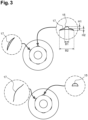
- Figure 3 shows schematically the free cross-sectional areas of the first and second vent channels 15, 17.
- the piston body 8 and the sealing element 18 are configured such that the temperature- and pressure-dependent elastic deformation of the sealing element 18 reduces the free cross-sectional area of the second vent channel 17 more greatly than the free cross-sectional area of the first vent channel 15.
- vent channels 15, 17 are shown at the top at the first pressure P1. Both the first and the second vent channels 15, 17 are open and have the maximal free cross-sectional area.
- the lower region of figure 3 shows the vent channels 15, 17 at the higher pressure P2.
- the flat vent grooves are completely filled by the sealing element which has been elastically deformed by the acting pressure.
- the second vent channels 17 therefore have no free cross-sectional area, but are completely closed.
- the vent groove 16 has a flat free cross-section, in particular a height H2 which is smaller in the radial direction than the width B2 in the circumferential direction.
- the vent notch 14 has a deep free cross-section, in particular a height H1 which is greater in the radial direction than the width B1 in the circumferential direction.
- the second vent channel 17 has a smaller maximal distance from the sealing element 18 than the first vent channel 15.
- the deformed sealing element 18 does not fill the vent notch 14 even at the higher pressure P2.
- the cross-sectional area of the first vent channel 15 is thus substantially unchanged.
- a minimum flow rate may be provided of 0.08 l/min to 0.15 l/min at a first temperature T1 in the range from -20°C to -30°C and a first working pressure P1 of the order of 70 psi.
- a maximum flow rate may be provided of 0.4 l/min to 0.7 l/min at a second temperature T2 in the range from 100°C to 130°C and a second working pressure P2 of the order of 300 psi. Up to a working pressure of 3 psi (or 15 psi), the system should be completely sealed so that it does not drain during longer stoppage periods and there is no risk of damage on recommissioning.
- Figure 4 shows a gear-change selector 2 for a gearshift in cross-section.
- the gear-change selector 2 has several pistons 7.
- the gear-change selector 2 is configured as a gear-change selector module which can be mounted on a transmission.
- Figure 5 shows at least parts of a gearshift.
- the gearshift comprises a gear-change selector 2 of the type described above.
- the gearshift may be part of a motor vehicle.
- the transmission itself is not shown, for the sake of greater clarity.
- Figure 6 shows a further embodiment of a piston 7.
- the piston 7 comprises a first sealing portion 19 and a second sealing portion 20.
- the piston body 8 and the first sealing portion 19 have mutually complementary geometries so that they form a first vent channel 15.
- the first vent channel 15 is arranged in a hydraulic series circuit with the second sealing portion 20.
- the second sealing portion 20 prevents venting up to a first pressure P1 and allows this above the first pressure P1.
- the piston 7 has a piston seal.
- the piston seal comprises a radial circumferential groove in the piston skirt 10.
- a self-sealing piston groove ring with a sealing lip is arranged in the circumferential groove 22.
- the piston 7 is a double-action piston.
- the piston body 8 has piston end faces 9 of the above-described type on both sides.
Landscapes
- Engineering & Computer Science (AREA)
- General Engineering & Computer Science (AREA)
- Mechanical Engineering (AREA)
- Physics & Mathematics (AREA)
- Fluid Mechanics (AREA)
- Hydraulic Clutches, Magnetic Clutches, Fluid Clutches, And Fluid Joints (AREA)
- Gear-Shifting Mechanisms (AREA)
- Sealing Devices (AREA)
Claims (15)
- Kolben (7), insbesondere für einen Gangsteller (2), umfassend einen Kolbenkörper (8) mit einem Kolbenhemd (10) und einer mit einem Arbeitsfluid druckbeaufschlagbaren Kolbenstirnfläche (9), wobei der Kolben (7) einen ersten Dichtungsabschnitt (19) und einen zweiten Dichtungsabschnitt (20) umfasst, wobei der Kolbenkörper (8) und der erste Dichtungsabschnitt (19) jeweils eine aufeinander abgestimmte Geometrie aufweisen, sodass sie einen ersten Entlüftungskanal (15) ausbilden, wobei der erste Entlüftungskanal (15) in einer hydraulischen Reihenschaltung mit dem zweiten Dichtungsabschnitt (20) angeordnet ist, dadurch gekennzeichnet, dass der zweite Dichtungsabschnitt (20) bis zu einem ersten Arbeitsfluiddruck (P1) eine Entlüftung verhindert und ab dem ersten Arbeitsfluiddruck (P1) freigibt.
- Kolben (7) nach Anspruch 1, wobei die Kolbenstirnfläche (9) eine Vertiefung (13) aufweist, in der ein gummielastisches Dichtelement (18) angeordnet ist, wobei der erste Dichtungsabschnitt (19) ein Bestandteil des Dichtelementes (18) ist, wobei der Kolbenkörper (8) und das Dichtelement (18) jeweils eine aufeinander abgestimmte Geometrie aufweisen, sodass sie den ersten Entlüftungskanal (15) mit einer ersten freien Querschnittsfläche und in einem druckentlasteten Zustand zwischen einander gegenüberliegenden Oberflächen der Vertiefung (13) sowie des ersten Dichtungsabschnittes (19) einen zweiten Entlüftungskanal (17) mit einer zweiten freien Querschnittsfläche ausbilden, wobei der erste Entlüftungskanal (15) und der zweite Entlüftungskanal (17) hydraulisch parallelgeschaltet sind und ferner wobei die Vertiefung (13) sowie das Dichtelement (18) derart ausgebildet sind, dass mit steigender Temperatur des Dichtelementes (18) dessen Elastizitätsmodul sinkt und eine Druckbeaufschlagung des Dichtelementes (18) durch das Arbeitsfluid zu einer temperatur- und druckabhängigen elastischen Verformung des Dichtelementes (18) sowie mittels der elastischen Verformung zu einer Verringerung der freien Querschnittsfläche des zweiten Entlüftungskanals (17) führt.
- Kolben (7) nach Anspruch 2, wobei der Kolbenkörper (8) und das Dichtelement (18) derart ausgebildet sind, dass die temperatur- und druckabhängige elastische Verformung des Dichtelementes (18) die freie Querschnittsfläche des zweiten Entlüftungskanals (17) stärker reduziert, als die freie Querschnittsfläche des ersten Entlüftungskanals (15).
- Kolben (7) nach einem der Ansprüche 2 und 3, wobei der erste Entlüftungskanal (15) und der zweite Entlüftungskanal (17) in einer hydraulischen Reihenschaltung mit dem zweiten Dichtungsabschnitt (20) angeordnet sind, wobei der zweite Dichtungsabschnitt (20) bis zu einem ersten Arbeitsfluiddruck (P1) eine Entlüftungsöffnung (12) in dem Kolbenkörper (8) gegenüber den ersten und zweiten Entlüftungskanälen (15, 17) abdichtet und ab dem ersten Arbeitsfluiddruck (P1) freigibt.
- Kolben (7) nach Anspruch 4, wobei die Vertiefung (13) einen außenliegenden Bereich auf Seite der Kolbenstirnfläche (9) aufweist, in den das gummielastische Dichtelement (18) eingebracht ist, und einen innenliegenden Bereich, der die Entlüftungsöffnung (12) umfasst, wobei zwischen dem innenliegenden Bereich und dem außenliegenden Bereich der zweite Dichtungsabschnitt (20) in Form einer Dichtlippe angeordnet ist.
- Kolben (7) nach einem der Ansprüche 4 und 5, wobei die Vertiefung (13) in ihrer Wandung eine Entlüftungsnut (16) aufweist, die zusammen mit dem ersten Dichtungsabschnitt (19) den zweiten Entlüftungskanal (17) ausbildet, wobei sich die Entlüftungsnut (16) von der Kolbenstirnfläche (9) bis hinter den außenliegenden Bereich in Richtung des innenliegenden Bereiches erstreckt und derart ausgestaltet und dimensioniert ist, dass der zweite Entlüftungskanal (17) bei dem ersten Arbeitsfluiddruck (P1) und/oder bei einer ersten Arbeitsfluidtemperatur (T1) von dem Dichtelement (18) nicht verschlossen wird und das arbeitsfluidtemperatur- und druckabhängig elastisch verformte Dichtelement (18) mit steigendem Arbeitsfluiddruck (Px) und/oder steigender Arbeitsfluidtemperatur (Tx) die freie Querschnittsfläche des zweiten Entlüftungskanals (17) zunehmend verschließt, insbesondere bis der zweite Entlüftungskanal (17) ab einem zweiten Arbeitsfluiddruck (P2) und/oder ab einer zweiten Arbeitsfluidtemperatur (T2) im Wesentlichen vollständig verschlossen wird.
- Kolben (7) nach Anspruch 6, wobei die Entlüftungsnut (16) einen flachen freien Querschnitt, insbesondere eine in radialer Richtung geringere Höhe (h) als Breite (b) in Umfangsrichtung, aufweist.
- Kolben (7) nach einem der Ansprüche 4 bis 7, wobei die Vertiefung (13) in ihrer Wandung eine Entlüftungsrille (14) aufweist, die zusammen mit dem ersten Dichtungsabschnitt (19) den ersten Entlüftungskanal (15) ausbildet, wobei sich die Entlüftungsrille (14) von der Kolbenstirnfläche (9) bis hinter den außenliegenden Bereich in Richtung des innenliegenden Bereiches erstreckt und derart ausgestaltet und dimensioniert ist, dass die Entlüftungsrille (14) auch bei einer temperatur- und druckabhängigen elastischen Verformung des Dichtelements (18) von dem Dichtelement (18) nicht verschlossen wird.
- Kolben (7) nach Anspruch 8, wobei die Entlüftungsnut (14) eine Höhe (h), die in radialer Richtung größer ist als die Breite (b) in Umfangsrichtung, aufweist.
- Kolben (7) nach einem der Ansprüche 2 bis 9, wobei der zweite Entlüftungskanal (17) einen geringeren maximalen Abstand zu dem Dichtelement (18) aufweist als der erste Entlüftungskanal (15).
- Kolben (7) nach einem der Ansprüche 2 bis 10, wobei die Vertiefung (13) eine sich in axialer Richtung erstreckende stirnseitige Ringnut ist.
- Kolben (7) nach einem der vorhergehenden Ansprüche, wobei der Kolben (7) eine Kolbendichtung aufweist, wobei die Kolbendichtung eine radiale Umfangsnut (22) in dem Kolbenhemd (10) umfasst.
- Kolben (7) nach einem der vorhergehenden Ansprüche, wobei der Kolben (7) ein doppelseitig wirkender Kolben ist, wobei der Kolbenkörper (8) beiderseits Kolbenstirnflächen (9) nach einem der vorhergehenden Ansprüche aufweist.
- Gangsteller (2) für eine Getriebeschaltung, wobei der Gangsteller (2) zumindest einen, bevorzugt mehrere der Kolben (7) nach einem der vorhergehenden Ansprüche umfasst, insbesondere wobei der Gangsteller (2) ein an ein Getriebe montierbares Gangstellermodul ist.
- Getriebeschaltung umfassend einem Gangsteller (2) nach Anspruch 14.
Applications Claiming Priority (1)
| Application Number | Priority Date | Filing Date | Title |
|---|---|---|---|
| DE102021118601.3A DE102021118601A1 (de) | 2021-07-19 | 2021-07-19 | Kolben, Gangsteller und Getriebeschaltung |
Publications (3)
| Publication Number | Publication Date |
|---|---|
| EP4123200A1 EP4123200A1 (de) | 2023-01-25 |
| EP4123200B1 true EP4123200B1 (de) | 2024-08-07 |
| EP4123200B8 EP4123200B8 (de) | 2024-09-18 |
Family
ID=82547299
Family Applications (1)
| Application Number | Title | Priority Date | Filing Date |
|---|---|---|---|
| EP22182663.9A Active EP4123200B8 (de) | 2021-07-19 | 2022-07-01 | Kolben, gangsteller und getriebeschaltvorrichtung |
Country Status (4)
| Country | Link |
|---|---|
| US (1) | US11905979B2 (de) |
| EP (1) | EP4123200B8 (de) |
| CN (1) | CN115638246B (de) |
| DE (1) | DE102021118601A1 (de) |
Families Citing this family (1)
| Publication number | Priority date | Publication date | Assignee | Title |
|---|---|---|---|---|
| DE102021133069A1 (de) * | 2021-12-14 | 2023-06-15 | Fte Automotive Gmbh | Kolben, Gangstellermodul sowie Verfahren zur Montage |
Family Cites Families (15)
| Publication number | Priority date | Publication date | Assignee | Title |
|---|---|---|---|---|
| DE1205390B (de) * | 1961-01-13 | 1965-11-18 | Julius Woerner | Entlueftungseinrichtung fuer hydraulische Zylinder von Maschinen |
| DE2222416C3 (de) * | 1972-05-06 | 1975-07-03 | Nabenfabrik Alfing Kessler Kg, 7083 Wasseralfingen | Dichtungsanordnung für den Kolben eines hydropneumatischen Speichers |
| US4207800A (en) * | 1978-11-02 | 1980-06-17 | Homuth Kenneth C | Single directional sealing piston ring |
| DE3268899D1 (en) * | 1981-12-04 | 1986-03-13 | Automotive Prod Plc | Hydraulic master cylinder |
| DE10308216B4 (de) | 2003-02-25 | 2014-01-23 | Volkswagen Ag | Automatisiertes Schaltgetriebe |
| GB0721774D0 (en) * | 2007-11-07 | 2007-12-19 | 3M Innovative Properties Co | one-piece vented piston |
| DE102008017035A1 (de) * | 2008-04-03 | 2009-10-08 | Gustav Magenwirth Gmbh & Co. Kg | Vorrichtung zum Abdichten eines Hydraulikkolbens |
| DE102009028999A1 (de) | 2009-08-28 | 2011-03-03 | Robert Bosch Gmbh | Hydraulische Komponente mit mindestens zwei Bereichen unterschiedlichen Drucks und mindestens einem Funktionselement |
| DE102010026946A1 (de) | 2010-07-12 | 2012-01-12 | Dichtungstechnik G. Bruss Gmbh & Co. Kg | Verbundkolben |
| EP2805091B1 (de) * | 2012-01-20 | 2017-03-22 | Naf Aktiebolag | Pneumatisch antreibbarer ventilaktuator und verfahren zum sichern eines ventilverschlusselements an einem ventilkörper |
| US20140084202A1 (en) * | 2012-09-27 | 2014-03-27 | Emerson Process Management Regulator Technologies, Inc. | Seal disk with a plurality of hardnesses |
| DE102013012044B4 (de) | 2013-07-19 | 2020-02-20 | Carl Freudenberg Kg | Dichtungsanordnung und Dichtring |
| FR3009037B1 (fr) * | 2013-07-23 | 2016-01-29 | Vianney Rabhi | Dispositif d'etancheite pour piston |
| CN104196697B (zh) * | 2014-07-14 | 2016-08-31 | 格力休闲体育用品有限公司 | 双向手拉气筒活塞 |
| DE102017011895A1 (de) * | 2017-12-21 | 2019-06-27 | Wabco Gmbh | Kolben-Zylinder-Anordnung |
-
2021
- 2021-07-19 DE DE102021118601.3A patent/DE102021118601A1/de active Pending
-
2022
- 2022-07-01 EP EP22182663.9A patent/EP4123200B8/de active Active
- 2022-07-19 US US17/813,436 patent/US11905979B2/en active Active
- 2022-07-19 CN CN202210849686.6A patent/CN115638246B/zh active Active
Also Published As
| Publication number | Publication date |
|---|---|
| CN115638246B (zh) | 2025-09-09 |
| EP4123200A1 (de) | 2023-01-25 |
| EP4123200B8 (de) | 2024-09-18 |
| DE102021118601A1 (de) | 2023-01-19 |
| US20230014514A1 (en) | 2023-01-19 |
| US11905979B2 (en) | 2024-02-20 |
| CN115638246A (zh) | 2023-01-24 |
Similar Documents
| Publication | Publication Date | Title |
|---|---|---|
| CN101421547B (zh) | 包括减压元件的密封系统以及密封系统对于调整一间隙压力级联的应用 | |
| US20090108542A1 (en) | Seal Assembly for Relieving Pressure | |
| US7644647B2 (en) | Hydraulic actuating device for actuating a shift rod in particular of a gearbox for motor vehicles | |
| US20040115070A1 (en) | Pressure intensifier | |
| CN105358879B (zh) | 用于自动变速器的液压控制装置和自动变速器 | |
| DK162793B (da) | Stangtaetning | |
| US11905979B2 (en) | Piston, gear-change selector and gearshift | |
| US8840115B2 (en) | Wide range temperature and pressure hydraulic cylinder sealing system | |
| KR100904790B1 (ko) | 구동 장치 | |
| US20030178786A1 (en) | Scraper with integrated seal | |
| US20200200274A1 (en) | Rotary seal assembly and rotary seal for high-pressure applications | |
| CA1134876A (en) | Seal arrangement for hydraulic pump | |
| US20070205561A1 (en) | Sealing Structure for Sliding Part | |
| KR101673945B1 (ko) | 실린더튜브 및 냉각재킷 실린더 | |
| US9482292B2 (en) | Piston-integrated seal | |
| US3954048A (en) | High pressure actuator | |
| US4867294A (en) | Accumulator piston for automotive transmission | |
| CN107208795B (zh) | 密封系统和密封系统的应用 | |
| KR102551456B1 (ko) | 냉각 및 윤활 밀봉부를 수용하기 위한 밸브를 가진 유압식 피스톤 | |
| EP0786052B1 (de) | Hydraulische betätigungsvorrichtung und schaltgetriebe mit einer solchen betätigungsvorrichtung | |
| US6626437B2 (en) | Wiper seal | |
| CN101531331A (zh) | 一种新型液压千斤顶 | |
| JP2025503883A (ja) | 圧力媒体オーバーフローを有する作動シリンダ | |
| US12196234B2 (en) | Dynamic seal assembly with a valve and a diaphragm function | |
| JP7706478B2 (ja) | 油圧機械用の改良された密閉装置 |
Legal Events
| Date | Code | Title | Description |
|---|---|---|---|
| PUAI | Public reference made under article 153(3) epc to a published international application that has entered the european phase |
Free format text: ORIGINAL CODE: 0009012 |
|
| STAA | Information on the status of an ep patent application or granted ep patent |
Free format text: STATUS: REQUEST FOR EXAMINATION WAS MADE |
|
| 17P | Request for examination filed |
Effective date: 20220701 |
|
| AK | Designated contracting states |
Kind code of ref document: A1 Designated state(s): AL AT BE BG CH CY CZ DE DK EE ES FI FR GB GR HR HU IE IS IT LI LT LU LV MC MK MT NL NO PL PT RO RS SE SI SK SM TR |
|
| STAA | Information on the status of an ep patent application or granted ep patent |
Free format text: STATUS: EXAMINATION IS IN PROGRESS |
|
| 17Q | First examination report despatched |
Effective date: 20231123 |
|
| GRAP | Despatch of communication of intention to grant a patent |
Free format text: ORIGINAL CODE: EPIDOSNIGR1 |
|
| STAA | Information on the status of an ep patent application or granted ep patent |
Free format text: STATUS: GRANT OF PATENT IS INTENDED |
|
| RIC1 | Information provided on ipc code assigned before grant |
Ipc: F16H 61/30 20060101ALN20240325BHEP Ipc: F16H 61/00 20060101ALN20240325BHEP Ipc: F16H 63/24 20060101ALN20240325BHEP Ipc: F15B 15/14 20060101ALI20240325BHEP Ipc: F15B 21/044 20190101ALI20240325BHEP Ipc: F16H 63/30 20060101AFI20240325BHEP |
|
| INTG | Intention to grant announced |
Effective date: 20240418 |
|
| GRAS | Grant fee paid |
Free format text: ORIGINAL CODE: EPIDOSNIGR3 |
|
| GRAA | (expected) grant |
Free format text: ORIGINAL CODE: 0009210 |
|
| STAA | Information on the status of an ep patent application or granted ep patent |
Free format text: STATUS: THE PATENT HAS BEEN GRANTED |
|
| AK | Designated contracting states |
Kind code of ref document: B1 Designated state(s): AL AT BE BG CH CY CZ DE DK EE ES FI FR GB GR HR HU IE IS IT LI LT LU LV MC MK MT NL NO PL PT RO RS SE SI SK SM TR |
|
| REG | Reference to a national code |
Ref country code: GB Ref legal event code: FG4D |
|
| REG | Reference to a national code |
Ref country code: CH Ref legal event code: EP |
|
| REG | Reference to a national code |
Ref country code: DE Ref legal event code: R081 Ref document number: 602022005115 Country of ref document: DE Owner name: VALEO POWERTRAIN GMBH, DE Free format text: FORMER OWNER: ANMELDERANGABEN UNKLAR / UNVOLLSTAENDIG, 80297 MUENCHEN, DE |
|
| REG | Reference to a national code |
Ref country code: IE Ref legal event code: FG4D |
|
| REG | Reference to a national code |
Ref country code: DE Ref legal event code: R096 Ref document number: 602022005115 Country of ref document: DE |
|
| REG | Reference to a national code |
Ref country code: CH Ref legal event code: PK Free format text: BERICHTIGUNG B8 |
|
| RAP2 | Party data changed (patent owner data changed or rights of a patent transferred) |
Owner name: VALEO POWERTRAIN GMBH |
|
| REG | Reference to a national code |
Ref country code: LT Ref legal event code: MG9D |
|
| REG | Reference to a national code |
Ref country code: NL Ref legal event code: MP Effective date: 20240807 |
|
| PG25 | Lapsed in a contracting state [announced via postgrant information from national office to epo] |
Ref country code: NO Free format text: LAPSE BECAUSE OF FAILURE TO SUBMIT A TRANSLATION OF THE DESCRIPTION OR TO PAY THE FEE WITHIN THE PRESCRIBED TIME-LIMIT Effective date: 20241107 |
|
| REG | Reference to a national code |
Ref country code: AT Ref legal event code: MK05 Ref document number: 1711272 Country of ref document: AT Kind code of ref document: T Effective date: 20240807 |
|
| PG25 | Lapsed in a contracting state [announced via postgrant information from national office to epo] |
Ref country code: GR Free format text: LAPSE BECAUSE OF FAILURE TO SUBMIT A TRANSLATION OF THE DESCRIPTION OR TO PAY THE FEE WITHIN THE PRESCRIBED TIME-LIMIT Effective date: 20241108 Ref country code: FI Free format text: LAPSE BECAUSE OF FAILURE TO SUBMIT A TRANSLATION OF THE DESCRIPTION OR TO PAY THE FEE WITHIN THE PRESCRIBED TIME-LIMIT Effective date: 20240807 Ref country code: NL Free format text: LAPSE BECAUSE OF FAILURE TO SUBMIT A TRANSLATION OF THE DESCRIPTION OR TO PAY THE FEE WITHIN THE PRESCRIBED TIME-LIMIT Effective date: 20240807 Ref country code: PL Free format text: LAPSE BECAUSE OF FAILURE TO SUBMIT A TRANSLATION OF THE DESCRIPTION OR TO PAY THE FEE WITHIN THE PRESCRIBED TIME-LIMIT Effective date: 20240807 Ref country code: PT Free format text: LAPSE BECAUSE OF FAILURE TO SUBMIT A TRANSLATION OF THE DESCRIPTION OR TO PAY THE FEE WITHIN THE PRESCRIBED TIME-LIMIT Effective date: 20241209 |
|
| PG25 | Lapsed in a contracting state [announced via postgrant information from national office to epo] |
Ref country code: BG Free format text: LAPSE BECAUSE OF FAILURE TO SUBMIT A TRANSLATION OF THE DESCRIPTION OR TO PAY THE FEE WITHIN THE PRESCRIBED TIME-LIMIT Effective date: 20240807 |
|
| PG25 | Lapsed in a contracting state [announced via postgrant information from national office to epo] |
Ref country code: LV Free format text: LAPSE BECAUSE OF FAILURE TO SUBMIT A TRANSLATION OF THE DESCRIPTION OR TO PAY THE FEE WITHIN THE PRESCRIBED TIME-LIMIT Effective date: 20240807 |
|
| PG25 | Lapsed in a contracting state [announced via postgrant information from national office to epo] |
Ref country code: AT Free format text: LAPSE BECAUSE OF FAILURE TO SUBMIT A TRANSLATION OF THE DESCRIPTION OR TO PAY THE FEE WITHIN THE PRESCRIBED TIME-LIMIT Effective date: 20240807 Ref country code: IS Free format text: LAPSE BECAUSE OF FAILURE TO SUBMIT A TRANSLATION OF THE DESCRIPTION OR TO PAY THE FEE WITHIN THE PRESCRIBED TIME-LIMIT Effective date: 20241207 |
|
| PG25 | Lapsed in a contracting state [announced via postgrant information from national office to epo] |
Ref country code: HR Free format text: LAPSE BECAUSE OF FAILURE TO SUBMIT A TRANSLATION OF THE DESCRIPTION OR TO PAY THE FEE WITHIN THE PRESCRIBED TIME-LIMIT Effective date: 20240807 |
|
| PG25 | Lapsed in a contracting state [announced via postgrant information from national office to epo] |
Ref country code: ES Free format text: LAPSE BECAUSE OF FAILURE TO SUBMIT A TRANSLATION OF THE DESCRIPTION OR TO PAY THE FEE WITHIN THE PRESCRIBED TIME-LIMIT Effective date: 20240807 Ref country code: RS Free format text: LAPSE BECAUSE OF FAILURE TO SUBMIT A TRANSLATION OF THE DESCRIPTION OR TO PAY THE FEE WITHIN THE PRESCRIBED TIME-LIMIT Effective date: 20241107 |
|
| PG25 | Lapsed in a contracting state [announced via postgrant information from national office to epo] |
Ref country code: RS Free format text: LAPSE BECAUSE OF FAILURE TO SUBMIT A TRANSLATION OF THE DESCRIPTION OR TO PAY THE FEE WITHIN THE PRESCRIBED TIME-LIMIT Effective date: 20241107 Ref country code: PT Free format text: LAPSE BECAUSE OF FAILURE TO SUBMIT A TRANSLATION OF THE DESCRIPTION OR TO PAY THE FEE WITHIN THE PRESCRIBED TIME-LIMIT Effective date: 20241209 Ref country code: PL Free format text: LAPSE BECAUSE OF FAILURE TO SUBMIT A TRANSLATION OF THE DESCRIPTION OR TO PAY THE FEE WITHIN THE PRESCRIBED TIME-LIMIT Effective date: 20240807 Ref country code: NO Free format text: LAPSE BECAUSE OF FAILURE TO SUBMIT A TRANSLATION OF THE DESCRIPTION OR TO PAY THE FEE WITHIN THE PRESCRIBED TIME-LIMIT Effective date: 20241107 Ref country code: NL Free format text: LAPSE BECAUSE OF FAILURE TO SUBMIT A TRANSLATION OF THE DESCRIPTION OR TO PAY THE FEE WITHIN THE PRESCRIBED TIME-LIMIT Effective date: 20240807 Ref country code: LV Free format text: LAPSE BECAUSE OF FAILURE TO SUBMIT A TRANSLATION OF THE DESCRIPTION OR TO PAY THE FEE WITHIN THE PRESCRIBED TIME-LIMIT Effective date: 20240807 Ref country code: IS Free format text: LAPSE BECAUSE OF FAILURE TO SUBMIT A TRANSLATION OF THE DESCRIPTION OR TO PAY THE FEE WITHIN THE PRESCRIBED TIME-LIMIT Effective date: 20241207 Ref country code: HR Free format text: LAPSE BECAUSE OF FAILURE TO SUBMIT A TRANSLATION OF THE DESCRIPTION OR TO PAY THE FEE WITHIN THE PRESCRIBED TIME-LIMIT Effective date: 20240807 Ref country code: GR Free format text: LAPSE BECAUSE OF FAILURE TO SUBMIT A TRANSLATION OF THE DESCRIPTION OR TO PAY THE FEE WITHIN THE PRESCRIBED TIME-LIMIT Effective date: 20241108 Ref country code: FI Free format text: LAPSE BECAUSE OF FAILURE TO SUBMIT A TRANSLATION OF THE DESCRIPTION OR TO PAY THE FEE WITHIN THE PRESCRIBED TIME-LIMIT Effective date: 20240807 Ref country code: ES Free format text: LAPSE BECAUSE OF FAILURE TO SUBMIT A TRANSLATION OF THE DESCRIPTION OR TO PAY THE FEE WITHIN THE PRESCRIBED TIME-LIMIT Effective date: 20240807 Ref country code: BG Free format text: LAPSE BECAUSE OF FAILURE TO SUBMIT A TRANSLATION OF THE DESCRIPTION OR TO PAY THE FEE WITHIN THE PRESCRIBED TIME-LIMIT Effective date: 20240807 Ref country code: AT Free format text: LAPSE BECAUSE OF FAILURE TO SUBMIT A TRANSLATION OF THE DESCRIPTION OR TO PAY THE FEE WITHIN THE PRESCRIBED TIME-LIMIT Effective date: 20240807 |
|
| PG25 | Lapsed in a contracting state [announced via postgrant information from national office to epo] |
Ref country code: DK Free format text: LAPSE BECAUSE OF FAILURE TO SUBMIT A TRANSLATION OF THE DESCRIPTION OR TO PAY THE FEE WITHIN THE PRESCRIBED TIME-LIMIT Effective date: 20240807 Ref country code: SM Free format text: LAPSE BECAUSE OF FAILURE TO SUBMIT A TRANSLATION OF THE DESCRIPTION OR TO PAY THE FEE WITHIN THE PRESCRIBED TIME-LIMIT Effective date: 20240807 |
|
| PG25 | Lapsed in a contracting state [announced via postgrant information from national office to epo] |
Ref country code: CZ Free format text: LAPSE BECAUSE OF FAILURE TO SUBMIT A TRANSLATION OF THE DESCRIPTION OR TO PAY THE FEE WITHIN THE PRESCRIBED TIME-LIMIT Effective date: 20240807 |
|
| PG25 | Lapsed in a contracting state [announced via postgrant information from national office to epo] |
Ref country code: SK Free format text: LAPSE BECAUSE OF FAILURE TO SUBMIT A TRANSLATION OF THE DESCRIPTION OR TO PAY THE FEE WITHIN THE PRESCRIBED TIME-LIMIT Effective date: 20240807 |
|
| REG | Reference to a national code |
Ref country code: DE Ref legal event code: R097 Ref document number: 602022005115 Country of ref document: DE |
|
| P01 | Opt-out of the competence of the unified patent court (upc) registered |
Free format text: CASE NUMBER: APP_17227/2025 Effective date: 20250409 |
|
| PLBE | No opposition filed within time limit |
Free format text: ORIGINAL CODE: 0009261 |
|
| STAA | Information on the status of an ep patent application or granted ep patent |
Free format text: STATUS: NO OPPOSITION FILED WITHIN TIME LIMIT |
|
| 26N | No opposition filed |
Effective date: 20250508 |
|
| PG25 | Lapsed in a contracting state [announced via postgrant information from national office to epo] |
Ref country code: SE Free format text: LAPSE BECAUSE OF FAILURE TO SUBMIT A TRANSLATION OF THE DESCRIPTION OR TO PAY THE FEE WITHIN THE PRESCRIBED TIME-LIMIT Effective date: 20240807 |
|
| PGFP | Annual fee paid to national office [announced via postgrant information from national office to epo] |
Ref country code: DE Payment date: 20250711 Year of fee payment: 4 |
|
| PGFP | Annual fee paid to national office [announced via postgrant information from national office to epo] |
Ref country code: FR Payment date: 20250730 Year of fee payment: 4 |
|
| PG25 | Lapsed in a contracting state [announced via postgrant information from national office to epo] |
Ref country code: IT Free format text: LAPSE BECAUSE OF FAILURE TO SUBMIT A TRANSLATION OF THE DESCRIPTION OR TO PAY THE FEE WITHIN THE PRESCRIBED TIME-LIMIT Effective date: 20240807 |
|
| REG | Reference to a national code |
Ref country code: CH Ref legal event code: H13 Free format text: ST27 STATUS EVENT CODE: U-0-0-H10-H13 (AS PROVIDED BY THE NATIONAL OFFICE) Effective date: 20260224 |
|
| PG25 | Lapsed in a contracting state [announced via postgrant information from national office to epo] |
Ref country code: LU Free format text: LAPSE BECAUSE OF NON-PAYMENT OF DUE FEES Effective date: 20250701 |
|
| REG | Reference to a national code |
Ref country code: BE Ref legal event code: MM Effective date: 20250731 |
|
| PG25 | Lapsed in a contracting state [announced via postgrant information from national office to epo] |
Ref country code: RO Free format text: LAPSE BECAUSE OF FAILURE TO SUBMIT A TRANSLATION OF THE DESCRIPTION OR TO PAY THE FEE WITHIN THE PRESCRIBED TIME-LIMIT Effective date: 20240807 Ref country code: BE Free format text: LAPSE BECAUSE OF NON-PAYMENT OF DUE FEES Effective date: 20250731 |
|
| PG25 | Lapsed in a contracting state [announced via postgrant information from national office to epo] |
Ref country code: CH Free format text: LAPSE BECAUSE OF NON-PAYMENT OF DUE FEES Effective date: 20250731 |