EP4123959A1 - Informations privées avec une source unique de vérité partagée - Google Patents
Informations privées avec une source unique de vérité partagée Download PDFInfo
- Publication number
- EP4123959A1 EP4123959A1 EP22176224.8A EP22176224A EP4123959A1 EP 4123959 A1 EP4123959 A1 EP 4123959A1 EP 22176224 A EP22176224 A EP 22176224A EP 4123959 A1 EP4123959 A1 EP 4123959A1
- Authority
- EP
- European Patent Office
- Prior art keywords
- shared
- private
- data
- block
- ledger
- Prior art date
- Legal status (The legal status is an assumption and is not a legal conclusion. Google has not performed a legal analysis and makes no representation as to the accuracy of the status listed.)
- Pending
Links
Images



Classifications
-
- H—ELECTRICITY
- H04—ELECTRIC COMMUNICATION TECHNIQUE
- H04L—TRANSMISSION OF DIGITAL INFORMATION, e.g. TELEGRAPHIC COMMUNICATION
- H04L9/00—Cryptographic mechanisms or cryptographic arrangements for secret or secure communications; Network security protocols
- H04L9/50—Cryptographic mechanisms or cryptographic arrangements for secret or secure communications; Network security protocols using hash chains, e.g. blockchains or hash trees
-
- G—PHYSICS
- G06—COMPUTING OR CALCULATING; COUNTING
- G06Q—INFORMATION AND COMMUNICATION TECHNOLOGY [ICT] SPECIALLY ADAPTED FOR ADMINISTRATIVE, COMMERCIAL, FINANCIAL, MANAGERIAL OR SUPERVISORY PURPOSES; SYSTEMS OR METHODS SPECIALLY ADAPTED FOR ADMINISTRATIVE, COMMERCIAL, FINANCIAL, MANAGERIAL OR SUPERVISORY PURPOSES, NOT OTHERWISE PROVIDED FOR
- G06Q20/00—Payment architectures, schemes or protocols
- G06Q20/38—Payment protocols; Details thereof
- G06Q20/382—Payment protocols; Details thereof insuring higher security of transaction
-
- G—PHYSICS
- G06—COMPUTING OR CALCULATING; COUNTING
- G06Q—INFORMATION AND COMMUNICATION TECHNOLOGY [ICT] SPECIALLY ADAPTED FOR ADMINISTRATIVE, COMMERCIAL, FINANCIAL, MANAGERIAL OR SUPERVISORY PURPOSES; SYSTEMS OR METHODS SPECIALLY ADAPTED FOR ADMINISTRATIVE, COMMERCIAL, FINANCIAL, MANAGERIAL OR SUPERVISORY PURPOSES, NOT OTHERWISE PROVIDED FOR
- G06Q20/00—Payment architectures, schemes or protocols
- G06Q20/38—Payment protocols; Details thereof
- G06Q20/40—Authorisation, e.g. identification of payer or payee, verification of customer or shop credentials; Review and approval of payers, e.g. check credit lines or negative lists
- G06Q20/401—Transaction verification
-
- H—ELECTRICITY
- H04—ELECTRIC COMMUNICATION TECHNIQUE
- H04L—TRANSMISSION OF DIGITAL INFORMATION, e.g. TELEGRAPHIC COMMUNICATION
- H04L67/00—Network arrangements or protocols for supporting network services or applications
- H04L67/01—Protocols
- H04L67/10—Protocols in which an application is distributed across nodes in the network
- H04L67/104—Peer-to-peer [P2P] networks
- H04L67/1074—Peer-to-peer [P2P] networks for supporting data block transmission mechanisms
- H04L67/1078—Resource delivery mechanisms
- H04L67/108—Resource delivery mechanisms characterised by resources being split in blocks or fragments
-
- H—ELECTRICITY
- H04—ELECTRIC COMMUNICATION TECHNIQUE
- H04L—TRANSMISSION OF DIGITAL INFORMATION, e.g. TELEGRAPHIC COMMUNICATION
- H04L9/00—Cryptographic mechanisms or cryptographic arrangements for secret or secure communications; Network security protocols
- H04L9/08—Key distribution or management, e.g. generation, sharing or updating, of cryptographic keys or passwords
- H04L9/0891—Revocation or update of secret information, e.g. encryption key update or rekeying
-
- G—PHYSICS
- G06—COMPUTING OR CALCULATING; COUNTING
- G06Q—INFORMATION AND COMMUNICATION TECHNOLOGY [ICT] SPECIALLY ADAPTED FOR ADMINISTRATIVE, COMMERCIAL, FINANCIAL, MANAGERIAL OR SUPERVISORY PURPOSES; SYSTEMS OR METHODS SPECIALLY ADAPTED FOR ADMINISTRATIVE, COMMERCIAL, FINANCIAL, MANAGERIAL OR SUPERVISORY PURPOSES, NOT OTHERWISE PROVIDED FOR
- G06Q2220/00—Business processing using cryptography
Definitions
- a relationship between entities is tracked by the shared interactions between the entities.
- the state of the entities and of the relationship may be tracked by independent journaled objects.
- the journaled objects are data structures that maintain immutable records of the updates to the objects representing the entities and the relationships.
- the object for the relationship e.g., and invoice object, is a shared object with fields visible to both of the entities, providing a common view of the state changes and agreements made during the life cycle of the relationship.
- a challenge is to maintain private information and state changes that are visible to a single entity that correspond to the changes to the shared object.
- one or more embodiments relate to a method that uses private information with a shared single source of truth.
- a message is received responsive to adding a first shared block to a shared object ledger of a shared object.
- the message includes message data.
- a private block is added to a private object ledger to update a private object.
- the private block includes private data from the message data.
- a second shared block is added to the shared object ledger to update the shared object.
- the second shared block includes shared data from the message data.
- one or more embodiments relate to a system including a server with one or more processors and one or more memories, a first client device, a second client device, and an application executing on one or more processors of the server.
- a message is received responsive to adding a first shared block to a shared object ledger of a shared object.
- the message includes message data.
- a private block is added to a private object ledger to update a private object.
- the private block includes private data from the message data.
- a second shared block is added to the shared object ledger to update the shared object.
- the second shared block includes shared data from the message data.
- one or more embodiments relate to a method that uses private information with a shared single source of truth.
- a transaction is initiated by adding an invoice block to a shared ledger.
- An approval message is received responsive to adding a change block to the shared ledger to update a shared object.
- a private approval block is added to a private object ledger to update a private object.
- the private block includes private data from the message data.
- a public approval block is added to the shared ledger to update the shared object.
- the public approval block includes shared data from the message data.
- the transaction is completed by adding an invoice complete block to the shared ledger.
- ordinal numbers e.g., first, second, third, etc.
- an element i.e., any noun in the application.
- the use of ordinal numbers is not to imply or create any particular ordering of the elements nor to limit any element to being only a single element unless expressly disclosed, such as by the use of the terms "before”, “after”, “single”, and other such terminology. Rather, the use of ordinal numbers is to distinguish between the elements.
- a first element is distinct from a second element, and the first element may encompass more than one element and succeed (or precede) the second element in an ordering of elements.
- invoices track transactions between entities (e.g., between businesses).
- the entities and invoices may be tracked and recorded with data structures recorded with computing systems.
- the data structures include objects that include ledgers.
- the object are journaled objects that maintain an immutable record of the changes to the fields of the objects using ledgers.
- Each object includes a ledger and blocks are added to the ledger when the fields or states of the objects are changed.
- Public information (accessible to each entity of a transaction) is stored in a public object with a public ledger.
- Private information (accessible to one entity) is stored in a private object with a private ledger. Updates to the public ledger (and object) are made in conjunction with updates to the private ledgers (and objects).
- the public ledger stores public information (accessible to each entity) and the private ledgers store private information (accessible to the entity maintaining the private ledger).
- public information may include the price of a transaction, which is stored publicly. Private information may identify who approved the transaction or changes to the transaction, which is not shared with the other parties to the transaction.
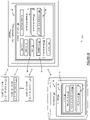
- Figures 1A and 1B show diagrams of embodiments that are in accordance with the disclosure.
- Figure 1A shows the system (100) that implements private information with a shared single source of truth.
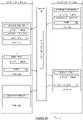
- Figure 1B shows the server application (112) that stores public and private information with objects and ledgers.
- the embodiments of Figures 1A and 1B may be combined and may include or be included within the features and embodiments described in the other figures of the application.
- the features and elements of Figures 1A and 1B are, individually and as a combination, improvements to hash chain technology and computing systems.
- the various elements, systems, and components shown in Figures 1A and 1B may be omitted, repeated, combined, and/or altered as shown from Figures 1A and 1B . Accordingly, the scope of the present disclosure should not be considered limited to the specific arrangements shown in Figures 1A and 1B .
- the system (100) records transactions using the journaled objects (115) with the ledgers (142).
- the system (100) includes the client devices A (102) through N (107), the server (110), and the repository (140).
- the client devices A (102), B (105), through N (107) are computing systems (an embodiment of which is described in Figure 4A ) that perform transactions using the journaled objects (115) with the ledgers (142).
- the client devices A (102), B (105), and N (107) respectively include the client applications A (103), B (106), and N (108).
- the client applications A (103) through N (108) are programs that operate on the client devices A (102) through N (107) to conduct transactions.
- the client applications A (103) through N (108) are browser programs that display information from a website hosted by the server application (112).
- the client application A (103) may be used by the seller of a product to place the product on sale on the website.
- the client application B (106) may be used by a buyer to purchase the product through the website with the purchase being recorded in the journaled object (115) and the ledger (126).
- the client applications A (103) through N (108) communicate with the server application (112) using a representational state transfer application programming interface (RESTful API).
- RESTful API representational state transfer application programming interface
- the server (111) is a computing system (an embodiment of which is described in Figure 4A ) that manages transactions using the journaled objects (115) with the ledgers (142).
- the server (111) includes the server apparition (112).
- the server application (112) is a collection of programs running on the server (111).
- the server application (112) may be a monolithic application or a distributed application that runs on multiple servers.
- the server application (112) may include a web application that hosts a website accessed by the client applications A (103) through N (108) to engage create transactions recorded by the journaled objects (115) and the ledgers (142).
- the journaled objects (115), including the journaled object (116), are computer programming objects that load, store, and process data in the system (100). Each of the journaled objects (115) may correspond to a transaction. As an example, the journaled object (116) may be a transaction between a user of the client device A (102) and a user of the client device B (105).
- the journaled object (116) includes the name (117), the version (118), the fields (120), the permissions (122), the program code (125), the ledger (126), the state machine (128), and the workflow graph (130).
- the name (117) is the name of the journaled object (116).
- the names of the journaled objects (115) may identify what the object is storing.
- the names may include the strings "INVOICE” for an object that represents an invoice of a transaction between two parties, "CONSUMER” for an object that represents an entity that is the buyer in a transaction, "VENDOR” for an object that represents an entity that is the seller in a transaction, etc.
- the version (118) identifies the version of the object (116).
- the version may be an identifier for the latest block added to the ledger (126).
- the name (116) with the version (118) uniquely identify the journaled object (116).
- the fields (120), including the field (121), are the pieces of data stored by the journaled object (116).
- the fields for an invoice object may include identifiers for the entities engaging in the transaction recorded by the invoice.
- the fields for an entity may include the contact information for the entity and a list of transactions (e.g., invoice objects) to which the entity is a party.
- the permissions (122), including the permission (123), identify the object and processes of the system (100) that may access the fields of the journaled object (116). For example, an invoice object for a transaction may be accessed by the entity objects engaging in the transaction, which is recorded in the permissions of the invoice object.
- the permissions of the entity objects would prevent the entity objects from directly sharing data, unless it is through a separate object, such as an invoice object.
- the program code (125) includes the code and instructions that execute on the server (111).
- the program code (125) is the code that loads, stores, and processes data for the journaled object (116).
- the ledger (126) is a hash chain for the object (116). In one embodiment, the ledger (126) stores an immutable historical record of the values of and changes made to the fields (120).
- the state machine (128) is a program that controls the status of the journaled object (116).
- the state machine (128) is part of the program code (125) and includes the workflow states (131) and workflow transitions (133) defined by the workflow graph (130).
- the workflow graph (130) defines the state machine (128).
- the workflow graph (130) includes the workflow states (131) and the workflow transitions (133).
- the workflow states (131) are the nodes of the workflow graph (130).
- the workflow states (131), including the workflow state (132), define the states of the workflow graph (130) that form the state machine (128).
- the journaled object (116) may be a shared object for an invoice for a transaction between two entities.
- the workflow states for the invoice may include an initialize invoice state, a change invoice state, a change approval state, an invoice complete state, etc.
- the state machine (128) maintains the current workflow state until a workflow transition is triggered.
- the workflow transitions (133) are the edges of the workflow graph (130) that connect between the workflow states (131).
- a change invoice workflow transition may change from the initialize invoice state to the change invoice state when the system (100) receives a message requesting to change the data in the invoice.
- the execution of workflow transitions includes adding blocks to the ledgers to update the journaled objects.
- the workflow transition (134) may transition to the workflow state (132) and execution of the workflow transition (134) may include adding the block (146) to the ledger (126).
- the block (146) may be an invoice complete block that, when added to the ledger (126), completes the workflow transition (134) to the workflow state (132).
- the repository (140) is a computing system that may include multiple computing devices in accordance with the computing system (400) and the nodes (422) and (424) described below in Figures 4A and 4B .
- the repository (140) may be hosted by a cloud services provider that also hosts the server (111).
- the cloud services provider may provide hosting, virtualization, and data storage services as well as other cloud services and to operate and control the data, programs, and applications that store and retrieve data from the repository (140).
- the data in the repository (140) includes the ledgers (142) that correspond to the journaled objects (115). Each of the journaled objects (115) may include at least one of the ledgers (142).
- the ledgers (142), including the ledger (126), store the data of the journaled objects (115) as immutable records that cannot be easily changed or modified.
- the ledger (126) includes the blocks (144).
- the block (146) is the most recently added block to the hash chain that forms the ledger (126).
- the block (146) includes the version value (147), the previous version value (148), and the field values (149).
- the version value (147) uniquely identifies the block (146) in the ledger (126).
- the version value (147) is calculated by hashing the previous version value (148) with the field values (149).
- the hashing is performed by a hash function that implements a cryptographic hash algorithm to generate a hash value (e.g., the version value (147)) (also referred to as a digest) from a payload (e.g., the field values (149)).
- Cryptographic hash algorithms that may be used as the hash function include the MD series of algorithms (MD4, MD5, MD6, etc.), the SHA series of algorithms (SHA-1, SHA-2, SHA-256, SHA-512, etc.), the RIPEMD series of algorithms (RIPEMD, RIPEMD-128, RIPEMD-320, etc.), the Whirlpool algorithm, the BLAKE series of algorithms (BLAKE2s, BLAKE-256, BLAKE3, etc. ) , etc.
- MD series of algorithms MD4, MD5, MD6, etc.
- the SHA series of algorithms SHA-1, SHA-2, SHA-256, SHA-512, etc.
- the RIPEMD series of algorithms RIPEMD, RIPEMD-128, RIPEMD-320, etc.
- Whirlpool algorithm the BLAKE series of algorithms (BLAKE2s, BLAKE-256, BLAKE3, etc. ) , etc.
- the previous version value (148) identifies the previous block (145) in the ledger (126).
- the previous block (145) was added to the ledger (126) before the block (146) was added to the ledger (126).
- the field values (149), including the field value (150), are the values for the fields (120) of the journaled object (116).
- Each one of the blocks (144) may include a complete set of field values (149) for each of the fields (120).
- the block (146) includes field values for fields with values that have changed. For example, when a price field is changed and other fields are not, the block (146) may include the field value for the price field and not include field values for the other fields.
- the server application (112) includes multiple objects.
- the objects are used to record data about entities and transactions.
- the objects A (160) and B (180) may record data about the entities taking part in a transaction.
- the shared object (170) is accessible to both the objects A (160) and B (180) and may record an invoice of a transaction between the entities that correspond to the objects A (160) and B (180).
- the private object A (165) is accessible by the object A (160) and not by the object B (180).
- the private object B (175) is accessible by the object B (180) and not by the object A (160).
- the private objects A (165) and B (175) store private information related to the transaction recorded with shared object (170).
- the objects (160), (165), (170), (175), and (180) respectively include the ledgers (161), (166), (171), (176), and (181).
- the blocks A (162), (167), (172), (177), and (182) respectively are the initial blocks added to the ledgers (161), (166), (171), (176), and (181).
- the blocks N (163), (168), (173), (178), and (183) respectively are the latest blocks added to the ledgers (161), (166), (171), (176), and (181).
- the block A (172) may be an initialize invoice block and the block N (173) may be an invoice complete block.
- the blocks of the private object ledgers may include references to blocks in the shared object ledgers (also referred to as shared blocks).
- the private blocks each include a reference to the last shared block of the shared object ledger at the time the private block is added to the private object ledger.
- the shared block A (172) may be the last block of the shared object ledger (171) and a reference to the shared block A (172) may be included in the private block A (167).
- the private block N (168) is added to the private object ledger A (166)
- the shared block N (173) may be the last block of the shared object ledger (171) and a reference to the shared block N (173) may be included in the private block N (168).
- Figure 2 shows flowchart of processes in accordance with the disclosure.
- Figure 2 is a flowchart of a method of using private information with a shared single source of truth.
- the embodiments of Figure 2 may be combined and may include or be included within the features and embodiments described in the other figures of the application.
- the features of Figure 2 are, individually and as an ordered combination, improvements to hash chain technology and computing systems. While the various steps in the flowcharts are presented and described sequentially, one of ordinary skill will appreciate that at least some of the steps may be executed in different orders, may be combined or omitted, and at least some of the steps may be executed in parallel. Furthermore, the steps may be performed actively or passively. For example, some steps may be performed using polling or be interrupt driven.
- determination steps may not have a processor process an instruction unless an interrupt is received to signify that condition exists.
- determinations may be performed by performing a test, such as checking a data value to test whether the value is consistent with the tested condition.
- the process (200) adds blocks to ledgers to record transactions using private information with a shared single source of truth.
- the process (200) may be performed by an application executing on a server.
- a message that is responsive to adding a first shared block to a shared object ledger of a shared object is received.
- the message includes message data.
- the message data includes an updated price that is submitted by a buyer in a transaction being recorded by the system.
- the message may be an approval, from the seller, of the updated price.
- the first shared block is added to the shared object ledger to update a shared object.
- the shared object may correspond to the invoice of the transaction.
- a first shared field of the shared object is updated with a first shared value recorded in the first shared block.
- the first shared value may be the updated price from the message data.
- an update to the private object is triggered in response to adding the first shared block.
- the private object may be updated to store an approval the price change to the transaction.
- the shared object ledger is traversed to retrieve shared object data.
- the shared object data may include the price change.
- the ledger may be traversed by locating that latest block added to the ledger and determining if the latest block includes the information being sought. If the latest block does not include the information, then the previous block is located, and the determination is performed again. Each of the blocks may be located until the information is identified or until there are no more blocks to locate.
- a private object ledger of the private object, is traversed to retrieve private object data.
- the private object data may include an identifier of an approver for the price change.
- a first object ledger of a first object, is traversed to retrieve first object data corresponding to the private object data.
- the first object data may include contact information (e.g., an email address) assigned to the identifier of the approver.
- a request is transmitted to a client device.
- the request may be transmitted using the first object data the private object data.
- the private object data e.g., the identifier of the approver
- the contact information is used to locate the contact information (the first object data) to which the request is sent.
- the shared object data is presented to a client device.
- the shared object data includes the price change, which is transmitted to and displayed on a client device of the approver that received the request.
- receiving the message from the client device in response to the request which may be in response to presenting the shared object data.
- the message may be an approval that is received in response to the price change in the request being displayed on the client device.
- a private block is added to a private object ledger to update a private object.
- the private block includes private data from the message data.
- the private block may record an approval of the price change and include private information, e.g., the identifier for approver.
- a private field of the private object is updated with a private value recorded in the private block.
- the private value may be the contact information for the approver, which may change when the approver changes.
- a first private object is accessible by a first object that represents a first entity (e.g., a seller).
- a second private object is accessible by second object that represents a second entity (e.g., a buyer).
- the shared object is accessible by a first object, the first private object, the second private object, and the second object.
- a second shared block is added to the shared object ledger to update the shared object.
- the second shared block includes shared data from the message data.
- the shared data may include an approval of the price change that uses shared information, e.g., an approval code.
- a shared field of the shared object is updated with a shared value recorded in the shared block.
- the shared value may include an approval code for the price change, which does not identify the approver (e.g., does not include the identifier or the contact information for the approver).
- a second workflow state is transitioned to from a first workflow state using a workflow transition.
- the workflow transition may include adding a second shared block (e.g., the approval code).
- the first workflow state, the second workflow state, and the workflow transition are defined by a workflow graph.
- the process (200) may initiate a transaction by adding an initialize invoice block to the shared object ledger of the shared object.
- the process (200) may add an invoice complete block to the shared object ledger of the shared object.
- an update request is received to update the shared object.
- the update request may be from the buyer requesting to update the price of the transaction.
- access to the shared object is authorized with authorization data.
- the authorization data is retrieved by traversing a private object ledger, e.g., to locate an identifier for authorization data in an object.
- An object (corresponding to the buyer) is then traversed to retrieve the authorization data, which corresponds to the identifier and is used to authorize the update request.
- Figures 3A and 3B show examples of systems and sequences that use private information with a shared single source of truth.
- Figure 3A shows the system (300) using private information with a shared single source of truth.
- Figure 3B shows the objects and ledgers for a transaction with a single source of trough, e.g., the shared object (340).
- the embodiments shown in Figures 3A and 3B may be combined and may include or be included within the features and embodiments described in the other figures of the application.
- the features and elements of Figures 3A and 3B are, individually and as a combination, improvements to hash chain technology and computing systems.
- the various features, elements, widgets, components, and interfaces shown in Figures 3A and 3B may be omitted, repeated, combined, and/or altered as shown. Accordingly, the scope of the present disclosure should not be considered limited to the specific arrangements shown in Figures 3A and 3B .
- the system (300) includes the seller client device (302), the server (304), and the buyer client device (306).
- the seller client device (302) communicates with the server (304) to retrieve the page A (310), which his displayed on the seller client device (302).
- a user of the seller client device (302) enters the information about the "BIG STOVE", which can be purchased through a website hosted by the server (304).
- the initial price is recorded as "$999.99".
- the details are sent to the server (304) after the submit button of page A (310) is selected.
- the server includes the server application (305), which processes transactions and maintains the website accessed by the seller and buyer client devices (302) and (306).
- the server (304) receives the information about the product described as "BIG STOVE" from the seller client device (302).
- Information about the seller (an entity) from the seller client device (302) may be stored in the seller data block (326) (of Figure 3B ).
- the seller data block (326) may include the description and price as well as contact information, shipping information, account information, etc., that corresponds the seller.
- a buyer accesses the website hosted by the server (304).
- the buyer uses the buyer client device (306), provides information that the server application (305), which is stored in the buyer data block (372) (of Figure 3B ).
- the information may include contact information, shipping information, account information, etc., that corresponds to the buyer.
- the buyer client device (306) displays the page B (312), which is received from the server (304).
- the page B (312) allows the buyer to adjust the price for the stove.
- the adjust price button (313) is selected and the page C (314) is displayed on the buyer client device (306).
- the submit button (315) is then selected, which triggers the buyer client device (306) to transfer information to the server (304).
- the server (304) receives the information and initiates a transaction between the buyer and the seller for the stove.
- the server application (305) adds the blocks (344) through (350) (of Figure 3B ) to the shared object ledger (342) (of Figure 3B ) of the shared object (340) (of Figure 3B ).
- the seller client device (302) receives and displays the page D (316) to allow for the approval of the adjustment.
- the adjustment may be approved by selection of the button (317) and denied by selection of the button (318).
- a user of the seller client device (302) selects the approve button (317) to approve the adjustment.
- the server (304) receives the approval from the seller client device (302).
- the private approval data block (336) (of Figure 3B ) is added to the private ledger B (332) (of Figure 3B ) of the private object B (330) (of Figure 3B ) and the public approval data block (352) (of Figure 3B ) is added to the shared object ledger (342) (of Figure 3B ) of the shared object (340) (of Figure 3B ).
- the server (304) then sends page E (319) to the buyer client device (306).
- the page E (319) is displayed on the buyer client device (306) and indicates that the adjustment was approved.
- the server application (305) uses public information and private information to record a transaction between the buyer, using the buyer client device (306) (of Figure 3A ), and the seller, using the seller client device (302) (of Figure 3A ).
- Data for the transaction is stored and processed using the buyer object (368), the private object A (358), the shared object (340), the private object B (330), and the seller object (322).
- the buyer object (368) includes the buyer ledger (370), which includes a hash chain formed by the buyer data block (372).
- the buyer object (368) records and processes data related to a buyer. Data stored in the fields of the buyer object (368) are recorded in the hash chain of the buyer ledger (370).
- the buyer data block (372) stores contact information, shipping information, account information etc, for the buyer of the transaction.
- the private object A (358) includes the private ledger A (360), which includes a hash chain formed by the data blocks (362) through (364).
- the private object A (358) records and processes private information and data related to the transaction. Data stored in the fields of the private object A (358) are recorded in the hash chain of the private ledger A (360).
- the buyer private data block (362) stores an identifier that resolves to information recorded in the buyer object (368).
- the buyer private data block (362) may include an address identifier for an address located in the buyer ledger (370).
- the buyer ledger (370) is traversed to reach the buyer data block (372).
- the address identifier may be the internet protocol (IP) address of the buyer client device (306) (of Figure 3A ), which is not accessible to the seller.
- IP internet protocol
- the private change data block (364) stores the adjustment to the price with a user identifier for the user that requested the adjustment.
- the user identifier is not accessible to the seller.
- the private change data block (364) is the last block added to the private ledger A (360) and includes a previous version value that identifies the buyer private data block (362).
- the shared object A (340) includes the shared object ledger (342), which includes a hash chain formed by the data blocks (344) through (354).
- the shared object A (340) records and processes public information and data related to the transaction that is accessible to both the buyer and the seller. Data stored in the fields of the shared object A (340) are recorded in the hash chain of the shared object ledger (342).
- the initialize invoice block (344) is the initial block of the shared object ledger (342).
- the initialize invoice block (344) is added when the buyer selects to buy a product.
- the buyer public data block (346) includes public data about the buyer for the transaction.
- the buyer public data block (346) may include an identifier for a shipping address that may be used by the seller for shipping the product.
- the seller public data block (348) includes public data about the seller for the transaction.
- the seller public data block (348) may include contact information for the seller and an initial price for the product that is accessible to the buyer.
- the public change data block (350) includes public data about a change to the transaction.
- the public change data block (350) may include the adjustment to the price requested by the buyer responsive to selection of the submit button (315) (of Figure 3A ) received by the buyer client device (306) (of Figure 3A ).
- the public approval data block (352) includes public data about an approval by the seller for the adjustment to the price for the transaction.
- the public data about the approval may include a binary value indicating that the adjustment is approved.
- the invoice complete block (354) completes the transaction.
- the invoice complete block (354) is added to the shared object ledger (342) upon completion of the transaction, which may be after the seller has shipped the product to the buyer.
- the private object B (330) includes the private ledger B (332), which includes a hash chain formed by the data blocks (334) through (336).
- the private object B (330) records and processes private information and data related to the transaction. Data stored in the fields of the private object B (330) are recorded in the hash chain of the private ledger B (332).
- the seller private data block (334) stores an identifier that resolves to information recorded in the seller object (322).
- the seller private data block (334) may include an address identifier for an address located in the seller ledger (324). To retrieve the information identified by the address identifier, the seller ledger (324) is traversed to reach the seller data block (326).
- the address identifier may be the internet protocol (IP) address of the seller client device (302) (of Figure 3A ), which is not accessible to the buyer.
- IP internet protocol
- the private approval data block (336) stores a user identifier for the user of the seller that approved the adjustment to the price.
- the user identifier of the seller is not accessible to the buyer.
- the private approval data block (336) is the last block added to the private ledger B (332) and includes a previous version value that identifies the seller private data block (334).
- the seller object (322) includes the seller ledger (324), which includes a hash chain formed by the seller data block (326).
- the seller object (322) records and processes data related to a seller. Data stored in the fields of the seller object (322) are recorded in the hash chain of the seller ledger (324).
- the seller data block (326) stores contact information, shipping information, account information etc., for the seller of the transaction.
- Embodiments of the disclosure may be implemented on a computing system. Any combination of a mobile, a desktop, a server, a router, a switch, an embedded device, or other types of hardware may be used.
- the computing system (400) may include one or more computer processor(s) (402), non-persistent storage (404) (e.g., volatile memory, such as a random access memory (RAM), cache memory), persistent storage (406) (e.g., a hard disk, an optical drive such as a compact disk (CD) drive or a digital versatile disk (DVD) drive, a flash memory, etc.), a communication interface (412) (e.g., Bluetooth interface, infrared interface, network interface, optical interface, etc.), and numerous other elements and functionalities.
- non-persistent storage 404
- volatile memory such as a random access memory (RAM), cache memory
- persistent storage e.g., a hard disk, an optical drive such as a compact disk (CD) drive or a digital versatile disk (DV
- the computer processor(s) (402) may be an integrated circuit for processing instructions.
- the computer processor(s) (402) may be one or more cores or micro-cores of a processor.
- the computing system (400) may also include one or more input device(s) (410), such as a touchscreen, a keyboard, a mouse, a microphone, a touchpad, an electronic pen, or any other type of input device.
- the communication interface (412) may include an integrated circuit for connecting the computing system (400) to a network (not shown) (e.g., a local area network (LAN), a wide area network (WAN) such as the Internet, a mobile network, or any other type of network) and/or to another device, such as another computing device.
- a network not shown
- LAN local area network
- WAN wide area network
- mobile network such as a mobile network, or any other type of network
- the computing system (400) may include one or more output device(s) (408), such as a screen (e.g., a liquid crystal display (LCD), a plasma display, a touchscreen, a cathode ray tube (CRT) monitor, a projector, or other display device), a printer, an external storage, or any other output device.
- a screen e.g., a liquid crystal display (LCD), a plasma display, a touchscreen, a cathode ray tube (CRT) monitor, a projector, or other display device
- One or more of the output device(s) (408) may be the same or different from the input device(s) (410).
- the input and output device(s) (410 and (408)) may be locally or remotely connected to the computer processor(s) (402), non-persistent storage (404), and persistent storage (406).
- the aforementioned input and output device(s) (410 and (408)) may take other forms.
- Software instructions in the form of computer readable program code to perform embodiments of the disclosure may be stored, in whole or in part, temporarily or permanently, on a non-transitory computer readable medium such as a CD, a DVD, a storage device, a diskette, a tape, flash memory, physical memory, or any other computer readable storage medium.
- the software instructions may correspond to computer readable program code that, when executed by a processor(s), is configured to perform one or more embodiments of the disclosure.
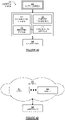
- the computing system (400) in Figure 4A may be connected to or be a part of a network.
- the network (420) may include multiple nodes (e.g., node X (422), node Y (424)).
- Each node may correspond to a computing system, such as the computing system (400) shown in Figure 4A , or a group of nodes combined may correspond to the computing system (400) shown in Figure 4A .
- embodiments of the disclosure may be implemented on a node of a distributed system that is connected to other nodes.
- embodiments of the disclosure may be implemented on a distributed computing system having multiple nodes, where each portion of the disclosure may be located on a different node within the distributed computing system. Further, one or more elements of the aforementioned computing system (400) may be located at a remote location and connected to the other elements over a network.
- the node may correspond to a blade in a server chassis that is connected to other nodes via a backplane.
- the node may correspond to a server in a data center.
- the node may correspond to a computer processor or micro-core of a computer processor with shared memory and/or resources.
- the nodes (e.g., node X (422), node Y (424)) in the network (420) may be configured to provide services for a client device (426).
- the nodes may be part of a cloud computing system.
- the nodes may include functionality to receive requests from the client device (426) and transmit responses to the client device (426).
- the client device (426) may be a computing system, such as the computing system (400) shown in Figure 4A . Further, the client device (426) may include and/or perform all or a portion of one or more embodiments of the disclosure.
- the computing system (400) or group of computing systems described in Figures 4A and 4B may include functionality to perform a variety of operations disclosed herein.
- the computing system(s) may perform communication between processes on the same or different system.
- a variety of mechanisms, employing some form of active or passive communication, may facilitate the exchange of data between processes on the same device. Examples representative of these inter-process communications include, but are not limited to, the implementation of a file, a signal, a socket, a message queue, a pipeline, a semaphore, shared memory, message passing, and a memory-mapped file. Further details pertaining to a couple of these non-limiting examples are provided below.
- sockets may serve as interfaces or communication channel end-points enabling bidirectional data transfer between processes on the same device.
- a server process e.g., a process that provides data
- the server process may create a first socket object.
- the server process binds the first socket object, thereby associating the first socket object with a unique name and/or address.
- the server process then waits and listens for incoming connection requests from one or more client processes (e.g., processes that seek data).
- client processes e.g., processes that seek data.
- the client process then proceeds to generate a connection request that includes at least the second socket object and the unique name and/or address associated with the first socket object.
- the client process then transmits the connection request to the server process.
- the server process may accept the connection request, establishing a communication channel with the client process, or the server process, busy in handling other operations, may queue the connection request in a buffer until server process is ready.
- An established connection informs the client process that communications may commence.
- the client process may generate a data request specifying the data that the client process wishes to obtain.
- the data request is subsequently transmitted to the server process.
- the server process analyzes the request and gathers the requested data.
- the server process then generates a reply including at least the requested data and transmits the reply to the client process.
- the data may be transferred, more commonly, as datagrams or a stream of characters (e.g., bytes).
- Shared memory refers to the allocation of virtual memory space in order to substantiate a mechanism for which data may be communicated and/or accessed by multiple processes.
- an initializing process first creates a shareable segment in persistent or non-persistent storage. Post creation, the initializing process then mounts the shareable segment, subsequently mapping the shareable segment into the address space associated with the initializing process. Following the mounting, the initializing process proceeds to identify and grant access permission to one or more authorized processes that may also write and read data to and from the shareable segment. Changes made to the data in the shareable segment by one process may immediately affect other processes, which are also linked to the shareable segment. Further, when one of the authorized processes accesses the shareable segment, the shareable segment maps to the address space of that authorized process. Often, only one authorized process may mount the shareable segment, other than the initializing process, at any given time.
- the computing system performing one or more embodiments of the disclosure may include functionality to receive data from a user.
- a user may submit data via a graphical user interface (GUI) on the user device.
- GUI graphical user interface
- Data may be submitted via the graphical user interface by a user selecting one or more graphical user interface widgets or inserting text and other data into graphical user interface widgets using a touchpad, a keyboard, a mouse, or any other input device.
- information regarding the particular item may be obtained from persistent or non-persistent storage by the computer processor.
- the contents of the obtained data regarding the particular item may be displayed on the user device in response to the user's selection.
- a request to obtain data regarding the particular item may be sent to a server operatively connected to the user device through a network.
- the user may select a uniform resource locator (URL) link within a web client of the user device, thereby initiating a Hypertext Transfer Protocol (HTTP) or other protocol request being sent to the network host associated with the URL.
- HTTP Hypertext Transfer Protocol
- the server may extract the data regarding the particular selected item and send the data to the device that initiated the request.
- the contents of the received data regarding the particular item may be displayed on the user device in response to the user's selection.
- the data received from the server after selecting the URL link may provide a web page in Hyper Text Markup Language (HTML) that may be rendered by the web client and displayed on the user device.
- HTML Hyper Text Markup Language
- the computing system may extract one or more data items from the obtained data.
- the extraction may be performed as follows by the computing system (400) in Figure 4A .
- the organizing pattern e.g., grammar, schema, layout
- the organizing pattern is determined, which may be based on one or more of the following: position (e.g., bit or column position, Nth token in a data stream, etc.), attribute (where the attribute is associated with one or more values), or a hierarchical/tree structure (consisting of layers of nodes at different levels of detail-such as in nested packet headers or nested document sections).
- the raw, unprocessed stream of data symbols is parsed, in the context of the organizing pattern, into a stream (or layered structure) of tokens (where each token may have an associated token "type").
- extraction criteria are used to extract one or more data items from the token stream or structure, where the extraction criteria are processed according to the organizing pattern to extract one or more tokens (or nodes from a layered structure).
- the token(s) at the position(s) identified by the extraction criteria are extracted.
- the token(s) and/or node(s) associated with the attribute(s) satisfying the extraction criteria are extracted.
- the token(s) associated with the node(s) matching the extraction criteria are extracted.
- the extraction criteria may be as simple as an identifier string or may be a query presented to a structured data repository (where the data repository may be organized according to a database schema or data format, such as XML).
- the extracted data may be used for further processing by the computing system.
- the computing system (400) of Figure 4A while performing one or more embodiments of the disclosure, may perform data comparison.
- the comparison may be performed by submitting A, B, and an opcode specifying an operation related to the comparison into an arithmetic logic unit (ALU) (i.e., circuitry that performs arithmetic and/or bitwise logical operations on the two data values).
- ALU arithmetic logic unit
- the ALU outputs the numerical result of the operation and/or one or more status flags related to the numerical result.
- the status flags may indicate whether the numerical result is a positive number, a negative number, zero, etc.
- the comparison may be executed. For example, in order to determine if A > B, B may be subtracted from A ( i.e., A - B), and the status flags may be read to determine if the result is positive ( i.e., if A > B, then A - B > 0).
- a and B may be vectors, and comparing A with B requires comparing the first element of vector A with the first element of vector B, the second element of vector A with the second element of vector B, etc.
- if A and B are strings, the binary values of the strings may be compared.
- the computing system (400) in Figure 4A may implement and/or be connected to a data repository.
- a data repository is a database.
- a database is a collection of information configured for ease of data retrieval, modification, re-organization, and deletion.
- a Database Management System is a software application that provides an interface for users to define, create, query, update, or administer databases.
- the user, or software application may submit a statement or query into the DBMS. Then the DBMS interprets the statement.
- the statement may be a select statement to request information, update statement, create statement, delete statement, etc.
- the statement may include parameters that specify data, or data container (database, table, record, column, view, etc.), identifier(s), conditions (comparison operators), functions (e.g., join, full join, count, average, etc.), sort (e.g., ascending, descending), or others.
- the DBMS may execute the statement. For example, the DBMS may access a memory buffer, a reference or index a file for read, write, deletion, or any combination thereof, for responding to the statement.
- the DBMS may load the data from persistent or non-persistent storage and perform computations to respond to the query.
- the DBMS may return the result(s) to the user or software application.
- the computing system (400) of Figure 4A may include functionality to present raw and/or processed data, such as results of comparisons and other processing.
- presenting data may be accomplished through various presenting methods.
- data may be presented through a user interface provided by a computing device.
- the user interface may include a GUI that displays information on a display device, such as a computer monitor or a touchscreen on a handheld computer device.
- the GUI may include various GUI widgets that organize what data is shown as well as how data is presented to a user.
- the GUI may present data directly to the user, e.g., data presented as actual data values through text, or rendered by the computing device into a visual representation of the data, such as through visualizing a data model.
- a GUI may first obtain a notification from a software application requesting that a particular data object be presented within the GUI.
- the GUI may determine a data object type associated with the particular data object, e.g., by obtaining data from a data attribute within the data object that identifies the data object type.
- the GUI may determine any rules designated for displaying that data object type, e.g., rules specified by a software framework for a data object class or according to any local parameters defined by the GUI for presenting that data object type.
- the GUI may obtain data values from the particular data object and render a visual representation of the data values within a display device according to the designated rules for that data object type.
- Data may also be presented through various audio methods.
- data may be rendered into an audio format and presented as sound through one or more speakers operably connected to a computing device.
- haptic methods may include vibrations or other physical signals generated by the computing system.
- data may be presented to a user using a vibration generated by a handheld computer device with a predefined duration and intensity of the vibration to communicate the data.
- a message is received responsive to adding a first shared block to a shared object ledger of a shared object.
- the message includes message data.
- a private block is added to a private object ledger to update a private object.
- the private block includes private data from the message data.
- a second shared block is added to the shared object ledger to update the shared object.
- the second shared block includes shared data from the message data.
Landscapes
- Engineering & Computer Science (AREA)
- Business, Economics & Management (AREA)
- Accounting & Taxation (AREA)
- Computer Security & Cryptography (AREA)
- Signal Processing (AREA)
- Computer Networks & Wireless Communication (AREA)
- Physics & Mathematics (AREA)
- General Business, Economics & Management (AREA)
- General Physics & Mathematics (AREA)
- Theoretical Computer Science (AREA)
- Strategic Management (AREA)
- Finance (AREA)
- Information Retrieval, Db Structures And Fs Structures Therefor (AREA)
Applications Claiming Priority (1)
| Application Number | Priority Date | Filing Date | Title |
|---|---|---|---|
| US17/380,919 US20230028702A1 (en) | 2021-07-20 | 2021-07-20 | Private information with a shared single source of truth |
Publications (1)
| Publication Number | Publication Date |
|---|---|
| EP4123959A1 true EP4123959A1 (fr) | 2023-01-25 |
Family
ID=81854841
Family Applications (1)
| Application Number | Title | Priority Date | Filing Date |
|---|---|---|---|
| EP22176224.8A Pending EP4123959A1 (fr) | 2021-07-20 | 2022-05-30 | Informations privées avec une source unique de vérité partagée |
Country Status (4)
| Country | Link |
|---|---|
| US (1) | US20230028702A1 (fr) |
| EP (1) | EP4123959A1 (fr) |
| AU (1) | AU2022203677B2 (fr) |
| CA (1) | CA3160075A1 (fr) |
Citations (2)
| Publication number | Priority date | Publication date | Assignee | Title |
|---|---|---|---|---|
| WO2019162753A1 (fr) * | 2018-02-23 | 2019-08-29 | Land Layby Technologies Limited | Système et procédé de transaction sur un bien |
| US20190327081A1 (en) * | 2018-04-24 | 2019-10-24 | Duvon Corporation | Autonomous exchange via entrusted ledger |
Family Cites Families (7)
| Publication number | Priority date | Publication date | Assignee | Title |
|---|---|---|---|---|
| US10529041B2 (en) * | 2016-04-18 | 2020-01-07 | Rs Ltd. | System and method for managing transactions in dynamic digital documents |
| US20210319436A1 (en) * | 2018-04-24 | 2021-10-14 | Duvon Corporation | Autonomous exchange via entrusted ledger wallet administration tool |
| US11170366B2 (en) * | 2018-05-18 | 2021-11-09 | Inveniam Capital Partners, Inc. | Private blockchain services |
| US11516000B2 (en) * | 2019-05-29 | 2022-11-29 | International Business Machines Corporation | Approximate hash verification of unused blockchain output |
| CN111357026B (zh) * | 2020-02-03 | 2022-06-07 | 支付宝(杭州)信息技术有限公司 | 基于区块链的可信保函 |
| US11928626B2 (en) * | 2021-01-07 | 2024-03-12 | The Toronto-Dominion Bank | System and method for persisting data generated in executing a process workflow |
| US12120243B2 (en) * | 2021-07-14 | 2024-10-15 | Barlea Corporation | Technologies for auditing and maintaining access to protected data |
-
2021
- 2021-07-20 US US17/380,919 patent/US20230028702A1/en active Pending
-
2022
- 2022-05-24 CA CA3160075A patent/CA3160075A1/fr active Pending
- 2022-05-30 EP EP22176224.8A patent/EP4123959A1/fr active Pending
- 2022-05-30 AU AU2022203677A patent/AU2022203677B2/en active Active
Patent Citations (2)
| Publication number | Priority date | Publication date | Assignee | Title |
|---|---|---|---|---|
| WO2019162753A1 (fr) * | 2018-02-23 | 2019-08-29 | Land Layby Technologies Limited | Système et procédé de transaction sur un bien |
| US20190327081A1 (en) * | 2018-04-24 | 2019-10-24 | Duvon Corporation | Autonomous exchange via entrusted ledger |
Non-Patent Citations (1)
| Title |
|---|
| WANG SHUAI ET AL: "Blockchain-Enabled Smart Contracts: Architecture, Applications, and Future Trends", IEEE TRANSACTIONS ON SYSTEMS, MAN, AND CYBERNETICS: SYSTEMS, IEEE, PISCATAWAY, NJ, USA, vol. 49, no. 11, 1 November 2019 (2019-11-01), pages 2266 - 2277, XP011750650, ISSN: 2168-2216, [retrieved on 20191014], DOI: 10.1109/TSMC.2019.2895123 * |
Also Published As
| Publication number | Publication date |
|---|---|
| AU2022203677A1 (en) | 2023-02-09 |
| CA3160075A1 (fr) | 2023-01-20 |
| AU2022203677B2 (en) | 2024-05-23 |
| US20230028702A1 (en) | 2023-01-26 |
Similar Documents
| Publication | Publication Date | Title |
|---|---|---|
| US10824345B2 (en) | Systems and methods for storing object state on hash chains | |
| CA3089289C (fr) | Systeme et procede de chargement d'objets a partir de chaines de hachage | |
| CA3089293C (fr) | Systemes et methodes pour la migration de chaines de hachage | |
| US12548014B2 (en) | Shareable and nested transactions on hash chains | |
| US12072865B2 (en) | Competing updates from multiple servicing instances | |
| AU2021330320B2 (en) | Transactions over live media | |
| US20220365921A1 (en) | Verifiable Cacheable Calclulations | |
| CA3089270C (fr) | Systemes et procedes permettant de stocker un etat d'objet sur des chaines de hachage | |
| EP4123959A1 (fr) | Informations privées avec une source unique de vérité partagée | |
| CA3119396C (fr) | Transactions partageables et nichees sur les chaines de hachage |
Legal Events
| Date | Code | Title | Description |
|---|---|---|---|
| PUAI | Public reference made under article 153(3) epc to a published international application that has entered the european phase |
Free format text: ORIGINAL CODE: 0009012 |
|
| STAA | Information on the status of an ep patent application or granted ep patent |
Free format text: STATUS: THE APPLICATION HAS BEEN PUBLISHED |
|
| AK | Designated contracting states |
Kind code of ref document: A1 Designated state(s): AL AT BE BG CH CY CZ DE DK EE ES FI FR GB GR HR HU IE IS IT LI LT LU LV MC MK MT NL NO PL PT RO RS SE SI SK SM TR |
|
| P01 | Opt-out of the competence of the unified patent court (upc) registered |
Effective date: 20230522 |
|
| STAA | Information on the status of an ep patent application or granted ep patent |
Free format text: STATUS: REQUEST FOR EXAMINATION WAS MADE |
|
| 17P | Request for examination filed |
Effective date: 20230725 |
|
| RBV | Designated contracting states (corrected) |
Designated state(s): AL AT BE BG CH CY CZ DE DK EE ES FI FR GB GR HR HU IE IS IT LI LT LU LV MC MK MT NL NO PL PT RO RS SE SI SK SM TR |
|
| STAA | Information on the status of an ep patent application or granted ep patent |
Free format text: STATUS: EXAMINATION IS IN PROGRESS |
|
| 17Q | First examination report despatched |
Effective date: 20250417 |