EP4129552A1 - Procédé de fabrication d'élément composite, et élément composite - Google Patents
Procédé de fabrication d'élément composite, et élément composite Download PDFInfo
- Publication number
- EP4129552A1 EP4129552A1 EP21776342.4A EP21776342A EP4129552A1 EP 4129552 A1 EP4129552 A1 EP 4129552A1 EP 21776342 A EP21776342 A EP 21776342A EP 4129552 A1 EP4129552 A1 EP 4129552A1
- Authority
- EP
- European Patent Office
- Prior art keywords
- resin
- metal
- porous film
- composite
- metal member
- Prior art date
- Legal status (The legal status is an assumption and is not a legal conclusion. Google has not performed a legal analysis and makes no representation as to the accuracy of the status listed.)
- Pending
Links
Images


Classifications
-
- C—CHEMISTRY; METALLURGY
- C23—COATING METALLIC MATERIAL; COATING MATERIAL WITH METALLIC MATERIAL; CHEMICAL SURFACE TREATMENT; DIFFUSION TREATMENT OF METALLIC MATERIAL; COATING BY VACUUM EVAPORATION, BY SPUTTERING, BY ION IMPLANTATION OR BY CHEMICAL VAPOUR DEPOSITION, IN GENERAL; INHIBITING CORROSION OF METALLIC MATERIAL OR INCRUSTATION IN GENERAL
- C23C—COATING METALLIC MATERIAL; COATING MATERIAL WITH METALLIC MATERIAL; SURFACE TREATMENT OF METALLIC MATERIAL BY DIFFUSION INTO THE SURFACE, BY CHEMICAL CONVERSION OR SUBSTITUTION; COATING BY VACUUM EVAPORATION, BY SPUTTERING, BY ION IMPLANTATION OR BY CHEMICAL VAPOUR DEPOSITION, IN GENERAL
- C23C24/00—Coating starting from inorganic powder
- C23C24/02—Coating starting from inorganic powder by application of pressure only
- C23C24/04—Impact or kinetic deposition of particles
-
- B—PERFORMING OPERATIONS; TRANSPORTING
- B23—MACHINE TOOLS; METAL-WORKING NOT OTHERWISE PROVIDED FOR
- B23K—SOLDERING OR UNSOLDERING; WELDING; CLADDING OR PLATING BY SOLDERING OR WELDING; CUTTING BY APPLYING HEAT LOCALLY, e.g. FLAME CUTTING; WORKING BY LASER BEAM
- B23K20/00—Non-electric welding by applying impact or other pressure, with or without the application of heat, e.g. cladding or plating
- B23K20/12—Non-electric welding by applying impact or other pressure, with or without the application of heat, e.g. cladding or plating the heat being generated by friction; Friction welding
- B23K20/122—Non-electric welding by applying impact or other pressure, with or without the application of heat, e.g. cladding or plating the heat being generated by friction; Friction welding using a non-consumable tool, e.g. friction stir welding
-
- B—PERFORMING OPERATIONS; TRANSPORTING
- B23—MACHINE TOOLS; METAL-WORKING NOT OTHERWISE PROVIDED FOR
- B23K—SOLDERING OR UNSOLDERING; WELDING; CLADDING OR PLATING BY SOLDERING OR WELDING; CUTTING BY APPLYING HEAT LOCALLY, e.g. FLAME CUTTING; WORKING BY LASER BEAM
- B23K20/00—Non-electric welding by applying impact or other pressure, with or without the application of heat, e.g. cladding or plating
- B23K20/22—Non-electric welding by applying impact or other pressure, with or without the application of heat, e.g. cladding or plating taking account of the properties of the materials to be welded
- B23K20/233—Non-electric welding by applying impact or other pressure, with or without the application of heat, e.g. cladding or plating taking account of the properties of the materials to be welded without ferrous layer
- B23K20/2333—Non-electric welding by applying impact or other pressure, with or without the application of heat, e.g. cladding or plating taking account of the properties of the materials to be welded without ferrous layer one layer being aluminium, magnesium or beryllium
-
- B—PERFORMING OPERATIONS; TRANSPORTING
- B29—WORKING OF PLASTICS; WORKING OF SUBSTANCES IN A PLASTIC STATE IN GENERAL
- B29C—SHAPING OR JOINING OF PLASTICS; SHAPING OF MATERIAL IN A PLASTIC STATE, NOT OTHERWISE PROVIDED FOR; AFTER-TREATMENT OF THE SHAPED PRODUCTS, e.g. REPAIRING
- B29C65/00—Joining or sealing of preformed parts, e.g. welding of plastics materials; Apparatus therefor
- B29C65/02—Joining or sealing of preformed parts, e.g. welding of plastics materials; Apparatus therefor by heating, with or without pressure
- B29C65/06—Joining or sealing of preformed parts, e.g. welding of plastics materials; Apparatus therefor by heating, with or without pressure using friction, e.g. spin welding
- B29C65/0681—Joining or sealing of preformed parts, e.g. welding of plastics materials; Apparatus therefor by heating, with or without pressure using friction, e.g. spin welding created by a tool
-
- B—PERFORMING OPERATIONS; TRANSPORTING
- B29—WORKING OF PLASTICS; WORKING OF SUBSTANCES IN A PLASTIC STATE IN GENERAL
- B29C—SHAPING OR JOINING OF PLASTICS; SHAPING OF MATERIAL IN A PLASTIC STATE, NOT OTHERWISE PROVIDED FOR; AFTER-TREATMENT OF THE SHAPED PRODUCTS, e.g. REPAIRING
- B29C65/00—Joining or sealing of preformed parts, e.g. welding of plastics materials; Apparatus therefor
- B29C65/02—Joining or sealing of preformed parts, e.g. welding of plastics materials; Apparatus therefor by heating, with or without pressure
- B29C65/44—Joining a heated non plastics element to a plastics element
-
- B—PERFORMING OPERATIONS; TRANSPORTING
- B29—WORKING OF PLASTICS; WORKING OF SUBSTANCES IN A PLASTIC STATE IN GENERAL
- B29C—SHAPING OR JOINING OF PLASTICS; SHAPING OF MATERIAL IN A PLASTIC STATE, NOT OTHERWISE PROVIDED FOR; AFTER-TREATMENT OF THE SHAPED PRODUCTS, e.g. REPAIRING
- B29C65/00—Joining or sealing of preformed parts, e.g. welding of plastics materials; Apparatus therefor
- B29C65/82—Testing the joint
- B29C65/8207—Testing the joint by mechanical methods
- B29C65/8215—Tensile tests
-
- B—PERFORMING OPERATIONS; TRANSPORTING
- B29—WORKING OF PLASTICS; WORKING OF SUBSTANCES IN A PLASTIC STATE IN GENERAL
- B29C—SHAPING OR JOINING OF PLASTICS; SHAPING OF MATERIAL IN A PLASTIC STATE, NOT OTHERWISE PROVIDED FOR; AFTER-TREATMENT OF THE SHAPED PRODUCTS, e.g. REPAIRING
- B29C65/00—Joining or sealing of preformed parts, e.g. welding of plastics materials; Apparatus therefor
- B29C65/82—Testing the joint
- B29C65/8253—Testing the joint by the use of waves or particle radiation, e.g. visual examination, scanning electron microscopy, or X-rays
-
- B—PERFORMING OPERATIONS; TRANSPORTING
- B29—WORKING OF PLASTICS; WORKING OF SUBSTANCES IN A PLASTIC STATE IN GENERAL
- B29C—SHAPING OR JOINING OF PLASTICS; SHAPING OF MATERIAL IN A PLASTIC STATE, NOT OTHERWISE PROVIDED FOR; AFTER-TREATMENT OF THE SHAPED PRODUCTS, e.g. REPAIRING
- B29C66/00—General aspects of processes or apparatus for joining preformed parts
- B29C66/01—General aspects dealing with the joint area or with the area to be joined
- B29C66/02—Preparation of the material, in the area to be joined, prior to joining or welding
-
- B—PERFORMING OPERATIONS; TRANSPORTING
- B29—WORKING OF PLASTICS; WORKING OF SUBSTANCES IN A PLASTIC STATE IN GENERAL
- B29C—SHAPING OR JOINING OF PLASTICS; SHAPING OF MATERIAL IN A PLASTIC STATE, NOT OTHERWISE PROVIDED FOR; AFTER-TREATMENT OF THE SHAPED PRODUCTS, e.g. REPAIRING
- B29C66/00—General aspects of processes or apparatus for joining preformed parts
- B29C66/01—General aspects dealing with the joint area or with the area to be joined
- B29C66/05—Particular design of joint configurations
- B29C66/10—Particular design of joint configurations particular design of the joint cross-sections
- B29C66/11—Joint cross-sections comprising a single joint-segment, i.e. one of the parts to be joined comprising a single joint-segment in the joint cross-section
- B29C66/112—Single lapped joints
- B29C66/1122—Single lap to lap joints, i.e. overlap joints
-
- B—PERFORMING OPERATIONS; TRANSPORTING
- B29—WORKING OF PLASTICS; WORKING OF SUBSTANCES IN A PLASTIC STATE IN GENERAL
- B29C—SHAPING OR JOINING OF PLASTICS; SHAPING OF MATERIAL IN A PLASTIC STATE, NOT OTHERWISE PROVIDED FOR; AFTER-TREATMENT OF THE SHAPED PRODUCTS, e.g. REPAIRING
- B29C66/00—General aspects of processes or apparatus for joining preformed parts
- B29C66/01—General aspects dealing with the joint area or with the area to be joined
- B29C66/05—Particular design of joint configurations
- B29C66/303—Particular design of joint configurations the joint involving an anchoring effect
- B29C66/3032—Particular design of joint configurations the joint involving an anchoring effect making use of protrusions or cavities belonging to at least one of the parts to be joined
- B29C66/30325—Particular design of joint configurations the joint involving an anchoring effect making use of protrusions or cavities belonging to at least one of the parts to be joined making use of cavities belonging to at least one of the parts to be joined
- B29C66/30326—Particular design of joint configurations the joint involving an anchoring effect making use of protrusions or cavities belonging to at least one of the parts to be joined making use of cavities belonging to at least one of the parts to be joined in the form of porosity
-
- B—PERFORMING OPERATIONS; TRANSPORTING
- B29—WORKING OF PLASTICS; WORKING OF SUBSTANCES IN A PLASTIC STATE IN GENERAL
- B29C—SHAPING OR JOINING OF PLASTICS; SHAPING OF MATERIAL IN A PLASTIC STATE, NOT OTHERWISE PROVIDED FOR; AFTER-TREATMENT OF THE SHAPED PRODUCTS, e.g. REPAIRING
- B29C66/00—General aspects of processes or apparatus for joining preformed parts
- B29C66/40—General aspects of joining substantially flat articles, e.g. plates, sheets or web-like materials; Making flat seams in tubular or hollow articles; Joining single elements to substantially flat surfaces
- B29C66/41—Joining substantially flat articles ; Making flat seams in tubular or hollow articles
- B29C66/43—Joining a relatively small portion of the surface of said articles
-
- B—PERFORMING OPERATIONS; TRANSPORTING
- B29—WORKING OF PLASTICS; WORKING OF SUBSTANCES IN A PLASTIC STATE IN GENERAL
- B29C—SHAPING OR JOINING OF PLASTICS; SHAPING OF MATERIAL IN A PLASTIC STATE, NOT OTHERWISE PROVIDED FOR; AFTER-TREATMENT OF THE SHAPED PRODUCTS, e.g. REPAIRING
- B29C66/00—General aspects of processes or apparatus for joining preformed parts
- B29C66/70—General aspects of processes or apparatus for joining preformed parts characterised by the composition, physical properties or the structure of the material of the parts to be joined; Joining with non-plastics material
- B29C66/71—General aspects of processes or apparatus for joining preformed parts characterised by the composition, physical properties or the structure of the material of the parts to be joined; Joining with non-plastics material characterised by the composition of the plastics material of the parts to be joined
-
- B—PERFORMING OPERATIONS; TRANSPORTING
- B29—WORKING OF PLASTICS; WORKING OF SUBSTANCES IN A PLASTIC STATE IN GENERAL
- B29C—SHAPING OR JOINING OF PLASTICS; SHAPING OF MATERIAL IN A PLASTIC STATE, NOT OTHERWISE PROVIDED FOR; AFTER-TREATMENT OF THE SHAPED PRODUCTS, e.g. REPAIRING
- B29C66/00—General aspects of processes or apparatus for joining preformed parts
- B29C66/70—General aspects of processes or apparatus for joining preformed parts characterised by the composition, physical properties or the structure of the material of the parts to be joined; Joining with non-plastics material
- B29C66/72—General aspects of processes or apparatus for joining preformed parts characterised by the composition, physical properties or the structure of the material of the parts to be joined; Joining with non-plastics material characterised by the structure of the material of the parts to be joined
- B29C66/721—Fibre-reinforced materials
-
- B—PERFORMING OPERATIONS; TRANSPORTING
- B29—WORKING OF PLASTICS; WORKING OF SUBSTANCES IN A PLASTIC STATE IN GENERAL
- B29C—SHAPING OR JOINING OF PLASTICS; SHAPING OF MATERIAL IN A PLASTIC STATE, NOT OTHERWISE PROVIDED FOR; AFTER-TREATMENT OF THE SHAPED PRODUCTS, e.g. REPAIRING
- B29C66/00—General aspects of processes or apparatus for joining preformed parts
- B29C66/70—General aspects of processes or apparatus for joining preformed parts characterised by the composition, physical properties or the structure of the material of the parts to be joined; Joining with non-plastics material
- B29C66/72—General aspects of processes or apparatus for joining preformed parts characterised by the composition, physical properties or the structure of the material of the parts to be joined; Joining with non-plastics material characterised by the structure of the material of the parts to be joined
- B29C66/727—General aspects of processes or apparatus for joining preformed parts characterised by the composition, physical properties or the structure of the material of the parts to be joined; Joining with non-plastics material characterised by the structure of the material of the parts to be joined being porous, e.g. foam
-
- B—PERFORMING OPERATIONS; TRANSPORTING
- B29—WORKING OF PLASTICS; WORKING OF SUBSTANCES IN A PLASTIC STATE IN GENERAL
- B29C—SHAPING OR JOINING OF PLASTICS; SHAPING OF MATERIAL IN A PLASTIC STATE, NOT OTHERWISE PROVIDED FOR; AFTER-TREATMENT OF THE SHAPED PRODUCTS, e.g. REPAIRING
- B29C66/00—General aspects of processes or apparatus for joining preformed parts
- B29C66/70—General aspects of processes or apparatus for joining preformed parts characterised by the composition, physical properties or the structure of the material of the parts to be joined; Joining with non-plastics material
- B29C66/73—General aspects of processes or apparatus for joining preformed parts characterised by the composition, physical properties or the structure of the material of the parts to be joined; Joining with non-plastics material characterised by the intensive physical properties of the material of the parts to be joined, by the optical properties of the material of the parts to be joined, by the extensive physical properties of the parts to be joined, by the state of the material of the parts to be joined or by the material of the parts to be joined being a thermoplastic or a thermoset
- B29C66/737—General aspects of processes or apparatus for joining preformed parts characterised by the composition, physical properties or the structure of the material of the parts to be joined; Joining with non-plastics material characterised by the intensive physical properties of the material of the parts to be joined, by the optical properties of the material of the parts to be joined, by the extensive physical properties of the parts to be joined, by the state of the material of the parts to be joined or by the material of the parts to be joined being a thermoplastic or a thermoset characterised by the state of the material of the parts to be joined
- B29C66/7375—General aspects of processes or apparatus for joining preformed parts characterised by the composition, physical properties or the structure of the material of the parts to be joined; Joining with non-plastics material characterised by the intensive physical properties of the material of the parts to be joined, by the optical properties of the material of the parts to be joined, by the extensive physical properties of the parts to be joined, by the state of the material of the parts to be joined or by the material of the parts to be joined being a thermoplastic or a thermoset characterised by the state of the material of the parts to be joined uncured, partially cured or fully cured
- B29C66/73751—General aspects of processes or apparatus for joining preformed parts characterised by the composition, physical properties or the structure of the material of the parts to be joined; Joining with non-plastics material characterised by the intensive physical properties of the material of the parts to be joined, by the optical properties of the material of the parts to be joined, by the extensive physical properties of the parts to be joined, by the state of the material of the parts to be joined or by the material of the parts to be joined being a thermoplastic or a thermoset characterised by the state of the material of the parts to be joined uncured, partially cured or fully cured the to-be-joined area of at least one of the parts to be joined being uncured, i.e. non cross-linked, non vulcanized
-
- B—PERFORMING OPERATIONS; TRANSPORTING
- B29—WORKING OF PLASTICS; WORKING OF SUBSTANCES IN A PLASTIC STATE IN GENERAL
- B29C—SHAPING OR JOINING OF PLASTICS; SHAPING OF MATERIAL IN A PLASTIC STATE, NOT OTHERWISE PROVIDED FOR; AFTER-TREATMENT OF THE SHAPED PRODUCTS, e.g. REPAIRING
- B29C66/00—General aspects of processes or apparatus for joining preformed parts
- B29C66/70—General aspects of processes or apparatus for joining preformed parts characterised by the composition, physical properties or the structure of the material of the parts to be joined; Joining with non-plastics material
- B29C66/73—General aspects of processes or apparatus for joining preformed parts characterised by the composition, physical properties or the structure of the material of the parts to be joined; Joining with non-plastics material characterised by the intensive physical properties of the material of the parts to be joined, by the optical properties of the material of the parts to be joined, by the extensive physical properties of the parts to be joined, by the state of the material of the parts to be joined or by the material of the parts to be joined being a thermoplastic or a thermoset
- B29C66/739—General aspects of processes or apparatus for joining preformed parts characterised by the composition, physical properties or the structure of the material of the parts to be joined; Joining with non-plastics material characterised by the intensive physical properties of the material of the parts to be joined, by the optical properties of the material of the parts to be joined, by the extensive physical properties of the parts to be joined, by the state of the material of the parts to be joined or by the material of the parts to be joined being a thermoplastic or a thermoset characterised by the material of the parts to be joined being a thermoplastic or a thermoset
- B29C66/7392—General aspects of processes or apparatus for joining preformed parts characterised by the composition, physical properties or the structure of the material of the parts to be joined; Joining with non-plastics material characterised by the intensive physical properties of the material of the parts to be joined, by the optical properties of the material of the parts to be joined, by the extensive physical properties of the parts to be joined, by the state of the material of the parts to be joined or by the material of the parts to be joined being a thermoplastic or a thermoset characterised by the material of the parts to be joined being a thermoplastic or a thermoset characterised by the material of at least one of the parts being a thermoplastic
-
- B—PERFORMING OPERATIONS; TRANSPORTING
- B29—WORKING OF PLASTICS; WORKING OF SUBSTANCES IN A PLASTIC STATE IN GENERAL
- B29C—SHAPING OR JOINING OF PLASTICS; SHAPING OF MATERIAL IN A PLASTIC STATE, NOT OTHERWISE PROVIDED FOR; AFTER-TREATMENT OF THE SHAPED PRODUCTS, e.g. REPAIRING
- B29C66/00—General aspects of processes or apparatus for joining preformed parts
- B29C66/70—General aspects of processes or apparatus for joining preformed parts characterised by the composition, physical properties or the structure of the material of the parts to be joined; Joining with non-plastics material
- B29C66/73—General aspects of processes or apparatus for joining preformed parts characterised by the composition, physical properties or the structure of the material of the parts to be joined; Joining with non-plastics material characterised by the intensive physical properties of the material of the parts to be joined, by the optical properties of the material of the parts to be joined, by the extensive physical properties of the parts to be joined, by the state of the material of the parts to be joined or by the material of the parts to be joined being a thermoplastic or a thermoset
- B29C66/739—General aspects of processes or apparatus for joining preformed parts characterised by the composition, physical properties or the structure of the material of the parts to be joined; Joining with non-plastics material characterised by the intensive physical properties of the material of the parts to be joined, by the optical properties of the material of the parts to be joined, by the extensive physical properties of the parts to be joined, by the state of the material of the parts to be joined or by the material of the parts to be joined being a thermoplastic or a thermoset characterised by the material of the parts to be joined being a thermoplastic or a thermoset
- B29C66/7394—General aspects of processes or apparatus for joining preformed parts characterised by the composition, physical properties or the structure of the material of the parts to be joined; Joining with non-plastics material characterised by the intensive physical properties of the material of the parts to be joined, by the optical properties of the material of the parts to be joined, by the extensive physical properties of the parts to be joined, by the state of the material of the parts to be joined or by the material of the parts to be joined being a thermoplastic or a thermoset characterised by the material of the parts to be joined being a thermoplastic or a thermoset characterised by the material of at least one of the parts being a thermoset
-
- B—PERFORMING OPERATIONS; TRANSPORTING
- B29—WORKING OF PLASTICS; WORKING OF SUBSTANCES IN A PLASTIC STATE IN GENERAL
- B29C—SHAPING OR JOINING OF PLASTICS; SHAPING OF MATERIAL IN A PLASTIC STATE, NOT OTHERWISE PROVIDED FOR; AFTER-TREATMENT OF THE SHAPED PRODUCTS, e.g. REPAIRING
- B29C66/00—General aspects of processes or apparatus for joining preformed parts
- B29C66/70—General aspects of processes or apparatus for joining preformed parts characterised by the composition, physical properties or the structure of the material of the parts to be joined; Joining with non-plastics material
- B29C66/74—Joining plastics material to non-plastics material
- B29C66/742—Joining plastics material to non-plastics material to metals or their alloys
-
- B—PERFORMING OPERATIONS; TRANSPORTING
- B29—WORKING OF PLASTICS; WORKING OF SUBSTANCES IN A PLASTIC STATE IN GENERAL
- B29C—SHAPING OR JOINING OF PLASTICS; SHAPING OF MATERIAL IN A PLASTIC STATE, NOT OTHERWISE PROVIDED FOR; AFTER-TREATMENT OF THE SHAPED PRODUCTS, e.g. REPAIRING
- B29C66/00—General aspects of processes or apparatus for joining preformed parts
- B29C66/70—General aspects of processes or apparatus for joining preformed parts characterised by the composition, physical properties or the structure of the material of the parts to be joined; Joining with non-plastics material
- B29C66/74—Joining plastics material to non-plastics material
- B29C66/742—Joining plastics material to non-plastics material to metals or their alloys
- B29C66/7422—Aluminium or alloys of aluminium
-
- B—PERFORMING OPERATIONS; TRANSPORTING
- B29—WORKING OF PLASTICS; WORKING OF SUBSTANCES IN A PLASTIC STATE IN GENERAL
- B29C—SHAPING OR JOINING OF PLASTICS; SHAPING OF MATERIAL IN A PLASTIC STATE, NOT OTHERWISE PROVIDED FOR; AFTER-TREATMENT OF THE SHAPED PRODUCTS, e.g. REPAIRING
- B29C66/00—General aspects of processes or apparatus for joining preformed parts
- B29C66/70—General aspects of processes or apparatus for joining preformed parts characterised by the composition, physical properties or the structure of the material of the parts to be joined; Joining with non-plastics material
- B29C66/74—Joining plastics material to non-plastics material
- B29C66/742—Joining plastics material to non-plastics material to metals or their alloys
- B29C66/7428—Transition metals or their alloys
-
- B—PERFORMING OPERATIONS; TRANSPORTING
- B29—WORKING OF PLASTICS; WORKING OF SUBSTANCES IN A PLASTIC STATE IN GENERAL
- B29C—SHAPING OR JOINING OF PLASTICS; SHAPING OF MATERIAL IN A PLASTIC STATE, NOT OTHERWISE PROVIDED FOR; AFTER-TREATMENT OF THE SHAPED PRODUCTS, e.g. REPAIRING
- B29C66/00—General aspects of processes or apparatus for joining preformed parts
- B29C66/70—General aspects of processes or apparatus for joining preformed parts characterised by the composition, physical properties or the structure of the material of the parts to be joined; Joining with non-plastics material
- B29C66/74—Joining plastics material to non-plastics material
- B29C66/742—Joining plastics material to non-plastics material to metals or their alloys
- B29C66/7428—Transition metals or their alloys
- B29C66/74283—Iron or alloys of iron, e.g. steel
-
- B—PERFORMING OPERATIONS; TRANSPORTING
- B29—WORKING OF PLASTICS; WORKING OF SUBSTANCES IN A PLASTIC STATE IN GENERAL
- B29C—SHAPING OR JOINING OF PLASTICS; SHAPING OF MATERIAL IN A PLASTIC STATE, NOT OTHERWISE PROVIDED FOR; AFTER-TREATMENT OF THE SHAPED PRODUCTS, e.g. REPAIRING
- B29C66/00—General aspects of processes or apparatus for joining preformed parts
- B29C66/80—General aspects of machine operations or constructions and parts thereof
- B29C66/83—General aspects of machine operations or constructions and parts thereof characterised by the movement of the joining or pressing tools
- B29C66/832—Reciprocating joining or pressing tools
- B29C66/8322—Joining or pressing tools reciprocating along one axis
-
- B—PERFORMING OPERATIONS; TRANSPORTING
- B29—WORKING OF PLASTICS; WORKING OF SUBSTANCES IN A PLASTIC STATE IN GENERAL
- B29C—SHAPING OR JOINING OF PLASTICS; SHAPING OF MATERIAL IN A PLASTIC STATE, NOT OTHERWISE PROVIDED FOR; AFTER-TREATMENT OF THE SHAPED PRODUCTS, e.g. REPAIRING
- B29C66/00—General aspects of processes or apparatus for joining preformed parts
- B29C66/80—General aspects of machine operations or constructions and parts thereof
- B29C66/83—General aspects of machine operations or constructions and parts thereof characterised by the movement of the joining or pressing tools
- B29C66/836—Moving relative to and tangentially to the parts to be joined, e.g. transversely to the displacement of the parts to be joined, e.g. using a X-Y table
-
- B—PERFORMING OPERATIONS; TRANSPORTING
- B23—MACHINE TOOLS; METAL-WORKING NOT OTHERWISE PROVIDED FOR
- B23K—SOLDERING OR UNSOLDERING; WELDING; CLADDING OR PLATING BY SOLDERING OR WELDING; CUTTING BY APPLYING HEAT LOCALLY, e.g. FLAME CUTTING; WORKING BY LASER BEAM
- B23K2103/00—Materials to be soldered, welded or cut
- B23K2103/08—Non-ferrous metals or alloys
- B23K2103/10—Aluminium or alloys thereof
-
- B—PERFORMING OPERATIONS; TRANSPORTING
- B23—MACHINE TOOLS; METAL-WORKING NOT OTHERWISE PROVIDED FOR
- B23K—SOLDERING OR UNSOLDERING; WELDING; CLADDING OR PLATING BY SOLDERING OR WELDING; CUTTING BY APPLYING HEAT LOCALLY, e.g. FLAME CUTTING; WORKING BY LASER BEAM
- B23K2103/00—Materials to be soldered, welded or cut
- B23K2103/16—Composite materials
-
- B—PERFORMING OPERATIONS; TRANSPORTING
- B23—MACHINE TOOLS; METAL-WORKING NOT OTHERWISE PROVIDED FOR
- B23K—SOLDERING OR UNSOLDERING; WELDING; CLADDING OR PLATING BY SOLDERING OR WELDING; CUTTING BY APPLYING HEAT LOCALLY, e.g. FLAME CUTTING; WORKING BY LASER BEAM
- B23K2103/00—Materials to be soldered, welded or cut
- B23K2103/18—Dissimilar materials
-
- B—PERFORMING OPERATIONS; TRANSPORTING
- B23—MACHINE TOOLS; METAL-WORKING NOT OTHERWISE PROVIDED FOR
- B23K—SOLDERING OR UNSOLDERING; WELDING; CLADDING OR PLATING BY SOLDERING OR WELDING; CUTTING BY APPLYING HEAT LOCALLY, e.g. FLAME CUTTING; WORKING BY LASER BEAM
- B23K2103/00—Materials to be soldered, welded or cut
- B23K2103/30—Organic materials
- B23K2103/42—Plastics other than composite materials
Definitions
- the present invention relates to a method for manufacturing a composite member and the composite member.
- Patent Literature 1 JP-A-2019-177704
- An object of the present invention is to provide a method for manufacturing a composite member, in which a composite member having a high joining strength can be manufactured in an inexpensive and efficient way; and the composite member.
- the method for manufacturing a composite member according to the present invention includes joining a metal member with a resin-containing member by heating the metal member while pressing the resin-containing member against a metal porous film formed on a surface of the metal member.
- a composite member according to the present invention has a metal member, a porous film formed on a surface of the metal member, and a resin-containing member provided on the porous film in the side opposite to the metal member, in which the metal member and the resin-containing member are joined together by allowing a portion of the resin-containing member to enter into voids of the porous film.
- the method for manufacturing a composite member according to the present invention can suitably manufacture a composite member according to the present invention.
- the resin-containing member can be melted or softened by heating the metal member so that the resin-containing member enters into voids of the porous film.
- the voids of the porous film are not oriented in one direction in contrast to holes formed by laser irradiation. This enables manufacture of a composite member having high joining strength in which the resin-containing member is not easily exfoliated.
- a porous film may be formed by any methods, but in particular, the porous film is preferably formed by impacting a surface of the metal member with metal powder using the cold spray process.
- the cold spray process enables formation of a porous film having a large number of pores, in which metal powder as a raw material is well joined together with little oxidation or degradation of the metal powder.
- use of the cold spray process for forming the porous film does not require expensive equipment as in the case when laser irradiation is used. Therefore, a composite member can be manufactured inexpensively.
- the porous film 12 can be formed in a short time on a large area of a surface by the cold spray process, and washing treatment and waste liquid treatment are not required as in the case when chemical etching treatment is used. Therefore, a composite member can be manufactured efficiently in a short time.
- the metal member and the porous film used in the method for manufacturing a composite member and the composite member according the present invention may be made of the same metal, or may be made of different metals.
- the metal member may be made of any metal, for example, may be made of aluminum or an aluminum alloy.
- the porous film may be made of any metal such as aluminum, an aluminum alloy, stainless steel, titanium, a titanium alloy, or the like, but is preferably made of titanium or a titanium alloy if it is formed by the cold spray process. In this case, a titanium powder or a titanium alloy can be used as the metal powder to form a robust porous film.
- the method for manufacturing a composite member according to the present invention may include: heating the metal member by friction while pressing the metal member against the resin-containing member in a state where the resin-containing member is in contact with the porous film.
- friction stir welding FSW
- FSW friction stir welding
- the resin-containing member used in the method for manufacturing a composite member and the composite member according to the present invention may be composed of any substance depending on the desired properties and applications.
- it may include a thermoplastic resin material or a green thermosetting resin material.
- the resin-containing member may consist only of a resin, or may be partly resinous.
- the metal member is preferably heated at a temperature lower than the melting point of the thermoplastic resin material. In this case, they may be joined together without melting the resin-containing member, leading to relatively easy manufacture of a composite member.
- Thermoplastic resin materials include, for example, high-strength PEEK (polyether ether ketone), PA6 (polyamide 6), or the like.
- the metal member is preferably heated at a temperature higher than the melting point of the thermosetting resin material.
- the resin-containing member may be composed of a thermosetting member having a fibrous reinforcing material and a resin, such as, for example, a prepreg material.
- the porous film preferably has a porosity of 4% or more, and preferably has a porosity of 30% or less. Further, the porous film preferably has a film thickness of 25 ⁇ m or more, and preferably has a film thickness of 280 ⁇ m or less. In these cases, the strength of the joining region between the metal member and the resin-containing member can be increased, and thus the metal member is resistant to separation from the resin-containing member joined together. Moreover, the porous film preferably has a porosity of 6% or more, and more preferably has a porosity of 27% or less.
- the porous film preferably has a film thickness of 35 ⁇ m or more, and preferably has a film thickness of 150 ⁇ m or less. In these cases, the strength of the porous film can be further increased, and thus the metal member is particularly resistant to separation from the resin-containing member joined together.
- the present invention can provide a method for manufacturing a composite member having a high joining strength in an inexpensive and efficient way, and the composite member.
- FIGs. 1 to 14 show the methods of manufacturing a composite member and the composite members therefrom according the embodiments of the present invention.
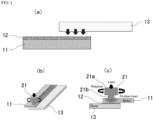
- a porous film 12 is firstly formed on a surface of a metal member 11 in the method for manufacturing a composite member according an embodiment of the present invention.
- the porous film 12 is formed by impacting a surface of the metal member 11 with metal powder using the cold spray process.
- the metal member 11 is plate-shaped and has a surface on which the porous film 12 is to be formed.
- the metal member 11 and the porous film 12 may be made of the same metal or may be composed of different metals.
- the metal member 11 may be composed of any metal.
- it is composed of aluminum or an aluminum alloy.
- the porous film 12 may also be composed of any metal.
- a titanium powder or a titanium alloy powder may be used as the metal powder to form a robust porous film 12 made of titanium or a titanium alloy by the cold spray process.
- the metal member 11 and a resin-containing member 13 are joined together by heating the metal member 11 while pressing the resin-containing member 13 against it.
- the resin-containing member 13 may be composed of any substance depending on the desired properties and applications.
- the resin-containing member 13 may consist only of a resin, or may be partly resinous.
- the resin-containing member 13 may be composed of a thermoplastic resin material, for example, such as high-strength PEEK (polyether ether ketone) or PA6 (polyamide 6), or may be composed of a thermosetting member having a fibrous reinforcing material and a resin, such as a prepreg material.
- a method of heating the metal member 11 there is no particular limitation for a method of heating the metal member 11.
- the following methods may be used: a method including heating the metal member 11 with a heater or the like while pressing the resin-containing member 13 against it as shown in FIG 1(a) ; a method including heating the metal member 11 with friction heat by pressing and rotating a cylindrical joining tool 21 against a surface of the metal member 11 opposite to the porous film 12 using friction stir welding (FSW) while the resin-containing member 13 is in contact with the porous film 12, as shown in FIGs. 1(a) and (b) .
- FSW friction stir welding
- the joining tool 21 for friction stir welding which is generally shaped to have a protruded probe 21b at the central region of a cylindrical shoulder 21a, is preferably configured such that the amount of protrusion of the probe 21b is very small to prevent deformation of the metal member 11 and to make the joining interface as flat as possible.
- Heating the metal member 11 in this way can melt or soften the resin-containing member 13 to allow the resin-containing member 13 to enter into voids of the porous film 12.
- This enables manufacture of a composite member according to an embodiment of the present invention, the composite member having the metal member 11 and the resin-containing member 13 joined together.
- the metal member 11 may be heated at a temperature lower than the melting point of the resin-containing member 13. Thereby, the resin-containing member 13 can be joined without melting the resin-containing member 13, leading to manufacture of a composite member with relative ease.
- the cold spray process enables formation of a porous film 12 having a large number of pores, in which metal powder as a raw material is well joined together with little oxidation or degradation of the metal powder.
- the voids of the porous film 12 are not oriented in one direction in contrast to holes formed by laser irradiation. This enables manufacture of a composite member having a high joining strength in which the resin-containing member 13 is not easily exfoliated.
- porous film 12 use of the cold spray process for forming the porous film 12 does not require expensive equipment as in the case when laser irradiation is used. Therefore, a composite member can be manufactured inexpensively. Moreover, the porous film 12 can be formed in a short time on a large area of a surface by the cold spray process, and washing treatment and waste liquid treatment are not required as in the case when chemical etching treatment is used. Therefore, a composite member can be manufactured efficiently in a short time.
- a metal member 11 and a resin-containing member 13 were joined together using friction stir welding (FSW).
- FSW friction stir welding
- a rolled material of an A5052 aluminum alloy was used as the metal member 11.
- the metal member 11 has a rectangular plate-like shape elongated in the rolling direction, and has the dimensions of 200 mm long, 50 mm wide, and 5 mm thick.
- the metal member 11 also has one surface (joining surface) roughened by injecting an alumina powder (particle diameter ⁇ 600 to 700 ⁇ m (#40), ⁇ 200 to 250 ⁇ m (#60), ⁇ 90 to 120 ⁇ m (#120)) to the surface at a pressure of 0.3 MPa.
- PEEK a thermoplastic resin material
- the resin-containing member 13 has a rectangular plate-like shape, and has the dimensions of 200 mm long, 50 mm wide, and 5 mm thick.
- a low-pressure cold spray apparatus (KM-CDS 3.0, INOVATI) was used to form the porous film 12 by the cold spray process.
- Metal powders shown in Table 1 were used in the cold spray process.
- Table 1 also shows film-forming conditions [the presence or absence of pretreatment (Blast), powder feed rates (Powder feed rate), the pressures of compressed gas (Gas pressure), the temperatures of process gas (Gas temp.), and traverse rates of spray nozzles (Traverse speed)] for each metal powder.
- blast treatment was performed as a pretreatment on a joining surface of the metal member 11 with alumina particles (#24) after the roughening treatment. He gas was used as the process gas. To control the porosity and thickness of the porous film 12, the traverse speed was varied as shown in Table 1. In some cases, heat treatment was performed after film formation to increase adhesion between the metal member 11 and the porous film 12. Heat treatment was performed in an electric muffle furnace under the air atmosphere.
- the heat-treatment temperature and the holding time were 500°C and 30 min, respectively for the Al powder, and 600°C and 4 hours, respectively for the Ti-20, Ti-45, Ti-20+Ti-45, and Ti-20+Al 2 O 3 powders (600°C and 2 or 14 hours in some cases for only Ti-20), all of which were air-cooled.
- a high-stiffness friction stir welding machine (TU-01 from Nitto Seiki Co., Ltd.) was used to join the metal member 11 with the resin-containing member 13.
- the overlap width between the metal member 11 and the resin-containing member 13 was set to 20 mm, and a joining tool of SKD61 was used as a joining tool 21.
- the joining tool 21 includes a cylindrical shoulder 21a having a tool diameter of 15 mm and a probe 21b having a diameter of 5 mm, in which the probe 21b is protruded by 1.4 mm from the central region of the cylindrical shoulder 21a.
- the traverse speed of the joining tool 21 was set to 10.0 mm/s, and the rotational speed of the joining tool 21 was set to 1200 rpm, and the insertion depth of the joining tool 21 into the metal member 11 was set to 1.1 mm, and the advancing angle of the joining tool 21 was set to 3°.
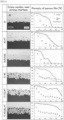
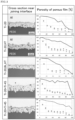
- Optical micrographs of cross sections near the joining interfaces of composite members each produced by forming a porous film 12 using one of the metal powders listed in Table 1 and joining a metal member 11 (Al alloy) with a resin-containing member 13 (PEEK) are shown left in FIGs 2 to 4 for each of the metal members and the film-forming conditions of the porous films 12.
- HT refers to a case where heat treatment was performed after the formation of the porous film 12.
- BL (Blast less) refers to a case where blast treatment was not performed before the film formation of the porous film 12.
- the porosity of each porous film 12 (Porosity) and the porosity of each porous film 12 filled with the resin-containing member 13 (Filled by PEEK) were determined from the corresponding optical micrograph in accordance with the point counting method, and the filling rate of the resin-containing member 13 (Filling rate) was calculated from the corresponding porosities.
- the results are shown in the corresponding graphs at the right side of FIGs 2 to 4 .
- the horizontal axis in each figure represents the percentage of the depth of the porous film 12 from a surface in the side of the resin-containing member 13, where 0% corresponds to the interface between the porous film 12 and the resin-containing member 13, and 100% corresponds to the interface between the porous film 12 and the metal member 11.
- each porous film 12 was determined from the corresponding optical micrograph. The results are shown in Table 2.
- Table 2 Metal powder, Film-forming conditions Film thickness of porous film [ ⁇ m] Average porosity of porous film [%] Al 95 7.8 Al, HT 100 8.7 SUS316L 120 6.9 Ti-45 110 25.4 Ti-45, HT 80 26.9 Ti-45, BL, HT 90 25.6 Ti-20 100 20.8 Ti-20, HT 100 21.1 Ti-20, BL, HT 80 26.0 Ti-20+Ti-45 110 19.7 Ti-20+Ti-45, HT 80 26.6 Ti-20+Al 2 O 3 110 11.9 Ti-20+Al 2 O 3 , HT 80 13.7 Ti-20+Al 2 O 3 , BL, HT 100 12.7
- the metal member 11 and the resin-containing member 13 were joined together by friction stir welding without forming the porous film 12 using a rolled material of an A5052 aluminum alloy (not roughened nor pretreated).
- the results demonstrated that the resin-containing member 13 exfoliated from the metal member 11 immediately after joining, and thus almost no joining was able to be achieved.
- a composite member was produced by joining the metal member 11 with the resin-containing member 13 (PEEK) by friction stir welding without forming the porous film 12 using a rolled material of an A5052 aluminum alloy having a surface blasted with alumina particles (#24, #60, or #120).
- Optical micrographs of cross sections near the joining interfaces of these composite members are shown in FIG 5 .
- FIG 5 it was observed that the insides of minute uneven structures on the surface of the metal member 11 formed by the blast treatment were filled with the resin-containing member 13, and the metal member 11 tightly adhered to the resin-containing member 13 without gaps.
- the composite members produced were each subjected to tensile shear tests.
- the tests were conducted using a universal testing machine (INSTRON) at a crosshead speed of 1.0 mm/min under room temperature. Test strips having a width of 20 to 25 mm were used for the tests.
- the test strips were cut out from each composite member perpendicularly to the joining direction. Specifically, 3 test strips were cut out from each of the composite materials, and each of the strips was subjected to the tensile shear test. Values obtained from dividing the resulting breaking loads by joining areas were averaged to obtain a tensile shear strength of each composite material.
- the resulting tensile shear strengths of the composite materials are each shown in Table 3.
- Table 3 Metal powder, Film-forming conditions Tensile shear strength [MPa] Al 9.62 Al, HT 10.5 SUS316L 13.1 Ti-45 12.0 Ti-45, HT 13.6 Ti-45, BL, HT 13.0 Ti-20 15.5 Ti-20, HT 15.3 Ti-20, BL, HT 13.2 Ti-20+Ti-45 15.8 Ti-20+Ti-45, HT 14.6 Ti-20+Al 2 O 3 15.5 Ti-20+Al 2 O 3 , HT 13.4 Ti-20+Al 2 O 3 , BL, HT 12.6
- the relation between the porosity of the porous film 12 and the tensile shear strength of a composite member was determined for the composite members that broke at the interfaces between the porous films 12 and the resin-containing members 13 during the tensile shear tests. The results are shown in FIG 6 . As shown in FIG 6 , it was observed that the tensile shear strength gradually increased as the porosity increased. It was also observed that a tensile shear strength of about 12 MPa was achieved even at a porosity of about 6.8%, demonstrating that sufficiently high strength was obtained.
- composite members having the porous films 12 formed the Ti-20 powder at various traverse speeds (Traverse speed; ts) and subjected to heat treatment after film formation were measured for the tensile shear strength. It is noted that measurements were performed for composite members having the metal members 11 subjected to blast treatment as pretreatment and composite members having the metal members 11 not subjected to blast treatment.
- the film thicknesses of the porous films 12 were also varied by varying the traverse speeds.
- Optical micrographs of cross sections near the joining interfaces and the film thicknesses of the porous films 12 of the composite members for which measurements were performed are shown in FIG 7 .
- the relation between the film thickness of the porous film 12 and the tensile shear strength is shown in FIG 8 .
- porous films 12 were measured for the tensile shear strength as in FIGs. 7 and 8 , the composite members having the porous films 12 formed with the Ti-20+Ti-45 powder at various traverse speeds and subjected to heat treatment after film formation.
- the relation between the film thickness of the porous film 12 and the tensile shear strength is shown in FIG 9 . It is noted that the porous films 12 formed with the Ti-20+Ti-45 powder have larger porosities than those formed with the Ti-20 powder.
- a composite member was produced by forming a large number of pores on a surface of the metal member 11 by laser irradiation; filling the surface of the metal member 11 with a molten resin by hot pressing; and cooling and solidifying the resin, as described in Nonpatent Literature 4.
- a Ti alloy was used as the metal member 11, and PEEK was used as the resin.
- the diameter of the laser-irradiated pores was set to about 270 ⁇ m, and the temperature for the hot pressing was set to 300°C.
- Optical micrographs of cross sections near the joining interfaces of composite members in which the area percentage of pores on the metal member 11 was 40% and 70% are shown in 1and (c), respectively.
- FIG 10(a) shows an optical micrograph of a cross section near the joining interface of the composite member.
- FIGs. 10(a) to (c) it was observed that the insides of unevenness and pores on the surface of the metal member 11 were filled with a resin for all of the composite members, and the metal members 11 tightly adhered to the resin without gaps.
- FIGs. 10(b) and 10(c) it was observed that the pores formed by laser irradiation extend only in the direction perpendicular to the surface of the metal member 11.
- the composite members shown in FIGs. 10(a) to 10(c) were subjected to tensile shear tests as in Example 1. The results showed that the tensile shear strength was 11 MPa, 25 MPa, and 51 MPa for a composite member shown in FIG 10(a) where blast treatment was performed, for a composite member shown in FIG 10(b) where the area percentage of pores by laser irradiation was 40%, and for a composite member shown in FIG 10(c) where the area percentage of pores by laser irradiation was 70%, respectively. Comparison of these results with those shown in Table 3 can reveal that the composite members prepared by laser irradiation have larger tensile shear strength than those having the porous films 12 formed by the cold spray process.
- a composite member prepared by laser irradiation suffers from weak sticking of resin in the direction perpendicular to a surface of the metal member 11 because holes formed by laser irradiation extend only in the direction perpendicular to the surface of the metal member 11 as shown in FIGs 10(b) and (c) .
- the composite member prepared by laser irradiation is more susceptible to exfoliation than one having the porous film 12 formed by the cold spray process.
- a rolled material of an A5052 aluminum alloy was used as the metal member 11, and a thermoplastic resin material PA6 was used as the resin-containing member 13 to form the porous film 12 using the cold spray process by the method of manufacture of a composite member according to an embodiment of the present invention as shown in FIGs. 1(b) and (c) , and then the metal member 11 was joined with the resin-containing member 13 by friction stir welding (FSW).
- a Ti powder was used in the cold spray process.
- the traverse speed of the joining tool 21 was set to 13 mm/s, and the rotational speed of the joining tool 21 was set to 1000 rpm, and the insertion depth of the joining tool 21 into the metal member 11 was set to 1.0 mm.
- Other manufacturing conditions were as in Example 1.
- the resulting composite member was subjected to tensile shear strength tests as in Example 1. The results showed that the tensile shear strength was 10 MPa, which was higher than those of the composite members without the porous films 12 as shown in FIG 5 . It is noted that the porous film 12 of the produced composite member had a film thickness of about 130 ⁇ m.
- a rolled material of an A5052 aluminum alloy was used as the metal member 11, and PA6 was used as the resin-containing member 13 to form the porous film 12 using the cold spray process by the method of manufacture of a composite member according to an embodiment of the present invention as shown in FIG 1A , and then the metal member 11 was joined with the resin-containing member 13 by heating the metal member 11 while pressing the resin-containing member 13 against it. The resin-containing member 13 was pressed against the metal member 11 by hand press. A temperature at which the metal member 11 was heated was 300°C.
- the resulting composite member was subjected to tensile shear strength tests as in Example 1. The results showed that the tensile shear strength was 7 MPa or more. It is noted that the porous film 12 of the produced composite member had a film thickness of about 270 ⁇ m.
- the porous film 12 formed using the cold spray process by the method for manufacturing a composite member according to an embodiment of the present invention was subjected to tensile tests.
- an A5052 aluminum alloy was used as the metal member 11 for the tensile tests.
- the metal member 11 has a cylindrical shape with a diameter of 25 mm and a length of 40 mm.
- a Ti-45 powder with a particle size of 1 to 45 ⁇ m was used at a compressed gas pressure of 620 kPa, a process temperature of 427°C, and a traverse speed of spray nozzles of 500 mm/s.
- the porous films 12 with various thicknesses were formed by varying the number of lamination layers in the cold spray process.
- the porosities of the porous films 12 are 6% or more for all.
- An example of an optical micrograph of a cross section of the porous film 12 formed on one surface of the metal member 11 is shown in FIG 11(b) .
- an adhesive (Adhesive) 31 was applied on a surface of each porous film 12 formed, and then a base material 32 made of an A5052 aluminum alloy having the same size as the metal member 11 was bonded for the tensile tests.
- a base material 32 made of an A5052 aluminum alloy having the same size as the metal member 11 was bonded for the tensile tests.
- the adhesive 31 "3M (registered trademark) Scotch-Weld (registered trademark) DP-460 Off-White (3M Japan Limited)" was used. After bonded via the adhesive, the metal member 11 and the base material 32 were pulled to determine the tensile strength for each porous film 12. The results from the tensile tests are shown in FIG 12 .
- the results from the tensile tests revealed that the adhesive underwent internal breakage, and the tensile strength was 35 MPa or more when the porous film 12 had a thickness of 150 ⁇ m or less. It was also observed that the porous film 12 underwent internal breakage near the metal member 11, and the tensile strength was 35 MPa or less when the porous film 12 had a thickness of 150 ⁇ m or more. These results suggest that a porous film 12 of 150 ⁇ m or less has a strength of at least 35 MPa or more, and thus when a composite member is manufactured with that porous film 12, the metal member 11 and the resin-containing member 13 joined together are more resistant to separation.
- the porous films 12 were formed and subjected to tensile tests as in Example 4.
- the porous films 12 with different porosities were formed using different gas pressures of compressed gas of 312 kPa, 483 kPa, and 620 kPa at the time of injecting metal powder.
- FIG 13 shows the relation between the distance of the porous film 12 from the surface of the metal member 11 and the porosity; and a scanning electron micrograph of a cross section of the porous film 12 for each gas pressure.
- the porosity of the porous membrane 12 was about 4% to about 9% with the average of 5.58% when the gas pressure was 312 kPa, and the porosity of the porous membrane 12 was about 8% to about 16% with the average of 12.4% when the gas pressure was 483 kPa, and the porosity of the porous membrane 12 was about 6% to about 20% with the average of 13.5% when the gas pressure was 620 kPa, demonstrating that the porosity of the porous film 12 increased as the gas pressure increased.
- This can be explained as follows. When the gas pressure is low, the colliding force of the metal powder is small.
- the results from the tensile tests of the porous films 12 prepared under different gas pressures are shown in FIG 14 .
- the results from the tensile tests revealed that the adhesive underwent internal breakage, and the tensile strength was 40 MPa or more when the gas pressure was 483 kPa and 620 kPa. It was also observed that the porous film 12 underwent internal breakage, and the tensile strength was about 32 MPa when the gas pressure was 312 kPa.
- a gas pressure of 483 kPa or more that is, a porosity of the porous film 12 of 6% or more with the average porosity of 12% or more can confer a strength of at least 40 MPa or more on the porous film, and thus when a composite member is manufactured with that porous film 12, the metal member 11 and the resin-containing member 13 joined together are more resistant to separation.
Landscapes
- Mechanical Engineering (AREA)
- Engineering & Computer Science (AREA)
- Chemical & Material Sciences (AREA)
- Crystallography & Structural Chemistry (AREA)
- Inorganic Chemistry (AREA)
- Chemical Kinetics & Catalysis (AREA)
- Organic Chemistry (AREA)
- Health & Medical Sciences (AREA)
- Toxicology (AREA)
- Metallurgy (AREA)
- Materials Engineering (AREA)
- Laminated Bodies (AREA)
- Lining Or Joining Of Plastics Or The Like (AREA)
Applications Claiming Priority (2)
| Application Number | Priority Date | Filing Date | Title |
|---|---|---|---|
| JP2020053609 | 2020-03-25 | ||
| PCT/JP2021/012011 WO2021193643A1 (fr) | 2020-03-25 | 2021-03-23 | Procédé de fabrication d'élément composite, et élément composite |
Publications (2)
| Publication Number | Publication Date |
|---|---|
| EP4129552A1 true EP4129552A1 (fr) | 2023-02-08 |
| EP4129552A4 EP4129552A4 (fr) | 2023-11-08 |
Family
ID=77916486
Family Applications (1)
| Application Number | Title | Priority Date | Filing Date |
|---|---|---|---|
| EP21776342.4A Pending EP4129552A4 (fr) | 2020-03-25 | 2021-03-23 | Procédé de fabrication d'élément composite, et élément composite |
Country Status (3)
| Country | Link |
|---|---|
| EP (1) | EP4129552A4 (fr) |
| JP (1) | JP2021154733A (fr) |
| CN (1) | CN115279575B (fr) |
Cited By (7)
| Publication number | Priority date | Publication date | Assignee | Title |
|---|---|---|---|---|
| US12140109B2 (en) | 2023-03-30 | 2024-11-12 | Blue Origin, Llc | Transpiration-cooled systems having permeable and non-permeable portions |
| US12172229B2 (en) | 2023-03-30 | 2024-12-24 | Blue Origin, Llc | Friction stir additive manufacturing devices and methods for forming in-situ rivets |
| US12246392B2 (en) | 2023-03-30 | 2025-03-11 | Blue Origin Manufacturing, LLC | Deposition head for friction stir additive manufacturing devices and methods |
| US12303994B2 (en) | 2023-08-03 | 2025-05-20 | Blue Origin Manufacturing, LLC | Friction stir additive manufacturing formed parts and structures with integrated passages |
| US12383975B2 (en) | 2023-08-03 | 2025-08-12 | Blue Origin Manufacturing, LLC | Friction stir additive manufacturing formed parts and structures with integrated passages |
| US12415229B2 (en) | 2020-07-29 | 2025-09-16 | Blue Origin Manufacturing, LLC | Friction stir welding systems and methods |
| US12589446B2 (en) | 2023-12-12 | 2026-03-31 | Blue Origin Manufacturing, LLC | Wire-feed friction stir additive manufacturing systems, devices, and methods |
Families Citing this family (1)
| Publication number | Priority date | Publication date | Assignee | Title |
|---|---|---|---|---|
| WO2023147321A1 (fr) * | 2022-01-25 | 2023-08-03 | Novelis Inc. | Systèmes de pulvérisation à froid et procédés de revêtement de matériaux coulés |
Family Cites Families (15)
| Publication number | Priority date | Publication date | Assignee | Title |
|---|---|---|---|---|
| US20070196681A1 (en) * | 2004-11-15 | 2007-08-23 | Taryn Biggs | Laminate panel and process for production thereof |
| JP2007008762A (ja) * | 2005-06-30 | 2007-01-18 | Tdk Corp | 複合多孔体 |
| JP2007012863A (ja) * | 2005-06-30 | 2007-01-18 | Tdk Corp | 複合多孔体の製造方法 |
| JP4626687B2 (ja) * | 2008-08-19 | 2011-02-09 | トヨタ自動車株式会社 | 樹脂と金属との接合方法 |
| CN102652357B (zh) * | 2010-05-21 | 2015-09-09 | 丰田自动车株式会社 | 半导体装置 |
| WO2013146900A1 (fr) * | 2012-03-29 | 2013-10-03 | 帝人株式会社 | Procédé de fabrication d'un élément de joint et élément de joint |
| JP5897423B2 (ja) * | 2012-07-30 | 2016-03-30 | 勤欽股▲ふん▼有限公司 | マグネシウム材と樹脂部品の複合品及びその製造方法 |
| JP6098527B2 (ja) * | 2014-01-14 | 2017-03-22 | マツダ株式会社 | 金属部材と樹脂部材との接合方法 |
| JP6014879B2 (ja) * | 2014-03-25 | 2016-10-26 | 株式会社栗本鐵工所 | 金属部材と樹脂部材の接合方法 |
| JP6102813B2 (ja) * | 2014-03-28 | 2017-03-29 | マツダ株式会社 | 金属部材と樹脂部材との接合方法 |
| JP2018144475A (ja) * | 2017-03-03 | 2018-09-20 | 三井化学株式会社 | アルミニウム系金属/樹脂複合構造体、アルミニウム系金属部材、アルミニウム系金属部材の製造方法およびアルミニウム系金属/樹脂複合構造体の製造方法 |
| JP6941953B2 (ja) * | 2017-03-28 | 2021-09-29 | 三井化学株式会社 | 金属/樹脂複合構造体および金属/樹脂複合構造体の製造方法 |
| JP2019166638A (ja) * | 2018-03-21 | 2019-10-03 | 学校法人早稲田大学 | 樹脂金属接合体の製造方法及び樹脂金属接合体 |
| CN109807460B (zh) * | 2019-03-20 | 2020-08-25 | 上海交通大学 | 一种通过检测下压力控制金属与高分子焊接的方法 |
| JP2019177704A (ja) * | 2019-07-26 | 2019-10-17 | 株式会社大貫工業所 | 金属部品と樹脂の接合方法及び金属部品と樹脂の一体成形品 |
-
2021
- 2021-03-23 CN CN202180021530.2A patent/CN115279575B/zh active Active
- 2021-03-23 EP EP21776342.4A patent/EP4129552A4/fr active Pending
- 2021-03-23 JP JP2021048892A patent/JP2021154733A/ja active Pending
Cited By (9)
| Publication number | Priority date | Publication date | Assignee | Title |
|---|---|---|---|---|
| US12415229B2 (en) | 2020-07-29 | 2025-09-16 | Blue Origin Manufacturing, LLC | Friction stir welding systems and methods |
| US12140109B2 (en) | 2023-03-30 | 2024-11-12 | Blue Origin, Llc | Transpiration-cooled systems having permeable and non-permeable portions |
| US12172229B2 (en) | 2023-03-30 | 2024-12-24 | Blue Origin, Llc | Friction stir additive manufacturing devices and methods for forming in-situ rivets |
| US12209559B2 (en) | 2023-03-30 | 2025-01-28 | Blue Origin, Llc | Transpiration-cooled systems having permeable and non-permeable portions |
| US12246392B2 (en) | 2023-03-30 | 2025-03-11 | Blue Origin Manufacturing, LLC | Deposition head for friction stir additive manufacturing devices and methods |
| US12558739B2 (en) | 2023-03-30 | 2026-02-24 | Blue Origin Manufacturing, LLC | Friction stir additive manufacturing devices and methods for forming in-situ rivets |
| US12303994B2 (en) | 2023-08-03 | 2025-05-20 | Blue Origin Manufacturing, LLC | Friction stir additive manufacturing formed parts and structures with integrated passages |
| US12383975B2 (en) | 2023-08-03 | 2025-08-12 | Blue Origin Manufacturing, LLC | Friction stir additive manufacturing formed parts and structures with integrated passages |
| US12589446B2 (en) | 2023-12-12 | 2026-03-31 | Blue Origin Manufacturing, LLC | Wire-feed friction stir additive manufacturing systems, devices, and methods |
Also Published As
| Publication number | Publication date |
|---|---|
| CN115279575A (zh) | 2022-11-01 |
| CN115279575B (zh) | 2026-01-02 |
| JP2021154733A (ja) | 2021-10-07 |
| EP4129552A4 (fr) | 2023-11-08 |
Similar Documents
| Publication | Publication Date | Title |
|---|---|---|
| EP4129552A1 (fr) | Procédé de fabrication d'élément composite, et élément composite | |
| Kajihara et al. | Joining strength dependence on molding conditions and surface textures in blast-assisted metal-polymer direct joining | |
| Vasconcelos et al. | Injection overmolding of polymer‐metal hybrid structures: A review | |
| JP5554483B2 (ja) | 金属と樹脂の複合体及びその製造方法 | |
| Ramani et al. | Thermoplastic bonding to metals via injection molding for macro‐composite manufacture | |
| JP5139426B2 (ja) | 鋼材複合体及びその製造方法 | |
| Kadoya et al. | PBT–anodized aluminum alloy direct joining: characteristic injection speed dependence of injected polymer replicated into nanostructures | |
| JP4903897B2 (ja) | 亜鉛系鍍金鋼板と被着材の接合体及びその製造方法 | |
| Frascio et al. | Appraisal of surface preparation in adhesive bonding of additive manufactured substrates | |
| JP5094849B2 (ja) | ステンレス鋼複合体 | |
| TWI707781B (zh) | 金屬樹脂複合成形體及其製造方法 | |
| JP5129903B2 (ja) | マグネシウム合金複合体とその製造方法 | |
| Ageorges et al. | Resistance welding of metal/thermoplastic composite joints | |
| EP2832526A1 (fr) | Procédé de fabrication d'un élément de joint et élément de joint | |
| KR20140144694A (ko) | 접합 부재의 제조 방법, 및 접합 부재 | |
| EP2280046B1 (fr) | Composite de résine métallique et procédé | |
| JP5253416B2 (ja) | 金属と樹脂の複合体とその製造方法 | |
| JP4906004B2 (ja) | 金属合金と繊維強化プラスチックの複合体の製造方法 | |
| Kandemir et al. | Investigation of the effect of surface roughness and plasma treatment on adhesively bonded aluminium-polyamide hybrid joints | |
| US12479188B2 (en) | Method for manufacturing composite member, and composite member | |
| EP2256232A2 (fr) | Composite de résine métallique et procédé | |
| JP2009241569A (ja) | 管状接合複合体 | |
| JP5714864B2 (ja) | Cfrpプリプレグと被着材の接合体 | |
| JP2023157675A (ja) | 複合部材の製造方法、及び複合部材 | |
| Xu et al. | Effects of surface microstructure and molding parameters on injection bonding strength of polyphenylenesulphide-aluminum alloy |
Legal Events
| Date | Code | Title | Description |
|---|---|---|---|
| STAA | Information on the status of an ep patent application or granted ep patent |
Free format text: STATUS: THE INTERNATIONAL PUBLICATION HAS BEEN MADE |
|
| PUAI | Public reference made under article 153(3) epc to a published international application that has entered the european phase |
Free format text: ORIGINAL CODE: 0009012 |
|
| STAA | Information on the status of an ep patent application or granted ep patent |
Free format text: STATUS: REQUEST FOR EXAMINATION WAS MADE |
|
| 17P | Request for examination filed |
Effective date: 20221020 |
|
| AK | Designated contracting states |
Kind code of ref document: A1 Designated state(s): AL AT BE BG CH CY CZ DE DK EE ES FI FR GB GR HR HU IE IS IT LI LT LU LV MC MK MT NL NO PL PT RO RS SE SI SK SM TR |
|
| DAV | Request for validation of the european patent (deleted) | ||
| DAX | Request for extension of the european patent (deleted) | ||
| A4 | Supplementary search report drawn up and despatched |
Effective date: 20231009 |
|
| RIC1 | Information provided on ipc code assigned before grant |
Ipc: B23K 103/16 20060101ALI20231003BHEP Ipc: B29C 65/00 20060101ALI20231003BHEP Ipc: B29C 65/82 20060101ALI20231003BHEP Ipc: B23K 103/00 20060101ALI20231003BHEP Ipc: B23K 103/18 20060101ALI20231003BHEP Ipc: B23K 103/10 20060101ALI20231003BHEP Ipc: B23K 20/233 20060101ALI20231003BHEP Ipc: C23C 24/04 20060101ALI20231003BHEP Ipc: B29C 65/44 20060101ALI20231003BHEP Ipc: B29C 65/06 20060101ALI20231003BHEP Ipc: B29C 65/02 20060101ALI20231003BHEP Ipc: B23K 20/12 20060101AFI20231003BHEP |