EP4131074A1 - Dispositif de classification de données, procédé de classification de données et programme de classification de données - Google Patents
Dispositif de classification de données, procédé de classification de données et programme de classification de données Download PDFInfo
- Publication number
- EP4131074A1 EP4131074A1 EP21779595.4A EP21779595A EP4131074A1 EP 4131074 A1 EP4131074 A1 EP 4131074A1 EP 21779595 A EP21779595 A EP 21779595A EP 4131074 A1 EP4131074 A1 EP 4131074A1
- Authority
- EP
- European Patent Office
- Prior art keywords
- data
- learned
- similarity
- classes
- class
- Prior art date
- Legal status (The legal status is an assumption and is not a legal conclusion. Google has not performed a legal analysis and makes no representation as to the accuracy of the status listed.)
- Pending
Links
Images



Classifications
-
- G—PHYSICS
- G06—COMPUTING OR CALCULATING; COUNTING
- G06F—ELECTRIC DIGITAL DATA PROCESSING
- G06F16/00—Information retrieval; Database structures therefor; File system structures therefor
- G06F16/90—Details of database functions independent of the retrieved data types
- G06F16/906—Clustering; Classification
-
- G—PHYSICS
- G06—COMPUTING OR CALCULATING; COUNTING
- G06F—ELECTRIC DIGITAL DATA PROCESSING
- G06F18/00—Pattern recognition
- G06F18/20—Analysing
- G06F18/24—Classification techniques
- G06F18/241—Classification techniques relating to the classification model, e.g. parametric or non-parametric approaches
- G06F18/2413—Classification techniques relating to the classification model, e.g. parametric or non-parametric approaches based on distances to training or reference patterns
-
- G—PHYSICS
- G06—COMPUTING OR CALCULATING; COUNTING
- G06F—ELECTRIC DIGITAL DATA PROCESSING
- G06F16/00—Information retrieval; Database structures therefor; File system structures therefor
- G06F16/50—Information retrieval; Database structures therefor; File system structures therefor of still image data
- G06F16/55—Clustering; Classification
-
- G—PHYSICS
- G06—COMPUTING OR CALCULATING; COUNTING
- G06F—ELECTRIC DIGITAL DATA PROCESSING
- G06F18/00—Pattern recognition
- G06F18/20—Analysing
- G06F18/21—Design or setup of recognition systems or techniques; Extraction of features in feature space; Blind source separation
- G06F18/217—Validation; Performance evaluation; Active pattern learning techniques
-
- G—PHYSICS
- G06—COMPUTING OR CALCULATING; COUNTING
- G06F—ELECTRIC DIGITAL DATA PROCESSING
- G06F18/00—Pattern recognition
- G06F18/20—Analysing
- G06F18/22—Matching criteria, e.g. proximity measures
-
- G—PHYSICS
- G06—COMPUTING OR CALCULATING; COUNTING
- G06F—ELECTRIC DIGITAL DATA PROCESSING
- G06F18/00—Pattern recognition
- G06F18/20—Analysing
- G06F18/24—Classification techniques
- G06F18/243—Classification techniques relating to the number of classes
- G06F18/2431—Multiple classes
-
- G—PHYSICS
- G06—COMPUTING OR CALCULATING; COUNTING
- G06N—COMPUTING ARRANGEMENTS BASED ON SPECIFIC COMPUTATIONAL MODELS
- G06N3/00—Computing arrangements based on biological models
- G06N3/02—Neural networks
- G06N3/04—Architecture, e.g. interconnection topology
- G06N3/0475—Generative networks
-
- G—PHYSICS
- G06—COMPUTING OR CALCULATING; COUNTING
- G06N—COMPUTING ARRANGEMENTS BASED ON SPECIFIC COMPUTATIONAL MODELS
- G06N3/00—Computing arrangements based on biological models
- G06N3/02—Neural networks
- G06N3/08—Learning methods
- G06N3/09—Supervised learning
-
- G—PHYSICS
- G06—COMPUTING OR CALCULATING; COUNTING
- G06N—COMPUTING ARRANGEMENTS BASED ON SPECIFIC COMPUTATIONAL MODELS
- G06N3/00—Computing arrangements based on biological models
- G06N3/02—Neural networks
- G06N3/04—Architecture, e.g. interconnection topology
- G06N3/0464—Convolutional networks [CNN, ConvNet]
Definitions
- the present invention relates to a data classification device, a data classification method, and a data classification program.
- Patent Literature 1 Japanese Patent Application Laid-open No. 2019-96313
- the classifier described above classifies data into one of known learned classes, even if the data is of an unknown class that originally cannot be classified. This could result in decreased accuracy in classification if an unknown class could occur in the data. Therefore, there has been a need for a technique that is capable of preventing the classification of data of an unknown class into a known class.
- a data classification device includes: a data acquisition unit configured to acquire data to be classified; a classification unit configured to classify the data into one of a plurality of classes by using a learned model learned using a neural network; a similarity calculation unit configured to calculate similarity between the data and learned data used to generate the learned model; and a determination unit configured to determine whether the data belongs to the classes, based on the similarity, and, when the data does not belong to any of the classes, determine that the data belongs to an unknown class.
- a data classification device is the data classification device according to the above-described invention in which the learned model takes the data as an input parameter and the learned model takes a classification result and a feature amount of the data as output parameters.
- a data classification device is the data classification device according to the above-described invention in which the similarity calculation unit is configured to calculate the similarity using a feature amount of the data and a feature amount of the learned data, and the determination unit is configured to determine, when the similarity meets a standard, a class to which the data belongs according to a classification result of the classification unit, and determine that, when the similarity does not meet the standard, the data is of an unknown class.
- a data classification device is the data classification device according to the above-described invention in which a control unit configured to cause a display device to display at least data most similar to the data together with a determination result by the determination unit is included.
- a data classification device is the data classification device according to the above-described invention in which an evaluation value calculation unit configured to calculate, when the number of determinations by the determination unit reaches the standard number of times, a determination evaluation value, which is a ratio of determinations that the data belongs to one of the classes, of determinations made the standard number of times, and a control unit configured to output, when the determination evaluation value is smaller than a threshold value, at least one of an evaluation result and information that prompts reconstruction of the learned model are included.
- a data classification device is the data classification device according to the above-described invention in which the similarity calculation unit is configured to calculate a minimum value in each class of Euclidean distance between a feature amount of the data and a feature amount of the learned data in a feature space as similarity to each class.
- a data classification device is the data classification device according to the above-described invention in which the similarity calculation unit is configured to calculate a predetermined distance between a feature amount of the data and the learned data representing each of the classes in a feature space as similarity to each class.
- a data classification method includes: a step of acquiring data to be classified; a step of classifying the data into one of a plurality of classes by reading out a learned model learned using a neural network from a storage unit, and by using the learned model; a step of calculating similarity between the data and learned data used to generate the learned model; and a step of determining whether the data belongs to the classes, based on the similarity, and, when the data does not belong to any of the classes, determining that the data belongs to an unknown class.
- the data classification program includes: a step of acquiring data to be classified; a step of classifying the data into one of a plurality of classes by using a learned model learned using a neural network; a step of calculating similarity between the data and learned data used to generate the learned model; and a step of determining whether the data belongs to the classes, based on the similarity, and, when the data does not belong to any of the classes, determining that the data belongs to an unknown class.
- data of an unknown class can be prevented from being classified into a known class.
- FIG. 1 is a block diagram illustrating a functional configuration of a data classification device according to an embodiment of the present invention.
- a data classification device 100 illustrated in the figure is a device that classifies data of defect images acquired by imaging defects that occur in a manufacturing process of polymer-based films into one of a plurality of classes that differ according to the defect type.
- the defects to be classified include those caused by a raw material that has been melted during the film manufacturing process stagnating inside manufacturing equipment and being modified due to excessive temperature, heat, time, and the like, foreign matter mixed in during the manufacturing process, and scratches caused by the manufacturing equipment.
- the data classification device 100 includes an input unit 1, a data acquisition unit 2, an image processing unit 3, a classification unit 4, a similarity calculation unit 5, a determination unit 6, an evaluation value calculation unit 7, a control unit 8, and a storage unit 9.
- the input unit 1 receives input of various types of information.
- the input unit 1 is configured by using a keyboard, mouse, microphone, or other user interface.
- the data acquisition unit 2 acquires defect image data sent from a defect inspection machine that images the surface of the film, extracts defects, and generates defect image data including the defects, and outputs the data to the storage unit 9 for storage.
- the image processing unit 3 performs known image processing on the defect image data, as well as image processing that uses portions other than the defects of the defect image data as a common background and that superimposes the defect portions on that background.
- the background is composed of a single color, for example, gray.
- the classification unit 4 classifies the defect image data into one of the classes by inputting the defect image data processed by the image processing unit 3 to a learned model learned using a neural network.
- the learned model is a neural network made up of an input layer, a middle layer, and an output layer, each layer having one or more nodes.
- the learned model is generated by learning to optimize network parameters of the neural network.
- the network parameters include information about weights and biases between the layers of the neural network.
- Input parameters of the learned model are the defect image data, and output parameters are the probability of the data belonging to each class and a predetermined feature amount in the defect image data.
- This neural network is a convolutional neural network (CNN) that introduces a softmax loss function, preferably an L 2 softmax loss function with an L 2 -norm constraint added to the softmax loss function (for the L 2 softmax loss function, see, for example, R. Ranjan et al., "L2-constrained Softmax Loss for Discriminative Face Verification", preprint, arXiv:1703.09507 [cs.CV] (https://arxiv.org/pdf/1703.09507.pdf )).
- a feature amount is generally defined as a multidimensional vector made up of a plurality of components that give features of the image data.
- the similarity calculation unit 5 calculates the similarity between the defect image data and learned defect image data used to generate the learned model (hereinafter also referred to as learned data).
- the similarity calculation unit 5 calculates the similarity by using the feature amount of the defect image data and the feature amount of the learned data.
- the similarity one of Euclidean distance, Mahalanobis distance, and Cosine similarity, for example, can be applied.
- the determination unit 6 determines whether the defect image data belongs to one of the classes on the basis of the similarity, and if the data does not belong to any of the classes, the determination unit 6 determines that the data belongs to an unknown class. If the similarity meets a predetermined standard, the determination unit 6 determines the class to which the defect image data belongs according to the classification result of the classification unit 4. If the similarity does not meet the standard, the determination unit 6 determines that the defect image data is of an unknown class.
- the evaluation value calculation unit 7 calculates the determination evaluation value, which is the ratio of determinations that the defect image data belongs to one of the classes, of the determinations made the standard number of times.
- the control unit 8 oversees and controls the operation of the data classification device 100.
- the control unit 8 includes a display control unit 81 that causes a display device to display the determination result of the determination unit 6.
- the display control unit 81 outputs the defect image data most similar to the defect image data together with the determination result by the determination unit 6 to the display device for display.
- the control unit 8 outputs at least one of the evaluation result and information to prompt reconstruction of the learned model.
- the control unit 8 may output that information to the display device for display or to an audio output device for audio output.
- the storage unit 9 includes a learned model storage unit 91 and a learned data storage unit 92.
- the learned model storage unit 91 stores therein the learned model described above.
- the learned data storage unit 92 stores therein defect image data used to learn the learned model (hereinafter referred to as learned data), the feature amount of the learned data, and the class to which the data belongs.
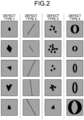
- FIG. 2 is a diagram illustrating an example of learned data stored by the learned data storage unit 92.
- FIG. 2 illustrates a case where there are four classes of defect types (defect type 1 to defect type 4).
- the storage unit 9 stores therein the number of determinations made by the determination unit 6. This number of determinations is reset under the control of the control unit 8 when the predetermined standard number of times is reached.
- the storage unit 9 also stores therein data including various computer programs for operating the data classification device 100 and various parameters necessary for the operation of the data classification device 100.
- the various computer programs include a data classification program according to the present embodiment.
- the storage unit 9 is configured by using a read only memory (ROM) in which various computer programs and the like are installed in advance, and a random access memory (RAM) that stores therein arithmetic parameters, data, and the like for each processing.
- the various computer programs may be recorded on a computer-readable recording medium, such as a hard disk drive (HDD), a solid state drive (SSD), flash memory, CD-ROM, DVD-ROM, or Blu-ray (registered trademark), or may be made downloadable via a communication network.
- the communication network herein refers to one that is configured by using at least one of existing public network, local area network (LAN), and wide area network (WAN), for example, and can be either wired or wireless.
- the data classification device 100 having the above functional configuration is a computer configured by using one or more pieces of hardware, such as a central processing unit (CPU), a graphics processing unit (GPU), an application specific integrated circuit (ASIC), and a field programmable gate array (FPGA).
- CPU central processing unit
- GPU graphics processing unit
- ASIC application specific integrated circuit
- FPGA field programmable gate array
- FIG. 3 is a flowchart illustrating an overview of processing performed by the data classification device 100.
- the data acquisition unit 2 acquires defect image data from the defect inspection machine (step S1).
- the image processing unit 3 then performs image processing (step S2). At this time, the image processing unit 3 performs rule-based image processing.
- the purpose here is to remove unnecessary areas in an image other than the defect section and to eliminate images in which it is obvious that no defects have been captured, for example.
- the classification processing from step S3 onward may use all images, or images to be classified may be selected in the image processing at step S2.
- processing is performed to cut out a portion of specific size centered on the defect area and to make the background area other than the defect a single color background, such as gray, and the defect area is superimposed on this background.
- the classification unit 4 performs classification using the learned model stored by the learned model storage unit 91 (step S3). Specifically, the classification unit 4 inputs the defect image data processed by the image processing unit 3 into the learned model, and acquires the probability of the data belonging to each class and the feature amount of the input defect image data as output parameters.
- the similarity calculation unit 5 calculates the similarity between the defect image data acquired at step S1 and the learned data by referring to the learned data storage unit 92 (step S4). For example, the similarity calculation unit 5 calculates the Euclidean distance between the feature amount of the defect image data and the feature amount of the learned data, and calculates the minimum Euclidean distance for each class as the similarity.
- the determination unit 6 first determines whether the similarity meets the predetermined standard (step S5). If the similarity meets the standard at step S5 (Yes at step S5), the data classification device 100 moves to step S6.
- the standard here is defined as the range of values that minimum value takes on, for example.
- the determination unit 6 makes a determination according to the classification result by the classification unit 4 (step S6). Specifically, the determination unit 6 determines that the class with the largest probability acquired at step S3 is the class to which the defect image data belongs.
- the determination unit 6 determines that the defect image data is of an unknown class (step S7).
- control unit 8 increases the number of determinations stored by the storage unit 9 by one (step S8).
- FIG. 4 and FIG. 5 are diagrams illustrating display examples of results determined by the determination unit 6 on the display device. Specifically, FIG. 4 illustrates a case where the defect image data is of a known class, and FIG. 5 illustrates a case where the defect image data is of an unknown class.
- a screen 201 illustrated in FIG. 4 displays information indicating that the defect image data (image name "Sample1.png”) has been classified into defect type 1, as well as four images and their respective Euclidean distances in ascending order of Euclidean distance. All the four images are of defect type 1.
- a screen 202 illustrated in FIG. 5 displays information indicating that the defect image data (image name "Sample3.png”) is of an unknown class, as well as four images in ascending order of Euclidean distance. These four images differ from each other in defect type.
- images that are similar to the image to be classified are displayed along with the determination result, which enables a user to visually understand the determination result by presenting not only the determination result but also the information on which the determination is based. Only at least one of the similar image and the Euclidean distance may be displayed.
- the number of images to be displayed is not limited to four, and may be set freely as long as there is more than one.
- the evaluation value calculation unit 7 compares the number of determinations by the determination unit 6 with the predetermined standard number of times by referring to the storage unit 9 (step S10). If the number of determinations by the determination unit 6 is less than the standard number of times (No at step S10), the process is repeated by returning to the data acquisition processing at step S1. If the number of determinations by the determination unit 6 reaches the standard number of times (Yes at step S10), the evaluation value calculation unit 7 calculates the determination evaluation value, which is the ratio of determinations that the defect image data belongs to one of the classes, of the determinations made the standard number of times (step S11) .
- the display control unit 81 If the calculated determination evaluation value is smaller than the predetermined threshold value (Yes at step S12), the display control unit 81 outputs information on the determination evaluation result to the display device for display, thereby informing the user of the determination evaluation result (step S13).
- the display control unit 81 may cause the display device to display information that prompts reconstruction of the learned model, instead of the determination evaluation result, or may cause the display device to display the determination evaluation result and information that prompts reconstruction of the learned model. This operation allows the user to recognize that the accuracy of the learned model is not adequate.
- the control unit 8 then resets the number of determinations stored by the storage unit 9 to zero (step S14). Thereafter, the data classification device 100 ends a series of processing.
- step S12 if the calculated determination evaluation value is equal to or higher than the predetermined threshold value (No at step S12), the data classification device 100 moves to step S14, resets the number of determinations, and ends the series of processing.
- FIG. 6 illustrates an effect of the embodiment described above. Specifically, FIG. 6 illustrates histograms of (a) a result of the minimum Euclidean distance calculated between samples of known classes and the learned data in each class, and (b) a result of calculating the minimum Euclidean distance calculated between samples of unknown classes and the learned data in each class.
- the histograms are created assuming that the class to which a sample belongs has already been determined in advance.
- cases are illustrated where two different threshold values, Th1 and Th2, are set as threshold values that provide boundaries for discriminating between known and unknown classes.
- the threshold value is set at Th1, that is, where the samples having values of equal to or smaller than the threshold value Th1 are defined as known classes.
- the samples of the known class are included in the unknown class, while according to (b), the samples of the unknown class are not included in the known class.
- the threshold value is set at Th2, that is, where the samples having values of equal to or smaller than the threshold value Th2 are defined as known classes.
- the samples having values of equal to or smaller than the threshold value Th2 are defined as known classes.
- all of the samples of the known class fall into the range of values equal to or smaller than the threshold value, while according to (b), many of the samples of the unknown class are included in the known class.
- FIG. 7 is a diagram illustrating changes in the detection rate of unknown classes and the erroneous detection rate of known classes when the threshold values have been changed in the example illustrated in FIG. 6 .
- a curve 301 illustrated in FIG. 7 is a receiver operating characteristic (ROC) curve, where points P and Q on the curve respectively correspond to the threshold values Th1 and Th2.
- ROC receiver operating characteristic
- the detection rate is 100% while the erroneous detection rate is less than 10%.
- the detection rate is about 15% while the erroneous detection rate is 0%.
- FIG. 8 is a diagram illustrating another way to determine a threshold value that provides the boundary for discriminating between known and unknown classes in the embodiment described above.
- the diagram of (a) in FIG. 8 illustrates a histogram illustrating the result of the minimum Euclidean distance calculated between the samples of known classes and the learned data in each class, and its normal distribution curve C. This normal distribution curve C is a line drawn assuming that the histogram is normally distributed.
- the diagram of (b) in FIG. 8 illustrates a histogram illustrating the result of the minimum Euclidean distance calculated between the samples of unknown classes and the learned data in each class.
- the histograms are created assuming that the class to which a sample belongs has already been determined in advance, in the same way as in FIG. 6 .
- a threshold value Th3 or Th4 is set as a threshold value that provides a boundary for discriminating between known and unknown classes.
- the threshold value In setting a threshold value that provides a boundary for discriminating between known and unknown classes, it may be difficult to prepare samples of unknown classes in advance. In such a case, the threshold value would be set from the minimum Euclidean distance between samples of known classes and learned data in each class.
- a normal distribution is assumed for the histograms illustrating the result of the minimum Euclidean distance calculated between the samples of known classes and the learned data in each class.
- a threshold value is determined from the confidence interval calculated from the mean ⁇ and the standard deviation ⁇ of the normal distribution.
- the distribution to be determined is not limited to a normal distribution, and a half-normal distribution or Poisson distribution may be used, or a mixture distribution that takes multimodality into account may be assumed as a probability distribution.
- the threshold value is set at Th3 (66% confidence interval of the normal distribution: mean ⁇ + 1 ⁇ ), that is, where the samples having values of equal to or smaller than the threshold value Th3 are defined as known classes.
- Th3 66% confidence interval of the normal distribution: mean ⁇ + 1 ⁇
- the threshold value is set at Th4 (99.9997 confidence interval of the normal distribution: mean ⁇ + 6 ⁇ ), that is, where the samples having values of equal to or smaller than the threshold value Th4 are defined as known classes.
- Th4 (99.9997 confidence interval of the normal distribution: mean ⁇ + 6 ⁇ )
- all of the samples of the known class fall into the range of values equal to or smaller than the threshold value
- many of the samples of the unknown class are included in the known class.
- threshold values according to the operational use may be set from samples of known classes only. For example, to avoid mistakenly determining a sample of a known class as a sample of an unknown class, a threshold value may be set like Th4. Conversely, to avoid mistakenly determining a sample of an unknown class as a sample of a known class, a threshold value may be set like Th3. Setting threshold values is not limited to the above, and threshold values are preferably set according to operational objectives.
- the similarity between the acquired defect image data and the learned data used to generate the learned model is calculated, whether the defect image data belongs to the classes is determined on the basis of the calculated similarity, and, if the data does not belong to any of the classes, the data is determined to belong to an unknown class, so that data of an unknown class can be prevented from being classified into a known class.
- At least defect image data most similar to the defect image data is displayed on the display device along with the determination result, so that the user can visually grasp the basis for the determination in addition to whether the defect image data belongs to a known class or an unknown class.
- the determination evaluation value which is the ratio of determinations that the defect image data belongs to one of the classes, of the determinations made the standard number of times, is calculated, and when the calculated result is smaller than the threshold value, an evaluation result or information to prompt reconstruction of the learned model is output.
- the learned model in use is not valid, this fact can be informed promptly.
- the conventional film manufacturing process if an optical system of the defect inspection machine is changed or manufacturing conditions of a product are changed, the previously used learned model may no longer be able to properly classify the product. Additionally, it has been difficult to evaluate the classification itself during operation.
- the classification itself is evaluated at predetermined intervals, the user can be informed accurately that the learned model is nonconforming when any changes occur in the manufacturing process.
- preprocessing is performed on the image at step S2, in view of the possibility of errors here, it is also possible to classify an image without image processing at step S2 prepared in advance, or to perform another image processing method under different conditions with different threshold values, filters, and the like prepared in advance, and then try classification again from step S3 onward.
- the similarity calculation unit 5 may calculate the similarity between the feature amount of the defect image data and the feature amount of data of a representative image of each class.
- the representative image may be an image with the feature amount closest to the center of gravity in the feature space of feature amount of each class, or an image with the feature amount closest to the average of the feature amount of each class.
- the present invention can also be applied to detection of abnormalities in time-series data (irregular pulse detection in human heartbeat data, for example).
- the data classification device, the data classification method, and the data classification program of the present invention are preferably applicable to prevent classification of data of an unknown class into a known class, but the scope of application is not limited thereto.
Landscapes
- Engineering & Computer Science (AREA)
- Theoretical Computer Science (AREA)
- Data Mining & Analysis (AREA)
- Physics & Mathematics (AREA)
- General Engineering & Computer Science (AREA)
- General Physics & Mathematics (AREA)
- Life Sciences & Earth Sciences (AREA)
- Artificial Intelligence (AREA)
- Evolutionary Computation (AREA)
- Databases & Information Systems (AREA)
- Computer Vision & Pattern Recognition (AREA)
- Evolutionary Biology (AREA)
- Bioinformatics & Computational Biology (AREA)
- Bioinformatics & Cheminformatics (AREA)
- General Health & Medical Sciences (AREA)
- Biophysics (AREA)
- Computational Linguistics (AREA)
- Biomedical Technology (AREA)
- Molecular Biology (AREA)
- Computing Systems (AREA)
- Mathematical Physics (AREA)
- Software Systems (AREA)
- Health & Medical Sciences (AREA)
- Image Analysis (AREA)
- Information Retrieval, Db Structures And Fs Structures Therefor (AREA)
Applications Claiming Priority (2)
| Application Number | Priority Date | Filing Date | Title |
|---|---|---|---|
| JP2020062979 | 2020-03-31 | ||
| PCT/JP2021/005080 WO2021199706A1 (fr) | 2020-03-31 | 2021-02-10 | Dispositif de classification de données, procédé de classification de données et programme de classification de données |
Publications (2)
| Publication Number | Publication Date |
|---|---|
| EP4131074A1 true EP4131074A1 (fr) | 2023-02-08 |
| EP4131074A4 EP4131074A4 (fr) | 2024-05-01 |
Family
ID=77927539
Family Applications (1)
| Application Number | Title | Priority Date | Filing Date |
|---|---|---|---|
| EP21779595.4A Pending EP4131074A4 (fr) | 2020-03-31 | 2021-02-10 | Dispositif de classification de données, procédé de classification de données et programme de classification de données |
Country Status (6)
| Country | Link |
|---|---|
| US (1) | US12554800B2 (fr) |
| EP (1) | EP4131074A4 (fr) |
| JP (1) | JP7609061B2 (fr) |
| KR (1) | KR20220160536A (fr) |
| CN (1) | CN115362445A (fr) |
| WO (1) | WO2021199706A1 (fr) |
Families Citing this family (4)
| Publication number | Priority date | Publication date | Assignee | Title |
|---|---|---|---|---|
| JP2022114332A (ja) * | 2021-01-26 | 2022-08-05 | 日東電工株式会社 | クラス判定システム、クラス判定方法及びクラス判定プログラム |
| JP7792683B2 (ja) * | 2021-11-15 | 2025-12-26 | 国立大学法人九州工業大学 | 画像認識装置および画像認識方法 |
| JP7782225B2 (ja) * | 2021-11-26 | 2025-12-09 | セイコーエプソン株式会社 | 機械学習モデルを用いてクラス分類処理を実行するクラス分類装置、方法、及び、コンピュータープログラム |
| EP4557216A1 (fr) * | 2022-07-12 | 2025-05-21 | Resonac Corporation | Dispositif d'analyse de défaut, procédé d'analyse de défaut et programme |
Family Cites Families (23)
| Publication number | Priority date | Publication date | Assignee | Title |
|---|---|---|---|---|
| JPH1074188A (ja) * | 1996-05-23 | 1998-03-17 | Hitachi Ltd | データ学習装置およびプラント制御装置 |
| JP2000207377A (ja) * | 1999-01-18 | 2000-07-28 | Nec Corp | ベクトル分類方法 |
| JP3804364B2 (ja) | 1999-11-12 | 2006-08-02 | 富士電機システムズ株式会社 | ニューラルネットワークの出力値の評価装置 |
| JP2003107022A (ja) * | 2001-09-28 | 2003-04-09 | Hitachi Ltd | 欠陥検査装置及び検査方法 |
| US7570797B1 (en) * | 2005-05-10 | 2009-08-04 | Kla-Tencor Technologies Corp. | Methods and systems for generating an inspection process for an inspection system |
| JP5323457B2 (ja) * | 2008-11-28 | 2013-10-23 | 株式会社日立ハイテクノロジーズ | 観察条件決定支援装置および観察条件決定支援方法 |
| US9165051B2 (en) * | 2010-08-24 | 2015-10-20 | Board Of Trustees Of The University Of Illinois | Systems and methods for detecting a novel data class |
| US20160078359A1 (en) * | 2014-09-12 | 2016-03-17 | Xerox Corporation | System for domain adaptation with a domain-specific class means classifier |
| BR102014023780B1 (pt) * | 2014-09-25 | 2023-04-18 | Universidade Estadual De Campinas - Unicamp (Br/Sp) | Método para classificação multiclasse em cenários abertos e usos do mesmo |
| US9785866B2 (en) * | 2015-01-22 | 2017-10-10 | Microsoft Technology Licensing, Llc | Optimizing multi-class multimedia data classification using negative data |
| US20170039469A1 (en) * | 2015-08-04 | 2017-02-09 | Qualcomm Incorporated | Detection of unknown classes and initialization of classifiers for unknown classes |
| JP6761717B2 (ja) * | 2016-09-29 | 2020-09-30 | ケーディーアイコンズ株式会社 | 情報処理装置及びプログラム |
| US20180336439A1 (en) * | 2017-05-18 | 2018-11-22 | Intel Corporation | Novelty detection using discriminator of generative adversarial network |
| CN109815971B (zh) | 2017-11-20 | 2023-03-10 | 富士通株式会社 | 信息处理方法和信息处理装置 |
| JP7043243B2 (ja) | 2017-12-18 | 2022-03-29 | ヤフー株式会社 | 分類装置、分類方法、およびプログラム |
| WO2019215924A1 (fr) | 2018-05-11 | 2019-11-14 | 株式会社オプティム | Système de classification de données d'opérations, procédé de classification de données d'opérations, et programme |
| US10769766B1 (en) * | 2018-05-31 | 2020-09-08 | Amazon Technologies, Inc. | Regularized multi-label classification from partially labeled training data |
| JP7106391B2 (ja) | 2018-08-22 | 2022-07-26 | 株式会社Ye Digital | 画像判定方法、画像判定装置および画像判定プログラム |
| JP6757378B2 (ja) | 2018-08-28 | 2020-09-16 | 株式会社モルフォ | 画像識別装置、画像識別方法及び画像識別プログラム |
| US11301756B2 (en) * | 2019-04-08 | 2022-04-12 | MakinaRocks Co., Ltd. | Novelty detection using deep learning neural network |
| US11295240B2 (en) * | 2019-06-15 | 2022-04-05 | Boult Terrance E | Systems and methods for machine classification and learning that is robust to unknown inputs |
| US11328170B2 (en) * | 2020-02-19 | 2022-05-10 | Toyota Research Institute, Inc. | Unknown object identification for robotic device |
| US11783233B1 (en) * | 2023-01-11 | 2023-10-10 | Dimaag-Ai, Inc. | Detection and visualization of novel data instances for self-healing AI/ML model-based solution deployment |
-
2021
- 2021-02-10 CN CN202180024451.7A patent/CN115362445A/zh active Pending
- 2021-02-10 KR KR1020227025585A patent/KR20220160536A/ko active Pending
- 2021-02-10 WO PCT/JP2021/005080 patent/WO2021199706A1/fr not_active Ceased
- 2021-02-10 EP EP21779595.4A patent/EP4131074A4/fr active Pending
- 2021-02-10 JP JP2021512280A patent/JP7609061B2/ja active Active
- 2021-02-10 US US17/913,256 patent/US12554800B2/en active Active
Also Published As
| Publication number | Publication date |
|---|---|
| CN115362445A (zh) | 2022-11-18 |
| JPWO2021199706A1 (fr) | 2021-10-07 |
| US12554800B2 (en) | 2026-02-17 |
| US20230126191A1 (en) | 2023-04-27 |
| WO2021199706A1 (fr) | 2021-10-07 |
| EP4131074A4 (fr) | 2024-05-01 |
| JP7609061B2 (ja) | 2025-01-07 |
| KR20220160536A (ko) | 2022-12-06 |
Similar Documents
| Publication | Publication Date | Title |
|---|---|---|
| US12554800B2 (en) | Data classification device, data classification method, and data classification program | |
| US12561617B2 (en) | Information processing apparatus, information processing method, and storage medium | |
| EP3379491B1 (fr) | Détection de défaut de surface | |
| CN106846316B (zh) | 一种gis内部典型缺陷图像自动识别方法 | |
| US20170330315A1 (en) | Information processing apparatus, method for processing information, discriminator generating apparatus, method for generating discriminator, and program | |
| CN115082467A (zh) | 基于计算机视觉的建材焊接表面缺陷检测方法 | |
| EP3477553A1 (fr) | Procédé permettant de détecter une image anormale parmi un premier ensemble de données d'images à l'aide d'un auto-encodeur contradictoire | |
| EP3220353B1 (fr) | Appareil de traitement d'images, procédé de traitement d'images, et support d'enregistrement | |
| US20210004721A1 (en) | Inspection system, discrimination system, and learning data generation device | |
| US20150262068A1 (en) | Event detection apparatus and event detection method | |
| WO2019102277A1 (fr) | Méthode et système de détermination de paramètres hématologiques dans un frottis sanguin périphérique | |
| JP7298176B2 (ja) | 欠点検査装置および学習済みモデル | |
| Ganapathy et al. | CometQ: An automated tool for the detection and quantification of DNA damage using comet assay image analysis | |
| Waheed et al. | Hybrid features and mediods classification based robust segmentation of blood vessels | |
| CN117237747B (zh) | 基于人工智能的五金件缺陷分类识别方法 | |
| CN115994900B (zh) | 基于迁移学习的无监督缺陷检测方法和系统、存储介质 | |
| CN114882020B (zh) | 产品的缺陷检测方法、装置、设备及计算机可读介质 | |
| CN118912528A (zh) | 基于工业视觉技术的火焰智能监控系统及方法 | |
| CN114384073A (zh) | 一种基于地铁隧道裂纹检测方法及系统 | |
| WO2023160666A1 (fr) | Procédé et appareil de détection de cible, et procédé et appareil d'apprentissage de modèle de détection de cible | |
| CN111612749A (zh) | 基于肺部影像的病灶检测方法和装置 | |
| US11657099B2 (en) | Information processing apparatus evaluating similarity between medical data, information processing method, and storage medium | |
| KR102823732B1 (ko) | 영상 패치 기반의 불량 검출 시스템 및 방법 | |
| US12327363B2 (en) | Apparatus, method and system for generating models for identifying objects of interest from images | |
| CN111199538B (zh) | 一种针对多层压缩感知图像的隐私保护度评价方法 |
Legal Events
| Date | Code | Title | Description |
|---|---|---|---|
| STAA | Information on the status of an ep patent application or granted ep patent |
Free format text: STATUS: THE INTERNATIONAL PUBLICATION HAS BEEN MADE |
|
| PUAI | Public reference made under article 153(3) epc to a published international application that has entered the european phase |
Free format text: ORIGINAL CODE: 0009012 |
|
| STAA | Information on the status of an ep patent application or granted ep patent |
Free format text: STATUS: REQUEST FOR EXAMINATION WAS MADE |
|
| 17P | Request for examination filed |
Effective date: 20220726 |
|
| AK | Designated contracting states |
Kind code of ref document: A1 Designated state(s): AL AT BE BG CH CY CZ DE DK EE ES FI FR GB GR HR HU IE IS IT LI LT LU LV MC MK MT NL NO PL PT RO RS SE SI SK SM TR |
|
| DAV | Request for validation of the european patent (deleted) | ||
| DAX | Request for extension of the european patent (deleted) | ||
| REG | Reference to a national code |
Ref country code: DE Ref legal event code: R079 Free format text: PREVIOUS MAIN CLASS: G06N0003020000 Ipc: G06N0003090000 |
|
| A4 | Supplementary search report drawn up and despatched |
Effective date: 20240404 |
|
| RIC1 | Information provided on ipc code assigned before grant |
Ipc: G06N 3/04 20060101ALN20240327BHEP Ipc: G06F 16/906 20190101ALI20240327BHEP Ipc: G06N 3/0475 20230101ALI20240327BHEP Ipc: G06N 3/09 20230101AFI20240327BHEP |