EP4131101A1 - Système de livraison, terminal d'utilisateur et serveur de gestion - Google Patents
Système de livraison, terminal d'utilisateur et serveur de gestion Download PDFInfo
- Publication number
- EP4131101A1 EP4131101A1 EP21780220.6A EP21780220A EP4131101A1 EP 4131101 A1 EP4131101 A1 EP 4131101A1 EP 21780220 A EP21780220 A EP 21780220A EP 4131101 A1 EP4131101 A1 EP 4131101A1
- Authority
- EP
- European Patent Office
- Prior art keywords
- leave
- delivery
- door
- door delivery
- management server
- Prior art date
- Legal status (The legal status is an assumption and is not a legal conclusion. Google has not performed a legal analysis and makes no representation as to the accuracy of the status listed.)
- Withdrawn
Links
Images






Classifications
-
- G—PHYSICS
- G06—COMPUTING OR CALCULATING; COUNTING
- G06Q—INFORMATION AND COMMUNICATION TECHNOLOGY [ICT] SPECIALLY ADAPTED FOR ADMINISTRATIVE, COMMERCIAL, FINANCIAL, MANAGERIAL OR SUPERVISORY PURPOSES; SYSTEMS OR METHODS SPECIALLY ADAPTED FOR ADMINISTRATIVE, COMMERCIAL, FINANCIAL, MANAGERIAL OR SUPERVISORY PURPOSES, NOT OTHERWISE PROVIDED FOR
- G06Q50/00—Information and communication technology [ICT] specially adapted for implementation of business processes of specific business sectors, e.g. utilities or tourism
- G06Q50/40—Business processes related to the transportation industry
-
- G—PHYSICS
- G06—COMPUTING OR CALCULATING; COUNTING
- G06Q—INFORMATION AND COMMUNICATION TECHNOLOGY [ICT] SPECIALLY ADAPTED FOR ADMINISTRATIVE, COMMERCIAL, FINANCIAL, MANAGERIAL OR SUPERVISORY PURPOSES; SYSTEMS OR METHODS SPECIALLY ADAPTED FOR ADMINISTRATIVE, COMMERCIAL, FINANCIAL, MANAGERIAL OR SUPERVISORY PURPOSES, NOT OTHERWISE PROVIDED FOR
- G06Q10/00—Administration; Management
- G06Q10/08—Logistics, e.g. warehousing, loading or distribution; Inventory or stock management
-
- G—PHYSICS
- G06—COMPUTING OR CALCULATING; COUNTING
- G06Q—INFORMATION AND COMMUNICATION TECHNOLOGY [ICT] SPECIALLY ADAPTED FOR ADMINISTRATIVE, COMMERCIAL, FINANCIAL, MANAGERIAL OR SUPERVISORY PURPOSES; SYSTEMS OR METHODS SPECIALLY ADAPTED FOR ADMINISTRATIVE, COMMERCIAL, FINANCIAL, MANAGERIAL OR SUPERVISORY PURPOSES, NOT OTHERWISE PROVIDED FOR
- G06Q10/00—Administration; Management
-
- G—PHYSICS
- G06—COMPUTING OR CALCULATING; COUNTING
- G06Q—INFORMATION AND COMMUNICATION TECHNOLOGY [ICT] SPECIALLY ADAPTED FOR ADMINISTRATIVE, COMMERCIAL, FINANCIAL, MANAGERIAL OR SUPERVISORY PURPOSES; SYSTEMS OR METHODS SPECIALLY ADAPTED FOR ADMINISTRATIVE, COMMERCIAL, FINANCIAL, MANAGERIAL OR SUPERVISORY PURPOSES, NOT OTHERWISE PROVIDED FOR
- G06Q10/00—Administration; Management
- G06Q10/08—Logistics, e.g. warehousing, loading or distribution; Inventory or stock management
- G06Q10/083—Shipping
-
- G—PHYSICS
- G06—COMPUTING OR CALCULATING; COUNTING
- G06Q—INFORMATION AND COMMUNICATION TECHNOLOGY [ICT] SPECIALLY ADAPTED FOR ADMINISTRATIVE, COMMERCIAL, FINANCIAL, MANAGERIAL OR SUPERVISORY PURPOSES; SYSTEMS OR METHODS SPECIALLY ADAPTED FOR ADMINISTRATIVE, COMMERCIAL, FINANCIAL, MANAGERIAL OR SUPERVISORY PURPOSES, NOT OTHERWISE PROVIDED FOR
- G06Q10/00—Administration; Management
- G06Q10/08—Logistics, e.g. warehousing, loading or distribution; Inventory or stock management
- G06Q10/083—Shipping
- G06Q10/0833—Tracking
-
- G—PHYSICS
- G06—COMPUTING OR CALCULATING; COUNTING
- G06Q—INFORMATION AND COMMUNICATION TECHNOLOGY [ICT] SPECIALLY ADAPTED FOR ADMINISTRATIVE, COMMERCIAL, FINANCIAL, MANAGERIAL OR SUPERVISORY PURPOSES; SYSTEMS OR METHODS SPECIALLY ADAPTED FOR ADMINISTRATIVE, COMMERCIAL, FINANCIAL, MANAGERIAL OR SUPERVISORY PURPOSES, NOT OTHERWISE PROVIDED FOR
- G06Q20/00—Payment architectures, schemes or protocols
- G06Q20/08—Payment architectures
- G06Q20/10—Payment architectures specially adapted for electronic funds transfer [EFT] systems; specially adapted for home banking systems
- G06Q20/102—Bill distribution or payments
-
- G—PHYSICS
- G06—COMPUTING OR CALCULATING; COUNTING
- G06Q—INFORMATION AND COMMUNICATION TECHNOLOGY [ICT] SPECIALLY ADAPTED FOR ADMINISTRATIVE, COMMERCIAL, FINANCIAL, MANAGERIAL OR SUPERVISORY PURPOSES; SYSTEMS OR METHODS SPECIALLY ADAPTED FOR ADMINISTRATIVE, COMMERCIAL, FINANCIAL, MANAGERIAL OR SUPERVISORY PURPOSES, NOT OTHERWISE PROVIDED FOR
- G06Q20/00—Payment architectures, schemes or protocols
- G06Q20/38—Payment protocols; Details thereof
- G06Q20/40—Authorisation, e.g. identification of payer or payee, verification of customer or shop credentials; Review and approval of payers, e.g. check credit lines or negative lists
- G06Q20/407—Cancellation of a transaction
-
- G—PHYSICS
- G06—COMPUTING OR CALCULATING; COUNTING
- G06Q—INFORMATION AND COMMUNICATION TECHNOLOGY [ICT] SPECIALLY ADAPTED FOR ADMINISTRATIVE, COMMERCIAL, FINANCIAL, MANAGERIAL OR SUPERVISORY PURPOSES; SYSTEMS OR METHODS SPECIALLY ADAPTED FOR ADMINISTRATIVE, COMMERCIAL, FINANCIAL, MANAGERIAL OR SUPERVISORY PURPOSES, NOT OTHERWISE PROVIDED FOR
- G06Q30/00—Commerce
- G06Q30/06—Buying, selling or leasing transactions
- G06Q30/0601—Electronic shopping [e-shopping]
- G06Q30/0633—Managing shopping lists, e.g. compiling or processing purchase lists
-
- G—PHYSICS
- G06—COMPUTING OR CALCULATING; COUNTING
- G06Q—INFORMATION AND COMMUNICATION TECHNOLOGY [ICT] SPECIALLY ADAPTED FOR ADMINISTRATIVE, COMMERCIAL, FINANCIAL, MANAGERIAL OR SUPERVISORY PURPOSES; SYSTEMS OR METHODS SPECIALLY ADAPTED FOR ADMINISTRATIVE, COMMERCIAL, FINANCIAL, MANAGERIAL OR SUPERVISORY PURPOSES, NOT OTHERWISE PROVIDED FOR
- G06Q30/00—Commerce
- G06Q30/06—Buying, selling or leasing transactions
- G06Q30/0601—Electronic shopping [e-shopping]
- G06Q30/0641—Electronic shopping [e-shopping] utilising user interfaces specially adapted for shopping
Definitions
- the present invention relates to a delivery system or the like for widely managing shipment of commodities or the like or delivery of commodities, packages, or the like, and more specifically to a delivery system or the like for flexibly operating shipment of commodities or the like or delivery of commodities, packages, or the like in a retail industry, an online shopping industry, or the like.
- Patent Literature 1 a technique for putting, when a recipient is absent upon delivery, an absence notice containing a location or the like where a storage container is installed in a recipient's home, causing the storage container to read a bar code added to a delivery notice, and storing a delivered package in the storage container, for example, has been proposed (Patent Literature 1).
- Patent Literature 1 discloses a home delivery system including pickup means for picking up a package deposited from a client, transport means for transporting the package picked up, delivery means for delivering the package transported by the transport means to a recipient, the home delivery system including storage means for storing the package when the recipient is absent upon delivery, in which an absence notice having a bar code added thereto is placed at a recipient's home when the recipient is absent upon delivery, the delivered package is stored in the storage means with a delivery notice having the same bar code added thereto read into the storage means, and the recipient causes the storage means to read the bar code on the absence notice to unlock the storage means and take out the package.
- Patent Literature 2 A technique for providing support to more reliably complete delivery by a deliverer when a recipient of an ordered package has changed a method for receiving the package has also been proposed (Patent Literature 2).
- Patent Literature 2 discloses a delivery management system including a terminal carried by a deliverer of an ordered package, and a delivery management device including a change information receiving unit that receives change information representing a change in a receiving method designated when the package is ordered from a terminal to be used by a recipient of the package, an acquisition unit that acquires, from a storage unit storing delivery status information representing a delivery status of the package, the delivery status information, a determination unit that determines whether or not the package is being delivered based on the received change information and the acquired delivery status information, and a transmission unit that transmits information indicating that the receiving method has been changed to the terminal carried by the deliverer when the determination unit determines that the package is being delivered.
- a change information receiving unit that receives change information representing a change in a receiving method designated when the package is ordered from a terminal to be used by a recipient of the package
- an acquisition unit that acquires, from a storage unit storing delivery status information representing a delivery status of the package, the delivery status information, a determination unit that determine
- Patent Literature 3 A home delivery technique for receiving a home delivery commodity using a delivery/receiving set at the time of absence upon delivery of the home delivery commodity has also be proposed (Patent Literature 3).
- Patent Literature 3 discloses a home delivery system including a management computer under control of a management company and having information about a contractor stored in its storage means, an information terminal under control of a home delivery company contracting with the management company, in which registration information is written into the storage means in the management computer and accessible to the management computer, and a delivery/receiving set installed in front of a contractor's home, in which the home delivery company accesses the management computer using the information terminal and obtains information about delivery to retain the home delivery commodity in the delivery/receiving set at the contractor's home based on the information.
- a delivery system or the like makes it possible to urge a client (user) of leave-at-door delivery to deliberately designate the leave-at-door delivery by collecting a leave-at-door delivery fee from the client when the leave-at-door delivery is designated.
- Point provision processing is performed when the leave-at-door delivery is completed, thereby making it possible to urge the client to designate the next and subsequent leave-at-door delivery services.
- a delivery target is a commodity for convenience of description
- the present invention is not limited to this, but is also applicable to a package as long as it is not unreasonable in view of the spirit of the invention (the commodity, the package, and the like are generically referred to as a "commodity or the like" or only merely a “commodity”).
- FIG. 1 schematically illustrates a facility and a distribution path, for example, in a delivery system according to an embodiment of the present invention.
- a delivery system 10 viewed from the facility and the distribution path generally includes distribution centers 11 to 13 and nearest bases 14 to 16, and constitutes a part of a large distribution network that distributes commodities or the like to customer's homes 141 to 142, 151 to 153, 162 to 165, and 199 via paths 143 to 144, 155 to 158, and 166 to 169.
- the respective numbers of the distribution centers 11 to 13 and the nearest bases 14 to 16 are not limited to the numbers, but can include any number of centers and any number of distribution bases.
- the present invention will be described below along a model illustrated in Figure 1 for convenience.
- the facility in the distribution system according to the embodiment of the present invention includes at least the two types of facilities.
- the nearest base according to the embodiment of the present invention is provided as a geographic base that can deliver commodities to the customer's home within a predetermined time period in addition to a distribution center as a conventional distribution base.
- the nearest base is a delivery base provided such that commodities or the like can be delivered to a customer in a short time.
- the distribution centers may respectively have different roles.
- the distribution center 12 delivers commodities or the like to the nearest bases 14 and 15, respectively, via the paths 121 and 122
- the distribution center 13 delivers commodities or the like to the nearest bases 15 and 16, respectively, via the paths 131 and 132.
- the distribution center 11 delivers commodities or the like to the other distribution centers 12 and 13, respectively, via the paths 112 and 114.
- the distribution center 11 also plays a role of delivering commodities or the like to the nearest bases 14, 15, and 16, respectively, via the paths 111, 113, and 115.
- commodities or the like are generally supplied to the nearest base 14 from the geographically near distribution center 12. However, if there is no inventory in the distribution center 12, commodities or the like may be supplied to the nearest base 14 from the distribution center 11.
- a path for directly delivering commodities or the like to the customer's home from each of the distribution centers 11 to 13 may be provided, which is not illustrated in Figure 1 (which is not an essential part in the present invention, and thus is not illustrated).
- a nearest area 140 represents an area to which commodities or the like can be delivered within a predetermined time period (e.g., 30 minutes, one hour, etc., which may be several hours) from the nearest base 14, and the same area schematically includes the customer's homes 141 and 142.
- a predetermined time period e.g., 30 minutes, one hour, etc., which may be several hours
- a nearest area 150 represents an area to which commodities or the like can be delivered within a predetermined time period (e.g., 30 minutes, one hour, etc., which may be several hours) from the nearest base 15, and the same area schematically includes the customer's homes 151, 152, 153, and 199.
- a nearest area 160 represents an area to which commodities or the like can be delivered within a predetermined time period (e.g., 30 minutes, one hour, etc., which may be several hours) from the nearest base 16, and the same area schematically includes the customer's homes 162, 163, 164, 165, and 199.
- the customer's home 199 is also included in both the nearest area 150 and the nearest area 160 by way of example.
- commodities to be handled can be provided with two types of sections "stock commodities” and "non-stock commodities” in a delivery system according to the embodiment of the present invention.
- the commodity sections are separated depending on whether a routine demand from a customer within a nearest area of a nearest base is high or low.
- the commodities each having a high routine demand from the customer within the nearest area of the nearest base are respectively partitioned as the stock commodities, and are managed such that the predetermined number of commodities are always available in the nearest base even when not ordered by the customer.
- the non-stock commodities are delivered to the nearest base from the distribution center and are delivered to a customer's home in the nearest area at a time point where they are ordered by the customer (or may be directly delivered to the customer's home from the distribution center).
- “Stock commodities” and “non-stock commodities” are selected on a system for each nearest area depending on whether a routine demand within the nearest area is high or low, and thus are not uniformly determined depending on a commodity section (a household electric appliance, a book, a cosmetic product, etc.).
- household electric appliances such as a refrigerator and a large-sized television may be partitioned into the non-stock commodities, and daily necessaries such as shampoo and toilet paper may be partitioned into the stock commodities.
- the stock commodities geographically and temporally vary depending on an area or a situation such as a situation immediately after an annual event or an earthquake.
- Stock commodities are commodities that have been each repeatedly demanded in a short period from a customer within a nearest area. Examples include daily necessaries and consumables.
- the stock commodities are commodities to be managed such that the predetermined number of commodities are always stocked in a nearest base.
- Non-stock commodities are commodities other than the stock commodities.
- the non-stock commodities are commodities delivered from a distribution center at a time point where they are ordered by a customer. Examples include a high-quality commodity such as a large-sized household electric appliance or a camera.
- the present invention does not necessarily need the above-described commodity sections, and is not limited to these even when "stock commodities” and “non-stock commodities” are separately described in the following embodiment (may be alternatively referred to as normal commodities).
- a portion described as "a commodity or the like can be delivered within a predetermined time period from a nearest base" or "when there is no inventory", for example, can be judged by management of a time period (estimated time period) required for delivery and an inventory quantity of commodities or the like at a base on the system.
- a management server in the delivery system according to the embodiment of the present invention is installed in any one of distribution centers or nearest bases in Figure 1 or an office building or the like not illustrated, and the management server is connected to each of the centers and each of the bases via an information terminal and a network, and manages an inventory status of commodities or the like and respective numbers of commodities to be loaded and unloaded in each of the bases or the like and a delivery status between the bases or to a destination from moment to moment. Further, from these actual results, for example, a delivery time period between the bases or to the destination is calculated, and is sequentially updated and managed.
- each of the paths illustrated in Figure 1 is not always only one route.
- the path from the distribution center 11 to the nearest base 14 is managed as 111 on the system, for example, one or more routes other than the path can also be stored and managed as an alternative route.
- the path from the nearest base 14 to the customer's home 141 is also managed as 143 on the system in the same drawing, one or more alternative routes can also be stored and managed.
- the alternative routes are alternatively adopted depending on a traffic condition of the moment, and the adopted alternative route can be designated for a specific delivery facility (base) or delivery means (delivery vehicle), for example.
- the delivery system In the delivery system according to the embodiment of the present invention, sales management of commodities or the like is also performed.
- the delivery system according to the embodiment of the present invention also operates simultaneously with a store POS cash register or a mail-order sales (electronic commerce) system not illustrated, and manages actual sales results in a store and actual sales results through mail order for each customer.
- databases (D1) to (D8), as described below, are included in the management server in the one embodiment. References and update requests from various terminals can be made.
- a customer management database is a database in which items relating to a customer are registered, in which personal information such as a name, an address, and a telephone number of the customer and appended information such as held points and a nearest base are registered.
- a commodity management database is a database in which items relating to a commodity are registered, in which a commodity name, a commodity code associated with a JAN code, and the like are registered and managed.
- An inventory management database is a database for managing a commodity inventory for each base, and appropriately cooperates with the commodity management database, and a required table is derived and extracted.
- a warehouse management database is a database for managing a commodity inventory to be stored in a warehouse in a distribution center or the like.
- a sales management database is an actual result management database relating to sold commodities for each base or store.
- a stock candidate commodity database is a database derived and extracted from the commodity management database and the inventory management database. Description of an example of extraction is omitted.
- a stock desire commodity database is a stock desire commodity database for each customer and for each nearest base derived from the commodity management database, the inventory management database, and the customer management database. Description of an example of extraction is omitted.
- a stock commodity database is a database for performing stock commodity inventory management for each nearest base derived from the commodity management database, the inventory management database, and the customer management database. Description of an example of extraction is omitted.
- a distribution system including the delivery system according to the embodiment of the present invention plays the following roles (system operations and works by workers such as a staff within the base are collectively listed).
- delivery from the distribution center to the nearest base is performed as a business operation within the same company, and is not entrusted to another delivery company or the like.
- the company delivers target commodities approximately several times per day by delivery of its own within the company.
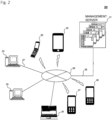
- Figure 2 is an entire configuration example of the delivery system according to the embodiment of the present invention.
- a delivery system 20 includes, as a configuration in the one embodiment, a management server 21, and various types of information processing apparatuses to be used by a user (customer), a deliverer, or the like (in the drawing, a portable information terminal or a tablet terminal 22, a mobile phone 23, PCs 24 to 26, and deliverer terminals 27 and 28 are illustrated by way of example, which may be hereinafter generically referred to as "various types of terminals" or also merely referred to as "terminals").
- the management server 21 and the various types of terminals in the delivery system 20 are connected to be mutually communicable via a dedicated line and a public line such as the Internet (37 to 39 as a wired line), as illustrated in Figure 2 .
- the line may be wired or wireless. If the line is wireless, the portable information terminal or the tablet terminal 22, the mobile phone 23, and the deliverer terminals 27 and 28 wirelessly enter the Internet 39 via a base station, an access point, or the like not illustrated, and is further connected to be mutually communicable with the management server 21 via the line 38.
- deliverer terminals 27 and 28 may each include a POS terminal, the present invention is not limited to this.
- the access point means a radio for mutually connecting wireless terminals such as a PC and a smartphone and connecting the wireless terminals to another network.
- the access point is a device that operates with a communication protocol of a first layer (physical layer) and a second layer (data link layer) in an OSI reference model.
- the mobile phone, the portable information terminal, or the tablet at the time point of filing of the present application may have a similar processing capability (a communication processing speed, an image processing capability, etc.) as that of the personal computer (PC), and should be said as a small computer.
- a similar processing capability a communication processing speed, an image processing capability, etc.
- a program or software required for the embodiment of the present invention is generally installed or stored in an HDD, an SSD, or the like in a storage unit in the PC or the portable information terminal.
- the program or the software is read into a memory in the storage unit, as needed, as a software module of its whole or part and is operated and executed in a CPU when executed.
- a browser-based computer or portable information terminal can also be adopted.
- a program is distributed to the terminal from another server or computer, as needed, and is executed by a browser on the terminal.
- a hardware configuration of the management server 21 can basically adopt a PC (described below with reference to Figure 3 , as a precaution). Although the present invention is not limited to this, the management server 21 can also have a configuration suitable for processing of large-scaled data by operating a plurality of PCs (several tens to several tens of thousands as an example) in parallel in raising a hardware specification, as needed.
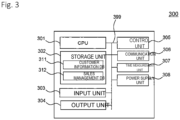
- FIG. 3 is a functional block diagram of a management server in the delivery system according to the embodiment of the present invention.
- an operation of the management server is implemented by each operation of hardware described below and a cooperation operation between software and the hardware.
- a management server 300 as an entire hardware block generally includes a CPU 301 for performing various types of comparison and operation processing, a storage unit 302 such as a RAM, a ROM, and a flash memory, an input unit 303 such as a keyboard and a pointing device, an output unit 304 such as a display and a speaker, a control unit 305 for various types of signal control, a communication (interface) unit 306 (that may be either wireless or wired), a time measurement unit 307 for measuring time or the like, and a power supply unit 308.
- a CPU 301 for performing various types of comparison and operation processing
- a storage unit 302 such as a RAM, a ROM, and a flash memory
- an input unit 303 such as a keyboard and a pointing device
- an output unit 304 such as a display and a speaker
- a control unit 305 for various types of signal control
- a communication (interface) unit 306 that may be either wireless or wired
- a time measurement unit 307
- the modules are appropriately connected to one another via a communication bus and a power feed line, as needed, (the lines are collectively represented as a wire connection 399 appropriately divided for convenience in Figure 3 ).
- a program or software to be executed on the management server 300 required for the embodiment of the present invention is generally installed or stored in a hard disk, an SSD (solid state drive), a flash memory, and the like constituting the storage unit 302.
- the program or the software is read into a memory in the storage unit 302, as needed, as a software module of its whole or part and is operated and executed in the CPU 301 when executed.
- the storage unit 302 includes a customer management database 311 and a sales management database 312.
- the customer management database 311 (hereinafter also referred to as "customer management DB 311") is a database in which items relating to a customer are registered, in which personal information such as a name, an address, and a telephone number of the customer and appended information such as held points and a nearest base are registered as an example.
- the points may be electronic money.
- the points may be exchanged to another electronic money or cash.
- Information about a customer charge (including a leave-at-door delivery charge) is also registered in the customer management DB 311.
- Information about a customer charge caused by settlement may be managed by another server.
- the sales management database 312 (hereinafter also referred to as "sales management DB 312) is an actual result management database relating to sold commodities for each base or store. Information about setting of leave-at-door delivery, a progress status of delivery and leave-at-door delivery, and the like is also registered and managed in addition to a delivery status of commodities or the like in the sales management DB 312.
- control unit 305 performs control relating to progress status management of delivery and leave-at-door delivery (details of which will be described below).
- the operation and the execution need not necessarily be performed in a central processing unit such as the CPU 301, and can also be performed by using an auxiliary operation apparatus such as a digital signal processor (DSP) not illustrated.
- DSP digital signal processor
- FIG 4 illustrates an external configuration of a tablet terminal 42 (22) as an information processing apparatus or a user terminal in the delivery system according to the embodiment of the present invention.
- the user terminal (tablet terminal) 42 includes a housing unit 421, a display 422, and a hardware button 423 provided in a lower center portion of the housing unit 421.
- the display 422 is typically composed of a liquid crystal display (LCD) or the like, and can display various information such as characters, a still image, and a moving image.
- a menu button and a software keyboard are displayed on the display 422, and are touched with a finger or a touch pen (not illustrated), for example, to issue an instruction (command) to the tablet terminal 42.
- LCD liquid crystal display
- the hardware button 423 is not an essential constituent element in this respect, the hardware button 223 is mounted as a button having a predetermined function for convenience of description of the present invention. Needless to say, the hardware button 423 can also be replaced with a menu button displayed on a part of the display 422.
- the display 422 includes a multi-touch input panel, and touch input position coordinates on the touch input panel are transmitted to a processing system (CPU) of the tablet terminal 42 via an input device interface (not illustrated) and are processed.
- the multi-touch input panel is configured to be able to simultaneously sense a plurality of contact points for the panel.
- the detection (sensor) can be implemented using various methods, and is not necessarily limited to a contact sensor. For example, an instruction point for the panel can also be extracted using an optical sensor. Further, as the sensor, a capacitive sensor that senses contact of a person's skin can also be used in addition to a contact type sensor and an optical sensor.
- the tablet terminal 42 can also include a microphone and a speaker, which do not appear in Figure 4 .
- a user's voice or the like picked from the microphone can be determined and set as an input command.
- a camera device such as a CMOS can also be mounted on a back surface of the tablet terminal 42, for example, which does not appear in Figure 4 .
- a recipient can designate or indicate leave-at-door delivery for delivering commodities or the like to a predetermined location at a delivery destination even when absent (details of which will be described below).
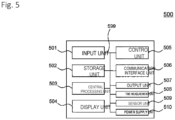
- FIG. 5 illustrates a functional block diagram of hardware constituting the tablet terminal 42 (22) according to the embodiment of the present invention.
- An operation of the tablet terminal 42 is implemented by each operation of the hardware described below and a cooperation operation between software and the hardware.
- a tablet terminal 500 as an entire hardware block generally includes an input unit 501 composed of a multi-touch input panel, a microphone, and the like provided in the hardware button 423 and the display 422 in Figure 4 , a storage unit 502 composed of a hard disk, a RAM, and/or a ROM or the like for storing a program, data, and the like, a central processing unit 503 composed of a CPU that uses the program to perform various numerical calculations and logic operations, a display unit 504 composed of the display 422 and the like, a control unit 505 for controlling a chip, an electric system, and the like, a communication interface unit 506 composed of a slot for accessing the Internet, a port for performing optical communication, and a communication interface, an output unit 507 such as a speaker, a vibration, and an infrared projector, a time measurement unit 508 for measuring time or the like, a sensor unit 509 composed of an image sensor such as a CMOS, an infrared sensor, an in
- the sensor unit 509 may include a GPS sensor module for identifying a position of the tablet terminal 500 (22). Signals respectively detected by the image sensor such as a CMOS, the infrared sensor, and the like constituting the sensor unit 509 can be processed as input information in the input unit 501.
- a GPS sensor module for identifying a position of the tablet terminal 500 (22). Signals respectively detected by the image sensor such as a CMOS, the infrared sensor, and the like constituting the sensor unit 509 can be processed as input information in the input unit 501.
- a program or software to be executed on the tablet terminal 500 required for the embodiment of the present invention is generally installed or stored in a hard disk, an SSD (solid state drive), a flash memory, and the like constituting the storage unit 502.
- the program or the software is read into a memory in the storage unit 502, as needed, as a software module of its whole or part and is operated and executed in the CPU 503 when executed.
- the operation and the execution need not necessarily be performed in the central processing unit 503 such as the CPU, and can also be performed by using an auxiliary operation device such as a digital signal processor (DSP) not illustrated.
- DSP digital signal processor
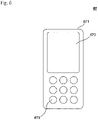
- Figure 6 illustrates an external configuration of a deliverer terminal 67 (27) as an information processing apparatus or a deliverer terminal (or a company terminal) in the delivery system according to the embodiment of the present invention.
- the deliverer terminal 67 includes a housing unit 671, a display 672, and a plurality of hardware buttons 673 provided in a lower portion of the housing unit 671.
- Respective basic configurations and functions of the housing unit 671, the display 672, the hardware button 673, and the like in the deliverer terminal 67 are similar to those of the housing unit 421, the display 422, the hardware button 423, and the like in the tablet terminal 42 or are known, and detailed description thereof is omitted.
- the deliverer can input completion of leave-at-door delivery.
- the deliverer terminal 67 performs various types of processing caused by the input (details of which will be described below).
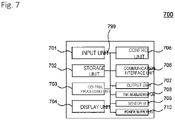
- Figure 7 illustrates a functional block diagram of hardware constituting the deliverer terminal 67 (27) according to the embodiment of the present invention.
- An operation of the deliverer terminal 67 is implemented by each operation of the hardware described below and a cooperation operation between software and the hardware.
- a deliverer terminal 700 as an entire hardware block includes an input unit 701, a storage unit 702, a central processing unit 703, a display unit 704, a control unit 705, a communication interface unit 706, an output unit 707, a time measurement unit 708, a sensor unit 709, and a power supply unit 710, and the modules are appropriately connected, as needed, to one another via a communication bus and a power feed line (the lines are collectively represented as a wire connection 799 appropriately divided for convenience in Figure 7 ).
- Respective basic configurations and functions of the components in the deliverer terminal 700 illustrated in Figure 7 are similar to those of the components in the tablet terminal 42 (22) illustrated in Figure 4 or are known, and detailed description thereof is omitted.
- the input unit 701 is composed of the hardware buttons 673 in Figure 6 , a multi-touch input panel provided in the display 672 in Figure 6 , a microphone, and the like, and the display unit 704 is composed of the display 672 and the like.
- Figure 8 illustrates a processing operation flow at the time of normal leave-at-door delivery in the delivery system according to the embodiment of the present invention.
- the operation flow illustrated in Figure 8 illustrate a variation of delivery from a "nearest base" in the embodiment of the present invention.
- a processing flow (a processing flow at the time of normal leave-at-door delivery) in which a commodity delivered from the nearest base is left by the door.
- a thick solid line arrow in a vertical direction indicates internal processing in the terminal or a management server
- a thin solid line arrow in a horizontal direction indicates processing between each of the terminals and the management server
- a thick one-dot-and-dash arrow in the vertical direction indicates a base terminal from a time t13 to a time t14
- a thin one-dot-and-dash line arrow in the horizontal direction indicates work by a deliverer
- a thin broken line in the horizontal direction indicates a point of time.
- the user terminal receives an order for a commodity while switching a screen to a commodity selection screen, an order screen, or the like depending on a user's operation for an input unit (step S801).
- the user terminal also receives designation or indication of leave-at-door delivery (details of which will be described below with reference to Figure 10 ). It is assumed that the leave-at-door delivery has been designated or indicated.
- the user terminal transmits, when it receives the order from a user via the input unit, a content of the order to the management server (step S802).
- the management server 21 that has received the content of the order performs order receiving processing at the time t12 to the time t13.
- the content of the order received from the user terminal is registered in the customer information DB 311 and the sales management DB 312 in association with a customer (a client or an orderer), and a leave-at-door delivery fee is collected from the customer.
- the collected leave-at-door delivery fee, together with a price of the commodity itself (a delivery charge when a package is to be delivered), can be settled using information about a credit card or the like of the customer in the one embodiment.
- a user can pay a leave-at-door delivery fee using points already accumulated by himself/herself.
- the leave-at-door delivery fee may be uniform.
- the leave-at-door delivery fee may be changed depending on the size of the commodity or the like and the price of the commodity or the like.
- the settlement is not limited to be implemented by a single management server but can also be performed by the management server communicating with another settlement server. Then, the management server transmits an instruction to deliver the ordered commodity to the base terminal at the nearest base (step S804).
- the base terminal at the nearest base that has received the delivery instruction displays an instruction to prepare shipment to a display unit.
- a deliverer prepares delivery of the ordered commodity at the time t13 to the time t14 based on the shipment preparation instruction (step S805). Then, at the time t14, the deliverer delivers the commodity to a delivery destination (customer's home) using a delivery vehicle (step S806).
- the leave-at-door delivery has been designated or indicated from the user. Accordingly, when the deliverer arrives at the customer's home, the deliverer leaves the commodity by the door based on a system operation in the embodiment of the present invention (step S807).
- "Leave-at-door delivery” herein referred to means delivering and putting the commodity at a predetermined location at the delivery destination even when a recipient is absent or its service.
- the predetermined location in this case, one or more of an entrance, a home delivery box, a gas meter box, a bicycle basket, a garage, and a reception desk in a building, for example, can be used.
- an inventory quantity for each commodity in each base, a delivery time period between bases, and a delivery time period to a customer's home are managed, are calculated again each time, and are updated and controlled as an example in the management server 21.
- the commodity is tracked after shipment from the base, a current position of the commodity that is being delivered is updated and managed, and a scheduled arrival time is calculated again and is appropriately notified to a customer terminal and a movement terminal of a deliverer according to an additional order or a change of the content of the order.
- an example of the screen to be displayed on the user terminal will be described below with reference to Figure 11 .
- a deliverer terminal receives input of the completion of the leave-at-door delivery in response to a deliverer's operation (step S808), and transmits a report that the leave-at-door delivery has been completed to the management server (step S809) at the time t14 to a time t15 in Figure 8 .
- the management server that has received the report that the leave-at-door delivery has been completed registers the completion of the leave-at-door delivery in the sales management DB (312 in Figure 3 ) (step S810) at the time t15 to a time t16.
- the management server transmits a leave-at-door delivery completion notification for notifying that the leave-at-door delivery has been completed to the user terminal (step S811).
- the leave-at-door delivery completion notification is preferably a push notification to the user terminal, the present invention is not limited to this.
- the leave-at-door delivery completion notification may be made at a timing at which an access (that is based on a customer's operation or is automatically performed periodically by the user terminal, for example) has been made from the user terminal to the management server.
- the user terminal that has received the leave-at-door delivery completion notification from the management server displays the completion of the leave-at-door delivery (step S812) at the time t16 to a time t17.
- the completion of the leave-at-door delivery is displayed, and an acceptance button (1213 in Figure 12 ) is displayed.
- the user terminal transmits to the management server an acceptance notification representing the intension of acceptance from the customer (step S813) at the time t17.
- the management server that has received the acceptance notification performs point provision processing (step S814) at the time t17 to a time t18.
- the point provision processing is processing for providing points corresponding to an amount obtained by adding a predetermined amount of money to the whole of the leave-at-door delivery fee collected from the customer when the leave-at-door delivery is designated to the customer (the orderer of the commodity) (step S803).
- the management server adds the points to a total amount of the points in the customer information DB (311 in Figure 3 ), to update the total amount of the points.
- the management server transmits to the user terminal a point provision notification for notifying that the points have been provided and notifying an added amount and a total value of the points (step S815).
- the transmission may be positioned as a part of the point provision processing.
- the user terminal that has received the point provision notification displays on the display unit a content of the point provision notification (step S16) at the time t18 to a time t19.
- Figure 9 to Figure 10 illustrate a display example of an information processing apparatus (user or customer terminal) in the delivery system according to the embodiment of the present invention.
- the display examples respectively illustrate variations of a mechanism for receiving an order for a commodity from a customer in the embodiment of the present invention.
- commodities are guided and an order can be received at various timings on respective screens of a WEB site (not illustrated) on an electronic commerce server directed toward the user terminal and a terminal application of the user terminal or the like.
- the present invention is not limited to these.
- examples of the scene include respective scenes in the following items (S1) to (S4).
- S1 When a customer accesses a WEB site directed toward a user terminal or starts an application on the user terminal, commodities are guided and an order is received.
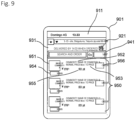
- Figure 9 illustrates an example of a screen of a user terminal configured such that commodities are guided and an order can be received from a customer.
- a header 911 including a current time display, a display column 921 in which a current address or a current location is displayed, a message 931 "Delivered by 14:03 when ordered now", and a search column 941 are displayed on a screen of a customer terminal 901, and a list of commodities that can be delivered to a customer's home in a short time (e.g., 30 minutes or one hour) is displayed in a commodity display column 950.
- a short time e.g. 30 minutes or one hour
- the present invention is not limited to this. More commodities can also be presented by scrolling means and page ejection means not illustrated. Narrowing-down based on a desired commodity genre or commodity category can also be performed by a search keyword or the like for the search column 941.
- a commodity name 952 is presented, and a normal price and a sales price 953 are also presented for a commodity A by way of example.
- an estimated arrival time 954 for a case where the commodity A is ordered now is displayed.
- a provided point 955 at the time of purchase is also presented.
- the customer can shift the screen to an order procedure screen, for example, by pressing an order button 956 on the screen.
- Figure 10 illustrates an example of a screen of a user terminal configured such that a commodity can be ordered and leave-at-door delivery can be designated or indicated.
- a header 1011 including a current time display, a display column 1021 in which a current address or a current location is displayed, a message 1025 "Order this product" and a commodity display column 1030 relating to a commodity (here, a commodity D) to be ordered, and a display column 1040 relating to information about delivery are displayed on a screen of a user terminal 1001.
- the commodity display column 1030 includes a commodity image 1031 and a commodity name 1032 of the commodity to be ordered.
- the display column 1040 includes an expected arrival time 1041 and an expected commodity arrival time 1042 required from the order to delivery.
- an amount description 1051 of a leave-at-door delivery fee (deposit), a toggle button 1052 for designating or indicating or applying for leave-at-door delivery, and an order button 1053 are displayed.
- the leave-at-door delivery fee (deposit) needs to be paid.
- the leave-at-door delivery fee (deposit) can be positioned as a deposit caused by the leave-at-door delivery or an insurance premium of the leave-at-door delivery, for example.
- the customer uses the toggle button 1052 to set whether or not leave-at-door delivery is used, and presses the order button 1053. If the toggle button 1052 is set to "Apply for leave-at-door delivery", leave-at-door delivery can be designated or indicated. Although only whether or not leave-at-door delivery is used can be set in Figure 10 , there may be provided an interface not illustrated for designating a location (an entrance, a home delivery box, etc.) for the leave-at-door delivery. Implementation examples include a select box for selecting the location for the leave-at-door delivery.
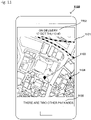
- Figure 11 illustrates an example of a screen for presenting or the like to a user a current position or the like of a commodity that is being delivered.
- the current position or the like of the commodity that is being delivered is displayed with a dedicated application started at a user terminal.
- a map display 1101 a header 1102 including a message "This product is on delivery" and a current time display, an icon 1103 representing a current position of a delivery vehicle loaded with the commodity that is being delivered, a delivery destination icon 1104 representing a position of a customer's home as a delivery destination, and a footer 1105 that displays information about a commodity (another commodity) other than the selected commodity are displayed on a screen of a user terminal 1100.
- the user can confirm the current position of the delivery vehicle, a road to the delivery destination, and the existence of the other commodity by seeing the screen illustrated in Figure 11 .
- the icon 1103 representing the current position of the delivery vehicle loaded with the commodity that is being delivered is displayed in a center portion of the screen in the example illustrated in Figure 11 , the present invention is not limited to this.
- the delivery destination icon 1104 representing the position of the customer's home as the delivery destination may be displayed in the center portion of the screen.
- the icons may be switchably mounted.
- Figure 12 illustrates an example of a screen of a user terminal that notifies a user that leave-at-door delivery has been completed.
- the screen in the same drawing is displayed when the leave-at-door delivery has been completed with a dedicated application started at the user terminal and the user terminal has received a leave-at-door delivery completion notification from a management server (step S812 in Figure 8 ).
- a leave-at-door delivery completion notification window 1210 is displayed on a screen 1201 of a user terminal 1200.
- the leave-at-door delivery completion notification window 1210 includes a message 1211 "Delivered by leave-at-door delivery", a leave-at-door delivery completion notification date 1212, and an acceptance button 1213.
- the user terminal when the user presses the acceptance button 1213, the user terminal makes an acceptance notification to the management server (step S813 in Figure 8 ), and the management server that has received the acceptance notification performs point provision processing for the user (steps S814 and S815). Points are provided to the user as the point provision processing is performed.
- the number of points to be provided is preferably a number of points having a value equivalent to that of a leave-at-door delivery fee, the present invention is not limited to this.
- Figure 13 illustrates a processing operation flow in a case where leave-at-door delivery is unavailable in the delivery system according to the embodiment of the present invention.
- a processing flow in a case where the leave-at-door delivery is unavailable due to a situation at a delivery destination (a processing flow at the time of the leave-at-door delivery being unavailable), although a deliverer has attempted to leave a commodity delivered from a nearest base by the door is illustrated.
- Steps S1301 to S1306 at a time t21 to a time t24 illustrated in Figure 13 are respectively similar to steps S801 to S806 at the time t11 to the time t14 illustrated in Figure 8 , and detailed description thereof is omitted.
- a deliverer terminal receives input of the unavailability of leave-at-door delivery in response to a deliverer's operation (step S1308) at the time t24 to a time t25, and transmits a report that the leave-at-door delivery is unavailable to a management server (step S1309).
- the deliverer may post an absence notice to a delivery destination together with the report that the leave-at-door delivery is unavailable.
- the management server that has received the report that the leave-at-door delivery is unavailable registers information about the leave-at-door delivery being unavailable, together with area information of the delivery destination, in the sales management DB (312 in Figure 3 ) at the time t25 to a time t26 (step S1310; Here, refund processing is also performed, as described below).
- the area information include information about the same range as those of the nearest areas 140, 150, and 160 ( Figure 1 ), area information using an area in a narrower range than those of the nearest areas as a unit, and street information or neighborhood information including the delivery destination, although not limited to these.
- the management server can perform control, by storing and managing the information about the leave-at-door delivery being unavailable, together with the area information, such that "designation of leave-at-door delivery" cannot be performed or set the leave-at-door delivery designation itself to non-display at the time of an order from a specific client or a specific area (step S1301).
- the management server instructs the user terminal not to be able to select the displays 1051 and 1052 on the order screen ( Figure 10 ).
- the management server or the user terminal performs control such that the displays 1051 and 1052 are not included on the order screen ( Figure 10 ) to be transmitted to the user terminal.
- the management server performs processing for refunding a leave-at-door delivery fee (deposit) (step S1310).
- the management server refunds the leave-at-door delivery fee (deposit) to a designated account of a customer (step S1310).
- the leave-at-door delivery fee may be refunded by returning points instead of refunding cash.
- the customer may be made to be able to select either refund by cash or return by points via an interface not illustrated at the time of refunding.
- the management server notifies the user terminal that the leave-at-door delivery has been unavailable and the leave-at-door delivery fee has been refunded (or will be refunded) (step S1311).
- a notification that leave-at-door delivery is unavailable or refund (or point return) processing may be respectively separate processes.
- a notification that leave-at-door delivery is unavailable is made in step S1311, and refund or point return processing is separately performed later.
- various examples such as "several minutes later", “several hours later", or “several days later” can be adopted.
- the user terminal that has received the notification indicates on a display unit (the display 422 or the like illustrated in Figure 4 ) that the leave-at-door delivery has been unavailable and that the leave-at-door delivery fee has been refunded (or will be refunded) at the time t26 to a time t27 (step S1312).
- control may be performed such that a redelivery request screen (not illustrated) is displayed when a redelivery request button not illustrated is pressed, although the present invention is not limited to this.
- a redelivery request screen (not illustrated) is displayed when a redelivery request button not illustrated is pressed
- the user terminal is controlled to transmit a redelivery request to the management server (step S1313).
- the management server that has received the redelivery request registers a content of the redelivery request in the sales management DB (312 in Figure 3 ) (step S1314) at the time t27 to a time t28.
- the management server transmits a redelivery receiving notification to the user terminal (step S1315).
- the user terminal that has received the redelivery receiving notification displays a content of the receiving on the display unit (step S1316) at the time t28 to a time t29.
- a redelivery request may be made using not the user terminal but a telephone or the like.
- Figure 14 illustrates a processing operation flow in a case where leave-at-door delivery has been completed but an acceptance from a customer is not obtained in the delivery system according to the embodiment of the present invention.
- Figure 14 illustrates a processing flow in a case where a deliverer can complete the leave-at-door delivery for a commodity delivered from a nearest base but an acceptance from the customer cannot be obtained (when the customer does not press the acceptance button 1213 ( Figure 12 )) (a processing flow at the time of completion of the leave-at-door delivery and no acceptance from the customer).
- Steps S1401 to S1411 at a time t31 to a time t36 illustrated in Figure 14 are respectively similar to steps S801 to S811 at the time t11 to the time t16 illustrated in Figure 8 , and detailed description thereof is omitted.
- control can also be performed such that step S1411 is not performed in a case where a power supply of a user terminal remains off and a case where a leave-at-door delivery completion notification is made when an access from the user terminal to a management server is made.
- the management server transmits a leave-at-door delivery completion notification to the user terminal (step S1411), but a customer has not yet confirmed the notification (step S1412), the management server starts to count a time period elapsed since the leave-at-door delivery was completed.
- the start of the counting may be another timing after the completion of the leave-at-door delivery instead of using transmission of the leave-at-door delivery completion notification as a trigger.
- a count value exceeds a predetermined threshold value (that may be any value in a range from several hours to one week or any value outside the range) (at a time t37 in Figure 14 )
- the management server performs point provision processing (step S1413) at the time t37 to a time t38.
- control may be performed to confirm on the management server side whether or not a leave-at-door notification from the management server has been confirmed by the user for each fixed time (e.g., for 30 minutes, for one hour, for three hours, for six hours, for 12 hours, or for one day).
- Steps S1413 to S1415 illustrated in Figure 14 are respectively similar to steps S814 to S816 illustrated in Figure 8 .
- control may be performed such that the number of points (S814 in Figure 8 ) to be provided when the acceptance from the customer has been obtained is made larger than the number of points (S1413 in Figure 14 ) to be provided when the acceptance from the customer has not been obtained (a return rate is increased). In this case, the acceptance from the customer will be able to be easily obtained.
- the display unit (504) in the user terminal (500 in Figure 5 ) displays a leave-at-door delivery fee when leave-at-door delivery is designated (S801 in Figure 8 , and Figure 10 ), and displays a point provision notification on condition that the leave-at-door delivery is completed (S816 in Figure 8 ).
- the control unit (505 in Figure 5 ) in the user terminal notifies the management server of information about the leave-at-door delivery when the leave-at-door delivery is designated on the leave-at-door delivery designation screen ( Figure 10 ) (S802 in Figure 8 ).
- control unit (705) in the deliverer terminal (700 in Figure 7 ) notifies the management server of the completion of the leave-at-door delivery when the completion of the leave-at-door delivery is inputted on the leave-at-door delivery completion input screen (S809 in Figure 8 ).
- control unit (305) in the management server (300 in Figure 3 ) registers a need for the leave-at-door delivery in the sales management DB (312) on condition that the designation of the leave-at-door delivery has been received from the user terminal, and collects the leave-at-door delivery fee from a customer (a client of the leave-at-door delivery) (S803 in Figure 8 ).
- the control unit in the management server performs point provision processing on condition that the completion of the leave-at-door delivery has been received from the deliverer terminal (S814).
- the leave-at-door delivery fee is collected from the customer when the leave-at-door delivery is designated, thereby making it possible to urge the customer to deliberately designate the leave-at-door delivery.
- the point provision processing is performed when the leave-at-door delivery is completed. This makes it possible to urge the customer to designate the next and subsequent leave-at-door delivery services.
- the display unit (704) in the deliverer terminal (700 in Figure 7 ; the company terminal) displays the leave-at-door delivery unavailable input screen into which the unavailability of leave-at-door delivery is inputted when the leave-at-door delivery at a predetermined location cannot be performed (S1308 in Figure 13 ), and the control unit (705 in Figure 7 ) notifies the management server that the leave-at-door delivery is unavailable when the unavailability of leave-at-door delivery is inputted (S1309 in Figure 13 ).
- the control unit (305 in Figure 3 ) in the management server registers the unavailability of leave-at-door delivery, together with the area information of the delivery destination, in the sales management DB (312 in Figure 3 ), and performs refund processing for refunding the leave-at-door delivery fee to the customer (the client) when the unavailability of leave-at-door delivery is received (S1310 in Figure 13 ).
- the management server (300 in Figure 3 ) transmits the leave-at-door delivery completion notification for notifying the user terminal (500 in Figure 5 ) of completion of the leave-at-door delivery on condition that the completion of the leave-at-door delivery has been received from the deliverer terminal (700 in Figure 7 ; the company terminal) (S811 in Figure 8 ).
- the user terminal displays, when it receives the leave-at-door delivery completion notification, the leave-at-door delivery completion notification (1211 in Figure 12 ) and the acceptance button that inputs an acceptance of the completion of the leave-at-door delivery from the customer (requestor) (1213; the acceptance input display) (S812 in Figure 8 ).
- the user terminal When the acceptance from the customer has been inputted, the user terminal notifies the management server of the acceptance from the customer (S813 in Figure 8 ). Further, the management server performs the point provision processing when it receives the acceptance from the customer (S814). Further, the management server performs the point provision processing (S1413) when a predetermined period has elapsed even when it does not receive an acceptance from the customer (client) since the leave-at-door delivery was completed (S1408 in Figure 14 ).
- the point provision processing is performed by using the input of the acceptance from the customer as a trigger, it is possible to urge acceptance confirmation (receiving confirmation) from the customer. Even when the acceptance from the customer is not inputted, the point provision processing is enabled, thereby making it possible to improve customer's convenience associated with point provision.
- leave-at-door delivery has been set at the time of an order (S801 in Figure 8 , and Figure 10 ) in the above-described embodiment, the present invention is not limited to this.
- the leave-at-door delivery may be set until a deliverer visits a delivery destination at the time of redelivery, for example.
- leave-at-door delivery can be newly designated from the time of an order to the time of completion of delivery (also including the time of redelivery), or a delivery date designated by a customer after the leave-at-door delivery has been designated can be changed.
- the deliverer terminal may be configured such that (1) determination whether or not leave-at-door delivery has been designated at a current time point and (2) a location of the leave-at-door delivery (e.g., an entrance of a house or a foot of a gas meter) is displayed when the leave-at-door delivery has been designated (a known user interface is adopted as display means in this case).
- a location of the leave-at-door delivery e.g., an entrance of a house or a foot of a gas meter
- the leave-at-door delivery can be designated from the time of the order to the time of the completion of the delivery, as described above.
- this can also be notified to the deliverer by notifying a deliverer terminal of a content of the designation and a content of a change (a PUSH notification as an example).
- the presence or absence of the designation of the leave-at-door delivery and the location of the leave-at-door delivery are substantially reflected in real time on the deliverer terminal every time they are updated.
- a configuration in which the deliverer is not notified can also be adopted.
- the deliverer may input the completion of the leave-at-door delivery at the base terminal or the distribution center terminal after returning to the nearest base or the distribution center.
- the base terminal or the distribution center terminal may be used as a company terminal instead of the deliverer terminal.
- points to be provided are not limited to this, but may be points corresponding to a part or the whole of the leave-at-door delivery fee. Alternatively, the points to be provided may be points corresponding to an amount obtained by adding a predetermined amount of money to a part of the leave-at-door delivery fee or points corresponding to only the predetermined amount of money.
- the point provision processing (S814) has been performed at a time point where the management server has received the acceptance notification from the customer (S813 in Figure 8 ) in the above-described embodiment, the point provision processing may be performed at another timing after completion of the leave-at-door delivery.
- the unavailability of leave-at-door delivery is registered and is used as information about the unavailability of setting of future leave-at-door delivery in the above-described embodiment
- information about a trouble e.g., a loss of a commodity
- a trouble e.g., a loss of a commodity
- a base terminal, a distribution center terminal, or a management server to input the trouble information, which can be stored in the customer information DB (311 in Figure 3 ) for use.
- An embodiment in which information about the leave-at-door delivery being unavailable is neither registered nor stored is also possible.
- an implementation as a recording medium having a program recorded thereon an optical disk, a magneto-optical disk, a CD-ROM, a CD-R, a CD-RW, a magnetic tape, a hard disk, or a memory card as an example
- an optical disk, a magneto-optical disk, a CD-ROM, a CD-R, a CD-RW, a magnetic tape, a hard disk, or a memory card as an example for example, in addition to a method or a program for implementing a system or an apparatus can be taken as the embodiment of the present invention.
- the one implementation of the program is not limited to an application program such as an object code to be compiled by a complier and a program code to be executed by an interpreter, but may be a form of a program module or the like to be incorporated into an operating system.
- the program can also be configured such that all processes need not necessarily be performed in only a CPU on a control substrate but some or all of the processes are performed by another processing unit (a DSP, etc.) mounted on an extension board or an extension unit added to the substrate, as needed.
- a DSP digital signal processor
- the present invention is not limited to any of the respective specific configurations of the above-described embodiments.
- the present invention can be extended to all of new features described in the present specification (including the claims, the abstract, and the drawings) or their combinations or steps of all described new methods or processes or their combinations.
Landscapes
- Business, Economics & Management (AREA)
- Engineering & Computer Science (AREA)
- Economics (AREA)
- Accounting & Taxation (AREA)
- Strategic Management (AREA)
- Theoretical Computer Science (AREA)
- General Physics & Mathematics (AREA)
- Physics & Mathematics (AREA)
- General Business, Economics & Management (AREA)
- Finance (AREA)
- Marketing (AREA)
- Development Economics (AREA)
- Tourism & Hospitality (AREA)
- Human Resources & Organizations (AREA)
- Operations Research (AREA)
- Quality & Reliability (AREA)
- Entrepreneurship & Innovation (AREA)
- Computer Security & Cryptography (AREA)
- Health & Medical Sciences (AREA)
- General Health & Medical Sciences (AREA)
- Primary Health Care (AREA)
- Management, Administration, Business Operations System, And Electronic Commerce (AREA)
Applications Claiming Priority (2)
| Application Number | Priority Date | Filing Date | Title |
|---|---|---|---|
| JP2020060321A JP6880274B1 (ja) | 2020-03-30 | 2020-03-30 | 配達システム、ユーザ端末及び管理サーバ |
| PCT/JP2021/012235 WO2021200472A1 (fr) | 2020-03-30 | 2021-03-24 | Système de livraison, terminal d'utilisateur et serveur de gestion |
Publications (2)
| Publication Number | Publication Date |
|---|---|
| EP4131101A1 true EP4131101A1 (fr) | 2023-02-08 |
| EP4131101A4 EP4131101A4 (fr) | 2023-06-14 |
Family
ID=76083845
Family Applications (1)
| Application Number | Title | Priority Date | Filing Date |
|---|---|---|---|
| EP21780220.6A Withdrawn EP4131101A4 (fr) | 2020-03-30 | 2021-03-24 | Système de livraison, terminal d'utilisateur et serveur de gestion |
Country Status (5)
| Country | Link |
|---|---|
| US (1) | US20230134586A1 (fr) |
| EP (1) | EP4131101A4 (fr) |
| JP (1) | JP6880274B1 (fr) |
| CN (1) | CN115362460A (fr) |
| WO (1) | WO2021200472A1 (fr) |
Families Citing this family (8)
| Publication number | Priority date | Publication date | Assignee | Title |
|---|---|---|---|---|
| JP7070944B2 (ja) * | 2020-06-23 | 2022-05-18 | Yper株式会社 | 情報処理装置 |
| CN112907842A (zh) * | 2021-02-02 | 2021-06-04 | 镇江华之云科技有限公司 | 一种基于燃气柜的快递收发系统 |
| US20250182039A1 (en) * | 2021-09-17 | 2025-06-05 | Misumi Group Inc. | Physical distribution management device, method of controlling physical distribution management device, and control program |
| JP7745428B2 (ja) * | 2021-10-26 | 2025-09-29 | 文化シヤッター株式会社 | 配達システム及び配達方法 |
| JP7844231B2 (ja) * | 2022-04-04 | 2026-04-13 | 日産自動車株式会社 | 配車管理装置、配車管理システム及び配車管理方法 |
| JP7340308B1 (ja) | 2023-05-29 | 2023-09-07 | 株式会社Nice Eze | 荷物を置き配する方法、およびこの方法のためのシステムと管理装置 |
| CN117035585B (zh) * | 2023-08-18 | 2024-08-06 | 中资国恒科技有限公司 | 基于大宗商品交易的物流监管及调度系统 |
| JP7802301B2 (ja) * | 2023-10-04 | 2026-01-20 | 株式会社エスシーシー | 置き配システム |
Family Cites Families (17)
| Publication number | Priority date | Publication date | Assignee | Title |
|---|---|---|---|---|
| JPH10245094A (ja) | 1997-03-04 | 1998-09-14 | Sanden Corp | 宅配システム |
| US20030065625A1 (en) * | 2001-10-01 | 2003-04-03 | Walter Rosenbaum | Overcoming null deliveries |
| JP2004026439A (ja) * | 2002-06-26 | 2004-01-29 | Nec Corp | 無人宅配受付システム、受付方法、及びプログラム |
| US9457810B2 (en) * | 2009-10-21 | 2016-10-04 | Berthold K. P. Horn | Method and apparatus for reducing motor vehicle traffic flow instabilities and increasing vehicle throughput |
| JP5578581B2 (ja) * | 2012-07-31 | 2014-08-27 | 寺田倉庫株式会社 | 保管依頼品寄託方法及び寄託システム |
| US10282766B2 (en) * | 2013-01-15 | 2019-05-07 | Drizly, Inc. | Distribution of products |
| US20160063435A1 (en) * | 2014-08-27 | 2016-03-03 | Inam Shah | Systems and methods for facilitating secure ordering, payment and delivery of goods or services |
| JP5919351B2 (ja) * | 2014-09-22 | 2016-05-18 | 寺田倉庫株式会社 | 保管依頼品寄託方法及び寄託システム |
| CN104794822A (zh) * | 2014-11-05 | 2015-07-22 | 杭州快柜网络科技有限公司 | 一种智能快递寄送存取终端及其寄送存取方法 |
| CN104794602A (zh) * | 2015-04-03 | 2015-07-22 | 洛阳飞来石软件开发有限公司 | 一种智能快递派收件方法、系统及智能快递柜 |
| WO2017053707A1 (fr) * | 2015-09-23 | 2017-03-30 | Sensoriant, Inc. | Procédé et système pour utiliser des états de dispositif et des préférences d'utilisateur pour créer des environnements conviviaux |
| JP6644420B2 (ja) | 2016-03-01 | 2020-02-12 | 俊二 土屋 | 宅配システムおよび宅配システム用授受セット |
| JP2018144946A (ja) * | 2017-03-06 | 2018-09-20 | グローリー株式会社 | 配送処理装置、配送処理システム及び配送処理方法 |
| JP6596799B2 (ja) * | 2017-07-06 | 2019-10-30 | アスクル株式会社 | 配達管理システム、配達管理装置、配達管理方法および配達管理プログラム |
| JP7024419B2 (ja) * | 2018-01-12 | 2022-02-24 | トヨタ自動車株式会社 | 情報処理システムおよび情報処理方法 |
| US11397911B2 (en) * | 2018-11-15 | 2022-07-26 | Uber Technologies, Inc. | Network computer system to make effort-based determinations for delivery orders |
| US12361477B2 (en) * | 2019-04-23 | 2025-07-15 | Walmart Apollo, Llc | Third party carrier management |
-
2020
- 2020-03-30 JP JP2020060321A patent/JP6880274B1/ja active Active
-
2021
- 2021-03-24 WO PCT/JP2021/012235 patent/WO2021200472A1/fr not_active Ceased
- 2021-03-24 CN CN202180026719.0A patent/CN115362460A/zh active Pending
- 2021-03-24 US US17/907,733 patent/US20230134586A1/en active Pending
- 2021-03-24 EP EP21780220.6A patent/EP4131101A4/fr not_active Withdrawn
Also Published As
| Publication number | Publication date |
|---|---|
| JP2021157746A (ja) | 2021-10-07 |
| US20230134586A1 (en) | 2023-05-04 |
| WO2021200472A1 (fr) | 2021-10-07 |
| CN115362460A (zh) | 2022-11-18 |
| EP4131101A4 (fr) | 2023-06-14 |
| JP6880274B1 (ja) | 2021-06-02 |
Similar Documents
| Publication | Publication Date | Title |
|---|---|---|
| EP4131101A1 (fr) | Système de livraison, terminal d'utilisateur et serveur de gestion | |
| CN104639756B (zh) | 一种显示短信的方法及装置 | |
| JP6532988B1 (ja) | 商品配達管理システム及びプログラム | |
| US9704110B2 (en) | Travel expense automation | |
| JP6303230B2 (ja) | 商品出荷管理システム及びプログラム | |
| CN107977888B (zh) | 一种以充电宝为载体的互联网共享经济商业模式 | |
| EP3859625A1 (fr) | Système et programme de gestion de livraison de marchandises | |
| US11829941B2 (en) | Purchased product pickup system | |
| WO2017212764A1 (fr) | Système et programme de gestion d'expédition de marchandises | |
| JP6304665B2 (ja) | 商品検索プログラム | |
| KR100865226B1 (ko) | 수금 대행 및 배달사원 공유를 위한 배달정보 제공 방법 | |
| WO2021233455A1 (fr) | Traitement d'informations | |
| JP6344661B2 (ja) | 商品出荷管理システムにおける商品検索プログラム及び方法 | |
| CN116977023A (zh) | 一种售药方法、售药平台及自动售药终端 | |
| JP5169303B2 (ja) | 携帯端末装置及びプログラム | |
| US20240046400A1 (en) | Information processing apparatus, information processing method, and non-transitory storage medium | |
| WO2022190989A1 (fr) | Dispositif de traitement d'informations, système de traitement d'informations, procédé de traitement d'informations, et programme de traitement d'informations | |
| JP2001253511A (ja) | 配送システムとその配送方法、及び配送プログラムを記録した記録媒体 | |
| CN201413549Y (zh) | 手机小额消费系统设备 | |
| AU2013101619A4 (en) | Travel Expense Automation | |
| KR20120020777A (ko) | 위치기반 주문 시스템 및 이를 이용한 위치기반 주문 방법 | |
| HK1193231A (en) | A computer-implemented system for ordering a taxi |
Legal Events
| Date | Code | Title | Description |
|---|---|---|---|
| STAA | Information on the status of an ep patent application or granted ep patent |
Free format text: STATUS: THE INTERNATIONAL PUBLICATION HAS BEEN MADE |
|
| PUAI | Public reference made under article 153(3) epc to a published international application that has entered the european phase |
Free format text: ORIGINAL CODE: 0009012 |
|
| STAA | Information on the status of an ep patent application or granted ep patent |
Free format text: STATUS: REQUEST FOR EXAMINATION WAS MADE |
|
| 17P | Request for examination filed |
Effective date: 20221021 |
|
| AK | Designated contracting states |
Kind code of ref document: A1 Designated state(s): AL AT BE BG CH CY CZ DE DK EE ES FI FR GB GR HR HU IE IS IT LI LT LU LV MC MK MT NL NO PL PT RO RS SE SI SK SM TR |
|
| A4 | Supplementary search report drawn up and despatched |
Effective date: 20230517 |
|
| RIC1 | Information provided on ipc code assigned before grant |
Ipc: G06Q 30/0601 20230101ALI20230511BHEP Ipc: G06Q 50/28 20120101ALI20230511BHEP Ipc: G06Q 30/06 20230101ALI20230511BHEP Ipc: G06Q 10/083 20230101ALI20230511BHEP Ipc: G06Q 10/00 20230101ALI20230511BHEP Ipc: G06Q 10/08 20230101AFI20230511BHEP |
|
| DAV | Request for validation of the european patent (deleted) | ||
| DAX | Request for extension of the european patent (deleted) | ||
| STAA | Information on the status of an ep patent application or granted ep patent |
Free format text: STATUS: THE APPLICATION HAS BEEN WITHDRAWN |
|
| RIC1 | Information provided on ipc code assigned before grant |
Ipc: G06Q 30/0601 20230101ALI20240327BHEP Ipc: G06Q 30/06 20120101ALI20240327BHEP Ipc: G06Q 10/083 20240101ALI20240327BHEP Ipc: G06Q 10/00 20120101ALI20240327BHEP Ipc: G06Q 10/08 20120101AFI20240327BHEP |
|
| 18W | Application withdrawn |
Effective date: 20240402 |