EP4131127A1 - Dispositif de coordination de commerce de carburant et système de coordination de commerce de carburant - Google Patents
Dispositif de coordination de commerce de carburant et système de coordination de commerce de carburant Download PDFInfo
- Publication number
- EP4131127A1 EP4131127A1 EP20927869.6A EP20927869A EP4131127A1 EP 4131127 A1 EP4131127 A1 EP 4131127A1 EP 20927869 A EP20927869 A EP 20927869A EP 4131127 A1 EP4131127 A1 EP 4131127A1
- Authority
- EP
- European Patent Office
- Prior art keywords
- hydrogen
- fuel
- trading
- order
- supplier
- Prior art date
- Legal status (The legal status is an assumption and is not a legal conclusion. Google has not performed a legal analysis and makes no representation as to the accuracy of the status listed.)
- Pending
Links
Images
Classifications
-
- G—PHYSICS
- G06—COMPUTING OR CALCULATING; COUNTING
- G06Q—INFORMATION AND COMMUNICATION TECHNOLOGY [ICT] SPECIALLY ADAPTED FOR ADMINISTRATIVE, COMMERCIAL, FINANCIAL, MANAGERIAL OR SUPERVISORY PURPOSES; SYSTEMS OR METHODS SPECIALLY ADAPTED FOR ADMINISTRATIVE, COMMERCIAL, FINANCIAL, MANAGERIAL OR SUPERVISORY PURPOSES, NOT OTHERWISE PROVIDED FOR
- G06Q30/00—Commerce
- G06Q30/06—Buying, selling or leasing transactions
- G06Q30/0601—Electronic shopping [e-shopping]
- G06Q30/0633—Managing shopping lists, e.g. compiling or processing purchase lists
- G06Q30/0635—Managing shopping lists, e.g. compiling or processing purchase lists replenishment orders; recurring orders
-
- G—PHYSICS
- G06—COMPUTING OR CALCULATING; COUNTING
- G06Q—INFORMATION AND COMMUNICATION TECHNOLOGY [ICT] SPECIALLY ADAPTED FOR ADMINISTRATIVE, COMMERCIAL, FINANCIAL, MANAGERIAL OR SUPERVISORY PURPOSES; SYSTEMS OR METHODS SPECIALLY ADAPTED FOR ADMINISTRATIVE, COMMERCIAL, FINANCIAL, MANAGERIAL OR SUPERVISORY PURPOSES, NOT OTHERWISE PROVIDED FOR
- G06Q30/00—Commerce
- G06Q30/018—Certifying business or products
-
- G—PHYSICS
- G06—COMPUTING OR CALCULATING; COUNTING
- G06Q—INFORMATION AND COMMUNICATION TECHNOLOGY [ICT] SPECIALLY ADAPTED FOR ADMINISTRATIVE, COMMERCIAL, FINANCIAL, MANAGERIAL OR SUPERVISORY PURPOSES; SYSTEMS OR METHODS SPECIALLY ADAPTED FOR ADMINISTRATIVE, COMMERCIAL, FINANCIAL, MANAGERIAL OR SUPERVISORY PURPOSES, NOT OTHERWISE PROVIDED FOR
- G06Q40/00—Finance; Insurance; Tax strategies; Processing of corporate or income taxes
- G06Q40/04—Trading; Exchange, e.g. stocks, commodities, derivatives or currency exchange
-
- G—PHYSICS
- G06—COMPUTING OR CALCULATING; COUNTING
- G06Q—INFORMATION AND COMMUNICATION TECHNOLOGY [ICT] SPECIALLY ADAPTED FOR ADMINISTRATIVE, COMMERCIAL, FINANCIAL, MANAGERIAL OR SUPERVISORY PURPOSES; SYSTEMS OR METHODS SPECIALLY ADAPTED FOR ADMINISTRATIVE, COMMERCIAL, FINANCIAL, MANAGERIAL OR SUPERVISORY PURPOSES, NOT OTHERWISE PROVIDED FOR
- G06Q50/00—Information and communication technology [ICT] specially adapted for implementation of business processes of specific business sectors, e.g. utilities or tourism
- G06Q50/06—Energy or water supply
-
- Y—GENERAL TAGGING OF NEW TECHNOLOGICAL DEVELOPMENTS; GENERAL TAGGING OF CROSS-SECTIONAL TECHNOLOGIES SPANNING OVER SEVERAL SECTIONS OF THE IPC; TECHNICAL SUBJECTS COVERED BY FORMER USPC CROSS-REFERENCE ART COLLECTIONS [XRACs] AND DIGESTS
- Y02—TECHNOLOGIES OR APPLICATIONS FOR MITIGATION OR ADAPTATION AGAINST CLIMATE CHANGE
- Y02P—CLIMATE CHANGE MITIGATION TECHNOLOGIES IN THE PRODUCTION OR PROCESSING OF GOODS
- Y02P20/00—Technologies relating to chemical industry
- Y02P20/151—Reduction of greenhouse gas [GHG] emissions, e.g. CO2
-
- Y—GENERAL TAGGING OF NEW TECHNOLOGICAL DEVELOPMENTS; GENERAL TAGGING OF CROSS-SECTIONAL TECHNOLOGIES SPANNING OVER SEVERAL SECTIONS OF THE IPC; TECHNICAL SUBJECTS COVERED BY FORMER USPC CROSS-REFERENCE ART COLLECTIONS [XRACs] AND DIGESTS
- Y02—TECHNOLOGIES OR APPLICATIONS FOR MITIGATION OR ADAPTATION AGAINST CLIMATE CHANGE
- Y02T—CLIMATE CHANGE MITIGATION TECHNOLOGIES RELATED TO TRANSPORTATION
- Y02T90/00—Enabling technologies or technologies with a potential or indirect contribution to GHG emissions mitigation
- Y02T90/40—Application of hydrogen technology to transportation, e.g. using fuel cells
Definitions
- the present disclosure relates to a fuel trading coordination device and a fuel trading coordination system.
- Hydrogen is a fuel receiving a lot of attention.
- Hydrogen can be produced from various energy sources, and the cost, amount, and energy-policy-related significance of hydrogen vary, depending on production methods.
- Green hydrogen is, for example, natural gas reformed hydrogen, which is produced from a fossil fuel as a raw material. Its CO 2 emission intensity is therefore high, because of which its environmental value is evaluated to be low.
- Green hydrogen e.g., hydrogen produced by electrolyzing water using electricity generated by renewable power generation, such as wind power generation or solar power generation
- Low Carbon hydrogen e.g., hydrogen produced by electrolyzing water using electricity from power generation systems
- These types of hydrogen however, require higher equipment/production costs and therefore tend to be more expensive than Gary hydrogen.
- NPL 1 "Production, Transportation, and Storage of Hydrogen” Natural Resources and Energy Agency, Fuel Cell Promotion Dept., April 14, 2014
- the European project focuses on certification of hydrogen producers, which has created a situation where a possibility of an illegal act by a hydrogen producer having been certified, such as selling Gary hydrogen disguised as Green hydrogen, cannot be denied.
- the European project has other issues to clear. For example, when the hydrogen user currently purchases only Green hydrogen due to problems with storage facilities, etc., the hydrogen user has no option but to purchase hydrogen from a Green hydrogen producer. In such a case, the European project fails to meet the hydrogen user's demand for purchasing a mix of Green hydrogen and Gary hydrogen in consideration of an economic value added. In the current situation, the project also fails to meet the hydrogen user's another demand that the user's contribution to the environment be made even if the economic value added is lowered (even if the cost of hydrogen rises). Leaving such a situation as it is will lead to a failure in ensuring convenience of the hydrogen user and in providing support to corporate efforts for making contributions to the environment.
- the present disclosure provides a technique that has been conceived in view of the above circumstances, the technique being a fuel trading coordination technique that enables certification processes taking account of a supply chain for a fuel, such as hydrogen, and that meets fuel users' demands while ensuring their convenience.
- the present disclosure provides a fuel trading coordination device including: a storage device that stores information of a plurality of fuel suppliers; and a controller that processes an order for purchasing a mix of a first type fuel and a second type fuel, the order being placed by a first type fuel user.
- the first type fuel and the second type fuel are fuels that are different in production method but can be used for the same purpose, and the controller transmits information of the order of the first type fuel user to a first supplier that supplies the first type fuel and to a second supplier that supplies the second type fuel.
- the fuel trading coordination technique of the present disclosure enables certification processes taking account of a fuel supply chain and meets fuel users' demands while ensuring their convenience.
- constituent elements are not necessarily essential unless otherwise specified or considered to be essential as an obvious conclusion from a logical principle.
- the embodiments of the present disclosure may be implemented by software running on a general-purpose computer or by dedicated hardware or a combination of software and hardware.
- Pieces of information on the present disclosure will be described in the form of a "table” (see FIG. 3 ). These pieces of information, however, do not necessarily need to be expressed in a data structure of a table form, and may be expressed in a data structure of a list, a DB, a queue, etc., or other data structures. For this reason, to indicate that information does not depend on the data structure, "table”, “list”, “DB”, “queue”, and the like may be simply referred to as "information”.
- hydrogen will be described as an example of a fuel that a fuel trading coordination system deals with.
- a trading coordination process which will be described later, can be applied in the same manner to a fuel different from hydrogen.
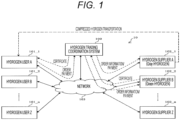
- FIG. 1 depicts a schematic configuration example of a hydrogen trading coordination system 10 according to an embodiment.
- the hydrogen trading coordination system 10 allows a hydrogen user, who usually makes a hydrogen trading with a hydrogen supplier in the form of a one-to-one deal, to make a hydrogen trading with a plurality of suppliers without changing facilities the hydrogen user has.
- the hydrogen trading coordination system 10 includes a hydrogen trading coordination device 100, terminal devices 101_1 to 101_n (n is any given integer equal to or more than 2) of a plurality of hydrogen users (hydrogen users A to Z), and terminal devices 102_1 to 102_n (n is an any given integer equal to or more than 2) of a plurality of hydrogen suppliers (hydrogen suppliers A to Z), and these device and terminal devices are connected to each other via a network 103.
- the hydrogen trading coordination device 100, the terminal devices 101_1 to 101_n of the plurality of hydrogen users, and the terminal devices 102_1 to 102_n of the plurality of hydrogen suppliers can each be composed of an ordinary computer (which includes a processor (control unit), a storage device (a memory, an HDD, or the like), a communication device, an input device (a mouse, a keyboard, and the like), and an output device (a display device, an audio output device and the like).
- an ordinary computer which includes a processor (control unit), a storage device (a memory, an HDD, or the like), a communication device, an input device (a mouse, a keyboard, and the like), and an output device (a display device, an audio output device and the like).
- a processor control unit
- storage device a memory, an HDD, or the like
- a communication device a communication device
- an input device a mouse, a keyboard, and the like
- an output device a display device, an audio output device and the like
- the hydrogen user A transmits a trading coordination request from the terminal device 101_1 of the hydrogen user A to the hydrogen trading coordination device 100.
- Forms of the trading coordination request include a form of changing the CO 2 emission intensity, for example, from X to Y (e.g., from 1.62 kg-CO 2 /Nm 3 -H 2 to 1.2 kg-CO 2 /Nm 3 -H 2 ) and a form of directly specifying an amount of Gray hydrogen and of Green hydrogen (e.g., 10 m 3 of Gray hydrogen and 10 m 3 of Green hydrogen).
- the hydrogen trading coordination device 100 Upon receiving the trading coordination request from the hydrogen user A, the hydrogen trading coordination device 100 calculates a trading amount of each type of hydrogen (calculating a trading amount of each type of hydrogen when a request for changing the CO 2 emission intensity is made) and a trading price of the same, and at the same time, transmits order information on an order for Green hydrogen to at least one of Green hydrogen suppliers (e.g., the terminal device 102_2 of a supplier B).
- Green hydrogen suppliers e.g., the terminal device 102_2 of a supplier B.
- the Green hydrogen supplier e.g., the terminal device 102_2 of the supplier B
- the Green hydrogen supplier automatically creates a Green hydrogen purchase certificate, based on the order information, (creates the certificate by, for example, entering necessary information, such as a date, the type of hydrogen, a trading amount, a purchaser, and a price, in a prescribed certificate format and attaching signature data or stamp data on the Green hydrogen supplier to the format), and transmits the Green hydrogen purchase certificate to the hydrogen trading coordination device 100.
- the hydrogen trading coordination device 100 transmits also order information on the hydrogen user A's order (a required amount of hydrogen: e.g., 20 m 3 , an amount of Gray hydrogen after trading coordination: e.g., 10 m 3 , and a price after trading coordination (actual payment): e.g., 100 yen) to one of the Gray hydrogen suppliers (e.g., the terminal device 102_1 of the supplier B from which the hydrogen user A has been purchasing hydrogen).
- the hydrogen supplier A supplies the hydrogen user A (orderer) with 20 m 3 of Grey hydrogen, but actually receives a payment for 10 m 3 of Grey hydrogen.
- the hydrogen supplier A When receiving the order information, the hydrogen supplier A transports hydrogen (compressed hydrogen) in an amount required by the hydrogen user A (20 m 3 in the above case) by a physical transportation means, to a hydrogen storage facility of the hydrogen user A. After all, this is a transaction in which the hydrogen user A has purchased 20 m 3 of hydrogen at a higher price (15 yen/m 3 ). It is nevertheless an undeniable fact that the hydrogen user A has succeeded in reducing the CO 2 emission intensity to 1.21 kg-CO 2 /Nm 3 -H 2 (succeeded in improving the environmental value).
- a difference e.g., 200 yen
- the amount of payment e.g., 300 yen
- the amount of payment e.g., 100 yen
- the hydrogen supplier hydrogen supplier A
- the Gray hydrogen supplier is pooled by the hydrogen trading coordination device 100.
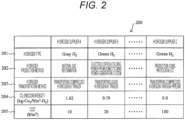
- FIG. 2 depicts a configuration example of hydrogen management information 200 held (managed) in a storage device (not illustrated) of the hydrogen trading coordination device 100.
- FIG. 2 shows an example in which the hydrogen management information 200 is managed in the form of a table.
- the hydrogen management information 200 may be managed in a non-table form, providing that pieces of information making up the hydrogen management information 200 are correlated with each other.
- the hydrogen management information 200 includes pieces of configuration information on each hydrogen supplier, the pieces of configuration information being hydrogen type 201, hydrogen production method 202, hydrogen transportation method 203, CO 2 emission intensity 204, and cost 205.
- Hydrogen type 201 is information indicating types of hydrogen, such as Gray hydrogen, Low Carbon hydrogen, and Green hydrogen.
- Green hydrogen and Low Carbon hydrogen are collectively referred to as premium hydrogen, which is hydrogen with a CO 2 emission intensity (kg-CO 2 /Nm 3 -H 2 ) of 36.4 or less.
- Gray hydrogen is hydrogen with a CO 2 emission intensity higher than 36.4.
- Natural gas reformation hydrogen (with a CO 2 emission intensity of 91) is classified into the Gray hydrogen category.
- Hydrogen production method 202 is information indicating a method by which hydrogen is produced (including information on energy used in the production process).
- Various hydrogen production methods are known, which include, for example, a method of reforming a fossil fuel (petroleum, natural gas, or the like) using a catalyst or the like, a method of producing hydrogen by electrolyzing water using electricity generated by systems utilizing natural energy (solar power, wind power, or the like), a method of producing hydrogen by purifying a by-product gas, which is a by-product from steel mills, chemical factories, or the like, a method of reforming a methanol or methane gas using a catalyst or the like, the gas being created from biomass, a method of producing hydrogen using a photocatalyst capable of extracting hydrogen by itself when exposed to sunlight, and a method of producing hydrogen through an IS process.
- Hydrogen transportation method 203 is information indicating a method by which hydrogen is transported from each hydrogen supplier to each hydrogen user's facility.
- Various hydrogen transportation methods are known, which include, for example, a method of transporting compressed hydrogen by trailer, a method of transporting liquid hydrogen by trailer, and a method of transferring compressed hydrogen through a pipeline.
- a transportation method is determined according to the form of hydrogen each hydrogen supplier produces (compressed hydrogen or liquid hydrogen) or the type of a storage facility of each hydrogen user.
- CO 2 emission intensity 204 is information indicating an amount of CO 2 emitted by each hydrogen production method. CO 2 emission intensity 204 may be calculated as an amount of CO 2 emission including an amount of CO 2 emitted by a transportation method.
- Cost 205 is information indicating a production cost (or a sales price) per 1 m 3 .
- the production cost is the lowest when a fossil fuel is used, and tends to rise in a case where a power generation facility or initial investment is expensive or high (e.g., power generation utilizing natural energy or a photocatalyst).
- a sales price is referred to as the production cost, the sales price actually includes a transportation cost and a hydrogen supplier's profit, in addition to the production cost.
- the hydrogen trading coordination device 100 may further save additional information on each hydrogen supplier, the additional information being different from items of information 201 to 205, in the storage device (not illustrated).
- the additional information include information on a hydrogen production capacity (e.g., a production volume per day), on a hydrogen shipment volume (e.g., shipment volume per day), and on a hydrogen shipment time.
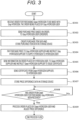
- FIG. 3 is a flowchart for explaining the details of a hydrogen trading coordination process executed by the hydrogen trading coordination system 10.
- the processor i.e., controller (not illustrated) of the hydrogen trading coordination device 100 mainly works as an operation subject.
- the operation subject is simply referred to as the hydrogen trading coordination device 100 (in a case of each terminal device being the operation subject, the "processor (controller)" is omitted from the description as in the case of the hydrogen trading coordination device 100).
- the hydrogen trading coordination device 100 receives an order for purchasing Green hydrogen to be mixed with Gray hydrogen, the order being placed by a Gray hydrogen user, from the terminal device 101_k of the Gray hydrogen user.
- forms of such an order for purchasing Green hydrogen to be mixed with Gray hydrogen include a form of changing the CO 2 emission intensity, for example, from X to Y (e.g., from 1.62 kg-CO 2 /Nm 3 -H 2 to 1.2 kg-CO 2 /Nm 3 -H 2 ) and a form of directly specifying an amount of Gray hydrogen and of Green hydrogen (e.g., 10 m 3 of Gray hydrogen and 10 m 3 of Green hydrogen).
- the hydrogen trading coordination device 100 calculates a purchase price, based on the order received at step 301. Specifically, the hydrogen trading coordination device 100 acquires information of a regular hydrogen supplier from which the Gray hydrogen user (orderer) usually purchases hydrogen (a hydrogen supplier to which a transportation distance is as short as possible is usually chosen but is not necessarily to be such), which information may be saved as registration information or included in the order, and acquires information of the cost of Gray hydrogen and of a Green hydrogen supplier and the cost of Green hydrogen, referring to the hydrogen management information 200. When the order is of the form of directly specifying an amount of Gray hydrogen and of Green hydrogen, the hydrogen trading coordination device 100 calculates a purchase price from the order amount and the cost of Gray hydrogen and of Green hydrogen.
- the hydrogen trading coordination device 100 calculates the purchase amount and purchase cost of Gray hydrogen and of Green hydrogen, based on information on the CO 2 emission intensity of the Gray hydrogen supplier and the CO 2 emission intensity of the Green hydrogen supplier supplying Green hydrogen to mixed with Gray hydrogen, and on information on the cost of Gray hydrogen and of Green hydrogen. Subsequently, the hydrogen trading coordination device 100 transmits the calculated purchase cost, information on the Gray hydrogen supplier, information on the Green hydrogen supplier, and information on the purchase amount of Gray hydrogen and of Green hydrogen, to the terminal device 101_k of the hydrogen user (orderer).
- the hydrogen trading coordination device 100 may execute a process of checking the amount of Green hydrogen based on the received order against at least one of pieces of information on the production capacity, the shipment volume, and the shipment time of the Green hydrogen supplier (e.g., hydrogen supplier B), who is a trading partner, and determining whether the Green hydrogen supplier can handle the order.
- the hydrogen trading coordination device 100 may send a notice of the trading being impossible (of the order being not processable and the reasons therefor) to the terminal device of the hydrogen user having placed the order (the terminal device 101_1 of the hydrogen user A).
- the Green hydrogen supplier does not supply Green hydrogen. Nevertheless, this approach allows trading practice based on an actual amount of hydrogen that can be supplied, thus allowing prevention of illegal acts.
- the hydrogen trading coordination device 100 may further check the production capacity and the shipment volume, and the like of other Green hydrogen suppliers (e.g., Green hydrogen suppliers C, D and so on) and send a message to the terminal device of the hydrogen user, the message inquiring whether the hydrogen user has an intention of making a trading with one or more other hydrogen suppliers capable of handling the order.
- This inquiry message allows confirming whether the hydrogen user still has an intention of purchasing hydrogen when the purchase price turns out to be higher than an expected purchase price.
- the hydrogen trading coordination device 100 generates purchase item data corresponding to the order and stores the purchase item data in a storage device.
- the purchase item data may include, for example, information on a purchase date, information on the hydrogen user who is the orderer, a ratio between Gray hydrogen and Green hydrogen, the hydrogen user's hydrogen storage facility, the regular hydrogen supplier from which hydrogen is usually purchased (the regular hydrogen supplier from which hydrogen that is not a mix of different types of hydrogen is purchased), the price to pay for the order (calculated amount of payment), a Gray hydrogen supplier and a Green hydrogen supplier who are written on a trading certificate based on the order (as mentioned above, the hydrogen user is actually supplied with a desired amount of hydrogen from a supplier from which the hydrogen user has been purchasing hydrogen), a difference between the price to pay for the order and an amount of payment to the hydrogen supplier who actual supplies hydrogen, and information indicating to which hydrogen supplier the difference should be paid in future.
- the hydrogen trading coordination device 100 pays an amount of money calculated by trading coordination, to the regular hydrogen supplier (e.g., the Gray hydrogen supplier A) of the hydrogen user (e.g., the hydrogen user A), as the purchase price (by, for example, electronic settlement), and sends an instruction to supply the hydrogen user with hydrogen (e.g., compressed hydrogen), to the terminal device 102_k of the regular hydrogen supplier (hydrogen supplier A 102_1).
- the hydrogen supplier transports hydrogen (e.g., Gray hydrogen of 20 m 3 ) of which the amount is equivalent to the order amount of the hydrogen user (overall order amount sent to the hydrogen trading coordination device 100, i.e., 20 m 3 ), to the orderer (hydrogen user A).
- the hydrogen trading coordination device 100 sends order information to a new hydrogen supplier or a hydrogen supplier used for hydrogen trading coordination (e.g., the Green hydrogen supplier B) that is different from the regular hydrogen supplier (e.g., the Gray hydrogen supplier A) the orderer has regular business dealings with, and instructs the new hydrogen supplier or the hydrogen supplier used for hydrogen trading coordination to issue a trading certificate (document certifying purchase of Green hydrogen).
- the hydrogen supplier e.g., hydrogen supplier B
- creates a Green hydrogen certificate (carrying information of a trading date, a hydrogen supplier, a hydrogen purchaser, an amount of Green hydrogen supplied, and the like), and sends the certificate to the hydrogen trading coordination device 100.
- Green hydrogen supplier the supplier the orderer (hydrogen user B) has regular business dealings with, e.g., the hydrogen supplier B
- creates a Green hydrogen certificate by following an instruction from the hydrogen trading coordination device 100, and sends the certificate to the hydrogen trading coordination device 100.
- the hydrogen trading coordination device 100 sends the certificate received from the Green hydrogen supplier (hydrogen supplier B), to the terminal device of the orderer (the terminal device 101_1 of the hydrogen user).
- the hydrogen trading coordination device 100 stores data of a price difference resulting from the hydrogen trading, in the storage device.
- the price difference data may be stored as data associated with information on the hydrogen user (hydrogen user A) and the hydrogen suppliers (hydrogen suppliers A and B) involved in the trading.
- the hydrogen trading coordination device 100 waits for an order from a Green hydrogen user (e.g., the hydrogen user B) for purchasing Gray hydrogen as a part of a Green hydrogen/Gray hydrogen mixture.
- a Green hydrogen user e.g., the hydrogen user B
- Gray hydrogen as a part of a Green hydrogen/Gray hydrogen mixture.
- the hydrogen trading coordination device 100 processes the received order from the Green hydrogen user (hydrogen user B), and adjusts the price difference stored in the storage device at step 307.
- the Green hydrogen supplier (hydrogen supplier B) actually supplies hydrogen larger in amount than Green hydrogen corresponding in purchase price to the Green hydrogen user's payment to the hydrogen trading coordination device 100 (hydrogen trading coordinator).
- the price for a surpass portion of hydrogen supplied will be compensated by a price difference resulting from a different hydrogen trading.
- the Gray hydrogen supplier (hydrogen supplier A) actually supplies no Gray hydrogen to the Green hydrogen user (hydrogen user B)
- the Gray hydrogen supplier is not paid for the order made in this trading.
- the Gray hydrogen supplier too is compensated for a surpass portion of hydrogen supply made in a past hydrogen trading with a price difference resulting from a different trading.
- Adjustment of the price difference is made, for example, in a certain period (e.g., one year) such that none of the hydrogen suppliers suffers any loss.
- Gray hydrogen (first type fuel) and Green hydrogen (second type fuel) are fuels that are different in production method but can be used for the same purpose.
- the hydrogen (fuel) trading coordination device sends order information received from the terminal device of a Gray hydrogen user, to a Gray hydrogen supplier (the first supplier who supplies the first type fuel) and to a Green hydrogen supplier (the second supplier that supplies the second type fuel).
- a Gray hydrogen supplier the first supplier who supplies the first type fuel
- a Green hydrogen supplier the second supplier that supplies the second type fuel.
- the hydrogen trading coordination device sends a payment (price) based on the amount of supply of Gray hydrogen corresponding to the order, to the first supplier, and instructs the first supplier to supply Gray hydrogen in the amount corresponding to the total amount of hydrogen specified in the order, that is, the sum of Gray hydrogen and Green hydrogen.
- a payment price
- the first supplier instructs the first supplier to supply Gray hydrogen in the amount corresponding to the total amount of hydrogen specified in the order, that is, the sum of Gray hydrogen and Green hydrogen.
- the hydrogen trading coordination device instructs the second supplier to issue a certificate certifying that the second supplier has supplied Green hydrogen, and sends data of the issued certificate to the terminal device of the Gray hydrogen user having placed the order.
- the data of the certificate can be used for the CO 2 emission right trading in the future by the Gray hydrogen user.
- the hydrogen trading coordination device processes orders from users of various types of hydrogen, and stores information on past orders from a plurality of Gray hydrogen users and on past orders from a plurality of Green hydrogen users, in a storage device. By managing such past order information, an amount of hydrogen available to each user can be determined (estimated) from order-placing histories. This allows the hydrogen trading coordination device to take a specific measure, such as making inquiries to hydrogen suppliers, when dealing with an order for hydrogen of which the amount exceeds an estimated order amount, thus allowing prevention of illegal acts.
- the storage device of the hydrogen trading coordination device stores information on a plurality of fuel suppliers, the information including information of a production method for hydrogen, a production capacity for the hydrogen, and the form of transportation of the hydrogen, information of the CO 2 emission intensity of the hydrogen, information of the sales price of the hydrogen, information of a shipment volume, and information on a shipment time.
- the hydrogen trading coordination device checks the amount of Green hydrogen based on the order against information of shipment volumes and shipment times of a plurality of hydrogen suppliers, determines whether hydrogen can be shipped out to meet the order, and when hydrogen cannot be shipped out, sends a notice of meeting the order being impossible, to the terminal device of the Gray hydrogen user having placed the order. This process prevents conduct of an illegal act in pseudo Green hydrogen trading transactions.
- the hydrogen trading coordination device calculates an order amount of Gray hydrogen and of Green hydrogen, based on the desired CO 2 emission intensity value, and sends order information including information of the order amounts, to the first supplier and to the second supplier.
- the order may be placed in the form of specifying a purchase amount of Gray hydrogen and of Green hydrogen.
- the hydrogen trading coordination device sends the order information including information on the purchase amount of Gray hydrogen and of Green hydrogen, to the first supplier and to the second supplier. This reduces a calculation load on the hydrogen trading coordination device.
- the functions of this embodiment can be implemented by a software program code.
- a storage medium recording the program code therein is incorporated in a system or a device, and a computer (or a CPU or MPU) of the system or the device reads the program code stored in the storage medium.
- the program code itself which is read out of the storage medium, implements the above functions of the embodiments, and the program code and the storage medium storing the program code constitute the present disclosure.
- Various storage media for supplying such a program code include, for example, a flexible disk, a CD-ROM, a DVD-ROM, a hard disk, an optical disk, a magneto-optical disk, a CD-R, a magnetic tape, a nonvolatile memory card, and a ROM.
- an operating system (OS) or the like running on a computer may execute a part or the whole of an actual process, based on an instruction from the program code, to implement the above functions of the embodiments through the process.
- OS operating system
- the CPU or the like of the computer may execute a part or the whole of the actual process, based on an instruction from the program code, to implement the above functions of the embodiments through the process.
- the software program code that implements the functions of the embodiment may be distributed via a network to store the program code in a storage means, such as a hard disk or a memory of the system or the device, or in a storage medium, such as a CD-RW or a CD-R, so that when the program code is used, the computer (or the CPU or MPU) of the system or the device reads the program code out of the storage means or the storage medium to execute the program code.
- a storage means such as a hard disk or a memory of the system or the device
- a storage medium such as a CD-RW or a CD-R
- control lines/data lines considered to be necessary for description are illustrated, and all control lines/information lines making up the product are not always illustrated. All constituent elements may be interconnected.
Landscapes
- Business, Economics & Management (AREA)
- Engineering & Computer Science (AREA)
- Economics (AREA)
- Finance (AREA)
- Accounting & Taxation (AREA)
- Theoretical Computer Science (AREA)
- General Physics & Mathematics (AREA)
- General Business, Economics & Management (AREA)
- Marketing (AREA)
- Physics & Mathematics (AREA)
- Strategic Management (AREA)
- Development Economics (AREA)
- Health & Medical Sciences (AREA)
- Tourism & Hospitality (AREA)
- Primary Health Care (AREA)
- Human Resources & Organizations (AREA)
- General Health & Medical Sciences (AREA)
- Water Supply & Treatment (AREA)
- Public Health (AREA)
- Entrepreneurship & Innovation (AREA)
- Technology Law (AREA)
- Management, Administration, Business Operations System, And Electronic Commerce (AREA)
Applications Claiming Priority (1)
| Application Number | Priority Date | Filing Date | Title |
|---|---|---|---|
| PCT/JP2020/013928 WO2021192205A1 (fr) | 2020-03-27 | 2020-03-27 | Dispositif de coordination de commerce de carburant et système de coordination de commerce de carburant |
Publications (2)
| Publication Number | Publication Date |
|---|---|
| EP4131127A1 true EP4131127A1 (fr) | 2023-02-08 |
| EP4131127A4 EP4131127A4 (fr) | 2023-08-30 |
Family
ID=77889969
Family Applications (1)
| Application Number | Title | Priority Date | Filing Date |
|---|---|---|---|
| EP20927869.6A Pending EP4131127A4 (fr) | 2020-03-27 | 2020-03-27 | Dispositif de coordination de commerce de carburant et système de coordination de commerce de carburant |
Country Status (4)
| Country | Link |
|---|---|
| US (1) | US20220292582A1 (fr) |
| EP (1) | EP4131127A4 (fr) |
| JP (1) | JP7257586B2 (fr) |
| WO (1) | WO2021192205A1 (fr) |
Families Citing this family (10)
| Publication number | Priority date | Publication date | Assignee | Title |
|---|---|---|---|---|
| US12602021B2 (en) * | 2020-06-30 | 2026-04-14 | Everfuel Europe A/S | Hydrogen supervisory control and data acquisition system |
| JP7044936B1 (ja) | 2021-10-20 | 2022-03-30 | 東京瓦斯株式会社 | カーボンニュートラル管理システム、カーボンニュートラル管理プログラム |
| WO2023127115A1 (fr) * | 2021-12-28 | 2023-07-06 | 株式会社日立製作所 | Dispositif d'aide à la transaction liée à l'hydrogène, procédé d'aide à la transaction liée à l'hydrogène et système d'aide à la transaction liée à l'hydrogène |
| US20230230663A1 (en) * | 2022-01-12 | 2023-07-20 | Aveva Software, Llc | Servers, systems, and methods for modeling the carbon footprint of an industrial process |
| JP2023174021A (ja) * | 2022-05-27 | 2023-12-07 | 住友大阪セメント株式会社 | カーボンリサイクル炭酸カルシウム処理・物流複合システム |
| JP2024006485A (ja) * | 2022-07-01 | 2024-01-17 | 株式会社東芝 | エネルギー管理システム |
| JP2024040712A (ja) * | 2022-09-13 | 2024-03-26 | 株式会社日立製作所 | ガス価格管理システム及びガス価格管理方法 |
| US20240144309A1 (en) * | 2022-10-26 | 2024-05-02 | Independence Hydrogen Inc. | System and method for aggregation and integration of hydrogen production, storage, and distribution to support and optimize normalization of hydrogen |
| WO2024099569A1 (fr) * | 2022-11-10 | 2024-05-16 | Siemens Gamesa Renewable Energy A/S | Procédé et système d'authentification d'hydrogène à partir de sources renouvelables |
| WO2025216221A1 (fr) * | 2024-04-09 | 2025-10-16 | 株式会社Sustech | Dispositif de traitement d'informations, procédé de traitement d'informations et programme |
Family Cites Families (10)
| Publication number | Priority date | Publication date | Assignee | Title |
|---|---|---|---|---|
| ES502483A0 (es) * | 1981-05-26 | 1982-04-01 | Bendiberica Sa | Perfeccionamientos en distribuidores hidraulicos rotativos |
| WO2007095742A1 (fr) * | 2006-02-27 | 2007-08-30 | Lange David H | Système et procédé de détermination et de courtage des compensations sur les émissions de carburants |
| WO2008100581A1 (fr) * | 2007-02-13 | 2008-08-21 | Greg Bailey | Système de rapprochement finances-énergie, et procédé |
| JP2008250501A (ja) * | 2007-03-29 | 2008-10-16 | Osaka Gas Co Ltd | 水素販売仲介方法 |
| US8945373B2 (en) * | 2011-12-22 | 2015-02-03 | Iogen Corporation | Method for producing renewable fuels |
| CN109888815A (zh) * | 2017-12-06 | 2019-06-14 | 平高集团有限公司 | 风光-氢储能及煤化工联合生产系统 |
| US20190259088A1 (en) * | 2018-02-19 | 2019-08-22 | Hyster-Yale Group, Inc. | Method and system for determining hydrogen supply location, cost, and infrastructure |
| US11077766B2 (en) * | 2018-08-30 | 2021-08-03 | Honda Motor Co., Ltd. | Vehicle-to-grid energy for use with hydrogen generation |
| JP7225718B2 (ja) * | 2018-11-15 | 2023-02-21 | トヨタ自動車株式会社 | 水素ガス供給システム |
| JP6539421B1 (ja) | 2019-01-23 | 2019-07-03 | 太平洋セメント株式会社 | ペレット状木質バイオマス燃料の受発注システム |
-
2020
- 2020-03-27 JP JP2022510309A patent/JP7257586B2/ja active Active
- 2020-03-27 EP EP20927869.6A patent/EP4131127A4/fr active Pending
- 2020-03-27 US US17/638,945 patent/US20220292582A1/en not_active Abandoned
- 2020-03-27 WO PCT/JP2020/013928 patent/WO2021192205A1/fr not_active Ceased
Also Published As
| Publication number | Publication date |
|---|---|
| WO2021192205A1 (fr) | 2021-09-30 |
| US20220292582A1 (en) | 2022-09-15 |
| JPWO2021192205A1 (fr) | 2021-09-30 |
| EP4131127A4 (fr) | 2023-08-30 |
| JP7257586B2 (ja) | 2023-04-13 |
Similar Documents
| Publication | Publication Date | Title |
|---|---|---|
| EP4131127A1 (fr) | Dispositif de coordination de commerce de carburant et système de coordination de commerce de carburant | |
| US20230206354A1 (en) | Information processing apparatus, information processing method, and computer-readable medium | |
| Yang et al. | China's renewable energy and energy efficiency policies toward carbon neutrality: A systematic cross-sectoral review | |
| US20190249319A1 (en) | Electrolyser and energy system | |
| Simshauser | From first place to last: the national electricity Market's policy‐induced ‘energy market death spiral’ | |
| Han et al. | Multiperiod stochastic optimization model for carbon capture and storage infrastructure under uncertainty in CO2 emissions, product prices, and operating costs | |
| US20090192894A1 (en) | Methods and apparatus for creating and managing green micro credits | |
| US20240265476A1 (en) | Communication terminal, tracking system, displaying method, and non-transitory recording medium | |
| CN102349033A (zh) | 协作的环境和生活受益交换系统 | |
| JP2022046757A (ja) | 電力取引システム | |
| Peng et al. | A holistic framework for the study of interdependence between electricity and gas sectors | |
| CN107016483A (zh) | 能量供求规划装置及能量供求规划方法 | |
| JP2024132366A (ja) | 管理装置 | |
| EP4432206A1 (fr) | Système intermédiaire, système de transaction et procédé de demande | |
| JP2005339187A (ja) | 二酸化炭素排出削減量を特定するための情報処理方法 | |
| KR102647579B1 (ko) | 환경 부하 관리 장치 | |
| JP2022018463A (ja) | 電力取引仲介装置 | |
| US20090210329A1 (en) | Renewable Energy Park | |
| Nielsen et al. | Excess heat regulations, contracts and business models–With a special focus on excess heat opportunities in Denmark | |
| Zhang et al. | One‐Way Substitution Newsboy Problem under Retailer’s Budget Constraint | |
| Fangmeier | Bridging the Natural Gas Gap: An Integrated Approach to De-Risking the Development of LNG-to-Power Infrastructure | |
| CN117992460B (zh) | 单据关联方法、装置、设备及存储介质 | |
| JP7792935B2 (ja) | 環境価値算出システム | |
| Mitrai et al. | Optimal Transition of Ammonia Supply Chain Networks via Stochastic Programming | |
| Hernandez | An Evaluation of Regulatory Frameworks for the Development of Interstate Hydrogen Infrastructure in the United States |
Legal Events
| Date | Code | Title | Description |
|---|---|---|---|
| STAA | Information on the status of an ep patent application or granted ep patent |
Free format text: STATUS: THE INTERNATIONAL PUBLICATION HAS BEEN MADE |
|
| PUAI | Public reference made under article 153(3) epc to a published international application that has entered the european phase |
Free format text: ORIGINAL CODE: 0009012 |
|
| STAA | Information on the status of an ep patent application or granted ep patent |
Free format text: STATUS: REQUEST FOR EXAMINATION WAS MADE |
|
| 17P | Request for examination filed |
Effective date: 20220303 |
|
| AK | Designated contracting states |
Kind code of ref document: A1 Designated state(s): AL AT BE BG CH CY CZ DE DK EE ES FI FR GB GR HR HU IE IS IT LI LT LU LV MC MK MT NL NO PL PT RO RS SE SI SK SM TR |
|
| DAV | Request for validation of the european patent (deleted) | ||
| DAX | Request for extension of the european patent (deleted) | ||
| A4 | Supplementary search report drawn up and despatched |
Effective date: 20230728 |
|
| RIC1 | Information provided on ipc code assigned before grant |
Ipc: G06Q 30/0601 20230101ALI20230724BHEP Ipc: G06Q 40/04 20120101ALI20230724BHEP Ipc: G06Q 30/018 20230101ALI20230724BHEP Ipc: G06Q 50/06 20120101AFI20230724BHEP |
|
| STAA | Information on the status of an ep patent application or granted ep patent |
Free format text: STATUS: EXAMINATION IS IN PROGRESS |
|
| 17Q | First examination report despatched |
Effective date: 20251007 |