EP4131171A2 - Computerimplementierte verfahren zum erzeugen und anwenden von vorgaben für die ausführung von bekleidungsstücken - Google Patents
Computerimplementierte verfahren zum erzeugen und anwenden von vorgaben für die ausführung von bekleidungsstücken Download PDFInfo
- Publication number
- EP4131171A2 EP4131171A2 EP22186426.7A EP22186426A EP4131171A2 EP 4131171 A2 EP4131171 A2 EP 4131171A2 EP 22186426 A EP22186426 A EP 22186426A EP 4131171 A2 EP4131171 A2 EP 4131171A2
- Authority
- EP
- European Patent Office
- Prior art keywords
- garment
- finish
- model
- preset
- computer implemented
- Prior art date
- Legal status (The legal status is an assumption and is not a legal conclusion. Google has not performed a legal analysis and makes no representation as to the accuracy of the status listed.)
- Withdrawn
Links
Images



Classifications
-
- G—PHYSICS
- G06—COMPUTING OR CALCULATING; COUNTING
- G06F—ELECTRIC DIGITAL DATA PROCESSING
- G06F30/00—Computer-aided design [CAD]
- G06F30/10—Geometric CAD
- G06F30/12—Geometric CAD characterised by design entry means specially adapted for CAD, e.g. graphical user interfaces [GUI] specially adapted for CAD
-
- A—HUMAN NECESSITIES
- A41—WEARING APPAREL
- A41H—APPLIANCES OR METHODS FOR MAKING CLOTHES, e.g. FOR DRESS-MAKING OR FOR TAILORING, NOT OTHERWISE PROVIDED FOR
- A41H3/00—Patterns for cutting-out; Methods of drafting or marking-out such patterns, e.g. on the cloth
- A41H3/007—Methods of drafting or marking-out patterns using computers
-
- G—PHYSICS
- G06—COMPUTING OR CALCULATING; COUNTING
- G06F—ELECTRIC DIGITAL DATA PROCESSING
- G06F30/00—Computer-aided design [CAD]
- G06F30/20—Design optimisation, verification or simulation
- G06F30/27—Design optimisation, verification or simulation using machine learning, e.g. artificial intelligence, neural networks, support vector machines [SVM] or training a model
-
- G—PHYSICS
- G06—COMPUTING OR CALCULATING; COUNTING
- G06T—IMAGE DATA PROCESSING OR GENERATION, IN GENERAL
- G06T19/00—Manipulating three-dimensional [3D] models or images for computer graphics
- G06T19/20—Editing of three-dimensional [3D] images, e.g. changing shapes or colours, aligning objects or positioning parts
-
- G—PHYSICS
- G06—COMPUTING OR CALCULATING; COUNTING
- G06F—ELECTRIC DIGITAL DATA PROCESSING
- G06F2113/00—Details relating to the application field
- G06F2113/12—Cloth
-
- G—PHYSICS
- G06—COMPUTING OR CALCULATING; COUNTING
- G06F—ELECTRIC DIGITAL DATA PROCESSING
- G06F2119/00—Details relating to the type or aim of the analysis or the optimisation
- G06F2119/18—Manufacturability analysis or optimisation for manufacturability
-
- G—PHYSICS
- G06—COMPUTING OR CALCULATING; COUNTING
- G06T—IMAGE DATA PROCESSING OR GENERATION, IN GENERAL
- G06T2200/00—Indexing scheme for image data processing or generation, in general
- G06T2200/24—Indexing scheme for image data processing or generation, in general involving graphical user interfaces [GUIs]
-
- G—PHYSICS
- G06—COMPUTING OR CALCULATING; COUNTING
- G06T—IMAGE DATA PROCESSING OR GENERATION, IN GENERAL
- G06T2210/00—Indexing scheme for image generation or computer graphics
- G06T2210/16—Cloth
-
- G—PHYSICS
- G06—COMPUTING OR CALCULATING; COUNTING
- G06T—IMAGE DATA PROCESSING OR GENERATION, IN GENERAL
- G06T2219/00—Indexing scheme for manipulating 3D models or images for computer graphics
- G06T2219/20—Indexing scheme for editing of 3D models
- G06T2219/2008—Assembling, disassembling
-
- G—PHYSICS
- G06—COMPUTING OR CALCULATING; COUNTING
- G06T—IMAGE DATA PROCESSING OR GENERATION, IN GENERAL
- G06T2219/00—Indexing scheme for manipulating 3D models or images for computer graphics
- G06T2219/20—Indexing scheme for editing of 3D models
- G06T2219/2012—Colour editing, changing, or manipulating; Use of colour codes
-
- G—PHYSICS
- G06—COMPUTING OR CALCULATING; COUNTING
- G06T—IMAGE DATA PROCESSING OR GENERATION, IN GENERAL
- G06T2219/00—Indexing scheme for manipulating 3D models or images for computer graphics
- G06T2219/20—Indexing scheme for editing of 3D models
- G06T2219/2024—Style variation
Definitions
- the present invention relates to a computer implemented methods for generating 3D garment models at least in part. Specifically, a fourth method is disclosed for generating a garment finish preset comprising assembly instructions for a garment finish for a garment to be fabricated, a fifth method is disclosed for automatically generating a garment finish preset comprising assembly instructions for a garment finish for a garment to be fabricated, and a sixth method is disclosed for automatically determining at least one candidate from a plurality of garment finish presets, each of said garment finish presets comprising assembly instructions for a garment finish for a garment to be fabricated from garment panels.
- One document is the garment pattern as mentioned above (often a 2D CAD model in DXF format) containing the pattern shapes and used for cutting out the different garment panels from cloth that are then assembled into a garment.
- Another document is a file or a set of files that contain assembly instructions and other details in a human readable format such as an Excel spread sheet or a PDF file.
- These kind of documents defining the garment are often referred to as a "Tech Pack”.
- the human readable instructions usually contain information about which fabric to use, what colors, what thread and stitch types, what finishes, what trims (buttons, zippers, hooks, etc.) to process, and so on.
- garment designers may want to update a garment design by amending an existing GDT on a three-dimensional virtual graphical user interface. It is therefore desirable to not start the design process from zero, but to have a predecessor model, e.g. a pre-season design, as a basis.
- 3D "Garment Digital Twins” are further of an increasing interest for the industry as they can be used to illustrate the garment, e.g. on a website, without the need for expensive and elaborate photo shootings.
- a GDT Once a GDT is at hand, it can be displayed in different poses, colors, sizes, and worn by different avatars or hangers. As well, the GDTs can be illustrated in a virtual fitting room where a customer can provide a three-dimensional representation of himself and virtually "try on” several different garments in different styles and sizes.
- a garment is to be finished which is defined at least by assembly steps to be applied in order to finish the garment in the desired way and optionally also by additional pieces to be connected to the garment.
- a finish feature that does not involve an extra part would be a dart incorporated into the back of a shirt or a hem on the bottom opening of a pair of jeans, and a finish feature that does involve extra parts would be a collar with a collar stand for a shirt.
- These finishes are so important because they ultimately define the garment design and appearance. The designers thus spend a lot of time working on the finishes in the 3D design software to bring the finishes to perfection for every individual garment. There is therefore need for simplification and computer-based support for the generation and application of garment finishes.
- the invention provides computer implemented methods that help overcoming this vast backlog demand. Methods according to the invention allow for reductions of working time and man power.
- the invention relates to a fourth computer implemented method, with program code being stored on a machine readable medium or embodied as an electromagnetic wave, for generating a garment finish preset comprising assembly instructions for a garment finish for a garment to be fabricated, the computer implemented method comprising:
- the computer implemented method further comprises
- the computer implemented method further comprises defining panel boundary counter-parameter based on the third user input.
- the garment finish preset comprises representation of seams to be placed at dedicated locations within at least one of a garment finish part comprised by the garment finish preset and the garment model.
- the garment finish preset contains representation of hems to be placed at openings of at least one of a garment finish part comprised by the garment finish preset and the garment model.
- the garment finish parts comprised by the garment finish preset represent at least one of a collar, a cuff, revers, lapel, a pocket, a belt hook, and a cowl.
- the garment finish preset contains representation of at least one of a button, a buttonhook, a buttonhole, a button tape, a snap fastener, a zipper, a touch fastener, a magnetic fastener, a hook, a loop for a hook or a button, a cord fastener, and laces.
- the garment finish preset contains representation of at least one of a dart and a pleat.
- the computer implemented method further comprises
- the design tools comprise a plurality of reshaping tools configured to reshape a garment finish part.
- the design tools comprise a plurality of design tool selection menus.
- At least one of the design tool selection menus comprise one of a thread color selection menu, a stitch pattern selection menu, a size selection menu, a part selection menu, a cloth type selection menu, a cloth color selection menu, and a part style menu.
- the invention further relates to a fifth computer implemented method, with program code being stored on a machine readable medium or embodied as an electromagnetic wave, for automatically generating a garment finish preset comprising assembly instructions for a garment finish for a garment to be fabricated, the computer implemented method comprising:
- generating the garment finish preset comprises virtually assembling the garment finish parts comprised by the garment finish preset based on the determined at least one garment finish feature.
- the computer implemented method further comprises
- the at least one garment finish feature is indicative for a position and an orientation of the respective additional garment component or garment property within a garment.
- the extraction algorithm comprises at least one of a pattern recognition algorithm and a text interpreter.
- the extraction algorithm is trainable based on user feedback.
- the extraction algorithm is configured for analyzing the at least one document with respect to at least one of: textual information, numerical information, image data, arrows, size data, color swatches, color indicators, stitch types, stitch designations, and a 2D/3D interpretation of the drawing.
- the computer implemented method further comprises determining, with the extraction algorithm, a garment type indicator from the at least one document, the garment type indicator representing a type of the garment that the garment finish belongs to and being one of a plurality of garment type indicators stored on the machine readable medium.
- the extraction algorithm is configured for analyzing at least one of
- the invention further relates to a sixth computer implemented method, with program code being stored on a machine readable medium or embodied as an electromagnetic wave, for automatically determining at least one candidate from a plurality of garment finish presets, each of said garment finish presets comprising assembly instructions for a garment finish for a garment to be fabricated from garment panels, the computer implemented method comprising providing at least one of
- the computer implemented method further comprises analyzing at least one of the at least one 2D pattern piece, the 3D garment model, and the at least one 3D panel model with respect to boundaries to provide panel boundary parameters, wherein determining the at least one candidate from the plurality of garment finish presets is further based on the panel boundary parameters.
- the computer implemented method further comprises, upon a user selection of the candidate or one of the candidates, applying the according garment finish preset to the garment model or assembling the garment model based on the at least one 2D pattern piece and the according garment finish preset.
- the computer implemented method further comprises, upon a computer selection of the candidate or one of the candidates, applying the according garment finish preset to the garment model or assembling the garment model based on the at least one 2D pattern piece and the according garment finish preset, wherein the computer selection is subject to a suitability likelihood value determined by matching the panel boundary parameters with panel boundary counter-parameter associated with each of the plurality of garment finish presets.
- each of the garment finish presets comprises at least one garment finish part
- applying or assembling comprises at least one of resizing and reshaping the at least one garment finish part of the selected candidate such that the resized at least one garment finish part is adapted to at least one of a shape and a size of the garment model.
- each of the garment finish presets has at least one tag indicative for a requirement or suitability feature of the 3D garment model for applying the according garment finish preset.
- the at least one tag is indicative for a necessary or suitable
- the invention further relates to a first computer implemented method, with program code being stored on a machine readable medium or embodied as an electromagnetic wave, for automatically generating a first 3D garment model representing a first garment to be fabricated from first garment panels, the computer implemented method comprising: (a) providing one or more first documents comprising a plurality of first 2D pattern pieces representing the first garment panels, (b) determining with a pattern recognition algorithm (i) a garment type indicator for at least one of the first 2D pattern pieces, the garment type indicator representing a type of a garment that the respective first garment panel belongs to and being one of a plurality of garment type indicators stored on the machine readable medium, and (ii) a panel pose indicator for each of the first 2D pattern pieces, the panel pose indicator representing an estimated position and an estimated orientation of the respective garment panel within the first garment, and (c) generating the first 3D garment model based on the first 2D pattern pieces, the at least one garment type indicator, and the panel pose indicators.
- the first computer implemented method further comprises adding default finishes to the first 3D garment model based on at least one of the at least one garment type indicator and the panel pose indicators.
- the first computer implemented method further comprises generating a first 2D panel model for each of the first 2D pattern pieces, wherein generating the first 3D garment model is based on draping a reference object with the first 2D panel models.
- the first computer implemented method further comprises: (a) positioning and orienting the first 2D panel models based on the panel pose indicators, in particular further based on a proportion of the 2D pattern pieces relative to each other, (b) while, before, or after positioning and orienting the 2D panel models, shaping each of the first 2D panel models into first 3D panel models so as they adapt to a shape of the reference object based on the at least one garment type indicator, and the panel pose indicators, and (c) generating the first 3D garment model by virtually assembling the first 3D panel models along their respective edges.
- the pattern recognition algorithm is configured for analyzing at least one of (a) a shape of the 2D pattern piece, (b) a proportion of the 2D pattern piece relative to the other 2D pattern pieces, (c) textual information associated with the 2D pattern piece in the respective first document, (d) whether the 2D pattern piece is at least in part symmetrical or not, and (e) an amount of provided 2D pattern pieces.
- the invention further relates to a second computer implemented method, with program code being stored on a machine readable medium or embodied as an electromagnetic wave, for virtually finishing a second 3D garment model representing a second garment to be fabricated without finishes or with default finishes, the computer implemented method comprising: (a) providing the second 3D garment model, (b) providing one or more second documents comprising human-readable garment finishing instructions for finishing the second garment, (c) determining with an extraction algorithm at least one garment finish feature from the one or more second documents, the garment finish feature corresponding to an additional garment component or a garment property and being indicative for a position and an orientation of the respective additional garment component or garment property within the second garment, and (d) virtually finishing the second 3D garment model based on the determined at least one garment finish feature.
- virtually finishing the second 3D garment model comprises modifying at least a part of the second 3D garment model.
- the garment finish feature corresponds to a fabric type of at least part of the second 3D garment model
- modifying the at least a part of the second 3D garment model comprises attributing at least one of a texture and a color to at least part of the second 3D garment model based on the garment finish feature.
- the garment finish feature corresponds to seams of the second garment
- modifying at least a part of the second 3D garment model comprises attributing at least one of a thread color, a thread type, and a stitch pattern to seams of the second garment.
- virtually finishing the second 3D garment model comprises adding at least one garment finish model to the second 3D garment model.
- the garment finish feature corresponds to seams of the second garment, wherein the at least one garment finish model represents stitches to be placed at dedicated locations within the second garment.
- the garment finish feature corresponds to bindings of the second garment, wherein the at least one garment finish model represents hems to be placed at openings of the second garment.
- the garment finish feature corresponds to a closure of the garment, wherein the at least one garment finish model represents at least one of a button, a buttonhook, a snap fastener, a zipper, a touch fastener, a magnetic fastener, a hook, a loop for a hook or a button, a cord fastener, and laces.
- the extraction algorithm is configured for analyzing the one or more second documents with respect to at least one of: textual information, image data, arrows, size data, color swatches, color indicators, stitch types, and stitch designations.
- the invention further relates to a third computer implemented method, with program code being stored on a machine readable medium or embodied as an electromagnetic wave, for automatically generating a plurality of third 3D garment models in a batch process, each third 3D garment model representing a third garment to be fabricated from third garment panels, the computer implemented method comprising: (a) for each third 3D garment model to be generated: (i) providing one or more third documents comprising (i1) a plurality of third 2D pattern pieces representing the third garment panels and (i2) human-readable garment finishing instructions for finishing the third garment, (ii) recognizing patterns of the third 2D pattern pieces, (iii) generating a fourth 3D garment model based on the recognized patterns of third 2D pattern pieces, (iv) extracting at least one garment finish feature from the human-readable garment finishing instructions, (v) generating a third 3D garment model by virtually finishing each of the fourth 3D garment models based on the extracted at least one garment finish feature; and (b) for the batch-processed plurality of third 3
- recognizing patterns of the third 2D pattern pieces is based on determining with a pattern recognition algorithm (a) a garment type indicator for at least one of the third 2D pattern pieces, the garment type indicator representing a type of a garment that the respective third garment panel belongs to and being one of a plurality of garment type indicators stored on the machine readable medium, and (b) a panel pose indicator for each of the third 2D pattern pieces, the panel pose indicator representing an estimated position and an estimated orientation of the respective garment panel within the third garment, wherein generating the fourth 3D garment model is further based on the garment type indicator and the panel pose indicator.
- the pattern recognition algorithm is trainable based on at least one of the generated report and user feedback.
- extracting at least one garment finish feature is based on determining with an extraction algorithm the at least one garment finish feature from the one or more third documents, the garment finish feature corresponding to an additional garment component or a garment property and being indicative for a position and an orientation of the respective additional garment component or garment property within the third garment.
- the extraction algorithm is configured for analyzing the one or more third documents with respect to at least one of: textual information, image data, arrows, size data, color swatches, color indicators, stitch types, and stitch designations.
- the extraction algorithm is trainable based on at least one of the generated report and user feedback.
- first, second, and third methods may be circumscribed as follows:
- Figures 1 to 3 show aspects that are used in the first computer implemented method as presented herein.
- the purpose of this method is to automatically generate a first 3D garment model such that it represents a first garment that is to be fabricated in reality from first garment panels.
- first documents 1 which comprise a plurality of first 2D pattern pieces 2 that represent those the first garment panels.
- These documents could be a Computer Aided Design (CAD) file, a Portable Document Format (PDF) file, an image file in any format, or any other file containing computer-readable or human-readable 2D shapes of pattern pieces.
- the 2D pattern document 1 contains representations of the front and back panels of a T-shirt (3 and 4), the sleeve panels 5 and 6, and a neck binding (or neck tape) 7.
- a garment type indicator for at least one of the first 2D pattern pieces 2 is determined with a pattern recognition algorithm.
- the garment type indicator represents a type of a garment that the respective first garment panel(s) belong(s) to.
- the pattern recognition algorithm detects that this document 1 belongs to a T-shirt because a typically shaped panel and/or a typical collection of typically shaped panels was detected.
- the determined garment type indicator is one of a plurality of garment type indicators stored on the machine readable medium.
- the garment type indicators can refer to the type of garment on a very basic level, like a T-shirt, pants, underwear, etc., but it can alternatively or additionally also refer to the type of garment on a more detailed level, like long-sleeved shirt or short-sleeved shirt, ladieswear or menswear, dressed or denim, suit pants or 5-pocket, etc.
- a panel pose indicator is determined with the pattern recognition algorithm for each of the first 2D pattern pieces.
- the panel pose indicator represents an estimated position and an estimated orientation of the respective garment panel within the first garment.
- the algorithm will identify a panel with the shape of the back piece 4 to be located in the back with the long straight line at the bottom. It will further identify the front piece 3 to be located in the front but turned around such that again the long straight line is at the bottom and the neck part in the top.
- the first 3D garment model is now generated based on the first 2D pattern pieces, the at least one garment type indicator, and the panel pose indicators.
- Figures 2 and 3 show two examples of this positioning and orienting. These two ways of assembly can be complementing or be applied alternatively.
- the first method may further comprise the generation of a first 2D panel model 8 for each of the first 2D pattern pieces 2, which are positioned and oriented in accordance with the panel pose indicators, wherein for generating the first 3D garment model 10, a reference object 9 is draped with the first 2D panel models 8.
- the reference object 9 is an invisible or transparent avatar having an average shape of a human body, in particular in accordance with the garment type indicator ( woman/man/child, etc.).
- the single components for the first 3D garment model 12 may be represented by first 2D panel models which are then pre-shaped before the final assembly to form first 3D panel models 11.
- first 2D panel models which are then pre-shaped before the final assembly to form first 3D panel models 11.
- each sleeve is wrapped around, e.g. to form a tube as shown, and sewed together, and the front and back panel are shaped following a typical chest and back form.
- assembling these first 3D panel models 11 to form a first 3D garment model 13 is straightforward because fewer computational effort is necessary to find the lines of connection (seams).
- the first 3D garment model 13 is shown on a transparent avatar 12, but the reference object can also be a garment hanger or any other holder that presents the garment in such a way that a designer can easily work on the garment design in a CAD environment.
- the reference object can be two- or three-dimensional.
- the first method may further comprise said positioning and orienting of the first 2D panel models 8 based on the panel pose indicators, in particular further based on based on a proportion of the first 2D pattern pieces 2 relative to each other. If also said proportion is taken into account, then the panels can be positioned and oriented already quite closely to each other (because the general size of the garment can be estimated) such that the rendering of the assembly is made more efficient.
- the first method may include shaping each of the first 2D panel models 8 into first 3D panel models 11 so as they adapt to a shape of the reference object 13 (in the respective area) based on the at least one garment type indicator, and the panel pose indicators.
- a respective garment type indicator in this case: a T-shirt
- the first method may take into account information (which may be stored on the computer-readable medium) about the typical 3D shape of the respective panel.
- the first 3D garment model 13 is generated by virtually assembling the first 3D panel models 11 (which are the shaped first 2D panel models 8) along their respective edges.
- the first 2D or 3D panel models are virtually stitched together a default allowance away from the edges, wherein models of default seams can be provided at the virtual stitch lines.
- the first method may provide adding default finishes to the first 3D garment model based on the respective garment type indicator and/or the panel pose indicators.
- the first 3D garment model 10/13 might be equipped with standard French seams, wherein in case of a jeans the method might equip the first 3D garment model with a standard lapped seam.
- the pattern recognition algorithm is configured for analyzing at least one of (a) a shape of the 2D pattern piece, (b) a proportion of the 2D pattern piece relative to the other 2D pattern pieces, (c) textual information associated with the 2D pattern piece in the respective first document, (d) whether the 2D pattern piece is at least in part symmetrical or not, and (e) an amount of provided 2D pattern pieces.
- a particular advantage of said first method is that the first 3D garment model is fully automatically generated without the need of manual intervention, based on merely the at least one first document with its depiction or description of the first 2D pattern pieces that represent the first garment panels from which the first garment is to be fabricated.
- the first method in particular the pattern recognition algorithm, may be trainable based on machine learning using training data from previous first 3D garment model generations. Specifically, such a machine learning algorithm can "learn” from user input that is aimed at correcting the automatic choices made by the computer.
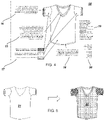
- Figures 4 and 5 show aspects that are used in the second computer implemented method as presented herein.
- the purpose of this method is to virtually finish a second 3D garment model which represents a second garment to be fabricated in reality and which does not yet have finishes or merely has default finishes.
- the second method it is therefore proposed to provide said second 3D garment model that has no or only default finishes and to further provide one or more second documents which comprise human-readable garment finishing instructions for finishing the second garment.
- One exemplary such document 14 often referred to as "Tech Pack” among experts, is shown in figure 4 .
- These one or more second documents describe how a certain garment is to be finished.
- the document may refer to several garment finish features, such as the type of fabric to be used, the color to be chosen for a specific component, the stitch type and a hem type to fabricate at an opening, the addition of certain elements, as well as further parameters and description that instruct a sewer to finish the garment.
- the instructions in such documents address humans and not machines.
- the single garment finish features are pointed at with arrows and described with text, parameters, references to 2D patterns, and/or samples.
- the second method provides an extraction algorithm that is configured to determine at least one such garment finish feature from the one or more second documents.
- Said garment finish feature corresponds to an additional garment component and/or a garment property, and is indicative for a position and an orientation of the respective additional garment component or garment property within the second garment. Therefore, the extraction algorithm specifically extracts all the information necessary to finish the garment as is provisioned in the second document(s).
- the extraction algorithm is configured to interpret the human-readable instructions and illustrations to establish the garment finish features.
- the second 3D garment model is then virtually finished based on the determined at least one garment finish feature.
- the second method may retrieve stored elements (e.g. 3D models of zippers or 2D models of seams) and/or model appearances (texture, color, etc.) in order to modify the second 3D garment model 21 (see figure 5 ) to form a finished second 3D garment model 22.
- the second method provides interpretations of garment finish features based on training data as to how and where the second 3D garment model 21 is to be modified in order to arrive at the finished second 3D garment model 22.
- the at least part of the second 3D garment model is modified by attributing at least one of a texture and a color to at least part of the second 3D garment model based on the garment finish feature.
- the at least part of the second 3D garment model is modified by attributing at least one of a thread color, a thread type, and a stitch pattern to seams of the second garment.
- Virtually finishing the second 3D garment model 21 may as mentioned also comprise adding at least one garment finish model to the second 3D garment model.
- the V-neckline is hemmed with an added neck tape (see reference 7 in figure 1 ) referred to in the text 15 pointing at the neckline.
- the neckline may be a boundary for further shaping the upper edge of the garment with a collar, cowl, darts, or pleats.
- the at least one garment finish model may represent stitches to be placed at dedicated locations within the second garment, see reference 15, 16, and 18 in figure 4 . If the garment finish feature corresponds to bindings of the second garment (see reference 18), the at least one garment finish model may represent a hem to be placed at the lower opening of the second garment. Therefore, in the given example of figure 5 , the bottom edge of the second 3D garment model 21 is turned down (or just shortened for the sake of visualization) and virtually stitched.
- the garment finish feature may also correspond to a closure of the garment (not the case in the shown example), wherein the at least one garment finish model represents at least one of a button, a buttonhook, a snap fastener, a zipper, a touch fastener, a magnetic fastener, a hook, a loop for a hook or a button, a cord fastener, and laces.
- the extraction algorithm may be configured for analyzing the one or more second document 14 with respect to at least one of: textual information 15-19, image data, arrows, size data 20, color swatches 17, color indicators, stitch types, and stitch designations.
- the algorithm may be trained to search the second document(s) 14 for keywords, known patterns in describing a garment finish feature, arrows (especially the alignment of arrows), numeric values (especially typical number ranges), and so on.
- the second 3D garment model 21 may be an assembly of a plurality of second 3D pattern pieces representing second garment panels that the second garment is to be fabricated from, i.e. just as it is established as first 3D garment model by the first method described above.
- This first 3D garment model lacks finishes or is equipped with default finishes because it is based on the first 2D pattern pieces comprised by the first document which is usually silent about how the panels are to be assembled.
- the third method as presented herein is a combination of the first and second method.
- the purpose of the third method is to automatically generate a plurality of third 3D garment models in a batch process, each third 3D garment model representing a third garment to be fabricated from third garment panels.
- one or more third documents are provided for each third 3D garment model to be generated.
- Said third document(s) comprise(s) a plurality of third 2D pattern pieces representing the third garment panels and human-readable garment finishing instructions for finishing the third garment.
- the garment patterns and corresponding instructions (“Tech Pack") are provided.
- the patterns of the third 2D pattern pieces are then automatically recognized, based on which a fourth 3D garment model is generated.
- a fourth 3D garment model is generated from the human-readable garment finishing instructions, at least one garment finish feature is extracted, based on which third 3D garment model is generated by virtually finishing each of the fourth 3D garment models. Even if the nomenclature suggests otherwise, the fourth 3D garment model is a "work-in-progress" and is predecessor to the third 3D garment model.
- a report is generated which is indicative for at least one of: (i) could all third documents be translated into fourth 3D garment models? (ii) specifically which of the fourth 3D garment models could be generated? (iii) with what level of confidence (likelihood of correctness) was each of the fourth 3D garment models generated? (iv) specifically which of the fourth 3D garment models could not be generated? (v) which of the fourth 3D garment models could be generated only in part and to what extent (e.g. what part is missing)? (vi) could a third 3D garment model be generated from each of the fourth 3D garment models? (vii) which of the third 3D garment models could be generated?
- the report may be used by a user to quickly find out about the unsuccessful or partly successful conversions in order to manually correct the respective models or give feedback to the computer (e.g. by confirming or rejecting the respective part of the report).
- the report and/or the manual corrections/user feedback may be used to further improve or train the pattern recognition, the extraction, and/or the virtual panel assembly.
- recognizing the patterns of the third 2D pattern pieces may be based on determining, with a pattern recognition algorithm, a garment type indicator for at least one of the third 2D pattern pieces and a panel pose indicator for each of the third 2D pattern pieces.
- Generating the fourth 3D garment model is further based on the garment type indicator and the panel pose indicator.
- Said garment type indicator represents, or in other words: is indicative for, a type of a garment that the respective third garment panel belongs to.
- the garment type indicator may be selected from a plurality of garment type indicators stored on the machine readable medium.
- Said panel pose indicator representing, or in other words: is indicative for, an estimated or preliminary position and an estimated or preliminary orientation of the respective garment panel within the third garment.
- the extraction of the at least one garment finish feature may be based on determining, with an extraction algorithm, the at least one garment finish feature from the one or more third documents, in particular from the human-readable garment finishing instructions for finishing the third garment.
- the garment finish feature corresponds to an additional garment component or a garment property and represents, or in other words: is indicative for, a position and an orientation of (a) the respective additional garment component or (b) the respective garment property within the third garment.
- the extraction algorithm may be configured for analyzing the one or more third documents, in particular the human-readable garment finishing instructions for finishing the third garment, with respect to at least one of: textual information, image data, arrows, size data, color swatches, color indicators, stitch types, and stitch designations.
- the one or more third documents that correspond to a single garment may in particular be so-called "Tech Packs" with corresponding 2D patterns and assembly instructions. This could all be combined in one file or document, however, it may also be provided as two or more correlated files or documents.
- Figure 4 shows an example for at least a part of a second document and for at least a part of a third document.
- Figures 6-10 show an exemplary garment finish preset generation process.
- a button 23 By clicking a button 23 with a mouse cursor, the process of generating a new finish preset is initiated.
- the design steps or assembly steps following the initiation are then tracked and sampled.
- Figure 7 shows a first exemplary design step, wherein a garment panel edge 24 is folded by 180° which is initiated by clicking a design tool button 25 with the mouse cursor (1).
- the amount of distance by which the edge 24 is folded can be determined by the mouse cursor drag-and-dropping the edge 24 at the desired location, which results in the hem edge 26.
- the stitch type can be chosen with the drop-down button 27.
- a variety of different stitch types is shown with dropped-down buttons, among which the user selects (1) the zig-zag pattern as per button 28.
- the user then (2) defines the location on the garment model where the zig-zag stitch should run, i.e. with what distance to the hem edge 26.
- an exemplary button 29 see figure 9
- the user can end the sampling and finalize the finish preset.
- a prompt window 30 shows up to save the preset under a desired name.
- the data or file containing the garment finish preset describes everything that is needed to assemble the finish, i.e. it comprises information about what finish parts are used (in the shown case: the thread to stitch the seam) and about what assembly steps are involved in manufacturing the finish from the finish parts (in the shown case: folding, length of overlap).
- each part involved is stored with different states for each assembly step, i.e. for example, in a first step a garment panel is unfolded, in a next step the same part is folded at a defined place, etc. They are the same piece but have different positions, orientations, and shapes depending on the commands the user has created to act upon them.
- Figures 11-13 show another exemplary garment finish preset generation process, wherein a user assembles a customized collar made of several different finish parts.
- category "Collars” is selected to display underneath it all available design tools related to collars.
- Different collar shapes can be selected with the button 32. Further options may be but are not limited to the neck band size or shape or style, stitch type, button hole type, button style, cloth type or color.
- Figure 12 shows how the finish parts can be parametrically altered.
- the user can click on the collar edge 33 and drag it to a different position to reshape the collar.
- the other side of the collar is altered in the same manner either simultaneously or afterwards in order to maintain symmetry.
- the user can trigger a "save as" window 34 to store the preset under a desired name.
- What this saved file will contain is a computer-interpretable data collection of what finish parts are comprised by the garment finish preset and what assembly steps are involved in manufacturing the finish from the finish parts.
- the preset can be retrieved in a virtual 3D environment and can be applied, either manually or automatically, to a garment model which is also loaded into the virtual 3D environment.
- Figure 14 shows an exemplary automatic garment finish preset generation process based on documents as they are explained above in context of figure 4 .
- Such documents which are often referred to as "Tech Packs", usually comprise information on how a certain garment is to be finished and that information is exclusively meant for humans to read and understand (not for computers).
- these documents usually comprise drawings, images, arrows, size data, color swatches, color indicators, stitch types, stitch designations (location), textual and/or numerical information that serve as instructions about how to manufacture the finish.
- "Tech Packs” are often highly individual also with regards to the ways they express the contained information.
- An extraction algorithm automatically determines garment finish features based on the documents.
- the extraction algorithm is trained, based on feedback and/or experience, to interpret drawings or images with respect to 2D/3D depiction.
- the extraction algorithm can distinguish between 2D depictions and 3D depictions and extract the correct dimensions and/or proportions based on this recognition.
- the document 35 contains a drawing of a cuff next to a lookup table that refers to the respective dimensions of the cuff regions.
- the extraction algorithm 36 executed on a computer 37 is trained to analyze the drawing and the values in the table and translates the information into a garment finish preset, that can be saved, for example, after confirmation via the pop-up window 38.
- the newly created preset can be linked to category and the window 38 may comprise a suggestion which can be overruled by the user in the box 39.
- the newly created garment finish preset 40 can also be automatically displayed to support the user in deciding what finish it is and if every information available in the document was (correctly) interpreted by the extraction algorithm.
- the model 40 of the finish may be configured to be three-dimensionally rotatable in the virtual 3D environment. It is possible that, such as in the shown case, one single document contains more than one finish instruction (see the chest pocket next to the cuff).
- the extraction algorithm is particularly configured to distinguish between a plurality of different finishes and associate the available data correctly.
- the extraction algorithm specifically extracts finish features from the drawing based on which the single finish parts of the finish are identified and used to virtually assemble the whole finish.
- the extraction algorithm may further be configured to identify, or interpret the garment finish features to determine a position and an orientation of the finish that it usually occupies within a garment.
- the respectively proposed computer implemented method may automatically associate counter-parameters or tags to the finish.
- the hem preset as seen in figure 8 would be equipped with tags representing the presence of a boundary or sleeve or opening of a garment, as it would be applicable to such places.
- the collar as created in figure 12 would automatically be attributed with an indicator that this preset is applicable to an neck opening, and also generally, that it is suitable for shirts (garment type indicator).
- These kind of tags make it possible to identify a suitability and possibly also a degree of suitability (likelihood) when the designer or the software searches for applicable finishes.
- edges of the cuff could also be assigned with counter-parameters or links or tags or attributes indicating where exactly it needs to be assembled with the sleeve of a shirt.
- these counter-parameters may also be added or defined manually by the user of the software.
- the above mentioned counter-parameters are labeled "counter" because they correspond to parameters comprised by the main garment. So, in a way, these parameters can be understood as tie points (panel boundary parameters) but potentially also as features that help to identify them.
- Figures 15-16 show an exemplary garment finish preset retrieval and application process.
- the finish preset generated with the process described with figures 6-10 was saved under the name of "NewSt.ZigZag_single" and that the user can now retrieve this preset in the window 41 by first selecting a category of the desired element in the field 42 and then pick it among all the presets saved under this category.
- the GUI can provide a preview 44 of the finish.
- the next step is shown in figure 16 : A garment 45 loaded into the virtual 3D environment can now be "equipped” with the selected finish, wherein the user needs to define the location within the garment model 45 where the finish shall be applied. He does this by selecting the bottom opening 46 of the shirt 45.
- Figures 17-18 show another exemplary garment finish preset retrieval and application process.
- the category "Collars” is selected which causes the finish preset drop-down menu 47 to load all available collar presets.
- the finish preset generated with the process described with figures 11-13 was saved under the name of "SumCollect. Casual 3.5" and that the user can retrieve this preset in the menu 47.
- a preview 48 may be loaded and displayed when hovering over the single presets.
- the selected collar is loaded into the virtual 3D environment where also the garment 45 has been designed before. The collar could be automatically inserted at the correct place, or, as in the shown case, it may be dragged by the user to the desired location, where it is, automatically or upon demand, assembled with the shirt 45.
- figures 19-20 show yet another exemplary garment finish preset retrieval and application process.
- the cuff that was automatically generated from the tech pack (see figure 14 and corresponding description) is loaded into the virtual 3D environment, which again serves as GUI in that the cuff can be displaced by the cursor to be linked to the sleeve of the shirt.
- a garment finish presets (generated in whatever way) can be suggested to a designer, i.e. a user of the virtual 3D environment of a garment design software, based on its suitability with a 3D garment model already at hand, or a 2D pattern set representing the panels that the respective garment is to be fabricated from.
- the garment finish preset may be understood as a set of macros that can be applied across garments.
- the features of said garment shall be identified. That may include, but is not limited to, pieces types and segments types, e.g. based on detected outside boundaries.
- the garment (which is either at hand already in 3D shape or to be assembled based on 2D pattern pieces) comprises parameters or "tags", that for example represent the existence of at least one of openings, other links, dimensions, locations of a specific feature, names, typical features that may be added at a specific location, garment category, etc.
- an indicator for the type of garment and an indicator for the type of the panels that the garment is comprised of are identified and based on the identified indicators, a list of suggested, likely suitable presets (candidates) is generated. For example, identifying a T-shirt and that the T-shirt has a short-arm sleeve, the software would present as a candidate garment finish preset a seam pattern for the shoulder area and for the hem of the sleeve. The identification algorithm would further identify the neck opening and thus trigger the suggestion of a neck binding, and so on.
- the computer implemented method may further provide a list of priorities, or a "ranking" so to speak, that provides a plurality of garment finish presets sorted after the likelihood of suitability, which may be derived by analyzing how many requirements are fulfilled in view of the garment at hand.
- the garment finish features contained by the suggestion list do not necessarily compete. For example, if the garment is identified as a shirt, it is determined that e.g. pockets, collars, cuff, neck binding, and slits are indeed suitable to be added to the garment. These finishes (pocket, collar, cuff, neck binding, slits) are detected based on said tags or parameters, i.e. each of the corresponding garment finish presets has a group of counter-parameters, and each group of these counter-parameters has an overlap with the group of parameters of the shirt model (or shirt pattern pieces). For each identified suitable garment finish preset (pocket, collar, cuff, neck binding, slits), one or more differently styled preset may be suggested. For that, even an analysis of style, shape, color, or cloth type me be undertaken to generate a list of priorities.
- the parts contained by the preset are automatically resized (in particular also reshaped) to fit the places where they are added to the garment (e.g. the opening in case of a collar or cuff).
- a garment finish preset may also refer to a more basic set of assembly instructions, e.g. a specific way how to sew the pieces of a T-shirt together. All information necessary to do so (type of sewing thread, color, type of seam, type of hems, etc.) are stored in the preset and automatically applied in the correct order to the T-shirt panels.
- the garment finish features stored in the library can be understood as "user defined finishes” comprised of a reusable list of commands (like a macro) that allow the user to assemble a portion of the garment using a series of commands.
- the commands are things like: “fold a piece”, “place a piece relative to another piece in this way”, “sew two segments together”, “create a piece of a certain size”, “add a slit to a piece”, “invert a piece”, etc.
- These commands or instructions can be executed to assemble or adjust a finish on the garment model.
- the garment finish presets mirror the steps to some degree of the actual assembly of the garment component and can be applied to all garments that are identified to be suitable.
- each piece and each segment (a continuous portion of the boundary), each drill point, notch point, and internal line may be given unique identifiers (parameters) that work across all similar garments.
- the orientation that a piece is to adapt should be consistent (for example a pocket bag), i.e. if e.g. a piece is folded according to a preset, the fold instruction has to assume the piece being oriented consistently so the fold will work the same way on all similar garments or pieces.
Landscapes
- Engineering & Computer Science (AREA)
- Physics & Mathematics (AREA)
- Theoretical Computer Science (AREA)
- Geometry (AREA)
- General Physics & Mathematics (AREA)
- Evolutionary Computation (AREA)
- Computer Hardware Design (AREA)
- General Engineering & Computer Science (AREA)
- Architecture (AREA)
- Software Systems (AREA)
- Artificial Intelligence (AREA)
- Computer Vision & Pattern Recognition (AREA)
- Computer Graphics (AREA)
- Medical Informatics (AREA)
- Textile Engineering (AREA)
- Human Computer Interaction (AREA)
- Computational Mathematics (AREA)
- Mathematical Analysis (AREA)
- Mathematical Optimization (AREA)
- Pure & Applied Mathematics (AREA)
- Details Of Garments (AREA)
- Outer Garments And Coats (AREA)
Applications Claiming Priority (1)
| Application Number | Priority Date | Filing Date | Title |
|---|---|---|---|
| US17/393,849 US20210383031A1 (en) | 2020-04-30 | 2021-08-04 | Computer implemented methods for generating 3d garment models |
Publications (2)
| Publication Number | Publication Date |
|---|---|
| EP4131171A2 true EP4131171A2 (de) | 2023-02-08 |
| EP4131171A3 EP4131171A3 (de) | 2023-07-12 |
Family
ID=82701787
Family Applications (1)
| Application Number | Title | Priority Date | Filing Date |
|---|---|---|---|
| EP22186426.7A Withdrawn EP4131171A3 (de) | 2021-08-04 | 2022-07-22 | Computerimplementierte verfahren zum erzeugen und anwenden von vorgaben für die ausführung von bekleidungsstücken |
Country Status (2)
| Country | Link |
|---|---|
| EP (1) | EP4131171A3 (de) |
| CN (1) | CN115908692A (de) |
Cited By (1)
| Publication number | Priority date | Publication date | Assignee | Title |
|---|---|---|---|---|
| EP4528570A1 (de) * | 2023-09-25 | 2025-03-26 | Assemblio GmbH | Verfahren zum automatisierten generieren einer technischen montageanleitung aus einem digitalen modell |
Family Cites Families (6)
| Publication number | Priority date | Publication date | Assignee | Title |
|---|---|---|---|---|
| US4926344A (en) * | 1988-03-16 | 1990-05-15 | Minnesota Mining And Manufacturing Company | Data storage structure of garment patterns to enable subsequent computerized prealteration |
| US7657341B2 (en) * | 2006-01-31 | 2010-02-02 | Dragon & Phoenix Software, Inc. | System, apparatus and method for facilitating pattern-based clothing design activities |
| US10820649B2 (en) * | 2016-03-14 | 2020-11-03 | Amazon Technologies, Inc. | Organized assembly instruction printing and referencing |
| US12165269B2 (en) * | 2018-03-01 | 2024-12-10 | Yuliya Brodsky | Cloud-based garment design system |
| CA3116540A1 (en) * | 2018-10-19 | 2020-04-23 | Perfitly, Llc. | Perfitly ar/vr platform |
| US11676341B2 (en) * | 2020-04-30 | 2023-06-13 | Clothing Tech LLC | Computer implemented methods for generating 3D garment models |
-
2022
- 2022-07-22 EP EP22186426.7A patent/EP4131171A3/de not_active Withdrawn
- 2022-07-28 CN CN202210897153.5A patent/CN115908692A/zh active Pending
Cited By (2)
| Publication number | Priority date | Publication date | Assignee | Title |
|---|---|---|---|---|
| EP4528570A1 (de) * | 2023-09-25 | 2025-03-26 | Assemblio GmbH | Verfahren zum automatisierten generieren einer technischen montageanleitung aus einem digitalen modell |
| WO2025068190A1 (de) * | 2023-09-25 | 2025-04-03 | Assemblio Gmbh | Verfahren zum automatisierten generieren einer technischen montageanleitung aus einem digitalen modell |
Also Published As
| Publication number | Publication date |
|---|---|
| EP4131171A3 (de) | 2023-07-12 |
| CN115908692A (zh) | 2023-04-04 |
Similar Documents
| Publication | Publication Date | Title |
|---|---|---|
| US20210383031A1 (en) | Computer implemented methods for generating 3d garment models | |
| US11461819B2 (en) | Custom digital files for garment production | |
| US12371830B2 (en) | Method and apparatus for 3D clothing draping simulation | |
| US20230200477A1 (en) | Computer implemented methods for generating 3d garment models | |
| US12400405B2 (en) | Method for generating instructions for fabricating a garment | |
| EP3971756B1 (de) | Computerimplementierte verfahren zur verbesserung, handhabung und grössenänderung von 3d-kleidungsmodellen | |
| US11064750B2 (en) | System and method for manufacturing of garments | |
| US8165711B2 (en) | Automated generation of garment construction specification | |
| CN113151985B (zh) | 服装纸样样片的自动缝纫方法及装置 | |
| US4926344A (en) | Data storage structure of garment patterns to enable subsequent computerized prealteration | |
| JP6906288B2 (ja) | 仮想衣類または家具のアップホルスタリのシームを定義するためのコンピュータ実施方法 | |
| EP3905206A1 (de) | Computerimplementierte verfahren zur erzeugung von 3d-kleidermodellen | |
| CN114270354B (zh) | 用于服装生产的数字文件结构 | |
| US11112772B2 (en) | Digital file structure for garment production | |
| US20210342495A1 (en) | Garment Creation System, Method and Apparatus | |
| US11559098B2 (en) | Generating digital files for garment production | |
| CN111679817A (zh) | 一种参数可调整的服装工艺模块化设计方法 | |
| CN115908692A (zh) | 生成3d服装模型的计算机实现方法 | |
| US20180077987A1 (en) | Method for Designing Garments Using Garment Graph Programming | |
| KR20210077955A (ko) | 의류생산 공정관리 시스템 및 공정관리방법 | |
| HK40048645B (en) | Method and device of automatic sewing for clothes pattern pieces | |
| HK40048645A (en) | Method and device of automatic sewing for clothes pattern pieces | |
| JPH11250110A (ja) | マスターテキストデータ作成装置、マスターテキストデータ作成方法、及びマスターテキストデータ作成プログラムを記録した記録媒体 |
Legal Events
| Date | Code | Title | Description |
|---|---|---|---|
| PUAI | Public reference made under article 153(3) epc to a published international application that has entered the european phase |
Free format text: ORIGINAL CODE: 0009012 |
|
| STAA | Information on the status of an ep patent application or granted ep patent |
Free format text: STATUS: THE APPLICATION HAS BEEN PUBLISHED |
|
| AK | Designated contracting states |
Kind code of ref document: A2 Designated state(s): AL AT BE BG CH CY CZ DE DK EE ES FI FR GB GR HR HU IE IS IT LI LT LU LV MC MK MT NL NO PL PT RO RS SE SI SK SM TR |
|
| RIC1 | Information provided on ipc code assigned before grant |
Ipc: G06F 119/18 20200101ALN20230321BHEP Ipc: G06F 113/12 20200101ALN20230321BHEP Ipc: G06F 30/27 20200101ALI20230321BHEP Ipc: G06F 30/12 20200101ALI20230321BHEP Ipc: G06V 20/70 20220101ALI20230321BHEP Ipc: G06V 20/64 20220101ALI20230321BHEP Ipc: G06T 17/00 20060101AFI20230321BHEP |
|
| PUAL | Search report despatched |
Free format text: ORIGINAL CODE: 0009013 |
|
| AK | Designated contracting states |
Kind code of ref document: A3 Designated state(s): AL AT BE BG CH CY CZ DE DK EE ES FI FR GB GR HR HU IE IS IT LI LT LU LV MC MK MT NL NO PL PT RO RS SE SI SK SM TR |
|
| RIC1 | Information provided on ipc code assigned before grant |
Ipc: G06F 119/18 20200101ALN20230602BHEP Ipc: G06F 113/12 20200101ALN20230602BHEP Ipc: G06T 19/20 20110101ALI20230602BHEP Ipc: A41H 3/00 20060101ALI20230602BHEP Ipc: G06F 30/27 20200101ALI20230602BHEP Ipc: G06F 30/12 20200101ALI20230602BHEP Ipc: G06V 20/70 20220101ALI20230602BHEP Ipc: G06V 20/64 20220101ALI20230602BHEP Ipc: G06T 17/00 20060101AFI20230602BHEP |
|
| STAA | Information on the status of an ep patent application or granted ep patent |
Free format text: STATUS: THE APPLICATION IS DEEMED TO BE WITHDRAWN |
|
| 18D | Application deemed to be withdrawn |
Effective date: 20240113 |