EP4131259B1 - Bitzuordnungsverfahren und -vorrichtung für tonsignale - Google Patents
Bitzuordnungsverfahren und -vorrichtung für tonsignale Download PDFInfo
- Publication number
- EP4131259B1 EP4131259B1 EP21797604.2A EP21797604A EP4131259B1 EP 4131259 B1 EP4131259 B1 EP 4131259B1 EP 21797604 A EP21797604 A EP 21797604A EP 4131259 B1 EP4131259 B1 EP 4131259B1
- Authority
- EP
- European Patent Office
- Prior art keywords
- grading parameter
- audio signal
- scene
- grading
- audio
- Prior art date
- Legal status (The legal status is an assumption and is not a legal conclusion. Google has not performed a legal analysis and makes no representation as to the accuracy of the status listed.)
- Active
Links
Images


Classifications
-
- G—PHYSICS
- G10—MUSICAL INSTRUMENTS; ACOUSTICS
- G10L—SPEECH ANALYSIS TECHNIQUES OR SPEECH SYNTHESIS; SPEECH RECOGNITION; SPEECH OR VOICE PROCESSING TECHNIQUES; SPEECH OR AUDIO CODING OR DECODING
- G10L19/00—Speech or audio signals analysis-synthesis techniques for redundancy reduction, e.g. in vocoders; Coding or decoding of speech or audio signals, using source filter models or psychoacoustic analysis
- G10L19/002—Dynamic bit allocation
-
- G—PHYSICS
- G10—MUSICAL INSTRUMENTS; ACOUSTICS
- G10L—SPEECH ANALYSIS TECHNIQUES OR SPEECH SYNTHESIS; SPEECH RECOGNITION; SPEECH OR VOICE PROCESSING TECHNIQUES; SPEECH OR AUDIO CODING OR DECODING
- G10L19/00—Speech or audio signals analysis-synthesis techniques for redundancy reduction, e.g. in vocoders; Coding or decoding of speech or audio signals, using source filter models or psychoacoustic analysis
- G10L19/008—Multichannel audio signal coding or decoding using interchannel correlation to reduce redundancy, e.g. joint-stereo, intensity-coding or matrixing
-
- G—PHYSICS
- G10—MUSICAL INSTRUMENTS; ACOUSTICS
- G10L—SPEECH ANALYSIS TECHNIQUES OR SPEECH SYNTHESIS; SPEECH RECOGNITION; SPEECH OR VOICE PROCESSING TECHNIQUES; SPEECH OR AUDIO CODING OR DECODING
- G10L19/00—Speech or audio signals analysis-synthesis techniques for redundancy reduction, e.g. in vocoders; Coding or decoding of speech or audio signals, using source filter models or psychoacoustic analysis
- G10L19/02—Speech or audio signals analysis-synthesis techniques for redundancy reduction, e.g. in vocoders; Coding or decoding of speech or audio signals, using source filter models or psychoacoustic analysis using spectral analysis, e.g. transform vocoders or subband vocoders
- G10L19/0212—Speech or audio signals analysis-synthesis techniques for redundancy reduction, e.g. in vocoders; Coding or decoding of speech or audio signals, using source filter models or psychoacoustic analysis using spectral analysis, e.g. transform vocoders or subband vocoders using orthogonal transformation
-
- G—PHYSICS
- G10—MUSICAL INSTRUMENTS; ACOUSTICS
- G10L—SPEECH ANALYSIS TECHNIQUES OR SPEECH SYNTHESIS; SPEECH RECOGNITION; SPEECH OR VOICE PROCESSING TECHNIQUES; SPEECH OR AUDIO CODING OR DECODING
- G10L19/00—Speech or audio signals analysis-synthesis techniques for redundancy reduction, e.g. in vocoders; Coding or decoding of speech or audio signals, using source filter models or psychoacoustic analysis
- G10L19/04—Speech or audio signals analysis-synthesis techniques for redundancy reduction, e.g. in vocoders; Coding or decoding of speech or audio signals, using source filter models or psychoacoustic analysis using predictive techniques
- G10L19/16—Vocoder architecture
- G10L19/167—Audio streaming, i.e. formatting and decoding of an encoded audio signal representation into a data stream for transmission or storage purposes
Definitions
- This application relates to audio processing technologies, and in particular, to a bit allocation method and apparatus for an audio signal.
- An immersive three-dimensional audio (3D audio) technology provides better three-dimensional sound experience for users by expanding audio representation to high-dimensional space.
- the three-dimensional audio technology does not simply perform representation by using a plurality of sound channels on a playback side. Instead, an audio signal is reconstructed in three-dimensional space, and audio is represented in the three-dimensional space by using a rendering technology.
- US2019/103118 A1 generally discloses a method which includes receiving, at an audio encoder, multiple streams of audio data, where N is the number of the received multi streams. The method includes determining a similarity value for each stream of the multiple streams and comparing the similarity value for each stream of the multiple streams with a threshold. The method also includes identifying, based on the comparison, L (L ⁇ N) number of streams to be encoded among the N number of the multiple streams. The method includes encoding the identified L number of streams to generate an encoded bitstream.
- US2015/255076 A1 generally discloses a system and method for generating one or more scaled compressed bitstreams from a single encoded plenary file.
- the plenary file contains multiple audio object files that were encoded separately using a scalable encoding process having fine-grained scalability.
- Activity in the data frames of the encoded audio object files at a time period are compared with each other to obtain a data frame activity comparison.
- Bits from an available bitpool are assigned to all of the data frames based on the data frame activity comparison and corresponding hierarchical metadata.
- a quantity of bits that are allocated to each audio signal and that are used for encoding and decoding cannot reflect a difference of the audio signals based on a spatial feature of the audio signals on the playback side, and cannot adapt to a feature of the audio signals. This reduces encoding and decoding efficiency of the audio signals.
- Embodiments of this application provides a bit allocation method and apparatus for an audio signal, to adapt to a feature of audio signals.
- different audio signals match different quantities of bits for encoding. This improves encoding and decoding efficiency of the audio signals.
- this application provides a bit allocation method for an audio signal according to claim 1.
- priorities of a plurality of audio signals are determined based on a feature of the plurality of audio signals included in the current frame and related information of the audio signals in metadata, and a quantity of bits to be allocated to each audio signal is determined based on the priorities, to adapt to a feature of the audio signals.
- different audio signals may match different quantities of bits for encoding. This improves encoding and decoding efficiency of the audio signals.
- the obtaining a scene grading parameter of each of the M audio signals includes: obtaining one or more of a movement grading parameter, a loudness grading parameter, a spread grading parameter, a diffuseness grading parameter, a status grading parameter, a priority grading parameter, and a signal grading parameter of a first audio signal, where the first audio signal is any one of the M audio signals; and obtaining a scene grading parameter of the first audio signal based on the obtained one or more of the movement grading parameter, the loudness grading parameter, the spread grading parameter, the diffuseness grading parameter, the status grading parameter, the priority grading parameter, and the signal grading parameter, where the movement grading parameter describes a movement speed of the first audio signal in a unit time in a spatial scene, the loudness grading parameter describes loudness of the first audio signal in the spatial scene, the spread grading parameter describes a spread range of the first audio signal in the spatial scene,
- a priority of the audio signal with respect to information in a plurality of dimensions may be obtained based on a plurality of parameters of an audio signal.
- the method when the obtaining T audio signals in a current frame, the method further includes: obtaining S groups of metadata in the current frame, where S is a positive integer, T ⁇ S, the S groups of metadata correspond to the T audio signals, and the metadata describes a status of a corresponding audio signal in a spatial scene.
- the obtaining a scene grading parameter of each of the M audio signals includes: obtaining one or more of a movement grading parameter, a loudness grading parameter, a spread grading parameter, a diffuseness grading parameter, a status grading parameter, a priority grading parameter, and a signal grading parameter of a first audio signal based on metadata corresponding to the first audio signal or based on the first audio signal and the metadata corresponding to the first audio signal, where the first audio signal is any one of the M audio signals; and obtaining a scene grading parameter of the first audio signal based on the obtained one or more of the movement grading parameter, the loudness grading parameter, the spread grading parameter, the diffuseness grading parameter, the status grading parameter, the priority grading parameter, and the signal grading parameter, where the movement grading parameter describes a movement speed of the first audio signal in a unit time in the spatial scene, the loudness grading parameter describes loudness of the first
- a reliable priority of the audio signal with respect to information in a plurality of dimensions may be obtained.
- the obtaining a scene grading parameter of the first audio signal based on the obtained one or more of the movement grading parameter, the loudness grading parameter, the spread grading parameter, the diffuseness grading parameter, the status grading parameter, the priority grading parameter, and the signal grading parameter includes: performing weighed averaging on the obtained more of the movement grading parameter, the loudness grading parameter, the spread grading parameter, the diffuseness grading parameter, the status grading parameter, the priority grading parameter, and the signal grading parameter to obtain the scene grading parameter; performing averaging on the obtained more of the movement grading parameter, the loudness grading parameter, the spread grading parameter, the diffuseness grading parameter, the status grading parameter, the priority grading parameter, and the signal grading parameter to obtain the scene grading parameter; or using, as the scene grading parameter, the obtained one of the movement grading parameter, the loudness grading parameter, the spread grading parameter,
- the determining the M priorities of the M audio signals based on the scene grading parameter of each of the M audio signals includes: determining a priority corresponding to the scene grading parameter of the first audio signal as a priority of the first audio signal based on a specified first correspondence, where the first correspondence includes correspondences between a plurality of scene grading parameters and a plurality of priorities, one or more scene grading parameters correspond to one priority, and the first audio signal is any one of the M audio signals; using the scene grading parameter of the first audio signal as a priority of the first audio signal; or determining a range of the scene grading parameter of the first audio signal based on a plurality of specified range thresholds, and determining a priority corresponding to the range of the scene grading parameter of the first audio signal as a priority of the first audio signal.
- the performing bit allocation based on a currently available bit quantity and the M priorities of the M audio signals includes: determining a bit quantity ratio of the first audio signal based on the priority of the first audio signal, where the first audio signal is any one of the M audio signals; and obtaining a bit quantity of the first audio signal based on a product of the currently available bit quantity and the bit quantity ratio of the first audio signal.
- the performing bit allocation based on a currently available bit quantity and the M priorities of the M audio signals includes: determining a bit quantity of the first audio signal from a specified second correspondence based on the priority of the first audio signal, where the second correspondence includes correspondences between a plurality of priorities and a plurality of bit quantities, one or more priorities correspond to one bit quantity, and the first audio signal is any one of the M audio signals.
- the determining a first audio signal set based on the T audio signals includes: adding a pre-specified audio signal of the T audio signals to the first audio signal set.
- the obtaining a scene grading parameter of each of the M audio signals includes: obtaining one or more of a movement grading parameter, a loudness grading parameter, a spread grading parameter, and a diffuseness grading parameter of a first audio signal, where the first audio signal is any one of the M audio signals; obtaining a first scene grading parameter of the first audio signal based on the obtained one or more of the movement grading parameter, the loudness grading parameter, the spread grading parameter, and the diffuseness grading parameter; obtaining one or more of a status grading parameter, a priority grading parameter, and a signal grading parameter of the first audio signal; obtaining a second scene grading parameter of the first audio signal based on the obtained one or more of the status grading parameter, the priority grading parameter, and the signal grading parameter; and obtaining a scene grading parameter of the first audio signal based on the first scene grading parameter and the second scene grading parameter;
- the obtaining a scene grading parameter of each of the M audio signals includes: obtaining one or more of a movement grading parameter, a loudness grading parameter, a spread grading parameter, and a diffuseness grading parameter of a first audio signal based on metadata corresponding to the first audio signal or based on the first audio signal and the metadata corresponding to the first audio signal, where the first audio signal is any one of the M audio signals; obtaining a first scene grading parameter of the first audio signal based on the obtained one or more of the movement grading parameter, the loudness grading parameter, the spread grading parameter, and the diffuseness grading parameter; obtaining one or more of a status grading parameter, a priority grading parameter, and a signal grading parameter of the first audio signal based on the metadata corresponding to the first audio signal or based on the first audio signal and the metadata corresponding to the first audio signal; obtaining a second scene grading parameter of the first audio signal based on the
- a plurality of scene grading parameters related to the audio signal are obtained by using a plurality of methods, and then a priority of the audio signal is determined based on the plurality of scene grading parameters.
- the priority obtained in this way may refer to the plurality of features of the audio signal, and may also be compatible with implementation solutions corresponding to the different features.
- the determining the M priorities of the M audio signals based on the scene grading parameter of each of the M audio signals includes: obtaining a first priority of the first audio signal based on the first scene grading parameter; obtaining a second priority of the first audio signal based on the second scene grading parameter; and obtaining the priority of the first audio signal based on the first priority and the second priority.
- a plurality of priorities related to the audio signal are obtained by using a plurality of methods, and then compatible combination is performed on the plurality of priorities to obtain a final priority of the audio signal.
- the priority obtained in this way may refer to the plurality of features of the audio signal, and may also be compatible with implementation solutions corresponding to the different features.
- the method further includes: encoding the M audio signals based on a quantity of bits allocated to the M audio signals to obtain an encoded bitstream.
- the encoded bitstream includes a bit quantity of the M audio signals.
- the method further includes: receiving an encoding bitstream; obtaining a bit quantity of each of the M audio signals by performing the bit allocation method for an audio signal according to any one of the implementations of the first aspect; and reconstructing the M audio signals based on the bit quantity of each of the M audio signals and the encoded bitstream.
- this application provides a device according to claim 14.
- At least one (item) refers to one or more and "a plurality of” refers to two or more.
- the term “and/or” is used to describe an association relationship between associated objects, and represents that three relationships may exist.
- a and/or B may represent the following three cases: Only A exists, only B exists, and both A and B exist, where A and B may be singular or plural.
- the character “/” generally indicates an "or” relationship between the associated objects.
- At least one of the following items (pieces) or a similar expression thereof means any combination of these items, including a single item (piece) or any combination of a plurality of items (pieces).
- At least one item (piece) of a, b, or c may indicate a, b, c, a and b, a and c, b and c, or a, b, and c, where a, b, and c may be singular or plural.
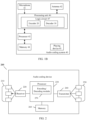
- FIG. 1A is an example of a schematic block diagram of an audio encoding and decoding system 10 applied in this application.
- the audio encoding and decoding system 10 may include a source device 12 and a destination device 14.
- the source device 12 generates encoded audio data, and therefore the source device 12 may be referred to as an audio encoding apparatus.
- the destination device 14 may decode the encoded audio data generated by the source device 12, and therefore the destination device 14 may be referred to as an audio decoding apparatus.
- the source device 12, the destination device 14, or various implementation solutions of the source device 12 or the destination device 14 may include one or more processors and a memory coupled to the one or more processors.
- the memory may include but is not limited to a random access memory (random access memory, RAM), a read-only memory (read-only memory, ROM), a flash memory, or any other medium that may be used to store desired program code in a form of instructions or a data structure accessible by a computer.
- the source device 12 and the destination device 14 may include various apparatuses, including a desktop computer, a mobile computing apparatus, a notebook (for example, a laptop) computer, a tablet computer, a set-top box, a telephone handset such as a so-called "smart" phone, a television, a camera, a display apparatus, a digital media player, an audio game console, a vehicle-mounted computer, a wireless communication device, or the like.
- FIG. 1A depicts the source device 12 and the destination device 14 as separate devices
- a device embodiment may alternatively include both the source device 12 and the destination device 14 or functionalities of both the source device 12 and the destination device 14, namely, the source device 12 or a corresponding functionality and the destination device 14 or a corresponding functionality.
- the source device 12 or the corresponding functionality and the destination device 14 or the corresponding functionality may be implemented by using same hardware and/or software, separate hardware and/or software, or any combination thereof.
- the one or more communication media may include a wireless communication medium and/or a wired communication medium, for example, a radio frequency (RF) spectrum or one or more physical transmission lines.
- the one or more communication media may constitute a part of a packet-based network, and the packet-based network is, for example, a local area network, a wide area network, or a global network (for example, the internet).
- the one or more communication media may include a router, a switch, a base station, or another device that facilitates communication from the source device 12 to the destination device 14.
- the audio source 16 may include or may be any type of audio capture device, for example, configured to capture real-world sound, and/or any type of audio generation device, for example, a computer audio processor, or any type of device configured to obtain and/or provide real-world audio, computer animation audio (for example, screen content and audio in virtual reality (VR)), and/or any combination thereof (for example, audio in augmented reality (AR)).
- the audio source 16 may be a microphone for capturing audio or a memory for storing audio.
- the audio source 16 may further include any type of (internal or external) interface for storing previously captured or generated audio and/or obtaining or receiving audio.
- Audio may be considered as a one-dimensional vector of a pixel (picture element).
- a pixel in the vector may also be referred to as a sample.
- a quantity of samples on the vector or audio defines a size of the audio.
- audio transmitted by the audio source 16 to an audio processor may also be referred to as original audio data 17.
- the audio preprocessor 18 is configured to receive the original audio data 17 and perform preprocessing on the original audio data 17 to obtain preprocessed audio 19 or preprocessed audio data 19.
- the preprocessing performed by the audio preprocessor 18 may include trimming, tuning, or denoising.
- the communication interface 22 may be configured to receive the encoded audio data 21, and transmit the encoded audio data 21 to the destination device 14 or any other device (for example, a memory) through the link 13 for storage or direct reconstruction.
- the any other device may be any device for decoding or storage.
- the communication interface 22 may be, for example, configured to encapsulate the encoded audio data 21 into an appropriate format, for example, a data packet, for transmission through the link 13.
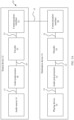
- the destination device 14 includes a decoder 30.
- the destination device 14 may further include a communication interface 28, an audio post-processor 32, and a playing device 34. Descriptions are as follows.
- the communication interface 28 may be configured to receive the encoded audio data 21 from the source device 12 or any other source.
- the any other source is, for example, a storage device.
- the storage device is, for example, an encoded audio data storage device.
- the communication interface 28 may be configured to transmit or receive the encoded audio data 21 through the link 13 between the source device 12 and the destination device 14 or through any type of network.
- the link 13 is, for example, a direct wired or wireless connection.
- the any type of network is, for example, a wired or wireless network or any combination thereof, or any type of private or public network, or any combination thereof.
- the communication interface 28 may be, for example, configured to decapsulate the data packet transmitted through the communication interface 22, to obtain the encoded audio data 21.
- the decoder 30 (or referred to as an audio decoder 30) is configured to receive the encoded audio data 21, and provide decoded audio data 31 or decoded audio 31.
- the decoder 30 may be configured to perform various embodiments described below, to implement application of the bit allocation method for an audio signal described in this application to a decoder side.
- the audio post-processor 32 is configured to perform post-processing on the decoded audio data 31 (also referred to as reconstructed audio data) to obtain post-processed audio data 33.
- the post-processing performed by the audio post-processor 32 may include trimming or resampling, or any other processing, and may be further configured to transmit the post-processed audio data 33 to the playing device 34.
- FIG. 1A depicts the source device 12 and the destination device 14 as separate devices
- a device embodiment may alternatively include both the source device 12 and the destination device 14 or functionalities of both the source device 12 and the destination device 14, namely, the source device 12 or a corresponding functionality and the destination device 14 or a corresponding functionality.
- the source device 12 or the corresponding functionality and the destination device 14 or the corresponding functionality may be implemented by using same hardware and/or software, separate hardware and/or software, or any combination thereof.
- the decoder 30 may be implemented by using the logic circuit 47 in a similar manner, to implement various modules of any other decoder system or subsystem described in this specification.
- the decoder 30 implemented by using the logic circuit may include a buffer (implemented by using the processing unit 46 or the memory 44) and an audio processing unit (for example, implemented by using the processing unit 46).
- the audio processing unit may be communicatively coupled to the buffer.
- the audio processing unit may include the decoder 30 implemented by using the logic circuit 47, to implement various modules of any other decoder system or subsystem described in this specification.
- the encoding/decoding module 270 provides a substantial improvement to functions of the audio coding device 200 and affects a switching of the audio coding device 200 to a different state.
- the encoding/decoding module 270 is implemented as instructions stored in the memory 260 and executed by the processor 230.
- the memory 330 may include a read-only memory (ROM) device or a random access memory (RAM) device. Any other proper type of storage device may also be used as the memory 330.
- the memory 330 may include code and data 331 that are accessed by the processor 310 through the bus 350.
- the memory 330 may further include an operating system 333 and an application 335.
- the bus system 350 may further include a power bus, a control bus, a status signal bus, and the like. However, for clear description, various types of buses in the figure are marked as the bus system 350.
- Step 401 Obtain T audio signals in a current frame.
- the current frame is an audio frame obtained at a current moment in a process of performing the method in this application.
- different sounds are no longer simply represented by using a plurality of channels, but are represented by using different audio signals.
- an environment includes a human sound, a music sound, and a vehicle sound, and three audio signals are separately used to represent the human sound, the music sound, and the vehicle sound.
- each sound is reconstructed in three-dimensional space based on the three audio signals, to represent a plurality of sounds in the three-dimensional space.
- the audio frame may include a plurality of audio signals, and one audio signal represents voice, music, or sound effect in reality. It should be noted that any technology for extracting an audio signal from an audio frame may be used in this application. This is not specifically limited.
- S groups of metadata in the current frame are obtained, where the S groups of metadata correspond to the T audio signals.
- each of the T audio signals corresponds to one group of metadata.
- S T.
- only some of the T audio signals correspond to the metadata. In this case, T > S. This is not specifically limited.
- audio data and metadata are separately generated in this process on an encoder side based on preprocessing of an original voice, music, sound effect, or the like.
- the encoder side may select, based on a principle of an audio frame and corresponding to a start time (sample) and an end time (sample) of the current frame, metadata in a corresponding time range as metadata of the current frame.
- a decoder side may parse a received bitstream to obtain the metadata of the current frame.
- the metadata describes a status of an audio signal in a spatial scene.
- Table 1 describes an example of the metadata.
- Parameters included in the metadata include an object index (object_index), an azimuth (position_azimuth), an elevation (position_elevation), a position radius (position_radius), a gain factor (gain_factor), a uniform spread degree (spread_uniform), a spread width (spread_width), a spread height (spread_height), a spread depth (spread_depth), diffuseness (diffuseness), a priority (priority), divergence (divergence), and a speed (speed).
- the metadata records a value range and a quantity of bits of the foregoing parameters.
- the metadata may further include another parameter and a parameter recording form. This is not specifically limited in this application.
- Step 402 Determine a first audio signal set based on the T audio signals.
- the spread grading parameter describes a playback spread range of the first audio signal in the spatial scene.
- the diffuseness grading parameter describes a diffuseness range of the first audio signal in the spatial scene.
- the status grading parameter describes sound source divergence of the first audio signal in the spatial scene.
- the priority grading parameter describes a priority of the first audio signal in the spatial scene.
- the signal grading parameter describes energy of the first audio signal in an encoding process.
- the following uses an i th audio signal as an example to describe a method for obtaining the foregoing parameters.
- the i th audio signal is any one of the M audio signals. It should be noted that the following several parameters are examples for description, and the scene grading parameter may alternatively be calculated based on another parameter or feature of the audio signal. This is not specifically limited in this application.
- spherical coordinates indicate a location of three-dimensional audio in the spatial scene
- a sphere center is used as the rendering center point
- a sphere radius is a distance between a location of the i th audio signal in the spatial scene and the sphere center
- an included angle between the location of the i th audio signal in the spatial scene and a horizontal plane is the elevation of the i th audio signal
- an included angle between a projection of the location of the i th audio signal in the spatial scene on the horizontal plane and a front of the rendering center point is the azimuth of the i th audio signal
- movement grading parameter may alternatively be calculated by using another method. This is not specifically limited in this application.
- mean ( A i ) indicates a sum or an average value of amplitudes of samples of the i th audio signal in the current frame.
- the amplitudes of the samples may be obtained based on metadata of the i th audio signal.
- ⁇ j 1 M
- mean A j indicates a sum or an average value of amplitudes of samples of the M audio signals in the current frame.
- r i indicates a distance between the i th audio signal and the rendering center point, and may be obtained based on metadata of the i th audio signal.
- gain i indicates a gain of the i th audio signal in rendering.
- the gain may be obtained by a user by customizing the i th audio signal, or may be generated by a decoder according to a specified rule.
- the loudness grading parameter may alternatively be calculated by using another method. This is not specifically limited in this application.
- the spread grading parameter describes a spread degree of the i th audio signal in the current frame, and may be obtained based on spread-related metadata of the i th audio signal. It should be noted that the spread grading parameter may alternatively be calculated by using another method. This is not specifically limited in this application.
- the status grading parameter describes divergence of the i th audio signal in the current frame, and may be obtained based on divergence-related metadata of the i th audio signal. It should be noted that the status grading parameter may alternatively be calculated by using another method. This is not specifically limited in this application.
- the priority grading parameter describes a priority of the i th audio signal in the current frame, and may be obtained based on priority-related metadata of the i th audio signal. It should be noted that the priority grading parameter may alternatively be calculated by using another method. This is not specifically limited in this application.
- a scene grading parameter sceneRatio i of the i th audio signal may be calculated based on the one or more of the parameters.
- the function may be linear or non-linear. This is not specifically limited in this application.
- the value of the weight factor may be preset, or may be obtained through adaptive calculation in an execution process of the method in this application. This is not specifically limited in this application.
- the parameter is used as the scene grading parameter of the i th audio signal.
- a priority of the i th audio signal may be obtained by using the following method.
- a larger scene grading parameter indicates a higher priority.
- a spatial scene uses a rendering center as a sphere center. An audio signal closer to the sphere center has a higher priority. An audio signal farther from the sphere center has a lower priority.
- a priority corresponding to the scene grading parameter of the i th audio signal may be determined as the priority of the i th audio signal based on a specified first correspondence.
- the first correspondence includes correspondences between a plurality of scene grading parameters and a plurality of priorities.
- One or more scene grading parameters correspond to one priority.
- a priority of an audio signal and a correspondence between a scene grading parameter and each priority may be preset.
- Table 2 describes an example of the first correspondence between the scene grading parameters and the priorities.
- Table 2 Scene grading parameter Priority 0.9 1 0.8 2 0.7 3 0.6 4 0.5 5 0.4 6 0.3 7 0.2 8 0.1 9 0 10
- Table 2 when the scene grading parameter of the i th audio signal is 0.4, the corresponding priority is 6. In this case, the priority of the i th audio signal is 6. When the scene grading parameter of the i th audio signal is 0.1, the corresponding priority is 9. In this case, the priority of the i th audio signal is 9. It should be noted that Table 2 is an example of the correspondence between the scene grading parameters and the priorities, and does not constitute a limitation on such a correspondence in this application.
- the scene grading parameter of the i th audio signal may be used as the priority of the i th audio signal.
- the priority may not be classified, and the scene grading parameter of the i th audio signal is directly used as the priority of the i th audio signal.
- a range of the scene grading parameter of the i th audio signal may be determined based on a specified range threshold, and a priority corresponding to the range of the scene grading parameter of the i th audio signal is determined as the priority of the i th audio signal.
- a priority of an audio signal and a correspondence between a range of a scene grading parameter and each priority may be preset.
- Table 3 describes another example of the first correspondence between the scene grading parameters and the priorities.
- Table 3 Range of a scene grading parameter Priority [0.9, 1) 1 [0.8, 0.9) 2 [0.7, 0.8) 3 [0.6, 0.7) 4 [0.5, 0.6) 5 [0.4, 0.5) 6 [0.3, 0.4) 7 [0.2, 0.3) 8 [0.1, 0.2) 9 [0, 0.1) 10
- Table 3 when the scene grading parameter of the i th audio signal is 0.6, the range of the scene grading parameter is [0.6, 0.7), and the corresponding priority is 4. In this case, the priority of the i th audio signal is 4. When the scene grading parameter of the i th audio signal is 0.15, the range of the scene grading parameter is [0.1, 0.2), and the corresponding priority is 9. In this case, the priority of the i th audio signal is 9. It should be noted that Table 3 is an example of the correspondence between the scene grading parameters and the priorities, and does not constitute a limitation on such a correspondence in this application.
- Step 404 Perform bit allocation on the M audio signals based on the M priorities of the M audio signals.
- bit allocation may be performed based on a currently available bit quantity and the M priorities of the M audio signals.
- a higher quantity of bits are allocated to an audio signal with a higher priority.
- the currently available bit quantity refers to a total quantity of bits that can be allocated to the M audio signals in the first audio signal set in the current frame before a codec performs bit allocation.
- a bit quantity ratio of the first audio signal may be determined based on the priority of the first audio signal.
- the first audio signal is any one of the M audio signals.
- a bit quantity of the first audio signal is obtained based on a product of the currently available bit quantity and the bit quantity ratio of the first audio signal.
- a correspondence is pre-established between the priority and the bit quantity ratio of the audio signal.
- One priority may correspond to one bit quantity ratio, or a plurality of priorities may correspond to one bit quantity ratio.
- a corresponding quantity of bits that can be allocated to the audio signal may be obtained through calculation based on the bit quantity ratio and the currently available bit quantity.
- M is 3, a priority of a first audio signal is 1, a priority of a second audio signal is 2, and a priority of a third audio signal is 3. It is assumed that a ratio corresponding to the priority 1 is set to 50%, a ratio corresponding to the priority 2 is set to 30%, a ratio corresponding to the priority 3 is set to 20%, and the currently available bit quantity is 100. In this case, a quantity of bits allocated to the first audio signal is 50, a quantity of bits allocated to the second audio signal is 30, and a quantity of bits allocated to the third audio signal is 20. It should be noted that, in different audio frames, a bit quantity corresponding to a priority may be adaptively adjusted. This is not specifically limited.
- the bit quantity corresponding to the priority of the first audio signal may be determined as the bit quantity of the first audio signal based on a specified second correspondence.
- the second correspondence includes correspondences between a plurality of priorities and a plurality of bit quantities.
- One or more priorities correspond to one bit quantity.
- a correspondence is pre-established between the priority and the bit quantity of the audio signal.
- One priority may correspond to one bit quantity, or a plurality of priorities may correspond to one bit quantity.
- the corresponding bit quantity may be obtained. For example, M is 3, a priority of a first audio signal is 1, a priority of a second audio signal is 2, and a priority of a third audio signal is 3. It is assumed that a bit quantity corresponding to the priority 1 is set to 50, a bit quantity corresponding to the priority 2 is set to 30, and a bit quantity corresponding to the priority 3 is set to 20.
- bit allocation between the audio signals may be determined based on an absolute energy ratio between the audio signals in an encoding and decoding process.
- bit allocation between the audio signals may be determined based on the scene grading parameter of the audio signal.
- bits _ object nrgRatio i ⁇ bits _ available , where ⁇ indicates an upper limit of the scene grading parameter, and nrgRatio i indicates an absolute energy ratio between the i th audio signal and another audio signal.
- bits _ object i sceneRatio, ⁇ bits _ available , where ⁇ indicates a lower limit of the scene grading parameter.
- bits _ object objRatio, ⁇ bits _ available , where objRatio i indicates a bit allocation factor of the i th audio signal.
- the M audio signals are determined from the T audio signals of the current frame and added to the first audio signal set.
- the method in step 403 and step 404 is used for the M audio signals.
- a priority of each audio signal is first determined, and then a quantity of bits allocated to each audio signal is determined based on the priority of the audio signal.
- T > M audio signals in the first audio signal set are not all audio signals in the current frame, and remaining audio signals may be added to a second audio signal set.
- a simple method may be used to determine a quantity of bits allocated to the N audio signals.
- a total available bit quantity of the second audio signal set is averaged by N to obtain a bit quantity of each audio signal.
- a total quantity of available bits of the second audio signal set are evenly allocated to the N audio signals in the set.
- another method may alternatively be used to obtain the bit quantity of each audio signal in the second audio signal set. This is not specifically limited in this application.
- this application further provides a priority combination method based on a plurality of priority determining methods, namely, a method for determining a final priority of an audio signal whose priority may be obtained by using a plurality of methods.
- the following uses the first audio signal as an example for description.
- the first audio signal is any one of the M audio signals.
- a first priority of the first audio signal is obtained based on the first scene grading parameter.
- the priority may be obtained by using the method in step 403, or may be obtained by using another method.
- a second priority of the first audio signal is obtained based on the second scene grading parameter.
- a method used herein is different from a method for calculating the first priority.
- the priority of the first audio signal is obtained based on the first priority and the second priority.
- a weighted averaging method may be used, or an averaging method may be used, or a method of obtaining a larger value or a smaller value may be used to determine the final priority of the audio signal.
- the decoding device After receiving the bitstream, the decoding device performs the foregoing bit allocation method for an audio signal based on the T first identifiers, the T second identifiers, and the T third identifiers that are carried in the bitstream, to determine the bit quantity of the T audio signals.
- the decoding device may directly determine the audio signal set to which the T audio signals belong, the priority, and the quantity of allocated bits based on the T first identifiers, the T second identifiers, and the T third identifiers that are carried in the bitstream, to decode the bitstream and obtain the T audio signals.
- the first identifier, the second identifier, and the third identifier are identifier information added on the basis of the method embodiment shown in FIG. 4 , so that an encoder side or a decoder side of an audio signal can encode or decode the audio signal based on the same method.
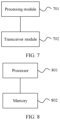
- FIG. 7 is a schematic diagram of a structure of an apparatus according to an embodiment of this application. As shown in FIG. 7 , the apparatus may be applied to the encoding device or the decoding device in the foregoing embodiments.
- the apparatus in this embodiment may include a processing module 701 and a transceiver module 702.
- the processing module 701 is configured to: obtain T audio signals in a current frame, where T is a positive integer; determine a first audio signal set based on the T audio signals, where the first audio signal set includes M audio signals, M is a positive integer, the T audio signals include the M audio signals, and T ⁇ M; determine M priorities of the M audio signals in the first audio signal set; and perform bit allocation on the M audio signals based on the M priorities of the M audio signals.
- the processing module 701 is specifically configured to: obtain a scene grading parameter of each of the M audio signals; and determine the M priorities of the M audio signals based on the scene grading parameter of each of the M audio signals.
- the processing module 701 is specifically configured to obtain S groups of metadata in the current frame, where S is a positive integer, T ⁇ S, the S groups of metadata correspond to the T audio signals, and the metadata describes a status of a corresponding audio signal in the spatial scene.
- the processing module 701 is specifically configured to: obtain one or more of a movement grading parameter, a loudness grading parameter, a spread grading parameter, a diffuseness grading parameter, a status grading parameter, a priority grading parameter, and a signal grading parameter of a first audio signal based on metadata corresponding to the first audio signal or based on the first audio signal and the metadata corresponding to the first audio signal, where the first audio signal is any one of the M audio signals; and obtain a scene grading parameter of the first audio signal based on the obtained one or more of the movement grading parameter, the loudness grading parameter, the spread grading parameter, the diffuseness grading parameter, the status grading parameter, the priority grading parameter, and the signal grading parameter, where the movement grading parameter describes a movement speed of the first audio signal in a unit time in a spatial scene, the loudness grading parameter describes loudness of the first audio signal in the spatial scene, the spread
- the processing module 701 is specifically configured to: perform weighed averaging on the obtained more of the movement grading parameter, the loudness grading parameter, the spread grading parameter, the diffuseness grading parameter, the status grading parameter, the priority grading parameter, and the signal grading parameter to obtain the scene grading parameter; perform averaging on the obtained more of the movement grading parameter, the loudness grading parameter, the spread grading parameter, the diffuseness grading parameter, the status grading parameter, the priority grading parameter, and the signal grading parameter to obtain the scene grading parameter; or use, as the scene grading parameter, the obtained one of the movement grading parameter, the loudness grading parameter, the spread grading parameter, the diffuseness grading parameter, the status grading parameter, the priority grading parameter, and the signal grading parameter.
- the processing module 701 is specifically configured to: determine a priority corresponding to the scene grading parameter of the first audio signal as a priority of the first audio signal based on a specified first correspondence, where the first correspondence includes correspondences between a plurality of scene grading parameters and a plurality of priorities, one or more scene grading parameters correspond to one priority, and the first audio signal is any one of the M audio signals; use the scene grading parameter of the first audio signal as a priority of the first audio signal; or determine a range of the scene grading parameter of the first audio signal based on a specified range threshold, and determining a priority corresponding to the range of the scene grading parameter of the first audio signal as a priority of the first audio signal.
- the processing module 701 is specifically configured to perform bit allocation based on a currently available bit quantity and the M priorities of the M audio signals, where a higher quantity of bits are allocated to an audio signal with a higher priority.
- the processing module 701 is specifically configured to determine a bit quantity of the first audio signal from a specified second correspondence based on the priority of the first audio signal, where the second correspondence includes correspondences between a plurality of priorities and a plurality of bit quantities, one or more priorities correspond to one bit quantity, and the first audio signal is any one of the M audio signals.
- the processing module 701 is specifically configured to add a pre-specified audio signal of the T audio signals to the first audio signal set.
- the processing module 701 is specifically configured to: add, to the first audio signal set, an audio signal that is in the T audio signals and that corresponds to the S groups of metadata; or add, to the first audio signal set, an audio signal that corresponds to a priority parameter greater than or equal to a specified participation threshold, where the metadata includes the priority parameter, and the T audio signals include the audio signal that corresponds to the priority parameter.
- the processing module 701 is specifically configured to: obtain one or more of a movement grading parameter, a loudness grading parameter, a spread grading parameter, and a diffuseness grading parameter of a first audio signal, where the first audio signal is any one of the M audio signals; obtain a first scene grading parameter of the first audio signal based on the obtained one or more of the movement grading parameter, the loudness grading parameter, the spread grading parameter, and the diffuseness grading parameter; obtain one or more of a status grading parameter, a priority grading parameter, and a signal grading parameter of the first audio signal; obtain a second scene grading parameter of the first audio signal based on the obtained one or more of the status grading parameter, the priority grading parameter, and the signal grading parameter; and obtain a scene grading parameter of the first audio signal based on the first scene grading parameter and the second scene grading parameter, where the movement grading parameter describes a movement speed
- the processing module 701 is specifically configured to: obtain one or more of a movement grading parameter, a loudness grading parameter, a spread grading parameter, and a diffuseness grading parameter of a first audio signal based on metadata corresponding to the first audio signal or based on the first audio signal and the metadata corresponding to the first audio signal, where the first audio signal is any one of the M audio signals; obtain a first scene grading parameter of the first audio signal based on the obtained one or more of the movement grading parameter, the loudness grading parameter, the spread grading parameter, and the diffuseness grading parameter; obtain one or more of a status grading parameter, a priority grading parameter, and a signal grading parameter of the first audio signal based on the metadata corresponding to the first audio signal or based on the first audio signal and the metadata corresponding to the first audio signal; obtain a second scene grading parameter of the first audio signal based on the obtained one or more of the status grading parameter, the
- the processing module 701 is specifically configured to: obtain a first priority of the first audio signal based on the first scene grading parameter; obtain a second priority of the first audio signal based on the second scene grading parameter; and obtain the priority of the first audio signal based on the first priority and the second priority.
- the processing module 701 is further configured to encode the M audio signals based on a quantity of bits allocated to the M audio signals, to obtain an encoded bitstream.
- the encoded bitstream includes a bit quantity of the M audio signals.
- the apparatus further includes the transceiver module 702, configured to receive the encoded bitstream.
- the processing module 701 is further configured to obtain a bit quantity of each of the M audio signals and reconstruct the M audio signals based on the bit quantity of each of the M audio signals and the encoded bitstream.
- the apparatus in this embodiment may be configured to execute the technical solution of the method embodiment shown in FIG. 4 .
- Implementation principles and technical effects thereof are similar, and details are not described herein again.
- FIG. 8 is a schematic diagram of a structure of a device according to an embodiment of this application. As shown in FIG. 8 , the device may be applied to the encoding device or the decoding device in the foregoing embodiments.
- the device in this embodiment may include a processor 801 and a memory 802.
- the memory 802 is configured to store one or more programs. When the one or more programs are executed by the processor 801, the processor 801 is enabled to implement the technical solution of the method embodiment shown in FIG. 4 .
- the steps in the foregoing method embodiments can be implemented by a hardware integrated logical circuit in the processor, or by using instructions in a form of software.
- the processor may be a general-purpose processor, a digital signal processor (digital signal processor, DSP), an application-specific integrated circuit (application-specific integrated circuit, ASIC), a field programmable gate array (field programmable gate array, FPGA) or another programmable logic device, a discrete gate or transistor logic device, or a discrete hardware component.
- the general-purpose processor may be a microprocessor, or the processor may be any conventional processor, or the like.
- the steps of the methods disclosed with reference to this application may be directly performed by a hardware encoding processor, or may be performed by a combination of hardware and a software module in an encoding processor.
- the software module may be located in a storage medium mature in the art, such as a random access memory, a flash memory, a read-only memory, a programmable read-only memory, an electrically erasable programmable memory, or a register.
- the storage medium is located in the memory.
- the processor reads information in the memory and completes the steps in the foregoing methods in combination with hardware of the processor.
- the memory in the foregoing embodiments may be a volatile memory or a nonvolatile memory, or may include both a volatile memory and a nonvolatile memory.
- the non-volatile memory may be a read-only memory (read-only memory, ROM), a programmable read-only memory (programmable ROM, PROM), an erasable programmable read-only memory (erasable PROM, EPROM), an electrically erasable programmable read-only memory (electrically EPROM, EEPROM), or a flash memory.
- the volatile memory may be a random access memory (random access memory, RAM), used as an external cache.
- RAMs may be used, for example, a static random access memory (static RAM, SRAM), a dynamic random access memory (dynamic RAM, DRAM), a synchronous dynamic random access memory (synchronous DRAM, SDRAM), a double data rate synchronous dynamic random access memory (double data rate SDRAM, DDR SDRAM), an enhanced synchronous dynamic random access memory (enhanced SDRAM, ESDRAM), a synchronous link dynamic random access memory (synchlink DRAM, SLDRAM), and a direct rambus random access memory (direct rambus RAM, DR RAM).
- static random access memory static random access memory
- DRAM dynamic random access memory
- DRAM dynamic random access memory
- SDRAM synchronous dynamic random access memory
- double data rate SDRAM double data rate SDRAM
- DDR SDRAM double data rate SDRAM
- ESDRAM enhanced synchronous dynamic random access memory
- SLDRAM synchronous link dynamic random access memory
- direct rambus RAM direct rambus RAM
- the disclosed system, apparatus, and method may be implemented in other manners.
- the described apparatus embodiment is merely an example.
- division into the units is merely logical function division and may be other division in actual implementation.
- a plurality of units or components may be combined or integrated into another system, or some features may be ignored or not performed.
- the displayed or discussed mutual couplings or direct couplings or communication connections may be implemented by using some interfaces.
- the indirect couplings or communication connections between the apparatuses or units may be implemented in electronic, mechanical, or other forms.
- the functions When the functions are implemented in the form of a software functional unit and sold or used as an independent product, the functions may be stored in a computer-readable storage medium. Based on such an understanding, the technical solutions of this application essentially, or the part contributing to the conventional technology, or some of the technical solutions may be implemented in a form of a software product.
- the computer software product is stored in a storage medium, and includes several instructions for instructing a computer device (which may be a personal computer, a server, a network device, or the like) to perform all or some of the steps of the methods described in embodiments of this application.
Landscapes
- Engineering & Computer Science (AREA)
- Physics & Mathematics (AREA)
- Health & Medical Sciences (AREA)
- Signal Processing (AREA)
- Audiology, Speech & Language Pathology (AREA)
- Human Computer Interaction (AREA)
- Computational Linguistics (AREA)
- Acoustics & Sound (AREA)
- Multimedia (AREA)
- Mathematical Physics (AREA)
- Stereophonic System (AREA)
- Compression, Expansion, Code Conversion, And Decoders (AREA)
- Stereo-Broadcasting Methods (AREA)
- Signal Processing For Digital Recording And Reproducing (AREA)
Claims (15)
- Bitzuordnungsverfahren für ein Audiosignal (400), umfassend:Erlangen von T Audiosignalen in einem aktuellen Frame, wobei T eine positive ganze Zahl ist (401);Bestimmen eines ersten Audiosignalsatzes basierend auf den T Audiosignalen, wobei der erste Audiosignalsatz M Audiosignale umfasst, M eine positive ganze Zahl ist, die T Audiosignale die M Audiosignale umfassen und T ≥ M (402) ist;Bestimmen von M Prioritäten der M Audiosignale in dem ersten Audiosignalsatz (403); undDurchführen einer Bitzuordnung an den M Audiosignalen basierend auf den M Prioritäten der M Audiosignale (404);wobei das Bestimmen von M Prioritäten der M Audiosignale in dem ersten Audiosignalsatz Folgendes umfasst:Erlangen eines Szenenbewertungsparameters für jedes der M Audiosignale; undBestimmen der M Prioritäten der M Audiosignale basierend auf dem Szenenbewertungsparameter von jedem der M Audiosignale;wobei das Bestimmen der M Prioritäten der M Audiosignale basierend auf dem Szenenbewertungsparameter von jedem der M Audiosignale Folgendes beinhaltet: Erlangen einer ersten Priorität des ersten Audiosignals basierend auf dem ersten Szenenbewertungsparameter; Erlangen einer zweiten Priorität des ersten Audiosignals basierend auf dem zweiten Szenenbewertungsparameter; und Erlangen der Priorität des ersten Audiosignals basierend auf der ersten Priorität und der zweiten Priorität; wobeiein Verfahren, das zum Erlangen der zweiten Priorität des ersten Audiosignals verwendet wird, sich von dem unterscheidet, das zum Erlangen der ersten Priorität des ersten Audiosignals verwendet wird.
- Verfahren nach Anspruch 1, wobei das Erlangen eines Szenenbewertungsparameters von jedem der M Audiosignale Folgendes umfasst:Erlangen eines oder mehrerer eines Bewegungsbewertungsparameters, eines Lautstärkebewertungsparameters, eines Ausbreitungsbewertungsparameters, eines Diffusitätsbewertungsparameters, eines Statusbewertungsparameters, eines Prioritätsbewertungsparameters und eines Signalbewertungsparameters eines ersten Audiosignals, wobei das erste Audiosignal ein beliebiges der M Audiosignale ist; undErlangen eines Szenenbewertungsparameters des ersten Audiosignals basierend auf dem erlangten einen oder mehreren des Bewegungsbewertungsparameters, des Lautstärkebewertungsparameters, des Ausbreitungsbewertungsparameters, des Diffusitätsbewertungsparameters des Statusbewertungsparameters, des Prioritätsbewertungsparameters und des Signalbewertungsparameters, wobeider Bewegungsbewertungsparameter eine Bewegungsgeschwindigkeit des ersten Audiosignals in einer Zeiteinheit in einer räumlichen Szene beschreibt, der Lautstärkebewertungsparameter eine Lautstärke des ersten Audiosignals in der räumlichen Szene beschreibt, der Ausbreitungsbewertungsparameter einen Ausbreitungsbereich des ersten Audiosignals in der räumlichen Szene beschreibt, der Diffusitätsbewertungsparameter einen Diffusitätsbereich des ersten Audiosignals in der räumlichen Szene beschreibt, der Statusbewertungsparameter eine Tonquellendivergenz des ersten Audiosignals in der räumlichen Szene beschreibt, der Prioritätsbewertungsparameter eine Priorität des ersten Audiosignals in der räumlichen Szene beschreibt und der Signalbewertungsparameter eine Energie des ersten Audiosignals in einem Codierungsprozess beschreibt.
- Verfahren nach Anspruch 1, wobei das Verfahren ferner Folgendes umfasst:
Erlangen von S Gruppen von Metadaten in dem aktuellen Frame, wobei S eine positive ganze Zahl ist, T ≥ S ist, die S Gruppen von Metadaten den T Audiosignalen entsprechen und die Metadaten einen Status eines entsprechenden Audiosignals in einer räumlichen Szene beschreiben. - Verfahren nach Anspruch 3, wobei das Erlangen eines Szenenbewertungsparameters von jedem der M Audiosignale Folgendes umfasst:Erlangen eines oder mehrerer eines Bewegungsbewertungsparameters, eines Lautstärkebewertungsparameters, eines Ausbreitungsbewertungsparameters, eines Diffusitätsbewertungsparameters, eines Statusbewertungsparameters, eines Prioritätsbewertungsparameters und eines Signalbewertungsparameters eines ersten Audiosignals basierend auf Metadaten, die dem ersten Audiosignal entsprechen, oder basierend auf dem ersten Audiosignal und den Metadaten, die dem ersten Audiosignal entsprechen, wobei das erste Audiosignal ein beliebiges der M Audiosignale ist; undErlangen eines Szenenbewertungsparameters des ersten Audiosignals basierend auf dem erlangten einen oder mehreren des Bewegungsbewertungsparameters, des Lautstärkebewertungsparameters, des Ausbreitungsbewertungsparameters, des Diffusitätsbewertungsparameters des Statusbewertungsparameters, des Prioritätsbewertungsparameters und des Signalbewertungsparameters, wobeider Bewegungsbewertungsparameter eine Bewegungsgeschwindigkeit des ersten Audiosignals in einer Zeiteinheit in der räumlichen Szene beschreibt, der Lautstärkebewertungsparameter eine Lautstärke des ersten Audiosignals in der räumlichen Szene beschreibt, der Ausbreitungsbewertungsparameter einen Ausbreitungsbereich des ersten Audiosignals in der räumlichen Szene beschreibt, der Diffusitätsbewertungsparameter einen Diffusitätsbereich des ersten Audiosignals in der räumlichen Szene beschreibt, der Statusbewertungsparameter eine Tonquellendivergenz des ersten Audiosignals in der räumlichen Szene beschreibt, der Prioritätsbewertungsparameter eine Priorität des ersten Audiosignals in der räumlichen Szene beschreibt und der Signalbewertungsparameter eine Energie des ersten Audiosignals in einem Codierungsprozess beschreibt.
- Verfahren nach Anspruch 2 oder 4, wobei das Erlangen eines Szenenbewertungsparameters des ersten Audiosignals basierend auf dem erlangten einen oder mehreren des Bewegungsbewertungsparameters, des Lautstärkebewertungsparameters, des Ausbreitungsbewertungsparameters, des Diffusitätsbewertungsparameters, des Statusbewertungsparameters, des Prioritätsbewertungsparameters und des Signalbewertungsparameters Folgendes umfasst:Durchführen einer gewichteten Mittelung an den erlangten mehreren des Bewegungsbewertungsparameters, des Lautstärkebewertungsparameters, des Ausbreitungsbewertungsparameters, des Diffusitätsbewertungsparameters des Statusbewertungsparameters, des Prioritätsbewertungsparameters und des Signalbewertungsparameters, um den Szenenbewertungsparameter zu erlangen;Durchführen einer Mittelung an den erlangten mehreren des Bewegungsbewertungsparameters, des Lautstärkebewertungsparameters, des Ausbreitungsbewertungsparameters, des Diffusitätsbewertungsparameters des Statusbewertungsparameters, des Prioritätsbewertungsparameters und des Signalbewertungsparameters, um den Szenenbewertungsparameter zu erlangen; oderVerwenden des erlangten einen des Bewegungsbewertungsparameters, des Lautstärkebewertungsparameters, des Ausbreitungsbewertungsparameters, des Diffusitätsbewertungsparameters des Statusbewertungsparameters, des Prioritätsbewertungsparameters und des Signalbewertungsparameters als den Szenenbewertungsparameter.
- Verfahren nach einem der Ansprüche 1 bis 5, wobei das Bestimmen der M Prioritäten der M Audiosignale basierend auf dem Szenenbewertungsparameter von jedem der M Audiosignale Folgendes umfasst:Bestimmen einer Priorität, die dem Szenenbewertungsparameter des ersten Audiosignals entspricht, als eine Priorität des ersten Audiosignals basierend auf einer festgelegten ersten Entsprechung, wobei die erste Entsprechung Entsprechungen zwischen einer Vielzahl von Szenenbewertungsparametern und einer Vielzahl von Prioritäten umfasst, ein oder mehrere Szenenbewertungsparameter einer Priorität entsprechen und das erste Audiosignal ein beliebiges der M Audiosignale ist;Verwenden des Szenenbewertungsparameters des ersten Audiosignals als eine Priorität des ersten Audiosignals; oderBestimmen eines Bereichs des Szenenbewertungsparameters des ersten Audiosignals basierend auf einer Vielzahl von festgelegten Bereichsschwellenwerten und Bestimmen einer Priorität, die dem Bereich des Szenenbewertungsparameters des ersten Audiosignals entspricht, als eine Priorität des ersten Audiosignals.
- Verfahren nach einem der Ansprüche 1 bis 6, wobei das Durchführen einer Bitzuordnung an den M Audiosignalen basierend auf den M Prioritäten der M Audiosignale Folgendes umfasst:
Durchführen einer Bitzuordnung basierend auf einer aktuell verfügbaren Bitmenge und den M Prioritäten der M Audiosignale, wobei einem Audiosignal mit einer höheren Priorität eine größere Menge an Bits zugeordnet wird. - Verfahren nach Anspruch 7, wobei das Durchführen einer Bitzuordnung basierend auf einer aktuell verfügbaren Bitmenge und den M Prioritäten der M Audiosignale Folgendes umfasst:Bestimmen eines Bitmengenverhältnisses des ersten Audiosignals basierend auf der Priorität des ersten Audiosignals, wobei das erste Audiosignal ein beliebiges der M Audiosignale ist; undErlangen einer Bitmenge des ersten Audiosignals basierend auf einem Produkt aus der aktuell verfügbaren Bitmenge und dem Bitmengenverhältnis des ersten Audiosignals.
- Verfahren nach Anspruch 7, wobei das Durchführen einer Bitzuordnung basierend auf einer aktuell verfügbaren Bitmenge und den M Prioritäten der M Audiosignale Folgendes umfasst:
Bestimmen einer Bitmenge des ersten Audiosignals anhand einer festgelegten zweiten Entsprechung basierend auf der Priorität des ersten Audiosignals, wobei die zweite Entsprechung Entsprechungen zwischen einer Vielzahl von Prioritäten und einer Vielzahl von Bitmengen umfasst, eine oder mehrere Prioritäten einer Bitmenge entsprechen und das erste Audiosignal ein beliebiges der M Audiosignale ist. - Verfahren nach einem der Ansprüche 1 bis 9, wobei das Bestimmen eines ersten Audiosignalsatzes basierend auf den T Audiosignalen Folgendes umfasst:
Hinzufügen eines vorab festgelegten Audiosignals der T-Audiosignale zu dem ersten Audiosignalsatz. - Verfahren nach Anspruch 3, wobei das Bestimmen eines ersten Audiosignalsatzes basierend auf den T Audiosignalen Folgendes umfasst:Hinzufügen, zu dem ersten Audiosignalsatz, eines Audiosignals, das zu den T Audiosignalen gehört und das den S Gruppen von Metadaten entspricht; oderHinzufügen, zu dem ersten Audiosignalsatz, eines Audiosignals, das einem Prioritätsparameter entspricht, der größer als ein festgelegter Teilnahmeschwellenwert oder gleich diesem ist, wobei die Metadaten den Prioritätsparameter umfassen und die T Audiosignale das Audiosignal umfassen, das dem Prioritätsparameter entspricht.
- Verfahren nach Anspruch 1, wobei das Erlangen eines Szenenbewertungsparameters von jedem der M Audiosignale Folgendes umfasst:Erlangen eines oder mehrerer eines Bewegungsbewertungsparameters, eines Lautstärkebewertungsparameters, eines Ausbreitungsbewertungsparameters und eines Diffusitätsbewertungsparameters des ersten Audiosignals, wobei das erste Audiosignal ein beliebiges der M Audiosignale ist;Erlangen eines ersten Szenenbewertungsparameters des ersten Audiosignals basierend auf dem erlangten einen oder mehreren des Bewegungsbewertungsparameters, des Lautstärkebewertungsparameters, des Ausbreitungsbewertungsparameters und des Diffusitätsbewertungsparameters;Erlangen eines oder mehrerer eines Statusbewertungsparameters, eines Prioritätsbewertungsparameters und eines Signalbewertungsparameters des ersten Audiosignals;Erlangen eines zweiten Szenenbewertungsparameters des ersten Audiosignals basierend auf dem erlangten einen oder mehreren des Statusbewertungsparameters, des Prioritätsbewertungsparameters und des Signalbewertungsparameters; undErlangen eines Szenenbewertungsparameters des ersten Audiosignals basierend auf dem ersten Szenenbewertungsparameter und dem zweiten Szenenbewertungsparameter, wobeider Bewegungsbewertungsparameter eine Bewegungsgeschwindigkeit des ersten Audiosignals in einer Zeiteinheit in einer räumlichen Szene beschreibt, der Lautstärkebewertungsparameter eine Wiedergabelautstärke des ersten Audiosignals in der räumlichen Szene beschreibt, der Ausbreitungsbewertungsparameter einen Wiedergabeausbreitungsbereich des ersten Audiosignals in der räumlichen Szene beschreibt, der Diffusitätsbewertungsparameter einen Diffusitätsbereich des ersten Audiosignals in der räumlichen Szene beschreibt, der Statusbewertungsparameter eine Tonquellendivergenz des ersten Audiosignals in der räumlichen Szene beschreibt, der Prioritätsbewertungsparameter eine Priorität des ersten Audiosignals in der räumlichen Szene beschreibt und der Signalbewertungsparameter eine Energie des ersten Audiosignals in einem Codierungsprozess beschreibt.
- Verfahren nach Anspruch 3, wobei das Erlangen eines Szenenbewertungsparameters von jedem der M Audiosignale Folgendes umfasst:Erlangen eines oder mehrerer eines Bewegungsbewertungsparameters, eines Lautstärkebewertungsparameters, eines Ausbreitungsbewertungsparameters und eines Diffusitätsbewertungsparameters eines ersten Audiosignals basierend auf Metadaten, die dem ersten Audiosignal entsprechen, oder basierend auf dem ersten Audiosignal und den Metadaten, die dem ersten Audiosignal entsprechen, wobei das erste Audiosignal ein beliebiges der M Audiosignale ist;Erlangen eines ersten Szenenbewertungsparameters des ersten Audiosignals basierend auf dem erlangten einen oder mehreren des Bewegungsbewertungsparameters, des Lautstärkebewertungsparameters, des Ausbreitungsbewertungsparameters und des Diffusitätsbewertungsparameters;Erlangen eines oder mehrerer eines Statusbewertungsparameters, eines Prioritätsbewertungsparameters und eines Signalbewertungsparameters des ersten Audiosignals basierend auf den Metadaten, die dem ersten Audiosignal entsprechen, oder basierend auf dem ersten Audiosignal und den Metadaten, die dem ersten Audiosignal entsprechen;Erlangen eines zweiten Szenenbewertungsparameters des ersten Audiosignals basierend auf dem erlangten einen oder mehreren des Statusbewertungsparameters, des Prioritätsbewertungsparameters und des Signalbewertungsparameters; undErlangen eines Szenenbewertungsparameters des ersten Audiosignals basierend auf dem ersten Szenenbewertungsparameter und dem zweiten Szenenbewertungsparameter, wobeider Bewegungsbewertungsparameter eine Bewegungsgeschwindigkeit des ersten Audiosignals in einer Zeiteinheit in der räumlichen Szene beschreibt, der Lautstärkebewertungsparameter eine Wiedergabelautstärke des ersten Audiosignals in der räumlichen Szene beschreibt, der Ausbreitungsbewertungsparameter einen Wiedergabeausbreitungsbereich des ersten Audiosignals in der räumlichen Szene beschreibt, der Diffusitätsbewertungsparameter einen Diffusitätsbereich des ersten Audiosignals in der räumlichen Szene beschreibt, der Statusbewertungsparameter eine Tonquellendivergenz des ersten Audiosignals in der räumlichen Szene beschreibt, der Prioritätsbewertungsparameter eine Priorität des ersten Audiosignals in der räumlichen Szene beschreibt und der Signalbewertungsparameter eine Energie des ersten Audiosignals in einem Codierungsprozess beschreibt.
- Einrichtung, umfassend:einen oder mehrere Prozessoren; undeinen Speicher, der dazu konfiguriert ist, ein oder mehrere Programme zu speichern, wobeiwenn das eine oder die mehreren Programme durch den einen oder die mehreren Prozessoren ausgeführt werden, der eine oder die mehreren Prozessoren in die Lage versetzt werden, das Verfahren nach einem der Ansprüche 1 bis 13 zu implementieren.
- Computerlesbares Speichermedium, umfassend ein Computerprogramm, wobei, wenn das Computerprogramm auf einem Computer ausgeführt wird, der Computer in die Lage versetzt wird, das Verfahren nach einem der Ansprüche 1 bis 13 durchzuführen.
Applications Claiming Priority (2)
| Application Number | Priority Date | Filing Date | Title |
|---|---|---|---|
| CN202010368424.9A CN113593585A (zh) | 2020-04-30 | 2020-04-30 | 音频信号的比特分配方法和装置 |
| PCT/CN2021/084578 WO2021218558A1 (zh) | 2020-04-30 | 2021-03-31 | 音频信号的比特分配方法和装置 |
Publications (3)
| Publication Number | Publication Date |
|---|---|
| EP4131259A1 EP4131259A1 (de) | 2023-02-08 |
| EP4131259A4 EP4131259A4 (de) | 2023-09-20 |
| EP4131259B1 true EP4131259B1 (de) | 2025-06-25 |
Family
ID=78237842
Family Applications (1)
| Application Number | Title | Priority Date | Filing Date |
|---|---|---|---|
| EP21797604.2A Active EP4131259B1 (de) | 2020-04-30 | 2021-03-31 | Bitzuordnungsverfahren und -vorrichtung für tonsignale |
Country Status (8)
| Country | Link |
|---|---|
| US (1) | US11900950B2 (de) |
| EP (1) | EP4131259B1 (de) |
| JP (1) | JP7550881B2 (de) |
| KR (1) | KR102868387B1 (de) |
| CN (1) | CN113593585A (de) |
| BR (1) | BR112022021882A2 (de) |
| TW (1) | TWI773286B (de) |
| WO (1) | WO2021218558A1 (de) |
Families Citing this family (6)
| Publication number | Priority date | Publication date | Assignee | Title |
|---|---|---|---|---|
| CN112767953B (zh) * | 2020-06-24 | 2024-01-23 | 腾讯科技(深圳)有限公司 | 语音编码方法、装置、计算机设备和存储介质 |
| CN115497485B (zh) * | 2021-06-18 | 2024-10-18 | 华为技术有限公司 | 三维音频信号编码方法、装置、编码器和系统 |
| CN115002613A (zh) * | 2022-04-18 | 2022-09-02 | 北京安声科技有限公司 | 耳机 |
| GB2624890A (en) * | 2022-11-29 | 2024-06-05 | Nokia Technologies Oy | Parametric spatial audio encoding |
| WO2025015478A1 (zh) * | 2023-07-14 | 2025-01-23 | 北京小米移动软件有限公司 | 信号处理方法及其装置 |
| WO2025081393A1 (zh) * | 2023-10-18 | 2025-04-24 | 北京小米移动软件有限公司 | 音频信号的处理方法、装置、音频设备及存储介质 |
Family Cites Families (16)
| Publication number | Priority date | Publication date | Assignee | Title |
|---|---|---|---|---|
| US5632005A (en) * | 1991-01-08 | 1997-05-20 | Ray Milton Dolby | Encoder/decoder for multidimensional sound fields |
| KR100228688B1 (ko) * | 1991-01-08 | 1999-11-01 | 쥬더 에드 에이. | 다차원 음장용 인코우더/디코우더 |
| CN101217037B (zh) * | 2007-01-05 | 2011-09-14 | 华为技术有限公司 | 对音频信号的编码速率进行源控的方法和系统 |
| WO2009039897A1 (en) * | 2007-09-26 | 2009-04-02 | Fraunhofer - Gesellschaft Zur Förderung Der Angewandten Forschung E.V. | Apparatus and method for extracting an ambient signal in an apparatus and method for obtaining weighting coefficients for extracting an ambient signal and computer program |
| CN101950562A (zh) * | 2010-11-03 | 2011-01-19 | 武汉大学 | 基于音频关注度的分级编码方法及系统 |
| EP2469741A1 (de) * | 2010-12-21 | 2012-06-27 | Thomson Licensing | Verfahren und Vorrichtung zur Kodierung und Dekodierung aufeinanderfolgender Rahmen einer Ambisonics-Darstellung eines 2- oder 3-dimensionalen Schallfelds |
| US9754595B2 (en) * | 2011-06-09 | 2017-09-05 | Samsung Electronics Co., Ltd. | Method and apparatus for encoding and decoding 3-dimensional audio signal |
| US9412385B2 (en) * | 2013-05-28 | 2016-08-09 | Qualcomm Incorporated | Performing spatial masking with respect to spherical harmonic coefficients |
| US20140355769A1 (en) * | 2013-05-29 | 2014-12-04 | Qualcomm Incorporated | Energy preservation for decomposed representations of a sound field |
| EP3059732B1 (de) * | 2013-10-17 | 2018-10-10 | Socionext Inc. | Audiodecodierungsvorrichtung |
| US9564136B2 (en) * | 2014-03-06 | 2017-02-07 | Dts, Inc. | Post-encoding bitrate reduction of multiple object audio |
| CN103928030B (zh) * | 2014-04-30 | 2017-03-15 | 武汉大学 | 基于子带空间关注测度的可分级音频编码系统及方法 |
| CN108496221B (zh) * | 2016-01-26 | 2020-01-21 | 杜比实验室特许公司 | 自适应量化 |
| US20180338212A1 (en) * | 2017-05-18 | 2018-11-22 | Qualcomm Incorporated | Layered intermediate compression for higher order ambisonic audio data |
| US10854209B2 (en) * | 2017-10-03 | 2020-12-01 | Qualcomm Incorporated | Multi-stream audio coding |
| JP2019121037A (ja) * | 2017-12-28 | 2019-07-22 | ソニー株式会社 | 情報処理装置、情報処理方法およびプログラム |
-
2020
- 2020-04-30 CN CN202010368424.9A patent/CN113593585A/zh active Pending
-
2021
- 2021-03-31 BR BR112022021882A patent/BR112022021882A2/pt unknown
- 2021-03-31 EP EP21797604.2A patent/EP4131259B1/de active Active
- 2021-03-31 KR KR1020227040823A patent/KR102868387B1/ko active Active
- 2021-03-31 JP JP2022565956A patent/JP7550881B2/ja active Active
- 2021-03-31 WO PCT/CN2021/084578 patent/WO2021218558A1/zh not_active Ceased
- 2021-04-29 TW TW110115467A patent/TWI773286B/zh active
-
2022
- 2022-10-28 US US17/976,474 patent/US11900950B2/en active Active
Also Published As
| Publication number | Publication date |
|---|---|
| KR102868387B1 (ko) | 2025-10-13 |
| WO2021218558A1 (zh) | 2021-11-04 |
| US11900950B2 (en) | 2024-02-13 |
| JP7550881B2 (ja) | 2024-09-13 |
| EP4131259A4 (de) | 2023-09-20 |
| TW202143216A (zh) | 2021-11-16 |
| US20230133252A1 (en) | 2023-05-04 |
| JP2023523081A (ja) | 2023-06-01 |
| EP4131259A1 (de) | 2023-02-08 |
| TWI773286B (zh) | 2022-08-01 |
| CN113593585A (zh) | 2021-11-02 |
| BR112022021882A2 (pt) | 2023-01-24 |
| KR20230002968A (ko) | 2023-01-05 |
Similar Documents
| Publication | Publication Date | Title |
|---|---|---|
| EP4131259B1 (de) | Bitzuordnungsverfahren und -vorrichtung für tonsignale | |
| CN114067810B (zh) | 音频信号渲染方法和装置 | |
| US12494212B2 (en) | Audio encoding and decoding method and apparatus | |
| US12469501B2 (en) | Audio encoding and decoding method and apparatus | |
| CN111819863A (zh) | 用音频信号及相关联元数据表示空间音频 | |
| KR102901181B1 (ko) | 오디오 코딩 방법 및 장치 | |
| WO2023051367A1 (zh) | 解码方法、装置、设备、存储介质及计算机程序产品 | |
| US12100408B2 (en) | Audio coding with tonal component screening in bandwidth extension | |
| KR102808817B1 (ko) | 가상 스피커 세트 결정 방법 및 디바이스 | |
| KR20240100384A (ko) | 신호 부호화/복호화 방법, 장치, 사용자 기기, 네트워크측 기기 및 저장 매체 | |
| WO2023051368A1 (zh) | 编解码方法、装置、设备、存储介质及计算机程序产品 | |
| KR20230002899A (ko) | 오디오 신호 코딩 방법 및 장치 | |
| US20230410823A1 (en) | Spatial audio parameter encoding and associated decoding | |
| US20260038521A1 (en) | Scene audio signal encoding method and apparatus | |
| WO2024212894A1 (zh) | 场景音频信号的解码方法和装置 | |
| CN119049484A (zh) | 音频信号的解码方法和装置 | |
| WO2024212895A1 (zh) | 场景音频信号的解码方法和装置 | |
| WO2024212896A1 (zh) | 场景音频信号的解码方法和装置 |
Legal Events
| Date | Code | Title | Description |
|---|---|---|---|
| STAA | Information on the status of an ep patent application or granted ep patent |
Free format text: STATUS: THE INTERNATIONAL PUBLICATION HAS BEEN MADE |
|
| PUAI | Public reference made under article 153(3) epc to a published international application that has entered the european phase |
Free format text: ORIGINAL CODE: 0009012 |
|
| STAA | Information on the status of an ep patent application or granted ep patent |
Free format text: STATUS: REQUEST FOR EXAMINATION WAS MADE |
|
| 17P | Request for examination filed |
Effective date: 20221031 |
|
| AK | Designated contracting states |
Kind code of ref document: A1 Designated state(s): AL AT BE BG CH CY CZ DE DK EE ES FI FR GB GR HR HU IE IS IT LI LT LU LV MC MK MT NL NO PL PT RO RS SE SI SK SM TR |
|
| DAV | Request for validation of the european patent (deleted) | ||
| DAX | Request for extension of the european patent (deleted) | ||
| REG | Reference to a national code |
Ref country code: DE Ref legal event code: R079 Ipc: G10L0019008000 Ref document number: 602021032978 Country of ref document: DE Free format text: PREVIOUS MAIN CLASS: G10L0019002000 |
|
| A4 | Supplementary search report drawn up and despatched |
Effective date: 20230821 |
|
| RIC1 | Information provided on ipc code assigned before grant |
Ipc: G10L 19/002 20130101ALI20230814BHEP Ipc: G10L 19/008 20130101AFI20230814BHEP |
|
| GRAP | Despatch of communication of intention to grant a patent |
Free format text: ORIGINAL CODE: EPIDOSNIGR1 |
|
| STAA | Information on the status of an ep patent application or granted ep patent |
Free format text: STATUS: GRANT OF PATENT IS INTENDED |
|
| INTG | Intention to grant announced |
Effective date: 20250212 |
|
| GRAS | Grant fee paid |
Free format text: ORIGINAL CODE: EPIDOSNIGR3 |
|
| GRAA | (expected) grant |
Free format text: ORIGINAL CODE: 0009210 |
|
| STAA | Information on the status of an ep patent application or granted ep patent |
Free format text: STATUS: THE PATENT HAS BEEN GRANTED |
|
| AK | Designated contracting states |
Kind code of ref document: B1 Designated state(s): AL AT BE BG CH CY CZ DE DK EE ES FI FR GB GR HR HU IE IS IT LI LT LU LV MC MK MT NL NO PL PT RO RS SE SI SK SM TR |
|
| REG | Reference to a national code |
Ref country code: GB Ref legal event code: FG4D |
|
| REG | Reference to a national code |
Ref country code: CH Ref legal event code: EP |
|
| REG | Reference to a national code |
Ref country code: CH Ref legal event code: EP |
|
| REG | Reference to a national code |
Ref country code: IE Ref legal event code: FG4D |
|
| REG | Reference to a national code |
Ref country code: DE Ref legal event code: R096 Ref document number: 602021032978 Country of ref document: DE |
|
| PG25 | Lapsed in a contracting state [announced via postgrant information from national office to epo] |
Ref country code: FI Free format text: LAPSE BECAUSE OF FAILURE TO SUBMIT A TRANSLATION OF THE DESCRIPTION OR TO PAY THE FEE WITHIN THE PRESCRIBED TIME-LIMIT Effective date: 20250625 |
|
| REG | Reference to a national code |
Ref country code: LT Ref legal event code: MG9D |
|
| PG25 | Lapsed in a contracting state [announced via postgrant information from national office to epo] |
Ref country code: NO Free format text: LAPSE BECAUSE OF FAILURE TO SUBMIT A TRANSLATION OF THE DESCRIPTION OR TO PAY THE FEE WITHIN THE PRESCRIBED TIME-LIMIT Effective date: 20250925 Ref country code: GR Free format text: LAPSE BECAUSE OF FAILURE TO SUBMIT A TRANSLATION OF THE DESCRIPTION OR TO PAY THE FEE WITHIN THE PRESCRIBED TIME-LIMIT Effective date: 20250926 |
|
| PG25 | Lapsed in a contracting state [announced via postgrant information from national office to epo] |
Ref country code: BG Free format text: LAPSE BECAUSE OF FAILURE TO SUBMIT A TRANSLATION OF THE DESCRIPTION OR TO PAY THE FEE WITHIN THE PRESCRIBED TIME-LIMIT Effective date: 20250625 |
|
| PG25 | Lapsed in a contracting state [announced via postgrant information from national office to epo] |
Ref country code: HR Free format text: LAPSE BECAUSE OF FAILURE TO SUBMIT A TRANSLATION OF THE DESCRIPTION OR TO PAY THE FEE WITHIN THE PRESCRIBED TIME-LIMIT Effective date: 20250625 |
|
| PG25 | Lapsed in a contracting state [announced via postgrant information from national office to epo] |
Ref country code: RS Free format text: LAPSE BECAUSE OF FAILURE TO SUBMIT A TRANSLATION OF THE DESCRIPTION OR TO PAY THE FEE WITHIN THE PRESCRIBED TIME-LIMIT Effective date: 20250925 |
|
| PG25 | Lapsed in a contracting state [announced via postgrant information from national office to epo] |
Ref country code: LV Free format text: LAPSE BECAUSE OF FAILURE TO SUBMIT A TRANSLATION OF THE DESCRIPTION OR TO PAY THE FEE WITHIN THE PRESCRIBED TIME-LIMIT Effective date: 20250625 |
|
| REG | Reference to a national code |
Ref country code: NL Ref legal event code: MP Effective date: 20250625 |
|
| PG25 | Lapsed in a contracting state [announced via postgrant information from national office to epo] |
Ref country code: NL Free format text: LAPSE BECAUSE OF FAILURE TO SUBMIT A TRANSLATION OF THE DESCRIPTION OR TO PAY THE FEE WITHIN THE PRESCRIBED TIME-LIMIT Effective date: 20250625 |
|
| PG25 | Lapsed in a contracting state [announced via postgrant information from national office to epo] |
Ref country code: PT Free format text: LAPSE BECAUSE OF FAILURE TO SUBMIT A TRANSLATION OF THE DESCRIPTION OR TO PAY THE FEE WITHIN THE PRESCRIBED TIME-LIMIT Effective date: 20251027 |
|
| REG | Reference to a national code |
Ref country code: AT Ref legal event code: MK05 Ref document number: 1807414 Country of ref document: AT Kind code of ref document: T Effective date: 20250625 |
|
| PG25 | Lapsed in a contracting state [announced via postgrant information from national office to epo] |
Ref country code: IS Free format text: LAPSE BECAUSE OF FAILURE TO SUBMIT A TRANSLATION OF THE DESCRIPTION OR TO PAY THE FEE WITHIN THE PRESCRIBED TIME-LIMIT Effective date: 20251025 |
|
| PG25 | Lapsed in a contracting state [announced via postgrant information from national office to epo] |
Ref country code: AT Free format text: LAPSE BECAUSE OF FAILURE TO SUBMIT A TRANSLATION OF THE DESCRIPTION OR TO PAY THE FEE WITHIN THE PRESCRIBED TIME-LIMIT Effective date: 20250625 Ref country code: SM Free format text: LAPSE BECAUSE OF FAILURE TO SUBMIT A TRANSLATION OF THE DESCRIPTION OR TO PAY THE FEE WITHIN THE PRESCRIBED TIME-LIMIT Effective date: 20250625 |
|
| PG25 | Lapsed in a contracting state [announced via postgrant information from national office to epo] |
Ref country code: CZ Free format text: LAPSE BECAUSE OF FAILURE TO SUBMIT A TRANSLATION OF THE DESCRIPTION OR TO PAY THE FEE WITHIN THE PRESCRIBED TIME-LIMIT Effective date: 20250625 |
|
| PG25 | Lapsed in a contracting state [announced via postgrant information from national office to epo] |
Ref country code: PL Free format text: LAPSE BECAUSE OF FAILURE TO SUBMIT A TRANSLATION OF THE DESCRIPTION OR TO PAY THE FEE WITHIN THE PRESCRIBED TIME-LIMIT Effective date: 20250625 |
|
| PG25 | Lapsed in a contracting state [announced via postgrant information from national office to epo] |
Ref country code: EE Free format text: LAPSE BECAUSE OF FAILURE TO SUBMIT A TRANSLATION OF THE DESCRIPTION OR TO PAY THE FEE WITHIN THE PRESCRIBED TIME-LIMIT Effective date: 20250625 |
|
| PG25 | Lapsed in a contracting state [announced via postgrant information from national office to epo] |
Ref country code: SK Free format text: LAPSE BECAUSE OF FAILURE TO SUBMIT A TRANSLATION OF THE DESCRIPTION OR TO PAY THE FEE WITHIN THE PRESCRIBED TIME-LIMIT Effective date: 20250625 |
|
| PG25 | Lapsed in a contracting state [announced via postgrant information from national office to epo] |
Ref country code: ES Free format text: LAPSE BECAUSE OF FAILURE TO SUBMIT A TRANSLATION OF THE DESCRIPTION OR TO PAY THE FEE WITHIN THE PRESCRIBED TIME-LIMIT Effective date: 20250625 |
|
| PGFP | Annual fee paid to national office [announced via postgrant information from national office to epo] |
Ref country code: GB Payment date: 20260209 Year of fee payment: 6 |
|
| PG25 | Lapsed in a contracting state [announced via postgrant information from national office to epo] |
Ref country code: DK Free format text: LAPSE BECAUSE OF FAILURE TO SUBMIT A TRANSLATION OF THE DESCRIPTION OR TO PAY THE FEE WITHIN THE PRESCRIBED TIME-LIMIT Effective date: 20250625 |
|
| PGFP | Annual fee paid to national office [announced via postgrant information from national office to epo] |
Ref country code: DE Payment date: 20260204 Year of fee payment: 6 |
|
| PG25 | Lapsed in a contracting state [announced via postgrant information from national office to epo] |
Ref country code: IT Free format text: LAPSE BECAUSE OF FAILURE TO SUBMIT A TRANSLATION OF THE DESCRIPTION OR TO PAY THE FEE WITHIN THE PRESCRIBED TIME-LIMIT Effective date: 20250625 |
|
| PGFP | Annual fee paid to national office [announced via postgrant information from national office to epo] |
Ref country code: FR Payment date: 20260209 Year of fee payment: 6 |
|
| PLBE | No opposition filed within time limit |
Free format text: ORIGINAL CODE: 0009261 |
|
| STAA | Information on the status of an ep patent application or granted ep patent |
Free format text: STATUS: NO OPPOSITION FILED WITHIN TIME LIMIT |