EP4131273A1 - Procédé pour fournir, en fonction d'une correspondance de marqueurs génétiques d'un organisme hétérologue, un service de test génétique à l'aide d'un ou plusieurs marqueurs génétiques d'un organisme modèle et des informations d'un profil de celui-ci en tant qu'informations de marqueurs génétiques de l'organisme cible - Google Patents
Procédé pour fournir, en fonction d'une correspondance de marqueurs génétiques d'un organisme hétérologue, un service de test génétique à l'aide d'un ou plusieurs marqueurs génétiques d'un organisme modèle et des informations d'un profil de celui-ci en tant qu'informations de marqueurs génétiques de l'organisme cible Download PDFInfo
- Publication number
- EP4131273A1 EP4131273A1 EP21776181.6A EP21776181A EP4131273A1 EP 4131273 A1 EP4131273 A1 EP 4131273A1 EP 21776181 A EP21776181 A EP 21776181A EP 4131273 A1 EP4131273 A1 EP 4131273A1
- Authority
- EP
- European Patent Office
- Prior art keywords
- organism
- genetic
- genetic marker
- target organism
- information
- Prior art date
- Legal status (The legal status is an assumption and is not a legal conclusion. Google has not performed a legal analysis and makes no representation as to the accuracy of the status listed.)
- Withdrawn
Links
Images


Classifications
-
- G—PHYSICS
- G16—INFORMATION AND COMMUNICATION TECHNOLOGY [ICT] SPECIALLY ADAPTED FOR SPECIFIC APPLICATION FIELDS
- G16B—BIOINFORMATICS, i.e. INFORMATION AND COMMUNICATION TECHNOLOGY [ICT] SPECIALLY ADAPTED FOR GENETIC OR PROTEIN-RELATED DATA PROCESSING IN COMPUTATIONAL MOLECULAR BIOLOGY
- G16B25/00—ICT specially adapted for hybridisation; ICT specially adapted for gene or protein expression
-
- G—PHYSICS
- G16—INFORMATION AND COMMUNICATION TECHNOLOGY [ICT] SPECIALLY ADAPTED FOR SPECIFIC APPLICATION FIELDS
- G16B—BIOINFORMATICS, i.e. INFORMATION AND COMMUNICATION TECHNOLOGY [ICT] SPECIALLY ADAPTED FOR GENETIC OR PROTEIN-RELATED DATA PROCESSING IN COMPUTATIONAL MOLECULAR BIOLOGY
- G16B20/00—ICT specially adapted for functional genomics or proteomics, e.g. genotype-phenotype associations
-
- G—PHYSICS
- G16—INFORMATION AND COMMUNICATION TECHNOLOGY [ICT] SPECIALLY ADAPTED FOR SPECIFIC APPLICATION FIELDS
- G16B—BIOINFORMATICS, i.e. INFORMATION AND COMMUNICATION TECHNOLOGY [ICT] SPECIALLY ADAPTED FOR GENETIC OR PROTEIN-RELATED DATA PROCESSING IN COMPUTATIONAL MOLECULAR BIOLOGY
- G16B20/00—ICT specially adapted for functional genomics or proteomics, e.g. genotype-phenotype associations
- G16B20/20—Allele or variant detection, e.g. single nucleotide polymorphism [SNP] detection
-
- G—PHYSICS
- G16—INFORMATION AND COMMUNICATION TECHNOLOGY [ICT] SPECIALLY ADAPTED FOR SPECIFIC APPLICATION FIELDS
- G16B—BIOINFORMATICS, i.e. INFORMATION AND COMMUNICATION TECHNOLOGY [ICT] SPECIALLY ADAPTED FOR GENETIC OR PROTEIN-RELATED DATA PROCESSING IN COMPUTATIONAL MOLECULAR BIOLOGY
- G16B25/00—ICT specially adapted for hybridisation; ICT specially adapted for gene or protein expression
- G16B25/10—Gene or protein expression profiling; Expression-ratio estimation or normalisation
-
- G—PHYSICS
- G16—INFORMATION AND COMMUNICATION TECHNOLOGY [ICT] SPECIALLY ADAPTED FOR SPECIFIC APPLICATION FIELDS
- G16B—BIOINFORMATICS, i.e. INFORMATION AND COMMUNICATION TECHNOLOGY [ICT] SPECIALLY ADAPTED FOR GENETIC OR PROTEIN-RELATED DATA PROCESSING IN COMPUTATIONAL MOLECULAR BIOLOGY
- G16B30/00—ICT specially adapted for sequence analysis involving nucleotides or amino acids
- G16B30/10—Sequence alignment; Homology search
Definitions
- the present invention is a method for providing a genetic test service using one or more genetic markers of representative model organisms, a set of genetic markers, and distribution pattern information of the markers as genetic marker information of a target organism, in which the genetic markers are those of well-known genes and representative model organisms that have already been studied in depth scientifically and well annotated in the literature, and a method for finding out or predicting genetic variation information and related functional information using a genetic marker of a pre-analyzed model organism as genetic marker information of a target organism to be tested.
- a genetic marker refers to a genetic type or characteristic that indicates the phenotype of living organisms, including humans. So far, many studies have been conducted comparing normal and disease samples in humans. Many studies have compared samples with and without having excellent economic and symbolic traits in the population of livestock and pets. Genetic markers representing these phenotypes exist on the genome of living things or in the exogenous genome (epigenome). However, the full-length genome is vast, so the study mainly focused on important genes known to be fundamentally related to traits.
- NGS next-generation sequencing
- decoding (sequence) information and genetic traits are being excavated as a large amount of data. As many of these NGS data are increasing, research in functional genomics is accelerating. Many NGS data are being generated to elucidate the functions of the genome and exogenous genome for not only humans but also economic animals such as pets and livestock, and plants, and functions for many genomic regions, including quantitative trait locus (QTL), have been revealed.
- QTL quantitative trait locus
- Korean Patent Publication No. 2019-0019395 published on February 27, 2019
- Korean Patent No. 10-1325736 published on November 08, 2013
- a configuration of obtaining information about at least one single nucleotide polymorphism marker associated with at least one trait among the genetic information of the subject determining the score of at least one single nucleotide polymorphic marker according to the effect of at least one single nucleotide polymorphic marker on at least one trait in reference to the expression type of the at least one single nucleotide polymorphism marker, determining the score of at least one single nucleotide polymorphic marker according to the effect of at least one single nucleotide polymorphic marker on at least one trait, and estimating the aptitude of the subject based on the determined score of at least one single nucleotide polymorphic marker and a configuration for extracting mutation data mapped to a gene by
- One embodiment of the present invention matches or transcribes information such as genes, exogenous genes, or combinations and distribution patterns of these types of markers of a model organism in which genetic markers are identified, such as humans, to a target organism, and changes in trait function derived from matched genetic markers are predicted bioinformatically.
- it is immediately used as a genetic marker of a target heterogeneous organism. Therefore, it is possible to easily translate and match genetic markers that have not been revealed through experimental research or verification in the target organism.
- the pre-established information of the model organism theoretically or inferentially is used to bioinformatically find or predict and use the genetic marker of the target organism, which is the species to be tested without additional expensive new research and development.
- it has the advantage of being able to generate and provide a gene test report for the predicted function of the target organism quickly and easily. However, since it is based on theoretical reasoning, some unintentional sacrifices in accuracy may occur.
- the method is a method of providing a genetic test service for a different species based on the use of a genetic marker of a model organism as a genetic marker of a target organism using genetic marker matching information of a heterogeneous organism.
- the technical task to be achieved by the present embodiment is not limited to the technical task described above, and other technical tasks may exist. Not only genes but also exogenous information can be matched and utilized in other organisms using the same principle. Even though it is referred to only as a gene in the present specification, the contents may be equally or similarly applied to the case of an exogenous gene.
- an embodiment of the present invention comprises steps of selecting at least one gene or exogenous marker from a pre-stored model organism, comparing when the selected at least one genetic marker is a pre-disclosed genetic marker based on pre-analyzed information, the genomic information of the model organism and the genome information of the target organism to be used for the genetic testing service, and providing a gene mutation-based gene report for the target organism based on the comparison result of the genome information of the target organism and the model organism.
- the genetic marker selected may be a 1:1 relationship resulting from comparison through the above-described matching process, etc., and maybe a relationship of a set of such markers. If there is a pattern such as distribution in the genetic markers, additional information such as distribution pattern within the genetic region may be used together.
- gene markers of a set of markers of a model organism in which genetic markers are identified, such as humans, are matched or transcribed to a target organism, and changes in trait function derived from matched genetic markers are predicted to use as a genetic marker of a target organism. Therefore, it is possible to easily translate and match genetic markers that have not been revealed in the target organism. Accordingly, the pre-established information of the model organism is used to find or predict and use the genetic marker of the target organism, which is the species to be tested without additional new research and development. As a final result, it is possible to quickly and easily generate and provide a genetic test report for a target organism.
- a "part" includes a unit realized by hardware, a unit realized by software, and a unit realized using both.
- one unit may be implemented using two or more hardware, and two or more units may be implemented with one hardware.
- some of the operations or functions described as being performed by the terminal, apparatus, or device may be performed instead of by a server connected to the terminal, apparatus, or device.
- some of the operations or functions described as being performed by the server may also be performed in a terminal, apparatus, or device connected to the server.
- mapping or matching with the terminal may be interpreted as mapping or matching the terminal's unique number or personal identification information, which is the identification data of the terminal.
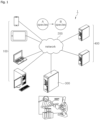
- Fig. 1 is a view for explaining a system for providing a genetic test service using a genetic marker of a model organism based on a genetic marker matching of a heterogeneous organism as a genetic marker of a target organism, according to an embodiment of the present invention.
- a system for providing genetic test service 1 using a genetic marker of a model organism based on genetic marker matching of a heterogeneous organism as a genetic marker of a target organism comprises at least one user terminal 100, a genetic test service providing server 300, at least one database server 400.
- the system for providing genetic test service 1 that uses the genetic marker of a model organism based on genetic marker matching of a heterogeneous organism of FIG. 1 as a genetic marker of a target organism is only an embodiment of the present invention. Accordingly, the present invention is not limitedly interpreted through Fig. 1 .
- each component of Fig. 1 is generally connected through a network 200.
- the at least one user terminal 100 may be connected to the genetic test service providing server 300 through the network 200.
- the genetic test service providing server 300 may be connected to the at least one user terminal 100 and the at least one database server 400 through the network 200.
- the at least one database server 400 may be connected to the genetic test service providing server 300 through the network 200.
- the network refers to a connection structure in which information exchange is possible between each node, such as a plurality of terminals and servers.
- Such networks include RF, 3rd generation partnership project (3GPP) network, and Long Term (LTE). Evolution) network, 5th generation partnership project (5GPP) network, world interoperability for microwave access (WiMAX) network, Internet, local area network (LAN), wireless local area network (Wireless LAN), wide area network (WAN), personal area network (PAN), Bluetooth network, NFC network, satellite broadcasting network, an analog broadcasting network, digital multimedia broadcasting (DMB) network, and the like are included but are not limited thereto.
- 3GPP 3rd generation partnership project
- LTE Long Term
- Evolution 5th generation partnership project
- WiMAX world interoperability for microwave access
- LAN local area network
- WiMAX wireless local area network
- WAN wide area network
- PAN personal area network
- Bluetooth network NFC network
- satellite broadcasting network satellite broadcasting network
- the at least one user terminal 100 may be a terminal of a user who requests a genetic test for themselves, others, or other biological species using a genetic test service-related web page, app page, program, or application that uses the genetic marker of a model organism based on genetic marker matching of a heterogeneous organism as a genetic marker of a target organism.
- the at least one user terminal 100 may be a terminal that requests a genetic test result for a genetic sample of a subject or a test species to the genetic test service providing server 300. Further, the at least one user terminal 100 may be a terminal that receives a genetic test result for a subject or a test species from the genetic test service providing server 300 as a genetic test report.
- the at least one user terminal 100 may be implemented as a computer capable of accessing a remote server or terminal through a network.
- the computer may include, for example, navigation, a laptop equipped with a web browser, a desktop, and a laptop.
- the at least one user terminal 100 may be implemented as a terminal capable of accessing a remote server or terminal through a network.
- the at least one user terminal 100 is, for example, a wireless communication device with guaranteed portability and mobility and may include all kinds of handheld-based wireless communication devices such as navigation, personal communication system (PCS), global system for mobile communications (GSM), personal digital cellular (PDC), personal handy-phone system (PHS), personal digital assistant (PDA), international mobile telecommunication (IMT)-2000, code division multiple access (CDMA)-2000, W-code division multiple access (W-CDMA), Wireless broadband internet (Wibro) terminal, a smartphone, a smart pad, a tablet PC, etc.
- PCS personal communication system
- GSM global system for mobile communications
- PDC personal digital cellular
- PHS personal handy-phone system
- IMT international mobile telecommunication
- CDMA code division multiple access
- W-CDMA W-code division multiple access
- Wibro Wireless broadband internet
- the genetic test service providing server 300 may be a server providing a genetic test service's web page, app page, program, or application using a genetic marker of a model organism based on genetic marker matching of a heterogeneous organism as a genetic marker of a target organism. Further, the genetic test service providing server 300 may be a server as follows: when the genetic test service providing server 300 receives a genetic test request for a subject or a test species from the user terminal 100, the genetic test service providing server 300 selects at least one genetic marker from the model organism. Further, when the selected genetic marker is a genetic marker that has already been identified and well known through research, etc., and is of high importance, the model organism's genome information and the target organism's genome information are compared.
- the degree of publicity may be determined depending on whether the search is performed in the at least one database server 400 or whether the importance has been studied and revealed, or what the level of importance is even if it is discovered but various variables other than the listed parameters and conditions may exist.
- the genetic test service providing server 300 may be implemented as a computer capable of accessing a remote server or terminal through a network.
- the computer may include, for example, navigation, a laptop equipped with a web browser, a desktop, and a laptop.
- the at least one database server 400 may be a server as follows: the server 400 may use or not use the genetic test service-related web page, app page, program, or application that uses the genetic marker of the model organism based on genetic marker matching of a heterogeneous organism as a genetic marker of the target organism. Further, when the genetic test service providing server 300 requests a response to the existence of the genetic marker or whether it is important or well known, the at least one database server 400 transmits the response data to the genetic test service providing server 300.
- the at least one database server 400 may be a server that collects, maps, and stores information on at least one genetic marker, a reference standard genome map, importance, and whether or not it is well known.
- the genetic test service providing server 300 builds the re-stored information for each genetic marker. Further, when the presence or absence of a genetic marker is received as a response (Ack) in the at least one database server 400, it may be implemented to integrate and use two pieces of information based on a genetic marker.
- the at least one database server 400 may be implemented as a computer that may connect to a remote server or terminal through a network.
- the computer may include, for example, navigation, a laptop equipped with a web browser, a desktop, and a laptop.
- the at least one database server 400 may be implemented as a terminal capable of accessing a remote server or terminal through a network.
- the at least one database server 400 is, for example, a wireless communication device with guaranteed portability and mobility and may include all kinds of handheld-based wireless communication devices such as navigation, personal communication system (PCS), global system for mobile communications (GSM), personal digital cellular (PDC), personal handy-phone system (PHS), personal digital assistant (PDA), international mobile telecommunication (IMT)-2000, code division multiple access (CDMA)-2000, W-code division multiple access (W-CDMA), Wireless broadband internet (Wibro) terminal, a smartphone, a smart pad, a tablet PC, etc.
- PCS personal communication system
- GSM global system for mobile communications
- PDC personal digital cellular
- PHS personal handy-phone system
- IMT international mobile telecommunication
- CDMA code division multiple access
- W-CDMA W-code division multiple access
- Wibro Wireless broadband internet
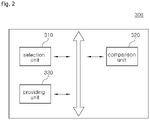
- Fig. 2 is a block diagram illustrating a genetic test service providing server included in the system of FIG. 1
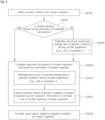
- Fig. 3 is a flowchart illustrating an example in which a genetic testing service using a genetic marker of a model organism based on genetic marker matching of a heterogeneous organism as a genetic marker of a target organism is performed, according to an embodiment of the present invention.
- Fig. 4 is an operation flowchart for explaining the process of comparing genome information between heterogeneous organisms of Fig. 3 .
- the genetic test service providing server 300 may include a selection unit 310, a comparison unit 320, and a providing unit 330.
- the gene test service providing server 300 When the gene test service providing server 300 according to an embodiment of the present invention, or another server (not shown) operating in conjunction with the same transmits an application, program, app page, web page of a genetic test service, and the like that uses the genetic marker of a model organism based on genetic marker matching of a heterogeneous organism as a genetic marker of a target organism to the at least one user terminal 100 and the at least one database server 400, the at least one user terminal 100 and the at least one database server 400 may install or open the application, program, app page, web page of a genetic test service and the like that uses the genetic marker of a model organism based on genetic marker matching of a heterogeneous organism as a genetic marker of a target organism.
- the service program may be driven in the at least one user terminal 100 and the at least one database server 400 using a script executed in a web browser.
- the web browser is a program that enables the use of a web (world wide web) service and refers to a program that receives and displays hypertext written in a hypertext markup language (HTML). Examples include Netscape, Explorer, and Chrome.
- the application means an application on the terminal, for example, includes an app (app) executed in a mobile terminal (smartphone).
- the selection unit 310 may select at least one genetic marker from a pre-stored model organism.
- the model organism means an organism in which a genetic marker corresponding to a phenotypic gene indicating a disease or physical characteristic has been previously identified through many studies and experiments, such as humans or mice.
- the genetic marker A of the human species has been identified for disease B or physical characteristics C through research and experimentation, the significance and association between the genetic marker A and disease B or between the genetic marker A and physical characteristics C have already been revealed.
- correspondence between genetic markers-diseases such as A-B and genetic markers-physical features such as A-C may be known.
- it is identified that the genetic marker of A is present in any patient Z it can be predicted that the disease B and the physical characteristics C have appeared, are about to appear, or have the potential to appear. Based on this, one embodiment of the present invention reveals the matching rate of genetic markers of not only homogeneous organisms but also heterogeneous organisms.
- humans and mice, humans and cats, humans and horses, and humans and dogs take advantage of the fact that when the gene marker A that appears in humans is also present in dogs, it can be predicted that disease B and physical characteristics C will appear.
- disease B and physical characteristics C will appear.
- the above description is a simplified process, and a detailed description is given later.
- the gene marker A is the same in humans and dogs, and it is predicted that a functional change corresponding to the genetic mutation of the gene marker A will occur, even in dogs, it can be predicted that a dog will also develop disease B or physical characteristics C.
- the at least one genetic marker may be a genetic marker selected from a preset functional region of the pre-stored model organism.
- the preset functional region may be a region including any one or a combination of at least one of a protein-coding region, a 5', 3' region, a promoter region, and a splice region, but is not limited to the described above. It may also be a genomic region having a lot of functional information, such as an intergenetic region, an intron, or a combination thereof.
- the preset functional region may be a region with a lot of functional significance among disease, physical characteristics, and phenotypic, genetic markers pre-studied for a model organism, such as an exogenously important region. Genetic markers may be selected from these preset functional regions.
- the preset functional region is not limited to a specific genomic region.
- the at least one genetic marker may include a gene mutation type corresponding to any one or a combination of at least one single nucleotide variant, copy number variation, indels, structural variation, epigenomic markers and protein expression among RNA expression.
- the at least one genetic marker may be any type of genetic mutation. The reason is that if the gene is mutated in the model organism, the gene can also be mutated in the target organism. Of course, it is not immediately applied because it is used after a pre-stored functional change prediction program, which will be described later, identifies functional changes due to genetic mutations.
- at least one genetic marker type is not limited to a specific mutation type, is not limited to those listed, and is not excluded for reasons not listed.
- the comparison unit 320 may compare the genome information of the target organism for the genetic testing service and the genome information of the model organism when the selected at least one genetic marker is a pre-published genetic marker based on pre-analyzed information. At this time, when the at least one selected genetic marker is not a pre-published genetic marker based on pre-analyzed information, the comparison unit 320 predicts a functional change due to genetic mutation through a pre-stored function change prediction program. If so, at least one genetic marker whose score corresponding to the predicted functional change exceeds a preset score may be selected.
- the pre-stored functional change prediction program may be a program for predicting the importance of a function, such as Sift or Polyphen-2, but the type of the program is not limited to those described above. This is because the functional change prediction program may be easily implemented in various ways, even if it is not the aforementioned program.
- the comparison unit 320 may compare the reference standard genome map corresponding to the genome information of the model organism and the reference standard genome map corresponding to the genome information of the target organism by whole genome alignment. For example, when comparing the reference standard genome map of humans, which is a model organism, with the reference standard genome map of dog, which is the target organism, major genetic markers present on the genome map are matched (liftover) and the matching rate exceeds the preset value, it can be considered that the two genetic markers perform the same function. The reason is that the genome means all deoxyribonucleic acid (DNA), including genes in living things, and contains all the biological information necessary to make living things and sustain life.
- DNA deoxyribonucleic acid
- an embodiment of the present invention performs whole genome alignment on a reference standard genome map to match a model organism, a genetic marker and a set of markers.
- a genetic marker preset to be important on the genome of a target organism similar or identical to the model organism, and when the matching result exceeds the preset value or aligned, it can be predicted that a phenotype such as a disease or physical characteristic of the model organism will be exhibited in the target organism in the order of the genetic marker with the highest matching rate.
- the comparison unit 320 compares the genome information of the target organism for genetic test service to the genome information of the model organism. Further, when the reference standard genome map corresponding to the genome information of the target organism does not exist, after aligning the gene sequence of the target organism to the reference standard genome map of the model organism (sequence alignments), at least selected After sequence-aligning the gene sequence of the target organism to the reference standard genome map of the model organism. Further, after matching (Liftover) with selected at least one genetic marker present on the genomic information of the model organism, The genome information of the target organism can be mapped to the genome.
- the cat's gene sequence is aligned to the human reference standard genome map. Further, when matching with the selected at least one genetic marker, and the matching rate exceeds a preset value or satisfies a preset rank when sorted in ascending order, it can be seen that a genetic marker in a region with a high matching rate is also present in cats, and it is possible to generate a genome map through this.
- the providing unit 330 may provide a gene report based on a gene mutation for the target organism based on the comparison result of the genomic information of the target organism and the model organism. At this time, when as a result of the comparison, the matching rate of pre-selected at least one genetic marker on the genomic information of the model organism to the target organism exceeds a preset value, the providing unit 330 predicts functional change due to genetic mutation of at least one of the target organism exceeding the preset value through pre-stored function change prediction program.
- the providing unit 330 sets at least one genetic marker for which the score corresponding to the predicted functional change exceeds a preset score as a genetic marker that is reliable in the functional association of the genetic mutation of the target organism and the model organism and the functional change of the genetic mutation, thereby creating a genetic report.
- the level i.e., the degree at which it is considered that the functional relevance and the reliability of the functional change of the gene mutation exist in both the target organism and the model organism, may be classified differently, according to the following four examples. That is, each reliability score may be given differently, which is described below.
- the comparison unit 330 provides the gene mutation-based gene report for the target organism based on the comparison result of the genomic information of the target organism and the model organism.
- the matching rate of the pre-selected at least one genetic marker on the genomic information of the model organism to the target organism exceeds a preset value, and the at least one genetic marker of the target organism exceeding the preset value is a functionally well-known genetic mutation marker in the model organism
- the genetic mutation of the model organism is applied to the target organism.
- the reliability of the functional change of the genetic mutation may be set at a lower level. Reliability may be classified into a low level, a median level, and a high level. However, in addition to the above-mentioned level, it may be given in points or percentages.
- the first embodiment may be given the lowest score
- the second and third embodiments may be given a higher score than the first embodiment
- the fourth embodiment may be given the highest score.
- a genetic mutation marker that is well known functionally in a human model organism is applied to the target organism as it is.
- the existing scientific research results have the same or similar effect on other species.
- the mutation information of a model organism in a disease-related database such as ClinVar or Omim, for example, a human genome genetic mutation is a meaningful mutation having the same function in the target species. Since all data is based on assumptions, the reliability score can give the low level the lowest.
- the comparison unit 330 provides the gene mutation-based gene report for the target organism based on the comparison result of the genomic information of the target organism and the model organism.
- the matching rate of the pre-selected at least one genetic marker on the genomic information of the model organism to the target organism exceeds a preset value
- at least one genetic marker of the model organism corresponding to the at least one genetic marker of the target organism exceeding a preset value is not a genetic mutation marker functionally well known in the model organism
- the function change score of the pre-stored functional change prediction program of at least one genetic marker of the target organism exceeding a preset value exceeds the preset score
- the genetic mutation of the model organism may be applied to the target organism, and the reliability may be set at a median level.
- the genetic mutation on the genome map of the matched (liftover) target organism has a large functional change in the result of driving it with a function change prediction program such as Sift or Polyphen-2, it may be used as a mutation that predicts the genetic mutation and functional change of another target species, that is, the target organism.
- This may have a slightly higher score than the first embodiment described above.
- the reliability may be given a median level. Further, the reliability may be calculated by a scoring method that gives more points than in the first embodiment, as described above.
- the providing unit 330 provides the gene mutation-based gene report for the target organism based on the comparison result of the genomic information of the target organism and the model organism.
- the matching rate of the pre-selected at least one genetic marker on the genomic information of the model organism to the target organism exceeds a preset value
- at least one genetic marker of the model organism corresponding to the at least one genetic marker of the target organism exceeding a preset value is a genetic mutation marker that is not included in a database pre-established in the model organism
- the functional change score of the pre-stored functional change prediction program exceeds the preset score
- the genetic mutation of the model organism may be applied to the target organism, and the reliability may be set at a median level.
- the score may be slightly higher than in the first embodiment, and for example, the reliability may be given a median level. Further, the reliability may be calculated by a scoring method that gives more points than in the first embodiment, as described above.
- the scores of the second and third embodiment may be the same, but different settings may be made. Further, it ispossible to set the level differently by subdividing the lower level among the median level.
- the providing unit 330 provides a gene mutation-based gene report for the target organism based on the comparison result of the genome information of the target organism and the model organism.
- the matching rate of the pre-selected at least one genetic marker on the genomic information of the model organism to the target organism exceeds a preset value
- at least one genetic marker of the model organism corresponding to the at least one genetic marker of the target organism exceeding a preset value is a genetic mutation marker that is not included in a database pre-established in the model organism
- the functional change score of the pre-stored functional change prediction program of at least one genetic marker of the target organism exceeding a preset value exceeds the preset score
- the genetic mutation of the model organism may be applied to the target organism, and the reliability may be set at a median level.
- the comparison unit 330 provides the gene mutation-based gene report for the target organism based on the comparison result of the genomic information of the target organism and the model organism.
- the matching rate of the pre-selected at least one genetic marker on the genomic information of the model organism to the target organism exceeds a preset value
- the at least one genetic marker of the target organism exceeding the preset value is a functionally well-known genetic mutation marker in the model organism
- the functional change score of the pre-stored functional change prediction program exceeds the preset score
- the genetic mutation of the model organism may be applied to the target organism, and the reliability may be set at a higher level.
- the model organism it is already known in the model organism that an important functional change occurs when a genetic mutation occurs. Further, when a functional change prediction program such as Sift and Polyphen-2 is run on the genetic mutation on the genome map of matched (liftover) different species, that is, the target organism, if the functional change continues to be large, it is to be used as a genetic mutation to predict the genetic mutation and functional change of the target organism, and it is to set the reliability as high as the intensity of the functional change is large. In this case, as described above, the score may be higher than that of the second or third embodiment; for example, the reliability may be given a higher level.
- the reliability may be calculated by a scoring method in which more points are given than in the second or third embodiment as described above. Overall, the first embodiment has the lowest score, the second embodiment and the third embodiment are higher than the first embodiment, the second embodiment and the third embodiment have the same score or are within the error range, and the fourth embodiment may be given a higher score than the second embodiment or third embodiment.
- Reliability can be summarized as follows: Reliability of embodiment 1 ⁇ Reliability of embodiment 2 ⁇ Reliability of embodiment 3 ⁇ Reliability of embodiment 4.
- the genetic test service providing server 300 selects a genetic marker from the model organism (S3100) and confirms that the selected genetic marker is classified as important based on pre-analyzed information and is a known genetic marker (S3200) as a result of confirmation if the information is i) pre-analyzed, ii) classified as important, and iii) is a known genetic marker, the genome information of the model organism and the genome information of the target organism are compared. If any one of i) to iii) or at least one combination thereof is not satisfied, the genetic test service providing server 300 predicts functional change due to genetic mutation in the model organism and performs scoring. Those with a high score may be utilized by making assumptions and predictions that there will be important functional changes even in the target organism, which is the target species.The score is not limited to any numerical value because the set value may differ for each genetic marker or mutation.
- the genetic test service providing server 300 compares the model organism's genome information with the target organism's genome information. At this time, referring to Fig. 4 , scoring is performed by predicting due to genetic mutation in the target organism (S3410), and the genetic mutation result of the target organism is predicted based on the analyzed information of the model organism and the target organism, and reliability may be given as described above.
- the analyzed information may be research result information but is not limited thereto. Different scores may be given to reliability, as described above.
- the genetic test service providing server 300 may provide a gene mutation-based gene report for the target organism.
- Fig. 5 is a view showing a process of transmitting and receiving data between respective components included in a system for providing genetic test service using a genetic marker of a model organism based on genetic marker matching of a heterogeneous organism of Fig. 1 ,according to an embodiment of the present invention.
- a process in which data is transmitted and received between the respective components is described with reference to Fig. 5 .
- the present application is not limited to such an embodiment. According to the various embodiments described above, the data transmission/reception process shown in Fig. 5 may be changed.
- the genetic test service providing server selects at least one genetic marker from a pre-stored model organism (S5100). It compares when the selected at least one genetic marker is a pre-published genetic marker as pre-analyzed information, the genome information of the target organism, and the genome information of the model organism to be used for the genetic testing service (S5200), and provides a gene mutation-based gene report for the target organism based on the comparison result of the genome information of the target organism and the model organism (S5300).
- steps S5100 to S5300 are merely an example, and the present invention is not limited thereto. That is, the order between the above-described steps S5100 to S5300 may be mutually changed, and some of these steps may be simultaneously executed or deleted.
- a method for providing a genetic test service using a genetic marker of a model organism based on genetic marker matching of a heterogeneous organism as a genetic marker of a target organism may also be implemented in the form of a recording medium containing instructions executable by a computer, such as an application or program module executed by a computer.
- Computer-readable media may be any available media accessed by a computer and includes volatile and nonvolatile media, removable and non-removable media. Further, computer-readable media may include all computer storage media. Computer storage media includes both volatile and nonvolatile, removable, and non-removable media implemented in any method or technology for storing information, such as computer-readable instructions, data structures, program modules, or other data.
- the method of providing a genetic test service using a genetic marker of a model organism based on genetic marker matching of a heterogeneous organism as a genetic marker of a target organism may be executed by an application basically installed in a terminal (This may include programs included in the platform or operating system installed by default in the terminal). It may be executed by an application (i.e., a program) directly installed in the master terminal by a user through an application-providing server such as an application store server, an application, or a web server related to the corresponding service.
- an application i.e., a program
- the method for providing a genetic test service using a genetic marker of a model organism based on genetic marker matching of a heterogeneous organism as a genetic marker of a target organism may be implemented by an application (i.e., a program) basically installed in a terminal or directly installed by a user and may be recorded in a computer-readable recording medium such as a terminal.
- an application i.e., a program
Landscapes
- Life Sciences & Earth Sciences (AREA)
- Physics & Mathematics (AREA)
- Health & Medical Sciences (AREA)
- Bioinformatics & Cheminformatics (AREA)
- Engineering & Computer Science (AREA)
- Theoretical Computer Science (AREA)
- General Health & Medical Sciences (AREA)
- Biophysics (AREA)
- Spectroscopy & Molecular Physics (AREA)
- Bioinformatics & Computational Biology (AREA)
- Biotechnology (AREA)
- Evolutionary Biology (AREA)
- Medical Informatics (AREA)
- Genetics & Genomics (AREA)
- Molecular Biology (AREA)
- Proteomics, Peptides & Aminoacids (AREA)
- Analytical Chemistry (AREA)
- Chemical & Material Sciences (AREA)
- Measuring Or Testing Involving Enzymes Or Micro-Organisms (AREA)
- Apparatus Associated With Microorganisms And Enzymes (AREA)
Applications Claiming Priority (2)
| Application Number | Priority Date | Filing Date | Title |
|---|---|---|---|
| KR1020200036720A KR102309277B1 (ko) | 2020-03-26 | 2020-03-26 | 이종생물 유래의 유전자 마커 매칭에 기반한 하나 혹은 그 이상의 모델생물의 유전자 마커와 그 패턴 정보를 목표하는 생물의 유전자 마커 정보로 이용하는 유전자 검사 서비스 제공 방법 |
| PCT/KR2021/003589 WO2021194227A1 (fr) | 2020-03-26 | 2021-03-23 | Procédé pour fournir, en fonction d'une correspondance de marqueurs génétiques d'un organisme hétérologue, un service de test génétique à l'aide d'un ou plusieurs marqueurs génétiques d'un organisme modèle et des informations d'un profil de celui-ci en tant qu'informations de marqueurs génétiques de l'organisme cible |
Publications (2)
| Publication Number | Publication Date |
|---|---|
| EP4131273A1 true EP4131273A1 (fr) | 2023-02-08 |
| EP4131273A4 EP4131273A4 (fr) | 2024-04-03 |
Family
ID=77892470
Family Applications (1)
| Application Number | Title | Priority Date | Filing Date |
|---|---|---|---|
| EP21776181.6A Withdrawn EP4131273A4 (fr) | 2020-03-26 | 2021-03-23 | Procédé pour fournir, en fonction d'une correspondance de marqueurs génétiques d'un organisme hétérologue, un service de test génétique à l'aide d'un ou plusieurs marqueurs génétiques d'un organisme modèle et des informations d'un profil de celui-ci en tant qu'informations de marqueurs génétiques de l'organisme cible |
Country Status (4)
| Country | Link |
|---|---|
| US (1) | US20230018139A1 (fr) |
| EP (1) | EP4131273A4 (fr) |
| KR (1) | KR102309277B1 (fr) |
| WO (1) | WO2021194227A1 (fr) |
Family Cites Families (7)
| Publication number | Priority date | Publication date | Assignee | Title |
|---|---|---|---|---|
| KR101325736B1 (ko) | 2010-10-27 | 2013-11-08 | 삼성에스디에스 주식회사 | 바이오 마커 추출 장치 및 방법 |
| US10235496B2 (en) * | 2013-03-15 | 2019-03-19 | The Scripps Research Institute | Systems and methods for genomic annotation and distributed variant interpretation |
| KR101545234B1 (ko) * | 2013-05-23 | 2015-08-18 | (주)휴레이포지티브 | 개인 정보 간 관련성을 판단하는 방법 및 장치 |
| KR101599922B1 (ko) * | 2014-10-20 | 2016-03-04 | 동아대학교 산학협력단 | 이종 간에 작용하는 유전자 마커 디자인을 위한 csgm 디자이너 플랫폼 |
| KR102073590B1 (ko) | 2017-08-17 | 2020-02-06 | (주)에이엔티홀딩스 | 유전자 정보에 기초하여 서비스를 제공하기 위한 방법, 시스템 및 비일시성의 컴퓨터 판독 가능 기록 매체 |
| KR102933367B1 (ko) * | 2018-02-27 | 2026-03-03 | 코넬 유니버시티 | 게놈-와이드 통합을 통한 순환 종양 dna의 초민감 검출 |
| WO2020036655A2 (fr) * | 2018-04-25 | 2020-02-20 | Juneau Biosciences, L.L.C. | Procédés d'utilisation de marqueurs génétiques associés à l'endométriose |
-
2020
- 2020-03-26 KR KR1020200036720A patent/KR102309277B1/ko active Active
-
2021
- 2021-03-23 EP EP21776181.6A patent/EP4131273A4/fr not_active Withdrawn
- 2021-03-23 WO PCT/KR2021/003589 patent/WO2021194227A1/fr not_active Ceased
-
2022
- 2022-09-24 US US17/952,212 patent/US20230018139A1/en active Pending
Also Published As
| Publication number | Publication date |
|---|---|
| US20230018139A1 (en) | 2023-01-19 |
| EP4131273A4 (fr) | 2024-04-03 |
| KR102309277B1 (ko) | 2021-10-07 |
| WO2021194227A1 (fr) | 2021-09-30 |
Similar Documents
| Publication | Publication Date | Title |
|---|---|---|
| US12205678B2 (en) | Genome explorer system to process and present nucleotide variations in genome sequence data | |
| Marchi et al. | Demographic inference | |
| Rašić et al. | Genome-wide SNPs lead to strong signals of geographic structure and relatedness patterns in the major arbovirus vector, Aedes aegypti | |
| Gruber et al. | dartr: An r package to facilitate analysis of SNP data generated from reduced representation genome sequencing | |
| Kong et al. | Allele-sharing models: LOD scores and accurate linkage tests | |
| Chang et al. | High density marker panels, SNPs prioritizing and accuracy of genomic selection | |
| Tuggle et al. | GO‐FAANG meeting: a gathering on functional annotation of an imal genomes | |
| Nosil et al. | Do highly divergent loci reside in genomic regions affecting reproductive isolation? A test using next-generation sequence data in Timema stick insects | |
| Zöllner et al. | A coalescent approach to study linkage disequilibrium between single-nucleotide polymorphisms | |
| Golan et al. | Effective genetic-risk prediction using mixed models | |
| Ehli et al. | A method to customize population-specific arrays for genome-wide association testing | |
| Wang et al. | A computationally efficient algorithm for genomic prediction using a Bayesian model | |
| Kapopoulou et al. | Demographic analyses of a new sample of haploid genomes from a Swedish population of Drosophila melanogaster | |
| Semenov et al. | Unifying theoretical and empirical perspectives on genomic differentiation | |
| Sucháčková Bartoňová et al. | Incorporating genomics into insect conservation: Butterflies as a model group | |
| McElroy et al. | Robbery in progress: Historical museum collections bring to light a mitochondrial capture within a bird species widespread across southern Australia, the Copperback Quail‐thrush Cinclosoma clarum | |
| Hobbs et al. | Bayesian clustering techniques and progressive partitioning to identify population structuring within a recovering otter population in the UK | |
| US20230018139A1 (en) | Method for providing, on basis of heterologous organism-derived genetic marker matching, genetic testing service by using one or more genetic markers of model organism and pattern information thereof as genetic marker information of target organism | |
| Hsu et al. | Genomic data reveal a loss of diversity in two species of tuco-tucos (genus Ctenomys) following a volcanic eruption | |
| Bemmels et al. | Legacy of supervolcanic eruptions on population genetic structure of brown kiwi | |
| Stroupe et al. | Genetic reassessment of population subdivision in Yellowstone National Park bison | |
| Bohra et al. | The 3366 chickpea genomes for research and breeding | |
| Contina et al. | Characterization of SNP markers for the Painted Bunting (Passerina ciris) and their relevance in population differentiation and genome evolution studies | |
| McCallum et al. | Empirical Bayes scan statistics for detecting clusters of disease risk variants in genetic studies | |
| Iquebal et al. | Development of a model webserver for breed identification using microsatellite DNA marker |
Legal Events
| Date | Code | Title | Description |
|---|---|---|---|
| STAA | Information on the status of an ep patent application or granted ep patent |
Free format text: STATUS: THE INTERNATIONAL PUBLICATION HAS BEEN MADE |
|
| PUAI | Public reference made under article 153(3) epc to a published international application that has entered the european phase |
Free format text: ORIGINAL CODE: 0009012 |
|
| STAA | Information on the status of an ep patent application or granted ep patent |
Free format text: STATUS: REQUEST FOR EXAMINATION WAS MADE |
|
| 17P | Request for examination filed |
Effective date: 20221006 |
|
| AK | Designated contracting states |
Kind code of ref document: A1 Designated state(s): AL AT BE BG CH CY CZ DE DK EE ES FI FR GB GR HR HU IE IS IT LI LT LU LV MC MK MT NL NO PL PT RO RS SE SI SK SM TR |
|
| DAV | Request for validation of the european patent (deleted) | ||
| DAX | Request for extension of the european patent (deleted) | ||
| A4 | Supplementary search report drawn up and despatched |
Effective date: 20240304 |
|
| RIC1 | Information provided on ipc code assigned before grant |
Ipc: G16B 25/10 20190101ALI20240227BHEP Ipc: G16B 20/00 20190101ALI20240227BHEP Ipc: G16B 25/00 20190101AFI20240227BHEP |
|
| STAA | Information on the status of an ep patent application or granted ep patent |
Free format text: STATUS: THE APPLICATION IS DEEMED TO BE WITHDRAWN |
|
| 18D | Application deemed to be withdrawn |
Effective date: 20251001 |