EP4131282A1 - Verfahren und system zur bestimmung einer ereignisklasse durch ki - Google Patents
Verfahren und system zur bestimmung einer ereignisklasse durch ki Download PDFInfo
- Publication number
- EP4131282A1 EP4131282A1 EP21775026.4A EP21775026A EP4131282A1 EP 4131282 A1 EP4131282 A1 EP 4131282A1 EP 21775026 A EP21775026 A EP 21775026A EP 4131282 A1 EP4131282 A1 EP 4131282A1
- Authority
- EP
- European Patent Office
- Prior art keywords
- class
- data
- event
- determination
- teacher
- Prior art date
- Legal status (The legal status is an assumption and is not a legal conclusion. Google has not performed a legal analysis and makes no representation as to the accuracy of the status listed.)
- Pending
Links
Images







Classifications
-
- G—PHYSICS
- G16—INFORMATION AND COMMUNICATION TECHNOLOGY [ICT] SPECIALLY ADAPTED FOR SPECIFIC APPLICATION FIELDS
- G16H—HEALTHCARE INFORMATICS, i.e. INFORMATION AND COMMUNICATION TECHNOLOGY [ICT] SPECIALLY ADAPTED FOR THE HANDLING OR PROCESSING OF MEDICAL OR HEALTHCARE DATA
- G16H50/00—ICT specially adapted for medical diagnosis, medical simulation or medical data mining; ICT specially adapted for detecting, monitoring or modelling epidemics or pandemics
- G16H50/20—ICT specially adapted for medical diagnosis, medical simulation or medical data mining; ICT specially adapted for detecting, monitoring or modelling epidemics or pandemics for computer-aided diagnosis, e.g. based on medical expert systems
-
- G—PHYSICS
- G06—COMPUTING OR CALCULATING; COUNTING
- G06N—COMPUTING ARRANGEMENTS BASED ON SPECIFIC COMPUTATIONAL MODELS
- G06N20/00—Machine learning
-
- G—PHYSICS
- G06—COMPUTING OR CALCULATING; COUNTING
- G06N—COMPUTING ARRANGEMENTS BASED ON SPECIFIC COMPUTATIONAL MODELS
- G06N20/00—Machine learning
- G06N20/20—Ensemble learning
Definitions
- the present invention relates to a method and a device for dividing events which should be classified based on an individual, a thing or information into classes from data pertaining to the individual, the thing or the information.
- the class division is determined based generally on a large amount of data, and reliability of the class division is increased by relying on a decision of an expert on kinds of the data pertaining to the events of the objects such as the individual, the thing or the information.
- gravity and a degree of seriousness of a disease that each individual to be an object has as an event are generally determined by a medical worker such as a doctor who is the expert based on medical data of each individual so that the accuracy is improved.
- the events of the objects such as the individual, the thing or the information change with time and the classes that the events are to be divided into also change as the events change.
- the change of the event in future based on present and past data can be estimated as the change of the class, it can contribute to better social activities such as advance risk aversion and future preparations.
- an amount of data determined by an expert is small when compared with a large amount of data called big data, and therefore accuracy of an answer of the AI itself varies.
- the present invention is to provide a novel determination technique and the system from such a viewpoint, and is to provide a novel determination technique and system enabling an AI process in which decisions are made from the viewpoint of allowing an expert to make a decision, and capable of providing a valid answer, even with a small amount of learning data, by adjusting errors in both the answer of the expert and the answer of AI.
- the present invention provides a system configured to cause an AI (Artificial Intelligence) process to be performed on teacher data for AI learning in which events of objects identified by identifying codes are divided into classes, and data pertaining to an object for which a class determination of the event is required, and to receive class determination data obtained by the AI process.
- AI Artificial Intelligence
- the system is configured to: cause teacher data for learning to be randomly inputted to, and learned by, each of a plurality of AI processes; input data pertaining to the object to each of the plurality of AI processes; and receive class determination data corresponding to each learning from each AI process.
- the class of an event of an object identified by each identifying code is determined based on each class determination data corresponding to the identifying code.
- the object can be a person
- the event is a severity degree pertaining to health of the person
- the severity degree is classified into a plurality of classes.
- the class of the event of the object identified by the identifying code can be determined to be the class to which the largest number of pieces of the class determination data obtained from each AI process belong.
- the predetermined condition may be at least based on dispersion of the two or more pieces of class determination data obtained from each AI process, and for example, it may be a condition that the dispersion of the two or more pieces of class determination data obtained from each AI process is a predetermined degree or lower.
- the predetermined condition it may be added as a condition that it is a case where the number of inconsistencies between the class indicated by the teacher data and the class indicated by the class determination data by the plurality of AI processes corresponding to the teacher data is a predetermined number or more.
- the class of the event of the object is the class of the event that changes according to a lapse of a time period, and can be the class of the event for which a class determination of the event to be obtained by the AI process is predicted after the lapse of the time period.
- utilization is available to predict the class of a severity degree that changes every fiscal year.
- the present invention provides a method, and the method includes steps of causing teacher data for AI learning in which events of objects identified by identifying codes stored in a storage device are divided into classes to be randomly inputted to, and learned by, each of a plurality of AI processes, and inputting data pertaining to the object for which a class determination of the event is required to each of the plurality of AI processes and receiving class determination data corresponding to each learning from each AI process by an information processor, and determining the class of the event of the object identified by each identifying code based on each class determination data corresponding to the identifying code.
- FIG. 1 illustrates a system 1 according to one embodiment of the present invention.
- an information processor 100 is connected to a network 20.
- a user can access the information processor 100 via an information terminal 30 and receive a service provided by the information processor 100. Accessing is performed via a wired or wireless network 20 such as the Internet, a private line or an indoor line.
- the number of accessible information terminals is not limited in particular, and appropriate utilization is possible according to a purpose of utilization.
- the information processor 100 is configured to receive input data from the information terminal 30 via the network 20 and provide a corresponding service.
- a source data server 10 is configured to provide the information processor 100 with required data according to service contents of the information processor 100 via the network 20.
- mutual authentication and agreement formation for data handling may be performed beforehand among the information processor 100, the source data server and the information terminal 30.
- An AI server or a server engine 200 can be configured by combining hardware such as a CPU, a multi-processor mounted with a plurality of processor cores, GPUs (Graphics Processing Units), DSPs (Digital Signal Processors), and FPGAs (Field-Programmable Gate Arrays), and may be configured by algorithm or a learned model or the like which realizes a machine learning function, a language analysis function and a voice recognition function further or the like.
- a quantum processor can be also combined, and the machine learning function may be achieved by, for example, a neural network including deep learning or reinforcement learning.
- the server can be configured by one or two or more servers, and individual components such as an AI engine unit and a storage unit may be distributedly arranged.
- the information processor 100 includes a CPU (Central Processing Unit), a RAM (Random Access Memory), a ROM (Read Only Memory), a storage unit, a communication unit including a network I/F (Interface), a display unit and an input unit or the like. As needed, other hardware configuration may be included.
- a CPU Central Processing Unit
- RAM Random Access Memory
- ROM Read Only Memory
- storage unit a storage unit
- communication unit including a network I/F (Interface), a display unit and an input unit or the like.
- other hardware configuration may be included.
- the CPU is an arithmetic unit which realizes control and functions of the information processor 100 by reading a program and data stored in the ROM and the storage unit or the like and executing a process while storing required data on the RAM.
- the storage unit is a storage device such as an HDD (Hard Disk Drive) and an SSD (Solid State Drive), for example, for storing an OS (Operating System) and various kinds of application programs or the like.
- HDD Hard Disk Drive
- SSD Solid State Drive
- the communication unit has a communication interface function for providing an interface of the information processor 100 and the network 20 and performing information communication with an external device such as the information terminal 30, the source data server 10 and the AI server 200 connected to the network 20.
- the display unit is a display device such as a display, and displays a processing result by the information processor 100 to the user.
- the input unit can be an input device such as a keyboard, a mouse, a camera and a microphone, etc..
- a bus transmits address signals, data signals and various kinds of control signals or the like in order to connect individual configuration units inside the information processor 100.
- the information processor 100 is not limited to the configuration described above and may be distributed and realized by separate computers, individual components of the information processor 100 may be distributed and integrally function, or individual elements configuring the information processor 100 may be single or formed of a plurality of combinations. Further, depending on demanded service contents, a required application may be distributed between the information terminal 30 and the information processor 100 to realize the service in cooperation.
- system is not limited to the hardware configuration indicated in the present embodiment, and may be in any form as long as the present invention can be implemented. Further, an external AI process function provided by nonofficial or the like may be utilized.
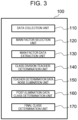
- FIG. 3 illustrates an example of the functions that the information processor 100 has.
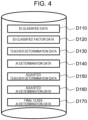
- FIG. 4 illustrates various kinds of data stored in the storage unit of the information processor 100, and
- FIG. 5 to FIG. 9 illustrate a series of main process flows based on the embodiment of the present invention.
- a data collection unit 110 collects data to be required when determining a class of an object event (step S110 in FIG. 5 ) and stores the data as ID-classified data D 110 which can be managed by identification data (ID).
- a main factor selection unit 120 allows the user utilizing the method and system of the present invention to select a factor to be utilized when determining a class. Instead of the user, the system 1 may automatically make a determination and select an effective factor.
- a main factor data extraction unit 130 extracts, according to the factor selected by the main factor selection unit 120, data for each ID related to the factor (hereinafter, also called “ID-classified factor data” or simply “factor data”) from the data collected in the data collection unit 110, and stores the data as ID-classified factor data D120 (step S120).
- ID-classified factor data also called “ID-classified factor data” or simply “factor data”
- the factor may be selected beforehand, and the factor data to be required may be collected from the source data server 10 based on the selected factor.
- the identification data is the data capable of uniquely identifying the object such as an individual person, a company, a thing and information
- the collected data and the extracted ID-classified data D110 include various kinds of data which can be linked or associated to the identification data.
- the identification data is, for an individual person, a name itself or an identifying code capable of specifying the name (for example, a patient ID at the time of attending a hospital, an account number at the time of a bank transaction, and an ID used when purchasing merchandise or the like by online shopping or the like).
- the identification data may be many IDs or accounts or the like as long as the individual person or the company or the like can be specified, and the data linked to them may be generally collected and integrated.
- the various kinds of data that can be linked to the identification data can be utilized to divide some kind of events pertaining to the object such as an individual, a company, a thing and information into classes from the data, the kind does not matter.
- the object is a company
- the events can be divided into classes as soundness of each company
- the various kinds of data may be any information related to the soundness of the company.
- a class division teacher determination unit 140 uses some ID-classified factor data of the ID-classified factor data D120 extracted from the ID-classified data D 110 as class determination (step S130).
- the ID-classified factor data may be extracted directly from the ID-classified data D 11 0 and used for the class determination.
- the determination is performed by an expert or an intellectual or the like (hereinafter, simply called an "expert") who is well informed about business practice related to the data.
- the expert of the business practice may input a class determination result to the information processor 100 via the information terminal 30.
- the information processor 100 displays information of the extracted factor data to the expert via the information terminal 30, and the expert can input the class determination result to the information terminal 30 based on his/her own experiences and knowledge on the basis of the displayed data, and store the class determination result in the information processor 100.
- the plurality of experts determine the classes, and the information processor 100 stores the class determination result by each of the plurality of experts in the information processor 100.
- step S130 performed by the class division teacher determination unit 140 may be realized as a simple interface application capable of providing the factor data from the information processor 100 to the information terminal 30 so that the expert can determine the classes and providing determination data from the information terminal 30 to the information processor 100, or may be realized as a simple application by which the expert can input the determination data to the information processor 100.
- the classes may be determined redundantly and uniquely by different experts based on same information based on the same identifying code.
- the class determination result is inputted to the AI and used as data for learning, the class determination result can be called teacher determination data or teacher data D130 as a generalized name here.
- the teacher determination data D130 may be future predictable class discrimination data in addition to the present class discrimination based on the factor data. Future prediction includes prediction of the next fiscal year and/or prediction of the next month, and the future period is not limited in particular. In addition, the future period may be appropriately set according to a period to which the collected data belongs.
- a teacher determination data noise elimination unit 150 eliminates data with which the class determination result is handled as abnormal, such as unique data or abnormal data from the teacher determination data inputted for learning, from the entire teacher determination data as the data with noise for example.
- the teacher determination data D130 is inputted to an AI process of the AI server 200 or the like, and learning according to the contents of the teacher determination data D130 is performed.
- the ID-classified factor data D120 is inputted to the AI process as a class prediction object, and outputted to the information processor 100 as AI determination data D140 accompanied by the class determination according to the learning (step S140).
- the main factor data extraction unit 130 may collect the ID-classified factor data D120 and the ID-classified factor data to be used for the determination by the expert separately from an external server. That is, when the ID-classified factor data D120 to be used for the determination by the AI and the ID-classified factor data to be supplied to the AI for learning are to be acquired and prepared through what route is not limited in particular.
- the AI determination data D140 can be accompanied by the class by teacher determination for each individual identifying code (ID), that is, the class determined by the expert, and the class determined by the AI.
- ID individual identifying code
- step S140 the teacher determination data D130 and the ID-classified factor data D120 that are randomly inputted are individually processed by the plurality of AIs (step S140), and individual AI determination data is received and stored in the information processor 100 as output of each AI. Then, from the AI determination data, two or more pieces of the AI determination data D140 according to the identifying codes are created.
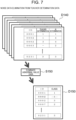
- FIG. 7 illustrates an example of deleting the teacher determination data in which the class is determined as 1 for the ID of 0002 from the determination (step S150 in FIG. 7 ).
- the teacher determination data is processed as the noise and removed from the entire teacher determination data (step S150).
- the classes are divided into 1-4 and numbered, in the case where there is the difference of a predetermined value, for example, 3 or larger between the class by the AI determination and the class by the teacher determination, it can be determined as the abnormal value.
- a technique of defining the abnormal class determination is not limited thereto and other appropriate determination techniques can be applied. In such a manner, by managing the class as a number, the information processor 100 can perform execution as a mathematical computational process.
- the group error is a difference between an average of values estimated by members of a certain group and a correct answer.
- the average individual error is an average value of errors of the individual members, and the variance is dispersion of estimated values of the individual members.
- the theory of collective intelligence indicates that a presumption error (first term) of an individual in a group is offset by diversity (second term) and presumption close to the correct answer can be performed as the group.
- AI(1)-AI(n) (n is an integer) which are AI servers or AI engines are defined as individual members and ranks predictively determined by the individual members are defined as estimated values
- determination results of the plurality of AIs should indicate a distribution centering on the correct answer, and according to the theory of collective intelligence, it means that, when the variance of the determination results of the individual members is larger, accuracy that the answer indicated by the average of the group becomes the correct answer increases compared to the determination result of each AI.
- the data to be deleted can be narrowed down to the data of a large error and a small variance or standard deviation.
- the case where the dispersion of the rank determined by the AI is within a predetermined range and the standard deviation is a certain threshold or smaller for example is defined as one condition, and the teacher data corresponding to the pertinent AI determination is deleted from the entire teacher data.
- the teacher data may be defined as the abnormal value on condition that the case where a predetermined number or more of the AIs cause the difference from the class of the teacher data between the class prediction of the plurality of AIs and the class of the teacher data, and the teacher data may be deleted from the entire teacher data.
- the teacher data may be defined to have the abnormal value due to unneglectable fluctuation or deviation and be eliminated.
- abnormal or "abnormal value” used here is conveniently used in order to eliminate the teacher determination data under a specified condition, and it should be understood that the term “abnormal” is to generally indicate the object to eliminate the teacher data determined as not suitable for the AI process.
- the teacher determination data from which the teacher determination data determined as being abnormal is eliminated is stored as adjusted teacher determination data D150.
- a post-elimination data class determination unit 160 inputs the adjusted teacher determination data D150 which includes two or more pieces of factor data related to the plurality of identifying codes and from which abnormal data is eliminated to the AI server 200 described above for utilization as learning data. Further, a group of the ID-classified factor data D120 related to one, two or more identifying codes to be divided into classes are also inputted to the AI server 200. By the AI process, based on the group of the ID-classified factor data, the AI determination of the class division corresponding to each identifying code is executed (step S160). The post-elimination data class determination unit 160 receives the determination result by the AI and stores it as AI determination data D160.
- the adjusted teacher determination data D150 and the ID-classified factor data D120 are inputted randomly.
- the adjusted teacher determination data D150 and the ID-classified factor data D120 that are inputted randomly are individually processed by the plurality of AIs and adjusted individual AI determination data is stored in the information processor 100 as the output of each AI. Then, from the AI determination data, final class AI determination data D160 according to the identifying codes is created.
- Final determined class data D 170 is created from the class determination of the AI(1)-AI(n) for each identifying code listed in the final class AI determination data D 160.
- the class determination standard may be determined from a midmean of the classes predicted by the AI(1)-AI(n), the most common class may be determined as the final class, or there may be other appropriate determination methods.
- conditions of people who had a health checkup is divided into four layers as classes, and an outline of a relation between the number of people in each layer and medical expenses is illustrated.
- the classes are numbered as a class 1, a class 2, a class 3 and a class 4 from a bottom layer, in which the class 1 is the condition of expecting continuous health promotion, the class 2 is the condition of a light level, the class 3 is the condition of a middle level and the class 4 is the condition of a severe level.
- the four layers are utilizable when measuring a risk of a disease to people and recognizable as levels of severity, and it can be determined that the severity level is highest for the top level and the severity level is almost zero for the bottom layer.
- the class division is risk division and the present invention can be utilized as risk management.
- ratios of the numbers of people in the individual layers to the number of the entire people form an almost pyramid shape of 50%, 30%, 15% and 5% from the bottom, though it depends on how they are divided.
- the medical expenses of the individual layers to the entire medical expenses forms an inverse pyramid distribution of 35%, 20% and 5% toward the bottom with 40% in the class 4 as the top layer.
- medical data health checkup and medical data
- experts doctors engaged in medical treatment and other experts (simply called “experts”) were asked to visually observe the medical data of the year 2014 and predict a risk level of severity of each person for the year 2015 which is the next fiscal year.
- the risk numbers were divided into numbers 1-4, and the medical data of each person accompanied by the risk numbers 1-4 was inputted to the AI as the learning data. Further, to the learned AI, the medical data of 50 people out of 250 people for the year 2014 was inputted and the severity risk for the year 2015 was predicted.
- the information processor 100 collected the data of "medical treatment information statement", “nursing care benefit statement”, “special health checkup result” and “insured master” from the data servers 10 ( FIG. 1 ) of various kinds of medical institutions to configure ID-classified data D110, and the ID-classified factor data D120 of 2699 cases including the factor data for the year 2014 of the 49 selected items was created and stored.
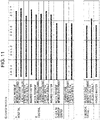
- FIG. 11 illustrates the corresponding years of the data collected from the individual medical institutions.
- the ID-classified factor data D120 of 2699 cases stored in the information processor 100 was read, the contents of the ID-classified factor data D 120 was displayed via the information terminal 30 utilized by 25 experts, and clinical inference by the experts based on each data of 49 items for the year 2014 was performed.
- Risk prediction for the year 2015 obtained by the clinical inference was inputted to the information terminal 30, and stored in the information processor 100 as the teacher determination data D130 for each ID of 2699 cases including the risk prediction.
- the information processor 100 inputted the teacher determination data D130 of the 2699 cases to the AI as the data for AI learning to be learned.
- the ID-classified factor data D120 of 6707 cases which is actual data of the year 2014 collected and extracted by the information processor 100, was inputted to the AI server 200.
- the information processor 100 received the prediction data (class prediction data for the year 2015) of 6707 cases predicted by the AI server 200 from the AI server 200.
- the risk division was performed by the clinical inference based on the actual data of 6707 cases of the year 2015, and the result (actual class determination by teacher based on the actual data of the year 2015) and the AI prediction (the class prediction for the year 2015) were compared.
- the severity levels by the plurality of AIs obtained as a result were compared with the corresponding predicted severity levels by the experts according to the IDs.
- the determinations among the AI(1)-AI(n) were also performed, and as illustrated as a list in FIG. 14 , based on the already explained theory of collective intelligence, the expert determination data, for which it is the case where the number of inconsistencies between the expert determination data and the AI determination data is 7 or larger and the deviation of the determinations between the AIs is smaller than 0.5 as the standard deviation, was deleted.
- the teacher data determined to have the abnormal value was deleted from the entire teacher data of 2699 cases, and new teacher data D150 of 2228 cases was created.
- the information processor 100 made the plurality of AIs perform learning randomly and receives the predicted determination result from the Ai server.
- the class division corresponds to the risk division, and each layer can be recognized also as a risk layer.
- the AI prediction based on the class division by the present invention is effective also for the risk management.
Landscapes
- Engineering & Computer Science (AREA)
- Software Systems (AREA)
- Theoretical Computer Science (AREA)
- Medical Informatics (AREA)
- Data Mining & Analysis (AREA)
- Health & Medical Sciences (AREA)
- General Physics & Mathematics (AREA)
- Computing Systems (AREA)
- General Engineering & Computer Science (AREA)
- Evolutionary Computation (AREA)
- Mathematical Physics (AREA)
- Computer Vision & Pattern Recognition (AREA)
- Artificial Intelligence (AREA)
- Physics & Mathematics (AREA)
- Public Health (AREA)
- Biomedical Technology (AREA)
- Databases & Information Systems (AREA)
- Pathology (AREA)
- Epidemiology (AREA)
- General Health & Medical Sciences (AREA)
- Primary Health Care (AREA)
- Management, Administration, Business Operations System, And Electronic Commerce (AREA)
- Medical Treatment And Welfare Office Work (AREA)
Applications Claiming Priority (2)
| Application Number | Priority Date | Filing Date | Title |
|---|---|---|---|
| JP2020054986 | 2020-03-25 | ||
| PCT/JP2021/012705 WO2021193864A1 (ja) | 2020-03-25 | 2021-03-25 | Aiによる事象クラスの判別方法及び判別システム |
Publications (2)
| Publication Number | Publication Date |
|---|---|
| EP4131282A1 true EP4131282A1 (de) | 2023-02-08 |
| EP4131282A4 EP4131282A4 (de) | 2024-04-17 |
Family
ID=77892750
Family Applications (1)
| Application Number | Title | Priority Date | Filing Date |
|---|---|---|---|
| EP21775026.4A Pending EP4131282A4 (de) | 2020-03-25 | 2021-03-25 | Verfahren und system zur bestimmung einer ereignisklasse durch ki |
Country Status (4)
| Country | Link |
|---|---|
| US (1) | US20230107088A1 (de) |
| EP (1) | EP4131282A4 (de) |
| JP (2) | JP7681211B2 (de) |
| WO (1) | WO2021193864A1 (de) |
Families Citing this family (2)
| Publication number | Priority date | Publication date | Assignee | Title |
|---|---|---|---|---|
| WO2023067726A1 (ja) * | 2021-10-20 | 2023-04-27 | 三菱電機株式会社 | 学習装置、予測装置、予測システム、学習方法、予測方法、及び予測プログラム |
| CN117456278B (zh) * | 2023-11-29 | 2024-11-26 | 中国科学院华南植物园 | 基于ai识别的物种鉴定专家对接方法、系统、设备及介质 |
Family Cites Families (15)
| Publication number | Priority date | Publication date | Assignee | Title |
|---|---|---|---|---|
| KR100737363B1 (ko) * | 2001-11-07 | 2007-07-09 | 다카후미 데라사와 | 스케줄 작성 방법 및 스케줄 작성 방법의 프로그램을 저장한 기억 매체 |
| EP1557788B1 (de) * | 2004-01-26 | 2008-04-16 | Honda Research Institute Europe GmbH | Reduktion von Angepasstheitsbeurteilungen unter Verwendung von Gruppierungstechniken und Neuronalnetzwerkmengen |
| JP4482796B2 (ja) | 2004-03-26 | 2010-06-16 | ソニー株式会社 | 情報処理装置および方法、記録媒体、並びにプログラム |
| JP2013148996A (ja) | 2012-01-18 | 2013-08-01 | Osaka Univ | 重症度判定装置、及び、重症度判定方法 |
| JP5953151B2 (ja) * | 2012-07-13 | 2016-07-20 | 日本放送協会 | 学習装置、及びプログラム |
| JP6188147B2 (ja) * | 2013-10-15 | 2017-08-30 | 国立大学法人広島大学 | 認識システム |
| US20230179955A1 (en) * | 2016-12-15 | 2023-06-08 | Conquer Your Addiction Llc | Dynamic and adaptive systems and methods for rewarding and/or disincentivizing behaviors |
| US20250016520A1 (en) * | 2016-12-15 | 2025-01-09 | Conquer Your Addiction Llc | Systems and methods for the use of digital agents |
| JP6729457B2 (ja) * | 2017-03-16 | 2020-07-22 | 株式会社島津製作所 | データ解析装置 |
| US20200126664A1 (en) * | 2017-07-24 | 2020-04-23 | Axion Research Inc. | Support system for estimating an internal state of a target system |
| AU2018350984A1 (en) * | 2017-10-17 | 2020-05-07 | Satish Rao | Machine learning based system for identifying and monitoring neurological disorders |
| US10824721B2 (en) | 2018-05-22 | 2020-11-03 | International Business Machines Corporation | Detecting and delaying effect of machine learning model attacks |
| US20230036730A1 (en) * | 2018-07-22 | 2023-02-02 | Glf Consulting Fz, Llc | Tokenization of expert time for soft skill development |
| US20200302296A1 (en) * | 2019-03-21 | 2020-09-24 | D. Douglas Miller | Systems and method for optimizing educational outcomes using artificial intelligence |
| WO2021181634A1 (ja) * | 2020-03-12 | 2021-09-16 | オリンパス株式会社 | 教師データ収集依頼装置および教師データ収集方法 |
-
2021
- 2021-03-25 US US17/913,643 patent/US20230107088A1/en active Pending
- 2021-03-25 WO PCT/JP2021/012705 patent/WO2021193864A1/ja not_active Ceased
- 2021-03-25 EP EP21775026.4A patent/EP4131282A4/de active Pending
- 2021-03-25 JP JP2022510691A patent/JP7681211B2/ja active Active
-
2025
- 2025-03-28 JP JP2025054971A patent/JP2025089540A/ja active Pending
Also Published As
| Publication number | Publication date |
|---|---|
| WO2021193864A1 (ja) | 2021-09-30 |
| EP4131282A4 (de) | 2024-04-17 |
| JP7681211B2 (ja) | 2025-05-22 |
| US20230107088A1 (en) | 2023-04-06 |
| JP2025089540A (ja) | 2025-06-12 |
| JPWO2021193864A1 (de) | 2021-09-30 |
Similar Documents
| Publication | Publication Date | Title |
|---|---|---|
| US20230084308A1 (en) | Computerized system and method for identifying members at high risk of falls and fractures | |
| US10650927B2 (en) | Machine learning clinical decision support system for risk categorization | |
| US20190362434A1 (en) | Predictive model segmentation platform | |
| US20120271612A1 (en) | Predictive modeling | |
| WO2008001355A2 (en) | Case based means and associated method of data analysis for use in risk assessment | |
| JP2025089540A (ja) | Aiによる事象クラスの判別方法及び判別システム | |
| Alrashidi | Data envelopment analysis for measuring the efficiency of head trauma care in England and Wales | |
| Novella et al. | Are we nearly there yet? New technology adoption and labor demand in Peru | |
| Escudero et al. | Directed Search, Wages, and Non-wage Amenities: Evidence from an Online Job Board | |
| JP6828203B1 (ja) | 勧奨通知最適タイミング算出方法、及び勧奨通知最適タイミング算出システム | |
| JP7504836B2 (ja) | ライフイベントプラットフォーム運用方法、ライフイベントプラットフォーム運用装置、及びライフイベントプラットフォーム運用システム | |
| JP6799403B2 (ja) | 健康指導支援装置、健康指導支援方法及びプログラム | |
| Jiang et al. | Using Data Mining to Analyze Patient Discharge Data for an Urban Hospital. | |
| Tekieh et al. | Analysing healthcare coverage with data mining techniques | |
| US20230018521A1 (en) | Systems and methods for generating targeted outputs | |
| US20100114593A1 (en) | Means and method of obtaining and processing data for use in medical or health assessment | |
| US20220180446A1 (en) | Method and System for Medical Malpractice Insurance Underwriting Using Value-Based Care Data | |
| US20250111441A1 (en) | Method and system for helping a long term care policy holder stay independent in the short term | |
| Stavrunova | Choice inconsistencies in the demand for private health insurance | |
| US20260045365A1 (en) | Devices, methods and artificial intelligence systems to monitor and improve physical, mental and financial health | |
| Bahal et al. | Caste Networks and Distress Borrowing | |
| Moriyama et al. | Patient Satisfaction-Driven Doctor Recommendation Strategy Using HIS Data: A Real-World Machine Learning Approach | |
| Biggs et al. | Explaining self-reported financial security among seniors | |
| Rinder | An Integrated Decision-Support Tool to Forecast and Schedule No-Show Appointments in Healthcare | |
| Marquardt | Mis (sed) Diagnosis: Physician Decision-Making and ADHD, Working Paper 2022-23 |
Legal Events
| Date | Code | Title | Description |
|---|---|---|---|
| STAA | Information on the status of an ep patent application or granted ep patent |
Free format text: STATUS: THE INTERNATIONAL PUBLICATION HAS BEEN MADE |
|
| PUAI | Public reference made under article 153(3) epc to a published international application that has entered the european phase |
Free format text: ORIGINAL CODE: 0009012 |
|
| STAA | Information on the status of an ep patent application or granted ep patent |
Free format text: STATUS: REQUEST FOR EXAMINATION WAS MADE |
|
| 17P | Request for examination filed |
Effective date: 20221011 |
|
| AK | Designated contracting states |
Kind code of ref document: A1 Designated state(s): AL AT BE BG CH CY CZ DE DK EE ES FI FR GB GR HR HU IE IS IT LI LT LU LV MC MK MT NL NO PL PT RO RS SE SI SK SM TR |
|
| DAV | Request for validation of the european patent (deleted) | ||
| DAX | Request for extension of the european patent (deleted) | ||
| REG | Reference to a national code |
Ref country code: DE Ref legal event code: R079 Free format text: PREVIOUS MAIN CLASS: G16H0050200000 Ipc: G06N0020200000 |
|
| A4 | Supplementary search report drawn up and despatched |
Effective date: 20240318 |
|
| RIC1 | Information provided on ipc code assigned before grant |
Ipc: G16H 50/20 20180101ALI20240312BHEP Ipc: G06N 20/20 20190101AFI20240312BHEP |