EP4131409A1 - Substrat d'affichage, panneau d'affichage et appareil d'affichage - Google Patents
Substrat d'affichage, panneau d'affichage et appareil d'affichage Download PDFInfo
- Publication number
- EP4131409A1 EP4131409A1 EP21923817.7A EP21923817A EP4131409A1 EP 4131409 A1 EP4131409 A1 EP 4131409A1 EP 21923817 A EP21923817 A EP 21923817A EP 4131409 A1 EP4131409 A1 EP 4131409A1
- Authority
- EP
- European Patent Office
- Prior art keywords
- pixel
- sub
- transistor
- base substrate
- light
- Prior art date
- Legal status (The legal status is an assumption and is not a legal conclusion. Google has not performed a legal analysis and makes no representation as to the accuracy of the status listed.)
- Granted
Links
Images
















Classifications
-
- H—ELECTRICITY
- H10—SEMICONDUCTOR DEVICES; ELECTRIC SOLID-STATE DEVICES NOT OTHERWISE PROVIDED FOR
- H10D—INORGANIC ELECTRIC SEMICONDUCTOR DEVICES
- H10D86/00—Integrated devices formed in or on insulating or conducting substrates, e.g. formed in silicon-on-insulator [SOI] substrates or on stainless steel or glass substrates
- H10D86/40—Integrated devices formed in or on insulating or conducting substrates, e.g. formed in silicon-on-insulator [SOI] substrates or on stainless steel or glass substrates characterised by multiple TFTs
- H10D86/421—Integrated devices formed in or on insulating or conducting substrates, e.g. formed in silicon-on-insulator [SOI] substrates or on stainless steel or glass substrates characterised by multiple TFTs having a particular composition, shape or crystalline structure of the active layer
-
- G—PHYSICS
- G09—EDUCATION; CRYPTOGRAPHY; DISPLAY; ADVERTISING; SEALS
- G09G—ARRANGEMENTS OR CIRCUITS FOR CONTROL OF INDICATING DEVICES USING STATIC MEANS TO PRESENT VARIABLE INFORMATION
- G09G3/00—Control arrangements or circuits, of interest only in connection with visual indicators other than cathode-ray tubes
- G09G3/20—Control arrangements or circuits, of interest only in connection with visual indicators other than cathode-ray tubes for presentation of an assembly of a number of characters, e.g. a page, by composing the assembly by combination of individual elements arranged in a matrix no fixed position being assigned to or needed to be assigned to the individual characters or partial characters
- G09G3/22—Control arrangements or circuits, of interest only in connection with visual indicators other than cathode-ray tubes for presentation of an assembly of a number of characters, e.g. a page, by composing the assembly by combination of individual elements arranged in a matrix no fixed position being assigned to or needed to be assigned to the individual characters or partial characters using controlled light sources
- G09G3/30—Control arrangements or circuits, of interest only in connection with visual indicators other than cathode-ray tubes for presentation of an assembly of a number of characters, e.g. a page, by composing the assembly by combination of individual elements arranged in a matrix no fixed position being assigned to or needed to be assigned to the individual characters or partial characters using controlled light sources using electroluminescent panels
- G09G3/32—Control arrangements or circuits, of interest only in connection with visual indicators other than cathode-ray tubes for presentation of an assembly of a number of characters, e.g. a page, by composing the assembly by combination of individual elements arranged in a matrix no fixed position being assigned to or needed to be assigned to the individual characters or partial characters using controlled light sources using electroluminescent panels semiconductive, e.g. using light-emitting diodes [LED]
- G09G3/3208—Control arrangements or circuits, of interest only in connection with visual indicators other than cathode-ray tubes for presentation of an assembly of a number of characters, e.g. a page, by composing the assembly by combination of individual elements arranged in a matrix no fixed position being assigned to or needed to be assigned to the individual characters or partial characters using controlled light sources using electroluminescent panels semiconductive, e.g. using light-emitting diodes [LED] organic, e.g. using organic light-emitting diodes [OLED]
- G09G3/3225—Control arrangements or circuits, of interest only in connection with visual indicators other than cathode-ray tubes for presentation of an assembly of a number of characters, e.g. a page, by composing the assembly by combination of individual elements arranged in a matrix no fixed position being assigned to or needed to be assigned to the individual characters or partial characters using controlled light sources using electroluminescent panels semiconductive, e.g. using light-emitting diodes [LED] organic, e.g. using organic light-emitting diodes [OLED] using an active matrix
- G09G3/3258—Control arrangements or circuits, of interest only in connection with visual indicators other than cathode-ray tubes for presentation of an assembly of a number of characters, e.g. a page, by composing the assembly by combination of individual elements arranged in a matrix no fixed position being assigned to or needed to be assigned to the individual characters or partial characters using controlled light sources using electroluminescent panels semiconductive, e.g. using light-emitting diodes [LED] organic, e.g. using organic light-emitting diodes [OLED] using an active matrix with pixel circuitry controlling the voltage across the light-emitting element
-
- H—ELECTRICITY
- H10—SEMICONDUCTOR DEVICES; ELECTRIC SOLID-STATE DEVICES NOT OTHERWISE PROVIDED FOR
- H10D—INORGANIC ELECTRIC SEMICONDUCTOR DEVICES
- H10D86/00—Integrated devices formed in or on insulating or conducting substrates, e.g. formed in silicon-on-insulator [SOI] substrates or on stainless steel or glass substrates
- H10D86/40—Integrated devices formed in or on insulating or conducting substrates, e.g. formed in silicon-on-insulator [SOI] substrates or on stainless steel or glass substrates characterised by multiple TFTs
- H10D86/441—Interconnections, e.g. scanning lines
-
- H—ELECTRICITY
- H10—SEMICONDUCTOR DEVICES; ELECTRIC SOLID-STATE DEVICES NOT OTHERWISE PROVIDED FOR
- H10D—INORGANIC ELECTRIC SEMICONDUCTOR DEVICES
- H10D86/00—Integrated devices formed in or on insulating or conducting substrates, e.g. formed in silicon-on-insulator [SOI] substrates or on stainless steel or glass substrates
- H10D86/40—Integrated devices formed in or on insulating or conducting substrates, e.g. formed in silicon-on-insulator [SOI] substrates or on stainless steel or glass substrates characterised by multiple TFTs
- H10D86/60—Integrated devices formed in or on insulating or conducting substrates, e.g. formed in silicon-on-insulator [SOI] substrates or on stainless steel or glass substrates characterised by multiple TFTs wherein the TFTs are in active matrices
-
- H—ELECTRICITY
- H10—SEMICONDUCTOR DEVICES; ELECTRIC SOLID-STATE DEVICES NOT OTHERWISE PROVIDED FOR
- H10K—ORGANIC ELECTRIC SOLID-STATE DEVICES
- H10K59/00—Integrated devices, or assemblies of multiple devices, comprising at least one organic light-emitting element covered by group H10K50/00
- H10K59/10—OLED displays
- H10K59/12—Active-matrix OLED [AMOLED] displays
- H10K59/121—Active-matrix OLED [AMOLED] displays characterised by the geometry or disposition of pixel elements
-
- H—ELECTRICITY
- H10—SEMICONDUCTOR DEVICES; ELECTRIC SOLID-STATE DEVICES NOT OTHERWISE PROVIDED FOR
- H10K—ORGANIC ELECTRIC SOLID-STATE DEVICES
- H10K59/00—Integrated devices, or assemblies of multiple devices, comprising at least one organic light-emitting element covered by group H10K50/00
- H10K59/10—OLED displays
- H10K59/12—Active-matrix OLED [AMOLED] displays
- H10K59/121—Active-matrix OLED [AMOLED] displays characterised by the geometry or disposition of pixel elements
- H10K59/1213—Active-matrix OLED [AMOLED] displays characterised by the geometry or disposition of pixel elements the pixel elements being TFTs
-
- H—ELECTRICITY
- H10—SEMICONDUCTOR DEVICES; ELECTRIC SOLID-STATE DEVICES NOT OTHERWISE PROVIDED FOR
- H10K—ORGANIC ELECTRIC SOLID-STATE DEVICES
- H10K59/00—Integrated devices, or assemblies of multiple devices, comprising at least one organic light-emitting element covered by group H10K50/00
- H10K59/10—OLED displays
- H10K59/12—Active-matrix OLED [AMOLED] displays
- H10K59/131—Interconnections, e.g. wiring lines or terminals
-
- G—PHYSICS
- G09—EDUCATION; CRYPTOGRAPHY; DISPLAY; ADVERTISING; SEALS
- G09G—ARRANGEMENTS OR CIRCUITS FOR CONTROL OF INDICATING DEVICES USING STATIC MEANS TO PRESENT VARIABLE INFORMATION
- G09G2300/00—Aspects of the constitution of display devices
- G09G2300/08—Active matrix structure, i.e. with use of active elements, inclusive of non-linear two terminal elements, in the pixels together with light emitting or modulating elements
- G09G2300/0809—Several active elements per pixel in active matrix panels
- G09G2300/0819—Several active elements per pixel in active matrix panels used for counteracting undesired variations, e.g. feedback or autozeroing
-
- G—PHYSICS
- G09—EDUCATION; CRYPTOGRAPHY; DISPLAY; ADVERTISING; SEALS
- G09G—ARRANGEMENTS OR CIRCUITS FOR CONTROL OF INDICATING DEVICES USING STATIC MEANS TO PRESENT VARIABLE INFORMATION
- G09G2300/00—Aspects of the constitution of display devices
- G09G2300/08—Active matrix structure, i.e. with use of active elements, inclusive of non-linear two terminal elements, in the pixels together with light emitting or modulating elements
- G09G2300/0809—Several active elements per pixel in active matrix panels
- G09G2300/0842—Several active elements per pixel in active matrix panels forming a memory circuit, e.g. a dynamic memory with one capacitor
-
- G—PHYSICS
- G09—EDUCATION; CRYPTOGRAPHY; DISPLAY; ADVERTISING; SEALS
- G09G—ARRANGEMENTS OR CIRCUITS FOR CONTROL OF INDICATING DEVICES USING STATIC MEANS TO PRESENT VARIABLE INFORMATION
- G09G2300/00—Aspects of the constitution of display devices
- G09G2300/08—Active matrix structure, i.e. with use of active elements, inclusive of non-linear two terminal elements, in the pixels together with light emitting or modulating elements
- G09G2300/0809—Several active elements per pixel in active matrix panels
- G09G2300/0842—Several active elements per pixel in active matrix panels forming a memory circuit, e.g. a dynamic memory with one capacitor
- G09G2300/0861—Several active elements per pixel in active matrix panels forming a memory circuit, e.g. a dynamic memory with one capacitor with additional control of the display period without amending the charge stored in a pixel memory, e.g. by means of additional select electrodes
-
- G—PHYSICS
- G09—EDUCATION; CRYPTOGRAPHY; DISPLAY; ADVERTISING; SEALS
- G09G—ARRANGEMENTS OR CIRCUITS FOR CONTROL OF INDICATING DEVICES USING STATIC MEANS TO PRESENT VARIABLE INFORMATION
- G09G2320/00—Control of display operating conditions
- G09G2320/06—Adjustment of display parameters
- G09G2320/0686—Adjustment of display parameters with two or more screen areas displaying information with different brightness or colours
-
- G—PHYSICS
- G09—EDUCATION; CRYPTOGRAPHY; DISPLAY; ADVERTISING; SEALS
- G09G—ARRANGEMENTS OR CIRCUITS FOR CONTROL OF INDICATING DEVICES USING STATIC MEANS TO PRESENT VARIABLE INFORMATION
- G09G3/00—Control arrangements or circuits, of interest only in connection with visual indicators other than cathode-ray tubes
- G09G3/20—Control arrangements or circuits, of interest only in connection with visual indicators other than cathode-ray tubes for presentation of an assembly of a number of characters, e.g. a page, by composing the assembly by combination of individual elements arranged in a matrix no fixed position being assigned to or needed to be assigned to the individual characters or partial characters
- G09G3/22—Control arrangements or circuits, of interest only in connection with visual indicators other than cathode-ray tubes for presentation of an assembly of a number of characters, e.g. a page, by composing the assembly by combination of individual elements arranged in a matrix no fixed position being assigned to or needed to be assigned to the individual characters or partial characters using controlled light sources
- G09G3/30—Control arrangements or circuits, of interest only in connection with visual indicators other than cathode-ray tubes for presentation of an assembly of a number of characters, e.g. a page, by composing the assembly by combination of individual elements arranged in a matrix no fixed position being assigned to or needed to be assigned to the individual characters or partial characters using controlled light sources using electroluminescent panels
- G09G3/32—Control arrangements or circuits, of interest only in connection with visual indicators other than cathode-ray tubes for presentation of an assembly of a number of characters, e.g. a page, by composing the assembly by combination of individual elements arranged in a matrix no fixed position being assigned to or needed to be assigned to the individual characters or partial characters using controlled light sources using electroluminescent panels semiconductive, e.g. using light-emitting diodes [LED]
- G09G3/3208—Control arrangements or circuits, of interest only in connection with visual indicators other than cathode-ray tubes for presentation of an assembly of a number of characters, e.g. a page, by composing the assembly by combination of individual elements arranged in a matrix no fixed position being assigned to or needed to be assigned to the individual characters or partial characters using controlled light sources using electroluminescent panels semiconductive, e.g. using light-emitting diodes [LED] organic, e.g. using organic light-emitting diodes [OLED]
- G09G3/3225—Control arrangements or circuits, of interest only in connection with visual indicators other than cathode-ray tubes for presentation of an assembly of a number of characters, e.g. a page, by composing the assembly by combination of individual elements arranged in a matrix no fixed position being assigned to or needed to be assigned to the individual characters or partial characters using controlled light sources using electroluminescent panels semiconductive, e.g. using light-emitting diodes [LED] organic, e.g. using organic light-emitting diodes [OLED] using an active matrix
- G09G3/3233—Control arrangements or circuits, of interest only in connection with visual indicators other than cathode-ray tubes for presentation of an assembly of a number of characters, e.g. a page, by composing the assembly by combination of individual elements arranged in a matrix no fixed position being assigned to or needed to be assigned to the individual characters or partial characters using controlled light sources using electroluminescent panels semiconductive, e.g. using light-emitting diodes [LED] organic, e.g. using organic light-emitting diodes [OLED] using an active matrix with pixel circuitry controlling the current through the light-emitting element
-
- H—ELECTRICITY
- H10—SEMICONDUCTOR DEVICES; ELECTRIC SOLID-STATE DEVICES NOT OTHERWISE PROVIDED FOR
- H10K—ORGANIC ELECTRIC SOLID-STATE DEVICES
- H10K59/00—Integrated devices, or assemblies of multiple devices, comprising at least one organic light-emitting element covered by group H10K50/00
- H10K59/30—Devices specially adapted for multicolour light emission
- H10K59/35—Devices specially adapted for multicolour light emission comprising red-green-blue [RGB] subpixels
-
- H—ELECTRICITY
- H10—SEMICONDUCTOR DEVICES; ELECTRIC SOLID-STATE DEVICES NOT OTHERWISE PROVIDED FOR
- H10K—ORGANIC ELECTRIC SOLID-STATE DEVICES
- H10K59/00—Integrated devices, or assemblies of multiple devices, comprising at least one organic light-emitting element covered by group H10K50/00
- H10K59/60—OLEDs integrated with inorganic light-sensitive elements, e.g. with inorganic solar cells or inorganic photodiodes
- H10K59/65—OLEDs integrated with inorganic image sensors
Definitions
- the present disclosure relates to a field of display technologies, and in particular to a display substrate, a display panel and a display apparatus.
- an "under-screen camera” solution has emerged.
- an imaging module such as a camera is embedded in a display region to reduce a size of a bezel region of the display apparatus, thereby increasing the screen-to-body ratio.
- the "under-screen camera” solution on a basis of increasing the screen-to-body ratio of the display apparatus, how to ensure both the light transmittance and the display effect at a position corresponding to the imaging module in the display substrate becomes an important topic which the research and development personnel focus on.
- a display substrate includes a first display region and a second display region, a light transmittance of the first display region being greater than a light transmittance of the second display region.
- the display substrate includes: a base substrate; a plurality of sub-pixels arranged on the base substrate and located in the first display region, wherein the sub-pixels include a first pixel driving circuit and a first light-emitting device, the first pixel driving circuit is electrically connected to the first light-emitting device and configured to drive the first light-emitting device to emit light; and a plurality of sub-pixels arranged on the base substrate and located in the second display region, wherein the sub-pixels located in the second display region include a second pixel driving circuit and a second light-emitting device, the second pixel driving circuit is electrically connected to the second light-emitting device and configured to drive the second light-emitting device to emit light.
- the first pixel driving circuit includes at least a compensation transistor, a switching transistor, and a light-emitting device initialization transistor, and each of the compensation transistor, the switching transistor and the light-emitting device initialization transistor includes an active layer.
- the display substrate further includes a scan signal line arranged in the first display region, the scan signal line is configured to provide a scan signal to the first pixel driving circuit. An orthographic projection of the scan signal line on the base substrate overlaps with an orthographic projection of the active layer of each of the compensation transistor, the switching transistor and the light-emitting device initialization transistor of the first pixel driving circuit on the base substrate.
- the first pixel driving circuit further includes a reset transistor, the reset transistor includes an active layer, and the active layer of the light-emitting device initialization transistor of the first pixel driving circuit extends from the active layer of the reset transistor in a direction toward the scan signal line configured to provide the scan signal to the first pixel driving circuit.
- an orthographic projection of an occupied region of the first pixel driving circuit in the first display region on the base substrate has a first size in a first direction and a second size in a second direction, the first direction is perpendicular to the second direction, and a ratio of the first size to the second size ranges from 0.8 to 1.2.
- the first pixel driving circuit further includes a light-emitting control transistor, and the light-emitting control transistor includes an active layer.
- the display substrate further includes a first connection portion, a layer where the first connection portion is located is on a side of a layer where the scan signal line is located away from the base substrate, and one end of the first connection portion is electrically connected to the active layer of the light-emitting device initialization transistor through a first via hole, and the other end of the first connection portion is electrically connected to the active layer of the light-emitting control transistor through a second via hole.
- the display substrate further includes an initialization voltage line arranged in the first display region, the initialization voltage line is configured to provide an initialization voltage to the first pixel driving circuit.
- the display substrate further includes a second connection portion, a layer where the second connection portion is located is on a side of the layer where the scan signal line is located away from the base substrate, and one end of the second connection portion is electrically connected to the active layer of the light-emitting device initialization transistor through a third via hole, and the other end of the second connection portion is electrically connected to the initialization voltage line through a fourth via hole.
- the first light-emitting device includes at least a first electrode and a light-emitting material layer, and the light-emitting material layer is arranged on a side of the first electrode away from the base substrate.
- An orthographic projection of the first electrode on the base substrate and an orthographic projection of the active layer of the light-emitting device initialization transistor on the base substrate at least partially overlap.
- the plurality of sub-pixels located in the first display region includes a first sub-pixel, a second sub-pixel and a third sub-pixel, and colors of light emitted by the first sub-pixel, the second sub-pixel and the third sub-pixel are different from each other.
- the orthographic projection of the first electrode of the first light-emitting device in the first sub-pixel on the base substrate covers the orthographic projection of the active layer of the light-emitting device initialization transistor on the base substrate; and/or, an orthographic projection of a first electrode of a first light-emitting device in the second sub-pixel on the base substrate covers the orthographic projection of the active layer of the light-emitting device initialization transistor on the base substrate; and/or, an orthographic projection of a first electrode of a first light-emitting device in the third sub-pixel on the base substrate covers most of the orthographic projection of the active layer of the light-emitting device initialization transistor on the base substrate.
- the first electrode includes an electrode body portion and an electrode connection portion, and an orthographic projection of the electrode body portion on the base substrate is circular.
- the first pixel driving circuit further includes a driving transistor, an operation control transistor, a light-emitting control transistor, and at least one storage capacitor.
- An orthographic projection of the first electrode in the sub-pixel located in the first display region on the base substrate at least covers orthographic projections of the driving transistor, the compensation transistor, the switching transistor and the light-emitting control transistor of the first pixel driving circuit in the sub-pixel on the base substrate.
- the display substrate further includes a reset signal line configured to transmit a reset control signal, a light-emitting control line configured to transmit a light-emitting control signal, and an initialization voltage line configured to transmit an initialization voltage, wherein each of the scan signal line, the reset signal line, the light-emitting control line, and the initialization voltage line extends in a first direction.
- the display substrate further includes a plurality of transparent conductive wires arranged on the base substrate, the plurality of transparent conductive wires are located in the first display region and include a first conductive wire, a second conductive wire, a third conductive wire, a fourth conductive wire, a fifth conductive wire, a sixth conductive wire, a seventh conductive wire, and an eighth conductive wire.
- the first conductive wire and the second conductive wire are respectively located on both sides of the scan signal line in the first direction, so as to electrically connect scan signal lines of respective sub-pixels in a same row together; and/or, the third conductive wire and the fourth conductive wire are respectively located on both sides of the reset signal line in the first direction, so as to electrically connect reset signal lines of respective sub-pixels in a same row together; and/or, the fifth conductive wire and the sixth conductive wire are respectively located on both sides of the light-emitting control line in the first direction, so as to electrically connect light-emitting control lines of respective sub-pixels in a same row together; and/or, the seventh conductive wire and the eighth conductive wire are respectively located on both sides of the initialization voltage line in the first direction, so as to electrically connect initialization voltage lines of respective sub-pixels in a same row together.
- the display substrate further includes: a data signal line configured to transmit a data signal; and a driving voltage line configured to transmit a driving voltage, wherein the data signal line and the driving voltage line extend in a second direction.
- the display substrate includes a transparent conductive layer arranged on the base substrate, and the transparent conductive layer includes a transparent conductive material. The plurality of transparent conductive wires, the data signal line, and the driving voltage line are located in the transparent conductive layer.
- the reset transistor includes the active layer, a gate, a source, and a drain.
- the storage capacitor includes a first storage capacitor electrode and a second storage capacitor electrode.
- the gate of the reset transistor is electrically connected to the reset signal line
- the source of the reset transistor is electrically connected to the initialization voltage line
- the drain of the reset transistor is electrically connected to the first storage capacitor electrode.
- the orthographic projection of the first electrode in the first sub-pixel located in the first display region on the base substrate and an orthographic projection of the reset transistor of the first pixel driving circuit in the first sub-pixel on the base substrate partially overlaps; and/or, the orthographic projection of the first electrode in the second sub-pixel located in the first display region on the base substrate and an orthographic projection of the reset transistor of the first pixel driving circuit in the second sub-pixel on the base substrate partially overlap.
- the compensation transistor includes the active layer, a gate, a source, and a drain.
- the gate of the compensation transistor is electrically connected to the scan signal line, and the drain of the compensation transistor is electrically connected to the drain of the reset transistor.
- the orthographic projection of the first electrode in the first sub-pixel located in the first display region on the base substrate covers an orthographic projection of the compensation transistor of the first pixel driving circuit in the first sub-pixel on the base substrate; and/or, the orthographic projection of the first electrode in the second sub-pixel located in the first display region on the base substrate covers an orthographic projection of the compensation transistor of the first pixel driving circuit in the second sub-pixel on the base substrate; and/or, the orthographic projection of the first electrode in the third sub-pixel located in the first display region on the base substrate covers an orthographic projection of the compensation transistor of the pixel driving circuit in the third sub-pixel on the base substrate.
- the driving transistor includes an active layer, a gate, a source, and a drain.
- the gate of the driving transistor is shared with the first storage capacitor electrode, and the drain of the driving transistor is electrically connected to the source of the compensation transistor.
- the orthographic projection of the first electrode in the first sub-pixel located in the first display region on the base substrate covers an orthographic projection of the driving transistor of the first pixel driving circuit in the first sub-pixel on the base substrate; and/or, the orthographic projection of the first electrode in the second sub-pixel located in the first display region on the base substrate covers an orthographic projection of the driving transistor of the first pixel driving circuit in the second sub-pixel on the base substrate; and/or, the orthographic projection of the first electrode in the third sub-pixel located in the first display region on the base substrate covers an orthographic projection of the driving transistor of the pixel driving circuit in the third sub-pixel on the base substrate.
- the switching transistor includes the active layer, a gate, a source, and a drain.
- the gate of the switching transistor is electrically connected to the scan signal line
- the source of the switching transistor is electrically connected to a data signal line
- the drain of the switching transistor is electrically connected to the source of the driving transistor.
- the orthographic projection of the first electrode in the first sub-pixel located in the first display region on the base substrate covers an orthographic projection of the switching transistor of the first pixel driving circuit in the first sub-pixel on the base substrate; and/or, the orthographic projection of the first electrode of the second sub-pixel located in the first display region on the base substrate covers an orthographic projection of the switching transistor of the first pixel driving circuit in the second sub-pixel on the base substrate; and/or, the orthographic projection of the first electrode of the third sub-pixel located in the first display region on the base substrate covers an orthographic projection of the switching transistor of the first pixel driving circuit in the third sub-pixel on the base substrate.
- the operation control transistor includes an active layer, a gate, a source and a drain.
- the gate of the operation control transistor is electrically connected to a light-emitting control line
- the source of the operation control transistor is electrically connected to a driving voltage line
- the drain of the operation control transistor is electrically connected to the source of the driving transistor.
- the orthographic projection of the first electrode in the first sub-pixel located in the first display region on the base substrate and an orthographic projection of the operation control transistor of the first pixel driving circuit in the first sub-pixel on the base substrate partially overlap; and/or, the orthographic projection of the first electrode in the second sub-pixel located in the first display region on the base substrate and an orthographic projection of the operation control transistor of the first pixel driving circuit in the second sub-pixel on the base substrate partially overlap.
- the light-emitting control transistor includes an active layer, a gate, a source, and a drain.
- the gate of the light-emitting control transistor is electrically connected to the light-emitting control line
- the source of the light-emitting control transistor is electrically connected to the drain of the driving transistor
- the drain of the light-emitting control transistor is electrically connected to the first electrode.
- the orthographic projection of the first electrode in the first sub-pixel located in the first display region on the base substrate covers an orthographic projection of the light-emitting control transistor of the first pixel driving circuit in the first sub-pixel on the base substrate; and/or, the orthographic projection of the first electrode in the second sub-pixel located in the first display region on the base substrate covers an orthographic projection of the light-emitting control transistor of the first pixel driving circuit in the second sub-pixel on the base substrate; and/or, the orthographic projection of the first electrode in the third sub-pixel located in the first display region on the base substrate covers an orthographic projection of the light-emitting control transistor of the first pixel driving circuit in the third sub-pixel on the base substrate.
- the driving voltage line is disconnected at the first pixel driving circuit, so that the driving voltage line includes a first driving voltage sub-line and a second driving voltage sub-line, and the first driving voltage sub-line and the second driving voltage sub-line are spaced apart in the second direction.
- the display substrate further includes a third connection portion, one end of the third connection portion is electrically connected to the first driving voltage sub-line through a via hole, and the other end of the third connection portion is electrically connected to the second driving voltage sub-line through a via hole.
- one end of the scan signal line is electrically connected to the first conductive wire through a fifth via hole
- the other end of the scan signal line is electrically connected to the second conductive wire through a sixth via hole.
- An orthographic projection of the sixth via hole on the base substrate is close to the orthographic projection of the active layer of the light-emitting device initialization transistor on the base substrate, and is located on a side of the orthographic projection of the active layer of the light-emitting device initialization transistor on the base substrate away from an orthographic projection of the active layer of the reset transistor on the base substrate.
- a drain of the light-emitting control transistor is electrically connected to the first electrode through a seventh via hole.
- An orthographic projection of the seventh via hole on the base substrate and an orthographic projection of a second via hole on the base substrate at least partially overlap.
- an orthographic projection of a second connection portion on the base substrate and an orthographic projection of the reset signal line on the base substrate at least partially overlap
- a display panel in another aspect, includes the display substrate as described above.
- a display apparatus in yet another aspect, includes the display substrate or the display panel as described above.
- the display apparatus further includes at least one image sensor.
- An orthographic projection of the at least one image sensor on the base substrate falls within an orthographic projection of the first display region on the base substrate.
- the element When an element is described as being “on”, “connected to” or “coupled to” another element, the element may be directly on the another element, directly connected to the another element or directly coupled to the another element, or there may be an intermediate element. However, when an element is described as being “directly on”, “directly connected to” or “directly coupled to” another element, there is no intermediate element.
- Other terms and/or expressions used to describe the relationship between elements should be interpreted in a similar manner, for example, “between” and “directly between”, “adjacent” and “directly adjacent”, or “on” and “directly on”, etc.
- the term “connected” may refer to a physical connection, an electrical connection, a communication connection, and/or a fluid connection.
- the X axis, the Y axis, and the Z axis are not limited to the three axes of the Cartesian coordinates, and may be interpreted in a broader meaning.
- the X axis, the Y axis, and the Z axis may be perpendicular to each other, or may represent different directions that are not perpendicular to each other.
- X, Y, or Z and "at least one selected from a group consisting of X, Y, or Z” may be interpreted as only X, only Y, only Z, or any combination of two or more of X, Y, or Z such as XYZ, XYY, YZ, and ZZ.
- the term "and/or" as used in the present disclosure includes any or all combinations of one or more related listed items.
- first and second
- a first component, member, element, region, layer and/or portion may be named as a second component, member, element, region, layer and/or portion.
- spatial relationship terms for example, "upper”, “lower”, “left”, “right”, etc. may be used here to describe a relationship between one element or feature and another element or feature as shown in a figure. It should be understood that, in addition to an orientation shown in the figure, the spatial relationship terms are intended to cover other different orientations of an apparatus in use or in operation. For example, if the apparatus in the figure is turned upside down, an element described as “below” or “under” another element or feature will be oriented “above” or “on” the another element or feature.
- a same layer refers to a layer structure formed by using a same film forming process to form a film layer used for forming a specific pattern, and then using a same mask to pattern the film layer through a patterning process.
- a patterning process may include multiple exposure, development, or etching processes, and the specific pattern formed in the layer structure may be continuous or discontinuous.
- the multiple elements, components, structures and/or portions located in "a same layer” are made of a same material, and are formed by a same patterning process. Generally, the multiple elements, components, structures and/or portions located in "a same layer” have approximately a same thickness.
- the expression “repeating unit” refers to a combination of multiple sub-pixels, for example, a combination of multiple sub-pixels used to display one pixel point, and multiple “repeating units” are arranged repeatedly in an array on a base substrate.
- a repeating unit may include at least one pixel, for example, two, three, four, or more sub-pixels.
- a repeating unit located in a first display region is referred to as a first repeating unit
- a repeating unit located in a second display region is referred to as a second repeating unit.
- pixel density refers to a number of repeating units or sub-pixels per unit area.
- PPI may be used to represent the pixel density, and the meaning of PPI is a number of pixels per unit area.
- distributed density refers to a number of components (for example, repeating units, sub-pixels, spacers, etc.) per unit area.
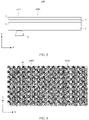
- FIG. 1 shows a schematic plan view of a display apparatus according to some exemplary embodiments of the present disclosure, and schematically shows a planar structure of a display substrate included in the display apparatus.
- FIG. 2 shows a schematic cross-sectional view of a display apparatus taken along a line AA' in FIG. 1 , according to some exemplary embodiments of the present disclosure.
- the display apparatus includes a display substrate.
- the display substrate may be an electroluminescent display substrate, such as an OLED display substrate.
- the display apparatus includes a display substrate 100.
- the display substrate 100 includes a display region, and the display region may include a first display region AA1 and a second display region AA2.
- the second display region AA2 at least partially surrounds (for example, completely surrounds) the first display region AA1.
- the display substrate 100 may include a base substrate 1.
- a sensor 2 may be arranged on a back surface (shown as a lower side in FIG. 2 , for example, a side opposite to a light exit direction during display) of the base substrate 1, and the first display region AA1 may meet an imaging requirement of the sensor 2 for light transmittance.
- a light transmittance of the first display region AA1 is greater than a light transmittance of the second display region AA2.
- the sensor 2 is, for example, an image sensor or an infrared sensor.
- the sensor 2 is used to receive light from a display side (shown as an upper side in FIG. 2 , for example, in the light exit direction during display or a direction where the human eye is during display) of the display substrate 100, so that operations such as image capturing, distance sensing, and light intensity sensing may be performed.
- the light for example, pass through the first display region AA1 and then illuminate the sensor, so as to be sensed by the sensor.
- the second display region AA2 completely surrounds the first display region AA1, however, the embodiments of the present disclosure are not limited thereto.
- the first display region AA1 may be located at an upper edge of the display substrate.
- three sides of the first display region AA1 are surrounded by the second display region AA2, and an upper side of the first display region AA1 is flush with an upper side of the display substrate.
- the first display region AA1 may be located at the upper edge of the display substrate and arranged along an entire width of the display substrate.
- a shape of the first display region AA1 may be a circle, an oval, a polygon, or a rectangle
- a shape of the second display region AA2 may be a circle, a ring, an oval, or a rectangle, but the embodiments of the present disclosure are not limited thereto.
- both the shape of the first display region AA1 and the shape of the second display region AA2 may be a rectangle, a rounded rectangle or other appropriate shapes.
- the OLED display technology may be applied in the display substrate shown in FIGS. 1 to 2 . Due to advantages of wide viewing angle, high contrast, fast response, low power consumption, foldability, flexibility, etc., OLED display substrates are more and more widely used in display products. With the development and in-depth application of the OLED display technology, the demand for displays with high screen-to-body ratio is becoming stronger. In the display substrate shown in FIGS. 1 and 2 , an under-screen camera solution is applied. In this way, a notch region may be avoided, no holes need to be punched in the display screen, and the screen-to-body ratio may be increased, which makes the visual experience better.
- the display substrate may include a base substrate 1 and various film layers arranged on the base substrate 1.
- the display substrate may further include a driving circuit layer, a light-emitting device layer, and an encapsulation layer arranged on the base substrate 1.
- the driving circuit layer 3, the light-emitting device layer 4, and the encapsulation layer 5 are schematically shown in FIG. 2 .
- the driving circuit layer 3 includes a driving circuit structure
- the light-emitting device layer 4 includes a light-emitting device such as OLED.
- the driving circuit structure controls a light-emitting device of each sub-pixel to emit light, so as to realize a display function.
- the driving circuit structure includes a thin film transistor, a storage capacitor, and various signal lines.
- the various signal lines include a gate line, a data line, an ELVDD power line, an ELVSS power line, etc., so as to provide various signals such as a control signal, a data signal, and a power supply voltage signal for a pixel driving circuit in each sub-pixel.
- the first display region AA1 may correspond to an under-screen camera, that is, the first display region AA1 may be an under-screen imaging region.
- that the display substrate 100 includes two first display regions AA1 is taken as an example for description.
- Each first display region AA1 may has a circular shape, a substantially circular shape, an oval shape, a polygonal shape, or the like.
- Two first display regions AA1 are spaced apart, and a spacing region SR is provided between the two first display regions AA1.
- two sensors 2 may be arranged to correspond to two sub-display regions respectively, so as to form a display apparatus with a dual-camera structure.
- the embodiments of the present disclosure are not limited thereto, and in other embodiments, fewer (for example, one) or more sub-display regions and sensors 2 may be arranged.
- a shape of the sub-display region may also be determined according to a shape of a hardware structure to be installed.
- orthographic projections of respective sub-display regions on the base substrate may have one or more of following shapes: a circle, an oval, a rectangle, a rounded rectangle, a square, a rhombus, a trapezoid, a polygon, etc., and various combinations thereof.
- a display region with a higher light transmittance than that of a normal display region is arranged in the display substrate, and a hardware structure such as a camera is installed in the display region.
- a hardware structure such as a camera
- a manner of reducing a pixel density of the first display region is generally used to cause a light transmittance of the display region provided with the sensor 2 (that is, the first display region AA1) to be greater than a light transmittance of a normal display region (that is, the second display region AA2), that is, cause PPI of the first display region to be less than PPI of the second display region, for example, the PPI of the first display region is generally set to be less than half of the PPI of the second display region.
- the manner of reducing PPI will reduce a display quality of the first display region. Different from the normal display region, a picture displayed in the first display region will be visually grainy.
- a pixel driving circuit of a pixel in the first display region is generally arranged outside an under-screen imaging region.
- a pixel driving circuit is arranged in the above-mentioned spacing region SR.
- the pixel driving circuit arranged outside must be electrically connected to a light-emitting element (such as OLED) of each pixel arranged in the under-screen imaging region via a conductive wire.
- the realization of high PPI of the under-screen imaging region will be limited, that is, the under-screen imaging region with high PPI cannot be realized.
- the embodiments of the present disclosure provide at least a display substrate, a display panel, and a display apparatus.
- the display substrate includes a first display region and a second display region, and a light transmittance of the first display region is greater than a light transmittance of the second display region.
- the display substrate includes: a base substrate, and a plurality of sub-pixels arranged on the base substrate and located in the first display region, where the sub-pixel includes a first pixel driving circuit and a first light-emitting device, and the first pixel driving circuit is electrically connected to the first light-emitting device and used to drive the first light-emitting device to emit light.
- the first pixel driving circuit includes a storage capacitor and a plurality of transistors, and the storage capacitor and the plurality of transistors included in the first pixel driving circuit are located in the first display region.
- a pixel driving circuit of each sub-pixel may be built into a corresponding sub-pixel, without being arranged outside the under-screen imaging region, which may avoid the above-mentioned various problems caused by arranging the external pixel driving circuit, so that a higher PPI of the under-screen imaging region may be realized, while ensuring that the light transmittance of the under-screen imaging region meets the requirements.
- FIG. 3 shows a partial enlarged view of a display substrate at part I in FIG. 1 , according to some exemplary embodiments of the present disclosure.
- FIG. 4 shows a partial enlarged view of a display substrate at part II in FIG. 3 , according to some exemplary embodiments of the present disclosure.
- FIG. 5 shows a partial enlarged view of a display substrate at part III in FIG. 4 , according to some exemplary embodiments of the present disclosure.
- the display substrate may include the first display region AA1 and the second display region AA2, a light transmittance of the first display region AA1 is greater than a light transmittance of the second display region AA2.
- the first display region AA1 may correspond to the sensor 2, that is, an orthographic projection of the sensor 2 on the base substrate 1 falls within an orthographic projection of the first display region AA1 on the base substrate 1.
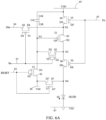
- FIG. 6A shows an equivalent circuit diagram of a pixel driving circuit of a display substrate, according to some exemplary embodiments of the present disclosure.
- an equivalent circuit diagram of a pixel driving circuit of a sub-pixel located in the first display region AA1 and an equivalent circuit diagram of a pixel driving circuit of a sub-pixel located in the second display region AA2 may be substantially the same, that is, the equivalent circuit diagram shown in FIG. 6A may be an equivalent circuit diagram of a pixel driving circuit of a sub-pixel in the first display region AA1 or the second display region AA2.
- the embodiments of the present disclosure are not limited thereto.
- the equivalent circuit diagram of the pixel driving circuit of the sub-pixel located in the first display region AA1 may be different from the equivalent circuit diagram of the pixel driving circuit of the sub-pixel located in the second display region AA2.
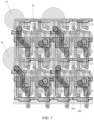
- FIG. 7 shows a plan view of an exemplary embodiment of a sub-pixel in a second display region AA2 of a display substrate, according to some exemplary embodiments of the present disclosure, and schematically shows a plan view of a repeating unit in the second display region AA2.
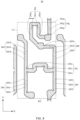
- FIG. 8 shows a plan view of a semiconductor layer of an exemplary embodiment of a sub-pixel included in a repeating unit in FIG. 7 .
- FIG. 9 shows a plan view of a combination of a semiconductor layer and a first conductive layer of an exemplary embodiment of a sub-pixel included in a repeating unit in FIG. 7 .
- FIG. 10 shows a plan view of a combination of a semiconductor layer, a first conductive layer, and a second conductive layer of an exemplary embodiment of a sub-pixel included in a repeating unit in FIG. 7 .
- FIG. 11 shows a plan view of a combination of a semiconductor layer, a first conductive layer, a second conductive layer and a third conductive layer of an exemplary embodiment of a sub-pixel included in a repeating unit in FIG. 7 .
- FIGS. 12A and 12B are respectively plan views each showing a combination of a semiconductor layer, a first conductive layer, a second conductive layer, a third conductive layer and a fourth conductive layer of an exemplary embodiment of a sub-pixel included in a repeating unit in FIG. 7 .
- FIG. 12A and 12B are respectively plan views each showing a combination of a semiconductor layer, a first conductive layer, a second conductive layer, a third conductive layer and a fourth conductive layer of an exemplary embodiment of
- FIG. 13 shows a plan view of a combination of a semiconductor layer, a first conductive layer, a second conductive layer, a third conductive layer, a fourth conductive layer, and a fifth conductive layer of an exemplary embodiment of a sub-pixel included in a repeating unit in FIG. 7 .
- FIG. 14A shows a schematic diagram of a cross-sectional structure of a display substrate taken along a line BB' in FIG. 12B , according to some exemplary embodiments of the present disclosure.
- FIG. 14B shows a schematic diagram of a cross-sectional structure of a display substrate taken along a line CC' in FIG. 13 , according to some exemplary embodiments of the present disclosure.
- a plurality of pixels may be provided in the first display region AA1.
- the plurality of pixels may be arranged on the base substrate 1 in an array in a first direction X and a second direction Y.
- each of the plurality of pixels may include a first sub-pixel 11, a second sub-pixel 12 and a third sub-pixel 13.
- the first sub-pixel 11, the second sub-pixel 12 and the third sub-pixel 13 may be respectively described as a red sub-pixel, a blue sub-pixel and a green sub-pixel, however, the embodiments of the present disclosure are not limited thereto.
- a plurality of pixels may be provided in the second display region AA2.
- the plurality of pixels may be arranged on the base substrate 1 in an array in the first direction X and the second direction Y.
- each of the plurality of pixels 20 may include a fourth sub-pixel 21, a fifth sub-pixel 22, and a sixth sub-pixel 23.
- the fourth sub-pixel 21, the fifth sub-pixel 22 and the sixth sub-pixel 23 may be respectively described as a red sub-pixel, a blue sub-pixel and a green sub-pixel, however, the embodiments of the present disclosure are not limited thereto.
- a plurality of repeating units arranged in an array may be provided in the second display region AA2.
- a repeating unit located in the second display region AA2 is referred to as a second repeating unit P2.
- a second repeating unit P2 may include at least one pixel.
- a second repeating unit P2 includes two pixels.
- a second repeating unit P2 may include a plurality of sub-pixels, such as the above-mentioned fourth sub-pixel 21, fifth sub-pixel 22 and sixth sub-pixel 23.
- a plurality of repeating units arranged in an array are provided in the first display region AA1.
- a repeating unit located in the first display region AA1 is referred to as a first repeating unit P1.
- a first repeating unit P1 may include at least one pixel.
- a first repeating unit P1 includes two pixels. Accordingly, a first repeating unit P1 may include a plurality of sub-pixels, such as the above-mentioned first sub-pixel 11, second sub-pixel 12 and third sub-pixel 13.
- each repeating unit may include at least two different colors of sub-pixels, for example, a first color sub-pixel, a second color sub-pixel, and a third color sub-pixel, and the first color, the second color, and third color are different from each other.
- R, G, and B are marked in respective sub-pixels to represent the red sub-pixel, the green sub-pixel, and the blue sub-pixel, respectively.
- this is only schematic, which should not be regarded as a limitation to the embodiments of the present disclosure.
- an arrangement of sub-pixels in each repeating unit may refer to a conventional pixel arrangement, such as GGRB, RGBG, RGB, etc., which is not limited in the embodiments of the present disclosure.
- each sub-pixel located in the first display region AA1 and the second display region AA2 may include a pixel driving circuit and a light-emitting device.
- the light-emitting device may be an OLED light-emitting device, and the OLED light-emitting device includes an anode, an organic light-emitting layer and a cathode that are stacked.
- the pixel driving circuit may include a plurality of thin film transistors and at least one storage capacitor.
- first direction X and the second direction Y are perpendicular to each other, however, the embodiments of the present disclosure are not limited thereto.
- the embodiments of the present disclosure are not limited to the 7T1C pixel driving circuit, and structures of other known pixel driving circuits may be applied to the embodiments of the present disclosure, under the condition of no conflict.
- the display substrate 100 further includes a pixel defining layer PDL on a side of a first electrode (such as an anode) away from the pixel driving circuit.
- the pixel defining layer PDL includes a plurality of openings, and each sub-pixel corresponds to at least one opening (for example, one opening) in the pixel-defining layer, and an actual light-emitting region or a display region of a sub-pixel is substantially equivalent to an opening in the pixel-defining layer corresponding to the sub-pixel.
- an area of an opening in the pixel defining layer corresponding to each sub-pixel or an actual light-emitting region of each sub-pixel is less than an area of the first electrode (such as an anode), and a projection of the opening in the pixel defining layer or the actual light-emitting region on the base substrate completely falls within a projection of the first electrode on the base substrate.
- the first electrode such as an anode
- each sub-pixel located in the second display region AA2 may include a light-emitting device (such as an OLED).
- a light-emitting device located in the second display region AA2 is called a second light-emitting device 42.
- the second light-emitting device 42 may include an anode 42A, a light-emitting material layer 42B, and a cathode 42C that are stacked. It should be noted that, for clarity, in the plan views, the anode of the second light-emitting device 42 is used to schematically illustrate the second light-emitting device 42, so as to schematically represent the sub-pixel located in the second display region AA2.
- the anode 42A of the second light-emitting device 42 may include an anode body portion 421 and an anode connection portion 422.
- An orthographic projection of the anode body portion 421 on the base substrate 1 may have a regular shape, such as a circle, an oval, a rectangle, a hexagon, an octagon, a rounded rectangle, and the like.
- the second display region AA2 is further provided with a pixel driving circuit (which will be described below) for driving the second light-emitting device 42, and the anode connection portion 422 is electrically connected to the pixel driving circuit for the second light-emitting device 42.
- the second repeating unit P2 may include a plurality of sub-pixels arranged in 4 rows and 4 columns.
- a fourth sub-pixel 21 and a fifth sub-pixel 22 are arranged in the first column and the third column, respectively.
- two sixth sub-pixels 23 are arranged in the second column and the fourth column, respectively.
- a fifth sub-pixel 22 and a fourth sub-pixel 21 are arranged in the first column and the third column, respectively.
- two sixth sub-pixels 23 are arranged in the second column and the fourth column, respectively.
- the arrangement of sub-pixels shown in FIG. 7 is only an exemplary arrangement of some embodiments of the present disclosure, and is not a limitation to the embodiments of the present disclosure. In other embodiments, the sub-pixels may be arranged in other ways.
- an area of an orthographic projection of an anode body portion 421 of a fourth sub-pixel 21 on the base substrate 1 is less than an area of an orthographic projection of an anode body portion 421 of a fifth sub-pixel 22 on the base substrate 1
- an area of an orthographic projection of an anode body portion 421 of a sixth sub-pixel 23 on the base substrate 1 is less than the area of the orthographic projection of the anode body portion 421 of the fourth sub-pixel 21 on the base substrate 1.
- an actual light-emitting area of a green sub-pixel is the smallest
- an actual light-emitting area of a blue sub-pixel is the largest
- an actual light-emitting area of a red sub-pixel is between the actual light-emitting areas of the green sub-pixel and the blue sub-pixel.
- the pixel driving circuit may include a plurality of thin film transistors and a storage capacitor Cst.
- the pixel driving circuit is used to drive an organic light-emitting diode (i.e., OLED).
- the plurality of thin film transistors include a first transistor T1, a second transistor T2, a third transistor T3, a fourth transistor T4, a fifth transistor T5, a sixth transistor T6, and a seventh transistor T7.
- Each transistor includes a gate, a source, and a drain.
- the display substrate may further include a plurality of signal lines, for example, the plurality of signal lines include: a scan signal line 61 for transmitting a scan signal Sn, a reset signal line 62 for transmitting a reset control signal RESET (for example, the reset control signal RESET may be a scan signal of a previous row), a light-emitting control line 63 for transmitting a light-emitting control signal En, a data signal line 64 for transmitting a data signal Dm, a driving voltage line 65 for transmitting a driving voltage VDD, an initialization voltage line 66 for transmitting an initialization voltage Vint, and a power supply line 67 for transmitting a VSS voltage.
- the plurality of signal lines include: a scan signal line 61 for transmitting a scan signal Sn, a reset signal line 62 for transmitting a reset control signal RESET (for example, the reset control signal RESET may be a scan signal of a previous row), a light-emitting control line 63 for transmitting a
- the storage capacitor Cst may include two capacitive plates Cst1 and Cst2.
- the capacitive plate Cst1 may be referred to as one end, a first end, or a first storage capacitor electrode of the storage capacitor Cst
- the capacitive plate Cst2 may be referred to as the other end, a second end, or a second storage capacitor electrode of the storage capacitor Cst.
- the first transistor T1, the second transistor T2, the third transistor T3, the fourth transistor T4, the fifth transistor T5, the sixth transistor T6 and the seventh transistor T7 may be formed along an active layer as shown in FIG. 8 .
- the active layer may have a curved or bent shape, and may include a first active layer 20a corresponding to the first transistor T1, a second active layer 20b corresponding to the second transistor T2, a third active layer 20c corresponding to the third transistor T3, a fourth active layer 20d corresponding to the fourth transistor T4, a fifth active layer 20e corresponding to the fifth transistor T5, a sixth active layer 20f corresponding to the sixth transistor T6, and a seventh active layer 20g corresponding to the seventh transistor T7.
- the active layer may include, for example, polysilicon, and include, for example, a channel region, a source region, and a drain region.
- the channel region may not be doped, or a doping type thereof is different from doping types of the source region and the drain region, and therefore the channel region has a semiconductor characteristic.
- the source region and the drain region are respectively located on both sides of the channel region, and are doped with impurities, and therefore have electrical conductivity.
- the impurities may be changed according to whether the TFT is an N-type transistor or a P-type transistor.
- the first transistor T1 includes the first active layer 20a and a first gate G1.
- the first active layer 20a includes a first channel region 201a, a first source region 203a, and a first drain region 205a.
- the gate G1 of the first transistor T1 is electrically connected to the reset signal line 62.
- a source S1 of the first transistor T1 is electrically connected to the initialization voltage line 66.
- a drain D1 of the first transistor T1 is electrically connected to the end Cst1 of the storage capacitor Cst, a drain D2 of the second transistor T2, and a gate G3 of the third transistor T3. As shown in FIG.
- the drain D1 of the first transistor T1, the end Cst1 of the storage capacitor Cst1, the drain D2 of the second transistor T2, and the gate G3 of the third transistor T3 are electrically connected at a node N1.
- the first transistor T1 is turned on according to the reset control signal RESET transmitted via the reset signal line 62, so as to transmit the initialization voltage Vint to the gate G1 of the third transistor T3, so that an initialization operation is performed to initialize a voltage of the gate G3 of the third transistor T3. That is, the first transistor T1 is also referred to as an initialization transistor or a reset transistor herein.
- the second transistor T2 includes the second active layer 20b and a second gate G2.
- the second active layer 20b includes a second channel region 201b, a second source region 203b, and a second drain region 205b.
- the gate G2 of the second transistor T2 is electrically connected to the scan signal line 61, a source S2 of the second transistor T2 is electrically connected to a node N3, and the drain D2 of the second transistor T2 is electrically connected to the node N1.
- the second transistor T2 is turned on according to the scan signal Sn transmitted via the scan signal line 61, so as to electrically connect the gate G3 and a drain D3 of the third transistor T3 to each other, thereby implementing a diode connection of the third transistor T3.
- the second transistor T2 is also referred to as a compensation transistor.
- the third transistor T3 includes the third active layer 20c and a third gate G3.
- the third active layer 20c includes a third source region 203c, a third drain region 205c, and a third channel region 201c connecting the third source region 203c and the third drain region 205c.
- the third source region 203c and the third drain region 205c extend in two opposite directions relative to the third channel region 201c.
- the third source region 203c of the third transistor T3 is connected to a fourth drain region 205d and a fifth drain region 205e.
- the third drain region 205c is connected to the second source region 203b and a sixth source region 203f.
- the gate G3 of the third transistor T3 is electrically connected to the node N1 through via holes VAH1 and VAH2, and a first connection portion 68.
- the gate G3 of the third transistor T3 is electrically connected to the node N1, a source S3 of the third transistor T3 is electrically connected to the node N2, and the drain D3 of the third transistor T3 is electrically connected to the node N3.
- the third transistor T3 receives the data signal Dm according to a switching operation of the fourth transistor T4, so as to provide a driving current Id to the OLED.
- the third transistor T3 is also referred to as a driving transistor.
- the fourth transistor T4 includes the fourth active layer 20d and a fourth gate G4.
- the fourth active layer 20d includes a fourth channel region 201d, a fourth source region 203d, and a fourth drain region 205d.
- the fourth transistor T4 serves as a switching device for selecting a target light-emitting sub-pixel.
- the fourth gate G4 is connected to the scan signal line 61, the fourth source region 203d is connected to the data signal line 64 through a via hole VAH4, and the fourth drain region 205d is connected to the first transistor T1 and the fifth transistor T5, that is, electrically connected to the node N2.
- the fourth transistor T4 is turned on according to the scan signal Sn transmitted via the scan signal line 61, so as to perform a switching operation to transmit the data signal Dm to the source S3 of the third transistor T3.
- the fourth transistor T4 is also referred to as a switching transistor.
- the fifth transistor T5 includes the fifth active layer 20e and a fifth gate G5.
- the fifth active layer 20e includes a fifth channel region 201e, a fifth source region 203e, and a fifth drain region 205e.
- the fifth source region 203e may be connected to the driving voltage line 65 through a via hole VAH6.
- the gate G5 of the fifth transistor T5 is electrically connected to the light-emitting control line 63, and a source S5 of the fifth transistor T5 is electrically connected to the driving voltage line 65.
- a drain D5 of the fifth transistor T5 is electrically connected to the node N2.
- the fifth transistor T5 is also referred to as an operation control transistor.
- the sixth transistor T6 includes the sixth active layer 20f and a sixth gate G6, and the sixth active layer 20f includes a sixth channel region 201f, a sixth source region 203f, and a sixth drain region 205f.
- the sixth drain region 205f may be connected to an anode of the OLED through a via hole VAH7.
- the gate G6 of the sixth transistor T6 is electrically connected to the light-emitting control line 63, a source S6 of the sixth transistor T6 is electrically connected to the node N3, and a drain D6 of the sixth transistor T6 is electrically connected to a node N4, that is, electrically connected to the anode of the OLED.
- the fifth transistor T5 and the sixth transistor T6 are concurrently (for example, simultaneously) turned on according to the light-emitting control signal En transmitted via the light-emitting control line 63, so as to transmit the driving voltage VDD to the OLED, thereby allowing the driving current Id to flow into the OLED.
- the sixth transistor T6 is also referred to as a light-emitting control transistor.
- the seventh transistor T7 includes the seventh active layer 20g and a seventh gate G7.
- the seventh active layer 20g includes a seventh source region 203 g, a seventh drain region 205g, and a seventh channel region 201g.
- the seventh drain region 205g is connected to the first source region 203a of the first transistor T1.
- the seventh drain region 205g may be electrically connected to the initialization voltage line 66 through a via hole VAH8, a second connection portion 69, and a via hole VAH5.
- the gate G7 of the seventh transistor T7 is electrically connected to the reset signal line 62, a source S7 of the seventh transistor T7 is electrically connected to the node N4, and a drain D7 of the seventh transistor T7 is electrically connected to the initialization voltage line 66.
- the initialization voltage Vint transmitted by the initialization voltage line 66 may be provided to the OLED, for example, to the first electrode (such as the anode) of the OLED, so as to initialize a voltage of the first electrode of the OLED.
- the seventh transistor T7 may also be referred to as a light-emitting device initialization transistor T7.
- the end Cst1 (hereinafter referred to as the first storage capacitor electrode) of the storage capacitor Cst is electrically connected to the node N1, and the other end Cst2 (hereinafter referred to as the second storage capacitor electrode) of the storage capacitor Cst is electrically connected to the driving voltage line 65.
- the anode of the OLED is electrically connected to the node N4, and a cathode of the OLED is electrically connected to the power supply line 67 to receive a common voltage VSS. Accordingly, the OLED receives the driving current Id from the third transistor T3 to emit light, thereby displaying an image.
- each of the thin film transistors T1, T2, T3, T4, T5, T6, and T7 is a p-channel field effect transistor, however, the embodiments of the present disclosure are not limited thereto, and at least some of the thin film transistors T1, T2, T3, T4, T5, T6, and T7 may be n-channel field effect transistors.
- the reset control signal RESET being at a low level is provided via the reset signal line 62.
- the first transistor T1 is turned on based on the reset control signal RESET being at a low level, and the initialization voltage Vint from the initialization voltage line 66 is transmitted to the gate G1 of the third transistor T3 via the first transistor T1. Therefore, the third transistor T3 is initialized due to the initialization voltage Vint.
- the scan signal Sn being at a low level is provided via the scan signal line 61.
- the fourth transistor T4 and the second transistor T2 are turned on based on the scan signal Sn being at a low level. Therefore, the third transistor T3 is in a diode-connected state as the second transistor T2 is turned on, and the third transistor T3 is positive biased.
- a compensation voltage (Dm + Vth) (for example, Vth is a negative value), which is obtained by subtracting a threshold voltage Vth of the third transistor T3 from the data signal Dm provided via the data signal line 64, is applied to the gate G3 of the third transistor T3.
- the driving voltage VDD and the compensation voltage (Dm + Vth) are applied to the two ends of the storage capacitor Cst, so that electric charges corresponding to a voltage difference between corresponding ends are stored in the storage capacitor Cst.
- the light-emitting control signal En from the light-emitting control line 63 changes from being at a high level to being at a low level.
- the fifth transistor T5 and the sixth transistor T6 are turned on based on the light-emitting control signal En being at a low level.
- a driving current is generated based on a difference between a voltage at the gate G3 of the third transistor T3 and the driving voltage VDD.
- the driving current Id corresponding to a difference between the driving current and a bypass current is provided to the OLED via the sixth transistor T6.
- a gate-source voltage of the third transistor T3 is maintained at ((Dm + Vth) - VDD) due to the storage capacitor Cst.
- the driving current Id is proportional to (Dm - VDD) 2 . Therefore, the driving current Id may not be affected by variation of the threshold voltage Vth of the third transistor T3.
- the display substrate includes a base substrate 1 and a plurality of film layers arranged on the base substrate 1.
- the plurality of film layers include at least a semiconductor layer 20, a first conductive layer 21, a second conductive layer 22, a third conductive layer 23, and a fourth conductive layer 24.
- the semiconductor layer 20, the first conductive layer 21, the second conductive layer 22, and the third conductive layer 23 are arranged away from the base substrate 1 sequentially.
- the plurality of film layers further include at least a plurality of insulating film layers.
- the plurality of insulating film layers may include a first gate insulating layer GI1, a second gate insulating layer GI2, an interlayer insulating layer IDL, and a passivation layer PVX.
- the first gate insulating layer GI1 may be arranged between the semiconductor layer 20 and the first conductive layer 21
- the second gate insulating layer GI2 may be arranged between the first conductive layer 21 and the second conductive layer 22
- the interlayer insulating layer IDL may be arranged between the second conductive layer 22 and the third conductive layer 23
- the passivation layer PVX may be arranged between the third conductive layer 23 and the fourth conductive layer 24.
- the semiconductor layer 20 may be made of a semiconductor material such as low-temperature polysilicon, and a film thickness thereof may be within a range of 400 angstroms to 800 angstroms, such as 500 angstroms.
- the first conductive layer 21 and the second conductive layer 22 may be made of a conductive material used to form a gate of a thin film transistor, for example, the conductive material may be Mo, and a film thickness of the first conductive layer 21 and the second conductive layer 22 may be within a range of 2000 angstroms to 4000 angstroms, such as 3000 angstroms.
- the third conductive layer 23 and the fourth conductive layer 24 may be made of a conductive material used to form a source and drain of a thin film transistor, for example, the conductive material may include Ti, Al, etc.
- the third conductive layer 23 may have a stack structure formed of Ti/Al/Ti, a film thickness of the third conductive layer 23 may range from 6000 angstroms to 9000 angstroms.
- thicknesses of respective layers of Ti/Al/Ti may be about 500 angstroms, 6000 angstroms, and 500 angstroms.
- the first gate insulating layer GI1 and the second gate insulating layer GI2 may be made of silicon oxide, silicon nitride or silicon oxynitride, and each layer may have a thickness ranging from about 1000 angstroms to 2000 angstroms.
- the interlayer insulating layer IDL may be made of silicon oxide, silicon nitride or silicon oxynitride, with a thickness ranging from about 3000 angstroms to 6000 angstroms.
- the display substrate includes the scan signal line 61, the reset signal line 62, the light-emitting control line 63 and the initialization voltage line 66 arranged in a row direction to respectively apply the scan signal Sn, the reset control signal RESET, the light-emitting control signal En, and the initialization voltage Vint to each sub-pixel.
- the display substrate may further include the data signal line 64 and the driving voltage line 65 intersecting the scan signal line 61, the reset signal line 62, the light-emitting control line 63 and the initialization voltage line 66, so as to respectively apply the data signal Dm and the driving voltage VDD to each sub-pixel.
- each of the scan signal line 61, the reset signal line 62, and the light-emitting control line 63 is located in the first conductive layer 21.
- Each of the gates G1 to G7 of the transistors described above is also located in the first conductive layer 21.
- parts of the reset signal line 62 overlapping the semiconductor layer 20 respectively form the gate G1 of the first transistor T1 and the gate G7 of the seventh transistor T7
- parts of the scan signal line 61 overlapping the semiconductor layer 20 respectively form the gate G2 of the second transistor T2 and the gate G4 of the fourth transistor T4
- parts of the light-emitting control line 63 overlapping the semiconductor layer 20 respectively form the gate G6 of the sixth transistor T6 and the gate G5 of the fifth transistor T5.
- the display substrate may further include a plurality of first storage capacitor electrodes Cst1.
- the plurality of first storage capacitor electrodes Cst1 are also located in the first conductive layer 21.
- a part of the first storage capacitor electrode Cst1 overlapping the semiconductor layer 20 forms the third gate G3 of the third transistor T3.
- the first storage capacitor electrode Cst1 also forms an end of the storage capacitor Cst. That is, the first storage capacitor electrode Cst1 simultaneously serves as the gate G3 of the third transistor T3 and an electrode of the storage capacitor Cst.
- an orthographic projection of the first storage capacitor electrode Cst1 on the base substrate 1 may have a substantially rectangular shape.
- the "substantially rectangular shape” may include a shape such as a rectangle, a rectangle with at least one corner rounded, and a rectangle with at least one corner chamfered.
- the initialization voltage line 66 is located in the second conductive layer 22.
- the display substrate may further include a plurality of second storage capacitor electrodes Cst2.
- the plurality of second storage capacitor electrodes Cst2 are also located in the second conductive layer 22.
- the plurality of second storage capacitor electrodes Cst2 are arranged corresponding to the plurality of first storage capacitor electrodes Cst1, respectively. That is, an orthographic projection of the plurality of second storage capacitor electrodes Cst2 on the base substrate 1 and an orthographic projection of the corresponding first storage capacitor electrodes Cst1 on the base substrate 1 at least partially overlap.
- the second storage capacitor electrode Cst2 forms the other end of the storage capacitor Cst.
- the first storage capacitor electrode Cst1 and the second storage capacitor electrode Cst2 are oppositely arranged, the orthographic projections of the two on the base substrate 1 at least partially overlap each other, and the second gate insulating layer GI2 is arranged between the two.
- the first storage capacitor electrode Cst1 may be electrically connected to the node N1 through the via holes VAH1 and VAH2, and the first connection portion 68, and the second storage capacitor electrode Cst2 may be electrically connected to the driving voltage line 65 through a via hole VAH9, that is, the first storage capacitor electrode Cst1 and the second storage capacitor electrode Cst2 are connected to different voltage signals. In this way, a part where the first storage capacitor electrode Cst1 and the second storage capacitor electrode Cst2 overlap each other may form the storage capacitor Cst.
- the second storage capacitor electrode Cst2 may include a through hole TH2, so that the first storage capacitor electrode Cst1 under the second storage capacitor electrode Cst2 is connected with a component located in the third conductive layer 23.
- a part of the first connection portion 68 is formed in the via hole VAH1 to form a conductive plug 681.
- the conductive plug 681 extends through the through hole TH2 to be electrically connected with the first storage capacitor electrode Cst1. In this way, an end of the first connection portion 68 is electrically connected with an end Cst1 of the storage capacitor.
- an orthographic projection of the through hole TH2 on the base substrate 1 may have a substantially rectangular shape.
- the "substantially rectangular shape” may include a shape such as a rectangle or a square, a rectangle or square with at least one corner rounded, and a rectangle or square with at least one corner chamfered.
- the data signal line 64 and the driving voltage line 65 are located in the third conductive layer 23.
- the first connection portion 68 and the second connection portion 69 are also located in the third conductive layer 23.
- a third connection portion 70 is located in the fourth conductive layer 24.
- One end of the third connection portion 70 is electrically connected to the sixth transistor T6, and the other end of the third connection portion 70 is electrically connected to the anode of the OLED.
- the display substrate 100 may further include an insulating layer disposed between the fourth conductive layer 24 and the fifth conductive layer 25, such as a passivation layer PVX.
- a via hole VAH10 may pass through the passivation layer PVX.
- the anode 42A of the second light-emitting device 42 is located in the fifth conductive layer 25.
- a part of the anode connection portion 422 is formed in the via hole VAH10, and this part extends downward to be electrically connected with a part of the third connection portion 10.
- third connection portion 70 is electrically connected with the sixth transistor T6 through the via hole VAH7, and the other end of the third connection portion 70 is electrically connected to the anode connection portion 422 through the via hole VAH10.
- each sub-pixel on the display substrate needs to be arranged in a prescribed manner. In this way, extension lengths of third connection portions 70 in respective sub-pixels may be the same or different from each other.
- FIG. 12A shows a plan view of a pixel driving circuit of a fourth sub-pixel or a fifth sub-pixel
- FIG. 12B shows a plan view of a pixel driving circuit of a sixth sub-pixel.
- An extension length of a third connection portion 70 in the sixth sub-pixel 23 may be less than an extension length of a third connection portion 70 in the fourth sub-pixel 21 or the fifth sub-pixel 22.
- FIG. 6B shows an equivalent circuit diagram of a pixel driving circuit of a sub-pixel in a first display region of a display substrate according to some exemplary embodiments of the present disclosure.
- FIG. 15A shows a plan view of an exemplary embodiment of a sub-pixel in a first display region AA1 of a display substrate according to some exemplary embodiments of the present disclosure, in which a plan view of a repeating unit in the first display region AA1 is schematically illustrated.
- FIG. 16 shows a plan view of a semiconductor layer of an exemplary embodiment of a sub-pixel included in a repeating unit in FIG.15A .
- FIG. 15A shows a plan view of an exemplary embodiment of a sub-pixel in a first display region AA1 of a display substrate according to some exemplary embodiments of the present disclosure, in which a plan view of a repeating unit in the first display region AA1 is schematically illustrated.
- FIG. 16 shows a plan view of a semiconductor layer of an exemplary embodiment of a
- FIG. 17 shows a plan view of a combination of a semiconductor layer and a first conductive layer of an exemplary embodiment of a sub-pixel included in a repeating unit in FIG. 15A .
- FIG. 18 shows a plan view of a combination of a semiconductor layer, a first conductive layer and a second conductive layer of a sub-pixel included in a repeating unit in FIG.15A .
- FIG. 19 shows a plan view of a combination of a semiconductor layer, a first conductive layer, a second conductive layer and a third conductive layer of an exemplary embodiment of a sub-pixel included in a repeating unit in FIG. 15A .
- FIG 20A shows a plan view of a combination of a semiconductor layer, a first conductive layer, a second conductive layer, a third conductive layer and a transparent conductive layer of an exemplary embodiment of a sub-pixel included in a repeating unit in FIG.15A .
- FIG. 20B shows a plan view of a combination of a semiconductor layer, a first conductive layer, a second conductive layer, a third conductive layer and a transparent conductive layer of an exemplary embodiment of 3 sub-pixels included in a repeating unit in FIG. 15A .
- FIG. 21 shows a plan view of a combination of a semiconductor layer, a first conductive layer, a second conductive layer, a third conductive layer, a transparent conductive layer and a fourth conductive layer of an exemplary embodiment of a sub-pixel included in a repeating unit in FIG.15A .
- FIGS. 22A , 22B and 22C respectively show plan views of combinations of a semiconductor layer, a first conductive layer, a second conductive layer, a third conductive layer, a transparent conductive layer, a fourth conductive layer and a fifth conductive layer of exemplary embodiments of three sub-pixels included in a repeating unit in FIG. 15A .
- FIG. 23 shows a plan view of a transparent conductive layer of an exemplary embodiment of a sub-pixel included in a repeating unit in FIG. 15A .
- FIG. 24 shows a plan view of a transparent conductive layer of an exemplary embodiment of a repeating unit in FIG.15A .
- FIG. 25A shows a schematic diagram of a cross-sectional structure of a display substrate taken along a line CC' in FIG. 21 , according to some exemplary embodiments of the present disclosure.
- FIG. 25B shows a schematic diagram of a cross-sectional structure of a display substrate taken along a line DD' in FIG. 22A , according to some exemplary embodiments of the present disclosure.
- elements having the same or similar functions and/or structures in the first display region and the second display region may be indicated by the same reference signs.
- a transistor, storage capacitor and signal line located in the first display region may be respectively indicated by reference signs indicating a transistor, a storage capacitor and signal line located in the second display region. It should be understood that, in the following description, these elements are located in the first display region AA1.
- a pixel driving circuit in the sub-pixels 11, 12, and 13 may include: a plurality of thin film transistors and a storage capacitor Cst.
- the pixel driving circuit is used to drive an organic light-emitting diode (i.e., OLED).
- the plurality of thin film transistors include a first transistor T1, a second transistor T2, a third transistor T3, a fourth transistor T4, a fifth transistor T5, a sixth transistor T6, and a seventh transistor T7.
- Each transistor includes a gate, a source, and a drain.
- the plurality of signal lines include: a scan signal line 61 for transmitting a scan signal Sn, and a reset signal line 62 for transmitting a reset control signal RESET (for example, the reset control signal RESET may be a scan signal of a previous row), a light-emitting control line 63 for transmitting a light-emitting control signal En, a data signal line 164 for transmitting a data signal Dm, a driving voltage line 165 for transmitting a driving voltage VDD, an initialization voltage line 66 for transmitting an initialization voltage Vint, and a power supply line 67 for transmitting a VSS voltage.
- a scan signal line 61 for transmitting a scan signal Sn
- a reset signal line 62 for transmitting a reset control signal RESET (for example, the reset control signal RESET may be a scan signal of a previous row)
- a light-emitting control line 63 for transmitting a light-emitting control signal En
- a data signal line 164 for transmit
- the display substrate further includes a pixel defining layer on a side of the first electrode away from the pixel driving circuit.
- the pixel defining layer includes a plurality of openings, each sub-pixel corresponds to at least one opening (for example, one) in the pixel defining layer, and an actual light-emitting region or a display region of a sub-pixel is substantially equivalent to an opening in the pixel defining layer corresponding to the sub-pixel.
- an area of an opening in the pixel defining layer corresponding to each sub-pixel or the actual light-emitting region of each sub-pixel is less than an area of the first electrode (such as an anode), and a projection of the opening in the pixel defining layer or the actual light-emitting region on the base substrate completely falls within a projection of the first electrode on the base substrate.
- each sub-pixel located in the first display region AA1 may include a light-emitting device (such as an OLED).
- a light-emitting device located in the first display region AA1 is referred to as a first light-emitting device 41.
- the first light-emitting device 41 may include an anode 41A (with reference to FIG. 25B ), a light-emitting material layer and a cathode that are stacked.
- the related drawings schematically show the first light-emitting device 41 using the anode of the first light-emitting device 41, thereby schematically illustrating the sub-pixel located in the first display region AA1.
- the anode of the first light-emitting device 41 includes an anode body portion 411 and an anode connection portion 412.
- An orthographic projection of the anode body portion 411 on the base substrate 1 may have a regular shape, such as a circle, an oval, a rectangle, a hexagon, an octagon, and a rounded rectangle.
- the first display region AA1 is further provided with a pixel driving circuit (to be described below) for driving the first light-emitting device 41, and the anode connection portion 412 is electrically connected to a pixel driving circuit of the first light-emitting device 41.
- FIG. 27 shows a plan view of an exemplary embodiment of a sub-pixel in a first display region AA1 of a display substrate, according to some exemplary embodiments of the present disclosure, in which a plan view of a repeating unit in the first display region AA1 is schematically illustrated, and an opening in a pixel defining layer and an anode are schematically illustrated.
- an opening in the pixel defining layer and an anode are schematically illustrated. Similar to the anode body portion, an orthographic projection of an opening OPH on the base substrate 1 may have a regular shape, such as a circle, an oval, a rectangle, a hexagon, an octagon, and a rounded rectangle. A projection of the opening OPH on the base substrate 1 completely falls within a projection of the anode body portion 411 on the base substrate 1.
- an approximate position and an approximate shape of the first electrode (such as an anode) of the sub-pixel are mainly illustrated to represent a distribution of each sub-pixel.
- an arrangement of the sub-pixels in each repeating unit may refer to a conventional pixel arrangement, such as GGRB, RGBG, RGB, etc., which is not limited in the embodiments of the present disclosure.
- the first repeating unit P1 may include a plurality of sub-pixels arranged in 4 rows and 4 columns.
- a first row a first sub-pixel 11 and a second sub-pixel 12 are arranged in a first column and a third column, respectively.
- two third sub-pixels 13 are arranged in a second column and a fourth column, respectively.
- a second sub-pixel 12 and a first sub-pixel 11 are arranged in the first column and the third column, respectively.
- two third sub-pixels 13 are arranged in the second column and the fourth column, respectively.
- FIG. 15A is only an exemplary arrangement of some embodiments of the present disclosure, rather than a limitation on the embodiments of the present disclosure.
- the sub-pixels may be arranged in other ways.
- the display substrate includes a base substrate 1 and a plurality of film layers arranged on the base substrate 1.
- the plurality of film layers include at least a semiconductor layer 20, a first conductive layer 21, a second conductive layer 22, a third conductive layer 23, a transparent conductive layer 26, a fourth conductive layer 24, and a fifth conductive layer 25.
- the semiconductor layer 20, the first conductive layer 21, the second conductive layer 22, the third conductive layer 23, the transparent conductive layer 26, the fourth conductive layer 24, and the fifth conductive layer 25 are arranged away from the base substrate 1 sequentially.
- the plurality of film layers further include at least a plurality of insulating film layers.
- the plurality of insulating film layers may include a first gate insulating layer GI1, a second gate insulating layer GI2, an interlayer insulating layer IDL, a passivation layer PVX and a planarization layer PLN.
- the first gate insulating layer GI1 may be arranged between the semiconductor layer 20 and the first conductive layer 21
- the second gate insulating layer GI2 may be arranged between the first conductive layer 21 and the second conductive layer 22
- the interlayer insulating layer IDL may be arranged between the second conductive layer 22 and the third conductive layer 23
- the passivation layer PVX may be arranged between the third conductive layer 23 and the first transparent conductive layer 26.
- the planarization layer PLN may include a plurality of film layers, which are respectively referred to as a first planarization layer PLN1 and a second planarization layer PLN2 for ease of description.
- the first planarization layer PLN1 may be arranged between the first transparent conductive layer 26 and the fourth conductive layer 24, and the second planarization layer PLN2 may be arranged between the fourth conductive layer 24 and the fifth conductive layer 25.
- the first transistor T1, the second transistor T2, the third transistor T3, the fourth transistor T4, the fifth transistor T5, the sixth transistor T6, and the seventh transistor T7 may be formed along an active layer as shown in FIG. 16 .
- the active layer may have a curved or bent shape, and may include the first active layer 20a corresponding to the first transistor T1, the second active layer 20b corresponding to the second transistor T2, and the third active layer 20c corresponding to the third transistor T3, the fourth active layer 20d corresponding to the fourth transistor T4, the fifth active layer 20e corresponding to the fifth transistor T5, the sixth active layer 20f corresponding to the sixth transistor T6, and the seventh active layer 20g corresponding to the seventh transistor T7.
- the active layers of the first transistor T1, the second transistor T2, the third transistor T3, the fourth transistor T4, the fifth transistor T5, the sixth transistor T6 and the seventh transistor T7 are formed as a continuously extending portion in the semiconductor layer 20.
- continuously extending means that there is no disconnection in this portion.
- the active layer 20g of the seventh transistor T7 is connected to the active layer 20a the first transistor T1
- the active layer 20a of the first transistor T1 is connected to the active layer 20b of the second transistor T2
- the active layer 20b of the second transistor T2 is connected to the active layer 20c of the third transistor T3 and the active layer 20f of the sixth transistor T6,
- the active layer 20c of the third transistor T3 is connected to the active layer 20d of the fourth transistor T4 and the active layer 20e of the fifth transistor T5.
- the active layer 20g of the seventh transistor T7 extends from the active layer 20a of the first transistor T1 in a direction away from the scan signal line 61 of the sub-pixel, that is, the active layer 20g of the seventh transistor T7 is located at the upper right of the active layer 20a of the first transistor T 1.
- the active layer 20g of the seventh transistor T7 may extend toward an active layer of an upper adjacent sub-pixel in the same column, so that the active layers of the sub-pixels located in the same column are formed to be a continuous extending structure.
- the active layer 20g of the seventh transistor T7 extends from the active layer 20a of the first reset transistor T1 in a direction close to the scan signal line 61 of the sub-pixel, that is, the active layer 20g of the seventh transistor T7 is located at the lower right of the active layer 20a of the first transistor T1.
- an occupied region of the active layer of the sub-pixel in the first display region AA1 has an outline of a square or a substantially square.
- the expression "occupied region” represents a largest region covered by an orthographic projection of a pattern, a layer structure, or the like on the base substrate.
- the orthographic projection of the pattern, the layer structure, or the like on the base substrate has two sides farthest apart in the first direction X and two sides farthest apart in the second direction Y, and extension lines of these four sides will cross to form a region, which is the occupied region of the pattern, the layer structure, or the like.
- an occupied region of the active layer of the sub-pixel has a rectangular or substantially rectangular shape.
- the occupied region of the active layer of a sub-pixel located in the second display region AA2 is schematically illustrated using a dashed box, and the occupied region has a size (i.e., a width W2) in the first direction X and a size (i.e., a length L2) in the second direction Y, and the length L2 is greater than the width W2, or in other words, the length L2 is greater than 1.2 times the width W2. That is, the occupied region has a rectangular shape.
- the occupied region of the active layer of the sub-pixel has a square or substantially square shape.
- the occupied region of the active layer of the sub-pixel in the first display region AA1 is schematically illustrated using a dashed box, and the occupied region has a size (i.e., a width W1) in the first direction X and a size (i.e., a length L1) in the second direction Y, and the length L1 is substantially equal to the width W1.
- an area of an occupied region of an active layer of a sub-pixel located in the first display region AA1 is less than that of an occupied region of an active layer of a sub-pixel of a same color located in the second display region AA2. In this way, an area of the occupied region of the pixel driving circuit of the sub-pixel located in the first display region AA1 may be reduced, which will be described in further detail below.
- the scan signal line 61, the reset signal line 62, and the light-emitting control line 63 are located in the first conductive layer 21.
- the gates G1 to G7 of the above-mentioned transistors are also located in the first conductive layer 21.
- the first storage capacitor electrode Cst1 is also located in the first conductive layer 21.
- parts where the scan signal line 61 overlaps the semiconductor layer 20 respectively form the gate G2 of the second transistor T2 and the gate G4 of the fourth transistor T4, and other part where the scan signal line 61 overlaps the semiconductor layer 20 further forms the gate G7 of the seventh transistor T7.
- the scan signal Sn is provided to each of the gates of the seventh transistor T7, the second transistor T2, and the fourth transistor T4.
- the initialization voltage Vint transmitted by the initialization voltage line 66 may be provided to the OLED, for example, to the first electrode (such as an anode) of the OLED, so as to initialize a voltage at the first electrode of the OLED. Therefore, the seventh transistor T7 may also be referred to as a light-emitting device initialization transistor T7 herein.
- the initialization voltage line 66 and the second storage capacitor electrode Cst2 are located in the second conductive layer 22.
- the second storage capacitor electrode Cst2 includes a through hole TH2, and an orthographic projection of a combination of a physical part of the second storage capacitor electrode Cst2 and the through hole TH2 on the base substrate 1 is in a shape of a rectangle or a rounded rectangle.
- the second storage capacitor electrode Cst2 has a notch NTH1 at a corner, that is, an orthographic projection of the second storage capacitor electrode Cst2 on the base substrate 1 has an "L" shape.
- an orthographic projection of a combination of a physical part of the second storage capacitor electrode Cst2 and the notch NTH1 on the base substrate 1 is in a shape of a rectangle or a rounded rectangle.
- the notch NTH1 exposes a part of the first storage capacitor electrode Cst1 which is located under the second storage capacitor electrode Cst2, so that the first storage capacitor electrode Cst1 is electrically connected with other parts.
- an area of an orthographic projection of a second storage capacitor electrode Cst2 of a sub-pixel located in the first display region AA1 on the base substrate 1 is less than an area of an orthographic projection of a second storage capacitor electrode Cst2 of a sub-pixel located in the second display region AA2.
- the second storage capacitor electrode Cst2 of the sub-pixel located in the first display region AA1 is designed into an "L" shape, without forming the through hole in the second storage capacitor electrode Cst2, so that it is ensured that an overlapping area of the first storage capacitor electrode Cst1 and the second storage capacitor electrode Cst2 of the sub-pixel in the first display region AA1 is relatively large, that is, a capacitance value of the storage capacitor Cst is ensured.
- connection portion 168 As shown in FIG. 19 , a connection portion 168, a connection portion 169, a connection portion 170, and a connection portion 171 are located in the third conductive layer 23.
- connection portion 168 A part of the connection portion 168 is formed in a via hole VH6, and this part extends downward to be electrically connected to a part of the first storage capacitor electrode Cst1 exposed by the notch NTH1. Another part of the connection portion 168 is formed in the via hole VH2, and the another part extends downward to be electrically connected to the drain D2 of the second transistor T2 and the drain D1 of the first transistor T1.
- the first storage capacitor electrode Cst1, the drain D2 of the second transistor T2 and the drain D1 of the first transistor T1 may be electrically connected, that is, the node N1 shown in FIG. 6B is formed.
- connection portion 169 A part of the connection portion 169 is formed in a via hole VH12, and extends downward to be electrically connected with the initialization voltage line 66. Another part of the connection portion 169 is formed in a via hole VH4, and extends downward to be electrically connected to the drain D7 of the seventh transistor T7. Through the connection part 169, the initialization voltage Vint transmitted by the initialization voltage line 66 may be provided to the drain D7 of the seventh transistor T7.
- connection portion 170 A part of the connection portion 170 is formed in a via hole VH5, and extends downward to be electrically connected to the source S7 of the seventh transistor T7. Another part of the connection portion 170 is formed in a via hole VH10, and extends downward to be electrically connected to the drain D6 of the sixth transistor T6. Through the connection portion 170, the source S7 of the seventh transistor T7 and the drain D6 of the sixth transistor T6 may be electrically connected, that is, the node N4 shown in FIG. 6B is formed.
- connection portion 171 A part of the connection portion 171 is formed in a via hole VH7, and extends downward to be electrically connected to the second storage capacitor electrode Cst2. Another part of the connection portion 171 is formed in a via hole VH9, and extends downward to be electrically connected to the source S5 of the fifth transistor T5. Through the connection portion 171, the second storage capacitor electrode Cst2 may be electrically connected to the source S5 of the fifth transistor T5.
- a transparent conductive layer 26 is provided in the first display region AA1.
- the transparent conductive layer 26 may be made of a transparent conductive material such as indium tin oxide (i.e., ITO).
- the data signal line 164 and the driving voltage line 165 are located in the transparent conductive layer 26. That is, the data signal line 164 and the driving voltage line 165 are made of a transparent conductive material such as indium tin oxide (i.e., ITO).
- the display substrate may further include a plurality of conductive wires located in the transparent conductive layer 26.
- the plurality of conductive wires may include a first conductive wire 161, a second conductive wire 162, a third conductive wire 163, a fourth conductive wire 266, a fifth conductive wire 163, a sixth conductive wire 263, a seventh conductive wire 166 and an eighth conductive wire 266. That is, these conductive wires are each made of a transparent conductive material such as indium tin oxide (i.e., ITO).
- a part of the data signal line 164 is formed in a via hole VH3, and extends downward to be electrically connected to the source S4 of the fourth transistor T4, so that the data signal Dm transmitted by the data signal line 164 is provided to the fourth transistor T4.
- the driving voltage line 165 is disconnected at the pixel driving circuit of the sub-pixel in the first display region AA1, and is divided into two parts.
- the two parts are denoted as a first driving voltage sub-line 1651 and a second driving voltage sub-line 1652, respectively.
- an orthographic projection of the first driving voltage sub-line 1651 on the base substrate 1 crosses an orthographic projection of the initialization voltage line 66 on the base substrate 1, and the orthographic projection of the first driving voltage sub-line 1651 on the base substrate 1 at least partially overlaps an orthographic projection of the reset signal line 62 on the base substrate 1.
- an orthographic projection of the second driving voltage sub-line 1652 on the base substrate 1 crosses an orthographic projection of the light-emitting control line 63 on the base substrate 1, and the orthographic projection of the second driving voltage sub-line 1652 on the base substrate 1 at least partially overlaps an orthographic projection of the second storage capacitor electrode Cst2 on the base substrate 1.
- a part of the second driving voltage sub-line 1652 is formed in a via hole VH7', and extends downward to be electrically connected to a part of the connection portion 171, so as to be electrically connected to the second storage capacitor electrode Cst2. In this way, an electrical connection between the driving voltage line, the second storage capacitor electrode Cst2 and the source S5 of the fifth transistor T5 may be realized.
- the first driving voltage sub-line 1651 and the second driving voltage sub-line 1652 are spaced apart from each other by a certain distance in the second direction Y.
- an orthographic projection of an end of the first driving voltage sub-line 1651 close to the second driving voltage sub-line 1652 on the base substrate 1 partially overlaps the orthographic projection of the reset signal line 62 on the base substrate 1
- an orthographic projection of an end of the second driving voltage sub-line line 1652 close to the first driving voltage sub-line 1651 on the base substrate 1 overlaps an orthographic projection of a part of the second storage capacitor electrode Cst2 close to the light-emitting control line 63 on the base substrate 1.
- the first driving voltage sub-line 1651 and the second driving voltage sub-line 1652 that are spaced apart from each other are electrically connected together by a connection portion, which will be described in detail below.
- the scan signal line 61, the reset signal line 62, the light-emitting control line 63 and the initialization voltage line 66 that extend in the first direction X are electrically connected through the conductive wires in the transparent conductive layer.
- the transparent conductive wires are arranged, and a conductive wire made of an opaque material such as a metal is not arranged. In this way, it may be ensured that the light transmittance of the first display region AA1 is relatively great.
- the first conductive wire 161 and the second conductive wire 261 are respectively arranged on both sides of the scan signal line 61 of the sub-pixel.
- a part of the first conductive wire 161 is formed in a via hole VH15, and extends downward to be electrically connected to one end of the scan signal line 61.
- a part of the second conductive wire 261 is formed in a via hole VH16, and extends downward to be electrically connected to the other end of the scan signal line 61.
- the scanning signal lines 61 of sub-pixels in a same row may be electrically connected through the first conductive wire 161 and the second conductive wire 261, so as to provide the scanning signal Sn.
- the third conductive wire 162 and the fourth conductive wire 262 are respectively arranged on both sides of the reset signal line 62 of the sub-pixel.
- a part of the third conductive wire 162 is formed in a via hole VH13, and extends downward to be electrically connected to one end of the reset signal line 62.
- a part of the fourth conductive wire 262 is formed in a via hole VH14, and extends downward to be electrically connected to the other end of the reset signal line 62.
- the reset signal lines 62 of the sub-pixels in a same row can be electrically connected through the third conductive wire 162 and the fourth conductive wire 262, so as to provide the reset signal Reset.
- the fifth conductive wire 163 and the sixth conductive wire 263 are respectively arranged on both sides of the light-emitting control line 63 of the sub-pixel.
- a part of the fifth conductive wire 163 is formed in a via hole VH17, and extends downward to be electrically connected to one end of the light-emitting control line 63.
- a part of the sixth conductive wire 263 is formed in a via hole VH18, and extends downward to be electrically connected to the other end of the light-emitting control line 63.
- the light-emitting control lines 63 of the sub-pixels in a same row may be electrically connected through the fifth conductive wire 163 and the sixth conductive wire 263, so as to provide the light-emitting control signal Em.
- a seventh conductive wire 166 and an eighth conductive wire 266 are respectively arranged on both sides of the initialization voltage line 66 of the sub-pixel.
- a part of the seventh conductive wire 166 is formed in a via hole VH11, and extends downward to be electrically connected to one end of the initialization voltage line 66.
- a part of the eighth conductive wire 266 is formed in a via hole VH12, and extends downward to be electrically connected to the other end of the initialization voltage line 66.
- the initialization voltage lines 66 of the sub-pixels in a same row may be electrically connected through the seventh conductive wire 166 and the eighth conductive wire 266, so as to provide the light-emitting initialization voltage signal Vinit.
- connection portion 172 and a conductive connection portion 173 are located in the fourth conductive layer 24.
- connection portion 172 A part of the connection portion 172 is formed in a via hole VH1, and extends downward to be electrically connected to the first driving voltage sub-line 1651. Another part of the connection portion 172 is formed in a via hole VH7", and extends downward to be electrically connected to the second driving voltage sub-line 1652. That is, the first driving voltage sub-line 1651 and the second driving voltage sub-line 1652 may be electrically connected through the connection portion 172, in this way, the driving voltage lines of the sub-pixels in a same column may be connected, so as to provide the driving voltage signal VDD to each sub-pixel.
- the first driving voltage sub-line 1651 and the second driving voltage sub-line 1652 may not be disconnected at the pixel driving circuit. In this way, the connection portion 172 may be omitted.
- the first driving voltage sub-line 1651 and the second driving voltage sub-line 1652 may be disconnected at the pixel driving circuit, and the connection portion 172 may also be provided at the same time. In this way, the connection portion 172 is connected in parallel with a part of the driving voltage line 165, which is conducive to a reduction of a resistance of the driving voltage line 165.
- a part of the conductive connection portion 173 is formed in a via hole VH10', and the via hole VH10' exposes a part of the connection portion 170, and the conductive connection portion 173 may be electrically connected to the connection portion 170.
- an anode of the first electrode of the first light-emitting device 41 may be located in the fifth conductive layer 25.
- the anode of the first light-emitting device 41 includes the anode body portion 411 and the anode connection portion 412.
- a part of the anode connection portion 412 may be formed in a via hole VH10", and the via hole VH10" exposes a part of the conductive connection portion 173, so that the anode connection portion 412 is electrically connected to the conductive connection portion 173 and then connected to the connection portion 170. That is, through the conductive connection portion 173 and the connection portion 170, the anode of the first light-emitting device 41, the source S7 of the seventh transistor T7, and the drain D6 of the sixth transistor T6 may be electrically connected, that is, the node N4 shown in FIG. 6B is formed.
- FIGS. 22A , 22B , and 22C respectively show plan views of the first sub-pixel 11, the second sub-pixel 12, and the third sub-pixel 13.
- a pixel driving circuit of each of the first sub-pixel 11, the second sub-pixel 12, and the third sub-pixel 13 may be substantially reduced to a size of the first light-emitting device 41, and may be arranged under the light-emitting device 41.
- the pixel driving circuit of each sub-pixel may be built into a corresponding sub-pixel, and there is no need to externally arrange the pixel driving circuit in the spacing region SR, which may avoid the above-mentioned various problems caused by the external pixel driving circuit.
- the pixel driving circuit of each sub-pixel is built in the corresponding sub-pixel and hidden under the light-emitting device of the corresponding sub-pixel, which may ensure that the light transmittance of the first display region is relatively great, and which is beneficial to achieve the high light transmittance of the first display region. Referring to FIG.
- the first display region AA1 there is a light-transmitting region TRA between adjacent sub-pixels.
- the pixel driving circuit of each sub-pixel may be substantially reduced to the size of the first light-emitting device 41 and arranged under the light-emitting device 41, it is beneficial to achieve a relatively large area of the light-transmitting region TRA, thereby ensuring the light transmittance of the first display region is relatively great.
- the light-transmitting region TRA only transparent conductive wires are provided, and there is no opaque wire, therefore, it may be further ensured that the light transmittance of the first display region is relatively great.
- an area of the occupied region of the pixel driving circuit in each of the sub-pixels 21, 22 and 23 is relatively large, and an area of the occupied region of the light-emitting device is relatively small.
- an occupied region of a pixel driving circuit in each of the sub-pixels 21, 22 and 23 may be represented by the following region.
- the data signal line 64 and the sixth active layer 20f of the sixth transistor T6 are respectively located on the leftmost side and the rightmost side, that is, a distance between the data signal line 64 and the sixth active layer 20f of the sixth transistor T6 in the first direction X is the largest; in the second direction Y, the initialization voltage line 66 and the light-emitting control line 63 are respectively located at the uppermost side and the lowermost side, that is, a distance between the initialization voltage line 66 and the light-emitting control line 63 in the second direction Y is the largest.
- the data signal line 64 has a first side away from the sixth active layer 20f of the sixth transistor T6, and the sixth active layer 20f of the sixth transistor T6 has a second side away from the data signal line 64, the initialization voltage line 66 has a third side away from the light-emitting control line 63, and the light-emitting control line 63 has a fourth side away from the initialization voltage line 66.
- the first side and the second side extend in the second direction Y, and the third side and the fourth side extend in the first direction X.
- Extension lines of these four sides will cross to enclose and form a region, which is an occupied region of a pixel driving circuit of a sub-pixel in the second display region AA2, referring to the region AR2 enclosed by a dashed box shown in FIG. 12A .
- an occupied region of a pixel driving circuit in each of the sub-pixels 11, 12 and 13 may be represented by the following region.
- the active layer 20e of the fifth transistor T5 and the active layer 20g of the seventh transistor T7 are respectively located at the leftmost side and the rightmost side, that is, a distance between the active layer 20e of the fifth transistor T5 and the active layer 20g of the seventh transistor T7 in the first direction X is the largest; in the second direction Y, the initialization voltage line 66 and the light-emitting control line 63 are respectively located at the uppermost side and the lowermost side, that is, a distance between the initialization voltage line 66 and the light-emitting control line 63 in the second direction Y is the largest.
- the active layer 20e of the fifth transistor T5 has a first side away from the active layer 20g of the seventh transistor T7, the active layer 20g of the seventh transistor T7 has a second side away from the active layer 20e of the fifth transistor T5, the initialization voltage line 66 has a third side away from the light-emitting control line 63, and the light-emitting control line 63 has a fourth side away from the initialization voltage line 66, and the first side and the second side extend in the second direction Y, and the third side and the fourth side extend in the first direction X.
- Extension lines of these four sides will cross to enclose and form a region, which is an occupied region of a pixel driving circuit of a sub-pixel in the first display region AA1.
- an occupied region of a pixel driving circuit of each of sub-pixels 11, 12 and 13 in the first display region AA1 may be represented by the following region.
- the via holes VH11, VH12, VH13, VH14, VH15, VH16, VH17 and VH18 are respectively located at the outermost side of the pixel driving circuit, and the via holes VH9 and VH10 are located at the outermost side of the pixel driving circuit.
- the region AR1 may be an occupied region of a pixel driving circuit of a sub-pixel in the first display region AA1.
- the occupied region of the light-emitting device of the sub-pixel in the second display region AA2 may be represented by a region covered by the orthographic projection of the anode of the light-emitting device on the base substrate.
- the occupied region of the light-emitting device of the sub-pixel in the first display region AA1 may be represented by a region covered by the orthographic projection of the anode of the light-emitting device on the base substrate.
- the PPI in the first display region AA1 is substantially equal to the PPI in the second display region.
- a number of the first repeating units P1 arranged in the first display region AA1 is substantially equal to a number of the second repeating units P2 arranged in the second display region AA2.
- a number of sub-pixels arranged in the first display region AA1 is substantially equal to a number of sub-pixels of a same color arranged in the second display region AA2. In this way, both the first display region and the second display region may have relatively high PPI and display quality, and the display uniformity is relatively good.
- the expressions “substantially equal to”, “substantially the same as”, etc. may indicate that a ratio of two values to be compared is approximately equal to 1, for example, the ratio of the two values to be compared may range from 0.8 to 1.2.
- an area of an occupied region of a light-emitting device of each sub-pixel in the first display region AA1 is substantially the same as an area of an occupied region of a light-emitting device in a sub-pixel of a same color in the second display region AA2.
- an area of an orthographic projection of an anode of a first light-emitting device 41 in a first sub-pixel 11 on the base substrate 1 is substantially equal to an area of an orthographic projection of an anode of a second light-emitting device 42 in a fourth sub-pixel 21 on the base substrate 1;
- an area of an orthographic projection of an anode of a first light-emitting device 41 in a second sub-pixel 12 on the base substrate 1 is substantially equal to an area of an orthographic projection of an anode of a second light-emitting device 42 in a fifth sub-pixel 22 on the base substrate 1;
- an area of an orthographic projection of an anode of a first light-emitting device 41 in a third sub-pixel 13 on the base substrate 1 is substantially equal to an area of an orthographic projection of an anode of a second light-emitting device 42 in a sixth sub-pixel 23 on the base substrate 1.
- Such arrangement is conducive to realize that the PPI in the first display region AA1 is substantial equal to the PPI in the second display region.
- the display uniformity between the first display region and the second display region is also relatively good, and the lifetime uniformity between a light-emitting material in the first display region and a light-emitting material in the second display region is also relatively good.
- the embodiments of the present disclosure are not limited to the above-mentioned embodiments.
- the area of the occupied region of the light-emitting device in each sub-pixel in the first display region AA1 may also be different from the area of the occupied region of the light-emitting device in the sub-pixel of a same color in the second display region AA2, as long as the PPI in the first display region AA1 is substantially equal to the PPI in the second display region.
- an occupied region of a pixel driving circuit of each of the sub-pixels 11, 12 and 13 in the first display region AA1 is reduced, which is conducive to hiding a pixel driving circuit of a sub-pixel in the first display region AA1 under a light-emitting device of the sub-pixel.
- the active layer 20g of the seventh transistor T7 extends in a direction close to the scan signal line 61 of the sub-pixel from the active layer 20a of the first transistor T1. That is, the active layer 20g of the seventh transistor T7 is located at the lower right of the active layer 20a of the first transistor T1.
- an outline of an occupied region of an active layer of a sub-pixel located in the first display region AA1 has a square or a substantially square shape.
- an orthographic projection of an anode body portion of a first light-emitting device 41 in each of the sub-pixels 11, 12 and 13 on the base substrate is in a shape of a circle. Such arrangement is conducive to realizing that the anode of each sub-pixel covers the pixel driving circuit of the sub-pixel.
- the orthographic projection of the anode of the first light-emitting device 41 in the first sub-pixel 11 on the base substrate 1 and an orthographic projection of an occupied region AR1 of the pixel driving circuit in the first sub-pixel 11 on the base substrate 1 at least partially overlap.
- the orthographic projection of the anode of the first light-emitting device 41 in the first sub-pixel 11 on the base substrate 1 covers most of the orthographic projection of the occupied region AR1 of the pixel driving circuit in the first sub-pixel 11 on the base substrate 1.
- the orthographic projection of the anode of the first light-emitting device 41 of the first sub-pixel 11 on the base substrate 1 covers more than 70%, even more than 80%, of the orthographic projection of the occupied region AR1 of the pixel driving circuit in the first sub-pixel 11 on the base substrate 1.
- the expression "most of the orthographic projection” means a part of a certain pattern whose orthographic projection on the base substrate is greater than 50% of a total area of the pattern.
- the orthographic projection of the anode of the first light-emitting device 41 in the second sub-pixel 12 on the base substrate 1 and an orthographic projection of an occupied region AR1 of the pixel driving circuit in the second sub-pixel 12 on the base substrate 1 at least partially overlaps.
- the orthographic projection of the anode of the first light-emitting device 41 in the second sub-pixel 12 on the base substrate 1 substantially completely covers the orthographic projection of the occupied region AR1 of the pixel driving circuit in the second sub-pixel 12 on the base substrate 1.
- the orthographic projection of the anode of the first light-emitting device 41 in the second sub-pixel 12 on the base substrate 1 covers more than 90% of the orthographic projection of the occupied region AR1 of the pixel driving circuit in the second sub-pixel 121 on the base substrate 1.
- the expression “substantially completely cover” means to cover more than 90% of a total area of a certain orthographic projection.
- the orthographic projection of the anode of the first light-emitting device 41 in the third sub-pixel 13 on the base substrate 1 and an orthographic projection of an occupied region AR1 of the pixel driving circuit in the third sub-pixel 13 on the base substrate 1 at least partially overlap.
- the orthographic projection of the anode of the first light-emitting device 41 in the third sub-pixel 13 on the base substrate 1 covers most of the orthographic projection of the occupied region AR1 of the pixel driving circuit in the third sub-pixel 13 on the base substrate 1.
- the orthographic projection of the anode of the first light-emitting device 41 in the third sub-pixel 13 on the base substrate 1 covers more than 60% of the orthographic projection of the occupied region AR1 of the pixel driving circuit in the third sub-pixel 13 on the base substrate 1.
- an area of the orthographic projection of the occupied region AR1 of the pixel driving circuit in the first sub-pixel 11 on the base substrate 1, an area of the orthographic projection of the occupied region AR1 of the pixel driving circuit in the second sub-pixel 12 on the base substrate 1, and an area of the orthographic projection of the occupied region AR1 of the pixel driving circuit in the third sub-pixel 13 on the base substrate 1 may be substantially equal to each other.
- the area of the orthographic projection of the anode of the first light-emitting device 41 in the third sub-pixel 13 on the base substrate 1 is less than the area of the orthographic projection of the anode of the first light-emitting device 41 in the first sub-pixel 11 on the base substrate 1, and the area of the orthographic projection of the anode of the first light-emitting device 41 in the first sub-pixel 11 on the base substrate 1 is less than the area of the orthographic projection of the anode of the first light-emitting device 41 in the second sub-pixel 12 on the base substrate 1.
- the area of the orthographic projection of the anode of the first light-emitting device 41 in the third sub-pixel 13 on the base substrate 1 may be more than 60% the area of the orthographic projection of the occupied region AR1 of the pixel driving circuit in the third sub-pixel 13 on the base substrate 1
- the area of the orthographic projection of the anode of the first light-emitting device 41 in the first sub-pixel 11 on the base substrate 1 may be more than 80% of the area of the orthographic projection of the occupied region AR1 of the pixel driving circuit in the first sub-pixel 11 on the base substrate 1
- the area of the orthographic projection of the anode of the first light-emitting device 41 in the second sub-pixel 12 on the base substrate 1 may be more than 90% of the area of the orthographic projection of the occupied region AR1 of the pixel driving circuit in the second sub-pixel 12 on the base substrate 1.
- an orthographic projection of an anode of a first light-emitting device 41 in each sub-pixel on the base substrate 1 at least covers an orthographic projection of a storage capacitor Cst (including a first storage capacitor electrode Cst1 and a second storage capacitor electrode Cst2) of a pixel driving circuit in the sub-pixel on the base substrate 1.
- the orthographic projection of the anode of the first light-emitting device 41 in each sub-pixel on the base substrate 1 at least covers an orthographic projection of a third transistor T3 (including an active layer, a source, a drain and a gate of the third transistor T3) of the pixel driving circuit in the sub-pixel on the base substrate 1.
- an orthographic projection of a transistor on a base substrate includes a combination of orthographic projections of an active layer, a gate, a source and a drain of the transistor on the base substrate.
- the orthographic projection of the anode of the first light-emitting device 41 in the third sub-pixel 13 on the base substrate 1 covers orthographic projections of the second transistor T2, the third transistor T3, the fourth transistor T4, the fifth transistor T5, the sixth transistor T6, the seventh transistor T7 and the storage capacitor Cst of the pixel driving circuit in the third sub-pixel 13 on the base substrate 1.
- the orthographic projection of the anode of the first light-emitting device 41 in the third sub-pixel 13 on the base substrate 1 and an orthographic projection of each of the first transistor T1 and the fifth transistor T5 of the pixel driving circuit in the third sub-pixel 13 on the base substrate 1 at least partially overlap.
- the orthographic projection of the anode of the first light-emitting device 41 in the first sub-pixel 11 on the base substrate 1 covers orthographic projections of the second transistor T2 and the third transistor T3, the fourth transistor T4, the sixth transistor T6, the seventh transistor T7, and the storage capacitor Cst of the pixel driving circuit in the first sub-pixel 11 on the base substrate 1.
- the orthographic projection of the anode of the first light-emitting device 41 in the first sub-pixel 11 on the base substrate 1 and an orthographic projection of each of the first transistor T1 and the fifth transistor T5 of the pixel driving circuit in the first sub-pixel 11 on the base substrate 1 at least partially overlap.
- the orthographic projection of the anode of the first light-emitting device 41 in the second sub-pixel 12 on the base substrate 1 covers orthographic projections of the second transistor T2, the third transistor T3, the fourth transistor T4, the sixth transistor T6, and the storage capacitor Cst of the pixel driving circuit in the second sub-pixel 12 on the base substrate 1.
- the orthographic projection of the anode of the first light-emitting device 41 in the second sub-pixel 12 on the base substrate 1 and an orthographic projection of each of the first transistor T1, the fifth transistor T5, and the seventh transistor T7 of the pixel driving circuit in the second sub-pixel 12 on the base substrate 1 at least partially overlap.
- the pixel driving circuit in each sub-pixel may be arranged under each light-emitting device (e.g., the anode), so that the pixel driving circuit may not occupy a light-transmitting region between the sub-pixels, which is conducive to the high light transmittance of first display region, and the high PPI of the first display region may be realized at the same time, that is, it is conducive to the high display quality of the under-screen imaging region.
- each light-emitting device e.g., the anode
- FIGS. 26A , 26B , and 26C respectively show plan views of combinations of a light shielding layer, a semiconductor layer, a first conductive layer, a second conductive layer, a third conductive layer, a transparent conductive layer, a fourth conductive layer, and a fifth conductive layer of exemplary embodiments of three sub-pixels included in a repeating unit in FIG. 15A .
- FIG. 28 shows a schematic diagram of a cross-sectional structure of a display substrate taken along a line FF' in FIG. 26A , according to some exemplary embodiments of the present disclosure.
- the display substrate may further include a light shielding layer LS.
- the light shielding layer LS may be arranged between the base substrate 1 and the semiconductor layer 20, and for protecting the semiconductor layer 20, so as to prevent the active layer of each transistor of the pixel driving circuit in each sub-pixel from being affected by external light.
- the light shielding layer LS may be made of an opaque metal material.
- the light shielding layer LS may also include a semiconductor film layer of amorphous silicon, polysilicon, or the like.
- An orthographic projection of the light shielding layer LS for each sub-pixel on the base substrate 1 may cover the orthographic projection of the occupied region AR1 of pixel driving circuit in the sub-pixel on the base substrate 1, that is, the orthographic projection of the light shielding layer LS for each sub-pixel on the base substrate 1 may cover orthographic projections of the first transistor T1, the second transistor T2, the third transistor T3, the fourth transistor T4, the fifth transistor T5, the sixth transistor T6, the seventh transistor T7, and the storage capacitor Cst of the pixel driving circuit in the sub-pixel on the base substrate 1.
- the pixel driving circuit in each sub-pixel may be prevented from being affected by external light.
- the light shielding layer LS may access to a fixed voltage to prevent the light shielding layer LS from being in a floating state.
- the light shielding layer LS may have a planar shape or a grid shape.
- the orthographic projection of the light shielding layer LS on the base substrate 1 may at least partially overlap an orthographic projection of a structure or a part in the first transparent conductive layer and/or the second transparent conductive layer on the base substrate 1.
- FIG. 29 shows a plan view of a combination of a transparent conductive layer and a sixth conductive layer of an exemplary embodiment of three sub-pixels included in a repeating unit in FIG. 15A .
- the first light-emitting device 41 may include an anode, a light-emitting material layer, and a cathode that are stacked.
- the display substrate may include a sixth conductive layer 27, and the cathode CAT is located in the sixth conductive layer 27.
- the sixth conductive layer 27 may be patterned. That is, the sixth conductive layer 27 may include a plurality of cathodes CAT and a plurality of cathode openings 271. A cathode opening 271 may be located between adjacent cathodes CAT.
- an orthographic projection of the cathode CAT of the first light-emitting device 41 in each sub-pixel on the base substrate 1 may cover the orthographic projection of the anode of the first light-emitting device 41 in the sub-pixel on the base substrate 1.
- An orthographic projection of each cathode opening 271 on the base substrate 1 may overlap the orthographic projection of the light-transmitting region TRA between the sub-pixels on the base substrate 1.
- FIG. 15B shows a plan view of an exemplary embodiment of a sub-pixel in the first display region AA1 of the display substrate, according to some other exemplary embodiments of the present disclosure, in which a plan view of a plurality of repeating units in the first display region AA1 is schematically illustrated.
- the embodiments of the present disclosure are not limited to the pixel arrangement shown in FIG. 15A .
- FIG. 15B shows another pixel arrangement. In the embodiment shown in FIG. 15B , except a different pixel arrangement, other structures may be referred to the above description, which will not be repeated here.
- At least some embodiments of the present disclosure further provide a display panel including the display substrate as described above.
- the display panel may be an OLED display panel.
- the display apparatus may include the display substrate as described above.
- the display apparatus may include any device or product with a display function.
- the display apparatus may be a smart phone, a mobile phone, an e-book reader, a desktop computer (PC), a laptop PC, a netbook PC, a personal digital assistant (PDA), a portable multimedia player (PMP), a digital audio player, a mobile medical device, a camera, a wearable device (such as a head-mounted device, an electronic clothing, an electronic bracelet, an electronic necklace, an electronic accessory, an electronic tattoo, or a smart watch), a television, etc.
- PDA personal digital assistant
- PMP portable multimedia player
- a digital audio player a mobile medical device
- a camera a wearable device (such as a head-mounted device, an electronic clothing, an electronic bracelet, an electronic necklace, an electronic accessory, an electronic tattoo, or a smart watch), a television, etc.
- the display panel and the display apparatus according to the embodiments of the present disclosure have all the characteristics and advantages of the above-mentioned display substrate.
- the above description please refer to the above description, which is not repeated here.
Landscapes
- Engineering & Computer Science (AREA)
- Microelectronics & Electronic Packaging (AREA)
- Physics & Mathematics (AREA)
- Geometry (AREA)
- Computer Hardware Design (AREA)
- General Physics & Mathematics (AREA)
- Theoretical Computer Science (AREA)
- Devices For Indicating Variable Information By Combining Individual Elements (AREA)
- Electroluminescent Light Sources (AREA)
Applications Claiming Priority (1)
| Application Number | Priority Date | Filing Date | Title |
|---|---|---|---|
| PCT/CN2021/075840 WO2022165806A1 (fr) | 2021-02-07 | 2021-02-07 | Substrat d'affichage, panneau d'affichage et appareil d'affichage |
Publications (3)
| Publication Number | Publication Date |
|---|---|
| EP4131409A1 true EP4131409A1 (fr) | 2023-02-08 |
| EP4131409A4 EP4131409A4 (fr) | 2023-08-09 |
| EP4131409B1 EP4131409B1 (fr) | 2025-10-01 |
Family
ID=82741943
Family Applications (1)
| Application Number | Title | Priority Date | Filing Date |
|---|---|---|---|
| EP21923817.7A Active EP4131409B1 (fr) | 2021-02-07 | 2021-02-07 | Substrat d'affichage, panneau d'affichage et appareil d'affichage |
Country Status (4)
| Country | Link |
|---|---|
| US (2) | US11900880B2 (fr) |
| EP (1) | EP4131409B1 (fr) |
| CN (1) | CN115191038B (fr) |
| WO (1) | WO2022165806A1 (fr) |
Families Citing this family (8)
| Publication number | Priority date | Publication date | Assignee | Title |
|---|---|---|---|---|
| CN115527486B (zh) * | 2022-10-24 | 2025-02-11 | 京东方科技集团股份有限公司 | 显示基板及显示装置 |
| KR20240126903A (ko) * | 2023-02-14 | 2024-08-22 | 삼성디스플레이 주식회사 | 표시 장치 |
| CN116234383A (zh) * | 2023-03-01 | 2023-06-06 | 武汉天马微电子有限公司 | 显示面板和显示装置 |
| CN116153944A (zh) * | 2023-03-03 | 2023-05-23 | 云谷(固安)科技有限公司 | 阵列基板及显示面板 |
| WO2024212119A1 (fr) * | 2023-04-12 | 2024-10-17 | Boe Technology Group Co., Ltd. | Substrat de réseau et appareil d'affichage |
| WO2024229689A1 (fr) * | 2023-05-09 | 2024-11-14 | Boe Technology Group Co., Ltd. | Substrat matriciel et appareil d'affichage |
| CN116841092B (zh) * | 2023-08-30 | 2024-01-30 | 惠科股份有限公司 | 阵列基板及其显示面板 |
| CN117037704B (zh) * | 2023-08-31 | 2025-11-21 | 昆山国显光电有限公司 | 像素驱动电路及其驱动方法、显示基板 |
Family Cites Families (11)
| Publication number | Priority date | Publication date | Assignee | Title |
|---|---|---|---|---|
| KR102326313B1 (ko) * | 2014-11-20 | 2021-11-15 | 삼성디스플레이 주식회사 | 유기 발광 표시 장치 |
| KR102491117B1 (ko) * | 2015-07-07 | 2023-01-20 | 삼성디스플레이 주식회사 | 유기 발광 표시 장치 |
| KR102613863B1 (ko) | 2016-09-22 | 2023-12-18 | 삼성디스플레이 주식회사 | 표시 장치 |
| CN107749247B (zh) | 2017-11-03 | 2019-09-27 | 武汉天马微电子有限公司 | 一种显示面板及显示装置 |
| CN108598139B (zh) * | 2018-06-26 | 2021-04-30 | 武汉天马微电子有限公司 | 显示面板及显示装置 |
| KR102869845B1 (ko) | 2019-03-06 | 2025-10-13 | 삼성디스플레이 주식회사 | 디스플레이 패널 및 이를 포함한 디스플레이 장치 |
| CN110188744B (zh) | 2019-05-28 | 2020-06-16 | 昆山国显光电有限公司 | 显示面板及显示装置 |
| CN210627870U (zh) * | 2019-11-21 | 2020-05-26 | 云谷(固安)科技有限公司 | 显示面板及显示装置 |
| CN210956677U (zh) * | 2019-12-16 | 2020-07-07 | 昆山国显光电有限公司 | 透明显示基板、显示面板及显示装置 |
| CN111668278B (zh) * | 2020-06-29 | 2023-05-05 | 武汉天马微电子有限公司 | 一种显示面板及显示装置 |
| CN112071268B (zh) * | 2020-08-12 | 2022-02-22 | 武汉华星光电半导体显示技术有限公司 | 显示面板和显示装置 |
-
2021
- 2021-02-07 WO PCT/CN2021/075840 patent/WO2022165806A1/fr not_active Ceased
- 2021-02-07 US US17/595,039 patent/US11900880B2/en active Active
- 2021-02-07 CN CN202180000197.7A patent/CN115191038B/zh active Active
- 2021-02-07 EP EP21923817.7A patent/EP4131409B1/fr active Active
-
2023
- 2023-09-25 US US18/473,830 patent/US12148387B2/en active Active
Also Published As
| Publication number | Publication date |
|---|---|
| CN115191038B (zh) | 2025-04-04 |
| EP4131409A4 (fr) | 2023-08-09 |
| US20230317011A1 (en) | 2023-10-05 |
| WO2022165806A1 (fr) | 2022-08-11 |
| US11900880B2 (en) | 2024-02-13 |
| EP4131409B1 (fr) | 2025-10-01 |
| US12148387B2 (en) | 2024-11-19 |
| US20240013726A1 (en) | 2024-01-11 |
| CN115191038A (zh) | 2022-10-14 |
Similar Documents
| Publication | Publication Date | Title |
|---|---|---|
| US12127455B2 (en) | Display substrate, display panel and display apparatus | |
| EP4131409B1 (fr) | Substrat d'affichage, panneau d'affichage et appareil d'affichage | |
| CN113674693B (zh) | 显示基板和显示装置 | |
| EP4131236B1 (fr) | Substrat d'affichage, panneau d'affichage et appareil d'affichage | |
| US11943981B2 (en) | Display substrate and display apparatus | |
| KR20260036033A (ko) | 디스플레이 기판 및 디스플레이 디바이스 | |
| US11676532B2 (en) | Display substrate, display panel, and display device | |
| US12532540B2 (en) | Display panel and display device | |
| US12588360B2 (en) | Display substrate and display device | |
| US12615930B2 (en) | Display substrate and display device | |
| US20230032526A1 (en) | Display substrate and display apparatus | |
| EP4590100A1 (fr) | Substrat d'affichage et dispositif d'affichage |
Legal Events
| Date | Code | Title | Description |
|---|---|---|---|
| STAA | Information on the status of an ep patent application or granted ep patent |
Free format text: STATUS: THE INTERNATIONAL PUBLICATION HAS BEEN MADE |
|
| PUAI | Public reference made under article 153(3) epc to a published international application that has entered the european phase |
Free format text: ORIGINAL CODE: 0009012 |
|
| STAA | Information on the status of an ep patent application or granted ep patent |
Free format text: STATUS: REQUEST FOR EXAMINATION WAS MADE |
|
| 17P | Request for examination filed |
Effective date: 20221101 |
|
| AK | Designated contracting states |
Kind code of ref document: A1 Designated state(s): AL AT BE BG CH CY CZ DE DK EE ES FI FR GB GR HR HU IE IS IT LI LT LU LV MC MK MT NL NO PL PT RO RS SE SI SK SM TR |
|
| REG | Reference to a national code |
Ref country code: DE Ref legal event code: R079 Free format text: PREVIOUS MAIN CLASS: H01L0027320000 Ipc: G09G0003320800 Ref country code: DE Ref legal event code: R079 Ref document number: 602021039847 Country of ref document: DE Free format text: PREVIOUS MAIN CLASS: H01L0027320000 Ipc: G09G0003320800 |
|
| A4 | Supplementary search report drawn up and despatched |
Effective date: 20230712 |
|
| RIC1 | Information provided on ipc code assigned before grant |
Ipc: H10K 59/65 20230101ALN20230706BHEP Ipc: H10K 59/35 20230101ALN20230706BHEP Ipc: H10K 59/131 20230101ALN20230706BHEP Ipc: H01L 27/12 20060101ALI20230706BHEP Ipc: H10K 59/121 20230101ALI20230706BHEP Ipc: G09G 3/3266 20160101ALI20230706BHEP Ipc: G09G 3/3208 20160101AFI20230706BHEP |
|
| DAV | Request for validation of the european patent (deleted) | ||
| DAX | Request for extension of the european patent (deleted) | ||
| GRAP | Despatch of communication of intention to grant a patent |
Free format text: ORIGINAL CODE: EPIDOSNIGR1 |
|
| STAA | Information on the status of an ep patent application or granted ep patent |
Free format text: STATUS: GRANT OF PATENT IS INTENDED |
|
| RIC1 | Information provided on ipc code assigned before grant |
Ipc: H10K 59/65 20230101ALN20250521BHEP Ipc: H10K 59/35 20230101ALN20250521BHEP Ipc: H10K 59/131 20230101ALN20250521BHEP Ipc: H10D 86/60 20250101ALI20250521BHEP Ipc: H10D 86/40 20250101ALI20250521BHEP Ipc: G09G 3/3233 20160101ALI20250521BHEP Ipc: H10K 59/121 20230101ALI20250521BHEP Ipc: G09G 3/3266 20160101ALI20250521BHEP Ipc: G09G 3/3208 20160101AFI20250521BHEP |
|
| INTG | Intention to grant announced |
Effective date: 20250603 |
|
| GRAS | Grant fee paid |
Free format text: ORIGINAL CODE: EPIDOSNIGR3 |
|
| GRAA | (expected) grant |
Free format text: ORIGINAL CODE: 0009210 |
|
| STAA | Information on the status of an ep patent application or granted ep patent |
Free format text: STATUS: THE PATENT HAS BEEN GRANTED |
|
| AK | Designated contracting states |
Kind code of ref document: B1 Designated state(s): AL AT BE BG CH CY CZ DE DK EE ES FI FR GB GR HR HU IE IS IT LI LT LU LV MC MK MT NL NO PL PT RO RS SE SI SK SM TR |
|
| REG | Reference to a national code |
Ref country code: GB Ref legal event code: FG4D Ref country code: CH Ref legal event code: F10 Free format text: ST27 STATUS EVENT CODE: U-0-0-F10-F00 (AS PROVIDED BY THE NATIONAL OFFICE) Effective date: 20251001 |
|
| REG | Reference to a national code |
Ref country code: IE Ref legal event code: FG4D |
|
| REG | Reference to a national code |
Ref country code: DE Ref legal event code: R096 Ref document number: 602021039847 Country of ref document: DE |
|
| REG | Reference to a national code |
Ref country code: NL Ref legal event code: MP Effective date: 20251001 |
|
| REG | Reference to a national code |
Ref country code: AT Ref legal event code: MK05 Ref document number: 1843391 Country of ref document: AT Kind code of ref document: T Effective date: 20251001 |
|
| PG25 | Lapsed in a contracting state [announced via postgrant information from national office to epo] |
Ref country code: NL Free format text: LAPSE BECAUSE OF FAILURE TO SUBMIT A TRANSLATION OF THE DESCRIPTION OR TO PAY THE FEE WITHIN THE PRESCRIBED TIME-LIMIT Effective date: 20251001 |
|
| PGFP | Annual fee paid to national office [announced via postgrant information from national office to epo] |
Ref country code: GB Payment date: 20260209 Year of fee payment: 6 |
|
| PG25 | Lapsed in a contracting state [announced via postgrant information from national office to epo] |
Ref country code: ES Free format text: LAPSE BECAUSE OF FAILURE TO SUBMIT A TRANSLATION OF THE DESCRIPTION OR TO PAY THE FEE WITHIN THE PRESCRIBED TIME-LIMIT Effective date: 20251001 |
|
| REG | Reference to a national code |
Ref country code: LT Ref legal event code: MG9D |
|
| PG25 | Lapsed in a contracting state [announced via postgrant information from national office to epo] |
Ref country code: NO Free format text: LAPSE BECAUSE OF FAILURE TO SUBMIT A TRANSLATION OF THE DESCRIPTION OR TO PAY THE FEE WITHIN THE PRESCRIBED TIME-LIMIT Effective date: 20260101 |
|
| PGFP | Annual fee paid to national office [announced via postgrant information from national office to epo] |
Ref country code: DE Payment date: 20260217 Year of fee payment: 6 |
|
| PG25 | Lapsed in a contracting state [announced via postgrant information from national office to epo] |
Ref country code: AT Free format text: LAPSE BECAUSE OF FAILURE TO SUBMIT A TRANSLATION OF THE DESCRIPTION OR TO PAY THE FEE WITHIN THE PRESCRIBED TIME-LIMIT Effective date: 20251001 Ref country code: FI Free format text: LAPSE BECAUSE OF FAILURE TO SUBMIT A TRANSLATION OF THE DESCRIPTION OR TO PAY THE FEE WITHIN THE PRESCRIBED TIME-LIMIT Effective date: 20251001 Ref country code: HR Free format text: LAPSE BECAUSE OF FAILURE TO SUBMIT A TRANSLATION OF THE DESCRIPTION OR TO PAY THE FEE WITHIN THE PRESCRIBED TIME-LIMIT Effective date: 20251001 |
|
| PG25 | Lapsed in a contracting state [announced via postgrant information from national office to epo] |
Ref country code: RS Free format text: LAPSE BECAUSE OF FAILURE TO SUBMIT A TRANSLATION OF THE DESCRIPTION OR TO PAY THE FEE WITHIN THE PRESCRIBED TIME-LIMIT Effective date: 20260101 |
|
| PG25 | Lapsed in a contracting state [announced via postgrant information from national office to epo] |
Ref country code: IS Free format text: LAPSE BECAUSE OF FAILURE TO SUBMIT A TRANSLATION OF THE DESCRIPTION OR TO PAY THE FEE WITHIN THE PRESCRIBED TIME-LIMIT Effective date: 20260201 |
|
| PG25 | Lapsed in a contracting state [announced via postgrant information from national office to epo] |
Ref country code: CZ Free format text: LAPSE BECAUSE OF FAILURE TO SUBMIT A TRANSLATION OF THE DESCRIPTION OR TO PAY THE FEE WITHIN THE PRESCRIBED TIME-LIMIT Effective date: 20251001 Ref country code: PT Free format text: LAPSE BECAUSE OF FAILURE TO SUBMIT A TRANSLATION OF THE DESCRIPTION OR TO PAY THE FEE WITHIN THE PRESCRIBED TIME-LIMIT Effective date: 20260202 |
|
| PG25 | Lapsed in a contracting state [announced via postgrant information from national office to epo] |
Ref country code: PL Free format text: LAPSE BECAUSE OF FAILURE TO SUBMIT A TRANSLATION OF THE DESCRIPTION OR TO PAY THE FEE WITHIN THE PRESCRIBED TIME-LIMIT Effective date: 20251001 |
|
| PG25 | Lapsed in a contracting state [announced via postgrant information from national office to epo] |
Ref country code: LV Free format text: LAPSE BECAUSE OF FAILURE TO SUBMIT A TRANSLATION OF THE DESCRIPTION OR TO PAY THE FEE WITHIN THE PRESCRIBED TIME-LIMIT Effective date: 20251001 |