EP4131485A1 - Positives elektrodenmaterial, herstellungsverfahren dafür, positive elektrode, lithiumionenbatterie und fahrzeug - Google Patents
Positives elektrodenmaterial, herstellungsverfahren dafür, positive elektrode, lithiumionenbatterie und fahrzeug Download PDFInfo
- Publication number
- EP4131485A1 EP4131485A1 EP20927634.4A EP20927634A EP4131485A1 EP 4131485 A1 EP4131485 A1 EP 4131485A1 EP 20927634 A EP20927634 A EP 20927634A EP 4131485 A1 EP4131485 A1 EP 4131485A1
- Authority
- EP
- European Patent Office
- Prior art keywords
- cathode material
- particle
- salt solution
- cathode
- precursor
- Prior art date
- Legal status (The legal status is an assumption and is not a legal conclusion. Google has not performed a legal analysis and makes no representation as to the accuracy of the status listed.)
- Pending
Links
- HBBGRARXTFLTSG-UHFFFAOYSA-N Lithium ion Chemical compound [Li+] HBBGRARXTFLTSG-UHFFFAOYSA-N 0.000 title claims abstract description 34
- 229910001416 lithium ion Inorganic materials 0.000 title claims abstract description 34
- 239000007774 positive electrode material Substances 0.000 title 1
- 238000002360 preparation method Methods 0.000 title 1
- 239000002245 particle Substances 0.000 claims abstract description 160
- 239000010406 cathode material Substances 0.000 claims abstract description 145
- PXHVJJICTQNCMI-UHFFFAOYSA-N nickel Substances [Ni] PXHVJJICTQNCMI-UHFFFAOYSA-N 0.000 claims abstract description 71
- 239000011159 matrix material Substances 0.000 claims abstract description 51
- 239000010410 layer Substances 0.000 claims abstract description 46
- 229910052759 nickel Inorganic materials 0.000 claims abstract description 31
- 238000000034 method Methods 0.000 claims abstract description 29
- 229910052760 oxygen Inorganic materials 0.000 claims abstract description 24
- 229910052748 manganese Inorganic materials 0.000 claims abstract description 21
- 239000002344 surface layer Substances 0.000 claims abstract description 13
- HFCVPDYCRZVZDF-UHFFFAOYSA-N [Li+].[Co+2].[Ni+2].[O-][Mn]([O-])(=O)=O Chemical compound [Li+].[Co+2].[Ni+2].[O-][Mn]([O-])(=O)=O HFCVPDYCRZVZDF-UHFFFAOYSA-N 0.000 claims abstract description 7
- BDKWOJYFHXPPPT-UHFFFAOYSA-N lithium dioxido(dioxo)manganese nickel(2+) Chemical compound [Mn](=O)(=O)([O-])[O-].[Ni+2].[Li+] BDKWOJYFHXPPPT-UHFFFAOYSA-N 0.000 claims abstract description 5
- 239000012266 salt solution Substances 0.000 claims description 87
- 239000002243 precursor Substances 0.000 claims description 68
- 239000011572 manganese Substances 0.000 claims description 44
- 238000002347 injection Methods 0.000 claims description 42
- 239000007924 injection Substances 0.000 claims description 42
- 238000006243 chemical reaction Methods 0.000 claims description 38
- 229910052751 metal Inorganic materials 0.000 claims description 37
- 239000011247 coating layer Substances 0.000 claims description 34
- 239000002184 metal Substances 0.000 claims description 31
- 239000000126 substance Substances 0.000 claims description 29
- 238000000975 co-precipitation Methods 0.000 claims description 25
- 238000001354 calcination Methods 0.000 claims description 23
- 239000013078 crystal Substances 0.000 claims description 23
- 239000010936 titanium Substances 0.000 claims description 22
- 229910052782 aluminium Inorganic materials 0.000 claims description 18
- 239000011777 magnesium Substances 0.000 claims description 18
- 229910052719 titanium Inorganic materials 0.000 claims description 18
- 229910052726 zirconium Inorganic materials 0.000 claims description 18
- 229910052749 magnesium Inorganic materials 0.000 claims description 17
- 239000011248 coating agent Substances 0.000 claims description 16
- KLZUFWVZNOTSEM-UHFFFAOYSA-K Aluminium flouride Chemical compound F[Al](F)F KLZUFWVZNOTSEM-UHFFFAOYSA-K 0.000 claims description 15
- 229910052796 boron Inorganic materials 0.000 claims description 15
- 229910052725 zinc Inorganic materials 0.000 claims description 15
- 239000012670 alkaline solution Substances 0.000 claims description 14
- 229910017052 cobalt Inorganic materials 0.000 claims description 14
- 239000010941 cobalt Substances 0.000 claims description 14
- GUTLYIVDDKVIGB-UHFFFAOYSA-N cobalt atom Chemical compound [Co] GUTLYIVDDKVIGB-UHFFFAOYSA-N 0.000 claims description 14
- PWHULOQIROXLJO-UHFFFAOYSA-N Manganese Chemical compound [Mn] PWHULOQIROXLJO-UHFFFAOYSA-N 0.000 claims description 13
- 230000012010 growth Effects 0.000 claims description 13
- 229910052744 lithium Inorganic materials 0.000 claims description 12
- 229910052684 Cerium Inorganic materials 0.000 claims description 11
- GWEVSGVZZGPLCZ-UHFFFAOYSA-N Titan oxide Chemical compound O=[Ti]=O GWEVSGVZZGPLCZ-UHFFFAOYSA-N 0.000 claims description 11
- 229910052804 chromium Inorganic materials 0.000 claims description 11
- 230000003247 decreasing effect Effects 0.000 claims description 11
- 229910052731 fluorine Inorganic materials 0.000 claims description 11
- 229910052698 phosphorus Inorganic materials 0.000 claims description 11
- 229910003002 lithium salt Inorganic materials 0.000 claims description 10
- 159000000002 lithium salts Chemical class 0.000 claims description 10
- 229910052757 nitrogen Inorganic materials 0.000 claims description 10
- 238000002156 mixing Methods 0.000 claims description 7
- 239000002994 raw material Substances 0.000 claims description 6
- KRHYYFGTRYWZRS-UHFFFAOYSA-M Fluoride anion Chemical compound [F-] KRHYYFGTRYWZRS-UHFFFAOYSA-M 0.000 claims description 5
- PNEYBMLMFCGWSK-UHFFFAOYSA-N aluminium oxide Inorganic materials [O-2].[O-2].[O-2].[Al+3].[Al+3] PNEYBMLMFCGWSK-UHFFFAOYSA-N 0.000 claims description 4
- 230000003698 anagen phase Effects 0.000 claims description 4
- 229910052593 corundum Inorganic materials 0.000 claims description 4
- 150000003839 salts Chemical class 0.000 claims description 4
- 229910001845 yogo sapphire Inorganic materials 0.000 claims description 4
- IRPGOXJVTQTAAN-UHFFFAOYSA-N 2,2,3,3,3-pentafluoropropanal Chemical compound FC(F)(F)C(F)(F)C=O IRPGOXJVTQTAAN-UHFFFAOYSA-N 0.000 claims description 3
- DDFHBQSCUXNBSA-UHFFFAOYSA-N 5-(5-carboxythiophen-2-yl)thiophene-2-carboxylic acid Chemical compound S1C(C(=O)O)=CC=C1C1=CC=C(C(O)=O)S1 DDFHBQSCUXNBSA-UHFFFAOYSA-N 0.000 claims description 3
- QGZKDVFQNNGYKY-UHFFFAOYSA-O Ammonium Chemical compound [NH4+] QGZKDVFQNNGYKY-UHFFFAOYSA-O 0.000 claims description 3
- UFHFLCQGNIYNRP-UHFFFAOYSA-N Hydrogen Chemical compound [H][H] UFHFLCQGNIYNRP-UHFFFAOYSA-N 0.000 claims description 3
- GEIAQOFPUVMAGM-UHFFFAOYSA-N ZrO Inorganic materials [Zr]=O GEIAQOFPUVMAGM-UHFFFAOYSA-N 0.000 claims description 3
- SMZOGRDCAXLAAR-UHFFFAOYSA-N aluminium isopropoxide Chemical compound [Al+3].CC(C)[O-].CC(C)[O-].CC(C)[O-] SMZOGRDCAXLAAR-UHFFFAOYSA-N 0.000 claims description 3
- LDDQLRUQCUTJBB-UHFFFAOYSA-N ammonium fluoride Chemical compound [NH4+].[F-] LDDQLRUQCUTJBB-UHFFFAOYSA-N 0.000 claims description 3
- KGBXLFKZBHKPEV-UHFFFAOYSA-N boric acid Chemical compound OB(O)O KGBXLFKZBHKPEV-UHFFFAOYSA-N 0.000 claims description 3
- 239000004327 boric acid Substances 0.000 claims description 3
- 229910052810 boron oxide Inorganic materials 0.000 claims description 3
- BSDOQSMQCZQLDV-UHFFFAOYSA-N butan-1-olate;zirconium(4+) Chemical compound [Zr+4].CCCC[O-].CCCC[O-].CCCC[O-].CCCC[O-] BSDOQSMQCZQLDV-UHFFFAOYSA-N 0.000 claims description 3
- 229910000420 cerium oxide Inorganic materials 0.000 claims description 3
- JKWMSGQKBLHBQQ-UHFFFAOYSA-N diboron trioxide Chemical compound O=BOB=O JKWMSGQKBLHBQQ-UHFFFAOYSA-N 0.000 claims description 3
- 238000001035 drying Methods 0.000 claims description 3
- CPLXHLVBOLITMK-UHFFFAOYSA-N magnesium oxide Inorganic materials [Mg]=O CPLXHLVBOLITMK-UHFFFAOYSA-N 0.000 claims description 3
- 239000000395 magnesium oxide Substances 0.000 claims description 3
- LOCZQLKNTOXJDV-UHFFFAOYSA-N magnesium;oxido(oxo)borane Chemical compound [Mg+2].[O-]B=O.[O-]B=O LOCZQLKNTOXJDV-UHFFFAOYSA-N 0.000 claims description 3
- AXZKOIWUVFPNLO-UHFFFAOYSA-N magnesium;oxygen(2-) Chemical compound [O-2].[Mg+2] AXZKOIWUVFPNLO-UHFFFAOYSA-N 0.000 claims description 3
- TWNQGVIAIRXVLR-UHFFFAOYSA-N oxo(oxoalumanyloxy)alumane Chemical compound O=[Al]O[Al]=O TWNQGVIAIRXVLR-UHFFFAOYSA-N 0.000 claims description 3
- BMMGVYCKOGBVEV-UHFFFAOYSA-N oxo(oxoceriooxy)cerium Chemical compound [Ce]=O.O=[Ce]=O BMMGVYCKOGBVEV-UHFFFAOYSA-N 0.000 claims description 3
- RVTZCBVAJQQJTK-UHFFFAOYSA-N oxygen(2-);zirconium(4+) Chemical compound [O-2].[O-2].[Zr+4] RVTZCBVAJQQJTK-UHFFFAOYSA-N 0.000 claims description 3
- OGIDPMRJRNCKJF-UHFFFAOYSA-N titanium oxide Inorganic materials [Ti]=O OGIDPMRJRNCKJF-UHFFFAOYSA-N 0.000 claims description 3
- VXUYXOFXAQZZMF-UHFFFAOYSA-N titanium(IV) isopropoxide Chemical compound CC(C)O[Ti](OC(C)C)(OC(C)C)OC(C)C VXUYXOFXAQZZMF-UHFFFAOYSA-N 0.000 claims description 3
- 229910001928 zirconium oxide Inorganic materials 0.000 claims description 3
- 239000007795 chemical reaction product Substances 0.000 claims description 2
- 238000001914 filtration Methods 0.000 claims description 2
- WPBNNNQJVZRUHP-UHFFFAOYSA-L manganese(2+);methyl n-[[2-(methoxycarbonylcarbamothioylamino)phenyl]carbamothioyl]carbamate;n-[2-(sulfidocarbothioylamino)ethyl]carbamodithioate Chemical compound [Mn+2].[S-]C(=S)NCCNC([S-])=S.COC(=O)NC(=S)NC1=CC=CC=C1NC(=S)NC(=O)OC WPBNNNQJVZRUHP-UHFFFAOYSA-L 0.000 claims description 2
- 238000005406 washing Methods 0.000 claims description 2
- QVGXLLKOCUKJST-UHFFFAOYSA-N atomic oxygen Chemical compound [O] QVGXLLKOCUKJST-UHFFFAOYSA-N 0.000 abstract description 13
- 239000001301 oxygen Substances 0.000 abstract description 13
- 239000003792 electrolyte Substances 0.000 abstract description 12
- 230000001351 cycling effect Effects 0.000 abstract description 5
- 230000003628 erosive effect Effects 0.000 abstract description 5
- 238000000926 separation method Methods 0.000 abstract description 5
- 239000000243 solution Substances 0.000 description 49
- XLYOFNOQVPJJNP-UHFFFAOYSA-N water Chemical compound O XLYOFNOQVPJJNP-UHFFFAOYSA-N 0.000 description 29
- HEMHJVSKTPXQMS-UHFFFAOYSA-M Sodium hydroxide Chemical compound [OH-].[Na+] HEMHJVSKTPXQMS-UHFFFAOYSA-M 0.000 description 21
- 239000008367 deionised water Substances 0.000 description 21
- 229910021641 deionized water Inorganic materials 0.000 description 21
- 239000000463 material Substances 0.000 description 21
- 238000000227 grinding Methods 0.000 description 19
- 239000000843 powder Substances 0.000 description 19
- 239000000203 mixture Substances 0.000 description 15
- WMFOQBRAJBCJND-UHFFFAOYSA-M Lithium hydroxide Chemical compound [Li+].[OH-] WMFOQBRAJBCJND-UHFFFAOYSA-M 0.000 description 14
- 239000012298 atmosphere Substances 0.000 description 14
- 238000010792 warming Methods 0.000 description 14
- 229910000361 cobalt sulfate Inorganic materials 0.000 description 10
- 229940044175 cobalt sulfate Drugs 0.000 description 10
- KTVIXTQDYHMGHF-UHFFFAOYSA-L cobalt(2+) sulfate Chemical compound [Co+2].[O-]S([O-])(=O)=O KTVIXTQDYHMGHF-UHFFFAOYSA-L 0.000 description 10
- 229940099596 manganese sulfate Drugs 0.000 description 10
- 239000011702 manganese sulphate Substances 0.000 description 10
- 235000007079 manganese sulphate Nutrition 0.000 description 10
- SQQMAOCOWKFBNP-UHFFFAOYSA-L manganese(II) sulfate Chemical compound [Mn+2].[O-]S([O-])(=O)=O SQQMAOCOWKFBNP-UHFFFAOYSA-L 0.000 description 10
- LGQLOGILCSXPEA-UHFFFAOYSA-L nickel sulfate Chemical compound [Ni+2].[O-]S([O-])(=O)=O LGQLOGILCSXPEA-UHFFFAOYSA-L 0.000 description 10
- 229940053662 nickel sulfate Drugs 0.000 description 10
- 229910000363 nickel(II) sulfate Inorganic materials 0.000 description 10
- WHXSMMKQMYFTQS-UHFFFAOYSA-N Lithium Chemical compound [Li] WHXSMMKQMYFTQS-UHFFFAOYSA-N 0.000 description 8
- 229910001868 water Inorganic materials 0.000 description 8
- VHUUQVKOLVNVRT-UHFFFAOYSA-N Ammonium hydroxide Chemical compound [NH4+].[OH-] VHUUQVKOLVNVRT-UHFFFAOYSA-N 0.000 description 7
- 235000011114 ammonium hydroxide Nutrition 0.000 description 7
- 239000004570 mortar (masonry) Substances 0.000 description 7
- 238000003756 stirring Methods 0.000 description 7
- MYMOFIZGZYHOMD-UHFFFAOYSA-N Dioxygen Chemical compound O=O MYMOFIZGZYHOMD-UHFFFAOYSA-N 0.000 description 6
- DIZPMCHEQGEION-UHFFFAOYSA-H aluminium sulfate (anhydrous) Chemical compound [Al+3].[Al+3].[O-]S([O-])(=O)=O.[O-]S([O-])(=O)=O.[O-]S([O-])(=O)=O DIZPMCHEQGEION-UHFFFAOYSA-H 0.000 description 6
- 230000000052 comparative effect Effects 0.000 description 6
- 150000002739 metals Chemical class 0.000 description 6
- 239000002086 nanomaterial Substances 0.000 description 6
- 230000008569 process Effects 0.000 description 6
- 230000035484 reaction time Effects 0.000 description 6
- QAOWNCQODCNURD-UHFFFAOYSA-L Sulfate Chemical compound [O-]S([O-])(=O)=O QAOWNCQODCNURD-UHFFFAOYSA-L 0.000 description 4
- 125000004122 cyclic group Chemical group 0.000 description 4
- 238000010586 diagram Methods 0.000 description 4
- 230000014759 maintenance of location Effects 0.000 description 4
- 239000000047 product Substances 0.000 description 4
- 230000001105 regulatory effect Effects 0.000 description 4
- 238000000576 coating method Methods 0.000 description 3
- 230000000694 effects Effects 0.000 description 3
- 239000006182 cathode active material Substances 0.000 description 2
- 230000007423 decrease Effects 0.000 description 2
- 238000007599 discharging Methods 0.000 description 2
- 238000005516 engineering process Methods 0.000 description 2
- 230000006872 improvement Effects 0.000 description 2
- PQXKHYXIUOZZFA-UHFFFAOYSA-M lithium fluoride Chemical compound [Li+].[F-] PQXKHYXIUOZZFA-UHFFFAOYSA-M 0.000 description 2
- 230000005012 migration Effects 0.000 description 2
- 238000013508 migration Methods 0.000 description 2
- DCKVFVYPWDKYDN-UHFFFAOYSA-L oxygen(2-);titanium(4+);sulfate Chemical compound [O-2].[Ti+4].[O-]S([O-])(=O)=O DCKVFVYPWDKYDN-UHFFFAOYSA-L 0.000 description 2
- 239000011164 primary particle Substances 0.000 description 2
- 229910000348 titanium sulfate Inorganic materials 0.000 description 2
- 238000001291 vacuum drying Methods 0.000 description 2
- ZXAUZSQITFJWPS-UHFFFAOYSA-J zirconium(4+);disulfate Chemical compound [Zr+4].[O-]S([O-])(=O)=O.[O-]S([O-])(=O)=O ZXAUZSQITFJWPS-UHFFFAOYSA-J 0.000 description 2
- 229910002651 NO3 Inorganic materials 0.000 description 1
- NHNBFGGVMKEFGY-UHFFFAOYSA-N Nitrate Chemical compound [O-][N+]([O-])=O NHNBFGGVMKEFGY-UHFFFAOYSA-N 0.000 description 1
- PFYQFCKUASLJLL-UHFFFAOYSA-N [Co].[Ni].[Li] Chemical compound [Co].[Ni].[Li] PFYQFCKUASLJLL-UHFFFAOYSA-N 0.000 description 1
- 230000009286 beneficial effect Effects 0.000 description 1
- 239000000969 carrier Substances 0.000 description 1
- 238000004140 cleaning Methods 0.000 description 1
- MZZUATUOLXMCEY-UHFFFAOYSA-N cobalt manganese Chemical compound [Mn].[Co] MZZUATUOLXMCEY-UHFFFAOYSA-N 0.000 description 1
- ZBDSFTZNNQNSQM-UHFFFAOYSA-H cobalt(2+);diphosphate Chemical compound [Co+2].[Co+2].[Co+2].[O-]P([O-])([O-])=O.[O-]P([O-])([O-])=O ZBDSFTZNNQNSQM-UHFFFAOYSA-H 0.000 description 1
- 230000019771 cognition Effects 0.000 description 1
- 150000001875 compounds Chemical class 0.000 description 1
- 238000011161 development Methods 0.000 description 1
- 230000018109 developmental process Effects 0.000 description 1
- 238000009792 diffusion process Methods 0.000 description 1
- 238000011156 evaluation Methods 0.000 description 1
- 230000002349 favourable effect Effects 0.000 description 1
- 230000014509 gene expression Effects 0.000 description 1
- 150000004820 halides Chemical class 0.000 description 1
- 239000011244 liquid electrolyte Substances 0.000 description 1
- XIXADJRWDQXREU-UHFFFAOYSA-M lithium acetate Chemical compound [Li+].CC([O-])=O XIXADJRWDQXREU-UHFFFAOYSA-M 0.000 description 1
- XGZVUEUWXADBQD-UHFFFAOYSA-L lithium carbonate Chemical compound [Li+].[Li+].[O-]C([O-])=O XGZVUEUWXADBQD-UHFFFAOYSA-L 0.000 description 1
- 229910052808 lithium carbonate Inorganic materials 0.000 description 1
- 229910021645 metal ion Inorganic materials 0.000 description 1
- 230000004048 modification Effects 0.000 description 1
- 238000012986 modification Methods 0.000 description 1
- 239000002105 nanoparticle Substances 0.000 description 1
- 239000012299 nitrogen atmosphere Substances 0.000 description 1
- 229910052755 nonmetal Inorganic materials 0.000 description 1
- 238000011056 performance test Methods 0.000 description 1
- 230000009467 reduction Effects 0.000 description 1
- 238000005096 rolling process Methods 0.000 description 1
- 238000007086 side reaction Methods 0.000 description 1
- 239000007787 solid Substances 0.000 description 1
- 230000000087 stabilizing effect Effects 0.000 description 1
- 230000009466 transformation Effects 0.000 description 1
Images



Classifications
-
- H—ELECTRICITY
- H01—ELECTRIC ELEMENTS
- H01M—PROCESSES OR MEANS, e.g. BATTERIES, FOR THE DIRECT CONVERSION OF CHEMICAL ENERGY INTO ELECTRICAL ENERGY
- H01M4/00—Electrodes
- H01M4/02—Electrodes composed of, or comprising, active material
- H01M4/36—Selection of substances as active materials, active masses, active liquids
- H01M4/362—Composites
- H01M4/366—Composites as layered products
-
- C—CHEMISTRY; METALLURGY
- C01—INORGANIC CHEMISTRY
- C01G—COMPOUNDS CONTAINING METALS NOT COVERED BY SUBCLASSES C01D OR C01F
- C01G53/00—Compounds of nickel
- C01G53/40—Complex oxides containing nickel and at least one other metal element
- C01G53/42—Complex oxides containing nickel and at least one other metal element containing alkali metals, e.g. LiNiO2
-
- C—CHEMISTRY; METALLURGY
- C01—INORGANIC CHEMISTRY
- C01G—COMPOUNDS CONTAINING METALS NOT COVERED BY SUBCLASSES C01D OR C01F
- C01G53/00—Compounds of nickel
- C01G53/80—Compounds containing nickel, with or without oxygen or hydrogen, and containing one or more other elements
- C01G53/82—Compounds containing nickel, with or without oxygen or hydrogen, and containing two or more other elements
-
- H—ELECTRICITY
- H01—ELECTRIC ELEMENTS
- H01M—PROCESSES OR MEANS, e.g. BATTERIES, FOR THE DIRECT CONVERSION OF CHEMICAL ENERGY INTO ELECTRICAL ENERGY
- H01M10/00—Secondary cells; Manufacture thereof
- H01M10/05—Accumulators with non-aqueous electrolyte
- H01M10/052—Li-accumulators
-
- H—ELECTRICITY
- H01—ELECTRIC ELEMENTS
- H01M—PROCESSES OR MEANS, e.g. BATTERIES, FOR THE DIRECT CONVERSION OF CHEMICAL ENERGY INTO ELECTRICAL ENERGY
- H01M10/00—Secondary cells; Manufacture thereof
- H01M10/05—Accumulators with non-aqueous electrolyte
- H01M10/052—Li-accumulators
- H01M10/0525—Rocking-chair batteries, i.e. batteries with lithium insertion or intercalation in both electrodes; Lithium-ion batteries
-
- H—ELECTRICITY
- H01—ELECTRIC ELEMENTS
- H01M—PROCESSES OR MEANS, e.g. BATTERIES, FOR THE DIRECT CONVERSION OF CHEMICAL ENERGY INTO ELECTRICAL ENERGY
- H01M10/00—Secondary cells; Manufacture thereof
- H01M10/05—Accumulators with non-aqueous electrolyte
- H01M10/058—Construction or manufacture
-
- H—ELECTRICITY
- H01—ELECTRIC ELEMENTS
- H01M—PROCESSES OR MEANS, e.g. BATTERIES, FOR THE DIRECT CONVERSION OF CHEMICAL ENERGY INTO ELECTRICAL ENERGY
- H01M4/00—Electrodes
- H01M4/02—Electrodes composed of, or comprising, active material
- H01M4/13—Electrodes for accumulators with non-aqueous electrolyte, e.g. for lithium-accumulators; Processes of manufacture thereof
- H01M4/131—Electrodes based on mixed oxides or hydroxides, or on mixtures of oxides or hydroxides, e.g. LiCoOx
-
- H—ELECTRICITY
- H01—ELECTRIC ELEMENTS
- H01M—PROCESSES OR MEANS, e.g. BATTERIES, FOR THE DIRECT CONVERSION OF CHEMICAL ENERGY INTO ELECTRICAL ENERGY
- H01M4/00—Electrodes
- H01M4/02—Electrodes composed of, or comprising, active material
- H01M4/36—Selection of substances as active materials, active masses, active liquids
-
- H—ELECTRICITY
- H01—ELECTRIC ELEMENTS
- H01M—PROCESSES OR MEANS, e.g. BATTERIES, FOR THE DIRECT CONVERSION OF CHEMICAL ENERGY INTO ELECTRICAL ENERGY
- H01M4/00—Electrodes
- H01M4/02—Electrodes composed of, or comprising, active material
- H01M4/36—Selection of substances as active materials, active masses, active liquids
- H01M4/48—Selection of substances as active materials, active masses, active liquids of inorganic oxides or hydroxides
- H01M4/485—Selection of substances as active materials, active masses, active liquids of inorganic oxides or hydroxides of mixed oxides or hydroxides for inserting or intercalating light metals, e.g. LiTi2O4 or LiTi2OxFy
-
- H—ELECTRICITY
- H01—ELECTRIC ELEMENTS
- H01M—PROCESSES OR MEANS, e.g. BATTERIES, FOR THE DIRECT CONVERSION OF CHEMICAL ENERGY INTO ELECTRICAL ENERGY
- H01M4/00—Electrodes
- H01M4/02—Electrodes composed of, or comprising, active material
- H01M4/36—Selection of substances as active materials, active masses, active liquids
- H01M4/48—Selection of substances as active materials, active masses, active liquids of inorganic oxides or hydroxides
- H01M4/50—Selection of substances as active materials, active masses, active liquids of inorganic oxides or hydroxides of manganese
- H01M4/505—Selection of substances as active materials, active masses, active liquids of inorganic oxides or hydroxides of manganese of mixed oxides or hydroxides containing manganese for inserting or intercalating light metals, e.g. LiMn2O4 or LiMn2OxFy
-
- H—ELECTRICITY
- H01—ELECTRIC ELEMENTS
- H01M—PROCESSES OR MEANS, e.g. BATTERIES, FOR THE DIRECT CONVERSION OF CHEMICAL ENERGY INTO ELECTRICAL ENERGY
- H01M4/00—Electrodes
- H01M4/02—Electrodes composed of, or comprising, active material
- H01M4/36—Selection of substances as active materials, active masses, active liquids
- H01M4/48—Selection of substances as active materials, active masses, active liquids of inorganic oxides or hydroxides
- H01M4/52—Selection of substances as active materials, active masses, active liquids of inorganic oxides or hydroxides of nickel, cobalt or iron
- H01M4/525—Selection of substances as active materials, active masses, active liquids of inorganic oxides or hydroxides of nickel, cobalt or iron of mixed oxides or hydroxides containing iron, cobalt or nickel for inserting or intercalating light metals, e.g. LiNiO2, LiCoO2 or LiCoOxFy
-
- H—ELECTRICITY
- H01—ELECTRIC ELEMENTS
- H01M—PROCESSES OR MEANS, e.g. BATTERIES, FOR THE DIRECT CONVERSION OF CHEMICAL ENERGY INTO ELECTRICAL ENERGY
- H01M4/00—Electrodes
- H01M4/02—Electrodes composed of, or comprising, active material
- H01M4/62—Selection of inactive substances as ingredients for active masses, e.g. binders, fillers
- H01M4/628—Inhibitors, e.g. gassing inhibitors, corrosion inhibitors
-
- C—CHEMISTRY; METALLURGY
- C01—INORGANIC CHEMISTRY
- C01P—INDEXING SCHEME RELATING TO STRUCTURAL AND PHYSICAL ASPECTS OF SOLID INORGANIC COMPOUNDS
- C01P2002/00—Crystal-structural characteristics
- C01P2002/50—Solid solutions
- C01P2002/52—Solid solutions containing elements as dopants
-
- C—CHEMISTRY; METALLURGY
- C01—INORGANIC CHEMISTRY
- C01P—INDEXING SCHEME RELATING TO STRUCTURAL AND PHYSICAL ASPECTS OF SOLID INORGANIC COMPOUNDS
- C01P2004/00—Particle morphology
- C01P2004/01—Particle morphology depicted by an image
- C01P2004/03—Particle morphology depicted by an image obtained by SEM
-
- C—CHEMISTRY; METALLURGY
- C01—INORGANIC CHEMISTRY
- C01P—INDEXING SCHEME RELATING TO STRUCTURAL AND PHYSICAL ASPECTS OF SOLID INORGANIC COMPOUNDS
- C01P2004/00—Particle morphology
- C01P2004/60—Particles characterised by their size
- C01P2004/61—Micrometer sized, i.e. from 1-100 micrometer
-
- C—CHEMISTRY; METALLURGY
- C01—INORGANIC CHEMISTRY
- C01P—INDEXING SCHEME RELATING TO STRUCTURAL AND PHYSICAL ASPECTS OF SOLID INORGANIC COMPOUNDS
- C01P2004/00—Particle morphology
- C01P2004/80—Particles consisting of a mixture of two or more inorganic phases
- C01P2004/82—Particles consisting of a mixture of two or more inorganic phases two phases having the same anion, e.g. both oxidic phases
- C01P2004/84—Particles consisting of a mixture of two or more inorganic phases two phases having the same anion, e.g. both oxidic phases one phase coated with the other
- C01P2004/86—Thin layer coatings, i.e. the coating thickness being less than 0.1 time the particle radius
-
- C—CHEMISTRY; METALLURGY
- C01—INORGANIC CHEMISTRY
- C01P—INDEXING SCHEME RELATING TO STRUCTURAL AND PHYSICAL ASPECTS OF SOLID INORGANIC COMPOUNDS
- C01P2006/00—Physical properties of inorganic compounds
- C01P2006/11—Powder tap density
-
- C—CHEMISTRY; METALLURGY
- C01—INORGANIC CHEMISTRY
- C01P—INDEXING SCHEME RELATING TO STRUCTURAL AND PHYSICAL ASPECTS OF SOLID INORGANIC COMPOUNDS
- C01P2006/00—Physical properties of inorganic compounds
- C01P2006/12—Surface area
-
- C—CHEMISTRY; METALLURGY
- C01—INORGANIC CHEMISTRY
- C01P—INDEXING SCHEME RELATING TO STRUCTURAL AND PHYSICAL ASPECTS OF SOLID INORGANIC COMPOUNDS
- C01P2006/00—Physical properties of inorganic compounds
- C01P2006/40—Electric properties
-
- H—ELECTRICITY
- H01—ELECTRIC ELEMENTS
- H01M—PROCESSES OR MEANS, e.g. BATTERIES, FOR THE DIRECT CONVERSION OF CHEMICAL ENERGY INTO ELECTRICAL ENERGY
- H01M4/00—Electrodes
- H01M4/02—Electrodes composed of, or comprising, active material
- H01M2004/021—Physical characteristics, e.g. porosity, surface area
-
- H—ELECTRICITY
- H01—ELECTRIC ELEMENTS
- H01M—PROCESSES OR MEANS, e.g. BATTERIES, FOR THE DIRECT CONVERSION OF CHEMICAL ENERGY INTO ELECTRICAL ENERGY
- H01M4/00—Electrodes
- H01M4/02—Electrodes composed of, or comprising, active material
- H01M2004/026—Electrodes composed of, or comprising, active material characterised by the polarity
- H01M2004/028—Positive electrodes
-
- H—ELECTRICITY
- H01—ELECTRIC ELEMENTS
- H01M—PROCESSES OR MEANS, e.g. BATTERIES, FOR THE DIRECT CONVERSION OF CHEMICAL ENERGY INTO ELECTRICAL ENERGY
- H01M2220/00—Batteries for particular applications
- H01M2220/20—Batteries in motive systems, e.g. vehicle, ship, plane
-
- Y—GENERAL TAGGING OF NEW TECHNOLOGICAL DEVELOPMENTS; GENERAL TAGGING OF CROSS-SECTIONAL TECHNOLOGIES SPANNING OVER SEVERAL SECTIONS OF THE IPC; TECHNICAL SUBJECTS COVERED BY FORMER USPC CROSS-REFERENCE ART COLLECTIONS [XRACs] AND DIGESTS
- Y02—TECHNOLOGIES OR APPLICATIONS FOR MITIGATION OR ADAPTATION AGAINST CLIMATE CHANGE
- Y02E—REDUCTION OF GREENHOUSE GAS [GHG] EMISSIONS, RELATED TO ENERGY GENERATION, TRANSMISSION OR DISTRIBUTION
- Y02E60/00—Enabling technologies; Technologies with a potential or indirect contribution to GHG emissions mitigation
- Y02E60/10—Energy storage using batteries
-
- Y—GENERAL TAGGING OF NEW TECHNOLOGICAL DEVELOPMENTS; GENERAL TAGGING OF CROSS-SECTIONAL TECHNOLOGIES SPANNING OVER SEVERAL SECTIONS OF THE IPC; TECHNICAL SUBJECTS COVERED BY FORMER USPC CROSS-REFERENCE ART COLLECTIONS [XRACs] AND DIGESTS
- Y02—TECHNOLOGIES OR APPLICATIONS FOR MITIGATION OR ADAPTATION AGAINST CLIMATE CHANGE
- Y02P—CLIMATE CHANGE MITIGATION TECHNOLOGIES IN THE PRODUCTION OR PROCESSING OF GOODS
- Y02P70/00—Climate change mitigation technologies in the production process for final industrial or consumer products
- Y02P70/50—Manufacturing or production processes characterised by the final manufactured product
Definitions
- the disclosure belongs to the technical field of materials, in particular to a cathode material and a method for preparing the cathode material, a cathode, a lithium ion battery and a vehicle.
- the cathode material can be increased in specific capacity by high nickel, thereby meeting the requirement on high energy density of the battery.
- continuous increase of nickel content will cause problems of decline of stability of a crystal structure of a material, severe mixed arranging problem of lithium/nickel in a lattice, such that the cycle performance and the safety performance of the lithium ion battery are affected.
- the cathode material in a monocrystal form can solve the problem of cycle performance caused by crystal boundary stress in a particle
- the cathode material of the type still has problems that an electrolyte erodes the cathode material relatively severely, the material is poor in conductivity or an interface between the cathode material and the electrolyte is poor, the stability is poor and the like.
- performance of a lithium cobaltous phosphate with the high nickel content is further improved to a great extent.
- the present disclosure provides a cathode material.
- the cathode material comprises a matrix particle, wherein the matrix particle is a monocrystal particle comprising nickel lithium manganate and nickel cobalt lithium manganate.
- a position in the matrix particle close to a surface layer is provided with a buffer layer.
- a content of at least one of elements Ni, Co and Mn in the buffer layer is lower than contents thereof in other positions of the matrix particle.
- the cathode material has at least one of advantages of relatively high specific capacity, cycling stability, better safety performance and the like, and a buffer layer can alleviate erosion by an electrolyte and inhibit separation of active oxygen.
- a chemical formula of a matrix of the cathode material is Li 1+ ⁇ Ni a Mn ⁇ Co y M (1- ⁇ - ⁇ - ⁇ ) O 2 , wherein, 0 ⁇ 0.1, 0.8 ⁇ 1, 0.01 ⁇ 0.1, 0 ⁇ 0.1, 0.01 ⁇ 1- ⁇ - ⁇ - ⁇ 0.05, M is selected from at least one of Al, Ti, Mg, Zr, Zn, Ce and Cr, N is selected from at least one of O, F, B and P, and a molar content of the element M in the buffer layer is higher than a molar content of the element M in a non-buffer layer.
- performance of the cathode material can be further improved.
- a chemical formula of a matrix of the cathode material is Li 1+ ⁇ Ni a Mn ⁇ Co y M (1- ⁇ - ⁇ - ⁇ ) O 2 , wherein, 0 ⁇ 0.1, 0.8 ⁇ 1, 0.01 ⁇ 0.1, 0 ⁇ 0.1, M is selected from at least one of Al, Ti, Mg, Zr, Zn, Ce and Cr, N is selected from at least one of O, F, B and P, and a molar content of the element M in the buffer layer is higher than a molar content of the element M in a non-buffer layer.
- performance of the cathode material can be further improved.
- the cathode material further includes a coating layer, the coating layer covering a surface layer of the matrix particle, the coating layer being free of Li, Ni, Co and Mn, the coating layer being M' ⁇ N v , the M including any one or a combination of at least two of Al, Ti, Mg, Zr, Zn, Ce, Cr and B, N being any one or a combination of at least two of O, F, B and P, wherein, 1 ⁇ 3, 1 ⁇ v ⁇ 6, and a type of M' in the coating layer is as same as a type of M in the matrix particle.
- performance of the cathode material can be further improved.
- M' includes any one or a combination of at least two of Al, Ti, Zr and Mg.
- performance of the cathode material can be further improved.
- the coating layer is at least one of AlF 3 , TiO 2 , Al 2 O 3 and ZrO.
- a thickness of the coating layer is 10-100 nm.
- performance of the cathode material can be further improved.
- the cathode material meets at least one of the following conditions: a particle size of the matrix particle is 0.2-10 microns, and a distance from the buffer layer to a surface layer of the matrix particle is 0.05-0.5 ⁇ m.
- a particle size of the matrix particle is 0.2-10 microns
- a distance from the buffer layer to a surface layer of the matrix particle is 0.05-0.5 ⁇ m.
- the present disclosure provides a method for preparing the cathode material.
- the method includes: under a condition suitable for crystal growth of a precursor particle, independently injecting a precursor raw material comprising a metal salt solution and an alkaline solution into a closed reactor respectively to carry out coprecipitation to obtain the precursor particle; and mixing the precursor particle with a lithium salt and carrying out first calcining treatment to obtain the cathode material.
- the method is easy to operate, and the obtained cathode material has at least one of advantages of relatively high specific capacity, cycling stability, better safety performance and the like, and the buffer layer can alleviate erosion by an electrolyte and inhibit separation of active oxygen.
- the metal salt solution includes a salt solution of nickel, a salt solution of cobalt and a salt solution of manganese
- the precursor raw material includes an M salt solution.
- the method includes: after a first predetermined time, increasing an injection speed of the M salt solution and decreasing an injection speed of at least one of the salt solution of nickel, the salt solution of cobalt and the salt solution of manganese until an end of a crystal growth phase of the precursor particle, and then restoring the injection speeds of the metal salt solution and the M salt solution to an initial injection speed until the coprecipitation is finished, wherein M in the M salt comprises at least one of Al, Ti, Mg, Zr, Zn, Ce and Cr, and the first predetermined time is easier than the end of the crystal growth phase of the precursor particle.
- M in the M salt comprises at least one of Al, Ti, Mg, Zr, Zn, Ce and Cr
- the first predetermined time is easier than the end of the crystal growth phase of the precursor particle.
- the first predetermined time is a time when a granularity of the particle reaches 90-99% of a preset granularity of the precursor particle during the coprecipitation reaction.
- the precursor particle of the monocrystal particle can be formed better.
- the injection flow rates of the salt solution of nickel, the salt solution of cobalt and the salt solution of manganese are decreased independently to 30-50% of initial values of flow rates thereof, respectively.
- the precursor particle of the monocrystal particle can be formed better.
- the injection flow rate of the M salt solution is increased to 120-140% of an initial value of a flow rate, respectively.
- the precursor particle of the monocrystal particle can be formed better.
- the method further includes filtering, washing and drying a reaction product after the coprecipitation is finished.
- a granularity of the precursor is 1-8 ⁇ m.
- the precursor particle of the monocrystal particle can be formed better.
- the specific surface area of the precursor is 5-25 m 2 /g.
- the precursor particle of the monocrystal particle can be formed better.
- a tap density of the precursor is 1.1-1.9 g/cc.
- the precursor particle of the monocrystal particle can be formed better.
- the method further includes: mixing the cathode material with a coating agent to carry out second calcining treatment to form the coating layer, the coating agent meeting at least one of the following conditions: the coating agent includes at least one of aluminum isopropoxide, aluminum fluoride, aluminum oxide, cerium oxide, isopropyl titanate, titanium oxide, boron oxide, boric acid, magnesium oxide, zirconium oxide, zirconium n-butoxide, ammonium fluoride, ammonium dihydrogen fluoride, ammonium monohydrogen fluoride and magnesium metaborate; and a particle size of the coating agent does not exceed 50 nm.
- the coating agent includes at least one of aluminum isopropoxide, aluminum fluoride, aluminum oxide, cerium oxide, isopropyl titanate, titanium oxide, boron oxide, boric acid, magnesium oxide, zirconium oxide, zirconium n-butoxide, ammonium fluoride, ammonium dihydrogen fluoride, ammonium monohydrogen fluor
- the present disclosure provides a cathode.
- the cathode includes a cathode pole piece and a cathode material distributed on the cathode pole piece, the cathode material being the cathode material according to any one of claims 1-6 or being prepared by the method.
- the cathode has all characteristics and advantages of the above-mentioned cathode material and no more detailed description is provided herein.
- the cathode has at least one of advantages of high stability of a cathode active material, and relatively high specific capacity, good cycle performance, better stability and the like of the lithium ion battery prepared by the cathode.
- the present disclosure provides a lithium ion battery.
- the lithium ion battery includes the above-mentioned cathode and anode as well as a diaphragm insulating the cathode with the anode.
- the lithium ion battery has all characteristics and advantages of the above-mentioned cathode, and no more detailed description is provided herein. In general, the lithium ion battery has at least one of advantages of relatively high specific capacity, good cycle performance, better stability and the like.
- the present disclosure provides a vehicle.
- the vehicle includes the above-mentioned lithium ion battery. Therefore, the vehicle has all characteristics and advantages of the above-mentioned lithium ion battery, and no more detailed description is provided herein. In general, the vehicle has at least one of advantages of relatively high mileage, better safety performance and stability, relatively small mileage attenuation and the like.
- the present disclosure provides a cathode material.
- the cathode material 100 includes a matrix particle 110 formed by a monocrystal particle. A position in the matrix particle 110 close to a surface layer is provided with a buffer layer 120. A content of at least one of elements Ni, Co and Mn in the buffer layer is lower than contents thereof in other positions of the matrix particle.
- the cathode material has at least one of advantages of relatively high specific capacity, cycling stability, better safety performance and the like, and the buffer layer can alleviate erosion by an electrolyte and inhibit separation of active oxygen.
- M is selected from at least one of Al, Ti, Mg, Zr, Zn, Ce and Cr
- N is selected from at least one of O, F, B and P; and a molar content of the element M in the buffer layer is higher than a molar content in a non-buffer layer.
- the chemical formula of the matrix particle further can meet a condition: 0 ⁇ 0.1, 0.8 ⁇ 1, 0.01 ⁇ 0.1, 0 ⁇ y ⁇ 0.1.
- the cathode material can be an LNCM material with a high nickel content and has an M-doped element.
- M can be one or more of Al, Ti, Mg, Zr, Zn, Ce and Cr, for example, two, three or more than three M metals.
- the cathode material further has one or more non-metal N elements, and N is selected from at least one of O, F, B and P, for example, one, two or more than two N elements.
- the content of the M-doped element in the cathode material provided by the present disclosure can be relatively high, for example, when M is Al, the content of Al in the cathode material can exceed 1% (atomic ratio).
- the specific structure of the cathode material and the principle capable of gaining beneficial effects are described below according to the specific embodiments of the present disclosure, the embodiments below are merely used for explaining and describing the present disclosure and are not construed to limit the present disclosure.
- the structure shown in the Fig. 1 is merely used for describing a relative position relationship of the matrix particle 110 and the buffer layer 120 conveniently and cannot be construed as limitation to the shape of the cathode material particle.
- the particle in the monocrystal form can include nickel lithium manganate and nickel cobalt lithium manganate materials.
- the buffer layer 120 is located in the position of the matrix particle close to the surface layer.
- the chemical composition of the buffer layer 120 is different from that in other positions of the matrix particle, for example, the chemical composition in a center position of the matrix particle is different from that on the surface layer on the outer side of the buffer layer.
- the content of at least one of Ni, Co and Mn in the buffer layer 120 is relatively low, and the matrix particle contains other elements.
- the content of M is relatively high, in particular, the contents of elements such as Al, Ti, Mg, Zr, Zn, Ce, Cr, B and the like are relatively high.
- the cathode material can have a certain particle size.
- the particle size of at least 80% of matrix particles is in a range of 1.5-10 microns
- a thickness of the buffer layer can be not greater than 200 nm
- the buffer layer can be located in a near surface layer range 0.05-0.5 micron away from the outer surface of the matrix particle. Therefore, the cathode material can be in a relatively proper dimensional range integrally and the thickness of the buffer layer outside the matrix particle is moderate. A situation that the buffer layer which is too thin cannot play a role is avoided and negative effects such as reduction of migration rate of lithium ions as the buffer layer is too thick are avoided.
- the buffer layer is too thick, which may affect migration and diffusion rates of lithium ions.
- the lithium ions are excessive in resistance as the buffer layer is too thick as a large current is laid down.
- the thickness of the buffer layer can be specifically 40-60 nm.
- the cathode material is usually a micron order particle and is composed of a plurality of particles of the structure. Therefore, the particle size of the structures such as the cathode material or the matrix particle is an average particle size of the cathode material or a particle size range of most particles among a plurality of particles included in the structures such as the cathode material, for example, the particle size range of over 50% or over 80% or over 90% of particles.
- the particle size of a part of cathode material can be greater than or smaller than the range, for example, the particle size of the cathode material can be within a range of 0.5-13 microns, and there can be particles with the particle sizes greater than 10 microns and less than 12.5 microns in the matrix particle 100.
- the cathode material further can include the coating layer 130.
- the coating layer 130 can cover the surface layer of the matrix particle 110.
- the matrix particle 110 of the cathode material can be formed by monocrystal particles of nickel lithium manganate or nickel cobalt lithium manganate.
- the chemical formula of the coating layer can be M' ⁇ Nv, wherein M' includes any one or a combination of at least two of Al, Ti, Mg, Zr, Zn, Ce, Cr and B, N is any one or a combination of at least two of O, F, B and P, wherein, 1 ⁇ 3, 1 ⁇ v ⁇ 6.
- the type of M' in the coating layer is as same as that of M in the matrix particle. That is to say, the coating layer can include the element M in the matrix particle and the compound formed by the element N.
- the coating layer can include at least one of halide, oxide, fluoride and phosphide containing M.
- the coating layer 130 does not contain Li, Ni, Co and Mn and can include substances formed by elements M and N in the matrix particle.
- the coating layer can be in a form of at least one of fluoride and oxide, and specifically, the coating layer 130 can be AlF 3 , TiO 2 , Al 2 O3, ZrO and the like.
- the buffer layer and the coating layer can be same in type of metal elements, i.e., the type of metal elements in the buffer layer can be further same with the type of the metal elements contained in the coating layer in quantity.
- the coating layer further contains m metals, and the m metals in the buffer layer and the m metal elements in the coating layer are totally same, for example, the metals can be Al, Ti or Zr simultaneously.
- the conductivity of the cathode material is improved favorably, thereby playing a role of stabilizing a cathode material/electrolyte interface and on the other hand, the coating with the compositor is better in compatibility as the coating has common element M with the buffer layer, thereby further improving the performance of the cathode material favorably.
- the cathode material formed by the monocrystal particle is also applied to the nickel cobalt lithium aluminate (LNCA) cathode material.
- the buffer layer and the coating layer are formed outside the matrix particle (the monocrystal particle) of the cathode material of the application, and thereby, the conductivity of the cathode material is further improved, the interface between the cathode material and the electrolyte is improved and the stability is improved. Therefore, when the cathode material is applied to the lithium ion battery, the lithium ion battery has better cycle performance.
- the present disclosure provides a method for preparing the cathode material.
- the method is easy to operate, and the obtained cathode material has at least one of advantages of relatively high specific capacity, cycling stability, better safety performance and the like, and the buffer layer can alleviate erosion by an electrolyte and inhibit separation of active oxygen.
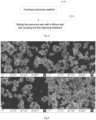
- the method includes: S100: a precursor is obtained.
- a precursor raw material including a metal salt solution and an alkaline solution is independently injected into a closed reactor respectively to carry out coprecipitation to obtain the precursor particle.
- the precursor particle obtained in the step can obtain the matrix particle with the monocrystal form by subsequent calcining treatment.
- the metal salt solution includes salt solutions of various metals, for example, a salt solution of nickel, a salt solution of cobalt and a salt solution of manganese.
- the precursor raw material further includes the M salt solution and M can include at least one of Al, Ti, Mg, Zr, Zn, Ce and Cr.
- the salt solutions of various metals and M are a solution of a same type salt, for example, a solution of sulfate or nitrate.
- Concentrations of the metal salt solution and the M salt solution and types of metal ions in various metal salt solutions can be adjusted by those skilled in the art according to the chemical composition of the cathode material formed as needed, for example, the concentrations of the various metal salt solutions can be independently 25-150 g/L respectively, for example, 60-150 g/L, specifically, 50 g/L, 70 g/L, 80 g/L, 90 g/L, 100 g/L, 120 g/L and the like or any point values within a range of 25-150 or a range formed by any two points in 25-150.
- the sulfate concentration of nickel can be 150-300 g/L
- the sulfate concentration of cobalt can be 10-20 g/L
- the sulfate concentration of manganese can be 10-20 g/L
- a salt solution concentration of M is 10-20 g/L.
- the concentration can be adjusted according to the chemical composition of the cathode particle prepared as needed, for example, the molar content of nickel, cobalt manganese and M in the cathode material can substantially meet the condition: the molar content of nickel is 88%, the molar content of cobalt is 6%, the molar content of manganese is 3% and the molar content of M is about 3%.
- the alkaline solutions can include an ammonia water and sodium hydroxide solution, and the concentration of the alkaline solution can be 80-240 g/L.
- the specific injection rates of the metal salt solution and the alkaline solution are not limited particularly, and those skilled in the art can determine and adjust the injection rates according to the volume of the reaction container, concentrations of the metal salt solutions and the alkaline solutions and the specific chemical composition of the cathode material.
- the specific injection speeds of the metal salt solutions and the alkaline solutions, and the pH values of the solutions in the reactor in the coprecipitation reaction period are 10.5-11.9, for example, the pH value is greater than 11 but less than 12.
- the metal salt solution and the alkaline solution are independently injected into the closed reactor respectively under a condition suitable for crystal growth of a precursor particle.
- the closed container can be a reaction kettle and the like.
- the injection speed of the metal salt solution can be dynamically adjusted based on crystal growth of the precursor particle.
- the time of the end of the particle growth can be speculated according to a kinetic model of crystal particle growth, and the flow rate (i.e., the injection speed) of the metal salt solution injected into the reaction kettle is adjusted, for example, the flow rate of the metal salt solution is increased or decreased in some period in crystal growth and after the crystal growth stage, the flow rate of each metal salt solution injected into the reaction kettle is then adjusted to an initial flow rate value thereof till the coprecipitation reaction is finished. Therefore, the formed precursor particle forms the matrix particle of monocrystal form via subsequent first calcining treatment, thereby finally obtaining the cathode material without a plurality of crystal boundaries internally.
- the flow rate i.e., the injection speed
- the salt solution can include various salt solutions, and each salt solution can have an independent initial injection speed.
- Increase or decrease of the injection speed means adjustment of the injection speed of each salt solution independently, respectively, i.e., the injection speed is increased or decreased relative to the initial injection speed of the salt solution, and after the crystal growth stage is finished, the injection speed of the salt solution is restored to the initial injections peed of the salt solution of the element.
- the initial injection speed of various elements M can be equal or not equal, and the initial injection speeds of the salt solution of nickel, the salt solution of cobalt and the salt solution of manganese can be equal or not equal.
- ⁇ adjusting to the initial flow rate value' and ⁇ restoring to the initial injection speed' are related to the initial injection speeds of themselves, for example, after the crystal growth stage is finished, the injection speed of the salt solution of nickel is restored to the initial injection speed of the salt solution of nickel, the injection speed of the salt solution of cobalt is restored to the initial injection speed of the salt solution of cobalt, and the injection speed of the salt solution of manganese is restored to the initial injection speed of the salt solution of manganese.
- size distribution of the precursor particle is monitored in real time in the coprecipitation process and the injection speed of the metal salt solution is adjusted based on size distribution.
- a part of solution can be extracted from a reaction container such as the reaction kettle periodically, and size distribution is analyzed by means of instruments including, but not limited to a laser particle size analyzer.
- the injection speed of the M salt solution can be increased after a first predetermined time and the injection speeds of the salt solutions of nickel, salt and manganese are reduced till the end of the crystal growth of the precursor particle. Then, the injection speeds of all the salt solutions are restored to the initial injection speeds till coprecipitation is finished.
- the first predetermined time is a time when a granularity of the particle reaches 90-99% of a preset granularity of the precursor particle during the coprecipitation reaction.
- the injection flow rates of the salt solution of nickel, the salt solution of cobalt and the salt solution of manganese are decreased independently to 30-50% of initial values of flow rates thereof, respectively after the first predetermined time, and the injection flow rates of the M salt solutions are increased to 120-140% of the initial values of the flow rates.
- M has a high concentration distribution zone and a low concentration distribution zone.
- a molar ratio of M contained in the low concentration distribution zone to M contained in the concentration distribution zone is 0.01-0.5, the low concentration distribution zone is located in the center zone and the surface layer of the precursor particle, the high concentration distribution zone is located in a range, 0.05-0.5 microns, away from the surface of the precursor particle, and a buffer layer can be formed in a subsequent step.
- the cathode material formed by the precursor particle with two concentration sub-zones of M can have higher stability.
- deionized water can be added into the reactor in advance and is warmed to 40-90 degrees centigrade, and the mixture is stirred at a speed of 700-1100 rmp, and the metal salt solution, the M salt solution and the alkaline solution are then injected under stirring.
- a product in the reactor can be filtered, washed and dried in vacuum to obtain the precursor particle.
- the product in the reactor can be filtered, and a filter residue is washed with deionized water and is dried for 6-12 hours in vacuum at 100-150 degrees centigrade.
- the particle size range of the precursor particle obtained in the step can be 1-8 microns, the specific surface area thereof can be 5-25 m 2 /g and the tap density thereof is 1.1-1.9 g/cc. Therefore, the obtained precursor particle is relatively ideal, which is favorable to obtain the cathode material which is proper in particle size of the matrix and better in interfacial property by means of first calcining treatment subsequently.
- the chemical composition of the precursor particle obtained in the step can be: Ni 0.88 Co 0.06 Mn 0.03 Al 0.03 (OH) 2 , Ni 0.88 Co 0.06 Mn 0.03 Zr 0.03 (OH) 2 , Ni 0.88 Co 0.06 Mn 0.03 Ti 0.03 (OH) 2 , or Ni 0.88 Co 0.06 Mn 0.03 Mg 0.03 (OH) 2 and the like.
- the precursor particle is mixed with a lithium salt and first calcining treatment is carried out to obtain the cathode material.
- the precursor particle is mixed with a lithium salt and first calcining treatment is carried out to obtain the cathode material.
- the specific type of the lithium salt is not limited particularly, for example, the lithium salt can be one or more of LiOH•H 2 O, LiF, Li 2 CO 3 and CH 3 COOLi.
- the mixing proportion of the lithium salt and the precursor particle can be adjusted by those skilled in the art according to the chemical composition of the cathode material needed to be prepared.
- the calcining temperature of the first calcining treatment can be 800-880 degrees centigrade
- the warming rate in the first calcining treatment process is 1.5-10 degrees centigrade/min
- the first calcining treatment time is 8-25 hours and the first calcining treatment is carried out in an oxygen atmosphere.
- the precursor particle and the lithium salt can be ground and dried in vacuum respectively before being mixed.
- the precursor particle and lithium salt are subjected to crushing treatment including, but not limited to grinding, respectively so as to obtain the particle with the nanoscale particle size, and then the particle is then dried in vacuum.
- the way of mixing the lithium salt with the precursor particle can be mixing powder by means of a mortar or is carried out by means of a high speed mixer, and the two are mixed uniformly before the first calcining treatment. Then, the cathode material can be obtained through the first calcining treatment.
- the method further can include a step of forming the coating layer.
- the cathode material is mixed with the coating agent and the mixture is subjected to second calcining treatment to form the coating layer on the surface of the matrix particle of the cathode material.
- the cathode material can be successively subjected to crushing treatment, cleaning treatment and vacuum drying treatment in advance before the cathode material and the coating agent are mixed.
- the cathode material can be placed in the deionized water with a certain volume to be washed with water for 3-10 min, and then the washed cathode material is dried in vacuum. Vacuum drying can be carried out at 120-180 degrees centigrade and the drying time can be 2-10 hours.
- the coating agent can include at least one of aluminum isopropoxide, aluminum fluoride, aluminum oxide, cerium oxide, isopropyl titanate, titanium oxide, boron oxide, boric acid, magnesium oxide, zirconium oxide, zirconium n-butoxide, ammonium fluoride, ammonium dihydrogen fluoride, ammonium monohydrogen fluoride and magnesium metaborate, and the particle size of the coating agent is not greater than 50 nm.
- a material with the metal element in the coating agent same as the metal element M in a cathode material prefabricate can be selected, thereby, guaranteeing batch consistence of products better.
- the temperature of the second calcining treatment can be 350-650 degrees centigrade
- the warming rate in the second calcining treatment process is 1-5 degrees centigrade/min
- the second calcining treatment time is 3-15 hours and the second calcining treatment is carried out in an oxygen atmosphere or a nitrogen atmosphere.
- the present disclosure provides a cathode.
- the cathode includes the cathode pole piece 200 and the cathode material 100 distributed on the cathode pole piece 200.
- the cathode material 100 is the above-mentioned cathode material or is prepared by the method. Therefore, the cathode has all characteristics and advantages of the above-mentioned cathode material and no more detailed description is provided herein.
- the cathode has at least one of advantages of high stability of a cathode active material, and relatively high specific capacity, good cycle performance, better stability and the like of the lithium ion battery prepared by the cathode.
- the cathode further can include but not limited to structures such as a lug 210, thereby facilitating connection when a battery is formed.
- the structure shown in the Fig. 3 is merely convenient for depicting a position relationship of the cathode pole piece 200 and the cathode material 100 and cannot be construed as limitation to the specific position and distribution mode of the cathode material 100.
- the cathode material 100 can be dispersed to carriers including, but not limited to an electrolyte, and is distributed to the cathode pole piece 200 by way of coating, rolling and the like.
- the present disclosure provides a lithium ion battery.
- the lithium ion battery includes the above-mentioned cathode and anode as well as a diaphragm insulating the cathode with the anode.
- the lithium ion battery has all characteristics and advantages of the above-mentioned cathode, and no more detailed description is provided herein. In general, the lithium ion battery has at least one of advantages of relatively high specific capacity, good cycle performance, better stability and the like.
- the specific type of the lithium ion battery is not limited particularly, for example, the lithium ion battery can be either a liquid electrolyte or a full-solid lithium ion battery.
- the lithium ion battery further can contain a plurality of independent sub batteries and has structures such as soft roll battery modules.
- the present disclosure provides a vehicle.
- the vehicle includes the above-mentioned lithium ion battery. Therefore, the vehicle has all characteristics and advantages of the above-mentioned lithium ion battery, and no more detailed description is provided herein. In general, the vehicle has at least one of advantages of relatively high mileage, better safety performance and stability, relatively small mileage attenuation and the like.
- the lithium ion battery can be used for driving a vehicle.
- the specific position of the lithium ion battery in the vehicle is not limited particularly and can be selected by those skilled in the art according to an actual condition. As the battery has better safety and stability, it is further more flexible to select the specific position of the power battery.
- a nickel sulfate solution, a cobalt sulfate solution and a manganese sulfate solution with concentrations of about 130 g/L and an aluminum sulfate solution with concentration of about 40 g/L are prepared and an ammonia water solution with concentration of about 150 g/L and a sodium hydroxide solution with concentration of about 130 g/L are prepared.
- 1.1 L of deionized water is added into a reaction kettle, the reaction kettle is warmed to a constant temperature 65 °C, the pH of the reaction process is controlled at about 11.4, the whole coprecipitation reaction time is 36 hours and the stirring rate is 950 rmp.
- the feeding flow rates of nickel sulfate, cobalt sulfate and manganese sulfate solutions are decreased to 30% of initial values, and meanwhile, the feeding flow rate of the aluminum sulfate solution is increased to 120% of the initial value, and the feeding flow rate of the salt solution is regulated back to the initial value after about 40-60 min till the coprecipitation reaction is finished.
- the obtained material is filtered, washed with the deionized water and dried for 10 hours in vacuum at 130 degrees centigrade to obtain the precursor particle with the chemical composition of Ni 0.88 Co 0.06 Mn 0.03 Al 0.03 (OH) 2 .
- 1 mol of precursor particle and 1.03 mol of lithium source are placed in a nano grinding miller respectively, are ground according to a set program and are then dried in vacuum.
- the obtained two types of nano material powder are placed in the grinding miller to be mixed fully, and are then placed in an about 850-degree centigrade calcinatory to be calcined for 20 hours in a pure oxygen atmosphere at a warming rate of 6 degrees centigrade/min.
- the calcined powder sample is placed in the deionized water to be washed for about 10 min and is then dried in vacuum to obtain a cathode material prefabricate.
- the dried cathode material prefabricate powder material is mixed with 4016 ppm AlF 3 (the particle size ⁇ 50 nm), is then placed in a 500-degree centigrade calcinatory to be calcined for 6 hours in an oxygen atmosphere at the warming rate of 1.5- degree centigrade/min, and is finally ground fully in the mortar or crushed in an ultracentrifugal grinding crusher to obtain the cathode material.
- the chemical compositor of the cathode material is 0.996LiNi 0.88 Co 0.06 Mn 0.03 Al 0.03 O 2 ⁇ 0.004AlF 3 .
- a scanning electron microscope picture is as shown in (a) in the Fig. 5 .
- a nickel sulfate solution, a cobalt sulfate solution and a manganese sulfate solution with concentrations of about 130 g/L and an titanium sulfate solution with concentration of about 36g/L are prepared and an ammonia water solution with concentration of about 150 g/L and a sodium hydroxide solution with concentration of about 130 g/L are prepared.
- 1.1 L of deionized water is added into a reaction kettle, the reaction kettle is warmed to a constant temperature 65 °C, the pH of the reaction process is controlled at about 11.5, the whole coprecipitation reaction time is 36 hours and the stirring rate is 950 rmp.
- the feeding flow rates of nickel sulfate, cobalt sulfate and manganese sulfate solutions are decreased to 30% of initial values, and meanwhile, the feeding flow rate of the titanium sulfate solution is increased to 130% of the initial value, and the feeding flow rate of the salt solution is regulated back to the initial value after about 40-60 min till the coprecipitation reaction is finished.
- the obtained material is filtered, washed with the deionized water and dried for 10 hours in vacuum at 130 degrees centigrade to obtain the precursor particle with the chemical formula of Ni 0.88 Co 0.06 Mn 0.03 Ti 0.03 (OH) 2 .
- the calcined powder sample is placed in the deionized water to be washed for about 10 min and is then dried in vacuum.
- the dried powder material is mixed with 4016 ppm TiO 2 (the particle size ⁇ 50 nm), is then placed in a 550-degree centigrade calcinatory to be calcined for 5.5 hours in an oxygen atmosphere at the warming rate of 1.5- degree centigrade/min, and is finally ground fully in the mortar or crushed in an ultracentrifugal grinding crusher to obtain the cathode material, the molecular formula of the cathode material being 0.996LiNi 0.88 Co 0.06 Mn 0.03 Ti 0.03 O 2 ⁇ 0.004TiO 2 .
- a scanning electron microscope picture is as shown in (b) in the Fig. 5 .
- a nickel sulfate solution, a cobalt sulfate solution and a manganese sulfate solution with concentrations of about 130 g/L and an aluminum sulfate solution with concentration of about 40 g/L are prepared and an ammonia water solution with concentration of about 150 g/L and a sodium hydroxide solution with concentration of about 130 g/L are prepared.
- 1.1 L of deionized water is added into a reaction kettle, the reaction kettle is warmed to a constant temperature 65 °C, the pH of the reaction process is controlled at about 11.4, the whole coprecipitation reaction time is 36 hours and the stirring rate is 950 rmp.
- the feeding flow rates of nickel sulfate, cobalt sulfate and manganese sulfate solutions are decreased to 30% of initial values, and meanwhile, the feeding flow rate of the aluminum sulfate solution is increased to 120% of the initial value, and the feeding flow rate of the salt solution is regulated back to the initial value after about 40-60 min till the coprecipitation reaction is finished.
- the obtained material is filtered, washed with the deionized water and dried for 10 hours in vacuum at 130 degrees centigrade to obtain the precursor particle with the chemical formula of Ni 0.88 Co 0.06 Mn 0.03 Al 0.03 (OH) 2 .
- the dried powder material is mixed with 4016 ppm Al 2 O 3 (the particle size ⁇ 50 nm), is then placed in a 450-degree centigrade calcinator to be calcined for 5 hours in an oxygen atmosphere at the warming rate of 2 °C/min, and is finally ground fully in the mortar or crushed in an ultracentrifugal grinding crusher to obtain the cathode material, the molecular formula of the cathode material being 0.996LiNi 0.88 Co 0.06 Mn 0.03 Al 0.03 O 2 ⁇ 0.004Al 2 O 3 .
- a scanning electron microscope picture is as shown in (c) in the Fig. 5 .
- a nickel sulfate solution, a cobalt sulfate solution and a manganese sulfate solution with concentrations of about 130 g/L and a zirconium sulfate solution with concentration of about 44g/L are prepared and an ammonia water solution with concentration of about 150 g/L and a sodium hydroxide solution with concentration of about 130 g/L are prepared.
- 1.1 L of deionized water is added into a reaction kettle, the reaction kettle is warmed to a constant temperature 65°C, the pH of the reaction process is controlled at about 11.7, the whole coprecipitation reaction time is 36 hours and the stirring rate is 950 rmp.
- the feeding flow rates of nickel sulfate, cobalt sulfate and manganese sulfate solutions are decreased to 30% of initial values, and meanwhile, the feeding flow rate of the zirconium sulfate solution is increased to 120% of the initial value, and the feeding flow rate of the salt solution is regulated back to the initial value after about 40-60 min till the coprecipitation reaction is finished.
- the obtained material is filtered, washed with the deionized water and dried for 10 hours in vacuum at 130 degrees centigrade to obtain the precursor particle with the chemical formula of Ni 0.88 Co 0.06 Mn 0.03 Zr 0.03 (OH) 2 .
- the dried powder material is mixed with 4016 ppm ZrO (the particle size ⁇ 50 nm), is then placed in a 500-degree centigrade calcinatory to be calcined for 6 hours in an oxygen atmosphere at the warming rate of 1.5-degree centigrade/min, and is finally ground fully in the mortar or crushed in an ultracentrifugal grinding crusher to obtain the cathode material, the molecular formula of the cathode material being 0.996LiNi 0.88 Co 0.06 Mn 0.03 Zr 0.03 O 2 ⁇ 0.004ZrO.
- a scanning electron microscope picture is as shown in (d) in the Fig. 5 .
- a nickel sulfate solution with concentration of about 290g/L, a cobalt sulfate solution with concentration of about 20g/L and a manganese sulfate solution with concentrations of about 10g/L and an aluminum sulfate solution with concentration of about 10g/L are prepared and an ammonia water solution with concentration of about 150 g/L and a sodium hydroxide solution with concentration of about 130 g/L are prepared.
- 1.1 L of deionized water is added into a reaction kettle, the reaction kettle is warmed to a constant temperature 70°C, the pH of the reaction process is controlled at about 11.4, the whole coprecipitation reaction time is 52 hours and the stirring rate is 960 rmp.
- the obtained material is filtered, washed with the deionized water and dried for 10 hours in vacuum at 130 degrees centigrade to obtain the precursor particle with the chemical composition of Ni 0.88 Co 0.06 Mn 0.03 Al 0.03 (OH) 2 .
- 1 mol of precursor particle and 1.03 mol of lithium source are placed in a nano grinding miller respectively, are ground according to a set program and are then dried in vacuum.
- the obtained two types of nano material powder are placed in the grinding miller to be mixed fully, and are then placed in an about 750-degree centigrade calcinatory to be calcined for 16 hours in a pure oxygen atmosphere at a warming rate of 2 degrees centigrade/min.
- the calcined powder sample is placed in the deionized water to be washed for about 10 min and is then dried in vacuum to obtain a cathode material prefabricate.
- the dried cathode material prefabricate powder material is mixed with 4016 ppm AlF 3 (the particle size ⁇ 50 nm), is then placed in a 500-degree centigrade calcinator to be calcined for 6 hours in an oxygen atmosphere at the warming rate of 1.5-degree centigrade/min, and is finally ground fully in the mortar or crushed in an ultracentrifugal grinding crusher to obtain the cathode material.
- the chemical compositor of the cathode material is 0.996LiNi 0.88 Co 0.06 Mn 0.03 Al 0.03 O 2 ⁇ 0.004AlF 3 .
- a scanning electron microscope picture is as shown in the Fig. 6 .
- a nickel sulfate solution with concentration of about 290g/L, a cobalt sulfate solution with concentration of about 20g/L and a manganese sulfate solution with concentrations of about 10g/L and an aluminum sulfate solution with concentration of about 10g/L are prepared and an ammonia water solution with concentration of about 150 g/L and a sodium hydroxide solution with concentration of about 130 g/L are prepared.
- 1.1 L of deionized water is added into a reaction kettle, the reaction kettle is warmed to a constant temperature 65°C, the pH of the reaction process is controlled at about 11.4, the whole coprecipitation reaction time is 36 hours and the stirring rate is 950 rmp.
- the obtained material is filtered, washed with the deionized water and dried for 10 hours in vacuum at 130 degrees centigrade to obtain the precursor particle with the chemical composition of Ni 0.88 Co 0.06 Mn 0.03 Al 0.03 (OH) 2 .
- 1 mol of precursor particle and 1.03 mol of lithium source are placed in a nano grinding miller respectively, are ground according to a set program and are then dried in vacuum.
- the obtained two types of nano material powder are placed in the grinding miller to be mixed fully, and are then placed in an about 850-degree centigrade calcinatory to be calcined for 20 hours in a pure oxygen atmosphere at a warming rate of 6 degrees centigrade/min.
- the calcined powder sample is placed in the deionized water to be washed for about 10 min and is then dried in vacuum to obtain a cathode material prefabricate.
- the dried cathode material prefabricate powder material is mixed with 4016 ppm AlF3 (the particle size ⁇ 50 nm), is then placed in a 500-degree centigrade calcinatory to be calcined for 6 hours in an oxygen atmosphere at the warming rate of 1.5- degree centigrade, and is finally ground fully in the mortar or crushed in an ultracentrifugal grinding crusher to obtain the cathode material.
- the chemical compositor of the cathode material is 0.996LiNi 0.88 Co 0.06 Mn 0.03 Al 0.03 O 2 ⁇ 0.004AlF 3 .
- a scanning electron microscope picture is as shown in the Fig. 7 .
- the scanning electron microscope pictures of the cathode materials prepared in the embodiments 1-4 show characteristics of the monocrystal particle. Therefore, it is confirmed that the cathode materials prepared by the embodiments 1-4 are different from conventional polycrystal particle essentially and do not include a plurality of primary particles, such that crystal boundary shapes among the primary particles are further avoided. With increase of charge and discharge cycle times, problems of side reactions of the electrolyte and damage in structure and the like as the electrolyte enters the particle can be solved, too due to the problems of stress of crystal boundary, micro-cracks and the like. It can be confirmed by the Fig. 5 that the monocrystal particle is an independent particle without a hidden danger of damaging the crystal boundary, such that the monocrystal particle keeps the original shape relatively stably in the long-time charge and discharge cycle processes.
- Fig. 8 is a first-time charging and discharging curve of the cathode material prepared in the embodiments 1-4.
- the charge and discharge rates are 0.1C/0.1C respectively and the voltage range is 3-4.3 V It can be seen from the Fig. 8 that the cathode materials prepared by the embodiments 1-4 show better first-time charging and discharging properties.
- the specific charge and discharge capacities are 232.1 mAh/ g and 204.6 mAh/g in sequence respectively, 225.4 mAh/g and 201.2 mAh/g respectively, 237.2 mAh/g and 212.4 mAh/g respectively, and 230 mAh/g and 206.3mAh/g, which exceed 200 mAh/g.
- Fig. 9 is specific discharge capacities of the cathode materials obtained in the embodiments 1-4 under different current densities.
- the charge and discharge rates are 0.1C/0.1C, 0.5C/0.5C, 0.5C/1C and 0.5C/2C respectively and the voltage range is 3-4.3 V It can be known from the Fig. 9 that when the discharge rate is 1C, the specific discharge capacities corresponding to the embodiments are 186 mAh/g, 179.6 mAh/g, 189.5 mAh/g and187.5mAh/g in sequence respectively, and the rate capabilities are better.
- the Fig. 10 is a keeping condition of the specific discharge capacities of the cathode materials prepared in the embodiments 1-4 in 50 cycle processes, the charge rate of cyclic charge and discharge is 0.5C, the discharge rate thereof is 1C and the voltage range is 3-4.3V It can be known from the Fig. 10 that the cyclic capacity retention ratios corresponding to the embodiments are 93.3%, 96.7%, 95.8% and 94.7% in sequence, and the cyclic capacity retention ratio reaches a higher level.
- the buffer layer and the coating layer on the surface of the particle can enable the sample to maintain a relatively high cyclic stability, such that the crystal structure of the material is stabilized.
- the 0.1C rate specific charge and discharge capacities of the sample obtained in the comparative example 1 are 234.8mAh/g and 202mAh/g respectively; the first-time coulombic efficiency is 86%; the 1C rate specific discharge capacity is 173 mAh/g; and the capacity retention ratio at charge 0.5C rate and discharge 1C rate after 50 charge and discharge cycles is 91%.
- the 0.1C rate specific charge and discharge capacities of the sample obtained in the comparative example 2 are 233.1 mAh/g and 203.9 mAh/g respectively; the first-time coulombic efficiency is 87.4%; the 1C rate specific discharge capacity is 180 mAh/g; and the capacity retention ratio at charge 0.5C rate and discharge 1C rate after 50 charge and discharge cycles is 89%. It can be seen that the sample according to the embodiments of the present disclosure has better cycle performance.
- orientation or position relationships indicated by terms: ⁇ inner', 'outer', ⁇ surface' and the like are orientation or position relationships indicated by the drawings and are only to describe the present disclosure and simplify the description rather than indicates or implies that the indicated device or components must have specific orientations. Therefore, it cannot be construed as limitations to the present disclosure.
- description with reference to “one embodiment”, “another embodiment” and the like means specific features, structures, materials or characteristics described in combination with the embodiments are included in at least one embodiment of the present disclosure.
- schematic expressions of the terms do not have to mean same embodiments or exemplary embodiments.
- specific features, structures, materials or characteristics described can be combined in any one or more embodiments or exemplary embodiments in proper manners.
- those skilled in the art can integrate or combine different embodiments or exemplary embodiments with different embodiments or exemplary embodiments described in the description.
Landscapes
- Chemical & Material Sciences (AREA)
- Chemical Kinetics & Catalysis (AREA)
- Electrochemistry (AREA)
- General Chemical & Material Sciences (AREA)
- Inorganic Chemistry (AREA)
- Engineering & Computer Science (AREA)
- Organic Chemistry (AREA)
- Composite Materials (AREA)
- Manufacturing & Machinery (AREA)
- Materials Engineering (AREA)
- Battery Electrode And Active Subsutance (AREA)
Applications Claiming Priority (2)
| Application Number | Priority Date | Filing Date | Title |
|---|---|---|---|
| CN202010230424.2A CN111430689B (zh) | 2020-03-27 | 2020-03-27 | 正极材料及其制备方法,正极、锂离子电池和车辆 |
| PCT/CN2020/137771 WO2021189997A1 (zh) | 2020-03-27 | 2020-12-18 | 正极材料及其制备方法,正极、锂离子电池和车辆 |
Publications (2)
| Publication Number | Publication Date |
|---|---|
| EP4131485A1 true EP4131485A1 (de) | 2023-02-08 |
| EP4131485A4 EP4131485A4 (de) | 2024-05-01 |
Family
ID=71549774
Family Applications (1)
| Application Number | Title | Priority Date | Filing Date |
|---|---|---|---|
| EP20927634.4A Pending EP4131485A4 (de) | 2020-03-27 | 2020-12-18 | Positives elektrodenmaterial, herstellungsverfahren dafür, positive elektrode, lithiumionenbatterie und fahrzeug |
Country Status (4)
| Country | Link |
|---|---|
| US (1) | US20230009617A1 (de) |
| EP (1) | EP4131485A4 (de) |
| CN (1) | CN111430689B (de) |
| WO (1) | WO2021189997A1 (de) |
Cited By (2)
| Publication number | Priority date | Publication date | Assignee | Title |
|---|---|---|---|---|
| EP4603460A1 (de) * | 2024-02-19 | 2025-08-20 | SK On Co., Ltd. | Kathodenaktivmaterial für lithiumsekundärbatterie und lithiumsekundärbatterie damit |
| EP4674816A1 (de) * | 2024-06-26 | 2026-01-07 | SK On Co., Ltd. | Kathodenaktivmaterial für lithiumsekundärbatterie und lithiumsekundärbatterie damit |
Families Citing this family (13)
| Publication number | Priority date | Publication date | Assignee | Title |
|---|---|---|---|---|
| CN111430689B (zh) * | 2020-03-27 | 2022-10-25 | 蜂巢能源科技有限公司 | 正极材料及其制备方法,正极、锂离子电池和车辆 |
| CN114068912B (zh) * | 2020-08-10 | 2023-09-05 | 巴斯夫杉杉电池材料有限公司 | 一种二元高镍单晶正极材料及其制备方法 |
| CN111933913A (zh) * | 2020-08-18 | 2020-11-13 | 苏州精诚智造智能科技有限公司 | 一种用于正极的制备方法 |
| CN111987304B (zh) * | 2020-08-21 | 2021-12-03 | 东莞东阳光科研发有限公司 | 三元正极材料前驱体及其制备方法、三元正极材料及其制备方法和锂离子电池 |
| CN112786834A (zh) * | 2021-01-26 | 2021-05-11 | 蜂巢能源科技有限公司 | 一种正极极片及包含其的锂离子电池 |
| CN113666436B (zh) * | 2021-08-31 | 2022-12-02 | 中南大学 | 一种富镍三元前驱体及其制备方法和应用 |
| TWI800941B (zh) * | 2021-10-06 | 2023-05-01 | 芯量科技股份有限公司 | 製備成分均勻正極材料前驅物的方法 |
| CN114388783B (zh) * | 2022-01-04 | 2024-06-25 | 万华化学集团股份有限公司 | 一种高镍正极材料、其制备方法及其应用 |
| CN114149033B (zh) * | 2022-02-09 | 2022-04-29 | 浙江长城搅拌设备股份有限公司 | 一种锂离子电池三元前驱体及其制备方法、制备装置 |
| CN114914431A (zh) * | 2022-06-16 | 2022-08-16 | 楚能新能源股份有限公司 | 复合包覆改性的三元正极材料及制备方法 |
| CN116230939A (zh) * | 2023-02-28 | 2023-06-06 | 山东友邦科思茂新材料有限公司 | 一种镍钴铝酸锂正极材料及其制备方法 |
| CN117154188B (zh) * | 2023-10-30 | 2024-04-12 | 宁德时代新能源科技股份有限公司 | 锂离子电池、电池和用电装置 |
| CN117945744B (zh) * | 2024-01-23 | 2024-07-09 | 天津大学 | 一种高熵陶瓷材料、高发射率高熵涂层及其制备方法 |
Family Cites Families (15)
| Publication number | Priority date | Publication date | Assignee | Title |
|---|---|---|---|---|
| CN101426728B (zh) * | 2006-02-17 | 2012-10-03 | 株式会社Lg化学 | 锂金属复合氧化物和使用其的电化学装置 |
| KR100822012B1 (ko) * | 2006-03-30 | 2008-04-14 | 한양대학교 산학협력단 | 리튬 전지용 양극 활물질, 그 제조 방법 및 그를 포함하는리튬 이차 전지 |
| KR101653334B1 (ko) * | 2009-09-09 | 2016-09-01 | 소니 주식회사 | 정극 활물질, 정극, 비수 전해질 전지 및 정극 활물질의 제조 방법 |
| JP5395258B2 (ja) * | 2010-03-31 | 2014-01-22 | 独立行政法人物質・材料研究機構 | 全固体リチウム電池 |
| KR101665766B1 (ko) * | 2013-09-30 | 2016-10-12 | 주식회사 엘지화학 | 이차전지용 양극활물질 및 이의 제조 방법 |
| KR102535985B1 (ko) * | 2014-10-27 | 2023-05-23 | 가부시키가이샤 한도오따이 에네루기 켄큐쇼 | 입자, 전극, 전력 저장 장치, 전자 장치, 및 전극의 제작 방법 |
| CN104409716A (zh) * | 2014-10-30 | 2015-03-11 | 中国科学院过程工程研究所 | 一种具有浓度梯度的镍锂离子电池正极材料及其制备方法 |
| CN105720244B (zh) * | 2014-12-05 | 2018-10-26 | 江苏华东锂电技术研究院有限公司 | 正极复合材料及锂离子电池以及其制备方法 |
| CN105161710A (zh) * | 2015-08-31 | 2015-12-16 | 宁波金和锂电材料有限公司 | 一种电池正极材料及其制备方法和锂离子电池 |
| KR20180064295A (ko) * | 2016-12-05 | 2018-06-14 | 주식회사 포스코 | 양극 활물질 전구체 및 이의 제조 방법, 양극 활물질 및 이의 제조 방법, 및 상기 양극 활물질을 포함하는 리튬 이차 전지 |
| EP3561920B1 (de) * | 2016-12-22 | 2021-04-28 | Posco | Positivelektrodenaktivmaterial, verfahren zur herstellung davon und lithiumsekundärbatterie damit |
| CN109755484A (zh) * | 2017-11-03 | 2019-05-14 | 天津国安盟固利新材料科技股份有限公司 | 一种改性三元正极材料及其制备方法 |
| CN110867575A (zh) * | 2018-08-28 | 2020-03-06 | 比亚迪股份有限公司 | 三元正极材料及其制备方法、锂离子电池和电动汽车 |
| CN110867576A (zh) * | 2018-08-28 | 2020-03-06 | 比亚迪股份有限公司 | 三元正极材料及其制备方法、锂离子电池和电动汽车 |
| CN111430689B (zh) * | 2020-03-27 | 2022-10-25 | 蜂巢能源科技有限公司 | 正极材料及其制备方法,正极、锂离子电池和车辆 |
-
2020
- 2020-03-27 CN CN202010230424.2A patent/CN111430689B/zh active Active
- 2020-12-18 EP EP20927634.4A patent/EP4131485A4/de active Pending
- 2020-12-18 WO PCT/CN2020/137771 patent/WO2021189997A1/zh not_active Ceased
- 2020-12-18 US US17/764,568 patent/US20230009617A1/en active Pending
Cited By (2)
| Publication number | Priority date | Publication date | Assignee | Title |
|---|---|---|---|---|
| EP4603460A1 (de) * | 2024-02-19 | 2025-08-20 | SK On Co., Ltd. | Kathodenaktivmaterial für lithiumsekundärbatterie und lithiumsekundärbatterie damit |
| EP4674816A1 (de) * | 2024-06-26 | 2026-01-07 | SK On Co., Ltd. | Kathodenaktivmaterial für lithiumsekundärbatterie und lithiumsekundärbatterie damit |
Also Published As
| Publication number | Publication date |
|---|---|
| CN111430689B (zh) | 2022-10-25 |
| US20230009617A1 (en) | 2023-01-12 |
| WO2021189997A1 (zh) | 2021-09-30 |
| CN111430689A (zh) | 2020-07-17 |
| EP4131485A4 (de) | 2024-05-01 |
Similar Documents
| Publication | Publication Date | Title |
|---|---|---|
| US20230009617A1 (en) | Cathode material and method for preparing cathode material, cathode, lithium ion battery and vehicle | |
| EP3996171B1 (de) | W enthaltendes ternäres positivelektrodenmaterial mit hohem nickelgehalt und verfahren zu seiner herstellung | |
| CN112952049B (zh) | 一种修复高镍正极材料表面结构的方法、由其得到的高镍正极材料以及锂离子电池 | |
| CN112750999B (zh) | 正极材料及其制备方法和锂离子电池 | |
| CN108832103B (zh) | 一种改性高镍三元正极材料及其制备方法和应用 | |
| WO2022207008A1 (zh) | 单晶型多元正极材料及其制备方法与应用 | |
| CN108217753B (zh) | 一种梯度掺杂四氧化三钴材料及其制备方法 | |
| KR102816877B1 (ko) | 리튬 이온 배터리의 양극 활성 소재 및 이의 제조방법 | |
| EP3965188A1 (de) | Zusammengesetztes positives elektrodenmaterial für lithiumionenbatterie, lithiumionenbatterie und fahrzeug | |
| CN112151790A (zh) | 高镍三元正极材料前驱体及其晶面可控生长的方法、三元正极材料及锂离子电池 | |
| CN109244436A (zh) | 一种高镍正极材料及其制备方法以及一种锂离子电池 | |
| CN105322154B (zh) | 一种特殊形貌的电极活性物质前驱体镍锰氧化物 | |
| CN103500827A (zh) | 锂离子电池及其多元正极材料、制备方法 | |
| CN112599736B (zh) | 一种掺硼磷酸锂包覆锂离子电池正极材料及其制备方法 | |
| CN111081987A (zh) | 一种4.45v以上锂离子电池钴酸锂正极材料及其制备方法 | |
| CN110649230B (zh) | 一种纳米铆钉核壳结构正极材料及制备方法 | |
| RU2307429C1 (ru) | Способ получения поверхностно-модифицированного катодного материала со слоистой структурой для литиевых и литий-ионных аккумуляторов | |
| EP4447156B1 (de) | Ternäres positivelektrodenmaterial, herstellungsverfahren dafür und sekundärbatterie | |
| WO2026056714A1 (zh) | 复合包覆的正极材料及其制备方法、正极极片、锂离子电池和用电装置 | |
| CN111087031A (zh) | 一种包覆型正极材料的制备方法 | |
| CN113571694A (zh) | 一种多离子修饰三元材料前驱体及正极材料制备方法 | |
| US20240262708A1 (en) | Method of manufacturing positive electrode active material | |
| CN119092657A (zh) | 一种低镍高容量的钠离子电池正极材料、制备方法及钠离子电池 | |
| CN115498147A (zh) | 一种铪改性的高镍层状氧化物电极材料及其制备方法 | |
| CN116247197B (zh) | 一种球形高电压镍锰酸锂正极材料及其制备方法、锂离子电池 |
Legal Events
| Date | Code | Title | Description |
|---|---|---|---|
| STAA | Information on the status of an ep patent application or granted ep patent |
Free format text: STATUS: THE INTERNATIONAL PUBLICATION HAS BEEN MADE |
|
| PUAI | Public reference made under article 153(3) epc to a published international application that has entered the european phase |
Free format text: ORIGINAL CODE: 0009012 |
|
| STAA | Information on the status of an ep patent application or granted ep patent |
Free format text: STATUS: REQUEST FOR EXAMINATION WAS MADE |
|
| 17P | Request for examination filed |
Effective date: 20220215 |
|
| AK | Designated contracting states |
Kind code of ref document: A1 Designated state(s): AL AT BE BG CH CY CZ DE DK EE ES FI FR GB GR HR HU IE IS IT LI LT LU LV MC MK MT NL NO PL PT RO RS SE SI SK SM TR |
|
| DAV | Request for validation of the european patent (deleted) | ||
| DAX | Request for extension of the european patent (deleted) | ||
| REG | Reference to a national code |
Ref country code: DE Ref legal event code: R079 Free format text: PREVIOUS MAIN CLASS: H01M0004360000 Ipc: C01G0053000000 |
|
| A4 | Supplementary search report drawn up and despatched |
Effective date: 20240403 |
|
| RIC1 | Information provided on ipc code assigned before grant |
Ipc: H01M 4/36 20060101ALI20240327BHEP Ipc: C01G 53/00 20060101AFI20240327BHEP |