EP4131491A1 - Matériau actif d'électrode négative pour batteries secondaires, et batterie secondaire l'utilisant - Google Patents
Matériau actif d'électrode négative pour batteries secondaires, et batterie secondaire l'utilisant Download PDFInfo
- Publication number
- EP4131491A1 EP4131491A1 EP21782413.5A EP21782413A EP4131491A1 EP 4131491 A1 EP4131491 A1 EP 4131491A1 EP 21782413 A EP21782413 A EP 21782413A EP 4131491 A1 EP4131491 A1 EP 4131491A1
- Authority
- EP
- European Patent Office
- Prior art keywords
- silicon
- negative electrode
- lithium
- secondary battery
- particles
- Prior art date
- Legal status (The legal status is an assumption and is not a legal conclusion. Google has not performed a legal analysis and makes no representation as to the accuracy of the status listed.)
- Pending
Links
- 239000007773 negative electrode material Substances 0.000 title claims abstract description 25
- XUIMIQQOPSSXEZ-UHFFFAOYSA-N Silicon Chemical compound [Si] XUIMIQQOPSSXEZ-UHFFFAOYSA-N 0.000 claims abstract description 89
- 229910052710 silicon Inorganic materials 0.000 claims abstract description 89
- 239000010703 silicon Substances 0.000 claims abstract description 89
- 239000000463 material Substances 0.000 claims abstract description 81
- 239000002245 particle Substances 0.000 claims abstract description 54
- 239000011856 silicon-based particle Substances 0.000 claims abstract description 49
- 229910052720 vanadium Inorganic materials 0.000 claims abstract description 38
- LEONUFNNVUYDNQ-UHFFFAOYSA-N vanadium atom Chemical compound [V] LEONUFNNVUYDNQ-UHFFFAOYSA-N 0.000 claims abstract description 37
- HBBGRARXTFLTSG-UHFFFAOYSA-N Lithium ion Chemical compound [Li+] HBBGRARXTFLTSG-UHFFFAOYSA-N 0.000 claims abstract description 35
- 229910001416 lithium ion Inorganic materials 0.000 claims abstract description 35
- XEEYBQQBJWHFJM-UHFFFAOYSA-N Iron Chemical compound [Fe] XEEYBQQBJWHFJM-UHFFFAOYSA-N 0.000 claims description 42
- BPQQTUXANYXVAA-UHFFFAOYSA-N Orthosilicate Chemical compound [O-][Si]([O-])([O-])[O-] BPQQTUXANYXVAA-UHFFFAOYSA-N 0.000 claims description 37
- OKTJSMMVPCPJKN-UHFFFAOYSA-N Carbon Chemical compound [C] OKTJSMMVPCPJKN-UHFFFAOYSA-N 0.000 claims description 30
- VYPSYNLAJGMNEJ-UHFFFAOYSA-N Silicium dioxide Chemical compound O=[Si]=O VYPSYNLAJGMNEJ-UHFFFAOYSA-N 0.000 claims description 28
- PAZHGORSDKKUPI-UHFFFAOYSA-N lithium metasilicate Chemical compound [Li+].[Li+].[O-][Si]([O-])=O PAZHGORSDKKUPI-UHFFFAOYSA-N 0.000 claims description 28
- 229910052912 lithium silicate Inorganic materials 0.000 claims description 28
- 229910052742 iron Inorganic materials 0.000 claims description 22
- 229910052799 carbon Inorganic materials 0.000 claims description 19
- 239000003792 electrolyte Substances 0.000 claims description 14
- 229910052814 silicon oxide Inorganic materials 0.000 claims description 12
- INZDTEICWPZYJM-UHFFFAOYSA-N 1-(chloromethyl)-4-[4-(chloromethyl)phenyl]benzene Chemical compound C1=CC(CCl)=CC=C1C1=CC=C(CCl)C=C1 INZDTEICWPZYJM-UHFFFAOYSA-N 0.000 claims description 10
- 239000000377 silicon dioxide Substances 0.000 claims description 9
- 229910052782 aluminium Inorganic materials 0.000 claims description 8
- 229910052783 alkali metal Inorganic materials 0.000 claims description 7
- 229910052681 coesite Inorganic materials 0.000 claims description 7
- 229910052906 cristobalite Inorganic materials 0.000 claims description 7
- 229910052682 stishovite Inorganic materials 0.000 claims description 7
- 229910052905 tridymite Inorganic materials 0.000 claims description 7
- 150000001340 alkali metals Chemical class 0.000 claims description 6
- 229910052796 boron Inorganic materials 0.000 claims description 4
- 229910052745 lead Inorganic materials 0.000 claims description 4
- 229910052725 zinc Inorganic materials 0.000 claims description 4
- 229910052787 antimony Inorganic materials 0.000 claims description 3
- 229910052718 tin Inorganic materials 0.000 claims description 3
- 229910052719 titanium Inorganic materials 0.000 claims description 3
- 229910052727 yttrium Inorganic materials 0.000 claims description 3
- 229910000756 V alloy Inorganic materials 0.000 claims description 2
- 229910052797 bismuth Inorganic materials 0.000 claims description 2
- 229910052758 niobium Inorganic materials 0.000 claims description 2
- 229910052698 phosphorus Inorganic materials 0.000 claims description 2
- 229910052721 tungsten Inorganic materials 0.000 claims description 2
- 229910052726 zirconium Inorganic materials 0.000 claims description 2
- 239000012071 phase Substances 0.000 description 64
- 239000000203 mixture Substances 0.000 description 39
- 239000011246 composite particle Substances 0.000 description 18
- 239000002994 raw material Substances 0.000 description 18
- 239000012298 atmosphere Substances 0.000 description 13
- 238000004458 analytical method Methods 0.000 description 11
- 239000000523 sample Substances 0.000 description 11
- 238000002354 inductively-coupled plasma atomic emission spectroscopy Methods 0.000 description 10
- 239000011133 lead Substances 0.000 description 10
- 238000000034 method Methods 0.000 description 10
- 230000008602 contraction Effects 0.000 description 9
- 229910052744 lithium Inorganic materials 0.000 description 9
- 239000000843 powder Substances 0.000 description 9
- SECXISVLQFMRJM-UHFFFAOYSA-N N-Methylpyrrolidone Chemical compound CN1CCCC1=O SECXISVLQFMRJM-UHFFFAOYSA-N 0.000 description 8
- -1 Na and Li Chemical class 0.000 description 8
- 239000002253 acid Substances 0.000 description 8
- 238000007789 sealing Methods 0.000 description 8
- WHXSMMKQMYFTQS-UHFFFAOYSA-N Lithium Chemical compound [Li] WHXSMMKQMYFTQS-UHFFFAOYSA-N 0.000 description 7
- 238000005481 NMR spectroscopy Methods 0.000 description 7
- 239000002585 base Substances 0.000 description 7
- 239000003575 carbonaceous material Substances 0.000 description 7
- 229910002804 graphite Inorganic materials 0.000 description 7
- 239000010439 graphite Substances 0.000 description 7
- 229910003002 lithium salt Inorganic materials 0.000 description 7
- 159000000002 lithium salts Chemical class 0.000 description 7
- 229910045601 alloy Inorganic materials 0.000 description 6
- 239000000956 alloy Substances 0.000 description 6
- 239000002131 composite material Substances 0.000 description 6
- 239000011267 electrode slurry Substances 0.000 description 6
- 239000010408 film Substances 0.000 description 6
- 239000011255 nonaqueous electrolyte Substances 0.000 description 6
- 239000011230 binding agent Substances 0.000 description 5
- 239000006258 conductive agent Substances 0.000 description 5
- 238000001035 drying Methods 0.000 description 5
- 230000000694 effects Effects 0.000 description 5
- JBTWLSYIZRCDFO-UHFFFAOYSA-N ethyl methyl carbonate Chemical compound CCOC(=O)OC JBTWLSYIZRCDFO-UHFFFAOYSA-N 0.000 description 5
- 230000001965 increasing effect Effects 0.000 description 5
- 239000011159 matrix material Substances 0.000 description 5
- 229910052751 metal Inorganic materials 0.000 description 5
- 239000002184 metal Substances 0.000 description 5
- PXHVJJICTQNCMI-UHFFFAOYSA-N nickel Substances [Ni] PXHVJJICTQNCMI-UHFFFAOYSA-N 0.000 description 5
- 239000011734 sodium Substances 0.000 description 5
- XKRFYHLGVUSROY-UHFFFAOYSA-N Argon Chemical compound [Ar] XKRFYHLGVUSROY-UHFFFAOYSA-N 0.000 description 4
- IJGRMHOSHXDMSA-UHFFFAOYSA-N Atomic nitrogen Chemical compound N#N IJGRMHOSHXDMSA-UHFFFAOYSA-N 0.000 description 4
- KMTRUDSVKNLOMY-UHFFFAOYSA-N Ethylene carbonate Chemical compound O=C1OCCO1 KMTRUDSVKNLOMY-UHFFFAOYSA-N 0.000 description 4
- KRHYYFGTRYWZRS-UHFFFAOYSA-N Fluorane Chemical compound F KRHYYFGTRYWZRS-UHFFFAOYSA-N 0.000 description 4
- VEXZGXHMUGYJMC-UHFFFAOYSA-N Hydrochloric acid Chemical compound Cl VEXZGXHMUGYJMC-UHFFFAOYSA-N 0.000 description 4
- QAOWNCQODCNURD-UHFFFAOYSA-N Sulfuric acid Chemical compound OS(O)(=O)=O QAOWNCQODCNURD-UHFFFAOYSA-N 0.000 description 4
- XAGFODPZIPBFFR-UHFFFAOYSA-N aluminium Chemical compound [Al] XAGFODPZIPBFFR-UHFFFAOYSA-N 0.000 description 4
- 239000007864 aqueous solution Substances 0.000 description 4
- 239000006229 carbon black Substances 0.000 description 4
- 239000002388 carbon-based active material Substances 0.000 description 4
- 238000007600 charging Methods 0.000 description 4
- 238000007599 discharging Methods 0.000 description 4
- 238000001914 filtration Methods 0.000 description 4
- 230000002427 irreversible effect Effects 0.000 description 4
- 229910052759 nickel Inorganic materials 0.000 description 4
- 229910052760 oxygen Inorganic materials 0.000 description 4
- 238000000550 scanning electron microscopy energy dispersive X-ray spectroscopy Methods 0.000 description 4
- 229910052708 sodium Inorganic materials 0.000 description 4
- QTBSBXVTEAMEQO-UHFFFAOYSA-N Acetic acid Chemical compound CC(O)=O QTBSBXVTEAMEQO-UHFFFAOYSA-N 0.000 description 3
- RYGMFSIKBFXOCR-UHFFFAOYSA-N Copper Chemical compound [Cu] RYGMFSIKBFXOCR-UHFFFAOYSA-N 0.000 description 3
- 229910001556 Li2Si2O5 Inorganic materials 0.000 description 3
- WMFOQBRAJBCJND-UHFFFAOYSA-M Lithium hydroxide Chemical compound [Li+].[OH-] WMFOQBRAJBCJND-UHFFFAOYSA-M 0.000 description 3
- 239000011149 active material Substances 0.000 description 3
- 229910021383 artificial graphite Inorganic materials 0.000 description 3
- QVGXLLKOCUKJST-UHFFFAOYSA-N atomic oxygen Chemical compound [O] QVGXLLKOCUKJST-UHFFFAOYSA-N 0.000 description 3
- 238000011088 calibration curve Methods 0.000 description 3
- KRKNYBCHXYNGOX-UHFFFAOYSA-N citric acid Chemical compound OC(=O)CC(O)(C(O)=O)CC(O)=O KRKNYBCHXYNGOX-UHFFFAOYSA-N 0.000 description 3
- 230000000052 comparative effect Effects 0.000 description 3
- 239000004020 conductor Substances 0.000 description 3
- 229910052802 copper Inorganic materials 0.000 description 3
- 239000010949 copper Substances 0.000 description 3
- 239000002612 dispersion medium Substances 0.000 description 3
- 238000004090 dissolution Methods 0.000 description 3
- 239000000706 filtrate Substances 0.000 description 3
- 239000010419 fine particle Substances 0.000 description 3
- 239000011888 foil Substances 0.000 description 3
- 229910021385 hard carbon Inorganic materials 0.000 description 3
- 150000002500 ions Chemical class 0.000 description 3
- XGZVUEUWXADBQD-UHFFFAOYSA-L lithium carbonate Chemical compound [Li+].[Li+].[O-]C([O-])=O XGZVUEUWXADBQD-UHFFFAOYSA-L 0.000 description 3
- 229910052808 lithium carbonate Inorganic materials 0.000 description 3
- 238000004519 manufacturing process Methods 0.000 description 3
- 238000005259 measurement Methods 0.000 description 3
- 229910021382 natural graphite Inorganic materials 0.000 description 3
- 239000003960 organic solvent Substances 0.000 description 3
- 239000001301 oxygen Substances 0.000 description 3
- 238000002360 preparation method Methods 0.000 description 3
- 238000011002 quantification Methods 0.000 description 3
- 238000005245 sintering Methods 0.000 description 3
- 229910021384 soft carbon Inorganic materials 0.000 description 3
- 239000000243 solution Substances 0.000 description 3
- 239000002904 solvent Substances 0.000 description 3
- 230000003595 spectral effect Effects 0.000 description 3
- 239000012086 standard solution Substances 0.000 description 3
- 229920003048 styrene butadiene rubber Polymers 0.000 description 3
- 239000000758 substrate Substances 0.000 description 3
- XLYOFNOQVPJJNP-UHFFFAOYSA-N water Substances O XLYOFNOQVPJJNP-UHFFFAOYSA-N 0.000 description 3
- OIFBSDVPJOWBCH-UHFFFAOYSA-N Diethyl carbonate Chemical compound CCOC(=O)OCC OIFBSDVPJOWBCH-UHFFFAOYSA-N 0.000 description 2
- 229910000640 Fe alloy Inorganic materials 0.000 description 2
- YCKRFDGAMUMZLT-UHFFFAOYSA-N Fluorine atom Chemical compound [F] YCKRFDGAMUMZLT-UHFFFAOYSA-N 0.000 description 2
- 229910001290 LiPF6 Inorganic materials 0.000 description 2
- GRYLNZFGIOXLOG-UHFFFAOYSA-N Nitric acid Chemical compound O[N+]([O-])=O GRYLNZFGIOXLOG-UHFFFAOYSA-N 0.000 description 2
- NBIIXXVUZAFLBC-UHFFFAOYSA-N Phosphoric acid Chemical compound OP(O)(O)=O NBIIXXVUZAFLBC-UHFFFAOYSA-N 0.000 description 2
- 238000002441 X-ray diffraction Methods 0.000 description 2
- 238000004833 X-ray photoelectron spectroscopy Methods 0.000 description 2
- MCMNRKCIXSYSNV-UHFFFAOYSA-N Zirconium dioxide Chemical compound O=[Zr]=O MCMNRKCIXSYSNV-UHFFFAOYSA-N 0.000 description 2
- 239000006230 acetylene black Substances 0.000 description 2
- 230000002378 acidificating effect Effects 0.000 description 2
- 150000001298 alcohols Chemical class 0.000 description 2
- 239000003125 aqueous solvent Substances 0.000 description 2
- 229910052786 argon Inorganic materials 0.000 description 2
- 150000001722 carbon compounds Chemical class 0.000 description 2
- 150000004651 carbonic acid esters Chemical class 0.000 description 2
- 229910052804 chromium Inorganic materials 0.000 description 2
- 239000011300 coal pitch Substances 0.000 description 2
- 239000011248 coating agent Substances 0.000 description 2
- 238000000576 coating method Methods 0.000 description 2
- 150000001875 compounds Chemical class 0.000 description 2
- 239000011889 copper foil Substances 0.000 description 2
- 238000000354 decomposition reaction Methods 0.000 description 2
- IEJIGPNLZYLLBP-UHFFFAOYSA-N dimethyl carbonate Chemical compound COC(=O)OC IEJIGPNLZYLLBP-UHFFFAOYSA-N 0.000 description 2
- 150000002170 ethers Chemical class 0.000 description 2
- 229910052731 fluorine Inorganic materials 0.000 description 2
- 239000011737 fluorine Substances 0.000 description 2
- GAEKPEKOJKCEMS-UHFFFAOYSA-N gamma-valerolactone Chemical compound CC1CCC(=O)O1 GAEKPEKOJKCEMS-UHFFFAOYSA-N 0.000 description 2
- 239000007789 gas Substances 0.000 description 2
- 229910021469 graphitizable carbon Inorganic materials 0.000 description 2
- 239000001257 hydrogen Substances 0.000 description 2
- 229910052739 hydrogen Inorganic materials 0.000 description 2
- 125000004435 hydrogen atom Chemical class [H]* 0.000 description 2
- 230000006872 improvement Effects 0.000 description 2
- 239000011261 inert gas Substances 0.000 description 2
- PNXOJQQRXBVKEX-UHFFFAOYSA-N iron vanadium Chemical compound [V].[Fe] PNXOJQQRXBVKEX-UHFFFAOYSA-N 0.000 description 2
- 239000007791 liquid phase Substances 0.000 description 2
- AMXOYNBUYSYVKV-UHFFFAOYSA-M lithium bromide Chemical compound [Li+].[Br-] AMXOYNBUYSYVKV-UHFFFAOYSA-M 0.000 description 2
- KWGKDLIKAYFUFQ-UHFFFAOYSA-M lithium chloride Chemical compound [Li+].[Cl-] KWGKDLIKAYFUFQ-UHFFFAOYSA-M 0.000 description 2
- 229910052749 magnesium Inorganic materials 0.000 description 2
- 229910052748 manganese Inorganic materials 0.000 description 2
- 238000013507 mapping Methods 0.000 description 2
- 239000000155 melt Substances 0.000 description 2
- 238000002844 melting Methods 0.000 description 2
- 230000008018 melting Effects 0.000 description 2
- 229910044991 metal oxide Inorganic materials 0.000 description 2
- 150000004706 metal oxides Chemical class 0.000 description 2
- VNWKTOKETHGBQD-UHFFFAOYSA-N methane Chemical compound C VNWKTOKETHGBQD-UHFFFAOYSA-N 0.000 description 2
- 239000012046 mixed solvent Substances 0.000 description 2
- 239000002105 nanoparticle Substances 0.000 description 2
- 229910017604 nitric acid Inorganic materials 0.000 description 2
- 229910052757 nitrogen Inorganic materials 0.000 description 2
- 229910021470 non-graphitizable carbon Inorganic materials 0.000 description 2
- 239000007774 positive electrode material Substances 0.000 description 2
- 229910052700 potassium Inorganic materials 0.000 description 2
- 238000012545 processing Methods 0.000 description 2
- RUOJZAUFBMNUDX-UHFFFAOYSA-N propylene carbonate Chemical compound CC1COC(=O)O1 RUOJZAUFBMNUDX-UHFFFAOYSA-N 0.000 description 2
- 238000004445 quantitative analysis Methods 0.000 description 2
- 229920005989 resin Polymers 0.000 description 2
- 239000011347 resin Substances 0.000 description 2
- 238000000682 scanning probe acoustic microscopy Methods 0.000 description 2
- 235000012239 silicon dioxide Nutrition 0.000 description 2
- 239000011863 silicon-based powder Substances 0.000 description 2
- 229910001220 stainless steel Inorganic materials 0.000 description 2
- 239000010935 stainless steel Substances 0.000 description 2
- 239000000126 substance Substances 0.000 description 2
- 239000002562 thickening agent Substances 0.000 description 2
- 239000011135 tin Substances 0.000 description 2
- 239000010936 titanium Substances 0.000 description 2
- 238000005406 washing Methods 0.000 description 2
- 238000003466 welding Methods 0.000 description 2
- 239000011701 zinc Substances 0.000 description 2
- GEWWCWZGHNIUBW-UHFFFAOYSA-N 1-(4-nitrophenyl)propan-2-one Chemical compound CC(=O)CC1=CC=C([N+]([O-])=O)C=C1 GEWWCWZGHNIUBW-UHFFFAOYSA-N 0.000 description 1
- KXGFMDJXCMQABM-UHFFFAOYSA-N 2-methoxy-6-methylphenol Chemical compound [CH]OC1=CC=CC([CH])=C1O KXGFMDJXCMQABM-UHFFFAOYSA-N 0.000 description 1
- 229910000838 Al alloy Inorganic materials 0.000 description 1
- 239000004215 Carbon black (E152) Substances 0.000 description 1
- 229920002134 Carboxymethyl cellulose Polymers 0.000 description 1
- ZAMOUSCENKQFHK-UHFFFAOYSA-N Chlorine atom Chemical compound [Cl] ZAMOUSCENKQFHK-UHFFFAOYSA-N 0.000 description 1
- 229910000881 Cu alloy Inorganic materials 0.000 description 1
- 229910016855 F9SO2 Inorganic materials 0.000 description 1
- 229910003253 LiB10Cl10 Inorganic materials 0.000 description 1
- 229910000552 LiCF3SO3 Inorganic materials 0.000 description 1
- 229910009998 LiaCoO2 Inorganic materials 0.000 description 1
- 229910009954 LiaCobM1-bOc Inorganic materials 0.000 description 1
- 229910009934 LiaCobNi1-bO2 Inorganic materials 0.000 description 1
- 229910008686 LiaMn2-bMbO4 Inorganic materials 0.000 description 1
- 229910008694 LiaMn2O4 Inorganic materials 0.000 description 1
- 229910008728 LiaMnO2 Inorganic materials 0.000 description 1
- 229910008642 LiaNi1-bMbOc Inorganic materials 0.000 description 1
- 229910014767 LiaNiO2 Inorganic materials 0.000 description 1
- 229910000990 Ni alloy Inorganic materials 0.000 description 1
- 239000002033 PVDF binder Substances 0.000 description 1
- 239000004698 Polyethylene Substances 0.000 description 1
- 239000004743 Polypropylene Substances 0.000 description 1
- 239000004372 Polyvinyl alcohol Substances 0.000 description 1
- 229920002125 Sokalan® Polymers 0.000 description 1
- 239000002174 Styrene-butadiene Substances 0.000 description 1
- RTAQQCXQSZGOHL-UHFFFAOYSA-N Titanium Chemical compound [Ti] RTAQQCXQSZGOHL-UHFFFAOYSA-N 0.000 description 1
- 230000001133 acceleration Effects 0.000 description 1
- DPXJVFZANSGRMM-UHFFFAOYSA-N acetic acid;2,3,4,5,6-pentahydroxyhexanal;sodium Chemical compound [Na].CC(O)=O.OCC(O)C(O)C(O)C(O)C=O DPXJVFZANSGRMM-UHFFFAOYSA-N 0.000 description 1
- 239000000654 additive Substances 0.000 description 1
- 230000000996 additive effect Effects 0.000 description 1
- 150000001335 aliphatic alkanes Chemical class 0.000 description 1
- 150000004703 alkoxides Chemical class 0.000 description 1
- HSFWRNGVRCDJHI-UHFFFAOYSA-N alpha-acetylene Natural products C#C HSFWRNGVRCDJHI-UHFFFAOYSA-N 0.000 description 1
- 229910000147 aluminium phosphate Inorganic materials 0.000 description 1
- 229910003481 amorphous carbon Inorganic materials 0.000 description 1
- 229910052788 barium Inorganic materials 0.000 description 1
- 230000005540 biological transmission Effects 0.000 description 1
- 230000015572 biosynthetic process Effects 0.000 description 1
- 239000005388 borosilicate glass Substances 0.000 description 1
- 230000003139 buffering effect Effects 0.000 description 1
- 229910052791 calcium Inorganic materials 0.000 description 1
- BVKZGUZCCUSVTD-UHFFFAOYSA-N carbonic acid Chemical compound OC(O)=O BVKZGUZCCUSVTD-UHFFFAOYSA-N 0.000 description 1
- 150000004649 carbonic acid derivatives Chemical class 0.000 description 1
- 230000008859 change Effects 0.000 description 1
- 239000003610 charcoal Substances 0.000 description 1
- 238000005229 chemical vapour deposition Methods 0.000 description 1
- 239000000460 chlorine Substances 0.000 description 1
- 229910052801 chlorine Inorganic materials 0.000 description 1
- 239000011651 chromium Substances 0.000 description 1
- 239000003245 coal Substances 0.000 description 1
- 239000011362 coarse particle Substances 0.000 description 1
- 239000000571 coke Substances 0.000 description 1
- 238000010280 constant potential charging Methods 0.000 description 1
- 238000010277 constant-current charging Methods 0.000 description 1
- 238000005336 cracking Methods 0.000 description 1
- 239000013078 crystal Substances 0.000 description 1
- 150000001924 cycloalkanes Chemical class 0.000 description 1
- 238000001514 detection method Methods 0.000 description 1
- 235000014113 dietary fatty acids Nutrition 0.000 description 1
- 238000009792 diffusion process Methods 0.000 description 1
- WVMPCBWWBLZKPD-UHFFFAOYSA-N dilithium oxido-[oxido(oxo)silyl]oxy-oxosilane Chemical compound [Li+].[Li+].[O-][Si](=O)O[Si]([O-])=O WVMPCBWWBLZKPD-UHFFFAOYSA-N 0.000 description 1
- 229920001971 elastomer Polymers 0.000 description 1
- 238000002149 energy-dispersive X-ray emission spectroscopy Methods 0.000 description 1
- 230000002708 enhancing effect Effects 0.000 description 1
- 125000002534 ethynyl group Chemical group [H]C#C* 0.000 description 1
- 238000011156 evaluation Methods 0.000 description 1
- 239000000194 fatty acid Substances 0.000 description 1
- 229930195729 fatty acid Natural products 0.000 description 1
- 150000004665 fatty acids Chemical class 0.000 description 1
- 239000000835 fiber Substances 0.000 description 1
- NBVXSUQYWXRMNV-UHFFFAOYSA-N fluoromethane Chemical compound FC NBVXSUQYWXRMNV-UHFFFAOYSA-N 0.000 description 1
- 230000009477 glass transition Effects 0.000 description 1
- 238000010438 heat treatment Methods 0.000 description 1
- 150000004678 hydrides Chemical class 0.000 description 1
- 229930195733 hydrocarbon Natural products 0.000 description 1
- 150000002430 hydrocarbons Chemical class 0.000 description 1
- 150000004679 hydroxides Chemical class 0.000 description 1
- 150000003949 imides Chemical class 0.000 description 1
- 230000010220 ion permeability Effects 0.000 description 1
- 238000002955 isolation Methods 0.000 description 1
- 239000003273 ketjen black Substances 0.000 description 1
- 239000005001 laminate film Substances 0.000 description 1
- 238000012621 laser-ablation inductively coupled plasma technique Methods 0.000 description 1
- 239000007788 liquid Substances 0.000 description 1
- 229910001547 lithium hexafluoroantimonate(V) Inorganic materials 0.000 description 1
- 229910001540 lithium hexafluoroarsenate(V) Inorganic materials 0.000 description 1
- 229910000103 lithium hydride Inorganic materials 0.000 description 1
- HSZCZNFXUDYRKD-UHFFFAOYSA-M lithium iodide Inorganic materials [Li+].[I-] HSZCZNFXUDYRKD-UHFFFAOYSA-M 0.000 description 1
- FUJCRWPEOMXPAD-UHFFFAOYSA-N lithium oxide Chemical compound [Li+].[Li+].[O-2] FUJCRWPEOMXPAD-UHFFFAOYSA-N 0.000 description 1
- 229910001947 lithium oxide Inorganic materials 0.000 description 1
- MHCFAGZWMAWTNR-UHFFFAOYSA-M lithium perchlorate Chemical compound [Li+].[O-]Cl(=O)(=O)=O MHCFAGZWMAWTNR-UHFFFAOYSA-M 0.000 description 1
- 229910001486 lithium perchlorate Inorganic materials 0.000 description 1
- 229910001537 lithium tetrachloroaluminate Inorganic materials 0.000 description 1
- 229910001496 lithium tetrafluoroborate Inorganic materials 0.000 description 1
- HSFDLPWPRRSVSM-UHFFFAOYSA-M lithium;2,2,2-trifluoroacetate Chemical compound [Li+].[O-]C(=O)C(F)(F)F HSFDLPWPRRSVSM-UHFFFAOYSA-M 0.000 description 1
- ACFSQHQYDZIPRL-UHFFFAOYSA-N lithium;bis(1,1,2,2,2-pentafluoroethylsulfonyl)azanide Chemical compound [Li+].FC(F)(F)C(F)(F)S(=O)(=O)[N-]S(=O)(=O)C(F)(F)C(F)(F)F ACFSQHQYDZIPRL-UHFFFAOYSA-N 0.000 description 1
- QSZMZKBZAYQGRS-UHFFFAOYSA-N lithium;bis(trifluoromethylsulfonyl)azanide Chemical compound [Li+].FC(F)(F)S(=O)(=O)[N-]S(=O)(=O)C(F)(F)F QSZMZKBZAYQGRS-UHFFFAOYSA-N 0.000 description 1
- 238000004949 mass spectrometry Methods 0.000 description 1
- 239000002609 medium Substances 0.000 description 1
- 239000002923 metal particle Substances 0.000 description 1
- 150000002739 metals Chemical class 0.000 description 1
- QLOAVXSYZAJECW-UHFFFAOYSA-N methane;molecular fluorine Chemical compound C.FF QLOAVXSYZAJECW-UHFFFAOYSA-N 0.000 description 1
- 150000007522 mineralic acids Chemical class 0.000 description 1
- 238000010295 mobile communication Methods 0.000 description 1
- 239000004570 mortar (masonry) Substances 0.000 description 1
- 239000005543 nano-size silicon particle Substances 0.000 description 1
- 150000002823 nitrates Chemical class 0.000 description 1
- 239000004745 nonwoven fabric Substances 0.000 description 1
- 150000007524 organic acids Chemical class 0.000 description 1
- 230000002093 peripheral effect Effects 0.000 description 1
- 239000011301 petroleum pitch Substances 0.000 description 1
- 229920001568 phenolic resin Polymers 0.000 description 1
- 239000005011 phenolic resin Substances 0.000 description 1
- 239000004584 polyacrylic acid Substances 0.000 description 1
- 229920006122 polyamide resin Polymers 0.000 description 1
- 229920000573 polyethylene Polymers 0.000 description 1
- 229920001721 polyimide Polymers 0.000 description 1
- 239000009719 polyimide resin Substances 0.000 description 1
- 229920000098 polyolefin Polymers 0.000 description 1
- 229920005672 polyolefin resin Polymers 0.000 description 1
- 229920001155 polypropylene Polymers 0.000 description 1
- 229920002451 polyvinyl alcohol Polymers 0.000 description 1
- 229920002981 polyvinylidene fluoride Polymers 0.000 description 1
- 238000003825 pressing Methods 0.000 description 1
- 230000008569 process Effects 0.000 description 1
- 239000000047 product Substances 0.000 description 1
- 230000002035 prolonged effect Effects 0.000 description 1
- 238000010298 pulverizing process Methods 0.000 description 1
- 230000009467 reduction Effects 0.000 description 1
- 239000012779 reinforcing material Substances 0.000 description 1
- 239000005060 rubber Substances 0.000 description 1
- 229910052706 scandium Inorganic materials 0.000 description 1
- 238000000926 separation method Methods 0.000 description 1
- 238000007086 side reaction Methods 0.000 description 1
- 150000004760 silicates Chemical class 0.000 description 1
- 239000002210 silicon-based material Substances 0.000 description 1
- 239000005361 soda-lime glass Substances 0.000 description 1
- 235000019812 sodium carboxymethyl cellulose Nutrition 0.000 description 1
- 239000007787 solid Substances 0.000 description 1
- 238000003746 solid phase reaction Methods 0.000 description 1
- 239000007858 starting material Substances 0.000 description 1
- 238000003860 storage Methods 0.000 description 1
- 229910052712 strontium Inorganic materials 0.000 description 1
- 150000003467 sulfuric acid derivatives Chemical class 0.000 description 1
- 238000003786 synthesis reaction Methods 0.000 description 1
- 239000010409 thin film Substances 0.000 description 1
- 230000007704 transition Effects 0.000 description 1
- GPPXJZIENCGNKB-UHFFFAOYSA-N vanadium Chemical compound [V]#[V] GPPXJZIENCGNKB-UHFFFAOYSA-N 0.000 description 1
- 125000000391 vinyl group Chemical group [H]C([*])=C([H])[H] 0.000 description 1
- 229920002554 vinyl polymer Polymers 0.000 description 1
- 238000004804 winding Methods 0.000 description 1
- 239000002759 woven fabric Substances 0.000 description 1
Images
Classifications
-
- H—ELECTRICITY
- H01—ELECTRIC ELEMENTS
- H01M—PROCESSES OR MEANS, e.g. BATTERIES, FOR THE DIRECT CONVERSION OF CHEMICAL ENERGY INTO ELECTRICAL ENERGY
- H01M4/00—Electrodes
- H01M4/02—Electrodes composed of, or comprising, active material
- H01M4/36—Selection of substances as active materials, active masses, active liquids
- H01M4/362—Composites
- H01M4/364—Composites as mixtures
-
- H—ELECTRICITY
- H01—ELECTRIC ELEMENTS
- H01M—PROCESSES OR MEANS, e.g. BATTERIES, FOR THE DIRECT CONVERSION OF CHEMICAL ENERGY INTO ELECTRICAL ENERGY
- H01M10/00—Secondary cells; Manufacture thereof
- H01M10/05—Accumulators with non-aqueous electrolyte
- H01M10/052—Li-accumulators
- H01M10/0525—Rocking-chair batteries, i.e. batteries with lithium insertion or intercalation in both electrodes; Lithium-ion batteries
-
- H—ELECTRICITY
- H01—ELECTRIC ELEMENTS
- H01M—PROCESSES OR MEANS, e.g. BATTERIES, FOR THE DIRECT CONVERSION OF CHEMICAL ENERGY INTO ELECTRICAL ENERGY
- H01M4/00—Electrodes
- H01M4/02—Electrodes composed of, or comprising, active material
- H01M4/36—Selection of substances as active materials, active masses, active liquids
- H01M4/362—Composites
-
- H—ELECTRICITY
- H01—ELECTRIC ELEMENTS
- H01M—PROCESSES OR MEANS, e.g. BATTERIES, FOR THE DIRECT CONVERSION OF CHEMICAL ENERGY INTO ELECTRICAL ENERGY
- H01M4/00—Electrodes
- H01M4/02—Electrodes composed of, or comprising, active material
- H01M4/36—Selection of substances as active materials, active masses, active liquids
- H01M4/362—Composites
- H01M4/366—Composites as layered products
-
- H—ELECTRICITY
- H01—ELECTRIC ELEMENTS
- H01M—PROCESSES OR MEANS, e.g. BATTERIES, FOR THE DIRECT CONVERSION OF CHEMICAL ENERGY INTO ELECTRICAL ENERGY
- H01M4/00—Electrodes
- H01M4/02—Electrodes composed of, or comprising, active material
- H01M4/36—Selection of substances as active materials, active masses, active liquids
- H01M4/38—Selection of substances as active materials, active masses, active liquids of elements or alloys
- H01M4/386—Silicon or alloys based on silicon
-
- H—ELECTRICITY
- H01—ELECTRIC ELEMENTS
- H01M—PROCESSES OR MEANS, e.g. BATTERIES, FOR THE DIRECT CONVERSION OF CHEMICAL ENERGY INTO ELECTRICAL ENERGY
- H01M4/00—Electrodes
- H01M4/02—Electrodes composed of, or comprising, active material
- H01M4/36—Selection of substances as active materials, active masses, active liquids
- H01M4/48—Selection of substances as active materials, active masses, active liquids of inorganic oxides or hydroxides
- H01M4/485—Selection of substances as active materials, active masses, active liquids of inorganic oxides or hydroxides of mixed oxides or hydroxides for inserting or intercalating light metals, e.g. LiTi2O4 or LiTi2OxFy
-
- H—ELECTRICITY
- H01—ELECTRIC ELEMENTS
- H01M—PROCESSES OR MEANS, e.g. BATTERIES, FOR THE DIRECT CONVERSION OF CHEMICAL ENERGY INTO ELECTRICAL ENERGY
- H01M4/00—Electrodes
- H01M4/02—Electrodes composed of, or comprising, active material
- H01M4/36—Selection of substances as active materials, active masses, active liquids
- H01M4/58—Selection of substances as active materials, active masses, active liquids of inorganic compounds other than oxides or hydroxides, e.g. sulfides, selenides, tellurides, halogenides or LiCoFy; of polyanionic structures, e.g. phosphates, silicates or borates
-
- H—ELECTRICITY
- H01—ELECTRIC ELEMENTS
- H01M—PROCESSES OR MEANS, e.g. BATTERIES, FOR THE DIRECT CONVERSION OF CHEMICAL ENERGY INTO ELECTRICAL ENERGY
- H01M4/00—Electrodes
- H01M4/02—Electrodes composed of, or comprising, active material
- H01M4/62—Selection of inactive substances as ingredients for active masses, e.g. binders, fillers
-
- H—ELECTRICITY
- H01—ELECTRIC ELEMENTS
- H01M—PROCESSES OR MEANS, e.g. BATTERIES, FOR THE DIRECT CONVERSION OF CHEMICAL ENERGY INTO ELECTRICAL ENERGY
- H01M50/00—Constructional details or processes of manufacture of the non-active parts of electrochemical cells other than fuel cells, e.g. hybrid cells
- H01M50/40—Separators; Membranes; Diaphragms; Spacing elements inside cells
- H01M50/46—Separators, membranes or diaphragms characterised by their combination with electrodes
-
- H—ELECTRICITY
- H01—ELECTRIC ELEMENTS
- H01M—PROCESSES OR MEANS, e.g. BATTERIES, FOR THE DIRECT CONVERSION OF CHEMICAL ENERGY INTO ELECTRICAL ENERGY
- H01M4/00—Electrodes
- H01M4/02—Electrodes composed of, or comprising, active material
- H01M2004/026—Electrodes composed of, or comprising, active material characterised by the polarity
- H01M2004/027—Negative electrodes
-
- Y—GENERAL TAGGING OF NEW TECHNOLOGICAL DEVELOPMENTS; GENERAL TAGGING OF CROSS-SECTIONAL TECHNOLOGIES SPANNING OVER SEVERAL SECTIONS OF THE IPC; TECHNICAL SUBJECTS COVERED BY FORMER USPC CROSS-REFERENCE ART COLLECTIONS [XRACs] AND DIGESTS
- Y02—TECHNOLOGIES OR APPLICATIONS FOR MITIGATION OR ADAPTATION AGAINST CLIMATE CHANGE
- Y02E—REDUCTION OF GREENHOUSE GAS [GHG] EMISSIONS, RELATED TO ENERGY GENERATION, TRANSMISSION OR DISTRIBUTION
- Y02E60/00—Enabling technologies; Technologies with a potential or indirect contribution to GHG emissions mitigation
- Y02E60/10—Energy storage using batteries
Definitions
- the present disclosure mainly relates to a negative electrode active material for a secondary battery.
- the material containing silicon shows significant expansion and contraction due to charge and discharge, and its capacity tends to decrease when the charge and discharge of the secondary battery are repeated.
- Patent Literature 2 proposes a negative electrode active material for a non-aqueous electrolyte secondary battery, including a lithium silicate phase represented by Li 2z SiO (2+z) where 0 ⁇ z ⁇ 2, silicon particles dispersed in the lithium silicate phase, and metal particles dispersed in the lithium silicate phase and mainly composed of one or more metals or alloys selected from Fe, Pb, Zn, Sn, Cu, Ni and Cr.
- Patent Literature 2 in a non-aqueous electrolyte secondary battery including a silicon material as a negative electrode active material, the initial charge and discharge efficiency can be improved, and the cycle life can be prolonged. However, the effect of prolonging the cycle life is not sufficient, and further improvement is desired.
- a negative electrode active material for a secondary battery including: a silicon-containing material, the silicon-containing material including a lithium-ion conductive phase, silicon particles dispersed in the lithium-ion conductive phase, and particles containing vanadium dispersed in the lithium-ion conductive phase.
- a secondary battery including: a positive electrode, a negative electrode, an electrolyte, and a separator interposed between the positive electrode and the negative electrode, wherein the negative electrode includes the above-described negative electrode active material for a secondary battery.
- a negative electrode active material for a secondary battery includes a silicon-containing material.
- the silicon-containing material includes a lithium-ion conductive phase, silicon particles dispersed in the lithium-ion conductive phase, and particles containing vanadium dispersed in the lithium-ion conductive phase.
- the silicon-containing material has a sea-island structure.
- the silicon particles (islands) are dispersed in a matrix (sea) of the lithium-ion conductive phase and covered with the lithium-ion conductive phase.
- the contacts between the silicon particles and the electrolyte are restricted, which can suppress side reactions.
- the stress caused by expansion and contraction of the silicon particles is relaxed by the matrix of the lithium-ion conductive phase.
- particles containing vanadium are dispersed in the lithium-ion conductive phase. Vanadium improves the strength of particles of the silicon-containing material. Vanadium is considered as forming highly hard microdomains within the lithium-ion conductive phase. Due to the presence of the highly hard microdomains uniformly distributed in the matrix of the lithium-ion conductive phase, the expansion and contraction of the silicon-containing material during charge and discharge can be suppressed, and the occurrence of cracks in the silicon-containing material, partial isolation of the silicon-containing material caused by collapse of the particles, and the like can also be suppressed. This can lead to a remarkable improvement in the cycle life of the secondary battery.
- Vanadium just by containing it in a smaller amount than that of iron in the lithium-ion conductive phase, can exhibit an effect of suppressing the expansion and contraction of the silicon-containing material due to charge and discharge and suppressing the occurrence of cracks in the silicon-containing material particles and the collapse of the particles.
- the content of the vanadium in the silicon-containing material may be 1000 ppm or less, may be 500 ppm or less, may be 300 ppm or less, and may be 100 ppm or less.
- the content of the vanadium in the silicon-containing material is preferably 5 ppm or more, may be 10 ppm or more, and may be 30 ppm or more, in view of enhancing the effect of increasing the hardness of the lithium-ion conductive phase.
- the content of the vanadium in the silicon-containing material can be measured, for example, by inductively coupled plasma atomic emission spectroscopy (ICP-AES). Specifically, a sample of the silicon-containing material is completely dissolved in a heated acid solution (a mixed acid of hydrofluoric acid, nitric acid and sulfuric acid), and the residue of dissolution, carbon, is removed by filtration. Then, the obtained filtrate is analyzed by ICP-AES, to measure a spectral intensity of vanadium. Subsequently, using a commercially available standard solution of the element, a calibration curve is drawn, from which the content of the vanadium is calculated.
- ICP-AES inductively coupled plasma atomic emission spectroscopy
- vanadium may be contained in at least one selected from the group consisting of a vanadium alloy and vanadium carbide. That is, the particles containing vanadium may be an alloy containing vanadium, vanadium carbide, or the like.
- vanadium carbide has a Vickers hardness of about 2800, and is effective in increasing the hardness of the lithium-ion conductive phase.
- the particles containing vanadium may further contain iron. That is, the particles containing vanadium may be formed of an alloy containing vanadium and iron, or an alloy containing vanadium carbide and iron. In the alloy containing vanadium and iron, elemental vanadium and/or vanadium carbide may be contained in a dispersed state. Iron has excellent malleability, which can remarkably suppress the cracks and collapse of the silicon-containing material that may occur during repeated charge and discharge. Therefore, the cycle life can be considerably improved. Such an effect unique to iron is exhibited sufficiently, even though the amount of ion is reduced, when vanadium and iron are used in combination.
- the content of the iron in the silicon-containing material may be 0.01 mass% or more and 10 mass% or less, and may be 0.1 mass% or more and 3 mass% or less.
- the content of the iron in the silicon-containing material can be measured, for example, by ICP-AES in a similar manner to that of the vanadium. Specifically, a sample of the silicon-containing material is completely dissolved in a heated acid solution, and the residue of dissolution, carbon, is removed by filtration. Then, the obtained filtrate is analyzed by ICP-AES, to measure a spectral intensity of ion. Subsequently, using a commercially available standard solution of the element, a calibration curve is drawn, from which the content of the iron is calculated.
- the silicon particles contained in the silicon-containing material may have an average particle diameter of, for example, 1 nm or more and 1000 nm or less.
- the average particle diameter of the silicon particles is preferably 500 nm or less, more preferably 200 nm or less, further more preferably 50 nm or less. That is, the silicon particles may be fine particles.
- the average particle diameter of the silicon particles can be measured by observing a cross section of the silicon-containing material using a SEM or TEM. Specifically, the maximum diameters of any 100 silicon particles are measured and averaged.
- the lithium-ion conductive phase may be, for example, at least one selected from the group consisting of a silicon oxide phase, a silicate phase, and a carbon phase.
- the silicate phase has a small irreversible capacity in the early stage of charge and discharge, and is suitable for obtaining a silicon-containing material with high capacity.
- the silicon oxide phase contains silicon dioxide as its main component (e.g., 95 to 100 mass%).
- the composition of a composite material containing a silicon oxide phase and silicon particles dispersed therein, as a whole, can be represented by SiO x .
- SiO x has a structure in which fine particles of silicon are dispersed in SiO 2 in an amorphous state.
- the content ratio x of oxygen to silicon is, for example, 0.5 ⁇ x ⁇ 2.0, more preferably 0.8 ⁇ x ⁇ 1.5.
- the carbon phase can be composed of, for example, formless carbon with low crystallinity (i.e., amorphous carbon).
- the formless carbon for example, may be hard carbon, may be soft carbon, or may be others.
- the silicate phase can contain at least one selected from the group consisting of an alkali metal element and a Group II element. By containing such an element, the irreversible capacity of the silicate phase is more significantly reduced.
- a silicate phase containing lithium hereinafter sometimes referred to as a lithium silicate phase
- the alkali metal element and the Group II element include Li, K, Na, Mg, Ca, Sr, and Ba.
- the silicate phase may further contain an element M other than alkali metal elements and Group II elements.
- the element M can be, for example, at least one selected from the group consisting of B, Al, Zr, Nb, Ta, La, Y, Ti, P, Bi, Zn, Sn, Pb, Sb, Co, Er, F, and W.
- the silicate phase preferably contains a lithium silicate represented by a formula: Li 2z SiO 2+z where 0 ⁇ z ⁇ 2.
- the lithium silicate is lightweight and has excellent lithium ion conductivity.
- the lithium silicate may be an oxide phase containing Li, Si and O, and may contain another element.
- the atomic ratio: O/Si of O to Si in the lithium silicate phase is, for example, greater than 2 and less than 4.
- the O/Si is greater than 2 and less than 3.
- the atomic ratio: Li/Si of Li to Si in the lithium silicate phase is, for example, greater than 0 and less than 4.
- the content of the silicon particles in the silicon-containing material is desirably, for example, 30 mass% or more and 80 mass% or less.
- the content of the silicon particles is lowered, and the initial charge and discharge efficiency tends to be improved.
- the content of the silicon particles is preferably 40 mass% or more, more preferably 50 mass% or more.
- the composition of the silicate phase can be analyzed by the following method.
- the composition analysis is desirably performed using the silicon-containing material or the negative electrode mixture layer in a discharged state.
- the sample to be analyzed is desirably of the silicon-containing material in the battery before charge-discharge cycles or in the early stage of the cycles.
- the contents of B, Na, K, and Al in the silicate phase can be determined, for example, by a quantitative analysis in accordance with JIS R3105 (1995) (analysis method for borosilicate glass).
- the Ca content can be determined by a quantitative analysis in accordance with JIS R3101 (1995) (analysis method of soda-lime glass).
- the content of each element contained in the silicon-containing material can be measured, for example, by ICP-AES in a similar manner to that of vanadium. Specifically, a sample of the silicon-containing material is completely dissolved in a heated acid solution, and the residue of dissolution, carbon, is removed by filtration. Then, the obtained filtrate is analyzed by ICP-AES, to measure a spectral intensity of the each element. Subsequently, using a commercially available standard solution of the each element, a calibration curve is drawn, from which the content of the each element is calculated.
- the silicon-containing material may be taken out from the battery, for example, in the following manner. Specifically, the battery is disassembled, to take out the negative electrode, which is then washed with anhydrous ethyl methyl carbonate or dimethyl carbonate to remove the electrolyte therefrom. Next, the negative electrode mixture layer is peeled off from the negative electrode current collector, and pulverized in a mortar, to obtain a sample powder. Next, the sample powder is dried in a dry atmosphere for 1 hour, and then immersed in a lightly-boiled 6M hydrochloric acid for 10 minutes, to remove alkali metals, such as Na and Li, that may have been contained in the binder and the like.
- alkali metals such as Na and Li
- sample powder is washed with ion-exchanged water, followed by separation by filtration, and then by drying at 200 °C for 1 hour. This is followed by heating in an oxygen atmosphere, to remove the carbon component. In this way, only the particles of the silicon-containing material can be isolated.
- a silicate phase, silicon oxide phases, silicon particles, and the like can be present.
- Si-NMR Si-NMR
- the Si content obtained by ICP-AES as described above is the sum of the amount of Si constituting the silicon particles, the amount of Si in the lithium-ion conductive phase, and the amount of Si in the silicon oxide phases.
- the amount of Si constituting the silicon particles and the amount of Si in the silicon oxide phases can be determined separately using Si-NMR. Therefore, the amount of Si in the silicate phase can be determined by subtracting the amount of Si constituting the silicon particles and the amount of Si in the silicon oxide phases, from the Si content obtained by ICP-AES.
- a mixture containing a silicate whose Si content is already known and silicon particles in a predetermined ratio is used.
- the quantification of each element in the silicon-containing material can be done by SEM-EDX analysis, Auger electron spectroscopy (AES), laser ablation ICP mass spectrometry (LA-ICP-MS), X-ray photoelectron spectroscopy (XPS), or the like.
- AES Auger electron spectroscopy
- LA-ICP-MS laser ablation ICP mass spectrometry
- XPS X-ray photoelectron spectroscopy
- quantification of each element in the silicon-containing material by SEM-EDX analysis can also be done by cross-sectional observation of the silicon-containing material on a cross section of the negative electrode mixture layer.
- the cross-sectional observation can be performed, for example, in the following manner.
- the battery is disassembled, to take out the negative electrode, and obtain a cross section of the negative electrode mixture layer using a cross section polisher (CP).
- the cross section of the negative electrode mixture layer is observed with a scanning electron microscope (SEM).
- SEM scanning electron microscope
- 10 particles of the silicon-containing material having a maximum diameter of 5 ⁇ m or more are randomly selected, and an elemental mapping analysis by energy dispersive X-ray (EDX) is performed on each particle.
- the area containing a target element is calculated using an image analysis software.
- the observation magnification is desirably 2,000 to 20,000 times.
- the measured values of the area containing the predetermined element obtained for 10 particles are averaged.
- a surface film is formed on the silicon-containing material due to the decomposition of the electrolyte or other causes.
- the silicon-containing material in some cases, has a conductive layer at its surface. Therefore, the mapping analysis by EDX is performed on a region 1 ⁇ m or more inward from the peripheral edge of the cross section of the silicon-containing material so that the measurement range does not include the surface film or the conductive layer.
- Desirable cross-sectional SEM-EDX analysis measurement conditions are shown below.
- the crystallite size of the silicon particles dispersed in the lithium-ion conductive phase is preferably 30 nm or less.
- the crystallite size of the silicon particles is more preferably 2 nm or more and 30 nm or less, still more preferably 2 nm or more and 20 nm or less.
- the crystallite size of the silicon particles is 20 nm or less, the expansion and contraction of the silicon particles can be uniformalized, and fine cracks in the particles due to expansion and contraction of the silicon particles during charge and discharge can be reduced, and the cycle characteristics can be improved.
- the crystallite size of the silicon particles can be calculated from the Scherrer formula, using a half-width of a diffraction peak attributed to the Si (111) plane of an X-ray diffraction (XRD) pattern of the silicon particle.
- At least part of the surface of the silicon-containing material may be coated with a conductive layer.
- a conductive layer By forming a conductive layer on the surface of the silicon-containing material, the conductivity of the silicon-containing material can be dramatically increased.
- a carbon material is preferred.
- the carbon material preferably includes at least one selected from the group consisting of a carbon compound and a carbonaceous material.
- the thickness of the conductive layer is preferably thin enough not to substantially influence the average particle diameter of the silicon-containing material.
- the conductive layer has a thickness of preferably 1 to 200 nm, more preferably 5 to 100 nm, for securing the electrical conductivity and allowing for diffusion of lithium ions.
- the thickness of the conductive layer can be measured by cross-section observation of the silicon-containing material using a SEM or TEM (transmission electron microscope).
- the carbon compound for example, a compound containing carbon and hydrogen, and a compound containing carbon, hydrogen, and oxygen are exemplified.
- the carbonaceous material formless carbon with low crystallinity, graphite with high crystallinity, and the like can be used.
- the formless carbon include carbon black, coal, coke, charcoal, and activated carbon.
- the graphite include natural graphite, artificial graphite, and graphitized mesophase carbon particles.
- Preferred is formless carbon, in terms of its low hardness and excellent buffering effect against the silicon particles whose volume changes during charge and discharge.
- the formless carbon may be graphitizable carbon (soft carbon) or non-graphitizable carbon (hard carbon).
- the carbon black include acetylene black and Ketjen black.
- a raw material mixture containing a Si raw material and a Li raw material in a predetermined ratio is used as a starting material of lithium silicate.
- a vanadium raw material e.g., vanadium carbide, vanadium iron alloy
- the raw material mixture may contain the aforementioned alkali metal element, Group II element, and/or element M.
- the raw material mixture is allowed to melt, and the melt is passed between metal rolls and formed into flakes, to prepare lithium silicate.
- the silicate flakes are heat-treated at a temperature equal to or higher than the glass transition point and lower than the melting point in an air atmosphere, so that the flakes are crystallized. Note that the silicate flakes can be used without being crystallized.
- Silicate can be produced, without allowing the raw material mixture to melt, by baking it at a temperature lower than the melting point, to proceed solid phase reaction.
- Si raw material silicon oxide can be used.
- Li raw material for example, lithium carbonate, lithium oxide, lithium hydroxide, lithium hydride, and the like can be used. These may be used singly or in combination of two or more kinds.
- the raw materials of the alkali metal element, Group II element, and element M include oxides, hydroxides, carbonate compounds, hydrides, nitrates, and sulfates of each element.
- the lithium silicate is blended with raw material silicon, to form a composite.
- a silicon-containing material composed of composite particles of lithium silicate and silicon particles hereinafter sometimes referred to as silicate composite particles
- Powder of raw material silicon and powder of the lithium silicate are mixed at a mass ratio of, for example, 20:80 to 95:5.
- coarse particles of silicon of about several ⁇ m to several tens of ⁇ m in average particle diameter can be used.
- the mixture of the raw material silicon and the lithium silicate, while being refined, is pulverized and formed into a composite.
- the mixture may be added with an organic solvent, and wet-pulverized.
- the organic solvent serves to prevent an object to be pulverized from adhering to the inner wall of the pulverizer.
- organic solvent examples include alcohols, ethers, fatty acids, alkanes, cycloalkanes, silicate esters, and metal alkoxides.
- the raw material silicon and the lithium silicate may be separately refined into fine particles, and then mixed. Without using a pulverizer, silicon nanoparticles and amorphous lithium silicate nanoparticles may be produced and mixed.
- any commonly known method such as a gas phase method (e.g., plasma method) or a liquid phase method (e.g., liquid phase reduction method) can be used.
- the mixture is heated, for example, under pressure to 600 °C to 1000 °C in an inert gas atmosphere (e.g., an atmosphere of argon, nitrogen, etc.), to be sintered.
- an inert gas atmosphere e.g., an atmosphere of argon, nitrogen, etc.
- a sintering apparatus capable of applying pressure in an inert atmosphere, such as a hot press, can be used.
- the silicate softens and flows so as to fill the gaps between the silicon particles.
- a dense block-shaped sintered body including the silicate phase as the sea portion and the silicon particles as the island portions can be obtained.
- silicate composite particles can be obtained.
- At least part of the surface of the composite particles may be coated with an electrically conductive material, to form a conductive layer.
- Examples of the method for coating the surface of the composite particles with a conductive carbon material include: a CVD method using a hydrocarbon gas, such as acetylene and methane, as a raw material; and a method in which coal pitch, petroleum pitch, phenolic resin, or the like is mixed with the composite particles and heated at 700 °C to 950 °C in an inert atmosphere (e.g., an atmosphere of argon, nitrogen), to be carbonized. Carbon black may be allowed to adhere to the surface of the composite particles.
- a step of washing the composite particles (including when having a conductive layer at the surface) with an acid may be performed.
- an acidic aqueous solution by washing the composite particles with an acidic aqueous solution, a very small amount of alkaline component that may occur when the raw material silicon and lithium silicate are formed into a composite can be dissolved and removed.
- the acidic aqueous solution include: an aqueous solution of an inorganic acid, such as hydrochloric acid, hydrofluoric acid, sulfuric acid, nitric acid, phosphoric acid, and carbonic acid; and an aqueous solution of an organic acid, such as citric acid and acetic acid.
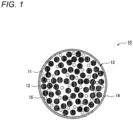
- FIG. 1 schematically illustrates a cross section of a silicate composite particle 10 coated with a conductive layer, as an example of the silicon-containing material.
- a silicate composite particle (base particle) 13 includes a lithium silicate phase 11, and silicon particles 12 dispersed in the lithium silicate phase 11.
- the silicate composite particle (base particle) 13 has a sea-island structure in which the fine silicon particles 12 are dispersed in a matrix of the lithium silicate phase 11.
- particles 15 containing vanadium are also dispersed.
- the particles 15 containing vanadium are usually smaller in average particle diameter than the silicon particles 12.
- the surface of the base particle 13 is coated with a conductive layer 14.
- the average particle diameter of the particles 15 containing vanadium is measured by observing a cross section of the silicon-containing material using a SEM or TEM. Specifically, the maximum diameters of any 100 particles containing vanadium are measured and averaged.
- silicon oxide phases can be dispersed.
- the SiO 2 content in the silicate composite particle (base particle) 13 as measured by Si-NMR is preferably, for example, 30 mass% or less, more preferably less than 7 mass%.
- the silicate composite particle (base particle) 13 may contain another component, in addition to the above components.
- a carbon material, an oxide such as ZrO 2 , and a reinforcing material such as a carbide may be contained in an amount of less than 10 mass%, relative to the base particle 13.
- a secondary battery includes a positive electrode, a negative electrode, an electrolyte, and a separator interposed between the positive electrode and the negative electrode.
- the negative electrode includes a negative electrode mixture layer containing a negative electrode active material including the silicon-containing material. A description will be given below of the negative electrode, the positive electrode, the electrolyte, and the separator included in the secondary battery according to an embodiment of the present disclosure.
- the negative electrode includes, for example, a negative electrode current collector, and a negative electrode mixture layer formed on a surface of the negative electrode current collector and containing a negative electrode active material.
- the negative electrode mixture layer can be formed by applying a negative electrode slurry of a negative electrode mixture dispersed in a dispersion medium onto a surface of the negative electrode current collector, followed by drying. The applied film after drying may be rolled, if necessary.
- the negative electrode mixture contains a negative electrode active material including the aforementioned silicon-containing material as an essential component, and can contain a binder, a conductive agent, a thickener, and the like, as optional components.
- the silicon particles in the silicon-containing material can absorb many lithium ions, and therefore, a high-capacity negative electrode can be obtained.
- the negative electrode active material may further include another active material that electrochemically absorb and release lithium ions.
- a carbon-based active material is preferred.
- the silicon-containing material expands and contracts in volume in association with charge and discharge. When the proportion of the silicon-containing material occupying the negative electrode active material is increased, a contact failure between the negative electrode active material and the negative electrode current collector tends to occur in association with charge and discharge.
- excellent cycle characteristics can be achieved, while a high capacity of the silicon particles can be imparted to the negative electrode.
- the ratio of the silicon-containing material to the total of the silicon-containing material and the carbon-based active material is for example, preferably 0.5 to 15 mass%, more preferably 1 to 5 mass%. In this case, a higher capacity and improved cycle characteristics can be both likely achieved.
- Examples of the carbon-based active material include graphite, graphitizable carbon (soft carbon), and non-graphitizable carbon (hard carbon).
- graphite in terms of its excellent stability during charge and discharge and small irreversible capacity.
- the graphite means a material having a graphite-like crystal structure, examples of which include natural graphite, artificial graphite, and graphitized mesophase carbon particles.
- the carbon-based material may be used singly or in combination of two or more kinds.
- Examples of the negative electrode current collector include a non-porous conductive substrate (e.g., metal foil) and a porous conductive substrate (e.g., mesh, net, punched sheet).
- the negative electrode current collector may be made of, for example, stainless steel, nickel, a nickel alloy, copper, or a copper alloy.
- binder examples include fluorocarbon resin, polyolefin resin, polyamide resin, polyimide resin, vinyl resin, styrene-butadiene copolymer rubber (SBR), polyacrylic acid and derivatives thereof. These may be used singly or in combination of two or more kinds.
- Examples of the conductive agent include carbon black, conductive fibers, fluorinated carbon, and organic conductive materials. These may be used singly or in combination of two or more kinds.
- thickener examples include carboxymethyl cellulose (CMC), and polyvinyl alcohol. These may be used singly or in combination of two or more kinds.
- dispersion medium examples include water, alcohols, ethers, N-methyl-2-pyrrolidone (NMP), and mixed solvents of these.
- the positive electrode includes, for example, a positive electrode current collector, and a positive electrode mixture layer formed on a surface of the positive electrode current collector.
- the positive electrode mixture layer can be formed by applying a positive electrode slurry of a positive electrode mixture dispersed in a dispersion medium onto a surface of the positive electrode current collector, followed by drying. The applied film after drying may be rolled, if necessary.
- the positive electrode mixture includes a positive electrode active material as an essential component, and may further include a binder, a conductive agent, and the like, as optional components.
- the positive electrode active material may be a lithium composite metal oxide.
- the lithium composite metal oxide include Li a CoO 2 , Li a NiO 2 , Li a MnO 2 , Li a Co b Ni 1-b O 2 , Li a Co b M 1-b O c , Li a Ni 1-b M b O c , Li a Mn 2 O 4 , Li a Mn 2-b M b O 4 , LiMePO 4 , Li 2 MePO 4 F.
- M represents at least one selected from Na, Mg, Sc, Y, Mn, Fe, Co, Ni, Cu, Zn, Al, Cr, Pb, Sb, and B.
- Me includes at least one transition element (e.g., at least one selected from the group consisting of Mn, Fe, Co, and Ni).
- transition element e.g., at least one selected from the group consisting of Mn, Fe, Co, and Ni.
- the value a representing the molar ratio of lithium is a value immediately after the preparation of the active material and is subjected to increase and decrease during charge and discharge.
- binder and the conductive agent may be like those exemplified for the negative electrode.
- Additional examples of the conductive agent include graphite, such as natural graphite and artificial graphite.
- the positive electrode current collector a conductive substrate conforming to the negative electrode current collector can be used.
- the positive electrode current collector may be made of, for example, stainless steel, aluminum, an aluminum alloy, and titanium.
- the electrolyte contains a solvent, and a lithium salt dissolved in the solvent.
- concentration of the lithium salt in the electrolyte is, for example, 0.5 to 2 mol/L.
- the electrolyte may contain a commonly known additive.
- the solvent may be aqueous or non-aqueous.
- the non-aqueous solvent may be, for example, a cyclic carbonic acid ester, a chain carbonic acid ester, or a cyclic carboxylic acid ester.
- the cyclic carbonic acid ester include propylene carbonate (PC) and ethylene carbonate (EC).
- Examples of the chain carbonic acid ester include diethyl carbonate (DEC), ethyl methyl carbonate (EMC), and dimethyl carbonate (DMC).
- Examples of the cyclic carboxylic acid ester include ⁇ -butyrolactone (GBL) and ⁇ -valerolactone (GVL).
- the non-aqueous solvent may be used singly, or in combination of two or more kinds.
- the lithium salt examples include a lithium salt of a chlorine-containing acid (e.g., LiClO 4 , LiAlCl 4 , LiB 10 Cl 10 ), a lithium salt of a fluorine-containing acid (e.g., LiPF 6 , LiBF 4 , LiSbF 6 , LiAsF 6 , LiCF 3 SO 3 , LiCF 3 CO 2 ), a lithium salt of a fluorine-containing acid imide (e.g., LiN(CF 3 SO 2 ) 2 , LiN(CF 3 SO 2 )(C 4 F 9 SO 2 ), LiN(C 2 F 5 SO 2 ) 2 ), and a lithium halide (e.g., LiCl, LiBr, LiI).
- the lithium salt may be used singly or in combination of two or more kinds.
- the separator is excellent in ion permeability and has moderate mechanical strength and electrically insulating properties.
- the separator may be, for example, a microporous thin film, a woven fabric, or a nonwoven fabric.
- the separator is preferably made of, for example, polyolefin, such as polypropylene or polyethylene.
- the secondary battery for example, has a structure in which an electrode group formed by winding the positive electrode and the negative electrode with the separator interposed therebetween is housed in an outer body, together with the electrolyte.
- the wound-type electrode group may be replaced with a different form of electrode group, for example, a stacked-type electrode group formed by stacking the positive electrode and the negative electrode with the separator interposed therebetween.
- the secondary battery may be in any form, such as cylindrical type, prismatic type, coin type, button type, or laminate type.
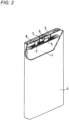
- FIG. 2 is a schematic partially cut-away oblique view of a prismatic secondary battery according to one embodiment of the present disclosure.
- the battery includes a bottomed prismatic battery case 4, and an electrode group 1 and an electrolyte (not shown) housed in the battery case 4, and a sealing plate 5 sealing the opening of the battery case 4.
- the electrode group 1 has a long negative electrode, a long positive electrode, and a separator interposed therebetween.
- the sealing plate 5 has a liquid inlet closed with a sealing plug 8, and a negative electrode terminal 6 insulated from the sealing plate 5 by a gasket 7.
- a negative electrode lead 3 is attached at its one end to the negative electrode current collector, by means of welding or the like.
- a positive electrode lead 2 is attached at its one end to the positive electrode current collector, by means of welding or the like.
- the negative electrode lead 3 is electrically connected at its other end to the negative electrode terminal 6.
- the positive electrode lead 2 is electrically connected at its other end to the sealing plate 5.
- the mixture was allowed to melt at 1500 °C for 5 hours in an inert gas atmosphere.
- the melt was passed between metal rolls and formed into flakes, and then heat-treated at 750 °C for 5 minutes, to give lithium silicate (Li 2 Si 2 O 5 ).
- the lithium silicate was pulverized to have an average particle diameter of 10 ⁇ m.
- Si powder (3N, average particle diameter: 10 ⁇ m) and Li 2 Si 2 O 5 powder (average particle diameter: 10 ⁇ m) were mixed in a mass ratio of 58:42, and a predetermined amount of particles of a vanadium-iron alloy containing elementary vanadium and vanadium carbide in a dispersed state were added thereto, which were packed into a pot (made of SUS, volume: 500 mL) of a planetary ball mill (P-5, available from Fritsch Co., Ltd.). Then, 24 SUS balls (diameter: 20 mm) were put in the pot, and with the lid closed, the mixture was pulverized at 200 rpm for 50 hours.
- Silicate composite particles containing 30 ppm of vanadium and 1.3 mass% of iron were thus obtained as a silicon-containing material A1.
- the silicon-containing material A1 was pulverized and passed through a 40- ⁇ m mesh, and then mixed with coal pitch (MCP 250, available from JFE Chemical Corporation). The mixture was heat-treated at 800 °C in an inert atmosphere, to coat the silicon-containing material A1 with carbon, to form a conductive layer. The coating amount of the carbon was approximately 5 mass%, relative to the total of the silicon-containing material A1 and the conductive layer. Thereafter, using a sieve, a silicon-containing material A1 of 5 ⁇ m in average particle diameter having a conductive layer was obtained.
- a TEM observation of a cross section of the silicon-containing material A1 found that the average particle diameter of Si particles was less than 50 nm.
- a SEM observation of a particle cross section of the silicon-containing material A1 confirmed that Si particles and powder containing vanadium carbide were dispersed substantially uniformly in the silicate phase.
- the silicon-containing material A1 was analyzed by Si-NMR. The result found that the content of SiO 2 was below the lower limit of detection.
- the content of vanadium and iron were determined by ICP-AES.
- a mixture containing the silicon-containing material A1 having a conductive layer and graphite in a weight ratio of 5:95, a sodium salt of carboxymethyl cellulose (CMC-Na), and styrene-butadiene rubber (SBR) were mixed in a mass ratio of 97.5:1.0:1.5, to which water was added.
- the mixture was stirred in a mixer (T.K. HIVIS MIX, available from PRIMIX Corporation), to prepare a negative electrode slurry.
- the negative electrode slurry was applied onto both surface of copper foil.
- the applied films were dried, then rolled, and thus, a negative electrode A2 in which a negative electrode mixture layer having a density of 1.6 g/cm 3 was formed on both sides of the copper foil was obtained.
- Lithium cobaltate, acetylene black, and polyvinylidene fluoride were mixed in a mass ratio of 95:2.5:2.5, to which N-methyl-2-pyrrolidone (NMP) was added.
- NMP N-methyl-2-pyrrolidone
- the mixture was stirred in a mixer (T.K. HIVIS MIX, available from PRIMIX Corporation), to prepare a positive electrode slurry.
- the positive electrode slurry was applied onto both surfaces of aluminum foil.
- the applied films were dried, then rolled, and thus, a positive electrode in which a positive electrode mixture layer having a density of 3.6 g/cm 3 was formed on both sides of the aluminum foil was obtained.
- LiPF 6 was dissolved at concentration of 1.0 mol/L, to prepare a non-aqueous electrolyte solution.
- the electrode group was inserted into an outer body made of aluminum laminate film and dried under vacuum at 105 °C for 2 hours. The non-aqueous electrolyte solution was injected, and the opening of the outer body was sealed. A secondary battery A1 was thus obtained.
- a negative electrode R1 and a secondary battery R1 were obtained in the same manner as in Example 1, except that vanadium carbide was not added to the mixture of Si powder and Li 2 Si 2 O 5 powder, and iron was added, to synthesize silicate composite particles containing 1.7 mass% of iron (silicon-containing material R1).
- the negative electrode for a secondary battery according to the present disclosure is useful in a secondary battery that serves as a main power source for mobile communication devices, portable electronic devices, and other similar devices.
Landscapes
- Chemical & Material Sciences (AREA)
- Chemical Kinetics & Catalysis (AREA)
- Electrochemistry (AREA)
- General Chemical & Material Sciences (AREA)
- Composite Materials (AREA)
- Engineering & Computer Science (AREA)
- Inorganic Chemistry (AREA)
- Materials Engineering (AREA)
- Manufacturing & Machinery (AREA)
- Battery Electrode And Active Subsutance (AREA)
Applications Claiming Priority (2)
| Application Number | Priority Date | Filing Date | Title |
|---|---|---|---|
| JP2020061364 | 2020-03-30 | ||
| PCT/JP2021/001564 WO2021199587A1 (fr) | 2020-03-30 | 2021-01-19 | Matériau actif d'électrode négative pour batteries secondaires, et batterie secondaire l'utilisant |
Publications (2)
| Publication Number | Publication Date |
|---|---|
| EP4131491A1 true EP4131491A1 (fr) | 2023-02-08 |
| EP4131491A4 EP4131491A4 (fr) | 2024-11-13 |
Family
ID=77929814
Family Applications (1)
| Application Number | Title | Priority Date | Filing Date |
|---|---|---|---|
| EP21782413.5A Pending EP4131491A4 (fr) | 2020-03-30 | 2021-01-19 | Matériau actif d'électrode négative pour batteries secondaires, et batterie secondaire l'utilisant |
Country Status (5)
| Country | Link |
|---|---|
| US (1) | US12506141B2 (fr) |
| EP (1) | EP4131491A4 (fr) |
| JP (1) | JP7664538B2 (fr) |
| CN (1) | CN115398674B (fr) |
| WO (1) | WO2021199587A1 (fr) |
Families Citing this family (3)
| Publication number | Priority date | Publication date | Assignee | Title |
|---|---|---|---|---|
| JPWO2024090148A1 (fr) * | 2022-10-24 | 2024-05-02 | ||
| WO2024090206A1 (fr) * | 2022-10-25 | 2024-05-02 | パナソニックIpマネジメント株式会社 | Électrode négative pour batterie secondaire, et batterie secondaire |
| CN119340378B (zh) * | 2024-12-16 | 2025-07-29 | 贝特瑞新材料集团股份有限公司 | 负极材料和二次电池 |
Family Cites Families (13)
| Publication number | Priority date | Publication date | Assignee | Title |
|---|---|---|---|---|
| US4173687A (en) * | 1978-06-20 | 1979-11-06 | Occidental Research Corporation | Current generating cell with alloy anode |
| JP5825573B2 (ja) * | 2011-10-13 | 2015-12-02 | 太平洋セメント株式会社 | リチウムイオン電池用正極活物質及びその製造法 |
| JP2014056722A (ja) | 2012-09-13 | 2014-03-27 | Asahi Glass Co Ltd | リン酸化合物、二次電池用正極材料、および二次電池の製造方法 |
| JP5759968B2 (ja) * | 2012-12-17 | 2015-08-05 | 太平洋セメント株式会社 | オリビン型シリケート化合物の製造法、及び二次電池正極活物質の製造法 |
| JPWO2015064633A1 (ja) * | 2013-10-30 | 2017-03-09 | 古河電気工業株式会社 | 負極活物質及びその製造方法並びにそれを用いた負極及び非水電解質二次電池 |
| JP6833511B2 (ja) | 2014-09-03 | 2021-02-24 | 三洋電機株式会社 | 非水電解質二次電池用負極活物質及び非水電解質二次電池 |
| WO2016121321A1 (fr) | 2015-01-28 | 2016-08-04 | 三洋電機株式会社 | Matériau actif d'électrode négative pour batteries secondaires à électrolyte non aqueux, et batterie secondaire à électrolyte non aqueux |
| WO2016121320A1 (fr) | 2015-01-28 | 2016-08-04 | 三洋電機株式会社 | Matériau actif d'électrode négative pour batterie secondaire à électrolyte non aqueux, et batterie secondaire à électrolyte non aqueux |
| WO2016152505A1 (fr) * | 2015-03-25 | 2016-09-29 | 株式会社村田製作所 | Batterie rechargeable au lithium-ion |
| CN107863503B (zh) | 2017-10-12 | 2020-09-11 | 合肥国轩高科动力能源有限公司 | 一种改性硅酸铁锂正极材料的制备方法 |
| CN107863506B (zh) * | 2017-10-20 | 2018-11-16 | 江苏贝肯盛创新能源科技有限公司 | 一种用于锂电池的氮掺杂锡/铜多孔负极材料及制备方法 |
| CN111566856B (zh) | 2017-12-27 | 2023-06-16 | 松下知识产权经营株式会社 | 二次电池用负极活性物质和二次电池 |
| WO2019151016A1 (fr) * | 2018-01-30 | 2019-08-08 | パナソニックIpマネジメント株式会社 | Substance active d'électrode négative destinée à une batterie secondaire, et batterie secondaire |
-
2021
- 2021-01-19 CN CN202180024438.1A patent/CN115398674B/zh active Active
- 2021-01-19 WO PCT/JP2021/001564 patent/WO2021199587A1/fr not_active Ceased
- 2021-01-19 EP EP21782413.5A patent/EP4131491A4/fr active Pending
- 2021-01-19 JP JP2022511558A patent/JP7664538B2/ja active Active
- 2021-01-19 US US17/912,130 patent/US12506141B2/en active Active
Also Published As
| Publication number | Publication date |
|---|---|
| CN115398674A (zh) | 2022-11-25 |
| WO2021199587A1 (fr) | 2021-10-07 |
| JPWO2021199587A1 (fr) | 2021-10-07 |
| CN115398674B (zh) | 2025-06-20 |
| JP7664538B2 (ja) | 2025-04-18 |
| EP4131491A4 (fr) | 2024-11-13 |
| US20230111143A1 (en) | 2023-04-13 |
| US12506141B2 (en) | 2025-12-23 |
Similar Documents
| Publication | Publication Date | Title |
|---|---|---|
| EP4131490B1 (fr) | Batterie rechargeable | |
| EP4254551B1 (fr) | Matériau d'électrode négative pour batterie secondaire à électrolyte non aqueux et batterie secondaire à électrolyte non aqueux | |
| WO2020129652A1 (fr) | Matériau actif d'électrode négative pour batteries secondaires, et batterie secondaire | |
| EP4206133B1 (fr) | Matériau d'électrode négative pour batterie secondaire à électrolyte non aqueux et batterie secondaire à électrolyte non aqueux | |
| US12506141B2 (en) | Negative electrode active material for secondary batteries, and secondary battery using same | |
| US20230083229A1 (en) | Negative electrode active substance for secondary battery, method for producing same, and secondary battery | |
| US12113216B2 (en) | Negative electrode active material for secondary batteries, and secondary battery | |
| CN114902447B (zh) | 二次电池用负极活性物质及二次电池 | |
| US20250201831A1 (en) | Negative electrode active material for secondary batteries, and secondary battery | |
| WO2020203420A1 (fr) | Batterie secondaire à électrolyte non aqueux | |
| EP4411882A1 (fr) | Substance active d'électrode négative pour batterie secondaire, son procédé de production, et batterie secondaire | |
| US12119481B2 (en) | Negative electrode active material for secondary batteries and secondary battery | |
| JP7681839B2 (ja) | 二次電池用負極活物質および二次電池 | |
| EP4550457A1 (fr) | Matériau d'électrode négative pour batterie secondaire et batterie secondaire | |
| EP4254550B1 (fr) | Matériau actif d'électrode négative pour batteries secondaires à électrolyte non aqueux, et batterie secondaire à électrolyte non aqueux | |
| US12155061B2 (en) | Negative electrode active material for secondary batteries, and secondary battery | |
| EP4583205A1 (fr) | Matériau actif d'électrode négative pour batteries secondaires et batterie secondaire | |
| EP4300627A1 (fr) | Matériau actif d'électrode négative pour batterie secondaire, et batterie secondaire l'utilisant | |
| EP4269350A1 (fr) | Particules composites pour batterie secondaire à électrolyte non aqueux, et batterie secondaire à électrolyte non aqueux |
Legal Events
| Date | Code | Title | Description |
|---|---|---|---|
| STAA | Information on the status of an ep patent application or granted ep patent |
Free format text: STATUS: THE INTERNATIONAL PUBLICATION HAS BEEN MADE |
|
| PUAI | Public reference made under article 153(3) epc to a published international application that has entered the european phase |
Free format text: ORIGINAL CODE: 0009012 |
|
| STAA | Information on the status of an ep patent application or granted ep patent |
Free format text: STATUS: REQUEST FOR EXAMINATION WAS MADE |
|
| 17P | Request for examination filed |
Effective date: 20220902 |
|
| AK | Designated contracting states |
Kind code of ref document: A1 Designated state(s): AL AT BE BG CH CY CZ DE DK EE ES FI FR GB GR HR HU IE IS IT LI LT LU LV MC MK MT NL NO PL PT RO RS SE SI SK SM TR |
|
| DAV | Request for validation of the european patent (deleted) | ||
| DAX | Request for extension of the european patent (deleted) | ||
| A4 | Supplementary search report drawn up and despatched |
Effective date: 20241010 |
|
| RIC1 | Information provided on ipc code assigned before grant |
Ipc: H01M 4/38 20060101ALI20241004BHEP Ipc: H01M 4/36 20060101AFI20241004BHEP |