EP4131706A1 - Procédé de gestion de charge et de décharge pour des blocs-batteries parallèles, dispositif électronique et système électrique - Google Patents
Procédé de gestion de charge et de décharge pour des blocs-batteries parallèles, dispositif électronique et système électrique Download PDFInfo
- Publication number
- EP4131706A1 EP4131706A1 EP21776075.0A EP21776075A EP4131706A1 EP 4131706 A1 EP4131706 A1 EP 4131706A1 EP 21776075 A EP21776075 A EP 21776075A EP 4131706 A1 EP4131706 A1 EP 4131706A1
- Authority
- EP
- European Patent Office
- Prior art keywords
- battery packs
- charge
- battery
- battery pack
- power bus
- Prior art date
- Legal status (The legal status is an assumption and is not a legal conclusion. Google has not performed a legal analysis and makes no representation as to the accuracy of the status listed.)
- Pending
Links
Images



Classifications
-
- H—ELECTRICITY
- H02—GENERATION; CONVERSION OR DISTRIBUTION OF ELECTRIC POWER
- H02J—ELECTRIC POWER NETWORKS; CIRCUIT ARRANGEMENTS OR SYSTEMS FOR SUPPLYING OR DISTRIBUTING ELECTRIC POWER; SYSTEMS FOR STORING ELECTRIC ENERGY
- H02J7/00—Circuit arrangements for charging or discharging batteries or for supplying loads from batteries
- H02J7/90—Regulation of charging or discharging current or voltage
- H02J7/933—Regulation of charging or discharging current or voltage the cycle being controlled or terminated in response to electric parameters
-
- H—ELECTRICITY
- H02—GENERATION; CONVERSION OR DISTRIBUTION OF ELECTRIC POWER
- H02J—ELECTRIC POWER NETWORKS; CIRCUIT ARRANGEMENTS OR SYSTEMS FOR SUPPLYING OR DISTRIBUTING ELECTRIC POWER; SYSTEMS FOR STORING ELECTRIC ENERGY
- H02J7/00—Circuit arrangements for charging or discharging batteries or for supplying loads from batteries
- H02J7/50—Circuit arrangements for charging or discharging batteries or for supplying loads from batteries acting upon multiple batteries simultaneously or sequentially
- H02J7/585—Sequential battery discharge in systems with a plurality of batteries
-
- H—ELECTRICITY
- H02—GENERATION; CONVERSION OR DISTRIBUTION OF ELECTRIC POWER
- H02J—ELECTRIC POWER NETWORKS; CIRCUIT ARRANGEMENTS OR SYSTEMS FOR SUPPLYING OR DISTRIBUTING ELECTRIC POWER; SYSTEMS FOR STORING ELECTRIC ENERGY
- H02J7/00—Circuit arrangements for charging or discharging batteries or for supplying loads from batteries
- H02J7/865—Battery or charger load switching, e.g. concurrent charging and load supply
-
- H—ELECTRICITY
- H02—GENERATION; CONVERSION OR DISTRIBUTION OF ELECTRIC POWER
- H02J—ELECTRIC POWER NETWORKS; CIRCUIT ARRANGEMENTS OR SYSTEMS FOR SUPPLYING OR DISTRIBUTING ELECTRIC POWER; SYSTEMS FOR STORING ELECTRIC ENERGY
- H02J7/00—Circuit arrangements for charging or discharging batteries or for supplying loads from batteries
- H02J7/90—Regulation of charging or discharging current or voltage
- H02J7/96—Regulation of charging or discharging current or voltage in response to battery voltage
-
- G—PHYSICS
- G01—MEASURING; TESTING
- G01R—MEASURING ELECTRIC VARIABLES; MEASURING MAGNETIC VARIABLES
- G01R19/00—Arrangements for measuring currents or voltages or for indicating presence or sign thereof
- G01R19/165—Indicating that current or voltage is either above or below a predetermined value or within or outside a predetermined range of values
- G01R19/16533—Indicating that current or voltage is either above or below a predetermined value or within or outside a predetermined range of values characterised by the application
- G01R19/16538—Indicating that current or voltage is either above or below a predetermined value or within or outside a predetermined range of values characterised by the application in AC or DC supplies
- G01R19/16542—Indicating that current or voltage is either above or below a predetermined value or within or outside a predetermined range of values characterised by the application in AC or DC supplies for batteries
-
- G—PHYSICS
- G01—MEASURING; TESTING
- G01R—MEASURING ELECTRIC VARIABLES; MEASURING MAGNETIC VARIABLES
- G01R31/00—Arrangements for testing electric properties; Arrangements for locating electric faults; Arrangements for electrical testing characterised by what is being tested not provided for elsewhere
- G01R31/36—Arrangements for testing, measuring or monitoring the electrical condition of accumulators or electric batteries, e.g. capacity or state of charge [SoC]
- G01R31/382—Arrangements for monitoring battery or accumulator variables, e.g. SoC
-
- G—PHYSICS
- G01—MEASURING; TESTING
- G01R—MEASURING ELECTRIC VARIABLES; MEASURING MAGNETIC VARIABLES
- G01R31/00—Arrangements for testing electric properties; Arrangements for locating electric faults; Arrangements for electrical testing characterised by what is being tested not provided for elsewhere
- G01R31/36—Arrangements for testing, measuring or monitoring the electrical condition of accumulators or electric batteries, e.g. capacity or state of charge [SoC]
- G01R31/382—Arrangements for monitoring battery or accumulator variables, e.g. SoC
- G01R31/3835—Arrangements for monitoring battery or accumulator variables, e.g. SoC involving only voltage measurements
-
- H—ELECTRICITY
- H01—ELECTRIC ELEMENTS
- H01M—PROCESSES OR MEANS, e.g. BATTERIES, FOR THE DIRECT CONVERSION OF CHEMICAL ENERGY INTO ELECTRICAL ENERGY
- H01M10/00—Secondary cells; Manufacture thereof
- H01M10/42—Methods or arrangements for servicing or maintenance of secondary cells or secondary half-cells
- H01M10/44—Methods for charging or discharging
- H01M10/441—Methods for charging or discharging for several batteries or cells simultaneously or sequentially
-
- H—ELECTRICITY
- H02—GENERATION; CONVERSION OR DISTRIBUTION OF ELECTRIC POWER
- H02J—ELECTRIC POWER NETWORKS; CIRCUIT ARRANGEMENTS OR SYSTEMS FOR SUPPLYING OR DISTRIBUTING ELECTRIC POWER; SYSTEMS FOR STORING ELECTRIC ENERGY
- H02J7/00—Circuit arrangements for charging or discharging batteries or for supplying loads from batteries
- H02J7/50—Circuit arrangements for charging or discharging batteries or for supplying loads from batteries acting upon multiple batteries simultaneously or sequentially
-
- H—ELECTRICITY
- H02—GENERATION; CONVERSION OR DISTRIBUTION OF ELECTRIC POWER
- H02J—ELECTRIC POWER NETWORKS; CIRCUIT ARRANGEMENTS OR SYSTEMS FOR SUPPLYING OR DISTRIBUTING ELECTRIC POWER; SYSTEMS FOR STORING ELECTRIC ENERGY
- H02J7/00—Circuit arrangements for charging or discharging batteries or for supplying loads from batteries
- H02J7/60—Circuit arrangements for charging or discharging batteries or for supplying loads from batteries including safety or protection arrangements
-
- H—ELECTRICITY
- H02—GENERATION; CONVERSION OR DISTRIBUTION OF ELECTRIC POWER
- H02J—ELECTRIC POWER NETWORKS; CIRCUIT ARRANGEMENTS OR SYSTEMS FOR SUPPLYING OR DISTRIBUTING ELECTRIC POWER; SYSTEMS FOR STORING ELECTRIC ENERGY
- H02J7/00—Circuit arrangements for charging or discharging batteries or for supplying loads from batteries
- H02J7/80—Circuit arrangements for charging or discharging batteries or for supplying loads from batteries including monitoring or indicating arrangements
-
- H—ELECTRICITY
- H02—GENERATION; CONVERSION OR DISTRIBUTION OF ELECTRIC POWER
- H02J—ELECTRIC POWER NETWORKS; CIRCUIT ARRANGEMENTS OR SYSTEMS FOR SUPPLYING OR DISTRIBUTING ELECTRIC POWER; SYSTEMS FOR STORING ELECTRIC ENERGY
- H02J7/00—Circuit arrangements for charging or discharging batteries or for supplying loads from batteries
- H02J7/80—Circuit arrangements for charging or discharging batteries or for supplying loads from batteries including monitoring or indicating arrangements
- H02J7/82—Control of state of charge [SOC]
-
- H—ELECTRICITY
- H02—GENERATION; CONVERSION OR DISTRIBUTION OF ELECTRIC POWER
- H02J—ELECTRIC POWER NETWORKS; CIRCUIT ARRANGEMENTS OR SYSTEMS FOR SUPPLYING OR DISTRIBUTING ELECTRIC POWER; SYSTEMS FOR STORING ELECTRIC ENERGY
- H02J7/00—Circuit arrangements for charging or discharging batteries or for supplying loads from batteries
- H02J7/80—Circuit arrangements for charging or discharging batteries or for supplying loads from batteries including monitoring or indicating arrangements
- H02J7/84—Control of state of health [SOH]
-
- Y—GENERAL TAGGING OF NEW TECHNOLOGICAL DEVELOPMENTS; GENERAL TAGGING OF CROSS-SECTIONAL TECHNOLOGIES SPANNING OVER SEVERAL SECTIONS OF THE IPC; TECHNICAL SUBJECTS COVERED BY FORMER USPC CROSS-REFERENCE ART COLLECTIONS [XRACs] AND DIGESTS
- Y02—TECHNOLOGIES OR APPLICATIONS FOR MITIGATION OR ADAPTATION AGAINST CLIMATE CHANGE
- Y02E—REDUCTION OF GREENHOUSE GAS [GHG] EMISSIONS, RELATED TO ENERGY GENERATION, TRANSMISSION OR DISTRIBUTION
- Y02E60/00—Enabling technologies; Technologies with a potential or indirect contribution to GHG emissions mitigation
- Y02E60/10—Energy storage using batteries
Definitions
- This application relates to the technical field of a power supply, and in particular, to a method for managing charging and discharging of a parallel-connected battery pack, an electronic device, and an electrical system.
- a single-battery-pack solution requires a higher energy density and a higher capacity of a battery cell of the battery pack, thereby increasing a volume and a weight of the battery pack and increasing costs of research and development, manufacturing, transportation, and installation of the battery pack.
- a parallel-connected battery pack solution viewed from a research and development perspective, requires merely design of a low-capacity solution, thereby reducing research and development costs and safety certification costs for developers.
- a key to a parallel-connected battery pack is that a master battery pack needs to monitor status information of each slave battery pack in real time. When a battery pack is faulty, the master battery pack feeds back fault information to a power conversion system (PCS) in time, and the PCS can immediately reduce power or cut off load operation to ensure safe operation of the parallel-connected battery pack.
- PCS power conversion system
- An existing technology of paralleling an energy storage system has the following problems: (1) prerequisites of paralleling battery packs are that the battery packs stand statically and have consistent voltages, and the voltages of the battery packs have to be manually adjusted during charging and discharging, consequently increasing complexity and costs of mounting and debugging; and (2) in a case that the battery packs are connected in parallel when being charged or discharged, voltage is used as a unique basis for paralleling, consequently increasing burnout risks caused by a too high cross current in a power loop of the parallel-connected battery pack.
- Solutions available in the prior art to such problems include: (1) before the battery packs are paralleled, a total voltage of each battery pack is manually adjusted, the battery packs are charged or discharged until the total voltage of each battery pack reaches a fixed voltage value, and the battery packs are paralleled after total voltages of all the battery packs have been adjusted properly; and (2) the battery packs are paralleled during charging or discharging, but a parameter used as a basis for paralleling is merely the voltage of each battery pack, and a charge or discharge current during the paralleling depends on a next-level load; and, when the voltage of a battery pack first incorporated into the power loop rises or falls to a value consistent with the voltage of an unincorporated battery pack during the charging or discharging, the unincorporated battery pack is connected to the power loop in parallel.
- the solutions in the prior art have the following disadvantages: (1) in solution (1), the voltage of the battery pack needs to be adjusted manually, and the parallel connecting of the battery packs is not smart enough but increases the complexity and costs of mounting and debugging; and (2) in solution (2), merely a single parameter is used as a basis for the parallel connecting of battery pack, and the charge current and the discharge current are not limited. Consequently, the voltage is consistent between the parallel-connected battery packs but an actual capacity differs sharply, the cross current between the parallel-connected battery packs is too high, and the battery cells of the battery packs, the power loop, and devices are likely to be damaged by the too high cross current.
- An embodiment of this application provides a method for managing charging and discharging of a parallel-connected battery pack.
- the method for managing charging and discharging of a parallel-connected battery pack includes: obtaining a voltage value and a state of charge of a plurality of battery packs; comparing the voltage value and the state of charge of each of the battery packs with a reference voltage value and a reference state of charge; and managing charging and discharging of the plurality of battery packs based on a comparison result.
- the reference voltage value may be obtained by: using a minimum value of voltage values of the plurality of battery packs as the reference voltage value when none of the plurality of battery packs is connected to a power bus.
- the reference state of charge may be obtained by: using a minimum value of states of charge of the plurality of battery packs as the reference state of charge when none of the plurality of battery packs is connected to a power bus.
- the reference voltage value may also be obtained by: using a minimum value of voltage values of battery packs already connected to a power bus as the reference voltage value when a battery pack is already connected to the power bus.
- the reference state of charge may also be obtained by: using a minimum value of states of charge of battery packs already connected to a power bus as the reference state of charge when a battery pack is already connected to the power bus.
- the method for managing charging and discharging of a parallel-connected battery pack further includes: obtaining a quantity of battery packs already connected to a power bus; and determining a charge current limit value I charge and a discharge current limit value I discharge of a power conversion system.
- the step of managing charging and discharging of the plurality of battery packs based on a comparison result includes: determining, when none of the plurality of battery packs is connected to a power bus, whether a difference between the voltage value of all the battery packs and the reference voltage value is less than a first threshold, and whether a difference between the state of charge of all the battery packs and the reference state of charge is less than a second threshold; and controlling the battery packs to sequentially connect to the power bus if the difference between the voltage value of all the battery packs and the reference voltage value is less than the first threshold, and if the difference between the state of charge of all the battery packs and the reference state of charge is less than the second threshold.
- the step of managing charging and discharging of the plurality of battery packs based on a comparison result further includes: determining, when at least one battery pack is already connected to the power bus and the battery back is in a charging state, whether a difference between the voltage value of battery packs not connected to the power bus and the reference voltage value is within a first range, and whether a difference between the state of charge of the battery packs not connected to the power bus and the reference state of charge is within a second range; and controlling the battery packs to sequentially connect to the power bus if the difference between the voltage value of all the battery packs not connected to the power bus and the reference voltage value is within the first range, and if the difference between the state of charge of all the battery packs not connected to the power bus and the reference state of charge is within the second range.
- the step of managing charging and discharging of the plurality of battery packs based on a comparison result further includes: determining, when at least one battery pack is already connected to the power bus and the battery backs not connected to the power bus are in a discharging state, whether a difference between the reference voltage value and the voltage value of all the battery packs not connected to the power bus is within a third range, and whether a difference between the reference state of charge and the state of charge of all the battery packs not connected to the power bus is within a fourth range; and controlling the battery packs to sequentially connect to the power bus if the difference between the reference voltage value and the voltage value of all the battery packs not connected to the power bus is within the third range, and if the difference between the reference state of charge and the state of charge of all the battery packs not connected to the power bus is within the fourth range.
- the method for managing charging and discharging of a parallel-connected battery pack further includes: receiving fault alarm information when a fault alarm occurs on a battery pack; and controlling all the battery packs to disconnect from the power bus or controlling the faulty battery pack to separately disconnect from the power bus.
- An embodiment of this application further provides an electronic device.
- the electronic device includes:
- the electronic device further includes a plurality of switches in one-to-one correspondence to a plurality of battery packs, and each switch is connected between the battery packs and a power conversion system.
- An embodiment of this application further provides an electrical system.
- the electrical system includes a power conversion system and the electronic device.
- the electronic device further includes a plurality of switches in one-to-one correspondence to a plurality of battery packs. Each switch is connected between the battery packs and the power conversion system.
- the voltage value and the state of charge of a plurality of battery packs are obtained, the voltage value and the state of charge of each of the battery packs is compared with a reference voltage value and a reference state of charge, and the charging and discharging of the plurality of battery packs is managed based on a comparison result.
- the technical solution provided herein can enhance automation of paralleling of battery packs, increase adaptability of a paralleling system, improve paralleling efficiency, further reduce operation and maintenance costs, and improve user experience.
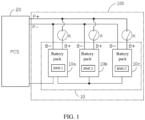
- FIG. 1 is a structural diagram of a paralleling system of a parallel-connected battery pack 10 according to an embodiment of this application.
- An embodiment of this application provides an electrical system.
- the electrical system includes an electronic device 100 and a power conversion system 20.
- the electronic device 100 in the embodiment of this application is electrically connected to the power conversion system 20.
- the electronic device 100 may include the parallel-connected battery pack 10.
- the parallel-connected battery pack 10 may include a plurality of battery packs connected in parallel ( FIG. 1 uses three battery packs 10a, 10b, and 10c as an example, but more or less than three battery packs may be connected in parallel).
- Each battery pack 10a, 10b, 10c includes a positive electrode B+ and a negative electrode B-.
- the positive electrodes B+ of the battery packs 10a ⁇ 10c are connected together to form a positive electrode of the parallel-connected battery pack 10, and the negative electrodes B- of the battery packs 10a ⁇ 10c are connected together to form a negative electrode of the parallel-connected battery pack 10.
- An output of the parallel-connected battery pack 10 is converged to a direct-current input side of the power conversion system 20.
- the negative electrode B- of the battery packs 10a, 10b, and 10c is electrically connected to a power bus P- of the power conversion system 20.
- the positive electrode B+ of the battery packs 10a, 10b, and 10c is electrically connected to a power bus P+ of the power conversion system 20 through a switch K.
- the quantity of switches is identical to the quantity of the battery packs, and the switches are in one-to-one correspondence to the battery packs.
- power lines of each battery pack may be connected in parallel to the power buses P+ and P- through the corresponding switch K.
- each battery pack 10a, 10b, 10c further includes an internal bus interface and an external bus interface.
- the internal bus interface can implement an internal bus communication function
- the external bus interface can implement an external bus communication function. Understandably, the internal bus communication function can implement internal communication between the battery packs 10a ⁇ 10c, and the external bus communication function can implement communication between a master battery pack and the power conversion system 20.
- the internal bus and the external bus may be a controller area network (CAN) communication bus or an RS485 communication bus.
- CAN controller area network
- RS485 RS485 communication bus
- one of the battery packs in the parallel-connected battery pack 10 may be a master battery pack, and remaining battery packs may be slave battery packs.
- a battery management unit may be disposed in each battery pack. Battery cells of each battery pack are managed by a corresponding battery management unit. To be specific, in this embodiment of this application, on/off states of the plurality of switches K may be controlled by the corresponding battery management unit.
- the battery pack 10a is a master battery pack
- the battery packs 10b and 10c are slave battery packs.
- a battery management unit BMU 1 is disposed in the battery pack 10a
- battery management units BMU 2 and BMU 3 are disposed in the battery packs 10b and 10c respectively.
- the battery management unit in the slave battery pack sends data information and status of the corresponding battery pack to the battery management unit in the master battery pack through the internal bus.
- the battery management unit in the master battery pack may aggregate and analyze the data information and status of all the battery management units (including the battery management unit of the master battery pack), calculate a corresponding control parameter, and then control each battery management unit separately through the internal bus, and may, through the external bus, exchange data with the power conversion system 20 and perform operation scheduling.
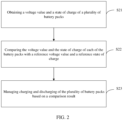
- FIG. 2 is a flowchart of a method for managing charging and discharging of a parallel-connected battery pack according to an embodiment of this application.
- the method for managing charging and discharging of a parallel-connected battery pack may include the following steps.
- Step S21 Obtaining a voltage value and a state of charge of a plurality of battery packs.
- the battery management unit in each slave battery pack sends data information and status of a corresponding battery pack to a battery management unit in a master battery pack through an internal bus.
- the battery management unit BMU 1 in the battery pack 10a may obtain voltage values and states of charge of the battery packs 10b and 10c through the battery management units BMU 2 and BMU 3.
- state of charge means a ratio of a remaining capacity of a battery to a fully charged capacity of the battery.
- Step S22 Comparing the voltage value and the state of charge of each of the battery packs with a reference voltage value and a reference state of charge.
- a total voltage value of each battery pack needs to be compared with a reference voltage value, and an SOC of each battery pack needs to be compared with a reference SOC.
- the reference voltage value and the reference SOC of the dynamic paralleling of power are calculated by the battery management unit of the master battery pack.
- the reference voltage value may be obtained by: using a minimum value of voltage values of the plurality of battery packs 10a ⁇ 10c as the reference voltage value if none of the plurality of battery packs 10a ⁇ 10c is connected to a power bus.
- the reference SOC may be obtained by: using a minimum value of SOCs of the plurality of battery packs 10a ⁇ 10c as the reference SOC if none of the plurality of battery packs 10a ⁇ 10c is connected to the power bus.
- the reference voltage value may also be obtained by: using a minimum value of voltage values of battery packs already connected to the power bus as the reference voltage value if any battery pack in the plurality of battery packs 10a ⁇ 10c is already connected to the power bus.
- the reference SOC may also be obtained by: using a minimum value of SOCs of battery packs already connected to the power bus as the reference SOC if any battery pack in the plurality of battery packs 10a ⁇ 10c is already connected to the power bus.
- Step S23 Managing charging and discharging of the plurality of battery packs based on a comparison result.
- the battery management unit of the master battery pack compares the voltage value and the SOC of each battery pack with the reference voltage value and the reference SOC to manage charging and discharging of the plurality of battery packs based on a comparison result.
- Dynamic paralleling of power requires coordination of the power conversion system. To be specific, during dynamic paralleling of the battery pack, the power conversion system needs to perform charging or discharging according to a current limit value calculated by the battery management unit of the master battery pack.
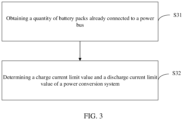
- the battery management unit of the master battery pack specifically calculates the charge current limit value and the discharge current limit value by performing the following steps: Step S31: Obtaining a quantity of battery packs already connected to a power bus.
- the battery management unit of the master battery pack obtains the quantity of the battery packs already connected to the power bus.
- Step S32 Determining a charge current limit value and a discharge current limit value of a power conversion system.
- the charge current limit value of the power conversion system is denoted as I charge and the discharge current limit value is denoted as I discharge .
- the battery management unit determines, by performing the following steps and based on a comparison result of the voltage value and the SOC of the battery packs versus the reference voltage value and the reference SOC, how to manage charging and discharging of the plurality of battery packs: Step S41: Determining that none of the plurality of battery packs is connected to the power bus.
- the battery management unit of the master battery pack may determine, based on the data information and status fed back by the battery management unit of each slave battery pack, whether none of the plurality of battery packs is connected to the power bus.
- the battery management unit BMU 1 of the battery pack 10a sends the charge current limit value I charge and the discharge current limit value I discharge to the power conversion system through an external bus, both being 0.
- the reference voltage value of the dynamically paralleled battery pack is the minimum value of the voltage values of the plurality of battery packs
- the reference SOC of the dynamically paralleled battery pack is the minimum value of the SOCs of the plurality of battery packs.
- Step S42 Determining whether a difference between the voltage value of all the battery packs 10a ⁇ 10c and the reference voltage value is less than a first threshold, and whether a difference between the SOC of all the battery packs 10a ⁇ 10c and the reference SOC is less than a second threshold. If the difference is less than the first threshold and the second threshold, the process proceeds to step S43.
- the battery management unit BMU 1 of the battery pack 10a compares the collected total voltage of each battery pack with the reference voltage value, and compares the collected SOC of each battery pack with the reference SOC.
- the battery management unit BMU 1 of the battery pack 10a determines whether the difference between the voltage value of all the battery packs and the reference voltage value is less than the first threshold, and whether the difference between the SOC of all the battery packs and the reference SOC is less than the second threshold.
- Step S43 Controlling the battery packs to sequentially connect to the power bus.
- the battery management unit BMU 1 of the battery pack 10a resets a power paralleling command of each battery pack. Then the battery management units BMU 1, BMU 2, and BMU 3 turn on the switch K, and the plurality of battery packs 10a ⁇ 10c are sequentially connected to the power bus. In this way, paralleling of the power of all the battery packs to the power bus is completed, and a power paralleling completion flag is reset.
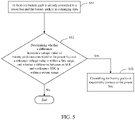
- the battery management unit determines, by performing the following steps and based on a comparison result of the voltage value and the SOC of the battery packs versus the reference voltage value and the reference SOC, how to manage charging and discharging of the plurality of battery packs: Step S51: Determining that at least one battery pack is already connected to the power bus and the battery pack is in a charging state.
- the battery management unit of the master battery pack sends a charge current limit value I charge and a discharge current limit value I discharge to the power conversion system 20 through an external bus. Therefore, the power conversion system 20 outputs a charge current and a discharge current according to the corresponding charge current limit value and discharge current limit value.
- Step S52 Determining whether the difference between the voltage value of the battery packs not connected to the power bus and the reference voltage value is within a first range, and whether the difference between the SOC and the reference SOC is within a second range. If the difference is within the first range and the second range, the process proceeds to step S53.
- the battery management unit BMU 1 determines whether the difference between the voltage value of the battery packs 10b and 10c and the reference voltage value is within the first range. In addition, the battery management unit BMU 1 determines whether the difference between the SOC of the battery packs 10b and 10c and the reference SOC is within the second range.
- Step S53 Controlling the battery packs to sequentially connect to the power bus.
- the battery management unit BMU 1 of the master battery pack resets the power paralleling command of each battery pack. Then the battery management units turn on the switch K, and the battery packs not connected to the power bus are sequentially connected to the power bus. In this way, paralleling of the power of all the battery packs to the power bus is completed, and the power paralleling completion flag is reset.
- the battery management unit determines, by performing the following steps and based on a comparison result of the voltage value and the SOC of the battery packs versus the reference voltage value and the reference SOC, how to manage charging and discharging of the plurality of battery packs: Step S61: Determining that at least one battery pack is already connected to the power bus and the battery pack is in a discharging state.
- the battery management unit of the master battery pack sends a charge current limit value I charge and a discharge current limit value I discharge to the power conversion system 20 through an external bus. Therefore, the power conversion system 20 outputs a charge current and a discharge current according to the corresponding charge current limit value and discharge current limit value.
- Step S62 Determining whether the difference between the reference voltage value and the voltage value of all the battery packs not connected to the power bus is within a third range, and whether the difference between the reference SOC and the SOC of all the battery packs not connected to the power bus is within a fourth range. If the difference is within the third range and the fourth range, the process proceeds to step S63.
- the battery management unit BMU 1 determines whether the difference between the reference voltage value and the voltage value of the battery packs 10b and 10c is within the third range. In addition, the battery management unit BMU 1 determines whether the difference between the reference SOC and the SOC of the battery packs 10b and 10c is within the fourth range.
- Step S63 Controlling the battery packs to sequentially connect to the power bus.
- the battery management unit BMU 1 of the master battery pack resets the power paralleling command of each battery pack. Then the battery management units turn on the switch K, and the battery packs not connected to the power bus are sequentially connected to the power bus. In this way, paralleling of the power of all the battery packs to the power bus is completed, and the power paralleling completion flag is reset.
- the battery management unit of the master battery pack calculates and updates the reference voltage value and the reference SOC in real time. If the voltage value and the SOC of the battery packs not connected to the power bus satisfy power paralleling conditions one by one during the charging or discharging, the battery packs will be connected to the power bus one by one, and the power paralleling completion flag of the battery packs will be reset one by one. As the quantity of the paralleled battery packs increases, the charge current limit value I charge and the discharge current limit value I discharge is calculated and updated in real time until all the battery packs have completed paralleling.
- the battery packs reset the power paralleling completion flag
- the master battery pack resets a main flag of power paralleling completion, and stops calculating the reference voltage value and the reference SOC.
- the calculation method of charge current limit value I charge and the discharge current limit value I discharge is changed from a current limiting method of power paralleling mode to a charge and discharge current limit value method of a normal operation mode of the energy storage system. That is, all the battery packs of the energy storage system exit the power paralleling mode.
- the power conversion system receives the main flag of power paralleling completion as well as the charge and discharge current limit values of the normal operation mode from the battery management unit of the master battery pack, and the power conversion system and the energy storage system enter the normal operation mode synchronously.
- the battery management unit of each battery pack (such as BMU 2 in the battery pack 10b) raises a fault alarm
- the battery management unit of the master battery pack (such as BMU 1 in the battery pack 10a) receives fault alarm information of each battery pack, and then controls all the battery packs to disconnect from the power bus, or controls the faulty battery pack to separately disconnect from the power bus.
- the disconnected battery pack removes the power paralleling completion flag
- the battery management BMU 1 in the master battery pack removes the power paralleling completion flag
- the energy storage system exits the normal operation mode and re-enters a power paralleling determining mode.
- FIG. 7 is a schematic diagram of a system 30 for managing charging and discharging of a parallel-connected battery pack according to an embodiment of this application.
- the system 30 for managing charging and discharging of a parallel-connected battery pack may be divided into one or more modules.
- the one or more modules are stored in the battery management unit BMU 1, and are managed by the battery management unit BMU 1.
- the battery management unit BMU 1 implements the steps described in the embodiment of the method for managing charging and discharging of a parallel-connected battery pack to implement this application.
- the one or more modules may be a series of computer program instruction segments capable of implementing specific functions.
- the instruction segments are used to describe a process of implementing the system 30 for managing charging and discharging of a parallel-connected battery pack in the electronic device 100.
- the system 30 for managing charging and discharging of a parallel-connected battery pack may be divided into an obtaining module 301, a comparison module 302, and a control module 303 in FIG. 7 .
- the obtaining module 301 is configured to obtain a voltage value and an SOC of a plurality of battery packs.
- the comparison module 302 is configured to compare the voltage value and the SOC of each of the battery packs with a reference voltage value and a reference SOC.
- the control module 303 is configured to manage charging and discharging of the plurality of battery packs based on a comparison result.
- the system for managing charging and discharging of a parallel-connected battery pack 30 can manage charging and discharging of the battery packs 10a ⁇ 10c, enhance automation of paralleling of the battery packs, increase adaptability of a paralleling system, improve paralleling efficiency, further reduce operation and maintenance costs, and improve user experience. Details may be obtained by referring to the embodiment of the method for managing charging and discharging of a parallel-connected battery pack, and are omitted here.
- the division into the modules is a logical function division, and may be in other division forms in actual implementation.
- function modules in each embodiment of this application may be integrated into one processing unit, or each module may exist physically alone, or two or more modules may be integrated into one unit.
- the integrated module may be implemented in form of hardware, or may be implemented in form of hardware plus a software function module.
Landscapes
- Engineering & Computer Science (AREA)
- Power Engineering (AREA)
- Physics & Mathematics (AREA)
- General Physics & Mathematics (AREA)
- Chemical Kinetics & Catalysis (AREA)
- Chemical & Material Sciences (AREA)
- Manufacturing & Machinery (AREA)
- Electrochemistry (AREA)
- General Chemical & Material Sciences (AREA)
- Charge And Discharge Circuits For Batteries Or The Like (AREA)
- Secondary Cells (AREA)
- Health & Medical Sciences (AREA)
- General Health & Medical Sciences (AREA)
- Medical Informatics (AREA)
Applications Claiming Priority (2)
| Application Number | Priority Date | Filing Date | Title |
|---|---|---|---|
| CN202010230929.9A CN111431228B (zh) | 2020-03-27 | 2020-03-27 | 并联电池组充放电管理方法及电子装置 |
| PCT/CN2021/076382 WO2021190196A1 (fr) | 2020-03-27 | 2021-02-09 | Procédé de gestion de charge et de décharge pour des blocs-batteries parallèles, dispositif électronique et système électrique |
Publications (2)
| Publication Number | Publication Date |
|---|---|
| EP4131706A1 true EP4131706A1 (fr) | 2023-02-08 |
| EP4131706A4 EP4131706A4 (fr) | 2023-11-22 |
Family
ID=71555516
Family Applications (1)
| Application Number | Title | Priority Date | Filing Date |
|---|---|---|---|
| EP21776075.0A Pending EP4131706A4 (fr) | 2020-03-27 | 2021-02-09 | Procédé de gestion de charge et de décharge pour des blocs-batteries parallèles, dispositif électronique et système électrique |
Country Status (7)
| Country | Link |
|---|---|
| US (1) | US11949273B2 (fr) |
| EP (1) | EP4131706A4 (fr) |
| JP (1) | JP7244635B2 (fr) |
| KR (1) | KR102659479B1 (fr) |
| CN (1) | CN111431228B (fr) |
| AU (1) | AU2021202731B2 (fr) |
| WO (1) | WO2021190196A1 (fr) |
Cited By (3)
| Publication number | Priority date | Publication date | Assignee | Title |
|---|---|---|---|---|
| EP4439916A1 (fr) * | 2023-03-31 | 2024-10-02 | Sungrow Power Supply Co., Ltd. | Procédé de connexion d'un bâti de batterie en parallèle, système de gestion de batterie, dispositif et support de stockage |
| EP4224662A4 (fr) * | 2020-09-29 | 2024-11-20 | Panasonic Intellectual Property Management Co., Ltd. | Dispositif de gestion et système d'alimentation en énergie |
| EP4629475A1 (fr) * | 2024-03-29 | 2025-10-08 | Xiamen Ampack Technology Limited | Système parallèle de batterie et procédé de connexion parallèle de batterie |
Families Citing this family (21)
| Publication number | Priority date | Publication date | Assignee | Title |
|---|---|---|---|---|
| JP7191873B2 (ja) * | 2020-01-17 | 2022-12-19 | 株式会社東芝 | 充放電制御装置、充放電システム、充放電制御方法及び充放電制御プログラム |
| CN111431228B (zh) * | 2020-03-27 | 2023-06-20 | 东莞新能安科技有限公司 | 并联电池组充放电管理方法及电子装置 |
| JP7377860B2 (ja) * | 2020-06-17 | 2023-11-10 | 東莞新能安科技有限公司 | 電池保護回路、電池管理システム、電池装置及びその制御方法 |
| US20220029431A1 (en) * | 2020-07-23 | 2022-01-27 | Aurora Flight Sciences Corporation, a subsidiary of The Boeing Company | Switchable Battery Management System |
| CN114079300A (zh) * | 2020-08-12 | 2022-02-22 | 比亚迪股份有限公司 | 多组储能电池控制方法、装置、系统及其存储介质 |
| CN112737018B (zh) * | 2020-12-24 | 2022-07-15 | 东莞新能安科技有限公司 | 电池包主从动态并机方法、用电设备及存储介质 |
| CN112798968B (zh) * | 2020-12-24 | 2024-07-23 | 重庆峘能电动车科技有限公司 | 估算电池并联系统soc的方法、用电设备及介质 |
| CN113472039A (zh) * | 2021-06-29 | 2021-10-01 | 东莞新能安科技有限公司 | 并联电池组检测方法及储能系统 |
| CN114030384B (zh) * | 2021-11-19 | 2024-01-09 | 广州小鹏汽车科技有限公司 | 电池组的充电控制方法、电池管理系统、装置及车辆 |
| CN114336888B (zh) * | 2022-01-11 | 2024-04-12 | 阳光电源股份有限公司 | 储能单元并机控制方法、电池管理系统和电池储能系统 |
| KR102689216B1 (ko) | 2022-04-26 | 2024-07-30 | 부산외국어대학교 산학협력단 | Knn 기계학습 알고리즘을 이용한 배터리팩 운용 관리 시스템 |
| EP4290648A4 (fr) * | 2022-04-28 | 2024-06-19 | Contemporary Amperex Technology Co., Limited | Procédé de commande de charge et appareil de commande de charge pour système de batterie |
| US20240088692A1 (en) * | 2022-09-09 | 2024-03-14 | Renesas Electronics America Inc. | Battery status detection using forced battery mode |
| CN115639395B (zh) * | 2022-11-18 | 2023-03-14 | 湖南恩智测控技术有限公司 | 电子负载并机电流回显算法、并机系统和电子设备 |
| CN115954970B (zh) * | 2022-12-21 | 2024-11-26 | 国广顺能(上海)能源科技有限公司 | 一种并联放电方法、存储介质及电子设备 |
| CN115833322A (zh) * | 2022-12-23 | 2023-03-21 | 惠州市德赛电池有限公司 | 一种低压户用储能控制方法,并机系统及电路 |
| CN115954976A (zh) * | 2022-12-29 | 2023-04-11 | 中国铁塔股份有限公司 | 多路双向、独立分路控制的电源系统及充放电控制方法 |
| CN116660768B (zh) * | 2023-08-01 | 2024-01-05 | 宁德时代新能源科技股份有限公司 | 环流测试方法以及电池测试系统 |
| CN117293964B (zh) * | 2023-09-27 | 2024-07-09 | 广州奥鹏能源科技有限公司 | 一种电池并机的数据处理方法、装置及终端设备 |
| CN118630858A (zh) * | 2024-05-24 | 2024-09-10 | 九江恒通自动控制器有限公司 | 一种用于储能电池组并机的控制系统及其控制方法 |
| CN120691546B (zh) * | 2025-06-30 | 2026-04-14 | 苏州科锐电源科技有限公司 | 整流备电储能一体机控制方法、系统、装置和存储介质 |
Family Cites Families (52)
| Publication number | Priority date | Publication date | Assignee | Title |
|---|---|---|---|---|
| US4553081A (en) * | 1982-06-07 | 1985-11-12 | Norand Corporation | Portable battery powered system |
| US8368346B2 (en) | 2007-03-26 | 2013-02-05 | The Gillette Company | Portable energy storage and charging device |
| JP2010271286A (ja) * | 2009-05-25 | 2010-12-02 | Mitsubishi Heavy Ind Ltd | 電池劣化判定装置、電池劣化判定方法、及びプログラム |
| JP5583781B2 (ja) * | 2010-10-15 | 2014-09-03 | 三洋電機株式会社 | 電力管理システム |
| CN102082307B (zh) * | 2010-12-31 | 2013-08-07 | 华为技术有限公司 | 锂电模块并联使用方法及系统 |
| JP5469625B2 (ja) * | 2011-03-01 | 2014-04-16 | 株式会社日立製作所 | 電池システム |
| JP5967378B2 (ja) * | 2011-06-03 | 2016-08-10 | パナソニックIpマネジメント株式会社 | 組電池の制御システム及びそれを備える電力供給システム |
| CN202260493U (zh) * | 2011-07-07 | 2012-05-30 | 天津市松正电动汽车技术股份有限公司 | 一种兼容多种电池的电池管理系统 |
| JP5748689B2 (ja) * | 2012-02-28 | 2015-07-15 | 三菱重工業株式会社 | 電池システム |
| JPWO2013161069A1 (ja) * | 2012-04-27 | 2015-12-21 | パナソニックIpマネジメント株式会社 | 太陽電池モジュール及び太陽電池モジュールの製造方法 |
| CN104272125B (zh) * | 2012-04-27 | 2016-12-07 | 日立汽车系统株式会社 | 电池监视装置和电池系统监视装置 |
| US9991723B2 (en) * | 2012-09-17 | 2018-06-05 | The Boeing Company | Virtual cell method for battery management |
| KR101973054B1 (ko) * | 2012-10-16 | 2019-04-26 | 삼성에스디아이 주식회사 | 배터리 팩 및 배터리 팩의 제어 방법 |
| CN103414224B (zh) * | 2013-08-14 | 2016-02-10 | 惠州市亿能电子有限公司 | 一种大容量高电压的集成电池组系统及其控制方法 |
| WO2015041249A1 (fr) * | 2013-09-20 | 2015-03-26 | 新神戸電機株式会社 | Système de stockage d'énergie et procédé de maintien de système de stockage d'énergie |
| JP6056730B2 (ja) * | 2013-10-16 | 2017-01-11 | トヨタ自動車株式会社 | 蓄電システム |
| KR20150081731A (ko) * | 2014-01-06 | 2015-07-15 | 삼성에스디아이 주식회사 | 배터리 팩, 배터리 팩을 포함하는 에너지 저장 시스템, 배터리 팩의 작동 방법 |
| US10063066B2 (en) * | 2014-01-07 | 2018-08-28 | Utah State University | Battery control |
| KR102332337B1 (ko) | 2015-01-30 | 2021-11-29 | 삼성에스디아이 주식회사 | 배터리 시스템 및 이를 포함하는 에너지 저장 시스템 |
| CN105098920B (zh) * | 2015-08-25 | 2017-09-15 | 哈尔滨工业大学(威海) | 开关电源及其控制方法 |
| JP6665826B2 (ja) * | 2016-07-22 | 2020-03-13 | 株式会社村田製作所 | 電池装置 |
| EP4475269A3 (fr) * | 2016-08-10 | 2025-03-19 | Briggs & Stratton, LLC | Unité d'alimentation extensible par l'utilisateur comprenant des blocs-batteries amovibles |
| JP6683819B2 (ja) * | 2016-09-21 | 2020-04-22 | 株式会社エンビジョンAescジャパン | 電源システム |
| KR20180049545A (ko) * | 2016-11-03 | 2018-05-11 | 주식회사 로코스 | 멀티 충전이 가능한 배터리팩과 배터리팩 확장성을 고려한 에너지 저장 시스템 |
| CN108206560B (zh) | 2016-12-20 | 2021-01-19 | 宁德时代新能源科技股份有限公司 | 电池均衡方法 |
| CN206313501U (zh) | 2016-12-31 | 2017-07-07 | 深圳市沃特玛电池有限公司 | 一种并联电池的充放电管理装置 |
| CN107599859B (zh) * | 2017-09-01 | 2018-07-06 | 苏州达思灵新能源科技有限公司 | 电动汽车的供电系统、控制方法和电动汽车 |
| US10110033B1 (en) * | 2018-01-31 | 2018-10-23 | Kitty Hawk Corporation | Multi-battery charging station which selectively connects battery sub-modules to a common power bus for charging |
| KR102361334B1 (ko) * | 2018-05-09 | 2022-02-09 | 주식회사 엘지에너지솔루션 | 배터리 제어 장치 및 이를 포함하는 에너지 저장 시스템 |
| US11336111B2 (en) * | 2018-06-08 | 2022-05-17 | Powin, Llc | Microgrid power system |
| CA3107893C (fr) * | 2018-08-01 | 2023-09-26 | Nanjing Chervon Industry Co., Ltd. | Tondeuse a gazon autoportee, et procede de protection limitant le courant pour celle-ci |
| CN110838737B (zh) * | 2018-08-15 | 2021-07-23 | 中国长城科技集团股份有限公司 | 退役动力电池组的充放电控制方法及充放电控制装置 |
| US10793019B2 (en) | 2018-08-16 | 2020-10-06 | Ford Global Technologies, Llc | Electrified vehicle DC power conversion with balancing of battery states |
| WO2020086973A1 (fr) * | 2018-10-26 | 2020-04-30 | Cummins Inc. | Charge et décharge de batterie de pluralité de blocs-batteries à différents états de charge |
| US11831186B2 (en) * | 2018-11-02 | 2023-11-28 | Gbatteries Energy Canada Inc. | Balancing a battery pack with pulse charging |
| US10854933B2 (en) * | 2019-01-18 | 2020-12-01 | GM Global Technology Operations LLC | Battery pack voltage-switching systems and control logic for multi-pack electric-drive motor vehicles |
| US11543458B2 (en) * | 2019-04-18 | 2023-01-03 | Briggs & Stratton, Llc | Power unit including multiple battery packs for use with outdoor power equipment |
| CN110281811B (zh) * | 2019-04-29 | 2023-04-07 | 山东沂星电动汽车有限公司 | 一种电动汽车的电池的限流保护方法及系统 |
| CN110266066B (zh) * | 2019-05-05 | 2021-10-22 | 江苏苏美达机电有限公司 | 多锂电池组并联的充电控制装置及充电控制方法 |
| US11515712B2 (en) * | 2019-05-22 | 2022-11-29 | Samsung Electronics Co., Ltd. | Battery including battery sub packs for increasing battery capacity |
| US11398734B2 (en) * | 2019-06-27 | 2022-07-26 | International Business Machines Corporation | Dynamic adjustment of hold-up time between battery packs |
| US11101680B2 (en) * | 2019-06-28 | 2021-08-24 | Microsoft Technology Licensing, Llc | Parallel battery charge management |
| US11165265B2 (en) * | 2019-06-28 | 2021-11-02 | Microsoft Technology Licensing, Llc | Parallel battery discharge management |
| US12261275B2 (en) * | 2019-07-04 | 2025-03-25 | Volvo Construction Equipment Ab | Method that consists to give a second life to used electric vehicle battery packs by reusing them as a power source for a battery charger |
| WO2021041684A1 (fr) * | 2019-08-28 | 2021-03-04 | Briggs & Stratton Corporation | Système de batterie à protection d'assemblage parallèle |
| CN114616479A (zh) * | 2019-08-28 | 2022-06-10 | 斯巴克充电公司 | 带智能电子绝缘系统的电池模块 |
| US11214171B2 (en) * | 2019-09-13 | 2022-01-04 | Ford Global Technologies, Llc | Mixed battery pack control |
| KR102335019B1 (ko) * | 2019-11-04 | 2021-12-02 | 삼성에스디아이 주식회사 | 배터리 팩 및 배터리 팩의 제어방법 |
| CN110783989A (zh) * | 2019-11-08 | 2020-02-11 | 海宁昱能电子有限公司 | 一种电池组并联工作的控制方法及相关装置 |
| US11605839B2 (en) * | 2020-02-10 | 2023-03-14 | Anduril Industries, Inc. | Battery system |
| EP4115472A2 (fr) * | 2020-03-02 | 2023-01-11 | The Toro Company | Système de batterie modulaire destiné à un équipement électrique |
| CN111431228B (zh) * | 2020-03-27 | 2023-06-20 | 东莞新能安科技有限公司 | 并联电池组充放电管理方法及电子装置 |
-
2020
- 2020-03-27 CN CN202010230929.9A patent/CN111431228B/zh active Active
-
2021
- 2021-02-09 JP JP2021517969A patent/JP7244635B2/ja active Active
- 2021-02-09 AU AU2021202731A patent/AU2021202731B2/en active Active
- 2021-02-09 EP EP21776075.0A patent/EP4131706A4/fr active Pending
- 2021-02-09 WO PCT/CN2021/076382 patent/WO2021190196A1/fr not_active Ceased
- 2021-02-09 KR KR1020217009259A patent/KR102659479B1/ko active Active
- 2021-02-09 US US17/281,667 patent/US11949273B2/en active Active
Cited By (4)
| Publication number | Priority date | Publication date | Assignee | Title |
|---|---|---|---|---|
| EP4224662A4 (fr) * | 2020-09-29 | 2024-11-20 | Panasonic Intellectual Property Management Co., Ltd. | Dispositif de gestion et système d'alimentation en énergie |
| EP4568062A3 (fr) * | 2020-09-29 | 2025-08-13 | Panasonic Intellectual Property Management Co., Ltd. | Dispositif de gestion et système d'alimentation électrique |
| EP4439916A1 (fr) * | 2023-03-31 | 2024-10-02 | Sungrow Power Supply Co., Ltd. | Procédé de connexion d'un bâti de batterie en parallèle, système de gestion de batterie, dispositif et support de stockage |
| EP4629475A1 (fr) * | 2024-03-29 | 2025-10-08 | Xiamen Ampack Technology Limited | Système parallèle de batterie et procédé de connexion parallèle de batterie |
Also Published As
| Publication number | Publication date |
|---|---|
| JP2022530291A (ja) | 2022-06-29 |
| US20220123576A1 (en) | 2022-04-21 |
| AU2021202731A1 (en) | 2021-10-14 |
| CN111431228B (zh) | 2023-06-20 |
| AU2021202731B2 (en) | 2023-03-09 |
| EP4131706A4 (fr) | 2023-11-22 |
| CN111431228A (zh) | 2020-07-17 |
| US11949273B2 (en) | 2024-04-02 |
| KR20210042402A (ko) | 2021-04-19 |
| KR102659479B1 (ko) | 2024-04-23 |
| JP7244635B2 (ja) | 2023-03-22 |
| WO2021190196A1 (fr) | 2021-09-30 |
Similar Documents
| Publication | Publication Date | Title |
|---|---|---|
| US11949273B2 (en) | Method for managing charging and discharging of parallel-connected battery pack, electronic device, and electrical system | |
| KR102572526B1 (ko) | 에너지 스토리지 배터리 구획을 위한 온도 제어 방법 및 에너지 스토리지 시스템을 위한 방전 제어 방법 및 에너지 스토리지 애플리케이션 시스템 | |
| CN102082307B (zh) | 锂电模块并联使用方法及系统 | |
| KR101300109B1 (ko) | 모듈화된 bms 연결 구조를 포함하는 전력 저장 시스템 및 그 제어 방법 | |
| US9780591B2 (en) | Adaptive battery pack | |
| CN105556782B (zh) | 蓄电池系统 | |
| CN210867226U (zh) | 一种充电站 | |
| CN109274138B (zh) | 一种基于多储能模块组合式多功能电动汽车移动储能充电系统的控制方法 | |
| CN105150874B (zh) | 动力电池管理系统及其供电控制方法 | |
| CN217642739U (zh) | 一种储能电池系统及储能设备 | |
| KR20230123503A (ko) | 배터리팩 제어시스템의 방전 제어방법 및 충전 제어방법 | |
| CN112769209B (zh) | 一种储能系统及电池模组充放电功率动态控制方法 | |
| WO2023125709A1 (fr) | Chargeur bidirectionnel, système d'alimentation électrique, et procédé et appareil de gestion de puissance | |
| CN108512262B (zh) | 储能电池管理系统的均衡方法、装置、储能电池管理系统 | |
| KR20210114758A (ko) | 배터리 관리 시스템 및 이의 제어방법 | |
| CN215646309U (zh) | 一种基于双尺度双控大规模电池储能系统 | |
| CN116647006A (zh) | 一种储能系统的功率分配方法、装置及储能系统 | |
| CN116094013A (zh) | 一种电池储能装置 | |
| CN119182212B (zh) | 直流-直流变换器的控制方法及相关装置 | |
| KR102598680B1 (ko) | 재사용 리튬이온 배터리 모듈을 이용한 무정전 전원 공급 장치 | |
| CN115580012A (zh) | 一种智能电源系统输出管理系统 | |
| CN119134609A (zh) | 功率分配方法、计算机设备及计算机可读存储介质 | |
| CN118157258A (zh) | 一种锂电池系统及控制方法 | |
| CN117543750A (zh) | 一种基于can通讯的家庭储能系统及其控制方法 | |
| CN110289653A (zh) | 锂电池充电控制方法及系统 |
Legal Events
| Date | Code | Title | Description |
|---|---|---|---|
| STAA | Information on the status of an ep patent application or granted ep patent |
Free format text: STATUS: THE INTERNATIONAL PUBLICATION HAS BEEN MADE |
|
| PUAI | Public reference made under article 153(3) epc to a published international application that has entered the european phase |
Free format text: ORIGINAL CODE: 0009012 |
|
| STAA | Information on the status of an ep patent application or granted ep patent |
Free format text: STATUS: REQUEST FOR EXAMINATION WAS MADE |
|
| 17P | Request for examination filed |
Effective date: 20221027 |
|
| AK | Designated contracting states |
Kind code of ref document: A1 Designated state(s): AL AT BE BG CH CY CZ DE DK EE ES FI FR GB GR HR HU IE IS IT LI LT LU LV MC MK MT NL NO PL PT RO RS SE SI SK SM TR |
|
| DAV | Request for validation of the european patent (deleted) | ||
| DAX | Request for extension of the european patent (deleted) | ||
| A4 | Supplementary search report drawn up and despatched |
Effective date: 20231020 |
|
| RIC1 | Information provided on ipc code assigned before grant |
Ipc: H02J 7/00 20060101AFI20231016BHEP |
|
| RAP1 | Party data changed (applicant data changed or rights of an application transferred) |
Owner name: NINGDE AMPEREX TECHNOLOGY LIMITED |
|
| RAP3 | Party data changed (applicant data changed or rights of an application transferred) |
Owner name: NINGDE AMPEREX TECHNOLOGY LIMITED |