EP4131876A1 - Procédé et dispositif de détermination de temps d'arrivée, dispositif terminal et support de stockage - Google Patents
Procédé et dispositif de détermination de temps d'arrivée, dispositif terminal et support de stockage Download PDFInfo
- Publication number
- EP4131876A1 EP4131876A1 EP20928202.9A EP20928202A EP4131876A1 EP 4131876 A1 EP4131876 A1 EP 4131876A1 EP 20928202 A EP20928202 A EP 20928202A EP 4131876 A1 EP4131876 A1 EP 4131876A1
- Authority
- EP
- European Patent Office
- Prior art keywords
- toa
- determining
- time
- detection
- correlation waveform
- Prior art date
- Legal status (The legal status is an assumption and is not a legal conclusion. Google has not performed a legal analysis and makes no representation as to the accuracy of the status listed.)
- Pending
Links
- 238000000034 method Methods 0.000 title claims abstract description 37
- 238000001514 detection method Methods 0.000 claims abstract description 179
- 238000003708 edge detection Methods 0.000 claims abstract description 30
- 230000004044 response Effects 0.000 claims description 24
- 230000008859 change Effects 0.000 claims description 20
- 238000004590 computer program Methods 0.000 claims description 7
- 230000003247 decreasing effect Effects 0.000 claims description 6
- 238000010586 diagram Methods 0.000 description 21
- 230000015654 memory Effects 0.000 description 11
- 238000004891 communication Methods 0.000 description 9
- 238000005259 measurement Methods 0.000 description 9
- 238000005314 correlation function Methods 0.000 description 8
- 238000005070 sampling Methods 0.000 description 7
- 230000006870 function Effects 0.000 description 6
- 230000003287 optical effect Effects 0.000 description 4
- 230000000644 propagated effect Effects 0.000 description 3
- 238000005516 engineering process Methods 0.000 description 2
- 238000000691 measurement method Methods 0.000 description 2
- 239000013307 optical fiber Substances 0.000 description 2
- 230000001360 synchronised effect Effects 0.000 description 2
- 240000001973 Ficus microcarpa Species 0.000 description 1
- 230000008901 benefit Effects 0.000 description 1
- 238000004364 calculation method Methods 0.000 description 1
- 125000004122 cyclic group Chemical group 0.000 description 1
- 238000013500 data storage Methods 0.000 description 1
- 230000000694 effects Effects 0.000 description 1
- 230000007274 generation of a signal involved in cell-cell signaling Effects 0.000 description 1
- 238000010295 mobile communication Methods 0.000 description 1
- 238000010606 normalization Methods 0.000 description 1
- 230000008569 process Effects 0.000 description 1
- 238000012545 processing Methods 0.000 description 1
- 239000004065 semiconductor Substances 0.000 description 1
Images



Classifications
-
- G—PHYSICS
- G01—MEASURING; TESTING
- G01S—RADIO DIRECTION-FINDING; RADIO NAVIGATION; DETERMINING DISTANCE OR VELOCITY BY USE OF RADIO WAVES; LOCATING OR PRESENCE-DETECTING BY USE OF THE REFLECTION OR RERADIATION OF RADIO WAVES; ANALOGOUS ARRANGEMENTS USING OTHER WAVES
- G01S5/00—Position-fixing by co-ordinating two or more direction or position line determinations; Position-fixing by co-ordinating two or more distance determinations
- G01S5/02—Position-fixing by co-ordinating two or more direction or position line determinations; Position-fixing by co-ordinating two or more distance determinations using radio waves
- G01S5/0205—Details
- G01S5/0221—Receivers
- G01S5/02213—Receivers arranged in a network for determining the position of a transmitter
- G01S5/02216—Timing or synchronisation of the receivers
-
- H—ELECTRICITY
- H04—ELECTRIC COMMUNICATION TECHNIQUE
- H04L—TRANSMISSION OF DIGITAL INFORMATION, e.g. TELEGRAPHIC COMMUNICATION
- H04L27/00—Modulated-carrier systems
- H04L27/26—Systems using multi-frequency codes
- H04L27/2601—Multicarrier modulation systems
- H04L27/2647—Arrangements specific to the receiver only
- H04L27/2655—Synchronisation arrangements
- H04L27/2666—Acquisition of further OFDM parameters, e.g. bandwidth, subcarrier spacing, or guard interval length
-
- G—PHYSICS
- G01—MEASURING; TESTING
- G01S—RADIO DIRECTION-FINDING; RADIO NAVIGATION; DETERMINING DISTANCE OR VELOCITY BY USE OF RADIO WAVES; LOCATING OR PRESENCE-DETECTING BY USE OF THE REFLECTION OR RERADIATION OF RADIO WAVES; ANALOGOUS ARRANGEMENTS USING OTHER WAVES
- G01S5/00—Position-fixing by co-ordinating two or more direction or position line determinations; Position-fixing by co-ordinating two or more distance determinations
- G01S5/02—Position-fixing by co-ordinating two or more direction or position line determinations; Position-fixing by co-ordinating two or more distance determinations using radio waves
- G01S5/0205—Details
- G01S5/0215—Interference
-
- G—PHYSICS
- G01—MEASURING; TESTING
- G01S—RADIO DIRECTION-FINDING; RADIO NAVIGATION; DETERMINING DISTANCE OR VELOCITY BY USE OF RADIO WAVES; LOCATING OR PRESENCE-DETECTING BY USE OF THE REFLECTION OR RERADIATION OF RADIO WAVES; ANALOGOUS ARRANGEMENTS USING OTHER WAVES
- G01S11/00—Systems for determining distance or velocity not using reflection or reradiation
- G01S11/02—Systems for determining distance or velocity not using reflection or reradiation using radio waves
-
- H—ELECTRICITY
- H04—ELECTRIC COMMUNICATION TECHNIQUE
- H04L—TRANSMISSION OF DIGITAL INFORMATION, e.g. TELEGRAPHIC COMMUNICATION
- H04L27/00—Modulated-carrier systems
- H04L27/26—Systems using multi-frequency codes
- H04L27/2601—Multicarrier modulation systems
- H04L27/2647—Arrangements specific to the receiver only
- H04L27/2655—Synchronisation arrangements
- H04L27/2662—Symbol synchronisation
- H04L27/2663—Coarse synchronisation, e.g. by correlation
-
- H—ELECTRICITY
- H04—ELECTRIC COMMUNICATION TECHNIQUE
- H04L—TRANSMISSION OF DIGITAL INFORMATION, e.g. TELEGRAPHIC COMMUNICATION
- H04L43/00—Arrangements for monitoring or testing data switching networks
- H04L43/08—Monitoring or testing based on specific metrics, e.g. QoS, energy consumption or environmental parameters
- H04L43/0852—Delays
-
- G—PHYSICS
- G01—MEASURING; TESTING
- G01S—RADIO DIRECTION-FINDING; RADIO NAVIGATION; DETERMINING DISTANCE OR VELOCITY BY USE OF RADIO WAVES; LOCATING OR PRESENCE-DETECTING BY USE OF THE REFLECTION OR RERADIATION OF RADIO WAVES; ANALOGOUS ARRANGEMENTS USING OTHER WAVES
- G01S5/00—Position-fixing by co-ordinating two or more direction or position line determinations; Position-fixing by co-ordinating two or more distance determinations
- G01S5/02—Position-fixing by co-ordinating two or more direction or position line determinations; Position-fixing by co-ordinating two or more distance determinations using radio waves
- G01S5/06—Position of source determined by co-ordinating a plurality of position lines defined by path-difference measurements
-
- H—ELECTRICITY
- H04—ELECTRIC COMMUNICATION TECHNIQUE
- H04L—TRANSMISSION OF DIGITAL INFORMATION, e.g. TELEGRAPHIC COMMUNICATION
- H04L27/00—Modulated-carrier systems
- H04L27/26—Systems using multi-frequency codes
- H04L27/2601—Multicarrier modulation systems
- H04L27/2647—Arrangements specific to the receiver only
- H04L27/2655—Synchronisation arrangements
- H04L27/2668—Details of algorithms
- H04L27/2681—Details of algorithms characterised by constraints
- H04L27/2682—Precision
-
- H—ELECTRICITY
- H04—ELECTRIC COMMUNICATION TECHNIQUE
- H04L—TRANSMISSION OF DIGITAL INFORMATION, e.g. TELEGRAPHIC COMMUNICATION
- H04L27/00—Modulated-carrier systems
- H04L27/26—Systems using multi-frequency codes
- H04L27/2601—Multicarrier modulation systems
- H04L27/2647—Arrangements specific to the receiver only
- H04L27/2655—Synchronisation arrangements
- H04L27/2689—Link with other circuits, i.e. special connections between synchronisation arrangements and other circuits for achieving synchronisation
- H04L27/2695—Link with other circuits, i.e. special connections between synchronisation arrangements and other circuits for achieving synchronisation with channel estimation, e.g. determination of delay spread, derivative or peak tracking
-
- H—ELECTRICITY
- H04—ELECTRIC COMMUNICATION TECHNIQUE
- H04W—WIRELESS COMMUNICATION NETWORKS
- H04W64/00—Locating users or terminals or network equipment for network management purposes, e.g. mobility management
Definitions
- the present disclosure relates to the field of communications, for example, to a method and apparatus for determining a time of arrival, a terminal device and a storage medium.
- the 4th-generation (4G) and 5G wireless systems are orthogonal frequency division multiplexing (OFDM) systems, which are communication systems based on fast Fourier transform (FFT).
- OFDM orthogonal frequency division multiplexing
- Communication network positioning may be realized based on cell identifier (CID), received signal strength indicator (RSSI), time difference of arrival (TDOA), etc.
- CID cell identifier
- RSSI received signal strength indicator
- TDOA time difference of arrival
- the present disclosure provides a method and apparatus for determining a time of arrival (TOA), a terminal device, and a storage medium.
- TOA time of arrival
- An embodiment of the present disclosure provides a method for determining a TOA, including: determining a detection start time on a correlation waveform based on a leading edge detection threshold; determining a noise threshold on the correlation waveform, and determining a quasi-TOA according to the detection start time; and determining the TOA according to data information in a target area of the correlation waveform and the noise threshold; where the target area is determined based on the quasi-TOA and a detection length.
- a further embodiment of the present disclosure provides an apparatus for determining a TOA, including: a detection start time determination module configured to determine a detection start time on a correlation waveform based on a leading edge detection threshold; a quasi-TOA determination module configured to determine a noise threshold on the correlation waveform, and determine a quasi-TOA according to the detection start time, the quasi-TOA being earlier than the detection start time; and a TOA determination module configured to determine the TOA according to data information in a target area of the correlation waveform and the noise threshold; where the target area is determined based on the quasi-TOA and a detection length.
- a further embodiment of the present disclosure provides a terminal device, including: at least one processor; and a storage apparatus, configured to store at least one program, where the at least one program, when executed by the at least one processor, causes the at least one processor to implement any of the methods according to the embodiments of the present disclosure.
- a further embodiment of the present disclosure provides a storage medium storing a computer program which, when executed by a processor, causes the processor to implement any of the methods according to the embodiments of the present disclosure.
- Fig. 1 is a flowchart of a method for determining a time of arrival (TOA) provided by the present disclosure, which can be applied to TOA determination.
- the method may be executed by an apparatus for determining a TOA, which is integrated in a terminal device, and the terminal device may be a positioning terminal device, such as a terminal device which receives an orthogonal frequency division multiplexing (OFDM) signal sent by a base station and performs positioning.
- OFDM orthogonal frequency division multiplexing
- the TOA When an existing technology is used for measuring the TOA, after analog digital (AD) sampling at a receiver, synchronous channel detection is performed, and after a radio frame header is determined, cyclic prefix (CP) removal is performed on each symbol of each subframe, and then fast Fourier transform (FFT) is performed. After receiving AD data, performing synchronous channel detection, defining OFDM symbols, removing a CP, and then correlating a received signal with a local signal, the TOA is obtained by solving a correlation function.
- AD analog digital
- FFT fast Fourier transform
- a time difference of arrival (TDOA) method based on a communication network includes: defining OFDM symbols after a frame header is determined, removing a fixed number of sampling points from a defined time point according to a CP length to obtain time-domain data of the OFDM symbols, then directly performing a mathematical sequence correlation operation, taking the first maximum correlation peaks as TOAs, obtaining TDOAs based on the TOAs, and then obtaining position information through calculation based on the TDOAs.
- a threshold is usually set according to a noise level, based on which threshold a signal leading edge is found, and then an earliest TOA of a signal is measured. Due to the fluctuation of the actual noise level, when noise is loud at a certain moment during actual detection, the noise may be mistaken for a signal, resulting in significant errors in detection.
- Fig. 1a is a schematic diagram of an influence of noise on leading edge detection provided by the present disclosure. As shown in Fig.
- a noise detection threshold namely detection threshold
- the noise level may be high over a certain time period in another interval, causing point a to be mistaken for a TOA measurement result, which should have been point b instead.
- the present disclosure proposes a method for determining a TOA to solve the technical problem of TOA measurement errors in a noisy environment. As shown in Fig. 1 , the present disclosure provides a method for determining a TOA, including the following steps.
- a detection start time on a correlation waveform is determined based on a leading edge detection threshold.
- the leading edge detection threshold may be considered as a threshold used for determining the detection start time.
- the way of determining the leading edge detection threshold is not specified here, and the threshold may be determined experimentally according to the actual situation or may be an empirical value.
- the correlation waveform may be considered as a waveform for determining the TOA.
- the correlation waveform may be determined based on a received orthogonal frequency division multiplexing (OFDM) signal and a local signal, where signal parameters for generating the local signal are the same as those for generating the OFDM signal.
- the detection start time may be considered as a start time point for detection in determination of the TOA.
- amplitudes of points on the correlation waveform may be compared with the leading edge detection threshold to determine the detection start time. For example, a time of a data point with an amplitude equal to the leading edge detection threshold is determined as the detection start time, or a time of a data point with an amplitude greater or smaller than the leading edge detection threshold by a preset value is determined as the detection start time.
- the preset value is not specified here and may be determined according to the actual situation.
- a noise threshold is determined on the correlation waveform, and a quasi-TOA is determined according to the detection start time.
- the noise threshold may be considered as a numerical value used for detecting a noise level. In this embodiment, determination of the detection start time and the noise threshold is not limited to a specific sequential order.
- the noise threshold may be determined based on an amplitude in a preset area on the correlation waveform.
- the preset area may be randomly determined, or may be a noise detection interval determined based on a maximum amplitude in the correlation waveform.
- the noise detection interval may be an interval on the correlation waveform determined based on time, a distance between a maximum time in the noise detection interval and a time corresponding to the maximum amplitude is greater than or equal to a predetermined distance, and a length of the noise detection interval is a predetermined length.
- Numerical values of the predetermined distance and the predetermined length are not specified here and may be determined according to the actual situation.
- an average value or a maximum value of amplitudes of various data points in the preset area may be determined as the noise threshold.
- the quasi-TOA may be considered as a preliminarily determined TOA. In this embodiment, it is necessary to analyze the correlation waveform before the quasi-TOA to determine the TOA.
- the quasi-TOA may be determined based on the detection start time, for example, a time earlier than the detection start time on the correlation waveform is determined as the quasi-TOA, or a time of a latest extreme point on the correlation waveform that is earlier than the detection start time is determined as the quasi-TOA.
- the first extreme point is a latest extreme point on the correlation waveform at a time earlier than the detection start time.
- a time of a latest extreme point on the correlation waveform at a time earlier than the detection start time and with an amplitude smaller than the noise threshold is determined as the quasi-TOA, that is, a time corresponding to a second extreme point is determined as the quasi-TOA.
- the second extreme point is a latest extreme point on the correlation waveform at a time earlier than the detection start time and with an amplitude smaller than the noise threshold.
- the TOA is determined according to data information in a target area of the correlation waveform and the noise threshold.
- the target area may be determined based on the quasi-TOA and a detection length.
- the target area may be considered as an area for determining whether to continue to detect the correlation waveform in a time decreasing direction.
- the TOA is determined.
- the detection length may be considered as a length of the target area.
- the detection length may be 2-4 sampling periods.
- the data information may be considered as data on the correlation waveform, such as an amplitude change rate, amplitude and/or time of a data point on the correlation waveform.
- the TOA may be determined by comparing an amplitude of a data point in the target area with the noise threshold; or in this step, the TOA may be determined by comparing the amplitude of the data point in the target area with the noise threshold and considering the amplitude change rate; or in this step, the TOA may be determined by comparing the amplitude of the data point in the target area with the noise threshold and considering whether a maximum data point is an extreme point, the maximum data point being a data point with a largest amplitude in the target area of the correlation waveform.
- an OFDM symbol may be received first, then a correlation operation is performed on the OFDM symbol and a local signal to obtain the correlation waveform, and the leading edge detection threshold is used for determining the detection start time; and the latest extreme point smaller than the noise threshold is searched for backward from the detection start time, the time of the first extreme point is taken as the quasi-TOA, it is determined whether there is any data point exceeding the noise threshold in the target area before the quasi-TOA, and if so, a latest extreme point smaller than the noise threshold is further searched for backward and taken as a new quasi-TOA. If not, the quasi-TOA is determined as the TOA.
- the method for determining the TOA includes: determining a detection start time on a correlation waveform based on a leading edge detection threshold; determining a noise threshold on the correlation waveform, and determining a quasi-TOA according to the detection start time; and determining the TOA according to data information in a target area of the correlation waveform and the noise threshold; where the target area is determined based on the quasi-TOA and a detection length.
- determining a detection start time on a correlation waveform based on a leading edge detection threshold includes: identifying target data points having an amplitude equal to the leading edge detection threshold on the correlation waveform; and determining a minimum time in the identified target data points as the detection start time.
- the target data point may be considered as a data point with an amplitude equal to the leading edge detection threshold on the correlation waveform.
- the minimum time may be selected from the identified target data points, and the minimum time may be determined as the detection start time.
- determining a noise threshold on the correlation waveform includes: determining a maximum amplitude in the correlation waveform; determining a noise detection interval in the correlation waveform, the noise detection interval being an interval determined on the correlation waveform based on time, and a distance between a maximum time in the noise detection interval from a time corresponding to the maximum amplitude being greater than or equal to a predetermined distance, and a length of the noise detection interval is a predetermined length; and determining the noise threshold according to signal amplitudes of the noise detection interval.
- a noise detection area may be determined based on the maximum amplitude in the correlation waveform, so that the noise threshold may be determined based on the noise detection interval.
- the noise detection interval may be a time interval on the correlation waveform.
- the distance between a right end point of the noise detection interval, that is, the maximum time in the noise detection interval from the time corresponding to the maximum amplitude may be greater than or equal to the predetermined distance, so as to ensure that the noise detection interval is far enough away from a highest point on the correlation waveform.
- the maximum amplitude may be considered as an amplitude of the highest point on the correlation waveform.
- the time corresponding to the maximum amplitude may be considered as a time corresponding to the highest point on the correlation waveform.
- the noise threshold may be determined based on the signal amplitudes of the correlation waveform in the noise detection interval, for example, an average value or a maximum value of the signal amplitudes of the correlation waveform in the noise detection interval is determined as the noise threshold.
- the quasi-TOA is a time corresponding to a first extreme point on the correlation waveform, the first extreme point being a latest extreme point on the correlation waveform at a time earlier than the detection start time; or the quasi-TOA is a time corresponding to a second extreme point on the correlation waveform, the second extreme point being a latest extreme point on the correlation waveform at a time earlier than the detection start time and with an amplitude smaller than the noise threshold.
- determining the TOA according to data information in a target area of the correlation waveform and the noise threshold includes: determining the data information in the target area of the correlation waveform, the data information including: at least one of the following attributes of a maximum data point: amplitude; amplitude change rate; or time, the maximum data point being a data point with a largest amplitude in the target area of the correlation waveform; determining the quasi-TOA as the TOA in response to the amplitude of the maximum data point being not greater than the noise threshold; and updating the quasi-TOA in response to the amplitude of the maximum data point being greater than the noise threshold, until there is no amplitude greater than the noise threshold in a target area corresponding to the updated quasi-TOA, and determining the updated quasi-TOA as the TOA.
- the data information may be correlation information of the maximum data point, such as at least one of amplitude, amplitude change rate or time.
- the quasi-TOA can be determined as the TOA.
- the correlation waveform may be continuously analyzed in the time decreasing direction to determine a new quasi-TOA, until there is no amplitude greater than the noise threshold in a new target area corresponding to the new quasi-TOA.
- the new quasi-TOA is determined as the TOA.
- updating the quasi-TOA includes: in response to the amplitude change rate at the maximum data point being negative, determining a target time on the correlation waveform as a new detection start time, the target time being a time corresponding to a third extreme point, and the third extreme point being a latest extreme point on the correlation waveform at a time earlier than the time corresponding to the maximum data point; in response to the amplitude change rate at the maximum data point being positive or the maximum data point being an extreme point, determining the time corresponding to the maximum data point as a new detection start time; and continuing to select the quasi-TOA to determine an updated quasi-TOA.
- the new quasi-TOA is determined, that is, a corresponding new target area, so as to continue to determine the TOA, which can be regarded as returning to S120. There is no need to determine the noise threshold when returning to S 120.
- the target area is an interval extending from the quasi-TOA in a time decreasing direction and having a length equal to the detection length.
- the numerical value of the detection length is not specified here and may be set according to the actual situation, such as 2-4 sampling periods.
- the method for determining the TOA provided by the present disclosure can be regarded as a leading edge detection-based TOA measurement method by first-path signal detection in a multipath environment, which can effectively solve the problem of high-precision first-path measurement in a complex wireless environment.
- the TOA measurement method based on leading edge detection includes the following steps.
- an OFDM signal is received, symbol data containing a positioning signal are extracted, a mathematical correlation operation is performed on the positioning signal and a local signal to obtain a correlation function waveform, namely the correlation waveform, and normalization is performed according to a modulus.
- the received positioning signal may be a signal generated by a radio signal transmitting node, such as a base station, a positioning base station, etc., after encoding and modulating information such as a positioning signal identifier.
- a terminal device wirelessly receives the OFDM signal containing the positioning signal.
- the local signal can be considered as a signal generated by the terminal device locally using the same signal parameters as the radio signal transmitting node.
- Signal generation may be performed according to the 3rd generation partnership project (3GPP) standard.
- a noise level is detected in an area far from a highest point of the correlation function waveform, and a noise threshold is determined as a second detection threshold, that is, the noise threshold;
- a leading edge threshold may be configured according to prior knowledge as a first detection threshold, that is, the leading edge detection threshold; and on the correlation function waveform, a detection interval T may be configured according to prior knowledge as a third detection threshold, that is, the target area.
- the area far from the highest point of the correlation function waveform can be considered as having a length of L, and a time difference between a rightmost time of the area and a time point corresponding to a highest amplitude point of the correlation function waveform exceeds the threshold 4.
- the thresholds 4 and L may be set according to the environment. L may be an integer.
- Detecting the noise level can be considered as taking a maximum or average value of signal amplitudes in the area with the length L.
- Fig. 2a is a schematic diagram of determining a detection threshold provided by an embodiment of the present disclosure.
- the leading edge detection threshold is used for determining a start point of first leading edge detection
- the noise detection threshold that is, the noise threshold
- the third detection threshold that is, the area shown by the interval T in the figure, is an interval range used for determining whether subsequent detection is required, and is generally set to 2-4 sampling periods Ts.
- a minimum time point equal to the first detection threshold is searched for on the correlation waveform at the beginning and taken as an initial detection start point.
- a time point c corresponding to a lowest point of a correlation signal modulus is searched for backward on the correlation waveform from the detection start point.
- a technical means for determining the detection start time can be to search for a minimum time point equal to the first detection threshold on the correlation waveform and take the minimum time point as the detection start time.
- Point c in Fig. 2a is an example of the time point corresponding to the lowest point of the correlation signal modulus searched for backward on the correlation waveform from the detection start point. This point c can be a time point corresponding to a latest extreme point found through backward search from the detection start time, or a time point corresponding to a latest extreme point smaller than the noise threshold found through backward search from the detection start time.
- the detection start time T start MIN ⁇ i
- r i > first detection threshold ⁇ , where r i is an i th data point on the correlation waveform. That is, the detection start time may be a smallest time point among data points greater than or equal to the first detection threshold.
- step 4 it is determined whether a maximum point in an area defined backward from the point c by the third detection threshold, i.e. a maximum data point, is greater than a point of the second detection threshold.
- this point is taken as a new detection start point, that is, a new detection start time; in response to a positive determination result and the amplitude change rate at the maximum point of the area being negative, an extreme point is obtained through backward search and taken as a new detection start point; and in response to a negative determination result, a time corresponding to the point c is taken as a TOA measurement value of the signal.
- Fig. 2b is a schematic diagram of determining a TOA provided by an embodiment of the present disclosure. Referring to Fig. 2b , the maximum point of the area is an extreme point, and the maximum point of the area will be used as the new detection start time, so as to continue to determine the quasi-TOA based on the new detection start time until the TOA is determined.
- Fig. 2c is another schematic diagram of determining a TOA provided by an embodiment of the present disclosure.
- the amplitude change rate at the maximum point of the area is negative, so it is necessary to search backward from the maximum point of the area, that is, the maximum data point, for a latest extreme point which is taken as a new detection start time, so as to continue to determine the quasi-TOA based on the new detection start time until the TOA is determined.
- a time corresponding to the point c is taken as a TOA measurement value of the signal.
- Fig. 2d is yet another schematic diagram of determining a TOA provided by an embodiment of the present disclosure. Referring to Fig. 2d , the maximum point of the area is smaller than or equal to the second detection threshold, and the point c is the TOA.
- the first detection threshold is used for determining the leading edge detection start time for the correlation waveform of the received signal, and the time point corresponding to the latest extreme value is searched for backward from the detection start time in the correlation waveform.
- whether there are data points exceeding the second detection threshold is determined so as to determine whether to search backward.
- the time corresponding to the current extreme point is taken as the TOA, that is, there are no data points exceeding the second detection threshold when searching backward, and the time corresponding to the current extreme point is taken as the TOA.
- the method provided by this example reduces the errors of TOA measurement caused by noise, improves the communication function and positioning precision of a wireless system, and enhances the detection precision of a first path under the influence of multipath signals.
- PRS 3GPP positioning reference signal
- BW 100 M
- PCI physical cell ID
- Ts 8 ns
- an oversampling factor may be 30
- a first detection threshold Thr1 is configured as 0.8 according to prior knowledge
- a third detection threshold: T width is 150; and the terminal device receives the positioning signal and correlates the positioning signal with the local signal.
- the present disclosure further provides an apparatus for determining a TOA.
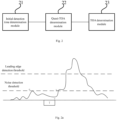
- Fig. 2 is a schematic diagram of an apparatus for determining a TOA provided by the present disclosure.
- the apparatus for determining a TOA in the embodiment of the present disclosure may be integrated on a terminal device. As shown in Fig.
- the apparatus includes: a detection start time determination module 21 configured to determine a detection start time on a correlation waveform based on a leading edge detection threshold; a quasi-TOA determination module 22 configured to determine a noise threshold on the correlation waveform, and determine a quasi-TOA according to the detection start time, the quasi-TOA being earlier than the detection start time; and a TOA determination module 23 configured to determine the TOA according to data information in a target area of the correlation waveform and the noise threshold; where the target area is determined based on the quasi-TOA and a detection length.
- the apparatus for determining a TOA provided in this embodiment is used for implementing the method for determining a TOA provided by the embodiments of the present disclosure.
- the implementation principles and technical effects of the apparatus for determining a TOA provided in this embodiment are similar to those of the method for determining a TOA provided by the embodiments of the present disclosure, and are not repeated here.
- the detection start time determination module 21 is specifically configured to: identify target data points having an amplitude equal to the leading edge detection threshold on the correlation waveform; and determine a minimum time in the identified target data points as the detection start time.
- the quasi-TOA determination module 22 is specifically configured to: determine a maximum amplitude in the correlation waveform; determine a noise detection interval in the correlation waveform, the noise detection interval being an interval determined on the correlation waveform based on time, and a distance between a maximum time in the noise detection interval from a time corresponding to the maximum amplitude being greater than or equal to a predetermined distance, and a length of the noise detection interval is a predetermined length; and determine the noise threshold according to signal amplitudes of the noise detection interval.
- the quasi-TOA is a time corresponding to a first extreme point on the correlation waveform, the first extreme point being a latest extreme point on the correlation waveform at a time earlier than the detection start time; or the quasi-TOA is a time corresponding to a second extreme point on the correlation waveform, the second extreme point being a latest extreme point on the correlation waveform at a time earlier than the detection start time and with an amplitude smaller than the noise threshold.
- the TOA determination module 23 is specifically configured to: determine the data information in the target area of the correlation waveform, the data information including: at least one of the following attributes of a maximum data point: amplitude; amplitude change rate; or time, the maximum data point being a data point with a largest amplitude in the target area of the correlation waveform; determine the quasi-TOA as the TOA in response to the amplitude of the maximum data point being not greater than the noise threshold; and update the quasi-TOA in response to the amplitude of the maximum data point being greater than the noise threshold, until there is no amplitude greater than the noise threshold in a target area corresponding to the updated quasi-TOA, and determine the updated quasi-TOA as the TOA.
- updating the quasi-TOA by the TOA determination module 23 includes: in response to the amplitude change rate at the maximum data point being negative, determining a target time on the correlation waveform as a new detection start time, the target time being a time corresponding to a third extreme point, and the third extreme point being a latest extreme point on the correlation waveform at a time earlier than the time corresponding to the maximum data point; in response to the amplitude change rate at the maximum data point being positive or the maximum data point being an extreme point, determining the time corresponding to the maximum data point as a new detection start time; and continuing to select the quasi-TOA to determine an updated quasi-TOA.
- the target area is an interval extending from the quasi-TOA in a time decreasing direction and having a length equal to the detection length.
- FIG. 3 is a schematic diagram of a terminal device provided by the present disclosure.
- the terminal device provided by the present disclosure includes at least one processor 31 and a storage apparatus 32.
- the terminal device may be provided with one or more processors 31, while one processor 31 is shown as an example in Fig. 3 .
- the storage apparatus 32 is configured to store at least one program, where the at least one program, when executed by the at least one processor 31, causes the at least one processor 31 to implement the method for determining time of arrival according to the embodiments of the present disclosure.
- the terminal device further includes: a communication apparatus 33, an input apparatus 34 and an output apparatus 35.
- the processor 31, the storage apparatus 32, the communication apparatus 33, the input apparatus 34, and the output apparatus 35 in the terminal device may be connected by a bus or other means.
- the connection is realized by a bus.
- the input apparatus 34 may be configured to receive input digital or character information and generate key signal inputs related to user settings and function control of the terminal device.
- the output apparatus 35 may include a display device such as a display screen.
- the communication apparatus 33 may include a receiver and a transmitter.
- the communication apparatus 33 is configured to transmit and receive information according to control of the processor 31.
- the storage apparatus 32 may be configured to store software programs, computer executable programs and modules, such as program instructions/modules corresponding to the method for determining a TOA described in the embodiments of the present disclosure (for example, the detection start time determination module 21, the quasi-TOA determination module 22 and the TOA determination module 23 in the apparatus for determining a TOA).
- the storage apparatus 32 may include a storage program area and a storage data area, where the storage program area may store an operating system and application program(s) required by at least one function, and the storage data area may store data created according to the use of a terminal device, etc.
- the storage apparatus 32 may include a high-speed random access memory and a non-volatile memory, for example, at least one magnetic disk storage device, a flash memory device, or another non-volatile solid-state storage device.
- the storage apparatus 32 may include memories remotely located with respect to the processor 31, and these remote memories may be connected to terminal devices via a network. Examples of the above-mentioned network include the Internet, an intranet, a local area network, a mobile communication network, and a combination thereof.
- a further embodiment of the present disclosure provides a storage medium storing a computer program which, when executed by a processor, causes the processor to implement the method for determining a TOA according to any of the embodiments of the present disclosure.
- the method includes: determining a detection start time on a correlation waveform based on a leading edge detection threshold; determining a noise threshold on the correlation waveform, and determining a quasi-TOA according to the detection start time; and determining the TOA according to data information in a target area of the correlation waveform and the noise threshold; where the target area is determined based on the quasi-TOA and a detection length.
- the computer storage medium of this embodiment may be any combination of one or more computer-readable media.
- the computer-readable medium may be a computer-readable signal medium or a computer-readable storage medium.
- the computer-readable storage medium may be, but is not limited to, electrical, magnetic, optical, electromagnetic, infrared, or semiconductor system, an apparatus or a device, or any combination thereof.
- Examples of the computer-readable storage medium include: an electrical connection with one or more wires, a portable computer disk, a hard disk, a Random Access Memory (RAM), a Read-Only Memory (ROM), an erasable programmable read-only memory, EPROM), a flash memory, an optical fiber, a Compact Disc Read-Only Memory (CD-ROM), an optical storage device, a magnetic storage device or any proper combination thereof.
- the computer-readable storage medium may be any tangible medium including or storing a program, and the program may be used by or used in combination with an instruction execution system, apparatus or device.
- the computer-readable signal medium may include a data signal propagated in a baseband or propagated as a part of a carrier, and carries computer-readable program code. Such a propagated data signal may be in multiple forms, including but not limited to: an electromagnetic signal, an optical signal, or any proper combination thereof.
- the computer-readable signal medium may alternatively be any computer-readable storage medium other than the computer-readable medium.
- the computer-readable storage medium may send, propagate or transmit a program used by or used in combination with an instruction execution system, apparatus or device.
- the program code included in the computer-readable medium may be transmitted by any suitable medium, including but not limited to: radio, an electric cable, an optical-fiber cable, Radio Frequency (RF), or any proper combination thereof.
- RF Radio Frequency
- Computer program code for executing the operations in the present disclosure may be compiled by using one or more program design languages or a combination thereof.
- the programming languages include object oriented programming languages, such as Java, Smalltalk, and C++, and conventional procedural programming languages, such as C or similar programming languages.
- the program code may be executed fully on a user computer, executed partially on a user computer, executed as an independent software package, executed partially on a user computer and partially on a remote computer, or executed fully on a remote computer or a server.
- the remote computer may be connected to a user computer via any type of network, including a Local Area Network (LAN) or a Wide Area Network (WAN), or may be connected to an external computer (for example, connected via the Internet by using an Internet service provider).
- LAN Local Area Network
- WAN Wide Area Network
- terminal device covers any suitable type of wireless user equipment, such as mobile phones, portable data processing equipment, portable web browsers or vehicle-mounted mobile stations.
- various embodiments of the present disclosure may be implemented in hardware or dedicated circuits, software, logic or any combination thereof.
- some aspects may be implemented in hardware, while other aspects may be implemented in firmware or software that may be executed by a controller, a microprocessor or another computing device.
- the present disclosure is not limited thereto.
- Embodiments of the present disclosure may be implemented by a data processor of a mobile device executing computer program instructions, for example, in a processor entity, or by hardware, or by a combination of software and hardware.
- the computer program instructions may be assembly instructions, Instruction Set Architecture (ISA) instructions, machine instructions, machine-related instructions, microcode, firmware instructions, state setting data or source code or object code written in any combination of one or more programming languages.
- ISA Instruction Set Architecture
- the block diagram of any logic process in the drawings of the present disclosure may represent program steps, or may represent interconnected logic circuits, modules and functions, or may represent a combination of program steps and logic circuits, modules and functions.
- the computer program may be stored in a memory.
- the memory may be of any type that is suitable for a local technical environment and may be implemented using any suitable data storage technology, for example but not limited to, a read-only memory (ROM), a random-access memory (RAM), optical storage devices and systems (a digital versatile disk (DVD) or a compact disk (CD)).
- the computer-readable medium may include a non-transitory storage medium.
- the data processor may be any type suitable for the local technical environment, for example but not limited to, a general-purpose computer, a special-purpose computer, a microprocessor, a digital signal processor (DSP), an application-specific integrated circuit (ASIC), a field-programmable gate array (FPGA) and a processor based on a multi-core processor architecture.
- DSP digital signal processor
- ASIC application-specific integrated circuit
- FPGA field-programmable gate array
Landscapes
- Engineering & Computer Science (AREA)
- Computer Networks & Wireless Communication (AREA)
- Signal Processing (AREA)
- Physics & Mathematics (AREA)
- General Physics & Mathematics (AREA)
- Radar, Positioning & Navigation (AREA)
- Remote Sensing (AREA)
- Environmental & Geological Engineering (AREA)
- Mobile Radio Communication Systems (AREA)
- Radar Systems Or Details Thereof (AREA)
Applications Claiming Priority (2)
| Application Number | Priority Date | Filing Date | Title |
|---|---|---|---|
| CN202010251399.6A CN111901274B (zh) | 2020-04-01 | 2020-04-01 | 一种到达时间确定方法、装置、终端设备及存储介质 |
| PCT/CN2020/138464 WO2021196765A1 (fr) | 2020-04-01 | 2020-12-23 | Procédé et dispositif de détermination de temps d'arrivée, dispositif terminal et support de stockage |
Publications (2)
| Publication Number | Publication Date |
|---|---|
| EP4131876A1 true EP4131876A1 (fr) | 2023-02-08 |
| EP4131876A4 EP4131876A4 (fr) | 2024-06-26 |
Family
ID=73206214
Family Applications (1)
| Application Number | Title | Priority Date | Filing Date |
|---|---|---|---|
| EP20928202.9A Pending EP4131876A4 (fr) | 2020-04-01 | 2020-12-23 | Procédé et dispositif de détermination de temps d'arrivée, dispositif terminal et support de stockage |
Country Status (4)
| Country | Link |
|---|---|
| US (1) | US12253613B2 (fr) |
| EP (1) | EP4131876A4 (fr) |
| CN (1) | CN111901274B (fr) |
| WO (1) | WO2021196765A1 (fr) |
Families Citing this family (2)
| Publication number | Priority date | Publication date | Assignee | Title |
|---|---|---|---|---|
| CN111901274B (zh) * | 2020-04-01 | 2024-11-26 | 中兴通讯股份有限公司 | 一种到达时间确定方法、装置、终端设备及存储介质 |
| CN113010141B (zh) * | 2021-03-04 | 2022-11-08 | 湖北三赫智能科技有限公司 | 一种信号首波信息提取方法、系统、装置及可读存储介质 |
Family Cites Families (17)
| Publication number | Priority date | Publication date | Assignee | Title |
|---|---|---|---|---|
| JP3673700B2 (ja) * | 2000-06-27 | 2005-07-20 | 株式会社日立製作所 | スペクトル拡散信号を用いた測距及び位置測定方法、その方法を行う装置 |
| CN1592434A (zh) * | 2003-09-04 | 2005-03-09 | 华为技术有限公司 | 一种估计到达时间附加时延误差的方法 |
| US7737893B1 (en) * | 2006-06-28 | 2010-06-15 | Rosum Corporation | Positioning in a single-frequency network |
| US20080130794A1 (en) * | 2006-12-04 | 2008-06-05 | Chia-Chin Chong | Method for optimum threshold selection of time-of-arrival estimators |
| US7570193B2 (en) * | 2007-01-22 | 2009-08-04 | Bandspeed, Inc. | Detecting and recognizing long duration waveforms |
| US20120309415A1 (en) * | 2010-07-21 | 2012-12-06 | Zulutime, Llc | Multipath compensation within geolocation of mobile devices |
| CN102238726A (zh) * | 2011-06-21 | 2011-11-09 | 北京理工大学 | 一种用于lte-a信号的非线性最小二乘toa估计方法 |
| US8718183B2 (en) | 2011-11-21 | 2014-05-06 | Broadcom Corporation | Transmitter to generate an analytic signal for reduced inter-symbol interference (ISI) |
| WO2014089040A1 (fr) * | 2012-12-03 | 2014-06-12 | University Of Florida Research Foundation, Inc. | Appareil, procédé et systèmes de logiciel pour une localisation en intérieur à grains fins basée sur un téléphone intelligent |
| US20160179748A1 (en) * | 2014-12-18 | 2016-06-23 | Lawrence R. Weill | Method and apparatus for estimating waveform onset time |
| US20180042025A1 (en) | 2016-08-03 | 2018-02-08 | Qualcomm Incorporated | Reference signal pattern detection in wireless transmissions |
| CN106879068B (zh) * | 2017-01-26 | 2020-05-08 | 浙江大学 | 一种强多径环境下信号的到达时间估计方法 |
| CN106952653B (zh) * | 2017-03-15 | 2021-05-04 | 科大讯飞股份有限公司 | 噪声去除方法、装置和终端设备 |
| CN109412990B (zh) * | 2017-08-18 | 2021-11-09 | 中兴通讯股份有限公司 | 一种首径到达时差测量方法和装置 |
| KR102483646B1 (ko) * | 2017-12-22 | 2023-01-02 | 삼성전자주식회사 | 객체 검출 장치 및 방법 |
| CN108923860B (zh) * | 2018-06-28 | 2021-01-08 | 电子科技大学 | 基于过门限修正的盲脉冲信号toa估计方法 |
| CN111901274B (zh) * | 2020-04-01 | 2024-11-26 | 中兴通讯股份有限公司 | 一种到达时间确定方法、装置、终端设备及存储介质 |
-
2020
- 2020-04-01 CN CN202010251399.6A patent/CN111901274B/zh active Active
- 2020-12-23 EP EP20928202.9A patent/EP4131876A4/fr active Pending
- 2020-12-23 WO PCT/CN2020/138464 patent/WO2021196765A1/fr not_active Ceased
- 2020-12-23 US US17/783,828 patent/US12253613B2/en active Active
Also Published As
| Publication number | Publication date |
|---|---|
| US20230003829A1 (en) | 2023-01-05 |
| CN111901274B (zh) | 2024-11-26 |
| CN111901274A (zh) | 2020-11-06 |
| WO2021196765A1 (fr) | 2021-10-07 |
| US12253613B2 (en) | 2025-03-18 |
| EP4131876A4 (fr) | 2024-06-26 |
Similar Documents
| Publication | Publication Date | Title |
|---|---|---|
| CN111935740B (zh) | 一种测量方法、装置、通信节点及存储介质 | |
| US12253613B2 (en) | Method and device for determining arrival time, terminal device, and storage medium | |
| KR102332471B1 (ko) | 동기 신호 검출을 위한 장치 및 방법 | |
| CN118555179B (zh) | 一种基于峰均比的帧同步方法、装置及电子设备 | |
| JP5765120B2 (ja) | 無線通信端末及び自動利得制御方法 | |
| CN103701498A (zh) | 电力线载波通信的信号处理方法与装置 | |
| EP2899936B1 (fr) | Procédé et appareil de recherche initiale destinés à un équipement d'utilisateur et une cellule associée | |
| EP3672179B1 (fr) | Procédé et dispositif de mesure de différence de temps d'arrivée d'un premier chemin | |
| WO2015116595A1 (fr) | Synchronisation initiale basée sur une autocorrélation et dépendant d'un snr prédit | |
| CN109526003B (zh) | 对目标终端的上行信号进行检测的方法及装置 | |
| US10880766B2 (en) | Method and apparatus for detecting characteristic sequence in wireless communication system | |
| CN102869091B (zh) | 一种确定定位参考信号到达时间的方法及装置 | |
| US20160112976A1 (en) | Estimation of spur parameters in wireless communications | |
| CN101227447B (zh) | 粗定时捕获方法、装置和移动终端 | |
| CN114557113B (zh) | 针对传播延迟的随机接入前同步码检测 | |
| KR100832517B1 (ko) | 신호 패턴/동기 검출 방법 및 이를 이용한 신호 패턴/동기검출 장치 | |
| CN114301743A (zh) | 频偏估计方法及装置、存储介质、终端 | |
| CN103139793A (zh) | 一种导频码的检测识别的方法及装置 | |
| CN114244450B (zh) | 一种信号识别方法、装置、电子设备及存储介质 | |
| US9706511B2 (en) | Method and apparatus for detection of synchronization signals in wireless networks | |
| US11825434B2 (en) | Method and architecture of synchronization of wireless communication system | |
| CN117979423B (zh) | 定位方法、装置、电子设备和存储介质 | |
| JP2014039253A (ja) | セル探索装置、受信機及びその方法 | |
| CN101365214A (zh) | 反向接入信道检测信号的方法和装置 | |
| KR20220095416A (ko) | 이동통신 시스템에서 cp 검출 장치 및 방법 |
Legal Events
| Date | Code | Title | Description |
|---|---|---|---|
| STAA | Information on the status of an ep patent application or granted ep patent |
Free format text: STATUS: THE INTERNATIONAL PUBLICATION HAS BEEN MADE |
|
| PUAI | Public reference made under article 153(3) epc to a published international application that has entered the european phase |
Free format text: ORIGINAL CODE: 0009012 |
|
| STAA | Information on the status of an ep patent application or granted ep patent |
Free format text: STATUS: REQUEST FOR EXAMINATION WAS MADE |
|
| 17P | Request for examination filed |
Effective date: 20220622 |
|
| AK | Designated contracting states |
Kind code of ref document: A1 Designated state(s): AL AT BE BG CH CY CZ DE DK EE ES FI FR GB GR HR HU IE IS IT LI LT LU LV MC MK MT NL NO PL PT RO RS SE SI SK SM TR |
|
| DAV | Request for validation of the european patent (deleted) | ||
| DAX | Request for extension of the european patent (deleted) | ||
| A4 | Supplementary search report drawn up and despatched |
Effective date: 20240529 |
|
| RIC1 | Information provided on ipc code assigned before grant |
Ipc: H04W 64/00 20090101ALN20240523BHEP Ipc: H04L 43/0852 20220101ALI20240523BHEP Ipc: H04L 27/26 20060101AFI20240523BHEP |