EP4132023A1 - Mbs-dienstschaltverfahren und zugehörige vorrichtung - Google Patents
Mbs-dienstschaltverfahren und zugehörige vorrichtung Download PDFInfo
- Publication number
- EP4132023A1 EP4132023A1 EP21874190.8A EP21874190A EP4132023A1 EP 4132023 A1 EP4132023 A1 EP 4132023A1 EP 21874190 A EP21874190 A EP 21874190A EP 4132023 A1 EP4132023 A1 EP 4132023A1
- Authority
- EP
- European Patent Office
- Prior art keywords
- mbs
- base station
- capability information
- switching
- target base
- Prior art date
- Legal status (The legal status is an assumption and is not a legal conclusion. Google has not performed a legal analysis and makes no representation as to the accuracy of the status listed.)
- Pending
Links
Images



Classifications
-
- H—ELECTRICITY
- H04—ELECTRIC COMMUNICATION TECHNIQUE
- H04W—WIRELESS COMMUNICATION NETWORKS
- H04W36/00—Hand-off or reselection arrangements
- H04W36/0005—Control or signalling for completing the hand-off
- H04W36/0007—Control or signalling for completing the hand-off for multicast or broadcast services, e.g. MBMS
-
- H—ELECTRICITY
- H04—ELECTRIC COMMUNICATION TECHNIQUE
- H04W—WIRELESS COMMUNICATION NETWORKS
- H04W36/00—Hand-off or reselection arrangements
- H04W36/0005—Control or signalling for completing the hand-off
- H04W36/0055—Transmission or use of information for re-establishing the radio link
-
- H—ELECTRICITY
- H04—ELECTRIC COMMUNICATION TECHNIQUE
- H04W—WIRELESS COMMUNICATION NETWORKS
- H04W36/00—Hand-off or reselection arrangements
- H04W36/0005—Control or signalling for completing the hand-off
- H04W36/0055—Transmission or use of information for re-establishing the radio link
- H04W36/0058—Transmission of hand-off measurement information, e.g. measurement reports
-
- H—ELECTRICITY
- H04—ELECTRIC COMMUNICATION TECHNIQUE
- H04W—WIRELESS COMMUNICATION NETWORKS
- H04W36/00—Hand-off or reselection arrangements
- H04W36/0005—Control or signalling for completing the hand-off
- H04W36/0083—Determination of parameters used for hand-off, e.g. generation or modification of neighbour cell lists
- H04W36/00835—Determination of neighbour cell lists
- H04W36/008357—Determination of target cell based on access point [AP] properties, e.g. AP service capabilities
-
- H—ELECTRICITY
- H04—ELECTRIC COMMUNICATION TECHNIQUE
- H04W—WIRELESS COMMUNICATION NETWORKS
- H04W36/00—Hand-off or reselection arrangements
- H04W36/08—Reselecting an access point
-
- H—ELECTRICITY
- H04—ELECTRIC COMMUNICATION TECHNIQUE
- H04W—WIRELESS COMMUNICATION NETWORKS
- H04W4/00—Services specially adapted for wireless communication networks; Facilities therefor
- H04W4/06—Selective distribution of broadcast services, e.g. multimedia broadcast multicast service [MBMS]; Services to user groups; One-way selective calling services
Definitions
- This application relates to the technical field of computers and communication, and in particular, to switching of MBS.
- a multicast and broadcast service is proposed, and the MBS has also become one of the key technologies in the 5G technology and network evolution.
- a 5G MBS is based on more cloud and service-oriented basic architecture, and a conventional switching mechanism needs to be redesigned for an MBS solution.
- An MBS switching method and a related apparatus are provided according to embodiments of this application, which can realize switching of an MBS at least to a certain extent.
- an MBS switching method is provided.
- the MBS switching method is performed by a serving base station of a user equipment, and the MBS switching method includes: acquiring capability information of another base station for an MBS, the capability information being used for indicating whether the other base station supports the MBS; determining, according to the capability information of the other base station for the MBS, whether a target base station supports the MBS in a case that it is determined to switch the MBS of the user equipment to the target base station; and initiating an MBS switching request to the target base station in a case that the target base station supports the MBS, the MBS switching request being used for indicating to switch the MBS of the user equipment to the target base station.
- an MBS switching method is provided.
- the MBS switching method is performed by a user equipment and the MBS switching method includes: processing an MBS on the basis of a serving base station; reporting acquired capability information of another base station for the MBS to the serving base station, the capability information being used for indicating whether the other base station supports the MBS; and processing the MBS on the basis of a target base station in a case that the serving base station switches, on the basis of an MBS switching request, the MBS to the target base station supporting the MBS, the MBS switching request being transmitted to the target base station by the serving base station after determining, according to capability information of the target base station, that the target base station supports the MBS.
- an MBS switching apparatus which includes: a first acquisition unit, configured to acquire capability information of another base station for an MBS, the capability information being used for indicating whether the other base station supports the MBS; a determination unit, configured to determine, according to the capability information of the other base station for the MBS, whether a target base station supports the MBS in a case that it is determined to switch the MBS of user equipment to the target base station; and a first processing unit, configured to initiate an MBS switching request to the target base station in a case that the target base station supports the MBS, the MBS switching request being used for indicating to switch the MBS of the user equipment to the target base station.
- the first acquisition unit acquires the capability information of the other base station for the MBS in at least one of the following ways:
- the capability information is further used for indicating at least one of the following: whether to support a shared tunnel transmission mode or a dedicated tunnel transmission mode at an N3 interface, and whether to support point-to-point broadcast or point-to-multipoint broadcast at an air interface.
- the MBS switching request is further used for indicating a tunnel transmission mode used by the target base station at the N3 interface.
- the MBS switching request is further used for indicating a broadcast mode used by the target base station at the air interface.
- the MBS switching apparatus further includes: a transmission unit, configured to transmit a notification message to the user equipment, the notification message being used for notifying the user equipment to report capability information of the target base station for the MBS; and a first receiving unit, configured to receive the capability information, reported by the user equipment, of the target base station for the MBS; and the determination unit is further configured to determine whether the target base station supports the MBS according to the capability information of the target base station for the MBS.
- the MBS switching apparatus further includes: a second receiving unit, configured to receive a cell measurement report reported by the user equipment; and the determination unit is further configured to determine to switch the MBS of the user equipment to the target base station according to the cell measurement report.
- the MBS switching apparatus further includes: a third receiving unit, configured to receive a signaling message transmitted by a core network device; and the determination unit is further configured to determine to switch the MBS of the user equipment to the target base station according to the signaling message.
- the first processing unit is further configured to: receiving indication information, transmitted by the core network device, indicating whether to perform data forwarding for the MBS before or during switching the MBS; and transmit the indication information to the target base station.
- the first processing unit is further configured to: adjust a configuration message for the MBS on the basis of a policy adjustment instruction in a case that the policy adjustment instruction, transmitted by the core network device, for the MBS is received, the policy adjustment instruction including at least one of the following: adjusting a tunnel transmission mode used at the N3 interface, or adjusting a broadcast mode used at the air interface.
- an MBS switching apparatus which includes: a second processing unit, configured to process an MBS on the basis of a serving base station; a reporting unit, configured to report acquired capability information of another base station for the MBS to the serving base station, the capability information being used for indicating whether the other base station supports the MBS; and a third processing unit, configured to process the MBS on the basis of a target base station in a case that the serving base station switches, on the basis of an MBS switching request, the MBS to the target base station supporting the MBS.
- the MBS switching request is transmitted to the target base station by the serving base station after determining, according to capability information of the target base station, that the target base station supports the MBS.
- the switching apparatus further includes: a second acquisition unit, configured to acquire capability information of the target base station for the MBS in a case that a notification message transmitted by the serving base station is received, the notification message being used for notifying the user equipment to report the capability information of the target base station for the MBS; and the reporting unit is further configured to: report the capability information of the target base station for the MBS to the serving base station for the serving base station to determine whether the target base station supports the MBS.
- the reporting unit is further configured to: receive system information broadcast by the other base station, the system information indicating the capability information of the other base station for the MBS in an implicit or explicit mode; and acquire the capability information of the other base station for the MBS according to the system information.
- the switching apparatus further includes: a negotiation unit, configured to perform communication negotiation with an application function entity corresponding to the MBS to determine switching policy information of the MBS, the switching policy information being configured, by the application function entity, to the serving base station through a core network device before or during switching the MBS.
- a negotiation unit configured to perform communication negotiation with an application function entity corresponding to the MBS to determine switching policy information of the MBS, the switching policy information being configured, by the application function entity, to the serving base station through a core network device before or during switching the MBS.
- the switching policy information includes at least one of the following: whether data forwarding treatment is performed between a base station used before switching and a base station used after switching, whether a shared tunnel transmission mechanism or a dedicated tunnel transmission mechanism is used at an N3 interface during processing the MBS by the base station used after switching, or whether point-to-point broadcast or point-to-multipoint broadcast is used at the N3 interface during processing the MBS by the base station used after switching.
- the reporting unit is configured to: report acquired capability information of all other base stations for the MBS to the serving base station.
- the reporting unit is configured to: reporting acquired capability information of a designated base station of the other base stations for the MBS to the serving base station, the designated base station comprising at least one of the following: a base station with a signal intensity greater than or equal to a set value of the other base stations, or a base station supporting the MBS of the other base stations.
- a computer-readable medium which stores a computer program.
- the computer program when executed by a processor, implements the MBS switching method according to the foregoing embodiments.
- an electronic device which includes: one or more processors; a storage apparatus, configured to store one or more programs.
- the one or more programs when executed by the one or more processors, cause the one or more processors to implement the MBS switching method according to the foregoing embodiments.
- a computer program product or a computer program includes computer instructions, the computer instructions are stored in a computer-readable storage medium.
- a processor of a computer device reads the computer instructions from the computer-readable storage medium, and executes the computer instructions, so that the computer device performs the MBS switching method provided in the various preferred embodiments.
- capability information of another base station for an MBS is acquired, so that whether a target base station supports the MBS is determined according to the capability information of the other base station for the MBS in a case that the MBS of a user equipment needs to be switched to the target base station; and an MBS switching request is initiated to the target base station in a case that the target base station supports the MBS, so as to switch the MBS of the user equipment to the target base station.
- whether the target base station supports the MBS can be determined on the basis of the capability information of the base station, which can avoid the interrupt of the MBS and the waste of signaling resources caused by blindly initiating a service switching request to a base station that does not support the MBS, thus supporting the switching of the MBS in a 5G system.
- Wireless communication systems of using a 2nd generation mobile communication technology (2G), a 3rd generation mobile communication technology (3G), and a 4th generation mobile communication technology (4G) support a multimedia broadcast and multicast service (MBMS).
- This service includes a broadcast service and a multicast service.
- the 4G system does not support the multicast service in terms of standards.
- the 2G, 3G, and 4G systems all support the broadcast service.
- the communication manner between network nodes also includes a unicast manner.
- "Unicast" represents the most common one-to-one communication manner, which has the advantages that a transmitter may transmit different contents to different receivers, but in a case that the transmitter needs to transmit the same content to multiple receivers, then multiple copies of the same data need to be transmitted end-to-end respectively, so the efficiency is low.
- a unicast source that is, a transmitter
- transmits data to multiple receivers in a unicast mode multiple copies of the same data needs to be transmitted respectively in an end-to-end mode (different line types in FIG. 1 represent different data streams).
- Multicast which may also be referred to as “multicasting”, represents that a transmitter transmits the same content to multiple receivers.
- An online video conference and online video on demand are particularly suitable for using a multicast mode, because in a case that a unicast mode is used, how many receivers there are, how many transmission processes there will be, which has extremely low efficiency.
- a broadcast mode that does not distinguish a target receiver from other receivers and transmits data to all receivers is used, although the data can be transmitted at one time, a purpose of distinguishing a specific data receiver from other receivers cannot be achieved.
- a multicast source that is, a transmitter
- a multicast source can transmit the same data to multiple receivers at one time.
- Broadcast is also used to transmit the same content to multiple receivers, but the receiver is not selected during transmission, so there may be a waste of network resources caused by transmitting data to an unnecessary device.
- some receivers may not be “interested” in the broadcast content, so the received data packet has to be discarded after the broadcast content is received, thereby causing a waste of terminal resources.
- the basic difference between a broadcast service and a multicast service is that all user equipments (UEs) of the broadcast service in a system may participate in the broadcast service without subscribing, while a user equipment of the multicast service can only participate in the multicast service after being subscribed and authenticated.
- UEs user equipments
- broadcast services there are many kinds of multicast services and broadcast services.
- For the multicast service user equipment joins a multicast group of a corresponding service through an Internet protocol (IP) multicast address.
- IP Internet protocol
- the broadcast service is distinguished by different areas, so that there is only one broadcast service in a certain area, and this broadcast service may transmit different services in different time periods.
- a switching solution for the MBS is provided in the embodiments of this application.
- a base station 1 and a base station 2 are adjacent base stations, and the base station 1 and the base station 2 may be connected to each other through an Xn interface.
- the base station 1 and the base station 2 may also not be connected to each other.
- the base station 1 and the base station 2 may be connected to an access and mobility management function (AMF) entity through N2 interfaces, and may be connected to a user plane function (UPF) entity through N3 interfaces.
- AMF access and mobility management function
- UPF user plane function
- a session management function (SMF) entity is responsible for a session management function related to the MBS
- a policy control function (PCF) entity is responsible for generating a policy related to the MBS
- an application function (AF) entity may be integrated with or deployed separately from a content server of the MBS
- UDM unified data management
- Other network elements, such as an operation administration and maintenance (OAM) entity and a network exposure function (NEF) entity, in a network are not shown in the system architecture. However, in practice, these network elements may be required.
- a base station 1 serves as a serving base station of a user equipment 201, and the MBS is processed on the basis of the base station 1.
- the base station 1 may acquire capability information of a base station 2 for an MBS, such as whether the base station 2 supports the MBS, whether the base station 2 supports shared tunnel transmission or dedicated tunnel transmission in an N3 interface, and whether the base station 2 supports point-to-point broadcast or point-to-multipoint broadcast in an air interface.
- the base station 1 may acquire the information from the base station 2 through the Xn interface, or may acquire the information through a report of a user equipment (such as the user equipment 201 as shown in FIG. 2 , or another user equipment not shown), or may acquire the information on the basis of a configuration of the OAM entity.
- the user equipment 201 will perform cell measurement during moving, and reports a cell measurement report to the base station 1.
- the base station 1 determines that an MBS of the user equipment 201 (an MBS of the user equipment 201 may be a service processed by an MBS transmission group that the user equipment 201 joins) needs to be switched to the base station 2 due to the movement of the user equipment 201, whether the base station 2 supports the MBS will be determined according to the capability information of the base station 2.
- the base station 1 may initiate an MBS switching request to the base station 2 to switch the MBS of the user equipment 201 to the base station 2, so that the user equipment 201 can processing the MBS on the basis of the base station 2.
- communication negotiation may also be performed between the user equipment 201 and the AF entity, so as to determine whether to perform data forwarding treatment according to the MBS of the user equipment 201, and determine whether the base station 2 uses the shared tunnel transmission or dedicated tunnel transmission at the N3 interface and uses the point-to-point broadcast or point-to-multipoint broadcast at the air interface after switching.
- the AF entity configures determined switching policy information to the base station 1 through the AMF entity or the SMF entity, and the base station 1 adds the switching policy information to the processing related to the MBS switching on the basis of the capability information of the base station 2.
- the AMF entity or the SMF entity may be referred to as a core network device.
- the data forwarding treatment in a case that the data forwarding treatment does not need to be performed (for example, the MBS is a live streaming service), switching is directly performed according to a switching policy.
- the data forwarding treatment needs to be performed for example, the MBS is a software downloading or upgrading task
- the data forwarding treatment needs to be performed between the base station 1 and the base station 2, so as to ensure the data integrity of the MBS.
- the primary factor affecting the user experience is to receive real-time data on the base station after switching as soon as possible, while data forwarding and recovery before or during the switching are not important. In this case, network resources can be saved and a switching process can be accelerated by skipping data forwarding.
- FIG. 3 is a flowchart of an MBS switching method according to an embodiment of this application.
- the MBS switching method may be performed by a base station, and the base station may be a serving base station configured to provide services for a user equipment.
- the MBS switching method includes at least step S310 to step S330, which are described in detail as follows.
- step S310 capability information of another base station for an MBS is acquired.
- the capability information is used for indicating whether the other base station supports the MBS.
- the other base station may be a neighboring base station adjacent to a position where the serving base station of the user equipment is located.
- the serving base station acquiring the capability information of the other base station for the MBS may be performed by receiving the capability information, reported by the user equipment, of the other base station for the MBS.
- the user equipment may receive system information broadcast by a neighboring base station of a current serving base station and acquire capability information of the neighboring base station for an MBS through the system information.
- the serving base station acquiring the capability information of the other base stations for the MBS may be performed by acquiring the capability information of the other base station for the MBS through a communication link established with the other base station. That is, the serving base station may establish a communication link with a neighboring base station through an Xn interface, so as to acquire the capability information of the other base station for the MBS.
- the serving base station acquiring the capability information of the other base stations for the MBS may be performed by acquiring the capability information, configured by an operation administration and maintenance entity, of the other base station for the MBS.
- the operation administration and maintenance entity may pre-configure the capability information of the other base station for the MBS to the serving base station.
- the serving base station may acquire the capability information of the other base station for the MBS in one or more of the above-mentioned manners.
- the foregoing capability information may further indicate at least one of the following: whether to support a shared tunnel transmission mode or a dedicated tunnel transmission mode at an N3 interface, and whether to support point-to-point broadcast or point-to-multipoint broadcast at an air interface.
- the capability information may be used for selecting switching policy information of a target base station during MBS switching. For example, in a case that the target base station supports the shared tunnel transmission mode at the N3 interface, the shared tunnel transmission mode may be used at the N3 interface of the target base station after the MBS is switched to the target base station.
- step S320 whether the target base station supports the MBS is determined according to the capability information of the other base station for the MBS in a case that it is determined to switch the MBS of the user equipment to the target base station.
- a cell measurement report reported by the user equipment may be received, and whether the MBS of the user equipment is switched to the target base station is determined according to the cell measurement report, that is, a manner of determining to switch the MBS of the user equipment to the target base station may include determining to switch the MBS of the user equipment to the target base station according to the cell measurement report.
- the switching is triggered on the basis of the movement of the user equipment. For example, the serving base station determines that the signal intensity, measured by the user equipment, of a certain base station adjacent to the serving base station is increasing according to the cell measurement report reported by the user equipment, it may be determined that the user equipment will move to the coverage of the base station, and the switching may be triggered.
- a signaling message transmitted by a core network device may be received, and whether to switch the MBS of the user equipment to a target base station is determined according to the signaling message, that is, a manner of determining to switch the MBS of the user equipment to the target base station may include determining to switch the MBS of the user equipment to the target base station according to the signaling message.
- the core network device may determine whether the MBS of the user equipment needs to be switched from the serving base station to another base station according to the information, such as a load condition of the serving base station and session parameters corresponding to a service flow.
- the core network device transmits a signaling message to the serving base station.
- the core network device in the embodiment may be an AMF or an SMF.
- the serving base station may transmit a notification message to the user equipment.
- the notification message is used for notifying the user equipment to report the capability information of the target base station for the MBS.
- the user equipment may acquire the capability information of the target base station for the MBS, for example, acquire the capability information of the target base stations for the MBS by receiving the system information broadcast by the target base station, and report the acquired capability information of the target base station for the MBS to the serving base station, so that the serving base station determines whether the target base station supports the MBS according to the capability information of the target base station for the MBS.
- step S330 an MBS switching request is initiated to the target base station in a case that the target base station supports the MBS.
- the MBS switching request is used for indicating to switch the MBS of the user equipment to the target base station.
- the serving base station may also indicate the tunnel transmission mode, that is, the shared tunnel transmission mode or the dedicated tunnel transmission mode, used by the target base station at the N3 interface through the MBS switching request.
- the serving base station may also indicate the broadcast mode, that is, the point-to-point broadcast mode or the point-to-multipoint broadcast mode, used by the target base station at the air interface through the MBS switching request.
- the serving base station may transmit the indication information to the target base station, so as to indicate whether the target base station needs to perform the data forwarding.
- the serving base station may add the indication information to the MBS switching request and transmit the MBS switching request added with the indication information to the target base station.
- the serving base station may receive the indication information, transmitted by the core network device, before or during switching the MBS.
- the indication information may be configured to the core network device or a base station as a parameter of a context of the UE. After the switching of the MBS, the indication information will be transferred to the target base station, that is, a new serving base station, together with the context
- the serving base station may adjust a configuration message for the MBS on the basis of the policy adjustment instruction.
- the policy adjustment instruction includes at least one of the following: adjusting a tunnel transmission mode used at the N3 interface, and adjusting a broadcast mode used at the air interface.
- the serving base station uses the shared tunnel transmission mode at the N3 interface for the MBS, and in a case that the core network device needs to adjust the tunnel transmission mode used by the serving base station at the N3 interface, that is, adjust the shared tunnel transmission mode to the dedicated tunnel transmission mode, the core network device may transmit a policy adjustment instruction to the serving base station.
- the MBS switching method of the embodiments of this application is described from the perspective of a base station.
- the MBS switching method of the embodiments of this application will be described in detail below from the perspective of a user equipment in combination with FIG. 4 .
- FIG. 4 is a flowchart of an MBS switching method according to an embodiment of this application.
- the MBS switching method may be performed by a user equipment.
- the MBS switching method includes at least step S410 to step S430, which are described in detail as follows.
- step S410 an MBS is processed on the basis of a serving base station.
- a process that the user equipment processes the MBS on the basis of the serving base station may include joining a certain MBS group to receive MBS data transmitted by the serving base station.
- the MBS data may be multimedia data (such as live streaming data and news data), software download package data, software update package data, etc.
- step S420 acquired capability information of another base station for the MBS is reported to the serving base station.
- the capability information is used for indicating whether the other base station supports the MBS.
- each base station may implicitly or explicitly indicate the capability information for the MBS through system information, and the user equipment may acquire the capability information of each base station for the MBS through the system information broadcast by each base station.
- the user equipment may report acquired capability information of all other base stations for the MBS to the serving base station.
- the user equipment may report acquired capability information of a designated base station of the other base stations for the MBS to the serving base station.
- the designated base station includes at least one of the following: a base station with a signal intensity greater than or equal to a set value of the other base stations, or a base station supporting the MBS of the other base stations. That is, in the embodiment, the user equipment may perform selection first according to the information of the base stations, and report the capability information of a selected designated base station for the MBS to the serving base station.
- the MBS is processed on the basis of a target base station in a case that the serving base station switches, on the basis of an MBS switching request, the MBS to the target base station supporting the MBS.
- the MBS switching request is transmitted to the target base station by the serving base station after determining, according to the capability information of the target base station, that the target base station supports the MBS.
- the serving base station may determine whether the target base station supports the MBS on the basis of the acquired capability information of each base station for the MBS.
- a notification message may be transmitted to the user equipment.
- the notification message is used for notifying the user equipment to report the capability information of the target base station for the MBS.
- the user equipment acquires the capability information of the target base station for the MBS after receiving the notification message, and reports the capability information of the target base station for the MBS to the serving base station for the serving base station to determine whether the target base station supports the MBS.
- the user equipment may also perform communication negotiation with an application function entity corresponding to the MBS, so as to determine switching policy information of the MBS. Then, the switching policy information is configured, by the AF entity, to the serving base station through a core network device before or during switching the MBS. For example, the AF entity may directly transmit the policy switching information to the PCF entity, or the AF entity transmits the policy switching information to the PCF entity through a NEF entity. Then, the policy switching information is transmitted to the AMF entity and/or the SMF entity by the PCF entity, and is configured to the serving base station through the AMF entity and/or the SMF entity.
- the above-mentioned switching policy information may include at least one of the following: whether data forwarding treatment is performed between base stations before and after switching, whether a shared tunnel transmission mechanism or a dedicated tunnel transmission mechanism is used at the N3 interface during processing the MBS by the base station used after switching, or whether point-to-point broadcast or point-to-multipoint broadcast is used at the N3 interface during processing the MBS by the base station used after switching.
- whether data forwarding treatment is performed between the base station used before switching and the base station used after switching may be determined according to the type of the MBS of the user equipment. For example, in a case that the type of the MBS belongs to services with a low packet loss requirement, such as a live streaming service or a real-time interactive service, the data forwarding treatment may be skipped. In a case that the type of the MBS belongs to services with a high packet loss requirement, such as a software package downloading/updating service, a map updating service, and a planning path updating service, the data forwarding treatment is performed to ensure the data integrity of the MBS.
- the technical solutions of the embodiments of this application are described above from the perspective of a base station and a user equipment respectively, that is, the technical solutions of the embodiments of this application mainly provide a wireless network switching mechanism for 5G MBS.
- the relevant capability of actively determining whether a potential target base station supports a 5G MBS during switching is realized by introducing new MBS related characteristic parameters to a 5G air interface, an interface between base stations, and an interface between a base station and a core network.
- communication negotiation between UE and an AF entity may also be introduced during switching, so as to select a proper switching mechanism according to the requirements of a service on a packet loss characteristic, thereby effectively supporting the MBS switching in a 5G network.
- the switching process of an MBS of a UE is performed to switch a 5G data radio bearer of an air interface and a tunnel of an N3 interface of a base station, so that the service data from an AF entity to the UE can be transmitted continually.
- an air interface between the UE and the base station 1 is switched to an air interface between the UE and the base station 2
- an N3 interface between the base station 1 and a UPF entity is switched to an N3 interface between the base station 2 and the UPF entity.
- the switching of an MBS may be assisted through an enhanced automatic neighbor relation (ANR) mechanism.
- ANR enhanced automatic neighbor relation
- a base station may learn capability information of another base station for a 5G MBS by the methods of UE report and/or communication between base stations and/or OAM entity configuration, etc.
- the capability information includes: whether the base station supports an MBS; whether the base station supports a shared tunnel transmission mechanism or a dedicated tunnel mechanism at an N3 interface; and whether the base station supports point-to-multipoint broadcast or point-to-point broadcast at an air interface.
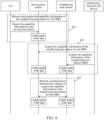
- the enhanced ANR mechanism in the embodiments of this application may include some or all mechanisms in 601, 602, and 603.
- a UE measures and acquires capability information of a neighboring base station for an MBS, and reports to the serving base station, so that the serving base station adds/updates maintained ANR data.
- a base station acquires the capability information of the neighboring base station for the MBS from an OAM entity/network side device, and the base station adds/updates the maintained ANR data.
- the network side device may be a core network device.
- the base station acquires the capability information of a neighboring base station for the MBS through communication, and the base station adds/updates the maintained ANR data.
- a supporting base station may implicitly or explicitly broadcast the foregoing capability information for the MBS through system information; and the user equipment may inform the serving base station of the capability information of the neighboring base station for the MBS through a UE reporting mechanism to assist the serving base station in making a decision.
- the enhanced ANR mechanism in the above-mentioned embodiments of this application can enable the serving base station to predict whether the target base station supports the 5G MBS and which MBS transmission modes are supported at the air interface and the N3 interface in advance, so as to configure corresponding switching policy information.
- UE may perform communication negotiation with the AF entity during switching, and a reasonable switching policy is selected according to the requirements of the MBS on the packet loss characteristic, a bearable switching time, etc., so as to effectively support the switching of the MBS in the 5G network.
- requirements for the data forwarding treatment are different for different types of MBS, in order to save network resources, for an 5G MBS that does not need data forwarding, the AF entity may notify a 5G core network device to skip the data forwarding for the MBS after interactive confirmation of the UE and the AF entity, so as to simplify the data forwarding treatment between a source base station (a serving base station of the user equipment used before switching) and a target base station.
- core networks corresponding to the source base station and the target base station may be the same.
- the AF entity may configure a policy about whether data forwarding needs to be performed for each MBS. For example, the AF entity may configure corresponding policies to the AMF entity, the SMF entity, and the UE through the PCF entity, and may update the configured policies. In addition, the specific configuration process may occur before or during switching of the MBS.
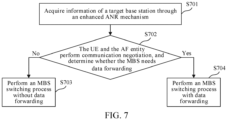
- FIG. 7 is a flowchart of an MBS switching method according to an embodiment of this application, which specifically includes the following steps S701 to S704.
- step S701 information of a target base station is acquired through an enhanced ANR mechanism.
- step S702 communication negotiation is performed between a UE and an AF entity, so as to determine whether an MBS needs the data forwarding treatment.
- step S704 is performed.
- step S703 is performed.
- the data forwarding treatment may be skipped.
- the data forwarding treatment is performed to ensure the data integrity of the MBS.
- step S703 MBS switching is performed without data forwarding.
- step S704 MBS switching is performed with data forwarding.
- the core network device or the source base station can determine a switching policy according to the tunnel transmission mode (a shared tunnel transmission mode or a dedicated tunnel transmission mode) supported at the N3 interface and a broadcast mode (a point-to-point mode or a point-to-multipoint mode) supported at the air interface by the target base station, for example, which MBS transmission modes are supported respectively at the air interface and the N3 interface after switching.
- the tunnel transmission mode a shared tunnel transmission mode or a dedicated tunnel transmission mode
- a broadcast mode a point-to-point mode or a point-to-multipoint mode
- MBS switching may be triggered by the mobility of a user equipment, or may be triggered by a non-mobility reason of a network side device, etc.
- the switching triggered by the non-mobility reason of the network side device, etc. includes: a load balancing policy of a network, the change of session parameters corresponding to a service flow, etc.
- the technical solutions of the above-mentioned embodiments of this application are applicable for the above-mentioned two cases.
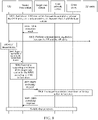
- the switching triggered by the mobility of user equipment will be described below with reference to FIG. 8 , which mainly includes the following steps S801 to S809.
- a UE establishes an MBS session at a source base station to process an MBS.
- an ANR mechanism may be performed between base stations, between an OAM entity and the base station, and between the UE and the base station, so that capability information of a neighboring base station for the MBS can be obtained by the base station, which includes, but is not limited to: whether the base station supports the MBS; whether the base station supports a shared tunnel transmission mechanism or a dedicated tunnel mechanism at an N3 interface; and whether the base station supports point-to-multipoint broadcast or point-to-point broadcast at an air interface.
- step S802 the source base station obtains an ANR execution result, that is, the source base station learns that whether a target base station supports the MBS, whether the target station supports the dedicated tunnel transmission mode or the shared tunnel transmission mode at the N3 interface, and whether the target base station supports point-to-point (PTP) or point-to-multipoint (PTMP) at the air interface.
- the source base station learns that whether a target base station supports the MBS, whether the target station supports the dedicated tunnel transmission mode or the shared tunnel transmission mode at the N3 interface, and whether the target base station supports point-to-point (PTP) or point-to-multipoint (PTMP) at the air interface.
- PTP point-to-point
- PTMP point-to-multipoint
- step S803 the UE performs communication negotiation with the AF entity before switching, so as to determine switching policy information, such as, whether data forwarding is performed during switching, whether the shared tunnel transmission mode or the dedicated tunnel transmission mode is used at the N3 interface after switching, and whether the point-to-multipoint broadcast mode or the point-to-point broadcast mode is used at the air interface after switching.
- switching policy information such as, whether data forwarding is performed during switching, whether the shared tunnel transmission mode or the dedicated tunnel transmission mode is used at the N3 interface after switching, and whether the point-to-multipoint broadcast mode or the point-to-point broadcast mode is used at the air interface after switching.
- step S804 the UE moves and discovers a neighboring base station through a measurement mechanism.
- the UE reports a measurement report to the serving base station (that is, the source base station).
- the measurement report may include a physical cell identifier (PCI) of the target base station.
- PCI physical cell identifier
- the serving base station in a case that the serving base station has learned the capability information of all neighboring base stations for the MBS through the ANR mechanism, the information, for example, whether a neighboring base station supports the MBS, may be determined according to the PCI reported by the UE.
- the ANR mechanism may be enabled. For example, the UE may be notified to acquire the capability information from the system information broadcast of the neighboring base station or acquire the capability information in other manners, and report the capability information to the serving base station.
- the UE may report the information of some or all cells to the serving base station, or perform selection (such as sorting according to the signal intensity of the neighboring base station or selecting according to whether the neighboring base station supports the MBS, etc.) and report to the serving base station.
- step S806 the source base station determines the supporting conditions of the target base station for the MBS according to ANR information.
- step S807 in a case that the source base station determines that the target base station supports the MBS, the source base station initiates an MBS switching request.
- the MBS switching request may carry MBS switching indication information, which includes: whether data forwarding is performed, whether the shared tunnel transmission mode or the dedicated tunnel transmission mode is used at the N3 interface after switching, whether the point-to-multipoint broadcast mode or the point-to-point broadcast mode is used at the air interface after switching, etc.
- the MBS switching indication information carried in the MBS switching request may be determined by the source base station, or may also be indicated to the source base station by the AMF entity.
- the target base station determines the switching policy information, which includes: whether data forwarding is performed, whether the shared tunnel transmission mode or the dedicated tunnel transmission mode is used at the N3 interface after switching, whether the point-to-multipoint broadcast mode or the point-to-point broadcast mode is used at the air interface after switching, etc.
- the target base station may actively generate a corresponding configuration message, and may adjust according to a policy adjustment instruction transmitted by a core network device subsequently.
- step S809 the target base station transmits a switching response to the source base station.
- the relevant capability of actively determining whether a potential target base station supports a 5G MBS during switching is realized by introducing new MBS related characteristic parameters to a 5G air interface, an interface between base stations, and an interface between a base station and a core network.
- communication negotiation between a UE and an AF entity may also be introduced during switching, so as to select a proper switching mechanism according to the requirements of a service on a packet loss characteristic, thereby avoiding resource waste caused by undifferentiated data forwarding of services, thus effectively supporting MBS switching in a 5G network.
- FIG. 9 is a block diagram of an MBS switching apparatus according to an embodiment of this application.
- the MBS switching apparatus may be arranged in a base station.
- the base station may be a serving base station configured to provide services for a user equipment.
- the MBS switching apparatus 900 includes: a first acquisition unit 902, a determination unit 904, and a first processing unit 906.
- the first acquisition unit 902 is configured to acquire capability information of other base stations for an MBS, the capability information being used for indicating whether the MBS is supported; the determination unit 904 is configured to determine, according to the capability information of the other base stations for the MBS, whether a target base station supports the MBS in a case that it is determined to switch the MBS of the user equipment to the target base station; and the first processing unit 906 is configured to initiate an MBS switching request to the target base station in a case that it is determined that the target base station supports the MBS, the MBS switching request being used for indicating to switch the MBS of the user equipment to the target base station.
- the first acquisition unit 902 acquires the capability information of the other base station for the MBS in at least one of the following ways:
- the capability information is further used for indicating at least one of the following: whether to support a shared tunnel transmission mode or a dedicated tunnel transmission mode at an N3 interface, and whether to support point-to-point broadcast or point-to-multipoint broadcast at an air interface.
- the MBS switching request is further used for indicating a tunnel transmission mode used by the target base station at the N3 interface.
- the MBS switching request is further used for indicating a broadcast mode used by the target base station at the air interface.
- the MBS switching apparatus 900 further includes: a transmission unit, configured to transmit a notification message to the user equipment, the notification message being used for notifying the user equipment to report capability information of the target base station for the MBS; and a first receiving unit, configured to receive the capability information, reported by the user equipment, of the target base station for the MBS; and the determination unit is further configured to determine whether the target base station supports the MBS according to the capability information of the target base station for the MBS.
- the MBS switching apparatus 900 further includes: a second receiving unit, configured to receive a cell measurement report reported by the user equipment; and the determination unit is further configured to determine to switch the MBS of the user equipment to the target base station according to the cell measurement report.
- the MBS switching apparatus 900 further includes: a third receiving unit, configured to receive a signaling message transmitted by a core network device; and the determination unit is further configured to determine to switch the MBS of the user equipment to the target base station according to the signaling message.
- the first processing unit 906 is further configured to: receive indication information, transmitted by the core network device, indicating whether to perform data forwarding for the MBS before or during switching the MBS; and transmit the indication information to the target base station.
- the first processing unit 906 is further configured to: adjust a configuration message for the MBS on the basis of a policy adjustment instruction in a case that the policy adjustment instruction, transmitted by the core network device, for the MBS is received, the policy adjustment instruction including at least one of the following: adjusting a tunnel transmission mode used at the N3 interface, and adjusting a broadcast mode used at the air interface.
- FIG. 10 is a block diagram of an MBS switching apparatus according to an embodiment of this application.
- the MBS switching apparatus may be arranged in a user equipment.
- the MBS switching apparatus 1000 includes: a second processing unit 1002, a reporting unit 1004, and a third processing unit 1006.
- the second processing unit 1002 is configured to process an MBS on the basis of a serving base station;
- the reporting unit 1004 is configured to report acquired capability information of another base station for the MBS to the serving base station, the capability information being used for indicating whether the other base station supports the MBS;
- the third processing unit 1006 is configured to process the MBS on the basis of a target base station in a case that the serving base station switches, on the basis of an MBS switching request, the MBS to the target base station supporting the MBS.
- the MBS switching request is transmitted to the target base station by the serving base station after determining, according to capability information of the target base station, that the target base station supports the MBS.
- the switching apparatus 1000 further includes: a second acquisition unit, configured to acquire capability information of the target base station for the MBS in a case that a notification message transmitted by the serving base station is received, the notification message being used for notifying the user equipment to report the capability information of the target base station for the MBS; and the reporting unit 1004 is further configured to: report the capability information of the target base station for the MBS to the serving base station for the serving base station to determine whether the target base station supports the MBS.
- a second acquisition unit configured to acquire capability information of the target base station for the MBS in a case that a notification message transmitted by the serving base station is received, the notification message being used for notifying the user equipment to report the capability information of the target base station for the MBS
- the reporting unit 1004 is further configured to: report the capability information of the target base station for the MBS to the serving base station for the serving base station to determine whether the target base station supports the MBS.
- the reporting unit 1004 is further configured to: receive system information broadcast by the other base station, the system information indicating the capability information of the other base station for the MBS in an implicit or explicit mode; and acquire the capability information of the other base station for the MBS according to the system information.
- the switching apparatus 1000 further includes: a negotiation unit, configured to perform communication negotiation with an application function entity corresponding to the MBS to determine switching policy information of the MBS, the switching policy information being configured, by the application function entity, to the serving base station through a core network device before or during switching the MBS.
- a negotiation unit configured to perform communication negotiation with an application function entity corresponding to the MBS to determine switching policy information of the MBS, the switching policy information being configured, by the application function entity, to the serving base station through a core network device before or during switching the MBS.
- the switching policy information includes at least one of the following: whether data forwarding treatment is performed between a base station used before switching and a base station used after switching, whether a shared tunnel transmission mechanism or a dedicated tunnel transmission mechanism is used at the N3 interface during processing the MBS by the base station used after switching, or whether point-to-point broadcast or point-to-multipoint broadcast is used at the N3 interface during processing the MBS by the base station used after switching.
- the reporting unit 1004 is configured to: report acquired capability information of all other base stations for the MBS to the serving base station.
- the reporting unit 1004 is configured to: report acquired capability information of a designated base station of the other base stations for the MBS to the serving base station, the designated base station including at least one of the following: a base station with a signal intensity greater than or equal to a set value of the other base stations, or a base station supporting the MBS of the other base stations.
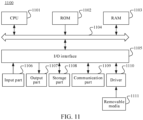
- FIG. 11 is a schematic structural diagram of a computer system of an electronic device adapted to implement the embodiments of this application.
- the computer system 1100 of the electronic device shown in FIG. 11 is merely an example, and does not constitute any limitation on functions and use ranges of the embodiments of this application.
- the computer system 1100 includes a central processing unit (CPU) 1101, which may execute various appropriate actions and processing according to a program stored in a read-only memory (ROM) 1102 or a program loaded from a storage part 1108 to a random-access memory (RAM) 1103, such as performing the methods described in the foregoing embodiments.
- the RAM 1103 further stores various programs and data required for operating the system.
- the CPU 1101, the ROM 1102, and the RAM 1103 are connected to each other through a bus 1104.
- An input/output (I/O) interface 1105 is also connected to the bus 1104.
- the following components are connected to the I/O interface 1105: an input part 1106 including a keyboard and a mouse, etc.; an output part 1107 including a cathode ray tube (CRT), a liquid crystal display (LCD), a speaker, or the like; a storage part 1108 including hard disk, or the like; and a communication part 1109 including a network interface card such as a local area network (LAN) card, a modem, or the like.
- the communication part 1109 performs communication processing by using a network such as the Internet.
- a drive 1110 is also connected to the I/O interface 1105 as required.
- a removable medium 1111 such as a disk, an optical disc, a magneto-optical disc, or a semiconductor memory, is installed on the drive 1110 as required, so that a computer program read from the removable medium 1111 is installed in the storage part 1108 as required.
- an embodiment of this application includes a computer program product.
- the computer program product includes a computer program stored in a computer-readable medium.
- the computer program includes a computer program used for performing a method shown in the flowchart.
- the computer program may be downloaded and installed through the communication part 1109 from a network, and/or installed from the removable medium 1111.
- the various functions defined in the system of this application are executed.
- the computer-readable medium shown in the embodiments of this application may be a computer-readable signal medium or a computer-readable storage medium or a combination thereof.
- the computer-readable storage medium may be, for example, but is not limited to, an electrical, magnetic, optical, electromagnetic, infrared, or semiconductor system, apparatus, or device, or any combination thereof.
- a more specific example of the computer-readable storage medium may include but is not limited to: an electrical connection having one or more wires, a portable computer magnetic disk, a hard disk, a random-access memory (RAM), a read-only memory (ROM), an erasable programmable read-only memory (EPROM), a flash memory, an optical fiber, a compact disk read-only memory (CD-ROM), an optical storage device, a magnetic storage device, or any appropriate combination thereof.
- the computer-readable storage medium may be any tangible medium containing or storing a program, and the program may be used by or used in combination with an instruction execution system, an apparatus, or a device.
- a computer-readable signal medium may include a data signal in a baseband or propagated as a part of a carrier wave, the data signal carrying a computer-readable computer program.
- a data signal propagated in such a way may assume multiple forms, including, but not limited to, an electromagnetic signal, an optical signal, or any appropriate combination thereof.
- the computer-readable signal medium may also be any computer-readable medium in addition to a computer-readable storage medium.
- the computer-readable medium may send, propagate, or transmit a program that is used by or used in combination with an instruction execution system, apparatus, or device.
- the computer program included in the computer-readable storage medium may be transmitted using any suitable medium, including but not limited to: a wireless medium, a wire medium, or the like, or any suitable combination thereof.
- Each box in a flowchart or a block diagram may represent a module, a program segment, or a part of code.
- the module, the program segment, or the part of code includes one or more executable instructions used for implementing designated logic functions.
- functions annotated in boxes may alternatively occur in a sequence different from that annotated in an accompanying drawing. For example, actually two boxes shown in succession may be performed basically in parallel, and sometimes the two boxes may be performed in a reverse sequence. This is determined by a related function.
- Each box in a block diagram and/or a flowchart and a combination of boxes in the block diagram and/or the flowchart may be implemented by using a dedicated hardware-based system configured to perform a specified function or operation, or may be implemented by using a combination of dedicated hardware and a computer instruction.
- a related unit described in the embodiments of this application may be implemented in a software manner, or may be implemented in a hardware manner, and the unit described may also be set in a processor. Names of the units do not constitute a limitation on the units in a specific case.
- this application further provides a computer readable medium.
- the computer readable medium may be included in the electronic device described in the above embodiments, or may exist alone without being assembled into the electronic device.
- the computer-readable medium carries one or more programs, the one or more programs, when executed by the electronic device, causing the electronic device to implement the method described in the foregoing embodiments.
- the software product may be stored in a non-volatile storage medium (which may be a CD-ROM, a USB flash drive, a removable hard disk, or the like) or on the network, including several instructions for instructing a computing device (which may be a personal computer, a server, a touch terminal, a network device, or the like) to perform the methods according to the embodiments of this application.
- a computing device which may be a personal computer, a server, a touch terminal, a network device, or the like
Landscapes
- Engineering & Computer Science (AREA)
- Computer Networks & Wireless Communication (AREA)
- Signal Processing (AREA)
- Multimedia (AREA)
- Mobile Radio Communication Systems (AREA)
- Telephonic Communication Services (AREA)
Applications Claiming Priority (2)
| Application Number | Priority Date | Filing Date | Title |
|---|---|---|---|
| CN202011061451.8A CN112243199B (zh) | 2020-09-30 | 2020-09-30 | Mbs业务的切换方法、装置、计算机可读介质及电子设备 |
| PCT/CN2021/116622 WO2022068529A1 (zh) | 2020-09-30 | 2021-09-06 | Mbs业务的切换方法及相关装置 |
Publications (2)
| Publication Number | Publication Date |
|---|---|
| EP4132023A1 true EP4132023A1 (de) | 2023-02-08 |
| EP4132023A4 EP4132023A4 (de) | 2023-11-29 |
Family
ID=74171822
Family Applications (1)
| Application Number | Title | Priority Date | Filing Date |
|---|---|---|---|
| EP21874190.8A Pending EP4132023A4 (de) | 2020-09-30 | 2021-09-06 | Mbs-dienstschaltverfahren und zugehörige vorrichtung |
Country Status (6)
| Country | Link |
|---|---|
| US (1) | US12568403B2 (de) |
| EP (1) | EP4132023A4 (de) |
| JP (1) | JP7423136B2 (de) |
| KR (1) | KR102950594B1 (de) |
| CN (2) | CN112243199B (de) |
| WO (1) | WO2022068529A1 (de) |
Cited By (5)
| Publication number | Priority date | Publication date | Assignee | Title |
|---|---|---|---|---|
| WO2023120175A1 (en) * | 2021-12-24 | 2023-06-29 | Nec Corporation | Communication method, access network node, user equipment |
| EP4158989A4 (de) * | 2020-05-26 | 2023-07-12 | ZTE Corporation | Tunnelwiederverwendung für multicast- und broadcast-dienst |
| WO2023219828A1 (en) * | 2022-05-09 | 2023-11-16 | Interdigital Patent Holdings, Inc. | Switching a service from a wtru to a pin and a pin to a wtru |
| EP4307725A4 (de) * | 2021-04-27 | 2024-08-07 | Vivo Mobile Communication Co., Ltd. | Verfahren und vorrichtung zur verwaltung gemeinsam genutzter tunnel, kernnetzwerkknoten und zugangsnetzwerkknoten |
| US12621882B2 (en) | 2022-11-21 | 2026-05-05 | Zte Corporation | Tunnel reuse for multicast and broadcast service |
Families Citing this family (7)
| Publication number | Priority date | Publication date | Assignee | Title |
|---|---|---|---|---|
| CN112243199B (zh) * | 2020-09-30 | 2023-05-12 | 腾讯科技(深圳)有限公司 | Mbs业务的切换方法、装置、计算机可读介质及电子设备 |
| CN112954613B (zh) * | 2021-02-10 | 2023-05-12 | 腾讯科技(深圳)有限公司 | 用于实现多播广播业务切换的方法及相关设备 |
| CN115150751B (zh) * | 2021-03-30 | 2024-11-29 | 维沃移动通信有限公司 | 业务数据处理方法、装置及设备 |
| CN115226165B (zh) * | 2021-04-14 | 2024-05-07 | 维沃移动通信有限公司 | 传输切换方法、终端及网络侧设备 |
| CN116419342A (zh) * | 2021-12-31 | 2023-07-11 | 腾讯科技(深圳)有限公司 | 网络切换处理方法、装置、计算机可读介质及电子设备 |
| CN116419341A (zh) * | 2021-12-31 | 2023-07-11 | 腾讯科技(深圳)有限公司 | 网络切换处理方法、装置、计算机可读介质及电子设备 |
| CN116419343A (zh) * | 2021-12-31 | 2023-07-11 | 腾讯科技(深圳)有限公司 | 网络切换处理方法、装置、计算机可读介质及电子设备 |
Family Cites Families (24)
| Publication number | Priority date | Publication date | Assignee | Title |
|---|---|---|---|---|
| CN101267593B (zh) * | 2007-03-15 | 2011-04-20 | 华为技术有限公司 | 对目标小区进行组播广播多媒体业务激活的方法及基站 |
| JP4825913B2 (ja) * | 2007-03-20 | 2011-11-30 | 富士通株式会社 | ハンドオーバ処理による転送遅延を軽減できる基地局及びその方法 |
| JP2008244910A (ja) * | 2007-03-28 | 2008-10-09 | Nec Corp | 送信電力推定方法及びそれを用いる送信電力推定システム |
| KR101467802B1 (ko) * | 2007-04-12 | 2014-12-04 | 엘지전자 주식회사 | 광대역 무선접속 시스템에서 핸드오버 수행 및 지원 방법 |
| CN101400028A (zh) * | 2007-09-29 | 2009-04-01 | 鼎桥通信技术有限公司 | 一种小区切换方法及装置 |
| KR101174059B1 (ko) * | 2008-12-19 | 2012-08-16 | 한국전자통신연구원 | E―mbms 구조를 갖는 이동통신 네트워크에서의 핸드오버 방법 |
| US8948073B2 (en) * | 2010-03-04 | 2015-02-03 | Electronics And Telecommunications Research Institute | Method and apparatus for managing carrier of multicast and broadcast service |
| US9686770B2 (en) * | 2010-06-15 | 2017-06-20 | Mediatek Inc. | Methods to support MBMS service continuity and counting and localized MBMS service |
| CN102685682A (zh) * | 2011-03-17 | 2012-09-19 | 中兴通讯股份有限公司 | 一种确定用户设备切换的目标小区的方法和系统 |
| US9173192B2 (en) * | 2011-03-17 | 2015-10-27 | Qualcomm Incorporated | Target cell selection for multimedia broadcast multicast service continuity |
| EP2698004B1 (de) * | 2011-04-13 | 2018-12-05 | HMD global Oy | Zellauswahl je nach mbms-fähigkeit |
| CN102769827A (zh) * | 2011-05-02 | 2012-11-07 | 上海贝尔股份有限公司 | 发起mbms业务接收状态报告的方法和设备 |
| US8750179B2 (en) * | 2011-08-15 | 2014-06-10 | Blackberry Limited | Efficient multimedia broadcast multicast service continuity methods |
| US9706369B2 (en) * | 2011-11-15 | 2017-07-11 | Kyocera Corporation | Handover management using a broadcast channel in a network having synchronized base stations |
| JP5752643B2 (ja) * | 2012-06-15 | 2015-07-22 | 株式会社東芝 | 無線管理装置、通信システム、通信方法、及び通信プログラム |
| US20140073303A1 (en) * | 2012-09-10 | 2014-03-13 | At&T Mobility Ii Llc | Historic performance analysis for modification of neighbor relations |
| CN104301959B (zh) * | 2014-08-28 | 2018-03-20 | 中兴通讯股份有限公司 | 一种保持eMBMS业务连续性的方法及系统、设备 |
| WO2016147028A1 (en) * | 2015-03-16 | 2016-09-22 | Telefonaktiebolaget Lm Ericsson (Publ) | Providing automated neighbor relation to user equipments |
| US10187789B2 (en) * | 2015-03-25 | 2019-01-22 | Nokia Solutions And Networks Oy | Method and system for cell identifier optimization |
| US10536946B2 (en) * | 2015-12-08 | 2020-01-14 | Huawei Technologies Co., Ltd. | Method and system for performing network slicing in a radio access network |
| EP3725035B1 (de) * | 2017-12-12 | 2024-10-02 | Nokia Solutions and Networks Oy | Verfahren, system und vorrichtung für multicast-sitzungsverwaltung in einem 5g-kommunikationsnetzwerk |
| CN113261327B (zh) * | 2019-01-08 | 2025-07-04 | 苹果公司 | 5g网络的随机接入信道(rach)优化和自动邻区关系创建 |
| CN116114270B (zh) * | 2020-09-07 | 2024-09-13 | 上海诺基亚贝尔股份有限公司 | 双连接中的多播/广播支持 |
| CN112243199B (zh) * | 2020-09-30 | 2023-05-12 | 腾讯科技(深圳)有限公司 | Mbs业务的切换方法、装置、计算机可读介质及电子设备 |
-
2020
- 2020-09-30 CN CN202011061451.8A patent/CN112243199B/zh active Active
- 2020-09-30 CN CN202310477662.7A patent/CN116321018A/zh active Pending
-
2021
- 2021-09-06 WO PCT/CN2021/116622 patent/WO2022068529A1/zh not_active Ceased
- 2021-09-06 JP JP2022563194A patent/JP7423136B2/ja active Active
- 2021-09-06 KR KR1020227037724A patent/KR102950594B1/ko active Active
- 2021-09-06 EP EP21874190.8A patent/EP4132023A4/de active Pending
-
2022
- 2022-10-31 US US17/978,060 patent/US12568403B2/en active Active
Cited By (5)
| Publication number | Priority date | Publication date | Assignee | Title |
|---|---|---|---|---|
| EP4158989A4 (de) * | 2020-05-26 | 2023-07-12 | ZTE Corporation | Tunnelwiederverwendung für multicast- und broadcast-dienst |
| EP4307725A4 (de) * | 2021-04-27 | 2024-08-07 | Vivo Mobile Communication Co., Ltd. | Verfahren und vorrichtung zur verwaltung gemeinsam genutzter tunnel, kernnetzwerkknoten und zugangsnetzwerkknoten |
| WO2023120175A1 (en) * | 2021-12-24 | 2023-06-29 | Nec Corporation | Communication method, access network node, user equipment |
| WO2023219828A1 (en) * | 2022-05-09 | 2023-11-16 | Interdigital Patent Holdings, Inc. | Switching a service from a wtru to a pin and a pin to a wtru |
| US12621882B2 (en) | 2022-11-21 | 2026-05-05 | Zte Corporation | Tunnel reuse for multicast and broadcast service |
Also Published As
| Publication number | Publication date |
|---|---|
| CN112243199A (zh) | 2021-01-19 |
| EP4132023A4 (de) | 2023-11-29 |
| KR102950594B1 (ko) | 2026-04-10 |
| US12568403B2 (en) | 2026-03-03 |
| JP7423136B2 (ja) | 2024-01-29 |
| JP2023522683A (ja) | 2023-05-31 |
| CN116321018A (zh) | 2023-06-23 |
| KR20220161431A (ko) | 2022-12-06 |
| CN112243199B (zh) | 2023-05-12 |
| WO2022068529A1 (zh) | 2022-04-07 |
| US20230050709A1 (en) | 2023-02-16 |
Similar Documents
| Publication | Publication Date | Title |
|---|---|---|
| US12568403B2 (en) | Supporting switching between base stations that provide multicast and broadcast service | |
| US12477306B2 (en) | Communication method and apparatus for multicast and broadcast service, medium, and electronic device | |
| JP6643510B2 (ja) | サービス継続性を維持する方法およびデバイス | |
| US12015967B2 (en) | Method, system and apparatus for multicast session management in 5G communication network | |
| US20100189027A1 (en) | Radio transmission method, radio reception method, radio transmission-reception method, radio transmission apparatus, radio reception apparatus, radio transmission-reception system, base station apparatus, and communication terminal | |
| EP4262248B1 (de) | Kommunikationsverfahren und -vorrichtung für multicast- und rundfunkdienst, medium und elektronische vorrichtung | |
| KR20140003604A (ko) | Mbms 서비스 송신 방식의 전환 방법, 장치 및 사용자 장비 | |
| US20250168601A1 (en) | Communication system | |
| JP7511757B2 (ja) | マルチキャストブロードキャストサービスの通信方法、装置、プログラム、及び電子機器 | |
| CN102387472B (zh) | 用户设备及其接收多媒体广播和组播业务的方法 | |
| CN102724636B (zh) | 一种mbms业务处理方法和系统 | |
| US12610301B2 (en) | Network handover processing method, network handover processing apparatus, computer-readable medium, and electronic device | |
| CN106686693A (zh) | 一种系统信息的传输方法和设备 | |
| HK40038152A (en) | Method and device for switching mbs business, computer readable medium and electronic apparatus | |
| HK40038152B (en) | Method and device for switching mbs business, computer readable medium and electronic apparatus | |
| CN119521140B (zh) | 数据传输的方法、装置、设备、存储介质及程序产品 | |
| US20250133422A1 (en) | Data transmission optimization | |
| HK40088406A (zh) | Mbs业务的切换方法、装置、计算机可读介质及电子设备 | |
| HK40053614B (en) | Communication method and apparatus for multicast broadcasting service, medium, and electronic device | |
| HK40053614A (en) | Communication method and apparatus for multicast broadcasting service, medium, and electronic device | |
| CN121968136A (zh) | 通信方法、通信节点、介质及程序产品 | |
| WO2011097996A1 (zh) | 多媒体广播和组播业务的业务声明更新处理方法、装置和系统 | |
| WO2026045564A1 (zh) | 通信方法及通信装置 | |
| CN121968122A (zh) | 通信方法、通信节点、介质及程序产品 | |
| HK40053613A (en) | Communication method and apparatus for multicast broadcasting service, medium, and electronic device |
Legal Events
| Date | Code | Title | Description |
|---|---|---|---|
| STAA | Information on the status of an ep patent application or granted ep patent |
Free format text: STATUS: THE INTERNATIONAL PUBLICATION HAS BEEN MADE |
|
| PUAI | Public reference made under article 153(3) epc to a published international application that has entered the european phase |
Free format text: ORIGINAL CODE: 0009012 |
|
| STAA | Information on the status of an ep patent application or granted ep patent |
Free format text: STATUS: REQUEST FOR EXAMINATION WAS MADE |
|
| 17P | Request for examination filed |
Effective date: 20221104 |
|
| AK | Designated contracting states |
Kind code of ref document: A1 Designated state(s): AL AT BE BG CH CY CZ DE DK EE ES FI FR GB GR HR HU IE IS IT LI LT LU LV MC MK MT NL NO PL PT RO RS SE SI SK SM TR |
|
| A4 | Supplementary search report drawn up and despatched |
Effective date: 20231026 |
|
| RIC1 | Information provided on ipc code assigned before grant |
Ipc: H04W 36/00 20090101ALI20231020BHEP Ipc: H04W 4/06 20090101AFI20231020BHEP |
|
| DAV | Request for validation of the european patent (deleted) | ||
| DAX | Request for extension of the european patent (deleted) |