EP4132087A1 - Elektronische vorrichtung zur änderung der kommunikationsfrequenz auf basis der detektion verborgener interferenzen und verfahren zum betrieb davon - Google Patents
Elektronische vorrichtung zur änderung der kommunikationsfrequenz auf basis der detektion verborgener interferenzen und verfahren zum betrieb davon Download PDFInfo
- Publication number
- EP4132087A1 EP4132087A1 EP21779899.0A EP21779899A EP4132087A1 EP 4132087 A1 EP4132087 A1 EP 4132087A1 EP 21779899 A EP21779899 A EP 21779899A EP 4132087 A1 EP4132087 A1 EP 4132087A1
- Authority
- EP
- European Patent Office
- Prior art keywords
- electronic device
- sub
- frequency band
- processor
- information
- Prior art date
- Legal status (The legal status is an assumption and is not a legal conclusion. Google has not performed a legal analysis and makes no representation as to the accuracy of the status listed.)
- Granted
Links
Images




Classifications
-
- H—ELECTRICITY
- H04—ELECTRIC COMMUNICATION TECHNIQUE
- H04W—WIRELESS COMMUNICATION NETWORKS
- H04W74/00—Wireless channel access
- H04W74/08—Non-scheduled access, e.g. ALOHA
- H04W74/0808—Non-scheduled access, e.g. ALOHA using carrier sensing, e.g. carrier sense multiple access [CSMA]
- H04W74/0816—Non-scheduled access, e.g. ALOHA using carrier sensing, e.g. carrier sense multiple access [CSMA] with collision avoidance
-
- H—ELECTRICITY
- H04—ELECTRIC COMMUNICATION TECHNIQUE
- H04L—TRANSMISSION OF DIGITAL INFORMATION, e.g. TELEGRAPHIC COMMUNICATION
- H04L5/00—Arrangements affording multiple use of the transmission path
- H04L5/0091—Signalling for the administration of the divided path, e.g. signalling of configuration information
- H04L5/0094—Indication of how sub-channels of the path are allocated
-
- H—ELECTRICITY
- H04—ELECTRIC COMMUNICATION TECHNIQUE
- H04W—WIRELESS COMMUNICATION NETWORKS
- H04W24/00—Supervisory, monitoring or testing arrangements
- H04W24/08—Testing, supervising or monitoring using real traffic
-
- H—ELECTRICITY
- H04—ELECTRIC COMMUNICATION TECHNIQUE
- H04W—WIRELESS COMMUNICATION NETWORKS
- H04W52/00—Power management, e.g. Transmission Power Control [TPC] or power classes
- H04W52/02—Power saving arrangements
- H04W52/0209—Power saving arrangements in terminal devices
- H04W52/0212—Power saving arrangements in terminal devices managed by the network, e.g. network or access point is leader and terminal is follower
- H04W52/0216—Power saving arrangements in terminal devices managed by the network, e.g. network or access point is leader and terminal is follower using a pre-established activity schedule, e.g. traffic indication frame
-
- H—ELECTRICITY
- H04—ELECTRIC COMMUNICATION TECHNIQUE
- H04W—WIRELESS COMMUNICATION NETWORKS
- H04W52/00—Power management, e.g. Transmission Power Control [TPC] or power classes
- H04W52/02—Power saving arrangements
- H04W52/0209—Power saving arrangements in terminal devices
- H04W52/0225—Power saving arrangements in terminal devices using monitoring of external events, e.g. the presence of a signal
- H04W52/0229—Power saving arrangements in terminal devices using monitoring of external events, e.g. the presence of a signal where the received signal is a wanted signal
-
- H—ELECTRICITY
- H04—ELECTRIC COMMUNICATION TECHNIQUE
- H04W—WIRELESS COMMUNICATION NETWORKS
- H04W52/00—Power management, e.g. Transmission Power Control [TPC] or power classes
- H04W52/02—Power saving arrangements
- H04W52/0209—Power saving arrangements in terminal devices
- H04W52/0225—Power saving arrangements in terminal devices using monitoring of external events, e.g. the presence of a signal
- H04W52/0241—Power saving arrangements in terminal devices using monitoring of external events, e.g. the presence of a signal where no transmission is received, e.g. out of range of the transmitter
-
- H—ELECTRICITY
- H04—ELECTRIC COMMUNICATION TECHNIQUE
- H04W—WIRELESS COMMUNICATION NETWORKS
- H04W72/00—Local resource management
- H04W72/02—Selection of wireless resources by user or terminal
-
- H—ELECTRICITY
- H04—ELECTRIC COMMUNICATION TECHNIQUE
- H04W—WIRELESS COMMUNICATION NETWORKS
- H04W72/00—Local resource management
- H04W72/04—Wireless resource allocation
- H04W72/044—Wireless resource allocation based on the type of the allocated resource
- H04W72/0453—Resources in frequency domain, e.g. a carrier in FDMA
-
- H—ELECTRICITY
- H04—ELECTRIC COMMUNICATION TECHNIQUE
- H04W—WIRELESS COMMUNICATION NETWORKS
- H04W72/00—Local resource management
- H04W72/50—Allocation or scheduling criteria for wireless resources
- H04W72/54—Allocation or scheduling criteria for wireless resources based on quality criteria
- H04W72/541—Allocation or scheduling criteria for wireless resources based on quality criteria using the level of interference
-
- H—ELECTRICITY
- H04—ELECTRIC COMMUNICATION TECHNIQUE
- H04W—WIRELESS COMMUNICATION NETWORKS
- H04W76/00—Connection management
- H04W76/10—Connection setup
- H04W76/15—Setup of multiple wireless link connections
- H04W76/16—Involving different core network technologies, e.g. a packet-switched [PS] bearer in combination with a circuit-switched [CS] bearer
-
- H—ELECTRICITY
- H04—ELECTRIC COMMUNICATION TECHNIQUE
- H04W—WIRELESS COMMUNICATION NETWORKS
- H04W84/00—Network topologies
- H04W84/02—Hierarchically pre-organised networks, e.g. paging networks, cellular networks, WLAN [Wireless Local Area Network] or WLL [Wireless Local Loop]
- H04W84/10—Small scale networks; Flat hierarchical networks
- H04W84/12—WLAN [Wireless Local Area Networks]
-
- H—ELECTRICITY
- H04—ELECTRIC COMMUNICATION TECHNIQUE
- H04W—WIRELESS COMMUNICATION NETWORKS
- H04W88/00—Devices specially adapted for wireless communication networks, e.g. terminals, base stations or access point devices
- H04W88/02—Terminal devices
- H04W88/06—Terminal devices adapted for operation in multiple networks or having at least two operational modes, e.g. multi-mode terminals
Definitions
- Various embodiments of the present disclosure relate to an electronic device for changing a communication frequency, based on the identifying of hidden interference, and a method for operating the same.
- An electronic device and an access point may transmit and receive a signal, based on a specified radio access technology (RAT).
- RAT radio access technology
- CSMA/CA carrier sense multiple access with collision avoidance
- An electronic device may receive a signal from another electronic device (e.g., another access point or a station) that uses the same frequency band according to a position.
- another electronic device e.g., another access point or a station
- a corresponding frequency band may be recognized as not being occupied by another electronic device.
- the electronic device may experience hidden interference that the access point does not recognize.
- An electronic device of an embodiment may include a communication module, a processor operatively connected to the communication module, and a memory operatively connected to the processor.
- the memory may include instructions that, when executed, cause the processor to receive a first signal by using a plurality of sub-frequency bands through the communication module, identify at least one sub-frequency band in which hidden interference is identified, based on a pre-high efficiency(pre-HE) modulated field of a packet indicated by the first signal, and change a communication frequency, by transmitting a second signal including information indicating the identified at least one sub-frequency band to an external electronic device in which a wireless communication connection has been established.
- pre-HE pre-high efficiency
- a method of operating an electronic device of an embodiment may include receiving a first signal by using a plurality of sub-frequency bands through a communication module of the electronic device, identifying at least one sub-frequency band in which hidden interference is identified, based on a pre-high efficiency (pre-HE) modulated field of a packet indicated by the first signal, and changing a communication frequency, by transmitting a second signal including information indicating the identified at least one sub-frequency band to an external electronic device in which a wireless communication connection has been established.
- pre-HE pre-high efficiency
- An electronic device of an embodiment and an operating method thereof may detect hidden interference, based on information on specified fields, and reduce the influence of the hidden interference.
- An electronic device of an embodiment and an operating method thereof may forward information on hidden interference to an external electronic device (e.g., an access point or a station) by using a signal of a specified format.
- an external electronic device e.g., an access point or a station
- An electronic device of an embodiment and an operating method thereof may improve the performance of wireless communication, by forwarding information on hidden interference to an external electronic device (e.g., an access point or a station) and stopping use of a frequency band in which the hidden interference exists.
- an external electronic device e.g., an access point or a station
- Fig. 1 is a block diagram illustrating an electronic device 101 in a network environment 100 according to an embodiment.
- the electronic device 101 in the network environment 100 may communicate with an electronic device 102 via a first network 198 (e.g., a short-range wireless communication network), or an electronic device 104 or a server 108 via a second network 199 (e.g., a long-range wireless communication network).
- the electronic device 101 may communicate with the electronic device 104 via the server 108.
- the electronic device 101 may include a processor 120, memory 130, an input device 150, a sound output device 155, a display device 160, an audio module 170, a sensor module 176, an interface 177, a haptic module 179, a camera module 180, a power management module 188, a battery 189, a communication module 190, a subscriber identification module(SIM) 196, or an antenna module 197.
- at least one (e.g., the display device 160 or the camera module 180) of the components may be omitted from the electronic device 101, or one or more other components may be added in the electronic device 101.
- some of the components may be implemented as single integrated circuitry.
- the sensor module 176 e.g., a fingerprint sensor, an iris sensor, or an illuminance sensor
- the display device 160 e.g., a display
- an haptic module 179 e.g., a camera module 180
- a power management module 188 e.g., the display
- the processor 120 may execute, for example, software (e.g., a program 140) to control at least one other component (e.g., a hardware or software component) of the electronic device 101 coupled with the processor 120, and may perform various data processing or computation. According to one embodiment, as at least part of the data processing or computation, the processor 120 may load a command or data received from another component (e.g., the sensor module 176 or the communication module 190) in volatile memory 132, process the command or the data stored in the volatile memory 132, and store resulting data in non-volatile memory 134.
- software e.g., a program 140
- the processor 120 may load a command or data received from another component (e.g., the sensor module 176 or the communication module 190) in volatile memory 132, process the command or the data stored in the volatile memory 132, and store resulting data in non-volatile memory 134.
- the processor 120 may include a main processor 121 (e.g., a central processing unit (CPU) or an application processor (AP)), and an auxiliary processor 123 (e.g., a graphics processing unit (GPU), an image signal processor (ISP), a sensor hub processor, or a communication processor (CP)) that is operable independently from, or in conjunction with, the main processor 121.
- auxiliary processor 123 may be adapted to consume less power than the main processor 121, or to be specific to a specified function.
- the auxiliary processor 123 may be implemented as separate from, or as part of the main processor 121.
- the auxiliary processor 123 may control at least some of functions or states related to at least one component (e.g., the display device 160, the sensor module 176, or the communication module 190) among the components of the electronic device 101, instead of the main processor 121 while the main processor 121 is in an inactive (e.g., sleep) state, or together with the main processor 121 while the main processor 121 is in an active state (e.g., executing an application).
- the auxiliary processor 123 e.g., an image signal processor or a communication processor
- the memory 130 may store various data used by at least one component (e.g., the processor 120 or the sensor module 176) of the electronic device 101.
- the various data may include, for example, software (e.g., the program 140) and input data or output data for a command related thererto.
- the memory 130 may include the volatile memory 132 or the non-volatile memory 134.
- the program 140 may be stored in the memory 130 as software, and may include, for example, an operating system (OS) 142, middleware 144, or an application 146.
- OS operating system
- middleware middleware
- application application
- the input device 150 may receive a command or data to be used by other component (e.g., the processor 120) of the electronic device 101, from the outside (e.g., a user) of the electronic device 101.
- the input device 150 may include, for example, a microphone, a mouse, a keyboard, or a digital pen (e.g., a stylus pen).
- the sound output device 155 may output sound signals to the outside of the electronic device 101.
- the sound output device 155 may include, for example, a speaker or a receiver.
- the speaker may be used for general purposes, such as playing multimedia or playing record, and the receiver may be used for an incoming calls. According to an embodiment, the receiver may be implemented as separate from, or as part of the speaker.
- the display device 160 may visually provide information to the outside (e.g., a user) of the electronic device 101.
- the display device 160 may include, for example, a display, a hologram device, or a projector and control circuitry to control a corresponding one of the display, hologram device, and projector.
- the display device 160 may include touch circuitry adapted to detect a touch, or sensor circuitry (e.g., a pressure sensor) adapted to measure the intensity of force incurred by the touch.
- the audio module 170 may convert a sound into an electrical signal and vice versa. According to an embodiment, the audio module 170 may obtain the sound via the input device 150, or output the sound via the sound output device 155 or a headphone of an external electronic device (e.g., an electronic device 102) directly (e.g., wiredly) or wirelessly coupled with the electronic device 101.
- an external electronic device e.g., an electronic device 102
- directly e.g., wiredly
- wirelessly e.g., wirelessly
- the sensor module 176 may detect an operational state (e.g., power or temperature) of the electronic device 101 or an environmental state (e.g., a state of a user) external to the electronic device 101, and then generate an electrical signal or data value corresponding to the detected state.
- the sensor module 176 may include, for example, a gesture sensor, a gyro sensor, an atmospheric pressure sensor, a magnetic sensor, an acceleration sensor, a grip sensor, a proximity sensor, a color sensor, an infrared (IR) sensor, a biometric sensor, a temperature sensor, a humidity sensor, or an illuminance sensor.
- the interface 177 may support one or more specified protocols to be used for the electronic device 101 to be coupled with the external electronic device (e.g., the electronic device 102) directly (e.g., wiredly) or wirelessly.
- the interface 177 may include, for example, a high definition multimedia interface (HDMI), a universal serial bus (USB) interface, a secure digital (SD) card interface, or an audio interface.
- HDMI high definition multimedia interface
- USB universal serial bus
- SD secure digital
- a connecting terminal 178 may include a connector via which the electronic device 101 may be physically connected with the external electronic device (e.g., the electronic device 102).
- the connecting terminal 178 may include, for example, a HDMI connector, a USB connector, a SD card connector, or an audio connector (e.g., a headphone connector).
- the haptic module 179 may convert an electrical signal into a mechanical stimulus (e.g., a vibration or a movement) or electrical stimulus which may be recognized by a user via his tactile sensation or kinesthetic sensation.
- the haptic module 179 may include, for example, a motor, a piezoelectric element, or an electric stimulator.
- the camera module 180 may capture a still image or moving images.
- the camera module 180 may include one or more lenses, image sensors, image signal processors, or flashes.
- the power management module 188 may manage power supplied to the electronic device 101.
- the power management module 188 may be implemented as at least part of, for example, a power management integrated circuit (PMIC).
- PMIC power management integrated circuit
- the battery 189 may supply power to at least one component of the electronic device 101.
- the battery 189 may include, for example, a primary cell which is not rechargeable, a secondary cell which is rechargeable, or a fuel cell.
- the communication module 190 may support establishing a direct (e.g., wired) communication channel or a wireless communication channel between the electronic device 101 and the external electronic device (e.g., the electronic device 102, the electronic device 104, or the server 108) and performing communication via the established communication channel.
- the communication module 190 may include one or more communication processors that are operable independently from the processor 120 (e.g., the application processor (AP)) and supports a direct (e.g., wired) communication or a wireless communication.
- AP application processor
- the communication module 190 may include a wireless communication module 192 (e.g., a cellular communication module, a short-range wireless communication module, or a global navigation satellite system (GNSS) communication module) or a wired communication module 194 (e.g., a local area network (LAN) communication module or a power line communication (PLC) module).
- a wireless communication module 192 e.g., a cellular communication module, a short-range wireless communication module, or a global navigation satellite system (GNSS) communication module
- GNSS global navigation satellite system
- wired communication module 194 e.g., a local area network (LAN) communication module or a power line communication (PLC) module.
- LAN local area network
- PLC power line communication
- a corresponding one of these communication modules may communicate with the external electronic device via the first network 198 (e.g., a short-range communication network, such as Bluetooth TM , wireless-fidelity (Wi-Fi) direct, or infrared data association (IrDA)) or the second network 199 (e.g., a long-range communication network, such as a cellular network, the Internet, or a computer network (e.g., LAN or wide area network (WAN)).
- the first network 198 e.g., a short-range communication network, such as Bluetooth TM , wireless-fidelity (Wi-Fi) direct, or infrared data association (IrDA)
- the second network 199 e.g., a long-range communication network, such as a cellular network, the Internet, or a computer network (e.g., LAN or wide area network (WAN)
- These various types of communication modules may be implemented as a single component (e.g., a single chip), or may be implemented as multi
- the wireless communication module 192 may identify and authenticate the electronic device 101 in a communication network, such as the first network 198 or the second network 199, using subscriber information (e.g., international mobile subscriber identity (IMSI)) stored in the subscriber identification module 196.
- subscriber information e.g., international mobile subscriber identity (IMSI)
- the antenna module 197 may transmit or receive a signal or power to or from the outside (e.g., the external electronic device) of the electronic device 101.
- the antenna module 197 may include an antenna including a radiating element composed of a conductive material or a conductive pattern formed in or on a substrate (e.g., PCB).
- the antenna module 197 may include a plurality of antennas. In such a case, at least one antenna appropriate for a communication scheme used in the communication network, such as the first network 198 or the second network 199, may be selected, for example, by the communication module 190 (e.g., the wireless communication module 192) from the plurality of antennas.
- the signal or the power may then be transmitted or received between the communication module 190 and the external electronic device via the selected at least one antenna.
- another component e.g., a radio frequency integrated circuit (RFIC)
- RFIC radio frequency integrated circuit
- At least some of the above-described components may be coupled mutually and communicate signals (e.g., commands or data) therebetween via an inter-peripheral communication scheme (e.g., a bus, general purpose input and output (GPIO), serial peripheral interface (SPI), or mobile industry processor interface (MIPI)).
- an inter-peripheral communication scheme e.g., a bus, general purpose input and output (GPIO), serial peripheral interface (SPI), or mobile industry processor interface (MIPI)
- commands or data may be transmitted or received between the electronic device 101 and the external electronic device 104 via the server 108 coupled with the second network 199.
- Each of the electronic devices 102 and 104 may be a device of a same type as, or a different type, from the electronic device 101.
- all or some of operations to be executed at the electronic device 101 may be executed at one or more of the external electronic devices 102, 104, or 108. For example, if the electronic device 101 should perform a function or a service automatically, or in response to a request from a user or another device, the electronic device 101, instead of, or in addition to, executing the function or the service, may request the one or more external electronic devices to perform at least part of the function or the service.
- the one or more external electronic devices receiving the request may perform the at least part of the function or the service requested, or an additional function or an additional service related to the request, and transfer an outcome of the performing to the electronic device 101.
- the electronic device 101 may provide the outcome, with or without further processing of the outcome, as at least part of a reply to the request.
- a cloud computing, distributed computing, or client-server computing technology may be used, for example.
- FIG. 2 is a diagram illustrating a situation in which the electronic device 101 detects hidden interference and changes a communication frequency according to an embodiment.
- FIG. 3 is a diagram illustrating a data format according to an embodiment.
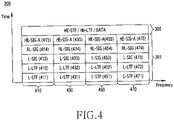
- FIG. 4 is a diagram illustrating a data format in frequency and time axes according to an embodiment.
- FIG. 2 , FIG. 3 , and FIG. 4 may be described with reference to the construction of the electronic device 101 of FIG. 1 .
- the electronic device 101 may move from a service area 221 of the external electronic device 211 to an area 230 where hidden interference by another external electronic device 215 (e.g., the electronic device 102 of FIG. 1 ) occurs.
- the area 230 in which the hidden interference occurs may be an area in which the service area 221 of the external electronic device 211 and a service area 225 of another external electronic device 215 are overlapped with each other.
- the external electronic device 211 may be an access point (AP) and/or a station.
- AP access point
- another external electronic device 215 may be a device that performs wireless communication that is based on a frequency band that at least partially overlaps with a frequency band used in the wireless communication channel between the electronic device 101 and the external electronic device 211. Since the external electronic device 211 is not located in the service area 225 of another external electronic device 215, the external electronic device 211 does not receive a signal transmitted by another external electronic device 215, and thus may not know the existence of another external electronic device 215. In this case, collision may occur in some frequency bands overlapping with a frequency band used by another external electronic device 215, among frequency bands used by the external electronic device 211.
- the electronic device 101 may send a request for changing a frequency band of the wireless communication channel to the external electronic device 211.
- the electronic device 101 may transmit, to the external electronic device 211, a signal indicating information on some frequency bands in which hidden interference is identified among frequency bands used in the wireless communication channel.
- the processor 120 of the electronic device 101 may establish a wireless communication channel with the external electronic device 211 through the wireless communication module 192 of the electronic device 101.
- the processor 120 may establish the wireless communication channel with the external electronic device 211 through the wireless communication module 192, based on a specified radio access technology (RAT).
- the specified RAT may include a RAT that is based on the Institute of Electrical and Electronics Engineers (IEEE) 802.11 standard (e.g., the IEEE 802.11ax standard).
- the processor 120 may transmit or receive a signal through the wireless communication module 192, based on a frequency band allocated to the wireless communication channel established with the external electronic device 211. In an embodiment, the processor 120 may transmit or receive a signal to or from the external electronic device 211 through the wireless communication module 192, based on a plurality of sub-frequency bands included in the allocated frequency band.
- the frequency band allocated to the wireless communication channel may include at least one sub-frequency band.
- the sub-frequency band may have a specified bandwidth (e.g., 20 MHz). In an embodiment, when the frequency band allocated to the wireless communication channel has a bandwidth of 20 MHz, there may be one sub-frequency band. In an embodiment, when the frequency band allocated to the wireless communication channel has a bandwidth of 160 MHz, there may be eight sub-frequency bands.
- a signal received based on the frequency band allocated to the wireless communication module 192 may have a data format 300 illustrated in FIG. 3 and FIG. 4 .
- the data format 300 may correspond to a high efficiency (HE) physical protocol data unit (PPDU).
- HE high efficiency
- the data format 300 may include a pre-HE modulated field 301 and an HE modulated field 305.
- the pre-HE modulated field 301 may include a non-high-throughput (HT) short training field (L-STF) 310, a non-HT long training field (L-LTF) 320, a non-HT signal field (L-SIG) 330, a repeated non-HT signal field (RL-SIG) 340, an HE signal A (HE-SIG-A) field 350, or a combination thereof.
- HT high-throughput
- L-STF non-high-throughput
- L-LTF non-HT long training field
- L-SIG non-HT signal field
- R-SIG repeated non-HT signal field
- HE-SIG-A HE signal A
- the HE modulated field 305 may further include an HE short training field (HE-STF) 360, at least one or more HE long training field (HE-LTF) 370, a data field 380, or a combination thereof.
- HE-STF HE short training field
- HE-LTF HE long training field
- data field 380 a data field 380
- some fields may be omitted, or other fields (e.g., an HE signal B (HE-SIG-B) field or a packet extension (PE) field) may be further added.
- HE-SIG-B HE signal B
- PE packet extension
- each of the fields 310 to 350 included in the pre-HE modulated field 301 may be repeatedly transmitted for each sub-frequency band.
- a signal received by the wireless communication module 192 may include the same four pre-HE modulated fields 301.
- information included in each of an L-STF 411, an L-LTF 412, an L-SIG field 413, an RL-SIF field 414, or an HE-SIG-A field 415 included in the pre-HE modulated field 301 of the sub-frequency band 410 may be the same as information included in each of an L-STF 431, 451, or 471, an L-LTF 432, 452, or 472, an L-SIG field 433, 453, or 473, an RL-SIF field 434, 454, or 474, or an HE-SIG-A field 435, 455, or 475.
- the L-STF 310 may include a short training orthogonal frequency division multiplexing (OFDM) symbol.
- the L-STF 310 may be used for frame timing acquisition, automatic gain control (AGC), diversity detection, coarse frequency / time synchronization, or a combination thereof.
- AGC automatic gain control
- the L-LTF 320 may include a long training OFDM symbol. In an embodiment, the L-LTF 320 may be used for fine frequency/time synchronization, channel estimation, or a combination thereof.
- the L-SIG field 330 may be used to transmit control information for demodulation and decoding of a data field.
- the L-SIG field 330 may include information on a data rate, a data length, or a combination thereof.
- the RL-SIG field 340 may be a field that repeats the L-SIG field 330. In an embodiment, the RL-SIG field 340 may be used to distinguish between PPDUs. In an embodiment, the RL-SIG field 340 may be used to distinguish between an HE PPDU, a non-HT PPDU, an HT PPDU, or a very high throughput (VHT) PPDU.
- VHT very high throughput
- the HE-SIG-A field 350 may include information necessary to interpret the HE PPDU.
- the HE-SIG-A field 350 may include common control information commonly transmitted to devices (e.g., the electronic device 101) receiving the PPDU.
- the HE-SIG-A field 350 may at least include bandwidth information, group identifier information (e.g., a basic service set (BSS) color), and a link indicator (e.g., information indicating uplink or downlink).
- the BSS color may indicate information for identifying a BSS.
- the HE-STF 360 may be a field for improving the estimation of automatic gain control in multiple inputs and multiple outputs (MIMO) transmission.
- MIMO multiple inputs and multiple outputs
- the HE-LTF 370 may be used to allow devices (e.g., the electronic device 101) receiving a signal to estimate a MIMO channel between reception chains and a set of constellation mapper outputs.
- the HE modulated field 305 may include one or more HE-LTFs 370.
- the processor 120 may receive, through the wireless communication module 192, a signal corresponding to the data format 300 through at least one of the sub-frequency bands 410, 430, 450, or 470. In an embodiment, the processor 120 may receive the pre-HE modulated field 301 through at least one of the sub-frequency bands 410, 430, 450, or 470 through the wireless communication module 192. In an embodiment, the processor 120 may receive the HE-SIG-A field 350 through at least one of the sub-frequency bands 410, 430, 450, or 470 through the wireless communication module 192.
- the processor 120 may identify information from a signal received through at least one sub-frequency band. In an embodiment, the processor 120 may identify information in the pre-HE modulated field 301 of the signal received through the at least one sub-frequency band. In an embodiment, the processor 120 may identify information in the HE-SIG-A field 350 of the signal received through the at least one sub-frequency band. In an embodiment, the identified information may include bandwidth information, BSS identification information, a link indicator, or a combination thereof.
- the processor 120 may identify whether information identified in the HE-SIG-A field 350 of the signal received through the at least one sub-frequency band includes specified information. For example, the processor 120 may identify whether the information identified in the HE-SIG-A field 435 of the signal received through the sub-frequency band 430 includes the specified information.
- the specified information may include identification information (e.g., a BSS color) of a BSS related to the external electronic device 211, and a link indicator indicating a downlink.
- the processor 120 may identify whether the information identified in the HE-SIG-A field 350 received through the at least one sub-frequency band indicates identification information (e.g., a BSS color) of a BSS related to the external electronic device 211. In an embodiment, the processor 120 may identify whether the information identified in the HE-SIG-A field 350 received through the at least one sub-frequency band indicates a downlink (e.g., a link in which the external electronic device 211 transmits data to the electronic device 101).
- identification information e.g., a BSS color
- the processor 120 may identify at least one sub-frequency band (e.g., a sub-frequency band 410) not receiving the pre-HE modulated field 301, among the sub-frequency bands 410, 430, 450, or 470. In an embodiment, the processor 120 may identify a sub-frequency band receiving the HE-SIG-A field 350 in which the specified information is not identified, among the sub-frequency bands 410, 430, 450, or 470, as a sub-frequency band not receiving the pre-HE modulated field 301.
- a sub-frequency band e.g., a sub-frequency band 410
- the processor 120 may identify a sub-frequency band receiving the HE-SIG-A field 350 in which the specified information is not identified, among the sub-frequency bands 410, 430, 450, or 470, as a sub-frequency band not receiving the pre-HE modulated field 301.
- the processor 120 may identify at least one sub-frequency band (e.g., the sub-frequency band 410) not receiving the pre-HE modulated field 301, as a sub-frequency band in which hidden interference exists. In an embodiment, the processor 120 may identify a sub-frequency band receiving the HE-SIG-A field 350 in which the specified information is not identified, among the sub-frequency bands 410, 430, 450, or 470, as the sub-frequency band in which the hidden interference exists.
- the processor 120 may identify at least one sub-frequency band (e.g., the sub-frequency band 410) not receiving the pre-HE modulated field 301, as a sub-frequency band in which hidden interference exists.
- the processor 120 may identify a sub-frequency band receiving the HE-SIG-A field 350 in which the specified information is not identified, among the sub-frequency bands 410, 430, 450, or 470, as the sub-frequency band in which the hidden interference exists.
- the processor 120 may identify a sub-frequency band receiving the HE-SIG-A field 350 in which identification information (e.g., a BSS color) of a BSS related to the external electronic device 211 among specified information is not identified, as a sub-frequency band in which hidden interference exists. For example, when the identification information (e.g., the BSS color) of the BSS related to the external electronic device 211 is not identified in the HE-SIG-A field 415 received through the sub-frequency band 410, the processor 120 may identify the sub-frequency band 410 as the sub-frequency band in which the hidden interference exists.
- identification information e.g., a BSS color
- the processor 120 may identify the sub-frequency band 410 as the sub-frequency band in which the hidden interference exists.
- the processor 120 may identify a sub-frequency band receiving the HE-SIG-A field 350 in which the indicator indicating the downlink among the specified information is not identified, as a sub-frequency band in which hidden interference exists. For example, when the indicator indicating the downlink is not identified in the HE-SIG-A field 415 received through the sub-frequency band 410, the processor 120 may identify the sub-frequency band 410 as the sub-frequency band in which the hidden interference exists. For another example, when the indicator indicating the uplink is identified in the HE-SIG-A field 415 received through the sub-frequency band 410, the processor 120 may identify the sub-frequency band 410 as the sub-frequency band in which the hidden interference exists.
- the processor 120 may identify a sub-frequency band receiving the pre-HE modulated field 301 in which a specified number or more of information different from information of the pre-HE modulated field 301 of a sub-frequency band in which the specified information is identified are identified, as a sub-frequency band in which hidden interference exists. For example, when the specified information is identified in the HE-SIG-A field 415 of the pre-HE modulated field 301 received through the sub-frequency band 430, the processor 120 may identify the sub-frequency band 410 receiving the pre-HE modulated field 301 in which a specified number or more of information different from information of the pre-HE modulated field 301 received through the sub-frequency band 430 are identified, as a sub-frequency band in which hidden interference exists.
- the processor 120 may identify a sub-frequency band receiving the pre-HE modulated field 301 in which the same information is not identified, as a sub-frequency band in which hidden interference exists. For example, when information indicated by the pre-HE modulated field 301 received through a relatively small number of sub-frequency bands is different from a specified number or more of information indicated by the pre-HE modulated field 301 received through a relatively large number of sub-frequency bands, the processor 120 may identify the relatively small number of sub-frequency bands, as the sub-frequency band in which the hidden interference exists.
- the processor 120 may identify the sub-frequency band 410 as the sub-frequency band in which the hidden interference exists.
- the processor 120 may request to change a frequency band allocated to a wireless communication channel established with the external electronic device 211, based on information on at least one sub-frequency band (e.g., the sub-frequency band 410) in which hidden interference exists.
- a sub-frequency band e.g., the sub-frequency band 410
- the processor 120 may determine whether it is necessary to change the frequency band allocated to the wireless communication channel established with the external electronic device 211, based on the number of times of identifying hidden interference in each of the at least one sub-frequency band 410, 430, 450, or 470 included in the allocated frequency band. In an embodiment, the processor 120 may determine whether it is necessary to change the frequency band allocated to the wireless communication channel established with the external electronic device 211, based on the number of times of identifying hidden interference per unit time (e.g., 1 second) in each of the at least one sub-frequency bands 410, 430, 450, or 470 included in the allocated frequency band.
- the processor 120 may determine whether it is necessary to change the frequency band allocated to the wireless communication channel established with the external electronic device 211, based on the number of times of identifying hidden interference per unit time (e.g., 1 second) in each of the at least one sub-frequency bands 410, 430, 450, or 470 included in the allocated frequency band.
- the processor 120 may determine that it is necessary to change the frequency band allocated to the wireless communication channel established with the external electronic device 211.
- the specified threshold number of times may be set differently for each application 146 (or a function presented by the application 146) of the electronic device 101 that is being executed.
- the application 146 of the electronic device 101 that is being executed may be a destination of a signal received through the wireless communication channel.
- the application 146 of the electronic device 101 that is being executed may be an application that is currently transmitting and receiving data with the external electronic device 211 through the wireless communication channel.
- the specified threshold number of times may be set differently for each application (or service type) as shown in Table 1 below. [Table 1] Applications VoIP Video Streaming Web Browsing Threshold number of times 5 10 20
- the threshold number of times may be 5.
- the threshold number of times may be 10.
- the threshold number of times may be 20.
- the processor 120 may determine whether it is necessary to change the frequency band allocated to the wireless communication channel established with the external electronic device 211 according to a function presented by the application 146 of the electronic device 101 that is being executed. For example, when the function presented by the application 146 of the electronic device 101 that is being executed is VoIP or video streaming, the processor 120 may determine that it is necessary to change a frequency band of the sub-frequency band 410 in which hidden interference exceeding the threshold number of times (e.g., 5 or 10) is identified.
- the threshold number of times e.g., 5 or 10
- the processor 120 may determine that it is not necessary to change a frequency band of the sub-frequency bands 410, 430, 450, or 470, since each of the sub-frequency bands 410, 430, 450, or 470 does not exceed the number of times (e.g., 20).
- the processor 120 may request a change of the frequency band allocated to the wireless communication channel, by transmitting a signal indicating a packet including information on at least one sub-frequency band (e.g., the sub-frequency band 410) in which the hidden interference exists to the external electronic device 211.
- a signal indicating a packet including information on at least one sub-frequency band e.g., the sub-frequency band 410 in which the hidden interference exists to the external electronic device 211.
- the packet including the information on the at least one sub-frequency band in which the hidden interference exists may be a packet including a target wake time (TWT) element.
- TWT element may be an element used to negotiate a time during which a station (e.g., the electronic device 101) may transmit a packet to an access point (e.g., the external electronic device 211).
- the TWT element may be defined as shown in Table 2 below. [Table 2] Field Name Element ID Length Control Parameter Information Byte 1 1 1 Variable
- the processor 120 may provide the TWT element including the information on the at least one sub-frequency band (e.g., the sub-frequency band 410) in which the hidden interference exists, in a TWT parameter information field.
- the TWT parameter information field may be defined as shown in Table 3 below. [Table 3] Field Name Request Type Target Wake Time TWT Group Assignment Nominal Minimum TWT Wake Duration TWT Wake Interval Mantissa TWT Channel NDP Paging (option) Byte 2 0 or 8 0, 3, or 9 1 2 1 0 or 4
- the processor 120 may provide the TWT element including the information on the at least one sub-frequency band (e.g., the sub-frequency band 410) in which the hidden interference exists, in the TWT channel field of the TWT parameter information field.
- the TWT channel field may be composed of bit sequences as shown in Table 4 below. [Table 4] order 1 2 3 4 5 6 7 8 bit value 0 1 1 1 1 1 1 1
- first to fourth bits may indicate the presence or absence of hidden interference of each of the sub-frequency bands 410, 430, 450, and 470.
- the first bit may indicate that hidden interference exists in the sub-frequency band 410.
- the second to fourth bits may indicate that hidden interference does not exist in each of the sub-frequency bands 410, 430, 450, and 470.
- the fifth to eighth bits may indicate sub-frequency bands not allocated to a wireless communication channel.
- the fifth to eighth bits may have a value of 0 or 1, according to a channel environment (e.g., presence or absence of hidden interference) of the sub-frequency band indicated by the corresponding bits.
- the processor 120 may request a change of a frequency band allocated to the wireless communication channel, by transmitting a signal including the provided TWT element to the external electronic device 211.
- a packet including information on at least one sub-frequency band in which hidden interference exists may be transmitted through a packet having a format for indicating a bandwidth query report (BQR).
- the packet having the format for indicating the BQR may be provided for a response to a BQP poll (BQRP) transmitted by an access point (e.g., the external electronic device 211) to a station (e.g., the electronic device 101) in order to identify a frequency band of an idle state at a specific time point.
- BQRP BQP poll
- the packet of the format for indicating the BQR may be defined as shown in Table 5 below. [Table 5] Field Name Available Channel Bitmap Reserved bit 8 2
- the processor 120 may provide a packet having a format for indicating a BQR including information on at least one sub-frequency band (e.g., the sub-frequency bands 410) in which the hidden interference exists, in an available channel bitmap field.
- the processor 120 may request a change of a frequency band allocated to a wireless communication channel, by transmitting a signal indicating the provided packet having the format for indicating the BQR to the external electronic device 211.
- the external electronic device 211 may change the frequency band allocated to the wireless communication channel with the electronic device 101, based on the signal received from the electronic device 101.
- the signal received by the external electronic device 211 from the electronic device 101 may include information on at least one sub-frequency band (e.g., the sub-frequency band 410) in which the hidden interference exists.
- the signal received by the external electronic device 211 from the electronic device 101 may include bit sequences of a specified length (e.g., 8).
- each of the bit sequences may indicate the presence or absence of hidden interference of each of sub-frequency bands included in a frequency band.
- the frequency band includes four sub-frequency bands 410, 430, 450, or 470
- the signal received from the electronic device 101 includes 8-bit bit sequences (e.g., 01111111)
- the first bit (e.g., 0) of the bit sequences may indicate that hidden interference exists in the first sub-frequency band (e.g., the sub-frequency band 410) among the sub-frequency bands included in the frequency band.
- the second to fourth bits (e.g., 111) of the bit sequences may indicate that hidden interference does not exist in the second to fourth sub-frequency bands 430, 450, and 470 among the sub-frequency bands included in the frequency band.
- the fifth to eighth bits (e.g., 1111) of the bit sequences (e.g., 01111111) may indicate a channel environment (e.g., presence or absence of hidden interference) of sub-frequency bands not allocated to the wireless communication channel.
- a channel environment e.g., presence or absence of hidden interference
- the bit indicating the channel environment of the sub-frequency band not allocated to the wireless communication channel is 1, it may indicate that the corresponding sub-frequency band is not occupied by another electronic device (e.g., the electronic device 221).
- the frequency band allocated to the wireless communication channel includes one sub-frequency band
- the signal received from the electronic device 101 includes 8-bit bit sequences (e.g., 01111111)
- the first bit (e.g., 0) of the bit sequences may indicate that hidden interference exists in the first sub-frequency band included in the frequency band.
- the second to eighth bits (e.g., 1111111) of the bit sequences may indicate a channel environment (e.g., presence or absence of hidden interference) of sub-frequency bands not allocated to the wireless communication channel.
- the first bit (e.g., 0) of the bit sequences (e.g., 01111111) may indicate that hidden interference exists in the first sub-frequency band among sub-frequency bands included in the frequency band.
- the second to eighth bits (e.g., 1111111) of the bit sequences (e.g., 01111111) may indicate that hidden interference does not exist in the second to eighth sub-frequency bands among the sub-frequency bands included in the frequency band.
- the external electronic device 211 may change a frequency band, by setting not to use a sub-frequency band (e.g., the sub-frequency band 410) in which the hidden interference exists, for communication with the electronic device 101.
- the external electronic device 211 may change the frequency band, by setting to use sub-frequency bands (e.g., the sub-frequency bands 430, 450, and 470) in which hidden interference does not exist, for communication with the electronic device 101.
- the external electronic device 211 may change the frequency band, by again setting the frequency band used for communication with the electronic device 101 in response to a request for changing the frequency band allocated to the wireless communication channel.
- the external electronic device 211 in response to the request for changing the frequency band allocated to the wireless communication channel, when the number of sub-frequency bands in which hidden interference exists is greater than or is equal to a specified number, the external electronic device 211 may change the frequency band, by again setting the frequency band used for communication with the electronic device 101.
- the external electronic device 211 may establish the wireless communication channel through a frequency band (e.g., 6.100 to 6.260 GHz) that is distinguished from a frequency band (e.g., 5.940 to 6.100 GHz) used for communication with the electronic device 101.
- the external electronic device 211 may change the frequency band, by additionally setting the frequency band used for communication with the electronic device 101. In an embodiment, in response to the request for changing the frequency band allocated to the wireless communication channel, the external electronic device 211 may change the frequency band, by additionally setting the frequency band used for communication with the electronic device 101, based on a bit indicating a channel environment of a sub-frequency band not allocated to the wireless communication channel. In an embodiment, in response to the request for changing the frequency band allocated to the wireless communication channel, the external electronic device 211 may change the frequency band, by additionally setting frequency bands adjacent to the frequency band used for communication with the electronic device 101.
- the external electronic device 211 may change the frequency band, by additionally setting frequency bands apart from the frequency band used for communication with the electronic device 101.
- the external electronic device 211 may use, for communication with the electronic device 101, an additional frequency band (e.g., 6.020 to 6.100 GHz, or 6.100 to 6.180 GHz) in addition to a frequency band (e.g., 5.940 to 6.020 GHz) used for communication with the electronic device 101.
- an additional frequency band e.g., 6.020 to 6.100 GHz, or 6.100 to 6.180 GHz
- a frequency band e.g., 5.940 to 6.020 GHz
- the external electronic device 211 may transmit information on a changed frequency band to the electronic device 101.
- the electronic device 101 and the external electronic device 211 may transmit/receive a signal, based on the changed frequency band.
- FIG. 5 is a flowchart illustrating an operation of an electronic device (e.g., the electronic device 101 of FIG. 1 ) according to an embodiment.
- FIG. 5 may be described with reference to FIG. 1 to FIG. 4 .
- the operations of FIG. 5 may be repeatedly performed by the electronic device 101 at a specified signal reception time of the electronic device 101 or periodically (e.g., at a specified time interval).
- the processor 120 of the electronic device 101 may receive a signal by using a plurality of sub-frequency bands 410, 430, 450, or 470, through the wireless communication module 192.
- the processor 120 may receive a signal from the external electronic device 211 by using the plurality of sub-frequency bands 410, 430, 450, or 470, based on a specified RAT (e.g., a RAT based on the IEEE 802.11ax standard).
- the plurality of sub-frequency bands 410, 430, 450, or 470 may be sub-frequency bands included in a frequency band allocated to a wireless communication channel between the external electronic device 211 and the electronic device 101.
- each of the sub-frequency bands 410, 430, 450, or 470 may have a specified bandwidth (e.g., 20 MHz).
- the processor 120 may identify at least one sub-frequency band in which hidden interference exists, based on the received signal.
- the processor 120 may identify at least one sub-frequency band in which hidden interference exists among the sub-frequency bands 410, 430, 450, or 470.
- the specified information may include identification information (e.g., a BSS color) of a BSS related to the external electronic device 211, and a link indicator indicating a downlink.
- the processor 120 may identify at least one sub-frequency band receiving a signal not including the specified information among the plurality of sub-frequency bands 410, 430, 450, or 470, as a sub-frequency band in which hidden interference exists. In an embodiment, when the information included in the specified field of the signal received through the at least one sub-frequency band includes the specified information, the processor 120 may identify at least one sub-frequency band in which the HE-SIG-A field 350 does not include the specified information among the plurality of sub-frequency bands 410, 430, 450, or 470, as a sub-frequency band in which hidden interference exists.
- the processor 120 may perform operation 530. In response to identifying in operation 520 that the hidden interference does not exist based on the received signal (determining 'No'), the processor 120 may end the operation of FIG. 5 .
- the processor 120 may request a frequency change, based on the identified at least one sub-frequency band.
- the processor 120 may request a change of a frequency band allocated to the wireless communication channel, by transmitting a signal including information on the at least one sub-frequency band (e.g., the sub-frequency band 410) in which the hidden interference exists to the external electronic device 211.
- a packet including the information on the at least one sub-frequency band (e.g., the sub-frequency band 410) in which the hidden interference exists may be a packet including a TWT element.
- the packet including the information on the at least one sub-frequency band (e.g., the sub-frequency band 410) in which the hidden interference exists may be a packet of a format for indicating a bandwidth query report (BQR).
- BQR bandwidth query report
- the external electronic device 211 may change the frequency band, by setting not to use the sub-frequency band (e.g., the sub-frequency band 410) in which the hidden interference exists, for communication with the electronic device 101, based on the information on the at least one sub-frequency band (e.g., the sub-frequency band 410) in which the hidden interference exists.
- the sub-frequency band e.g., the sub-frequency band 410 in which the hidden interference exists.
- the external electronic device 211 may change the frequency band, by again setting a frequency band used for communication with the electronic device 101.
- the external electronic device 211 may change the frequency band, by setting a frequency band distinguished from the sub-frequency band in which the hidden interference exists, as a frequency band used for communication with the electronic device 101, based on the information on the at least one sub-frequency band (e.g., the sub-frequency band 410) in which the hidden interference exists.
- the external electronic device 211 may change the frequency band, by additionally setting a frequency band used for communication with the electronic device 101. In an embodiment, in response to the frequency change request, the external electronic device 211 may change the frequency band, by setting a sub-frequency band not allocated to a wireless communication channel with the electronic device 101, as the frequency band used for communication with the electronic device 101.
- the external electronic device 211 may transmit information on the changed frequency band to the electronic device 101. In an embodiment, the external electronic device 211 may transmit the information on the changed frequency band to the electronic device 101 by using a specified format (e.g., an HE operation element). In an embodiment, the electronic device 101 and the external electronic device 211 may transmit/receive signals, based on the changed frequency band.
- a specified format e.g., an HE operation element
- FIG. 6 is a flowchart illustrating an operation of identifying hidden interference in an electronic device (e.g., the electronic device 101 of FIG. 1 ) according to an embodiment.
- the operations of FIG. 6 may be included in operation 520 of FIG. 5 .
- FIG. 6 may be described with reference to FIG. 1 to FIG. 4 .
- the processor 120 of the electronic device 101 may identify specified data in a specified field of a received signal.
- the processor 120 may identify the specified data in a specified field of a signal received through at least one of the plurality of sub-frequency bands 410, 430, 450, or 470.
- the field in which the processor 120 identifies the specified data may be the HE-SIG-A field 350.
- the specified data may include identification information (e.g., a BSS color) of a BSS related to the external electronic device 211, and a link indicator indicating a downlink.
- the processor 120 may perform operation 620. In response to identifying that the specified data is not identified in the specified field of the received signal (determining 'No') in operation 610, the processor 120 may end the operation of FIG. 6 .
- the processor 120 may identify at least one sub-frequency band in which hidden interference exists, based on the received signal.
- the processor 120 may identify a sub-frequency band receiving the HE-SIG-A field 350 in which the identification information (e.g., the BSS color) of the BSS related to the external electronic device 211 is not identified, as a sub-frequency band in which hidden interference exists. In an embodiment, the processor 120 may identify a sub-frequency band in which the HE-SIG-A field 350 in which the indicator indicating the downlink is not identified, as a sub-frequency band in which hidden interference exists.
- the identification information e.g., the BSS color
- the processor 120 may perform operation 630. In response to identifying in operation 620 that the at least one sub-frequency band in which the hidden interference exists is not identified (determining 'No'), the processor 120 may end the operation of FIG. 6 . In an embodiment, when the operation of FIG. 6 is ended, the processor 120 may again perform the operation of FIG. 5 in a next cycle (e.g., a next signal reception time).
- a next cycle e.g., a next signal reception time
- the processor 120 may increase the number of identification of hidden interference of the at least one sub-frequency band in which the hidden interference exists. In an embodiment, the processor 120 may increase, by one, the number of hidden interference identification of at least one sub-frequency band in which the hidden interference exists.
- the processor 120 may increase the number of hidden interference identification in each of the at least one sub-frequency band in which the hidden interference exists among at least one sub-frequency band 410, 430, 450, or 470 included in an allocated frequency band. In an embodiment, the processor 120 may count the number of times of identifying hidden interference per specified unit time (e.g., 1 second) in each of the at least one sub-frequency band 410, 430, 450, or 470 included in the allocated frequency band, by increasing the number of hidden interference identification in each of the at least one sub-frequency band. For example, the processor 120 may count the number of hidden interference identification in each of the at least one sub-frequency band in which the hidden interference exists, based on a received signal, during a specified time, and may perform operation 640 when the specified time is ended.
- the processor 120 may increase the number of hidden interference identification in each of the at least one sub-frequency band in which the hidden interference exists among at least one sub-frequency band 410, 430, 450, or 470 included in an allocated frequency band.
- the processor 120 may identify at least one sub-frequency band in which the number of hidden interference identification exceeds a specified reference value.
- the specified reference value may correspond to a specified threshold number of times.
- the specified reference value may be set differently for each application 146 (or a function presented by the application 146) of the electronic device 101 that is being executed.
- the reference value when the application 146 transmits/receives data to and from the external electronic device 211 through VoIP, the reference value may be 5 times per second.
- the reference value when the application 146 is under video streaming, the reference value may be 10 times per second.
- the application 146 is under web browsing, the reference value may be 20 times per second.
- the processor 120 may identify at least one sub-frequency band (e.g., the sub-frequency band 410) in which the number of hidden interference identification exceeds a reference value that is specified for the application 146 (or a function presented by the application 146) of the electronic device 101 that is being executed.
- the sub-frequency band 410 e.g., the sub-frequency band 410 in which the number of hidden interference identification exceeds a reference value that is specified for the application 146 (or a function presented by the application 146) of the electronic device 101 that is being executed.
- the processor 120 when counting the number of hidden interference identification, may count separately based on each sub-frequency band, or may count based on whether hidden interference has occurred in at least one sub-frequency band, or may count based on a sum of sub-frequency bands in which hidden interference occurs.
- the processor 120 may perform operation 530.
- the processor 120 may end the operation of FIG. 6 .
- the processor 120 may request a frequency change, by transmitting a signal including information on the identified at least one sub-frequency band.
- the processor 120 may request a change of a frequency allocated to a wireless communication channel, by transmitting the signal including the information on the identified at least one sub-frequency band (e.g., the sub-frequency band 410) to the external electronic device 211.
- the signal including the information on the determined at least one sub-frequency band may be a signal indicating a packet including a TWT element, or a signal indicating a BQR.
- the external electronic device 211 may change a frequency band allocated to a wireless communication channel with the electronic device 101, based on a signal received from the electronic device 101.
- the external electronic device 211 may change the frequency band, by again setting a frequency band used for communication with the electronic device 101. In an embodiment, the external electronic device 211 may change the frequency band, by setting a frequency band distinguished from the sub-frequency band in which the hidden interference exists, as the frequency band used for communication with the electronic device 101.
- the external electronic device 211 may change the frequency band, by additionally setting the frequency band used for communication with the electronic device 101. In an embodiment, the external electronic device 211 may change the frequency band, by setting a sub-frequency band not allocated to the wireless communication channel with the electronic device 101, as the frequency band used for communication with the electronic device 101.
- the external electronic device 211 may transmit information on the changed frequency band to the electronic device 101.
- the external electronic device 211 may transmit the information on the changed frequency band to the electronic device 101, by using a specified format (e.g., an HE operation element).
- the external electronic device 211 may transmit information on a field indicating a channel number of the changed frequency band, and a field indicating a center frequency, to the electronic device 101, by using the specified format (e.g., the HE operation element).
- the electronic device 101 and the external electronic device 211 may transmit/receive signals, based on the changed frequency band.
- the processor 120 may again perform the operation of FIG. 5 periodically (e.g., a next signal reception time or a specified time interval).
- the electronic device 101 of an embodiment described above may include the communication module 192, the processor 120 operatively connected to the communication module 192, and the memory 130 operatively connected to the processor 120.
- the memory 130 may include instructions that, when executed, cause the processor 120 to receive a first signal by using the plurality of sub-frequency bands 410, 430, 450 or 470 through the communication module 192, identify at least one sub-frequency band in which hidden interference is identified, based on the pre-high efficiency(pre-HE) modulated field 301 of a packet indicated by the first signal, and change a communication frequency, by transmitting a second signal including information indicating the identified at least one sub-frequency band to the external electronic device 211 in which a wireless communication connection has been established.
- pre-HE pre-high efficiency
- the instructions may, when executed, cause the processor 120 to identify first information and second information included in the pre-HE modulated field, identify whether the first information indicates identification information of a basic service set (BSS) related to the external electronic device 211, identify whether the second information indicates that the packet is a downlink packet, and, in response to identifying that the first information indicates the identification information of the BSS related to the external electronic device 211, and the second information indicates that the packet is a downlink packet, identify the at least one sub-frequency band in which the hidden interference exists.
- BSS basic service set
- the instructions may, when executed, cause the processor 120 to identify the first information and the second information in a high-efficiency signal A (HE-SIG A) field among the pre-HE modulated field.
- HE-SIG A high-efficiency signal A
- the instructions may, when executed, cause the processor 120 to identify a sub-frequency band in which information included in the pre-HE modulated field is not identified among the plurality of sub-frequency bands, as the at least one sub-frequency band in which the hidden interference exists.
- the identification information of the BSS related to the access point is a BSS color.
- the instructions may, when executed, cause the processor 120 to count the number of times of identifying hidden interference of each of the plurality of sub-frequency bands, based on the pre-HE modulated field of the packet indicated by the first signal received at every specified reception time, and transmit the second signal to the access point (e.g., the external electronic device 211), based on the number of times of identifying hidden interference in each of the plurality of sub-frequency bands.
- the access point e.g., the external electronic device 211
- the instructions may, when executed, cause the processor 120 to transmit the second signal to the external electronic device 211, based on identifying that the number of times of identifying hidden interference exceeds a specified threshold number of times.
- the specified threshold number of times may be set based on an application that is currently transmitting and/or receiving data with the external electronic device 211.
- the second signal may be a packet including a target wake time (TWT) element.
- TWT target wake time
- the information indicating the identified at least one sub-frequency band may be included in a TWT channel field of the packet of the TWT format.
- the second signal may be a packet of a format for indicating a bandwidth query report (BQR).
- BQR bandwidth query report
- the second signal may be transmitted in response to receiving a bandwidth query report poll (BQRP) from the access point.
- BQRP bandwidth query report poll
- a method of operating the electronic device 101 of an embodiment described above may include receiving a first signal by using the plurality of sub-frequency bands 410, 430, 450, or 470, through the communication module 192 of the electronic device 101, identifying at least one sub-frequency band in which hidden interference is identified, based on a pre-high efficiency (pre-HE) modulated field of a packet indicated by the first signal, and changing a communication frequency, by transmitting a second signal including information indicating the identified at least one sub-frequency band to the external electronic device 211 in which a wireless communication connection has been established.
- pre-HE pre-high efficiency
- identifying the at least one sub-frequency band may include identifying first information and second information included in the pre-HE modulated field, identifying whether the first information indicates identification information of a basic service set (BSS) related to the external electronic device 211, identifying whether the second information indicates that the packet is a downlink packet, and, in response to identifying that the first information indicates the identification information of the BSS related to the external electronic device, 211 and the second information indicates that the packet is a downlink packet, identifying the at least one sub-frequency band in which the hidden interference exists.
- BSS basic service set
- identifying the first information and the second information may include identifying the first information and the second information in a high-efficiency signal A (HE-SIG A) field among the pre-HE modulated field.
- HE-SIG A high-efficiency signal A
- identifying the at least one sub-frequency band in which the hidden interference exists may include identifying a sub-frequency band in which the pre-HE modulated field is not identified among the plurality of sub-frequency bands, as the at least one sub-frequency band in which the hidden interference exists.
- changing the communication frequency may include counting the number of times of identifying hidden interference of each of the plurality of sub-frequency bands, based on the pre-HE modulated field of the packet indicated by the first signal received at every specified reception time, and transmitting the second signal to the external electronic device 211, based on the number of times of identifying hidden interference in each of the plurality of sub-frequency bands.
- transmitting the second signal to the external electronic device 211 may include transmitting the second signal to the external electronic device 211, based on identifying that the number of times of identifying hidden interference exceeds a specified threshold number of times.
- the second signal may be a packet of a target wake time (TWT) format.
- TWT target wake time
- the second signal may be a packet of a format for indicating a bandwidth query report (BQR).
- BQR bandwidth query report
- the electronic device may be one of various types of electronic devices.
- the electronic devices may include, for example, a portable communication device (e.g., a smartphone), a computer device, a portable multimedia device, a portable medical device, a camera, a wearable device, or a home appliance. According to an embodiment of the disclosure, the electronic devices are not limited to those described above.
- each of such phrases as “A or B,” “at least one of A and B,” “at least one of A or B,” “A, B, or C,” “at least one of A, B, and C,” and “at least one of A, B, or C,” may include any one of, or all possible combinations of the items enumerated together in a corresponding one of the phrases.
- such terms as “1st” and “2nd,” or “first” and “second” may be used to simply distinguish a corresponding component from another, and does not limit the components in other aspect (e.g., importance or order).
- an element e.g., a first element
- the element may be coupled with the other element directly (e.g., wiredly), wirelessly, or via a third element.
- module may include a unit implemented in hardware, software, or firmware, and may interchangeably be used with other terms, for example, “logic,” “logic block,” “part,” or “circuitry”.
- a module may be a single integral component, or a minimum unit or part thereof, adapted to perform one or more functions.
- the module may be implemented in a form of an application-specific integrated circuit (ASIC).
- ASIC application-specific integrated circuit
- Various embodiments as set forth herein may be implemented as software (e.g., the program 140) including one or more instructions that are stored in a storage medium (e.g., internal memory 136 or external memory 138) that is readable by a machine (e.g., the electronic device 101) .
- a processor(e.g., the processor 120) of the machine e.g., the electronic device 101
- the one or more instructions may include a code generated by a complier or a code executable by an interpreter.
- the machine-readable storage medium may be provided in the form of a non-transitory storage medium.
- non-transitory simply means that the storage medium is a tangible device, and does not include a signal (e.g., an electromagnetic wave), but this term does not differentiate between where data is semi-permanently stored in the storage medium and where the data is temporarily stored in the storage medium.
- a method may be included and provided in a computer program product.
- the computer program product may be traded as a product between a seller and a buyer.
- the computer program product may be distributed in the form of a machine-readable storage medium (e.g., compact disc read only memory (CD-ROM)), or be distributed (e.g., downloaded or uploaded) online via an application store (e.g., PlayStore TM ), or between two user devices (e.g., smart phones) directly. If distributed online, at least part of the computer program product may be temporarily generated or at least temporarily stored in the machine-readable storage medium, such as memory of the manufacturer's server, a server of the application store, or a relay server.
- CD-ROM compact disc read only memory
- an application store e.g., PlayStore TM
- two user devices e.g., smart phones
- each component e.g., a module or a program of the above-described components may include a single entity or multiple entities. According to various embodiments, one or more of the above-described components may be omitted, or one or more other components may be added. Alternatively or additionally, a plurality of components (e.g., modules or programs) may be integrated into a single component. In such a case, according to various embodiments, the integrated component may still perform one or more functions of each of the plurality of components in the same or similar manner as they are performed by a corresponding one of the plurality of components before the integration.
- operations performed by the module, the program, or another component may be carried out sequentially, in parallel, repeatedly, or heuristically, or one or more of the operations may be executed in a different order or omitted, or one or more other operations may be added.
Landscapes
- Engineering & Computer Science (AREA)
- Signal Processing (AREA)
- Computer Networks & Wireless Communication (AREA)
- Quality & Reliability (AREA)
- Mobile Radio Communication Systems (AREA)
Applications Claiming Priority (2)
| Application Number | Priority Date | Filing Date | Title |
|---|---|---|---|
| KR1020200041034A KR102985360B1 (ko) | 2020-04-03 | 2020-04-03 | 숨은 간섭의 검출에 기반한 통신 주파수를 변경하는 전자 장치 및 이의 동작 방법 |
| PCT/KR2021/002973 WO2021201456A1 (ko) | 2020-04-03 | 2021-03-10 | 숨은 간섭의 검출에 기반한 통신 주파수를 변경하는 전자 장치 및 이의 동작 방법 |
Publications (4)
| Publication Number | Publication Date |
|---|---|
| EP4132087A1 true EP4132087A1 (de) | 2023-02-08 |
| EP4132087A4 EP4132087A4 (de) | 2023-09-27 |
| EP4132087C0 EP4132087C0 (de) | 2025-05-07 |
| EP4132087B1 EP4132087B1 (de) | 2025-05-07 |
Family
ID=77929039
Family Applications (1)
| Application Number | Title | Priority Date | Filing Date |
|---|---|---|---|
| EP21779899.0A Active EP4132087B1 (de) | 2020-04-03 | 2021-03-10 | Elektronische vorrichtung zur änderung der kommunikationsfrequenz auf basis der detektion verborgener interferenzen und verfahren zum betrieb davon |
Country Status (5)
| Country | Link |
|---|---|
| US (1) | US12471126B2 (de) |
| EP (1) | EP4132087B1 (de) |
| KR (1) | KR102985360B1 (de) |
| CN (1) | CN115486122B (de) |
| WO (1) | WO2021201456A1 (de) |
Cited By (1)
| Publication number | Priority date | Publication date | Assignee | Title |
|---|---|---|---|---|
| EP4207910A4 (de) * | 2021-06-25 | 2024-04-24 | Honor Device Co., Ltd. | Ofdma-frequenzbereichsressourcenplanungsverfahren, sta, ap und kommunikationssystem |
Families Citing this family (1)
| Publication number | Priority date | Publication date | Assignee | Title |
|---|---|---|---|---|
| KR102985360B1 (ko) | 2020-04-03 | 2026-07-02 | 삼성전자주식회사 | 숨은 간섭의 검출에 기반한 통신 주파수를 변경하는 전자 장치 및 이의 동작 방법 |
Family Cites Families (22)
| Publication number | Priority date | Publication date | Assignee | Title |
|---|---|---|---|---|
| US9119110B2 (en) | 2010-09-22 | 2015-08-25 | Qualcomm, Incorporated | Request to send (RTS) and clear to send (CTS) for multichannel operations |
| US9961678B2 (en) * | 2013-11-19 | 2018-05-01 | Intel IP Corporation | Master station and method for HEW communication with signal field configuration for HEW OFDMA MU-MIMO wideband channel operation |
| US9398571B2 (en) | 2014-09-12 | 2016-07-19 | Newracom, Inc. | System and method for packet information indication in communication systems |
| KR102367779B1 (ko) * | 2014-10-14 | 2022-02-28 | 주식회사 윌러스표준기술연구소 | 무선 통신 방법 및 무선 통신 단말 |
| US10057021B2 (en) * | 2015-04-24 | 2018-08-21 | Ubiquiti Networks, Inc. | Resource allocation in a wireless communication system |
| US10701730B2 (en) | 2015-06-05 | 2020-06-30 | Lg Electronics Inc. | Method for transmitting data in wireless communication system and apparatus therefor |
| CN106612162B (zh) * | 2015-10-22 | 2020-07-24 | 华为技术有限公司 | 用于无线局域网的干扰检测方法和装置 |
| TWI734725B (zh) * | 2016-01-07 | 2021-08-01 | 美商內數位專利控股公司 | 多使用者(mu)傳輸保護方法及裝置 |
| US10285066B2 (en) * | 2016-03-29 | 2019-05-07 | Lg Electronics Inc. | VHT frame including spatial reuse parameter in HE WLAN |
| US10764877B2 (en) | 2016-05-06 | 2020-09-01 | Qualcomm Incorporated | Trigger frame in wireless local area network |
| ES2940446T3 (es) | 2017-01-09 | 2023-05-08 | Wilus Inst Standards & Tech Inc | Método de comunicaciones inalámbricas y terminal de comunicaciones inalámbricas para señalizar paquetes multiusuario |
| EP3678300A4 (de) * | 2017-08-28 | 2020-07-29 | Sony Corporation | Drahtloskommunikationsvorrichtung und -verfahren sowie programm |
| JP6954000B2 (ja) | 2017-10-26 | 2021-10-27 | 富士通株式会社 | 無線通信装置、無線通信システムおよび無線通信方法 |
| CN110098879B (zh) | 2018-01-31 | 2021-08-24 | 慧与发展有限责任合伙企业 | 用于选择基本服务集颜色值的设备及方法 |
| KR20190107599A (ko) * | 2018-03-12 | 2019-09-20 | 센스콤 세미컨덕터 씨오., 엘티디. | 고효율 무선랜에서 전이중 통신방법 및 스테이션 장치 |
| US20210153031A1 (en) * | 2018-07-11 | 2021-05-20 | Sony Corporation | Communication management device, communication device, communication management method, and communication method |
| US12588044B2 (en) * | 2018-07-27 | 2026-03-24 | Mediatek Singapore Pte. Ltd. | Transmission protection mechanism in 6 GHz |
| KR102562119B1 (ko) * | 2018-08-28 | 2023-08-02 | 삼성전자주식회사 | 송신 신호에 포함된 지정된 주파수 대역에 대응하는 성분을 확인하는 전자장치 및 방법 |
| WO2020050541A1 (ko) * | 2018-09-05 | 2020-03-12 | 엘지전자 주식회사 | 무선랜 시스템에서 프레임을 송수신하는 방법 및 장치 |
| US12477528B2 (en) | 2018-09-19 | 2025-11-18 | Lg Electronics Inc. | Method and device for receiving data in wireless LAN system |
| KR102985360B1 (ko) | 2020-04-03 | 2026-07-02 | 삼성전자주식회사 | 숨은 간섭의 검출에 기반한 통신 주파수를 변경하는 전자 장치 및 이의 동작 방법 |
| CN113473622B (zh) * | 2021-06-25 | 2022-05-17 | 荣耀终端有限公司 | Ofdma频域资源调度方法、sta、ap及通信系统 |
-
2020
- 2020-04-03 KR KR1020200041034A patent/KR102985360B1/ko active Active
-
2021
- 2021-03-10 WO PCT/KR2021/002973 patent/WO2021201456A1/ko not_active Ceased
- 2021-03-10 EP EP21779899.0A patent/EP4132087B1/de active Active
- 2021-03-10 CN CN202180032601.9A patent/CN115486122B/zh active Active
-
2022
- 2022-09-28 US US17/954,847 patent/US12471126B2/en active Active
Cited By (2)
| Publication number | Priority date | Publication date | Assignee | Title |
|---|---|---|---|---|
| EP4207910A4 (de) * | 2021-06-25 | 2024-04-24 | Honor Device Co., Ltd. | Ofdma-frequenzbereichsressourcenplanungsverfahren, sta, ap und kommunikationssystem |
| US12707443B2 (en) | 2021-06-25 | 2026-08-11 | Honor Device Co., Ltd. | Method for scheduling frequency-domain resource in OFDMA, STA, AP, and communications system |
Also Published As
| Publication number | Publication date |
|---|---|
| CN115486122B (zh) | 2026-02-03 |
| CN115486122A (zh) | 2022-12-16 |
| KR20210123636A (ko) | 2021-10-14 |
| EP4132087C0 (de) | 2025-05-07 |
| US20230035273A1 (en) | 2023-02-02 |
| EP4132087B1 (de) | 2025-05-07 |
| WO2021201456A1 (ko) | 2021-10-07 |
| US12471126B2 (en) | 2025-11-11 |
| KR102985360B1 (ko) | 2026-07-02 |
| EP4132087A4 (de) | 2023-09-27 |
Similar Documents
| Publication | Publication Date | Title |
|---|---|---|
| US11659626B2 (en) | Apparatus and method for communicating by using Bluetooth low energy | |
| US11751034B2 (en) | Electronic device for transmitting response message in bluetooth network environment and method thereof | |
| US12309862B2 (en) | Electronic device using plurality of communication methods, and method for controlling same | |
| US12213077B2 (en) | Electronic device for reducing power consumption in network on basis of Wi-Fi direct protocol, and method related thereto | |
| EP3863366B1 (de) | Mit einer externen elektronischen vorrichtung über einen drahtlosen kommunikationskanal unter verwendung einer tdls-sitzung, die durch ieee 802.11 standard definiert ist, verbundene elektronische vorrichtung | |
| US11076448B2 (en) | Apparatus and method for selecting uplink based on communication state | |
| US20210076419A1 (en) | Method and system for multi-link aggregation in wireless local area network | |
| EP3917273B1 (de) | Elektronische vorrichtung zur übertragung von antwortnachrichten in einer bluetooth-netzwerkumgebung und verfahren dafür | |
| US20250227133A1 (en) | Electronic device for providing audio service and method for operating same | |
| US20220256648A1 (en) | Apparatus and method for performing data communication in nan protocol-based network environment | |
| US12520230B2 (en) | Electronic device for transmitting and/or receiving protocol/service information, and method for operating same | |
| EP3923537B1 (de) | Verfahren zur gemeinsamen nutzung von kanalinformationen in einem bluetooth-netzwerk und elektronische vorrichtung dafür | |
| US12471126B2 (en) | Electronic device for changing communication frequency on basis of detection of hidden interference and method for operating same | |
| US11503451B2 (en) | Device and method for transmitting signals in plurality of frequency bands | |
| EP4319463A1 (de) | Elektronische vorrichtung zur durchführung einer mediensynchronisation einer verbindung und betriebsverfahren einer elektronischen vorrichtung | |
| US12335191B2 (en) | Electronic device for allocating resource in WLAN system and operating method thereof | |
| EP4535852A1 (de) | Elektronische vorrichtung zur durchführung einer überhitzungsregelung in überhitztem zustand und verfahren zum betrieb davon | |
| EP4351183A1 (de) | Verfahren zum betrieb eines uwb-signals und elektronische vorrichtung | |
| US20250393074A1 (en) | Electronic device for transmitting data through plurality of links, and electronic device operating method |
Legal Events
| Date | Code | Title | Description |
|---|---|---|---|
| STAA | Information on the status of an ep patent application or granted ep patent |
Free format text: STATUS: THE INTERNATIONAL PUBLICATION HAS BEEN MADE |
|
| PUAI | Public reference made under article 153(3) epc to a published international application that has entered the european phase |
Free format text: ORIGINAL CODE: 0009012 |
|
| STAA | Information on the status of an ep patent application or granted ep patent |
Free format text: STATUS: REQUEST FOR EXAMINATION WAS MADE |
|
| 17P | Request for examination filed |
Effective date: 20221028 |
|
| AK | Designated contracting states |
Kind code of ref document: A1 Designated state(s): AL AT BE BG CH CY CZ DE DK EE ES FI FR GB GR HR HU IE IS IT LI LT LU LV MC MK MT NL NO PL PT RO RS SE SI SK SM TR |
|
| DAV | Request for validation of the european patent (deleted) | ||
| DAX | Request for extension of the european patent (deleted) | ||
| A4 | Supplementary search report drawn up and despatched |
Effective date: 20230824 |
|
| RIC1 | Information provided on ipc code assigned before grant |
Ipc: H04W 24/08 20090101ALN20230818BHEP Ipc: H04W 88/06 20090101ALN20230818BHEP Ipc: H04W 52/02 20090101ALN20230818BHEP Ipc: H04W 48/18 20090101ALN20230818BHEP Ipc: H04W 48/12 20090101ALN20230818BHEP Ipc: H04W 72/0453 20230101ALI20230818BHEP Ipc: H04B 17/345 20150101ALI20230818BHEP Ipc: H04W 84/12 20090101ALI20230818BHEP Ipc: H04W 72/02 20090101ALI20230818BHEP Ipc: H04W 28/20 20090101AFI20230818BHEP |
|
| RAP3 | Party data changed (applicant data changed or rights of an application transferred) |
Owner name: SAMSUNG ELECTRONICS CO., LTD. |
|
| GRAP | Despatch of communication of intention to grant a patent |
Free format text: ORIGINAL CODE: EPIDOSNIGR1 |
|
| STAA | Information on the status of an ep patent application or granted ep patent |
Free format text: STATUS: GRANT OF PATENT IS INTENDED |
|
| RIC1 | Information provided on ipc code assigned before grant |
Ipc: H04W 24/08 20090101ALN20241121BHEP Ipc: H04W 88/06 20090101ALN20241121BHEP Ipc: H04W 52/02 20090101ALN20241121BHEP Ipc: H04W 48/18 20090101ALN20241121BHEP Ipc: H04W 48/12 20090101ALN20241121BHEP Ipc: H04W 72/0453 20230101ALI20241121BHEP Ipc: H04B 17/345 20150101ALI20241121BHEP Ipc: H04W 84/12 20090101ALI20241121BHEP Ipc: H04W 72/02 20090101ALI20241121BHEP Ipc: H04W 28/20 20090101AFI20241121BHEP |
|
| INTG | Intention to grant announced |
Effective date: 20241202 |
|
| RIN1 | Information on inventor provided before grant (corrected) |
Inventor name: HWANG, MINSIK Inventor name: LEE, WOOSUP Inventor name: NAM, JANGHYUN Inventor name: NA, HYOSEOK Inventor name: CHOI, JUNSU |
|
| GRAS | Grant fee paid |
Free format text: ORIGINAL CODE: EPIDOSNIGR3 |
|
| GRAA | (expected) grant |
Free format text: ORIGINAL CODE: 0009210 |
|
| STAA | Information on the status of an ep patent application or granted ep patent |
Free format text: STATUS: THE PATENT HAS BEEN GRANTED |
|
| AK | Designated contracting states |
Kind code of ref document: B1 Designated state(s): AL AT BE BG CH CY CZ DE DK EE ES FI FR GB GR HR HU IE IS IT LI LT LU LV MC MK MT NL NO PL PT RO RS SE SI SK SM TR |
|
| REG | Reference to a national code |
Ref country code: GB Ref legal event code: FG4D |
|
| REG | Reference to a national code |
Ref country code: CH Ref legal event code: EP |
|
| REG | Reference to a national code |
Ref country code: DE Ref legal event code: R096 Ref document number: 602021030517 Country of ref document: DE |
|
| REG | Reference to a national code |
Ref country code: IE Ref legal event code: FG4D |
|
| U01 | Request for unitary effect filed |
Effective date: 20250604 |
|
| U07 | Unitary effect registered |
Designated state(s): AT BE BG DE DK EE FI FR IT LT LU LV MT NL PT RO SE SI Effective date: 20250611 |
|
| PG25 | Lapsed in a contracting state [announced via postgrant information from national office to epo] |
Ref country code: ES Free format text: LAPSE BECAUSE OF FAILURE TO SUBMIT A TRANSLATION OF THE DESCRIPTION OR TO PAY THE FEE WITHIN THE PRESCRIBED TIME-LIMIT Effective date: 20250507 |
|
| PG25 | Lapsed in a contracting state [announced via postgrant information from national office to epo] |
Ref country code: GR Free format text: LAPSE BECAUSE OF FAILURE TO SUBMIT A TRANSLATION OF THE DESCRIPTION OR TO PAY THE FEE WITHIN THE PRESCRIBED TIME-LIMIT Effective date: 20250808 Ref country code: NO Free format text: LAPSE BECAUSE OF FAILURE TO SUBMIT A TRANSLATION OF THE DESCRIPTION OR TO PAY THE FEE WITHIN THE PRESCRIBED TIME-LIMIT Effective date: 20250807 |
|
| PG25 | Lapsed in a contracting state [announced via postgrant information from national office to epo] |
Ref country code: PL Free format text: LAPSE BECAUSE OF FAILURE TO SUBMIT A TRANSLATION OF THE DESCRIPTION OR TO PAY THE FEE WITHIN THE PRESCRIBED TIME-LIMIT Effective date: 20250507 |
|
| PG25 | Lapsed in a contracting state [announced via postgrant information from national office to epo] |
Ref country code: HR Free format text: LAPSE BECAUSE OF FAILURE TO SUBMIT A TRANSLATION OF THE DESCRIPTION OR TO PAY THE FEE WITHIN THE PRESCRIBED TIME-LIMIT Effective date: 20250507 |
|
| PG25 | Lapsed in a contracting state [announced via postgrant information from national office to epo] |
Ref country code: RS Free format text: LAPSE BECAUSE OF FAILURE TO SUBMIT A TRANSLATION OF THE DESCRIPTION OR TO PAY THE FEE WITHIN THE PRESCRIBED TIME-LIMIT Effective date: 20250807 |
|
| PG25 | Lapsed in a contracting state [announced via postgrant information from national office to epo] |
Ref country code: IS Free format text: LAPSE BECAUSE OF FAILURE TO SUBMIT A TRANSLATION OF THE DESCRIPTION OR TO PAY THE FEE WITHIN THE PRESCRIBED TIME-LIMIT Effective date: 20250907 |
|
| PG25 | Lapsed in a contracting state [announced via postgrant information from national office to epo] |
Ref country code: SM Free format text: LAPSE BECAUSE OF FAILURE TO SUBMIT A TRANSLATION OF THE DESCRIPTION OR TO PAY THE FEE WITHIN THE PRESCRIBED TIME-LIMIT Effective date: 20250507 |
|
| PG25 | Lapsed in a contracting state [announced via postgrant information from national office to epo] |
Ref country code: CZ Free format text: LAPSE BECAUSE OF FAILURE TO SUBMIT A TRANSLATION OF THE DESCRIPTION OR TO PAY THE FEE WITHIN THE PRESCRIBED TIME-LIMIT Effective date: 20250507 |
|
| PG25 | Lapsed in a contracting state [announced via postgrant information from national office to epo] |
Ref country code: SK Free format text: LAPSE BECAUSE OF FAILURE TO SUBMIT A TRANSLATION OF THE DESCRIPTION OR TO PAY THE FEE WITHIN THE PRESCRIBED TIME-LIMIT Effective date: 20250507 |
|
| PLBE | No opposition filed within time limit |
Free format text: ORIGINAL CODE: 0009261 |
|
| STAA | Information on the status of an ep patent application or granted ep patent |
Free format text: STATUS: NO OPPOSITION FILED WITHIN TIME LIMIT |
|
| REG | Reference to a national code |
Ref country code: CH Ref legal event code: L10 Free format text: ST27 STATUS EVENT CODE: U-0-0-L10-L00 (AS PROVIDED BY THE NATIONAL OFFICE) Effective date: 20260318 |
|
| PGFP | Annual fee paid to national office [announced via postgrant information from national office to epo] |
Ref country code: GB Payment date: 20260224 Year of fee payment: 6 |
|
| 26N | No opposition filed |
Effective date: 20260210 |
|
| U20 | Renewal fee for the european patent with unitary effect paid |
Year of fee payment: 6 Effective date: 20260323 |