EP4132090B1 - Verfahren und vorrichtung zur übergabe von netzwerk-slices - Google Patents
Verfahren und vorrichtung zur übergabe von netzwerk-slices Download PDFInfo
- Publication number
- EP4132090B1 EP4132090B1 EP20928303.5A EP20928303A EP4132090B1 EP 4132090 B1 EP4132090 B1 EP 4132090B1 EP 20928303 A EP20928303 A EP 20928303A EP 4132090 B1 EP4132090 B1 EP 4132090B1
- Authority
- EP
- European Patent Office
- Prior art keywords
- slice
- base station
- target base
- supported
- pdu session
- Prior art date
- Legal status (The legal status is an assumption and is not a legal conclusion. Google has not performed a legal analysis and makes no representation as to the accuracy of the status listed.)
- Active
Links
Images


Classifications
-
- H—ELECTRICITY
- H04—ELECTRIC COMMUNICATION TECHNIQUE
- H04W—WIRELESS COMMUNICATION NETWORKS
- H04W36/00—Hand-off or reselection arrangements
- H04W36/12—Reselecting a serving backbone network switching or routing node
-
- H—ELECTRICITY
- H04—ELECTRIC COMMUNICATION TECHNIQUE
- H04W—WIRELESS COMMUNICATION NETWORKS
- H04W36/00—Hand-off or reselection arrangements
- H04W36/0005—Control or signalling for completing the hand-off
- H04W36/0011—Control or signalling for completing the hand-off for data sessions of end-to-end connection
- H04W36/0033—Control or signalling for completing the hand-off for data sessions of end-to-end connection with transfer of context information
-
- H—ELECTRICITY
- H04—ELECTRIC COMMUNICATION TECHNIQUE
- H04W—WIRELESS COMMUNICATION NETWORKS
- H04W36/00—Hand-off or reselection arrangements
- H04W36/0005—Control or signalling for completing the hand-off
- H04W36/0011—Control or signalling for completing the hand-off for data sessions of end-to-end connection
- H04W36/0016—Hand-off preparation specially adapted for end-to-end data sessions
-
- H—ELECTRICITY
- H04—ELECTRIC COMMUNICATION TECHNIQUE
- H04W—WIRELESS COMMUNICATION NETWORKS
- H04W36/00—Hand-off or reselection arrangements
- H04W36/0005—Control or signalling for completing the hand-off
- H04W36/0055—Transmission or use of information for re-establishing the radio link
- H04W36/0064—Transmission or use of information for re-establishing the radio link of control information between different access points
-
- H—ELECTRICITY
- H04—ELECTRIC COMMUNICATION TECHNIQUE
- H04W—WIRELESS COMMUNICATION NETWORKS
- H04W36/00—Hand-off or reselection arrangements
- H04W36/13—Cell handover without a predetermined boundary, e.g. virtual cells
Definitions
- This application relates to the field of communication technology, and particularly to a method and apparatus for network slice handover (HO).
- HO network slice handover
- an existing HO procedure is that a source base station configures a user equipment (UE, that is, a terminal device) to perform measurement reporting, and transmits an HO request to a target base station based on a reporting result of the UE, where the HO request will carry packet data unit (PDU)-session-related information.
- the target base station performs access control. If a PDU session in the HO request corresponds to a slice that is not supported by the target base station, the target base station will reject the PDU session.
- the target base station In the existing slice HO procedure, if the target base station does not support a slice that requires switch by the source base station, the target base station will reject a PDU session corresponding to the slice, which has a technical problem of service discontinuity during slice HO.
- EP 3592035 provides a handover method in a mobile network and a communications apparatus.
- the method includes: sending, by a target access network node, a path switch request to a first core network node, where the first core network node is an access and mobility management function supported by both a source access network node and the target access network node, and the path switch request includes indication information of at least one semi-accepted flow/session/radio bearer; and receiving, by the target access network node, a path switch request reply sent by the first core network node, where the path switch request reply includes at least one of the following parameters: a flow/session/radio bearer whose path is successfully switched, a flow/session/radio bearer whose path fails to be switched, indication information of a new network slice, and a context of a modified flow/session/radio bearer.
- HUAWEI "Xn based mobility for slicing across RA”
- 3GPP DRAFT, R3-173894 depicts: for the Handover Request message, it includes (all) PUD sessions with active UP connections handled by the source gNB, to indicate the target gNB which PDU session should handover to the target.
- CN 110419240 relates to a network entity (110, 150) configured to control a handover of a user equipment (120) from a serving base station (110) to a candidate target base station (130) of a mobile communication network (100), wherein the serving base station (110) provides at least a first slice (110a-c) of a first slice type and the candidate target base station (130) provides at least a secondslice (130a-c) of a second slice type, wherein the user equipment (120) is registered to the first slice (110a-c) of the serving base station (110).
- the network entity (110, 150) comprises a processor (113, 153) configured to control, in response to a handover trigger, the handover of the user equipment (120) on the basis of a requested slice type and the second slice type provided by the candidate target base station (130).
- the invention relates to a corresponding target base station (130) which comprises a processor (133) configured to process the handover request on the basis of the requested slice type and the second slice type.
- the invention relates to the corresponding handover control methods performed by the network entity (110, 150) and the target base station (130), as well as to a corresponding computer program for performing either one of those methods.
- WO 2018/143769 A1 relates to a pre-5th-Generation (5G) or 5G communication system to be provided for supporting higher data rates Beyond 4th-Generation (4G) communication system such as Long Term Evolution (LTE).
- 5G pre-5th-Generation
- 4G 4th-Generation
- Embodiments of the present disclosure provide a method of controlling data transmission and a device for performing the method. The method comprises: obtaining information on UE data and/or a UE context; and performing control for transmission of the UE data, according to the obtained information on the UE data and/or UE context.
- the present invention provides a method for network slice handover executed by a target base station according to independent claim 1 and a corresponding target base station according to independent claim 13.
- Embodiments of the invention are defined in the dependent claims.
- the target base station receives the HO request transmitted by the source base station, and the target base station determines whether to perform slice remapping. As such, upon receiving the HO request transmitted by the source base station, the target base station can determine whether to perform slice remapping. By performing slice remapping at the target base station, it is possible to ensure HO service continuity during slice HO, thereby solving a technical problem of service discontinuity during slice HO.
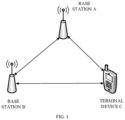
- FIG. 1 illustrates a system architecture of a communication system to which the following implementations of the disclosure are applicable.
- the system architecture includes base station A, base station B, and terminal device C.
- RAN radio access network
- RAN slicing can allow application providers to participate in design, deployment, and operations of a customized RAN, to better support services of the application providers.
- release 17 introduces access-network enhancements of slicing.
- a RAN-side defines one S-NSSAI (that is, single network slice selection assistance information) for each slice.
- a user equipment (UE)-side maintains one NSSAI, where the NSSAI is a list of S-NSSAIs.
- the UE-side can support up to 8 S-NSSAIs.
- the S-NSSAI includes a slice/service type (SST) and a slice differentiator (SD), where the SST represents a service type, and the SD represents different UE groups served under the same SST.
- SST slice/service type
- SD slice differentiator
- a target base station In an existing slice handover (HO) procedure, if a target base station does not support a slice that requires switch by a source base station, the target base station will reject a packet data unit (PDU) session corresponding to the slice, which has a technical problem of service discontinuity during slice HO.
- PDU packet data unit
- the exemplary communication system may be a global system of mobile communication (GSM), a code division multiple access (CDMA) system, a wideband code division multiple access (WCDMA) system, a general packet radio service (GPRS), a long term evolution (LTE) system, an LTE frequency division duplex (FDD) system, an LTE time division duplex (TDD) system, an advanced LTE (LTE-A) system, a new radio (NR) system, an evolved system of the NR system, an LTE-based access to unlicensed spectrum (LTE-U) system, an NR-based access to unlicensed spectrum (NR-U) system, a universal mobile telecommunication system (UMTS), a worldwide interoperability for microwave access (WiMAX) communication system, a wireless local area networks (WLAN), a wireless fidelity (WiFi), a next-generation communication system, or other communication systems, etc.
- GSM global system of mobile communication
- CDMA code division multiple access
- WCDMA wideband code division multiple access
- the exemplary communication system specifically includes a network device and a terminal.
- the terminal accesses a mobile communication network provided by the network device
- the terminal and the network device may be in a communication connection through a wireless link
- a mode of communication connection may be a single connectivity mode, a dual connectivity mode, or a multi-connectivity mode.
- the network device may be an LTE base station or an NR base station (also called a gNB base station); and when the mode of communication connection is the dual connectivity mode (which may be implemented through a carrier aggregation (CA) technology or multiple network devices).
- CA carrier aggregation
- the terminal in implementations of the disclosure may include various devices with wireless communication functions such as handheld devices, in-vehicle devices, wearable devices, computing devices or other processing devices connected to a wireless modem, and various forms of UEs, mobile stations (MS), terminal devices, etc.
- terminal device the devices mentioned above are collectively referred to as "terminal device”.
- system and "network” herein are usually used interchangeably throughout this disclosure.
- the term “and/or” herein only describes an association relationship between associated objects, which means that there can be three relationships. For example, A and/or B can mean A alone, both A and B exist, and B alone.
- the character “j” herein generally indicates that the associated objects are in an "or" relationship.
- B corresponding to A indicates that B is associated with A, and B may be determined according to A.
- determination B according to A does not mean that B is determined according to A only, and B may also be determined according to A and/or other information.
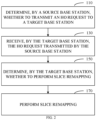
- FIG. 2 is a flowchart of a method for network slice HO according to implementation I of the disclosure which corresponds to the claimed embodiment. As illustrated in FIG. 2 , the method is applicable to a target base station and includes the following.
- Step 130 the target base station receives an HO request transmitted by a source base station.
- Step 150 the target base station determines whether to perform slice remapping.
- the HO request indicates that the target base station performs slice HO.
- the target base station determines whether to perform slice remapping.
- the manner of determining whether to perform slice remapping may be that the target base station performs admission control.
- slice remapping may also be slice fallback.
- step 150 may include the following.
- Step 1511 the target base station determines whether to perform slice remapping.
- step 1511 may include the following. If a first condition is satisfied, the target base station determines to perform slice remapping. The first condition is used for the target base station to determine whether to perform slice remapping, and the first condition is determined by the target base station according to the first slice information.
- step 1511 may include the following.
- the target base station determines to perform slice remapping on condition that a slice supported by the target base station is different from a slice that requires switch by a terminal device requesting HO.
- the target base station determines whether to perform slice remapping.
- the first slice information may be obtained from an orbital angular momentum (OAM), and/or obtained from an access and mobility management function (AMF), and/or obtained from a neighbouring base station.
- OAM orbital angular momentum
- AMF access and mobility management function
- the target base station determines, according to the first slice information, whether the first condition is satisfied, and/or if the target base station determines that the first condition is satisfied, on condition that the slice supported by the target base station is different from the slice that requires switch by the terminal device requesting HO, the target base station determines to perform slice remapping.
- the first slice information includes at least one of: a slice support capability of the target base station, a slice supported by the source base station, a slice corresponding to a PDU session currently established by the terminal device at the source base station, a slice supported by the target base station, a service corresponding to a slice corresponding to an original PDU session, a group that a slice corresponding to an original PDU session belongs to (slices in the same group can be remapped to each other), an indication of whether a default slice corresponding to the target base station is supported, whether a PDU session and/or slice that requires switch has a requirement and/or indication for HO service continuity, or whether a PDU session and/or slice that requires switch but is not supported by the target is a highest priority service and/or slice.
- the first condition includes at least one of: the target base station has a slice support capability, where the slice support capability includes a remapping capability; the target base station does not support a slice corresponding to a PDU session requested by the source base station, but supports a default slice; a slice corresponding to a PDU session established at the source base station by the terminal device requesting HO and a slice supported by the target base station have the same SST field, but have different SDs; a slice corresponding to a PDU session established at the source base station by the terminal device requesting HO and a slice supported by the target base station are different, but correspond to a same service; a slice corresponding to a PDU session established at the source base station by the terminal device requesting HO and a slice supported by the target base station are different, but services corresponding to the two slices belong to a same service group; a slice corresponding to a PDU session established at the source base station by the terminal device requesting HO and a slice supported by the target base station are different, but
- the method may further include the following.
- Step 170 perform slice remapping.
- step 170 may include the following.
- a mapping between original PDU sessions and (user) data radio bearers (DRB) is modified into a mapping between new PDU sessions and DRBs.
- DRB data radio bearers
- modifying the mapping between original PDU sessions and DRBs into the mapping between new PDU sessions and DRBs may include at least one of the following.
- Step 1701 the target base station transmits an HO request acknowledge (ACK) to the source base station.
- the ACK contains new-PDU-session information and/or notifies a data forwarding tunnel for a DRB corresponding to a PDU session to-be-remapped.
- the new-PDU-session information includes at least one of: a remapping indication, an original-PDU-session identity (ID), a slice corresponding to an original PDU session, a slice corresponding to a new PDU session, a new-PDU-session ID, the mapping between original PDU sessions and DRBs, or the mapping between new PDU sessions and DRB.
- the PDU session to-be-remapped may be a data forwarding tunnel for a DRB corresponding to a new PDU session.
- Step 1702 the source base station forwards data corresponding to the original PDU sessions to the target base station via the data forwarding tunnel, and transmits an HO command to the terminal device requesting HO.
- Step 1703 the target base station transmits a path switch request to an AMF.
- the path switch request is N2 path switch request.
- the path switch request may contain a list of PDU sessions to-be-remapped with a remapping cause per PDU session, where the cause includes slice remapping, and the list includes the original-PDU-session ID and/or the new-PDU-session ID.
- Step 1704 the AMF transmits a slice-management-function update-session-management-context request (referred to as "Nsmf_PDUSession_UpdateSMContext Request") to a session management function (SMF).
- the Nsmf_PDUSession_UpdateSMContext Request contains at least one of the list of PDU sessions to-be-remapped (referred to as “PDU session to-be-remapped with a remapping cause”), a PDU session remapping indication (referred to as "PDU session is to be remapped”), or a remapping cause.
- Step 1705 the SMF triggers a PDU session modification and/or establishment procedure, to modify an existing PDU session and/or add a new PDU session.
- the SMF may notify the terminal device (i.e. UE) to establish a new PDU session.
- Step 1706 the SMF transmits to a user plane function (UPF) a session modification request (the session modification request is N4 session modification request), to trigger an end marker.
- UPF user plane function
- Step 1707 the UPF transmits a session modification response to the SMF.
- the session modification response is N4 session modification response.
- Step 1708 the UPF transmits the end marker to the source base station.
- Step 1709 the SMF transmits a slice-management-function update-session-management-context response (referred to as "Nsmf_PDUSession_UpdateSMContext Response") to the AMF, to indicate that the list of PDU sessions is remapped successfully.
- Nsmf_PDUSession_UpdateSMContext Response may indicate a list of PDU sessions that are remapped successfully.
- Step 1710 the AMF transmits a path switch request ACK to the target base station.
- the path switch request ACK is N2 path switch request ACK.
- the path switch request ACK contains a list of remapped PDU sessions (referred to as "remapped-PDU-session list").
- Step 1711 the target base station transmits a release resource to the source base station after switch succeeds.
- the method for slice HO may further include the following.
- Step 110 the source base station determines whether to transmit the HO request to the target base station.
- Whether to transmit the HO request to the target base station may be determined in two manners.
- step 110 includes the following.
- Step 1111 the source base station determines whether to transmit the HO request to the target base station according to second slice information.
- step 1111 includes the following.
- the source base station determines, according to the second slice information, whether a second condition is satisfied.
- the source base station determines whether to transmit the HO request to the target base station.
- step 1111 includes the following. If a second condition is satisfied, the source base station transmits the HO request to the target base station.
- the second condition is used for the source base station to determine whether to transmit the HO request to the target base station, and the second condition is determined by the source base station according to the second slice information.
- the second slice information includes at least one of: a slice support capability of the target base station, a slice supported by the source base station, a slice corresponding to a PDU session currently established by the terminal device at the source base station, a slice supported by the target base station, a service corresponding to a slice corresponding to an original PDU session, a group that a slice corresponding to an original PDU session belongs to, or an indication of whether a default slice corresponding to the target base station is supported.
- the second condition includes at least one of: the target base station has a slice support capability, where the slice support capability may include a remapping capability; existence of an indication that a default slice corresponding to the target base station is supported; a slice supported by the source base station is the same as a slice supported by the target base station, or is a subset of slices supported by the target base station; a slice corresponding to a PDU session currently established by the terminal device at the source base station is the same as a slice supported by the target base station, or is a subset of slices supported by the target base station, or belongs to a same service group as a service corresponding to the slice supported by the target base station; a service corresponding to a slice supported by the source base station is the same as a service corresponding to a slice supported by the target base station, or is a subset of services corresponding to slices supported by the target base station, or belongs to a same service group as the service corresponding to the slice supported by the target base station; a service corresponding to a slice
- the HO request contains remapping information, where the remapping information includes at least one of: a remapping indication, an original-PDU-session ID, a slice corresponding to an original PDU session, a slice corresponding to a new PDU session, a new-PDU-session ID, a mapping between original PDU sessions and DRBs, or a mapping between new PDU sessions and DRBs.
- the source base station transmits the HO request to the target base station, if the source base station determines, according to the second slice information, that the second condition is satisfied.
- the HO request may contain the remapping information.
- the remapping information includes at least one of: the remapping indication, the original-PDU-session ID, the slice corresponding to an original PDU session, the slice corresponding to a new PDU session, the new-PDU-session ID, the mapping between original PDU sessions and DRBs, or the mapping between new PDU sessions and DRBs (the PDU session may also be replaced by a quality of service (QoS) flow).
- QoS quality of service
- the source base station can still trigger the HO request.
- the procedure thereof is the same as that of legacy HO.
- a condition for determining slice remapping is provided, which ensures efficient implementation of slice remapping and avoids service discontinuity during slice service HO.
- a first-round screening by the source base station is introduced, which avoids delay and waste of interface signaling after transmission of the HO request due to non-support for a slice by the target base station.
- step 110 includes the following.
- Step 1121 the source base station determines an HO request result according to third slice information, where the third slice information is used for determining the HO request result.
- Step 1123 whether to transmit the HO request to the target base station is determined according to the HO request result.
- the HO request may contain the HO request result.
- the third slice information includes at least one of: a slice support capability of the target base station, a slice supported by the source base station, a slice corresponding to a PDU session currently established by the terminal device at the source base station, a slice supported by the target base station, a service corresponding to a slice corresponding to an original PDU session, a group that a slice corresponding to an original PDU session belongs to, an indication of whether a default slice corresponding to the target base station is supported, whether a PDU session and/or slice that requires switch has a requirement and/or indication for HO service continuity, or whether a PDU session and/or slice that requires switch but is not supported by the target is a highest priority service and/or slice.
- the HO request result includes one of the following.
- the HO request will be transmitted, where the HO request carries a slice remapping indication.
- the slice remapping indication may be an HO with slice remapping indication.
- the HO request will be transmitted, where the HO request does not carry the slice remapping indication or carries a no-slice-remapping indication.
- the no-slice-remapping indication is an HO indication and/or an HO without slice remapping indication.
- the HO request will not be transmitted.
- not transmitting HO request may be implemented as a no-HO indication (referred to as "no HO").
- determining, according to the HO request result, whether to transmit to the target base station the HO request containing the HO request result at step 1123 includes the following.
- Step 11231 if a third condition is satisfied, the HO request result is transmitting the HO request with the slice remapping indication.
- the third condition is used for the source base station to determine whether to transmit to the target base station the HO request with the slice remapping indication.
- the third condition is determined according to the third slice information.
- the HO request result is the HO with slice remapping indication.
- the source base station determines that slice remapping is needed.
- the source base station transmits the HO request to the target base station.
- the HO request may carry remapping information, where the remapping information includes at least one of: a remapping indication, an original-PDU-session ID, a slice corresponding to an original PDU session, a slice corresponding to a new PDU session, a new-PDU-session ID, a mapping between original PDU sessions and DRBs, or a mapping between new PDU sessions and DRBs (the PDU session may also be replaced by a QoS flow).
- Step 11233 when the third condition is not satisfied and/or a fourth condition is satisfied, the HO request result is transmitting the HO request without the slice remapping indication or with the no-slice-remapping indication.
- the no-slice-remapping indication is used for the target base station to determine to perform HO without slice remapping, when an HO request indicating not to perform slice remapping is received by the target base station.
- the fourth condition is used for the source base station to determine whether to transmit to the target base station the HO request without the slice remapping indication or with the no-slice-remapping indication.
- the third condition and/or the fourth condition is determined according to the third slice information.
- Step 11235 when the third condition is not satisfied and/or the fourth condition is not satisfied, the HO request result is not transmitting the HO request.
- the HO request result is the no-HO indication (that is, the source base station does not transmit the HO request to the target base station) if the following condition is satisfied: the target base station does not support a slice, and/or a PDU session and/or slice that requires switch but is not supported by the target is not a highest priority service and/or slice, and/or a PDU session and/or slice that requires switch has no requirement and/or indication for HO service continuity.
- the third condition and/or the fourth condition is determined according to the third slice information.
- the third condition includes at least one of: the target base station has a slice support capability, where the slice support capability may include a remapping capability; existence of an indication that a default slice corresponding to the target base station is supported; a slice supported by the source base station is the same as a slice supported by the target base station, or is a subset of slices supported by the target base station; a slice corresponding to a PDU session currently established by the terminal device at the source base station is the same as a slice supported by the target base station, or is a subset of slices supported by the target base station; a service corresponding to a slice supported by the source base station is the same as a service corresponding to a slice supported by the target base station, or is a subset of services corresponding to slices supported by the target base station; a service corresponding to a slice corresponding to a PDU session currently established by the terminal device at the source base station is the same as a service corresponding to a slice supported by the target base station, or is a subset of services
- the fourth condition includes at least one of: the target base station does not support a slice, and may have a slicing capability; a slice corresponding to a PDU session currently established by the terminal device at the source base station is the same as a slice supported by the target base station; a PDU session and/or slice that requires switch but is not supported by the target is not a highest priority service and/or slice; or a PDU session and/or slice that requires switch has no requirement and/or indication for HO service continuity.
- a slice corresponding to a PDU session currently established by the terminal device at the source base station is different from a slice supported by the target base station; and/or a service corresponding to a slice corresponding to a PDU session currently established by the terminal device at the source base station is different from a service corresponding to a slice supported by the target base station.
- the HO request is transmitted only on condition that the source base station determines that the target can perform remapping or the target is required to perform remapping (for example, slice remapping may not be required if a slice that requires switch is not supported by the target, and service continuity does not need to be guaranteed), and the target base station is required explicitly to perform slice remapping, which ensures implementation of slice remapping and avoids delay and waste of interface signaling after transmission of the HO request due to the target base station not supporting a slice or no slice remapping being performed. Furthermore, the target base station performs corresponding operations only if the source base station determines that remapping is needed, which reduces complexity in implementation of a base station.
- the target base station may determine whether to perform slice remapping at step 150 in one of the following manners.
- step 150 includes following.
- Step 1511 according to the first slice information, the target base station determines whether to perform slice remapping.
- step 150 includes following.
- Step 1513 if a fifth condition is satisfied, the target base station determines to perform slice remapping.
- the target base station determines to perform slice remapping if the fifth condition is satisfied.
- step 150 includes following.
- Step 1513 if a fifth condition is satisfied, the target base station determines to perform slice remapping.
- the target base station determines to perform slice remapping at step 1513 as follows.
- Step 15131 upon determining, according to the HO request, that the fifth condition is satisfied, the target base station determines to perform slice remapping.
- the target base station determines to perform slice remapping upon determining that the fifth condition is satisfied according to the HO request, where the HO request result is the HO with slice remapping indication.
- the target base station determines to perform HO without slice remapping.
- Step 15133 regardless of the HO request result in the HO request, the target base station determines to perform slice remapping if the fifth condition is satisfied.
- the fifth condition includes at least one of: unconditionally; a slice supported by the target base station is different from a slice that requires switch by the terminal device requesting HO; the target base station has a slice support capability, where the slice support capability includes a remapping capability; the target base station does not support a slice corresponding to a PDU session requested by the source base station, but supports a default slice; a slice corresponding to a PDU session established at the source base station by the terminal device requesting HO and a slice supported by the target base station have the same SST field, but have different SDs; a slice corresponding to a PDU session established at the source base station by the terminal device requesting HO and a slice supported by the target base station are different, but correspond to a same service; a slice corresponding to a PDU session established at the source base station by the terminal device requesting HO and a slice supported by the target base station are different, but services corresponding to the two slices belong to a same service group; or a slice corresponding to
- the slice is identified by at least one of an S-NSSAI or a network slice identity (NSID).
- S-NSSAI S-NSSAI
- NSID network slice identity
- steps 1701 and 1702 need to be performed after step 1710. If a new PDU session is a PDU session that has already been established by the terminal device, steps 1701 and 1702 may remain unchanged in execution order, or may take place after step 1710.
- a new PDU session is a PDU session that has not been established by the terminal device, the new PDU session needs to be established, to correspond to a DRB corresponding to an existing original PDU session. If a new PDU session is a PDU session that has already been established by the terminal device, the original PDU session and the DRB will be deleted, and data of the original DRB may be forwarded to a path for the new PDU session and passed to the UPF via N3.
- all session lists may be slice lists, or a session list contains slice information.
- remapping may be replaced by fallback.
- This embodiment provides a condition for determining slice remapping that is selected by the target base station for performing slice remapping, which ensures efficient implementation of slice remapping and avoids service discontinuity during HO of slice services.
- the target base station receives the HO request transmitted by the source base station, and the target base station determines whether to perform slice remapping. As such, upon receiving the HO request transmitted by the source base station, the target base station can determine whether to perform slice remapping. By performing slice remapping at the target base station, it is possible to ensure HO service continuity during slice HO, thereby solving a technical problem of service discontinuity during slice HO.
- FIG. 4 is a block diagram of an apparatus for network slice HO provided in implementation II of the disclosure.
- the apparatus is a target base station, and may include but is not limited to a receiving module 230 and a determining module 250.
- the receiving module 230 is configured for the target base station to receive an HO request transmitted by a source base station.
- the determining module 250 is configured for the target base station to determine whether to perform slice remapping.
- the determining module 250 is further configured for the target base station to determine whether to perform slice remapping according to first slice information.
- the determining module 250 is further configured for the target base station to determine to perform slice remapping when a first condition is satisfied.
- the first condition is used for the target base station to determine whether to perform slice remapping, and the first condition is determined by the target base station according to the first slice information.
- the determining module 250 is further configured for the target base station to determine to perform slice remapping on condition that a slice supported by the target base station is different from a slice that requires switch by a terminal device requesting HO, upon determining that the first condition is satisfied according to the first slice information.
- the first slice information includes at least one of: a slice support capability of the target base station, a slice supported by the source base station, a slice corresponding to a PDU session currently established by the terminal device at the source base station, a slice supported by the target base station, a service corresponding to a slice corresponding to an original PDU session, a group that a slice corresponding to an original PDU session belongs to, an indication of whether a default slice corresponding to the target base station is supported, whether a PDU session and/or slice that requires switch has a requirement and/or indication for HO service continuity, or whether a PDU session and/or slice that requires switch but is not supported by the target is a highest priority service and/or slice.
- the first condition includes at least one of: the target base station has a slice support capability, where the slice support capability includes a remapping capability; the target base station does not support a slice corresponding to a PDU session requested by the source base station, but supports a default slice; a slice corresponding to a PDU session established at the source base station by the terminal device requesting HO and a slice supported by the target base station have the same SST field, but have different SDs; a slice corresponding to a PDU session established at the source base station by the terminal device requesting HO and a slice supported by the target base station are different, but correspond to a same service; a slice corresponding to a PDU session established at the source base station by the terminal device requesting HO and a slice supported by the target base station are different, but services corresponding to the two slices belong to a same service group; a slice corresponding to a PDU session established at the source base station by the terminal device requesting HO and a slice supported by the target base station are different, but
- the apparatus further includes a remapping module 270.
- the remapping module 270 is configured to perform slice remapping.
- the remapping module 270 is further configured to modify a mapping between original PDU sessions and DRBs into a mapping between new PDU sessions and DRBs.
- the remapping module 270 is further configured for the target base station to transmit an HO request ACK to the source base station.
- the ACK contains new-PDU-session information and/or notifies a data forwarding tunnel for a DRB corresponding to a PDU session to-be-remapped
- the new-PDU-session information includes at least one of: a remapping indication, an original-PDU-session ID, a slice corresponding to an original PDU session, a slice corresponding to a new PDU session, a new-PDU-session ID, the mapping between original PDU sessions and DRBs, or the mapping between new PDU sessions and DRBs.
- the remapping module 270 is further configured for the source base station to forward data corresponding to the original PDU sessions to the target base station via the data forwarding tunnel, and transmit an HO command to the terminal device requesting HO.
- the remapping module 270 is further configured for the target base station to transmit a path switch request to an AMF.
- the remapping module 270 is further configured for the AMF to transmit a slice-management-function update-session-management-context request to an SMF.
- the slice-management-function update-session-management-context request contains at least one of a list of PDU sessions to-be-remapped, a PDU session remapping indication, or a remapping cause.
- the remapping module 270 is further configured for the SMF to trigger a PDU session modification and/or establishment procedure, to modify an existing PDU session and/or add a new PDU session.
- the remapping module 270 is further configured for the SMF to transmit a session modification request to a UPF.
- the remapping module 270 is further configured for the UPF to transmit a session modification response to the SMF.
- the remapping module 270 is further configured for the UPF to transmit an end marker to the source base station.
- the remapping module 270 is further configured for the SMF to transmit a slice-management-function update-session-management-context response to the AMF, to indicate that the list of PDU sessions is remapped successfully.
- the remapping module 270 is further configured for the target base station to receive a path switch request ACK transmitted by the AMF, where the path switch request ACK contains a list of remapped PDU sessions.
- the remapping module 270 is further configured for the target base station to transmit a release resource to the source base station after switch succeeds.
- the apparatus may further include, but is not limited to, a transmission-determining module 210.
- the transmission-determining module 210 is configured for the source base station to determine whether to transmit the HO request to the target base station.
- the transmission-determining module 210 is further configured for the source base station to determine whether to transmit the HO request to the target base station according to second slice information.
- the transmission-determining module 210 is further configured for the source base station to transmit the HO request to the target base station when a second condition is satisfied.
- the second condition is used for the source base station to determine whether to transmit the HO request to the target base station, and the second condition is determined by the source base station according to the second slice information.
- the second slice information includes at least one of: a slice support capability of the target base station, a slice supported by the source base station, a slice corresponding to a PDU session currently established by the terminal device at the source base station, a slice supported by the target base station, a service corresponding to a slice corresponding to an original PDU session, a group that a slice corresponding to an original PDU session belongs to, or an indication of whether a default slice corresponding to the target base station is supported.
- the second condition includes at least one of: the target base station has a slice support capability; existence of an indication that a default slice corresponding to the target base station is supported; a slice supported by the source base station is the same as a slice supported by the target base station, or is a subset of slices supported by the target base station; a slice corresponding to a PDU session currently established by the terminal device at the source base station is the same as a slice supported by the target base station, or is a subset of slices supported by the target base station, or belongs to a same service group as a service corresponding to the slice supported by the target base station; a service corresponding to a slice supported by the source base station is the same as a service corresponding to a slice supported by the target base station, or is a subset of services corresponding to slices supported by the target base station, or belongs to a same service group as the service corresponding to the slice supported by the target base station; a service corresponding to a slice corresponding to a PDU session currently established by the terminal device
- the HO request contains remapping information, where the remapping information includes at least one of: a remapping indication, an original-PDU-session ID, a slice corresponding to an original PDU session, a slice corresponding to a new PDU session, a new-PDU-session ID, a mapping between original PDU sessions and DRBs, or a mapping between new PDU sessions and DRBs.
- the transmission-determining module 210 is further configured for the source base station to determine an HO request result according to third slice information, where the third slice information is used for determining the HO request result.
- the transmission-determining module 210 is further configured to determine, according to the HO request result, whether to transmit the HO request to the target base station, where the HO request contains the HO request result.
- the third slice information includes at least one of: a slice support capability of the target base station, a slice supported by the source base station, a slice corresponding to a PDU session currently established by the terminal device at the source base station, a slice supported by the target base station, a service corresponding to a slice corresponding to an original PDU session, a group that a slice corresponding to an original PDU session belongs to, an indication of whether a default slice corresponding to the target base station is supported, whether a PDU session and/or slice that requires switch has a requirement and/or indication for HO service continuity, or whether a PDU session and/or slice that requires switch but is not supported by the target is a highest priority service and/or slice.
- the HO request result includes one of: transmitting the HO request with a slice remapping indication, transmitting the HO request without the slice remapping indication or with a no-slice-remapping indication, or not transmitting the HO request.
- the transmission-determining module 210 is further configured to, when a third condition is satisfied, the HO request result is transmitting the HO request with the slice remapping indication.
- the third condition is used for the source base station to determine whether to transmit to the target base station the HO request with the slice remapping indication.
- the transmission-determining module 210 is further configured to, when the third condition is not satisfied and/or a fourth condition is satisfied, the HO request result is transmitting the HO request without the slice remapping indication or with the no-slice-remapping indication.
- the no-slice-remapping indication is used for the target base station to determine to perform HO without slice remapping when an HO request without slice remapping is received by the target base station.
- the fourth condition is used for the source base station to determine whether to transmit to the target base station the HO request without the slice remapping indication or with the no-slice-remapping indication.
- the transmission-determining module 210 is further configured to, when the third condition is not satisfied and/or the fourth condition is not satisfied, the HO request result is not transmitting the HO request.
- the third condition includes at least one of: the target base station has a slice support capability; existence of an indication that a default slice corresponding to the target base station is supported; a slice supported by the source base station is the same as a slice supported by the target base station, or is a subset of slices supported by the target base station; a slice corresponding to a PDU session currently established by the terminal device at the source base station is the same as a slice supported by the target base station, or is a subset of slices supported by the target base station; a service corresponding to a slice supported by the source base station is the same as a service corresponding to a slice supported by the target base station, or is a subset of services corresponding to slices supported by the target base station; a service corresponding to a slice corresponding to a PDU session currently established by the terminal device at the source base station is the same as a service corresponding to a slice supported by the target base station, or is a subset of services corresponding to slices supported by the target base station; a slice corresponding
- the fourth condition includes at least one of: the target base station does not support a slice; a slice corresponding to a PDU session currently established by the terminal device at the source base station is the same as a slice supported by the target base station; a PDU session and/or slice that requires switch but is not supported by the target is not a highest priority service and/or slice; or a PDU session and/or slice that requires switch has no requirement and/or indication for HO service continuity.
- the PDU session and/or slice that requires switch but is not supported by the target is not the highest priority service and/or slice and/or the PDU session and/or slice that requires switch has no requirement and/or indication for HO service continuity further includes the following.
- a slice corresponding to a PDU session currently established by the terminal device at the source base station is different from a slice supported by the target base station, and/or a service corresponding to a slice corresponding to a PDU session currently established by the terminal device at the source base station is different from a service corresponding to a slice supported by the target base station.
- the determining module 250 is further configured for the target base station to determine to perform slice remapping when a fifth condition is satisfied, where the fifth condition is used for the target base station to determine whether to perform slice remapping.
- the fifth condition includes at least one of: unconditionally; a slice supported by the target base station is different from a slice that requires switch by the terminal device requesting HO; the target base station has a slice support capability, where the slice support capability includes a remapping capability; the target base station does not support a slice corresponding to a PDU session requested by the source base station, but supports a default slice; a slice corresponding to a PDU session established at the source base station by the terminal device requesting HO and a slice supported by the target base station have the same SST field, but have different SDs; a slice corresponding to a PDU session established at the source base station by the terminal device requesting HO and a slice supported by the target base station are different, but correspond to a same service; a slice corresponding to a PDU session established at the source base station by the terminal device requesting HO and a slice supported by the target base station are different, but services corresponding to the two slices belong to a same service group; or a slice corresponding to
- the slice is identified by at least one of an S-NSSAI or an NSID.
- FIG. 5 is a block diagram of an apparatus for network slice HO provided in implementation III of the disclosure.
- the apparatus is a source base station.
- the apparatus may include but is not limited to a transmitting module 330 and a receiving module 350.
- the transmitting module 330 is configured for the source base station to transmit an HO request to a target base station.
- the HO request is used for the target base station to determine whether to perform slice remapping when the HO request is received by the target base station.
- the receiving module 350 is configured for the source base station to receive an HO request ACK fedback by the target base station.
- the HO request ACK contains new-PDU-session information and/or notifies a data forwarding tunnel for a DRB corresponding to a PDU session to-be-remapped.
- the apparatus may further include but is not limited to a determining module 310.
- the determining module 310 is configured for the source base station to determine whether to transmit the HO request to the target base station.
- the determining module 310 is further configured for the source base station to determine whether to transmit the HO request to the target base station according to second slice information.
- the determining module 310 is further configured for the source base station to transmit the HO request to the target base station if a second condition is satisfied.
- the second condition is used for the source base station to determine whether to transmit the HO request to the target base station, and the second condition is determined by the source base station according to the second slice information.
- the determining module 310 is further configured for the source base station to determine an HO request result according to third slice information, where the third slice information is used for determining the HO request result.
- the determining module 310 is further configured to determine, according to the HO request result, whether to transmit the HO request to the target base station, where the HO request contains the HO request result.
- the transmitting module 330 is further configured to forward data corresponding to an original PDU session to the target base station via the data forwarding tunnel, and transmit an HO command to a terminal device requesting HO.
- the receiving module 350 is further configured to receive an end marker transmitted by a UPF, and receive a release resource transmitted by the target base station.
- FIG. 6 is a hardware structural diagram of an apparatus for network slice HO provided in implementation IV of the disclosure. As illustrated in FIG. 6 , the apparatus includes a processor 410 and a memory 420. The various assemblies above of the apparatus are in a communication connection with each other via a bus system.
- the memory 420 is configured to store programs executable by the processor 410.
- the processor 410 when executing the programs, implements some or all operations of the foregoing method for network slice HO in implementation I of the disclosure.
- the processor 410 may be a separate component, or may be a collective term for multiple processing components.
- the processor 410 may be a central processing unit (CPU), or may be an application specific integrated circuit (ASIC), or may be one or more integrated circuits configured to implement the foregoing method such as at least one microprocessor (e.g. digital signal processor (DSP)) or at least one field programmable gate array (FPGA), etc.
- DSP digital signal processor
- FPGA field programmable gate array
- the steps of the method or algorithm described in implementations of the disclosure may be implemented by means of hardware, or may be implemented by executing software instructions by a processor.
- the software instructions can be implemented by corresponding software modules, which can be stored in a random access memory (RAM), a flash memory, a read only memory (ROM), an erasable programmable ROM (EPROM), an electrically EPROM (EEPROM), registers, hard disk, mobile hard disk, compact disc (CD)-ROM, or any other form of storage medium known in the art.
- An exemplary storage medium is coupled to the processor, such that the processor can read information from the storage medium and write information to the storage medium.
- the storage medium can also be a component of the processor.
- the processor and the storage medium may be located in an ASIC.
- the ASIC can be located in an access-network device, a target network device, or a core-network device.
- the processor and the storage medium may also be present as discrete components in the access-network device, the target network device, or the core-network device.
- all or part of functions described in implementations of the disclosure can be implemented through software, hardware, firmware, or any other combination thereof.
- all or part of the functions can be implemented in the form of a computer program product.
- the computer program product includes one or more computer instructions.
- the computer can be a general-purpose computer, a special-purpose computer, a computer network, or other programmable apparatuses.
- the computer instruction can be stored in a computer-readable storage medium, or transmitted from one computer-readable storage medium to another computer-readable storage medium.
- the computer instruction can be transmitted from one website, computer, server, or data center to another website, computer, server, or data center in a wired manner or in a wireless manner.
- the wired manner can be a coaxial cable, an optical fiber, a digital subscriber line (DSL), etc.
- the wireless manner can be, for example, infrared, wireless, microwave, etc.
- the computer-readable storage medium can be any computer accessible usable-medium or a data storage device such as a server, a data center, or the like which integrates one or more usable media.
- the usable medium can be a magnetic medium (such as a soft disc, a hard disc, or a magnetic tape), an optical medium (such as a digital video disc (DVD)), or a semiconductor medium (such as a solid state disk (SSD)), etc.
- a magnetic medium such as a soft disc, a hard disc, or a magnetic tape
- an optical medium such as a digital video disc (DVD)
- a semiconductor medium such as a solid state disk (SSD)
Landscapes
- Engineering & Computer Science (AREA)
- Computer Networks & Wireless Communication (AREA)
- Signal Processing (AREA)
- Mobile Radio Communication Systems (AREA)
Claims (15)
- Verfahren zur Übergabe (HO) von Netzwerk-Slices, das von einer Ziel-Basisstation ausgeführt wird und Folgendes umfasst:Empfangen (130), durch die Ziel-Basisstation, einer HO-Anforderung, die von einer Quell-Basisstation gesendet wurde; undBestimmen (150), durch die Ziel-Basisstation, ein Slice-Remapping durchzuführen, wenn eine erste Bedingung erfüllt ist,wobei die erste Bedingung für die Ziel-Basisstation verwendet wird, um zu bestimmen, ob ein Slice-Remapping durchgeführt werden soll, und die erste Bedingung von der Ziel-Basisstation gemäß der ersten Slice-Information bestimmt wird,wobei die erste Slice-Information von der Ziel-Basisstation von einer Zugangs- und Mobilitätsverwaltungsfunktion (AMF) und/oder einer benachbarten Basisstation erhalten wird,wobei die erste Slice-Information Folgendes umfasst:
ob eine Paketdateneinheits-(PDU)-Sitzung und/oder ein Slice, die/das eine Umschaltung erfordert, eine Anforderung für die Kontinuität des HO-Dienstes hat; und wobei die erste Bedingung Folgendes umfasst:
eine PDU-Sitzung und/oder ein Slice, für die/das eine Umschaltung erforderlich ist, muss die Kontinuität des HO-Dienstes gewährleisten. - Verfahren nach Anspruch 1,
wobei die erste Slice-Information ferner mindestens eines der folgenden Elemente umfasst:eine Slice-Unterstützungsfähigkeit der Ziel-Basisstation;ein von der Quell-Basisstation unterstütztes Slice;ein Slice, das einer PDU-Sitzung entspricht, die derzeit von dem Endgerät an der Quell-Basisstation aufgebaut wird;ein von der Ziel-Basisstation unterstütztes Slice;einen Dienst, der einem Slice entspricht, das einer ursprünglichen PDU-Sitzung entspricht;eine Gruppe, zu der ein Slice gehört, das einer ursprünglichen PDU-Sitzung entspricht;eine Angabe darüber, ob ein der Ziel-Basisstation entsprechendes Standard-Slice unterstützt wird;ob eine PDU-Sitzung und/oder ein Slice, für die/das ein Switch erforderlich ist, einen Hinweis auf die Kontinuität des HO-Dienstes hat; oderob eine PDU-Sitzung und/oder ein Slice, die/das einen Switch erfordert, aber vom Ziel nicht unterstützt wird, ein Dienst und/oder Slice höchster Priorität ist. - Verfahren nach Anspruch 2,
wobei die erste Bedingung ferner mindestens eines der folgenden Elemente umfasst:die Ziel-Basisstation besitzt eine Slice-Unterstützungsfähigkeit, wobei die Slice-Unterstützungsfähigkeit eine Remapping-Fähigkeit umfasst;die Ziel-Basisstation unterstützt kein Slice, das einer von der Quell-Basisstation angeforderten PDU-Sitzung entspricht, sondern ein Standard-Slice;ein Slice, das einer PDU-Sitzung entspricht, die an der Quell-Basisstation durch das Endgerät, das ein HO anfordert, eingerichtet wurde, und ein Slice, das von der Ziel-Basisstation unterstützt wird, das gleiche Slice/Service-Typ-Feld (SST) haben, aber unterschiedliche Slice-Differenzierer (SD) aufweisen;wobei ein Slice, das einer PDU-Sitzung entspricht, die von dem Endgerät, das ein HO anfordert, an der Quell-Basisstation eingerichtet wurde, und ein Slice, das von der Ziel-Basisstation unterstützt wird, unterschiedlich sind, aber demselben Dienst entsprechen;ein Slice, das einer PDU-Sitzung entspricht, die an der Quell-Basisstation durch das Endgerät, das ein HO anfordert, eingerichtet wurde, und ein Slice, das von der Ziel-Basisstation unterstützt wird, unterschiedlich sind, aber die Dienste, die den beiden Slices entsprechen, zu einer gleichen Dienstgruppe gehören;ein Slice, das einer PDU-Sitzung entspricht, die an der Quell-Basisstation von dem Endgerät, das ein HO anfordert, eingerichtet wurde, und ein Slice, das von der Ziel-Basisstation unterstützt wird, unterschiedlich sind, aber zur gleichen Slice-Gruppe gehören;eine PDU-Sitzung und/oder ein Slice, für die/das eine Umschaltung erforderlich ist, hat eine Anzeige für die Kontinuität des HO-Dienstes; odereine PDU-Sitzung und/oder ein Slice, die/das eine Umschaltung erfordert, aber vom Ziel nicht unterstützt wird, ist ein Dienst und/oder Slice mit höchster Priorität. - Verfahren nach einem der Ansprüche 1 bis 3, das ferner Folgendes umfasst:
Durchführen von (170) Slice-Remapping. - Verfahren nach Anspruch 4,
wobei die Durchführung des Slice-Remappings Folgendes umfasst:
Ändern eines Mappings zwischen ursprünglichen PDU-Sitzungen und Datenfunkträgern (DRB) in ein Mapping zwischen neuen PDU-Sitzungen und DRBs. - Verfahren nach Anspruch 5,
wobei das Ändern des Mappings zwischen ursprünglichen PDU-Sitzungen und DRBs in das Mapping zwischen neuen PDU-Sitzungen und DRBs mindestens eines der folgenden Elemente umfasst:
Übertragen, durch die Ziel-Basisstation, einer HO-Anforderungsbestätigung (ACK) an die Quell-Basisstation, wobei die ACK Informationen über eine neue PDU-Sitzung enthält und/oder einen Datenweiterleitungstunnel für einen DRB anzeigt, der einer neu zuzuordnenden PDU-Sitzung entspricht, und die Informationen über die neue PDU-Sitzung mindestens eines der folgenden Elemente umfassen:eine Remapping-Angabe, eine Original-PDU-Sitzungsidentität (ID), ein Slice, das einer ursprünglichen PDU-Sitzung entspricht, ein Slice, das einer neuen PDU-Sitzung entspricht, eine neue PDU-Sitzungs-ID, die Zuordnung zwischen ursprünglichen PDU-Sitzungen und DRBs oder die Zuordnung zwischen neuen PDU-Sitzungen und DRBs;wobei Daten, die den ursprünglichen PDU-Sitzungen entsprechen, von der Quell-Basisstation über den Datenweiterleitungstunnel an die Ziel-Basisstation weitergeleitet werden, und ein HO-Befehl an das Endgerät, das ein HO von der Quell-Basisstation anfordert, übertragen wird;Übertragen, durch die Ziel-Basisstation, einer Pfadwechselanfrage an eine Zugangs- und Mobilitätsverwaltungsfunktion (AMF);wobei eine Anfrage zur Aktualisierung des Sitzungsverwaltungskontextes der Slice-Verwaltungsfunktion (slice-management-function update-session-management-context) von der AMF an eine Sitzungsverwaltungsfunktion (SMF) übermittelt wird,wobei die Anforderung zur Aktualisierung des Sitzungsverwaltungskontextes durch die Slice-Verwaltungsfunktion mindestens eine Liste der neu zuzuordnenden PDU-Sitzungen, eine Anzeige für das Remapping von PDU-Sitzungen oder eine Ursache für das Remapping enthält;ein Verfahren zur Änderung und/oder Einrichtung einer PDU-Sitzung vom SMF ausgelöst wird, um eine bestehende PDU-Sitzung zu ändern und/oder eine neue PDU-Sitzung hinzuzufügen;eine Anforderung zur Sitzungsänderung von der SMF an eine Benutzerebenenfunktion (UPF) übermittelt wird;eine Antwort auf die Sitzungsänderung von der UPF an die SMF übermittelt wird;eine Endmarkierung von der UPF an die Quell-Basisstation übertragen wird;eine Antwort zur Aktualisierung des Sitzungsverwaltungskontextes der Slice-Verwaltungsfunktion wird von der SMF an die AMF übertragen, um anzuzeigen, dass die Liste der PDU-Sitzungen erfolgreich neu zugeordnet wurde;Empfangen, durch die Ziel-Basisstation, einer von der AMF gesendeten Pfadwechselanforderungsbestätigung (ACK),wobei die ACK der Pfadwechselanforderung eine Liste der neu zugeordneten PDU-Sitzungen enthält; oderÜbertragen, durch die Ziel-Basisstation einer Freigabe-Ressource an die Quell-Basisstation nach erfolgreicher Umschaltung. - Verfahren nach einem der Ansprüche 1 bis 6,
wobei die Quell-Basisstation bestimmt, ob die HO-Anforderung an die Ziel-Basisstation übertragen werden soll. - Verfahren nach Anspruch 7,
wobei die Quell-Basisstation anhand der zweiten Slice-Information bestimmt, ob die HO-Anforderung an die Ziel-Basisstation übertragen werden soll. - Verfahren nach Anspruch 8,wobei die HO-Anforderung von der Quell-Basisstation an die Ziel-Basisstation übertragen wird, wenn eine zweite Bedingung erfüllt ist,wobei die zweite Bedingung für die Quell-Basisstation verwendet wird, um zu bestimmen, ob die HO-Anforderung an die Ziel-Basisstation übertragen werden soll, und die zweite Bedingung von der Quell-Basisstation gemäß der zweiten Slice-Information bestimmt wird.
- Verfahren nach Anspruch 8 oder 9,
wobei die zweite Slice-Information mindestens eines der folgenden Elemente umfasst:eine Slice-Unterstützungsfähigkeit der Ziel-Basisstation;ein von der Quell-Basisstation unterstütztes Slice;ein Slice, das einer PDU-Sitzung entspricht, die derzeit von dem Endgerät an der Quell-Basisstation aufgebaut wird;ein von der Ziel-Basisstation unterstütztes Slice;einen Dienst, der einem Slice entspricht, das einer ursprünglichen PDU-Sitzung entspricht;eine Gruppe, zu der ein Slice gehört, das einer ursprünglichen PDU-Sitzung entspricht; odereine Angabe darüber, ob ein der Ziel-Basisstation entsprechendes Standard-Slice unterstützt wird. - Verfahren nach Anspruch 10,
wobei die zweite Bedingung mindestens einen der folgenden Punkte umfasst:die Ziel-Basisstation verfügt über eine Slice-Unterstützungsfähigkeit;Vorhandensein eines Hinweises, dass ein der Ziel-Basisstation entsprechendes Standard-Slice unterstützt wird;ein von der Quell-Basisstation unterstütztes Slice ist dasselbe wie ein von der Ziel-Basisstation unterstütztes Slice, oder ist eine Teilmenge der von der Ziel-Basisstation unterstützten Slices;ein Slice, das einer PDU-Sitzung entspricht, die derzeit von dem Endgerät an der Quell-Basisstation aufgebaut wird, ist dasselbe wie ein Slice, das von der Ziel-Basisstation unterstützt wird, oder ist eine Teilmenge von Slices, die von der Ziel-Basisstation unterstützt werden, oder es gehört zu derselben Dienstgruppe wie ein Dienst, der dem Slice entspricht, das von der Ziel-Basisstation unterstützt wird;ein Dienst, der einem von der Quell-Basisstation unterstützten Slice entspricht, ist derselbe wie ein Dienst, der einem von der Ziel-Basisstation unterstützten Slice entspricht, oder er ist eine Teilmenge von Diensten, die den von der Ziel-Basisstation unterstützten Slices entsprechen, oder er gehört zu derselben Dienstgruppe wie der Dienst, der dem von der Ziel-Basisstation unterstützten Slice entspricht;ein Dienst, der einem Slice entspricht, das einer PDU-Sitzung entspricht, die derzeit von dem Endgerät an der Quell-Basisstation aufgebaut wird, ist derselbe wie ein Dienst, der einem Slice entspricht, das von der Ziel-Basisstation unterstützt wird, oder ist eine Teilmenge von Diensten, die Slices entsprechen, die von der Ziel-Basisstation unterstützt werden;ein von der Quell-Basisstation unterstütztes Slice und ein von der Ziel-Basisstation unterstütztes Slice gehören zur selben Gruppe; oderein Slice, das einer PDU-Sitzung entspricht, die derzeit von dem Endgerät an der Quell-Basisstation aufgebaut wird, und ein Slice, das von der Ziel-Basisstation unterstützt wird, gehören zu derselben Gruppe. - Verfahren nach einem der Ansprüche 7 bis 11,
wobei die HO-Anforderung Remapping-Informationen enthält, und die Remapping-Informationen mindestens eines der folgenden Elemente umfassen:
eine Remapping-Angabe, eine Original-PDU-Sitzungs-ID, ein Slice, das einer ursprünglichen PDU-Sitzung entspricht, ein Slice, das einer neuen PDU-Sitzung entspricht, eine neue PDU-Sitzungs-ID, ein Mapping zwischen ursprünglichen PDU-Sitzungen und DRBs oder ein Mapping zwischen neuen PDU-Sitzungen und DRBs. - Ziel-Basisstation für die Übergabe (HO) von Netzwerk-Slices, die Folgendes umfasst:ein Empfangsmodul (230), das so ausgebildet ist, dass es eine von einer Quell-Basisstation übertragene HO-Anforderung empfängt; undein Bestimmungsmodul (250), das so ausgebildet ist, dass es bestimmt, dass ein Slice-Remapping durchgeführt wird, wenn eine erste Bedingung erfüllt ist,wobei die erste Bedingung verwendet wird, um zu bestimmen, ob ein Slice-Remapping durchgeführt werden soll, und die erste Bedingung entsprechend der ersten Slice-Information bestimmt wird,wobei die erste Slice-Information von der Ziel-Basisstation von einer Zugangs- undMobilitätsverwaltungsfunktion (AMF) und/oder einer benachbarten Basisstation erhalten wird,wobei die erste Slice-Information Folgendes umfasst:ob eine Paketdateneinheits-(PDU)-Sitzung und/oder ein Slice, die/das eine Vermittlung erfordert, eine Anforderung an die Kontinuität des HO-Dienstes hat;wobei die erste Bedingung Folgendes umfasst:
eine PDU-Sitzung und/oder ein Slice, für die/das eine Umschaltung erforderlich ist, muss die Kontinuität des HO-Dienstes gewährleisten. - Ziel-Basisstation nach Anspruch 13,
wobei die erste Slice-Information ferner mindestens eines der folgenden Elemente umfasst:eine Slice-Unterstützungsfähigkeit der Ziel-Basisstation;ein von der Quell-Basisstation unterstütztes Slice;ein Slice, das einer PDU-Sitzung entspricht, die derzeit von dem Endgerät an der Quell-Basisstation aufgebaut wird;ein von der Ziel-Basisstation unterstütztes Slice;einen Dienst, der einem Slice entspricht, das einer ursprünglichen PDU-Sitzung entspricht;eine Gruppe, zu der ein Slice gehört, das einer ursprünglichen PDU-Sitzung entspricht;eine Angabe darüber, ob ein der Ziel-Basisstation entsprechendes Standard-Slice unterstützt wird;ob eine PDU-Sitzung und/oder ein Slice, für die/das ein Switch erforderlich ist, einen Hinweis auf die Kontinuität des HO-Dienstes hat; oderob eine PDU-Sitzung und/oder ein Slice, die/das einen Switch erfordert, aber vom Ziel nicht unterstützt wird, ein Dienst und/oder Slice höchster Priorität ist. - Ziel-Basisstation nach Anspruch 14, wobei die erste Bedingung außerdem mindestens eines der folgenden Merkmale umfasst:die Ziel-Basisstation besitzt eine Slice-Unterstützungsfähigkeit, wobei die Slice-Unterstützungsfähigkeit eine Remapping-Fähigkeit umfasst;die Ziel-Basisstation unterstützt kein Slice, das einer von der Quell-Basisstation angeforderten PDU-Sitzung entspricht, sondern ein Standard-Slice;ein Slice, das einer PDU-Sitzung entspricht, die an der Quell-Basisstation durch das Endgerät, das ein HO anfordert, eingerichtet wurde, und ein Slice, das von der Ziel-Basisstation unterstützt wird, das gleiche Slice/Service-Typ-Feld (SST) haben, aber unterschiedliche Slice-Differenzierer (SD) aufweisen;wobei ein Slice, das einer PDU-Sitzung entspricht, die von dem Endgerät, das HO anfordert, an der Quell-Basisstation eingerichtet wurde, und ein Slice, das von der Ziel-Basisstation unterstützt wird, unterschiedlich sind, aber demselben Dienst entsprechen;ein Slice, das einer PDU-Sitzung entspricht, die an der Quell-Basisstation durch das Endgerät, das HO anfordert, eingerichtet wurde, und ein Slice, das von der Ziel-Basisstation unterstützt wird, unterschiedlich sind, aber die Dienste, die den beiden Slices entsprechen, zu einer gleichen Dienstgruppe gehören;ein Slice, das einer PDU-Sitzung entspricht, die an der Quell-Basisstation von dem Endgerät, das HO anfordert, eingerichtet wurde, und ein Slice, das von der Ziel-Basisstation unterstützt wird, unterschiedlich sind, aber zur gleichen Slice-Gruppe gehören;eine PDU-Sitzung und/oder ein Slice, für die/das ein Switch erforderlich ist, hat eine Anzeige für die Kontinuität des HO-Dienstes; odereine PDU-Sitzung und/oder ein Slice, die/das einen Switch erfordert, aber vom Ziel nicht unterstützt wird, ist ein Dienst und/oder Slice mit höchster Priorität.
Applications Claiming Priority (1)
| Application Number | Priority Date | Filing Date | Title |
|---|---|---|---|
| PCT/CN2020/083253 WO2021196171A1 (zh) | 2020-04-03 | 2020-04-03 | 网络切片切换的方法、装置及其设备 |
Publications (3)
| Publication Number | Publication Date |
|---|---|
| EP4132090A1 EP4132090A1 (de) | 2023-02-08 |
| EP4132090A4 EP4132090A4 (de) | 2023-08-23 |
| EP4132090B1 true EP4132090B1 (de) | 2024-11-06 |
Family
ID=77927338
Family Applications (1)
| Application Number | Title | Priority Date | Filing Date |
|---|---|---|---|
| EP20928303.5A Active EP4132090B1 (de) | 2020-04-03 | 2020-04-03 | Verfahren und vorrichtung zur übergabe von netzwerk-slices |
Country Status (4)
| Country | Link |
|---|---|
| US (1) | US20230014464A1 (de) |
| EP (1) | EP4132090B1 (de) |
| CN (1) | CN115336321A (de) |
| WO (1) | WO2021196171A1 (de) |
Families Citing this family (6)
| Publication number | Priority date | Publication date | Assignee | Title |
|---|---|---|---|---|
| EP4138452A4 (de) * | 2020-04-13 | 2023-06-21 | Guangdong Oppo Mobile Telecommunications Corp., Ltd. | Schneideverfahren und -vorrichtung, speichermedium und prozessor |
| US11736906B2 (en) * | 2020-08-06 | 2023-08-22 | Samsung Electronics Co., Ltd. | Method and system for MBS switching and continuity in 5G wireless network |
| US11871285B2 (en) * | 2020-09-24 | 2024-01-09 | Electronics And Telecommunications Research Institute | Handover processing method based slice and device for performing the method |
| WO2023009046A1 (en) * | 2021-07-27 | 2023-02-02 | Telefonaktiebolaget Lm Ericsson (Publ) | Methods for controlling a service session handover between network slices, network nodes and a communications device implementing the methods in a communications network |
| US20250133462A1 (en) * | 2021-11-19 | 2025-04-24 | Qualcomm Incorporated | Wireless communication using multiple network slice services |
| CN120282153B (zh) * | 2025-06-10 | 2025-08-19 | 国网湖北省电力有限公司信息通信公司 | 一种基于5g切片的电站ftu环网建立方法和系统 |
Citations (1)
| Publication number | Priority date | Publication date | Assignee | Title |
|---|---|---|---|---|
| WO2018143769A1 (en) * | 2017-02-06 | 2018-08-09 | Samsung Electronics Co., Ltd. | Method and device for controlling data transmission, method and apparatus for controlling continuity of ue |
Family Cites Families (20)
| Publication number | Priority date | Publication date | Assignee | Title |
|---|---|---|---|---|
| CN109041137B (zh) * | 2016-01-16 | 2020-01-17 | 华为技术有限公司 | 一种切换的方法、基站及终端设备 |
| US10321371B2 (en) * | 2016-04-11 | 2019-06-11 | Telefonaktiebolaget Lm Ericsson (Publ) | Method and apparatus for communication over network slices in wireless communication systems |
| WO2018084593A1 (ko) * | 2016-11-03 | 2018-05-11 | 주식회사 케이티 | 네트워크 슬라이스 기반 데이터 처리 방법 및 그 장치 |
| KR102108871B1 (ko) * | 2016-11-03 | 2020-05-12 | 주식회사 케이티 | 네트워크 슬라이스 기반 데이터 처리 방법 및 그 장치 |
| WO2018135992A1 (en) * | 2017-01-18 | 2018-07-26 | Telefonaktiebolaget Lm Ericsson (Publ) | Systems and methods of mapping a network slice |
| CN108366365B (zh) * | 2017-01-26 | 2021-03-23 | 华为技术有限公司 | 一种接入目标小区的方法以及设备 |
| WO2018170777A1 (en) * | 2017-03-22 | 2018-09-27 | Motorola Mobility Llc | A condition for handover |
| CN110419240B (zh) * | 2017-03-24 | 2023-09-29 | 华为技术有限公司 | 切片兼容的切换控制设备和方法 |
| CN108632927B (zh) * | 2017-03-24 | 2021-08-13 | 华为技术有限公司 | 移动网络切换方法和通信装置 |
| CN113163459B (zh) * | 2017-04-04 | 2024-04-09 | 华为技术有限公司 | 通信方法及通信设备 |
| CN117545105A (zh) * | 2017-05-05 | 2024-02-09 | 华为技术有限公司 | 一种失败处理方法、切换方法及终端设备、网络设备 |
| CN113473646B (zh) * | 2017-11-21 | 2022-04-12 | 华为技术有限公司 | 一种通信方法及装置 |
| US11071025B2 (en) * | 2018-06-29 | 2021-07-20 | FG Innovation Company Limited | Cell handover with minimum mobility interruption |
| CN110838927B (zh) * | 2018-08-15 | 2023-01-03 | 中国移动通信有限公司研究院 | 切片映射重映射方法及接入网网元 |
| CN118019147A (zh) * | 2018-11-01 | 2024-05-10 | 北京三星通信技术研究有限公司 | 用于会话建立的方法、会话管理功能实体、基站和存储介质 |
| CN114885385B (zh) * | 2018-11-19 | 2025-03-14 | 华为技术有限公司 | 一种通信方法及装置 |
| ES2993566T3 (en) * | 2019-02-11 | 2025-01-02 | Nokia Technologies Oy | Enhanced mobility in cellular deployments with network slicing |
| CN118612801A (zh) * | 2019-07-23 | 2024-09-06 | 北京三星通信技术研究有限公司 | 一种支持在移动通信网络中切换的方法 |
| WO2021147099A1 (zh) * | 2020-01-23 | 2021-07-29 | 华为技术有限公司 | 一种网络切片重定向的方法和装置 |
| CN113498129B (zh) * | 2020-04-02 | 2023-03-24 | 维沃移动通信有限公司 | 小区切换方法、小区切换处理方法、终端及网络设备 |
-
2020
- 2020-04-03 WO PCT/CN2020/083253 patent/WO2021196171A1/zh not_active Ceased
- 2020-04-03 CN CN202080098790.5A patent/CN115336321A/zh active Pending
- 2020-04-03 EP EP20928303.5A patent/EP4132090B1/de active Active
-
2022
- 2022-09-26 US US17/952,610 patent/US20230014464A1/en active Pending
Patent Citations (1)
| Publication number | Priority date | Publication date | Assignee | Title |
|---|---|---|---|---|
| WO2018143769A1 (en) * | 2017-02-06 | 2018-08-09 | Samsung Electronics Co., Ltd. | Method and device for controlling data transmission, method and apparatus for controlling continuity of ue |
Also Published As
| Publication number | Publication date |
|---|---|
| CN115336321A (zh) | 2022-11-11 |
| EP4132090A1 (de) | 2023-02-08 |
| WO2021196171A1 (zh) | 2021-10-07 |
| US20230014464A1 (en) | 2023-01-19 |
| EP4132090A4 (de) | 2023-08-23 |
Similar Documents
| Publication | Publication Date | Title |
|---|---|---|
| EP4132090B1 (de) | Verfahren und vorrichtung zur übergabe von netzwerk-slices | |
| EP4026366B1 (de) | Verfahren und vorrichtung für bedingten pscell-wechsel | |
| EP3913974B1 (de) | Relaiskommunikationsverfahren und -vorrichtung | |
| EP4195768A1 (de) | Informationsübertragungsverfahren und -vorrichtung in einer iab-knotengruppenumschaltung und netzwerkvorrichtung | |
| US8977303B2 (en) | Interworking circuit service fall back | |
| CN113163512B (zh) | 一种建立无线承载的方法及基站 | |
| CN112514452A (zh) | 在nr无线网络中回报早期测量结果 | |
| AU2017252265B2 (en) | Techniques for transmission control protocol aware handover type determination | |
| US20080186912A1 (en) | Method, apparatus, system, computer program product and computer program distribution medium for data transfer | |
| EP4132102B1 (de) | Übertragungsteuerungsverfahren, -vorrichtung und -system | |
| CN118120287A (zh) | PSCell改变中的测量配置的源节点和目标节点协调 | |
| WO2018029373A1 (en) | Base station, user equipment and mobile telecommunicatons system method | |
| CN112399503B (zh) | 链路失败报告传输的方法和装置 | |
| US20230328618A1 (en) | Reconfiguration procedure in multi connectivity communication | |
| KR20230091138A (ko) | Mro 크리티컬 시나리오의 판정 방법, 장치 및 기기 | |
| US20250081055A1 (en) | Measurement configuration update during conditional reconfiguration for pscell for wireless networks | |
| TW202535085A (zh) | 用以處理無線電資源控制訊息之方法及裝置 | |
| JP7815545B2 (ja) | 条件付きハンドオーバおよびデュアルコネクティビティの共存 | |
| CN115804148A (zh) | 网络切换方法、装置、设备及存储介质 | |
| CN115706963A (zh) | 移动性管理的方法及通信装置 | |
| US20250088916A1 (en) | Communication method and apparatus | |
| WO2024007297A1 (en) | Method and apparatus of supporting quality of experience (qoe) measurement collection | |
| US20260025718A1 (en) | Method and apparatus for dual connectivity conditional handover recovery | |
| CN121751271A (zh) | 一种网络切换方法、装置、系统、存储介质及计算机程序产品 | |
| CN119732113A (zh) | 条件切换 |
Legal Events
| Date | Code | Title | Description |
|---|---|---|---|
| STAA | Information on the status of an ep patent application or granted ep patent |
Free format text: STATUS: THE INTERNATIONAL PUBLICATION HAS BEEN MADE |
|
| PUAI | Public reference made under article 153(3) epc to a published international application that has entered the european phase |
Free format text: ORIGINAL CODE: 0009012 |
|
| STAA | Information on the status of an ep patent application or granted ep patent |
Free format text: STATUS: REQUEST FOR EXAMINATION WAS MADE |
|
| 17P | Request for examination filed |
Effective date: 20221027 |
|
| AK | Designated contracting states |
Kind code of ref document: A1 Designated state(s): AL AT BE BG CH CY CZ DE DK EE ES FI FR GB GR HR HU IE IS IT LI LT LU LV MC MK MT NL NO PL PT RO RS SE SI SK SM TR |
|
| RIC1 | Information provided on ipc code assigned before grant |
Ipc: H04W 76/10 20180101ALN20230417BHEP Ipc: H04W 36/12 20090101ALN20230417BHEP Ipc: H04W 36/00 20090101AFI20230417BHEP |
|
| DAV | Request for validation of the european patent (deleted) | ||
| DAX | Request for extension of the european patent (deleted) | ||
| A4 | Supplementary search report drawn up and despatched |
Effective date: 20230724 |
|
| RIC1 | Information provided on ipc code assigned before grant |
Ipc: H04W 76/10 20180101ALN20230718BHEP Ipc: H04W 36/12 20090101ALN20230718BHEP Ipc: H04W 36/00 20090101AFI20230718BHEP |
|
| STAA | Information on the status of an ep patent application or granted ep patent |
Free format text: STATUS: EXAMINATION IS IN PROGRESS |
|
| 17Q | First examination report despatched |
Effective date: 20240307 |
|
| GRAP | Despatch of communication of intention to grant a patent |
Free format text: ORIGINAL CODE: EPIDOSNIGR1 |
|
| STAA | Information on the status of an ep patent application or granted ep patent |
Free format text: STATUS: GRANT OF PATENT IS INTENDED |
|
| INTG | Intention to grant announced |
Effective date: 20240613 |
|
| RIC1 | Information provided on ipc code assigned before grant |
Ipc: H04W 36/12 20090101ALN20240531BHEP Ipc: H04W 36/00 20090101AFI20240531BHEP |
|
| GRAS | Grant fee paid |
Free format text: ORIGINAL CODE: EPIDOSNIGR3 |
|
| GRAA | (expected) grant |
Free format text: ORIGINAL CODE: 0009210 |
|
| STAA | Information on the status of an ep patent application or granted ep patent |
Free format text: STATUS: THE PATENT HAS BEEN GRANTED |
|
| AK | Designated contracting states |
Kind code of ref document: B1 Designated state(s): AL AT BE BG CH CY CZ DE DK EE ES FI FR GB GR HR HU IE IS IT LI LT LU LV MC MK MT NL NO PL PT RO RS SE SI SK SM TR |
|
| REG | Reference to a national code |
Ref country code: GB Ref legal event code: FG4D |
|
| REG | Reference to a national code |
Ref country code: CH Ref legal event code: EP |
|
| REG | Reference to a national code |
Ref country code: DE Ref legal event code: R096 Ref document number: 602020041113 Country of ref document: DE |
|
| REG | Reference to a national code |
Ref country code: IE Ref legal event code: FG4D |
|
| REG | Reference to a national code |
Ref country code: LT Ref legal event code: MG9D |
|
| REG | Reference to a national code |
Ref country code: NL Ref legal event code: MP Effective date: 20241106 |
|
| P01 | Opt-out of the competence of the unified patent court (upc) registered |
Free format text: CASE NUMBER: APP_9868/2025 Effective date: 20250226 |
|
| PG25 | Lapsed in a contracting state [announced via postgrant information from national office to epo] |
Ref country code: IS Free format text: LAPSE BECAUSE OF FAILURE TO SUBMIT A TRANSLATION OF THE DESCRIPTION OR TO PAY THE FEE WITHIN THE PRESCRIBED TIME-LIMIT Effective date: 20250306 Ref country code: PT Free format text: LAPSE BECAUSE OF FAILURE TO SUBMIT A TRANSLATION OF THE DESCRIPTION OR TO PAY THE FEE WITHIN THE PRESCRIBED TIME-LIMIT Effective date: 20250306 Ref country code: HR Free format text: LAPSE BECAUSE OF FAILURE TO SUBMIT A TRANSLATION OF THE DESCRIPTION OR TO PAY THE FEE WITHIN THE PRESCRIBED TIME-LIMIT Effective date: 20241106 |
|
| PG25 | Lapsed in a contracting state [announced via postgrant information from national office to epo] |
Ref country code: FI Free format text: LAPSE BECAUSE OF FAILURE TO SUBMIT A TRANSLATION OF THE DESCRIPTION OR TO PAY THE FEE WITHIN THE PRESCRIBED TIME-LIMIT Effective date: 20241106 Ref country code: NL Free format text: LAPSE BECAUSE OF FAILURE TO SUBMIT A TRANSLATION OF THE DESCRIPTION OR TO PAY THE FEE WITHIN THE PRESCRIBED TIME-LIMIT Effective date: 20241106 |
|
| REG | Reference to a national code |
Ref country code: AT Ref legal event code: MK05 Ref document number: 1740758 Country of ref document: AT Kind code of ref document: T Effective date: 20241106 |
|
| PG25 | Lapsed in a contracting state [announced via postgrant information from national office to epo] |
Ref country code: BG Free format text: LAPSE BECAUSE OF FAILURE TO SUBMIT A TRANSLATION OF THE DESCRIPTION OR TO PAY THE FEE WITHIN THE PRESCRIBED TIME-LIMIT Effective date: 20241106 |
|
| PG25 | Lapsed in a contracting state [announced via postgrant information from national office to epo] |
Ref country code: ES Free format text: LAPSE BECAUSE OF FAILURE TO SUBMIT A TRANSLATION OF THE DESCRIPTION OR TO PAY THE FEE WITHIN THE PRESCRIBED TIME-LIMIT Effective date: 20241106 |
|
| PG25 | Lapsed in a contracting state [announced via postgrant information from national office to epo] |
Ref country code: NO Free format text: LAPSE BECAUSE OF FAILURE TO SUBMIT A TRANSLATION OF THE DESCRIPTION OR TO PAY THE FEE WITHIN THE PRESCRIBED TIME-LIMIT Effective date: 20250206 |
|
| PG25 | Lapsed in a contracting state [announced via postgrant information from national office to epo] |
Ref country code: LV Free format text: LAPSE BECAUSE OF FAILURE TO SUBMIT A TRANSLATION OF THE DESCRIPTION OR TO PAY THE FEE WITHIN THE PRESCRIBED TIME-LIMIT Effective date: 20241106 Ref country code: GR Free format text: LAPSE BECAUSE OF FAILURE TO SUBMIT A TRANSLATION OF THE DESCRIPTION OR TO PAY THE FEE WITHIN THE PRESCRIBED TIME-LIMIT Effective date: 20250207 Ref country code: AT Free format text: LAPSE BECAUSE OF FAILURE TO SUBMIT A TRANSLATION OF THE DESCRIPTION OR TO PAY THE FEE WITHIN THE PRESCRIBED TIME-LIMIT Effective date: 20241106 |
|
| PG25 | Lapsed in a contracting state [announced via postgrant information from national office to epo] |
Ref country code: PL Free format text: LAPSE BECAUSE OF FAILURE TO SUBMIT A TRANSLATION OF THE DESCRIPTION OR TO PAY THE FEE WITHIN THE PRESCRIBED TIME-LIMIT Effective date: 20241106 |
|
| PG25 | Lapsed in a contracting state [announced via postgrant information from national office to epo] |
Ref country code: RS Free format text: LAPSE BECAUSE OF FAILURE TO SUBMIT A TRANSLATION OF THE DESCRIPTION OR TO PAY THE FEE WITHIN THE PRESCRIBED TIME-LIMIT Effective date: 20250206 |
|
| PG25 | Lapsed in a contracting state [announced via postgrant information from national office to epo] |
Ref country code: SM Free format text: LAPSE BECAUSE OF FAILURE TO SUBMIT A TRANSLATION OF THE DESCRIPTION OR TO PAY THE FEE WITHIN THE PRESCRIBED TIME-LIMIT Effective date: 20241106 |
|
| PGFP | Annual fee paid to national office [announced via postgrant information from national office to epo] |
Ref country code: DE Payment date: 20250417 Year of fee payment: 6 |
|
| PG25 | Lapsed in a contracting state [announced via postgrant information from national office to epo] |
Ref country code: DK Free format text: LAPSE BECAUSE OF FAILURE TO SUBMIT A TRANSLATION OF THE DESCRIPTION OR TO PAY THE FEE WITHIN THE PRESCRIBED TIME-LIMIT Effective date: 20241106 |
|
| PG25 | Lapsed in a contracting state [announced via postgrant information from national office to epo] |
Ref country code: EE Free format text: LAPSE BECAUSE OF FAILURE TO SUBMIT A TRANSLATION OF THE DESCRIPTION OR TO PAY THE FEE WITHIN THE PRESCRIBED TIME-LIMIT Effective date: 20241106 |
|
| PG25 | Lapsed in a contracting state [announced via postgrant information from national office to epo] |
Ref country code: RO Free format text: LAPSE BECAUSE OF FAILURE TO SUBMIT A TRANSLATION OF THE DESCRIPTION OR TO PAY THE FEE WITHIN THE PRESCRIBED TIME-LIMIT Effective date: 20241106 |
|
| PG25 | Lapsed in a contracting state [announced via postgrant information from national office to epo] |
Ref country code: SK Free format text: LAPSE BECAUSE OF FAILURE TO SUBMIT A TRANSLATION OF THE DESCRIPTION OR TO PAY THE FEE WITHIN THE PRESCRIBED TIME-LIMIT Effective date: 20241106 |
|
| PG25 | Lapsed in a contracting state [announced via postgrant information from national office to epo] |
Ref country code: CZ Free format text: LAPSE BECAUSE OF FAILURE TO SUBMIT A TRANSLATION OF THE DESCRIPTION OR TO PAY THE FEE WITHIN THE PRESCRIBED TIME-LIMIT Effective date: 20241106 |
|
| PG25 | Lapsed in a contracting state [announced via postgrant information from national office to epo] |
Ref country code: IT Free format text: LAPSE BECAUSE OF FAILURE TO SUBMIT A TRANSLATION OF THE DESCRIPTION OR TO PAY THE FEE WITHIN THE PRESCRIBED TIME-LIMIT Effective date: 20241106 |
|
| REG | Reference to a national code |
Ref country code: DE Ref legal event code: R097 Ref document number: 602020041113 Country of ref document: DE |
|
| PG25 | Lapsed in a contracting state [announced via postgrant information from national office to epo] |
Ref country code: SE Free format text: LAPSE BECAUSE OF FAILURE TO SUBMIT A TRANSLATION OF THE DESCRIPTION OR TO PAY THE FEE WITHIN THE PRESCRIBED TIME-LIMIT Effective date: 20241106 |
|
| PLBE | No opposition filed within time limit |
Free format text: ORIGINAL CODE: 0009261 |
|
| STAA | Information on the status of an ep patent application or granted ep patent |
Free format text: STATUS: NO OPPOSITION FILED WITHIN TIME LIMIT |
|
| 26N | No opposition filed |
Effective date: 20250807 |
|
| REG | Reference to a national code |
Ref country code: CH Ref legal event code: H13 Free format text: ST27 STATUS EVENT CODE: U-0-0-H10-H13 (AS PROVIDED BY THE NATIONAL OFFICE) Effective date: 20251125 |
|
| PG25 | Lapsed in a contracting state [announced via postgrant information from national office to epo] |
Ref country code: LU Free format text: LAPSE BECAUSE OF NON-PAYMENT OF DUE FEES Effective date: 20250403 |
|
| PG25 | Lapsed in a contracting state [announced via postgrant information from national office to epo] |
Ref country code: MC Free format text: LAPSE BECAUSE OF FAILURE TO SUBMIT A TRANSLATION OF THE DESCRIPTION OR TO PAY THE FEE WITHIN THE PRESCRIBED TIME-LIMIT Effective date: 20241106 |
|
| REG | Reference to a national code |
Ref country code: BE Ref legal event code: MM Effective date: 20250430 |
|
| PG25 | Lapsed in a contracting state [announced via postgrant information from national office to epo] |
Ref country code: FR Free format text: LAPSE BECAUSE OF NON-PAYMENT OF DUE FEES Effective date: 20250430 |
|
| PG25 | Lapsed in a contracting state [announced via postgrant information from national office to epo] |
Ref country code: BE Free format text: LAPSE BECAUSE OF NON-PAYMENT OF DUE FEES Effective date: 20250430 |
|
| PG25 | Lapsed in a contracting state [announced via postgrant information from national office to epo] |
Ref country code: CH Free format text: LAPSE BECAUSE OF NON-PAYMENT OF DUE FEES Effective date: 20250430 |
|
| PGFP | Annual fee paid to national office [announced via postgrant information from national office to epo] |
Ref country code: GB Payment date: 20260327 Year of fee payment: 7 |
|
| PG25 | Lapsed in a contracting state [announced via postgrant information from national office to epo] |
Ref country code: IE Free format text: LAPSE BECAUSE OF NON-PAYMENT OF DUE FEES Effective date: 20250403 |