EP4132297B1 - Fischanalog - Google Patents
Fischanalog Download PDFInfo
- Publication number
- EP4132297B1 EP4132297B1 EP22724781.4A EP22724781A EP4132297B1 EP 4132297 B1 EP4132297 B1 EP 4132297B1 EP 22724781 A EP22724781 A EP 22724781A EP 4132297 B1 EP4132297 B1 EP 4132297B1
- Authority
- EP
- European Patent Office
- Prior art keywords
- fish
- analogue
- fish analogue
- weight
- plant
- Prior art date
- Legal status (The legal status is an assumption and is not a legal conclusion. Google has not performed a legal analysis and makes no representation as to the accuracy of the status listed.)
- Active
Links
Images
Classifications
-
- A—HUMAN NECESSITIES
- A23—FOODS OR FOODSTUFFS; TREATMENT THEREOF, NOT COVERED BY OTHER CLASSES
- A23J—PROTEIN COMPOSITIONS FOR FOODSTUFFS; WORKING-UP PROTEINS FOR FOODSTUFFS; PHOSPHATIDE COMPOSITIONS FOR FOODSTUFFS
- A23J3/00—Working-up of proteins for foodstuffs
- A23J3/22—Working-up of proteins for foodstuffs by texturising
- A23J3/225—Texturised simulated foods with high protein content
- A23J3/227—Meat-like textured foods
-
- A—HUMAN NECESSITIES
- A23—FOODS OR FOODSTUFFS; TREATMENT THEREOF, NOT COVERED BY OTHER CLASSES
- A23L—FOODS, FOODSTUFFS OR NON-ALCOHOLIC BEVERAGES, NOT OTHERWISE PROVIDED FOR; PREPARATION OR TREATMENT THEREOF
- A23L17/00—Food-from-the-sea products; Fish products; Fish meal; Fish-egg substitutes; Preparation or treatment thereof
- A23L17/10—Fish meal or powder; Granules, agglomerates or flakes
-
- A—HUMAN NECESSITIES
- A23—FOODS OR FOODSTUFFS; TREATMENT THEREOF, NOT COVERED BY OTHER CLASSES
- A23J—PROTEIN COMPOSITIONS FOR FOODSTUFFS; WORKING-UP PROTEINS FOR FOODSTUFFS; PHOSPHATIDE COMPOSITIONS FOR FOODSTUFFS
- A23J3/00—Working-up of proteins for foodstuffs
- A23J3/22—Working-up of proteins for foodstuffs by texturising
- A23J3/225—Texturised simulated foods with high protein content
-
- A—HUMAN NECESSITIES
- A23—FOODS OR FOODSTUFFS; TREATMENT THEREOF, NOT COVERED BY OTHER CLASSES
- A23L—FOODS, FOODSTUFFS OR NON-ALCOHOLIC BEVERAGES, NOT OTHERWISE PROVIDED FOR; PREPARATION OR TREATMENT THEREOF
- A23L17/00—Food-from-the-sea products; Fish products; Fish meal; Fish-egg substitutes; Preparation or treatment thereof
- A23L17/70—Comminuted, e.g. emulsified, fish products; Processed products therefrom such as pastes, reformed or compressed products
-
- A—HUMAN NECESSITIES
- A23—FOODS OR FOODSTUFFS; TREATMENT THEREOF, NOT COVERED BY OTHER CLASSES
- A23L—FOODS, FOODSTUFFS OR NON-ALCOHOLIC BEVERAGES, NOT OTHERWISE PROVIDED FOR; PREPARATION OR TREATMENT THEREOF
- A23L33/00—Modifying nutritive qualities of foods; Dietetic products; Preparation or treatment thereof
- A23L33/10—Modifying nutritive qualities of foods; Dietetic products; Preparation or treatment thereof using additives
- A23L33/17—Amino acids, peptides or proteins
- A23L33/185—Vegetable proteins
-
- A—HUMAN NECESSITIES
- A23—FOODS OR FOODSTUFFS; TREATMENT THEREOF, NOT COVERED BY OTHER CLASSES
- A23L—FOODS, FOODSTUFFS OR NON-ALCOHOLIC BEVERAGES, NOT OTHERWISE PROVIDED FOR; PREPARATION OR TREATMENT THEREOF
- A23L7/00—Cereal-derived products; Malt products; Preparation or treatment thereof
- A23L7/10—Cereal-derived products
- A23L7/117—Flakes or other shapes of ready-to-eat type; Semi-finished or partly-finished products therefor
- A23L7/135—Individual or non-extruded flakes, granules or shapes having similar size, e.g. breakfast cereals
Definitions
- the present invention relates to a fish analogue, a method of producing the same and to a food product comprising the fish analogue and a batter layer or crumb layer coating, as defined by the appended claims.
- the present invention also relates to the use of wheat gluten to increase the protein content of a fish analogue, as defined in the appended claims.
- the review article by Kazir Meital and Livney Yoav D.: "Plant-Based Seafood Analogs", MOLECULES, vol. 26, 12 March 2021, DOI: 10.3390/molecules26061559 relates to the development of plant-based analogues that mimic the texture and sensorial properties of fish-meat, seafood or processed fish products.
- WO2010/126563A1 relates to flaked fish analogues having a realistic fish-like appearance and texture.
- the present invention solves this problem by providing a food product that is plant-based and mimics white fish, as defined in the appended claims.
- a fish analogue comprising from 50% to 70% by weight textured rice flake, and from 7% to 20% by weight wheat gluten, and wherein the fish analogue does not comprise an ingredient from an animal origin.
- the present invention may have one or more of the following advantages over and above the prior art.
- a food product comprising the fish analogue according to the first aspect and a coating, wherein the coating is selected from a coating comprising a batter layer or a coating comprising a crumb layer.
- a fish analogue that does not comprise an ingredient from an animal origin as described herein comprising:
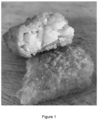
- Figure 1 is a photograph showing an example food product of the present invention, comprising an example fish analogue of the present invention.
- the fish analogue according to the present invention comprises textured rice flake and wheat gluten, as defined in the appended claims.
- Fish analogue refers to a fishless substance that is designed to resemble fish. Fish analogue may otherwise be referred to as a vegetarian fish product, a vegan fish product, a fish substitute, a fish extender, mock fish or imitation fish. Fish analogue described herein refers to the "core" of the food product, i.e., an uncoated food product.
- Plant-based or “plant” referred to herein indicates that the product or component derives from plant and comprises no animal-derived product, for example, no meat or dairy product.
- Textured rice flake referred to herein refers to a rice product that is in the form of textured individual pieces.
- the pieces have a varied size and shape distribution. It is preferred that the pieces have a length in the size range 2-20 mm ⁇ 10%.
- Textured rice flake comprises rice, water and optionally an emulsifier.
- the emulsifier comprises seaweed extract or alginate.
- Textured rice flake can be formed by mixing rice starch with water and optionally an emulsifier using a hydrocolloid process, producing flakes of varied piece sizes.
- the material may then be frozen to produce the finished product.
- the material may undergo a drying process to produce a dehydrated format.
- Textured rice flake is distinct from rice flour, rice protein isolate or rice bran. Textured rice flake may be used interchangeably with the term rice flake.
- Textured rice flake is well-known in the art and can be obtained from commercial sources, for example, from Meatless (https://www.meatless.nl/). Textured rice flake may be obtained frozen or dehydrated.
- Textured rice flake is selected for the fish analogue of the present invention because it is white or very pale in colour which assists in mimicking the appearance of white fish.
- the rice flake used in the present invention is as textured individual pieces. The size and shape distribution also assists in mimicking the texture of white fish.
- the textured rice flake enhances the colour and the texture of the fish analogue.
- the textured rice flake has a coarse flake.
- a coarse flake described herein refers to a flake with a size between about 2 and about 20 mm in length (wherein about is defined as ⁇ 10%), as determined by visual measurement against a measuring device. The function is to provide a flaky texture with a white appearance.
- Textured rice flake is generally present in the fish analogue at 50-70 % by weight of the fish analogue (i.e. uncoated fish analogue product), optionally 60-68 % and in some embodiments is present at 65 % by weight of the fish analogue.
- the textured rice flake is present in the fish analogue in an amount greater than 50 % by weight of the fish analogue, or greater than 52 %, or greater than 54%, or greater than 56%, or greater than 58%, or greater than 60%, or greater than 62% by weight of the fish analogue.
- the textured rice flake is present in the fish analogue in an amount less than 70%, or less than 68%, or less than 66% by weight of the fish analogue.
- Wheat gluten is selected for the fish analogue of the present invention because it has a number of important properties. Wheat gluten has a high protein content at about 60 - 95% of the wheat gluten. This is important to help increase the protein content of the fish analogue. Vegetarian and vegan diets benefit from having meat or fish substitute products that can provide suitable sources of protein. Wheat gluten is pale in appearance which is found to be important to mimic the appearance of white fish. Alternative plant-based protein sources are found not to have the required pale colour appearance.
- Wheat gluten is also capable of forming a protein network or a protein structure matrix.
- this network/matrix is highly beneficial for the final texture and cohesion of the fish analogue.
- Wheat gluten hydrates in water and has a high water binding capacity (200-400%). The presence of water bound with the wheat gluten can assist with the moist succulent texture of the fish analogue.
- the present inventors found that the wheat gluten could be used in place of a binder, and can be used to effectively bind all components of the fish analogue together to form a fish analogue with a cohesive and succulent mouthfeel.
- the use of wheat gluten may negate the need for other binders typically used in fish analogues, such as egg albumin or chemically modified cellulose-derived binders.
- wheat gluten is found to have emulsifying properties.
- the wheat gluten is powdered wheat gluten.
- the powdered wheat gluten may be a fine powder, that is, wherein 99% of the particles have a particle size of less than 0.25 mm which is as determined by sieving.
- the fine powder may assist in the preparation methods to produce the fish analogue.
- Wheat gluten can be obtained from commercial sources, for example, Crespel and Deiters Group (https://crespeldeitersgroup.com/).
- the wheat gluten has a number of functions. It serves as a binder for the fish analogue. It provides texture to the fish analogue. The wheat gluten also provides protein fortification.
- Wheat gluten is generally present in the fish analogue at 7-20% by weight of the fish analogue, optionally 8-18 %, optionally 9-15%, optionally 9-12% and in some embodiments is present at 10% by weight of the fish analogue. In an embodiment, the wheat gluten is present in an amount greater than 7%, or greater than 8%, or greater than 9%, or greater than or equal to 10% by weight of the fish analogue. Lower amounts of wheat gluten ( ⁇ 7 %) do not provide an adequate source of protein, while higher amounts of wheat gluten (> 20%) were found to have a detrimental effect on texture, with the fish analogue products becoming more chewy and less flaky.
- the fish analogue comprises plant fibre.
- Plant fibre referred to herein refers to a fibre that is plant-derived.
- the plant fibre may be a cereal fibre, bamboo fibre, or a fruit or vegetable fibre.
- the fibre may be selected from wheat fibre, oat fibre, carrot fibre, bamboo fibre, apple fibre, citrus fibre, pea fibre, potato fibre, psyllium fibre.
- the plant fibre is a cereal fibre, optionally selected from wheat fibre or oat fibre, or bamboo fibre.
- the plant fibre is wheat fibre.
- the presence of plant fibre may help to bind the ingredients together, in combination with the wheat gluten.
- the presence of plant fibre may improve the binding of the components in the fish analogue as compared to wheat gluten alone.
- the presence of plant fibre may improve the nutritional properties of the fish analogue.
- cereal fibres and/or bamboo fibres may be preferred over fruit or vegetable fibres since they (i) have good oil and water binding properties, (ii) may be paler in colour, (iii) may be free of pectin, which may otherwise affect the texture of the fish analogue, and (iv) may provide a meat or fish analogue that has improved texture as compared to other vegetable fibres.
- the use of potato fibre, for example, may result in a meat or fish analogue with a more undesirable softer texture.
- Wheat fibre in particular, has a high water binding capacity (400-1250%), and a high oil binding capacity (300-1100%), and therefore effectively binds water and/or a plant-based oil.
- the plant fibre has a fibre length (i.e. the longest dimension of the fibre) between 80 microns to 500 microns, or from 150 microns to 250 microns, or 200 microns.
- the fibre length may be determined by optical microscopy in the range of 400 x to 1000 x magnification. These fibre lengths are found to have particularly good oil and water binding capacity.
- Wheat fibre can be obtained from commercial sources, for example, J. Rettenmaier & Söhne ( https://www.jrs.eu/jrs_en). The present inventors found that smaller fibre lengths have reduced water and oil binding capacity, while longer fibre lengths can have a detrimental effect on texture.
- the plant fibre has a fibre length that is from 150 microns to 250 microns, or 200 microns. In some embodiments, the plant fibre has a fibre length that is greater than 80 microns, or greater than 100 microns, or greater than 120 microns, or greater than 140 microns, or greater than 160 microns, or greater than 180 microns. In some embodiments, the plant fibre has a fibre length that is less than 500 microns, or less than 450 microns, or less than 400 microns, or less than 350 microns, or less than 300 microns, or less than 275 microns, or less than 250 microns, or less than 225 microns.
- the fish analogue comprises from 0.25 to 5 % plant fibre by weight of the fish analogue, or from 0.35 to 1.25 % plant fibre, or 0.5 to 1 %, or 0.75 % plant fibre by weight of the fish analogue.
- the plant fibre is wheat fibre. Too little plant fibre ( ⁇ 0.25 %) has reduced water and oil binding capacity, while too much fibre may lead to a product that is too firm in texture.
- the fish analogue comprises greater than 0.25% plant fibre by weight of the fish analogue, or greater than 0.5% plant fibre, or greater than 0.7% plant fibre by weight of the fish analogue. In some embodiments, the fish analogue comprises less than 5% plant fibre by weight of the fish analogue or less than 4% plant fibre, or less than 3% plant fibre, or less than 2% plant fibre, or less than 1% plant fibre by weight of the fish analogue. In a preferred embodiment, the plant fibre is wheat fibre.
- the plant fibre preferably comprises insoluble fibres. In some embodiments, the plant fibre comprises at least about 96 % insoluble fibres by weight of the plant fibre.
- the ratio of wheat gluten to plant fibre in the fish analogue is from 7:1 to 30:1, optionally from 10:1 to 15:1, or 13:1. In some embodiments, the ratio of wheat gluten to plant fibre in the fish analogue is greater than 7:1, or greater than 8:1, or greater than 9:1, or greater than 10:1, or greater than 11:1, or greater than 12:1. In some embodiments, the ratio of wheat gluten to plant fibre in the fish analogue is less than 20:1, or less than 19:1, or less than 18:1, or less than 17:1, or less than 16:1, or less than 15:1, or less than 14:1. These ratios are found to provide a good balance of component binding, bite texture and protein fortification.
- the fish analogue comprises from 10 to 25 % water by weight of the fish analogue, or from 12 to 20 % water, or 14% water by weight of the fish analogue. In some embodiments, the fish analogue comprises greater than 10% water by weight of the fish analogue, or greater than 11% water, or greater than 12% water, or greater than 13% water by weight of the fish analogue. In some embodiments, the fish analogue comprises less than 20% water by weight of the fish analogue, or less than 19% water, or less than 18% water, or less than 17% water, or less than 16% water, or less than 15% water by weight of the fish analogue. The amount of water added is selected to provide the fish analogue with an appropriate texture and optionally appropriate succulence.
- the fish analogue comprises a plant-based oil.
- the plant-based oil may be selected from rapeseed oil, sunflower oil, olive oil or grapeseed oil or a combination thereof.
- the plant-based oil is rapeseed oil.
- Rapeseed oil is light in colour and has a preferential flavour profile to compliment this application. Rapeseed oil also advantageously provides a source of omega 3 fatty acids.
- Other plant-based oils at levels greater than 5% by weight of the fish analogue, like flaxseed and hempseed oil, can add a nutty flavour note which may not be desirable in this application.
- the fish analogue may further comprise algae oil, i.e., in combination with a plant-based oil selected from rapeseed oil, sunflower oil, olive oil or grapeseed oil.
- the fish analogue comprises from 5 to 15 % plant-based oil by weight of the fish analogue, or from 6 to 13%, or from 7 to 12% plant-based oil, or 7.5% plant-based oil by weight of the fish analogue.
- the oil addition assists in the creation of a succulent mouth feel. Preferred ranges are selected because higher amounts of oil can result in a greasy coating in the mouth when eating; and lower amounts of oil can have a negative impact on the texture and also the creation of the emulsion during processing.
- the fish analogue comprises greater than about 5% plant-based oil by weight of the fish analogue, or greater than 6% plant-based oil, or greater than about 7% plant-based oil by weight of the fish analogue.
- the fish analogue comprises less than 12% plant-based oil by weight of the fish analogue, or less than 11% plant-based oil, or less than 10% plant-based oil, or less than 9% plant-based oil, or less than 8% plant-based oil by weight of the fish analogue.
- the plant-based oil delivers flavour and may contribute to the succulent texture and good mouth-feel of the fish analogue.
- the fish analogue comprises flavourings.
- the flavouring may be powdered flavourings.
- the flavourings are fish flavouring.
- the flavourings include one or more of natural flavouring preparations, sunflower seed oil, sugar and/or maltodextrin (potato and corn).
- the fish analogue comprises up to 2.5% flavourings.
- the fish analogue comprises from 1.5 to 2.5 % flavourings by weight of the fish analogue, or from 1.75 to 2.4% flavourings, or 1.8 to 2.2% flavourings, or 1.96% flavourings by weight of the fish analogue.
- the fish analogue comprises greater than 1.5% flavourings by weight of the fish analogue, or greater than 1.75% flavourings by weight of the fish analogue. In some embodiments, the fish analogue comprises less than 2.5% flavouring by weight of the fish analogue, or less than 2.4% flavourings, or less than 2.3% flavourings, or less than 2.2 % flavourings, or less than 2.1% flavourings, or less than 2% flavourings by weight of the fish analogue.
- the fish analogue comprises salt. Salt described herein may refer to sodium chloride (NaCl). In some embodiments, the fish analogue comprises up to 3% salt by weight of the fish analogue. In some embodiments, the fish analogue comprises from 1 to 3 % salt by weight of the fish analogue, or from 1 to 1.5 % salt, or 1.17% salt by weight of the fish analogue. In some embodiments, the fish analogue comprises greater than 1% salt by weight of the fish analogue, or greater than 1.15% salt by weight of the fish analogue.
- the fish analogue comprises less than 3% salt by weight of the fish analogue, or less than 2.5 % salt, or less than 2% salt, or less than 1.5%, or less than 1.25% salt by weight of the fish analogue.
- the presence of salt may enhance the flavour of the product.
- the fish analogue may comprise an additional protein source (i.e. different to wheat gluten), for example, a powdered protein source.
- the additional protein source may be present in an amount up to 15% by weight of the fish analogue.
- the fish analogue comprises from 1 to 15 % additional protein source by weight of the fish analogue.
- the fish analogue comprises an omega-3 fatty acid, for example, one or more of docosahexaenoic acid (DHA), eicosapentaenoic acid (EPA) and ALA (alpha-linolenic acid).
- DHA docosahexaenoic acid
- EPA eicosapentaenoic acid
- ALA alpha-linolenic acid
- the fish analogue comprises at least 0.3g, or at least 0.35g or at least 0.4g or at least 0.45g alpha-linolenic acid per 100g and per 100kcal, or at least 40mg, or at least 45mg, or at least 50mg of the sum of eicosapentaenoic acid and docosahexaenoic acid per 100g and per 100kcal.
- omega-3 fatty acids can be used to more closely emulate the nutritional benefits obtained from eating white fish.
- the inclusion of omega-3 fatty acids may not significantly alter the texture and/or appearance of the fish analogue.
- the omega-3 fatty acids can be provided by rapeseed oil.
- the omega-3 fatty acids can be provided by the presence of algae oil.
- the present invention also provides for a food product comprising the fish analogue described herein and a coating, wherein the coating is selected from a coating comprising a batter layer or a coating comprising a crumb layer.
- the food product is a fish portion analogue, a fish finger analogue, a fishcake analogue or a fish fillet analogue.
- the food product is a chilled food product or a frozen food product, that is, a food product that is suitable for chilling or freezing respectively.
- the fish analogue has the texture of white fish. This may be determined by sensory evaluation and/or consumer testing.
- the fish analogue has the appearance of white fish.
- the fish analogue has the same colour as white fish, which may be determined by appearance and/or consumer evaluation.
- the fish analogues described herein may have good or improved protein content as compared to other fish analogues, while still advantageously having the texture and appearance of white fish.
- the protein content is at least 7.5% by weight of the fish analogue, or at least 8 %, or at least 9%, or at least 10% by weight of the fish analogue.
- the fish analogues of the present invention may have good or improved fibre content, while still advantageously having the texture and appearance of white fish.
- the fibre content is at least 2% by weight of the fish analogue
- the fish analogues of the present invention may have improved and balanced nutritional properties, which is particularly important for consumers that have a vegan and/or vegetarian diet.
- the fish analogues of the present invention do not comprise an ingredient from an animal origin, for example, the fish analogues of the present invention do not contain any meat and/or dairy products.
- the fish analogues of the present invention are free of egg albumin, which is often used as a binder in known meat or fish analogues.
- the products of the present invention are suitable for consumers with a vegetarian diet.
- the fish analogue of the present invention is plant-based or plant-derived.
- the products of the present invention may therefore be suitable for consumers with a vegan diet.
- the fish analogue of the present invention does not comprise fungus-derived protein, such as mycoprotein.
- the fish analogue of the present invention does not comprise soy protein.
- the fish analogue of the present invention does not contain nuts. This may be advantageous, for example, for consumers that are allergic to mycoprotein, nuts and/or soy protein. Products containing plant proteins other than soy protein are considered to be more sustainable and environmentally friendly due to the link between farming of soy protein and deforestation.
- the fish analogue is free of chemically modified or synthetic cellulose-derived products, which are often used as binders in known meat or fish analogues.
- the fish analogue is free of microcrystalline cellulose (E460), methyl cellulose (E461), ethyl cellulose (E462), hydroxypropyl cellulose (E463), hydroxylpropyl methyl cellulose (E464), ethyl methyl cellulose (E465), sodium Carboxy Methyl Cellulose (E466), Cross-linked Carboxy Methyl Cellulose (E468), Enzymatically Hydrolysed Carboxy Methyl Cellulose (E469) and Hydroxyethyl Cellulose (E1525).
- the fish analogue may be free of modified starches or starch derivatives. Consumers are increasingly looking at minimising their intake of artificial or chemically modified additives.
- the fish analogues described herein therefore provide a more natural and label-friendly product while still having good texture and appearance.
- the fish analogue is free of E-numbers of artificial additives.
- a product free of chemically modified or synthetic cellulose-derived products may also be advantageous because cellulose-derived binders have a known laxative effect.
- the fish analogue is free of palm oil. This may provide a healthier fish analogue that is low in saturated fats.
- the present invention also provides for a method of producing a fish analogue that does not comprise an ingredient from an animal origin, the method comprising:
- a fish analogue prepared by the above-mentioned method. Evenly distributed referred to herein refers to said components being mixed until homogenous.
- the pre-blending of the mixture with wheat gluten and optionally plant fibre, before adding the textured rice flake is found to produce a fish analogue with an improved texture and a lighter material, as compared to without a pre-blending step.
- the textured rice flake is frozen before adding to the mixture.
- the mixing in step (a) is performed at medium shear.
- the mixing in step (a) can be performed for at least 20 - 50 seconds, at least 25 - 40 seconds, for example, 30 seconds.
- steps (b) and/or (c) occur in a bowl chopper.
- the bowl chopper consists of a rotating bowl with a series of rotating knives running in a vertical plane in the trough of the bowl.
- the knife head speed can be varied, as can the rotation speed of the bowl. They offer the advantage over other systems that the mixing and comminution step can be accomplished in one operation.
- the mixture is preferably rotated.
- the mixing in steps (b) and/or (c) are performed at low shear.
- the mixing in step (b) and/or (c) can be performed for at least 20 - 50 seconds, at least 25 - 40 seconds, for example, 30 seconds.
- steps (b) and/or (c) occur at a temperature of -10 to 10 °C, and more preferably at a temperature of -2 to 3 °C. In some embodiments, steps (b) and/or (c) may be performed at a temperature less than 10 °C, or less than 9 °C, or less than 8 °C, or less than 7 °C, or less than 6 °C, or less than 5 °C, or less than 4 °C, or less than 3 °C, or less than 2 °C.
- a low temperature may be important for preventing moisture release from the textured rice flake, which may be preferably added in frozen form. Moisture release may cause the texture rice flake to soften, increasing the likelihood of the material to be broken down during the manufacturing process which would be disadvantageous to the final product. A low temperature may also be beneficial for microbiological control.
- the fish analogue mixture is formed into a fish analogue unit, for example, by cutting.
- the fish analogue is cut into finger planks or rectangles.
- the fish analogue unit, finger planks or rectangles may resemble fish fingers.
- the fish analogue unit is coated.
- the fish analogue may be coated with a batter layer or a crumb layer, for example, using a batter or crumb mixture.
- the fish analogue unit is coated twice with the batter or crumb mixture.
- the coated fish analogue unit is fried.
- the coated fish analogue is fried at a temperature from 180 °C to 210 °C, for example, 195 °C.
- the frying step may be performed for 30 seconds to 55 seconds, optionally 45 seconds.
- the coated fish analogue unit after frying, is chilled or frozen, or is suitable for chilling or being frozen.
- the present invention also provides for the use of wheat gluten to increase the protein content of a fish analogue that does not comprise an ingredient from an animal origin, the method comprising
- the fish analogue comprises from 50 to 70 % textured rice flake, or from 60 to 68% textured rice flake, from 7 to 20 % wheat gluten, or from 9 to 15% wheat gluten, from 10 to 25% water from 5 to 15% plant-based oil, or from 7 to 12% plant-based oil, optionally rapeseed oil from 0.25 to 5% plant fibre, optionally wheat fibre up to about 2.5% flavourings, or from 1.75 to 2.4 % flavourings up to 3% salt, or from 1 to 1.5% salt, wherein % are by weight of the fish analogue.
- the core mixture was cut to size, coated, and fried at a temperature of 195 °C.
- the final products are suitable for chilling or for freezing.
- the example fish analogue was found to have a good texture, resembling fish, as determined by sensory evaluation. Notably, the example fish analogue also demonstrated a white colour and good appearance. This is demonstrated by a fish analogue in accordance with the present invention, which is shown in Figure 1 .
- the wheat gluten aided by wheat fibre, could effectively bind the components of the fish analogue together to form a fish analogue with a cohesive texture.
- a fish analogue according to Example 1 comprising 100% coarse textured rice flake was compared with two example fish analogues comprising either i) 50% coarse and 50% fine textured rice flake and ii) 75% coarse and 25% fine textured rice flake.
- Fine textured rice flake refers to a rice flake that has a smaller rice flake size and distribution compared to coarse textured rice flake.
- Example 2 A comparative product similar to Example 1 was prepared, wherein the 9.85% wheat gluten was replaced with 9% pea protein isolate.
- the resultant product did not demonstrate the same properties as the product formed using wheat gluten.
- the fish analogue core was beige in colour and too dark to resemble white fish.
- the texture of the comparative Example was powdery and chalky.
- a second comparative product comprising a combination of wheat gluten at 4.8% and pea protein isolate at 2% was also trialled however the resultant product demonstrated an unpleasant off taste from the pea protein, which also had a negative impact on the texture. As a result this created a chalky mouth feel and darkened the overall colour of the analogue. The mix also failed to produce a source of protein nutrition claim
Landscapes
- Life Sciences & Earth Sciences (AREA)
- Health & Medical Sciences (AREA)
- Chemical & Material Sciences (AREA)
- Polymers & Plastics (AREA)
- Nutrition Science (AREA)
- Engineering & Computer Science (AREA)
- Food Science & Technology (AREA)
- Zoology (AREA)
- Marine Sciences & Fisheries (AREA)
- Biochemistry (AREA)
- Molecular Biology (AREA)
- Proteomics, Peptides & Aminoacids (AREA)
- Mycology (AREA)
- Meat, Egg Or Seafood Products (AREA)
- General Preparation And Processing Of Foods (AREA)
- Jellies, Jams, And Syrups (AREA)
- Grain Derivatives (AREA)
Claims (14)
- Fischanalog, umfassend 50 bis 70 Gew.-% texturierte Reisflocken und 7 bis 20 Gew.-% Weizengluten und wobei das Fischanalog keinen Inhaltsstoff tierischen Ursprungs umfasst.
- Fischanalog nach Anspruch 1, wobei das Fischanalog pflanzlich ist.
- Fischanalog nach einem der vorhergehenden Ansprüche, wobei der Proteingehalt mindestens 7,5 Gew.-% des Fischanalogs, optional mindestens 10 Gew.-% des Fischanalogs beträgt.
- Fischanalog nach einem der vorhergehenden Ansprüche, wobei die texturierten Reisflocken 60 bis 68 Gew.-% des Fischanalogs betragen.
- Fischanalog nach einem der vorhergehenden Ansprüche, wobei das Weizengluten 9 bis 15 Gew.-% des Fischanalogs beträgt.
- Fischanalog nach einem der vorhergehenden Ansprüche, wobei das Fischanalogon eine Omega-3-Fettsäure umfasst.
- Fischanalog nach einem der vorhergehenden Ansprüche, ferner umfassend eine oder mehrere Pflanzenfasern, ein Öl auf Pflanzenbasis, Aromastoffe und/oder Salz.
- Fischanalog nach einem der vorhergehenden Ansprüche, ferner umfassend Pflanzenfasern, optional Weizenfasern, in einer Menge von 0,25 bis 5 Gew.-% des Fischanalogs.
- Fischanalog nach einem der vorhergehenden Ansprüche, umfassend:50 bis 70 % texturierte Reisflocken,7 bis 20 % Weizengluten,10 bis 25 % Wasser5 bis 15 % Öl auf Pflanzenbasis, optional Rapsöl0,25 bis 5 % Pflanzenfaser, optional Weizenfaserbis zu 2,5 % Aromastoffe,bis zu 3 % Salz,wobei sich % auf das Gewicht des Fischanalogs beziehen.
- Fischanalog nach einem der vorhergehenden Ansprüche, wobei das Fischanalog frei von mikrokristalliner Cellulose (E460), Methylcellulose (E461), Ethylcellulose (E462), Hydroxypropylcellulose (E463), Hydroxypropylmethylcellulose (E464), Ethylmethylcellulose (E465), Natriumcarboxymethylcellulose (E466), vernetzter Carboxymethylcellulose (E468), enzymatisch hydrolysierter Carboxymethylcellulose (E469) und Hydroxyethylcellulose (E1525) ist.
- Lebensmittelprodukt, umfassend das Fischanalog nach einem der Ansprüche 1 bis 10 und eine Hülle, wobei die Hülle aus einer Hülle, die eine Teigschicht umfasst, oder einer Hülle, die eine Krümelschicht umfasst, ausgewählt ist.
- Verfahren zum Herstellen eines Fischanalogs, das keinen Inhaltsstoff tierischen Ursprungs umfasst, wobei das Verfahren Folgendes umfasst:(a) Mischen von Öl auf Pflanzenbasis, Aromastoffe und Wasser, bis zur gleichmäßigen Verteilung,(b) Zugeben von Weizengluten und optional Pflanzenfasern und Mischen bis zur gleichmäßigen Verteilung und bis eine Emulsion gebildet ist, und(c) Zugeben von texturierten Reisflocken und Mischen,wobei das Fischanalog 50 bis 70 Gew.-% texturierte Reisflocken und 7 bis 20 Gew.-% Weizengluten umfasst.
- Verfahren nach Anspruch 12, wobei die Schritte (b) und (c) in einem Kutter und/oder bei einer Temperatur von -10 bis 10 °C erfolgen.
- Verwendung von Weizengluten zum Erhöhen des Proteingehalts eines Fischanalogs, das keinen Inhaltsstoff tierischen Ursprungs umfasst, wobei die Verwendung Folgendes umfasst:(a) Zugeben von Weizengluten und optional Pflanzenfasern zu einer Vormischung, die Pflanzenöl, Aromastoffe und Wasser umfasst,(b) Mischen der Mischung aus (a), um eine Emulsion zu bilden, und(c) Zugeben texturierter Reisflocken,(d) Mischen der Mischung aus (c) und(e) Formen der Mischung zu Fischanalogeinheiten,wobei das Fischanalog zu 7 bis 20 Gew.-% Weizengluten umfasst und der Proteingehalt mindestens 7,5 Gew.-% des Fischanalogs beträgt.
Applications Claiming Priority (2)
| Application Number | Priority Date | Filing Date | Title |
|---|---|---|---|
| GB2105921.7A GB2603214B (en) | 2021-04-26 | 2021-04-26 | Fish analogue |
| PCT/EP2022/060910 WO2022229106A1 (en) | 2021-04-26 | 2022-04-25 | Fish analogue |
Publications (3)
| Publication Number | Publication Date |
|---|---|
| EP4132297A1 EP4132297A1 (de) | 2023-02-15 |
| EP4132297B1 true EP4132297B1 (de) | 2023-11-08 |
| EP4132297C0 EP4132297C0 (de) | 2023-11-08 |
Family
ID=76193582
Family Applications (1)
| Application Number | Title | Priority Date | Filing Date |
|---|---|---|---|
| EP22724781.4A Active EP4132297B1 (de) | 2021-04-26 | 2022-04-25 | Fischanalog |
Country Status (4)
| Country | Link |
|---|---|
| EP (1) | EP4132297B1 (de) |
| ES (1) | ES2972408T3 (de) |
| GB (1) | GB2603214B (de) |
| WO (1) | WO2022229106A1 (de) |
Family Cites Families (4)
| Publication number | Priority date | Publication date | Assignee | Title |
|---|---|---|---|---|
| US9907322B2 (en) * | 2006-05-19 | 2018-03-06 | Solae Llc | Structured protein product |
| US20080075808A1 (en) * | 2006-09-21 | 2008-03-27 | Solae, Llc | Process for Producing Colored Structured Plant Protein Products |
| US8293297B2 (en) * | 2007-04-05 | 2012-10-23 | Solae, Llc | Colored structured protein products |
| CA2759636C (en) * | 2009-04-27 | 2017-08-29 | Nestec S.A. | Flaked fish analogs and methods for making such analogs |
-
2021
- 2021-04-26 GB GB2105921.7A patent/GB2603214B/en active Active
-
2022
- 2022-04-25 EP EP22724781.4A patent/EP4132297B1/de active Active
- 2022-04-25 WO PCT/EP2022/060910 patent/WO2022229106A1/en not_active Ceased
- 2022-04-25 ES ES22724781T patent/ES2972408T3/es active Active
Also Published As
| Publication number | Publication date |
|---|---|
| EP4132297A1 (de) | 2023-02-15 |
| GB202105921D0 (en) | 2021-06-09 |
| GB2603214A (en) | 2022-08-03 |
| ES2972408T3 (es) | 2024-06-12 |
| WO2022229106A1 (en) | 2022-11-03 |
| EP4132297C0 (de) | 2023-11-08 |
| GB2603214B (en) | 2023-11-22 |
Similar Documents
| Publication | Publication Date | Title |
|---|---|---|
| Mehta et al. | Novel trends in development of dietary fiber rich meat products—a critical review | |
| US20070269571A1 (en) | Composition for Soybean Protein-Processed Food, Paste for Meat-Containing or Meat-Not-Containing Processed Food, Dried Meat-Like Food | |
| Kumar et al. | Meat snacks: A novel technological perspective | |
| JP5566053B2 (ja) | 食品組成物 | |
| JP2022512853A (ja) | 乳成分不含有の食品組成物及びその製造方法 | |
| CN114727637B (zh) | 成形食品加工用组合物 | |
| TWI442887B (zh) | 重組肉品與其形成方法 | |
| WO2022264330A1 (ja) | スクランブルエッグ様食品及び卵調理品様食品 | |
| NZ581112A (en) | Non-sweet food binder compositions and methods of making and using same | |
| WO2021065930A1 (ja) | 組成物 | |
| JPH05505098A (ja) | 低カロリー肉製品およびその製造方法 | |
| Bodner et al. | Fiber | |
| US6419977B1 (en) | Nutritional meat extender compositions | |
| JP7536218B1 (ja) | 脂肪組織様食品 | |
| CA2160369A1 (en) | Food binder matrix for formed food products | |
| EP4132295B1 (de) | Fischanalog | |
| EP4132297B1 (de) | Fischanalog | |
| CN120981164A (zh) | 用于含有植物原料的替代肉加工品的油包水型乳化组合物 | |
| WO2023214326A1 (en) | Plant-only gums (1) replacement system in food products | |
| Quiles et al. | Clean Label Foods with Reduced Fat Content | |
| TWI843147B (zh) | 肉類替代品及餃子 | |
| US20250098705A1 (en) | A process for preparing a food product and the food product | |
| CN121078985A (zh) | 鱼替代物 | |
| Rachma et al. | Porang flour functions as a plant-based hydrocolloid to improve technofunctional and sensory properties in duck meatball processing | |
| WO2023218392A1 (en) | Plant-only gums (2) replacement system in food products |
Legal Events
| Date | Code | Title | Description |
|---|---|---|---|
| STAA | Information on the status of an ep patent application or granted ep patent |
Free format text: STATUS: UNKNOWN |
|
| STAA | Information on the status of an ep patent application or granted ep patent |
Free format text: STATUS: THE INTERNATIONAL PUBLICATION HAS BEEN MADE |
|
| PUAI | Public reference made under article 153(3) epc to a published international application that has entered the european phase |
Free format text: ORIGINAL CODE: 0009012 |
|
| STAA | Information on the status of an ep patent application or granted ep patent |
Free format text: STATUS: REQUEST FOR EXAMINATION WAS MADE |
|
| 17P | Request for examination filed |
Effective date: 20221111 |
|
| AK | Designated contracting states |
Kind code of ref document: A1 Designated state(s): AL AT BE BG CH CY CZ DE DK EE ES FI FR GB GR HR HU IE IS IT LI LT LU LV MC MK MT NL NO PL PT RO RS SE SI SK SM TR |
|
| RAX | Requested extension states of the european patent have changed |
Extension state: ME Payment date: 20230118 Extension state: BA Payment date: 20230118 |
|
| GRAP | Despatch of communication of intention to grant a patent |
Free format text: ORIGINAL CODE: EPIDOSNIGR1 |
|
| STAA | Information on the status of an ep patent application or granted ep patent |
Free format text: STATUS: GRANT OF PATENT IS INTENDED |
|
| INTG | Intention to grant announced |
Effective date: 20230524 |
|
| GRAS | Grant fee paid |
Free format text: ORIGINAL CODE: EPIDOSNIGR3 |
|
| GRAA | (expected) grant |
Free format text: ORIGINAL CODE: 0009210 |
|
| STAA | Information on the status of an ep patent application or granted ep patent |
Free format text: STATUS: THE PATENT HAS BEEN GRANTED |
|
| RBV | Designated contracting states (corrected) |
Designated state(s): AL AT BE BG CH CY CZ DE DK EE ES FI FR GR HR HU IE IS IT LI LT LU LV MC MK MT NL NO PL PT RO RS SE SI SK SM TR |
|
| DAV | Request for validation of the european patent (deleted) | ||
| AK | Designated contracting states |
Kind code of ref document: B1 Designated state(s): AL AT BE BG CH CY CZ DE DK EE ES FI FR GR HR HU IE IS IT LI LT LU LV MC MK MT NL NO PL PT RO RS SE SI SK SM TR |
|
| REG | Reference to a national code |
Ref country code: CH Ref legal event code: EP |
|
| REG | Reference to a national code |
Ref country code: DE Ref legal event code: R096 Ref document number: 602022000941 Country of ref document: DE |
|
| REG | Reference to a national code |
Ref country code: IE Ref legal event code: FG4D |
|
| U01 | Request for unitary effect filed |
Effective date: 20231128 |
|
| U07 | Unitary effect registered |
Designated state(s): AT BE BG DE DK EE FI FR IT LT LU LV MT NL PT SE SI Effective date: 20231204 |
|
| PG25 | Lapsed in a contracting state [announced via postgrant information from national office to epo] |
Ref country code: GR Free format text: LAPSE BECAUSE OF FAILURE TO SUBMIT A TRANSLATION OF THE DESCRIPTION OR TO PAY THE FEE WITHIN THE PRESCRIBED TIME-LIMIT Effective date: 20240209 |
|
| PG25 | Lapsed in a contracting state [announced via postgrant information from national office to epo] |
Ref country code: IS Free format text: LAPSE BECAUSE OF FAILURE TO SUBMIT A TRANSLATION OF THE DESCRIPTION OR TO PAY THE FEE WITHIN THE PRESCRIBED TIME-LIMIT Effective date: 20240308 |
|
| PG25 | Lapsed in a contracting state [announced via postgrant information from national office to epo] |
Ref country code: IS Free format text: LAPSE BECAUSE OF FAILURE TO SUBMIT A TRANSLATION OF THE DESCRIPTION OR TO PAY THE FEE WITHIN THE PRESCRIBED TIME-LIMIT Effective date: 20240308 Ref country code: GR Free format text: LAPSE BECAUSE OF FAILURE TO SUBMIT A TRANSLATION OF THE DESCRIPTION OR TO PAY THE FEE WITHIN THE PRESCRIBED TIME-LIMIT Effective date: 20240209 |
|
| U20 | Renewal fee for the european patent with unitary effect paid |
Year of fee payment: 3 Effective date: 20240425 |
|
| PG25 | Lapsed in a contracting state [announced via postgrant information from national office to epo] |
Ref country code: RS Free format text: LAPSE BECAUSE OF FAILURE TO SUBMIT A TRANSLATION OF THE DESCRIPTION OR TO PAY THE FEE WITHIN THE PRESCRIBED TIME-LIMIT Effective date: 20231108 Ref country code: PL Free format text: LAPSE BECAUSE OF FAILURE TO SUBMIT A TRANSLATION OF THE DESCRIPTION OR TO PAY THE FEE WITHIN THE PRESCRIBED TIME-LIMIT Effective date: 20231108 Ref country code: NO Free format text: LAPSE BECAUSE OF FAILURE TO SUBMIT A TRANSLATION OF THE DESCRIPTION OR TO PAY THE FEE WITHIN THE PRESCRIBED TIME-LIMIT Effective date: 20240208 Ref country code: HR Free format text: LAPSE BECAUSE OF FAILURE TO SUBMIT A TRANSLATION OF THE DESCRIPTION OR TO PAY THE FEE WITHIN THE PRESCRIBED TIME-LIMIT Effective date: 20231108 |
|
| REG | Reference to a national code |
Ref country code: ES Ref legal event code: FG2A Ref document number: 2972408 Country of ref document: ES Kind code of ref document: T3 Effective date: 20240612 |
|
| PG25 | Lapsed in a contracting state [announced via postgrant information from national office to epo] |
Ref country code: CZ Free format text: LAPSE BECAUSE OF FAILURE TO SUBMIT A TRANSLATION OF THE DESCRIPTION OR TO PAY THE FEE WITHIN THE PRESCRIBED TIME-LIMIT Effective date: 20231108 |
|
| PG25 | Lapsed in a contracting state [announced via postgrant information from national office to epo] |
Ref country code: SK Free format text: LAPSE BECAUSE OF FAILURE TO SUBMIT A TRANSLATION OF THE DESCRIPTION OR TO PAY THE FEE WITHIN THE PRESCRIBED TIME-LIMIT Effective date: 20231108 |
|
| PG25 | Lapsed in a contracting state [announced via postgrant information from national office to epo] |
Ref country code: SM Free format text: LAPSE BECAUSE OF FAILURE TO SUBMIT A TRANSLATION OF THE DESCRIPTION OR TO PAY THE FEE WITHIN THE PRESCRIBED TIME-LIMIT Effective date: 20231108 Ref country code: SK Free format text: LAPSE BECAUSE OF FAILURE TO SUBMIT A TRANSLATION OF THE DESCRIPTION OR TO PAY THE FEE WITHIN THE PRESCRIBED TIME-LIMIT Effective date: 20231108 Ref country code: RO Free format text: LAPSE BECAUSE OF FAILURE TO SUBMIT A TRANSLATION OF THE DESCRIPTION OR TO PAY THE FEE WITHIN THE PRESCRIBED TIME-LIMIT Effective date: 20231108 Ref country code: CZ Free format text: LAPSE BECAUSE OF FAILURE TO SUBMIT A TRANSLATION OF THE DESCRIPTION OR TO PAY THE FEE WITHIN THE PRESCRIBED TIME-LIMIT Effective date: 20231108 |
|
| REG | Reference to a national code |
Ref country code: DE Ref legal event code: R097 Ref document number: 602022000941 Country of ref document: DE |
|
| PLBE | No opposition filed within time limit |
Free format text: ORIGINAL CODE: 0009261 |
|
| STAA | Information on the status of an ep patent application or granted ep patent |
Free format text: STATUS: NO OPPOSITION FILED WITHIN TIME LIMIT |
|
| 26N | No opposition filed |
Effective date: 20240809 |
|
| PG25 | Lapsed in a contracting state [announced via postgrant information from national office to epo] |
Ref country code: MC Free format text: LAPSE BECAUSE OF FAILURE TO SUBMIT A TRANSLATION OF THE DESCRIPTION OR TO PAY THE FEE WITHIN THE PRESCRIBED TIME-LIMIT Effective date: 20231108 |
|
| PG25 | Lapsed in a contracting state [announced via postgrant information from national office to epo] |
Ref country code: MC Free format text: LAPSE BECAUSE OF FAILURE TO SUBMIT A TRANSLATION OF THE DESCRIPTION OR TO PAY THE FEE WITHIN THE PRESCRIBED TIME-LIMIT Effective date: 20231108 |
|
| PG25 | Lapsed in a contracting state [announced via postgrant information from national office to epo] |
Ref country code: IE Free format text: LAPSE BECAUSE OF NON-PAYMENT OF DUE FEES Effective date: 20240425 |
|
| U1H | Name or address of the proprietor changed after the registration of the unitary effect |
Owner name: NOMAD FOODS EUROPE LIMITED; GB |
|
| U20 | Renewal fee for the european patent with unitary effect paid |
Year of fee payment: 4 Effective date: 20250428 |
|
| PGFP | Annual fee paid to national office [announced via postgrant information from national office to epo] |
Ref country code: ES Payment date: 20250507 Year of fee payment: 4 |
|
| PG25 | Lapsed in a contracting state [announced via postgrant information from national office to epo] |
Ref country code: CY Free format text: LAPSE BECAUSE OF FAILURE TO SUBMIT A TRANSLATION OF THE DESCRIPTION OR TO PAY THE FEE WITHIN THE PRESCRIBED TIME-LIMIT; INVALID AB INITIO Effective date: 20220425 |
|
| PG25 | Lapsed in a contracting state [announced via postgrant information from national office to epo] |
Ref country code: HU Free format text: LAPSE BECAUSE OF FAILURE TO SUBMIT A TRANSLATION OF THE DESCRIPTION OR TO PAY THE FEE WITHIN THE PRESCRIBED TIME-LIMIT; INVALID AB INITIO Effective date: 20220425 |
|
| REG | Reference to a national code |
Ref country code: CH Ref legal event code: H13 Free format text: ST27 STATUS EVENT CODE: U-0-0-H10-H13 (AS PROVIDED BY THE NATIONAL OFFICE) Effective date: 20251125 |
|
| PG25 | Lapsed in a contracting state [announced via postgrant information from national office to epo] |
Ref country code: CH Free format text: LAPSE BECAUSE OF NON-PAYMENT OF DUE FEES Effective date: 20250430 |