EP4132984B1 - Prépolymères d'isocyanate à faible viscosité bloqués ayant des phénols obtenus à partir de l'huile de noix de cajou, leur procédé de fabrication et leur utilisation - Google Patents
Prépolymères d'isocyanate à faible viscosité bloqués ayant des phénols obtenus à partir de l'huile de noix de cajou, leur procédé de fabrication et leur utilisation Download PDFInfo
- Publication number
- EP4132984B1 EP4132984B1 EP21715921.9A EP21715921A EP4132984B1 EP 4132984 B1 EP4132984 B1 EP 4132984B1 EP 21715921 A EP21715921 A EP 21715921A EP 4132984 B1 EP4132984 B1 EP 4132984B1
- Authority
- EP
- European Patent Office
- Prior art keywords
- weight
- blocking agent
- reaction
- component
- blocked isocyanate
- Prior art date
- Legal status (The legal status is an assumption and is not a legal conclusion. Google has not performed a legal analysis and makes no representation as to the accuracy of the status listed.)
- Revoked
Links
Classifications
-
- C—CHEMISTRY; METALLURGY
- C08—ORGANIC MACROMOLECULAR COMPOUNDS; THEIR PREPARATION OR CHEMICAL WORKING-UP; COMPOSITIONS BASED THEREON
- C08G—MACROMOLECULAR COMPOUNDS OBTAINED OTHERWISE THAN BY REACTIONS ONLY INVOLVING UNSATURATED CARBON-TO-CARBON BONDS
- C08G18/00—Polymeric products of isocyanates or isothiocyanates
- C08G18/06—Polymeric products of isocyanates or isothiocyanates with compounds having active hydrogen
- C08G18/08—Processes
- C08G18/10—Prepolymer processes involving reaction of isocyanates or isothiocyanates with compounds having active hydrogen in a first reaction step
- C08G18/12—Prepolymer processes involving reaction of isocyanates or isothiocyanates with compounds having active hydrogen in a first reaction step using two or more compounds having active hydrogen in the first polymerisation step
-
- C—CHEMISTRY; METALLURGY
- C08—ORGANIC MACROMOLECULAR COMPOUNDS; THEIR PREPARATION OR CHEMICAL WORKING-UP; COMPOSITIONS BASED THEREON
- C08G—MACROMOLECULAR COMPOUNDS OBTAINED OTHERWISE THAN BY REACTIONS ONLY INVOLVING UNSATURATED CARBON-TO-CARBON BONDS
- C08G18/00—Polymeric products of isocyanates or isothiocyanates
- C08G18/06—Polymeric products of isocyanates or isothiocyanates with compounds having active hydrogen
- C08G18/70—Polymeric products of isocyanates or isothiocyanates with compounds having active hydrogen characterised by the isocyanates or isothiocyanates used
- C08G18/72—Polyisocyanates or polyisothiocyanates
- C08G18/74—Polyisocyanates or polyisothiocyanates cyclic
- C08G18/76—Polyisocyanates or polyisothiocyanates cyclic aromatic
- C08G18/7657—Polyisocyanates or polyisothiocyanates cyclic aromatic containing two or more aromatic rings
- C08G18/7664—Polyisocyanates or polyisothiocyanates cyclic aromatic containing two or more aromatic rings containing alkylene polyphenyl groups
- C08G18/7671—Polyisocyanates or polyisothiocyanates cyclic aromatic containing two or more aromatic rings containing alkylene polyphenyl groups containing only one alkylene bisphenyl group
-
- C—CHEMISTRY; METALLURGY
- C08—ORGANIC MACROMOLECULAR COMPOUNDS; THEIR PREPARATION OR CHEMICAL WORKING-UP; COMPOSITIONS BASED THEREON
- C08G—MACROMOLECULAR COMPOUNDS OBTAINED OTHERWISE THAN BY REACTIONS ONLY INVOLVING UNSATURATED CARBON-TO-CARBON BONDS
- C08G18/00—Polymeric products of isocyanates or isothiocyanates
- C08G18/06—Polymeric products of isocyanates or isothiocyanates with compounds having active hydrogen
- C08G18/28—Polymeric products of isocyanates or isothiocyanates with compounds having active hydrogen characterised by the compounds used containing active hydrogen
- C08G18/40—High-molecular-weight compounds
- C08G18/48—Polyethers
- C08G18/4825—Polyethers containing two hydroxy groups
-
- C—CHEMISTRY; METALLURGY
- C08—ORGANIC MACROMOLECULAR COMPOUNDS; THEIR PREPARATION OR CHEMICAL WORKING-UP; COMPOSITIONS BASED THEREON
- C08G—MACROMOLECULAR COMPOUNDS OBTAINED OTHERWISE THAN BY REACTIONS ONLY INVOLVING UNSATURATED CARBON-TO-CARBON BONDS
- C08G18/00—Polymeric products of isocyanates or isothiocyanates
- C08G18/003—Polymeric products of isocyanates or isothiocyanates with epoxy compounds having no active hydrogen
-
- C—CHEMISTRY; METALLURGY
- C08—ORGANIC MACROMOLECULAR COMPOUNDS; THEIR PREPARATION OR CHEMICAL WORKING-UP; COMPOSITIONS BASED THEREON
- C08G—MACROMOLECULAR COMPOUNDS OBTAINED OTHERWISE THAN BY REACTIONS ONLY INVOLVING UNSATURATED CARBON-TO-CARBON BONDS
- C08G18/00—Polymeric products of isocyanates or isothiocyanates
- C08G18/06—Polymeric products of isocyanates or isothiocyanates with compounds having active hydrogen
- C08G18/08—Processes
- C08G18/10—Prepolymer processes involving reaction of isocyanates or isothiocyanates with compounds having active hydrogen in a first reaction step
-
- C—CHEMISTRY; METALLURGY
- C08—ORGANIC MACROMOLECULAR COMPOUNDS; THEIR PREPARATION OR CHEMICAL WORKING-UP; COMPOSITIONS BASED THEREON
- C08G—MACROMOLECULAR COMPOUNDS OBTAINED OTHERWISE THAN BY REACTIONS ONLY INVOLVING UNSATURATED CARBON-TO-CARBON BONDS
- C08G18/00—Polymeric products of isocyanates or isothiocyanates
- C08G18/06—Polymeric products of isocyanates or isothiocyanates with compounds having active hydrogen
- C08G18/08—Processes
- C08G18/16—Catalysts
- C08G18/22—Catalysts containing metal compounds
- C08G18/24—Catalysts containing metal compounds of tin
- C08G18/244—Catalysts containing metal compounds of tin tin salts of carboxylic acids
-
- C—CHEMISTRY; METALLURGY
- C08—ORGANIC MACROMOLECULAR COMPOUNDS; THEIR PREPARATION OR CHEMICAL WORKING-UP; COMPOSITIONS BASED THEREON
- C08G—MACROMOLECULAR COMPOUNDS OBTAINED OTHERWISE THAN BY REACTIONS ONLY INVOLVING UNSATURATED CARBON-TO-CARBON BONDS
- C08G18/00—Polymeric products of isocyanates or isothiocyanates
- C08G18/06—Polymeric products of isocyanates or isothiocyanates with compounds having active hydrogen
- C08G18/28—Polymeric products of isocyanates or isothiocyanates with compounds having active hydrogen characterised by the compounds used containing active hydrogen
- C08G18/2805—Compounds having only one group containing active hydrogen
- C08G18/281—Monocarboxylic acid compounds
-
- C—CHEMISTRY; METALLURGY
- C08—ORGANIC MACROMOLECULAR COMPOUNDS; THEIR PREPARATION OR CHEMICAL WORKING-UP; COMPOSITIONS BASED THEREON
- C08G—MACROMOLECULAR COMPOUNDS OBTAINED OTHERWISE THAN BY REACTIONS ONLY INVOLVING UNSATURATED CARBON-TO-CARBON BONDS
- C08G18/00—Polymeric products of isocyanates or isothiocyanates
- C08G18/06—Polymeric products of isocyanates or isothiocyanates with compounds having active hydrogen
- C08G18/28—Polymeric products of isocyanates or isothiocyanates with compounds having active hydrogen characterised by the compounds used containing active hydrogen
- C08G18/2805—Compounds having only one group containing active hydrogen
- C08G18/2815—Monohydroxy compounds
- C08G18/282—Alkanols, cycloalkanols or arylalkanols including terpenealcohols
- C08G18/2825—Alkanols, cycloalkanols or arylalkanols including terpenealcohols having at least 6 carbon atoms
-
- C—CHEMISTRY; METALLURGY
- C08—ORGANIC MACROMOLECULAR COMPOUNDS; THEIR PREPARATION OR CHEMICAL WORKING-UP; COMPOSITIONS BASED THEREON
- C08G—MACROMOLECULAR COMPOUNDS OBTAINED OTHERWISE THAN BY REACTIONS ONLY INVOLVING UNSATURATED CARBON-TO-CARBON BONDS
- C08G18/00—Polymeric products of isocyanates or isothiocyanates
- C08G18/06—Polymeric products of isocyanates or isothiocyanates with compounds having active hydrogen
- C08G18/28—Polymeric products of isocyanates or isothiocyanates with compounds having active hydrogen characterised by the compounds used containing active hydrogen
- C08G18/30—Low-molecular-weight compounds
- C08G18/32—Polyhydroxy compounds; Polyamines; Hydroxyamines
- C08G18/3225—Polyamines
- C08G18/3234—Polyamines cycloaliphatic
-
- C—CHEMISTRY; METALLURGY
- C09—DYES; PAINTS; POLISHES; NATURAL RESINS; ADHESIVES; COMPOSITIONS NOT OTHERWISE PROVIDED FOR; APPLICATIONS OF MATERIALS NOT OTHERWISE PROVIDED FOR
- C09D—COATING COMPOSITIONS, e.g. PAINTS, VARNISHES OR LACQUERS; FILLING PASTES; CHEMICAL PAINT OR INK REMOVERS; INKS; CORRECTING FLUIDS; WOODSTAINS; PASTES OR SOLIDS FOR COLOURING OR PRINTING; USE OF MATERIALS THEREFOR
- C09D175/00—Coating compositions based on polyureas or polyurethanes; Coating compositions based on derivatives of such polymers
- C09D175/04—Polyurethanes
Definitions
- the present invention relates to new, solvent-free, room temperature-curing, blocked isocyanate prepolymers and a process for their production.
- the present invention also relates to the use of these blocked isocyanate prepolymers for the production of solvent-free reactive systems and their use in turn for the production of room temperature-curing adhesives, sealants, casting compounds, molded parts or coatings.
- a process for producing elasticized molded parts and fabrics is described in the DE 24 18 041 A1 described.
- An epoxide is reacted with an amine compound, which is obtained by hydrolysis of prepolymeric ketimines or enamines.
- This process can be used to produce chemical-resistant, well-adhering duromers with improved properties.
- the disadvantage of the process described is the high level of procedural complexity.
- the DE 21 52 606 A1 describes reactive systems based on alkylphenol-blocked polyisocyanates and polyamines, which can also be cured in combination with epoxy resins if necessary. These reactive systems also have some application-related disadvantages, for example the reactive systems have a relatively high viscosity and the blocking agent released is of comparatively low molecular weight, which means that it migrates out of the coating over time and the adhesion of the coating to the substrate is no longer affected is sufficient.
- Reactive compositions consist of reversibly blocked organic polyisocyanates and at least one polyamine with at least two primary amino groups and optionally also contain a compound containing oxirane groups.
- Hydrocarbon resins with phenolic OH groups are used as blocking agents for the organic polyisocyanates.
- Polyisocyanates blocked in this way are characterized by a significantly reduced reactivity towards polyamines compared to alkylphenol-blocked polyisocyanates.
- Prepolymers which can be used as organic polyisocyanates are those obtained by reacting polyhydroxy compounds with an excess of di- or polyisocyanates.
- polyether polyols which can be used as polyhydroxy compounds are polyether polyols, which are accessible by alkoxylation of suitable starter molecules (eg monomeric polyols).
- WO 2006/037453 A2 describes a process for the production of blocked polyisocyanates, whereby at least 50 mol% of the NCO groups were blocked with a sterically hindered phenol.
- An analogous procedure describes EP 1 650 243 A1 .
- EP 1 204 691 B1 describes room temperature-curing, solvent-free reactive systems based on blocked isocyanates and organic amines.
- EP 1 578 836 B1 describes a process for producing polyurethane prepolymers with low viscosity for room temperature-curing reactive systems.
- WO 2015/153399 A1 describes a natural oil-derived blocked prepolymer prepared from an isocyanate-terminated prepolymer and a natural oil-derived blocking agent, such as cashew nut shell liquid containing 94% Cardanol.
- the high viscosity is a disadvantage when processing the blocked prepolymer. This is in the range of 50,000 Pas to 300,000 Pas.
- An analogous procedure describes WO 2017/044402 A1 .
- the object of the present invention was therefore to produce new blocked isocyanate prepolymers which, due to their low viscosity, can be easily processed into corresponding reactive systems with polyamines and optionally epoxides, which are solvent-free and harden at room temperature.
- the new blocked isocyanate prepolymers are intended to be used in the production of adhesives, sealants, potting compounds, composites (fiber composite materials), molded parts and coatings. Possible areas of application include, in particular, corrosion protection coatings in hydraulic steel construction, shipbuilding (e.g. ballast tanks) and for pipelines as well as floor coatings.
- the coatings produced from these reactive systems should have good adhesion, especially wet adhesion, chemical resistance, impact and shock resistance, while at the same time being flexible and elastic.
- isocyanate prepolymers that are blocked with mixtures of phenolic blocking agents, as described below, have a significantly lower viscosity than isocyanate prepolymers blocked according to the prior art and can therefore be processed particularly well into reactive systems.
- the sulfur content of the blocking agent is preferably less than 15 mg/kg, particularly preferably less than 12 mg/kg.
- the present invention also includes blocked isocyanate prepolymers obtainable by the process described above.
- Starting compounds A for the process according to the invention are any diisocyanates and/or polyisocyanates with aliphatic, cycloaliphatic, araliphatic and/or aromatically bound isocyanate groups.
- Suitable diisocyanates A are any, in various ways, for example by phosgenation in the liquid or gas phase or in a phosgene-free way, such as. B. by thermal urethane cleavage, accessible diisocyanates.
- Preferred diisocyanates are those in the molecular weight range 140 to 400 with aliphatic, cycloaliphatic, araliphatic and / or aromatically bound isocyanate groups, such as. B.
- 1,4-Diisocyanatobutane 1,5-Diisocyanatopentane (PDI), 1,6-Diisocyanatohexane (HDI), 2-Methyl-1,5-diisocyanatopentane, 1,5-Diisocyanato-2,2-dimethylpentane, 2, 2,4- or 2,4,4-trimethyl-1,6-diisocyanatohexane, 1,10-diisocyanatodecane, 1,3- and 1,4-diisocyanatocyclohexane, 1,3- and 1,4-bis- (isocyanatomethyl)-cyclohexane, 1-isocyanato-3,3,5-trimethyl-5-isocyanatomethylcyclohexane (isophorone diisocyanate, IPDI), 4,4'-diisocyanatodicyclohexylmethane, 1-isocyanato-1-methyl-4(3)isocyanato
- Aromatic polyisocyanates such as 1,5-naphthalene diisocyanate (NDI), diisocyanatodiphenylmethane (MDI), poly(methylene phenyl isocyanate) (pMDI, polymeric MDI, crude MDI), diisocyanatomethylbenzene (2,4- and 2,6-tolylene diisocyanate, TDI) are particularly suitable. , in particular the 2,4- and 2,6-isomers and technical mixtures of the two isomers.
- a particularly suitable aromatic diisocyanate is 2,4-tolylene diisocyanate and its technical mixture of 70 to 90% 2,4-tolylene diisocyanate and 30 to 10% 2,6-tolylene diisocyanate.
- Suitable polyisocyanates A are any polyisocyanates with a uretdione, isocyanurate, allophanate, biuret, iminooxadiazinedione and/or oxadiazinetrione structure, prepared by modifying simple aliphatic, cycloaliphatic, araliphatic and/or aromatic diisocyanates, for example those of the type mentioned above them for example in J. Pract. Chem.
- the actual modification reaction is usually followed by a further process step for separating off the unreacted excess monomeric diisocyanates.
- This monomer separation is carried out using methods known per se, preferably by thin-film distillation in a vacuum or by extraction with suitable solvents that are inert to isocyanate groups, for example aliphatic or cycloaliphatic hydrocarbons such as pentane, hexane, heptane, cyclopentane or cyclohexane.
- polyisocyanates of the type mentioned as starting component A which have a monomeric diisocyanate content of less than 1% by weight, preferably less than 0.5% by weight, particularly preferably less than 0.3% by weight .-% exhibit.
- Particularly preferred polyisocyanates A for the process according to the invention are those of the type mentioned with exclusively aromatically bound isocyanate groups.
- Very particularly preferred polyisocyanates A are those based on 2,4- and 2,6-diisocyanatotoluene (TDI), as well as its technical mixture of 70% to 90% 2,4-tolylene diisocyanate and 30% to 10% 2,6-tolyene diisocyanate .
- TDI 2,4- and 2,6-diisocyanatotoluene
- the polyhydroxy compounds B used in the process according to the invention are any polyols, for example the polymeric polyether polyols, polyester polyols, polycarbonate polyols, polyurethane polyols and/or polyacrylate polyols known from polyurethane chemistry.
- Polyether polyols or mixtures of the polymeric polyols mentioned, containing at least one polyether polyol, are preferably used. It is particularly preferred to use exclusively polyether polyols.
- the number-average molecular weight (determined according to DIN 55672-I:2016-03) of these polyols is generally from 1000 to 10,000 g/mol, preferably from 1000 to 4000 g/mol, particularly preferably from 1000 to 2000 g/mol. Any mixtures of such polyols can also be used.
- Suitable polyhydroxy compounds B for the process according to the invention are polyether polyols, for example those in the DE 26 22 951 B , column 6, line 65 to column 7, line 26, the EP-A 0 978 523 Page 4, line 45 to page 5, line 14 or the WO 2011/069966 , page 4, line 20 to page 5, line 23, provided they correspond to the information given above with regard to functionality and molecular weight.
- Polyether polyols which are particularly preferred as polyether polyols B are addition products of ethylene oxide and/or propylene oxide with 1,2-propanediol, 1,3-propanediol, glycerol, trimethylolpropane, ethylenediamine and/or pentaerythritol or, for example, according to Angew. Chem. 72, 927 (1960 ) polytetramethylene ether glycols of the above-mentioned molecular weight range obtainable by polymerization of tetrahydrofuran.
- Addition products of ethylene oxide and/or propylene oxide with 1,2-propanediol (propylene glycol) are very particularly preferred, the polyether polyol containing 80% by weight of propylene glycol, more preferably 90% by weight of propylene glycol, most preferably 100% by weight of propylene glycol .
- component C suitable blocking agents with phenolic compounds are used.
- the phenolic blocking agent containing cardanol and cardol can be obtained from cashew nut shell oil (CNSL), a waste product from the cultivation of cashew nuts.
- CNSL cashew nut shell oil
- the cardanol content in CNSL is at least 90% by weight, based on the total weight, with the secondary components cardol, methylcardol and/or anarcadic acid also being present as secondary components.
- the CNSL is purified using thermal treatment such as: distillation.
- thermal treatment such as: distillation.
- the general composition of the raw material of cashew nut shell oil is described in detail in WO 2017/207346 .
- compositions of cardanol and cardol in a weight ratio of 92:8 to 100:0, preferably 95:5 to 100:0, particularly preferably 97:3 to 100:0 are suitable.
- the blocking agent C additionally contains at least one compound of the general formula (1) in a total amount of 0.1 to 3.0% by weight, preferably 1.0 to 3.0% by weight, particularly preferably 1.2 to 2 .8% by weight, based on the total weight of the blocking agent.
- the blocking agent C contains at least one compound of the general formula (2) in a total amount of at most 1.8% by weight, preferably at most 1.5% by weight, particularly preferably at most 0.5% by weight, very particularly preferably a maximum of 0.1% by weight, based on the total weight of the blocking agent. Most preferably the blocking agent is free of compounds of formula (2).
- the blocking agent C preferably has an OH number of 184 to 206, particularly preferably 184 to 200 and very particularly preferably 186 to 192.
- the blocking reaction can be carried out with or without catalysts (D1) known per se from polyurethane chemistry, such as organometallic compounds such as tin(II) octoate, dibutyltin(II) diacetate, dibutyltin(II) laurate, 2,3-dimethyl-3, 4,5,6-tetrahydropyrimidine or tertiary amines such as triethylamine or diazabicyclooctane or 1,8-diazabicylo[5.4.0]-undec-7-ene can be carried out.
- the blocking reaction is preferably carried out using at least one of these catalysts.
- the blocking reaction can be carried out using a suitable solvent that is inert to the reactive groups of the starting components.
- suitable solvents are, for example, the usual paint solvents known per se, such as ethyl acetate, butyl acetate, ethylene glycol monomethyl or ethyl ether acetate, 1-methoxypropyl-2-acetate (MPA), 3-methoxy-n-butyl acetate, acetone, 2-butanone, 4-methyl -2-pentanone, cyclohexanone, toluene, xylene, chlorobenzene, white spirit, highly substituted aromatics, such as those under the names Solventnaphtha, Solvesso, Isopar, Nappar (ExxonMobil Chemical Central Europe, Cologne, DE) and Shellsol (Shelltechnik Oil GmbH, Hamburg, DE) are commercially available, but also solvents such as propylene glycol diacetate, diethylene glycol dimethyl ether, dipropylene glyco
- the content of free NCO groups in the blocked isocyanate prepolymers according to the invention is preferably ⁇ 0.5% by weight, particularly preferably ⁇ 0.2% by weight, very particularly preferably ⁇ 0.1% by weight.
- component B is reacted with excess amounts of isocyanate component A, optionally in the presence of a catalyst D2. Any unreacted di- or polyisocyanate is then distilled, for example Thin film distillation, removed again.
- the molar ratio of the OH groups of the polyether polyol component to the NCO groups of the di- or polyisocyanate is preferably between 1:1.5 and 1:20, particularly preferably between 1:1.8 and 1:5 and particularly preferably between 1:1 .95 and 1:2.05.
- the reaction of components B and A generally takes place at a temperature of 0 to 250 ° C, preferably from 20 to 140 ° C and particularly preferably from 40 to 100 ° C, optionally using a catalyst component D2.
- Suitable catalysts for the prepolymer formation (D2) are the catalysts already described above for component D1. If component A comprises aromatic diisocyanates or polyisocyanates with aromatically bound isocyanate groups, the prepolymerization reaction preferably takes place without a catalyst.
- catalysts are used for the prepolymerization reaction as well as for the blocking reaction, the same catalysts or catalyst mixtures are preferably used for both reactions.
- the prepolymerization reaction can be carried out using a solvent.
- Suitable solvents include, for example, the solvents already described above for the blocking reaction. It is preferred to work solvent-free.
- the isocyanate group-containing prepolymers obtained from component A and component B, optionally using catalyst component D2 are treated in a further step with the blocking agent C at temperatures of 40 to 100 ° C, preferably from 50 to 90 ° C and particularly preferably from 60 to 80 ° C, optionally using a suitable catalyst component D 1.
- the amount of component C used in the blocking reaction should be at least 30 mol%, preferably 50 mol%, particularly preferably more than 95 mol% , correspond to the amount of isocyanate groups to be blocked. A small excess of blocking agent may be useful to ensure complete reaction of all isocyanate groups.
- the excess is not more than 20 mol%, preferably not more than 15 mol% and particularly preferably not more than 10 mol%, based on the isocyanate groups to be blocked.
- the amount of component C used in the blocking reaction is therefore very particularly preferably 95 mol% to 110 mol%, based on the amount of isocyanate groups of the isocyanate prepolymer to be blocked.
- the components can be added in any order both when producing the isocyanate group-containing prepolymers and when blocking them.
- the polyether polyol B is placed in a suitable reaction vessel and, if necessary, with stirring in the above-mentioned temperature range (max. 250 ° C, preferably 20 to 140 ° C and particularly preferably 40 to 100 ° C).
- the di- or polyisocyanate A is then added with stirring.
- a catalyst D2 can be added at any time before, during or after the steps described above.
- the reaction mixture is now stirred until the theoretical NCO content of the isocyanate prepolymer expected according to the selected stoichiometry is reached or slightly below.
- the isocyanate prepolymer obtained in this way can be subjected to distillative purification.
- the temperature of the reaction mixture is set to a value between 40 and 100 ° C.
- the blocking agent C is added.
- a suitable catalyst D1 such as dibutyltin(II) dilaurate, can be added. This can be done before or after setting the temperature and before or after adding the blocking agent.
- the reaction mixture is then stirred until the content of free isocyanate groups is less than 0.5% by weight, preferably less than 0.2% by weight, particularly preferably less than 0.1% by weight.
- the reaction mixture is then cooled and, if necessary, provided with a reaction stopper, such as benzoyl chloride.
- the di- or polyisocyanate A is placed in a suitable reaction vessel and, if necessary, heated to 40 to 100 ° C with stirring. After reaching the desired temperature, the polyether polyol B is then added while stirring. To accelerate the reaction, a catalyst D2 can be added at any time before, during or after the steps described above. The reaction mixture is stirred until the theoretical NCO content of the isocyanate prepolymer expected based on the selected stoichiometry is reached or slightly below. Further implementation then takes place as already described.
- Another subject of the present invention are the blocked isocyanate prepolymers described above with a viscosity, measured according to DIN EN ISO 3219:1994-10 at 23 ° C, less than 40,000 mPas, preferably less than 35,000 mPas, particularly preferably less than 30,000 mPas.
- the amines of component b are polyamines which have at least two primary amino groups per molecule and optionally secondary amino groups and preferably have an average molecular weight of 60 to 500.
- Suitable examples are ethylenediamine, 1,2- and 1,3-diaminopropane, 1,4-diaminobutane, 2,2,4-and/or 2,4,4-trimethylhexamethylenediamine, the isomeric xylenediamines, 1,4-diaminocyclohexane, 4 ,4'-diaminodicyclohexylmethane, 1,3-diaminocyclopentane, 4,4'-diaminodicyclohexylsulfone, 4,4'-diaminodicyclohexylpropane-1,3, 4,4'-diaminodicyclohexylpropane-2,2, 3,3'-dimethyl-4, 4'-diaminodicyclohe
- Polyamines in particular diamines mentioned above, are particularly preferred.
- Molecular weight range that have one or more cycloaliphatic rings include, for example, 1,4-diaminodicyclohexylmethane, 4,4'-diaminodicyclohexylmethane, 1,3-diaminodicyclohexylsulfone, 4,4'-diaminodicyclohexylpropane-1,3, 4,4'-diaminodicyclohexylpropane-2,2 , 3,3'-dimethyl-4,4'-diaminodicyclohexylmethane, 3-aminomethyl-3,3,5-trimethylcyclohexylamine(isophoronediamine), 3- and 4-aminomethyl-1-methylcyclohexylamine or technical bisaminomethyltricyclodecane.
- adducts which are produced by reacting an excess of the polyamines mentioned with epoxy resins of the type mentioned below.
- component b Also usable in component b are polyether amines, which are produced by reacting polyether polyols with ammonia and are sold, for example, by Huntsman under the trade name Jeffamin® .
- polyamide resins are also suitable as a component of component b.
- Such polyamide resins which include the polyaminoamides and the polyaminoimidazolines, are sold by Henkel KGaA, among others, under the trade name “ Versamid® ”.
- Compounds of component c are compounds containing oxirane groups.
- Suitable compounds containing oxirane groups are epoxy resins which, on average, contain more than one epoxy group per molecule.
- suitable epoxy resins are glycidyl ethers of polyhydric alcohols such as butanediol, hexanediol, glycerin, hydrogenated diphenylolpropane or polyhydric phenols such as resorcinol, diphenylolpropane-2,2 (bisphenol A), diphenylolmethane (bisphenol F) or phenol-aldehyde condensates.
- Glycidyl esters of polyvalent carboxylic acids can also be used; such as hexahydrophthalic acid or dimerized fatty acid can be used.
- liquid epoxy resins based on epichlorohydrin and diphenylolpropane-2,2 (bisphenol A) or diphenylolmethane (bisphenol F) or mixtures thereof is particularly preferred.
- the viscosity of the mixtures can be reduced using monofunctional epoxy compounds, thereby improving processing.
- aliphatic and aromatic glycidyl ethers such as butyl glycidyl ether, phenyl glycidyl ether or glycidyl esters such as versatic acid glycidyl ester or epoxides such as styrene oxide or 1,2-epoxy dodecane.
- reaction accelerators such as salicylic acid, bis-(dimethylamino-methyl)-phenol or tris-(dimethylaminomethyl)-phenol
- fillers such as sand, rock powder, silica, asbestos powder, kaolin, talc, metal powder, tar, tar pitch, asphalts, cork shot, polyamides
- plasticizers such as phthalic acid esters or other viscosity regulators such as benzyl alcohol.
- a solvent or paint solvent of the type already described above can be added to the ready-to-use mixture for application technology purposes. If solvents are used at this point, the removal of the solvent can be dispensed with even if solvents are used during the synthesis of the polyurethane prepolymers according to the invention.
- component a is mixed with component b in any order, preferably with stirring.
- Components c and d can then be added, also in any order and again if necessary with stirring.
- the reactive systems according to the invention from a and b and optionally c and/or d are preferably prepared at temperatures of -20°C to 50°C, particularly preferably at 0°C to 40°C.
- the polyisocyanates according to the invention are suitable for the production of coatings, adhesives, sealants, casting compounds or molded parts in all areas of application where good adhesion, chemical resistance, as well as high impact and shock resistance, combined with good flexibility and elasticity, are required.
- the systems according to the invention are particularly suitable as corrosion protection coatings. Particularly when exposed to aggressive media, such as the ballast tank coating, the systems are characterized by good wet adhesion and good adhesion under cathode protection conditions.
- Another subject of the present invention is the use of the blocked isocyanate prepolymers in the production of polyurethane plastics.
- a further subject of the present invention is the use of the reactive systems according to the invention for the production of coatings, in particular anti-corrosion coatings, adhesives, sealants, casting compounds, primers or molded parts.
- the objects of the present invention are coatings, in particular anti-corrosion coatings, adhesives, sealants, casting compounds, primers and molded parts containing the blocked isocyanate prepolymers according to the above description, as well as substrates coated with these coatings, in particular such an anti-corrosion coating.
- the reactive systems according to the invention can be used on a wide variety of substrates.
- substrates include mineral substrates, for example made of concrete and/or stone, metallic substrates, for example made of iron, steel, copper, brass, bronze, aluminum or titanium as well as alloys of the metals mentioned, and plastics, for example in the form of existing coatings for example the metallic or mineral substrates mentioned.
- the blocked isocyanate prepolymers according to the invention show excellent compatibility with components b and c, since the reaction of epoxy resin/amine and blocked isocyanate/amine can be adjusted so that the reactive systems produce a compatible blend at room temperature.
- the reactive systems according to the invention can be applied to the surface to be coated, for example, by pouring, brushing, dipping, spraying, flooding, doctoring or rolling.
- layer thicknesses of 10 ⁇ m e.g. for thin corrosion protection coatings
- centimeters e.g. for crack-bridging casting compounds
- the reactive systems according to the invention harden under ambient conditions, i.e. at temperatures of preferably -30 ° C to 50 ° C and a relative humidity of preferably 10% to 90% within a few minutes to a few days. Hardening can be further accelerated by increasing temperatures, i.e. above the above-mentioned 50°C, which may also be desirable in practice.
- the composition of the phenolic blocking agent was determined by gas chromatography. The measurement was carried out on an Agilent GC 6890 using an Optima-1 MS Accent column (30 m x 0.25 mm x 0.5 ⁇ m) and an MSD 5973 mass spectrometer detector. Helium was used as the carrier gas with a flow rate of 3 mL/min used. The column temperature was 80 °C and was then increased to 320 °C at 6 °C/min and held for 20 min when the target temperature was reached. For GC/MS detection, the ionization energy was 70 eV. Injection temperature was 270 °C with a split ratio of 20:1.
- the sulfur content of the phenolic blocking agent was determined using inductively coupled plasma optical emission spectrometry (ICP-OES).
- ICP-OES inductively coupled plasma optical emission spectrometry
- the sample was first brought into solution using microwave digestion.
- the optical spectroscopy was carried out using an ICP-OES device from Spectro (Arcos II) against certified standards.
- the 180,731 nm line was used as the main detection line for sulfur.
- a second line (182.034 nm) was also observed.
- the NCO content was determined titrimetrically according to DIN EN ISO 11909:2007-05.
- the OH numbers were determined titrimetrically based on DIN 53240 T.2.
- the tear strength was determined according to ISO 34-1:2016-06.
- the Epilox T19-34/700 is a liquid epoxy resin based on bisphenol A and bisphenol F with an epoxy equivalent of 165-180 and a corresponding epoxy content of 23.9 - 26.1% (both values according to DIN 16945:1989 -03), available from Overlack GmbH, Germany.
- Efka ® SI 2008 is a deaeration and defoaming additive available from BASF AG, Ludwigshafen, DE, and TCD Diamine, octahydro-4,7-methano-1H-indenedimethylamine, Oxea, Marl, DE.
- phenolic blocking agent 1 (NX 2026, commercial product from Cardolite Specialty Chemicals Europe N.V.) with OH number 191, containing cardanol and cardol in a weight ratio of 100: 0, 1.7% of the compound, were then added of the general formula (1), 0% of the compound of the general formula (2) and a sulfur content of less than 10 ppm, catalyzed with 1.6 g of tin (II) octoate, and stirred at 65 ° C until the NCO content was below 0.4%.
- NX 2026 commercial product from Cardolite Specialty Chemicals Europe N.V.
- the blocked isocyanate prepolymer thus obtained is characterized by the following characteristics: Viscosity (23 °C) 27500 mPas Free NCO content 0.22% b) 40 g of the blocked isocyanate prepolymer from a) were added with 40 g of Epilox T19-34/700, 0.8 g of oleic acid, 0.4 g of Efka® SI 2008, 0.4 g of benzyl alcohol and stirred until homogeneous mixture was created. The hardener TCD Diamine was then added and mixed homogeneously again. The mixture was poured out in a layer thickness of approximately 1.5 mm. After a few hours a transparent, highly elastic plastic with the following mechanical characteristics: Breaking stress: 15.5 N/ mm2 Elongation at break: 40.0% Tear resistance: 51.9 N/mm Shore A: 95 Shore D: 63
Landscapes
- Chemical & Material Sciences (AREA)
- Organic Chemistry (AREA)
- Health & Medical Sciences (AREA)
- Chemical Kinetics & Catalysis (AREA)
- Medicinal Chemistry (AREA)
- Polymers & Plastics (AREA)
- Life Sciences & Earth Sciences (AREA)
- Engineering & Computer Science (AREA)
- Materials Engineering (AREA)
- Wood Science & Technology (AREA)
- Polyurethanes Or Polyureas (AREA)
Claims (15)
- Agent bloquant, contenant, ou en étant constitué,du cardanol et du cardol selon un rapport en poids de 92:8 à 100:0,ainsi qu'au moins un composé de Formule générale 1
 dans laquelle R représente C17H33-n, avec n = 0, 2 ou 4,les composés de Formule 1 étant présents en une quantité totale de 0,1 à 3,0 % en poids, de préférence de 1,0 à 3,0 % en poids, d'une manière particulièrement préférée de 1,2 à 2,8 % en poids par rapport au poids total de l'agent bloquant, et déterminée par le procédé indiqué dans la description,
etéventuellement au moins un composé de Formule générale 2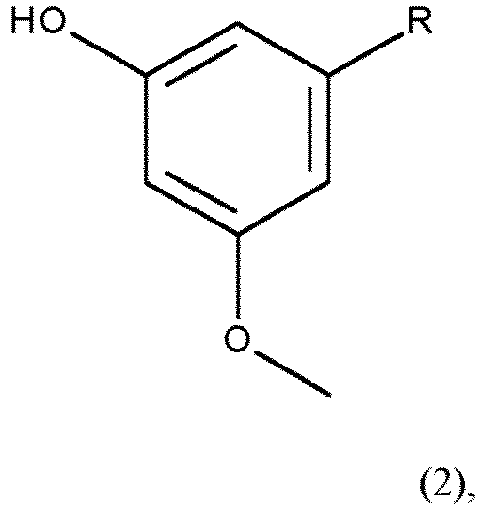 dans laquelle R représente C15H31-n, avec n = 4 ou 6,les composés de Formule 2, s'ils sont présents, l'étant en une quantité totale au maximum de 1,8 % en poids, de préférence au maximum de 1,5 % en poids, d'une manière particulièrement préférée au maximum de 0,5 % en poids, d'une manière tout particulièrement préférée au maximum 0,1 % en poids, par rapport au poids total de l'agent bloquant, et déterminée par le procédé indiqué dans la description.
 - Agent bloquant selon la revendication 1, l'agent bloquant présentant un indice d'OH de 184 à 206, d'une manière particulièrement préférée de 184 à 200 et d'une manière tout particulièrement préférée de 186 à 192, déterminé par le procédé indiqué dans la description.
- Agent bloquant selon la revendication 1 ou 2, ayant une teneur en soufre inférieure à 15 mg/kg, de préférence inférieure à 12 mg/kg, déterminée par le procédé indiqué dans la description.
- Procédé de fabrication de prépolymères d'isocyanate bloqués, comprenant, ou en étant constitué, la réaction deau moins un prépolymère portant des groupes isocyanate, pouvant être obtenu par la réaction d'une composition comprenant, ou en étant constitué,A. au moins un di- et/ou un polyisocyanate aliphatique, cycloaliphatique, araliphatique et/ou aromatique etB. au moins un composé polyhydroxylé avecun agent bloquant C selon l'une des revendications 1 à 3.
- Procédé selon la revendication 4, dans lequel on utilise en tant que composant A au moins un di- et/ou un polyisocyanate à base de diisocyanate de 1,5-naphtalène (NDI), de diisocyanatodiphénylméthane (MDI), de poly(isocyanate de méthylènephényle) (pMDI), de diisocyanatométhylbenzène (diisocyanate de 2,4- et de 2,6-toluylène, TDI).
- Procédé selon la revendication 4 ou 5, dans lequel on utilise comme composant B au moins un composé polyhydroxylé, de préférence au moins un polyétherpolyol, ayant une fonctionnalité OH de 1,8 à 6,0 et une masse moléculaire moyenne en nombre de 1 000 g/mol à 10 000 g/mol, déterminée par le procédé indiqué dans la description.
- Procédé selon l'une des revendications 4 à 6, dans lequel on utilise comme composant B au moins un polyétherpolyol, qui est un produit d'addition d'oxyde d'éthylène et/ou d'oxyde de propylène sur du 1,2-propanediol (propylèneglycol), du 1,3-propanediol, du glycérol, du triméthylolpropane, de l'éthylènediamine et/ou du pentaérythritol, ou qui est un polytétraméthylèneétherglycol pouvant être obtenu par polymérisation de tétrahydrofurane.
- Procédé selon l'une des revendications 4 à 7, dans lequel l'au moins un prépolymère portant des groupes isocyanate, qui peut être obtenu par la réaction de la composition, comprenant, ou en étant constituée, les composants A et B, est débarrassé au moins partiellement du composé A, par distillation, avant la réaction avec le composant C, du di- et/ou du polyisocyanate n'ayant pas réagi.
- Procédé selon l'une des revendications 4 à 8, dans lequel la réaction de la composition comprenant, ou en étant constituée, les composants A et B, a lieu avec le composant C en présence d'un catalyseur D1.
- Prépolymères d'isocyanate bloqués pouvant être obtenus par un procédé selon l'une des revendications 4 à 9.
- Prépolymères d'isocyanate bloqués selon la revendication 10, ayant une viscosité, mesurée selon DIN EN ISO 3219:1994-10 à 23 °C, inférieure à 40 000 mPa.s, de préférence inférieure à 35 000 mPa.s, d'une manière particulièrement préférée inférieure à 30 000 mPa.s.
- Systèmes réactifs contenant, ou en étant constituésa) au moins un prépolymère d'isocyanate bloqué, selon l'invention, selon l'une des revendications 10 ou 11,b) au moins un composé organique ayant au moins 2 groupes amino primaires,c) éventuellement au moins un composé comportant des groupes oxirane ayant une fonctionnalité oxirane moyenne > 1, ainsi qued) éventuellement des produits de réactions des composants a à c les uns avec les autres,e) éventuellement des catalyseurs, des adjuvants et des additifs.
- Utilisation des prépolymères d'isocyanate bloqués selon la revendication 10 ou 11 pour la fabrication de plastiques de polyuréthane.
- Utilisation des systèmes réactifs selon la revendication 12 pour fabriquer des revêtements, en particulier des revêtements anticorrosion, d'adhésifs, de masses d'étanchéité, de masses de scellement, de primaires ou d'objets moulés.
- Revêtements, en particulier revêtements anticorrosion, adhésifs, masses d'étanchéité, masses de scellement, primaires et objets moulés, contenant les prépolymères d'isocyanate bloqués selon la revendication 10 ou 11, ainsi que des substrats revêtus de revêtements, en particulier d'un tel revêtement anticorrosion, contenant les prépolymères d'isocyanate bloqués selon la revendication 10 ou 11.
Applications Claiming Priority (2)
| Application Number | Priority Date | Filing Date | Title |
|---|---|---|---|
| EP20168769.6A EP3892659A1 (fr) | 2020-04-08 | 2020-04-08 | Prépolymères d'isocyanate à faible viscosité bloqués ayant des phénols obtenus à partir de l'huile de noix de cajou, leur procédé de fabrication et leur utilisation |
| PCT/EP2021/058835 WO2021204741A1 (fr) | 2020-04-08 | 2021-04-06 | Prépolymères d'isocyanate à faible viscosité bloqués par des phénols pouvant être obtenus à partir d'huile de coquille de noix cajou, procédé de production correspondant et utilisation correspondante |
Publications (3)
| Publication Number | Publication Date |
|---|---|
| EP4132984A1 EP4132984A1 (fr) | 2023-02-15 |
| EP4132984B1 true EP4132984B1 (fr) | 2023-12-13 |
| EP4132984C0 EP4132984C0 (fr) | 2023-12-13 |
Family
ID=70277221
Family Applications (2)
| Application Number | Title | Priority Date | Filing Date |
|---|---|---|---|
| EP20168769.6A Ceased EP3892659A1 (fr) | 2020-04-08 | 2020-04-08 | Prépolymères d'isocyanate à faible viscosité bloqués ayant des phénols obtenus à partir de l'huile de noix de cajou, leur procédé de fabrication et leur utilisation |
| EP21715921.9A Revoked EP4132984B1 (fr) | 2020-04-08 | 2021-04-06 | Prépolymères d'isocyanate à faible viscosité bloqués ayant des phénols obtenus à partir de l'huile de noix de cajou, leur procédé de fabrication et leur utilisation |
Family Applications Before (1)
| Application Number | Title | Priority Date | Filing Date |
|---|---|---|---|
| EP20168769.6A Ceased EP3892659A1 (fr) | 2020-04-08 | 2020-04-08 | Prépolymères d'isocyanate à faible viscosité bloqués ayant des phénols obtenus à partir de l'huile de noix de cajou, leur procédé de fabrication et leur utilisation |
Country Status (7)
| Country | Link |
|---|---|
| US (1) | US20230127025A1 (fr) |
| EP (2) | EP3892659A1 (fr) |
| JP (1) | JP2023521346A (fr) |
| KR (1) | KR20220166799A (fr) |
| CN (1) | CN115427472A (fr) |
| ES (1) | ES2973411T3 (fr) |
| WO (1) | WO2021204741A1 (fr) |
Families Citing this family (11)
| Publication number | Priority date | Publication date | Assignee | Title |
|---|---|---|---|---|
| KR20240112930A (ko) * | 2021-12-07 | 2024-07-19 | 다우 글로벌 테크놀로지스 엘엘씨 | 개선된 저장 안정성을 갖는 차단된 예비중합체 조성물 |
| CN114106280B (zh) * | 2021-12-14 | 2023-05-16 | 上海华峰新材料研发科技有限公司 | 一种脂肪族聚氨酯树脂及其制备方法和用途 |
| CN114133529B (zh) * | 2021-12-14 | 2023-07-14 | 上海华峰新材料研发科技有限公司 | 一种芳香族聚氨酯树脂及其制备方法和用途 |
| CN114889291B (zh) * | 2022-03-28 | 2024-01-02 | 珠海市赛纬电子材料股份有限公司 | 一种铝塑膜及其制备方法 |
| CN115894839B (zh) * | 2022-11-14 | 2025-06-10 | 东莞澳中新材料科技股份有限公司 | 一种低温热固化的封闭型固化剂及应用其的单组分低温热固化的聚氨酯结构胶 |
| CN117186280B (zh) * | 2023-11-02 | 2024-01-26 | 广东创新精细化工实业有限公司 | 一种内嵌腰果酚多异氰酸酯封闭物的防水剂及其制备方法、应用 |
| CN122094998A (zh) | 2023-11-21 | 2026-05-26 | 科思创德国股份有限公司 | 水可分散的封闭型异氰酸酯预聚物体系及其制备方法与应用 |
| EP4574860A1 (fr) | 2023-12-19 | 2025-06-25 | Covestro Deutschland AG | Composition sans solvant contenant des oxazolidinones à fonction époxy |
| CN118064049B (zh) * | 2024-02-21 | 2024-09-20 | 山东交通学院 | 一种可水中快速固化的防腐涂层及其制备方法 |
| EP4759853A1 (fr) | 2024-12-16 | 2026-06-17 | Covestro Deutschland AG | Polyisocyanates hautement fonctionnels modifiés par des groupes allophanates et éventuellement des groupes isocyanurates et leur préparation |
| EP4759854A1 (fr) | 2024-12-16 | 2026-06-17 | Covestro Deutschland AG | Polyisocyanates hydrophilisés hautement fonctionnels et leur préparation |
Citations (5)
| Publication number | Priority date | Publication date | Assignee | Title |
|---|---|---|---|---|
| WO1997046603A1 (fr) | 1996-06-03 | 1997-12-11 | Uniroyal Chemical Company, Inc. | Retrait de diisocyanate monomere n'ayant pas reagi contenu dans des prepolymeres polyurethaniques |
| US20060116501A1 (en) | 2004-10-01 | 2006-06-01 | Bayer Materialscience Ag | Polyisocyanates blocked with sterically hindered phenols |
| WO2015153399A1 (fr) | 2014-03-31 | 2015-10-08 | Dow Global Technologies Llc | Prépolymères bloqués dérivés d'huile naturelle et compositions de plastisol acrylique présentant les prépolymères bloqués |
| WO2017207346A1 (fr) | 2016-05-31 | 2017-12-07 | Evonik Degussa Gmbh | Procédés à base de membrane pour la purification du baume de cajou |
| WO2020236440A1 (fr) | 2019-05-21 | 2020-11-26 | Ddp Specialty Electronic Materials Us, Llc | Matériaux d'interface en deux parties, systèmes comprenant le matériau d'interface, et procédés associés |
Family Cites Families (33)
| Publication number | Priority date | Publication date | Assignee | Title |
|---|---|---|---|---|
| DE1954093C3 (de) | 1968-11-15 | 1978-12-21 | Mobay Chemical Corp., Pittsburgh, Pa. (V.St.A.) | Verfahren zur Herstellung von polymeren organischen Isocyanaten |
| BE790295A (fr) | 1971-10-22 | 1973-04-19 | Bayer Ag | Matieres plastiques elastifiees |
| CA997495A (en) | 1972-08-14 | 1976-09-21 | Witco Chemical Corporation | Amine terminated polyurethane urea polymers cured with epoxides |
| DE2414413C3 (de) | 1974-03-26 | 1978-08-24 | Bayer Ag, 5090 Leverkusen | Verwendung von Lösungen von Polyisocyanaten mit Isocyanuratstruktur in Zweikomponenten-Polyurethan-Lacken |
| DE2418041C3 (de) | 1974-04-13 | 1982-04-29 | Schering Ag, 1000 Berlin Und 4619 Bergkamen | Verfahren zur Herstellung von elastifizierten Formteilen nach Flächengebilden |
| DE2452532C3 (de) | 1974-11-06 | 1978-08-24 | Bayer Ag, 5090 Leverkusen | Verfahren zur Herstellung von Polyisocyanaten mit Isocyanurat-Struktur |
| DE2622951B2 (de) | 1976-05-21 | 1979-09-06 | Bayer Ag, 5090 Leverkusen | Verfahren zur Herstellung von elastischen Fonnkörpern |
| DE2641380C2 (de) | 1976-09-15 | 1989-11-23 | Bayer Ag, 5090 Leverkusen | Verfahren zur Herstellung von Polyisocyanaten mit Isocyanuratstruktur |
| DE3151592A1 (de) | 1981-12-28 | 1983-07-07 | Schering Ag, 1000 Berlin Und 4619 Bergkamen | Haertbare kunstharzmischungen und mittel fuer haertbare kunstharzmischungen auf basis von praepolymeren polyaetherurethanharnstoffaminen und epoxidharzen |
| DE3151591A1 (de) | 1981-12-28 | 1983-07-14 | Lechler Chemie Gmbh, 7000 Stuttgart | Haertbare kunstharzmischungen und mittel fuer haertbare kunstharzmischungen auf basis von praepolymeren polyaetherurethanharnstoffaminen und epoxidharzen und/oder aromatischen carbamidsaeurearylestern |
| CA1219986A (fr) * | 1982-12-15 | 1987-03-31 | Christian Burba | Melanges durcissables d'urethane et de resine epoxy |
| DE3700209A1 (de) | 1987-01-07 | 1988-07-21 | Bayer Ag | Verfahren zur herstellung von polyisocyanaten mit biuretstruktur |
| AU602399B2 (en) | 1987-05-15 | 1990-10-11 | Interez Inc. | Polyamine-polyisocyanate reaction products as epoxy resin curing agents |
| DE3811350A1 (de) | 1988-04-02 | 1989-10-19 | Bayer Ag | Verfahren zur herstellung von isocyanuratpolyisocyanaten, die nach diesem verfahren erhaltenen verbindungen und ihre verwendung |
| DE3814167A1 (de) | 1988-04-27 | 1989-11-09 | Bayer Ag | Verfahren zur herstellung von isocyanuratgruppen aufweisenden polyisocyanaten und ihre verwendung |
| DE3900053A1 (de) | 1989-01-03 | 1990-07-12 | Bayer Ag | Verfahren zur herstellung von uretdion- und isocyanuratgruppen aufweisenden polyisocyanaten, die nach diesem verfahren erhaeltlichen polyisocyanate und ihre verwendung in zweikomponenten-polyurethanlacken |
| DE3928503A1 (de) | 1989-08-29 | 1991-03-07 | Bayer Ag | Verfahren zur herstellung von loesungen von isocyanuratgruppen aufweisenden polyisocyanaten in lackloesungsmitteln und ihre verwendung |
| DE4015302A1 (de) | 1990-05-12 | 1991-11-14 | Bayer Ag | Verfahren zur herstellung von aminen, die so erhaltenen amine und ihre verwendung als haerter fuer epoxidharze |
| DE4421816A1 (de) * | 1994-06-22 | 1996-01-04 | Bayer Ag | Mischblockierte Isocyanatpräpolymere, ein Verfahren zu ihrer Herstellung und ihre Verwendung zur Herstellung flexibilisierter Epoxidharz-Systeme |
| DE19611849A1 (de) | 1996-03-26 | 1997-10-02 | Bayer Ag | Neue Isocyanattrimerisate und Isocyanattrimerisatmischungen, deren Herstellung und Verwendung |
| DE19816570A1 (de) | 1998-04-15 | 1999-10-21 | Bayer Ag | Reaktivsysteme und ihre Verwendung zur Herstellung von Beschichtungen, Klebstoffen, Dichtungsmassen, Vergußmassen oder Formteilen |
| DE19835113A1 (de) | 1998-08-04 | 2000-02-10 | Basf Ag | Verfahren zur Herstellung von kompakten, transparenten Polyisocyanat-Polyadditionsprodukten |
| DE19935325A1 (de) | 1999-07-28 | 2001-02-01 | Bayer Ag | Lösemittelfreie, raumtemperaturhärtende Reaktivsysteme und ihre Verwendung zur Herstellung von Klebstoffen, Dichtungsmassen, Vergußmassen, Formteilen oder Beschichtungen |
| DE10260299A1 (de) | 2002-12-20 | 2004-07-01 | Bayer Ag | Reaktivsysteme, deren Herstellung und deren Verwendung |
| DE10316396A1 (de) * | 2003-04-10 | 2004-11-04 | Bayer Materialscience Ag | Phenolisch-blockierte Polyurethan-Prepolymere |
| US20060089480A1 (en) | 2004-10-21 | 2006-04-27 | Roesler Richard R | Biuretized isocyanates and blocked biuretized isocyanates |
| DE102006037288B4 (de) * | 2006-08-09 | 2019-06-13 | Ask Chemicals Gmbh | Formstoffmischung enthaltend Cardol und/oder Cardanol in Gießereibindemitteln auf Polyurethanbasis, Verfahren zur Herstellung eines Formkörpers sowie Verwendung desselben |
| WO2008147641A1 (fr) * | 2007-05-29 | 2008-12-04 | Dow Global Technologies Inc. | Formulations isocyanate-époxy pour un contrôle amélioré du durcissement |
| DE102009057597A1 (de) | 2009-12-09 | 2011-06-16 | Bayer Materialscience Ag | Polyrethan-Prepolymere |
| CN105960424B (zh) * | 2013-11-27 | 2019-08-30 | 陶氏环球技术有限责任公司 | 经腰果酚改性的环氧多元醇 |
| CN105992784B (zh) * | 2013-11-27 | 2019-08-09 | 陶氏环球技术有限责任公司 | 经腰果酚改性的环氧多元醇 |
| JP6595585B2 (ja) * | 2014-09-22 | 2019-10-23 | ダウ グローバル テクノロジーズ エルエルシー | 噴霧可能なポリウレタンコーティング |
| BR112018003350B1 (pt) | 2015-09-10 | 2022-06-14 | Dow Global Technologies Llc | Composição adequada como endurecedor em um adesivo de epóxi e método de fabricação de uma composição adequada como um endurecedor em um adesivo de epóxi |
-
2020
- 2020-04-08 EP EP20168769.6A patent/EP3892659A1/fr not_active Ceased
-
2021
- 2021-04-06 JP JP2022561059A patent/JP2023521346A/ja not_active Withdrawn
- 2021-04-06 ES ES21715921T patent/ES2973411T3/es active Active
- 2021-04-06 US US17/907,694 patent/US20230127025A1/en not_active Abandoned
- 2021-04-06 CN CN202180026365.XA patent/CN115427472A/zh active Pending
- 2021-04-06 WO PCT/EP2021/058835 patent/WO2021204741A1/fr not_active Ceased
- 2021-04-06 KR KR1020227034547A patent/KR20220166799A/ko not_active Withdrawn
- 2021-04-06 EP EP21715921.9A patent/EP4132984B1/fr not_active Revoked
Patent Citations (5)
| Publication number | Priority date | Publication date | Assignee | Title |
|---|---|---|---|---|
| WO1997046603A1 (fr) | 1996-06-03 | 1997-12-11 | Uniroyal Chemical Company, Inc. | Retrait de diisocyanate monomere n'ayant pas reagi contenu dans des prepolymeres polyurethaniques |
| US20060116501A1 (en) | 2004-10-01 | 2006-06-01 | Bayer Materialscience Ag | Polyisocyanates blocked with sterically hindered phenols |
| WO2015153399A1 (fr) | 2014-03-31 | 2015-10-08 | Dow Global Technologies Llc | Prépolymères bloqués dérivés d'huile naturelle et compositions de plastisol acrylique présentant les prépolymères bloqués |
| WO2017207346A1 (fr) | 2016-05-31 | 2017-12-07 | Evonik Degussa Gmbh | Procédés à base de membrane pour la purification du baume de cajou |
| WO2020236440A1 (fr) | 2019-05-21 | 2020-11-26 | Ddp Specialty Electronic Materials Us, Llc | Matériaux d'interface en deux parties, systèmes comprenant le matériau d'interface, et procédés associés |
Non-Patent Citations (2)
| Title |
|---|
| ANONYMOUS: ""Bio-based Material of the Year 2018" - NX-2026 Awarded Silver Medal - ", CARDOLITE NEWS, CARDOLITE CORPORATION, 17 May 2018 (2018-05-17), pages 1 - 2, XP093216484, Retrieved from the Internet <URL:https://www.cardolite.com/2018/05/17/nx-2026-biobased-silvermedal/> |
| YUN MI KIM, NATESH, ANBU; CAMPAGNER, PEITRO: "Cardanol – An Eco-friendly Isocyanate Blocking Agent", COATINGS WORLD, pages 1 - 18, XP055725748, Retrieved from the Internet <URL:https://www.coatingsworld.com/issues/2019-02-01/view_technical-papers/cardanol---an-eco-friendly-isocyanate-blocking-agent/> [retrieved on 20200828] |
Also Published As
| Publication number | Publication date |
|---|---|
| KR20220166799A (ko) | 2022-12-19 |
| CN115427472A (zh) | 2022-12-02 |
| EP3892659A1 (fr) | 2021-10-13 |
| EP4132984A1 (fr) | 2023-02-15 |
| JP2023521346A (ja) | 2023-05-24 |
| ES2973411T3 (es) | 2024-06-20 |
| US20230127025A1 (en) | 2023-04-27 |
| EP4132984C0 (fr) | 2023-12-13 |
| WO2021204741A1 (fr) | 2021-10-14 |
Similar Documents
| Publication | Publication Date | Title |
|---|---|---|
| WO2021204741A1 (fr) | Prépolymères d'isocyanate à faible viscosité bloqués par des phénols pouvant être obtenus à partir d'huile de coquille de noix cajou, procédé de production correspondant et utilisation correspondante | |
| EP0950675B1 (fr) | Systèmes réactifs et leur utilisation pour la production de revêtements, adhésifs, matériaux d'étanchéité, matériaux de coulée ou des pièces moulées | |
| EP1578836B1 (fr) | Prepolymeres de polyurethanne bloques par des cetones cycliques a ch-acide, systemes reactifs produits au moyen de ces prepolymeres, et production et utilisation de ceux-ci | |
| EP0457089B1 (fr) | Procédé de préparation d'amines et leur utilisation comme durcisseur pour des résines époxydes | |
| EP0688803B1 (fr) | Prépolymères d'isocyanates bloqués par des agents de blocage différents, leur procédé de préparation et leur utilisation dans la production de systèmes de résines époxydes flexibilisées | |
| EP0477488A1 (fr) | Masses de polyuréthane-polyurée duroplastiques durcissant à froid et exempts de solvant | |
| EP1208128B1 (fr) | Polyamines comportant des groupes uree, procede permettant de les preparer et leur utilisation comme durcisseurs de resines epoxydes | |
| EP1578833B1 (fr) | Systeme reactif durcissant a temperature ambiante | |
| EP1204691B1 (fr) | Systemes reactifs exempts de solvants et durcissant a temperature ambiante et leur utilisation pour la production d'adhesifs, de masses d'etancheite, de masses de remplissage, de pieces moulees ou de revetements | |
| EP0082983B1 (fr) | Compositions de résine synthétique durcissables et agents pour compositions de résine synthétique durcissables à base d'amines de polyéther-uréthanne-urée et de résines époxide et/ou d'esters aryliques/aromatiques de l'acide carbamique | |
| EP1615964B1 (fr) | Procede de fabrication de prepolymeres de polyurethane a blocage phenolique | |
| EP4265663A1 (fr) | Compositions de revêtement à deux composants à base de polyaspartate destinées à la fabrication de revêtements présentant de bonnes propriétés d'auto-cicatrisation et en même temps une faible adhérence | |
| WO2006002811A1 (fr) | Procede pour produire des prepolymeres de polyurethannes aminofonctionnels | |
| DE102009017412A1 (de) | Reaktivsysteme, deren Herstellung und deren Verwendung | |
| EP1772499A2 (fr) | Systèmes réactifs, leur préparation et leur utilisation | |
| DE102004056398A1 (de) | Hydrolysestabile, hydrophobe, lösemittelfreie Polyole |
Legal Events
| Date | Code | Title | Description |
|---|---|---|---|
| STAA | Information on the status of an ep patent application or granted ep patent |
Free format text: STATUS: UNKNOWN |
|
| STAA | Information on the status of an ep patent application or granted ep patent |
Free format text: STATUS: THE INTERNATIONAL PUBLICATION HAS BEEN MADE |
|
| PUAI | Public reference made under article 153(3) epc to a published international application that has entered the european phase |
Free format text: ORIGINAL CODE: 0009012 |
|
| STAA | Information on the status of an ep patent application or granted ep patent |
Free format text: STATUS: REQUEST FOR EXAMINATION WAS MADE |
|
| 17P | Request for examination filed |
Effective date: 20221108 |
|
| AK | Designated contracting states |
Kind code of ref document: A1 Designated state(s): AL AT BE BG CH CY CZ DE DK EE ES FI FR GB GR HR HU IE IS IT LI LT LU LV MC MK MT NL NO PL PT RO RS SE SI SK SM TR |
|
| DAV | Request for validation of the european patent (deleted) | ||
| DAX | Request for extension of the european patent (deleted) | ||
| GRAP | Despatch of communication of intention to grant a patent |
Free format text: ORIGINAL CODE: EPIDOSNIGR1 |
|
| STAA | Information on the status of an ep patent application or granted ep patent |
Free format text: STATUS: GRANT OF PATENT IS INTENDED |
|
| INTG | Intention to grant announced |
Effective date: 20230807 |
|
| GRAS | Grant fee paid |
Free format text: ORIGINAL CODE: EPIDOSNIGR3 |
|
| GRAA | (expected) grant |
Free format text: ORIGINAL CODE: 0009210 |
|
| STAA | Information on the status of an ep patent application or granted ep patent |
Free format text: STATUS: THE PATENT HAS BEEN GRANTED |
|
| AK | Designated contracting states |
Kind code of ref document: B1 Designated state(s): AL AT BE BG CH CY CZ DE DK EE ES FI FR GB GR HR HU IE IS IT LI LT LU LV MC MK MT NL NO PL PT RO RS SE SI SK SM TR |
|
| REG | Reference to a national code |
Ref country code: GB Ref legal event code: FG4D Free format text: NOT ENGLISH |
|
| REG | Reference to a national code |
Ref country code: CH Ref legal event code: EP |
|
| REG | Reference to a national code |
Ref country code: DE Ref legal event code: R096 Ref document number: 502021002183 Country of ref document: DE |
|
| REG | Reference to a national code |
Ref country code: IE Ref legal event code: FG4D Free format text: LANGUAGE OF EP DOCUMENT: GERMAN |
|
| U01 | Request for unitary effect filed |
Effective date: 20231231 |
|
| U07 | Unitary effect registered |
Designated state(s): AT BE BG DE DK EE FI FR IT LT LU LV MT NL PT SE SI Effective date: 20240110 |
|
| PG25 | Lapsed in a contracting state [announced via postgrant information from national office to epo] |
Ref country code: GR Free format text: LAPSE BECAUSE OF FAILURE TO SUBMIT A TRANSLATION OF THE DESCRIPTION OR TO PAY THE FEE WITHIN THE PRESCRIBED TIME-LIMIT Effective date: 20240314 |
|
| U20 | Renewal fee for the european patent with unitary effect paid |
Year of fee payment: 4 Effective date: 20240320 |
|
| PG25 | Lapsed in a contracting state [announced via postgrant information from national office to epo] |
Ref country code: GR Free format text: LAPSE BECAUSE OF FAILURE TO SUBMIT A TRANSLATION OF THE DESCRIPTION OR TO PAY THE FEE WITHIN THE PRESCRIBED TIME-LIMIT Effective date: 20240314 |
|
| PG25 | Lapsed in a contracting state [announced via postgrant information from national office to epo] |
Ref country code: RS Free format text: LAPSE BECAUSE OF FAILURE TO SUBMIT A TRANSLATION OF THE DESCRIPTION OR TO PAY THE FEE WITHIN THE PRESCRIBED TIME-LIMIT Effective date: 20231213 Ref country code: NO Free format text: LAPSE BECAUSE OF FAILURE TO SUBMIT A TRANSLATION OF THE DESCRIPTION OR TO PAY THE FEE WITHIN THE PRESCRIBED TIME-LIMIT Effective date: 20240313 Ref country code: HR Free format text: LAPSE BECAUSE OF FAILURE TO SUBMIT A TRANSLATION OF THE DESCRIPTION OR TO PAY THE FEE WITHIN THE PRESCRIBED TIME-LIMIT Effective date: 20231213 |
|
| PG25 | Lapsed in a contracting state [announced via postgrant information from national office to epo] |
Ref country code: IS Free format text: LAPSE BECAUSE OF FAILURE TO SUBMIT A TRANSLATION OF THE DESCRIPTION OR TO PAY THE FEE WITHIN THE PRESCRIBED TIME-LIMIT Effective date: 20240413 |
|
| PGFP | Annual fee paid to national office [announced via postgrant information from national office to epo] |
Ref country code: ES Payment date: 20240509 Year of fee payment: 4 |
|
| PG25 | Lapsed in a contracting state [announced via postgrant information from national office to epo] |
Ref country code: CZ Free format text: LAPSE BECAUSE OF FAILURE TO SUBMIT A TRANSLATION OF THE DESCRIPTION OR TO PAY THE FEE WITHIN THE PRESCRIBED TIME-LIMIT Effective date: 20231213 |
|
| PG25 | Lapsed in a contracting state [announced via postgrant information from national office to epo] |
Ref country code: SK Free format text: LAPSE BECAUSE OF FAILURE TO SUBMIT A TRANSLATION OF THE DESCRIPTION OR TO PAY THE FEE WITHIN THE PRESCRIBED TIME-LIMIT Effective date: 20231213 |
|
| PG25 | Lapsed in a contracting state [announced via postgrant information from national office to epo] |
Ref country code: SM Free format text: LAPSE BECAUSE OF FAILURE TO SUBMIT A TRANSLATION OF THE DESCRIPTION OR TO PAY THE FEE WITHIN THE PRESCRIBED TIME-LIMIT Effective date: 20231213 Ref country code: SK Free format text: LAPSE BECAUSE OF FAILURE TO SUBMIT A TRANSLATION OF THE DESCRIPTION OR TO PAY THE FEE WITHIN THE PRESCRIBED TIME-LIMIT Effective date: 20231213 Ref country code: RO Free format text: LAPSE BECAUSE OF FAILURE TO SUBMIT A TRANSLATION OF THE DESCRIPTION OR TO PAY THE FEE WITHIN THE PRESCRIBED TIME-LIMIT Effective date: 20231213 Ref country code: IS Free format text: LAPSE BECAUSE OF FAILURE TO SUBMIT A TRANSLATION OF THE DESCRIPTION OR TO PAY THE FEE WITHIN THE PRESCRIBED TIME-LIMIT Effective date: 20240413 Ref country code: CZ Free format text: LAPSE BECAUSE OF FAILURE TO SUBMIT A TRANSLATION OF THE DESCRIPTION OR TO PAY THE FEE WITHIN THE PRESCRIBED TIME-LIMIT Effective date: 20231213 |
|
| PG25 | Lapsed in a contracting state [announced via postgrant information from national office to epo] |
Ref country code: PL Free format text: LAPSE BECAUSE OF FAILURE TO SUBMIT A TRANSLATION OF THE DESCRIPTION OR TO PAY THE FEE WITHIN THE PRESCRIBED TIME-LIMIT Effective date: 20231213 |
|
| PG25 | Lapsed in a contracting state [announced via postgrant information from national office to epo] |
Ref country code: PL Free format text: LAPSE BECAUSE OF FAILURE TO SUBMIT A TRANSLATION OF THE DESCRIPTION OR TO PAY THE FEE WITHIN THE PRESCRIBED TIME-LIMIT Effective date: 20231213 |
|
| REG | Reference to a national code |
Ref country code: DE Ref legal event code: R026 Ref document number: 502021002183 Country of ref document: DE |
|
| PLBI | Opposition filed |
Free format text: ORIGINAL CODE: 0009260 |
|
| PLAX | Notice of opposition and request to file observation + time limit sent |
Free format text: ORIGINAL CODE: EPIDOSNOBS2 |
|
| 26 | Opposition filed |
Opponent name: DDP SPECIALTY ELECTRONIC MATERIALS US, LLC Effective date: 20240912 |
|
| PG25 | Lapsed in a contracting state [announced via postgrant information from national office to epo] |
Ref country code: MC Free format text: LAPSE BECAUSE OF FAILURE TO SUBMIT A TRANSLATION OF THE DESCRIPTION OR TO PAY THE FEE WITHIN THE PRESCRIBED TIME-LIMIT Effective date: 20231213 |
|
| PG25 | Lapsed in a contracting state [announced via postgrant information from national office to epo] |
Ref country code: MC Free format text: LAPSE BECAUSE OF FAILURE TO SUBMIT A TRANSLATION OF THE DESCRIPTION OR TO PAY THE FEE WITHIN THE PRESCRIBED TIME-LIMIT Effective date: 20231213 |
|
| REG | Reference to a national code |
Ref country code: CH Ref legal event code: PL |
|
| PG25 | Lapsed in a contracting state [announced via postgrant information from national office to epo] |
Ref country code: CH Free format text: LAPSE BECAUSE OF NON-PAYMENT OF DUE FEES Effective date: 20240430 |
|
| PLAK | Information related to reply of patent proprietor to notice(s) of opposition modified |
Free format text: ORIGINAL CODE: EPIDOSCOBS3 |
|
| PLBB | Reply of patent proprietor to notice(s) of opposition received |
Free format text: ORIGINAL CODE: EPIDOSNOBS3 |
|
| RDAE | Information deleted related to despatch of communication that patent is revoked |
Free format text: ORIGINAL CODE: EPIDOSDREV1 |
|
| RDAF | Communication despatched that patent is revoked |
Free format text: ORIGINAL CODE: EPIDOSNREV1 |
|
| PG25 | Lapsed in a contracting state [announced via postgrant information from national office to epo] |
Ref country code: IE Free format text: LAPSE BECAUSE OF NON-PAYMENT OF DUE FEES Effective date: 20240406 |
|
| U20 | Renewal fee for the european patent with unitary effect paid |
Year of fee payment: 5 Effective date: 20250320 |
|
| RDAG | Patent revoked |
Free format text: ORIGINAL CODE: 0009271 |
|
| STAA | Information on the status of an ep patent application or granted ep patent |
Free format text: STATUS: PATENT REVOKED |
|
| REG | Reference to a national code |
Ref country code: CH Ref legal event code: PL |
|
| 27W | Patent revoked |
Effective date: 20250214 |
|
| GBPR | Gb: patent revoked under art. 102 of the ep convention designating the uk as contracting state |
Effective date: 20250214 |
|
| PG25 | Lapsed in a contracting state [announced via postgrant information from national office to epo] |
Ref country code: CY Free format text: LAPSE BECAUSE OF FAILURE TO SUBMIT A TRANSLATION OF THE DESCRIPTION OR TO PAY THE FEE WITHIN THE PRESCRIBED TIME-LIMIT; INVALID AB INITIO Effective date: 20210406 |
|
| PG25 | Lapsed in a contracting state [announced via postgrant information from national office to epo] |
Ref country code: HU Free format text: LAPSE BECAUSE OF FAILURE TO SUBMIT A TRANSLATION OF THE DESCRIPTION OR TO PAY THE FEE WITHIN THE PRESCRIBED TIME-LIMIT; INVALID AB INITIO Effective date: 20210406 |
|
| PG25 | Lapsed in a contracting state [announced via postgrant information from national office to epo] |
Ref country code: TR Free format text: LAPSE BECAUSE OF FAILURE TO SUBMIT A TRANSLATION OF THE DESCRIPTION OR TO PAY THE FEE WITHIN THE PRESCRIBED TIME-LIMIT Effective date: 20231213 |