EP4133846B1 - Gestion de transmissions multi-trip de canal partagé de liaison descendante physique - Google Patents
Gestion de transmissions multi-trip de canal partagé de liaison descendante physique Download PDFInfo
- Publication number
- EP4133846B1 EP4133846B1 EP20936008.0A EP20936008A EP4133846B1 EP 4133846 B1 EP4133846 B1 EP 4133846B1 EP 20936008 A EP20936008 A EP 20936008A EP 4133846 B1 EP4133846 B1 EP 4133846B1
- Authority
- EP
- European Patent Office
- Prior art keywords
- tci
- dci
- pdsch
- codepoint
- transmission
- Prior art date
- Legal status (The legal status is an assumption and is not a legal conclusion. Google has not performed a legal analysis and makes no representation as to the accuracy of the status listed.)
- Active
Links
Images



Classifications
-
- H—ELECTRICITY
- H04—ELECTRIC COMMUNICATION TECHNIQUE
- H04B—TRANSMISSION
- H04B7/00—Radio transmission systems, i.e. using radiation field
- H04B7/02—Diversity systems; Multi-antenna system, i.e. transmission or reception using multiple antennas
- H04B7/04—Diversity systems; Multi-antenna system, i.e. transmission or reception using multiple antennas using two or more spaced independent antennas
- H04B7/08—Diversity systems; Multi-antenna system, i.e. transmission or reception using multiple antennas using two or more spaced independent antennas at the receiving station
- H04B7/0868—Hybrid systems, i.e. switching and combining
- H04B7/088—Hybrid systems, i.e. switching and combining using beam selection
-
- H—ELECTRICITY
- H04—ELECTRIC COMMUNICATION TECHNIQUE
- H04L—TRANSMISSION OF DIGITAL INFORMATION, e.g. TELEGRAPHIC COMMUNICATION
- H04L5/00—Arrangements affording multiple use of the transmission path
- H04L5/0001—Arrangements for dividing the transmission path
- H04L5/0014—Three-dimensional division
- H04L5/0023—Time-frequency-space
-
- H—ELECTRICITY
- H04—ELECTRIC COMMUNICATION TECHNIQUE
- H04L—TRANSMISSION OF DIGITAL INFORMATION, e.g. TELEGRAPHIC COMMUNICATION
- H04L5/00—Arrangements affording multiple use of the transmission path
- H04L5/003—Arrangements for allocating sub-channels of the transmission path
- H04L5/0032—Distributed allocation, i.e. involving a plurality of allocating devices, each making partial allocation
- H04L5/0035—Resource allocation in a cooperative multipoint environment
-
- H—ELECTRICITY
- H04—ELECTRIC COMMUNICATION TECHNIQUE
- H04L—TRANSMISSION OF DIGITAL INFORMATION, e.g. TELEGRAPHIC COMMUNICATION
- H04L5/00—Arrangements affording multiple use of the transmission path
- H04L5/003—Arrangements for allocating sub-channels of the transmission path
- H04L5/0044—Allocation of payload; Allocation of data channels, e.g. PDSCH or PUSCH
-
- H—ELECTRICITY
- H04—ELECTRIC COMMUNICATION TECHNIQUE
- H04L—TRANSMISSION OF DIGITAL INFORMATION, e.g. TELEGRAPHIC COMMUNICATION
- H04L5/00—Arrangements affording multiple use of the transmission path
- H04L5/0091—Signalling for the administration of the divided path, e.g. signalling of configuration information
- H04L5/0094—Indication of how sub-channels of the path are allocated
-
- H—ELECTRICITY
- H04—ELECTRIC COMMUNICATION TECHNIQUE
- H04W—WIRELESS COMMUNICATION NETWORKS
- H04W16/00—Network planning, e.g. coverage or traffic planning tools; Network deployment, e.g. resource partitioning or cells structures
- H04W16/14—Spectrum sharing arrangements between different networks
-
- H—ELECTRICITY
- H04—ELECTRIC COMMUNICATION TECHNIQUE
- H04W—WIRELESS COMMUNICATION NETWORKS
- H04W72/00—Local resource management
- H04W72/20—Control channels or signalling for resource management
- H04W72/23—Control channels or signalling for resource management in the downlink direction of a wireless link, i.e. towards a terminal
-
- H—ELECTRICITY
- H04—ELECTRIC COMMUNICATION TECHNIQUE
- H04B—TRANSMISSION
- H04B7/00—Radio transmission systems, i.e. using radiation field
- H04B7/02—Diversity systems; Multi-antenna system, i.e. transmission or reception using multiple antennas
- H04B7/04—Diversity systems; Multi-antenna system, i.e. transmission or reception using multiple antennas using two or more spaced independent antennas
- H04B7/06—Diversity systems; Multi-antenna system, i.e. transmission or reception using multiple antennas using two or more spaced independent antennas at the transmitting station
- H04B7/0613—Diversity systems; Multi-antenna system, i.e. transmission or reception using multiple antennas using two or more spaced independent antennas at the transmitting station using simultaneous transmission
- H04B7/0615—Diversity systems; Multi-antenna system, i.e. transmission or reception using multiple antennas using two or more spaced independent antennas at the transmitting station using simultaneous transmission of weighted versions of same signal
- H04B7/0665—Feed forward of transmit weights to the receiver
-
- H—ELECTRICITY
- H04—ELECTRIC COMMUNICATION TECHNIQUE
- H04W—WIRELESS COMMUNICATION NETWORKS
- H04W72/00—Local resource management
- H04W72/12—Wireless traffic scheduling
- H04W72/1263—Mapping of traffic onto schedule, e.g. scheduled allocation or multiplexing of flows
- H04W72/1273—Mapping of traffic onto schedule, e.g. scheduled allocation or multiplexing of flows of downlink data flows
Definitions
- a user equipment may establish a connection to at least one of a plurality of different networks or types of networks.
- a next generation NodeB (gNB) transmits downlink control information (DCI) to the UE via a physical downlink control channel (PDCCH).
- DCI downlink control information
- PDCCH physical downlink control channel
- the PDCCH is transmitted to the UE via one or more control resource sets (CORESETS), each of which includes a transmission configuration indicator (TCI) state configured by the gNB.
- CORESETS control resource sets
- One type of information on the PDCCH is scheduling of a physical downlink shared channel (PDSCH) transmission and a beam over which the UE should use to receive the PDCCH.
- the UE may receive the PDCCH on one component carrier (in one serving cell) with scheduling of a PDSCH on a different component carrier (in a different serving cell).
- the UE may use a default beam to receive the PDSCH.
- the UE would also use the default beam to receive the PDSCH in this case.
- the default beam selected by the UE is the beam that corresponds to the lowest TCI codepoint from a plurality of TCI codepoints, each of which includes two different TCI states.
- Multiple PDSCHs may be scheduled for UE reception via multi-transmission reception points (TRP) to improve the throughput of the UE.
- the PDSCHs may partially or fully overlap in frequency (overlapping reference elements (REs)) and/or in time (e.g., two PDSCHs received at the same time).
- REs overlapping reference elements
- 5G NR spectrum is difficult to obtain and expensive, operators have utilized dynamic spectrum sharing (DSS) so that 5G NR and Long Term Evolution (ETE) transmissions can coexist in the same spectrum.
- DSS dynamic spectrum sharing
- ETE Long Term Evolution
- one method the 5G NR network may use is rate matching its signals around the LTE signals.
- the exemplary embodiments may be further understood with reference to the following description and the related appended drawings, wherein like elements are provided with the same reference numerals.
- the exemplary embodiments relate to reporting user equipment (UE) physical downlink shared channel (PDSCH) overlapping capability with a gNB of a 5G new radio (NR) network.
- the exemplary embodiments further relate to default beam selection by a UE in self-scheduled and cross-carrier scheduled PDSCH reception.
- the exemplary embodiments further relate to determining a shift of a demodulation reference signal (DMRS) in a dynamic spectrum sharing (DSS) environment.
- DMRS demodulation reference signal
- DSS dynamic spectrum sharing
- the exemplary embodiments are described with regard to a UE. However, the use of a UE is merely for illustrative purposes.
- the exemplary embodiments may be utilized with any electronic component that may establish a connection with a network and is configured with the hardware, software, and/or firmware to exchange information and data with the network. Therefore, the UE as described herein is used to represent any electronic component.
- the exemplary embodiments are also described with regard to a network that includes 5G NR radio access technology (RAT).
- RAT radio access technology
- reference to a 5G NR network is merely provided for illustrative purposes.
- the exemplary embodiments may be utilized with any network that implements multiple transmission and reception points. Therefore, the 5G NR network as described herein may represent any network that includes the functionalities associated with multi-TRP.
- Release 16 of 5G NR supports multi-downlink control information (DCI), multi-transmission reception point (TRP) communications.
- DCI multi-downlink control information
- TRP multi-transmission reception point
- a UE can receive two physical downlink shared channel (PDSCH) transmissions from two TRPs.
- PDSCH physical downlink shared channel
- Release 16 also supports fully overlapping, partially overlapping, and non-overlapping PDSCHs in the time domain and/or the frequency domain.
- an issue that arises with two PDSCHs overlapping in the frequency domain is interference.
- the network is unaware of the capability of the UE to handle such overlapping.
- the UE may group capabilities regarding overlapping PDSCHs into a plurality of groups and report the UE's capability based on the groups to the gNB.
- the network is advantageously aware of the UE's capabilities when scheduling more than one PDSCH.
- multi-TRP communications some issues that may arise when scheduling the PDSCH are (1) the transmission configuration indicator (TCI) field in the downlink control information (DCI) of the PDSCH is not configured; or (2) the UE does not have enough time to switch beams to receive the PDSCH scheduled by the gNB.
- TCI transmission configuration indicator
- DCI downlink control information
- the UE determines a default beam to receive the PDSCH that overcomes these issues.
- both 5G NR signals and LTE signals are transmitted within the same spectrum.
- DSS dynamic spectrum sharing
- a possible issue that arises from this coexistence on the same spectrum is interference when the DMRS of a 5G NR transmission collides with a cell-specific reference signal (CRS) of an LTE transmission.
- CRS cell-specific reference signal
- the gNB shifts the DMRS in some scenarios when a collision with a CRS is expected.
- Fig. 1 shows an exemplary network arrangement 100 according to various exemplary embodiments.
- the exemplary network arrangement 100 includes a UE 110.
- the UE 110 may be any type of electronic component that is configured to communicate via a network, e.g., mobile phones, tablet computers, desktop computers, smartphones, phablets, embedded devices, wearables, Internet of Things (IoT) devices, etc.
- IoT Internet of Things
- an actual network arrangement may include any number of UEs being used by any number of users.
- the example of a single UE 110 is merely provided for illustrative purposes.
- the UE 110 may be configured to communicate with one or more networks.
- the networks with which the UE 110 may wirelessly communicate are a 5G New Radio (NR) radio access network (5G NR-RAN) 120, an LTE radio access network (LTE-RAN) 122 and a wireless local access network (WLAN) 124.
- NR 5G New Radio
- LTE-RAN LTE radio access network
- WLAN wireless local access network
- the UE 110 may also communicate with other types of networks and the UE 110 may also communicate with networks over a wired connection. Therefore, the UE 110 may include a 5G NR chipset to communicate with the 5G NR-RAN 120, an LTE chipset to communicate with the LTE-RAN 122 and an ISM chipset to communicate with the WLAN 124.
- the 5G NR-RAN 120 and the LTE-RAN 122 may be portions of cellular networks that may be deployed by cellular providers (e.g., Verizon, AT&T, Sprint, T-Mobile, etc.). These networks 120, 122 may include, for example, cells or base stations (Node Bs, eNodeBs, HeNBs, eNBS, gNBs, gNodeBs, macrocells, microcells, small cells, femtocells, etc.) that are configured to send and receive traffic from UEs that are equipped with the appropriate cellular chip set.
- the WLAN 124 may include any type of wireless local area network (WiFi, Hot Spot, IEEE 802.11x networks, etc.).
- the UE 110 may connect to the 5G NR-RAN 120 via the gNB 120A.
- the gNB 120A may be configured with the necessary hardware (e.g., antenna array), software and/or firmware to perform massive multiple in multiple out (MIMO) functionality.
- Massive MIMO may refer to a base station that is configured to generate a plurality of beams for a plurality of UEs.
- the UE 110 may be within range of a plurality of gNBs.
- the UE 110 may also connect to the 5G NR-RAN 120 via the gNB 120B.
- Reference to two gNBs 120A, 120B is merely for illustrative purposes. The exemplary embodiments may apply to any appropriate number of gNBs.
- the UE 110 may communicate with the eNB 122A of the LTE-RAN 122 to transmit and receive control information used for downlink and/or uplink synchronization with respect to the 5G NR-RAN 120 connection.
- the gNB may perform various operation related to determining a shift of a DMRS when a collision between a DMRS of the 5G NR RAN 120 collides with a CRS of the LTE RAN 122.
- any association procedure may be performed for the UE 110 to connect to the 5G NR-RAN 120.
- the 5G NR-RAN 120 may be associated with a particular cellular provider where the UE 110 and/or the user thereof has a contract and credential information (e.g., stored on a SIM card).
- the UE 110 may transmit the corresponding credential information to associate with the 5G NR-RAN 120.
- the UE 110 may associate with a specific base station (e.g., the gNB 120A of the 5G NR-RAN 120).
- the network arrangement 100 also includes a cellular core network 130, the Internet 140, an IP Multimedia Subsystem (IMS) 150, and a network services backbone 160.
- the cellular core network 130 may be considered to be the interconnected set of components that manages the operation and traffic of the cellular network.
- the cellular core network 130 also manages the traffic that flows between the cellular network and the Internet 140.
- the IMS 150 may be generally described as an architecture for delivering multimedia services to the UE 110 using the IP protocol.
- the IMS 150 may communicate with the cellular core network 130 and the Internet 140 to provide the multimedia services to the UE 110.
- the network services backbone 160 is in communication either directly or indirectly with the Internet 140 and the cellular core network 130.
- the network services backbone 160 may be generally described as a set of components (e.g., servers, network storage arrangements, etc.) that implement a suite of services that may be used to extend the functionalities of the UE 110 in communication with the various networks.
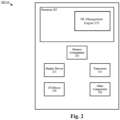
- Fig. 2 shows an exemplary UE 110 according to various exemplary embodiments.
- the UE 110 will be described with regard to the network arrangement 100 of Fig. 1 .
- the UE 110 may represent any electronic device and may include a processor 205, a memory arrangement 210, a display device 215, an input/output (I/O) device 220, a transceiver 225 and other components 230.
- the other components 230 may include, for example, an audio input device, an audio output device, a battery that provides a limited power supply, a data acquisition device, ports to electrically connect the UE 110 to other electronic devices, one or more antenna panels, etc.
- the processor 205 may be configured to execute a plurality of engines of the UE 110.
- the engines may include a downlink (DL) management engine 235.
- the DL management engine 235 may perform various operations related to determining UE capability with regards to PDSCH overlapping and default beam selection.
- the above referenced engine being an application (e.g., a program) executed by the processor 205 is only exemplary.
- the functionality associated with the engine may also be represented as a separate incorporated component of the UE 110 or may be a modular component coupled to the UE 110, e.g., an integrated circuit with or without firmware.
- the integrated circuit may include input circuitry to receive signals and processing circuitry to process the signals and other information.
- the engines may also be embodied as one application or separate applications.
- the functionality described for the processor 205 is split among two or more processors such as a baseband processor and an applications processor.
- the exemplary embodiments may be implemented in any of these or other configurations of a UE.
- the memory arrangement 210 may be a hardware component configured to store data related to operations performed by the UE 110.
- the display device 215 may be a hardware component configured to show data to a user while the I/O device 220 may be a hardware component that enables the user to enter inputs.
- the display device 215 and the I/O device 220 may be separate components or integrated together such as a touchscreen.
- the transceiver 225 may be a hardware component configured to establish a connection with the 5G NR-RAN 120, the LTE-RAN 122, the WLAN 124, etc. Accordingly, the transceiver 225 may operate on a variety of different frequencies or channels (e.g., set of consecutive frequencies).
- Fig. 3 shows a method 300 of performing overlapping PDSCH capability signaling by a UE (e.g., UE 110) according to various exemplary embodiments.
- the method 300 assumes that the gNB 120A or 120B has two PDSCHs to transmit to the UE 110.
- the UE 110 groups the UE's capabilities for handling overlapping PDSCHs into multiple groups.
- the UE 110 may determine three (3) groups.
- group 1 includes PDSCHs that do not overlap in the frequency domain, but are fully overlapping, partially overlapping, or not overlapping in the time domain. In this group, there is no interference of any REs between the two PDSCHs.
- the two PDSCHs can arrive in any temporal order. For example, the two PDSCHs can arrive at the same time or can overlap in time.
- group 2 includes PDSCHs that fully overlap.
- Group 2 can be classified in two ways: (1) both PDSCHs have the same number of resource blocks (RBs) and every resource elements (REs) of a first PDSCH overlaps with the REs of a second PDSCH; or (2) the first PDSCH includes the same amount of or more RBs than the second PDSCH and some of the REs of the first PDSCH overlap with all of the REs of the second PDSCH. That is, the second PDSCH REs can be considered a subset of the first PDSCH REs. Although fully overlapping PDSCHs cause interference, this interference is constant because it is across all REs.
- group 3 includes PDSCHs that partially overlap.
- Group 3 can be classified in two ways: (1) for at least one PDSCH (the first OR second PDSCH), at least one RE does not overlap with an RE of the other PDSCH; or (2) for each PDSCH (the first AND second PDSCH), at least one RE does not overlap with an RE of the other PDSCH.
- demodulation of the PDSCHs will result in no interference on some REs but some interference on other REs.
- the UE 110 may use two receivers to handle the two PDSCHs (1 for each PDSCH).
- group 1 may include PDSCHs that do not overlap in frequency nor in time. In other words, each PDSCH is received at a different time than the other PDSCH and none of the REs of either PDSCH overlap with the REs of the other PDSCH.
- group 2 may include PDSCHs that (1) fully overlap in the frequency domain; or (2) do not overlap in the frequency domain, but partially or fully overlap in the time domain.
- the UE 110 determines its capability of handling overlapping PDSCHs based on the groups the UE 110 determined at 305.
- the UE 110 may support only Group 1.
- the UE 110 may support all three groups.
- the UE 110 may support all or a subset of the capability groups.
- the UE 110 transmits the capabilities to the gNB 120A or 120B.
- the network may require that the UE mandatorily support a minimum functionality. For example, the network may require the UE 110 to support the functions of Group 1 and optionally support the functions of Groups 2 and 3.
- Fig. 4 shows a method 400 of selecting a TCI state(s) for beam selection according to various exemplary embodiments.
- the UE 110 receives a PDCCH transmission including DCI information.
- the UE 110 determines whether the TCI field in is configured in the DCI. If the DCI field is not configured (e.g., by the gNB 120a or 120b), at 420, the UE 110 uses the CORESET associated with a monitored search space with the lowest controlResourceSetId in the latest slot in which one or more CORESETs within the active bandwidth part (BWP) of the serving cell are monitored.
- BWP active bandwidth part
- the UE 110 selects the CORESET with the lowest ID in the slot in which the UE last monitored the PDCCH in the latest control monitoring duration.
- the UE 110 bases the default beam on the beam used for that particular CORESET for the PDSCH decoding.
- the UE 110 determines, at 415, whether the configured TCI field indicates a codepoint with two (2) TCI states. If the TCI field indicates a codepoint with two TCI states, the UE 110 uses, at 425, the default beam to receive the single-DCI, multi-TRP scheduling. That is, when the UE 110 decodes the TCI field containing 2 states, the UE understands that two default beams are used to buffer the PDSCH. After the UE 110 decodes the DCI, the UE understands that two PDSCHs are to be decoded. So, the UE 110 uses the default beam that contains two TCI states to decode the single DCI, multi-TRP scheduling.
- the UE 110 may handle this scenario in multiple manners at 430.
- the UE 110 decodes the TCI field including one TCI state and realizes that only one PDSCH is to be decoded.
- the UE 110 has two sets of buffers, each having a different beam, it is unnecessary to buffer the single PDSCH using two different beams.
- the UE 110 is allowed to autonomously/independently decide how to decode the single PDSCH (UE implementation).
- the UE may use one of the sets of buffers to decode the PDSCH.
- the UE 110 may use both sets of buffers to decode the PDSCH to improve performance.
- a rule may exist for such a scenario. For example, the rule may instruct the UE 110 to prioritize the first TCI state and base the default beam on this TCI state. The rule may instruct the UE 110 to prioritize the second TCI state, if it exists, and base the default beam on this TCI state. However, if the second TCI state is absent from the TCI codepoint, then the UE 110 may then default to the first TCI state.
- Fig. 5 shows a method 500 of determining a default beam in cross-carrier PDSCH scheduling according to various exemplary embodiments.
- the PDCCH is received on a first CC/serving cell but the reception of the PDSCH scheduled by the CSI-RS is on a second CC/serving cell.
- the UE 110 receives the PDCCH from a first serving cell (e.g., gNB 120a) that schedules reception of the PDSCH in a second serving cell (e.g., gNB 120b).
- a first serving cell e.g., gNB 120a
- a second serving cell e.g., gNB 120b
- the UE determines the default beam to use for reception of the PDSCH. In some embodiments, no default beam is selected. In such an embodiment, there a time offset between the DCI and PDSCH so that before PDSCH arrives, the UE 110 has enough time to decode the DCI. If the gNB does not explicitly identify which beam should be used to receive the PDSCH, the UE may buffer the PDSCH to determine which beam to receive the PDSCH on. As such, the UE needs enough time to switch beams.
- the UE 110 may base the default beam on the lowest codepoint from the plurality of TCI codepoints having two different TCI states in the scheduled cell (the cell in which the UE decodes the PDSCH). In some embodiments, the UE 110 may base the default beam on the lowest codepoint from the plurality of TCI codepoints having two different TCI states in the scheduling cell (the cell in which the UE decodes the DCI).
- Fig. 6 a method 600 of determining a shift of a demodulated reference signal (DMRS) in a dynamic spectrum sharing (DSS) environment according to various exemplary embodiments.
- the network e.g., LTE RAN 122
- the network can configure six (6) CRS patterns in each CC (three CRSs for each of the two TRPs).
- the CRS signal occupies symbols 0, 4, 7, and 11, the method 600 focuses on the collision between the DMRS and the CRS at symbol 11.
- the gNB 120a or 120b determines whether the DMRS of a PDSCH collides with a CRS of an LTE signal. If no collision is detected, the gNB 120a/120b determines, at 615, that no shift of the DMRS is necessary.
- the gNB determines, at 610, if the CRS with which the DMRS collides is from the same TRP as the DMRS. If the CRS originates from a different TRP than the DMRS, the gNB determines, at 625, that no shifting of the DMRS is necessary. If, however, the gNB determines that the CRS and the DMRS are from the same TRP, the gNB shifts, at 620, the DMRS to the next symbol (e.g., symbol 12).
- the next symbol e.g., symbol 12
- the gNB 120a/120b determines from which TRP the CRS originated based on a CORESETPoolIndex value in a multi-DCI, multi-TRP system or a TCI state in a TCI codepoint in a single-DCI, multi-TRP system.
- a CORESETPoolIndex value of 0 may refer to the first TRP and a CORESETPoolIndex value of 1 may refer to the second TRP.
- the first TCI state in the TCI codepoint may be mapped to the first TRP and the second TCI state in the TCI codepoint may be mapped to the second TRP.
- the gNB 120A/120B may skip to 620 and shift the DMRS to the next symbol (e.g., symbol 12) regardless of which TRP the CRS originated from.
- personally identifiable information should follow privacy policies and practices that are generally recognized as meeting or exceeding industry or governmental requirements for maintaining the privacy of users.
- personally identifiable information data should be managed and handled so as to minimize risks of unintentional or unauthorized access or use, and the nature of authorized use should be clearly indicated to users.
- An exemplary hardware platform for implementing the exemplary embodiments may include, for example, an Intel x86 based platform with compatible operating system, a Windows OS, a Mac platform and MAC OS, a mobile device having an operating system such as iOS, Android, etc.
- the exemplary embodiments of the above described method may be embodied as a program containing lines of code stored on a non-transitory computer readable storage medium that, when compiled, may be executed on a processor or microprocessor.
Landscapes
- Engineering & Computer Science (AREA)
- Signal Processing (AREA)
- Computer Networks & Wireless Communication (AREA)
- Mobile Radio Communication Systems (AREA)
Claims (10)
- Un support de stockage lisible par calculateur comprenant des instructions qui, lorsqu'elles sont exécutées par un calculateur, amènent le calculateur à réaliser les étapes suivantes :la réception (405) d'une transmission de canal physique de contrôle de liaison descendante, PDCCH, configurée avec une information de contrôle de liaison descendante, DCI, dans une opération de point d'émission/réception, TRP, multiple de DCI unique, dans lequel la DCI planifie une réception d'une transmission de canal physique partagé de liaison descendante, PDSCH, dans lequel le PDCCH est reçu sur une première cellule de desserte et dans lequel la DCI comporte la planification d'une réception de la transmission PDSCH sur une seconde cellule de desserte ;la détermination (410) si un champ TCI est ou non configuré dans la DCI ;lorsque le champ TCI n'est pas configuré dans la DCI, la détermination (420) d'un faisceau par défaut sur la base d'un ensemble de ressources de contrôle, CORESET, avec l'ID le plus bas dans le PDCCH pour décoder le PDSCH ;lorsque le champ TCI est configuré dans la DCI, la détermination si le champ TCI indique un point de code TCI qui comporte deux états TCI ; etlorsque le champ TCI indique que le point de code comporte deux états TCI, la sélection (425) d'un faisceau par défaut ayant deux états TCI pour décoder la planification multi-TRP de DCI unique.
- Le support de stockage lisible par calculateur selon la revendication 1, dans lequel les opérations comprennent en outre :
lorsque le champ TCI indique que le point de code comporte un état TCI, les opérations comportent en outre au moins une parmi : a) la permission à l'UE de décider indépendamment comment mettre en mémoire tampon un unique PDSCH indiqué par l'un des états TCI, b) la supposition d'un premier état TCI dans un point de code TCI par défaut, ou c) la supposition d'un second état TCI dans un point de code TCI par défaut si le second état TCI existe. - Le support de stockage lisible par calculateur selon la revendication 2, dans lequel, lorsque l'UE décide indépendamment comment mettre en mémoire tampon l'unique PDSCH, l'UE peut utiliser un ou plusieurs ensembles de mémoires tampon pour décoder l'unique PDSCH.
- Le support de stockage lisible par calculateur selon une revendication précédente, dans lequel le CORESET avec l'ID le plus bas est un CORESET ayant un controlResourceSetId le plus bas dans le dernier slot dans lequel un ou plusieurs CORESET à l'intérieur d'une partie de bande passante, BWP, active d'une cellule de desserte sont surveillés.
- Un équipement utilisateur, UE, comprenant :un émetteur-récepteur configuré pour se connecter à un premier nœud B de prochaine génération, gNB, et à un second gNB dans une configuration de point d'émission/réception multiple, TRP, d'information de contrôle de liaison descendante, DCI, unique ; etun processeur configuré pour :recevoir une transmission de canal physique de contrôle de liaison descendante, PDCCH, configurée avec une DCI dans une opération de TRP multiple de DCI unique, dans lequel la DCI planifie une réception d'une transmission de canal physique partagé de liaison descendante, PDSCH, dans lequel le PDCCH est reçu sur une première cellule de desserte et dans lequel la DCI comporte la planification d'une réception de la transmission PDSCH sur une seconde cellule de desserte ;déterminer un faisceau par défaut sur lequel l'UE reçoit la transmission PDSCH ;déterminer si un champ TCI est configuré dans la DCI ;lorsque le champ TCI n'est pas configuré dans la DCI, déterminer le faisceau par défaut sur la base d'un ensemble de ressources de contrôle, CORESET, avec l'ID le plus bas dans le PDCCH pour décoder le PDSCH ;lorsque le champ TCI est configuré dans la DCI, déterminer si le champ TCI indique un point de code TCI qui comporte deux états TCI ; etlorsque le champ TCI indique que le point de code comporte deux états TCI, sélectionner un faisceau par défaut ayant deux états TCI pour décoder la planification multi-TRP de DCI unique.
- L'UE selon la revendication 5, dans lequel si le champ TCI indique que le point de code comporte un état TCI, le processeur est configuré en outre pour réaliser au moins un parmi : a) décider indépendamment comment mettre en mémoire tampon un unique PDSCH indiqué par l'un des états TCI, b) supposer un premier état TCI dans un point de code TCI par défaut, ou c) supposer un second état TCI dans un point de code TCI par défaut si le second état TCI existe.
- L'UE selon la revendication 6, dans lequel, si l'UE décide indépendamment comment mettre en mémoire tampon l'unique PDSCH, l'UE peut utiliser un ou plusieurs ensembles de mémoires tampon pour décoder l'unique PDSCH.
- L'UE selon l'une des revendications 6 ou 7, dans lequel le CORESET avec l'ID le plus bas est un CORESET ayant un controlResourceSetId le plus bas dans le dernier slot dans lequel un ou plusieurs CORESET à l'intérieur d'une partie de bande passante, BWP, active d'une cellule de desserte sont surveillés.
- L'UE selon la revendication 5, dans lequel le processeur est en outre configuré pour :
déterminer le faisceau par défaut sur la base d'un point de code le plus bas à partir d'une pluralité de points de code ayant deux états TCI différents dans la seconde cellule. - L'UE selon la revendication 5, dans lequel le processeur est en outre configuré pour :
déterminer le faisceau par défaut sur la base d'un point de code le plus bas à partir d'une pluralité de points de code ayant deux états TCI différents dans la première cellule.
Priority Applications (1)
| Application Number | Priority Date | Filing Date | Title |
|---|---|---|---|
| EP25167090.7A EP4554137A1 (fr) | 2020-05-15 | 2020-05-15 | Gestion de transmissions multi-trp de canal partagé de liaison descendante physique |
Applications Claiming Priority (1)
| Application Number | Priority Date | Filing Date | Title |
|---|---|---|---|
| PCT/CN2020/090571 WO2021227032A1 (fr) | 2020-05-15 | 2020-05-15 | Gestion de transmissions multi-trip de canal partagé de liaison descendante physique |
Related Child Applications (1)
| Application Number | Title | Priority Date | Filing Date |
|---|---|---|---|
| EP25167090.7A Division EP4554137A1 (fr) | 2020-05-15 | 2020-05-15 | Gestion de transmissions multi-trp de canal partagé de liaison descendante physique |
Publications (3)
| Publication Number | Publication Date |
|---|---|
| EP4133846A1 EP4133846A1 (fr) | 2023-02-15 |
| EP4133846A4 EP4133846A4 (fr) | 2023-06-07 |
| EP4133846B1 true EP4133846B1 (fr) | 2025-04-30 |
Family
ID=78526285
Family Applications (2)
| Application Number | Title | Priority Date | Filing Date |
|---|---|---|---|
| EP20936008.0A Active EP4133846B1 (fr) | 2020-05-15 | 2020-05-15 | Gestion de transmissions multi-trip de canal partagé de liaison descendante physique |
| EP25167090.7A Pending EP4554137A1 (fr) | 2020-05-15 | 2020-05-15 | Gestion de transmissions multi-trp de canal partagé de liaison descendante physique |
Family Applications After (1)
| Application Number | Title | Priority Date | Filing Date |
|---|---|---|---|
| EP25167090.7A Pending EP4554137A1 (fr) | 2020-05-15 | 2020-05-15 | Gestion de transmissions multi-trp de canal partagé de liaison descendante physique |
Country Status (4)
| Country | Link |
|---|---|
| US (1) | US12150127B2 (fr) |
| EP (2) | EP4133846B1 (fr) |
| CN (2) | CN115553011A (fr) |
| WO (1) | WO2021227032A1 (fr) |
Families Citing this family (10)
| Publication number | Priority date | Publication date | Assignee | Title |
|---|---|---|---|---|
| EP4218183A4 (fr) * | 2020-09-24 | 2024-09-11 | Qualcomm Incorporated | Ensemble de ressources de détection de défaillance de faisceau pour canal physique de commande de liaison descendante (pdcch) avec répétition |
| CN113261323A (zh) * | 2021-03-30 | 2021-08-13 | 北京小米移动软件有限公司 | 默认波束的确定方法、装置及通信设备 |
| US12388560B2 (en) * | 2021-04-21 | 2025-08-12 | Mediatek Inc. | Mechanism to cancel LTE CRS interference from neighboring cell in DSS |
| KR20220166656A (ko) * | 2021-06-10 | 2022-12-19 | 삼성전자주식회사 | 네트워크 협력 통신에서 하향링크 데이터 송수신 방법 및 장치 |
| WO2023052806A1 (fr) * | 2021-09-30 | 2023-04-06 | Orope France Sarl | Appareil et procédé de communication sans fil de multiples canaux physiques partagés de liaison descendante, pdsch |
| WO2023131306A1 (fr) * | 2022-01-07 | 2023-07-13 | Mediatek Inc. | Procédé et équipement utilisateur pour une indication de configuration de transmission pour de multiples points de réception et de transmission |
| KR20240132454A (ko) * | 2022-01-12 | 2024-09-03 | 퀄컴 인코포레이티드 | 물리적 다운링크 공유 채널 디폴트 빔 선택 |
| WO2024031677A1 (fr) * | 2022-08-12 | 2024-02-15 | Apple Inc. | Procédés et appareil pour de multiples faisceaux par défaut et de multiples états tci avec programmation de multiples cellules sur la base d'une seule information dci |
| US20260089736A1 (en) * | 2022-09-09 | 2026-03-26 | Beijing Xiaomi Mobile Software Co., Ltd. | Tci state determination method and apparatus, and device and storage medium |
| US20240259172A1 (en) * | 2023-01-26 | 2024-08-01 | Qualcomm Incorporated | Unified tci for dci format 1_2 |
Family Cites Families (20)
| Publication number | Priority date | Publication date | Assignee | Title |
|---|---|---|---|---|
| WO2017078372A1 (fr) | 2015-11-02 | 2017-05-11 | 엘지전자 주식회사 | Procédé et équipement utilisateur permettant de recevoir un canal de liaison descendante, et procédé et station de base permettant de transmettre un canal de liaison descendante |
| US11239893B2 (en) | 2018-01-24 | 2022-02-01 | Qualcomm Incorporated | Quasi co-location assumptions for aperiodic channel state information reference signal triggers |
| SG11202001967UA (en) * | 2018-02-21 | 2020-04-29 | Lg Electronics Inc | Method and apparatus for configuring control channel according to bwp or beam switching in wireless communication system |
| EP3547782B1 (fr) * | 2018-03-26 | 2020-10-21 | ASUSTek Computer Inc. | Procédé et appareil d'indication de faisceaux en tenant compte de la planification de support croisé dans un système de communication sans fil |
| US10856320B2 (en) | 2018-04-06 | 2020-12-01 | Lenovo (Singapore) Pte. Ltd. | Configuring for bandwidth parts |
| US10880895B2 (en) | 2018-05-27 | 2020-12-29 | Brian Gordaychik | Variable length downlink control information formats for next generation radio technologies |
| CN110753341A (zh) | 2018-07-23 | 2020-02-04 | 华为技术有限公司 | 一种资源配置方法及装置 |
| CN113507747B (zh) | 2018-08-08 | 2023-09-01 | 中兴通讯股份有限公司 | 信息发送和接收方法、设备和存储介质 |
| US10917212B2 (en) * | 2018-08-10 | 2021-02-09 | Mediatek Inc. | Default QCL assumption for PDSCH reception |
| US11006403B2 (en) | 2018-09-04 | 2021-05-11 | Qualcomm Incorporated | Techniques for use in determining a transmission configuration state |
| US11212032B2 (en) | 2018-10-08 | 2021-12-28 | Qualcomm Incorporated | Partial/full overlapping of multiple PDSCHs for non-ideal backhaul and associated rate matching of DMRS ports |
| WO2020086572A1 (fr) * | 2018-10-24 | 2020-04-30 | Intel Corporation | Détermination de quasi-colocalisation (qcl) pour la réception d'un canal physique partagé descendant (pdsch) |
| US12021588B2 (en) * | 2018-11-02 | 2024-06-25 | Apple Inc. | CSI measurement and report quality definition for 5G NR multi-TRP |
| CN115842607B (zh) | 2018-11-02 | 2024-06-11 | 中兴通讯股份有限公司 | Harq-ack码本确定方法及装置、终端、存储介质 |
| US12069656B2 (en) * | 2019-01-08 | 2024-08-20 | Beijing Xiaomi Mobile Software Co., Ltd. | Downlink data receiving method and device, downlink data sending method and device, and storage medium |
| CN111586872B (zh) * | 2019-02-15 | 2023-06-13 | 华为技术有限公司 | 基于多个下行控制信息的传输方法、设备及系统、存储介质 |
| US11997678B2 (en) | 2019-04-04 | 2024-05-28 | Lg Electronics Inc. | Method for transmitting and receiving data in wireless communication system, and apparatus therefor |
| WO2021062709A1 (fr) * | 2019-09-30 | 2021-04-08 | 华为技术有限公司 | Procédé et appareil de transmission de données |
| CN111082912B (zh) | 2019-10-12 | 2023-07-14 | 中兴通讯股份有限公司 | 信息确定方法及装置、电子装置和存储介质 |
| US11405094B2 (en) * | 2020-01-16 | 2022-08-02 | Qualcomm Incorporated | Default quasi co-location assumption after beam failure recovery for single-downlink control information-based multiple transmit receive point communication |
-
2020
- 2020-05-15 EP EP20936008.0A patent/EP4133846B1/fr active Active
- 2020-05-15 EP EP25167090.7A patent/EP4554137A1/fr active Pending
- 2020-05-15 CN CN202080100862.5A patent/CN115553011A/zh active Pending
- 2020-05-15 CN CN202511374029.0A patent/CN121240240A/zh active Pending
- 2020-05-15 US US17/593,488 patent/US12150127B2/en active Active
- 2020-05-15 WO PCT/CN2020/090571 patent/WO2021227032A1/fr not_active Ceased
Also Published As
| Publication number | Publication date |
|---|---|
| WO2021227032A1 (fr) | 2021-11-18 |
| CN121240240A (zh) | 2025-12-30 |
| CN115553011A (zh) | 2022-12-30 |
| EP4554137A1 (fr) | 2025-05-14 |
| EP4133846A1 (fr) | 2023-02-15 |
| EP4133846A4 (fr) | 2023-06-07 |
| US20220312449A1 (en) | 2022-09-29 |
| US12150127B2 (en) | 2024-11-19 |
Similar Documents
| Publication | Publication Date | Title |
|---|---|---|
| EP4133846B1 (fr) | Gestion de transmissions multi-trip de canal partagé de liaison descendante physique | |
| US11937098B2 (en) | Spatial relation and pathloss reference signal for multi-TRP operation | |
| US20250142550A1 (en) | Multi-TRP Beam Indication Using TCI State | |
| EP3613166B1 (fr) | Structure de canal de commande de liaison descendante physique dans des systèmes à faible latence | |
| US12580620B2 (en) | UE capability-based CSI report configuration | |
| US12463787B2 (en) | SRS signaling in 5G new radio wireless communications | |
| US20240348385A1 (en) | Handling Multi-TRP Transmissions | |
| US12562827B2 (en) | Determining default beam and QCL collision handling | |
| US12375959B2 (en) | Transmission and reception point configuration | |
| US20250202658A1 (en) | Scheduling Restriction and Interruption for SRS Antenna Port Switching | |
| US12082017B2 (en) | Physical downlink control channel monitoring in collocation scenarios | |
| EP4140173B1 (fr) | Commutation de partie de bande passante dans une connectivité double de nouvelle radio 5g | |
| US20240284218A1 (en) | Physical Downlink Control Channel Monitoring Scaling | |
| CN116058054B (zh) | 用于dl tci配置的网络操作 | |
| EP4151017B1 (fr) | Programmation de signalisation de commande sur une cellule primaire par une cellule secondaire | |
| EP4131834A1 (fr) | Signalisation srs dans de nouvelles communications sans fil radio 5g | |
| WO2023077465A1 (fr) | Cellules secondaires programmant une cellule spéciale |
Legal Events
| Date | Code | Title | Description |
|---|---|---|---|
| STAA | Information on the status of an ep patent application or granted ep patent |
Free format text: STATUS: THE INTERNATIONAL PUBLICATION HAS BEEN MADE |
|
| PUAI | Public reference made under article 153(3) epc to a published international application that has entered the european phase |
Free format text: ORIGINAL CODE: 0009012 |
|
| STAA | Information on the status of an ep patent application or granted ep patent |
Free format text: STATUS: REQUEST FOR EXAMINATION WAS MADE |
|
| 17P | Request for examination filed |
Effective date: 20221111 |
|
| AK | Designated contracting states |
Kind code of ref document: A1 Designated state(s): AL AT BE BG CH CY CZ DE DK EE ES FI FR GB GR HR HU IE IS IT LI LT LU LV MC MK MT NL NO PL PT RO RS SE SI SK SM TR |
|
| REG | Reference to a national code |
Ref country code: DE Free format text: PREVIOUS MAIN CLASS: H04W0072040000 Ref country code: DE Ref legal event code: R079 Ref document number: 602020050659 Country of ref document: DE Free format text: PREVIOUS MAIN CLASS: H04W0072040000 Ipc: H04L0005000000 |
|
| A4 | Supplementary search report drawn up and despatched |
Effective date: 20230508 |
|
| RIC1 | Information provided on ipc code assigned before grant |
Ipc: H04W 72/23 20230101ALN20230428BHEP Ipc: H04W 72/1273 20230101ALN20230428BHEP Ipc: H04B 7/06 20060101ALN20230428BHEP Ipc: H04B 7/08 20060101ALI20230428BHEP Ipc: H04L 5/00 20060101AFI20230428BHEP |
|
| DAV | Request for validation of the european patent (deleted) | ||
| DAX | Request for extension of the european patent (deleted) | ||
| GRAP | Despatch of communication of intention to grant a patent |
Free format text: ORIGINAL CODE: EPIDOSNIGR1 |
|
| STAA | Information on the status of an ep patent application or granted ep patent |
Free format text: STATUS: GRANT OF PATENT IS INTENDED |
|
| RIC1 | Information provided on ipc code assigned before grant |
Ipc: H04W 72/23 20230101ALN20241107BHEP Ipc: H04W 72/1273 20230101ALN20241107BHEP Ipc: H04B 7/06 20060101ALN20241107BHEP Ipc: H04B 7/08 20060101ALI20241107BHEP Ipc: H04L 5/00 20060101AFI20241107BHEP |
|
| INTG | Intention to grant announced |
Effective date: 20241128 |
|
| GRAS | Grant fee paid |
Free format text: ORIGINAL CODE: EPIDOSNIGR3 |
|
| GRAA | (expected) grant |
Free format text: ORIGINAL CODE: 0009210 |
|
| STAA | Information on the status of an ep patent application or granted ep patent |
Free format text: STATUS: THE PATENT HAS BEEN GRANTED |
|
| P01 | Opt-out of the competence of the unified patent court (upc) registered |
Free format text: CASE NUMBER: APP_11534/2025 Effective date: 20250310 |
|
| AK | Designated contracting states |
Kind code of ref document: B1 Designated state(s): AL AT BE BG CH CY CZ DE DK EE ES FI FR GB GR HR HU IE IS IT LI LT LU LV MC MK MT NL NO PL PT RO RS SE SI SK SM TR |
|
| REG | Reference to a national code |
Ref country code: CH Ref legal event code: EP Ref country code: GB Ref legal event code: FG4D |
|
| REG | Reference to a national code |
Ref country code: DE Ref legal event code: R096 Ref document number: 602020050659 Country of ref document: DE |
|
| REG | Reference to a national code |
Ref country code: IE Ref legal event code: FG4D |
|
| PGFP | Annual fee paid to national office [announced via postgrant information from national office to epo] |
Ref country code: DE Payment date: 20250521 Year of fee payment: 6 |
|
| REG | Reference to a national code |
Ref country code: NL Ref legal event code: MP Effective date: 20250430 |
|
| REG | Reference to a national code |
Ref country code: AT Ref legal event code: MK05 Ref document number: 1791099 Country of ref document: AT Kind code of ref document: T Effective date: 20250430 |
|
| PG25 | Lapsed in a contracting state [announced via postgrant information from national office to epo] |
Ref country code: FI Free format text: LAPSE BECAUSE OF FAILURE TO SUBMIT A TRANSLATION OF THE DESCRIPTION OR TO PAY THE FEE WITHIN THE PRESCRIBED TIME-LIMIT Effective date: 20250430 Ref country code: ES Free format text: LAPSE BECAUSE OF FAILURE TO SUBMIT A TRANSLATION OF THE DESCRIPTION OR TO PAY THE FEE WITHIN THE PRESCRIBED TIME-LIMIT Effective date: 20250430 Ref country code: PT Free format text: LAPSE BECAUSE OF FAILURE TO SUBMIT A TRANSLATION OF THE DESCRIPTION OR TO PAY THE FEE WITHIN THE PRESCRIBED TIME-LIMIT Effective date: 20250901 |
|
| REG | Reference to a national code |
Ref country code: LT Ref legal event code: MG9D |
|
| PG25 | Lapsed in a contracting state [announced via postgrant information from national office to epo] |
Ref country code: NO Free format text: LAPSE BECAUSE OF FAILURE TO SUBMIT A TRANSLATION OF THE DESCRIPTION OR TO PAY THE FEE WITHIN THE PRESCRIBED TIME-LIMIT Effective date: 20250730 Ref country code: GR Free format text: LAPSE BECAUSE OF FAILURE TO SUBMIT A TRANSLATION OF THE DESCRIPTION OR TO PAY THE FEE WITHIN THE PRESCRIBED TIME-LIMIT Effective date: 20250731 |
|
| PG25 | Lapsed in a contracting state [announced via postgrant information from national office to epo] |
Ref country code: NL Free format text: LAPSE BECAUSE OF FAILURE TO SUBMIT A TRANSLATION OF THE DESCRIPTION OR TO PAY THE FEE WITHIN THE PRESCRIBED TIME-LIMIT Effective date: 20250430 Ref country code: PL Free format text: LAPSE BECAUSE OF FAILURE TO SUBMIT A TRANSLATION OF THE DESCRIPTION OR TO PAY THE FEE WITHIN THE PRESCRIBED TIME-LIMIT Effective date: 20250430 |
|
| PG25 | Lapsed in a contracting state [announced via postgrant information from national office to epo] |
Ref country code: BG Free format text: LAPSE BECAUSE OF FAILURE TO SUBMIT A TRANSLATION OF THE DESCRIPTION OR TO PAY THE FEE WITHIN THE PRESCRIBED TIME-LIMIT Effective date: 20250430 |
|
| PG25 | Lapsed in a contracting state [announced via postgrant information from national office to epo] |
Ref country code: HR Free format text: LAPSE BECAUSE OF FAILURE TO SUBMIT A TRANSLATION OF THE DESCRIPTION OR TO PAY THE FEE WITHIN THE PRESCRIBED TIME-LIMIT Effective date: 20250430 |
|
| PG25 | Lapsed in a contracting state [announced via postgrant information from national office to epo] |
Ref country code: AT Free format text: LAPSE BECAUSE OF FAILURE TO SUBMIT A TRANSLATION OF THE DESCRIPTION OR TO PAY THE FEE WITHIN THE PRESCRIBED TIME-LIMIT Effective date: 20250430 |
|
| PG25 | Lapsed in a contracting state [announced via postgrant information from national office to epo] |
Ref country code: RS Free format text: LAPSE BECAUSE OF FAILURE TO SUBMIT A TRANSLATION OF THE DESCRIPTION OR TO PAY THE FEE WITHIN THE PRESCRIBED TIME-LIMIT Effective date: 20250731 |
|
| PG25 | Lapsed in a contracting state [announced via postgrant information from national office to epo] |
Ref country code: IS Free format text: LAPSE BECAUSE OF FAILURE TO SUBMIT A TRANSLATION OF THE DESCRIPTION OR TO PAY THE FEE WITHIN THE PRESCRIBED TIME-LIMIT Effective date: 20250830 |
|
| PG25 | Lapsed in a contracting state [announced via postgrant information from national office to epo] |
Ref country code: LV Free format text: LAPSE BECAUSE OF FAILURE TO SUBMIT A TRANSLATION OF THE DESCRIPTION OR TO PAY THE FEE WITHIN THE PRESCRIBED TIME-LIMIT Effective date: 20250430 |
|
| REG | Reference to a national code |
Ref country code: CH Ref legal event code: H13 Free format text: ST27 STATUS EVENT CODE: U-0-0-H10-H13 (AS PROVIDED BY THE NATIONAL OFFICE) Effective date: 20251223 |
|
| PG25 | Lapsed in a contracting state [announced via postgrant information from national office to epo] |
Ref country code: SM Free format text: LAPSE BECAUSE OF FAILURE TO SUBMIT A TRANSLATION OF THE DESCRIPTION OR TO PAY THE FEE WITHIN THE PRESCRIBED TIME-LIMIT Effective date: 20250430 Ref country code: DK Free format text: LAPSE BECAUSE OF FAILURE TO SUBMIT A TRANSLATION OF THE DESCRIPTION OR TO PAY THE FEE WITHIN THE PRESCRIBED TIME-LIMIT Effective date: 20250430 |
|
| PG25 | Lapsed in a contracting state [announced via postgrant information from national office to epo] |
Ref country code: LU Free format text: LAPSE BECAUSE OF NON-PAYMENT OF DUE FEES Effective date: 20250515 |
|
| PG25 | Lapsed in a contracting state [announced via postgrant information from national office to epo] |
Ref country code: CH Free format text: LAPSE BECAUSE OF NON-PAYMENT OF DUE FEES Effective date: 20250531 |
|
| PG25 | Lapsed in a contracting state [announced via postgrant information from national office to epo] |
Ref country code: CZ Free format text: LAPSE BECAUSE OF FAILURE TO SUBMIT A TRANSLATION OF THE DESCRIPTION OR TO PAY THE FEE WITHIN THE PRESCRIBED TIME-LIMIT Effective date: 20250430 |
|
| PG25 | Lapsed in a contracting state [announced via postgrant information from national office to epo] |
Ref country code: EE Free format text: LAPSE BECAUSE OF FAILURE TO SUBMIT A TRANSLATION OF THE DESCRIPTION OR TO PAY THE FEE WITHIN THE PRESCRIBED TIME-LIMIT Effective date: 20250430 |
|
| PG25 | Lapsed in a contracting state [announced via postgrant information from national office to epo] |
Ref country code: SK Free format text: LAPSE BECAUSE OF FAILURE TO SUBMIT A TRANSLATION OF THE DESCRIPTION OR TO PAY THE FEE WITHIN THE PRESCRIBED TIME-LIMIT Effective date: 20250430 |
|
| PG25 | Lapsed in a contracting state [announced via postgrant information from national office to epo] |
Ref country code: IT Free format text: LAPSE BECAUSE OF FAILURE TO SUBMIT A TRANSLATION OF THE DESCRIPTION OR TO PAY THE FEE WITHIN THE PRESCRIBED TIME-LIMIT Effective date: 20250430 |
|
| REG | Reference to a national code |
Ref country code: BE Ref legal event code: MM Effective date: 20250531 |
|
| PG25 | Lapsed in a contracting state [announced via postgrant information from national office to epo] |
Ref country code: MC Free format text: LAPSE BECAUSE OF FAILURE TO SUBMIT A TRANSLATION OF THE DESCRIPTION OR TO PAY THE FEE WITHIN THE PRESCRIBED TIME-LIMIT Effective date: 20250430 |
|
| REG | Reference to a national code |
Ref country code: DE Ref legal event code: R097 Ref document number: 602020050659 Country of ref document: DE |
|
| PG25 | Lapsed in a contracting state [announced via postgrant information from national office to epo] |
Ref country code: RO Free format text: LAPSE BECAUSE OF FAILURE TO SUBMIT A TRANSLATION OF THE DESCRIPTION OR TO PAY THE FEE WITHIN THE PRESCRIBED TIME-LIMIT Effective date: 20250430 |
|
| PLBE | No opposition filed within time limit |
Free format text: ORIGINAL CODE: 0009261 |
|
| STAA | Information on the status of an ep patent application or granted ep patent |
Free format text: STATUS: NO OPPOSITION FILED WITHIN TIME LIMIT |
|
| REG | Reference to a national code |
Ref country code: CH Ref legal event code: L10 Free format text: ST27 STATUS EVENT CODE: U-0-0-L10-L00 (AS PROVIDED BY THE NATIONAL OFFICE) Effective date: 20260311 |
|
| 26N | No opposition filed |
Effective date: 20260202 |
|
| PGFP | Annual fee paid to national office [announced via postgrant information from national office to epo] |
Ref country code: GB Payment date: 20260313 Year of fee payment: 7 |
|
| PG25 | Lapsed in a contracting state [announced via postgrant information from national office to epo] |
Ref country code: IE Free format text: LAPSE BECAUSE OF NON-PAYMENT OF DUE FEES Effective date: 20250515 |
|
| PG25 | Lapsed in a contracting state [announced via postgrant information from national office to epo] |
Ref country code: BE Free format text: LAPSE BECAUSE OF NON-PAYMENT OF DUE FEES Effective date: 20250531 |
|
| PG25 | Lapsed in a contracting state [announced via postgrant information from national office to epo] |
Ref country code: FR Free format text: LAPSE BECAUSE OF NON-PAYMENT OF DUE FEES Effective date: 20250630 |