EP4134061A1 - Dispositif d'acupression et élément textile destiné à être utilisé comme partie d'un tel dispositif d'acupression - Google Patents
Dispositif d'acupression et élément textile destiné à être utilisé comme partie d'un tel dispositif d'acupression Download PDFInfo
- Publication number
- EP4134061A1 EP4134061A1 EP22188475.2A EP22188475A EP4134061A1 EP 4134061 A1 EP4134061 A1 EP 4134061A1 EP 22188475 A EP22188475 A EP 22188475A EP 4134061 A1 EP4134061 A1 EP 4134061A1
- Authority
- EP
- European Patent Office
- Prior art keywords
- layer
- acupressure device
- connections
- elasticity
- layers
- Prior art date
- Legal status (The legal status is an assumption and is not a legal conclusion. Google has not performed a legal analysis and makes no representation as to the accuracy of the status listed.)
- Pending
Links
Images


Classifications
-
- A—HUMAN NECESSITIES
- A61—MEDICAL OR VETERINARY SCIENCE; HYGIENE
- A61H—PHYSICAL THERAPY APPARATUS, e.g. DEVICES FOR LOCATING OR STIMULATING REFLEX POINTS IN THE BODY; ARTIFICIAL RESPIRATION; MASSAGE; BATHING DEVICES FOR SPECIAL THERAPEUTIC OR HYGIENIC PURPOSES OR SPECIFIC PARTS OF THE BODY
- A61H39/00—Devices for locating or stimulating specific reflex points of the body for physical therapy, e.g. acupuncture
- A61H39/04—Devices for pressing such points, e.g. Shiatsu or Acupressure
-
- A—HUMAN NECESSITIES
- A61—MEDICAL OR VETERINARY SCIENCE; HYGIENE
- A61H—PHYSICAL THERAPY APPARATUS, e.g. DEVICES FOR LOCATING OR STIMULATING REFLEX POINTS IN THE BODY; ARTIFICIAL RESPIRATION; MASSAGE; BATHING DEVICES FOR SPECIAL THERAPEUTIC OR HYGIENIC PURPOSES OR SPECIFIC PARTS OF THE BODY
- A61H39/00—Devices for locating or stimulating specific reflex points of the body for physical therapy, e.g. acupuncture
- A61H39/007—Stimulation by mechanical vibrations, e.g. ultrasonic
-
- A—HUMAN NECESSITIES
- A41—WEARING APPAREL
- A41D—OUTERWEAR; PROTECTIVE GARMENTS; ACCESSORIES
- A41D2400/00—Functions or special features of garments
- A41D2400/32—Therapeutic use
- A41D2400/324—Acupuncture
-
- A—HUMAN NECESSITIES
- A41—WEARING APPAREL
- A41D—OUTERWEAR; PROTECTIVE GARMENTS; ACCESSORIES
- A41D31/00—Materials specially adapted for outerwear
- A41D31/04—Materials specially adapted for outerwear characterised by special function or use
- A41D31/18—Elastic
- A41D31/185—Elastic using layered materials
-
- A—HUMAN NECESSITIES
- A61—MEDICAL OR VETERINARY SCIENCE; HYGIENE
- A61H—PHYSICAL THERAPY APPARATUS, e.g. DEVICES FOR LOCATING OR STIMULATING REFLEX POINTS IN THE BODY; ARTIFICIAL RESPIRATION; MASSAGE; BATHING DEVICES FOR SPECIAL THERAPEUTIC OR HYGIENIC PURPOSES OR SPECIFIC PARTS OF THE BODY
- A61H2201/00—Characteristics of apparatus not provided for in the preceding codes
- A61H2201/16—Physical interface with patient
- A61H2201/1602—Physical interface with patient kind of interface, e.g. head rest, knee support or lumbar support
- A61H2201/165—Wearable interfaces
-
- A—HUMAN NECESSITIES
- A61—MEDICAL OR VETERINARY SCIENCE; HYGIENE
- A61H—PHYSICAL THERAPY APPARATUS, e.g. DEVICES FOR LOCATING OR STIMULATING REFLEX POINTS IN THE BODY; ARTIFICIAL RESPIRATION; MASSAGE; BATHING DEVICES FOR SPECIAL THERAPEUTIC OR HYGIENIC PURPOSES OR SPECIFIC PARTS OF THE BODY
- A61H2201/00—Characteristics of apparatus not provided for in the preceding codes
- A61H2201/16—Physical interface with patient
- A61H2201/1602—Physical interface with patient kind of interface, e.g. head rest, knee support or lumbar support
- A61H2201/1654—Layer between the skin and massage elements, e.g. fluid or ball
-
- A—HUMAN NECESSITIES
- A61—MEDICAL OR VETERINARY SCIENCE; HYGIENE
- A61H—PHYSICAL THERAPY APPARATUS, e.g. DEVICES FOR LOCATING OR STIMULATING REFLEX POINTS IN THE BODY; ARTIFICIAL RESPIRATION; MASSAGE; BATHING DEVICES FOR SPECIAL THERAPEUTIC OR HYGIENIC PURPOSES OR SPECIFIC PARTS OF THE BODY
- A61H2205/00—Devices for specific parts of the body
- A61H2205/08—Trunk
Definitions
- the invention relates to an acupressure device according to claims 1 and 14 and to a textile element for use as part of such an acupressure device according to claim 13.
- acupressure is an ancient technique used to treat the human (and generally animal) body. With the help of acupressure, well-being can be increased and physical ailments can be healed or at least alleviated. Acupressure is usually performed by a treating person while the treated person remains in a motionless position.
- an acupressure device which consists of a textile element in the form of a vest and a plurality of balls attached to this textile element. These balls press on the user's body due to gravity, especially when the user is in a lying position.
- the present invention sets itself the task of providing a device with which acupressure can be carried out without the assistance of a person being treated, in particular to the effect that the person on whom the acupressure is being applied can also move during the acupressure treatment .
- This is particularly advantageous because it has been shown that a very effective combination of yoga and acupressure can be carried out in this way; Furthermore, an acupressure stimulus applied over a longer period of time can be very advantageous.
- an acupressure device having the features of claim 1 and/or by an acupressure device having the features of claim 14.
- a textile element for use as part of such an acupressure device is specified in claim 13.
- the acupressure device has at least two elements.
- the first of these elements is a textile element having a first elastic layer, a second elastic layer and a plurality of connections connecting the first layer and the second layer together.
- the second element is an element received or receivable between the two layers, which is preferably a rigid body, in particular a rigid sphere.
- this element can be slid between the two elastic layers to a desired position.
- the acupressure device then has a "bulge" which presses on the underlying part of the body and thus exerts the desired punctual pressure stimulus.
- the positioning can be carried out by the user himself.
- the user first puts on the textile element and then positions the male or female element by exerting lateral pressure on this element through the outer of the two layers of the textile element and thereby displacing it.
- this element can be permanently, i.e. "irremovably” enclosed between the two layers, but it is usually preferred that there is at least one access to the space formed between the two layers, so that this element Textile element can be removed, so it is a “recordable element”. This also makes it possible, in particular, to introduce any number of elements that can be taken up between the two layers and thus set any number of acupressure points.
- the female element is preferably a rigid sphere.
- Their diameter is preferably between 8 mm and 20 mm, preferably between 10 mm and 16 mm.
- the connections preferably define a plurality of retention portions for the male or male element. More preferably, this plurality of holding sections has a plurality of first holding sections, wherein each first holding section is further preferably defined by at least three, more preferably by four connections. Different types of holding sections can be provided, in particular two types of holding sections (hereinafter: first and second holding sections).
- each holding section that is not located at the edge of the textile element is connected to at least two adjacent, preferably four adjacent holding sections, so that the received element can be moved from each holding section that is not located at the edge of the textile element to at least two adjacent holding sections.
- the links associated with a first holding section define a circle. Its diameter preferably essentially corresponds to the diameter of the received or receivable element designed as a sphere.
- connections are formed as first lines parallel to one another and as second lines parallel to one another, so that rhombuses are formed which are not closed at their points. This results in the connections defining, in addition to the first holding sections, a plurality of second holding sections for the received or receivable element.
- connections connect the two layers directly to one another, so that the thickness of the textile element at the connections essentially corresponds to the total thickness of the two layers.
- the elasticity of the two layers can be selected within a wide range, also depending on how strong the force exerted by the acupressure points should be.
- the elasticity of the two layers is preferably 50% to 300%, preferably 60% to 160%.
- Elastic textiles are particularly widespread in the field of sportswear and - just as an example - textiles such as those used to produce cycling shorts would be fundamentally suitable because of their elastic properties. If higher compression (and thus greater force) is desired, a material such as that used for compression stockings is suitable, for example.
- This range of elasticity is also preferred when the at least one received element is not slidably arranged between the layers; the effect that the acupressure device works even when the user moves is of course retained in the case of stationary elements.
- the textile element is preferably a garment, so that when worn, the first layer forms its inner layer and the second layer forms its outer layer.
- This item of clothing can in particular be a top, trousers, overalls, gloves/mittens, a cap or a sock.
- the elasticity of the inner layer and that of the outer layer are the same, but it is also conceivable that the elasticity of the inner layer is greater than the elasticity of the outer layer, so that the force generated by the absorbed element decreases is larger inside than outside.
- the elasticity and geometry of the garment in relation to the part of the human body for which the garment is intended are preferably selected in such a way that when the garment is being worn, there is a resting pressure (i.e without agitation) between 2.4 kPa and 4.5 kPa, preferably between 3 kPa and 4.5 kPa.
- the pressure stimulus of the recorded elements also works when they are not located below or above the user, i.e. the force caused by gravity is not present.
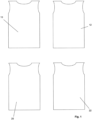
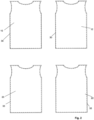
- the textile element is a sleeveless upper part, which consists exclusively of a front side and a back side, which are congruent in the exemplary embodiment specifically shown.
- a textile element can also be significantly more complex and, in particular, consist of more elements;
- a geometrically simple textile element is very well suited for representing the invention.
- the textile element consists of a total of four layers, which in this case are congruent, which is why the assignment is arbitrary.
- all blanks are made of the same material.
- This material is an elastic fabric and can be, for example, a plated merino wool with a polyamide coated ROICA. This results in both suitable elastic properties and high wearing comfort.
- the four layers are the first layer 10 on the front, the second layer 12 on the front, the first layer 20 on the back, and the second layer 22 on the back.
- a hem seam 30 is sewn on in each case.
- a seam prevents fraying; in principle it would still be possible to turn over the edges or a part of the edges before the hem, but this is not shown here.
- the front 14 and the back 24 are sewn or embroidered together.
- the result of this is in the Figures 3 and 4 to see.
- the connection of the first layer 10 of the front side 14 with the second layer 12 of the front side 14 and the first layer 20 of the back side 24 with the second layer 22 of the back side 24 takes place via inner linear connections 40 and 42, which in the embodiment shown - as mentioned - are sewn or embroidered.
- inner linear connections 40 and 42 which in the embodiment shown - as mentioned - are sewn or embroidered.
- the first line-shaped connections 40 and the second line-shaped connections 42 generate, as can be seen from FIG Figures 3 and 4 or also on
- each connection 40, 42 (unless it is at the edge lies) belongs to two adjacent diamonds.
- Each first inner line link 40 has (of course) a first end 40a and a second end 40b, and likewise each second inner line link 42 has a first end 42a and a second end 42b.
- Each "set" of these ends 40a, 40b, 42a, 42b defines a first holding section H 1 .
- These first holding sections H 1 again form a regular pattern. For each of these first holding sections H 1 one can define a circle with the diameter D 1 which touches the ends.
- each diamond (such a diamond is defined by two first inner linear joints 40 and two second inner linear joints 42) defines a second holding portion H 2 .
- These second holding sections H 2 also define a regular pattern.
- a circle can also be defined for each of these second holding sections, namely in such a way that this circle touches but does not intersect each of the connections.
- the diameter D 2 of these circles is larger than the diameter D 1 .
- a male element 50 is shown in the form of a sphere with a diameter D K .
- D K D 1 .
- the ball is made of a rigid material such as steel or glass and is intended to be slipped between the front plies 10,12 or the rear plies 20,22. In practice, several similar male elements 50 are normally provided.
- the front 14 and back 24 are sewn together using the side seams 32 and the garment is then turned inside out ( Figures 6 and 7 ).
- the first layers 10, 20 are not continuously connected to their second layers 12, 22, so that between the first layer 10 and the second layer 12 of the front side 14 and between the first layer 20 and the second layer 22 of the back side 24 each inserted one or more receivable elements 50 and can.
- this also makes it possible to remove these elements.
- Figures 9 and 10 show a ball (received element) 50 held at a first breakpoint H1 . Due to the elasticity of the two layers between which the ball 50 is received, it can be pushed from breakpoint to breakpoint, with between two first breakpoints H 1 is always a second breakpoint H 2 and vice versa. With the textile element on, this can be done simply by pressing, in particular with a finger, through the outer of the two layers, so that the ball 50 can be pushed to the desired location by the user when the textile element is being worn. If no other external forces are exerted, the ball remains on the selected holding section and does not leave it even if the person wearing the textile element moves.
- the diameter of the ball D K and the diameters D 1 and D 2 can be chosen to be relatively small, especially in the range of 10mm to 16mm, so that a sufficiently fine grid is created and the position of the Ball 50 defined pressure point can be set with sufficient accuracy at any desired location on the body.
- An acupressure device usually includes more than one receivable element (ball 50), so that several acupressure points can be set.
- the textile element can take almost any form, for example in figure 11 a two-piece training suit (comprising two textile elements according to the invention) is shown, the inner connections however, are not shown.
- the textile element can also be designed in the form of a glove, a sock or a cap or as an overall.
- acupressure device is understood here generally for a device which, when used as intended, is suitable for generating one (or more) small-area pressure stimuli on the body. Whether this is at a point according to traditional Chinese medicine is irrelevant for the invention, especially since the location of the pressure stimulus is usually selected by the user anyway.
Landscapes
- Health & Medical Sciences (AREA)
- Rehabilitation Therapy (AREA)
- Epidemiology (AREA)
- Pain & Pain Management (AREA)
- Physical Education & Sports Medicine (AREA)
- Life Sciences & Earth Sciences (AREA)
- Animal Behavior & Ethology (AREA)
- General Health & Medical Sciences (AREA)
- Public Health (AREA)
- Veterinary Medicine (AREA)
- Engineering & Computer Science (AREA)
- Mechanical Engineering (AREA)
- Finger-Pressure Massage (AREA)
Applications Claiming Priority (2)
| Application Number | Priority Date | Filing Date | Title |
|---|---|---|---|
| DE102021120641 | 2021-08-09 | ||
| DE102021125689.5A DE102021125689A1 (de) | 2021-08-09 | 2021-10-04 | Akupressurvorrichtung und Textilelement zur Verwendung als Teil einer solchen Akupressurvorrichtung |
Publications (1)
| Publication Number | Publication Date |
|---|---|
| EP4134061A1 true EP4134061A1 (fr) | 2023-02-15 |
Family
ID=82786732
Family Applications (1)
| Application Number | Title | Priority Date | Filing Date |
|---|---|---|---|
| EP22188475.2A Pending EP4134061A1 (fr) | 2021-08-09 | 2022-08-03 | Dispositif d'acupression et élément textile destiné à être utilisé comme partie d'un tel dispositif d'acupression |
Country Status (1)
| Country | Link |
|---|---|
| EP (1) | EP4134061A1 (fr) |
Citations (2)
| Publication number | Priority date | Publication date | Assignee | Title |
|---|---|---|---|---|
| JPH07268705A (ja) | 1993-02-26 | 1995-10-17 | Yasuatsu Higa | 指圧部材を有する着衣 |
| JP2006223770A (ja) * | 2005-02-14 | 2006-08-31 | Kazuo Umagami | 足裏指圧健康靴下 |
-
2022
- 2022-08-03 EP EP22188475.2A patent/EP4134061A1/fr active Pending
Patent Citations (2)
| Publication number | Priority date | Publication date | Assignee | Title |
|---|---|---|---|---|
| JPH07268705A (ja) | 1993-02-26 | 1995-10-17 | Yasuatsu Higa | 指圧部材を有する着衣 |
| JP2006223770A (ja) * | 2005-02-14 | 2006-08-31 | Kazuo Umagami | 足裏指圧健康靴下 |
Similar Documents
| Publication | Publication Date | Title |
|---|---|---|
| DE2629837C2 (de) | Medizinischer Strumpf | |
| DE69832287T2 (de) | Gefalteter chirurgischer kittel zum aseptischen anlegen, vorrichtung und verfahren zum herstellen desselben | |
| DE818542C (de) | Verfahren zum Anfertigen von Schlupfhosen und aehnlichen Kleidungsstuecken | |
| DE102004036344B4 (de) | Strickware zum Stützen und/oder Komprimieren und/oder Kompressionsbehandlung von Körperteilen und Verfahren zur Herstellung einer solchen Strickware | |
| CH662942A5 (de) | Vorrichtung zur wiederherstellung der funktionen der handwurzel-, mittelhand- und fingergelenke. | |
| DE4228408A1 (de) | Verfahren zur Herstellung eines formgerechten, einstückigen Flachgestricks, für ein mit Ärmeln versehenes Kleidungsstück | |
| DE102011105954B4 (de) | Handschuh und Verfahren für dessen Herstellung | |
| DE2019782A1 (de) | Handschuh aus einheitlichem,elastischem Material | |
| DE202012004652U1 (de) | Bandage mit einer Öffnung zum Durchführen einer Gliedmaßenspitze | |
| DE202017100286U1 (de) | Kompressions-Leibteil oder Kompressionsstrumpfhose mit Leibteil zur Kompressionsbehandlung während der Schwangerschaft | |
| EP4137626B1 (fr) | Procédé de fabrication d'un article de compression sans couture sur un métier à tricoter rectiligne | |
| EP4134061A1 (fr) | Dispositif d'acupression et élément textile destiné à être utilisé comme partie d'un tel dispositif d'acupression | |
| DE102021125689A1 (de) | Akupressurvorrichtung und Textilelement zur Verwendung als Teil einer solchen Akupressurvorrichtung | |
| EP4545058A1 (fr) | Vêtement pour exciter un flux lymphatique dans une zone du corps d'un porteur | |
| DE102016125409A1 (de) | Eingefasste Textilorthese | |
| CH620718A5 (fr) | ||
| DE102022104092A1 (de) | Textile Vorrichtung für schwangere Frauen | |
| DE1958569A1 (de) | Strumpfhose und Verfahren zu deren Herstellung | |
| EP1626111B1 (fr) | Procédé de la fabrication d'un tricot circulaire et tubulaire | |
| DE102010000066B4 (de) | Bekleidungsoberteil mit einem Kompressionsärmel | |
| DE19920483C2 (de) | Elastisches Band und Verfahren zu dessen Herstellung | |
| DE2752745A1 (de) | Verfahren zur herstellung eines strickartikels, insbesondere einer hose o.dgl., auf einer rundstrickmaschine | |
| DE2909426A1 (de) | Maschenstrumpf sowie verfahren zu seiner herstellung | |
| DE1460030B2 (de) | Verfahren zur herstellung eines gestrickten kleidungsstueckes | |
| DE102004022504B4 (de) | Manschette zum Behandeln von Ödemen |
Legal Events
| Date | Code | Title | Description |
|---|---|---|---|
| PUAI | Public reference made under article 153(3) epc to a published international application that has entered the european phase |
Free format text: ORIGINAL CODE: 0009012 |
|
| STAA | Information on the status of an ep patent application or granted ep patent |
Free format text: STATUS: THE APPLICATION HAS BEEN PUBLISHED |
|
| AK | Designated contracting states |
Kind code of ref document: A1 Designated state(s): AL AT BE BG CH CY CZ DE DK EE ES FI FR GB GR HR HU IE IS IT LI LT LU LV MC MK MT NL NO PL PT RO RS SE SI SK SM TR |
|
| STAA | Information on the status of an ep patent application or granted ep patent |
Free format text: STATUS: REQUEST FOR EXAMINATION WAS MADE |
|
| 17P | Request for examination filed |
Effective date: 20230816 |
|
| RBV | Designated contracting states (corrected) |
Designated state(s): AL AT BE BG CH CY CZ DE DK EE ES FI FR GB GR HR HU IE IS IT LI LT LU LV MC MK MT NL NO PL PT RO RS SE SI SK SM TR |
|
| STAA | Information on the status of an ep patent application or granted ep patent |
Free format text: STATUS: EXAMINATION IS IN PROGRESS |
|
| 17Q | First examination report despatched |
Effective date: 20240722 |
|
| GRAP | Despatch of communication of intention to grant a patent |
Free format text: ORIGINAL CODE: EPIDOSNIGR1 |
|
| STAA | Information on the status of an ep patent application or granted ep patent |
Free format text: STATUS: GRANT OF PATENT IS INTENDED |
|
| INTG | Intention to grant announced |
Effective date: 20251030 |
|
| GRAJ | Information related to disapproval of communication of intention to grant by the applicant or resumption of examination proceedings by the epo deleted |
Free format text: ORIGINAL CODE: EPIDOSDIGR1 |
|
| STAA | Information on the status of an ep patent application or granted ep patent |
Free format text: STATUS: EXAMINATION IS IN PROGRESS |
|
| INTC | Intention to grant announced (deleted) | ||
| GRAP | Despatch of communication of intention to grant a patent |
Free format text: ORIGINAL CODE: EPIDOSNIGR1 |
|
| STAA | Information on the status of an ep patent application or granted ep patent |
Free format text: STATUS: GRANT OF PATENT IS INTENDED |