EP4134148A1 - Matériau filtrant et moyen de protection individuelle l'utilisant - Google Patents
Matériau filtrant et moyen de protection individuelle l'utilisant Download PDFInfo
- Publication number
- EP4134148A1 EP4134148A1 EP21783839.0A EP21783839A EP4134148A1 EP 4134148 A1 EP4134148 A1 EP 4134148A1 EP 21783839 A EP21783839 A EP 21783839A EP 4134148 A1 EP4134148 A1 EP 4134148A1
- Authority
- EP
- European Patent Office
- Prior art keywords
- filtration
- layer
- liquid
- fine
- predominantly
- Prior art date
- Legal status (The legal status is an assumption and is not a legal conclusion. Google has not performed a legal analysis and makes no representation as to the accuracy of the status listed.)
- Pending
Links
Images




Classifications
-
- A—HUMAN NECESSITIES
- A62—LIFE-SAVING; FIRE-FIGHTING
- A62B—DEVICES, APPARATUS OR METHODS FOR LIFE-SAVING
- A62B23/00—Filters for breathing-protection purposes
- A62B23/02—Filters for breathing-protection purposes for respirators
-
- A—HUMAN NECESSITIES
- A62—LIFE-SAVING; FIRE-FIGHTING
- A62B—DEVICES, APPARATUS OR METHODS FOR LIFE-SAVING
- A62B18/00—Breathing masks or helmets, e.g. affording protection against chemical agents or for use at high altitudes or incorporating a pump or compressor for reducing the inhalation effort
- A62B18/04—Gas helmets
-
- B—PERFORMING OPERATIONS; TRANSPORTING
- B01—PHYSICAL OR CHEMICAL PROCESSES OR APPARATUS IN GENERAL
- B01D—SEPARATION
- B01D39/00—Filtering material for liquid or gaseous fluids
- B01D39/14—Other self-supporting filtering material ; Other filtering material
- B01D39/16—Other self-supporting filtering material ; Other filtering material of organic material, e.g. synthetic fibres
- B01D39/1607—Other self-supporting filtering material ; Other filtering material of organic material, e.g. synthetic fibres the material being fibrous
- B01D39/1623—Other self-supporting filtering material ; Other filtering material of organic material, e.g. synthetic fibres the material being fibrous of synthetic origin
-
- B—PERFORMING OPERATIONS; TRANSPORTING
- B01—PHYSICAL OR CHEMICAL PROCESSES OR APPARATUS IN GENERAL
- B01D—SEPARATION
- B01D39/00—Filtering material for liquid or gaseous fluids
- B01D39/14—Other self-supporting filtering material ; Other filtering material
- B01D39/16—Other self-supporting filtering material ; Other filtering material of organic material, e.g. synthetic fibres
- B01D39/18—Other self-supporting filtering material ; Other filtering material of organic material, e.g. synthetic fibres the material being cellulose or derivatives thereof
-
- A—HUMAN NECESSITIES
- A62—LIFE-SAVING; FIRE-FIGHTING
- A62B—DEVICES, APPARATUS OR METHODS FOR LIFE-SAVING
- A62B7/00—Respiratory apparatus
- A62B7/10—Respiratory apparatus with filter elements
-
- B—PERFORMING OPERATIONS; TRANSPORTING
- B01—PHYSICAL OR CHEMICAL PROCESSES OR APPARATUS IN GENERAL
- B01D—SEPARATION
- B01D2239/00—Aspects relating to filtering material for liquid or gaseous fluids
- B01D2239/04—Additives and treatments of the filtering material
- B01D2239/0407—Additives and treatments of the filtering material comprising particulate additives, e.g. adsorbents
-
- B—PERFORMING OPERATIONS; TRANSPORTING
- B01—PHYSICAL OR CHEMICAL PROCESSES OR APPARATUS IN GENERAL
- B01D—SEPARATION
- B01D2239/00—Aspects relating to filtering material for liquid or gaseous fluids
- B01D2239/04—Additives and treatments of the filtering material
- B01D2239/0442—Antimicrobial, antibacterial, antifungal additives
-
- B—PERFORMING OPERATIONS; TRANSPORTING
- B01—PHYSICAL OR CHEMICAL PROCESSES OR APPARATUS IN GENERAL
- B01D—SEPARATION
- B01D2239/00—Aspects relating to filtering material for liquid or gaseous fluids
- B01D2239/06—Filter cloth, e.g. knitted, woven non-woven; self-supported material
- B01D2239/0604—Arrangement of the fibres in the filtering material
- B01D2239/0618—Non-woven
-
- B—PERFORMING OPERATIONS; TRANSPORTING
- B01—PHYSICAL OR CHEMICAL PROCESSES OR APPARATUS IN GENERAL
- B01D—SEPARATION
- B01D2239/00—Aspects relating to filtering material for liquid or gaseous fluids
- B01D2239/06—Filter cloth, e.g. knitted, woven non-woven; self-supported material
- B01D2239/0604—Arrangement of the fibres in the filtering material
- B01D2239/0636—Two or more types of fibres present in the filter material
-
- B—PERFORMING OPERATIONS; TRANSPORTING
- B01—PHYSICAL OR CHEMICAL PROCESSES OR APPARATUS IN GENERAL
- B01D—SEPARATION
- B01D2239/00—Aspects relating to filtering material for liquid or gaseous fluids
- B01D2239/06—Filter cloth, e.g. knitted, woven non-woven; self-supported material
- B01D2239/0645—Arrangement of the particles in the filtering material
-
- B—PERFORMING OPERATIONS; TRANSPORTING
- B01—PHYSICAL OR CHEMICAL PROCESSES OR APPARATUS IN GENERAL
- B01D—SEPARATION
- B01D2239/00—Aspects relating to filtering material for liquid or gaseous fluids
- B01D2239/06—Filter cloth, e.g. knitted, woven non-woven; self-supported material
- B01D2239/065—More than one layer present in the filtering material
-
- B—PERFORMING OPERATIONS; TRANSPORTING
- B01—PHYSICAL OR CHEMICAL PROCESSES OR APPARATUS IN GENERAL
- B01D—SEPARATION
- B01D2239/00—Aspects relating to filtering material for liquid or gaseous fluids
- B01D2239/12—Special parameters characterising the filtering material
- B01D2239/1233—Fibre diameter
-
- B—PERFORMING OPERATIONS; TRANSPORTING
- B01—PHYSICAL OR CHEMICAL PROCESSES OR APPARATUS IN GENERAL
- B01D—SEPARATION
- B01D2239/00—Aspects relating to filtering material for liquid or gaseous fluids
- B01D2239/12—Special parameters characterising the filtering material
- B01D2239/1241—Particle diameter
-
- B—PERFORMING OPERATIONS; TRANSPORTING
- B01—PHYSICAL OR CHEMICAL PROCESSES OR APPARATUS IN GENERAL
- B01D—SEPARATION
- B01D2239/00—Aspects relating to filtering material for liquid or gaseous fluids
- B01D2239/12—Special parameters characterising the filtering material
- B01D2239/1291—Other parameters
Definitions
- a group of inventions relates to multilayer filtration materials for liquid or gas purification, which can be used in purification systems for liquids, for example water from various sources, including drinking water, in ventilation systems or air filtration or for personal or collective protective equipment production, including respiratory protective equipment, produced based on filtration materials.
- Filtration materials for purification of different liquids for example, water or oil and/or gases, for example, air and personal protective equipment based on them are known from the state of the art.
- Main requirements to filtration materials are high efficiency (material must absorb maximum impurities) and long-term service. Filtration material with long-term service, but low efficiency and on the contrary, short-term service, but with high efficiency are known from the state of the art.
- Multilayer liquid filtration material of the patent US 3780872 (applicant Pall Corp, priority 27.05.1968 , IPC B01D 27/06) is known from the state of the art.
- Material of a patent US 3780872 is canvas of several layers, where every layer is made of range of fibers interlaced between each other. Fiber of every following layer in the canvas interlocks the fiber of the previous layer.
- Two types of texture are claimed in the patent - with overlap and folding, which is stronger than overlap in four times.
- layers with different weaving are put against each other, and then are put under press bar and the layers are shifted against each other. As the layers are porous, the channels inside them are shifted too, forming tortuous path for liquid. But at the same time the inner size of the channels decreases and becomes approximately 50 microns. Wire made of metals resistant to corrosion and inert for filtrated media can be used for fiber production.
- liquid to be filtered passes the material layer by layer and is purified from mechanical debris, the size of which is bigger than pores in the layers.
- the drawback of the material of a patent US 3780872 is high production costs (as metal fibers are used) along with low filtration efficiency (material eliminates only relatively big mechanical debris but does not delete absorbed debris). Also, such layers cannot be filled with sorbents as soon as structure is damaged under pressure, and as metal fiber is inert, sorbent cannot fix on fibers, and it will be washed away during filtration.
- Filtration material for air purification of a patent US 7691168 (applicant 3M Innovative Properties Company, priority 10.10.2006 , IPC B01D 24/00, D01D 5/20, H05H 1/26, A62B 7/10, B03C 3/00) is known from the state of the art.
- Filtration material consists of two layers - hydrocharged fibrous filtration layer, capable to abrsorb particles up to several microns size and porous roll-to-roll processable support layer.
- Hydrocharged fibrous filtration layer consists of interlaced fibers with size from 12 to 300 microns, from 25 to 200 microns, from 50 to 150 microns, which are preliminary put into polar liquid, for example water, alcohols, ketones, or their mixtures and then are dried under conditions for fiber surface charge.
- polar liquid for example water, alcohols, ketones, or their mixtures
- filtration material works as follows: the air passes the support layer, which mechanically eliminates large particles and after that, air passes through fibrous filtration layer, which mechanically and due to electrostatic forces eliminates small particles from air.
- Filtration material of a patent US 7691168 may be used for respiratory protective equipment production for example, in respirators. Filtration material of a patent US 7691168 has a drawback. Charged surface within time can lose its power and filtration material will lose its efficiency. Also, this material is not effective towards small particles, which have no surface charge. So, the main drawback of this material is its low efficiency.
- Filtration material Ahlstrom Disruptor 5283 (produced by Ahlstrom-Munksjo, Sweden, https://www.wasser-primus.com/wp-content/uploads/Grayl-Filtration-Alstrom-Disruptor-Presentation-2011-1.pdf), is known from the state of the art and is chosen as the closest analogue.
- This filtration material consists of macrofibers, for example glass, covered with boehmite (aluminium oxohydroxide), which are added to composition of fibrous material during non-woven fabric production. Produced material is laid between spunbond layers to increase strength. The length of macofibers covered with boehmite varies from 2 to 250 nm.
- Crystal structure of boehmite creates electrokinetic potential on fiber's surface.
- Material Ahlstrom Disruptor 5283 has multilayered pore structure. Within the scope of invention, such material works as follows: liquid to be filtered flows through the material layer and is purified from impurities. The main drawback of the material is that efficiency of it relates to electrokinetic potential on the fibers surface, during sorption of debris the potential changes, the material stops to absorb impurities, so it has short service time.
- Filtration material of a patent US 4976858 (applicant Toyo Roki Kabushiki Kaisha, priority 01.02.1990 , IPC B01D39/14), is known from the state of the art and chosen as the closest analogue.
- Filtration material of a patent US 4976858 consists of at least two layers fused to each other. Liquid or gas flows layers of different density layer by layer. The first layer is coarse filter and is made of nonwoven fibrous fabric and is denser, then the second. The second layer is made of filtration paper and is a fine filter. Additional layers of different density may lay between two main layers.
- Filtration material is intended for mechanical liquid filtration and within the scope of the claims works as follows: filtered liquid flows layer by layer, large particles are mechanically absorbed in the first layer, and fine particles are absorbed in the second layer.
- Filtration material of the patent US 4976858 has the essential drawback, as purifies liquid only mechanically, but it can't absorb dissolved impurities. Also, layers of such material cannot be filled with any sorbents as sorbent may be fixed in the layers only due to mechanical forces (surface roughness of sorbent and layers). During filtration sorbent may be washed of by the liquid flow. So, the main drawback of this material is its low efficiency.
- Personal protective equipment of a patent EP 2376168 (applicant Intersurgical S.P.A., priority 03.12.2008 , IPC A61M 16/06, A 62B 17/04) is known from the state of the art.
- Personal protective equipment is made in the form of helmet, consisting of body predominantly of transparent polymeric material with openings for air inlet and outlet, collar of elastic polymeric material and firm collar - support. Air inlet may be connected to stationary or portable oxygen source, and that is the drawback of the given personal protective equipment as significantly narrows the area of its use.
- Personal protective equipment of utility model patent RU65385 (applicant ZAO "Northwest scientific-technical center "A.A. Gunayev Portable personal protective equipment", priority 28.03.2007 , IPC A62B 15/00, A62B 17/04).
- Personal protective equipment is a helmet, consisting of the body, predominantly made of transparent polymeric material and skirt (sealing cup), sealingly connected by its upper edge to the edge of helmets neck. There is an opening in the skirt for exhalation valve.
- This skirt may be made of fibrous polymeric filtration material or of fibrous polymeric filtration material of Petraynov filter, filled with powdered sorbents, and of ion-exchange fibrous filtration or of activated carbon fibrous material with sorbing properties.
- Optionally personal protective equipment maybe equipped with protective half-mask of sorbing and filtration material, attached to the skirt with exhalating valve.
- indicated personal protective equipment works as follows. When the user breathes in the exhalating valve is closed and exhaustion occurs in the space under protective hood. Due to exhaustion under the skirt contaminated air flows through skirts of filtration material. Air purifies only from aerosols or from aerosols, gases, and vapors, and flows into the space under the skirt. Due to exhaustion under half-mask, air predominantly purified by material of the skirt, flows through filtration material of the half-mask, additionally purifies, and then flows to the user.
- Personal protective equipment of a patent US 4620538 (applicant The United States of America as represented by Secretary of Air Force, priority 19.03.1985 , IPC A61H 31/00) and chosen by the applicant as the closest analogue is known from the state of the art.
- Personal protective equipment of a patent US 4620538 is made as a helmet, consisting of the body made predominantly of transparent polymeric material with openings for oxygen inlet and air outlet, elastic inflating collar and two adjusting rings. The air outlet is equipped with non-return valve, which preserves inner space of the helmet from the ambient air.
- indicated personal protective equipment works as follows: the user puts on the helmet, adjusts the size of inflating to make it airtight to the neck.
- Object of the invention and the technical result are achieved by developing of new filtration material for liquid or gas purification with high efficiency to impurities filtration and with long service life and personal protective equipment on its bases, which protects the user from the environment and on the contrary.
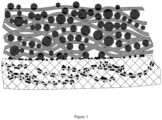
- a filtration material for liquid or gas purification consisting of at least two layers, through which the liquid or gas flows one by one, wherein the first layer is a coarse filtration layer made on the basis of a nonwoven fibrous material, and the second layer is a fine filtration layer made on the basis of filtration paper and/or filtration cardboard, characterized in that the filtration material is configured to sorption filtration of liquid or gas, the coarse filtration layer contains particles with a size of 2 to 500 microns, predominantly from 5 to 200 microns, of at least one type of sorbent, retained in the structure of the nonwoven fibrous material predominantly due to mechanical forces, and the second fine filtration layer contains particles with a size of 0.05 to 20 microns, predominantly from 0.2 to 5 microns of at least one fine-dispersed sorbent, retained in the structure of the filtration paper and/or filtration cardboard predominantly due to adhesive forces.
- activated carbons, activated carbon fibers, fibrous ion exchange materials for example on the base of polyacrylonitrile, subsoil resources carbons, silica gels, alumina gels, alumina silicates, diatomite, ion exchange resins, chitin, chitosanase, sorbents on the base of metal oxides and hydroxides mixtures of indicated sorbents can be used as the first coarse layer, and for example, but not limited to, activated carbons, activated carbon fibers, fibrous ion exchange materials, for example on the base of polyacrylonitrile, subsoil resources carbons, silica gels, alumina gels, alumina silicates, diatomite, sorbents on the base of metal oxides and hydroxides mixtures of indicated sorbents can be used as the second fine filtration layer.
- filtration paper and/or carboard of the second fine filtration layer is a composite, containing predominantly up to 50% of fibers on the base of cellulose and may additionally contain up to 30% of selective fibrous ion exchange material and from 0.001 to 2%, predominantly from 0.004 to 0.1%, flocculant, which may be neutral, cationic, anionic or cationic-anionic, for example, but not limited to, polyvinyl alcohol, polyoxythelens, polyacrilimides, polyacrylates, polymetacrylates, partly partially hydrolyzed polyacrylamide.
- the second fine filtration layer has an increased sorption ability to retain powdered sorbent particles, washed or blown off from the first layer during filtration.
- the surface of the first coarse filtration layer is rougher, than the surface of the second fine filtration layer, therein the liquid predominantly evenly spreads when flowing out from the first coarse layer and coming into the second fine filtration layer.
- at least one of the layers may be corrugated, and the material itself may additionally contain one or more filtration layers before and after the first or the second filtration layers, and be made of, for example, but not limited, spun bond, carbon nonwoven fiber, meshy polymeric material, for example, dividing porous polymeric mesh or fibrillated porous film, graphene film.
- the filtration material for liquid or gas purification may be used to produce personal protective equipment, including, but not limited to respiratory masks of different configurations, and personal protective equipment based thereon, which is made as a helmet, consisting of a body made of a predominantly transparent polymeric material with air inlet and outlet openings, a collar made of elastic polymeric material, the personal protective equipment contains at least one air circulation means, wherein the air inlet and outlet openings are equipped with filters made of the claimed filtration material, wherein in the inlet filter is directed to the environment by the first coarse filtration layer of the filtration matedrial, and the outlet filter - by the second fine layer of the filtration material.
- the air circulation means is made as, for example, but not limited to, a compressor, a pump or a ventilator.
- the personal protective equipment may additionally contain a membrane valve, configured to consume water and spoon-food without taking off the personal protective equipment, wherein the collar made of elastic polymeric material is configured to adjust its size by means of air supplied into an inner cavity of the collar.
- Filtration material for liquid or gas purification consists predominantly of two obligatory layers, which filtrated liquid or gas flow consequently. Therein at least one of the layers may be corrugated.
- First layer - coarse layer - is made on the base of nonwoven fibrous material for example from the hydrophobic polyolefin fibers with fiber diameter from 5 to 30 microns and is filled with particles with size from 2 to 500 microns, predominantly from 5 to 200 microns, of at least one type of sorbent.
- Material of the first layer is aerodynamic-laid web from fibers, produced by extruding the polymer melt through the nozzle into the transporting gas flow with simultaneous supply of granulated or powdered sorbent. Therein the particles of the sorbent not only engage to the fibers surface, but due to high temperature melt with the fibers and so mechanically attach to them.
- Activated carbons, activated carbon fibers, fibrous ion exchange materials for example on the base of polyacrylonitrile, subsoil resources carbons, silica gels, alumina gels, alumina silicates, diatomite, ion exchange resins, chitin, chitosanase, sorbents on the base of metal oxides and hydroxides mixtures of indicated sorbents may be used, but not limited to, as sorbents of the first coarse layer.
- Indicated sorbents may be additionally manufactured with bactericidal agent, for example, but not limited to, for example, silver containing agent.
- Second layer - fine filtration layer - is a composite material up to 50% consisting of cellulose fibers with fiber length from 0.5 to 3 mm, diameter from 5 to 30 microns, predominantly from 5 to 25 microns, selective fibrous sorbent (not more than 30% of overall mass), ultradisperse particles of the sorbent with the size from 1 to 25 microns, predominantly from 2 to 20 microns, and also flocculant in amount from 0.001 to 2%, predominantly from 0.004 to 0.1 %.
- Activated carbons, activated carbon fibers, fibrous ion exchange materials for example on the base of polyacrylonitrile, subsoil resources carbons, silica gels, alumina gels, alumina silicates, diatomite, sorbents on the base of metal oxides and hydroxides mixtures of indicated sorbents can be used as ultradisperse particles for the second fine filtration layer.
- Indicated sorbents may be additionally manufactured with bactericidal agent, for example, but not limited to, for example, silver containing agent.
- Flocullant may be neutral, cationic, anionic, or cationic-anionic, for example, but not limited to, polyvinyl alcohol, polyoxythelens, polyacrilimides, polyacrylates, polymetacrylates, partly partially hydrolized polyacrylamide. Due to that the material of the second layer consists mostly of cellulose fibers, it is produced by handsheet with further drying and pressure molding. Ultradisperse particles attach to the fibers mostly due to adhesion forces. Besides the second fine filtration layer has an increased sorption ability to retain powdered sorbent particles, washed off or blown from the first layer during filtration.
- Produced filtration material has hydrophobic-hydrophilic properties. These properties mostly are arranged by the fibers of different type. Hydrophobic fibers are prevailed in the first layer, hydrophilic - in the second. Hydrophobic-hydrophilic properties of the sorbent provide increased efficiency during hydrophobic-hydrophilic impurities, for example viruses. Therein the claimed material is bacteriostatic.
- First layer has rougher surface, than the second. Unevenness is the ratio between fibers diameter and size of sorbent particles.
- First filtration layer contains the fibers with diameter from 5 to 30 microns and particles size from 2 to 500 microns, predominantly from 5 to 200 microns.
- Second filtration layer contains the fibers with diameter from 5 to 30 microns and particles size from 1 to 25 microns, predominantly from 2 to 20 microns. So, the unevenness of the surface of the first layer is at least by one order more than unevenness of thew second layer.
- This provides dispersion of liquid flow after it comes from the first layer before it enters the second layer, so that if even the part of the pores of the first layer is clogged with large mechanical particles, the second layer totally takes part in filtration process. If the material of the first layer is blocked with particles, all the channels of the second layer remain opened for liquid and gas flow. So, during filtration totally or partly acts the volume of the first layer and all the volume of the second layer of the filtration material, increasing velocity and purification rate.
- the filtration material may additionally contain one or more filtration layers before and after the first or the second filtration layers, and be made of, for example, but not limited, spunbond, carbon nonwoven fiber, meshy polymeric material, for example, dividing porous polymeric mesh or fibrillated porous film, graphene film.
- filtration material acts as follows. Liquid or gas to be filtrated flows into the first layer, where the first filtration step takes place. As the average particle size of the first layer sorbent is predominantly bigger than the average diameter of fibers of the first layer, the first layer has extended surface (big number of pores) and has high contaminant capacity and ability to absorb the impurities slowly. After the first layer, liquid or gas to be filtrated flow into the second layer, therein when the liquid is purified, after the first layer liquid uniformly spreads when flowing to the second layer. The second filtration step takes place in the second filtration layer. The second layer has an extended surface (big number of pores) either and simultaneously sorbent particles of the second layer have high kinetic ability to absorb dissolved impurities. Besides, if powdered B particles of the sorbent of the first layer are washed or blown off, the second layer blocks them. Purified liquid or gas goes to the user after the second purification layer.
- the second layer can absorb powdered particles washed off from the first layer.
- sorbent retention is due to mechanical forces, so the sorbent will be washed off and that will decrease the efficiency of the material, and worse the usability, as purified liquid or gas will contain the sorbent particles.
- the sorbent particles, left in the purified gas limits the material use in the personal protective equipment, so the claimed material is the new one, but not the combination of analog and other sorbents from the state of the art.
- E , % Cinitial ⁇ Cfiltrated Cinitial ⁇ 100 % , where E,% - sorption of colloidal ferrum efficiency, %; Cinitial - model ferrum colloidal solution concentration; Cfiltrated - the ferrum concentration in solution after purification.
- claimed filtration material may be used in personal protective equipment.
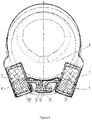
- Personal protective equipment ( figures 2 - 4 ) is made as a helmet and consists of a body (1) from predominantly transparent polymeric material with air inlet (2) and outlet (3), collar (4) from elastic polymeric material, and one air circulation means (6). Also, personal protective equipment may comprise electric power supply unit (not shown) and control panel (5). Air inlet (2) and outlet (3) openings are equipped with filters (7, 8) made of claimed filtration material. Therein in the inlet filter (7) coarse filtration layer goes first to the environment, and the outlet filter (8) - second fine layer of the filtration material.
- Air circulation means (6) is made as, for example, but not limited to, as compressor, pump or ventilator.
- the size of the collar is regulated by means of air supply into the inner cavity of the collar (4).
- Respiratory protective equipment works as follows. The user draws on the equipment and pumps the collar (4) to the required size and fixates the equipment airtight around the neck. When the equipment is turned on, the air circulation means (6) starts to supply air through inlet filter (7). Filtration material works as follows. Air flows through consequently first and then the second layers of the material, filtrating from mechanical and other impurities. When the user breathes in/out the air, which is aerosol, its particles get into the material and due to its hydrophobic-hydrophilic properties are retained there. The moisture is dried due to air circulating means (6) operation, and impurities remain on the sorbent's granules surface. Due to the indicated properties of the filtration material, liquid or gas purification is done mire quick and effective, then in the material of the closest analogue. During the operation of the equipment the used air flows out from outlet opening (3), equipped with the outlet filter (8) into the environment.
- the filter material is highly efficient and can absorb viruses, among other things.
- the inventive filter material is preferably bacteriostatic, which means that the risk of microorganisms and viruses developing on the surface of the filter material is reduced, thus, personal protective equipment based on the specified filter material is safe to maintain (there is no danger of bacteriological contamination when replacing the filter material in personal protective equipment).
- the claimed protective equipment has both an inlet and an outlet filter, and the air circulation means provides an unambiguous movement of flows, the air exhaled by the user necessarily passes through the outlet filter, that is, the personal protective equipment protects not only the user from the environment, but also the environment from the user, thus ensuring the achievement of a technical result.
Landscapes
- Health & Medical Sciences (AREA)
- Chemical & Material Sciences (AREA)
- Chemical Kinetics & Catalysis (AREA)
- General Health & Medical Sciences (AREA)
- Business, Economics & Management (AREA)
- Emergency Management (AREA)
- Pulmonology (AREA)
- Filtering Materials (AREA)
Applications Claiming Priority (2)
| Application Number | Priority Date | Filing Date | Title |
|---|---|---|---|
| RU2020112991A RU2782467C2 (ru) | 2020-04-06 | Фильтрующий материал и средство индивидуальной защиты на его основе | |
| PCT/RU2021/000130 WO2021206586A1 (fr) | 2020-04-06 | 2021-03-26 | Matériau filtrant et moyen de protection individuelle l'utilisant |
Publications (2)
| Publication Number | Publication Date |
|---|---|
| EP4134148A1 true EP4134148A1 (fr) | 2023-02-15 |
| EP4134148A4 EP4134148A4 (fr) | 2024-04-17 |
Family
ID=77999478
Family Applications (1)
| Application Number | Title | Priority Date | Filing Date |
|---|---|---|---|
| EP21783839.0A Pending EP4134148A4 (fr) | 2020-04-06 | 2021-03-26 | Matériau filtrant et moyen de protection individuelle l'utilisant |
Country Status (4)
| Country | Link |
|---|---|
| US (1) | US20230166134A1 (fr) |
| EP (1) | EP4134148A4 (fr) |
| CN (1) | CN115697520A (fr) |
| WO (1) | WO2021206586A1 (fr) |
Families Citing this family (1)
| Publication number | Priority date | Publication date | Assignee | Title |
|---|---|---|---|---|
| CN116099255B (zh) * | 2022-08-31 | 2026-03-13 | 杭州科百特过滤器材有限公司 | 一种除病毒膜包、其润湿保存方法及囊式过滤装置 |
Family Cites Families (22)
| Publication number | Priority date | Publication date | Assignee | Title |
|---|---|---|---|---|
| US3780872A (en) | 1968-05-27 | 1973-12-25 | Pall Corp | Filters comprising anisometric compressed and bonded multilayer knitted wire mesh composites |
| JPS60225619A (ja) * | 1984-04-23 | 1985-11-09 | Yoshimi Oshitari | 液体濾過材 |
| US4620538A (en) * | 1985-03-19 | 1986-11-04 | The United States Of America As Represented By The Secretary Of The Air Force | Light-weight oxygen delivery hood assembly for hyperbaric chamber |
| US4976858A (en) | 1987-08-12 | 1990-12-11 | Toyo Roki Seizo Kabushiki Kaisha | Multi-layer filter medium |
| WO1994011556A1 (fr) * | 1992-11-18 | 1994-05-26 | Hoechst Celanese Corporation | Structure fibreuse contenant un materiau particulaire immobilise et procede de production d'une telle structure |
| EP0955087B1 (fr) * | 1998-05-08 | 2008-12-24 | Toyobo Co., Ltd. | Feuille absorbante pour l'adsorption de gaz et filtre pour la purification de l'air |
| RU2185877C2 (ru) * | 2000-06-06 | 2002-07-27 | Константинов Александр Павлович | Фильтрующий материал и способ его изготовления |
| JP2009512578A (ja) | 2005-10-19 | 2009-03-26 | スリーエム イノベイティブ プロパティズ カンパニー | 音響吸収特性を有する多層物品、並びにその製造および使用方法 |
| BY11680C1 (fr) * | 2006-10-27 | 2009-08-28 | ||
| US7988860B2 (en) * | 2007-03-15 | 2011-08-02 | Donaldson Company Inc. | Superabsorbent-containing web that can act as a filter, absorbent, reactive layer or fuel fuse |
| RU65385U1 (ru) | 2007-03-28 | 2007-08-10 | Закрытое акционерное общество "Северо-Западный научно-технический центр "Портативные средства индивидуальной защиты" имени А.А. Гуняева" | Защитный капюшон |
| EP2206544B1 (fr) * | 2007-09-28 | 2016-07-20 | Toray Industries, Inc. | Média filtrant |
| US20100083958A1 (en) * | 2008-09-18 | 2010-04-08 | Ilc Dover Lp | Personal protective hood having thermoplastic neckdam |
| ITMI20080396U1 (it) | 2008-12-03 | 2010-06-03 | Starmed S P A Ora Intersurgical S P A | Struttura di casco per la ventilazione non invasiva di pazienti. |
| US8984753B2 (en) * | 2010-05-20 | 2015-03-24 | 3M Innovative Properties Company | Method of making filter cartridge having roll-based housing sidewall |
| RU2505325C1 (ru) * | 2012-07-02 | 2014-01-27 | Открытое акционерное общество "Корпорация "Росхимзащита" (ОАО "Корпорация "Росхимзащита") | Устройство для защиты органов дыхания |
| EP3815766A1 (fr) * | 2013-08-30 | 2021-05-05 | EMD Millipore Corporation | Milieu composite filtrant en profondeur à capacité élevé avec bas niveau d'extractibles |
| CN205198650U (zh) * | 2015-11-24 | 2016-05-04 | 中国人民解放军总医院 | 一种氧气面罩 |
| JP7010452B2 (ja) * | 2016-03-14 | 2022-02-10 | スリーエム イノベイティブ プロパティズ カンパニー | 反応性ガス用のポリマー収着剤を含むエアフィルタ |
| CN205494719U (zh) * | 2016-04-09 | 2016-08-24 | 莫军 | 可自由呼吸清洁空气的装置及系统 |
| US11273399B2 (en) * | 2016-04-29 | 2022-03-15 | Ahlstrom-Munksjö Oyj | Filter medium, method of manufacturing the same and uses thereof |
| CN208975021U (zh) * | 2018-06-27 | 2019-06-14 | 靳涛 | 一种消防员专用双层过滤式防毒面具 |
-
2021
- 2021-03-26 US US17/918,272 patent/US20230166134A1/en active Pending
- 2021-03-26 EP EP21783839.0A patent/EP4134148A4/fr active Pending
- 2021-03-26 WO PCT/RU2021/000130 patent/WO2021206586A1/fr not_active Ceased
- 2021-03-26 CN CN202180038671.5A patent/CN115697520A/zh active Pending
Also Published As
| Publication number | Publication date |
|---|---|
| RU2020112991A3 (fr) | 2021-10-06 |
| WO2021206586A1 (fr) | 2021-10-14 |
| EP4134148A4 (fr) | 2024-04-17 |
| RU2020112991A (ru) | 2021-10-06 |
| CN115697520A (zh) | 2023-02-03 |
| US20230166134A1 (en) | 2023-06-01 |
Similar Documents
| Publication | Publication Date | Title |
|---|---|---|
| AU2009330550B2 (en) | Compact multigas filter | |
| RU2579344C1 (ru) | Устройство для фильтрации воздуха с регулируемой системой распределения воздуха | |
| JP5126650B2 (ja) | 一体化された粒子及び/若しくはエアゾール濾過機能を有する吸着濾過材料及びその使用 | |
| CN102548635B (zh) | 具有一体式初级过滤器和增泽过滤器的活性颗粒空气过滤器 | |
| KR101358486B1 (ko) | 초미세 또는 나노크기 분말을 혼입한 부직 매체 | |
| CA1306201C (fr) | Canevas en plastique | |
| KR102027606B1 (ko) | 층상 필터 카트리지용 사용 수명 종료 표시 시스템 | |
| CA2295170A1 (fr) | Filtre de respirateur a couche de filtre plissee | |
| EP0159697A2 (fr) | Cartouche pour masque à gaz | |
| JP2013506546A5 (fr) | ||
| JP2016534825A (ja) | 積層又は混合吸着剤床の保護濾過装置 | |
| EP4134148A1 (fr) | Matériau filtrant et moyen de protection individuelle l'utilisant | |
| EP0159698A2 (fr) | Cartouche pour masque à gaz | |
| RU60874U1 (ru) | Патронный фильтровальный элемент (варианты) | |
| KR20210025381A (ko) | 습식 가변형 다층 여과 시스템 및 이를 포함하는 필터 유닛 | |
| RU2782467C2 (ru) | Фильтрующий материал и средство индивидуальной защиты на его основе | |
| US20220339471A1 (en) | Multi-layer filtration system and filter unit comprising same | |
| WO2022088556A1 (fr) | Construction de filtre et dispositif d'épurateur d'air | |
| KR200292111Y1 (ko) | 독성 및 유해성 가스 제거용 활성탄소섬유, 금속 첨착활성탄소섬유 내장 정화통의 제조 |
Legal Events
| Date | Code | Title | Description |
|---|---|---|---|
| STAA | Information on the status of an ep patent application or granted ep patent |
Free format text: STATUS: THE INTERNATIONAL PUBLICATION HAS BEEN MADE |
|
| PUAI | Public reference made under article 153(3) epc to a published international application that has entered the european phase |
Free format text: ORIGINAL CODE: 0009012 |
|
| STAA | Information on the status of an ep patent application or granted ep patent |
Free format text: STATUS: REQUEST FOR EXAMINATION WAS MADE |
|
| 17P | Request for examination filed |
Effective date: 20221107 |
|
| AK | Designated contracting states |
Kind code of ref document: A1 Designated state(s): AL AT BE BG CH CY CZ DE DK EE ES FI FR GB GR HR HU IE IS IT LI LT LU LV MC MK MT NL NO PL PT RO RS SE SI SK SM TR |
|
| DAV | Request for validation of the european patent (deleted) | ||
| DAX | Request for extension of the european patent (deleted) | ||
| A4 | Supplementary search report drawn up and despatched |
Effective date: 20240320 |
|
| RIC1 | Information provided on ipc code assigned before grant |
Ipc: B01D 39/16 20060101ALN20240314BHEP Ipc: A61M 16/06 20060101ALI20240314BHEP Ipc: A62B 23/02 20060101ALI20240314BHEP Ipc: A62B 7/10 20060101ALI20240314BHEP Ipc: A62B 18/04 20060101ALI20240314BHEP Ipc: B01D 39/18 20060101ALI20240314BHEP Ipc: B01D 39/14 20060101AFI20240314BHEP |