EP4134236A1 - Carton asymétrique - Google Patents
Carton asymétrique Download PDFInfo
- Publication number
- EP4134236A1 EP4134236A1 EP21190815.7A EP21190815A EP4134236A1 EP 4134236 A1 EP4134236 A1 EP 4134236A1 EP 21190815 A EP21190815 A EP 21190815A EP 4134236 A1 EP4134236 A1 EP 4134236A1
- Authority
- EP
- European Patent Office
- Prior art keywords
- grammage
- outer layer
- layer
- paperboard
- furnish
- Prior art date
- Legal status (The legal status is an assumption and is not a legal conclusion. Google has not performed a legal analysis and makes no representation as to the accuracy of the status listed.)
- Withdrawn
Links
Images

Classifications
-
- D—TEXTILES; PAPER
- D21—PAPER-MAKING; PRODUCTION OF CELLULOSE
- D21J—FIBREBOARD; MANUFACTURE OF ARTICLES FROM CELLULOSIC FIBROUS SUSPENSIONS OR FROM PAPIER-MACHE
- D21J1/00—Fibreboard
-
- B—PERFORMING OPERATIONS; TRANSPORTING
- B32—LAYERED PRODUCTS
- B32B—LAYERED PRODUCTS, i.e. PRODUCTS BUILT-UP OF STRATA OF FLAT OR NON-FLAT, e.g. CELLULAR OR HONEYCOMB, FORM
- B32B29/00—Layered products comprising a layer of paper or cardboard
- B32B29/002—Layered products comprising a layer of paper or cardboard as the main or only constituent of a layer, which is next to another layer of the same or of a different material
- B32B29/005—Layered products comprising a layer of paper or cardboard as the main or only constituent of a layer, which is next to another layer of the same or of a different material next to another layer of paper or cardboard layer
-
- D—TEXTILES; PAPER
- D21—PAPER-MAKING; PRODUCTION OF CELLULOSE
- D21F—PAPER-MAKING MACHINES; METHODS OF PRODUCING PAPER THEREON
- D21F11/00—Processes for making continuous lengths of paper, or of cardboard, or of wet web for fibre board production, on paper-making machines
- D21F11/02—Processes for making continuous lengths of paper, or of cardboard, or of wet web for fibre board production, on paper-making machines of the Fourdrinier type
- D21F11/04—Processes for making continuous lengths of paper, or of cardboard, or of wet web for fibre board production, on paper-making machines of the Fourdrinier type paper or board consisting on two or more layers
-
- D—TEXTILES; PAPER
- D21—PAPER-MAKING; PRODUCTION OF CELLULOSE
- D21H—PULP COMPOSITIONS; PREPARATION THEREOF NOT COVERED BY SUBCLASSES D21C OR D21D; IMPREGNATING OR COATING OF PAPER; TREATMENT OF FINISHED PAPER NOT COVERED BY CLASS B31 OR SUBCLASS D21G; PAPER NOT OTHERWISE PROVIDED FOR
- D21H11/00—Pulp or paper, comprising cellulose or lignocellulose fibres of natural origin only
- D21H11/02—Chemical or chemomechanical or chemothermomechanical pulp
-
- D—TEXTILES; PAPER
- D21—PAPER-MAKING; PRODUCTION OF CELLULOSE
- D21H—PULP COMPOSITIONS; PREPARATION THEREOF NOT COVERED BY SUBCLASSES D21C OR D21D; IMPREGNATING OR COATING OF PAPER; TREATMENT OF FINISHED PAPER NOT COVERED BY CLASS B31 OR SUBCLASS D21G; PAPER NOT OTHERWISE PROVIDED FOR
- D21H11/00—Pulp or paper, comprising cellulose or lignocellulose fibres of natural origin only
- D21H11/02—Chemical or chemomechanical or chemothermomechanical pulp
- D21H11/04—Kraft or sulfate pulp
-
- D—TEXTILES; PAPER
- D21—PAPER-MAKING; PRODUCTION OF CELLULOSE
- D21H—PULP COMPOSITIONS; PREPARATION THEREOF NOT COVERED BY SUBCLASSES D21C OR D21D; IMPREGNATING OR COATING OF PAPER; TREATMENT OF FINISHED PAPER NOT COVERED BY CLASS B31 OR SUBCLASS D21G; PAPER NOT OTHERWISE PROVIDED FOR
- D21H11/00—Pulp or paper, comprising cellulose or lignocellulose fibres of natural origin only
- D21H11/08—Mechanical or thermomechanical pulp
-
- D—TEXTILES; PAPER
- D21—PAPER-MAKING; PRODUCTION OF CELLULOSE
- D21H—PULP COMPOSITIONS; PREPARATION THEREOF NOT COVERED BY SUBCLASSES D21C OR D21D; IMPREGNATING OR COATING OF PAPER; TREATMENT OF FINISHED PAPER NOT COVERED BY CLASS B31 OR SUBCLASS D21G; PAPER NOT OTHERWISE PROVIDED FOR
- D21H27/00—Special paper not otherwise provided for, e.g. made by multi-step processes
-
- D—TEXTILES; PAPER
- D21—PAPER-MAKING; PRODUCTION OF CELLULOSE
- D21H—PULP COMPOSITIONS; PREPARATION THEREOF NOT COVERED BY SUBCLASSES D21C OR D21D; IMPREGNATING OR COATING OF PAPER; TREATMENT OF FINISHED PAPER NOT COVERED BY CLASS B31 OR SUBCLASS D21G; PAPER NOT OTHERWISE PROVIDED FOR
- D21H27/00—Special paper not otherwise provided for, e.g. made by multi-step processes
- D21H27/30—Multi-ply
Definitions
- the present disclosure relates to the field of paperboard and in particular to paperboard for use in laminates for packaging of liquid food.
- Conventional paperboard for use in liquid food packaging laminates has two outer layers of cellulose fibres (a print layer and a reverse layer) and at least one middle layer of cellulose fibres.
- the print layer may be provided with a pigment coating for improved printability and/or a more appealing appearance.
- WO 2017/003364 discloses an oxygen barrier based on modified cellulose fibres.
- Various applications of the fibre-based barrier are suggested.
- One of them is as an oxygen-barrier layer in a multi-layered paperboard product.
- the paperboard and the oxygen-barrier layer may be produced independently of each other and then laminated together. No characteristics of the paperboard other than ranges for density and thickness are disclosed.
- WO 2011/003565 discloses a laminate for packaging of liquid food.
- the laminate comprises e.g. paperboard and an oxygen barrier.
- the aluminium foil that is traditionally used as the oxygen barrier in liquid food packaging is replaced with a paper-based oxygen barrier, which preferably has a grammage of 30-60 g/m 2 .
- the paperboard of the laminate may be a conventional paperboard of suitable packaging quality that has a grammage of 100-500 g/m 2 (preferably 200-400 g/m 2 , more preferably 200-300 g/m 2 ).
- WO 2017/089508 Further details about a paper on which a barrier for a liquid food packaging laminate can be based are disclosed in WO 2017/089508 , which also suggest to downgauge the cellulose-based bulk or core layer of the laminate in comparison to conventional liquid packaging paperboard. In more detail, it is suggested to replace the traditional paperboard with a spacer layer that has lower or no inherent bending stiffness and that is sandwiched between stiffness-enhancing layers. So-called foamed cellulose (a fibrous material) is given as an example of a suitable spacer layer.
- the present inventors have realized that in a packaging laminate including a paper-based barrier that makes a significant stiffness contribution, the paperboard should not be stripped down to merely a bulky core. Instead, the paperboard should have the conventional multi-layered structure, but in an unconventional grammage ratio adapted to the inclusion of the paper-based barrier.
- existing paperboard machines can be used with no or minimal modifications, which is a crucial advantage given the investments made in building them.
- all the headboxes and all the wires of the conventional paperboard machine may still be utilized after switching to the paperboard of the present disclosure.
- the middle layer(s) is (are) not exposed in the pressing and drying section during production of the paperboard of the present disclosure, which may be a significant advantage given the dusting issues often associated with the fibre composition of a typical middle layer.
- the paperboard of the present disclosure is asymmetric in the sense that the grammage of one outer layer has been reduced to the extent that it is half or less of the grammage of the other outer layer. This reduction may allow for an increase of the grammage of a bulkier middle layer.
- the paperboard of the present disclosure is not necessarily thinner than the conventional paperboard. Instead, it may actually be thicker since "high-density" pulp in the outer layer has been replaced with "low-density” pulp in the middle layer.
- the design of the paperboard of the present disclosure makes no sense, but in a laminate also including a paper-based barrier, it is optimized and provides for increased bending stiffness and/or reduced fibre content/consumption.
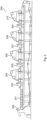
- the forming section 200 contains a single fourdrinier wire 201.
- a first outer layer which is intended for printing, is formed by means of a first headbox 202 feeding a first furnish onto the wire 201.
- a first middle layer is formed on the first outer layer by means of a second headbox 203 and a first top former 204.
- a second middle layer is formed on the first middle layer by means of a third headbox 205 and a second top former 206.
- a third middle layer is formed on the second middle layer by means of a fourth headbox 207 and a third top former 208.
- a second outer layer which is intended to be the reverse layer, is formed on the third middle layer by means of a fifth headbox 209 and a fourth top former 210.
- the multi-layered web formed in the forming section 200 is transferred to a pressing section (not shown).
- a multi-layered paperboard comprising a first outer layer, a second outer layer and at least one middle layer arranged between the first and the second outer layer.
- all these layers are based on cellulose fibres.
- the paperboard is asymmetric in the sense that the grammage of the first outer layer is at least 2.0 times higher than the grammage of the second outer layer.
- the grammage of the first outer layer is at least 2.5 times higher than the grammage of the second outer layer, such as at least 3.0 times higher than the grammage of the second outer layer, such as at least 3.5 times higher than the grammage of the second outer layer, such as at least 4.0 times higher than the grammage of the second outer layer.
- a FORTUNA Bandknife-Splitting Machine (Type AB 320 E/P) can be used.
- Such a machine that has been customized for paperboard splitting is commercially available and is used by several major companies in the paperboard field.
- a surface grinding technique can be used to remove all layers but the layer of interest.
- Such a surface grinding is one of the services that are commercially available at RISE Bioeconomy (formerly Innventia) in Sweden.
- grammage is preferably measured according to ISO 536:2019.
- the at least one middle layer of the paperboard may for example be one, two or three middle layers.
- the grammage of the paperboard is typically 150-500 g/m 2 . In one embodiment it is 150-250 g/m 2 . In another embodiment, it is above 250 g/m 2 , but not above 500 g/m 2 .
- the at least one middle layer typically constitutes a smaller portion of the paperboard when the paperboard grammage is lower.
- One reason for that is that an outer layer of a certain grammage is typically needed for satisfactory printability irrespective of the grammage of the other layers.
- the grammage of the second outer layer is normally significantly lower than the grammage of the at least one middle layer.
- the grammage of the paperboard (excluding any coating layers) is relatively low, i.e. 150-250 g/m 2
- the grammage of the at least one middle layer is typically least 2.5 times higher than the grammage of the second outer layer, such as at least 4.0 times higher than the grammage of the second outer layer.
- the grammage of the at least one middle layer is typically at least 4.0 times higher than the grammage of the second outer layer, such as at least 7.0 times higher than the grammage of the second outer layer.
- the grammage of the second outer layer is below 25 g/m 2 , such as below 20 g/m 2 , such as below 17 g/m 2 .
- the grammage of the first outer layer is typically above 35 g/m 2 , such as above 50 g/m 2 , such as above 55 g/m 2 .
- the grammage of the at least one middle layer is preferably at least 50 g/m 2 , such as at least 65 g/m 2 , such as at least 75 g/m 2 .
- the "grammage of the at least one middle layer” refer to all middle layers of the paperboard. If the paperboard has only one middle layer, it is referred to the grammage thereof. If the paperboard has two or three middle layers, it is referred to the combined grammage thereof.
- the grammage thereof is preferably at least 80 g/m 2 .
- the grammage of the paperboard is relatively high, i.e. above 250 g/m 2
- the grammage of the at least one middle layer is preferably at least 100 g/m 2 , such as at least 140 g/m 2 .
- the at least one middle layer is formed from at least one furnish.
- the middle layers may be formed from furnishes having the same or different compositions.
- the furnish(es) from which the at least one middle layer is (are) formed preferably comprises mechanical pulp, such as chemitermomechanical pulp (CTMP).
- CTMP chemitermomechanical pulp
- the proportion (by dry weight) of mechanical pulp (preferably CTMP) in the middle layer furnish(es) is preferably at least 20%, more preferably at least 30%, such as at least 40%.
- the middle layer furnish(es) thus comprise(s) at least 30% by dry weight and more preferably at least 40% by dry weight CTMP.
- the inclusion of mechanical pulp is advantageous since it increases the bulk of the middle layer(s).
- the mechanical pulp may reduce the z strength and/or the Scott Bond value.
- at least one strength chemical also referred to as strength agent
- the middle layer furnish(es) may comprise cationic starch and CMC or microfibrillated cellulose (MFC).
- Another option is to combine the cationic starch with anionic polyacrylamide (A-PAM) or anionic starch.
- A-PAM anionic polyacrylamide
- PVAm cationic polyvinylamine
- the middle layer furnish(es) may further comprise retention chemicals known to the skilled person.
- the middle layer furnish(es) preferably comprises broke pulp.
- the proportion (by dry weight) of broke pulp in the middle layer furnish(es) may be at least 20%, such as at least 30%, such as at least 40%.
- the middle layer furnish(es) thus comprise(s) at least 40% by dry weight CTMP and at least 40% by dry weight broke pulp.
- the middle layer furnish(es) may comprise chemical pulp, such as kraft pulp.
- the proportion (by dry weight) of chemical pulp is preferably lower than the proportion of mechanical pulp. In one embodiment, the proportion (by dry weight) of chemical pulp in the middle layer furnish(es) is 5%-20%.
- the at least one middle layer comprise(s) hydrophobic size, such as rosin size, AKD and/or ASA.
- the middle layer may comprise both rosin size and AKD or ASA.
- AKD or ASA is particularly preferred when the paperboard is intended for use in liquid food packaging.
- the first outer layer is typically formed from a furnish comprising chemical pulp, such as kraft pulp, such as bleached kraft pulp.
- chemical pulp such as kraft pulp, such as bleached kraft pulp.
- the proportion of kraft pulp in this furnish is at least 80% by dry weight.
- the proportion of hardwood pulp in this furnish is preferably at least 50% by dry weight, such as at least 80% by dry weight. At least 80% softwood in this furnish is however not excluded.
- the second outer layer is typically formed from a furnish comprising chemical pulp, such as kraft pulp.
- this furnish comprises at least 80% by dry weight kraft pulp, such as at least 90% by dry weight kraft pulp.
- the first and the second outer layer comprise hydrophobic size, such as rosin size, AKD and/or ASA.
- the outer layers may comprise both rosin size and AKD or ASA.
- AKD or ASA is particularly preferred when the paperboard is intended for use in liquid food packaging.
- At least one strength chemical such as starch
- these furnishes typically comprise at least one retention agent.
- the density of the at least one middle layer is lower than the density of the first outer layer and the density of the second outer layer. If there is only one middle layer, the density thereof is thus less than the densities of the other layers (not including any coating layers). If there are two or three middle layers, each of them preferably has lower density than the other layers (not including any coating layers).
- each middle layer has a density that is at least 25% lower than the density of the first outer layer and the density of the second outer layer
- the density of the at least one middle layer is preferably below 550 kg/m 3 , more preferably below 490 kg/m 3 , such as below 430 kg/m 3 .
- the density of the second outer layer may be above 600 kg/m 3 , such as above 650 kg/m 3 .
- the density of the first outer layer may be above 600 kg/m 3 .
- density is preferably measured according to ISO 534:2011.
- the density of the second outer layer may be higher than the density of the first outer layer. This density difference may be the effect of that the furnish that is used to form the second outer layer has a higher SR number than the furnish used to form the first outer layer (further discussed below).
- the second outer layer is coated or impregnated with polyvinyl alcohol (PVOH), carboxymethyl cellulose (CMC) or starch.
- PVOH polyvinyl alcohol
- CMC carboxymethyl cellulose
- starch starch
- a method of forming, in a full-scale paperboard machine, a multi-layered paperboard comprising a first outer layer, a second outer layer and at least one middle layer arranged between the first and the second outer layer.
- a full-scale paperboard machine comprises a forming section, a pressing section and a drying section.
- the full-scale paperboard machine may further comprise a coating section arranged downstream the drying section.
- the full-scale paperboard machine comprises at least on calender arranged downstream the drying section or in a downstream region of the drying section. When the coating section is included, the calender is typically arranged upstream thereof.
- a full-scale paperboard machine typically produces at least 50,000 tonnes of paperboard per year.
- the method comprises the steps of:
- a first headbox feeds the first furnish to a first wire in the formation of the first outer layer.
- a second headbox feeds the second furnish to a second wire in the formation of the second outer layer.
- at least one middle layer headbox feed(s) the at least one middle layer furnish to at least one middle layer wire to form the at least one middle layer.
- headboxes for each layer are arranged along a single fourdrinier wire in a forming section also containing top formers.
- An example of such an embodiment is further described with reference to figure 2 .
- one primary head box is followed by four secondary headboxes.
- the number of secondary headboxes may also be two or three.
- the second furnish advantageously has a Schopper-Riegler (SR) number according to ISO 5267-1:1999 above 25, such as above 30.
- SR Schopper-Riegler
- a typical upper limit may be 45.
- the pulps used for the second layer furnish are preferably subjected to low consistency (SR) refining.
- the first outer layer is of much higher grammage and therefore, an equally high SR number is not needed for the furnish used to form it.
- the SR number (ISO 5267-1:1999) is in one embodiment higher for the second furnish than for the first furnish.
- the SR number of the second furnish may be at least 20% higher than the SR number of the first furnish.
- the method of the second aspect provides the possibility of forming a second outer layer that has barrier properties.
- the traditional paperboard machine adapted to reverse layers of normal grammage has excess dewatering and drying capacity. This leaves room for extensive refining of the pulps of the second furnish (and the existing refiners may be sufficient for such extensive refining given the reduced grammage).
- the degree of refining can be such that the SR number of the second furnish is above 50 and even above 60 or 70. This may result in a second outer layer having a density of at least 800 kg/m 3 .
- the dense second outer layer formed from the highly refined pulps can provide the barrier properties, such as oxygen barrier properties.
- barrier properties may be improved further by coating or impregnating the second outer layer with a polymer, such as polyvinyl alcohol (PVOH), carboxymethyl cellulose (CMC) or starch.
- a polymer such as polyvinyl alcohol (PVOH), carboxymethyl cellulose (CMC) or starch.
- PVOH polyvinyl alcohol
- CMC carboxymethyl cellulose
- Starch a polymer that is used for the barrier-improving coating or impregnation.
- any cracking of the second outer layer is however less of a concern since this layer is intended to be covered by a barrier paper.
- One way of orienting the fibres in the MD is to have a difference between the jet speed and the wire speed.
- the jet-wire speed difference in the formation of the first outer layer and in the formation(s) of the at least one middle layer is +/- 5-30 m/min. For the avoidance of doubt, this means that the speed of the wire is 5-30 m/min faster or 5-30 m/min slower than the speed of the jet from the headbox.
- starch may be applied between the layers in the forming section before they are merged.
- a "traditional" paperboard design having a 70 g/m 2 print layer, a 130 g/m 2 middle layer and 45 g/m 2 reverse layer was used as a first reference.
- the grammage of the middle layer was increased at the expense of the grammage of the reverse layer such that the print layer to reverse layer grammage ratio was above two and the middle layer to reverse layer grammage ratio was above four.
- the structures for which the calculations were made contained a barrier paper provided on the reverse side. Any impact of the adhesive used for attaching the barrier paper to the reverse side of the paperboard has been disregarded in the calculations.
- the density and tensile stiffness index of this barrier paper was set to 962 kg/m 3 and 7.2 kNm/g, respectively.
- the grammage is the same (245 g/m 2 ).
- the grammage is reduced by 7 g/m 2 (a reduction of 2.9%). This reduction may appear small, but in a full-scale machine producing tens or hundreds of thousands of tonnes of paperboard each year, such a reduction has a significant effect on the economics and environmental impact of the paperboard production.
- the skilled person who wanted reduce the grammage of the traditional paperboard made the same proportional reduction to the middle layer and the reverse layer, but left the grammage of the print layer unchanged for the reason given above.
- a "traditional" paperboard design having a 60 g/m 2 print layer, a 130 g/m 2 middle layer and 45 g/m 2 reverse layer was used as a first reference.
- the grammage of the middle layer was increased at the expense of the grammage of the reverse layer such that the print layer to reverse layer grammage ratio was at least two and the middle layer to reverse layer grammage ratio was above four.
- the structures for which the calculations were made contained a barrier paper provided on the reverse side. Any impact of the adhesive used for attaching the barrier paper to the reverse side of the paperboard has been disregarded in the calculations.
- the density and tensile stiffness index of this barrier paper was set to 962 kg/m 3 and 7.2 kNm/g, respectively.
- the grammage is the same (235 g/m 2 ).
- the grammage is reduced by 7 g/m 2 (a reduction of 3.0%).
- this reduction may appear small, but in a full-scale machine producing tens or hundreds of thousands of tonnes of paperboard each year, such a reduction has a significant effect on the economics and environmental impact of the paperboard production.
- the skilled person who wanted reduce the grammage of the traditional paperboard made the same proportional reduction to the middle layer and the reverse layer, but left the grammage of the print layer unchanged for the reason given above.
- a "traditional" paperboard design having a 65 g/m 2 print layer, a 62 g/m 2 middle layer and 45 g/m 2 reverse layer was used as a first reference.
- the grammage of the middle layer was increased at the expense of the grammage of the reverse layer such that the print layer to reverse layer grammage ratio was above two and the middle layer to reverse layer grammage ratio was above four.
- the structures for which the calculations were made contained a barrier paper provided on the reverse side. Any impact of the adhesive used for attaching the barrier paper to the reverse side of the paperboard has been disregarded in the calculations.
- the density and tensile stiffness index of this barrier paper was set to 962 kg/m 3 and 7.2 kNm/g, respectively.
- the grammage is the same (172 g/m 2 ).
- the grammage is reduced by 7g/m 2 (a reduction of 4.1%). As noted above, this reduction may appear small, but in a full-scale machine producing tens or hundreds of thousands of tonnes of paperboard each year, such a reduction has a significant effect on the economics and environmental impact of the paperboard production.
- the skilled person who wanted to reduce the grammage of the traditional paperboard made the same proportional reduction to the middle layer and the reverse layer, but left the grammage of the print layer unchanged for the reason given above.
Landscapes
- Chemical & Material Sciences (AREA)
- Chemical Kinetics & Catalysis (AREA)
- General Chemical & Material Sciences (AREA)
- Paper (AREA)
Priority Applications (6)
| Application Number | Priority Date | Filing Date | Title |
|---|---|---|---|
| EP21190815.7A EP4134236A1 (fr) | 2021-08-11 | 2021-08-11 | Carton asymétrique |
| US18/292,424 US20240376673A1 (en) | 2021-08-11 | 2022-08-11 | Assymetric Paperboard |
| PCT/EP2022/072623 WO2023017139A1 (fr) | 2021-08-11 | 2022-08-11 | Carton assymétrique |
| MX2024001822A MX2024001822A (es) | 2021-08-11 | 2022-08-11 | Carton asimetrico. |
| EP22764741.9A EP4384395B1 (fr) | 2021-08-11 | 2022-08-11 | Carton asymétrique |
| CN202280055197.1A CN117858802A (zh) | 2021-08-11 | 2022-08-11 | 不对称纸板 |
Applications Claiming Priority (1)
| Application Number | Priority Date | Filing Date | Title |
|---|---|---|---|
| EP21190815.7A EP4134236A1 (fr) | 2021-08-11 | 2021-08-11 | Carton asymétrique |
Publications (1)
| Publication Number | Publication Date |
|---|---|
| EP4134236A1 true EP4134236A1 (fr) | 2023-02-15 |
Family
ID=77300840
Family Applications (2)
| Application Number | Title | Priority Date | Filing Date |
|---|---|---|---|
| EP21190815.7A Withdrawn EP4134236A1 (fr) | 2021-08-11 | 2021-08-11 | Carton asymétrique |
| EP22764741.9A Active EP4384395B1 (fr) | 2021-08-11 | 2022-08-11 | Carton asymétrique |
Family Applications After (1)
| Application Number | Title | Priority Date | Filing Date |
|---|---|---|---|
| EP22764741.9A Active EP4384395B1 (fr) | 2021-08-11 | 2022-08-11 | Carton asymétrique |
Country Status (5)
| Country | Link |
|---|---|
| US (1) | US20240376673A1 (fr) |
| EP (2) | EP4134236A1 (fr) |
| CN (1) | CN117858802A (fr) |
| MX (1) | MX2024001822A (fr) |
| WO (1) | WO2023017139A1 (fr) |
Families Citing this family (1)
| Publication number | Priority date | Publication date | Assignee | Title |
|---|---|---|---|---|
| EP4134235A1 (fr) * | 2021-08-11 | 2023-02-15 | Billerud Aktiebolag (publ) | Carton asymétrique |
Citations (2)
| Publication number | Priority date | Publication date | Assignee | Title |
|---|---|---|---|---|
| WO2006084883A1 (fr) * | 2005-02-10 | 2006-08-17 | Stora Enso Ab | Carton de grande qualite et produits fabriques a partir de celui-ci |
| EP3816347A1 (fr) * | 2018-06-27 | 2021-05-05 | Nippon Paper Industries Co., Ltd. | Papier de base de tube de papier et tube de papier |
Family Cites Families (33)
| Publication number | Priority date | Publication date | Assignee | Title |
|---|---|---|---|---|
| US4913773A (en) * | 1987-01-14 | 1990-04-03 | James River-Norwalk, Inc. | Method of manufacture of paperboard |
| SE459263B (sv) * | 1987-10-16 | 1989-06-19 | Sca Development Ab | Saett att framstaella treskiktspapper |
| DE4401761C2 (de) * | 1994-01-22 | 1997-04-24 | Voith Gmbh J M | Verfahren und Vorrichtung zur Verbesserung der Papierqualität von Mehrschicht- und Mehrlagenpapieren |
| JPH1048782A (ja) * | 1996-08-06 | 1998-02-20 | Fuji Photo Film Co Ltd | 感光材料用紙製容器及びその製造方法並びに感光材料包装体 |
| SE510407C2 (sv) * | 1997-07-07 | 1999-05-17 | Stora Kopparbergs Bergslags Ab | Kartong med hög styvhet samt förpackning därav |
| US5916417A (en) * | 1997-08-22 | 1999-06-29 | International Paper Company | Method of making multi-ply paperboard sheet having layers of different fiber properties |
| ATE553919T1 (de) | 1998-09-03 | 2012-05-15 | Stora Enso Ab | Papier-oder kartonlaminat und verfahren zu seiner herstellung |
| EP1218592B1 (fr) * | 1999-09-06 | 2004-11-10 | Metso Paper, Inc. | Machine a carton et procede de fabrication d'une feuille continue de carton multicouche |
| IT1307819B1 (it) * | 1999-12-02 | 2001-11-19 | Perini Navi Spa | Metodo e dispositivo per la produzione di carta multistrato erelativo prodotto. |
| DE10015827A1 (de) * | 2000-03-30 | 2001-10-11 | Voith Paper Patent Gmbh | Maschine zur Herstellung einer mehrlagigen Faserstoffbahn |
| SE519173C2 (sv) | 2000-05-15 | 2003-01-21 | Stora Kopparbergs Bergslags Ab | Pappers-eller kartonglaminat samt sätt att framställa ett sådant laminat |
| DE10122047A1 (de) * | 2001-05-07 | 2002-11-14 | Voith Paper Patent Gmbh | Blattbildungsvorrichtung und -verfahren |
| FI116688B (fi) * | 2004-02-13 | 2006-01-31 | Metso Paper Inc | Monikerrosrainan muodostusosa |
| US20060213630A1 (en) * | 2005-03-22 | 2006-09-28 | Bunker Daniel T | Method for making a low density multi-ply paperboard with high internal bond strength |
| FI118605B (fi) * | 2005-10-26 | 2008-01-15 | Metso Paper Inc | Rainanmuodostusosa ja menetelmä monikerrosrainan valmistamiseksi |
| US20070202283A1 (en) * | 2006-02-27 | 2007-08-30 | John Meazle | Reducing top ply basis weight of white top linerboard in paper or paperboard |
| JP2010511798A (ja) * | 2006-12-01 | 2010-04-15 | アクゾ ノーベル ナムローゼ フェンノートシャップ | 包装材積層体 |
| ATE520820T1 (de) * | 2007-12-20 | 2011-09-15 | Stora Enso Oyj | Anordnung für die pressenpartie einer maschine zur herstellung einer materialbahn und in einer solchen anordnung hergestellter karton oder papier |
| RU2011149225A (ru) * | 2009-05-05 | 2013-06-10 | Мидвествако Корпорейшн | Контейнер на основе картона для напитков |
| BR112016006857B1 (pt) | 2013-09-13 | 2023-02-14 | Stora Enso Oyj | Papelão em multicamadas de alta qualidade |
| WO2015087293A1 (fr) * | 2013-12-13 | 2015-06-18 | Stora Enso Oyj | Carton multicouche |
| US11846072B2 (en) * | 2016-04-05 | 2023-12-19 | Fiberlean Technologies Limited | Process of making paper and paperboard products |
| US10280559B2 (en) * | 2016-11-01 | 2019-05-07 | International Paper Company | Process for producing increased bulk pulp fibers, pulp fibers obtained, and products incorporating same |
| CN111771026B (zh) * | 2018-03-22 | 2023-04-11 | 凯米拉公司 | 制造多层纸板的方法、多层纸板以及用于多层纸板制造的组合物 |
| SE543190E (en) * | 2018-06-12 | 2025-03-25 | Stora Enso Oyj | Re-pulpable packaging material |
| SE543039C2 (en) * | 2018-06-27 | 2020-09-29 | Stora Enso Oyj | A corrugated board and use of a linerboard in the manufacturing of a corrugated board to reduce the washboard effect |
| FI20185867A1 (fi) * | 2018-10-15 | 2020-04-16 | Valmet Technologies Oy | Menetelmä monikerrosrainan liimaamiseksi ja muodostusosa monikerrosrainaa varten |
| CN111088724A (zh) | 2019-12-30 | 2020-05-01 | 珠海红塔仁恒包装股份有限公司 | 一种用于集束包装的涂布牛卡纸及其加工工艺 |
| CN113123173A (zh) | 2021-04-22 | 2021-07-16 | 江苏博汇纸业有限公司 | 一种本色化机浆高松白板纸及生产技术 |
| FI4105381T3 (fi) * | 2021-06-18 | 2023-08-23 | Billerud Ab Publ | Painatusominaisuuksiltaan aikaisempaa parempi kartonkituote |
| EP4134235A1 (fr) * | 2021-08-11 | 2023-02-15 | Billerud Aktiebolag (publ) | Carton asymétrique |
| EP4261346B1 (fr) * | 2022-04-14 | 2024-11-27 | Billerud Aktiebolag (publ) | Production de papier ou de carton doublure |
| WO2025202957A1 (fr) * | 2024-03-28 | 2025-10-02 | Stora Enso Oyj | Procédé de fabrication d'un carton multicouche et carton multicouche |
-
2021
- 2021-08-11 EP EP21190815.7A patent/EP4134236A1/fr not_active Withdrawn
-
2022
- 2022-08-11 CN CN202280055197.1A patent/CN117858802A/zh active Pending
- 2022-08-11 EP EP22764741.9A patent/EP4384395B1/fr active Active
- 2022-08-11 WO PCT/EP2022/072623 patent/WO2023017139A1/fr not_active Ceased
- 2022-08-11 MX MX2024001822A patent/MX2024001822A/es unknown
- 2022-08-11 US US18/292,424 patent/US20240376673A1/en active Pending
Patent Citations (2)
| Publication number | Priority date | Publication date | Assignee | Title |
|---|---|---|---|---|
| WO2006084883A1 (fr) * | 2005-02-10 | 2006-08-17 | Stora Enso Ab | Carton de grande qualite et produits fabriques a partir de celui-ci |
| EP3816347A1 (fr) * | 2018-06-27 | 2021-05-05 | Nippon Paper Industries Co., Ltd. | Papier de base de tube de papier et tube de papier |
Also Published As
| Publication number | Publication date |
|---|---|
| MX2024001822A (es) | 2024-05-08 |
| WO2023017139A1 (fr) | 2023-02-16 |
| US20240376673A1 (en) | 2024-11-14 |
| EP4384395A1 (fr) | 2024-06-19 |
| CN117858802A (zh) | 2024-04-09 |
| EP4384395B1 (fr) | 2025-05-21 |
| EP4384395C0 (fr) | 2025-05-21 |
Similar Documents
| Publication | Publication Date | Title |
|---|---|---|
| EP4105381B1 (fr) | Produit de carton présentant de meilleures propriétés d'impression | |
| EP4261346B1 (fr) | Production de papier ou de carton doublure | |
| EP0994981B1 (fr) | Carton a grande rigidite et emballage a base de ce carton | |
| EP3044371B1 (fr) | Carton multicouche | |
| AU2016285836B2 (en) | Wood-free fiber compositions and uses in paperboard packaging | |
| EP3137680B1 (fr) | Procédé de production d'au moins une couche de papier ou de carton, et papier ou carton fabriqué selon le procédé | |
| US20240426060A1 (en) | Method for manufacturing a multiply paperboard, and a multiply paperboard | |
| EP4389972A1 (fr) | Carton multicouche | |
| EP4384395B1 (fr) | Carton asymétrique | |
| EP4384394B1 (fr) | Carton asymétrique | |
| US20240133122A1 (en) | A method, a paperboard product and use of a foam coater and a subsequent high-consistency metering size press | |
| EP3502348B1 (fr) | Fractionnement de fibres | |
| CN117321266B (zh) | 用于瓦楞纸板的多片层挂面纸 | |
| EP2669432A1 (fr) | Procédé de fabrication de planche multiple et produit à planche multiple | |
| EP4382662B1 (fr) | Procédé de fabrication d'un carton multicouche | |
| EP4575084B1 (fr) | Procédé de fabrication d'un carton multicouche | |
| EP4357522B1 (fr) | Carton comprenant des fibres recyclées | |
| EP4357520B1 (fr) | Carton comprenant des fibres recyclées | |
| WO1984004115A1 (fr) | Papier multicouche et son procede de fabrication |
Legal Events
| Date | Code | Title | Description |
|---|---|---|---|
| PUAI | Public reference made under article 153(3) epc to a published international application that has entered the european phase |
Free format text: ORIGINAL CODE: 0009012 |
|
| STAA | Information on the status of an ep patent application or granted ep patent |
Free format text: STATUS: THE APPLICATION HAS BEEN PUBLISHED |
|
| AK | Designated contracting states |
Kind code of ref document: A1 Designated state(s): AL AT BE BG CH CY CZ DE DK EE ES FI FR GB GR HR HU IE IS IT LI LT LU LV MC MK MT NL NO PL PT RO RS SE SI SK SM TR |
|
| STAA | Information on the status of an ep patent application or granted ep patent |
Free format text: STATUS: THE APPLICATION IS DEEMED TO BE WITHDRAWN |
|
| 18D | Application deemed to be withdrawn |
Effective date: 20230817 |