EP4134631A1 - Résolveur redondant et dispositif de direction assistée électrique équipé d'un résolveur redondant - Google Patents
Résolveur redondant et dispositif de direction assistée électrique équipé d'un résolveur redondant Download PDFInfo
- Publication number
- EP4134631A1 EP4134631A1 EP20930079.7A EP20930079A EP4134631A1 EP 4134631 A1 EP4134631 A1 EP 4134631A1 EP 20930079 A EP20930079 A EP 20930079A EP 4134631 A1 EP4134631 A1 EP 4134631A1
- Authority
- EP
- European Patent Office
- Prior art keywords
- sub
- excitation
- main
- teeth
- angle
- Prior art date
- Legal status (The legal status is an assumption and is not a legal conclusion. Google has not performed a legal analysis and makes no representation as to the accuracy of the status listed.)
- Pending
Links
Images




Classifications
-
- G—PHYSICS
- G01—MEASURING; TESTING
- G01D—MEASURING NOT SPECIALLY ADAPTED FOR A SPECIFIC VARIABLE; ARRANGEMENTS FOR MEASURING TWO OR MORE VARIABLES NOT COVERED IN A SINGLE OTHER SUBCLASS; TARIFF METERING APPARATUS; MEASURING OR TESTING NOT OTHERWISE PROVIDED FOR
- G01D5/00—Mechanical means for transferring the output of a sensing member; Means for converting the output of a sensing member to another variable where the form or nature of the sensing member does not constrain the means for converting; Transducers not specially adapted for a specific variable
- G01D5/12—Mechanical means for transferring the output of a sensing member; Means for converting the output of a sensing member to another variable where the form or nature of the sensing member does not constrain the means for converting; Transducers not specially adapted for a specific variable using electric or magnetic means
- G01D5/14—Mechanical means for transferring the output of a sensing member; Means for converting the output of a sensing member to another variable where the form or nature of the sensing member does not constrain the means for converting; Transducers not specially adapted for a specific variable using electric or magnetic means influencing the magnitude of a current or voltage
- G01D5/20—Mechanical means for transferring the output of a sensing member; Means for converting the output of a sensing member to another variable where the form or nature of the sensing member does not constrain the means for converting; Transducers not specially adapted for a specific variable using electric or magnetic means influencing the magnitude of a current or voltage by varying inductance, e.g. by a movable armature
- G01D5/204—Mechanical means for transferring the output of a sensing member; Means for converting the output of a sensing member to another variable where the form or nature of the sensing member does not constrain the means for converting; Transducers not specially adapted for a specific variable using electric or magnetic means influencing the magnitude of a current or voltage by varying inductance, e.g. by a movable armature by influencing the mutual induction between two or more coils
- G01D5/2046—Mechanical means for transferring the output of a sensing member; Means for converting the output of a sensing member to another variable where the form or nature of the sensing member does not constrain the means for converting; Transducers not specially adapted for a specific variable using electric or magnetic means influencing the magnitude of a current or voltage by varying inductance, e.g. by a movable armature by influencing the mutual induction between two or more coils by a movable ferromagnetic element, e.g. a core
-
- B—PERFORMING OPERATIONS; TRANSPORTING
- B62—LAND VEHICLES FOR TRAVELLING OTHERWISE THAN ON RAILS
- B62D—MOTOR VEHICLES; TRAILERS
- B62D5/00—Power-assisted or power-driven steering
- B62D5/04—Power-assisted or power-driven steering electrical, e.g. using an electric servo-motor connected to, or forming part of, the steering gear
- B62D5/0457—Power-assisted or power-driven steering electrical, e.g. using an electric servo-motor connected to, or forming part of, the steering gear characterised by control features of the drive means as such
- B62D5/0481—Power-assisted or power-driven steering electrical, e.g. using an electric servo-motor connected to, or forming part of, the steering gear characterised by control features of the drive means as such monitoring the steering system, e.g. failures
-
- G—PHYSICS
- G01—MEASURING; TESTING
- G01B—MEASURING LENGTH, THICKNESS OR SIMILAR LINEAR DIMENSIONS; MEASURING ANGLES; MEASURING AREAS; MEASURING IRREGULARITIES OF SURFACES OR CONTOURS
- G01B7/00—Measuring arrangements characterised by the use of electric or magnetic techniques
- G01B7/30—Measuring arrangements characterised by the use of electric or magnetic techniques for measuring angles or tapers; for testing the alignment of axes
-
- H—ELECTRICITY
- H02—GENERATION; CONVERSION OR DISTRIBUTION OF ELECTRIC POWER
- H02K—DYNAMO-ELECTRIC MACHINES
- H02K1/00—Details of the magnetic circuit
- H02K1/06—Details of the magnetic circuit characterised by the shape, form or construction
- H02K1/12—Stationary parts of the magnetic circuit
- H02K1/16—Stator cores with slots for windings
-
- H—ELECTRICITY
- H02—GENERATION; CONVERSION OR DISTRIBUTION OF ELECTRIC POWER
- H02K—DYNAMO-ELECTRIC MACHINES
- H02K1/00—Details of the magnetic circuit
- H02K1/06—Details of the magnetic circuit characterised by the shape, form or construction
- H02K1/22—Rotating parts of the magnetic circuit
- H02K1/24—Rotor cores with salient poles ; Variable reluctance rotors
-
- H—ELECTRICITY
- H02—GENERATION; CONVERSION OR DISTRIBUTION OF ELECTRIC POWER
- H02K—DYNAMO-ELECTRIC MACHINES
- H02K24/00—Machines adapted for the instantaneous transmission or reception of the angular displacement of rotating parts, e.g. synchro, selsyn
-
- H—ELECTRICITY
- H02—GENERATION; CONVERSION OR DISTRIBUTION OF ELECTRIC POWER
- H02K—DYNAMO-ELECTRIC MACHINES
- H02K3/00—Details of windings
- H02K3/04—Windings characterised by the conductor shape, form or construction, e.g. with bar conductors
- H02K3/28—Layout of windings or of connections between windings
Definitions
- the present disclosure relates to a redundant resolver and an electric power steering device mounted with the redundant resolver.
- resolvers that make use of change in permeance at a gap between a rotor and a stator
- multiple-system resolvers so-called redundant resolvers having two sets of excitation windings connected to different excitation circuits have been known.
- Patent Document 1 discloses a redundant resolver having two excitation windings, the redundant resolver achieving redundancy by dividing one resolver stator into a first system and a second system in a circumferential direction in order to reduce a dimension in an axial direction.
- Patent Document 2 the two resolvers are stacked in two layers via a shaft, and thus a problem arises in that the dimension in the axial-line direction is twice as large as that of a single-system resolver.
- the present disclosure has been made to solve the above problems, and an object of the present disclosure is to provide a redundant resolver having a high accuracy of angle detection in a main system without being upsized.
- a redundant resolver according to the present disclosure includes:
- the number of the teeth of the stator composing the main system is set to be larger than half the number of all the teeth, and thus the redundant resolver has an improved accuracy of angle detection without being upsized.
- FIG. 1 is a diagram showing an example of attaching a redundant resolver 1 according to the present embodiment 1 to a rotary electric machine. It is noted that, although an example of attachment to a shaft 3 of a rotary electric machine 2 will be described, the part to which the redundant resolver 1 is to be attached is not limited to a rotary electric machine and may be another part as long as the part is a rotation shaft of a rotation portion (rotator) of any kind of device.
- the redundant resolver 1 is attached to the shaft 3 which is a rotation shaft of the rotary electric machine 2.
- the redundant resolver 1 includes: a resolver body 4 which is a sensor; and a control circuit 5 for controlling the resolver body 4.
- the resolver body 4 includes a pair of members which are a stator 41 and a rotor 42, and windings 43 are wound on the stator 41.
- the rotor 42 is connected to a rotation portion of the rotary electric machine 2 via the shaft 3.
- the control circuit 5 includes: an excitation circuit 51 which applies AC voltage to each of excitation windings (described later) among the windings 43, to perform excitation; and an angle computation unit 52 which computes a rotation angle on the basis of the waveform of a signal from each of output windings (described later) among the windings 43.
- an excitation circuit 51 and the angle computation unit 52 an excitation circuit 511 and an angle computation unit 521 are provided to a main system, and an excitation circuit 512 and an angle computation unit 522 are provided to a sub-system.
- FIG. 2 shows an example of hardware implemented by a microcomputer in the control circuit 5.
- the hardware is composed of a processor 500 and a storage device 510.
- the storage device 510 includes a volatile storage device such as a random access memory, and a nonvolatile auxiliary storage device such as a flash memory.
- the storage device may include, as the auxiliary storage device, a hard disk instead of a flash memory.
- the processor 500 executes a program inputted from the storage device 510, whereby, for example, the angle calculation unit 52 computes an angle.
- the program is inputted from the auxiliary storage device via the volatile storage device to the processor 500.
- the processor 500 may output data such as a computation result to the volatile storage device of the storage device 510 or may save the data via the volatile storage device into the auxiliary storage device.
- control circuit 5 does not have to be implemented by a microcomputer and may be implemented by an application specific integrated circuit (ASIC), a field programmable gate array (FPGA), a simple logic circuit, a relay, or the like.
- ASIC application specific integrated circuit
- FPGA field programmable gate array
- simple logic circuit a relay, or the like.
- FIG. 3 is a diagram showing a configuration of the redundant resolver 1 according to the present embodiment 1.
- the redundant resolver 1 includes a resolver of a main system 101 and a resolver of a sub-system 102.
- Each of the resolver of the main system 101 and the resolver of the sub-system 102 has, as the windings 43, first output windings Sa, second output windings Sb, and excitation windings R.
- the first output windings Sa and the second output windings Sb are connected to the corresponding one of the angle computation units 521 and 522, and the excitation windings R are connected to the corresponding one of the excitation circuits 511 and 512.
- the angle computation unit 521 of the main system 101 and the angle computation unit 522 of the sub-system 102 are connected to each other by an angle computation unit communication device 6.
- the angle computation unit communication device 6 receives a main-system detection angle ⁇ m and a sub-system detection angle ⁇ s, and, if both the main system 101 and the sub-system 102 are normal, the angle computation unit communication device 6 outputs the main-system detection angle ⁇ m to, for example, a control device 13 (see FIG. 14 ).
- the angle computation unit communication device 6 With the angle computation unit communication device 6 having received the main-system detection angle ⁇ m and the sub-system detection angle ⁇ s, if the main system 101 has failed, the angle computation unit communication device 6 outputs the sub-system detection angle ⁇ s to the control device 13. Meanwhile, if the sub-system 102 has failed, the angle computation unit communication device 6 outputs the main-system detection angle ⁇ m to the control device 13. Likewise, the excitation circuit 511 of the main system 101 and the excitation circuit 512 of the sub-system 102 are connected to each other by an excitation circuit communication device 7.
- the phases of a main-system excitation signal and a sub-system excitation signal outputted from the excitation circuit 511 of the main system 101 and the excitation circuit 512 of the sub-system 102 are matched with each other so that magnetic interference between the main system 101 and the sub-system 102 is avoided.
- the angle computation units 521 and 522 are provided to the respective systems, and the excitation circuits 511 and 512 are also provided to the respective systems, so that redundancy is ensured.
- FIG. 4 is a cross-sectional view of the resolver body 4 taken at the line X-X in FIG. 1 .
- the windings 43 are wound on respective teeth 411 of the stator 41 having a yoke 412 and the teeth 411.
- the rotor 42 having salient pole portions is attached to the shaft 3.
- the number Ns of the teeth 411 of the stator of the redundant resolver 1 is defined as 12, and the number Nx of the salient poles of the rotor 42 is defined as 5.
- the number Nx of the salient poles is also called a shaft angle multiplier.
- FIG. 5 is a diagram obtained by excluding the rotor 42 and the shaft 3 from FIG. 4 , corresponds to a cross-sectional view of the stator 41, and shows a part of the configuration of the resolvers of the main system 101 and the sub-system 102. As described above, the number Ns of the teeth 411 of the stator 41 of the redundant resolver 1 is 12. In FIG.
- the teeth 411 are named a tooth T1 to a tooth T12 in the clockwise direction
- the teeth 411 are divided by the line Y-Y in the drawing so as to be divided in the circumferential direction into two types of teeth, i.e., main-system teeth which are the tooth T1 to the tooth T7 and sub-system teeth which are the tooth T8 to the tooth T12. That is, the number of the main-system teeth is 7, and the number of the sub-system teeth is 5. Thus, in this configuration, the number of the main-system teeth is larger.
- the main-system teeth compose the resolver of the main system 101
- the sub-system teeth compose the resolver of the sub-system 102. Both resolvers compose the multiple-system redundant resolver 1.
- excitation windings R8 to R12 of the sub-system 102, first output windings Sa8 to Sa12 of the sub-system 102, and second output windings Sb8 to Sb12 of the sub-system 102 are wound on the sub-system teeth T8 to T12 (in FIG. 5 , only the first output winding Sa1, the second output winding Sb1, and the excitation winding R1 on the tooth T1, and the first output winding Sa11, the second output winding Sb11, and the excitation winding R11 on the tooth T11, are shown).
- the excitation windings R1 to R7 of the main system 101 and the excitation windings R8 to R12 of the sub-system 102 are connected to the excitation circuit 511 of the main system 101 and the excitation circuit 512 of the sub-system 102 via excitation terminals (not shown) provided to extending portions (not shown) of the respective resolvers.
- the first output windings Sa1 to Sa7 of the main system 101 and the second output windings Sb1 to Sb7 of the main system 101 are connected to the angle computation unit 521 of the main system 101 via output terminals (not shown) provided to an extending portion of the corresponding resolver.
- the first output windings Sa8 to Sa12 of the sub-system 102 and the second output windings Sb8 to Sb12 of the sub-system 102 are connected to the angle computation unit 522 of the sub-system 102 via output terminals (not shown) provided to an extending portion of the corresponding resolver.
- the angle computation unit 521 of the main system 101 and the angle computation unit 522 of the sub-system 102 respectively calculate a main-system detection angle ⁇ m and a sub-system detection angle ⁇ s of the rotor on the basis of output signals outputted from the two phases of output windings which are the first output windings Sa and the second output windings Sb, and output the main-system detection angle ⁇ m and the sub-system detection angle ⁇ s (see FIG. 3 ).
- the excitation winding R1 is wound first, and then the first output winding Sa1 and the second output winding Sb1 are wound in this order. That is, a configuration is employed in which: the excitation winding R1 is wound first; and the two phases of output windings are wound thereon.
- the order of winding the two phases of output windings which are the first output winding Sa1 and the second output winding Sb1 is not limited to this order, and either of the output windings may be wound first. There is a case of providing a tooth on which one of the two phases of output windings which are the first output winding Sa1 and the second output winding Sb1 is not wound.
- a stator core including the tooth T1 and the windings R1, Sa1, and Sb1 are insulated from each other by means of insulation paper, coating, resin, or the like (not shown). It is noted that the tooth T1 has been described, and, on the other teeth T2 to T12 as well, the excitation windings R2 to R12, the first output windings Sa2 to Sa12, and the second output windings Sb2 to Sb12 are wound in the same manner.
- the excitation windings R1 to R7, the first output windings Sa1 to Sa7, and the second output windings Sb1 to Sb7 are connected in series to each other.
- the excitation windings R8 to R12, the first output windings Sa8 to Sa12, and the second output windings Sb8 to Sb12 are connected in series to each other.
- FIG. 6 is a diagram showing a distribution of the windings in the redundant resolver according to the present embodiment 1.
- the numbers of excitation turns are normalized with amplitude, and the numbers of turns of the excitation windings R wound on the main-system teeth T1 to T7 and the sub-system teeth T8 to T12 are continuously shown.
- a winding direction (+) and a winding direction (-) are defined for each of the excitation windings in the resolvers.
- the excitation windings R are arranged such that the winding directions (+) and the winding directions (-) thereof are alternately present.
- the winding direction (+) and the winding direction (-) indicate the polarities, of the windings, that are different from each other. If the direction of a certain coil winding is expressed as the winding direction (+), the direction of a coil winding wound in an opposite direction is expressed as the winding direction (-).
- the number of turns in the winding direction (+) and the number of turns in the winding direction (-) take the same absolute value. Therefore, the spatial order Ne of the excitation windings R is 6.
- the winding arrangement is not limited thereto, and it is possible to employ other winding arrangements such as a winding arrangement in which: the winding directions (+) and the winding directions (-) are present at every two teeth; and the spatial order of the excitation windings is 3.
- FIG. 7 is a diagram showing a distribution of the numbers of turns of the first output windings Sa1 to Sa7 and the second output windings Sb1 to Sb7 of the main system 101, and the first output windings Sa8 to Sa12 and the second output windings Sb8 to Sb12 of the sub-system 102, in the redundant resolver 1 according to the present embodiment.
- the numbers of the output turns are normalized with amplitude, and the numbers of turns of the output windings wound on the main-system teeth T1 to T7 and the sub-system teeth T8 to T12 are continuously shown.
- N Sai and N Sbi of turns of the first output winding and the second output winding wound on an i-th tooth can be expressed according to the following expression (1), with phase difference between the windings being 90°.
- N Sai N 1 cos N e ⁇ N x 1 N s 2 i ⁇ 1 ⁇ + ⁇ teeth
- N 1 represents the amplitude of the number of turns of each output winding
- ⁇ teetn represents the position in the circumferential direction of the tooth. Since the spatial order Ne of the excitation windings R is 6 and the shaft angle multiplier Nx is 5, the spatial order of the output windings is 1 in this case.
- the output windings are distributed in a sinusoidal pattern in the circumferential direction of the teeth. If the number of turns is a decimal, the decimal is rounded to the nearest whole number to obtain an integer.
- the number of turns of each output winding is normalized with the amplitude of the number of turns, i.e., with N 1 .
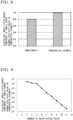
- the accuracies of angle detection in the redundant resolver 1 according to the present embodiment 1 and a comparative example, i.e., a redundant resolver in which the number of the main-system teeth is 6, are compared to each other.
- the vertical axis indicates electrical angle fifth-order component of angle error.
- the electrical angle fifth-order component is normalized with a value in the comparative example.
- the redundant resolver 1 performs communication between the angle computation unit 521 of the main system 101 and the angle computation unit 522 of the sub-system 102 and inputs the main-system detection angle ⁇ m to the control device 13, to control the rotary electric machine 2. If the angle computation unit 521 or the angle computation unit communication device 6 detects a failure of the main system 101, the sub-system detection angle ⁇ s is inputted to the control device 13. If the angle computation unit 522 or the angle computation unit communication device 6 detects a failure of the sub-system 102, the main-system detection angle ⁇ m is inputted to the control device 13.
- the redundant resolver according to the present embodiment 1 makes it possible to achieve redundancy even though the redundant resolver has a dimension equivalent to the dimension of a single-system resolver. Furthermore, the redundant resolver makes it possible to improve the accuracy of angle detection in a normal case as compared to a redundant resolver that achieves redundancy by dividing the stator into two equal parts.
- FIG. 9 shows the accuracy of angle detection with the number of the main-system teeth being changed from 3 to 11.
- the vertical axis indicates electrical angle fifth-order component of angle error.
- the electrical angle fifth-order component is normalized with a value in the comparative example.
- the shaft angle multiplier Nx is set to 5 and the number Ns of the teeth is set to 12 in the redundant resolver according to the present embodiment 1, the present disclosure is not limited thereto, and the same advantageous effect can be obtained also with other numbers as long as: Nx is a natural number; and Ns is an integer equal to or larger than 3.
- FIG. 10 is a diagram showing a configuration of a redundant resolver 1a according to the present embodiment 2.
- the redundant resolver 1a includes a resolver of a main system 101a and a resolver of a sub-system 102a.
- An excitation circuit 511a of the main system 101a and an excitation circuit 512a of the sub-system 102a are not connected to each other by an excitation circuit communication device and are independent of each other. With such a configuration, a common cause failure due to the excitation circuit communication device can be prevented, and thus an advantageous effect of enabling more improvement in the safety of the redundant resolver can be obtained.
- the excitation circuit 511a which gives an excitation signal to each of the excitation windings R1 to R7 of the main system 101a
- the excitation circuit 512a which gives an excitation signal to each of the excitation windings R8 to R12 of the sub-system 102a
- the excitation circuits are independent of each other, it is difficult to perform synchronization between the excitation signal in the main system 101a and the excitation signal in the sub-system 102a.
- the frequencies are not completely matched with each other, and a minute difference is generated therebetween.
- the difference between the excitation signal in the main system 101a and the excitation signal in the sub-system 102a is not fixed but changes over time. Consequently, one of the systems influences the other system. This causes deterioration of the accuracy of angle detection.
- FIG. 11 shows an excitation signal in the main system 101a and an excitation signal in the sub-system 102a, in the redundant resolver 1 according to the present embodiment 2.
- a frequency f1 of the excitation signal in the main system 101a is 10 kHz
- a frequency f2 of the excitation signal in the sub-system 102a is 20 kHz.
- the vertical axis indicates voltage of excitation signal. The voltage is normalized with amplitude.
- each of an angle computation unit 521a of the main system 101a and an angle computation unit 522a of the sub-system 102a has a function of eliminating a frequency component of the other system. That is, a component based on the excitation signal in the sub-system 102a is eliminated from each of the first output signal in the main system 101a and the second output signal in the main system 101a so that only a component based on the excitation signal in the main system 101a is extracted therefrom.
- a component based on the excitation signal in the main system 101a is eliminated from each of the first output signal in the sub-system 102a and the second output signal in the sub-system 102a so that only a component based on the excitation signal in the sub-system 102a is extracted therefrom.
- a method for, in one of the systems, eliminating a frequency component of the other system will be described.
- FIG. 12 is a diagram for explaining the waveform of an output signal in the main system 101a and shows, in order from above, the waveforms of the output signal in the main system 101a, the excitation signal in the main system 101a, and the excitation signal in the sub-system 102a.
- the output signal in the main system 101a originally has a waveform with the frequency f1 corresponding to the excitation signal in the main system 101a.
- the output signal has a waveform in which a component having the frequency f2 of the excitation signal in the sub-system 102a has been added.
- +A and -A of the excitation signal in the main system 101a respectively correspond to a positive peak and a negative peak of the signal.
- the output signal in the main system 101a has a waveform resulting from distortion from the sine wave.
- this output signal in the main system 101a is sampled at a cycle of 1/f1 and an arc tangent is directly computed, an error is generated owing to a component having the frequency f2 of the excitation signal in the sub-system.
- the output signal in the main system 101a is sampled at 2/f1, to obtain ⁇ (A+Bn)-(-A+Bn) ⁇ /2. Consequently, only the component A having the frequency f1 of the excitation signal in the main system 101a can be extracted so that the component Bn having the frequency f2 of the excitation signal in the sub-system 102a can be eliminated. Thus, the accuracy of rotation angle detection can be improved.
- FIG. 13 is a diagram for explaining the waveform of an output signal in the sub-system 102a and shows, in order from above, the waveforms of the output signal in the sub-system 102a, the excitation signal in the sub-system 102a, and the excitation signal in the main system 101a.
- the output signal in the sub-system 102a originally has a waveform with the frequency f2 corresponding to the excitation signal in the sub-system 102a.
- the output signal has a waveform in which a component having the frequency f1 of the excitation signal in the main system 101a has been added.
- +B, -B, +B, and -B of the excitation signal in the sub-system 102a respectively correspond to a positive peak, a negative peak, a positive peak, and a negative peak of the signal.
- components +An1, +An2, -An1, and -An2 of the excitation signal in the main system 101a are respectively added at +B, -B, +B, and -B, the output signal in the sub-system 102a has a waveform resulting from distortion from the sine wave.
- this output signal in the sub-system 102a is sampled at a cycle of 1/f2 and an arc tangent is directly computed, an error is generated owing to a component having the frequency f1 of the excitation signal in the main system 101a.
- the output signal in the sub-system 102a is sampled at 2/f2, to obtain ⁇ (B+An1)+(B-An1)-(-B+An2)-(-B-An2) ⁇ /4. Consequently, only the component B having the frequency f2 of the excitation signal in the sub-system 102a can be extracted so that the component An having the frequency f1 of the excitation signal in the main system 101a can be eliminated. Thus, the accuracy of rotation angle detection can be improved.
- the main system 101a and the sub-system 102a are arranged on a stator having the shape of one circle. Further, excitation signals having frequencies that are different between the systems are supplied, and each of the angle computation units 521a and 522a eliminates influence of the excitation signal in the other system. With this feature, the main system 101a and the sub-system 102a are in a state of being independent of each other.
- the main system 101a is in the same physical state as that in the case where: no excitation signal is applied to the excitation windings R of the sub-system 102a wound on the teeth of the sub-system 102a; and the sub-system 102a suffers a failure such as disconnection.
- the sub-system 102a is in the same physical state as that in the case where the main system 101a suffers a failure such as disconnection.
- excitation signals having frequencies different from each other are supplied from the independent excitation circuits 511a and 512a so that, in each system, a signal that does not influence the signal in the other system is obtained.
- Any of the redundant resolvers 1 described above is applicable to an electric power steering device for a vehicle.
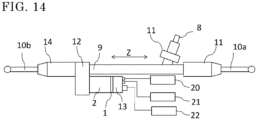
- FIG. 14 is a schematic configuration diagram of the electric power steering device mounted in a vehicle such as an automobile.
- a steering wheel (not shown) to be steered by a driver is connected to one end of a shaft 8.
- the shaft 8 is connected to a rack shaft (not shown) inside a housing 9.
- a front right wheel tie rod 10a and a front left wheel tie rod 10b are respectively connected to both ends of the rack shaft, a right wheel (not shown) is connected via a knuckle arm (not shown) to the front right wheel tie rod 10a, and a left wheel (not shown) is connected via a knuckle arm (not shown) to the front left wheel tie rod 10b.
- the left and right front wheels are oriented according to steering of the steering wheel by the driver. It is noted that a rack boot 14 is provided such that no foreign object enters the device.
- the electric power steering device assists a driver in steering of the steering wheel.
- this assist is performed by generating a supplementary torque that supplements the steering torque.
- this supplementary torque is generated with the rotary electric machine 2, which is a permanent magnet type rotary electric machine, serving as a power source.
- a torque is detected by a torque sensor 11 attached to the shaft 8.
- the detected torque is transmitted to a main-system power supply source 20 and a sub-system power supply source 21.
- information about the vehicle such as a vehicle speed is also converted into an electrical signal, and the electrical signal is transmitted to the main-system power supply source 20 and the sub-system power supply source 21.
- Each of the main-system power supply source 20 and the sub-system power supply source 21 computes a required assist torque on the basis of the detected torque and the information about the vehicle such as the vehicle speed, and supplies current to the rotary electric machine 2 via the control device 13 (inverter or the like) for the rotary electric machine.
- the control device 13 power is supplied from a power supply 22 via a power supply connector.
- the redundant resolver 1 is attached to the shaft 3 of the rotary electric machine 2.
- the redundant resolver 1 detects a rotation angle of a rotor of the rotary electric machine 2 and outputs a rotation angle signal corresponding to the rotation angle.
- the control device 13 may have the hardware configuration shown in FIG. 2 in the same manner as the control circuit 5.
- the rotary electric machine 2 is disposed so as to be oriented parallelly to a movement direction (arrow Z) of the rack shaft.
- a torque generated by the rotary electric machine 2 is transmitted to a belt and a ball screw inside a gearbox 12, and thrust force for moving the rack shaft inside a housing 8 in a direction indicated by the arrow Z is generated.
- the thrust force provides assist for the steering force of the driver.
- the front right wheel tie rod 10a and the front left wheel tie rod 10b are operated by the thrust force of the rotary electric machine 2 and the steering force of the driver. Thus, the orientations of both wheels are changed, whereby the vehicle can be turned.
- the driver can turn the vehicle with a small amount of steering force.
- the redundant resolver 1 according to the above embodiment 1 or 2 has been applied for detecting a rotation angle of the rotary electric machine 2.
- cogging torque and torque ripple generated by the rotary electric machine 2 are transmitted via a gear to the driver.
- cogging torque and torque ripple are desirably reduced in order to obtain favorable steering feeling.
- vibrations and noise at the time of operation of the rotary electric machine 2 are also desirably reduced.
- the rotation angle of the rotary electric machine 2 is detected with high accuracy. Consequently, the rotary electric machine can be smoothly controlled. Thus, generation of torque ripple can be suppressed as compared to the case where the accuracy of rotation angle detection is low. The same applies also to vibrations and noise. Therefore, the electric power steering device in which the rotary electric machine 2 is mounted with the redundant resolver 1 according to the above embodiment 1 or 2 can provide favorable steering feeling to the driver.
- the redundant resolver 1 can detect a rotation angle with high accuracy in the other system.
- the redundant resolver 1 can continuously output assist force. It is noted that, although the redundant resolver 1 is shown as being attached to the rotary electric machine in FIG. 1 , it is needless to say that: a body of the redundant resolver 1 can be attached inside the rotary electric machine; and the control circuit 5 can be provided outside of the rotary electric machine 2.
Landscapes
- Engineering & Computer Science (AREA)
- Power Engineering (AREA)
- Physics & Mathematics (AREA)
- General Physics & Mathematics (AREA)
- Chemical & Material Sciences (AREA)
- Combustion & Propulsion (AREA)
- Transportation (AREA)
- Mechanical Engineering (AREA)
- Transmission And Conversion Of Sensor Element Output (AREA)
- Measurement Of Length, Angles, Or The Like Using Electric Or Magnetic Means (AREA)
Applications Claiming Priority (1)
| Application Number | Priority Date | Filing Date | Title |
|---|---|---|---|
| PCT/JP2020/015954 WO2021205596A1 (fr) | 2020-04-09 | 2020-04-09 | Résolveur redondant et dispositif de direction assistée électrique équipé d'un résolveur redondant |
Publications (2)
| Publication Number | Publication Date |
|---|---|
| EP4134631A1 true EP4134631A1 (fr) | 2023-02-15 |
| EP4134631A4 EP4134631A4 (fr) | 2023-05-10 |
Family
ID=78023087
Family Applications (1)
| Application Number | Title | Priority Date | Filing Date |
|---|---|---|---|
| EP20930079.7A Pending EP4134631A4 (fr) | 2020-04-09 | 2020-04-09 | Résolveur redondant et dispositif de direction assistée électrique équipé d'un résolveur redondant |
Country Status (5)
| Country | Link |
|---|---|
| US (1) | US12163809B2 (fr) |
| EP (1) | EP4134631A4 (fr) |
| JP (1) | JP7459233B2 (fr) |
| CN (1) | CN115443401B (fr) |
| WO (1) | WO2021205596A1 (fr) |
Families Citing this family (2)
| Publication number | Priority date | Publication date | Assignee | Title |
|---|---|---|---|---|
| WO2021100076A1 (fr) * | 2019-11-18 | 2021-05-27 | 三菱電機株式会社 | Résolveur redondant et dispositif de direction assistée électrique dans lequel celui-ci est monté |
| US20220181940A1 (en) * | 2020-12-03 | 2022-06-09 | Joby Aero, Inc. | Redundant resolver |
Family Cites Families (19)
| Publication number | Priority date | Publication date | Assignee | Title |
|---|---|---|---|---|
| JP5016165B2 (ja) * | 2001-04-11 | 2012-09-05 | 株式会社アミテック | 相対回転位置検出装置 |
| JP4147930B2 (ja) | 2002-12-18 | 2008-09-10 | 株式会社デンソー | 蒸気圧縮式冷凍機 |
| JP4034691B2 (ja) * | 2003-05-09 | 2008-01-16 | ミネベア株式会社 | 回転角度センサー |
| JP5120586B2 (ja) * | 2005-06-28 | 2013-01-16 | 株式会社デンソー | 界磁巻線型同期機 |
| DE102007039050B8 (de) * | 2007-08-17 | 2024-02-15 | Avago Technologies International Sales Pte. Limited | Linearsegment- oder Umdrehungszähler mit einem ferromagnetischen Element |
| JP4991991B2 (ja) | 2008-03-13 | 2012-08-08 | トヨタ自動車株式会社 | レゾルバ |
| JP2010002205A (ja) * | 2008-06-18 | 2010-01-07 | Nsk Ltd | 多重系回転センサ |
| US9094015B2 (en) * | 2011-01-14 | 2015-07-28 | Infineon Technologies Ag | Low-power activation circuit with magnetic motion sensor |
| JP5174945B2 (ja) * | 2011-09-02 | 2013-04-03 | 日本航空電子工業株式会社 | バリアブルリラクタンス型レゾルバ及び回転角検出装置 |
| JP2013247828A (ja) * | 2012-05-29 | 2013-12-09 | Tamagawa Seiki Co Ltd | 冗長系レゾルバ巻線構造 |
| CN106797169B (zh) * | 2014-08-21 | 2020-01-24 | 三菱电机株式会社 | 旋转变压器 |
| US10222240B2 (en) * | 2015-06-05 | 2019-03-05 | Mitsubishi Electric Corporation | Resolver, rotating electrical machine, and elevator hoisting machine |
| EP3399283B1 (fr) * | 2015-12-28 | 2020-09-30 | Mitsubishi Electric Corporation | Dispositif de détection d'angle de rotation et machine dynamoélectrique |
| JP6320599B1 (ja) * | 2017-04-26 | 2018-05-09 | 三菱電機株式会社 | 高精度分割型回転角度検出装置 |
| JP2019032200A (ja) * | 2017-08-07 | 2019-02-28 | マブチモーター株式会社 | 位置センサ及びモータ |
| JP6918142B2 (ja) | 2017-12-21 | 2021-08-11 | 三菱電機株式会社 | 冗長型レゾルバ、およびそれを用いた回転角度検出装置 |
| WO2020001552A1 (fr) * | 2018-06-29 | 2020-01-02 | 广东威灵汽车部件有限公司 | Transformateur rotatif |
| JP7081386B2 (ja) * | 2018-08-06 | 2022-06-07 | 株式会社デンソー | 回転検出装置、および、これを用いた電動パワーステアリング装置 |
| CN109781195B (zh) * | 2019-01-21 | 2022-01-04 | 西南石油大学 | 一种基于双频励磁的电磁流量计系统及信号提取方法 |
-
2020
- 2020-04-09 EP EP20930079.7A patent/EP4134631A4/fr active Pending
- 2020-04-09 WO PCT/JP2020/015954 patent/WO2021205596A1/fr not_active Ceased
- 2020-04-09 US US17/915,860 patent/US12163809B2/en active Active
- 2020-04-09 CN CN202080099187.9A patent/CN115443401B/zh active Active
- 2020-04-09 JP JP2022513793A patent/JP7459233B2/ja active Active
Also Published As
| Publication number | Publication date |
|---|---|
| CN115443401B (zh) | 2026-04-07 |
| CN115443401A (zh) | 2022-12-06 |
| JPWO2021205596A1 (fr) | 2021-10-14 |
| US12163809B2 (en) | 2024-12-10 |
| EP4134631A4 (fr) | 2023-05-10 |
| JP7459233B2 (ja) | 2024-04-01 |
| WO2021205596A1 (fr) | 2021-10-14 |
| US20230125647A1 (en) | 2023-04-27 |
Similar Documents
| Publication | Publication Date | Title |
|---|---|---|
| US7664619B2 (en) | Fault detection unit for rotation angle detecting device | |
| US7301333B2 (en) | Angle position detection apparatus | |
| EP4063799B1 (fr) | Résolveur redondant et dispositif de direction assistée électrique dans lequel celui-ci est monté | |
| EP3382330B1 (fr) | Dispositif de détection d'angle et dispositif de direction à assistance électrique | |
| JP2008241405A (ja) | レゾルバ | |
| EP4134631A1 (fr) | Résolveur redondant et dispositif de direction assistée électrique équipé d'un résolveur redondant | |
| WO2011104898A1 (fr) | Procédé de détection d'angle de rotation ou procédé de bobinage pour synchroniser des enroulements de dispositif | |
| EP4325173A1 (fr) | Résolveur et dispositif électrique de direction assistée équipé de ce dernier | |
| JP7142776B2 (ja) | 冗長レゾルバ装置及び電動パワーステアリング装置 | |
| JP4702526B2 (ja) | 角度位置検出装置及び方法 | |
| JP4991992B2 (ja) | レゾルバ | |
| EP4134632B1 (fr) | Capteur de rotation à systèmes multiples et dispositif de direction assistée électrique pourvu d'un capteur de rotation à systèmes multiples | |
| JP7297103B2 (ja) | レゾルバおよび電動パワーステアリング装置 | |
| EP4113069B1 (fr) | Dispositif de détection d'anomalie de résolveur | |
| WO2018110458A1 (fr) | Machine électrique rotative du type à enroulement de champ | |
| US12562618B2 (en) | Dual motor drive assembly |
Legal Events
| Date | Code | Title | Description |
|---|---|---|---|
| STAA | Information on the status of an ep patent application or granted ep patent |
Free format text: STATUS: THE INTERNATIONAL PUBLICATION HAS BEEN MADE |
|
| PUAI | Public reference made under article 153(3) epc to a published international application that has entered the european phase |
Free format text: ORIGINAL CODE: 0009012 |
|
| STAA | Information on the status of an ep patent application or granted ep patent |
Free format text: STATUS: REQUEST FOR EXAMINATION WAS MADE |
|
| 17P | Request for examination filed |
Effective date: 20220920 |
|
| AK | Designated contracting states |
Kind code of ref document: A1 Designated state(s): AL AT BE BG CH CY CZ DE DK EE ES FI FR GB GR HR HU IE IS IT LI LT LU LV MC MK MT NL NO PL PT RO RS SE SI SK SM TR |
|
| A4 | Supplementary search report drawn up and despatched |
Effective date: 20230411 |
|
| RIC1 | Information provided on ipc code assigned before grant |
Ipc: H02K 24/00 20060101ALI20230403BHEP Ipc: G01D 5/20 20060101AFI20230403BHEP |
|
| DAV | Request for validation of the european patent (deleted) | ||
| DAX | Request for extension of the european patent (deleted) | ||
| STAA | Information on the status of an ep patent application or granted ep patent |
Free format text: STATUS: EXAMINATION IS IN PROGRESS |
|
| 17Q | First examination report despatched |
Effective date: 20241118 |