EP4134856A2 - Verfahren und vorrichtung zur verteilten konsensierung unter berücksichtigung der anteilsproportionen von knoten und verfahren zum erzeugen einer blockchain unter verwendung desselben - Google Patents
Verfahren und vorrichtung zur verteilten konsensierung unter berücksichtigung der anteilsproportionen von knoten und verfahren zum erzeugen einer blockchain unter verwendung desselben Download PDFInfo
- Publication number
- EP4134856A2 EP4134856A2 EP22186228.7A EP22186228A EP4134856A2 EP 4134856 A2 EP4134856 A2 EP 4134856A2 EP 22186228 A EP22186228 A EP 22186228A EP 4134856 A2 EP4134856 A2 EP 4134856A2
- Authority
- EP
- European Patent Office
- Prior art keywords
- nodes
- consensus
- shares
- node
- transactions
- Prior art date
- Legal status (The legal status is an assumption and is not a legal conclusion. Google has not performed a legal analysis and makes no representation as to the accuracy of the status listed.)
- Pending
Links
Images




Classifications
-
- G—PHYSICS
- G06—COMPUTING OR CALCULATING; COUNTING
- G06F—ELECTRIC DIGITAL DATA PROCESSING
- G06F21/00—Security arrangements for protecting computers, components thereof, programs or data against unauthorised activity
- G06F21/60—Protecting data
- G06F21/64—Protecting data integrity, e.g. using checksums, certificates or signatures
-
- H—ELECTRICITY
- H04—ELECTRIC COMMUNICATION TECHNIQUE
- H04L—TRANSMISSION OF DIGITAL INFORMATION, e.g. TELEGRAPHIC COMMUNICATION
- H04L9/00—Cryptographic mechanisms or cryptographic arrangements for secret or secure communications; Network security protocols
- H04L9/50—Cryptographic mechanisms or cryptographic arrangements for secret or secure communications; Network security protocols using hash chains, e.g. blockchains or hash trees
-
- H—ELECTRICITY
- H04—ELECTRIC COMMUNICATION TECHNIQUE
- H04L—TRANSMISSION OF DIGITAL INFORMATION, e.g. TELEGRAPHIC COMMUNICATION
- H04L9/00—Cryptographic mechanisms or cryptographic arrangements for secret or secure communications; Network security protocols
- H04L9/08—Key distribution or management, e.g. generation, sharing or updating, of cryptographic keys or passwords
- H04L9/0816—Key establishment, i.e. cryptographic processes or cryptographic protocols whereby a shared secret becomes available to two or more parties, for subsequent use
- H04L9/085—Secret sharing or secret splitting, e.g. threshold schemes
-
- H—ELECTRICITY
- H04—ELECTRIC COMMUNICATION TECHNIQUE
- H04L—TRANSMISSION OF DIGITAL INFORMATION, e.g. TELEGRAPHIC COMMUNICATION
- H04L9/00—Cryptographic mechanisms or cryptographic arrangements for secret or secure communications; Network security protocols
- H04L9/32—Cryptographic mechanisms or cryptographic arrangements for secret or secure communications; Network security protocols including means for verifying the identity or authority of a user of the system or for message authentication, e.g. authorization, entity authentication, data integrity or data verification, non-repudiation, key authentication or verification of credentials
- H04L9/3247—Cryptographic mechanisms or cryptographic arrangements for secret or secure communications; Network security protocols including means for verifying the identity or authority of a user of the system or for message authentication, e.g. authorization, entity authentication, data integrity or data verification, non-repudiation, key authentication or verification of credentials involving digital signatures
- H04L9/3255—Cryptographic mechanisms or cryptographic arrangements for secret or secure communications; Network security protocols including means for verifying the identity or authority of a user of the system or for message authentication, e.g. authorization, entity authentication, data integrity or data verification, non-repudiation, key authentication or verification of credentials involving digital signatures using group based signatures, e.g. ring or threshold signatures
-
- H—ELECTRICITY
- H04—ELECTRIC COMMUNICATION TECHNIQUE
- H04L—TRANSMISSION OF DIGITAL INFORMATION, e.g. TELEGRAPHIC COMMUNICATION
- H04L2209/00—Additional information or applications relating to cryptographic mechanisms or cryptographic arrangements for secret or secure communication H04L9/00
- H04L2209/46—Secure multiparty computation, e.g. millionaire problem
- H04L2209/463—Electronic voting
Definitions
- the present invention relates generally to technology for distributed consensus in blockchain, and more particularly to a method for forming a consensus congress for Byzantine fault-tolerant distributed consensus and a method of generating a blockchain using the same.
- Blockchain is technology enabling transactions to be successfully performed and safely managed without a trusted third party.
- a trusted third party exclusively manages a centralized ledger in order to prevent transaction information from being tampered with, thereby indirectly and manually guaranteeing trust.
- a ledger is managed in a distributed manner through a consensus algorithm, that is, a method of making nodes directly participate in consensus, instead of entrusting a trusted third party with the task of guaranteeing trust in an indirect and manual manner.
- candidate nodes for generating a new block are required to receive transactions.
- the network cost for transferring transactions also increases.
- a competitive consensus method PoW, PoS, or the like
- network cost is incurred in order to transfer transactions to be processed to all full nodes.
- PoW a competitive consensus method
- the cost of transferring transactions has little effect on overall performance due to low processing performance.
- DPoS Delegated Proof of Stake
- EOS Delegated Proof of Stake
- the DPoS method used in EOS and the like is a method of delegating authority to some nodes selected through voting and allowing only these nodes (21 nodes) to participate in consensus. This method may obtain high processing performance because only nodes to which authority is delegated participate in consensus. Also, because transactions to be processed have only to be transferred to the consensus nodes to which authority is delegated, the traffic cost for transferring the transactions may be reduced. However, in this method, nodes other than the selected consensus nodes are not able to participate in consensus, which causes a centralization problem.
- a Pure Proof of Stake (PPoS) consensus method used in Algorand is a method of performing proof-of-stake using the stakes of randomly selected nodes, and has decentralized characteristics because all nodes are eligible to participate in consensus. Also, because only some nodes randomly selected from among a large number of participating nodes participate in consensus, high processing performance may be obtained. However, because any of the nodes participating in consensus is allowed to propose a new candidate block, transactions that have to be processed must be transferred to all nodes. The amount of data corresponding to consensus messages may be reduced using hash or the like, but because the transactions have to be transferred to all nodes and validated, it is necessary to optimize transfer of transactions in order to improve overall performance. That is, in a consensus method satisfying both decentralization and high processing performance, the traffic cost for transferring transactions affects overall performance.
- TPS Transactions Per Second
- An object of the present invention is to enable nodes that are randomly selected for each block from among participating nodes to be selected as a consensus congress while enabling only some nodes to receive transactions to be processed in a blockchain.
- Another object of the present invention is to improve consensus performance by reducing the number of transactions to be transferred by limiting the number of nodes to receive the transactions to be processed and to prevent a centralization problem by enabling all nodes to participate in a consensus process.
- a further object of the present invention is to make only some selected nodes process transactions and to make a consensus congress randomly selected for each block from among all nodes generate a new block and connect the same to a blockchain.
- Yet another object of the present invention is to enable different services to be processed in parallel in a single blockchain using multiple shares of each node, without being physically split into groups.
- a method for distributed consensus, performed by an apparatus for distributed consensus includes performing, by each of nodes forming a blockchain, an operation corresponding to a success probability (p) a number of times corresponding to the share value thereof; sending, by nodes having at least one share corresponding to the operation which is successful, a message for being selected as consensus nodes; and performing, by the consensus nodes, which are nodes having consensus shares selected from among the shares corresponding to the operation which is successful, distributed consensus.
- p success probability
- the nodes forming the blockchain include major shareholder nodes for processing transactions.
- the major shareholder nodes may send a delegate request message including transactions
- nodes other than the major shareholder nodes, among the consensus nodes may send a delegate request message including no transactions.
- shares corresponding to the operation which is successful, among shares possessed by the major shareholder nodes, may have priority for being selected as the consensus shares.
- the major shareholder nodes have an upper limit on the number of consensus shares capable of being assigned thereto.
- the major shareholder nodes may be selected from among the nodes in descending order of shares possessed thereby.
- the major shareholder nodes may be selected until the cumulative number of shares of nodes selected as the major shareholder nodes becomes equal to or greater than a preset proportion of all shares or until the number of nodes selected as the major shareholder nodes becomes equal to or greater than a preset number.
- the operation may compare a random value generated using a nonce chain of a node performing the operation with a threshold corresponding to the success probability.
- the nodes may have at least one additional share value along with the share value and process different kinds of services in parallel based on the share value and the additional share value.
- the operation may perform comparison of a threshold corresponding to the success probability using a nonce chain of a node performing the operation, and a nonce value corresponding to the nonce chain may be shared between the share value and the additional share value.
- an apparatus for distributed consensus includes one or more processors; and executable memory for storing at least one program executed by the one or more processors.
- the at least one program may perform an operation corresponding to a success probability (p) a number of times corresponding to the share value of each of nodes forming a blockchain, send a message for selecting nodes having at least one share corresponding to the operation which is successful as consensus nodes, and perform distributed consensus by using nodes having consensus shares, selected from among the shares corresponding to the operation which is successful, as the consensus nodes.
- the nodes forming the blockchain may include major shareholder nodes for processing transactions.
- the major shareholder nodes may send a delegate request message including transactions
- nodes other than the major shareholder nodes, among the consensus nodes may send a delegate request message including no transactions.
- shares corresponding to the operation which is successful, among shares possessed by the major shareholder nodes, may have priority for being selected as the consensus shares.
- the major shareholder nodes have an upper limit on the number of consensus shares capable of being assigned thereto.
- the major shareholder nodes may be selected from among the nodes in descending order of shares possessed thereby.
- a method for generating a blockchain includes receiving, by a chair node, which is one of consensus nodes that are selected in order to connect an additional block to a blockchain, delegate request messages, including transactions that have to be processed after a previous block connected to the blockchain is agreed upon, from major shareholder nodes, among the consensus nodes; receiving, by the chair node, delegate request messages including no transactions from remaining nodes, excluding the major shareholder nodes, among the consensus nodes; performing, by the chair node, share-based verification using the delegate request messages including the transactions and the delegate request messages including no transactions; sending, by the chair node, a prepare message to quorum nodes when the share-based verification succeeds; receiving commit messages from the quorum nodes; and connecting the additional block to the blockchain based on the commit messages.
- the share-based verification may include checking whether the sum of successful shares corresponding to the delegate request messages including the transactions and the delegate request messages including no transactions is greater than a quorum size (2f + 1).
- the prepare message may include transactions for which the sum of successful shares is verified using a reference natural number (f + 1), which corresponds to half the result of adding 1 to the quorum size (2f + 1).
- the consensus nodes may be selected based on an operation corresponding to a success probability (p), which is performed a number of times corresponding to the share value of each of nodes forming the blockchain.
- p success probability
- the consensus nodes may be nodes having consensus shares selected from among shares corresponding to the operation which is successful.
- the major shareholder nodes may have an upper limit on the number of consensus shares capable of being assigned thereto.
- the major shareholder nodes may be selected from among the nodes in descending order of shares possessed thereby.
- the randomly selected consensus nodes may improve performance using a consensus algorithm having message complexity of O(N).
- a consensus algorithm having message complexity of O(N) because all nodes have the possibility of being selected as consensus nodes, the traffic cost for transferring transactions to be processed to all participating nodes increases in proportion to the number of nodes, which may degrade performance. Accordingly, a method for reducing the amount of data over the entire network is required. For example, there is research for reducing the amount of data through optimization using a gossip protocol or the like, but because it is impossible to predict the nodes to be selected as a consensus congress when the consensus congress is randomly selected, the number of transactions transferred to the respective nodes cannot be reduced.
- n is the number of all participating nodes
- b is the number of Byzantine nodes, and is set to n ⁇ b p when the proportion of Byzantine nodes included in all of the nodes is b p.
- Equation (1) means that, when each of b Byzantine nodes performs a coin toss with a success probability of p and a failure probability of 1-p, the probability of the number of Byzantine nodes that win the coin toss exceeding f is equal to or less than P max_bzt .
- Equation (2) means that, when a total of n nodes perform a coin toss with a success probability of p and a failure probability of 1-p, the probability that the number of nodes that win the coin toss is equal to or less than 3f is equal to or less than Pmin node.
- a consensus congress is formed by randomly selecting 3f + 1 nodes.
- all nodes have the possibility of being selected as a consensus congress, so transactions to be processed have to be transferred to all of the nodes. This is a problem not only in the consensus algorithm introduced in the above-mentioned paper but also in all consensus algorithms in which a consensus congress is formed by randomly selecting nodes and only the nodes belonging to the formed consensus congress participate in consensus.
- Byzantine fault-tolerant distributed consensus is performed based on the proportion of shares of nodes in distributed consensus in blockchain. Particularly, according to an embodiment of the present invention, only some selected nodes process transactions, and a consensus congress randomly selected for each block from among all nodes may generate a new block and connect the same to a blockchain.
- not the number of all nodes but the sum of shares issued to all nodes may be used as n in the above two equations, and not the number of Byzantine nodes (the maximum number of Byzantine nodes) but shares possessed by the Byzantine nodes (the maximum Byzantine shares included in all of the shares) may be used as b in the above two equations.
- the nodes to process transactions are selected, consensus nodes are selected using these nodes, and distributed consensus is performed by the consensus nodes, whereby a new block may be connected to a blockchain.
- nodes for processing transactions may be selected as follows.
- Nodes forming a blockchain are sorted in descending order of the share value (share size) possessed thereby, and nodes may be sequentially selected as major shareholder nodes starting with the node having the largest share value.
- the major shareholder nodes may be nodes having shares, the sum of which is equal to or greater than a preset value.
- the major shareholder nodes may be selected until the cumulative number of shares of the nodes selected as major shareholder nodes becomes equal to or greater than a certain proportion of all shares, or a predefined number of major shareholder nodes may be selected from the nodes having the largest share values.
- the remaining nodes may serve merely to mediate transactions.
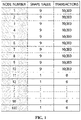
- FIG. 1 is a table illustrating the state of shares possessed by nodes, including major shareholder nodes, and transaction processing according to an embodiment of the present invention.
- the total number of nodes is 100
- the total number of issued shares is 180
- the cumulative number of shares possessed by 10 top nodes is 90, which accounts for 50% of all of the shares.
- node 1, node 2, node 3, node 4, node 5, node 6, node 7, node 8, node 9, and node 10, which possess 50% of all of the shares, may be selected as major shareholder nodes.
- only node 1, node 2, node 3, node 4, node 5, node 6, node 7, node 8, node 9, and node 10, which are the nodes selected as major shareholder nodes, may receive transactions to be processed, and the remaining nodes, namely node 11, node 12, ..., node 99, and node 100, may serve merely to mediate transactions.
- selecting consensus nodes according to an embodiment of the present invention is performed by applying Equations (1) and (2) above based on shares.
- each of nodes forming a blockchain repeatedly performs a coin toss with a success probability of p a number of times equal to the share value thereof. After the results of all of the nodes are collected, when the sum of the shares corresponding to the success is equal to or greater than 3f + 1, arbitrary nodes that possess 3f + 1 shares are selected as consensus nodes (a consensus congress).
- a method of admitting only shares up to an upper limit, among participatory shares, as valid shares may be applied.
- Equation (1) is 36 and 0.76666666666667, respectively.
- n is the number of all nodes
- 3f + 1 is the number of consensus nodes corresponding to a consensus congress
- 2f +1 is the number of quorum nodes corresponding to a consensus quorum
- f is the number of Byzantine nodes corresponding to the probability P max_bzt .
- n is the total number of shares possessed by all nodes
- 3f + 1 is the number of consensus shares corresponding to a consensus congress
- 2f + 1 is the number of quorum shares corresponding to a consensus quorum
- f is the number of Byzantine shares corresponding to the probability P max_bzt .
- the total number of consensus nodes having the consensus shares becomes 50 by adding the 10 major shareholder nodes and the remaining 40 nodes (because the remaining 40 nodes each have a share value of 1). This means that distributed consensus is possible with a smaller number of consensus nodes, compared to the case in which, when a consensus congress is selected based on nodes, 61 consensus nodes are required when 100 nodes participate, as shown in Table 1 above.
- the consensus algorithm according to an embodiment of the present invention enables all nodes to be eligible to participate in consensus while separately arranging nodes for processing transactions, thereby maintaining decentralization.
- FIG. 2 is a flowchart illustrating a distributed consensus method according to an embodiment of the present invention.
- each of nodes forming a blockchain performs an operation corresponding to a success probability of p a number of times corresponding to the share value thereof at step S210.
- the nodes forming the blockchain may include major shareholder nodes for processing transactions.
- the operation may be configured to compare a random value generated using the nonce chain of the node performing the operation with a threshold corresponding to the success probability.
- nodes having at least one share corresponding to the operation which is successful send messages for being selected as consensus nodes at step S220.
- nodes having consensus shares which are selected from among the shares corresponding to the operation which is successful, perform distributed consensus as consensus nodes at step S230.
- shares corresponding to the operation which is successful, among the shares possessed by the major shareholder nodes, may have priority for being selected as consensus shares.
- the major shareholder nodes may have an upper limit on the number of consensus shares capable of being assigned thereto.
- the major shareholder nodes may be selected from among the nodes in descending order of shares possessed by the nodes.
- the major shareholder nodes may be selected until the cumulative number of shares of the nodes selected as the major shareholder nodes becomes equal to or greater than a preset proportion of all of the shares or until the number of nodes selected as major shareholder nodes becomes equal to or greater than a preset number.
- the major shareholder nodes may send delegate request messages including transactions, and nodes, other than the major shareholder nodes, among the consensus nodes, may send delegate request messages not including any transactions.
- the nodes forming the blockchain have at least one additional share value along with the share value, and may process different kinds of services in parallel based on the share value and the additional share value.
- a nonce value corresponding to the nonce chain may be shared between the share value and the additional share value.
- the nonce value is shared, if a hash related to the share of the previous block is used, a coin toss for two or more share values becomes possible.
- FIG. 3 is a block diagram illustrating an example in which a new block is agreed upon and added to a blockchain using a method for generating a blockchain according to an embodiment of the present invention.
- block 101 is connected to the blockchain.
- the results of a coin toss performed by nodes are collected in order to decide on a consensus congress for block 101, and 50 nodes having 109 successful shares may be selected as a consensus congress (consensus nodes), as in the above-described example.
- FIG. 4 is a table illustrating a method for generating a blockchain according to an embodiment of the present invention.
- node 5 is a chair node for block 101 in the method for generating a blockchain according to an embodiment of the present invention.
- FIG. 4 corresponds to an embodiment of the present invention described with reference to FIGS. 1 to 3 , and consensus nodes are 50 nodes having 109 successful shares and include major shareholder nodes, which are nodes from node 1 to node 10. Although not explicitly illustrated in FIG. 4 , the consensus nodes include 40 nodes selected from among nodes from node 11 to node 100, other than the 10 major shareholder nodes.
- transactions t1, t2, t3, and t4 which have not yet been processed, are transferred to the respective major shareholder nodes, whereby nodes from node 1 to node 10 are assigned the transactions t1, t2, t3 and t4.
- each of the consensus nodes sends a message, containing the transactions received thereby, to the chair node.
- the format of the message may be Dr(node, ⁇ txs ⁇ ), and additional information, such as a digital signature and the like, may be included in the message for integrity thereof.
- additional information such as a digital signature and the like
- 40 consensus nodes selected from among nodes from node 11 to node 100 have no transactions, and therefore send a message such as Dr(node, ⁇ ) to node 5, which is a chair node.
- the quorum nodes are a total of 14 nodes including the chair node (node 1, node 2, node 3, node 4, node 5, node 6, node 7, node 8, node 9, node 10, node 12, node 35, node 76, and node 100).
- the prepare message generated by the chair node may include transactions, processing of which is requested by the nodes having 37 (f + 1) or more successful shares, among the transactions ⁇ t1, t2, t3, t4 ⁇ included in each of the received delegate request messages, along with additional information.
- the additional information may be proof corresponding to the included transactions, data for a multi-signature, or the like. Consensus technology using multi-signature has been described in detail in the above-mentioned paper and patents.
- a prepare message including the transactions t1, t2, t3, and t4 and proof for the successful shares of the nodes that made a request to process the respective transactions, is generated and sent to the quorum nodes.
- the transaction data load imposed on each node is 20 Mbit/s. Accordingly, nodes from node 1 to node 10 have to receive 10,000 transactions per second, check whether there is any abnormality therein, generate a Dr(node, ⁇ 10,000 txs ⁇ ) message including 10,000 transactions, and send the same to the chair node.
- the volume of traffic for transferring raw transactions from nine nodes, excluding the chair node, to the chair node is 180 Mbit/s.
- the network cost may be reduced.
- the 40 consensus nodes selected from among nodes from node 11 to node 100 neither receive nor store transactions, they transfer Dr(node, ⁇ ) messages containing an empty transaction to the chair node. Accordingly, the network cost for transferring transactions is zero.
- Dr(node, ⁇ ) messages received from the 40 nodes include no transactions, the computing load for processing transactions is reduced in the chair node.
- the quorum nodes are 14 nodes (node 1, node 2, node 3, node 4, node 5, node 6, node 7, node 8, node 9, node 10, node 12, node 35, node 76, and node 100), which have 73 (2f + 1) successful shares.
- 41 nodes have to constitute the quorum nodes, as shown in Table 1, but according to the present invention, the number of quorum nodes is decreased from 41 to 14, which has an effect of reducing the amount of computing resources and network resources required for the consensus process.
- Table 2 shows the difference in the number of nodes between the node-based consensus algorithm and the share-based consensus algorithm. [Table 2] TOTAL NODES CONSENSUS NODES QUORUM NODES NODE-BASED 100 61 41 SHARE-BASED 100 50 14
- the quorum nodes receiving the prepare message change the states thereof to a prepare stage. Only the quorum nodes, the node state of which is a prepare stage, are able to generate a commit message.
- the quorum nodes, the node state of which is a prepare stage check whether or not the received prepare message is normal, generate a commit message including the signature thereof when there is no abnormality, transfer the same to the chair node, and change the state thereof to 'commit'.
- the chair node in the 'prepare' state receives the commit messages from all of the quorum nodes, excluding the chair node itself, the chair node generates a committed block, including the transactions t1, t2, t3, and t4, which are finally agreed upon, and a multi-signature acquired by aggregating the signatures of the nodes, and adds the committed block as block 101 subsequent to block 100 in the blockchain thereof. Simultaneously therewith, the chair node propagates the block (block 101) that is agreed upon to all of the nodes and changes the state thereof to a committed state.
- all of the nodes that are not in the committed state for block 101 receive the committed block, check whether the multi-signature of the block is valid, add block 101 subsequent to block 100 of the blockchain thereof only when the multi-signature is valid, and change the state thereof to a committed state. All of the nodes that are in the committed state for block 101 become ready to agree on block 102.
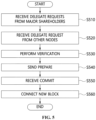
- FIG. 5 is a flowchart illustrating a method for generating a blockchain according to an embodiment of the present invention.
- a chair node which is one of consensus nodes that are selected in order to connect an additional block to a blockchain, receives delegate request messages, including transactions that have to be processed after the previous block connected to the blockchain is agreed upon, from major shareholder nodes, among the consensus nodes, at step S510.
- the consensus nodes may be selected based on an operation corresponding to a success probability of p that is performed as many times as the share value of each of nodes forming the blockchain.
- the consensus nodes may be nodes having consensus shares that are selected from among shares corresponding to the operation which is successful.
- the major shareholder nodes may be selected from among the nodes in descending order of shares possessed thereby.
- the major shareholder nodes may have an upper limit on the number of consensus shares capable of being assigned thereto.
- the chair node receives delegate request messages including no transactions from the remaining nodes, excluding the major shareholder nodes, among the consensus nodes, at step S520.
- steps S510 and S520 may be performed according to the order in which the consensus nodes for sending the delegate request messages send the delegate request messages, rather than being sequentially performed in the order illustrated in FIG. 5 . That is, steps S510 and 520 may be performed in the order illustrated in FIG. 5 , in the reverse order, or at the same time.
- the chair node performs share-based verification using the delegate request messages including the transactions and the delegate request messages including no transactions at step S530.
- share-based verification may include checking whether the sum of successful shares corresponding to the delegate request messages including the transactions and the delegate request messages including no transactions is greater than a quorum size (2f + 1).
- a prepare message may include transactions for which the sum of successful shares is verified using a reference natural number (f + 1), which corresponds to half the result of adding 1 to the quorum size.
- the chair node sends the prepare message to quorum nodes at step S540.
- the chair node receives commit messages from the quorum nodes at step S550.
- the chair node connects the additional block to the blockchain based on the commit messages at step S560.
- FIG. 6 is a flowchart illustrating a process in which each of nodes forming a blockchain performs an operation corresponding to a success probability a number of times equal to the share value thereof according to an embodiment of the present invention.
- FIG. 6 illustrates technology in which each node is able to repeat a coin toss a number of times equal to the share value possessed thereby based on technology in which each node performs a coin toss once using a Verifiable Random Function (VRF) or a nonce chain described in the above-mentioned paper and patents.
- VRF Verifiable Random Function
- a random value Rn is generated first and variables 'pass' and 'loop' are initialized at step S610.
- 'HASH VALUE OF PREVIOUS BLOCK' may be the header hash of the previous block.
- 'loop SHARE VALUE' indicates that the variable 'loop' is initialized to the share value of each node. The variable 'pass' is initialized to 0.
- variable 'loop' is greater than 0 is determined at step S620.
- step S620 When it is determined at step S620 that 'loop' is greater than 0, this indicates that there is a share with which a coin toss is capable of being performed, so the process goes to step S630, whereby an operation corresponding to the coin toss is performed at step S630.
- the threshold is a value corresponding to p, which is set based on Equations (1) and (2) above, and may be calculated using p. For example, when the operation is performed on 32 bits, the product of p and a 32-bit value, all bits of which are 1, may be used as the threshold.
- step S630 When it is determined at step S630 that Rn is less than the threshold, this is considered success in the coin toss, and the process goes to step S640, whereby the variable 'pass' is increased by 1.
- variable 'loop' is decreased by 1 at step S650.
- step S630 When it is determined at step S630 that Rn is not less than the threshold, this is considered failure in the coin toss, so the process goes to step S650 without increasing the variable 'pass'.
- step S620 is performed again.
- step S670 is performed, whereby whether the variable 'pass' is greater than 0 is checked.
- a 'Next Congressman' message is output, whereby the node announces that the node itself is eligible to become a consensus congress candidate for the next block at step S680.
- the nodes receiving the 'Next Congressman' message are made aware of the number of times the node sending the 'Next Congressman' message won the coin toss.
- step S670 When it is determined at step S670 that the variable 'pass' is not greater than 0, the operation is terminated.
- Nodes receiving the 'Next Congressman' message may check whether there is any abnormality by again performing the steps illustrated in FIG. 6 .
- FIG. 7 is a table illustrating an example of the case in which nodes forming a blockchain have different types of share values according to an embodiment of the present invention.
- each node has multiple different share values (share value 1 and share value 2).
- the participating nodes may process two or more different agreements in parallel.
- share value 1 consensus may be performed whereby nodes from node 1 to node 10 constitute major shareholder nodes
- share value 2 consensus may be performed whereby nodes from node 11 to node 20 constitute major shareholder nodes.
- share values (share value 1 and share value 2) may be used to respectively connect new blocks to different blockchains.
- FIG. 8 is a block diagram illustrating a computer system configuration according to an embodiment of the present invention.
- the distributed consensus apparatus, the blockchain generation apparatus, and the nodes forming a blockchain may be implemented in a computer system 700 including a computer-readable recording medium.
- the computer system 700 may include one or more processors 710, memory 730, a user-interface input device 740, a user-interface output device 750, and storage 760, which communicate with each other via a bus 720. Also, the computer system 700 may further include a network interface 770 connected to a network 780.
- the processor 710 may be a central processing unit or a semiconductor device for executing a program or processing instructions stored in the memory 730 or the storage 760.
- the memory 730 and the storage 760 may be storage media including at least one of a volatile medium, a nonvolatile medium, a detachable medium, a non-detachable medium, a communication medium, or an information delivery medium, or a combination thereof.
- the memory 730 may include ROM 731 or RAM 732.
- At least one program may be recorded in the memory 730.
- the processor 710 may execute the program.
- the program may perform an operation corresponding to a success probability (p) a number of times corresponding to the share value of each of the nodes forming a blockchain, send a message for selecting nodes having at least one share corresponding to the operation which is successful as consensus nodes, and perform distributed consensus by using the nodes having consensus shares, selected from among the shares corresponding to the operation which is successful, as the consensus nodes.
- p success probability
- the nodes forming the blockchain may include major shareholder nodes for transaction processing.
- the major shareholder nodes may send a delegate request message including transactions
- nodes other than the major shareholder nodes, among the consensus nodes may send a delegate request message including no transactions.
- the shares corresponding to the operation which is successful, among the shares possessed by the major shareholder nodes, may have priority for being selected as consensus shares.
- the major shareholder nodes may have an upper limit on the number of consensus shares capable of being assigned thereto.
- the major shareholder nodes may be selected from among the nodes in descending order of shares possessed thereby.
- the share-based distributed consensus method has an effect of reducing the number of nodes that receive transactions to 1/10 of the original number. Also, as shown in Table 2, when n is set to the number of shares, the size of a consensus congress is reduced to 50, compared to the case in which the size is 61 when n is set to the number of nodes. Furthermore, when n is set to the number of nodes, a quorum size is 41, but when n is set to the number of shares, the quorum size is reduced to 14, whereby message complexity and the amount of traffic required for consensus are significantly reduced.
- difference services may be processed in parallel in a single blockchain.
- a physical split into shards is required for such a parallel-processing effect, but according to the present invention, parallel processing is possible without performing splitting into groups.
- nodes for each block which are randomly selected from among participating nodes, may be selected as a consensus congress while only some nodes receive transactions to be processed in a blockchain.
- the present invention may improve consensus performance by reducing the number of transactions to be transferred by limiting the number of nodes to receive the transactions to be processed, and may prevent a centralization problem by enabling all nodes to participate in a consensus process.
- the present invention may enable different services to be processed in parallel in a single blockchain using multiple shares of each node, without being physically split into groups.
- the distributed consensus method, the distributed consensus apparatus, and the blockchain generation method according to the present invention are not limitedly applied to the configurations and operations of the above-described embodiments, but all or some of the embodiments may be selectively combined and configured, so the embodiments may be modified in various ways.
Landscapes
- Engineering & Computer Science (AREA)
- Computer Security & Cryptography (AREA)
- Computer Networks & Wireless Communication (AREA)
- Signal Processing (AREA)
- Theoretical Computer Science (AREA)
- General Health & Medical Sciences (AREA)
- Bioethics (AREA)
- Computer Hardware Design (AREA)
- Software Systems (AREA)
- Physics & Mathematics (AREA)
- General Engineering & Computer Science (AREA)
- General Physics & Mathematics (AREA)
- Health & Medical Sciences (AREA)
- Information Retrieval, Db Structures And Fs Structures Therefor (AREA)
- Hardware Redundancy (AREA)
Applications Claiming Priority (2)
| Application Number | Priority Date | Filing Date | Title |
|---|---|---|---|
| KR20210105386 | 2021-08-10 | ||
| KR1020220060794A KR102668468B1 (ko) | 2021-08-10 | 2022-05-18 | 노드의 지분 비율을 고려한 분산 합의 방법, 장치 및 이를 이용한 블록체인 생성 방법 |
Publications (2)
| Publication Number | Publication Date |
|---|---|
| EP4134856A2 true EP4134856A2 (de) | 2023-02-15 |
| EP4134856A3 EP4134856A3 (de) | 2023-06-07 |
Family
ID=82656271
Family Applications (1)
| Application Number | Title | Priority Date | Filing Date |
|---|---|---|---|
| EP22186228.7A Pending EP4134856A3 (de) | 2021-08-10 | 2022-07-21 | Verfahren und vorrichtung zur verteilten konsensierung unter berücksichtigung der anteilsproportionen von knoten und verfahren zum erzeugen einer blockchain unter verwendung desselben |
Country Status (2)
| Country | Link |
|---|---|
| US (1) | US12506626B2 (de) |
| EP (1) | EP4134856A3 (de) |
Cited By (2)
| Publication number | Priority date | Publication date | Assignee | Title |
|---|---|---|---|---|
| EP4346159A1 (de) * | 2022-09-27 | 2024-04-03 | Electronics and Telecommunications Research Institute | Verfahren und vorrichtung zum hinzufügen einer zusätzlichen kette zu einer blockchain sowie verfahren und vorrichtung zur erzeugung einer staffe dafür |
| EP4481612A3 (de) * | 2023-06-20 | 2025-02-19 | Electronics and Telecommunications Research Institute | Verfahren und vorrichtung für verteilten konsens unter verwendung eines identifikators öffentlicher knoten und verfahren zur erzeugung einer blockchain damit |
Families Citing this family (1)
| Publication number | Priority date | Publication date | Assignee | Title |
|---|---|---|---|---|
| US20250112797A1 (en) * | 2023-09-29 | 2025-04-03 | Ava Labs, Inc. | Consensus protocol modifications |
Citations (4)
| Publication number | Priority date | Publication date | Assignee | Title |
|---|---|---|---|---|
| US20190327048A1 (en) | 2018-04-23 | 2019-10-24 | Qualcomm Incorporated | Demodulation reference signal configuration for shortened transmission time interval baseline pattern |
| US20190327084A1 (en) | 2018-04-19 | 2019-10-24 | Electronics And Telecommunications Research Institute | Method for selecting consensus node using nonce and method and apparatus for generating blockchain using the same |
| US20190379538A1 (en) | 2018-06-12 | 2019-12-12 | Electronics And Telecommunications Research Institute | Method and apparatus for selecting distributed consensus node based on proof of nonce |
| US20200403776A1 (en) | 2019-06-18 | 2020-12-24 | Electronics And Telecommunications Research Institute | Apparatus and method for achieving distributed consensus based on decentralized byzantine fault tolerance |
Family Cites Families (7)
| Publication number | Priority date | Publication date | Assignee | Title |
|---|---|---|---|---|
| EP3452975A4 (de) | 2016-05-04 | 2020-04-15 | Algorand Inc. | Verteiltes transaktionsweiterleitungs- und -verifizierungssystem |
| CN107450981B (zh) * | 2017-05-31 | 2020-04-24 | 创新先进技术有限公司 | 一种区块链共识方法及设备 |
| CN107590738A (zh) * | 2017-08-24 | 2018-01-16 | 阿里巴巴集团控股有限公司 | 选择共识节点的处理方法、装置及服务器 |
| US10887090B2 (en) * | 2017-09-22 | 2021-01-05 | Nec Corporation | Scalable byzantine fault-tolerant protocol with partial tee support |
| KR102019211B1 (ko) | 2017-11-14 | 2019-11-04 | 주식회사 아이콘루프 | 비잔틴 장애를 극복 가능한 블록체인 생성 방법 |
| US20200026699A1 (en) * | 2018-07-20 | 2020-01-23 | True Blockchain Technology Ltd. | Highly Performant Decentralized Public Ledger with Hybrid Consensus |
| KR102406020B1 (ko) | 2019-06-18 | 2022-06-10 | 한국전자통신연구원 | 탈 중앙화된 비잔틴 오류 감내 분산 합의 장치 및 방법 |
-
2022
- 2022-07-21 EP EP22186228.7A patent/EP4134856A3/de active Pending
- 2022-07-21 US US17/870,633 patent/US12506626B2/en active Active
Patent Citations (4)
| Publication number | Priority date | Publication date | Assignee | Title |
|---|---|---|---|---|
| US20190327084A1 (en) | 2018-04-19 | 2019-10-24 | Electronics And Telecommunications Research Institute | Method for selecting consensus node using nonce and method and apparatus for generating blockchain using the same |
| US20190327048A1 (en) | 2018-04-23 | 2019-10-24 | Qualcomm Incorporated | Demodulation reference signal configuration for shortened transmission time interval baseline pattern |
| US20190379538A1 (en) | 2018-06-12 | 2019-12-12 | Electronics And Telecommunications Research Institute | Method and apparatus for selecting distributed consensus node based on proof of nonce |
| US20200403776A1 (en) | 2019-06-18 | 2020-12-24 | Electronics And Telecommunications Research Institute | Apparatus and method for achieving distributed consensus based on decentralized byzantine fault tolerance |
Cited By (2)
| Publication number | Priority date | Publication date | Assignee | Title |
|---|---|---|---|---|
| EP4346159A1 (de) * | 2022-09-27 | 2024-04-03 | Electronics and Telecommunications Research Institute | Verfahren und vorrichtung zum hinzufügen einer zusätzlichen kette zu einer blockchain sowie verfahren und vorrichtung zur erzeugung einer staffe dafür |
| EP4481612A3 (de) * | 2023-06-20 | 2025-02-19 | Electronics and Telecommunications Research Institute | Verfahren und vorrichtung für verteilten konsens unter verwendung eines identifikators öffentlicher knoten und verfahren zur erzeugung einer blockchain damit |
Also Published As
| Publication number | Publication date |
|---|---|
| EP4134856A3 (de) | 2023-06-07 |
| US20230066169A1 (en) | 2023-03-02 |
| US12506626B2 (en) | 2025-12-23 |
Similar Documents
| Publication | Publication Date | Title |
|---|---|---|
| EP4134856A2 (de) | Verfahren und vorrichtung zur verteilten konsensierung unter berücksichtigung der anteilsproportionen von knoten und verfahren zum erzeugen einer blockchain unter verwendung desselben | |
| US11687562B2 (en) | Apparatus and method for adaptively managing sharded blockchain network based on deep Q network | |
| CN113660125B (zh) | 一种基于随机可信委员会的共识方法及装置 | |
| US20250202715A1 (en) | Unity protocol consensus | |
| CN111582843A (zh) | 一种基于聚合签名的区块链隐私交易方法 | |
| CN115499453B (zh) | 面向联盟链的分片存储方法 | |
| KR20200081533A (ko) | 사물 인터넷 환경을 위한 동적 블라인드 투표기반의 블록체인 합의방법 | |
| CN117370460A (zh) | 基于双链存储的区块链存储优化方法及装置 | |
| EP4346159A1 (de) | Verfahren und vorrichtung zum hinzufügen einer zusätzlichen kette zu einer blockchain sowie verfahren und vorrichtung zur erzeugung einer staffe dafür | |
| CN114386967A (zh) | 跨链资产转移方法、计算机设备和存储介质 | |
| Peter et al. | Shared cache coded caching schemes with known user-to-cache association profile using placement delivery arrays | |
| CN118473640B (zh) | 一种面向云原生的区块链共识方法及系统 | |
| Fisch et al. | Permissionless verifiable information dispersal (data availability for bitcoin rollups) | |
| CN114861233B (zh) | 一种无需可信第三方的分片异步拜占庭容错共识方法和装置 | |
| KR102668468B1 (ko) | 노드의 지분 비율을 고려한 분산 합의 방법, 장치 및 이를 이용한 블록체인 생성 방법 | |
| US12323533B2 (en) | Apparatus and method for distributed consensus in dynamic byzantine fraction environment | |
| Cheng et al. | A new hybrid consensus protocol: Deterministic proof of work | |
| CN115021944B (zh) | 基于聚合签名和时空证明算法的共识方法及装置 | |
| CN115842767B (zh) | 基于共识算法的物联网设备集群协同方法及系统 | |
| CN114546687B (zh) | 一种用于基于区块链的时间混合队列分片系统的通讯方法 | |
| CN117527243A (zh) | 区块链的共识方法、装置、计算机可读介质及电子设备 | |
| Mišić et al. | Fast cycle multiple entry PBFT consensus | |
| EP4481612A2 (de) | Verfahren und vorrichtung für verteilten konsens unter verwendung eines identifikators öffentlicher knoten und verfahren zur erzeugung einer blockchain damit | |
| Neu et al. | Securing Proof-of-Stake Nakamoto Consensus Under Bandwidth Constraint. | |
| CN117792600A (zh) | 向区块链添加附加链的方法和设备 |
Legal Events
| Date | Code | Title | Description |
|---|---|---|---|
| PUAI | Public reference made under article 153(3) epc to a published international application that has entered the european phase |
Free format text: ORIGINAL CODE: 0009012 |
|
| STAA | Information on the status of an ep patent application or granted ep patent |
Free format text: STATUS: THE APPLICATION HAS BEEN PUBLISHED |
|
| AK | Designated contracting states |
Kind code of ref document: A2 Designated state(s): AL AT BE BG CH CY CZ DE DK EE ES FI FR GB GR HR HU IE IS IT LI LT LU LV MC MK MT NL NO PL PT RO RS SE SI SK SM TR |
|
| PUAL | Search report despatched |
Free format text: ORIGINAL CODE: 0009013 |
|
| AK | Designated contracting states |
Kind code of ref document: A3 Designated state(s): AL AT BE BG CH CY CZ DE DK EE ES FI FR GB GR HR HU IE IS IT LI LT LU LV MC MK MT NL NO PL PT RO RS SE SI SK SM TR |
|
| RIC1 | Information provided on ipc code assigned before grant |
Ipc: H04L 9/00 20220101ALI20230503BHEP Ipc: G06F 21/64 20130101AFI20230503BHEP |
|
| STAA | Information on the status of an ep patent application or granted ep patent |
Free format text: STATUS: REQUEST FOR EXAMINATION WAS MADE |
|
| 17P | Request for examination filed |
Effective date: 20231207 |
|
| RBV | Designated contracting states (corrected) |
Designated state(s): AL AT BE BG CH CY CZ DE DK EE ES FI FR GB GR HR HU IE IS IT LI LT LU LV MC MK MT NL NO PL PT RO RS SE SI SK SM TR |