EP4134893A1 - Verfahren und vorrichtung zur verhinderung des forking einer blockchain - Google Patents
Verfahren und vorrichtung zur verhinderung des forking einer blockchain Download PDFInfo
- Publication number
- EP4134893A1 EP4134893A1 EP21784416.6A EP21784416A EP4134893A1 EP 4134893 A1 EP4134893 A1 EP 4134893A1 EP 21784416 A EP21784416 A EP 21784416A EP 4134893 A1 EP4134893 A1 EP 4134893A1
- Authority
- EP
- European Patent Office
- Prior art keywords
- block
- blockchain
- chain
- signature
- blocks
- Prior art date
- Legal status (The legal status is an assumption and is not a legal conclusion. Google has not performed a legal analysis and makes no representation as to the accuracy of the status listed.)
- Pending
Links
Images


Classifications
-
- G—PHYSICS
- G06—COMPUTING OR CALCULATING; COUNTING
- G06F—ELECTRIC DIGITAL DATA PROCESSING
- G06F16/00—Information retrieval; Database structures therefor; File system structures therefor
- G06F16/90—Details of database functions independent of the retrieved data types
- G06F16/901—Indexing; Data structures therefor; Storage structures
- G06F16/9024—Graphs; Linked lists
-
- G—PHYSICS
- G06—COMPUTING OR CALCULATING; COUNTING
- G06Q—INFORMATION AND COMMUNICATION TECHNOLOGY [ICT] SPECIALLY ADAPTED FOR ADMINISTRATIVE, COMMERCIAL, FINANCIAL, MANAGERIAL OR SUPERVISORY PURPOSES; SYSTEMS OR METHODS SPECIALLY ADAPTED FOR ADMINISTRATIVE, COMMERCIAL, FINANCIAL, MANAGERIAL OR SUPERVISORY PURPOSES, NOT OTHERWISE PROVIDED FOR
- G06Q20/00—Payment architectures, schemes or protocols
- G06Q20/38—Payment protocols; Details thereof
- G06Q20/382—Payment protocols; Details thereof insuring higher security of transaction
- G06Q20/3829—Payment protocols; Details thereof insuring higher security of transaction involving key management
-
- G—PHYSICS
- G06—COMPUTING OR CALCULATING; COUNTING
- G06F—ELECTRIC DIGITAL DATA PROCESSING
- G06F16/00—Information retrieval; Database structures therefor; File system structures therefor
- G06F16/20—Information retrieval; Database structures therefor; File system structures therefor of structured data, e.g. relational data
- G06F16/22—Indexing; Data structures therefor; Storage structures
- G06F16/2228—Indexing structures
- G06F16/2246—Trees, e.g. B+trees
-
- G—PHYSICS
- G06—COMPUTING OR CALCULATING; COUNTING
- G06F—ELECTRIC DIGITAL DATA PROCESSING
- G06F16/00—Information retrieval; Database structures therefor; File system structures therefor
- G06F16/20—Information retrieval; Database structures therefor; File system structures therefor of structured data, e.g. relational data
- G06F16/24—Querying
- G06F16/245—Query processing
- G06F16/2458—Special types of queries, e.g. statistical queries, fuzzy queries or distributed queries
- G06F16/2471—Distributed queries
-
- G—PHYSICS
- G06—COMPUTING OR CALCULATING; COUNTING
- G06Q—INFORMATION AND COMMUNICATION TECHNOLOGY [ICT] SPECIALLY ADAPTED FOR ADMINISTRATIVE, COMMERCIAL, FINANCIAL, MANAGERIAL OR SUPERVISORY PURPOSES; SYSTEMS OR METHODS SPECIALLY ADAPTED FOR ADMINISTRATIVE, COMMERCIAL, FINANCIAL, MANAGERIAL OR SUPERVISORY PURPOSES, NOT OTHERWISE PROVIDED FOR
- G06Q20/00—Payment architectures, schemes or protocols
- G06Q20/30—Payment architectures, schemes or protocols characterised by the use of specific devices or networks
- G06Q20/36—Payment architectures, schemes or protocols characterised by the use of specific devices or networks using electronic wallets or electronic money safes
- G06Q20/367—Payment architectures, schemes or protocols characterised by the use of specific devices or networks using electronic wallets or electronic money safes involving electronic purses or money safes
- G06Q20/3678—Payment architectures, schemes or protocols characterised by the use of specific devices or networks using electronic wallets or electronic money safes involving electronic purses or money safes e-cash details, e.g. blinded, divisible or detecting double spending
-
- G—PHYSICS
- G06—COMPUTING OR CALCULATING; COUNTING
- G06Q—INFORMATION AND COMMUNICATION TECHNOLOGY [ICT] SPECIALLY ADAPTED FOR ADMINISTRATIVE, COMMERCIAL, FINANCIAL, MANAGERIAL OR SUPERVISORY PURPOSES; SYSTEMS OR METHODS SPECIALLY ADAPTED FOR ADMINISTRATIVE, COMMERCIAL, FINANCIAL, MANAGERIAL OR SUPERVISORY PURPOSES, NOT OTHERWISE PROVIDED FOR
- G06Q20/00—Payment architectures, schemes or protocols
- G06Q20/38—Payment protocols; Details thereof
- G06Q20/382—Payment protocols; Details thereof insuring higher security of transaction
-
- G—PHYSICS
- G06—COMPUTING OR CALCULATING; COUNTING
- G06Q—INFORMATION AND COMMUNICATION TECHNOLOGY [ICT] SPECIALLY ADAPTED FOR ADMINISTRATIVE, COMMERCIAL, FINANCIAL, MANAGERIAL OR SUPERVISORY PURPOSES; SYSTEMS OR METHODS SPECIALLY ADAPTED FOR ADMINISTRATIVE, COMMERCIAL, FINANCIAL, MANAGERIAL OR SUPERVISORY PURPOSES, NOT OTHERWISE PROVIDED FOR
- G06Q20/00—Payment architectures, schemes or protocols
- G06Q20/38—Payment protocols; Details thereof
- G06Q20/382—Payment protocols; Details thereof insuring higher security of transaction
- G06Q20/3825—Use of electronic signatures
-
- G—PHYSICS
- G06—COMPUTING OR CALCULATING; COUNTING
- G06Q—INFORMATION AND COMMUNICATION TECHNOLOGY [ICT] SPECIALLY ADAPTED FOR ADMINISTRATIVE, COMMERCIAL, FINANCIAL, MANAGERIAL OR SUPERVISORY PURPOSES; SYSTEMS OR METHODS SPECIALLY ADAPTED FOR ADMINISTRATIVE, COMMERCIAL, FINANCIAL, MANAGERIAL OR SUPERVISORY PURPOSES, NOT OTHERWISE PROVIDED FOR
- G06Q20/00—Payment architectures, schemes or protocols
- G06Q20/38—Payment protocols; Details thereof
- G06Q20/382—Payment protocols; Details thereof insuring higher security of transaction
- G06Q20/3827—Use of message hashing
-
- G—PHYSICS
- G06—COMPUTING OR CALCULATING; COUNTING
- G06Q—INFORMATION AND COMMUNICATION TECHNOLOGY [ICT] SPECIALLY ADAPTED FOR ADMINISTRATIVE, COMMERCIAL, FINANCIAL, MANAGERIAL OR SUPERVISORY PURPOSES; SYSTEMS OR METHODS SPECIALLY ADAPTED FOR ADMINISTRATIVE, COMMERCIAL, FINANCIAL, MANAGERIAL OR SUPERVISORY PURPOSES, NOT OTHERWISE PROVIDED FOR
- G06Q20/00—Payment architectures, schemes or protocols
- G06Q20/38—Payment protocols; Details thereof
- G06Q20/389—Keeping log of transactions for guaranteeing non-repudiation of a transaction
-
- H—ELECTRICITY
- H04—ELECTRIC COMMUNICATION TECHNIQUE
- H04L—TRANSMISSION OF DIGITAL INFORMATION, e.g. TELEGRAPHIC COMMUNICATION
- H04L9/00—Cryptographic mechanisms or cryptographic arrangements for secret or secure communications; Network security protocols
- H04L9/32—Cryptographic mechanisms or cryptographic arrangements for secret or secure communications; Network security protocols including means for verifying the identity or authority of a user of the system or for message authentication, e.g. authorization, entity authentication, data integrity or data verification, non-repudiation, key authentication or verification of credentials
- H04L9/3247—Cryptographic mechanisms or cryptographic arrangements for secret or secure communications; Network security protocols including means for verifying the identity or authority of a user of the system or for message authentication, e.g. authorization, entity authentication, data integrity or data verification, non-repudiation, key authentication or verification of credentials involving digital signatures
-
- H—ELECTRICITY
- H04—ELECTRIC COMMUNICATION TECHNIQUE
- H04L—TRANSMISSION OF DIGITAL INFORMATION, e.g. TELEGRAPHIC COMMUNICATION
- H04L9/00—Cryptographic mechanisms or cryptographic arrangements for secret or secure communications; Network security protocols
- H04L9/32—Cryptographic mechanisms or cryptographic arrangements for secret or secure communications; Network security protocols including means for verifying the identity or authority of a user of the system or for message authentication, e.g. authorization, entity authentication, data integrity or data verification, non-repudiation, key authentication or verification of credentials
- H04L9/3297—Cryptographic mechanisms or cryptographic arrangements for secret or secure communications; Network security protocols including means for verifying the identity or authority of a user of the system or for message authentication, e.g. authorization, entity authentication, data integrity or data verification, non-repudiation, key authentication or verification of credentials involving time stamps, e.g. generation of time stamps
-
- H—ELECTRICITY
- H04—ELECTRIC COMMUNICATION TECHNIQUE
- H04L—TRANSMISSION OF DIGITAL INFORMATION, e.g. TELEGRAPHIC COMMUNICATION
- H04L9/00—Cryptographic mechanisms or cryptographic arrangements for secret or secure communications; Network security protocols
- H04L9/50—Cryptographic mechanisms or cryptographic arrangements for secret or secure communications; Network security protocols using hash chains, e.g. blockchains or hash trees
Definitions
- the present disclosure generally relates to the technical field of blockchain, and in particular to a method and device for preventing forking of blockchain.
- the traditional consensus problem is to consider how to quickly reach a consensus in a relatively closed distributed system in which normal nodes and failed nodes are allowed to exist at the same time, so as to continue to generate blocks in the blockchain.
- most of the environments in which existing blockchains are applied are completely open and may face a variety of attack scenarios.
- the network quality based on Internet can only guarantee to match the application of blockchains as much as possible but not completely, which makes the problem more complicated and makes it difficult to use the traditional consensus algorithm in this scenario.
- a more common POW (proof of work) consensus mechanism is a formula that is based on probability and gradually enhances confirmation over time, that is, existing reached results may be overturned theoretically, but the price of an attacker will rise exponentially over time, and the possibility of being overturned will decline exponentially.
- a blockchain is a set of blocks, where each block contains hash operation values for all preceding blocks.
- a hash operation can map a plaintext string of arbitrary length into a binary hash string that is shorter and usually fixed-length, and it is difficult to map different plaintexts to the same hash value.
- the hash algorithm used by the blockchain can calculate a hash value in a limited time and limited resources given the plaintext. However, given several hash values, it is difficult, or even impossible, to deduce the plaintext inversely in a limited time. Due to the high sensitivity to changes in original input information, it is also difficult to find two plaintexts with different contents that can obtain the same hash value, that is, the hash operation is collision-resistant. These attributes directly cause each block in a legitimate main blockchain to eventually trace its origin forward, all pointing to the Genesis block.
- the blockchain structure supported by the hash link is essentially not a chain structure, but a tree structure with the blockchain as the root node. Therefore, as a block on a legitimate blockchain, it will have an evolution track with a definite number from the Genesis block, unless the Genesis block has a block close to itself.
- the blockchain finds a single chain along a child-parent link in a DAG (directed acyclic graph) created by a designated user, associating all units together. Starting with any vertex, a main chain can be built. If main chains are chosen from two different vertices with the same rules, the two main chains, once intersect in the backtracking process, will completely overlap after the intersecting point, and the overlapping part is called a stable main chain.
- the stable main chain can establish a total order between two conflicting disordered units.
- the n-th block is defined as immutable or tamper-proof.
- the unchangeable portion only grows unidirectionally.
- the unchangeable sequence seen from a single node is the same as or a part of the prefix of the unchangeable sequence seen from outside the blockchain.
- a blockchain is allowed to contain a certain amount of bad or dishonest nodes and untrusted nodes, where these nodes may not comply with the blockchain protocol, which herein is a formal set of rules describing how data is transmitted or exchanged, particularly throughout the network.
- these bad nodes are also a member of the mining collection, and once their range of hash values is selected for compliance with the protocol requirements, they can publish blocks at any time by themselves.
- the block published at this point is not located on the legitimate chain, but on a forking derived from a certain position of the legitimate chain.
- the block published at this point is "pseudo-unmodifiable”.
- the present invention modifies the basic physical architecture of the blockchain, and introduces the backlinking mechanism into the blockchain, so that each published new block that is considered to be tamper-proof can be definitely "unmodifiable", and any trusted node will trust the authenticity of the information in the new block.
- each block contains timestamp information. If the timestamp of the existing block is located on the legal chain, it should be strictly greater than the timestamp information of the preceding block, because the generation of timestamp information is greatly related to and close to the true time of block publication.
- the rate at which the block is generated is defined within a certain time interval. This assumption may, for example, remind the time or the timestamp in a reasonably accurate manner through an honest node in the blockchain, for example, by setting an internal clock, so as to determine time-related events to avoid forking.
- the blockchain is divided into the public chain and the consortium chain according to the scope of open objects. Any individual or group in the world can send a transaction through the public chain, and the transaction can be effectively confirmed by the blockchain, and anyone can participate in its consensus process. It is precisely because the access threshold of the public chain is low that anyone can join and quit freely. The identity of the participant is hidden but all data is exposed by default, so there is a greater risk of forking.
- a blockchain is used as a ledger, and in each fixed period of time, a bookkeeper is randomly selected to record the transactions for that period of time and place them in the blockchain to form a "transaction page". After a period of time, the "transaction page” forms the latest page on the ledger. Thanks to the data structure design of the blockchain, after each "transaction page" is signed by the bookkeeper, the transaction data cannot be tampered with. After the next transaction page is determined, any content of the previous transaction page cannot be tampered with. And according to the current blockchain data structure, after the previous transaction page is determined, there is no content association between the content of the next transaction page and the previous transaction page, and only the page number needs to be increased by 1.
- the forking problem is solved by establishing a total order between two conflicting units.
- the units directly located on the stable main chain are indexed, where the Genesis unit is indexed as 0, the sub-unit of the Genesis unit is indexed as 1, and so on. All the units on the main chain are assigned indices along the stable main chain, and for a unit not on the stable main chain, the first main chain unit directly or indirectly referring to this unit is found, so that each unit is assigned an MCI (main chain index). Then, for a given two units, the unit with a smaller MCI is considered to be generated earlier. If the two units have exactly the same MCI and are in conflict, the unit with a smaller hash value is valid.
- the main chain construction process is actually a recursive call process of the optimal parent unit selection algorithm.
- the optimal parent unit is selected by comparing the number of notarized units in the optional path (units issued by the same notary are counted once), that is, the "transaction page" can be verified by page number order.
- the notarized units are issued by witnesses who are non-anonymous, long-term community participants in a good reputation, or organizations that actively maintain the healthy development of the network. While they are expected to act honestly, it would be unreasonable to trust anyone witness completely. Thus, different witnesses are also chosen, and this method itself gives the opportunity for bad nodes to cooperate with evil.
- the blockchain employs a POW mechanism in relation to the above, which has an important advantage over other mining protocols in preventing forking.
- a potential user is more willing to choose the main chain as a basis for continuing to work, even if he simultaneously obtains information about both the main chain and the evil chain as a fork. Therefore, the longest chain model under the POW mechanism provides the most effective security theory, but the security theory can be implemented only on the premise that all nodes can and have learned the existence of a legitimate chain head without forking actually, and all subsequent blocks must be analyzed from the head of the blockchain.
- the node when a node is determining whether the proposed head is a real head or a camouflaged head exists on the forked chain, the node usually adopts the following manner: obtaining the whole generation process of the block or searching surrounding nodes (connection nodes specified in the transport protocol) for blockchain-related information, and determining, on this basis, whether the blockchain forks.
- the node will temporarily disconnect from the storage portion where the main chain is located or attacked by a malicious node, and some data in the subsequent process may be temporarily unreadable, but the process following the pointer to search for data does not realize this, at this time, a wrong conclusion about whether to continue to generate blocks on the main chain my be given, which will cause a series of wrong operations subsequently. In this case, there may be uncertainty in checking whether the designated blockchain is the main chain.
- an improvement to the above manner i.e., an improvement for a manner in which determination is made and data information is searched only based on limited blockchain information that can be received, so that a verification result for determining the main chain or the forked chain can still be obtained with more certainty in a case where the amount of information obtained is limited or in a case where the network communication is temporarily lost or the blockchain is attacked by a malicious node.
- the present disclosure proposes a method and device for preventing forking of blockchain.
- a method for preventing blockchain forks for preventing a forked chain from being wrongly determined as the main chain so that the main chain is not accepted.
- the method is realized by establishing a backlink for each block of the blockchain and making a determination according to a number of backlinks, comprising steps of: S101, selecting s consecutive blocks B n to B n+s ; S102, by generating a node A n that creates the block B n in the s consecutive blocks, a key pair for the block B n , wherein the block B n contains a public key PK n in the key pair, and a private key PK' n in the key pair is held individually by the node A n ; S103, holding the node A n active in a process of continuous generation of blocks B n+1 to B n+s in the blockchain until the block B n+s in the s consecutive blocks becomes a tamper-proof block; S104, in response to the
- the node A n uses only once the private key PK' n , and a key pair for each of the s consecutive blocks B n to B n+s is regenerated.
- the public key PK n is generated based on a hash signature algorithm, wherein the hash signature algorithm comprises a Lamport algorithm.
- the method further comprises placing the signature in a location other than the block B n+s of the blockchain to ensure that the signature can be placed in the block B m in the S105.
- the signature is deposited as a transaction in the blockchain.
- the signature is copied to obtain a copied signature, and both the signature and the copied signature are stored on the blockchain.
- the legitimacy of the signature is checked before execution of the S105, and the signature passing the legitimacy check proceeds to be executed with the S105, while the signature not passing the legitimacy check is considered by the blockchain as an illegitimate signature, and thereby is refused to be executed with the S105.
- the signature process is performed in a trusted execution environment (TEE).
- TEE trusted execution environment
- the blockchain is a public chain.
- the Genesis block of the blockchain is fully trusted, wherein a node of the Genesis block or a node of another block authorized by the Genesis block establishes a first backlink for the Genesis block, and after the first backlink appears, a probability of forking occurring within the s consecutive blocks covered by the first backlink is zero.
- determination of whether a new block is a head on the forked chain cannot be achieved in a case where a small amount of blocks exist at a head and tail of the blockchain comprising: when the new block is at a position of a closest suspected fork point, all blocks before the new block are in the main chain, and a node creating the new block has not formed and placed a complete backlink in the blockchain, performing a short-term signature on a block or a block sequence that has been tamper-proof in successor blocks of the new block, and placing the short-term signature in one or more storage positions, so that when a number of successor blocks that have backlinks of the new block is less than s, if the short-term signature is not in real-time or expired, the short-term signature is used instead of the backlinks for determination; determining that the new block is on the forked chain in response to the short-term signature being absent or expired; or continuously waiting until a predetermined number of the backlinks are formed from the block to be determined by
- a search is performed on a chain portion other than the main chain of the blockchain to confirm whether there exists a duplicate signer that performs a duplicate signature on the backlinks.
- the duplicate signers represent a plurality of nodes that perform signature on two blocks to be generated, and the two blocks to be generated are respectively on the main chain and the forked chain, so that the forked chain is found according to a block created by the duplicate signer.
- the main chain portion before the suspected forked chain and a chain structure after an intersection of the suspected forked chain and the main chain are compared, wherein the main chain comprises the backlinks, and if a comparison result shows a significant difference in the number of the backlinks, the suspected forked chain is determined to be a forked chain, or otherwise, the suspected forked chain is determined to be the main chain.
- the private key PK' n in response to using the private key PK' n to sign on the block B n+s in the S104, the private key PK' n is deleted to prevent it from being abused.
- a device for preventing blockchain forks comprising a blockchain and a processor, wherein the blockchain can ensure that information published thereon is tamper-proof, and the processor may be configured to: selecting s consecutive blocks B n to B n+s ; generating, by a node A n that creates the block B n in the s consecutive blocks, a key pair for the block B n , wherein the block B n contains a public key PK n in the key pair, and a private key PK' n in the key pair is held individually by the node A n ; holding the node A n active in a process of continuous generation of blocks B n+1 to B n+s in the blockchain until the block B n+s in the s consecutive blocks becomes a tamper-proof block; in response to the block B n+s in the s consecutive blocks becoming a tamper-proof block, using the private key PK' n to sign on the block
- the node A n forcibly uses only once the private key PK' n , and a key pair for each of the s consecutive blocks B n to B n+s is regenerated.
- the public key PK n is generated based on a hash signature algorithm, wherein the hash signature algorithm comprises a Lamport algorithm.
- the processor is further configured to place the signature in a location other than the block B n+s of the blockchain to ensure that in response to the subsequent generation of a block B m in the blockchain, the signature can be placed in the block B m .
- the processor is configured to deposit the signature as a transaction in the blockchain.
- the processor is configured to copy the signature to obtain a copied signature and store both the signature and the copied signature on the blockchain.
- the processor is further configured to, in response to the subsequent generation of a block B m in the blockchain, check the legitimacy of the signature before placing the signature in the block B m , wherein the signature passing the legitimacy check proceeds to be executed with placing the signature in the block B m , while the signature not passing the legitimacy check is considered by the blockchain as an illegitimate signature, and thereby is refused to be executed with placing the signature in the block B m .
- the signature process is performed in a trusted execution environment.
- the blockchain is a public chain.
- a Genesis block of the blockchain is fully trusted, wherein a node of the Genesis block or a node of another block authorized by the Genesis block establishes a first backlink for the Genesis block, and after the first backlink appears, a probability of forking occurring within the s consecutive blocks covered by the first backlink is zero.
- the processor is configured to: in a case where the new block is at a position of a closest suspected fork point, all blocks before the new block are in the main chain, and a node creating the new block has not formed and placed a complete backlink in the blockchain, performing a short-term signature on a block or a block sequence that has been tamper-proof in successor blocks of the new block, and placing the short-term signature in one or more storage positions, so that when the number of successor blocks that have backlinks of the new block is less than s, if the short-term signature is not in real-time or expired, the short-term signature is used instead of the backlinks for determination; determining that the new block is on the forked chain in response to the short-term signature being absent or expired; or continuously waiting until a predetermined number of the backlinks are formed from the block
- the processor is further configured to perform a search on a chain portion other than the main chain of the blockchain to confirm whether there exists a duplicate signer that performs a duplicate signature on the backlinks, wherein the duplicate signer represents a plurality of nodes that perform signature on two blocks to be generated, and the two blocks to be generated are respectively on the main chain and the forked chain, so that the forked chain is found according to a block created by the duplicate signer.
- the processor is configured to, for a suspected forked chain, compare the main chain portion before the suspected forked chain and a chain structure after an intersection of the suspected forked chain and the main chain, wherein the main chain comprises the backlinks, and if a comparison result shows a significant difference in the number of the backlinks, the suspected forked chain is determined to be a forked chain, or otherwise, the suspected forked chain is determined to be the main chain.
- the processor is configured to, in response to using the private key PK' n to sign on the block B n+s , delete the private key PK' n to prevent it from being abused.
- a machine-readable storage medium having stored a computer program thereon is also provided, wherein the computer program, when executed by a processor, implements the method for preventing blockchain forks as described above.
- the advantageous effects of the present disclosure are as follows, first, the technical solution of the present disclosure is to ensure that a new user who only learns the information of the Genesis block can still join the main chain very securely and ensure block generation, and the implementation of such secure joining depends only on the state of the blockchain itself, rather than on the nature of the network system in which the blockchain is located. Secondly, due to the technical solution according to the present disclosure, a bad node intended to produce a fork will give up the evil of forking under consideration of a game, with knowledge of a new protocol mode of the public chain.
- a blockchain applied in this embodiment is composed of a series of blocks at any time, that is, the format of a public chain is composed of a series of numerical blocks.
- the number of blocks can be defined using the number of blocks in any manner known in the art or in the future, such as several millions or more, and the present invention is not limited in this respect.
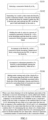
- Fig. 1 illustrates a flowchart of a method for preventing blockchain forks according to an exemplary embodiment of the present disclosure. As shown in Fig. 1 , a backlink method for preventing forking of blockchain is shown, which is proposed based on the following assumptions for blockchain architecture.
- all nodes in the set of active nodes can know the changes in the head of the blockchain and its vicinity, and except for the part of nodes that have just become active, all other good nodes in the set of active nodes can know the changes in the head and its vicinity.
- the tamper-proof property eventually becomes a consensus after a network-wide broadcast by notifying all nodes in the set of active nodes, nodes in the set of active nodes, and users who only pay attention to yet do not participate in the main chain can be notified about the blocks that become tamper-proof blocks, and the nodes and the users also know from each other that the other party has learned the above information.
- a node can leave or join the active nodes freely, the way of joining the active nodes is to know the numerical values of a plurality of blocks at the head of the blockchain, and the way of joining is the focus of the present invention, that is, how to determine that the joining corresponds to the real head of the main chain.
- the node may become familiar with all information and activities near the node and can accurately follow the development of the entire main chain.
- This method is implemented by running a block creation algorithm with the following attributes in a blockchain environment under development.
- the method comprises the following steps: S101, selecting s consecutive blocks B n to B n+s .
- S101 selecting s consecutive blocks B n to B n+s .
- the consecutive blocks are all located on the main chain of the blockchain, more than 50% of the blocks in the s consecutive blocks are created by trusted nodes.
- the proportion of trusted nodes in all nodes create the s consecutive blocks is at least p
- a link is created therebetween, under which B n actually proves B n+s , and each block of B n+1 ⁇ B n+s-1 proves by the traditional blockchain link.
- a node that creates B n is named A n ; S102, the node An that creates the block Bn in the consecutive s blocks generates a key pair for the block B n , wherein the block B n contains a public key PK n in the key pair, and a private key PK' n in the key pair is held individually by the node A n ; S103, holding the node A n active in a process of continuous generation of blocks B n+1 to B n+s in the blockchain.
- the node has always been participating in the construction of the blockchain, and will not become a zombie node, until the block B n+s in the s consecutive blocks becomes a tamper-proof block;
- S 104 in response to the block B n+s in the s consecutive blocks becoming a tamper-proof block, using the private key PK' n to sign on the block B n+s ;
- S105 in response to the subsequent generation of a block B m in the blockchain, placing the signature in the block B m , where m>n+s;
- S106 forming a plurality of backlinks associated with a block size of the blockchain, when the generation node for each of the s consecutive blocks has completed the above steps.
- the access to the block B m actually includes the verification of the link from the block B n to the block B n+s , thereby ensuring that the growth of the blockchain is performed on the main chain, and that each block is proved by an earlier block; S 107, when a new chain claiming to be on the legitimate main chain of the blockchain is received, determined by a newly added node whether the blockchain forks according to the pattern and number of the backlinks.
- the pattern of the so-called backlinks is the specific link form of the backlink realized through the loop of steps S101-S105, and those skilled in the art should be well aware that, according to the existing architecture of the blockchain, it is necessary to first determine whether the new block belongs to a legitimate blockchain before determining whether the new block belongs to the head of the forked chain of the blockchain, and if the new block does not belong to blocks on the legitimate blockchain, it is unnecessary to perform the subsequent determination.
- the so-called legitimate blockchain includes the main chain and the forked chain derived from the same blockchain, and if the new block does not belong to the legitimate blockchain, it is meaningless to distinguish whether it is on the main chain or on the forked chain.
- a blockchain is formed by a data structure in which blocks containing transaction information is sequentially linked from back to front, and each block points to a preceding block, and each block head contains a hash value of its preceding block, so that a chain that can trace back to the first block (the Genesis block) is created.
- the Genesis block contains a hash value of its preceding block, so that a chain that can trace back to the first block (the Genesis block) is created.
- the new block is located on a legal block chain by judging whether the new block finally points to the genesis block of the block chain through the traditional block chain link. In the affirmative case, the new block is located on the legitimate blockchain, or otherwise does not belong to the legitimate blockchain.
- Those skilled in the art may surely make a determination by other reasonable means in compliance with the characteristics of the blockchain architecture in the prior art.
- determining the number of backlinks which comprises: in case there are L backlinks in any s consecutive blocks of the new chain, in response to the condition that G>s/2 and only if L ⁇ s/2, determining the blockchain to be the main chain that does not fork; in response to the condition that 1 ⁇ G ⁇ s/2, and only if L>s-G, determining blockchain to be the main chain that does not fork; in response to the condition that L ⁇ G, determining the blockchain to be a forked chain; and in response to the condition that G ⁇ L ⁇ s-G, determining that it cannot be decided whether forking occurs, and other types of evidence are also required for determination, wherein G represents a minimum number of trusted nodes in the s consecutive blocks.
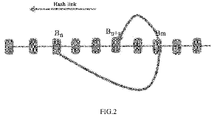
- FIG. 2 A schematic diagram of a single backlink formed according to the above method is shown in Fig. 2 , which, for the sake of clarity, only shows the backlink relationship contained among three nodes with relatively short spacing, which reduces or eliminates the number of keys previously required.
- node A n uses only once the private key PK' n , and a key pair for each of the s blocks B n to B n+s is regenerated.
- the public key is generated based on a hash signature algorithm
- the hash signature algorithm comprises a Lamport algorithm
- the method further comprises placing the signature in a location other than the block B n+s of the blockchain to ensure that the signature can be placed in the block B m in the S105.
- the signature is deposited as a transaction in the blockchain. Because the signature is "transformed" to form the transaction and placed on the blockchain, the existing mechanism cannot ensure that the transaction as a signature will certainly become tamper-proof along with other ordinary transaction data within the same time range. If not guaranteed by a certain delay mechanism, the transaction may be discarded, so it is usually used together with a certain delay mechanism.
- the signature is copied to obtain a copied signature, and both the signature and the copied signature are stored on the blockchain.
- the legitimacy of the signature is checked before execution of the S105, and the signature passing the legitimacy check proceeds to be executed with the S105, while the signature not passing the legitimacy check is considered by the blockchain as an illegitimate signature, and thereby is refused to executed with the S105.
- the blockchain is a public chain.
- a Genesis block of the blockchain is fully trusted, wherein a node of the Genesis block or a node of another block authorized by the Genesis block establishes a first backlink for the Genesis block, and after the first backlink appears, a probability of forking occurring within the s consecutive blocks covered by the first backlink is zero. This is because for any block within B 0 to B s , it is first determined that a new node can be traced back to B 0 by tracing the parent block hash from B s , and then it is uniquely determined that B 0 to B s are on the main chain because the backlink of B 0 uniquely proves that B s is its own legitimate successor block.
- the method comprises: In the first way, the new block is at a position of a closest suspected fork point, all blocks before the new block are in the main chain, and a node creating the new block has not formed and placed a complete backlink in the blockchain, performing a short-term signature on a block or a block sequence that has been tamper-proof in successor blocks of the new block, and placing the short-term signature in one or more storage positions, so that when a number of successor blocks that have backlinks of the new block is less than s, if the short-term signature is not in real-time or expired, the short-term signature is used instead of the backlinks for determination; determining that the new block is on the forked chain in response to the short-term signature being absent or expired; or the second method is to continue to wait until a sufficient number of backlinks are formed
- the specific implementation of the embodiment is to assume that B i is the closest suspected forking point that can be confirmed, that is, all the leading blocks of the block are on the main chain.
- a block creation node A j (i-j ⁇ s) before the block has not placed its backlinks in the blockchain, and the protocol requires that these nodes continue to focus on the growth of the blockchain, perform a short-term signature on a block or a block sequence that has been tamper-proof in its successor blocks, and place the short-term signature in some storage position (e.g., the transaction pool).
- the short-term signature can be used to replace the original backlink for determination. If these short-term signatures do not exist or expire, it can be judged that B i is on the forked chain.
- the determined storage location may be a transaction pool, and the transaction pool is searched for a clue as to whether the block has become a tamper-proof block on the main chain while searching for a backlink.
- the transaction pool stores short-term signature information that has been signed.
- the short-term signature information is confirmation information that identifies a blockchain head location provided by a node that does not provide a backlink, and whether the block is a head on a forked chain is determined by accessing the short-term signature information in the transaction pool.
- whether the block is a block on the main chain of the blockchain can be determined by counting the voting information included in the short-term signature, and if more than 50% of voting information included in the short-term signature determines that the block is a block on the main chain, the block is identified to be a block on the main chain and accepted; otherwise, the new block is determined as a block on the forked chain.
- This setup is to try to find more evidence about whether the new block is a head of the forked chain as a supplement, and a duplicate signer will use one public key to sign two blocks.
- a duplicate signer will use one public key to sign two blocks.
- he while exposing his identity, he also exposes the new block generated on the forked chain, which in turn will reflect the location of the forked chain.
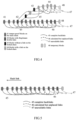
- the blockchain includes tamper-proof blocks 41 on the main chain, blocks 42 with illegitimate double links, blocks 43 without a link on the forked chain, and blocks 44 with a link on the forked chain.
- Most of the tamper-proof blocks 41 have formed a complete backlink 45, however, a part of blocks that are close to the head have only completed the formation of the key pair and the formation of the partial signature, and still have not reached a time node of performing a second signature (i.e., step S105) after computations, thereby forming a calculated but unplaced link 46. Even some blocks that are closer to the head have not formed an available link, i.e., have formed an unavailable link 47. Those blocks that are close to the head, whether on the forked chain or the main chain, are referred to as temporary blocks 48.
- Figs. 5 to 8 illustrate in detail the two situations that occur in Fig. 4 , respectively.
- Fig. 6 describes a case where the method is executed only to step S104, that is, blocks B n to B n+s have been formed, but blocks after B n+s have not been generated, or only several blocks have been generated, and block B m has not been generated.
- the blockchain is in two states at the same time: a state 61, in which the public key material is located in B n ; and state 62, in which the signature/link is still located outside the blockchain, and the signature is not checked yet. Therefore, the short-term signature verification mode in the first manner is executed, in which case the short-term signature may be located in the transaction pool. Of course, the second waiting manner may also be adopted.
- Fig. 7 describes a case where the method is executed only to step S102, that is, blocks B n to B n+s have been formed, but B n+s has not become a tamper-proof block, let alone the generation of block B m .
- the blockchain is in three states at the same time: a state 71, in which the current block B n becomes a tamper-proof block; a state 72, in which the public key in the block B m is unavailable; and a state 73, in which B n+s is generated, but an untamperable block has not yet been formed, so that backlinks have not formed available backlinks.
- the short-term signature verification mode is a state corresponding to a point just previous to that of the state under Fig. 6 . Therefore, it is still necessary to perform the short-term signature verification mode under the first manner, in which case the short-term signature may be located in the transaction pool.
- the second waiting manner can also be adopted.
- Fig. 8 describes a case where the method is executed only to step S101, that is, B n has not been generated.
- blocks B n to B n+s have not become tamper-proof blocks, that is, block B m has not been generated yet.
- the blockchain is in two states at the same time: a state 81, in which the current block B n has not been generated; and a state 82, in which the public key material has not been formed, the key pair has also not been formed, and in this case, there is no available backlink.
- the state under Fig. 8 is a state corresponding to a point earlier than that of the state under Fig. 7 . Therefore, it is still necessary to perform the short-term signature verification mode under the first manner, in which case the short-term signature may be located in the transaction pool.
- the second waiting manner can also be adopted.
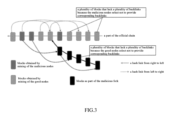
- Fig. 9 shows a backlink pattern formed in a case where a complete backlink 45, a calculated but unplaced link 46 (i.e., where the block B m has not occurred), and an unused link 47 (i.e., where the block B n+s has not occurred) exist simultaneously on a main chain of the blockchain after the formation of the backlink mechanism.
- the public key material exists on each block of a sequence of selected s blocks and on the blocks on the main chain generated thereafter, that is, the creator of each block generates a corresponding key pair.
- a complete backlink portion (indicated by a solid arrow) only exists on block B m (the 6th block in this implementation) formed at the first execution of S105 and on subsequent blocks on the main chain, and a signature (indicated by a dotted arrow in the figure) placed without being checked also exists in the blockchain structure.
- the short-term signature verification mode under the first manner may be performed, in which case the short-term signature may be located in the transaction pool.
- the second waiting manner can also be adopted.
- the method further comprises performing a search on a chain portion other than the main chain to confirm whether there exists a duplicate signer that performs a duplicate signature on the backlinks, wherein the duplicate signer represents a plurality of nodes that perform signature on two blocks to be generated, and the two blocks to be generated are respectively on the main chain and the fork, so that the fork is found according to a block generated by the duplicate signer.
- the suspected forked chain by comparing a main chain before the suspected forked chain with a chain structure formed by the backlink after an intersection of the suspected forked chain, if there is a significant difference between the main chain before the suspected forked chain and the chain structure formed by the backlink of the chain after the intersection of one of the suspected forked chains, the suspected forked chain is determined to be a forked chain, or otherwise determined to be the main chain.
- a main chain portion before the suspected forked chain and a chain structure after an intersection of the suspected forked chain and the main chain are compared, wherein the main chain comprises the backlinks, and if a comparison result shows a significant difference in the number of the backlinks, the suspected forked chain is determined to be a forked chain, or otherwise the suspected forked chain is determined to be a main chain.
- a comparison result shows a significant difference in the number of the backlinks
- the suspected forked chain is determined to be a forked chain, or otherwise the suspected forked chain is determined to be a main chain.
- those skilled in the art may also not have to calculate a specific number of backlinks so as to save computing resources, but make a straightforward comparison of the data scale of the backlinks on the chain structure.
- the private key PK' n in response to using the private key PK' n to sign on the block B n+s , the private key PK' n is deleted to prevent it from being abused.
- block B After the backlink mechanism is embedded in the blockchain, we test one block (defined as block B).
- the content of the test is the execution of the algorithm logic, wherein the algorithm logic includes: (1) all hash pointers are traced back to their respective root nodes, i.e., the Genesis block B 0 .
- the block B is determined not to be a part of the blockchain; and (2) for externally determined constants r and s, it is set that the block B is at the m-th level, then for a block B n+s (n+s ⁇ m-r), the block B n+s is signed by using the private key corresponding to the public key included in the block B n , where the constant r means waiting for at least r blocks, so that the signature can be included in the subsequent block.
- the numerical range of r is agreed in advance by all the included nodes involved in the blockchain according to factors such as the generation speed of the block and the packing speed of the transaction. For example, the determined backlink must be generated within 20 blocks, so that the block generation range when the backlink is determined, and the verification of the backlink is completed, thereby improving the operability of the method.
- the two logics of the algorithm are also verification logics. If at least one of the two verification logics fails, the verifier (i.e., the corresponding node) can determine that block B is not part of the main chain if the protocol follows the assumption that the main chain starts from the Genesis block.
- the generation sequence of blocks is B n , B n+s , to B m , so as to clarify the actual physical meaning of the backlink, that is, the signature of the block B n+s by the private key corresponding to the public key in the block B n reveals the unique true inheritance relationship between the two blocks, and the backlink is actually included in the r blocks after the block B n+s , so as to reveal the assumption related to the timestamp and ensure the authenticity and certainty of the verification. Therefore, according to the generation rule of the backlink, by taking a block that is r blocks ahead of the current block as a boundary, the generated blockchain can be guaranteed not to fork.
- the method is performed on the premise that there should be s independent backlink overlays on every consecutive pair of blocks in the central portion of the blockchain, but the situation at the head and tail of the blockchain has a different appearance due to the insufficient number of forward and backward blocks, in which case a short fork phenomenon can easily occur.
- the backlink mechanism cannot be initiated at all, and of course, when s is small, a long fork cannot be created.
- one method is to continue when determining whether a block is a head on the forked chain, continuously waiting until a sufficient number of backlinks are formed from the block to be determined, and another method comprises searching the transaction pool for a clue as to whether the block is a block on the main chain while searching the blocks for backlinks.
- the information stored in the transaction pool is signed copied information provided by a plurality of nodes that do not provide backlinks with respect to the position of the head of the blockchain, and the copied information is accessed through the transaction pool for determination without storing the copied information in the chain, and the signature does not need to be a long-term signature.
- the number of blocks involved in the related operation in the Genesis blocks also needs to be set according to the requirements of the system application.
- the backlink detection protocol is set in every s consecutive block, having at least L desired signatures, and that the blockchain can be identified as an official chain or the main chain only after forming L backlinks.
- L false positive: the protocol identifies a blockchain that wrongly forks as the official chain or the main chain; (2) false negative: because the attacker attempts to limit the number of signatures to less than L, no L backlinks are formed, thus the protocol refuses to accept the real official chain or main chain.
- the attacker When the attacker should publish the signature yet refrain from doing so, in addition to economic losses, in fact, the attacker also exposes himself to the probability and identity that he may become a dishonest node, so that he may be found before the act of forking, which leads to failure.
- the dishonest node's motivation to do evil is lost, thus the dishonest node is pushed toward the direction of not doing evil on the public chain.
- the defense mechanism is mainly used to prevent long forks, where participants have a longer time to organize defense and impose punishment. If the selected s is large, the time waiting for ensuring whether the s blocks are on the main chain will be longer, and the miner will have to spend more time waiting.
- no additional number of signatures is required (that is, one miner still provides one signature)
- forking is found by searching other chains for duplicate signers (i.e., a plurality of nodes signing two blocks to be generated) of a backlink.
- the composition of the chains after the intersection of the two chains by comparing the composition of the chains after the intersection of the two chains, if there is a great difference in the composition of one of the two chains after the intersection, it can be determined to be a forked chain, or otherwise it can be determined to be an official chain (i.e., the main chain).
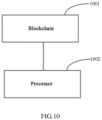
- Fig. 10 shows a schematic structural diagram of a device for preventing forking of blockchain according to an exemplary embodiment of the present disclosure.
- the device for preventing blockchain forks includes a blockchain 1001 and a processor 1002, wherein the blockchain 1001 is capable of ensuring that information published thereon is tamper-proof.
- the blockchain is a chained data structure formed by connecting data in chronological order in a series of blocks, and is also a tamper-proof and unforgeable distributed ledger that cryptographically guarantees data.
- Blockchain uses cryptography such as hash and signature and consensus algorithm to build a trust mechanism, which makes the cost of repudiation, tampering, and fraud huge and ensures data is tamper-proof and unforgeable. It may be realized that the blockchain may be implemented in any manner known in the art or known in the future, such as Bitcoin, Ethereum, etc.
- the processor 1002 may be used for the following.
- a node that creates B n is named A n ; generating, by the node A n that creates the block B n in the s consecutive blocks, a key pair for the block B n , wherein the block B n contains a public key PK n in the key pair, and a private key PK' n in the key pair is held individually by the node A n ; holding the node A n active in a process of continuous generation of blocks B n+1 to B n+s in the blockchain, that is, the node has always been participating in the construction of the blockchain, and will not become a zombie node, until the block B n+s in the s consecutive blocks becomes a tamper-proof block; in response to the block B n+s in the s consecutive blocks becoming a tamper-proof block, using the private key PK' n to sign on the block B n+s ; in response to subsequent generation of a block B m in the blockchain, placing the signature in the block B
- the access to the block B m actually includes the verification of the link from the block B n to the block B n+s , thereby ensuring that the growth of the blockchain is performed on the main chain, and that each block is proved by an earlier block; when a new chain claiming to be on the legitimate main chain of the blockchain is received, determined by a newly added node whether the blockchain forks according to the pattern and number of the backlinks.
- the pattern of the so-called backlinks is the specific link form of the backlink realized through the loop of the steps implemented previously, and those skilled in the art should be well aware that, according to the existing architecture of the blockchain, it is necessary to first determine whether the new block belongs to a legitimate blockchain before determining whether the new block belongs to the head of the forked chain of the blockchain, and if the new block does not belong to blocks on the legitimate blockchain, it is unnecessary to perform the subsequent determination.
- a blockchain is formed by a data structure in which blocks containing transaction information is sequentially linked from back to front, and each block points to a preceding block, and each block head contains a hash value of its preceding block, so that a chain that can trace back to the first block (the Genesis block) is created.
- the Genesis block contains a hash value of its preceding block, so that a chain that can trace back to the first block (the Genesis block) is created.
- this tree structure characteristic whether the new block is located on a legitimate blockchain can be determined by determining whether the new block can eventually point to the Genesis block of the blockchain through the traditional blockchain link, that is, whether the current blockchain structure meets the basic tree structure characteristic.
- determining the number of backlinks which comprises: in case that there are L backlinks in any s consecutive blocks of the new chain, in response to the condition that G>s/2 and only if L ⁇ s/2, determining the blockchain to be a main chain that does not fork; in response to the condition that 1 ⁇ G ⁇ s/2, and only if L>s-G, determining the blockchain be a main chain that does not fork; in response to the condition that L ⁇ G, determining the blockchain to be a forked chain; and in response to the condition that G ⁇ L ⁇ s-G, determining that it cannot be decided whether forking occurs, and other types of evidence are also required for determination, wherein G represents a minimum number of trusted nodes in the s consecutive blocks.
- the node A n uses only once the private key PK' n , and a key pair for each of the s blocks B n to B n+s is regenerated.
- the public key is generated based on a hash signature algorithm
- the hash signature algorithm comprises a Lamport algorithm that can only be signed once using a private key.
- the processor 1002 is further configured to place the signature in a location other than block B n+s of the blockchain to ensure that in response to the subsequent generation of a block B m in the blockchain, the signature can be placed in the block B m .
- the processor 1002 is configured to deposit the signature as a transaction in the blockchain.
- the processor 1002 is configured to copy the signature to obtain a copied signature and store both the signature and the copied signature on the blockchain.
- the processor 1002 is configured to check the legitimacy of the signature before signing the block B n+s using the private key PK' n in response to the block B n+s in the s consecutive blocks becoming a tamper-proof block, wherein the signature passing the legitimacy check proceeds to be executed with placing the signature in the block B m , while the signature not passing the legitimacy check is considered by the blockchain as an illegitimate signature, and thereby is refused to be executed with placing the signature in the block B m .
- the signature process is performed in a trusted execution environment.
- the blockchain is a public chain.
- a Genesis block of the blockchain is fully trusted, wherein a node of the Genesis block or a node of another block authorized by the Genesis block establishes a first backlink for the Genesis block, and after the first backlink appears, a probability of forking occurring within the s consecutive blocks covered by the first backlink is zero. This is because for any block within B 0 to B s , it is first determined that a new node can be traced back to B 0 by tracing the parent block hash from B s , and then it is uniquely determined that B 0 to B s are on the main chain because the backlink of B 0 uniquely proves that B s is its own legitimate successor block.
- the processor 1002 when determination of whether a new block is a head on the forked chain cannot be achieved in a case where a small amount of blocks exist at a head and tail of the blockchain, the processor 1002 is configured to implement: a first method in which the new block is at a position of a closest suspected forking point, all blocks before the new block are in the main chain, and a node creating the new block has not formed and placed a complete backlink in the blockchain, comprising performing a short-term signature on a block or a block sequence that has been tamper-proof in successor blocks of the new block, and placing the short-term signature in one or more storage positions, so that when a number of successor blocks that have backlinks of the new block is less than s, if the short-term signature is not in real-time or expired, the short-term signature is used instead of the backlink for determination; and determining that the new block is on the forked chain in response to the short-term signature being absent or expired; or a second method, comprising continuously waiting until
- a specific implementation of the embodiment is to assume that B i is the closest suspected forking point that can be confirmed, that is, all the leading blocks of the block are on the main chain.
- a block creation node A j (i-j ⁇ s) before the block has not placed its backlinks in the blockchain, and the protocol requires that those nodes continue to focus on the growth of the blockchain, perform a short-term signature on a block or a block sequence that has been tamper-proof in its successor blocks, and place the short-term signature in some storage position (e.g., the transaction pool).
- B i can be determined to be located on the forked chain.
- the determined storage location may be a transaction pool, and the transaction pool is searched for a clue as to whether the block has become a tamper-proof block on the main chain while searching for a backlink.
- the transaction pool stores short-term signature information that has been signed.
- the short-term signature information is confirmation information that identifies the blockchain head location provided by a node that does not provide a backlink, and whether the block is a head on a forked chain is determined by accessing the short-term signature information in the transaction pool.
- whether the block is a block on the main chain of the blockchain can be determined by counting voting information included in the short-term signature, and if more than 50% of voting information included in the short-term signature determines that the block is a block on the main chain, the block is identified to be a block on the main chain and accepted; otherwise, the new block is determined as a block on the forked chain.
- This setup is to try to find more evidence as to whether the new block is a head of the forked chain as a supplement, and a duplicate signer will use a public key to sign two blocks, thus exposing his identity while exposing the new block generated by himself on the forked chain, which in turn will reflect the location of the forked chain.
- the processor 1002 is further configured to perform a search on a chain portion other than the main chain to confirm whether there exists a duplicate signer that performs duplicate signature on the backlink, wherein the duplicate signer represents a plurality of nodes that perform signature on two blocks to be generated, and the two blocks to be generated are respectively on the main chain and the forked chain, so that the forked chain is found according to a block generated by the duplicate signer.
- the processor 1002 is configured to compare, for a suspected forked chain, a main chain portion before the suspected forked chain and a chain structure after an intersection of the suspected forked chain and the main chain, wherein the main chain comprises the backlinks, and if a comparison result shows a significant difference in the number of the backlinks, the suspected forked chain is determined to be a forked chain, otherwise, the suspected forked chain is determined to be a main chain.
- the processor 1002 is configured to delete, in response to using the private key PK' n to sign on the block B n+s , the private key PK' n to prevent it from being abused.
- the method ensures that the previous transaction page in the blockchain restricts the subsequent transaction page. Because the number of blocks in this mechanism is selected to be large enough, the basic assumption of blockchain is satisfied, that is, the number of malicious bookkeepers is small, so the number of link ropes that can be migrated to the forged ledger at the back end is small. Thus, the verification on the number of backlinks in the method cannot be passed, and a fork cannot be successfully forged.
- a machine-readable storage medium on which a computer program is stored, wherein the computer program, when executed by a processor, implements the method for preventing forking of blockchain as described above.
- the technical solution of the method for preventing forking of blockchain has been described in detail above, and is not repeated herein.
- the machine-readable storage medium is a tangible component of a digital processing device. In other embodiments, the machine-readable storage medium is optionally removable from a digital processing device.
- the machine-readable storage medium may include a USB disk, a removable hard disk, a read-only memory (ROM), a random access memory (RAM), a flash memory, a programmable read-only memory (PROM), an erasable programmable read-only memory (EPROM), a solid state memory, a magnetic disk, an optical disk, a cloud computing system or a service, or the like.
- ROM read-only memory
- RAM random access memory
- EPROM erasable programmable read-only memory
- solid state memory a magnetic disk, an optical disk, a cloud computing system or a service, or the like.
Landscapes
- Engineering & Computer Science (AREA)
- Business, Economics & Management (AREA)
- Accounting & Taxation (AREA)
- Theoretical Computer Science (AREA)
- Computer Security & Cryptography (AREA)
- Physics & Mathematics (AREA)
- General Physics & Mathematics (AREA)
- Finance (AREA)
- Strategic Management (AREA)
- General Business, Economics & Management (AREA)
- Computer Networks & Wireless Communication (AREA)
- Signal Processing (AREA)
- Databases & Information Systems (AREA)
- Software Systems (AREA)
- Data Mining & Analysis (AREA)
- General Engineering & Computer Science (AREA)
- Fuzzy Systems (AREA)
- Mathematical Physics (AREA)
- Probability & Statistics with Applications (AREA)
- Computational Linguistics (AREA)
- Storage Device Security (AREA)
- Financial Or Insurance-Related Operations Such As Payment And Settlement (AREA)
Applications Claiming Priority (2)
| Application Number | Priority Date | Filing Date | Title |
|---|---|---|---|
| CN202010276328.1A CN111445247B (zh) | 2020-04-09 | 2020-04-09 | 用于防止区块链分叉的方法和设备 |
| PCT/CN2021/085888 WO2021204181A1 (zh) | 2020-04-09 | 2021-04-08 | 用于防止区块链分叉的方法和设备 |
Publications (2)
| Publication Number | Publication Date |
|---|---|
| EP4134893A1 true EP4134893A1 (de) | 2023-02-15 |
| EP4134893A4 EP4134893A4 (de) | 2024-04-24 |
Family
ID=71651394
Family Applications (1)
| Application Number | Title | Priority Date | Filing Date |
|---|---|---|---|
| EP21784416.6A Pending EP4134893A4 (de) | 2020-04-09 | 2021-04-08 | Verfahren und vorrichtung zur verhinderung des forking einer blockchain |
Country Status (4)
| Country | Link |
|---|---|
| US (1) | US12254468B2 (de) |
| EP (1) | EP4134893A4 (de) |
| CN (1) | CN111445247B (de) |
| WO (1) | WO2021204181A1 (de) |
Families Citing this family (9)
| Publication number | Priority date | Publication date | Assignee | Title |
|---|---|---|---|---|
| CN111445247B (zh) | 2020-04-09 | 2021-05-28 | 堡垒科技有限公司 | 用于防止区块链分叉的方法和设备 |
| CN113535732B (zh) * | 2021-07-23 | 2023-07-25 | 东北大学 | 面向信誉-行为关联双区块链的可验证查询优化方法 |
| US20230125542A1 (en) * | 2021-10-22 | 2023-04-27 | Mastercard International Incorporated | Method and system of initiating simultaneous start of block formation |
| CN114338677B (zh) * | 2021-12-30 | 2022-10-21 | 中山大学 | 一种区块链系统中的区块生成方法和相关装置 |
| GB2620902A (en) | 2022-03-23 | 2024-01-31 | The Blockhouse Tech Limited | Blockchain data processing |
| CN115033644B (zh) * | 2022-06-24 | 2025-07-04 | 北京航天奥祥通风科技股份有限公司 | 创世区块的生成方法及装置 |
| CN117857113B (zh) * | 2023-12-12 | 2025-02-14 | 北京邮电大学 | 基于tee的分布式dag区块安全排序方法 |
| CN120011444B (zh) * | 2024-12-16 | 2025-11-11 | 深圳可信数据科技有限公司 | 一种区块链本地账本数据同步方法及系统 |
| CN119848636B (zh) * | 2025-03-21 | 2025-08-05 | 浙江天正信息科技有限公司 | 一种全生命周期科技数据识别与溯源方法及系统 |
Family Cites Families (17)
| Publication number | Priority date | Publication date | Assignee | Title |
|---|---|---|---|---|
| US10812274B2 (en) * | 2015-05-07 | 2020-10-20 | Blockstream Corporation | Transferring ledger assets between blockchains via pegged sidechains |
| US11831748B1 (en) * | 2017-01-17 | 2023-11-28 | Justin Fisher | Method and system for utilizing the infrastructure of a blockchain to enhance the degree of security and veracity of another blockchain |
| CN107171810B (zh) | 2017-06-27 | 2020-03-13 | 中国联合网络通信集团有限公司 | 区块链的验证方法及装置 |
| US10630463B2 (en) * | 2018-02-26 | 2020-04-21 | Ca, Inc. | Meta block chain |
| CN108647963B (zh) * | 2018-05-02 | 2020-05-12 | 百度在线网络技术(北京)有限公司 | 区块链主链的确定方法、装置、服务器和存储介质 |
| CN108880795A (zh) * | 2018-06-22 | 2018-11-23 | 方亚南 | 一种区块链安全机制及装置 |
| CN109033832B (zh) * | 2018-06-22 | 2021-02-09 | 深圳前海益链网络科技有限公司 | 一种防范对区块链网络进行短暂分叉双花攻击的方法 |
| US11088827B2 (en) * | 2018-07-09 | 2021-08-10 | At&T Intellectual Property I, L.P. | Location-based blockchain |
| CN109191120A (zh) * | 2018-08-03 | 2019-01-11 | 克洛斯比尔有限公司 | 一种防止区块链分叉的方法、设备及可读存储介质 |
| CN109379396B (zh) * | 2018-08-23 | 2021-06-29 | 泰链(厦门)科技有限公司 | 区块链系统中防止出现硬分叉现象的方法、介质、装置和区块链系统 |
| CN109447795B (zh) * | 2018-09-11 | 2021-06-04 | 中国人民解放军国防科技大学 | 一种支持快速达成最终确认性的拜占庭共识方法 |
| CN110061851A (zh) * | 2019-04-28 | 2019-07-26 | 广州大学 | 一种去中心化的跨信任域认证方法及系统 |
| CN110276613B (zh) * | 2019-06-20 | 2020-03-27 | 卓尔智联(武汉)研究院有限公司 | 基于区块链的数据处理装置、方法及计算机可读存储介质 |
| CN110689345B (zh) * | 2019-09-06 | 2022-03-18 | 北京清红微谷技术开发有限责任公司 | 调整区块权重的无许可区块链共识方法、系统、p2p网络 |
| CN110704464B (zh) * | 2019-09-12 | 2022-07-08 | 广州蚁比特区块链科技有限公司 | 一种分叉问题的处理方法及装置 |
| JP7791094B2 (ja) * | 2020-02-19 | 2025-12-23 | エヌチェーン ライセンシング アーゲー | プラットフォームサービスの検証 |
| CN111445247B (zh) * | 2020-04-09 | 2021-05-28 | 堡垒科技有限公司 | 用于防止区块链分叉的方法和设备 |
-
2020
- 2020-04-09 CN CN202010276328.1A patent/CN111445247B/zh active Active
-
2021
- 2021-04-08 US US17/917,013 patent/US12254468B2/en active Active
- 2021-04-08 EP EP21784416.6A patent/EP4134893A4/de active Pending
- 2021-04-08 WO PCT/CN2021/085888 patent/WO2021204181A1/zh not_active Ceased
Also Published As
| Publication number | Publication date |
|---|---|
| US20230153806A1 (en) | 2023-05-18 |
| WO2021204181A1 (zh) | 2021-10-14 |
| CN111445247A (zh) | 2020-07-24 |
| EP4134893A4 (de) | 2024-04-24 |
| CN111445247B (zh) | 2021-05-28 |
| US12254468B2 (en) | 2025-03-18 |
Similar Documents
| Publication | Publication Date | Title |
|---|---|---|
| US12254468B2 (en) | Method and device for preventing forking of blockchain | |
| Deuber et al. | Redactable blockchain in the permissionless setting | |
| Thin et al. | Formal analysis of a proof-of-stake blockchain | |
| US20230120854A1 (en) | Secure blockchain-based consensus | |
| US12487990B2 (en) | Methods and apparatus for a distributed database within a network | |
| CN113268776B (zh) | 基于区块链的模型联合训练方法及装置 | |
| EP3399446B1 (de) | Verfahren und vorrichtung für eine verteilte datenbank innerhalb eines netzwerks | |
| JP2023076628A (ja) | 一対の結合ブロックチェーンを構成するバイナリブロックチェーンに関連するコンピュータ実装システム及び方法 | |
| US20170352219A1 (en) | System and method for securely receiving and counting votes in an election | |
| Luo | Application of blockchain technology in intellectual property protection | |
| CN110611701A (zh) | 一种基于区块链的参数配置和交易处理方法 | |
| CN111444204A (zh) | 一种同步处理方法、装置、设备及介质 | |
| CN113890739B (zh) | 跨区块链的认证方法、装置、电子设备及介质 | |
| JP7600260B2 (ja) | ブロックチェーンネットワークにおいてブロックを伝播する方法及び装置 | |
| CN120915422A (zh) | 基于区块链存证的电子合同签署方法 | |
| Katal et al. | Blockchain consensus algorithms: study and challenges | |
| Nacer et al. | Blockchain as a Complementary Technology for the Internet of Things: A Survey | |
| Keller et al. | Hotpow: Finality from proof-of-work quorums | |
| Lei et al. | Enhancing Editability in Permissionless Blockchain: A Three-Chain Model for Efficiency and Ledger Consistency | |
| US12634338B2 (en) | Secure blockchain-based consensus | |
| Chokkalingam | Comparison of acclaimed consensus algorithm | |
| RU2776826C2 (ru) | Способы и устройство для распределенной базы данных, которая позволяет удалять события | |
| Pan et al. | Plume: Fast Finality Blockchain without Single Failure Point | |
| Oyinloye et al. | Proof of Success Rate: A Past Behaviour-Based Consensus Protocol | |
| Schachenhofer | On the Security of proof-of-stake directed acyclic graph protocols: a simulation-based approach |
Legal Events
| Date | Code | Title | Description |
|---|---|---|---|
| STAA | Information on the status of an ep patent application or granted ep patent |
Free format text: STATUS: THE INTERNATIONAL PUBLICATION HAS BEEN MADE |
|
| PUAI | Public reference made under article 153(3) epc to a published international application that has entered the european phase |
Free format text: ORIGINAL CODE: 0009012 |
|
| STAA | Information on the status of an ep patent application or granted ep patent |
Free format text: STATUS: REQUEST FOR EXAMINATION WAS MADE |
|
| 17P | Request for examination filed |
Effective date: 20221018 |
|
| AK | Designated contracting states |
Kind code of ref document: A1 Designated state(s): AL AT BE BG CH CY CZ DE DK EE ES FI FR GB GR HR HU IE IS IT LI LT LU LV MC MK MT NL NO PL PT RO RS SE SI SK SM TR |
|
| DAV | Request for validation of the european patent (deleted) | ||
| DAX | Request for extension of the european patent (deleted) | ||
| REG | Reference to a national code |
Ref country code: DE Ref legal event code: R079 Free format text: PREVIOUS MAIN CLASS: G06Q0020380000 Ipc: H04L0009000000 |
|
| A4 | Supplementary search report drawn up and despatched |
Effective date: 20240321 |
|
| RIC1 | Information provided on ipc code assigned before grant |
Ipc: G06Q 20/36 20120101ALI20240315BHEP Ipc: G06F 16/901 20190101ALI20240315BHEP Ipc: G06Q 20/38 20120101ALI20240315BHEP Ipc: H04L 9/32 20060101ALI20240315BHEP Ipc: H04L 9/00 20060101AFI20240315BHEP |