EP4134941B1 - Circuit de registre à décalage et son procédé d'attaque, circuit d'attaque de grille et appareil d'affichage - Google Patents
Circuit de registre à décalage et son procédé d'attaque, circuit d'attaque de grille et appareil d'affichage Download PDFInfo
- Publication number
- EP4134941B1 EP4134941B1 EP20900710.3A EP20900710A EP4134941B1 EP 4134941 B1 EP4134941 B1 EP 4134941B1 EP 20900710 A EP20900710 A EP 20900710A EP 4134941 B1 EP4134941 B1 EP 4134941B1
- Authority
- EP
- European Patent Office
- Prior art keywords
- terminal
- transistor
- voltage
- circuit
- pull
- Prior art date
- Legal status (The legal status is an assumption and is not a legal conclusion. Google has not performed a legal analysis and makes no representation as to the accuracy of the status listed.)
- Active
Links
Images







Classifications
-
- G—PHYSICS
- G09—EDUCATION; CRYPTOGRAPHY; DISPLAY; ADVERTISING; SEALS
- G09G—ARRANGEMENTS OR CIRCUITS FOR CONTROL OF INDICATING DEVICES USING STATIC MEANS TO PRESENT VARIABLE INFORMATION
- G09G3/00—Control arrangements or circuits, of interest only in connection with visual indicators other than cathode-ray tubes
- G09G3/20—Control arrangements or circuits, of interest only in connection with visual indicators other than cathode-ray tubes for presentation of an assembly of a number of characters, e.g. a page, by composing the assembly by combination of individual elements arranged in a matrix no fixed position being assigned to or needed to be assigned to the individual characters or partial characters
-
- G—PHYSICS
- G09—EDUCATION; CRYPTOGRAPHY; DISPLAY; ADVERTISING; SEALS
- G09G—ARRANGEMENTS OR CIRCUITS FOR CONTROL OF INDICATING DEVICES USING STATIC MEANS TO PRESENT VARIABLE INFORMATION
- G09G3/00—Control arrangements or circuits, of interest only in connection with visual indicators other than cathode-ray tubes
- G09G3/20—Control arrangements or circuits, of interest only in connection with visual indicators other than cathode-ray tubes for presentation of an assembly of a number of characters, e.g. a page, by composing the assembly by combination of individual elements arranged in a matrix no fixed position being assigned to or needed to be assigned to the individual characters or partial characters
- G09G3/22—Control arrangements or circuits, of interest only in connection with visual indicators other than cathode-ray tubes for presentation of an assembly of a number of characters, e.g. a page, by composing the assembly by combination of individual elements arranged in a matrix no fixed position being assigned to or needed to be assigned to the individual characters or partial characters using controlled light sources
- G09G3/30—Control arrangements or circuits, of interest only in connection with visual indicators other than cathode-ray tubes for presentation of an assembly of a number of characters, e.g. a page, by composing the assembly by combination of individual elements arranged in a matrix no fixed position being assigned to or needed to be assigned to the individual characters or partial characters using controlled light sources using electroluminescent panels
- G09G3/32—Control arrangements or circuits, of interest only in connection with visual indicators other than cathode-ray tubes for presentation of an assembly of a number of characters, e.g. a page, by composing the assembly by combination of individual elements arranged in a matrix no fixed position being assigned to or needed to be assigned to the individual characters or partial characters using controlled light sources using electroluminescent panels semiconductive, e.g. using light-emitting diodes [LED]
- G09G3/3208—Control arrangements or circuits, of interest only in connection with visual indicators other than cathode-ray tubes for presentation of an assembly of a number of characters, e.g. a page, by composing the assembly by combination of individual elements arranged in a matrix no fixed position being assigned to or needed to be assigned to the individual characters or partial characters using controlled light sources using electroluminescent panels semiconductive, e.g. using light-emitting diodes [LED] organic, e.g. using organic light-emitting diodes [OLED]
- G09G3/3266—Details of drivers for scan electrodes
-
- G—PHYSICS
- G09—EDUCATION; CRYPTOGRAPHY; DISPLAY; ADVERTISING; SEALS
- G09G—ARRANGEMENTS OR CIRCUITS FOR CONTROL OF INDICATING DEVICES USING STATIC MEANS TO PRESENT VARIABLE INFORMATION
- G09G3/00—Control arrangements or circuits, of interest only in connection with visual indicators other than cathode-ray tubes
- G09G3/20—Control arrangements or circuits, of interest only in connection with visual indicators other than cathode-ray tubes for presentation of an assembly of a number of characters, e.g. a page, by composing the assembly by combination of individual elements arranged in a matrix no fixed position being assigned to or needed to be assigned to the individual characters or partial characters
- G09G3/34—Control arrangements or circuits, of interest only in connection with visual indicators other than cathode-ray tubes for presentation of an assembly of a number of characters, e.g. a page, by composing the assembly by combination of individual elements arranged in a matrix no fixed position being assigned to or needed to be assigned to the individual characters or partial characters by control of light from an independent source
- G09G3/36—Control arrangements or circuits, of interest only in connection with visual indicators other than cathode-ray tubes for presentation of an assembly of a number of characters, e.g. a page, by composing the assembly by combination of individual elements arranged in a matrix no fixed position being assigned to or needed to be assigned to the individual characters or partial characters by control of light from an independent source using liquid crystals
- G09G3/3611—Control of matrices with row and column drivers
- G09G3/3674—Details of drivers for scan electrodes
- G09G3/3677—Details of drivers for scan electrodes suitable for active matrices only
-
- G—PHYSICS
- G11—INFORMATION STORAGE
- G11C—STATIC STORES
- G11C19/00—Digital stores in which the information is moved stepwise, e.g. shift registers
- G11C19/28—Digital stores in which the information is moved stepwise, e.g. shift registers using semiconductor elements
-
- G—PHYSICS
- G09—EDUCATION; CRYPTOGRAPHY; DISPLAY; ADVERTISING; SEALS
- G09G—ARRANGEMENTS OR CIRCUITS FOR CONTROL OF INDICATING DEVICES USING STATIC MEANS TO PRESENT VARIABLE INFORMATION
- G09G2310/00—Command of the display device
- G09G2310/02—Addressing, scanning or driving the display screen or processing steps related thereto
- G09G2310/0264—Details of driving circuits
- G09G2310/0286—Details of a shift registers arranged for use in a driving circuit
-
- G—PHYSICS
- G09—EDUCATION; CRYPTOGRAPHY; DISPLAY; ADVERTISING; SEALS
- G09G—ARRANGEMENTS OR CIRCUITS FOR CONTROL OF INDICATING DEVICES USING STATIC MEANS TO PRESENT VARIABLE INFORMATION
- G09G2310/00—Command of the display device
- G09G2310/06—Details of flat display driving waveforms
- G09G2310/061—Details of flat display driving waveforms for resetting or blanking
-
- G—PHYSICS
- G09—EDUCATION; CRYPTOGRAPHY; DISPLAY; ADVERTISING; SEALS
- G09G—ARRANGEMENTS OR CIRCUITS FOR CONTROL OF INDICATING DEVICES USING STATIC MEANS TO PRESENT VARIABLE INFORMATION
- G09G2310/00—Command of the display device
- G09G2310/08—Details of timing specific for flat panels, other than clock recovery
Definitions
- the present disclosure relates to the field of display technologies, and in particular, to a display apparatus, comprising a gate driver circuit, the gate driver circuit including a plurality of shift register circuits, and a method of driving each shift register circuit of the display apparatus.
- GOA Gate Driver on Array
- a shift register unit which includes an input circuit, a first output circuit and a first output signal adjustment circuit.
- the input circuit is configured for receiving an input signal from an input terminal and controlling an electrical signal of a first node based on the input signal.
- the first output circuit is configured for outputting a first output signal at a first output terminal of the shift register unit based on a first clock signal under control of the electrical signal of the first node.
- the first output signal adjustment circuit is configured for providing a first reference signal to the first output terminal under control of the second clock signal so as to decrease an amplitude of the first output signal.
- US 2021/201805 A1 provides an electronic panel, display device and driving method.
- An electronic panel, a display device and a driving method are disclosed.
- each row of subpixel units is divided into a plurality of subpixel unit groups, and each subpixel unit group includes a first subpixel unit and a second subpixel unit.
- the first subpixel unit includes a first light emitter unit, a first pixel driving circuit for driving the first light emitter unit to emit light, and a first sensing circuit for sensing the first pixel driving circuit;
- the second subpixel unit includes a second light emitter unit, a second pixel driving circuit for driving the second light emitter unit to emit light, and a second sensing circuit for sensing the second pixel driving circuit.
- US 2018/190180 A1 provides a shift register unit and driving methods thereof, gate driving circuits and display devices.
- Embodiments of the present disclosure provide a shift register unit, a driving method thereof, a gate driving circuit, and a display device.
- the shift register unit comprises an input circuit, a reset circuit, a plurality of output circuits, a plurality of pull-down circuits and a plurality of pull-down control circuits. During a first time period, all of signals output by the plurality of output circuits are valid.
- the shift register unit may enable transistors in a pixel circuit to switch between ON and OFF states, so as to extend lifetime of the transistors.
- a shift register according to the present disclosure may specifically include multi-level shift register units, a first connecting TFT set and a second connecting TFT set.
- control signal input ends of odd-number-level shift register units are inputted with a first control signal and control signal input ends of even-number-level shift register units are inputted with a second control signal.
- Connecting TFTs in the first connecting TFT set and the second connecting TFT set are configured to achieve an electrical connection between gate electrode signal output ends of odd-number-level shift register units and even-number-level shift register units in the shift register under a control of a control signal transmitted by a timing controller.
- the present disclosure provides a display apparatus which is defined by claim 1.
- the present disclosure provides a method of driving each shift register circuit (RS) of the display apparatus which is defined by claim 13.
- first and second are used for descriptive purposes only, and are not to be construed as indicating or implying the relative importance or implicitly indicating the number of indicated technical features.
- features defined as “first” and “second” may explicitly or implicitly include one or more of the features.
- the term “a/the plurality of” means two or more unless otherwise specified.
- Coupled and “connected” along with their derivatives.
- some embodiments may be described using the term “connected” to indicate that two or more elements are in direct physical contact or electrical contact with each other.
- some embodiments may be described using the term “coupled” to indicate that two or more components are in direct physical or electrical contact.
- the term “coupled” or “communicatively coupled”, however, may also mean that two or more components are not in direct contact with each other, but yet still co-operate or interact with each other.
- the embodiments disclosed herein are not necessarily limited to the content herein.
- At least one of A, B, and C has a same meaning as "at least one of A, B, or C", and both include the following combinations of A, B, and C: only A, only B, only C, a combination of A and B, a combination of A and C, a combination of B and C, and a combination of A, B, and C.
- the term “if” is, optionally, construed to mean “when” or “upon” or “in response to determining” or “in response to detecting”, depending on the context.
- the phrases “if it is determined that " or “if [a stated condition or event] is detected” is, optionally, construed to mean “ upon determining that " or “in response to determining that " or “upon detecting [the stated condition or event]” or “in response to detecting [the stated condition or event]", depending on the context.
- Embodiments of the present disclosure provide a display apparatus.
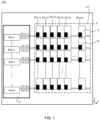
- the display apparatus includes a display panel 100 as shown in FIG. 1 .
- the display panel 100 has an active area (AA) and a peripheral area S at least located on one side of the active area AA.
- the display panel 100 includes a plurality of sub-pixels P disposed in the AA.
- the plurality of sub-pixels P at least include sub-pixels of a first color, sub-pixels of a second color and sub-pixels of a third color, and the first color, the second color and the third color are three primary colors such as red, green and blue.
- FIG. 1 is an illustration by taking an example in which the plurality of sub-pixels P are arranged in an array of n rows and m columns, but embodiments of the present disclosure are not limited thereto, and the plurality of sub-pixels P may be arranged in other manners.
- Sub-pixels P arranged in a row in a horizontal direction X are refered to as sub-pixels in a same row.
- Sub-pixels P arranged in a column in a vertical direction Y are refered to as sub-pixels in a same column.
- a plurality of first scan signal lines GL1(1) to GL1(n), a plurality of second scan signal lines GL2(1) to GL2(n) and a plurality of data signal lines DL(1) to DL(m) are provided in the display panel 100.
- the first scan signal lines GL1 and the second scan signal lines GL2 extend in the horizontal direction X
- the data signal lines DL extend in the vertical direction Y.
- a gate driver circuit 10 is provided in the peripheral area S of the display panel 100.
- the gate driver circuit 10 includes a plurality of shift register circuits RS(1) to RS(n).
- a shift register circuit RS is coupled to a first scan signal line GL1 and a second scan signal line GL2.
- a pixel driving circuit 20 is provided in a sub-pixel P.
- the pixel driving circuit 20 is coupled to a light-emitting device L, and the pixel driving circuit 20 is used for driving the light-emitting device L to emit light.
- the light-emitting device L includes an OLED (Organic Light-Emitting Diode).
- the pixel driving circuit 20 includes a storage capacitor Cst, a parasitic capacitor Ca, a first switching transistor T1, a second switching transistor T2 and a driving transistor DT.
- a control electrode of the first switching transistor T1 is coupled to a first scan signal terminal G1, and a first electrode of the first switching transistor T1 is coupled to a data signal terminal DATA.
- a control electrode of the second switching transistor T2 is coupled to a second scan signal terminal G2, and a first electrode of the second switching transistor T2 is coupled to a reference signal terminal VREF.
- a control electrode g of the driving transistor DT is coupled to a second electrode of the first switching transistor T1, and a first electrode of the driving transistor DT is coupled to a first power voltage signal terminal ELVDD.
- a second electrode s of the driving transistor DT is coupled to a second electrode of the second switching transistor T2.
- a first terminal of the storage capacitor Cst is coupled to the control electrode of the driving transistor DT, and a second terminal of the storage capacitor Cst is coupled to the second electrode s of the driving transistor DT.
- a first terminal of the parasitic capacitor Ca is coupled to the control electrode of the first switching transistor T1
- a second terminal of the parasitic capacitor Ca is coupled to the second electrode of the first switching transistor T1. That is, the parasitic capacitor Ca is a parasitic capacitor formed between the control electrode and the second electrode of the first switching transistor T1.
- a first electrode of the light-emitting device L is coupled to the second electrode s of the driving transistor DT, and a second electrode of the light-emitting device L is coupled to a second power voltage signal terminal ELVSS.
- the first scan signal line GL1 provides a first scan signal for the first scan signal terminal G1
- the second scan signal line GL2 provides a second scan signal for the second scan signal terminal G2
- a data signal line DL provides a data signal for the data signal terminal DATA.
- the control electrode of the first switching transistor T1 is coupled to the first scan signal terminal G1
- the second electrode of the first switching transistor T1 is coupled to the control electrode g of the driving transistor DT and the first terminal of the storage capacitor Cst
- the parasitic capacitor Ca is coupled to the storage capacitor Cst
- the parasitic capacitor Ca transmits a signal received at the first scan signal terminal G1 to the control electrode g of the driving transistor DT and the first terminal of the storage capacitor Cst.
- a change gradient of a potential the signal received at the first scan signal terminal G1 is too large, for example, a time for the potential of the signal received at the first scan signal terminal G1 to change from a high level to a low level is too short.
- a potential of the control electrode g of the driving transistor DT will change abruptly, causing a potential difference between the control electrode g (i.e., gate) and the second electrode s (i.e., source) of the driving transistor DT to decrease and thus affecting a brightness uniformity of the display apparatus.
- the embodiments of the present disclosure provide a shift register circuit RS.
- the shift register circuit includes a first input sub-circuit 101, an output sub-circuit 102 and an output control sub-circuit 103.
- the first input sub-circuit 101 is coupled to a first signal input terminal IN1, a second signal input terminal IN2 and a pull-up node PU.
- the output sub-circuit 102 is at least coupled to the pull-up node PU, a first clock signal terminal CLKA, an output signal transmission terminal OT, a shift signal output terminal CR and a first scan signal output terminal OUT1.
- the output control sub-circuit 103 is coupled to a second clock signal terminal CLKB, a chamfering signal terminal VA and the first scan signal output terminal OUT1.
- the first input sub-circuit 101 is configured to transmit a signal received at the second signal input terminal IN2 to the pull-up node PU under the control of a signal received at the first signal input terminal IN1.
- the signal received at the second signal input terminal IN2 may be a fixed-level signal, for example, a direct current (DC) high-level signal.
- the second signal input terminal IN2 may serve as a fixed voltage terminal.
- the fixed voltage terminal transmits the DC high-level signal.
- the signal received at the second signal input terminal IN2 is the same as the signal received at the first signal input terminal IN1, that is, the second signal input terminal IN2 and the first signal input terminal IN1 are the same signal terminal.
- the output sub-circuit 102 is configured to transmit a signal received at the first clock signal terminal CLKA to the shift signal output terminal CR and to transmit a signal received at the output signal transmission terminal OT to the first scan signal output terminal OUT1 in response to a voltage of the pull-up node PU, so as to scan a gate line coupled to the first scan signal output terminal OUT1.
- the signal received at the output signal transmission terminal OT may be a clock signal.
- the signal received at the output signal transmission terminal OT is the same as the signal received at the first clock signal terminal CLKA.
- the signal received at the output signal transmission terminal OT may be a fixed-level signal, for example, a DC level signal.
- the output control sub-circuit 103 is configured to transmit a signal received at the chamfering signal terminal VA to the first scan signal output terminal OUT1 in response to a signal received at the second clock signal terminal CLKB in a predetermined time before the first scan signal output terminal OUT1 stops outputting a signal from the output signal transmission terminal OT.
- the chamfering signal terminal VA is configured to transmit a signal with a voltage amplitude within a variation range of a voltage amplitude of a signal of the first scan signal output terminal OUT1.
- the output control sub-circuit 103 transmits the signal received at the chamfering signal terminal VA to the first scan signal output terminal OUT1. After this period of time, signal output from the first scan signal output terminal OUT1 is an invalid signal. This period of time is the predetermined time.
- a duration of the predetermined time before the first scan signal output terminal OUT1 stops outputting the signal from the output signal transmission terminal OT is a duration in which the output control sub-circuit 103 transmits the signal received at the chamfering signal terminal VA to the first scan signal output terminal OUT1.
- the signal received at the chamfering signal terminal VA may be a fixed-level signal, for example, a DC low-level signal.
- the chamfering signal terminal VA may serve as a fixed voltage terminal, and the voltage amplitude of the fixed voltage terminal is within the variation range of the voltage amplitude of the signal of the first scan signal output terminal OUT1.
- the signal received at the chamfering signal terminal VA may be a signal with a variable voltage amplitude.
- the chamfering signal terminal VA may serve as a variable voltage terminal, and a variation range of the voltage amplitude of the variable voltage terminal is within the variation range of the voltage amplitude of the signal of the first scan signal output terminal OUT1.
- the output sub-circuit 102 transmits the signal received at the output signal transmission terminal OT to the first scan signal output terminal OUT1, so that a voltage of the signal output from the first scan signal output terminal OUT1 is equal to a voltage of the signal received at the output signal transmission terminal OT.
- the output control sub-circuit 103 transmits the signal received at the chamfering signal terminal VA to the first scan signal output terminal OUT1.
- the voltage amplitude of the signal received at the chamfering signal terminal VA is within the variation range of the voltage amplitude of the signal of the first scan signal output terminal OUT1.
- the voltage amplitude of the signal received at the chamfering signal terminal VA is less than the voltage amplitude of the signal output from the first scan signal output terminal OUT1. Therefore, a potential of the signal output from the first scan signal output terminal OUT1 is affected by the signal received at the chamfering signal terminal VA and decreases, so that during a process in which a potential of the signal output from the first scan signal output terminal OUT1 changes, for example, from a high-level signal to a low-level signal, a change gradient is reduced, and a change time increases. In this way, it may be possible to avoid a problem that an afterimage appears on the display apparatus due to flickering of the light-emitting device, and thus improve a display effect.
- the duration of the predetermined time before the first scan signal output terminal OUT1 stops outputting the signal from the output signal transmission terminal OT and a potential of the signal received at the chamfering signal terminal VA may be set according to actual situations, so as to adjust a curvature, voltage and amplitude of a chamfered portion of a waveform of the signal output from the first scan signal output terminal OUT1, which is not limited herein.
- the shift register circuit RS provided in the embodiments of the present disclosure includes the first input sub-circuit 101, the output sub-circuit 102 and the output control sub-circuit 103.
- the first input sub-circuit 101 transmits the signal received at the second signal input terminal IN2 to the pull-up node PU under the control of the signal received at the first signal input terminal IN1.
- the output sub-circuit 102 transmits the signal received at the first clock signal terminal CLKA to the shift signal output terminal CR, and transmits the signal received at the output signal transmission terminal OT to the first scan signal output terminal OUT1 in response to the voltage of the pull-up node PU.
- the output control sub-circuit 103 transmits the signal received at the chamfering signal terminal VA to the first scan signal output terminal OUT1 in response to the signal received at the second clock signal terminal CLKB in the predetermined time before the first scan signal output terminal OUT1 stops outputting the signal from the output signal transmission terminal OT.
- the chamfering signal terminal VA is configured to transmit the signal with the voltage amplitude within the variation range of the voltage amplitude of the signal of the first scan signal output terminal OUT1.
- the potential of the signal output from the first scan signal output terminal OUT1 is affected by the signal received at the chamfering signal terminal VA and decreases, so that during the process in which the potential of the signal output from the first scan signal output terminal OUT1 changes, for example, from the high-level signal to the low-level signal, the change gradient is reduced, and the change time increases.
- a resistance and a parasitic capacitance of the first scan signal line G1 also reduce the potential of the signal output from the first scan signal output terminal OUT1, so that a chamfering effect (e.g., an arc-shaped chamfering effect) appears on the waveform of the signal output from the first scan signal output terminal OUT1 in the predetermined time before the first scan signal output terminal OUT1 stops outputting the signal from the output signal transmission terminal OT, and the change gradient of the potential of the signal output from the first scan signal output terminal OUT1 is reduced. In this way, it may be possible to avoid the problem that the afterimage appears on the display apparatus due to the flickering of the light-emitting device, and thus improve the display effect.
- a chamfering effect e.g., an arc-shaped chamfering effect
- the output control sub-circuit 103 includes a first transistor M1.
- a control electrode of the first transistor M1 is coupled to the second clock signal terminal CLKB, a first electrode of the first transistor M1 is coupled to the chamfering signal terminal VA, and a second electrode of the first transistor M1 is coupled to the first scan signal output terminal OUT1.
- the first input sub-circuit 101 includes a second transistor M2.
- a control electrode of the second transistor M2 is coupled to the first signal input terminal IN1, a first electrode of the second transistor M2 is coupled to the second signal input terminal IN2, and a second electrode of the second transistor M2 is coupled to the pull-up node PU.
- the output sub-circuit 102 includes a third transistor M3 and a fourth transistor M4.
- a control electrode of the third transistor M3 is coupled to the pull-up node PU or the shift signal output terminal CR, a first electrode of the third transistor M3 is coupled to the output signal transmission terminal OT, and a second electrode of the third transistor M3 is coupled to the first scan signal output terminal OUT1.
- a width-to-length ratio of a channel of the first transistor M1 is less than a width-to-length ratio of a channel of the third transistor M3.
- a control electrode of the fourth transistor M4 is coupled to the pull-up node PU, a first electrode of the fourth transistor M4 is coupled to the first clock signal terminal CLKA, and a second electrode of the fourth transistor M4 is coupled to the shift signal output terminal CR.
- the output signal transmission terminal OT is a third clock signal terminal CLKC.
- the output signal transmission terminal OT is a first voltage terminal V1.
- the signal received at the output signal transmission terminal OT is a clock signal; in a case where the output signal transmission terminal OT is the first voltage terminal V1, the signal received at the output signal transmission terminal OT is a fixed-level signal, for example, a DC high-level signal.
- the output sub-circuit 102 further includes a first capacitor C1. As shown in FIG. 5 , a first terminal of the first capacitor C1 is coupled to the pull-up node PU and the control electrode of the fourth transistor M4, and a second terminal of the first capacitor C1 is coupled to the shift signal output terminal CR and the second electrode of the fourth transistor M4.
- the control electrode of the third transistor M3 is coupled to the shift signal output terminal CR
- the first terminal of the first capacitor C1 is coupled to the pull-up node PU and the control electrode of the fourth transistor M4
- the second terminal of the first capacitor C1 is coupled to the shift signal output terminal CR, the control electrode of the third transistor M3 and the second electrode of the fourth transistor M4.
- the shift register circuit RS further includes a resistor R and a fourth capacitor C4.
- a first terminal of the resistor R is coupled to the first scan signal output terminal OUT1, and a second terminal of the resistor R is grounded.
- a first terminal of the fourth capacitor C4 is coupled to the first scan signal output terminal OUT1, and a second terminal of the fourth capacitor C4 is grounded.
- the potential of the signal output from the first scan signal output terminal OUT1 is affected by the resistor R and the fourth capacitor C4 and decreases, so that the chamfering effect appears on the waveform of the signal output from the first scan signal output terminal OUT1.
- the output sub-circuit 102 is further coupled to a fourth clock signal terminal CLKD and a second scan signal output terminal OUT2.
- the output sub-circuit 102 is configured to transmit a signal received at the fourth clock signal terminal CLKD to the second scan signal output terminal OUT2 in response to the voltage of the pull-up node PU.
- the output sub-circuit 102 further includes a fifth transistor M5 and a second capacitor C2.
- a control electrode of the fifth transistor M5 is coupled to the pull-up node, a first electrode of the fifth transistor M5 is coupled to the fourth clock signal terminal CLKD, and a second electrode of the fifth transistor M5 is coupled to the second scan signal output terminal OUT2.
- a first terminal of the second capacitor C2 is coupled to the pull-up PU node and the control electrode of the fifth transistor M5, and a second terminal of the second capacitor C2 is coupled to the second scan signal output terminal OUT2 and the second electrode of the fifth transistor M5.
- the output sub-circuit 102 includes the first capacitor C1
- the control electrode of the third transistor M3 is coupled to the pull-up node PU
- the first terminal of the first capacitor C1 is coupled to the pull-up node PU and the control electrode of the third transistor M3
- the second terminal of the first capacitor C1 is coupled to the first scan signal output terminal OUT1 and the second electrode of the third transistor M3.
- the first electrode of the second transistor M2 is coupled to the first signal input terminal IN1.
- the shift register circuit RS further includes a first pull-down control sub-circuit 104.
- the first pull-down control sub-circuit 104 is coupled to the pull-up node PU, a first pull-down node PD1, a second voltage terminal V2 and a third voltage terminal V3.
- the first pull-down control sub-circuit 104 is configured to transmit a voltage of the second voltage terminal V2 to the first pull-down node PD1 under the control of the voltage of the pull-up node PU, and to transmit a voltage of the third voltage terminal V3 to the first pull-down node PD1 under the control of the voltage of the third voltage terminal V3.
- the third voltage terminal V3 is configured to transmit a fixed-level signal, such as a DC high-level voltage, during an operation period of the first pull-down control sub-circuit 104.
- the second voltage terminal V2 is configured to transmit a fixed-level signal, such as a DC low-level voltage.
- the first voltage terminal V1 and the second voltage terminal V2 are the same voltage terminal.
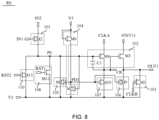
- the output control sub-circuit 103 includes the first transistor M1, as shown in FIGS. 8 and 9 , the first electrode of the first transistor M1 is coupled to the second voltage terminal V2.
- the first pull-down control sub-circuit 104 includes a sixth transistor M6 and a seventh transistor M7.
- a control electrode and a first electrode of the sixth electrode M6 are coupled to the third voltage terminal V3, and a second electrode of the sixth transistor M6 is coupled to the first pull-down node PD1.
- a control electrode of the seventh transistor M7 is coupled to the pull-up node PU, a first electrode of the seventh transistor is coupled to the second voltage terminal V2, and a second electrode of the seventh transistor M7 is coupled to the first pull-down node PD1.
- the shift register circuit RS further includes a first noise reduction sub-circuit 105.
- the first noise reduction sub-circuit 105 is coupled to the pull-up node PU, the first pull-down node PD1 and the second voltage terminal V2.
- the first noise reduction sub-circuit 105 is configured to transmit the voltage of the second voltage terminal V2 to the pull-up node PU under the control of a voltage of the first pull-down node PD1, so as to denoise the pull-up node PU in a stage when the shift register circuit RS does not output a scan signal.
- the first noise reduction sub-circuit 105 includes an eighth transistor M8.
- a control electrode of the eighth transistor M8 is coupled to the first pull-down node PD1, a first electrode of the eighth transistor M8 is coupled to the second voltage terminal V2, and a second electrode of the eighth transistor M8 is coupled to the pull-up node PU.
- the shift register circuit RS further includes a second noise reduction sub-circuit 106.
- the second noise reduction sub-circuit 106 is coupled to the first scan signal output terminal OUT1, the first pull-down node PD1 and a fourth voltage terminal V4.
- the second noise reduction sub-circuit 106 is configured to transmit a voltage of the fourth voltage terminal V4 to the first scan signal output terminal OUT1 under the control of the voltage of the first pull-down node PD1, so as to denoise the first scan signal output terminal OUT1 in the stage when the shift register circuit RS does not output the scan signal.
- the fourth voltage terminal V4 is configured to transmit a DC low-level signal.
- the fourth voltage terminal V4 and the second voltage terminal V2 may be the same voltage terminal, or may be different voltage terminals.
- the second noise reduction sub-circuit 106 includes a ninth transistor M9.
- a control electrode of the ninth transistor M9 is coupled to the first pull-down node PD1, a first electrode of the ninth transistor M9 is coupled to the fourth voltage terminal V4, and a second electrode of the ninth transistor M9 is coupled to the first scan signal output terminal OUT1.
- the first electrode of the ninth transistor M9 is coupled to the second voltage terminal V2.
- the output signal transmission terminal OT is the first voltage terminal V1
- the first voltage terminal V1 and the second voltage terminal V2 are the same voltage terminal
- the output control sub-circuit 103 includes the first transistor M1, as shown in FIG. 10
- the first electrode of the first transistor M1 is coupled to the fourth voltage terminal V4.
- the shift register circuit further includes a third noise reduction sub-circuit 107.
- the third noise reduction sub-circuit 107 is coupled to the shift signal output terminal CR, the first pull-down node PD1 and the second voltage terminal V2.
- the third noise reduction sub-circuit 107 is configured to transmit the voltage at the second voltage terminal V2 to the shift signal output terminal CR under the control of the voltage of the first pull-down node PD1, so as to denoise the shift signal output terminal CR in the stage when the shift register circuit RS does not output the scan signal.
- the third noise reduction sub-circuit 107 includes a tenth transistor M10.
- a control electrode of the tenth transistor M10 is coupled to the first pull-down node PD1, a first electrode of the tenth transistor M10 is coupled to the second voltage terminal V2, and a second electrode of the tenth transistor M10 is coupled to the shift signal output terminal CR.
- the shift register circuit RS further includes a first reset sub-circuit 108.
- the first reset sub-circuit 108 is coupled to the pull-up node PU, a first reset signal terminal RST1 and the second voltage terminal V2.
- the first reset sub-circuit 108 is configured to transmit the voltage of the second voltage terminal V2 to the pull-up node PU under the control of a signal received at the first reset signal terminal RST1.
- the first reset sub-circuit 108 includes an eleventh transistor M11.
- a control electrode of the eleventh transistor M11 is coupled to the first reset signal terminal RST1, a first electrode of the eleventh transistor M11 is coupled to the second voltage terminal V2, and a second electrode of the eleventh transistor M11 is coupled to the pull-up node PU.
- the shift register circuit RS further includes a fourth noise reduction sub-circuit 109.
- the fourth noise reduction sub-circuit 109 is coupled to the second scan signal output terminal OUT2, the first pull-down node PD1 and the fourth voltage terminal V4.
- the fourth noise reduction sub-circuit 109 is configured to transmit the voltage of the fourth voltage terminal V4 to the second scan signal output terminal OUT2 under the control of the voltage of the first pull-down node PD1, so as to denoise the second scan signal output terminal OUT2 in the stage when the shift register circuit RS does not output the scan signal.
- the fourth noise reduction sub-circuit 109 includes a twelfth transistor M12.
- a control electrode of the twelfth transistor M12 is coupled to the first pull-down node PD1, a first electrode of the twelfth transistor M12 is coupled to the fourth voltage terminal V4, and a second electrode of the twelfth transistor M12 is coupled to the second scan signal output terminal OUT2.
- the shift register circuit RS further includes a second rest sub-circuit 110.
- the second reset sub-circuit 110 is coupled to a second reset signal terminal RST2, the pull-up node PU and the second voltage terminal V2.
- the second reset sub-circuit 110 is configured to transmit the voltage of the second voltage terminal V2 to the pull-up node PU under the control of a signal received at the second reset signal terminal RST2.
- the second reset sub-circuit 110 includes a thirteenth transistor M13.
- a control electrode of the thirteenth transistor M13 is coupled to the second reset signal terminal RST2, a first electrode of the thirteenth transistor M13 is coupled to the second voltage terminal V2, and a second electrode of the thirteenth transistor M13 is coupled to the pull-up node PU.
- the shift register circuit RS further includes a second pull-down control sub-circuit 111.
- the second pull-down control sub-circuit 111 is coupled to the pull-up node PU, a second pull-down node PD2, the second voltage terminal V2 and a fifth voltage terminal V5.
- the second pull-down control sub-circuit 111 is configured to transmit the voltage of the second voltage terminal V2 to the second pull-down node PD2 under the control of the voltage of the pull-up node PU, and to transmit a voltage of the fifth voltage terminal V5 to the second pull-down node PD2 under the control of the voltage of the fifth voltage terminal V5.
- the fifth voltage terminal V5 is configured to transmit a fixed-level voltage, such as a DC high-level voltage, during an operation period of the second pull-down control sub-circuit 111.
- the first pull-down control sub-circuit 104 and the second pull-down control sub-circuit 111 operate alternately. In this way, continuous operation of the first pull-down control sub-circuit 104 or the second pull-down control sub-circuit 111 is avoided, thereby shortening respective operation times of the first pull-down control sub-circuit 104 and the second pull-down control sub-circuit 111, and prolonging a service life of the shift register circuit RS.
- a cycle of an alternate operation of the first pull-down control sub-circuit 104 and the second pull-down control sub-circuit 111 is not limited in the present disclosure and may be set according to actual situations.
- the second pull-down control sub-circuit 111 includes a fourteenth transistor M14 and a fifteenth transistor M15.
- a control electrode and a first electrode of the fourteenth transistor M14 are coupled to the fifth voltage terminal V5, and a second electrode of the fourteenth transistor M14 is coupled to the second pull-down node PD2.
- a control electrode of the fifteenth transistor M15 is coupled to the pull-up node PU, a first electrode of the fifteenth transistor M15 is coupled to the second voltage terminal V2, and a second electrode of the fifteenth transistor M15 is coupled to the second pull-down node PD2.
- the shift register circuit RS further includes a fifth noise reduction sub-circuit 112.
- the fifth noise reduction sub-circuit 112 is coupled to the pull-up node PU, the second pull-down node PD2 and the second voltage terminal V2.
- the fifth noise reduction sub-circuit 112 is configured to transmit the voltage of the second voltage terminal V2 to the pull-up node PU under the control of the voltage of the second pull-down node PD2, so as to denoise the pull-up node PU in the stage when the shift register circuit RS does not output the scan signal.
- the fifth noise reduction sub-circuit 112 includes a sixteenth transistor M16.
- a control electrode of the sixteenth transistor M16 is coupled to the second pull-down node PD2, a first electrode of the sixteenth transistor M16 is coupled to the second voltage terminal V2, and a second electrode of the sixteenth transistor M16 is coupled to the pull-up node PU.
- the shift register circuit RS further includes a sixth noise reduction sub-circuit 113.
- the sixth noise reduction sub-circuit 113 is coupled to the first scan signal output terminal OUT1, the second pull-down node PD2 and the fourth voltage terminal V4.
- the sixth noise reduction sub-circuit 113 is configured to transmit the voltage of the fourth voltage terminal V4 to the first scan signal output terminal OUT1 under the control of the voltage of the second pull-down node PD2, so as to denoise the first scan signal output terminal OUT1 in the stage when the shift register circuit RS does not output the scan signal.
- the sixth noise reduction sub-circuit 113 includes a seventeenth transistor M17.
- a control electrode of the seventeenth transistor M17 is coupled to the second pull-down node PD2, a first electrode of the seventeenth transistor M17 is coupled to the fourth voltage terminal V4, and a second electrode of the seventeenth transistor M17 is coupled to the first scan signal output terminal OUT1.
- the shift register circuit RS further includes a seventh noise reduction sub-circuit 114.
- the seventh noise reduction sub-circuit 114 is coupled to the shift signal output terminal CR, the second pull-down node PD2 and the second voltage terminal V2.
- the seventh noise reduction sub-circuit 114 is configured to transmit the voltage of the second voltage terminal V2 to the shift signal output terminal CR under the control of the voltage of the second pull-down node PD2, so as to denoise the shift signal output terminal CR in the stage when the shift register circuit RS does not output the scan signal.
- the seventh noise reduction sub-circuit 114 includes an eighteenth transistor M18.
- a control electrode of the eighteenth transistor M18 is coupled to the second pull-down node PD2, a first electrode of the eighteenth transistor M18 is coupled to the second voltage terminal V2, and a second electrode of the eighteenth transistor M18 is coupled to the shift signal output terminal CR.
- the shift register circuit RS further includes an eighth noise reduction sub-circuit 115.
- the eighth noise reduction sub-circuit 115 is coupled to the second scan signal output terminal OUT2, the second pull-down node PD2 and the fourth voltage terminal V4.
- the eighth noise reduction sub-circuit 115 is configured to transmit the voltage of the fourth voltage terminal V4 to the second scan signal output terminal OUT2 under the control of the voltage of the second pull-down node PD2, so as to denoise the second scan signal output terminal OUT2 in the stage when the shift register circuit RS does not output the scan signal.
- the eighth noise reduction sub-circuit 115 includes a nineteenth transistor M19.
- a control electrode of the nineteenth transistor M19 is coupled to the second pull-down node PD2, a first electrode of the nineteenth transistor M19 is coupled to the fourth voltage terminal V4, and a second electrode of the nineteenth transistor M19 is coupled to the second scan signal output terminal OUT2.
- the shift register circuit RS further includes a second input sub-circuit 116, a compensation sub-circuit 117 and a storage sub-circuit 118.
- the second input sub-circuit 116 is coupled to a control signal terminal OE, the first signal input terminal IN1 and a first node H.
- the compensation sub-circuit 117 is coupled to a fifth clock signal terminal CLKE, the first node H and the pull-up node PU.
- the storage sub-circuit 118 is coupled to a sixth voltage terminal V6 and the first node H.
- the second input sub-circuit 116 is configured to transmit the signal received at the first signal input terminal IN1 to the first node H under the control of a signal received at the control signal terminal OE.
- the compensation sub-circuit 117 is configured to transmit a signal received at the fifth clock signal terminal CLKE to the pull-up node PU under the control of a voltage of the first node H and a signal received at the fifth clock signal terminal CLKE.
- the storage sub-circuit 118 is configured to store a signal that is transmitted to the first node H from the first signal input terminal IN1.
- the sixth voltage terminal V6 is configured to transmit a fixed-level signal, for example, a DC high-level signal or a DC low-level signal.
- the second input sub-circuit 116 includes a twentieth transistor M20.
- a control electrode of the twentieth transistor M20 is coupled to the control signal terminal OE, a first electrode of the twentieth transistor M20 is coupled to the first signal input terminal IN1, and a second electrode of the twentieth transistor M20 is coupled to the first node H.
- the compensation sub-circuit 117 includes a twenty-first transistor M21 and a twenty-second transistor M22.
- a control electrode of the twenty-first transistor M21 is coupled to the first node H, and a first electrode of the twenty-first transistor M21 is coupled to the fifth clock signal terminal CLKE.
- a control electrode of the twenty-second transistor M22 is coupled to the fifth clock signal terminal CLKE, a first electrode of the twenty-second transistor M22 is coupled to a second electrode of the twenty-first transistor M21, and a second electrode of the twenty-second transistor M22 is coupled to the pull-up node PU.
- the storage sub-circuit 118 includes a third capacitor C3.
- a first terminal of the third capacitor C3 is coupled to the sixth voltage terminal V6, and a second terminal of the third capacitor C3 is coupled to the first node H.
- the shift register circuit RS further includes a first potential boosting sub-circuit 119 and a second potential boosting sub-circuit 120.
- the first potential boosting sub-circuit 119 is coupled to a seventh voltage terminal V7, the pull-up node PU and a second node Q.
- the second node Q is coupled to the compensation sub-circuit 117.
- the second potential boosting sub-circuit 120 is coupled to the seventh voltage terminal V7, the first node H and the second input sub-circuit 116.
- the first potential boosting sub-circuit 119 is configured to transmit a voltage of the seventh voltage terminal V7 to the second node Q under the control of the voltage of the pull-up node PU, so as to reduce leakage currents of the transistors in the compensation sub-circuit 117 that is coupled to the second node Q.
- the second potential boosting sub-circuit 120 is configured to transmit the voltage of the seventh voltage terminal V7 to the second input sub-circuit 116 under the control of the voltage of the first node H, so as to reduce a leakage current of the transistor in the second input sub-circuit 116.
- the seventh voltage terminal V7 is configured to transmit a fixed-level signal, for example, a DC high-level signal.
- the first potential boosting sub-circuit 119 includes a twenty-seventh transistor M27.
- a control electrode of the twenty-seventh transistor M27 is coupled to the pull-up node PU, a first electrode of the twenty-seventh transistor M27 is coupled to the seventh voltage terminal V7, and a second electrode of the twenty-seventh transistor M27 is coupled to the second node Q.
- the second potential boosting sub-circuit 120 includes a twenty-eighth transistor M28.
- a control electrode of the twenty-eighth transistor M28 is coupled to the first node H, a first electrode of the twenty-eighth transistor M28 is coupled to the seventh voltage terminal V7, and a second electrode of the twenty-eighth transistor M28 is coupled to the second input sub-circuit 116.
- the twenty-second transistor M22 in the compensation sub-circuit 117 is replaced with a transistor M22a and a transistor M22b that are connected in series.
- a control electrode of the transistor M22a is coupled to a control electrode of the transistor M22b and the fifth clock signal terminal CLKE, a first electrode of the transistor M22a is coupled to the twenty-first transistor M21, a second electrode of the transistor M22a is coupled to a first electrode of the transistor M22b and the second node Q, and a second electrode of the transistor M22b is coupled to the pull-up node PU.
- the second potential boosting sub-circuit 120 includes the twenty-seventh transistor M27
- the twenty-seventh transistor M27 transmits the voltage of the seventh voltage terminal V7 to the second node Q under the control of the voltage of the pull-up node PU
- a potential of the first electrode of the transistor M22b is the same as a potential of the second electrode of the transistor M22b, so that a leakage current of the transistor M22b is reduced.
- the first noise reduction sub-circuit 105 is further coupled to the second node Q.
- the eighth transistor M8 in the first noise reduction sub-circuit 105 is replaced with a transistor M8a and a transistor M8b that are connected in series.
- a control electrode of the transistor M8a is coupled to a control electrode of the transistor M8b and the first pull-down node PD1, a first electrode of the transistor M8a is coupled to a second electrode of the transistor M8b and the second node Q, a second electrode of the transistor M8a is coupled to the pull-up node PU, and a first electrode of the transistor M8b is coupled to the second voltage terminal V2.
- the second potential boosting sub-circuit 120 includes the twenty-seventh transistor M27
- the twenty-seventh transistor M27 transmits the voltage of the seventh voltage terminal V7 to the second node Q under the control of the voltage of the pull-up node PU
- a potential of the first electrode of the transistor M8a is the same as a potential of the second electrode of the transistor M8a, so that a leakage current of the transistor M8a is reduced.
- the first reset sub-circuit 108 is further coupled to the second node Q.
- the eleventh transistor M11 in the first reset sub-circuit 108 is replaced with a transistor M11a and a transistor M11b that are connected in series.
- a control electrode of the transistor M11a is coupled to a control electrode of the transistor M1 1b and the first reset signal terminal RST1, a first electrode of the transistor M11a is coupled to a second electrode of the transistor M11 b and the second node Q, a second electrode of the transistor M11a is coupled to the pull-up node PU, and a first electrode of the transistor M11b is coupled to the second voltage terminal V2.
- the second potential boosting sub-circuit 120 includes the twenty-seventh transistor M27
- the twenty-seventh transistor M27 transmits the voltage of the seventh voltage terminal V7 to the second node Q under the control of the voltage of the pull-up node PU
- a potential of the first electrode of the transistor M11a is the same as a potential of the second electrode of the transistor M11 a, so that a leakage current of the transistor M11 a is reduced.
- the second reset sub-circuit 110 is further coupled to the second node Q.
- the thirteenth transistor M13 in the second reset sub-circuit 110 is replaced with a transistor M13a and a transistor M13b that are connected in series.
- a control electrode of the transistor M 13a is coupled to a control electrode of the transistor M13b and the second reset signal terminal RST2, a first electrode of the transistor M13a is coupled to a second electrode of the transistor M13b and the second node Q, a second electrode of the transistor M13a is coupled to the pull-up node PU, and a first electrode of the transistor M13b is coupled to the second voltage terminal V2.
- the second potential boosting sub-circuit 120 includes the twenty-seventh transistor M27
- the twenty-seventh transistor M27 transmits the voltage of the seventh voltage terminal V7 to the second node Q under the control of the voltage of the pull-up node PU
- a potential of the first electrode of the transistor M13a is the same as a potential of the second electrode of the transistor M13a, so that a leakage current of the transistor M13a is reduced.
- the fifth noise reduction sub-circuit 112 is further coupled to the second node Q.
- the sixteenth transistor M16 in the fifth noise reduction sub-circuit 112 is replaced with a transistor M16a and a transistor M16b that are connected in series.
- a control electrode of the transistor M16a is coupled to a control electrode of the transistor M16b and the second pull-down node PD2, a first electrode of the transistor M16a is coupled to a second electrode of the transistor M16b and the second node Q, a second electrode of the transistor M16a is coupled to the pull-up node PU, and a first electrode of the transistor M16b is coupled to the second voltage terminal V2.
- the second potential boosting sub-circuit 120 includes the twenty-seventh transistor M27
- the twenty-seventh transistor M27 transmits the voltage of the seventh voltage terminal V7 to the second node Q under the control of the voltage of the pull-up node PU
- a potential of the first electrode of the transistor M16a is the same as a potential of the second electrode of the transistor M16a, so that a leakage current of the transistor M13a is reduced.
- the shift register circuit RS in a case where the shift register circuit RS includes the first pull-down control sub-circuit 104, as shown in FIG. 11 , the shift register circuit RS further includes a first control sub-circuit 121 and a second control sub-circuit 122.
- the first control sub-circuit 121 is coupled to the fifth clock signal terminal CLKE, the second voltage terminal V2 and the first pull-down node PD1.
- the second control sub-circuit 122 is coupled to the first signal input terminal IN1, the second voltage terminal V2 and the first pull-down node PD1.
- the first control sub-circuit 121 is configured to transmit the voltage of the second voltage terminal V2 to the first pull-down node PD1 under the control of the signal received at the fifth clock signal terminal CLKE.
- the second control sub-circuit 122 is configured to transmit the voltage of the second voltage terminal V2 to the first pull-down node PD1 under the control of the signal received at the first signal input terminal IN1.
- the first control sub-circuit 121 includes a twenty-third transistor M23.
- a control electrode of the twenty-third transistor M23 is coupled to the fifth clock signal terminal CLKE, a first electrode of the twenty-third transistor M23 is coupled to the second voltage terminal V2, and a second electrode of the twenty-third transistor M23 is coupled to the first pull-down node PD1.
- the second control sub-circuit 122 includes a twenty-fourth transistor M24.
- a control electrode of the twenty-fourth transistor M24 is coupled to the first signal input terminal IN1, a first electrode of the twenty-fourth transistor M24 is coupled to the second voltage terminal V2, and a second electrode of the twenty-fourth transistor M24 is coupled to the first pull-down node PD1.
- the shift register circuit RS in a case where the shift register circuit RS includes the second pull-down control sub-circuit 111, as shown in FIG. 11 , the shift register circuit RS further includes a third control sub-circuit 123 and a fourth control sub-circuit 124.
- the third control sub-circuit 123 is coupled to the fifth clock signal terminal CLKE, the second voltage terminal V2 and the second pull-down node PD2.
- the fourth control sub-circuit 124 is coupled to the first signal input terminal IN1, the second voltage terminal V2 and the second pull-down node PD2.
- the third control sub-circuit 123 is configured to transmit the voltage of the second voltage terminal V2 to the second pull-down node PD2 under the control of the signal received at the fifth clock signal terminal CLKE.
- the fourth control sub-circuit 124 is configured to transmit the voltage of the second voltage terminal V2 to the second pull-down node PD2 under the control of the signal received at the first signal input terminal IN1.
- the third control sub-circuit 123 includes a twenty-fifth transistor M25.
- a control electrode of the twenty-fifth transistor M25 is coupled to the fifth clock signal terminal CLKE, a first electrode of the twenty-fifth transistor M25 is coupled to the second voltage terminal V2, and a second electrode of the twenty-fifth transistor M25 is coupled to the second pull-down node PD2.
- the fourth control sub-circuit 124 includes a twenty-sixth transistor M26.
- a control electrode of the twenty-sixth transistor M26 is coupled to the first signal input terminal IN1, a first electrode of the twenty-sixth transistor M26 is coupled to the second voltage terminal V2, and a second electrode of the twenty-sixth transistor M26 is coupled to the second pull-down node PD2.
- transistors used in the shift register circuit RS provided in the embodiments of the present disclosure may be thin film transistors (TFT), field effect transistors (FET) or other switching devices with same characteristics, which is not limited in the embodiments of the present disclosure.
- TFT thin film transistors
- FET field effect transistors
- a control electrode of each transistor used in the shift register circuit RS is a gate of the transistor, a first electrode of the transistor is one of a source and a drain of the transistor, and a second electrode of the transistor is the other of the source and the drain of the transistor. Since the source and the drain of the transistor may be structurally symmetrical, there may be no difference between the source and the drain of the transistor in terms of structure. That is, there may be no difference between the first electrode and the second electrode of the transistor in structure in the embodiments of the present disclosure. For example, in a case where the transistor is a P-type transistor, the first electrode of the transistor is the source, and the second electrode of the transistor is the drain. For example, in a case where the transistor is an N-type transistor, the first electrode of the transistor is the drain, and the second electrode of the transistor is the source.
- the pull-up node PU, the first pull-down node PD1, the second pull-down node PD2, the first node H and the second node Q do not represent actual components, but rather represent junctions of related electrical connections in a circuit diagram. That is, these nodes are nodes equivalent to the junctions of the related electrical connections in the circuit diagram.
- each sub-circuit is not limited to the manners described above, and may be any implementation manner used, such as a conventional connection manner known to a person skilled in the art, as long as corresponding functions can be achieved.
- the above examples do not limit the protection scope of the present disclosure.
- a person skilled in the art may choose to use or not to use one or more of the above sub-circuits according to actual situations.
- Various combinations and variations based on the above sub-circuits do not depart from principles of the present disclosure, and details are not repeated herein.
- the first pull-down control sub-circuit 104 and the second pull-down control sub-circuit 111 operate alternately.
- a person skilled in the art may adjust the cycle of alternate operation of the first pull-down control sub-circuit 104 and the second pull-down control sub-circuit 111 by adjusting duty ratios of a signal received at the third voltage terminal V3 and a signal received at the fifth voltage terminal V5, which is not limited in the present disclosure.
- the embodiments of the present disclosure are described by taking an example in which the cycle of alternate operation of the first pull-down control sub-circuit 104 and the second pull-down control sub-circuit 111 is a single image frame.
- the voltage of the second voltage terminal V2 is a DC low-level voltage
- the voltage of the fourth voltage terminal V4 is a DC low-level voltage.
- the voltage of the third voltage terminal V3 is a DC high-level voltage
- the voltage of the fifth voltage terminal V5 is a DC high-level voltage.
- the first input sub-circuit 101 is turned on under the control of the signal received at the first signal input terminal IN1 to transmit the signal received at the second signal input terminal IN2 to the pull-up node PU, so as to charge the pull-up node PU.
- the second transistor M2 is turned on under the control of the signal of high-level potential received at the first signal input terminal IN1 to transmit the signal received at the second signal input terminal IN2 to the pull-up node PU to charge the pull-up node PU and the first capacitor C1.
- the second signal input terminal IN2 and the first signal input terminal IN1 are different signal terminals
- the second signal input terminal IN2 transmits a DC high-level signal
- the second transistor M2 transmits the high-level signal received at the second signal input terminal IN2 to the pull-up node PU.
- the first input sub-circuit 101 transmits the signal received at the first signal input terminal IN1 to the pull-up node PU under the control of the signal received at the first signal input terminal IN1, so as to charge the pull-up node PU.
- the second transistor M2 is turned on under the control of the signal of high-level potential received at the first signal input terminal IN1 to transmit the signal received at the first signal input terminal IN1 to the pull-up node PU to charge the pull-up node PU and the first capacitor C1.
- the output sub-circuit 102 is turned on under the control of the voltage of the pull-up node PU to transmit the signal received at the first clock signal terminal CLKA to the shift signal output terminal CR.
- the fourth transistor M4 is turned on under the control of a high-level voltage of the pull-up node PU to transmit a low-level signal received at the first clock signal terminal CLKA to the shift signal output terminal CR.
- the output sub-circuit 102 transmits the signal received at the output signal transmission terminal OT to the first scan signal output terminal OUT1.
- the third transistor M3 is turned off under the control of a low-level signal output from the shift signal output terminal CR, and the first scan signal output terminal OUT1 does not output a valid signal.
- the third transistor M3 is turned on under the control of the high-level voltage of the pull-up node PU.
- the output signal transmission terminal OT is the third clock signal terminal CLKC
- the third transistor M3 transmits a low-level signal received at the third clock signal terminal CLKC to the first scan signal output terminal OUT1.
- the output sub-circuit 102 transmits a signal received at the fourth clock signal terminal CLKD to the second scan signal output terminal OUT2 under the control of the voltage of the pull-up node PU.
- the fifth transistor M5 is turned on under the control of the high-level voltage of the pull-up node PU to transmit a low-level signal received at the fourth clock signal terminal CLKD to the second scan signal output terminal OUT2.
- the second capacitor C2 and the first capacitor C1 are charged at the same time.
- the second input sub-circuit 116 transmits the signal received at the first signal input terminal IN1 to the first node H under the control of the signal received at the control signal terminal OE.
- the twentieth transistor M20 is turned on under the control of a high-level signal received at the control signal terminal OE to transmit a high-level signal received at the first signal input terminal IN1 to the first node H.
- a potential of the first node H is at a high level.
- the storage sub-circuit 118 stores the signal that is transmitted to the first node H from the first signal input terminal IN1.
- the third capacitor C3 stores the high-level signal from the first signal input terminal IN1.
- the third capacitor C3 may store the signal from the first signal input terminal IN1 until the end of the display period of the image frame, so that the stored signal may be used in a blanking stage.
- the compensation sub-circuit 117 is turned off under the control of the signal received at the fifth clock signal terminal CLKE.
- the twenty-first transistor M21 is turned on under the control of the high-level voltage of the first node H.
- the twenty-second transistor M22 is turned off under the control of a low-level signal received at the fifth clock signal terminal CLKE. Therefore, a fifth clock signal received at the fifth clock signal terminal CLKE will not be transmitted to the pull-up node PU.
- the first pull-down control sub-circuit 104 transmits the voltage of the second voltage terminal V2 to the first pull-down node PD1 under the control of the voltage of the pull-up node PU.
- the sixth transistor M6 is turned on under the control of a high-level voltage of the third voltage terminal V3and the seventh transistor M7 is turned on under the control of the high-level voltage of the pull-up node PU. Since a width-to-length ratio of a channel of the seventh transistor M7 is greater than a width-to-length ratio of a channel of the sixth transistor M6, the seventh transistor M7 transmits a low-level voltage of the second voltage terminal V2 to the first pull-down node PD1. In this case, a potential of the first pull-down node PD1 is at a low level.
- the second control sub-circuit 122 is turned on under the control of the signal received at the first signal input terminal IN1 to transmit the voltage of the second voltage terminal V2 to the first pull-down node PD1.
- the twenty-fourth transistor M24 is turned on under the control of the high-level signal received at the first signal input terminal IN1 to transmit the low-level voltage of the second voltage terminal V2 to the first pull-down node PD1, so as to denoise the first pull-down node PD1.
- the second potential boosting sub-circuit 120 is turned on under the control of the voltage of the first node H to transmit the voltage of the seventh voltage terminal V7 to the second input sub-circuit 116.
- the twenty-eighth transistor M28 is turned on to transmit the high-level voltage of the seventh voltage terminal V7 to the second electrode of the transistor M20a and the first electrode of the transistor M20b.
- a potential of the first electrode of the transistor M20a is a potential of the high-level signal of the first signal input terminal IN1
- a potential of the second electrode of the transistor M20b is the high-level potential of the first node H
- a potential of the first electrode thereof is the same as a potential of the second electrode thereof. Therefore, leakage currents of the transistor M20a and the transistor M20b may be reduced, and a stability of the potential of the first node H may be improved.
- the second pull-down control sub-circuit 111 transmits the voltage of the second voltage terminal V2 to the second pull-down node PD2 under the control of the voltage of the pull-up node PU.
- the fourteenth transistor M14 is turned on under the control of the high-level voltage of the fifth voltage terminal V5, and the fifteenth transistor M15 is turned on under the control of the high-level voltage of the pull-up node PU.
- the fifteenth transistor M15 transmits the low-level voltage of the second voltage terminal V2 to the second pull-down node PD2.
- a potential of the second pull-down node PD2 is a low-level potential.
- the fourth control sub-circuit 124 is turned on under the control of the signal received at the first signal input terminal IN1 to transmit the voltage of the second voltage terminal V2 to the second pull-down node PD2.
- the twenty-sixth transistor M26 is turned on under the control of the high-level signal received at the first signal input terminal IN1 to transmit the low-level voltage of the second voltage terminal V2 to the second pull-down node PD2, so as to denoise the second pull-down node PD2.
- the output sub-circuit 102 is turned on under the control of the voltage of the pull-up node PU to transmit the signal received at the first clock signal terminal CLKA to the shift signal output terminal CR.
- the first capacitor C1 releases electric charges stored therein to the pull-up node PU
- the fourth transistor M4 is turned on under the control of the high-level voltage of the pull-up node PU to transmit a high-level signal received at the first clock signal terminal CLKA to the shift signal output terminal CR.
- a potential of the signal of the shift signal output terminal CR is at a high level.
- the output sub-circuit 102 transmits the signal received at the output signal transmission terminal OT to the first scan signal output terminal OUT1.
- the third transistor M3 is turned on under the control of the high-level signal output from the shift signal output terminal CR.
- the output signal transmission terminal OT is the first voltage terminal V1
- the first voltage terminal V1 transmits a DC high-level voltage
- the third transistor M3 transmits the high-level voltage of the first voltage terminal V1 to the first scan signal output terminal OUT1.
- the first capacitor C1 releases the electrical charges stored therein to the pull-up node PU, and the third transistor M3 is turned on under the control of the high-level voltage of the pull-up node PU.
- the output signal transmission terminal OT is the third clock signal terminal CLKC, and the third transistor M3 transmits the high level signal received at the third clock signal terminal CLKC to the first scan signal output terminal OUT1.
- a potential of the signal of the first scan signal output terminal OUT1 is a high-level potential.
- the output control sub-circuit 103 transmits the signal received at the chamfering signal terminal VA to the first scan signal output terminal OUT1 in response to the signal received at the second clock signal terminal CLKB.
- the voltage amplitude of the signal received at the chamfering signal terminal VA is within the variation range of the voltage amplitude of the signal received at the first scan signal output terminal OUT1.
- the third transistor M3 transmits the high-level voltage of the first voltage terminal V1 to the first scan signal output terminal OUT1.
- the voltage of the signal of the first scan signal output terminal OUT1 is the high-level voltage of the first voltage terminal V1.
- the first transistor M1 in the predetermined time t before the first scan signal output terminal OUT1 stops outputting the signal from the output signal transmission terminal OT, the first transistor M1 is turned on in response to a high-level signal received at the second clock signal terminal CLKB to transmit the signal received at the chamfering signal terminal VA to the first scan signal output terminal OUT1.
- the voltage amplitude of the signal received at the chamfering signal terminal VA is less than an amplitude of the high-level voltage of the first voltage terminal V1.
- the third transistor M3 transmits a high-level voltage of the third clock signal terminal CLKC to the first scan signal output terminal OUT1.
- the voltage of the signal of the first scan signal output terminal OUT1 is the high-level voltage of the third clock signal terminal CLKC.
- the first transistor M1 in the predetermined time t before the first scan signal output terminal OUT1 stops outputting the signal from the output signal transmission terminal OT, the first transistor M1 is turned on in response to the high level signal received at the second clock signal terminal CLKB to transmit the signal received at the chamfering signal terminal VA to the first scan signal output terminal OUT1.
- the voltage amplitude of the signal received at the chamfering signal terminal VA is less than an amplitude of the high-level voltage of the third clock signal terminal CLKC.
- the voltage amplitude of the signal received at the chamfering signal terminal VA is an amplitude of the low-level voltage of the second voltage terminal V2.
- the first transistor M1 transmits the voltage of the second voltage terminal V2 to the first scan signal output terminal OUT1, which may affect a high-level signal of the first scan signal output terminal OUT1, so that the waveform of the signal of the first scan signal output terminal OUT1 will be chamfered.
- the chamfering signal terminal VA is the fourth voltage terminal V4 (as shown in FIG.
- the voltage amplitude of the signal received at the chamfering signal terminal VA is an amplitude of a low-level voltage of the fourth voltage terminal V4.
- the first transistor M1 transmits the voltage of the fourth voltage terminal V4 to the first scan signal output terminal OUT1, which may affect the high-level signal of the first scan signal output terminal OUT1, so that the waveform of the signal of the first scan signal output terminal OUT1 will be chamfered.
- the potential of the high-level signal of the first scan signal output terminal OUT1 is affected by the signal received at the chamfering signal terminal VA and decreases.
- the potential of the signal output from the first scan signal output terminal OUT1 changes from a high-level signal to a low-level signal with a reduced variation amplitude and an increased change time.
- the chamfering effect e.g., the arc-shaped chamfering effect
- appears on the waveform of the signal output from the first scan signal output terminal OUT1 which reduces the change gradient of the potential of the signal output from the first scan signal output terminal OUT1. In this way, it may be possible to avoid the problem that the afterimage appears on the display apparatus due to the flickering of the light-emitting device, and thus improve the display effect.
- the output sub-circuit 102 transmits the signal received at the fourth clock signal terminal CLKD to the second scan signal output terminal OUT2 under the control of the voltage of the pull-up node PU.
- the second capacitor C2 releases the electrical charges stored therein to the pull-up node PU
- the fifth transistor M5 is turned on under the control of the voltage of the pull-up node PU to transmit the signal received at the fourth clock signal terminal CLKD to the second scan signal output terminal OUT2.
- the output signal transmission terminal OT is the third clock signal terminal CLKC
- waveforms of the signal received at the first clock signal terminal CLKA, the signal received at the third clock signal terminal CLKC and the signal received at the fourth clock signal terminal CLKD are the same, but it does not mean that the three signals are the same signal.
- the first pull-down control sub-circuit 104 transmits the voltage of the second voltage terminal V2 to the first pull-down node PD1.
- the potential of the first pull-down node PD1 is at a low level, and as for a specific mode of operation, reference may be made to the description in the first stage, which will not be repeated here.
- the second pull-down control sub-circuit 111 transmits the voltage of the second voltage terminal V2 to the second pull-down node PD2, for example, the potential of the second pull-down node PD2 is at a low level, as for a specific mode of operation, reference may be made to the description in the first stage (P1), which will not be repeated here.
- the first reset sub-circuit 108 is turned on under the control of the signal received at the first reset signal terminal RST1 to transmit the voltage of the second voltage terminal V2 to the pull-up node PU, so as to reset the potential of the pull-up node PU.
- the eleventh transistor M11 is turned on under the control of a high-level signal received at the first reset signal terminal RST1 to transmit the low-level voltage of the second voltage terminal V2 to the pull-up node PU. In this case, the potential of the pull-up node PU is at a low level.
- the first pull-down control sub-circuit 104 transmits the voltage of the third voltage terminal V3 to the first pull-down node PD1 under the control of the signal received at the third voltage terminal V3.
- the seventh transistor M7 is turned off under the control of the low voltage of the pull-up node PU.
- the sixth transistor M6 is turned on under the control of the high-level voltage of the third voltage terminal V3 to transmit the high-level voltage of the third voltage terminal V3 to the first pull-down node PD1.
- the potential of the first pull-down node PD1 is at a high level.
- the first noise reduction sub-circuit 105 transmits the voltage of the second voltage terminal V2 to the pull-up node PU under the control of the voltage of the first pull-down node PD1, so as to denoise the pull-up node PU.
- the eighth transistor M8 is turned on under the control of the high-level voltage of the first pull-down node PD1 to transmit the low-level voltage of the second voltage terminal V2 to the pull-up node PU, so that the potential of the pull-up node PU is at a low level.
- the second noise reduction sub-circuit 106 transmits the voltage of the fourth voltage terminal V4 to the first scan signal output terminal OUT1 under the control of the first pull-down node PD1, so as to denoise the first scan signal output terminal OUT1.
- the ninth transistor M9 is turned on under the control of the high-level voltage of the first pull-down node PD1 to transmit the low-level voltage of the fourth voltage terminal V4 to the first scan signal output terminal.
- the signal of the first scan signal output terminal OUT1 is a low-level signal.
- the fourth voltage terminal V4 and the second voltage terminal V2 are the same voltage terminal, as shown in FIGS.
- the ninth transistor M9 is turned on under the control of the high-level voltage of the first pull-down node PD1 to transmit the low-level voltage of the second voltage terminal V2 to the first scan signal output terminal OUT1.
- the signal of the first scan signal output terminal OUT1 is a low-level signal.
- the third noise reduction sub-circuit 107 transmits the voltage of the second voltage terminal V2 to the shift signal output terminal CR under the control of the voltage of the first pull-down node PD1, so as to denoise the shift signal output terminal CR.
- the tenth transistor M10 is turned on under the control of the high-level voltage of the first pull-down node PD1 to transmit the low-level voltage of the second voltage terminal V2 to the shift signal output terminal CR.
- the signal of the shift signal output terminal CR is a low-level signal.
- the fourth noise reduction sub-circuit 109 is turned on under the control of the voltage of the first pull-down node PD1 to transmit the voltage of the fourth voltage terminal V4 to the second scan signal output terminal OUT2, so as to denoise the second scan signal output terminal OUT2.
- the fourth noise reduction sub-circuit 109 is turned on under the control of the voltage of the first pull-down node PD1 to transmit the voltage of the fourth voltage terminal V4 to the second scan signal output terminal OUT2, so as to denoise the second scan signal output terminal OUT2.
- the twelfth transistor M12 is turned on under the control of the high-level voltage of the first pull-down node PD1 to transmit the low-level voltage of the fourth voltage terminal V4 to the second scan signal output terminal OUT2.
- the signal of the second scan signal output terminal OUT2 is a level signal.
- the second pull-down control sub-circuit 111 transmits the voltage of the fifth voltage terminal V5 to the second pull-down node PD2 under the control of the voltage of the fifth voltage terminal V5.
- the fifteenth transistor M15 is turned off under the control of the low-level voltage of the pull-up node PU.
- the fourteenth transistor M14 is turned on under the control of the high-level voltage of the fifth voltage terminal V5 to transmit the high-level voltage of the fifth voltage terminal V5 to the second pull-down node PD2.
- the potential of the second pull-down node PD2 is at a high level.
- the fifth noise reduction sub-circuit 112 transmits the voltage of the second voltage terminal V2 to the pull-up node PU under the control of the voltage of the second pull-down node PD2.
- the sixteenth transistor M16 is turned on under the control of the high-level voltage of the second pull-down node PD2 to transmit the low-level voltage of the second voltage terminal V2 to the pull-up node PU, so that the potential of the pull-up node PU is at a low level.
- the sixth noise reduction sub-circuit 113 transmits the voltage of the fourth voltage terminal V4 to the first scan signal output terminal OUT1 under the control of the second pull-down node PD2, so as to denoise the first scan signal output terminal OUT1.
- the seventeenth transistor M17 is turned on under the control of the high-level voltage of the second pull-down node PD2 to transmit the low-level voltage of the fourth voltage terminal V4 to the first scan signal output terminal OUT1.
- the signal of the first scan signal output terminal OUT1 is a low-level signal.
- the seventh noise reduction sub-circuit 114 transmits the voltage of the second voltage terminal V2 to the shift signal output terminal CR under the control of the voltage of the second pull-down node PD2, so as to denoise the shift signal output terminal CR.
- the eighteenth transistor M18 is turned on under the control of the high-level voltage of the second pull-down node PD2 to transmit the low-level voltage of the second voltage terminal V2 to the shift signal output terminal CR.
- the signal of the shift signal output terminal CR is a low-level signal.
- the eighth noise reduction sub-circuit 115 is turned on under the control of the voltage of the second pull-down node PD2 to transmit the voltage of the fourth voltage terminal V4 to the second scan signal output terminal OUT2, so as to denoise the second scan signal output terminal OUT2.
- the nineteenth transistor M19 is turned on under the control of the high-level voltage of the second pull-down node PD2 to transmit the low-level voltage of the fourth voltage terminal V4 to the second scan signal output terminal OUT2.
- the signal of the second scan signal output terminal OUT2 is a level signal.
- the output signal transmission terminal OT is the third clock signal terminal CLKC
- the third transistor M3 transmits the low-level signal of the third clock signal terminal CLKC to the first scan signal output terminal OUT1
- the fifth transistor M5 transmits the low-level signal of the fourth clock signal terminal CLKD to the second scan signal output terminal OUT2, so as to realize a noise reduction of the shift signal output terminal CR, the first scan signal output terminal OUT1 and the second scan signal output terminal OUT2.
- the first pull-down control sub-circuit 104 transmits the voltage of the second voltage terminal V2 to the first pull-down node PD1 under the control of the voltage of the pull-up node PU and the voltage of the third voltage terminal V3.
- the seventh transistor M7 is turned off under the control of the low voltage of the pull-up node PU.
- the sixth transistor M6 is turned on under the control of the high-level voltage of the third voltage terminal V3 to transmit the high-level voltage of the third voltage terminal V3 to the first pull-down node PD1.
- the potential of the first pull-down node PD1 is at a high level.
- the first noise reduction sub-circuit 105 is turned on under the control of the voltage of the first pull-down node PD1 to transmit the voltage of the second voltage terminal V2 to the pull-up node PU.
- the eighth transistor M8 is turned on under the control of the high-level voltage of the first pull-down node PD1 to transmit the low-level voltage of the second voltage terminal V2 to the pull-up node PU, so that the potential of the pull-up node PU is at a low level.
- the second noise reduction sub-circuit 106 is turned on under the control of the voltage of the first pull-down node PD1 to transmit the voltage of the fourth voltage terminal V4 to the first scan signal output terminal OUT1.
- the ninth transistor M9 is turned on under the control of the high-level voltage of the first pull-down node PD1 to transmit the low-level voltage of the fourth voltage terminal V4 to the first scan signal output terminal OUT1.
- the signal of the first scan signal output terminal OUT1 is a low-level signal.
- the fourth voltage terminal V4 and the second voltage terminal V2 are the same voltage terminal, as shown in FIGS.
- the ninth transistor M9 is turned on under the control of the high-level voltage of the first pull-down node PD1 to transmit the low-level voltage of the second voltage terminal V2 to the first scan signal output terminal OUT1.
- the signal of the first scan signal output terminal OUT1 is a low-level signal.
- the third noise reduction sub-circuit 107 is turned on under the control of the voltage of the first pull-down node PD1 to transmit the voltage of the fourth voltage terminal V4 to the shift signal output terminal CR.
- the tenth transistor M10 is turned on under the control of the high-level voltage of the first pull-down node PD1 to transmit the low-level voltage of the second voltage terminal V2 to the shift signal output terminal CR.
- the signal of the shift signal output terminal CR is a low-level signal.
- the fourth noise reduction sub-circuit 109 is turned on under the control of the voltage of the first pull-down node PD1 to transmit the voltage of the fourth voltage terminal V4 to the second scan signal output terminal OUT2, so as to denoise the second scan signal output terminal OUT2.
- the fourth noise reduction sub-circuit 109 is turned on under the control of the voltage of the first pull-down node PD1 to transmit the voltage of the fourth voltage terminal V4 to the second scan signal output terminal OUT2, so as to denoise the second scan signal output terminal OUT2.
- the twelfth transistor M12 is turned on under the control of the high-level voltage of the first pull-down node PD1 to transmit the low-level voltage of the fourth voltage terminal V4 to the second scan signal output terminal OUT2.
- the signal of the second scan signal output terminal OUT2 is a level signal.
- the second pull-down control sub-circuit 111 transmits the voltage of the fifth voltage terminal V5 to the second pull-down node PD2 under the control of the voltage of the fifth voltage terminal V5.
- the fifteenth transistor M15 is turned off under the control of the low-level voltage of the pull-up node PU.
- the fourteenth transistor M14 is turned on under the control of the high-level voltage of the fifth voltage terminal V5 to transmit the high-level voltage of the fifth voltage terminal V5 to the second pull-down node PD2.
- the potential of the second pull-down node PD2 is at a high level.
- the fifth noise reduction sub-circuit 112 transmits the voltage of the second voltage terminal V2 to the pull-up node PU under the control of the voltage of the second pull-down node PD2.
- the sixteenth transistor M16 is turned on under the control of the high-level voltage of the second pull-down node PD2 to transmit the low-level voltage of the second voltage terminal V2 to the pull-up node PU, so that the potential of the pull-up node PU is at a low level.
- the sixth noise reduction sub-circuit 113 transmits the voltage of the fourth voltage terminal V4 to the first scan signal output terminal OUT1 under the control of the second pull-down node PD2, so as to denoise the first scan signal output terminal OUT1.
- the seventeenth transistor M17 is turned on under the control of the high-level voltage of the second pull-down node PD2 to transmit the low-level voltage of the fourth voltage terminal V4 to the first scan signal output terminal OUT1.
- the potential of the first scan signal output terminal OUT1 is a low-level signal.
- the seventh noise reduction sub-circuit 114 transmits the voltage of the second voltage terminal V2 to the shift signal output terminal CR under the control of the voltage of the second pull-down node PD2, so as to denoise the shift signal output terminal CR.
- the eighteenth transistor M18 is turned on under the control of the high-level voltage of the second pull-down node PD2 to transmit the low-level voltage of the second voltage terminal V2 to the shift signal output terminal CR.
- the signal of the shift signal output terminal CR is a low-level signal.
- the eighth noise reduction sub-circuit 115 is turned on under the control of the voltage of the second pull-down node PD2 to transmit the voltage of the fourth voltage terminal V4 to the second scan signal output terminal OUT2, so as to denoise the second scan signal output terminal OUT2.
- the nineteenth transistor M19 is turned on under the control of the high-level voltage of the second pull-down node PD2 to transmit the low-level voltage of the fourth voltage terminal V4 to the second scan signal output terminal OUT2.
- the signal of the second scan signal output terminal OUT2 is a level signal.
- the signal of the fifth clock signal terminal CLKE maintains at a low level and the twenty-second transistor M22 is in an off state.
- the potentials of the first node H and the pull-up node PU may be separated to prevent the voltage of the first node H from affecting the output signal during the display period.
- the storage sub-circuit 118 stores the voltage of the first node H and holds the voltage of the first node H.
- the compensation sub-circuit 117 is turned on under the control of the voltage of the first node H and the signal received at the fifth clock signal terminal CLKE to transmit the signal received at the fifth clock signal terminal CLKE to the pull-up node PU, so that the output sub-circuit 102 is turned on to transmit a signal, so as to compensate the pixel driving circuit 20.
- the potential of the first node H maintains at a high level due to a holding effect of the third capacitor C3.
- the twenty-first transistor M21 is turned on under the control of the high-level voltage of the first node H
- the twenty-second transistor M22 is turned on under the control of the high-level signal received at the fifth clock signal terminal CLKE, so that the high-level signal received at the fifth clock signal terminal CLKE is transmitted to the pull-up node PU through the twenty-first transistor M21 and the twenty-second transistor M22, and the first capacitor C1 and the second capacitor C2 are charged.
- the signal received at the third clock signal terminal CLKC and the signal received at the fourth clock signal terminal CLKD are both low-level signals
- the first scan signal output terminal OUT1 and the second scan signal output terminal OUT2 both output low-level signals.
- the first control sub-circuit 121 is turned on under the control of the signal received at the fifth clock signal terminal CLKE to transmit the voltage of the second voltage terminal V2 to the first pull-down node PD1.
- the twenty-third transistor M23 is turned on under the control of the high-level signal received at the fifth clock signal terminal CLKE to transmit the low-level voltage of the second voltage terminal V2 to the first pull-down node PD1, so as to denoise the first pull-down node PD1.
- the third control sub-circuit 123 is turned on under the control of the signal received at the fifth clock signal terminal CLKE to transmit the voltage of the second voltage terminal V2 to the second pull-down node PD2.
- the twenty-fifth transistor M25 is turned on under the control of the high-level signal received at the fifth clock signal terminal CLKE to transmit the low-level voltage of the second voltage terminal V2 to the second pull-down node PD2, so as to denoise the second pull-down node PD2.
- the twenty-second transistor M22 is turned off, and the signal received at the fifth clock signal terminal CLKE will not be transmitted to the pull-up node PU.
- the pull-up node PU is in a floating state, and the potential of the pull-up node PU maintains at a high level as in the previous stage.
- the potential of the pull-up node PU will be lifted higher.
- the third transistor M3 and the fifth transistor M5 are both turned on.
- the third transistor M3 is able to transmit the high-level signal received at the third clock signal terminal CLKC to the first scan signal output terminal OUT1
- the fifth transistor M5 is able to transmit the high-level signal received at the fourth clock signal terminal CLKD to the second scan signal output terminal OUT2, so as to compensate the pixel driving circuit 20.
- the first transistor M1 in the output control sub-circuit 103 is turned on under the control of the high-level signal received at the second clock signal terminal CLKB to transmit the signal received at the chamfering signal terminal VA to the first scan signal output terminal OUT1, so that the waveform of the signal of the first scan signal output terminal OUT1 is chamfered.
- the second potential boosting sub-circuit 120 is turned on under the control of the voltage of the first node H to transmit the voltage of the seventh voltage terminal V7 to the second input sub-circuit 116.
- the twenty-eighth transistor M28 is turned on to transmit the high-level voltage of the seventh voltage terminal V7 to the second electrode of the transistor M20a and the first electrode of the transistor M20b.
- the potential of the first electrode of the transistor M20b is equal to the potential of the second electrode of the transistor M20b, so that the leakage current of the transistor M20b is reduced, and the stability of the potential of the first node H is improved.
- the first potential boosting sub-circuit 119 transmits the voltage of the seventh voltage terminal V7 to the second node Q under the control of the voltage of the pull-up node PU.
- the twenty-seventh transistor M27 is turned on under the control of the high-level voltage of the pull-up node PU to transmit the high-level voltage of the seventh voltage terminal V7 to the second node Q.
- the potential of the second node Q is at a high level.
- potentials of the first electrode and the second electrode of the transistor M22b in the compensation sub-circuit 117 are both at a high level, which reduces the leakage current of the transistor M22b.
- the potential of the first electrode of the transistor M22a is a potential of the high-level signal from the fifth clock signal terminal CLKE
- potentials of the first electrode and the second electrode of the transistor M22a are the same, the leakage currents of the transistors in the compensation circuit 117 may be reduced, and the stability of the potential of the pull-up node PU may be improved.
- the potentials of the first electrode and the second electrode thereof are all at a high level.
- leakage currents of the transistors in the first noise reduction sub-circuit 105, the first reset sub-circuit 108, the second reset sub-circuit 110 and the fifth noise reduction sub-circuit 112 may be reduced, and the stability of the potential of the pull-up node PU may be improved.
- the first pull-down control sub-circuit 104 operates, so that the potential of the first pull-down node PD1 is at a low level; or, the second pull-down control sub-circuit 111 operates, so that the potential of the second pull-down node PD2 is at a low level.
- the potential of the pull-up node PU is reduced but still maintains at a high level, and the third transistor M3 and the fifth transistor M5 still remain turned on.
- the signal of the third clock signal terminal CLKC varies from a high level to a low level, and the third transistor M3 transmits the low-level signal to the first scan signal output terminal OUT1.
- the signal of the fourth clock signal terminal CLKD varies from a high level to a low level, and the fifth transistor M5 transmits the low-level signal to the second scan signal output terminal OUT2.
- the twentieth transistor M20 is turned on under the control of the high-level signal received at the control signal terminal OE to transmit the low-level signal received at the first signal input terminal IN1 to the first node H, so as to reset the potential of the first node H.
- the second reset sub-circuit 110 transmits the voltage of the second voltage terminal V2 to the pull-up node PU under the control of the signal received at the second reset signal terminal RST2, so as to reset the pull-up node PU.
- the thirteenth transistor M13 is turned on under the control of the high-level signal received at the second reset signal terminal RST2 to transmit the low-level voltage of the second voltage terminal V2 to the pull-up node PU.
- the potential of the pull-up node PU is at a low level.
- the first pull-down control sub-circuit 104 transmits the voltage of the second voltage terminal V2 to the first pull-down node PD1 under the control of the voltage of the pull-up node PU and the voltage of the third voltage terminal V3.
- the seventh transistor M7 is turned off under the control of the low voltage of the pull-up node PU.
- the sixth transistor M6 is turned on under the control of the high-level voltage of the third voltage terminal V3 to transmit the high-level voltage of the third voltage terminal V3 to the first pull-down node PD1.
- the potential of the first pull-down node PD1 is at a high level.
- the first noise reduction sub-circuit 105 is turned on under the control of the voltage of the first pull-down node PD1 to transmit the voltage of the second voltage terminal V2 to the pull-up node PU.
- the eighth transistor M8 is turned on under the control of the high-level voltage of the first pull-down node PD1 to transmit the low-level voltage of the second voltage terminal V2 to the pull-up node PU, so that the potential of the pull-up node PU is at a low level.
- the second noise reduction sub-circuit 106 is turned on under the control of the voltage of the first pull-down node PD1 to transmit the voltage of the fourth voltage terminal V4 to the first scan signal output terminal OUT1.
- the ninth transistor M9 is turned on under the control of the high-level voltage of the first pull-down node PD1 to transmit the low-level voltage of the fourth voltage terminal V4 to the first scan signal output terminal OUT1.
- the signal of the first scan signal output terminal OUT1 is a low-level signal.
- the fourth voltage terminal V4 and the second voltage terminal V2 are the same voltage terminal, as shown in FIGS.
- the ninth transistor M9 is turned on under the control of the high-level voltage of the first pull-down node PD1 to transmit the low-level voltage of the second voltage terminal V2 to the first scan signal output terminal OUT1.
- the signal of the first scan signal output terminal OUT1 is a low-level signal.
- the third noise reduction sub-circuit 107 is turned on under the control of the voltage of the first pull-down node PD1 to transmit the voltage of the fourth voltage terminal V4 to the shift signal output terminal CR.
- the tenth transistor M10 is turned on under the control of the high-level voltage of the first pull-down node PD1 to transmit the low-level voltage of the second voltage terminal V2 to the shift signal output terminal CR.
- the signal of the shift signal output terminal CR is a low-level signal.
- the fourth noise reduction sub-circuit 109 is turned on under the control of the voltage of the first pull-down node PD1 to transmit the voltage of the fourth voltage terminal V4 to the second scan signal output terminal OUT2, so as to denoise the second scan signal output terminal OUT2.
- the twelfth transistor M12 is turned on under the control of the high-level voltage of the first pull-down node PD1 (as shown in FIG. 15 ) to transmit the low-level voltage of the fourth voltage terminal V4 to the second scan signal output terminal OUT2.
- the signal of the second scan signal output terminal OUT2 is a low-level signal.
- the second pull-down control sub-circuit 111 transmits the voltage of the fifth voltage terminal V5 to the second pull-down node PD2 under the control of the voltage of the fifth voltage terminal V5.
- the fifteenth transistor M15 is turned off under the control of the low-level voltage of the pull-up node PU.
- the fourteenth transistor M14 is turned on under the control of the high-level voltage of the fifth voltage terminal V5 to transmit the high-level voltage of the fifth voltage terminal V5 to the second pull-down node PD2.
- the potential of the second pull-down node PD2 is at a high level.
- the fifth noise reduction sub-circuit 112 transmits the voltage of the second voltage terminal V2 to the pull-up node PU under the control of the voltage of the second pull-down node PD2.
- the sixteenth transistor M16 is turned on under the control of the high-level voltage of the second pull-down node PD2 to transmit the low-level voltage of the second voltage terminal V2 to the pull-up node PU, so that the potential of the pull-up node PU is at a low level.
- the sixth noise reduction sub-circuit 113 transmits the voltage of the fourth voltage terminal V4 to the first scan signal output terminal OUT1 under the control of the second pull-down node PD2, so as to denoise the first scan signal output terminal OUT1.
- the seventeenth transistor M17 is turned on under the control of the high-level voltage of the second pull-down node PD2 to transmit the low-level voltage of the fourth voltage terminal V4 to the first scan signal output OUT1.
- the first scan signal output terminal OUT1 is a low-level signal.
- the seventh noise reduction sub-circuit 114 transmits the voltage of the second voltage terminal V2 to the shift signal output terminal CR under the control of the voltage of the second pull-down node PD2, so as to denoise the shift signal output terminal CR.
- the eighteenth transistor M18 is turned on under the control of the high-level voltage of the second pull-down node PD2 to transmit the low-level voltage of the second voltage terminal V2 to the shift signal output terminal CR.
- the signal of the shift signal output terminal CR is a low-level signal.
- the eighth noise reduction sub-circuit 115 is turned on under the control of the voltage of the second pull-down node PD2 to transmit the voltage of the fourth voltage terminal V4 to the second scan signal output terminal OUT2, so as to denoise the second scan signal output terminal OUT2.
- the nineteenth transistor M19 is turned on under the control of the high-level voltage of the second pull-down node PD2 to transmit the low-level voltage of the fourth voltage terminal V4 to the second scan signal output terminal OUT2.
- the signal of the second scan signal output terminal OUT2 is a level signal.
- the gate driver circuit includes a plurality of shift register circuits (RS(1)-> RS(N)) provided in any one of the above embodiments connected in cascade.
- a first signal input terminal IN1 of a first-stage shift register circuit RS(1) is coupled to a start signal line STU.
- the start signal line STU is configured to transmit a start signal
- the first-stage shift register circuit RS(1) in the gate driver circuit 10 starts operating after receiving the start signal.
- Second reset terminals RST2 of all of the shift register circuits RS are coupled to a reset signal line TRST.
- the shift register circuits are cascaded sequentially.
- a first signal input terminal IN1 of each stage of shift register circuit is coupled to a shift signal output terminal CR of a shift register circuit in a previous stage.
- a first reset signal terminal RST1 of each stage of shift register circuit is coupled to a shift signal output terminal CR of a shift register circuit in a next stage.
- a first reset signal terminal RST1 of the last-stage shift register circuit RS may be coupled to the start signal line STU.
- the first reset signal terminal RST1 of the last-stage shift register circuit RS(N) receives the start signal to reset the last-stage shift register circuit RS(N).
- any adjacent two shift register circuits RS connected in cascade are coupled to different first clock signal lines.
- first clock signal terminals CLKA of shift register circuits in odd-numbered stages are coupled to a first first clock signal line CLKA1
- first clock signal terminals CLKA of shift register circuits in even-numbered stages are coupled to a second first clock signal line CLKA2.
- a signal transmitted by the first first clock signal line CLKA1 and a signal transmitted by the second first clock signal line CLKA2 have a certain phase difference therebetween.
- a second clock signal terminal CLKB of each shift register circuit RS is coupled to a same second clock signal line CLKB.
- second clock signal terminals CLKB of the shift register circuits in the odd-numbered stages are coupled to a first second clock signal line CLKB1
- second clock signal terminals CLKB of the shift register circuits in the even-numbered stages are coupled to a second second clock signal line CLKB2.
- a signal transmitted by the first second clock signal line CLKB1 and a signal transmitted by the second second clock signal line CLKB2 have a certain phase difference therebetween.
- second clock signal terminals CLKB in the shift register circuits RS that output overlapped signals receive different signals.
- the number of second clock signal lines CLKB required for the gate driver circuit 10 is greater than or equal to the number of shift register circuits RS with overlapped output signals of the first scan signal output terminal OUT1.
- a person skilled in the art may adjust a phase of the signal received by the second clock signal terminal CLKB of each shift register circuit according to the output of each shift register circuit, and adjust a duty cycle of the signal transmitted by the second clock signal line coupled to each shift register circuit, so as to ensure the normal output of each shift register circuit.
- a first signal input terminal IN1 of a j-th-stage shift register circuit RS(j) is coupled to a shift signal output terminal CR of a (j-2)-th-stage shift register circuit RS(j-2), and a first reset terminal RST1 of the j-th-stage shift register circuit RS(j) is coupled to a shift signal output terminal CR of a (j+4)-th-stage shift register circuit RS(j+4).
- j is greater than or equal to 3 and less than or equal to N (3 ⁇ j ⁇ N), and is a positive integer. For example, as shown in FIG.
- a first signal input terminal IN1 of a third-stage shift register circuit RS(3) is coupled to a shift signal output terminal CR of the first-stage shift register circuit RS(1)
- a first signal input terminal IN1 of a fifth-stage shift register circuit RS(5) is coupled to a shift signal output terminal CR of a third-stage shift register circuit RS(3).
- a reset signal terminal RST1 of the first-stage shift register circuit RS(1) is coupled to a shift signal output terminal CR of the fifth-stage shift register circuit RS(5).
- the first signal input terminal IN1 of the first-stage shift register circuit RS(1) and a first signal input terminal IN1 of a second-stage shift register circuit RS(2) are both coupled to the start signal line STU.
- the start signal transmitted by the start signal line STU is used to control operations of the first-stage shift register circuit RS(1) and the second-stage shift register circuit RS(2).
- any adjacent two cascaded shift register circuits RS are coupled to different fourth clock signal lines and fifth clock signal lines.
- fourth clock signal terminals CLKD of the shift register circuits in the odd-numbered stages are coupled to a first fourth clock signal line CLKD1
- fourth clock signal terminals CLKD of the shift register circuits in the even-numbered stages are coupled to a second fourth clock signal line CLKD2.
- a signal transmitted by the first fourth clock signal line CLKD1 and a signal transmitted by the second fourth clock signal line CLKD2 have a certain phase difference therebetween.
- Fifth clock signal terminals CLKE of the shift register circuits in the odd-numbered stages are coupled to a first fifth clock signal line CLKE, and fifth clock signal terminals CLKE of the shift register circuits in the even-numbered stages are coupled to a second fifth clock signal line CLKE2.
- a signal transmitted by the first fifth clock signal line CLKE1 and a signal transmitted by the second fifth clock signal line CLKE2 have a certain phase difference therebetween.
- the first signal input terminal IN1 of the j-th-stage shift register circuit RS(j) is coupled to the (j-2)-th-stage shift register circuit RS(j-2), and the first reset signal terminal RST1 of the j-th-stage shift register circuit RS(j) is coupled to a (j+3)-th-stage shift register circuit RS(j+3).
- j is greater than or equal to 3 and less than or equal to N (3 ⁇ j ⁇ N), and is a positive integer. For example, as shown in FIG.
- the first signal input terminal IN1 of the third-stage shift register circuit RS(3) is coupled to the shift signal output terminal CR of the first-stage shift register circuit RS(1)
- the first signal input terminal IN1 of the fifth-stage shift register circuit RS(5) is coupled to the shift signal output terminal CR of the third-stage shift register circuit RS(3).
- the first reset signal terminal RST1 of the first-stage shift register circuit RS(1) is coupled to a shift signal output terminal CR of a fourth-stage shift register circuit RS(4)
- a first reset signal terminal RST1 of the second-stage shift register circuit RS(2) is coupled to the shift signal output terminal CR of the fifth-stage shift register circuit RS(5).
- the display apparatus may be any device that can display an image whether moving (such as a video) or fixed (such as a static image), and whether literal or graphical. More specifically, it is contemplated that the described embodiments may be implemented in or associated with a variety of electronic devices.
- the variety of electronic devices may include (but are not limited to), for example, mobile telephones, wireless devices, portable digital devices (PDA), hand-held or portable computers, global positioning system (GPS) receivers/navigators, cameras, MPEG-4 Part 14 (MP4) video players, video cameras, game consoles, watches, clocks, calculators, TV monitors, flat panel displays, computer monitors, car displays (such as odometer display), navigators, cockpit controllers and/or displays, camera view displays (such as rear view camera display in a vehicle), electronic photos, electronic billboards or signages, projectors, building structures, packaging and aesthetic structures (such as a display for an image of a piece of jewelry), etc.
- PDA portable digital devices
- GPS global positioning system
- MP4 MPEG-4 Part 14
- the display apparatus includes the display panel 100 as shown in FIG. 1 .
- the display panel 100 includes the gate driver circuit 10 provided in any one of the above embodiments.
- FIG. 1 is only an illustration by taking a single-sided driving (that is, the gate driver circuit 10 is provided in the peripheral area S of the display panel 100 and loacated on a single side of the active area, and the first scan signal lines GL1 and the second scan signal lines GL2 are sequentially driven line by line from the single side) as an example.
- a double-sided simultaneous driving that is, two gate driver circuits 10 are provided in the peripheral area S of the display panel 100 and each gate driver circuit 10 is loacated on a respective one of two sides of the active area along an extending direction of the first scan signal lines GL1 and the second scan signal lines GL2, and the first scan signal lines GL1 and the second scan signal lines GL2 are sequentially driven line by line from the two sides simultaneously through the two gate driver circuits 10) may be adopted.
- a double-sided alternate driving (that is, two gate driver circuits 10 are provided in the peripheral area S of the display panel 100 and each gate driver circuit 10 is loacated on a respective one of two sides of the active area along an extending direction of the first scan signal lines GL1 and the second scan signal lines GL2, and the first scan signal lines GL1 and the second scan signal lines GL2 are sequentially driven line by line from the two sides alternately through the two gate driver circuits 10) may be adopted in the display panel 100.
- the gate driver circuit 10 provided in the embodiments of the present disclosure is described by taking the single-sided driving as an example.
- a multi-clock signals mode may be adopted in the clock signal terminals in the shift register circuits RS.
- a two-clock signals mode, a four-clock signals mode, a six-clock signals mode, an eight-clock signals mode or a ten-clock signals mode may be adopted, which is not limited in the present disclosure.
- the gate driver circuit 10 provided in the embodiments of the present disclosure is described by taking the two-clock signals model as an example.
- Some embodiments of the present disclosure provide a method of driving the shift register circuit RS according to any one of the embodiments above. As shown in FIG. 3 , the method includes:
- the voltage amplitude of the signal received at the chamfering signal terminal VA is within the variation range of the voltage amplitude of the signal of the first scan signal output terminal OUT1.
- the method of driving the shift register circuit RS has the same beneficial effects as the shift register circuit RS described above, and details will not be repeated here.
Landscapes
- Engineering & Computer Science (AREA)
- Physics & Mathematics (AREA)
- Computer Hardware Design (AREA)
- General Physics & Mathematics (AREA)
- Theoretical Computer Science (AREA)
- Chemical & Material Sciences (AREA)
- Crystallography & Structural Chemistry (AREA)
- Liquid Crystal Display Device Control (AREA)
- Control Of Indicators Other Than Cathode Ray Tubes (AREA)
- Shift Register Type Memory (AREA)
Claims (13)
- Appareil d'affichage, comprenant un circuit d'attaque de grille (10), le circuit d'attaque de grille (10) incluant une pluralité de circuits de registre à décalage (RS) reliés en cascade, dans lequel chaque circuit de registre à décalage (RS) comprend :un premier sous-circuit d'entrée (101) couplé à une première borne d'entrée de signal (IN1), à une deuxième borne d'entrée de signal (IN2) et à un noeud d'excursion haute (PU), le premier sous-circuit d'entrée (101) étant configuré pour transmettre un signal reçu au niveau de la deuxième borne d'entrée de signal (IN2) au noeud d'excursion haute (PU) sous commande d'un signal reçu au niveau de la première borne d'entrée de signal (IN1), le premier sous-circuit d'entrée (101) incluant un deuxième transistor (M2), une électrode de commande du deuxième transistor (M2) étant couplée à la première borne d'entrée de signal (IN1), une première électrode du deuxième transistor (M2) étant couplée à la deuxième borne d'entrée de signal (IN2), et une deuxième électrode du deuxième transistor (M2) étant couplée au noeud d'excursion haute (PU) ;un sous-circuit de sortie (102) au moins couplé au noeud d'excursion haute (PU), à une première borne de signal d'horloge (CLKA), à une borne de transmission de signal de sortie (OT), à une borne de sortie de signal de décalage (CR) et à une première borne de sortie de signal de balayage (OUT1), le sous-circuit de sortie (102) étant configuré pour transmettre un signal reçu au niveau de la première borne de signal d'horloge (CLKA) à la borne de sortie de signal de décalage (CR) et pour transmettre un signal reçu au niveau de la borne de transmission de signal de sortie (OT) à la première borne de sortie de signal de balayage (OUT1) en réponse à une tension du noeud d'excursion haute (PU), le sous-circuit de sortie (102) incluant un troisième transistor (M3) et un quatrième transistor (M4), une électrode de commande du troisième transistor (M3) étant couplée au noeud d'excursion haute (PU) ou à la borne de sortie de signal de décalage (CR), une première électrode du troisième transistor (M3) étant couplée à la borne de transmission de signal de sortie (OT), une deuxième électrode du troisième transistor (M3) étant couplée à la première borne de sortie de signal de balayage (OUT1), une électrode de commande du quatrième transistor (M4) étant couplée au noeud d'excursion haute (PU), une première électrode du quatrième transistor (M4) étant couplée à la première borne de signal d'horloge (CLKA), et une deuxième électrode du quatrième transistor (M4) étant couplée à la borne de sortie de signal de décalage (CR) ;un sous-circuit de commande de sortie (103) couplé à une deuxième borne de signal d'horloge (CLKB), à une borne de signal de chanfrein (VA) et à la première borne de sortie de signal de balayage (OUT1), le sous-circuit de commande de sortie (103) étant configuré pour transmettre un signal reçu au niveau de la borne de signal de chanfrein (VA) à la première borne de sortie de signal de balayage (OUT1) en réponse à un signal reçu au niveau de la deuxième borne de signal d'horloge (CLKB) dans un temps prédéterminé (t) avant que la première borne de sortie de signal de balayage (OUT1) n'arrête de produire en sortie le signal provenant de la borne de transmission de signal de sortie (OT), le sous-circuit de commande de sortie (103) incluant un premier transistor (M1), une électrode de commande du premier transistor (M1) étant couplée à la deuxième borne de signal d'horloge (CLKB), une première électrode du premier transistor (M1) étant couplée à la borne de signal de chanfrein (VA), et une deuxième électrode du premier transistor (M1) étant couplée à la première borne de sortie de signal de balayage (OUT1) ;un premier sous-circuit de commande d'excursion basse (104) couplé au noeud d'excursion haute (PU), à un premier noeud d'excursion basse (PD1), à une deuxième borne de tension (V2) et à une troisième borne de tension (V3), le premier sous-circuit de commande d'excursion basse (104) étant configuré pour transmettre une tension de la deuxième borne de tension (V2) au premier noeud d'excursion basse (PD1) sous commande d'une tension du noeud d'excursion haute (PU), et pour transmettre une tension de la troisième borne de tension (V3) au premier noeud d'excursion basse (PD1) sous commande de la tension de la troisième borne de tension (V3), le premier sous-circuit de commande d'excursion basse (104) incluant un sixième transistor (M6) et un septième transistor (M7), une électrode de commande et une première électrode du sixième transistor (M6) étant couplées à la troisième borne de tension (V3), une deuxième électrode du sixième transistor (M6) étant couplée au premier noeud d'excursion basse (PD1), une électrode de commande du septième transistor (M7) étant couplée au noeud d'excursion haute (PU), une première électrode du septième transistor (M7) étant couplée à la deuxième borne de tension (V2), et une deuxième électrode du septième transistor (M7) étant couplée au premier noeud d'excursion basse (PD1) ;un premier sous-circuit de commande (121) couplé à une cinquième borne de signal d'horloge (CLKE), à la deuxième borne de tension (V2) et au premier noeud d'excursion basse (PD1), le premier sous-circuit de commande (121) étant configuré pour transmettre la tension de la deuxième borne de tension (V2) au premier noeud d'excursion basse (PD1) sous commande d'un signal reçu au niveau de la cinquième borne de signal d'horloge (CLKE), le premier sous-circuit de commande (121) incluant un vingt-troisième transistor (M23), une électrode de commande du vingt-troisième transistor (M23) étant couplée à la cinquième borne de signal d'horloge (CLKE), une première électrode du vingt-troisième transistor (M23) étant couplée à la deuxième borne de tension (V2), et une deuxième électrode du vingt-troisième transistor (M23) étant couplée au premier noeud d'excursion basse (PD1) ;un deuxième sous-circuit de commande (122) couplé à la première borne d'entrée de signal (IN1), à la deuxième borne de tension (V2) et au premier noeud d'excursion basse (PD1), le deuxième sous-circuit de commande (122) étant configuré pour transmettre la tension de la deuxième borne de tension (V2) au premier noeud d'excursion basse (PD1) sous la commande du signal reçu au niveau de la première borne d'entrée de signal (IN1), le deuxième sous-circuit de commande (122) incluant un vingt-quatrième transistor (M24), une électrode de commande du vingt-quatrième transistor (M24) étant couplée à la première borne d'entrée de signal (IN1), une première électrode du vingt-quatrième transistor (M24) étant couplée à la deuxième borne de tension (V2), et une deuxième électrode du vingt-quatrième transistor (M24) étant couplée au premier noeud d'excursion basse (PD1) ;un deuxième sous-circuit de commande d'excursion basse (111) couplé au noeud d'excursion haute (PU), à un deuxième noeud d'excursion basse (PD2), à la deuxième borne de tension (V2) et à une cinquième borne de tension (V5), le deuxième sous-circuit de commande d'excursion basse (111) étant configuré pour transmettre la tension de la deuxième borne de tension (V2) au deuxième noeud d'excursion basse (PD2) sous commande de la tension du noeud d'excursion haute (PU), et pour transmettre une tension de la cinquième borne de tension (V5) au deuxième noeud d'excursion basse (PD2) sous commande de la tension de la cinquième borne de tension (V5), le deuxième sous-circuit de commande d'excursion basse (111) incluant un quatorzième transistor (M14) et un quinzième transistor (M15), une électrode de commande et une première électrode du quatorzième transistor (M14) étant couplées à la cinquième borne de tension (V5), une deuxième électrode du quatorzième transistor (M14) étant couplée au deuxième noeud d'excursion basse (PD2), une électrode de commande du quinzième transistor (M15) étant couplée au noeud d'excursion haute (PU), une première électrode du quinzième transistor (M15) étant couplée à la deuxième borne de tension (V2), et une deuxième électrode du quinzième transistor (M15) étant couplée au deuxième noeud d'excursion basse (PD2) ;un troisième sous-circuit de commande (123) couplé à la cinquième borne de signal d'horloge (CLKE), à la deuxième borne de tension (V2) et au deuxième noeud d'excursion basse (PD2), le troisième sous-circuit de commande (123) étant configuré pour transmettre la tension de la deuxième borne de tension (V2) au deuxième noeud d'excursion basse (PD2) sous commande du signal reçu au niveau de la cinquième borne de signal d'horloge (CLKE), le troisième sous-circuit de commande (123) incluant un vingt-cinquième transistor (M25), une électrode de commande du vingt-cinquième transistor (M25) étant couplée à la cinquième borne de signal d'horloge (CLKE), une première électrode du vingt-cinquième transistor (M25) étant couplée à la deuxième borne de tension (V2), et une deuxième électrode du vingt-cinquième transistor (M25) étant couplée au deuxième noeud d'excursion basse (PD2) ; etun quatrième sous-circuit de commande (124) couplé à la première borne d'entrée de signal (IN1), à la deuxième borne de tension (V2) et au deuxième noeud d'excursion basse (PD2), le quatrième sous-circuit de commande (124) étant configuré pour transmettre la tension de la deuxième borne de tension (V2) au deuxième noeud d'excursion basse (PD2) sous la commande du signal reçu au niveau de la première borne d'entrée de signal (IN1), le quatrième sous-circuit de commande (124) incluant un vingt-sixième transistor (M26), une électrode de commande du vingt-sixième transistor (M26) étant couplée à la première borne d'entrée de signal (IN1), une première électrode du vingt-sixième transistor (M26) étant couplée à la deuxième borne de tension (V2), et une deuxième électrode du vingt-sixième transistor (M26) étant couplée au deuxième noeud d'excursion basse (PD2) ;dans lequel la borne de signal de chanfrein (VA) est configurée pour transmettre un signal présentant une amplitude de tension située à l'intérieur d'une plage de variation d'une amplitude de tension d'un signal de la première borne de sortie de signal de balayage (OUT1) ; etle signal reçu au niveau de la première borne d'entrée de signal (IN1), le signal reçu au niveau de la deuxième borne d'entrée de signal (IN2), le signal reçu au niveau de la première borne de signal d'horloge (CLKA), le signal reçu au niveau de la borne de transmission de signal de sortie (OT), le signal reçu au niveau de la deuxième borne de signal d'horloge (CLKB), le signal reçu au niveau de la borne de signal de chanfrein (VA) et le signal reçu au niveau de la cinquième borne de signal d'horloge (CLKE) sont fournis par l'appareil d'affichage.
- Appareil d'affichage selon la revendication 1, dans lequel l'électrode de commande du troisième transistor (M3) est couplée au noeud d'excursion haute (PU), et la borne de transmission de signal de sortie (OT) est une troisième borne de signal d'horloge (CLKC).
- Appareil d'affichage selon la revendication 1, dans lequel l'électrode de commande du troisième transistor (M3) est couplée à la borne de sortie de signal de décalage (CR), et la borne de transmission de signal de sortie (OT) est une première borne de tension (V1).
- Appareil d'affichage selon la revendication 2 ou 3, dans lequel le sous-circuit de sortie (102) inclut en outre un premier condensateur (C1) ;dans le cas où l'électrode de commande du troisième transistor (M3) est couplée au noeud d'excursion haute (PU), une première borne du premier condensateur (C1) est couplée au noeud d'excursion haute (PU) et à l'électrode de commande du troisième transistor (M3), et une deuxième borne du premier condensateur (C1) est couplée à la première borne de sortie de signal de balayage (OUT1) et à la deuxième électrode du troisième transistor (M3) ; ou, une première borne du premier condensateur (C1) est couplée au noeud d'excursion haute (PU) et à l'électrode de commande du quatrième transistor (M4), et une deuxième borne du premier condensateur (C1) est couplée à la borne de sortie de signal de décalage (CR) et à la deuxième électrode du quatrième transistor (M4) ;dans le cas où l'électrode de commande du troisième transistor (M3) est couplée à la borne de sortie de signal de décalage (CR), une première borne du premier condensateur (C1) est couplée au noeud d'excursion haute (PU) et à l'électrode de commande du quatrième transistor (M4), une deuxième borne du premier condensateur (C1) est couplée à la borne de sortie de signal de décalage (CR) et à la deuxième électrode du quatrième transistor (M4).
- Appareil d'affichage selon l'une quelconque des revendications 1 à 4, dans lequel le sous-circuit de sortie (102) est en outre couplé à une quatrième borne de signal d'horloge (CLKD) et à une deuxième borne de sortie de signal de balayage (OUT2) ;le sous-circuit de sortie (102) est en outre configuré pour transmettre un signal reçu au niveau de la quatrième borne de signal d'horloge (CLKD) à la deuxième borne de sortie de signal de balayage (OUT2) en réponse à la tension du noeud d'excursion haute (PU) ;dans lequel le sous-circuit de sortie (102) inclut en outre :un cinquième transistor (M5), une électrode de commande du cinquième transistor (M5) étant couplée au noeud d'excursion haute (PU), une première électrode du cinquième transistor (M5) étant couplée à la quatrième borne de signal d'horloge (CLKD), et une deuxième électrode du cinquième transistor (M5) étant couplée à la deuxième borne de sortie de signal de balayage (OUT2) ; etun deuxième condensateur (C2), une première borne du deuxième condensateur (C2) étant couplée au noeud d'excursion haute (PU) et à l'électrode de commande du cinquième transistor (M5), une deuxième borne du deuxième condensateur (C2) étant couplée à la deuxième borne de sortie de signal de balayage (OUT2) et à la deuxième électrode du cinquième transistor (M5).
- Appareil d'affichage selon l'une quelconque des revendications 1 à 5, dans lequel chaque circuit à décalage (RS) comprend en outre :un premier sous-circuit de réduction de bruit (105) couplé au noeud d'excursion haute (PU), au premier noeud d'excursion basse (PD1) et à la deuxième borne de tension (V2), le premier sous-circuit de réduction de bruit (105) étant configuré pour transmettre la tension de la deuxième borne de tension (V2) au noeud d'excursion haute (PU) sous commande d'une tension du premier noeud d'excursion basse (PD1) ;un deuxième sous-circuit de réduction de bruit (106) couplé à la première borne de sortie de signal de balayage (OUT1), au premier noeud d'excursion basse (PD1) et à une quatrième borne de tension (V4), le deuxième sous-circuit de réduction de bruit (106) étant configuré pour transmettre une tension de la quatrième borne de tension (V4) à la première borne de sortie de signal de balayage (OUT1) sous la commande de la tension du premier noeud d'excursion basse (PD1) ;un troisième sous-circuit de réduction de bruit (107) couplé à la borne de sortie de signal de décalage (CR), au premier noeud d'excursion basse (PD1) et à la deuxième borne de tension (V2), le troisième sous-circuit de réduction de bruit (107) étant configuré pour transmettre la tension de la deuxième borne de tension (V2) à la borne de sortie de signal de décalage (CR) sous la commande de la tension du premier noeud d'excursion basse (PD1) ; etun premier sous-circuit de réinitialisation (108) couplé au noeud d'excursion haute (PU), à une première borne de signal de réinitialisation (RST1) et à la deuxième borne de tension (V2), le premier sous-circuit de réinitialisation (108) étant configuré pour transmettre la tension de la deuxième borne de tension (V2) au noeud d'excursion haute (PU) sous commande d'un signal reçu au niveau de la première borne de signal de réinitialisation (RST1) ;dans lequel, dans un cas où le sous-circuit de sortie (102) est en outre couplé à une deuxième borne de sortie de signal de balayage (OUT2), le circuit de registre à décalage (RS) comprend en outre :
un quatrième sous-circuit de réduction de bruit (109) couplé à la deuxième borne de sortie de signal de balayage (OUT2), au premier noeud d'excursion basse (PD1) et à la quatrième borne de tension (V4), le quatrième sous-circuit de réduction de bruit (109) étant configuré pour transmettre la tension de la quatrième borne de tension (V4) à la deuxième borne de sortie de signal de balayage (OUT2) sous la commande de la tension du premier noeud d'excursion basse (PD1). - Appareil d'affichage selon la revendication 6, dans lequel chaque circuit à décalage (RS) comprend en outre :
un deuxième sous-circuit de réinitialisation (110) couplé à une deuxième borne de signal de réinitialisation (RST2), au noeud d'excursion haute (PU) et à la deuxième borne de tension (V2), le deuxième sous-circuit de réinitialisation (110) étant configuré pour transmettre la tension de la deuxième borne de tension (V2) au noeud d'excursion haute (PU) sous commande d'un signal reçu au niveau de la deuxième borne de signal de réinitialisation (RST2). - Appareil d'affichage selon la revendication 6 ou la revendication 7, dans lequel le premier sous-circuit de réduction de bruit (105) inclut :un huitième transistor (M8), une électrode de commande du huitième transistor (M8) étant couplée au premier noeud d'excursion basse (PD1), une première électrode du huitième transistor (M8) étant couplée à la deuxième borne de tension (V2), et une deuxième électrode du huitième transistor (M8) étant couplée au noeud d'excursion haute (PU) ;le deuxième sous-circuit de réduction de bruit (106) inclut :un neuvième transistor (M9), une électrode de commande du neuvième transistor (M9) étant couplée au premier noeud d'excursion basse (PD1), une première électrode du neuvième transistor (M9) étant couplée à la quatrième borne de tension (V4), et une deuxième électrode du neuvième transistor (M9) étant couplée à la première borne de sortie de signal de balayage (OUT1) ;le troisième sous-circuit de réduction de bruit (107) inclut :un dixième transistor (M10), une électrode de commande du dixième transistor (M10) étant couplée au premier noeud d'excursion basse (PD1), une première électrode du dixième transistor (M10) étant couplée à la deuxième borne de tension (V2), et une deuxième électrode du dixième transistor (M10) étant couplée à la borne de sortie de signal de décalage (CR) ; etle premier sous-circuit de réinitialisation (108) inclut :un onzième transistor (M11), une électrode de commande du onzième transistor (M11) étant couplée à la première borne de signal de réinitialisation (RST1), une première électrode du onzième transistor (M11) étant couplée à la deuxième borne de tension (V2), et une deuxième électrode du onzième transistor (M11) étant couplée au noeud d'excursion haute (PU) ;dans un cas où le circuit de registre à décalage (RS) comprend en outre le quatrième sous-circuit de réduction de bruit (109), le quatrième sous-circuit de réduction de bruit (109) inclut :un douzième transistor (M12), une électrode de commande du douzième transistor (M12) étant couplée au premier noeud d'excursion basse (PD1), une première électrode du douzième transistor (M12) étant couplée à la quatrième borne de tension (V4), et une deuxième électrode du douzième transistor (M12) étant couplée à la deuxième borne de sortie de signal de balayage (OUT2) ;dans un cas où le circuit de registre à décalage (RS) comprend en outre un deuxième sous-circuit de réinitialisation (110), le deuxième sous-circuit de réinitialisation (110) inclut :
un treizième transistor (M13), une électrode de commande du treizième transistor (M13) étant couplée à une deuxième borne de signal de réinitialisation (RST2), une première électrode du treizième transistor (M13) étant couplée à la deuxième borne de tension (V2), et une deuxième électrode du treizième transistor (M13) étant couplée au noeud d'excursion haute (PU). - Appareil d'affichage selon l'une quelconque des revendications 6 à 8, dans lequel chaque circuit de registre à décalage (RS) comprend en outre :un cinquième sous-circuit de réduction de bruit (112) couplé au noeud d'excursion haute (PU), au deuxième noeud d'excursion basse (PD2) et à la deuxième borne de tension (V2), le cinquième sous-circuit de réduction de bruit (112) étant configuré pour transmettre la tension de la deuxième borne de tension (V2) au noeud d'excursion haute (PU) sous commande d'une tension du deuxième noeud d'excursion basse (PD2) ;un sixième sous-circuit de réduction de bruit (113) couplé à la première borne de sortie de signal de balayage (OUT1), au deuxième noeud d'excursion basse (PD2) et à la quatrième borne de tension (V4), le sixième sous-circuit de réduction de bruit (113) étant configuré pour transmettre la tension de la quatrième borne de tension (V4) à la première borne de sortie de signal de balayage (OUT1) sous commande de la tension du deuxième noeud d'excursion basse (PD2) ; etun septième sous-circuit de réduction de bruit (114) couplé à la borne de sortie de signal de décalage (CR), au deuxième noeud d'excursion basse (PD2) et à la deuxième borne de tension (V2), le septième sous-circuit de réduction de bruit (114) étant configuré pour transmettre la tension de la deuxième borne de tension (V2) à la borne de sortie de signal de décalage (CR) sous commande de la tension du deuxième noeud d'excursion basse (PD2) ;dans lequel, dans un cas où le sous-circuit de sortie (102) est en outre couplé à la deuxième borne de sortie de signal de balayage (OUT2), le circuit de registre à décalage (RS) comprend en outre :
un huitième sous-circuit de réduction de bruit (115) couplé à la deuxième borne de sortie de signal de balayage (OUT2), au deuxième noeud d'excursion basse (PD2) et à la quatrième borne de tension (V4), le huitième sous-circuit de réduction de bruit (115) étant configuré pour transmettre la tension de la quatrième borne de tension (V4) à la deuxième borne de sortie de signal de balayage (OUT2) sous commande de la tension du deuxième noeud d'excursion basse (PD2). - Appareil d'affichage selon la revendication 9, dans lequel le cinquième sous-circuit de réduction de bruit (112) inclut :un seizième transistor (M16), une électrode de commande du seizième transistor (M16) étant couplée au deuxième noeud d'excursion basse (PD2), une première électrode du seizième transistor (M16) étant couplée à la deuxième borne de tension (V2), et une deuxième électrode du seizième transistor (M16) étant couplée au noeud d'excursion haute (PU) ;le sixième sous-circuit de réduction de bruit (113) inclut :
un dix-septième transistor (M17), une électrode de commande du dix-septième transistor (M17) étant couplée au deuxième noeud d'excursion basse (PD2), une première électrode du dix-septième transistor (M17) étant couplée à la quatrième borne de tension (V4), et une deuxième électrode du dix-septième transistor (M17) étant couplée à la première borne de sortie de signal de balayage (OUT1) ; etle septième sous-circuit de réduction de bruit (114) inclut :un dix-huitième transistor (M18), une électrode de commande du dix-huitième transistor (M18) étant couplée au deuxième noeud d'excursion basse (PD2), une première électrode du dix-huitième transistor (M18) étant couplée à la deuxième borne de tension (V2), et une deuxième électrode du dix-huitième transistor (M18) étant couplée à la borne de sortie de signal de décalage (CR) ;dans un cas où le circuit de registre à décalage (RS) comprend en outre le huitième sous-circuit de réduction de bruit (115), le huitième sous-circuit de réduction de bruit (115) inclut :
un dix-neuvième transistor (M19), une électrode de commande du dix-neuvième transistor (M19) étant couplée au deuxième noeud d'excursion basse (PD2), une première électrode du dix-neuvième transistor (M19) étant couplée à la quatrième borne de tension (V4), et une deuxième électrode du dix-neuvième transistor (M19) étant couplée à la deuxième borne de sortie de signal de balayage (OUT2). - Appareil d'affichage selon l'une quelconque des revendications 1 à 10, dans lequel chaque circuit à décalage (RS) comprend en outre :un deuxième sous-circuit d'entrée (116) couplé à une borne de signal de commande (OE), à la première borne d'entrée de signal (IN1) et à un premier noeud (H), le deuxième sous-circuit d'entrée (116) étant configuré pour transmettre le signal reçu au niveau de la première borne d'entrée de signal (IN1) au premier noeud (H) sous commande d'un signal reçu au niveau de la borne de signal de commande (OE) ;un sous-circuit de compensation (117) couplé à la cinquième borne de signal d'horloge (CLKE), au premier noeud (H) et au noeud d'excursion haute (PU), le sous-circuit de compensation (117) étant configuré pour transmettre le signal reçu au niveau de la cinquième borne de signal d'horloge (CLKE) au noeud d'excursion haute (PU) sous commande d'une tension du premier noeud (H) et le signal reçu au niveau de la cinquième borne de signal d'horloge (CLKE) ;un sous-circuit de stockage (118) couplé à une sixième borne de tension (V6) et au premier noeud (H), le sous-circuit de stockage (118) étant configuré pour stocker un signal qui est transmis au premier noeud (H) à partir de la première borne d'entrée de signal (IN1) ;un premier sous-circuit amplificateur de potentiel (119) couplé à une septième borne de tension (V7), au noeud d'excursion haute (PU) et à un deuxième noeud (Q), le premier sous-circuit amplificateur de potentiel (119) étant configuré pour transmettre une tension de la septième borne de tension (V7) au deuxième noeud (Q) sous commande de la tension du noeud d'excursion haute (PU) ; dans lequel le deuxième noeud (Q) est couplé au sous-circuit de compensation (117) ; etun deuxième sous-circuit amplificateur de potentiel (120) couplé à la septième borne de tension (V7), au premier noeud (H) et au deuxième sous-circuit d'entrée (116), le deuxième sous-circuit amplificateur de potentiel (120) étant configuré pour transmettre la tension de la septième borne de tension (V7) au deuxième sous-circuit d'entrée (116) sous la commande de la tension du premier noeud (H).
- Appareil d'affichage selon la revendication 11, dans lequel le deuxième sous-circuit d'entrée (116) inclut :un vingtième transistor (M20), une électrode de commande du vingtième transistor (M20) étant couplée à la borne de signal de commande (OE), une première électrode du vingtième transistor (M20) étant couplée à la première borne d'entrée de signal (IN1), et une deuxième électrode du vingtième transistor (M20) étant couplée au premier noeud (H) ;le sous-circuit de compensation (117) inclut :un vingt-et-unième transistor (M21), une électrode de commande du vingt-et-unième transistor (M21) étant couplée au premier noeud (H), une première électrode du vingt-et-unième transistor (M21) étant couplée à la cinquième borne de signal d'horloge (CLKE) ; etun vingt-deuxième transistor (M22), une électrode de commande du vingt-deuxième transistor (M22) étant couplée à la cinquième borne de signal d'horloge (CLKE), une première électrode du vingt-deuxième transistor (M22) étant couplée à une deuxième électrode du vingt-et-unième transistor (M21), et une deuxième électrode du vingt-deuxième transistor (M22) étant couplée au noeud d'excursion haute (PU) ;le sous-circuit de stockage (118) inclut :un troisième condensateur (C3), une première borne du troisième condensateur (C3) étant couplée à la sixième borne de tension (V6), et une deuxième borne du troisième condensateur (C3) étant couplée au premier noeud (H) ;le premier sous-circuit amplificateur de potentiel (119) inclut :un vingt-septième transistor (M27), une électrode de commande du vingt-septième transistor (M27) étant couplée au noeud d'excursion haute (PU), une première électrode du vingt-septième transistor (M27) étant couplée à la septième borne de tension (V7), et une deuxième électrode du vingt-septième transistor (M27) étant couplée au deuxième noeud (Q) ; etle deuxième sous-circuit amplificateur de potentiel (120) inclut :
un vingt-huitième transistor (M28), une électrode de commande du vingt-huitième transistor (M28) étant couplée au premier noeud (H), une première électrode du vingt-huitième transistor (M28) étant couplée à la septième borne de tension (V7), et une deuxième électrode du vingt-huitième transistor (M28) étant couplée au deuxième sous-circuit d'entrée (116). - Procédé d'attaque de chaque circuit de registre à décalage (RS) de l'appareil d'affichage selon l'une quelconque des revendications 1 à 12, le procédé comprenant :la transmission, par le premier sous-circuit d'entrée (101), du signal reçu au niveau de la deuxième borne d'entrée de signal (IN2) au noeud d'excursion haute (PU), le deuxième transistor (M2) étant allumé, sous la commande du signal reçu au niveau de la première borne d'entrée de signal (IN1) ;la transmission, par le sous-circuit de sortie (102), du signal reçu au niveau de la première borne de signal d'horloge (CLKA) à la borne de sortie de signal de décalage (CR), et du signal reçu au niveau de la borne de transmission de signal de sortie (OT) à la première borne de sortie de signal de balayage (OUT1), le troisième transistor (M3) et le quatrième transistor (M4) étant allumés, en réponse à la tension du noeud d'excursion haute (PU) ;la transmission, par le sous-circuit de commande de sortie (103), du signal reçu au niveau de la borne de signal de chanfrein (VA) à la première borne de sortie de signal de balayage (OUT1), le premier transistor (M1) étant allumé, en réponse au signal reçu au niveau de la deuxième borne de signal d'horloge (CLKB) dans le temps prédéterminé (t) avant que la première borne de sortie de signal de balayage (OUT1) n'arrête de produire en sortie le signal provenant de la borne de transmission de signal de sortie (OT) ;la transmission, par le premier sous-circuit de commande d'excursion basse (104), de la tension de la deuxième borne de tension (V2) au premier noeud d'excursion basse (PD1), le septième transistor (M7) étant allumé, sous la commande de la tension du noeud d'excursion haute (PU) ; et la transmission, par le premier sous-circuit de commande d'excursion basse (104),
de la tension de la troisième borne de tension (V3) au premier noeud d'excursion basse (PD1), le sixième transistor (M6) étant allumé, sous la commande de la tension de la troisième borne de tension (V3) ;la transmission, par le premier sous-circuit de commande (121), de la tension de la deuxième borne de tension (V2) au premier noeud d'excursion basse (PD1), le vingt-troisième transistor (M23) étant allumé, sous la commande du signal reçu au niveau de la cinquième borne de signal d'horloge (CLKE) ;la transmission, par le deuxième sous-circuit de commande (122), de la tension de la deuxième borne de tension (V2) au premier noeud d'excursion basse (PD1), le vingt-quatrième transistor (M24) étant allumé, sous la commande du signal reçu au niveau de la première borne d'entrée de signal (IN1) ;la transmission, par le deuxième sous-circuit de commande d'excursion basse (111), de la tension de la deuxième borne de tension (V2) au deuxième noeud d'excursion basse (PD2), le quinzième transistor (M15) étant allumé, sous la commande de la tension du noeud d'excursion haute (PU) ; et la transmission, par le deuxième sous-circuit de commande d'excursion basse (111),
de la tension de la cinquième borne de tension (V5) au deuxième noeud d'excursion basse (PD2), le quatorzième transistor (M14) étant allumé, sous la commande de la tension de la cinquième borne de tension (V5) ;la transmission, par le troisième sous-circuit de commande (123), de la tension de la deuxième borne de tension (V2) au deuxième noeud d'excursion basse (PD2), le vingt-cinquième transistor (M25) étant allumé, sous la commande du signal reçu au niveau de la cinquième borne de signal d'horloge (CLKE) ; etla transmission, par le quatrième sous-circuit de commande (124), de la tension de la deuxième borne de tension (V2) au deuxième noeud d'excursion basse (PD2), le vingt-sixième transistor (M26) étant allumé, sous la commande du signal reçu au niveau de la première borne d'entrée de signal (IN1) ;dans lequel l'amplitude de tension du signal reçu au niveau de la borne de signal de chanfrein (VA) est située à l'intérieur de la plage de variation de l'amplitude de tension du signal de la première borne de sortie de signal de balayage (OUT1).
Applications Claiming Priority (1)
| Application Number | Priority Date | Filing Date | Title |
|---|---|---|---|
| PCT/CN2020/083521 WO2021203238A1 (fr) | 2020-04-07 | 2020-04-07 | Circuit de registre à décalage et son procédé d'attaque, circuit d'attaque de grille et appareil d'affichage |
Publications (3)
| Publication Number | Publication Date |
|---|---|
| EP4134941A1 EP4134941A1 (fr) | 2023-02-15 |
| EP4134941A4 EP4134941A4 (fr) | 2023-04-05 |
| EP4134941B1 true EP4134941B1 (fr) | 2024-09-18 |
Family
ID=78022474
Family Applications (1)
| Application Number | Title | Priority Date | Filing Date |
|---|---|---|---|
| EP20900710.3A Active EP4134941B1 (fr) | 2020-04-07 | 2020-04-07 | Circuit de registre à décalage et son procédé d'attaque, circuit d'attaque de grille et appareil d'affichage |
Country Status (4)
| Country | Link |
|---|---|
| US (1) | US11538416B2 (fr) |
| EP (1) | EP4134941B1 (fr) |
| CN (1) | CN114026633B (fr) |
| WO (1) | WO2021203238A1 (fr) |
Families Citing this family (6)
| Publication number | Priority date | Publication date | Assignee | Title |
|---|---|---|---|---|
| CN114038387B (zh) * | 2021-12-07 | 2023-08-01 | 深圳市华星光电半导体显示技术有限公司 | Goa电路及显示面板 |
| CN117396943A (zh) | 2022-03-21 | 2024-01-12 | 京东方科技集团股份有限公司 | 显示基板和显示装置 |
| CN115641803B (zh) | 2022-11-02 | 2025-07-25 | 惠州华星光电显示有限公司 | 栅极驱动电路及显示面板 |
| CN118679521A (zh) * | 2023-01-18 | 2024-09-20 | 京东方科技集团股份有限公司 | 一种移位寄存器单元、显示面板及其驱动方法 |
| KR20240141075A (ko) * | 2023-03-17 | 2024-09-25 | 삼성디스플레이 주식회사 | 게이트 구동 회로 및 이를 포함하는 표시 장치 |
| WO2024221353A1 (fr) * | 2023-04-27 | 2024-10-31 | 京东方科技集团股份有限公司 | Circuit d'attaque et appareil d'affichage |
Family Cites Families (27)
| Publication number | Priority date | Publication date | Assignee | Title |
|---|---|---|---|---|
| JP5079301B2 (ja) * | 2006-10-26 | 2012-11-21 | 三菱電機株式会社 | シフトレジスタ回路およびそれを備える画像表示装置 |
| US8331524B2 (en) | 2009-12-30 | 2012-12-11 | Au Optronics Corp. | Shift register circuit |
| US8098792B2 (en) | 2009-12-30 | 2012-01-17 | Au Optronics Corp. | Shift register circuit |
| CN103680427A (zh) | 2012-09-07 | 2014-03-26 | 瀚宇彩晶股份有限公司 | 液晶显示器及其移位寄存装置 |
| JP6024316B2 (ja) * | 2012-09-07 | 2016-11-16 | 株式会社リコー | トナー製造装置、及びトナー製造方法 |
| TWI520493B (zh) * | 2013-02-07 | 2016-02-01 | 友達光電股份有限公司 | 移位暫存電路以及削角波形產生方法 |
| US9437324B2 (en) * | 2013-08-09 | 2016-09-06 | Boe Technology Group Co., Ltd. | Shift register unit, driving method thereof, shift register and display device |
| CN103680387B (zh) * | 2013-12-24 | 2016-08-31 | 合肥京东方光电科技有限公司 | 一种移位寄存器及其驱动方法、显示装置 |
| CN104952409B (zh) * | 2015-07-07 | 2018-12-28 | 京东方科技集团股份有限公司 | 栅极驱动单元及其驱动方法、栅极驱动电路和显示装置 |
| CN105895045B (zh) * | 2016-06-12 | 2018-02-09 | 京东方科技集团股份有限公司 | 移位寄存器单元、栅极驱动电路及其驱动方法 |
| CN106531051B (zh) * | 2017-01-03 | 2019-05-03 | 京东方科技集团股份有限公司 | 移位寄存器单元及其驱动方法、栅极驱动电路及显示装置 |
| CN109389926B (zh) * | 2017-08-11 | 2022-02-25 | 京东方科技集团股份有限公司 | 移位寄存器、栅极驱动电路、阵列基板 |
| CN107342038B (zh) * | 2017-09-13 | 2021-04-02 | 京东方科技集团股份有限公司 | 一种移位寄存器、其驱动方法、栅极驱动电路及显示装置 |
| CN107507599B (zh) * | 2017-10-09 | 2020-09-04 | 京东方科技集团股份有限公司 | 移位寄存单元及其驱动方法、栅极驱动电路和显示装置 |
| CN108257578A (zh) * | 2018-04-16 | 2018-07-06 | 京东方科技集团股份有限公司 | 移位寄存器单元及其控制方法、栅极驱动装置、显示装置 |
| CN114677965B (zh) | 2018-05-31 | 2023-12-26 | 京东方科技集团股份有限公司 | 移位寄存器单元、栅极驱动电路及显示装置 |
| CN108877627B (zh) * | 2018-07-13 | 2021-01-26 | 京东方科技集团股份有限公司 | 移位寄存器单元及驱动方法、栅极驱动电路、显示装置 |
| CN109935199B (zh) | 2018-07-18 | 2021-01-26 | 京东方科技集团股份有限公司 | 移位寄存器单元、栅极驱动电路、显示装置及驱动方法 |
| CN109935209B (zh) * | 2018-07-18 | 2021-02-02 | 京东方科技集团股份有限公司 | 移位寄存器单元、栅极驱动电路、显示装置及驱动方法 |
| CN108877716B (zh) * | 2018-07-20 | 2021-01-26 | 京东方科技集团股份有限公司 | 移位寄存器单元及其驱动方法、栅极驱动电路和显示装置 |
| CN108648718B (zh) * | 2018-08-01 | 2020-07-14 | 京东方科技集团股份有限公司 | 移位寄存器单元及其驱动方法、栅极驱动电路及显示装置 |
| CN108806597B (zh) * | 2018-08-30 | 2020-08-18 | 合肥京东方卓印科技有限公司 | 移位寄存器单元、栅极驱动电路、显示装置及驱动方法 |
| CN109147704B (zh) | 2018-09-28 | 2021-02-26 | 合肥鑫晟光电科技有限公司 | 移位寄存器单元、栅极驱动电路、显示装置及驱动方法 |
| CN109166529B (zh) * | 2018-10-24 | 2020-07-24 | 合肥京东方卓印科技有限公司 | 显示面板、显示装置及驱动方法 |
| CN115064127A (zh) * | 2019-01-09 | 2022-09-16 | 京东方科技集团股份有限公司 | 移位寄存器及其驱动方法、栅极驱动电路和显示装置 |
| CN109935188B (zh) * | 2019-03-08 | 2020-11-24 | 合肥京东方卓印科技有限公司 | 栅极驱动单元、方法、栅极驱动模组、电路及显示装置 |
| CN110660444B (zh) | 2019-09-30 | 2022-01-07 | 合肥京东方卓印科技有限公司 | 显示装置、栅极驱动电路、移位寄存电路及其驱动方法 |
-
2020
- 2020-04-07 WO PCT/CN2020/083521 patent/WO2021203238A1/fr not_active Ceased
- 2020-04-07 CN CN202080000480.5A patent/CN114026633B/zh active Active
- 2020-04-07 US US17/261,652 patent/US11538416B2/en active Active
- 2020-04-07 EP EP20900710.3A patent/EP4134941B1/fr active Active
Also Published As
| Publication number | Publication date |
|---|---|
| CN114026633B (zh) | 2023-04-21 |
| EP4134941A4 (fr) | 2023-04-05 |
| EP4134941A1 (fr) | 2023-02-15 |
| US11538416B2 (en) | 2022-12-27 |
| CN114026633A (zh) | 2022-02-08 |
| WO2021203238A1 (fr) | 2021-10-14 |
| US20220108657A1 (en) | 2022-04-07 |
Similar Documents
| Publication | Publication Date | Title |
|---|---|---|
| EP4134941B1 (fr) | Circuit de registre à décalage et son procédé d'attaque, circuit d'attaque de grille et appareil d'affichage | |
| US10971104B2 (en) | Shift register and method for driving the same, gate driving circuit, and display device | |
| US11837147B2 (en) | Display substrate, display panel, display apparatus and display driving method | |
| US9190169B2 (en) | Shift register and flat panel display device having the same | |
| US9959801B2 (en) | Display device and method for driving same with light-emission enable signal switching unit | |
| US8451260B2 (en) | Driver circuit controlling threshold voltage shift of transistor | |
| US12437720B2 (en) | Gate driver circuit, display panel and display device including the same | |
| US20220036788A1 (en) | Shift register and method for driving the same, gate driving circuit, and display apparatus | |
| US10650716B2 (en) | Shift register unit, shift register, driving method, display panel and display apparatus | |
| US11195450B2 (en) | Shift register unit using clock signals, gate drive circuit, display panel, display device and driving method | |
| US11094389B2 (en) | Shift register unit and driving method, gate driving circuit, and display device | |
| US20110292007A1 (en) | Shift register, display device provided with same, and method of driving shift register | |
| CN113257186B (zh) | 扫描驱动电路、显示面板及显示装置 | |
| CN113903301A (zh) | 移位寄存器、扫描驱动电路、驱动方法、显示面板及装置 | |
| US20250157433A1 (en) | Display panel, driving method for the display panel and display device | |
| US12236915B2 (en) | Shift register circuit, gate driver circuit and driving method therefor, and display apparatus | |
| CN117854441A (zh) | 显示面板及显示装置 | |
| US10998069B2 (en) | Shift register and electronic device having the same | |
| US12142224B2 (en) | Shift register and driving method thereof, scan driving circuit, display panel and display apparatus | |
| GB2609869A (en) | Shift register circuit and driving method therefor, a gate driving circuit, and display device | |
| US12340754B2 (en) | Shift register circuit, gate driver circuit and driving method therefor, and display apparatus | |
| US20190378447A1 (en) | Inversion control circuit, method for driving the same, display panel, and display device | |
| CN108470545B (zh) | 一种像素驱动电路、amoled显示屏及电子设备 |
Legal Events
| Date | Code | Title | Description |
|---|---|---|---|
| STAA | Information on the status of an ep patent application or granted ep patent |
Free format text: STATUS: UNKNOWN |
|
| STAA | Information on the status of an ep patent application or granted ep patent |
Free format text: STATUS: THE INTERNATIONAL PUBLICATION HAS BEEN MADE |
|
| PUAI | Public reference made under article 153(3) epc to a published international application that has entered the european phase |
Free format text: ORIGINAL CODE: 0009012 |
|
| STAA | Information on the status of an ep patent application or granted ep patent |
Free format text: STATUS: REQUEST FOR EXAMINATION WAS MADE |
|
| 17P | Request for examination filed |
Effective date: 20210623 |
|
| AK | Designated contracting states |
Kind code of ref document: A1 Designated state(s): AL AT BE BG CH CY CZ DE DK EE ES FI FR GB GR HR HU IE IS IT LI LT LU LV MC MK MT NL NO PL PT RO RS SE SI SK SM TR |
|
| A4 | Supplementary search report drawn up and despatched |
Effective date: 20230303 |
|
| RIC1 | Information provided on ipc code assigned before grant |
Ipc: G09G 3/20 20060101ALI20230227BHEP Ipc: G09G 3/3266 20160101ALI20230227BHEP Ipc: G11C 19/28 20060101ALI20230227BHEP Ipc: G09G 3/36 20060101AFI20230227BHEP |
|
| DAV | Request for validation of the european patent (deleted) | ||
| DAX | Request for extension of the european patent (deleted) | ||
| GRAP | Despatch of communication of intention to grant a patent |
Free format text: ORIGINAL CODE: EPIDOSNIGR1 |
|
| STAA | Information on the status of an ep patent application or granted ep patent |
Free format text: STATUS: GRANT OF PATENT IS INTENDED |
|
| INTG | Intention to grant announced |
Effective date: 20240529 |
|
| GRAS | Grant fee paid |
Free format text: ORIGINAL CODE: EPIDOSNIGR3 |
|
| GRAA | (expected) grant |
Free format text: ORIGINAL CODE: 0009210 |
|
| STAA | Information on the status of an ep patent application or granted ep patent |
Free format text: STATUS: THE PATENT HAS BEEN GRANTED |
|
| AK | Designated contracting states |
Kind code of ref document: B1 Designated state(s): AL AT BE BG CH CY CZ DE DK EE ES FI FR GB GR HR HU IE IS IT LI LT LU LV MC MK MT NL NO PL PT RO RS SE SI SK SM TR |
|
| REG | Reference to a national code |
Ref country code: GB Ref legal event code: FG4D |
|
| REG | Reference to a national code |
Ref country code: CH Ref legal event code: EP |
|
| REG | Reference to a national code |
Ref country code: IE Ref legal event code: FG4D |
|
| REG | Reference to a national code |
Ref country code: DE Ref legal event code: R096 Ref document number: 602020038139 Country of ref document: DE |
|
| REG | Reference to a national code |
Ref country code: LT Ref legal event code: MG9D |
|
| PG25 | Lapsed in a contracting state [announced via postgrant information from national office to epo] |
Ref country code: NO Free format text: LAPSE BECAUSE OF FAILURE TO SUBMIT A TRANSLATION OF THE DESCRIPTION OR TO PAY THE FEE WITHIN THE PRESCRIBED TIME-LIMIT Effective date: 20241218 |
|
| PG25 | Lapsed in a contracting state [announced via postgrant information from national office to epo] |
Ref country code: GR Free format text: LAPSE BECAUSE OF FAILURE TO SUBMIT A TRANSLATION OF THE DESCRIPTION OR TO PAY THE FEE WITHIN THE PRESCRIBED TIME-LIMIT Effective date: 20241219 Ref country code: FI Free format text: LAPSE BECAUSE OF FAILURE TO SUBMIT A TRANSLATION OF THE DESCRIPTION OR TO PAY THE FEE WITHIN THE PRESCRIBED TIME-LIMIT Effective date: 20240918 |
|
| PG25 | Lapsed in a contracting state [announced via postgrant information from national office to epo] |
Ref country code: BG Free format text: LAPSE BECAUSE OF FAILURE TO SUBMIT A TRANSLATION OF THE DESCRIPTION OR TO PAY THE FEE WITHIN THE PRESCRIBED TIME-LIMIT Effective date: 20240918 |
|
| PG25 | Lapsed in a contracting state [announced via postgrant information from national office to epo] |
Ref country code: LV Free format text: LAPSE BECAUSE OF FAILURE TO SUBMIT A TRANSLATION OF THE DESCRIPTION OR TO PAY THE FEE WITHIN THE PRESCRIBED TIME-LIMIT Effective date: 20240918 |
|
| PG25 | Lapsed in a contracting state [announced via postgrant information from national office to epo] |
Ref country code: HR Free format text: LAPSE BECAUSE OF FAILURE TO SUBMIT A TRANSLATION OF THE DESCRIPTION OR TO PAY THE FEE WITHIN THE PRESCRIBED TIME-LIMIT Effective date: 20240918 |
|
| REG | Reference to a national code |
Ref country code: NL Ref legal event code: MP Effective date: 20240918 |
|
| PG25 | Lapsed in a contracting state [announced via postgrant information from national office to epo] |
Ref country code: RS Free format text: LAPSE BECAUSE OF FAILURE TO SUBMIT A TRANSLATION OF THE DESCRIPTION OR TO PAY THE FEE WITHIN THE PRESCRIBED TIME-LIMIT Effective date: 20241218 |
|
| PG25 | Lapsed in a contracting state [announced via postgrant information from national office to epo] |
Ref country code: RS Free format text: LAPSE BECAUSE OF FAILURE TO SUBMIT A TRANSLATION OF THE DESCRIPTION OR TO PAY THE FEE WITHIN THE PRESCRIBED TIME-LIMIT Effective date: 20241218 Ref country code: NO Free format text: LAPSE BECAUSE OF FAILURE TO SUBMIT A TRANSLATION OF THE DESCRIPTION OR TO PAY THE FEE WITHIN THE PRESCRIBED TIME-LIMIT Effective date: 20241218 Ref country code: LV Free format text: LAPSE BECAUSE OF FAILURE TO SUBMIT A TRANSLATION OF THE DESCRIPTION OR TO PAY THE FEE WITHIN THE PRESCRIBED TIME-LIMIT Effective date: 20240918 Ref country code: HR Free format text: LAPSE BECAUSE OF FAILURE TO SUBMIT A TRANSLATION OF THE DESCRIPTION OR TO PAY THE FEE WITHIN THE PRESCRIBED TIME-LIMIT Effective date: 20240918 Ref country code: GR Free format text: LAPSE BECAUSE OF FAILURE TO SUBMIT A TRANSLATION OF THE DESCRIPTION OR TO PAY THE FEE WITHIN THE PRESCRIBED TIME-LIMIT Effective date: 20241219 Ref country code: FI Free format text: LAPSE BECAUSE OF FAILURE TO SUBMIT A TRANSLATION OF THE DESCRIPTION OR TO PAY THE FEE WITHIN THE PRESCRIBED TIME-LIMIT Effective date: 20240918 Ref country code: BG Free format text: LAPSE BECAUSE OF FAILURE TO SUBMIT A TRANSLATION OF THE DESCRIPTION OR TO PAY THE FEE WITHIN THE PRESCRIBED TIME-LIMIT Effective date: 20240918 |
|
| REG | Reference to a national code |
Ref country code: AT Ref legal event code: MK05 Ref document number: 1725379 Country of ref document: AT Kind code of ref document: T Effective date: 20240918 |
|
| PG25 | Lapsed in a contracting state [announced via postgrant information from national office to epo] |
Ref country code: NL Free format text: LAPSE BECAUSE OF FAILURE TO SUBMIT A TRANSLATION OF THE DESCRIPTION OR TO PAY THE FEE WITHIN THE PRESCRIBED TIME-LIMIT Effective date: 20240918 |
|
| PG25 | Lapsed in a contracting state [announced via postgrant information from national office to epo] |
Ref country code: PT Free format text: LAPSE BECAUSE OF FAILURE TO SUBMIT A TRANSLATION OF THE DESCRIPTION OR TO PAY THE FEE WITHIN THE PRESCRIBED TIME-LIMIT Effective date: 20250120 Ref country code: IS Free format text: LAPSE BECAUSE OF FAILURE TO SUBMIT A TRANSLATION OF THE DESCRIPTION OR TO PAY THE FEE WITHIN THE PRESCRIBED TIME-LIMIT Effective date: 20250118 |
|
| PG25 | Lapsed in a contracting state [announced via postgrant information from national office to epo] |
Ref country code: RO Free format text: LAPSE BECAUSE OF FAILURE TO SUBMIT A TRANSLATION OF THE DESCRIPTION OR TO PAY THE FEE WITHIN THE PRESCRIBED TIME-LIMIT Effective date: 20240918 Ref country code: SM Free format text: LAPSE BECAUSE OF FAILURE TO SUBMIT A TRANSLATION OF THE DESCRIPTION OR TO PAY THE FEE WITHIN THE PRESCRIBED TIME-LIMIT Effective date: 20240918 |
|
| PG25 | Lapsed in a contracting state [announced via postgrant information from national office to epo] |
Ref country code: ES Free format text: LAPSE BECAUSE OF FAILURE TO SUBMIT A TRANSLATION OF THE DESCRIPTION OR TO PAY THE FEE WITHIN THE PRESCRIBED TIME-LIMIT Effective date: 20240918 |
|
| PG25 | Lapsed in a contracting state [announced via postgrant information from national office to epo] |
Ref country code: EE Free format text: LAPSE BECAUSE OF FAILURE TO SUBMIT A TRANSLATION OF THE DESCRIPTION OR TO PAY THE FEE WITHIN THE PRESCRIBED TIME-LIMIT Effective date: 20240918 Ref country code: AT Free format text: LAPSE BECAUSE OF FAILURE TO SUBMIT A TRANSLATION OF THE DESCRIPTION OR TO PAY THE FEE WITHIN THE PRESCRIBED TIME-LIMIT Effective date: 20240918 |
|
| PG25 | Lapsed in a contracting state [announced via postgrant information from national office to epo] |
Ref country code: CZ Free format text: LAPSE BECAUSE OF FAILURE TO SUBMIT A TRANSLATION OF THE DESCRIPTION OR TO PAY THE FEE WITHIN THE PRESCRIBED TIME-LIMIT Effective date: 20240918 Ref country code: PL Free format text: LAPSE BECAUSE OF FAILURE TO SUBMIT A TRANSLATION OF THE DESCRIPTION OR TO PAY THE FEE WITHIN THE PRESCRIBED TIME-LIMIT Effective date: 20240918 |
|
| PG25 | Lapsed in a contracting state [announced via postgrant information from national office to epo] |
Ref country code: SK Free format text: LAPSE BECAUSE OF FAILURE TO SUBMIT A TRANSLATION OF THE DESCRIPTION OR TO PAY THE FEE WITHIN THE PRESCRIBED TIME-LIMIT Effective date: 20240918 Ref country code: IT Free format text: LAPSE BECAUSE OF FAILURE TO SUBMIT A TRANSLATION OF THE DESCRIPTION OR TO PAY THE FEE WITHIN THE PRESCRIBED TIME-LIMIT Effective date: 20240918 |
|
| REG | Reference to a national code |
Ref country code: DE Ref legal event code: R097 Ref document number: 602020038139 Country of ref document: DE |
|
| PGFP | Annual fee paid to national office [announced via postgrant information from national office to epo] |
Ref country code: DE Payment date: 20250417 Year of fee payment: 6 |
|
| PG25 | Lapsed in a contracting state [announced via postgrant information from national office to epo] |
Ref country code: DK Free format text: LAPSE BECAUSE OF FAILURE TO SUBMIT A TRANSLATION OF THE DESCRIPTION OR TO PAY THE FEE WITHIN THE PRESCRIBED TIME-LIMIT Effective date: 20240918 |
|
| PGFP | Annual fee paid to national office [announced via postgrant information from national office to epo] |
Ref country code: FR Payment date: 20250416 Year of fee payment: 6 |
|
| PLBE | No opposition filed within time limit |
Free format text: ORIGINAL CODE: 0009261 |
|
| STAA | Information on the status of an ep patent application or granted ep patent |
Free format text: STATUS: NO OPPOSITION FILED WITHIN TIME LIMIT |
|
| 26N | No opposition filed |
Effective date: 20250619 |
|
| PG25 | Lapsed in a contracting state [announced via postgrant information from national office to epo] |
Ref country code: SE Free format text: LAPSE BECAUSE OF FAILURE TO SUBMIT A TRANSLATION OF THE DESCRIPTION OR TO PAY THE FEE WITHIN THE PRESCRIBED TIME-LIMIT Effective date: 20240918 |
|
| REG | Reference to a national code |
Ref country code: CH Ref legal event code: H13 Free format text: ST27 STATUS EVENT CODE: U-0-0-H10-H13 (AS PROVIDED BY THE NATIONAL OFFICE) Effective date: 20251125 |
|
| PG25 | Lapsed in a contracting state [announced via postgrant information from national office to epo] |
Ref country code: LU Free format text: LAPSE BECAUSE OF NON-PAYMENT OF DUE FEES Effective date: 20250407 |
|
| PG25 | Lapsed in a contracting state [announced via postgrant information from national office to epo] |
Ref country code: MC Free format text: LAPSE BECAUSE OF FAILURE TO SUBMIT A TRANSLATION OF THE DESCRIPTION OR TO PAY THE FEE WITHIN THE PRESCRIBED TIME-LIMIT Effective date: 20240918 |
|
| REG | Reference to a national code |
Ref country code: BE Ref legal event code: MM Effective date: 20250430 |
|
| PG25 | Lapsed in a contracting state [announced via postgrant information from national office to epo] |
Ref country code: BE Free format text: LAPSE BECAUSE OF NON-PAYMENT OF DUE FEES Effective date: 20250430 |
|
| PG25 | Lapsed in a contracting state [announced via postgrant information from national office to epo] |
Ref country code: CH Free format text: LAPSE BECAUSE OF NON-PAYMENT OF DUE FEES Effective date: 20250430 |
|
| PGFP | Annual fee paid to national office [announced via postgrant information from national office to epo] |
Ref country code: GB Payment date: 20260323 Year of fee payment: 7 |
|
| PG25 | Lapsed in a contracting state [announced via postgrant information from national office to epo] |
Ref country code: IE Free format text: LAPSE BECAUSE OF NON-PAYMENT OF DUE FEES Effective date: 20250407 |