EP4135264A1 - Procédé et appareil de prédiction d'état de noeud - Google Patents
Procédé et appareil de prédiction d'état de noeud Download PDFInfo
- Publication number
- EP4135264A1 EP4135264A1 EP20935951.2A EP20935951A EP4135264A1 EP 4135264 A1 EP4135264 A1 EP 4135264A1 EP 20935951 A EP20935951 A EP 20935951A EP 4135264 A1 EP4135264 A1 EP 4135264A1
- Authority
- EP
- European Patent Office
- Prior art keywords
- data
- time range
- graphs
- nodes
- target
- Prior art date
- Legal status (The legal status is an assumption and is not a legal conclusion. Google has not performed a legal analysis and makes no representation as to the accuracy of the status listed.)
- Pending
Links
Images



Classifications
-
- H—ELECTRICITY
- H04—ELECTRIC COMMUNICATION TECHNIQUE
- H04L—TRANSMISSION OF DIGITAL INFORMATION, e.g. TELEGRAPHIC COMMUNICATION
- H04L41/00—Arrangements for maintenance, administration or management of data switching networks, e.g. of packet switching networks
- H04L41/14—Network analysis or design
- H04L41/147—Network analysis or design for predicting network behaviour
-
- G—PHYSICS
- G06—COMPUTING OR CALCULATING; COUNTING
- G06N—COMPUTING ARRANGEMENTS BASED ON SPECIFIC COMPUTATIONAL MODELS
- G06N5/00—Computing arrangements using knowledge-based models
- G06N5/02—Knowledge representation; Symbolic representation
- G06N5/022—Knowledge engineering; Knowledge acquisition
-
- H—ELECTRICITY
- H04—ELECTRIC COMMUNICATION TECHNIQUE
- H04W—WIRELESS COMMUNICATION NETWORKS
- H04W24/00—Supervisory, monitoring or testing arrangements
- H04W24/02—Arrangements for optimising operational condition
-
- H—ELECTRICITY
- H04—ELECTRIC COMMUNICATION TECHNIQUE
- H04L—TRANSMISSION OF DIGITAL INFORMATION, e.g. TELEGRAPHIC COMMUNICATION
- H04L41/00—Arrangements for maintenance, administration or management of data switching networks, e.g. of packet switching networks
- H04L41/12—Discovery or management of network topologies
Definitions
- This application relates to the field of artificial intelligence technologies, and specifically, to a method and an apparatus for predicting a node state.
- a current state of a node is related not only to time, but also to space in which the node is located. For example, in a cellular network, traffic carried by a base station in daytime is different from traffic carried by the base station at night, that is, traffic carried by a base station is correlated with time; and in addition, traffic carried by a base station located at a center of the network is different from traffic carried by a base station located at an edge of the network, that is, traffic carried by a base station is correlated with space. To facilitate network management and maintenance, a state in a future period of time needs to be predicted for a node in a network.
- a method for predicting a node state is to obtain a preset network topology view and predict a state of a node in a network based on the preset network topology view and some network-related time information. This method is applicable to a network whose topology structure stays in a fixed state for a long time. For a network whose topology structure changes rapidly with time, such as a cellular network, an effect achieved by applying the above method is less satisfactory.
- This application provides a method and an apparatus for predicting a node state, so as to increase accuracy of node state prediction in a network with a dynamic topological relationship.
- a method for predicting a node state including: obtaining static graphs and dynamic graphs of a plurality of nodes in a target network, where the static graphs and the dynamic graphs are all topology views; generating spatial feature data of the plurality of nodes based on the static graphs and the dynamic graphs; obtaining time feature data of the plurality of nodes; and obtaining a predicted state of a target node in a target time range based on the spatial feature data and the time feature data, where the target node is any node in the plurality of nodes.
- a dynamic spatial feature is used in addition to a time feature and a static spatial feature. This increases accuracy of node state prediction in a network with a dynamic topological relationship, so that the network is more intelligent in node state prediction.
- the obtaining time feature data of the plurality of nodes includes: obtaining observation data of the plurality of nodes in a first historical time range, where the first historical time range is a time range before the target time range; slicing the observation data in a time dimension to obtain time slice data, where a data amount of the time slice data is less than a data amount of the observation data; and obtaining the time feature data based on the time slice data.
- the time slice data is partial data selected from a complete observation data set. Compared with the complete observation data set, the time slice data has a smaller data amount, and performing prediction by using the time slice data can reduce a time required for prediction.
- the time slice data includes: observation data in a time range that is in the first historical time range and that is adjacent to the target time range.
- the time slice data includes: observation data in a specific time range in the first historical time range, where the specific time range is located in a first period, the target time range is located in a second period, and the specific time range includes a time range that corresponds to the target time range and that is in the first period.
- the adjacent time range is close to the target time range, and the specific time range and the target time range are located at corresponding time-domain locations in different periods. Therefore, the observation data in the adjacent time range and that in the specific time range have a relatively strong correlation with a node state in the target time range. Performing prediction by using the observation data in the adjacent time range and/or that in the specific time range is beneficial to improving prediction accuracy.
- the obtaining static graphs and dynamic graphs of a plurality of nodes includes: obtaining observation data of the plurality of nodes in a second historical time range, where the second historical time range is a time range before the target time range; and constructing the static graphs and the dynamic graphs based on the observation data.
- the second historical time range may be the same as or different from the first historical time range.
- a latest spatial feature can be obtained in time by constructing the static graphs and the dynamic graphs by using the observation data.
- the observation data includes at least one of the following data: meteorological data, network topology data, traffic data, voice data, signaling data, point of interest POI data, major-event data, and holiday data.
- the network topology data, the traffic data, the voice data, the signaling data, and the POI data may be used to construct the static graphs and the dynamic graphs, to help obtain the spatial feature data.
- the meteorological data, the major-event data, and the holiday data may be used to obtain the time feature data.
- the foregoing observation data used to obtain the spatial feature data may also be used to obtain the time feature data.
- the foregoing data has different sources and different data structures, and may be referred to as multi-source heterogeneous data.
- the time feature data and the spatial feature data are obtained from the multi-source heterogeneous data, and this enables a temporal model and a spatial model to learn richer knowledge, thereby increasing prediction accuracy.
- the method further includes: obtaining a true state of the target node in the target time range; and training a temporal model and a spatial model based on the true state and the predicted state, where the temporal model is used to output the time feature data based on input observation data, and the spatial model is used to output the spatial feature data based on the static graphs and the dynamic graphs that are input.
- the static graphs belong to first-type topology views
- the dynamic graphs belong to second-type topology views
- a topological relationship change rate of the first-type topology views is less than a topological relationship change rate of the second-type topology views.
- the target network is a communications network
- the static graphs are topology views representing a traffic-based topological relationship of the plurality of nodes
- the dynamic graphs are topology views representing a physical-line-based topological relationship of the plurality of nodes.
- this application provides an apparatus for predicting a node state, including units configured to perform the method according to the first aspect.
- the apparatus may be a terminal device or a server, or may be a chip in a terminal device or a server.
- the apparatus may include an input unit and a processing unit.
- the processing unit may be a processor, and the input unit may be a transceiver.
- the terminal device may further include a storage unit, and the storage unit may be a memory.
- the storage unit is configured to store an instruction, and the processing unit executes the instruction stored in the storage unit, so that the terminal device performs the method according to the first aspect.
- the processing unit may be a processing unit inside the chip, and the input unit may be an input/output interface, a pin, a circuit, or the like.
- the processing unit executes an instruction stored in a storage unit, so that the chip performs the method according to the first aspect.
- the storage unit may be a storage unit (for example, a register or a buffer) in the chip, or may be a storage unit (for example, a read-only memory or a random access memory) located outside the chip.
- this application provides a computer readable storage medium.
- the computer readable storage medium stores a computer program.
- the processor is enabled to perform the method according to the first aspect.
- this application provides a computer program product.
- the computer program product includes computer program code.
- the processor is enabled to perform the method according to the first aspect.
- FIG. 1 shows a network applicable to this application.
- a network 100 includes a plurality of base stations.
- Abase station may be referred to as a node.
- the traffic between the base stations and the base stations jointly form one type of topology view of the network 100, and the physical line between the base stations and the base stations jointly form the other type of topology view of the network 100.
- traffic carried by each base station has a relatively strong correlation with a time dimension and a space dimension. Therefore, a traffic-based topology view continuously changes with time.
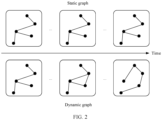
- Such a topology view with a topological relationship changing quickly with time may be referred to as a dynamic graph.
- the physical line is not affected by the use behavior and the movement behavior of the user.
- a topological relationship of such a topology view changes slowly with time, and therefore, the topology view may be referred to as a static graph.
- FIG. 2 shows dynamic graphs and static graphs of the network 100. Black dots denote base stations. In the dynamic graphs, lines between the black dots denote traffic. In the static graphs, lines between the black dots denote physical lines.
- substations may be considered as nodes.
- An electricity transmission line between the substations and the substations jointly form a static graph of the power grid, and a current between the substations and the substations jointly form a dynamic graph of the power grid.
- users may be considered as nodes.
- a relationship between friendly users and these users jointly form a static graph of the social network, and a relationship between stranger users and these users jointly form a dynamic graph of the social network.
- a method 300 includes the following steps.
- S310 Obtain static graphs and dynamic graphs of a plurality of nodes in a target network, where the static graphs and the dynamic graphs are all topology views.
- the static graphs and the dynamic graphs are undirected unweighted graphs.
- An apparatus for performing the method 300 may construct connection matrices corresponding to different graphs by using a plurality of methods.
- connection matrices between the base stations may be determined based on formula (1), so as to further determine the static graphs.
- a SD i j F e ⁇ d ij 2 ⁇ 2
- a SD ( i,j ) denotes a connection relationship between a base station i and a base station j that is determined based on a distance.
- d ij denotes a distance between the base station i and the base station j .
- e denotes a natural constant.
- ⁇ is a hyperparameter, which is used to control a value of a distance between base stations.
- F is a mapping function, which is used to map e ⁇ d ij 2 ⁇ 2 to 1 or 0.
- a FS i j F ⁇ x w i , x w j
- a FS ( i , j ) denotes a connection relationship between a base station i and a base station j that is determined based on the historical traffic.
- x w ( i ) denotes weekly average traffic data of the base station i.
- x w ( j ) denotes weekly average traffic data of the base station j .
- ⁇ x w ( i ), x w ( j ) denotes a Pearson (Pearson) correlation coefficient between x w ( i ) and x w ( j ).
- F is a mapping function, which is used to map ⁇ x w ( i ) , x w ( j ) to 1 or 0.
- a static graph may be used as an initial graph and then may be updated by using real-time data to obtain a dynamic graph.
- a dynamic graph may be directly constructed by using real-time data, as shown in formula (3).
- a TC t i j F ⁇ x t i , x t j
- a TC t i j denotes a connection relationship at moment t between a base station i and a base station j that is determined based on traffic.
- x t ( i ) ( x t-H +1 ( i ),..., x t -1 ( i )) denotes a collection of traffic of the base station i at H moments closest to the moment t.
- x t ( j ) (x t-H +1 ( j ),..., x t -1 ( j )) denotes a collection of traffic of the base station j at the H moments closest to the moment t.
- ⁇ x t ( i ) x t ( j ) denotes a Pearson correlation coefficient between x t ( i ) and x t ( j ).
- F is a mapping function, which is used to map ⁇ x w ( i ), x w ( j ) to 1 or 0.
- F z ⁇ 1 , z ⁇ ⁇ 0 , z ⁇ ⁇ z denotes e ⁇ d ij 2 ⁇ 2 , ⁇ x w ( i ), x w ( j ) , or ⁇ x t ( i ), x t ( j ) .
- ⁇ is a hyperparameter, which is used to control a density of a topology view.
- the method for determining a static graph and that for determining a dynamic graph that are applicable to this application are not limited to the examples described above.
- the apparatus for performing the method 300 may perform the following steps.
- S320 Generate spatial feature data of the plurality of nodes based on the static graphs and the dynamic graphs.
- the static graphs and the dynamic graphs may be processed by using a graph neural network (graph neural networks, GCN), and a convolution operation may be performed on the static graph and the dynamic graphs separately by using a convolution kernel of the GCN to obtain the spatial feature data.
- GCN graph neural networks
- An execution sequence of S320 and S330 is not limited.
- Observation data of the plurality of nodes in a historical time range may be processed by using a gated recurrent unit (gate recurrent unit, GRU) in a recursive neural network (recursive neural network, RNN) to obtain the time feature data.
- GRU gated recurrent unit
- RNN recursive neural network
- the foregoing observation data includes at least one of the following data: meteorological data, network topology data, traffic data, voice data, signaling data, point of interest (point of interest, POI) data, major-event data, and holiday data.
- the observation data may be preprocessed to reduce the time required for prediction.
- the observation data may be sliced (that is, sampled) by using characteristics of the observation data such as temporal proximity and periodicity to determine time slice data from the observation data.
- a data amount of the time slice data is less than the data amount of the observation data. Then, the time slice data is processed by using the GRU to obtain the time feature data.
- the following describes a method for performing time slicing on traffic data according to this application.
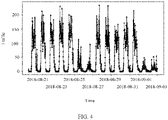
- FIG. 4 shows traffic data within a historical time range (20 days) of a target base station. It can be learned that, the traffic data is apparently periodic.
- the traffic data may be sliced based on a location of the target time range (that is, a time range in which prediction is to be performed) in one period, and traffic data in a time range that corresponds to the target time range and that is in another period is determined as the time slice data. Because data in corresponding time ranges in different periods is similar, performing prediction based on time slice data obtained based on this feature can reduce the time required for prediction without affecting a prediction effect.
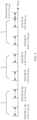
- FIG. 5 shows a method for obtaining time slice data.
- a period may be a day (day) or a week (week), and traffic data in a time range that corresponds to the target time range and that is in an adjacent period may be determined as the time slice data.
- August 30, 2018 may be regarded as the first period, and 8:15 to 9:15 a.m. on August 30, 2018 is a time range that corresponds to the target time range and that is in the first period, and a time range including this corresponding time range may be referred to as a specific time range.
- the specific time range on August 30, 2018 is 6:30 to 9:30 a.m.
- it may be further determined that 3:1 to 9:30 a.m. on August 30, 2018 is the specific time range.
- each specific time range may be referred to as T d .
- a period (August 27, 2018 to September 2, 2018) in which the target time range (8:15 to 9:15 a.m.) is located is a second period
- a period from August 20, 2018 to August 26, 2018 may be regarded as the first period
- 8:15 to 9:15 a.m. on August 25, 2018 (Saturday) is a time range that corresponds to the target time range and that is in the first period.
- a time range including this corresponding time range may be referred to as a specific time range.
- a specific time range on August 20, 2018 to August 26, 2018 is 3:1 to 9:30 a.m. on August 25, 2018 (Saturday).
- it may be further determined that 3:1 to 9:30 a.m. on August 11, 2018 (Saturday) is a specific time range.
- each specific time range may be referred to as T w .
- observation data in the specific time range is the time slice data.
- time slice data may be further determined from traffic data in a historical time range by using a month (month) or a quarter (quarter) as a period.
- the time slice data further includes traffic data in a time range adjacent to the target time range, and the adjacent time range is, for example, 5:00 to 8:00 a.m. on September 1, 2018 and 8:00 to 11:00 post meridiem (p.m.) on August 30, 2018.
- each adjacent time range may be referred to as T r .
- time slice data may be used independently or in combination.
- each time slice ( T d , T w , or T r ) in FIG. 5 includes 12 pieces of data. Three pieces of the data in T d , three pieces of the data in T w , and four pieces of the data in T r may be selected as the time slice data. In this case, there are totally 120 pieces of data (equivalent to data in eight hours) in the time slice data. Traffic data in 20 days includes about 1920 pieces of data in total. Compared with the time slice data, performing prediction by using the time slice data can reduce the time required for prediction without affecting the prediction effect.
- the apparatus for performing the method 300 may perform the following step.
- S340 Obtain a predicted state of a target node in a target time range based on the spatial feature data and the time feature data, where the target node is any node in the plurality of nodes.
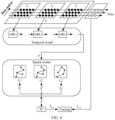
- FIG. 6 shows a prediction method according to this application.
- X t denotes data obtained after time slicing processing is performed on base station observation data existing before a moment t.
- X t is input into a temporal model (temporal modeling), and time feature data Y t is output after processing by the temporal model.
- the temporal model is a GRU.
- Static graphs and dynamic graphs are input into a spatial model (spatial modeling), and spatial feature data is output after processing by the spatial model.
- the spatial model is a GCN
- the time feature data includes denotes a result of a convolution operation performed on a graph by using a convolution kernel ⁇ of the GCN.
- ⁇ convolution kernel
- Y t is input into the spatial model. Based on Y t and ⁇ * G i t , a result Z i t combining a temporal feature and a spatial feature may be obtained, as shown in formula (5).
- Z i t ReLU ⁇ G i t ⁇ Y t
- ReLU denotes a rectified linear unit (rectified linear unit).
- a final output result Z t of the spatial model may be obtained by adding up a plurality of Z i t , as shown in formula (6).
- Z t may be processed by using a fully connected (fully connected, FC) layer to obtain x ⁇ t + k , as shown in formula (7).
- x ⁇ t + k Z t W ⁇ + b ⁇
- W f is a weight parameter of the FC layer
- b f is an offset parameter of the FC layer
- x ⁇ t + k denotes a predicted state of the target base station at a moment t + k.
- a dynamic spatial feature obtained from observation data is used in addition to a time feature and a static spatial feature that are obtained from the observation data. This increases accuracy of node state prediction in a network with a dynamic topological relationship.
- co-training may be performed on the temporal model, the spatial model, and the FC layer by minimizing a loss function.
- An optional loss function is shown in formula (8).
- L ( x ⁇ t + k ,x t + k ) is the loss function
- x t + k is a true state of the target base station at the moment t + k
- ( x ⁇ t + k ( i )- x t + k ( i )) 2 is a mean square error (mean square error, MSE)
- is a mean absolute error (mean absolute error, MAE)
- ⁇ is used to balance weights of the MSE and the MAD
- N denotes a quantity of nodes.
- the methods participating in the comparison include historical average (historical average, HA), Prophet (Prophet), Spatio-Temporal Graph Convolutional Network (spatio-temporal graph convolutional network, STGCN), Attention Spatio -Temporal Graph Convolutional Network (attention spatio-temporal graph convolutional network, ASTGCN) and Diffusion Convolutional Recurrent Neural Network (diffusion convolutional recurrent neural network, DCRNN), and evaluation indicators are a root mean square error (root mean square error, RMSE) and an MAE. Smaller values of the RMSE and the MAE indicate a better predictive capability of a method. Comparison results are shown in Table 1.
- the STGCN, ASTGCN, DCRNN, and method 300 are deep learning-based methods. Some differences exist in a result of each operation. Table 1 shows results of 10 predictions separately performed by these methods, and also shows mean values and variances. It can be learned from Table 1 that, the method 300 achieves an optimal prediction effect among the several methods.
- a corresponding apparatus includes a corresponding hardware structure and/or software module for executing each function.
- a person skilled in the art should easily be aware that, in combination with units and algorithm steps of the examples described in the embodiments disclosed in this specification, this application may be implemented by hardware or a combination of hardware and computer software. Whether a function is performed by hardware or hardware driven by computer software depends on particular applications and design constraints of the technical solutions. A person skilled in the art may use different methods to implement the described functions for each particular application, but it should not be considered that the implementation goes beyond the scope of this application.
- FIG. 7 is a schematic structural diagram of an apparatus for predicting a node state according to this application.
- An apparatus 700 includes an input unit 710 and a processing unit 720.
- the processing unit 720 is configured to obtain static graphs and dynamic graphs of a plurality of nodes in a target network, where the static graphs and the dynamic graphs are all topology views; generate spatial feature data of the plurality of nodes based on the static graphs and the dynamic graphs; obtain time feature data of the plurality of nodes; and obtain a predicted state of a target node in a target time range based on the spatial feature data and the time feature data, where the target node is any node in the plurality of nodes.
- the input unit 710 is configured to obtain observation data of the plurality of nodes in a first historical time range, where the first historical time range is a time range before the target time range; and the processing unit 720 is specifically configured to slice the observation data in a time dimension to obtain time slice data, where a data amount of the time slice data is less than a data amount of the observation data; and obtain the time feature data based on the time slice data.
- the time slice data includes: observation data in a time range that is in the first historical time range and that is adjacent to the target time range.
- the time slice data includes: observation data in a specific time range in the first historical time range, where the specific time range is located in a first period, the target time range is located in a second period, and the specific time range includes a time range that corresponds to the target time range and that is in the first period.
- the input unit 710 is configured to obtain observation data of the plurality of nodes in a second historical time range, where the second historical time range is a time range before the target time range; and the processing unit 720 is specifically configured to construct the static graphs and the dynamic graphs based on the observation data.
- the observation data includes at least one of the following data: meteorological data, network topology data, traffic data, voice data, signaling data, POI data, major-event data, and holiday data.
- the processing unit 720 is further configured to obtain a true state of the target node in the target time range; and train a temporal model and a spatial model based on the true state and the predicted state, where the temporal model is used to output the time feature data based on input observation data, and the spatial model is used to output the spatial feature data based on the static graphs and the dynamic graphs that are input.
- the static graphs belong to first-type topology views
- the dynamic graphs belong to second-type topology views
- a topological relationship change rate of the first-type topology views is less than a topological relationship change rate of the second-type topology views.
- the target network is a communications network
- the static graphs are topology views representing a traffic-based topological relationship of the plurality of nodes
- the dynamic graphs are topology views representing a physical-line-based topological relationship of the plurality of nodes.
- the apparatus 700 performs the method for predicting a node state and a beneficial effect incurred, refer to related descriptions in the method embodiments.
- FIG. 8 is a schematic structural diagram of a device for predicting a node state according to this application.
- a dashed line in FIG. 8 indicates that the unit or the module is optional.
- a device 800 may be configured to implement the method described in the foregoing method embodiments.
- the device 800 may be a terminal device, a server, or a chip.
- the device 800 includes one or more processors 801.
- the one or more processors 801 can support the device 800 in implementing the method in the method embodiments.
- the processor 801 may be a general-purpose processor or a dedicated processor.
- the processor 801 may be a central processing unit (central processing unit, CPU).
- the CPU may be configured to control the device 800, execute a software program, and process data of the software program.
- the device 800 may further include a communications unit 805, configured to implement input (receiving) and/or output (sending) of signals (such as observation data and prediction results).
- the device 800 may be a chip, and the communications unit 805 may be an input circuit and/or an output circuit of the chip, or the communications unit 805 may be a communications interface of the chip.
- the chip may be used as a component of a terminal device, a network device, or another electronic device.
- the device 800 may be a terminal device or a server
- the communications unit 805 may be a transceiver of the terminal device or the server
- the communications unit 805 may be a transceiver circuit of the terminal device or the server.
- the device 800 may include one or more memories 802, which store a program 804.
- the program 804 may be run by the processor 801 to generate an instruction 803, so that the processor 801 performs the method described in the foregoing method embodiments based on the instruction 803.
- the memory 802 may further store data (for example, observation data).
- the processor 801 may further read the data stored in the memory 802, where the data may be stored at a storage address the same as that of the program 804, or the data may be stored at a storage address different from that of the program 804.
- the processor 801 and the memory 802 may be separately disposed, or may be integrated together, for example, integrated on a system on chip (system on chip, SOC) of a terminal device.
- SOC system on chip
- the processor 801 may be a CPU, a digital signal processor (digital signal processor, DSP), an application specific integrated circuit (application specific integrated circuit, ASIC), a field programmable gate array (field programmable gate array, FPGA), or another programmable logic device, for example, discrete gates, transistor logic, or discrete hardware components.
- DSP digital signal processor
- ASIC application specific integrated circuit
- FPGA field programmable gate array
- This application further provides a computer program product.
- the computer program product is executed by the processor 801, the method according to any method embodiment of this application is implemented.
- the computer program product may be stored in the memory 802, for example, may be the program 804. After processing processes such as preprocessing, compilation, assembly, and linking, the program 804 is finally converted into an executable target file that can be executed by the processor 801.
- This application further provides a computer readable storage medium, which stores a computer program.
- a computer program When the computer program is executed by a computer, the method according to any method embodiment of this application is implemented.
- the computer program may be a high-level language program or an executable target program.
- the computer readable storage medium is the memory 802.
- the memory 802 may be a volatile memory or a non-volatile memory, or the memory 802 may include both a volatile memory and a non-volatile memory.
- the nonvolatile memory may be a read-only memory (read-only memory, ROM), a programmable read-only memory (programmable ROM, PROM), an erasable programmable read-only memory (erasable PROM, EPROM), an electrically erasable programmable read-only memory (electrically EPROM, EEPROM), or a flash memory.
- the volatile memory may be a random access memory (random access memory, RAM), used as an external cache.
- RAMs may be used, for example, a static random access memory (static RAM, SRAM), a dynamic random access memory (dynamic RAM, DRAM), a synchronous dynamic random access memory (synchronous DRAM, SDRAM), a double data rate synchronous dynamic random access memory (double data rate SDRAM, DDR SDRAM), an enhanced synchronous dynamic random access memory (enhanced SDRAM, ESDRAM), a synchronous link dynamic random access memory (synchlink DRAM, SLDRAM), and a direct rambus dynamic random access memory (direct rambus RAM, DR RAM).
- static random access memory static random access memory
- DRAM dynamic random access memory
- DRAM dynamic random access memory
- SDRAM synchronous dynamic random access memory
- double data rate SDRAM double data rate SDRAM
- DDR SDRAM double data rate SDRAM
- ESDRAM enhanced synchronous dynamic random access memory
- SLDRAM synchronous link dynamic random access memory
- direct rambus RAM direct rambus RAM
- the disclosed system, apparatus and method may be implemented in other manners. For example, some features of the method embodiments described above may be ignored or not performed.
- the described apparatus embodiments are merely examples.
- the unit division is merely logical function division and may be other division in actual implementation.
- a plurality of units or components may be combined or integrated into another system.
- coupling between the units or coupling between the components may be direct coupling or indirect coupling, and the coupling may include an electrical connection, a mechanical connection, or another form of connection.
- Sequence numbers of the foregoing processes do not mean execution sequences in various embodiments of this application.
- the execution sequences of the processes should be determined based on functions and internal logic of the processes, and should not be construed as any limitation on the implementation processes of the embodiments of this application.
Landscapes
- Engineering & Computer Science (AREA)
- Computer Networks & Wireless Communication (AREA)
- Signal Processing (AREA)
- General Engineering & Computer Science (AREA)
- Theoretical Computer Science (AREA)
- Physics & Mathematics (AREA)
- Data Mining & Analysis (AREA)
- Evolutionary Computation (AREA)
- Computational Linguistics (AREA)
- Computing Systems (AREA)
- General Physics & Mathematics (AREA)
- Mathematical Physics (AREA)
- Software Systems (AREA)
- Artificial Intelligence (AREA)
- Data Exchanges In Wide-Area Networks (AREA)
- Management, Administration, Business Operations System, And Electronic Commerce (AREA)
Applications Claiming Priority (2)
| Application Number | Priority Date | Filing Date | Title |
|---|---|---|---|
| CN202010409392.2A CN111726243B (zh) | 2020-05-14 | 2020-05-14 | 预测节点状态的方法和装置 |
| PCT/CN2020/141253 WO2021227535A1 (fr) | 2020-05-14 | 2020-12-30 | Procédé et appareil de prédiction d'état de nœud |
Publications (2)
| Publication Number | Publication Date |
|---|---|
| EP4135264A1 true EP4135264A1 (fr) | 2023-02-15 |
| EP4135264A4 EP4135264A4 (fr) | 2023-09-13 |
Family
ID=72564499
Family Applications (1)
| Application Number | Title | Priority Date | Filing Date |
|---|---|---|---|
| EP20935951.2A Pending EP4135264A4 (fr) | 2020-05-14 | 2020-12-30 | Procédé et appareil de prédiction d'état de noeud |
Country Status (4)
| Country | Link |
|---|---|
| US (1) | US20230117633A1 (fr) |
| EP (1) | EP4135264A4 (fr) |
| CN (1) | CN111726243B (fr) |
| WO (1) | WO2021227535A1 (fr) |
Families Citing this family (7)
| Publication number | Priority date | Publication date | Assignee | Title |
|---|---|---|---|---|
| CN111726243B (zh) * | 2020-05-14 | 2021-10-22 | 华为技术有限公司 | 预测节点状态的方法和装置 |
| US20220343146A1 (en) * | 2021-04-23 | 2022-10-27 | Alibaba Singapore Holding Private Limited | Method and system for temporal graph neural network acceleration |
| CN114417192B (zh) * | 2022-03-28 | 2022-07-12 | 北京百度网讯科技有限公司 | 更新兴趣点poi状态的方法、装置、设备、介质及产品 |
| CN114827353B (zh) * | 2022-04-15 | 2023-10-10 | 中国电信股份有限公司 | 通信网络通话预测方法、装置、设备及存储介质 |
| CN114900441B (zh) * | 2022-04-29 | 2024-04-26 | 华为技术有限公司 | 网络性能预测方法,性能预测模型训练方法及相关装置 |
| CN115225546B (zh) * | 2022-07-22 | 2023-11-28 | 北京天融信网络安全技术有限公司 | 一种网络流量的预测方法、装置及设备 |
| CN117973647B (zh) * | 2024-04-02 | 2024-08-09 | 南方电网数字电网研究院股份有限公司 | 综合能源系统负荷预测方法、装置和计算机设备 |
Family Cites Families (15)
| Publication number | Priority date | Publication date | Assignee | Title |
|---|---|---|---|---|
| US8937970B2 (en) * | 2012-11-14 | 2015-01-20 | Telefonaktiebolaget L M Ericsson (Publ) | Resource allocation for minimum satisfaction guarantees in multi-service and multi-antenna networks |
| US10536357B2 (en) * | 2015-06-05 | 2020-01-14 | Cisco Technology, Inc. | Late data detection in data center |
| CN108234198B (zh) * | 2017-12-19 | 2020-07-07 | 清华大学 | 一种基站流量预测方法和设备 |
| CN108053080B (zh) * | 2017-12-30 | 2021-05-11 | 中国移动通信集团江苏有限公司 | 区域用户数量统计值预测方法、装置、设备及介质 |
| CN108566305B (zh) * | 2018-04-28 | 2021-04-06 | 中国人民大学 | 一种计算机网络智能组网与优化系统和方法 |
| CN108879692B (zh) * | 2018-06-26 | 2020-09-25 | 湘潭大学 | 一种区域综合能源系统能流分布预测方法及系统 |
| US11221617B2 (en) * | 2018-10-22 | 2022-01-11 | Nec Corporation | Graph-based predictive maintenance |
| CN109862585B (zh) * | 2019-01-31 | 2022-04-19 | 湖北工业大学 | 一种基于深度时空神经网络的动态异构网络流量预测方法 |
| CN110784903A (zh) * | 2019-11-06 | 2020-02-11 | 周口师范学院 | 网络数据传输方法、装置、计算机设备和存储介质 |
| CN110889546B (zh) * | 2019-11-20 | 2020-08-18 | 浙江省交通规划设计研究院有限公司 | 一种基于注意力机制的交通流量模型训练方法 |
| US11196633B2 (en) * | 2019-11-22 | 2021-12-07 | International Business Machines Corporation | Generalized correlation of network resources and associated data records in dynamic network environments |
| US11863298B1 (en) * | 2019-11-26 | 2024-01-02 | ZaiNar, Inc. | Method for identifying and diagnosing failures in pairwise time synchronization and frequency calibration in a mesh network |
| CN110969854A (zh) * | 2019-12-13 | 2020-04-07 | 深圳先进技术研究院 | 一种交通流量的预测方法、系统及终端设备 |
| CN110995520B (zh) * | 2020-02-28 | 2020-06-30 | 清华大学 | 网络流量预测方法、装置、计算机设备及可读存储介质 |
| CN111726243B (zh) * | 2020-05-14 | 2021-10-22 | 华为技术有限公司 | 预测节点状态的方法和装置 |
-
2020
- 2020-05-14 CN CN202010409392.2A patent/CN111726243B/zh active Active
- 2020-12-30 WO PCT/CN2020/141253 patent/WO2021227535A1/fr not_active Ceased
- 2020-12-30 EP EP20935951.2A patent/EP4135264A4/fr active Pending
-
2022
- 2022-11-10 US US17/984,421 patent/US20230117633A1/en active Pending
Also Published As
| Publication number | Publication date |
|---|---|
| US20230117633A1 (en) | 2023-04-20 |
| WO2021227535A1 (fr) | 2021-11-18 |
| CN111726243B (zh) | 2021-10-22 |
| CN111726243A (zh) | 2020-09-29 |
| EP4135264A4 (fr) | 2023-09-13 |
Similar Documents
| Publication | Publication Date | Title |
|---|---|---|
| US20230117633A1 (en) | Method and apparatus for predicting node state | |
| US12205029B2 (en) | Increasing accuracy and resolution of weather forecasts using deep generative models | |
| Liao et al. | Ultra-short-term interval prediction of wind power based on graph neural network and improved bootstrap technique | |
| US20230140289A1 (en) | Traffic accident prediction systems and methods | |
| Wang et al. | Deep learning for real time crime forecasting | |
| CN113610286A (zh) | 顾及时空相关性和气象因素的pm2.5浓度预测方法及装置 | |
| WO2022175337A1 (fr) | Prévision immédiate à l'aide de réseaux neuronaux génératifs | |
| CN117076738B (zh) | 基于变网格模型的中长期气象预测方法、系统及介质 | |
| Ohba et al. | Rainfall downscaling of weekly ensemble forecasts using self-organising maps | |
| CN111105093B (zh) | 基于CNN和BiLSTM的临近降水预测方法 | |
| CN117349795A (zh) | 基于ann和gwr耦合的降水融合方法和系统 | |
| CN119179868B (zh) | 基于高频增强去噪扩散模型的短期净负荷概率预测方法 | |
| US20250173564A1 (en) | Method and system for training a neural network to forecast multivariate data | |
| Thong et al. | Interpolative picture fuzzy rules: A novel forecast method for weather nowcasting | |
| García et al. | A Bayesian hierarchical spatio-temporal model for extreme rainfall in Extremadura (Spain) | |
| CN115982534B (zh) | 一种江河水文监测数据的处理方法 | |
| Saxena et al. | Application of stacked and bidirectional long short-term memory deep learning models for wind speed forecasting at an offshore site | |
| CN117808155A (zh) | 一种基于风云4a卫星的地表入射太阳辐射智能化预报方法 | |
| CN116911178A (zh) | 一种基于气象预报的中小型水库容量预测方法及系统 | |
| CN115186927A (zh) | 一种基于数值天气预报和模型融合的风向预测方法及系统 | |
| CN116634453B (zh) | 网络性能确定方法、装置、服务器和存储介质 | |
| Baxevani et al. | Very short-term spatio-temporal wind power prediction using a censored Gaussian field | |
| US20240282465A1 (en) | Method of predicting infectious disease infections and system thereof, device, and storage medium | |
| CN119444264A (zh) | 一种基于区块链的绿电交易预测方法及系统 | |
| CN116170349B (zh) | 通信网络流量预测方法及装置 |
Legal Events
| Date | Code | Title | Description |
|---|---|---|---|
| STAA | Information on the status of an ep patent application or granted ep patent |
Free format text: STATUS: THE INTERNATIONAL PUBLICATION HAS BEEN MADE |
|
| PUAI | Public reference made under article 153(3) epc to a published international application that has entered the european phase |
Free format text: ORIGINAL CODE: 0009012 |
|
| STAA | Information on the status of an ep patent application or granted ep patent |
Free format text: STATUS: REQUEST FOR EXAMINATION WAS MADE |
|
| 17P | Request for examination filed |
Effective date: 20221110 |
|
| AK | Designated contracting states |
Kind code of ref document: A1 Designated state(s): AL AT BE BG CH CY CZ DE DK EE ES FI FR GB GR HR HU IE IS IT LI LT LU LV MC MK MT NL NO PL PT RO RS SE SI SK SM TR |
|
| REG | Reference to a national code |
Ref country code: DE Ref legal event code: R079 Free format text: PREVIOUS MAIN CLASS: H04L0012240000 Ipc: H04L0041147000 |
|
| DAV | Request for validation of the european patent (deleted) | ||
| DAX | Request for extension of the european patent (deleted) | ||
| A4 | Supplementary search report drawn up and despatched |
Effective date: 20230810 |
|
| RIC1 | Information provided on ipc code assigned before grant |
Ipc: H04L 41/12 20220101ALI20230804BHEP Ipc: H04L 41/147 20220101AFI20230804BHEP |
|
| STAA | Information on the status of an ep patent application or granted ep patent |
Free format text: STATUS: EXAMINATION IS IN PROGRESS |
|
| 17Q | First examination report despatched |
Effective date: 20241128 |