EP4135280B1 - Nachrichtenparsingverfahren und -vorrichtung - Google Patents
Nachrichtenparsingverfahren und -vorrichtung Download PDFInfo
- Publication number
- EP4135280B1 EP4135280B1 EP20933357.4A EP20933357A EP4135280B1 EP 4135280 B1 EP4135280 B1 EP 4135280B1 EP 20933357 A EP20933357 A EP 20933357A EP 4135280 B1 EP4135280 B1 EP 4135280B1
- Authority
- EP
- European Patent Office
- Prior art keywords
- packet header
- protocol type
- packet
- nhf
- configuration
- Prior art date
- Legal status (The legal status is an assumption and is not a legal conclusion. Google has not performed a legal analysis and makes no representation as to the accuracy of the status listed.)
- Active
Links
Images





Classifications
-
- H—ELECTRICITY
- H04—ELECTRIC COMMUNICATION TECHNIQUE
- H04L—TRANSMISSION OF DIGITAL INFORMATION, e.g. TELEGRAPHIC COMMUNICATION
- H04L69/00—Network arrangements, protocols or services independent of the application payload and not provided for in the other groups of this subclass
- H04L69/22—Parsing or analysis of headers
Definitions
- Embodiments of this application relate to the electronic information field, and in particular, to a packet parsing method and apparatus.
- the Transmission Control Protocol/Internet Protocol (TCP/IP) model is a basis of a current Internet Protocol (IP) network.
- IP Internet Protocol
- IP Internet Protocol
- an entire data communication task may be divided into different function layers, and each layer corresponds to a different function and a different protocol type. It may be understood that when data is transmitted and/or processed at different layers, a protocol type of a corresponding layer needs to be matched. Data specified by different protocol types includes different information such as a location of a specific field. Therefore, to perform transmission and/or processing at different layers, the data needs to be able to match a plurality of different protocol types.
- a packet can include a plurality of packet headers and packet data payloads.
- Each of the plurality of packet headers corresponds to a protocol type of a layer.
- the packet header may include a plurality of control fields.
- a corresponding function may be implemented by using the plurality of control fields, for example, extracting corresponding data from a packet data payload.
- a packet parsing engine may be configured to separately parse the plurality of packet headers included in the packet, to obtain protocol types respectively corresponding to the plurality of packet headers and an offset of each packet header in the packet. Therefore, when a control field of a protocol type needs to be extracted, a specific location of the key field in the packet header may be determined according to an offset of a packet header of a corresponding protocol type, and the key field is extracted. In this way, data can be transmitted and processed at different layers.
- XP086043586 proposes new methods for protocol-independent packet parsing.
- US 2013/215906 A1 relates to methods and devices for reconfigurable parsing of data packet headers in a network.
- XP058058151 relates to design principles for packet parsers.
- Embodiments of this application provide a packet parsing method and apparatus, and relate to the field of electronic information, to resolve a problem in the conventional technology that a special type of packet header cannot be accurately parsed through proper programming during packet parsing.
- a packet parsing method includes: receiving a packet, where the packet includes at least a first packet header and a second packet header, and the second packet header is a next-level packet header of the first packet header; obtaining a configuration of the first packet header, where the configuration of the first packet header includes a protocol type of the first packet header; obtaining first configuration information from the first packet header based on the configuration of the first packet header, where the first configuration information includes a next packet header field (NHF) and an additional field of the first packet header; searching a first table based on the additional field to obtain a protocol type corresponding to the additional field, and searching a second table based on the NHF to obtain a protocol type corresponding to the NHF; when there is the protocol type corresponding to the additional field in the first table, obtaining a protocol type of the second packet header based on the protocol type corresponding to the additional field; and when there is no protocol type corresponding to the additional field in the first table, obtaining the protocol type of the
- a configuration of the second packet header is determined based on the configuration of the first packet header, improving flexibility.
- the protocol type of the second packet header may be determined based on a target field in the first packet header.
- the protocol type of the second packet header may be determined based on the NHF in the first packet header. Therefore, according to the method, parsing of a plurality of protocol types of the second packet header can be supported, and a packet header of a special protocol type can be parsed.
- the first table may store a correspondence between the additional field and the protocol type.
- the first table may also store a correspondence between the additional field and a protocol type identifier.
- an identifier 1 corresponds to a protocol type 1
- an identifier 2 corresponds to a protocol type 2. Therefore, the protocol type identifier corresponding to the additional field may be obtained by searching the first table, and a corresponding protocol type is further determined based on the identifier.
- the first table further stores a correspondence between an additional field identifier and the protocol type identifier, or a correspondence between the additional field identifier and the protocol type.
- the correspondence stored in the second table may also be any one of the foregoing three examples, for example, a correspondence between the NHF and the protocol type, a correspondence between the NHF and the protocol type identifier, and a correspondence between a NHF identifier and the protocol type identifier.
- a protocol type that is determined based on the first table and that corresponds to the additional field may correspond to the protocol type of the second packet header.
- the protocol type corresponding to the additional field in the first table may be used as the protocol type of the second packet header.
- the protocol type that corresponds to the additional field and that is determined based on the first table may also have a function of correcting the protocol type of the first packet header.
- the protocol type corresponding to the additional field in the first table may be used to update the protocol type of the first packet header, and determine the protocol type of the second packet header based on the updated protocol type of the first packet header.
- the configuration of the first packet header further includes an offset of the first packet header
- the first configuration information further includes length information of the first packet header.
- the method further includes: obtaining an offset of the second packet header based on the length information of the first packet header and the offset of the first packet header. Based on this solution, a method is provided for determining an offset of a next packet header level by level based on the first packet header in the solutions provided in this application.
- the obtaining a configuration of the first packet header includes: when the first packet header is a first-level packet header of the packet, obtaining the configuration of the first packet header based on a physical port number used to receive the packet; and when the first packet header is not the first-level packet header of the packet, obtaining second configuration information based on a configuration of a previous-level packet header of the first packet header.
- the second configuration information includes an NHF of the previous-level packet header, an additional field of the previous-level packet header, and length information of the previous-level packet header. The additional field is used to determine the configuration of the first packet header, and obtain the configuration of the first packet header based on the second configuration information.
- a method for determining the protocol type of the first-level packet header is provided.
- the protocol type and the offset of the first-level packet header are determined based on a correspondence between physical port numbers.
- a method is also provided for determining the protocol type and the offset of the first packet header in a scenario in which the first packet header is not the first-level packet header. After the protocol type of the first-level packet header is determined, the packet header may be parsed level by level.
- the obtaining first configuration information based on a configuration of the first packet header includes: searching a third table based on the protocol type of the first packet header to obtain first location information, where the first location information indicates a location of the additional field in the first packet header, and extracting the additional field from the first packet header based on the first location information; searching a fourth table based on the protocol type of the first packet header to obtain second location information, where the second location information indicates a location of the NHF in the first packet header, and extracting the NHF from the first packet header based on the second location information; and searching a fifth table based on the protocol type of the first packet header to obtain third location information, where the third location information indicates a location of length calculation configuration information in the first packet header, and calculating to obtain the length information of the first packet header based on the length calculation configuration information.
- locations corresponding to the NHF, the additional field, and a packet length calculation method in the first packet header can be separately determined based on the third table, the fourth table, and the fifth table.
- a corresponding field is extracted based on the information, to obtain the NHF, the additional field, and the length calculation configuration information.
- the searching a second table based on the NHF to obtain a protocol type corresponding to the NHF includes: performing ternary content addressable memory (TCAM) searching on the second table based on the NHF to obtain the protocol type corresponding to the NHF.
- TCAM ternary content addressable memory
- the performing ternary content addressable memory (TCAM) searching on the second table based on the NHF to obtain the protocol type corresponding to the NHF includes: generating, based on the NHF, a search key corresponding to the NHF; obtaining an entry corresponding to the key in the second table; when there is the entry corresponding to the key in the second table, using a protocol type indicated by the entry as the protocol type corresponding to the NHF; and when there are a plurality of entries corresponding to the key in the second table, determining a target entry from the plurality of entries through priority addressing, and using a protocol type indicated by the target entry as the protocol type corresponding to the NHF.
- TCAM ternary content addressable memory
- a specific manner is provided, to generate the key based on the NHF and perform TCAM searching, to obtain a corresponding searching result, and further determine a corresponding protocol type.
- a correct search result may be determined based on priority addressing, and a corresponding protocol type may be determined.
- the method further includes: generating a packet descriptor (PHD) of the packet based on the configuration of the first packet header and a configuration of the second packet header.
- the configuration of the second packet header includes the protocol type and the offset that are of the second packet header.
- a corresponding PHD is generated based on the configuration of the packet header in the packet, to extract a key field (for example, a corresponding control field in the packet header).
- a packet parsing apparatus includes a receiving unit and an obtaining unit.
- the receiving unit is configured to receive a packet, where the packet includes at least a first packet header and a second packet header, and the second packet header is a next-level packet header of the first packet header.
- the obtaining unit is configured to obtain a configuration of the first packet header, where the configuration of the first packet header includes a protocol type of the first packet header.
- the obtaining unit is further configured to obtain first configuration information from the first packet header based on the configuration of the first packet header, where the first configuration information includes a next packet header field (NHF) and an additional field of the first packet header.
- NAF next packet header field
- the obtaining unit is further configured to: search a first table based on the additional field to obtain a protocol type corresponding to the additional field, and search a second table based on the NHF to obtain a protocol type corresponding to the NHF; when there is the protocol type corresponding to the additional field in the first table, obtain a protocol type of the second packet header based on the protocol type corresponding to the additional field; and when there is no protocol type corresponding to the additional field in the first table, obtain the protocol type of the second packet header based on the protocol type corresponding to the NHF.
- the configuration of the first packet header further includes an offset of the first packet header
- the first configuration information further includes length information of the first packet header.
- the obtaining unit is further configured to obtain an offset of the second packet header based on the length information of the first packet header and the offset of the first packet header.
- the obtaining unit is further configured to: when the first packet header is a first-level packet header of the packet, obtain the configuration of the first packet header based on a physical port number used to receive the packet; and when the first packet header is not the first-level packet header of the packet, obtain second configuration information based on a configuration of a previous-level packet header of the first packet header.
- the second configuration information includes an NHF of the previous-level packet header, an additional field of the previous-level packet header, and length information of the previous-level packet header. The additional field is used to determine the configuration of the first packet header, and obtain the configuration of the first packet header based on the second configuration information.
- the obtaining unit is further configured to: search a third table based on the protocol type of the first packet header to obtain first location information, where the first location information indicates a location of the additional field in the first packet header, and extract the additional field from the first packet header based on the first location information.
- the obtaining unit is further configured to: search a fourth table based on the protocol type of the first packet header to obtain second location information, where the second location information indicates a location of the NHF in the first packet header, and extract the NHF from the first packet header based on the second location information.
- the obtaining unit is further configured to: search a fifth table based on the protocol type of the first packet header to obtain third location information, where the third location information indicates a location of length calculation configuration information in the first packet header, and calculate to obtain the length information of the first packet header based on the length calculation configuration information.
- the obtaining unit is further configured to perform ternary content addressable memory (TCAM) searching on the second table based on the NHF to obtain the protocol type corresponding to the NHF.
- TCAM ternary content addressable memory
- the obtaining unit is further configured to: generate, based on the NHF, a search key corresponding to the NHF; determine an entry corresponding to the key in the second table; when there is the entry corresponding to the key in the second table, use a protocol type indicated by the entry as the protocol type corresponding to the NHF; and when there are a plurality of entries corresponding to the key in the second table, determine a target entry from the plurality of entries through priority addressing, and use a protocol type indicated by the target entry as the protocol type corresponding to the NHF.
- the apparatus further includes a generation unit, where the generation unit is configured to generate a packet descriptor (PHD) of the packet based on the configuration of the first packet header and a configuration of the second packet header.
- PLD packet descriptor
- the configuration of the second packet header includes the protocol type and the offset that are of the second packet header.
- data may be transmitted and processed at different layers in a form of a packet.
- the packet may include a plurality of packet headers. Different packet headers may correspond to different protocol types. In this way, after the packet is received, a corresponding layer may determine a location of data in the packet based on a packet header of a corresponding protocol type, to apply the data.
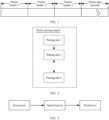
- FIG. 1 is a schematic composition diagram of a packet.
- the packet may include a plurality of packet headers (a packet header 1, a packet header 2, and a packet header 3 shown in FIG. 1 ) and a packet data payload.
- Different packet headers may correspond to different protocol types.
- the packet header 1 may correspond to the Ethernet protocol
- the packet header 2 may correspond to the Internet Protocol version 4 (IPv4)
- the packet header 3 may correspond to the Transmission Control Protocol (TCP).
- IPv4 Internet Protocol version 4
- TCP Transmission Control Protocol
- the packet data payload carries data information.
- a corresponding layer may parse the packet, to obtain protocol types of different packet headers (for example, the packet header 1, the packet header 2, and the packet header 3) and a location of a corresponding packet header in the packet. (that is, an offset).
- protocol types of different packet headers for example, the packet header 1, the packet header 2, and the packet header 3
- a location of a corresponding packet header in the packet that is, an offset.
- a location of a packet header (for example, the packet header 3) that matches a current Layer protocol type in the packet is determined, and then a location of a control field (or referred to as a key field) that needs to be used in the packet header is determined based on the packet header 3 and extracted.
- the packet header may be referred to as a first-level packet, a second-level packet, or the like of the packet based on a location of the packet header in the packet, for example, a sequence of physical locations corresponding to the packet header.
- the packet header 1 may be referred to as a first-level packet
- the packet header 2 may be referred to as a second-level packet
- the packet header 3 may be referred to as a third-level packet.
- packet parsing may be performed by searching a preset table. For example, a protocol type of the first-level packet header in the packet may be determined based on a physical port number used to receive the packet. The preset table is searched for a related match item based on the protocol type of the first-level packet header, to obtain protocol types of the second-level packet header and subsequent packet headers. It can be learned that although the method can complete parsing of the packet based on the protocol type of the first-level packet header, by using this method, a combination of the protocol type of the first-level packet header and a protocol type of a subsequent packet header is fixed. As a result, the packet header in the packet cannot support a new protocol type. Therefore, an unknown protocol jump branch is not supported.
- a packet parsing engine having this feature may be referred to as a non-programmable packet parsing engine.
- Each packet header may include a next packet header field (NHF), and the next packet header field may be used to indicate a protocol type of a next-level packet header of a current packet header.
- NHF next packet header field
- the packet header 1 may include an NHF, used to indicate that a protocol type of a next-level packet header (that is, the packet header 2) is TCP.
- the current packet header is a packet header of a special protocol type
- an error may occur in extraction of the NHF, and the NHF may not correctly indicate the protocol type of a next-level packet header. Therefore, packet parsing based on the NHF cannot identify a packet header of a special protocol type.
- Embodiments of this application provide a packet parsing method and apparatus. Refer to an NHF included in a packet header. A protocol type and an offset of a next-level packet header are accurately determined based on a protocol type and an offset of a previous-level packet header. Parsing of a plurality of new protocols can be supported. In this way, a packet parsing process is flexible and programmable.
- the packet parsing apparatus may also be referred to as a packet parsing engine.
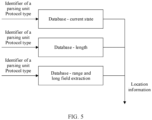
- FIG. 2 is a schematic composition diagram of a packet parsing engine according to an embodiment of this application.
- the packet parsing engine may include one or more parsing slices (PS).
- the packet parsing engine may include a parsing unit 1 to a parsing unit n shown in FIG. 2 .
- Each parsing unit in the N parsing units may perform packet header parsing on a first-level packet header of a packet. Therefore, the N parsing units can complete parsing of a plurality of levels of packet headers of the packet in sequence.
- the parsing unit 1 may parse the first-level packet header, and input a determined configuration of the first-level packet header to a parsing unit 2, so that the parsing unit 2 determines a configuration of a second-level packet header based on the configuration of the first-level packet header, and so on.
- the packet parsing engine shown in FIG. 2 may be separately disposed, to implement sequential parsing on the packet.
- a plurality of packet parsing engines may be disposed.
- each packet parsing engine may be configured to process a data flow corresponding to a packet, and the plurality of packet parsing engines may concurrently parse a plurality of different packets.
- the parsing unit when parsing the packet, is configured to determine the configuration of the first packet header in the packet.
- the configuration may include a protocol type and an offset of the first packet header.
- the parsing unit may further extract an additional field and an NHF from the first packet header based on the protocol type of the first packet header, and calculate a length of the first packet header.
- the parsing unit may be further configured to search, based on the additional field, a preset table (for example, the first table), for a protocol type that matches the additional field, and use the protocol type as a protocol type of a next-level packet header (for example, a second packet header).
- the parsing unit may further perform ternary content addressable memory (TCAM) searching based on the NHF, to determine the protocol type of the second packet header.
- TCAM ternary content addressable memory
- the parsing unit provided in this embodiment of this application may be implemented by using one or more of a field programmable gate array (FPGA), a programmable array logic (PLA), and/or an integrated circuit (for example, an integrated circuit (Application Specific Integrated Circuit, ASIC) used for a dedicated application).
- FPGA field programmable gate array
- PLA programmable array logic
- ASIC Application Specific Integrated Circuit
- a function of the parsing unit may also be implemented by using a component having an operation capability, such as a central processing unit (CPU), disposed in a device that needs to perform the packet parsing operation.
- a component having an operation capability such as a central processing unit (CPU) disposed in a device that needs to perform the packet parsing operation. This is not limited in this embodiment of this application.
- one or more storage modules having a storage function may be further disposed in the packet parsing engine.
- the storage module may be configured to store tables required in a packet parsing process.
- the storage module may provide a database (DB) that includes configurations corresponding to a large quantity of protocol types, and is shared by a plurality of parsing units. Therefore, when parsing packets including packet headers of different protocol types, different parsing units may select, from the DB, configurations required by the different parsing units as a search table of the different parsing units, to quickly and accurately parse the packets.
- the search table may include tables such as a Database. Current State (DB.DC) used to search location information of the NHF, a Database. Range & Long Field Extraction (DB.RLFE) used to search location information of the additional field, and a Database. Length (DS.Len) used to search location information of length calculation configuration information.
- DB.DC Current State
- DB.RLFE Range & Long Field Ex
- a larger quantity of parsing units sharing a same storage module indicates a higher usage of data stored in the parsing engine, and correspondingly the storage module needs to have a high data processing and transmission capability. Therefore, in different implementations, a quantity of parsing units that share the same storage module may be flexibly selected based on a specific situation. For example, four parsing units may be used to contribute to one storage module (memory). Certainly, a configuration used for packet parsing may also be stored in a storage medium other than the packet parsing engine. When the parsing unit needs to use a corresponding configured table to parse the packet, the parsing unit may extract corresponding configuration information from the storage medium through an interface disposed on the packet parsing engine.
- the packet parsing method provided in this embodiment of this application may be applied to the packet parsing engine shown in FIG. 2 , to implement flexible and programmable packet parsing.
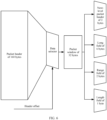
- FIG. 3 is a schematic diagram of logic of a packet parsing method according to an embodiment of this application.
- the packet parsing method may logically include three steps: extraction, identification, and prediction.
- Each of the N parsing units (for example, the parsing unit 1 to the parsing unit n) in FIG. 2 may parse the packet according to the method.
- FIG. 4 is a schematic flowchart of a packet parsing method according to an embodiment of this application. As shown in FIG. 4 , the method may include S401 to S404.
- S401 Receive a packet, where the packet includes at least a first packet header and a second packet header, and the second packet header is a next-level packet header of the first packet header.
- a configuration of a packet header may include a protocol type of a corresponding packet header and an offset of the packet header.
- the configuration of the first packet header may include a protocol type of the first packet header and an offset of the first packet header.
- the offset may be a physical location of a first byte of the first packet header in the packet, or may be a physical location of a specific byte included in the first packet header in the packet, or may be a location of a last byte of the first packet header in the packet. The following uses an example in which the offset of the first packet header is the physical location of the first byte of the first packet header in the packet.
- the parsing unit may determine the protocol type of the first packet header and the offset of the first packet header based on information about a physical port that receives the packet. For example, a parsing unit may determine the protocol type of the first packet header based on a table including a correspondence between port information and the protocol type.
- the offset of the first packet header is equal to start locations of all packet headers in the first packet header. For example, when the packet header in the packet starts from the first byte, the offset of the first packet header is 0.
- a method for determining the configuration of the first packet header is similar to the method for determining a configuration of a second packet header in this embodiment of this application. A specific method thereof is described in detail in the following description, and details are not described herein again.
- S403 Obtain first configuration information based on the configuration of the first packet header.
- the first configuration information includes an NHF of the first packet header, an additional field of the first packet header, and length information of the first packet header.
- the additional field is used to determine a protocol type of the second packet header.
- the parsing unit may search a correspondence table based on the protocol type of the first packet header, to determine location information of corresponding information (such as the NHF, the additional field, and the length calculation configuration information) in the first packet header.
- the location information of the NHF may include an offset of the NHF in the first packet header and length information of the NHF.
- the location information of the additional field may include an offset of the additional field in the first packet header and length information of the additional field.
- the location information of the length calculation configuration information may include an offset of the length calculation configuration information in the first packet header and length information of the length calculation configuration information.
- the parsing unit may search a third table (for example, DB. RLFE) based on the protocol type (State) of the first packet header, to obtain the location information of the additional field in the first packet header.
- the parsing unit may further search a fourth table (for example, DB.CS) based on the protocol type of the first packet header, to obtain the location information of the NHF in the first packet header.
- the parsing unit may further search a fifth table (for example, DB.Len) based on the protocol type of the first packet header, to obtain the length calculation configuration information of the first packet header.
- length information of packet headers having different protocol types may be fixed or may not be fixed. Therefore, when the length information of the first packet header is fixed and known, the foregoing operation of searching for the DB.Len may not be performed any more, to reduce workload of the parsing unit.
- the following uses an example in which the length information of the first packet header is not fixed. In other words, the length information of the first packet header can be obtained only by searching the DB.Len.
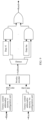
- a packet parsing engine in this embodiment of this application may include a plurality of parsing units, and different parsing units process different packets. Therefore, as shown in FIG. 5 , when the corresponding information in the first packet header is determined, an identifier (for example, PS_ID) of the parsing unit is further input. Therefore, before searching, it can be determined whether the table (for example, the DB.RLFE, the DB.CS, and the DB.Len) is a correct table. Certainly, in some implementation scenarios, if the packet parsing engine includes only one parsing unit, the corresponding information of the packet header may be determined without entering the PS_ID.
- an identifier for example, PS_ID
- an extraction operation shown in FIG. 3 is completed.
- an NHF, length calculation configuration information, and location information of an additional field in a packet header that are included in a current packet header are extracted.
- the parsing unit may extract the NHF, the additional field, and the length calculation configuration information from the first packet header based on the location information of the NHF, the length calculation configuration information, and the additional field in the packet header that are included in the extracted current packet header (for example, the first packet header).
- a corresponding field is extracted from the first packet header as the NHF field based on an offset that is of the NHF in the first packet header and that is indicated by the location information of the NHF and the length information of the NHF.
- a corresponding field is extracted from the first packet header as a field of the additional field based on an offset that is of the additional field in the first packet header and that is indicated by the location information of the additional field and the length information of the additional field.
- a corresponding field is extracted from the first packet header as a field of the length calculation configuration information based on an offset that is of the length calculation configuration information in the first packet header and that is indicated by the location information of the length calculation configuration information and the length information of the length calculation configuration information.
- FIG. 6 shows a schematic diagram of a corresponding information extraction method.
- a length of the first packet header for example, a Packet Header
- the parsing unit may input all fields of the packet header of 160 B to a data selector (Sliced mux) disposed in the parsing unit, and input an offset that includes a packet header and a header offset of location information of the foregoing corresponding information to the sliced mux at the same time.
- a packet window (Input Window) whose length is 32 B and that includes all corresponding information may be determined.
- the parsing unit may extract the input window of 32 B from the packet header, and further extract an NHF of 2 B, a length field of 1 B, and an additional field from the input window.
- the additional field may include a range field of 2 B and a long field of 6 B.
- the recognition operation shown in FIG. 3 is completed.
- the corresponding information of the first packet header such as the NHF, the additional field, and the length calculation configuration information, is identified and extracted from the first packet header based on the location of the corresponding information extracted in the first step.
- S404 Determine a configuration of the second packet header based on the first configuration information.
- the configuration of the second packet header includes the protocol type of the second packet header and the offset of the second packet header in the packet.
- the configuration of the second packet header may be determined based on the configuration information of the first packet header by using a plurality of different methods.
- the parsing unit may obtain the offset of the second packet header by calculation based on the offset of the first packet header and the length information of the first packet header. The following describes in detail a method for obtaining the protocol type of the second packet header by the parsing unit.
- the parsing unit may search the first table based on the additional field, to determine the protocol type of the second packet header.
- the first table may include a correspondence between one or more additional fields and a protocol type of a next-level packet header.
- the next-level packet header for example, the second packet header
- the protocol type of the second packet header may not be correctly obtained by using another determining method. Therefore, in this example, a corresponding indication identifier may be carried in the additional field of the first packet header, so that the parsing unit can determine the protocol type of the second packet header based on the indication identifier by searching the first table.
- the additional field may, as described above, indicate a protocol type of the second packet header used as the special packet header.
- the additional field may also indicate the protocol type of the first packet header used as a special packet header.
- the additional field in the first packet header may correct a currently determined protocol type that is of the first packet header and that may have an error.
- the protocol type of the first packet header may be obtained by searching a correspondence table by using a physical port number used to receive the packet.
- the first packet header is the packet header of the special protocol type
- a result obtained by searching the correspondence table by using the physical port number may be incorrect, and the protocol type of the first packet header cannot be correctly reflected. Therefore, in this embodiment of this application, the additional field in the first packet header may be extracted.
- the special protocol type corresponding to the additional field may be determined by searching the correspondence table based on the additional field. Then, the parsing unit may update the protocol type of the current packet header (for example, the first packet header).
- the parsing unit may determine the protocol type that is of the next-level packet header and that corresponds to the protocol type of the first packet header. Further, the protocol type of the second packet header is determined.
- the first packet header is the first-level packet header of the packet. It should be understood that when the first packet header is a second-level packet header or another packet header of the packet, and when the first packet header is a packet header of a special protocol type, the protocol type of the first packet header may be incorrectly estimated. Therefore, in this embodiment of this application, the protocol type of the first packet header may be updated based on the additional field, so that an accurate packet parsing result can be obtained, and a protocol type of the next-level packet header can be accurately estimated based on the first packet header.
- the parsing unit may determine a target entry that corresponds to a key and that is in each row of entries in the second table (for example, referred to as a TCAM table) corresponding to the TCAM, and use a protocol type indicated by the target entry as the protocol type of the second packet header.
- the key for performing TCAM searching may be generated based on the NHF of the first packet header.
- a composition form of the key may be ⁇ PS_ID, protocol type of the first packet header, NHF ⁇ .
- the parsing unit may input the key into the TCAM table to perform TCAM searching.
- TCAM searching when TCAM searching is performed by using a key, if matching results of all rows of the TCAM are different, TCAM searching may be implemented by using TCAM searching logic shown in FIG. 7 . This ensures low power consumption and low delay for TCAM searching.
- each row of data may correspond to one TCAM configuration unit (TCAM ROW).
- TCAM ROW TCAM configuration unit
- the TCAM table includes m rows of data, which are respectively data #1 to data #m.
- the parsing unit may use the key to match each TCAM ROW in the TCAM table.
- the matching is successful, that is, a matching result is hit.
- a corresponding TCAM ROW can output 1.
- the matching result between the key and the corresponding row is false, it is considered that matching fails, that is, the matching result is miss. In this case, the corresponding TCAM ROW can output 0.
- the result and data corresponding to the TCAM ROW may be input to an AND gate together for AND calculation.
- an output result of a TCAM ROW #1 and data #1 are input to an AND gate 701 together.
- an output result of a TCAM ROW #m and data #m are input to an AND gate 702 together.
- the output of TCAM ROW is 1, a result of AND calculation is corresponding data.
- the output of TCAM ROW is 0, the result of AND calculation is 0.
- All results of AND calculation are input to an OR gate 703 for OR calculation, so that a TCAM searching result matching the key can be obtained by using a result output by the OR gate 703.
- the parsing unit may determine the protocol type corresponding to the search result, and use the protocol type as the protocol type of the second packet header.
- the parsing unit may separately match TCAM ROW #1 to #4 by using keys. For example, if a matching result between the key and the TCAM ROW #1 is hit, 1 is output. If other matching results are miss, 0 is output.
- An AND gate at the back end of the TCAM ROW can be used to perform AND calculation on an output result and corresponding data.
- an AND gate 801 may perform AND calculation on an output result (that is, 1) of the TCAM ROW #1 and data #1, and output the data #1.
- An AND gate 802 may perform AND calculation on an output result (that is, 0) of a TCAM ROW #2 and Data #2, and output 0.
- An AND gate 803 may perform AND calculation on an output result (that is, 0) of a TCAM ROW #3 and Data #3, and output 0.
- An AND gate 804 may perform AND calculation on an output result (that is, 0) of a TCAM ROW #4 and Data #4, and output 0.
- the AND gate may separately input the calculation results of the AND gate to an OR gate 805 for OR calculation.
- input items for performing an OR operation are respectively data #1, 0, 0, and 0. Therefore, output after the OR operation is the data #1.
- the parsing unit determines, through TCAM searching, a search result that matches the key, that is, the Data #1. Then, the parsing unit may determine a corresponding protocol type of the data #1, and use the protocol type as the protocol type of the second packet header.
- each row of the TCAM has a different matching result, but there is only one key, only one hit appears in a matching result with the TCAM ROW, and then one piece of corresponding data is determined as the TCAM searching result.
- different TCAM ROWs may include only a part of data corresponding to the key. Therefore, a matching result includes a plurality of hits.
- the search logic shown in FIG. 7 is used, OR calculation may be performed on a plurality of pieces of data. In this case, a correct search result cannot be obtained.
- this embodiment of this application further provides other search logic, so that a TCAM searching result can be accurately determined.
- FIG. 9 is another schematic diagram of TCAM searching logic according to an embodiment of this application.
- a priority encoder and a demux are disposed between a TCAM ROW and an AND gate.
- the parsing unit may input the matching results to the priority encoder based on a TCAM ROW sequence.
- the priority encoder performs priority addressing on the input matching results, and obtains and outputs an address (such as an Idx) of the TCAM ROW whose first matching result is hit.
- the demux may receive the Idx, and set a corresponding bit of the Idx to 1 and other bits to 0 in a binary number whose length is m bits based on the Idx. Then, the demux can perform AND calculation on adjusted m-bit output and data of the corresponding address. It may be understood that, after AND calculation is performed, only data corresponding to a TCAM ROW whose first matching result is hit is reserved, and data corresponding to another TCAM ROWs is set to 0. Therefore, after OR calculation is performed, data corresponding to the TCAM ROW whose matching result is hit may be obtained. In this way, OR calculation is not performed on a plurality of pieces of data. Therefore, the parsing unit may use the data as a search result of the TCAM, and determine the protocol type of the second packet header accordingly.
- the parsing unit may separately match TCAM ROW #1 to #4 by using keys. For example, if a matching result between the key and the TCAM ROW #1 and between the key and the TCAM ROW #3 are hit, 1 is output. If other matching results are miss, 0 is output.
- the output results can be transmitted to the priority encoder for priority addressing and an address with a highest priority can be output.
- the matching result input to the priority encoder may be denoted as 0101 sorted based on a sequence of #4 to #1.
- the demux can allocate an adjusted matching results to a corresponding logic branch and perform AND calculation with the corresponding data. For example, 1 of a #1 bit and the data #1 are input into an AND gate 1001 together, to obtain an AND result of the data #1. 0 of a #2 bit and the data #2 are input into an AND gate 1002 together, to obtain an AND result of 0. 0 of a #3 bit and the data #3 are input into an AND gate 1003 together, to obtain an AND result of 0. 0 of a #4 bit and the data #4 are input into the AND gate 1004 together, to obtain an AND result of 0. After the AND result of each logic branch is obtained, these results may be separately input to an OR gate 1005 for OR calculation, to obtain an OR result of the data #1. Then, the parsing unit may determine a corresponding protocol type of the data #1, and use the protocol type as the protocol type of the second packet header.
- FIG. 11 is still another schematic diagram of TCAM searching logic according to an embodiment of this application.
- the parsing unit may input the matching results to the priority encoder based on a TCAM ROW sequence.
- the priority encoder performs priority addressing on the input matching results, obtains and outputs an address (such as an Idx) of the TCAM ROW whose first matching result is hit, and outputs the address to the mux.
- Data corresponding to different TCAM ROWs is also synchronously input to the mux, for example, the data #1 to the data #m.
- the mux filters the data corresponding to the address from the plurality of input data as the output (Result) of the mux.
- the mux outputs only one complete data. Therefore, the problem that the query result cannot correspond to the data does not occur.
- the parsing unit may separately match TCAM ROW #1 to #4 by using keys. For example, if a matching result between the key and the TCAM ROW #1 and between the key and the TCAM ROW #3 are hit, 1 is output. If other matching results are miss, 0 is output.
- the output results can be transmitted to the priority encoder for priority addressing and an address with a highest priority can be output. For example, as shown in FIG. 12 , the matching result input to the priority encoder may be denoted as 0101 sorted based on a sequence of #4 to #1.
- the priority encoder may determine, based on the input matching result, an address (that is, the Idx) corresponding to a first non-zero matching result from right to left in the matching result. For example, the matching result is 0101, and the address of the first non-zero matching result from right to left is #1. In this case, the Idx may be #1.
- the priority encoder can send the Idx (such as #1) to the mux. Data #1, data #2, data #3, and data #4 are also input to mux.
- the mux may use, based on the #1 indicated by Idx, the data #1 corresponding to the address in the input data as an output. In this way, the TCAM searching result, that is, the data #1, is obtained.
- the parsing unit may determine a corresponding protocol type of the data #1, and use the protocol type as the protocol type of the second packet header.
- the protocol type of the second packet header is determined based on the protocol type.
- TCAM searching is used to determine the protocol type of the second packet header. Therefore, the protocol type of the second packet header can be accurately determined, and the correspondence table can be adjusted as required, to implement programmable packet parsing.
- a location of a corresponding control field (or referred to as a key field) in the packet header may be determined based on the configuration, and extracted. In this way, data can be transmitted and processed at different layers.
- the following uses an example in which the processor extracts the key field based on the configuration of the packet header.
- the processor may generate, based on the configurations of different packet headers included in the packet, a packet header descriptor (PHD) corresponding to each packet header in the packet. For example, when the packet includes N packet headers (for example, a packet header 1 to a packet header n), the processor may generate N PHDs (for example, PHD 1 to PHD n) based on a configuration of the packet header.
- N PHDs for example, PHD 1 to PHD n
- the processor may obtain a location of the key field in the packet header based on the corresponding PHD.
- the processor may obtain a corresponding extraction command from a corresponding command library, and extract the key field based on the extraction command. It may be understood that, generally, the processor may simultaneously extract a plurality of key fields corresponding to a plurality of different protocol types. In this embodiment of this application, the processor may extract the plurality of key fields in parallel based on the N PHDs.
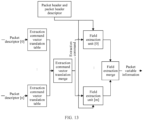
- FIG. 13 is a schematic diagram of logic of a data extraction method according to an embodiment of this application.
- a processor needs to extract key fields of N different protocol types.
- N PHDs for example, PHD 1 to PHD n
- the ECVTT may store a correspondence between the PHD and an extraction command.
- Extraction commands of N different key fields can be obtained through ECVTT query. It should be noted that, in an actual execution process, there may be a plurality of ECVTT tables, or there may be one ECVTT table. In FIG. 13 , an example in which N ECVTTs are included is used.
- the N extraction commands may be respectively input into ECVTT Merge for summarization, to integrate dispersed extraction commands to facilitate extraction.
- the extraction command (Cmd_idx) obtained through ECVTT Merge processing may be separately input into a plurality of field extraction segments (EFS) (for example, respectively input into m EFSs).
- EFS field extraction segments
- the m EFSs may separately perform a parallel extraction operation on a final extraction command, to summarize extracted fields in the EFS Merge, to obtain corresponding packet variable information (Packet Template Vector, PTV) including N key fields.
- PTV Packet Template Vector
- the processor may apply and process the corresponding key fields by using an arithmetic logical unit (ALU) disposed therein.
- ALU arithmetic logical unit
- the m EFSs may input the corresponding data into a corresponding location of the PTV field according to a preset rule. Therefore, the ALU can obtain the corresponding key field in the PTV according to the preset rule, determine locations of key fields to be processed and accurately extract and process the fields.
- the packet parsing method refer to the NHF and the additional field included in the packet header.
- a protocol type and an offset of a next-level packet header are accurately determined based on a protocol type and an offset of a previous-level packet header. Parsing of a plurality of new protocols can be supported. In this way, a packet parsing process is flexible and programmable.
- a plurality of different TCAM query methods are provided to adapt to different requirement scenarios, to obtain optimal query logic in a corresponding scenario.
- a plurality of parsing units share a database in a storage module to implement data sharing and reduce the storage pressure.
- a parallel extraction method is used to effectively reduce time required for extracting the key fields.
- the parsing unit includes a corresponding hardware structure and/or software module for implementing each function.
- steps may be implemented by hardware or a combination of hardware and computer software. Whether a function is performed by hardware or hardware driven by computer software depends on particular applications and design constraints of the technical solutions.
- a person skilled in the art may use different methods to implement the described functions for each particular application, but it should not be considered that the implementation goes beyond the scope of this application.
- each functional module in the parsing unit may be defined based on the foregoing method examples.
- each functional module may be defined in a correspondence to each function, or two or more functions may be integrated in one processing module.
- the integrated module may be implemented in a form of hardware, or may be implemented in a form of a software functional module.
- division into modules is used as an example, and is merely logical function division. In actual implementation, another division manner may be used.
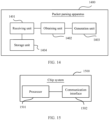
- FIG. 14 shows a schematic composition diagram of a packet parsing apparatus 1400.
- the packet parsing apparatus 1400 may be configured to perform the function of the parsing unit in the foregoing embodiment.
- the packet parsing apparatus 1400 may include a receiving unit 1401 and an obtaining unit 1402.
- the receiving unit 1401 is configured to receive a packet, where the packet includes at least a first packet header and a second packet header, and the second packet header is a next-level packet header of the first packet header.
- the receiving unit 1401 may be configured to perform S401 shown in FIG. 4 .
- the obtaining unit 1402 is configured to obtain a configuration of the first packet header, where the configuration of the first packet header includes a protocol type of the first packet header.
- the obtaining unit 1402 is further configured to obtain first configuration information from the first packet header based on the configuration of the first packet header, where the first configuration information includes a next packet header field (NHF) and an additional field of the first packet header.
- NEF next packet header field
- the obtaining unit 1402 is further configured to: search a first table based on the additional field to obtain a protocol type corresponding to the additional field, and search a second table based on the NHF to obtain a protocol type corresponding to the NHF; when there is the protocol type corresponding to the additional field in the first table, obtain a protocol type of the second packet header based on the protocol type corresponding to the additional field; and when there is no protocol type corresponding to the additional field in the first table, obtain the protocol type of the second packet header based on the protocol type corresponding to the NHF.
- the receiving unit 1401 may be configured to perform S402 to S404 shown in FIG. 4 .
- the configuration of the first packet header further includes an offset of the first packet header
- the first configuration information further includes length information of the first packet header.
- the obtaining unit 1402 is further configured to obtain an offset of the second packet header based on the length information of the first packet header and the offset of the first packet header.
- the obtaining unit 1402 is further configured to: when the first packet header is a first-level packet header of the packet, obtain the configuration of the first packet header based on a physical port number used to receive the packet; and when the first packet header is not the first-level packet header of the packet, obtain second configuration information based on a configuration of a previous-level packet header of the first packet header.
- the second configuration information includes an NHF of the previous-level packet header, an additional field of the previous-level packet header, and length information of the previous-level packet header. The additional field is used to determine the configuration of the first packet header, and obtain the configuration of the first packet header based on the second configuration information.
- the obtaining unit 1402 is further configured to: search a third table based on the protocol type of the first packet header to obtain first location information, where the first location information indicates a location of the additional field in the first packet header, and extract the additional field from the first packet header based on the first location information.
- the obtaining unit 1402 is further configured to: search a fourth table based on the protocol type of the first packet header to obtain second location information, where the second location information indicates a location of the NHF in the first packet header, and extract the NHF from the first packet header based on location information of the NHF.
- the obtaining unit 1402 is further configured to: search a fifth table based on the protocol type of the first packet header to obtain third location information, where the third location information indicates a location of length calculation configuration information in the first packet header, and calculate to obtain the length information of the first packet header based on the length calculation configuration information.
- the obtaining unit 1402 is further configured to perform ternary content addressable memory (TCAM) searching on the second table based on the NHF to obtain the protocol type corresponding to the NHF.
- TCAM ternary content addressable memory
- the obtaining unit 1402 is further configured to: generate, based on the NHF, a search key corresponding to the NHF; determine an entry corresponding to the key in the second table; when there is the entry corresponding to the key in the second table, use a protocol type indicated by the entry as the protocol type corresponding to the NHF; and when there are a plurality of entries corresponding to the key in the second table, determine a target entry from the plurality of entries through priority addressing, and use a protocol type indicated by the target entry as the protocol type corresponding to the NHF.
- the apparatus further includes a generation unit 1403, configured to generate a packet descriptor (PHD) of the packet based on the configuration of the first packet header and a configuration of the second packet header.
- PLD packet descriptor
- the configuration of the second packet header includes the protocol type and the offset that are of the second packet header.
- the obtaining unit 1402 is further configured to obtain packet variable information (PTV) based on the PHD, where the PTV includes a key field.
- PTV packet variable information
- the apparatus further includes a storage unit 1404.
- the storage unit 1404 is configured to store a configuration table, where the configuration table includes at least correspondences included in the first table, the second table, the third table, the fourth table, and the fifth table.
- the packet parsing apparatus includes a plurality of packet parsing units, the plurality of packet parsing units share the configuration table stored in the storage unit 1404.
- the packet parsing apparatus provided in this embodiment of this application is configured to perform the function of the parsing unit in the foregoing communication method, and therefore can achieve a same effect as the foregoing packet parsing method.
- the packet parsing apparatus provided in this embodiment of this application may include a processing module or a control module configured to support the receiving unit 1401 and/or the obtaining unit 1402 and/or the generation unit 1403 and/or the storage unit 1404 in completing corresponding functions.
- FIG. 15 shows a schematic composition diagram of a chip system 1500.
- the chip system 1500 may include a processor 1501 and a communication interface 1502, configured to support the parsing unit in implementing the functions in the foregoing embodiments.
- the chip system 1500 further includes a memory, configured to store program instructions and data that are necessary for a terminal.
- the chip system may include a chip, or may include a chip and another discrete component.
- the data transmission apparatus configured to perform functions of the terminal in the foregoing communication method, and therefore can achieve a same effect as the foregoing communication method.
- inventions may be implemented by using software, hardware, firmware, or any combination thereof.
- a software program is used to implement embodiments, embodiments may be implemented completely or partially in a form of a computer program product.
- the computer program product includes one or more computer instructions.
- the computer may be a general-purpose computer, a dedicated computer, a computer network, or other programmable apparatuses.
- the computer instructions may be stored in a computer-readable storage medium or may be transmitted from a computer-readable storage medium to another computer-readable storage medium.
- the computer instructions may be transmitted from a website, computer, server, or data center to another website, computer, server, or data center in a wired (for example, a coaxial cable, an optical fiber, or a digital subscriber line (DSL)) or wireless (for example, infrared, radio, or microwave) manner.
- the computer-readable storage medium may be any usable medium accessible by a computer, or a data storage device, such as a server or a data center, integrating one or more usable media.
- the usable medium may be a magnetic medium (for example, a floppy disk, a hard disk, or a magnetic tape), an optical medium (for example, a DVD), a semiconductor medium (for example, a solid-state drive (SSD)), or the like.
Landscapes
- Engineering & Computer Science (AREA)
- Computer Security & Cryptography (AREA)
- Computer Networks & Wireless Communication (AREA)
- Signal Processing (AREA)
- Data Exchanges In Wide-Area Networks (AREA)
- Communication Control (AREA)
Claims (14)
- Paketparsingverfahren, wobei das Verfahren Folgendes umfasst:Empfangen eines Pakets, wobei das Paket mindestens einen ersten Paket-Header und einen zweiten Paket-Header umfasst und der zweite Paket-Header ein Paket-Header der nächsten Ebene des ersten Paket-Headers ist;Erlangen einer Konfiguration des ersten Paket-Headers, wobei die Konfiguration des ersten Paket-Headers einen Protokolltyp des ersten Paket-Headers umfasst;Erlangen von ersten Konfigurationsinformationen aus dem ersten Paket-Header basierend auf der Konfiguration des ersten Paket-Headers, wobei die ersten Konfigurationsinformationen ein nächstes Paket-Header-Feld, NHF (next packet header field), und ein zusätzliches Feld des ersten Paket-Headers umfassen;Durchsuchen einer ersten Tabelle basierend auf dem zusätzlichen Feld, um einen Protokolltyp zu erlangen, der dem zusätzlichen Feld entspricht, und Durchsuchen einer zweiten Tabelle basierend auf dem NHF, um einen Protokolltyp zu erlangen, der dem NHF entspricht;wenn der Protokolltyp, der dem zusätzlichen Feld entspricht, in der ersten Tabelle vorliegt, Erlangen eines Protokolltyps des zweiten Paket-Headers basierend auf dem Protokolltyp, der dem zusätzlichen Feld entspricht; undwenn der Protokolltyp, der dem zusätzlichen Feld entspricht, in der ersten Tabelle nicht vorliegt, Erlangen des Protokolltyps des zweiten Paket-Headers basierend auf dem Protokolltyp, der dem NHF entspricht.
- Verfahren gemäß Anspruch 1, wobei die Konfiguration des ersten Paket-Headers ferner einen Versatz des ersten Paket-Headers umfasst und die ersten Konfigurationsinformationen ferner Längeninformationen des ersten Paket-Headers umfassen; und
das Verfahren ferner Folgendes umfasst:
Erlangen eines Versatzes des zweiten Paket-Headers basierend auf den Längeninformationen des ersten Paket-Headers und dem Versatz des ersten Paket-Headers. - Verfahren gemäß Anspruch 2, wobei das Erlangen einer Konfiguration des ersten Paket-Headers Folgendes umfasst:wenn der erste Paket-Header ein Paket-Header erster Ebene des Pakets ist, Erlangen der Konfiguration des ersten Paket-Headers basierend auf einer physischen Portnummer, die zum Empfangen des Pakets verwendet wird; undwenn der erste Paket-Header nicht der Paket-Header erster Ebene des Pakets ist, Erlangen von zweiten Konfigurationsinformationen basierend auf einer Konfiguration eines Paket-Headers vorheriger Ebene des ersten Paket-Headers, wobei die zweiten Konfigurationsinformationen ein NHF des Paket-Headers vorheriger Ebene, ein zusätzliches Feld des Paket-Headers vorheriger Ebene und Längeninformationen des Paket-Headers vorheriger Ebene umfassen und das zusätzliche Feld verwendet wird, um die Konfiguration des ersten Paket-Headers zu bestimmen und die Konfiguration des ersten Paket-Headers basierend auf den zweiten Konfigurationsinformationen zu erlangen.
- Verfahren gemäß Anspruch 2 oder 3, wobei das Erlangen der ersten Konfigurationsinformationen basierend auf der Konfiguration des ersten Paket-Headers Folgendes umfasst:Durchsuchen einer dritten Tabelle basierend auf dem Protokolltyp des ersten Paket-Headers, um erste Ortsinformationen zu erlangen, wobei die ersten Ortsinformationen einen Ort des zusätzlichen Feldes in dem ersten Paket-Header anzeigen, und Extrahieren des zusätzlichen Feldes aus dem ersten Paket-Header basierend auf den ersten Ortsinformationen;Durchsuchen einer vierten Tabelle basierend auf dem Protokolltyp des ersten Paket-Headers, um zweite Ortsinformationen zu erlangen, wobei die zweiten Ortsinformationen einen Ort des NHF in dem ersten Paket-Header anzeigen, und Extrahieren des NHF aus dem ersten Paket-Header basierend auf den zweiten Ortsinformationen; undDurchsuchen einer fünften Tabelle basierend auf dem Protokolltyp des ersten Paket-Headers, um dritte Ortsinformationen zu erlangen, wobei die dritten Ortsinformationen einen Ort von Längenberechnungskonfigurationsinformationen in dem ersten Paket-Header anzeigen, und Berechnen, um die Längeninformationen des ersten Paket-Headers basierend auf den Längenberechnungskonfigurationsinformationen zu erlangen.
- Verfahren gemäß einem der Ansprüche 1 bis 4, wobei das Durchsuchen einer zweiten Tabelle basierend auf dem NHF, um einen Protokolltyp zu erlangen, der dem NHF entspricht, Folgendes umfasst:
Durchführen einer ternären inhaltsadressierbaren Speicherdurchsuchung, TCAM (ternary content addressable memory), in der zweiten Tabelle basierend auf dem NHF, um den Protokolltyp zu erlangen, der dem NHF entspricht. - Verfahren gemäß Anspruch 5, wobei das Durchführen der ternären inhaltsadressierbaren Speicherdurchsuchung, TCAM, in der zweiten Tabelle basierend auf dem NHF, um den Protokolltyp zu erlangen, der dem NHF entspricht, Folgendes umfasst:Generieren eines Suchschlüssels, der dem NHF entspricht, basierend auf dem NHF;Erlangen eines Eintrages in der zweiten Tabelle, der dem Schlüssel entspricht;wenn der Eintrag, der dem Schlüssel entspricht, in der zweiten Tabelle vorliegt, Verwenden eines Protokolltyps, der durch den Eintrag angezeigt wird, als der Protokolltyp, der dem NHF entspricht; undwenn eine Vielzahl von Einträgen, die dem Schlüssel entspricht, in der zweiten Tabelle vorliegt, Bestimmen eines Zieleintrags aus der Vielzahl von Einträgen durch Prioritätsadressierung und Verwenden eines Protokolltyps, der durch den Zieleintrag angezeigt wird, als der Protokolltyp, der dem NHF entspricht.
- Verfahren gemäß einem der Ansprüche 1 bis 6, wobei das Verfahren ferner Folgendes umfasst:
Generieren eines Paketdeskriptors, PHD (packet descriptor), des Pakets basierend auf der Konfiguration des ersten Paket-Headers und einer Konfiguration des zweiten Paket-Headers, wobei die Konfiguration des zweiten Paket-Headers den Protokolltyp und den Versatz umfasst, die zu dem zweiten Paket-Header gehören. - Paketparsingvorrichtung, wobei die Vorrichtung eine Empfangseinheit und eine Erlangungseinheit umfasst;wobei die Empfangseinheit dazu konfiguriert ist, ein Paket zu empfangen, wobei das Paket mindestens einen ersten Paket-Header und einen zweiten Paket-Header umfasst und der zweite Paket-Header ein Paket-Header der nächsten Ebene des ersten Paket-Headers ist;wobei die Erlangungseinheit dazu konfiguriert ist, eine Konfiguration des ersten Paket-Headers zu erlangen, wobei die Konfiguration des ersten Paket-Headers einen Protokolltyp des ersten Paket-Headers umfasst;wobei die Erlangungseinheit ferner dazu konfiguriert ist, erste Konfigurationsinformationen aus dem ersten Paket-Header basierend auf der Konfiguration des ersten Paket-Headers zu erlangen, wobei die ersten Konfigurationsinformationen ein nächstes Paket-Header-Feld, NHF, und ein zusätzliches Feld des ersten Paket-Headers umfassen;wobei die Erlangungseinheit ferner zu Folgendem konfiguriert ist: Durchsuchen einer ersten Tabelle basierend auf dem zusätzlichen Feld, um einen Protokolltyp zu erlangen, der dem zusätzlichen Feld entspricht, und Durchsuchen einer zweiten Tabelle basierend auf dem NHF, um einen Protokolltyp zu erlangen, der dem NHF entspricht;wenn der Protokolltyp, der dem zusätzlichen Feld entspricht, in der ersten Tabelle vorliegt, Erlangen eines Protokolltyps des zweiten Paket-Headers basierend auf dem Protokolltyp, der dem zusätzlichen Feld entspricht; undwenn der Protokolltyp, der dem zusätzlichen Feld entspricht, in der ersten Tabelle nicht vorliegt, Erlangen des Protokolltyps des zweiten Paket-Headers basierend auf dem Protokolltyp, der dem NHF entspricht.
- Vorrichtung gemäß Anspruch 8, wobei die Konfiguration des ersten Paket-Headers ferner einen Versatz des ersten Paket-Headers umfasst und die ersten Konfigurationsinformationen ferner Längeninformationen des ersten Paket-Headers umfassen;
und
wobei die Erlangungseinheit ferner dazu konfiguriert ist, einen Versatz des zweiten Paket-Headers basierend auf den Längeninformationen des ersten Paket-Headers und dem Versatz des ersten Paket-Headers zu erlangen. - Vorrichtung gemäß 9, wobei
die Erlangungseinheit ferner zu Folgendem konfiguriert ist:wenn der erste Paket-Header ein Paket-Header erster Ebene des Pakets ist, Erlangen der Konfiguration des ersten Paket-Headers basierend auf einer physischen Portnummer, die zum Empfangen des Pakets verwendet wird; undwenn der erste Paket-Header nicht der Paket-Header erster Ebene des Pakets ist, Erlangen von zweiten Konfigurationsinformationen basierend auf einer Konfiguration eines Paket-Headers vorheriger Ebene des ersten Paket-Headers,wobei die zweiten Konfigurationsinformationen ein NHF des Paket-Headers vorheriger Ebene, ein zusätzliches Feld des Paket-Headers vorheriger Ebene und Längeninformationen des Paket-Headers vorheriger Ebene umfassen und das zusätzliche Feld verwendet wird, um die Konfiguration des ersten Paket-Headers zu bestimmen und die Konfiguration des ersten Paket-Headers basierend auf den zweiten Konfigurationsinformationen zu erlangen. - Vorrichtung gemäß Anspruch 9 oder 10, wobei die Erlangungseinheit ferner zu Folgendem konfiguriert ist:Durchsuchen einer dritten Tabelle basierend auf dem Protokolltyp des ersten Paket-Headers, um erste Ortsinformationen zu erlangen, wobei die ersten Ortsinformationen einen Ort des zusätzlichen Feldes in dem ersten Paket-Header anzeigen, und Extrahieren des zusätzlichen Feldes aus dem ersten Paket-Header basierend auf den ersten Ortsinformationen;die Erlangungseinheit ferner zu Folgendem konfiguriert ist:Durchsuchen einer vierten Tabelle basierend auf dem Protokolltyp des ersten Paket-Headers, um zweite Ortsinformationen zu erlangen, wobei die zweiten Ortsinformationen einen Ort des NHF in dem ersten Paket-Header anzeigen, und Extrahieren des NHF aus dem ersten Paket-Header basierend auf den zweiten Ortsinformationen; unddie Erlangungseinheit ferner zu Folgendem konfiguriert ist:
Durchsuchen einer fünften Tabelle basierend auf dem Protokolltyp des ersten Paket-Headers, um dritte Ortsinformationen zu erlangen, wobei die dritten Ortsinformationen einen Ort von Längenberechnungskonfigurationsinformationen in dem ersten Paket-Header anzeigen, und Berechnen, um die Längeninformationen des ersten Paket-Headers basierend auf den Längenberechnungskonfigurationsinformationen zu erlangen. - Vorrichtung gemäß einem der Ansprüche 8 bis 11, wobei wobei die Erlangungseinheit ferner dazu konfiguriert ist, eine ternäre inhaltsadressierbare Speicherdurchsuchung, TCAM, in der zweiten Tabelle basierend auf dem NHF durchzuführen, um den Protokolltyp zu erlangen, der dem NHF entspricht.
- Vorrichtung gemäß Anspruch 12, wobei
die Erlangungseinheit ferner zu Folgendem konfiguriert ist:Generieren, basierend auf dem NHF, eines Suchschlüssels, der dem NHF entspricht, und Bestimmen eines Eintrags in der zweiten Tabelle, der dem Schlüssel entspricht;wenn der Eintrag, der dem Schlüssel entspricht, in der zweiten Tabelle vorliegt, Verwenden eines Protokolltyps, der durch den Eintrag angezeigt wird, als der Protokolltyp, der dem NHF entspricht; undwenn eine Vielzahl von Einträgen, die dem Schlüssel entspricht, in der zweiten Tabelle vorliegt, Bestimmen eines Zieleintrags aus der Vielzahl von Einträgen durch Prioritätsadressierung und Verwenden eines Protokolltyps, der durch den Zieleintrag angezeigt wird, als der Protokolltyp, der dem NHF entspricht. - Vorrichtung gemäß einem der Ansprüche 8 bis 13, wobei die Vorrichtung ferner eine Generierungseinheit umfasst;
wobei die Generierungseinheit dazu konfiguriert ist, einen Paketdeskriptor, PHD, des Pakets basierend auf der Konfiguration des ersten Paket-Headers und einer Konfiguration des zweiten Paket-Headers zu generieren, wobei die Konfiguration des zweiten Paket-Headers den Protokolltyp und den Versatz umfasst, die zu dem zweiten Paket-Header gehören.
Applications Claiming Priority (1)
| Application Number | Priority Date | Filing Date | Title |
|---|---|---|---|
| PCT/CN2020/088312 WO2021217588A1 (zh) | 2020-04-30 | 2020-04-30 | 一种报文解析方法和装置 |
Publications (3)
| Publication Number | Publication Date |
|---|---|
| EP4135280A1 EP4135280A1 (de) | 2023-02-15 |
| EP4135280A4 EP4135280A4 (de) | 2023-04-19 |
| EP4135280B1 true EP4135280B1 (de) | 2024-07-24 |
Family
ID=78331634
Family Applications (1)
| Application Number | Title | Priority Date | Filing Date |
|---|---|---|---|
| EP20933357.4A Active EP4135280B1 (de) | 2020-04-30 | 2020-04-30 | Nachrichtenparsingverfahren und -vorrichtung |
Country Status (3)
| Country | Link |
|---|---|
| EP (1) | EP4135280B1 (de) |
| CN (1) | CN114946167B (de) |
| WO (1) | WO2021217588A1 (de) |
Families Citing this family (8)
| Publication number | Priority date | Publication date | Assignee | Title |
|---|---|---|---|---|
| CN114448685B (zh) * | 2022-01-13 | 2023-11-03 | 绿盟科技集团股份有限公司 | 一种生成网络协议报文防护策略的方法及装置 |
| CN117915398A (zh) * | 2022-10-12 | 2024-04-19 | 上海朗帛通信技术有限公司 | 一种被用于无线通信的通信节点中的方法和装置 |
| CN115623054A (zh) * | 2022-10-26 | 2023-01-17 | 建信金融科技有限责任公司 | 远程服务调用方法、装置、设备及存储介质 |
| CN115883681B (zh) * | 2023-02-08 | 2023-06-23 | 天翼云科技有限公司 | 报文解析方法、装置、电子设备及存储介质 |
| CN116634042B (zh) * | 2023-05-23 | 2025-12-16 | 重庆赛力斯凤凰智创科技有限公司 | 大数据报文解析方法、装置及存储介质 |
| CN116668385B (zh) * | 2023-06-09 | 2026-03-10 | 北京百度网讯科技有限公司 | 一种报文处理方法、装置、电子设备及存储介质 |
| CN119484635B (zh) * | 2024-09-13 | 2025-11-21 | 中国建设银行股份有限公司 | 报文转换方法、装置、设备、存储介质及程序产品 |
| CN119342123B (zh) * | 2024-10-15 | 2025-12-26 | 无锡众星微系统技术有限公司 | 一种灵活报文解析装置和方法 |
Family Cites Families (6)
| Publication number | Priority date | Publication date | Assignee | Title |
|---|---|---|---|---|
| CN101022405B (zh) * | 2006-06-23 | 2010-08-25 | 华为技术有限公司 | 一种通用成帧规程封装方法 |
| US9282173B2 (en) * | 2012-02-17 | 2016-03-08 | Viavi Solutions Inc. | Reconfigurable packet header parsing |
| US10142229B2 (en) * | 2015-03-13 | 2018-11-27 | Oracle International Corporation | Concealed datagram-based tunnel for real-time communications |
| CN105554002A (zh) * | 2015-12-22 | 2016-05-04 | 曙光信息产业股份有限公司 | 一种隧道报文的解析方法和装置 |
| CN109218417A (zh) * | 2018-09-04 | 2019-01-15 | 浙江中控技术股份有限公司 | 一种数据获取方法及装置 |
| CN110912859B (zh) * | 2018-09-17 | 2021-12-14 | 华为技术有限公司 | 发送报文的方法、接收报文的方法及网络设备 |
-
2020
- 2020-04-30 EP EP20933357.4A patent/EP4135280B1/de active Active
- 2020-04-30 WO PCT/CN2020/088312 patent/WO2021217588A1/zh not_active Ceased
- 2020-04-30 CN CN202080092603.2A patent/CN114946167B/zh active Active
Also Published As
| Publication number | Publication date |
|---|---|
| WO2021217588A1 (zh) | 2021-11-04 |
| EP4135280A4 (de) | 2023-04-19 |
| CN114946167B (zh) | 2023-11-03 |
| EP4135280A1 (de) | 2023-02-15 |
| CN114946167A (zh) | 2022-08-26 |
Similar Documents
| Publication | Publication Date | Title |
|---|---|---|
| EP4135280B1 (de) | Nachrichtenparsingverfahren und -vorrichtung | |
| US11792117B2 (en) | Packet processing method and apparatus | |
| CN115883681B (zh) | 报文解析方法、装置、电子设备及存储介质 | |
| CN114448891B (zh) | 流表同步方法、装置、设备和介质 | |
| CN110324245B (zh) | 一种基于集成流表转发报文的方法及装置 | |
| CN104702588A (zh) | 解析器、分组处理装置以及相关方法 | |
| WO1996034479A1 (en) | Packet switching engine | |
| CN106878194B (zh) | 一种报文处理方法和装置 | |
| WO2020087400A1 (zh) | 一种报头解析装置及方法 | |
| US20160127237A1 (en) | System and method for reduced forwarding information storage | |
| JP2022527704A (ja) | トラフィック分類方法及び装置 | |
| CN103873464B (zh) | 报文处理的方法及转发设备 | |
| CN117240947B (zh) | 一种报文处理方法、装置及介质 | |
| CN103825824A (zh) | 一种报文处理方法及装置 | |
| US7599364B2 (en) | Configurable network connection address forming hardware | |
| CN119946168B (zh) | 一种报文解析装置及方法 | |
| US9577669B2 (en) | Methods, systems, and computer readable media for optimized message decoding | |
| US20170250910A1 (en) | Routing traffic between networks governed by different versions of the internet protocol | |
| US20060129718A1 (en) | Method and apparatus for pipelined processing of data packets | |
| CN110808972B (zh) | 数据流识别方法及装置 | |
| US20060274762A1 (en) | Method and system for supporting efficient and cache-friendly TCP session lookup operations based on canonicalization tags | |
| CN114697160A (zh) | 一种隧道报文的处理方法和装置 | |
| US12452348B2 (en) | Packet modification method and apparatus, computer device, and storage medium | |
| CN112052191A (zh) | 报文的寻址方法及装置、存储介质、电子装置 | |
| CN118157877B (zh) | 一种ipv6源防护方法、装置及存储介质 |
Legal Events
| Date | Code | Title | Description |
|---|---|---|---|
| STAA | Information on the status of an ep patent application or granted ep patent |
Free format text: STATUS: THE INTERNATIONAL PUBLICATION HAS BEEN MADE |
|
| PUAI | Public reference made under article 153(3) epc to a published international application that has entered the european phase |
Free format text: ORIGINAL CODE: 0009012 |
|
| STAA | Information on the status of an ep patent application or granted ep patent |
Free format text: STATUS: REQUEST FOR EXAMINATION WAS MADE |
|
| 17P | Request for examination filed |
Effective date: 20221107 |
|
| AK | Designated contracting states |
Kind code of ref document: A1 Designated state(s): AL AT BE BG CH CY CZ DE DK EE ES FI FR GB GR HR HU IE IS IT LI LT LU LV MC MK MT NL NO PL PT RO RS SE SI SK SM TR |
|
| REG | Reference to a national code |
Ref country code: DE Ref legal event code: R079 Free format text: PREVIOUS MAIN CLASS: H04L0029060000 Ipc: H04L0069220000 Ref document number: 602020034678 Country of ref document: DE |
|
| A4 | Supplementary search report drawn up and despatched |
Effective date: 20230317 |
|
| RIC1 | Information provided on ipc code assigned before grant |
Ipc: H04L 69/22 20220101AFI20230313BHEP |
|
| DAV | Request for validation of the european patent (deleted) | ||
| DAX | Request for extension of the european patent (deleted) | ||
| GRAP | Despatch of communication of intention to grant a patent |
Free format text: ORIGINAL CODE: EPIDOSNIGR1 |
|
| STAA | Information on the status of an ep patent application or granted ep patent |
Free format text: STATUS: GRANT OF PATENT IS INTENDED |
|
| INTG | Intention to grant announced |
Effective date: 20240223 |
|
| GRAS | Grant fee paid |
Free format text: ORIGINAL CODE: EPIDOSNIGR3 |
|
| GRAA | (expected) grant |
Free format text: ORIGINAL CODE: 0009210 |
|
| STAA | Information on the status of an ep patent application or granted ep patent |
Free format text: STATUS: THE PATENT HAS BEEN GRANTED |
|
| AK | Designated contracting states |
Kind code of ref document: B1 Designated state(s): AL AT BE BG CH CY CZ DE DK EE ES FI FR GB GR HR HU IE IS IT LI LT LU LV MC MK MT NL NO PL PT RO RS SE SI SK SM TR |
|
| REG | Reference to a national code |
Ref country code: GB Ref legal event code: FG4D |
|
| REG | Reference to a national code |
Ref country code: CH Ref legal event code: EP |
|
| REG | Reference to a national code |
Ref country code: IE Ref legal event code: FG4D Ref country code: DE Ref legal event code: R096 Ref document number: 602020034678 Country of ref document: DE |
|
| REG | Reference to a national code |
Ref country code: LT Ref legal event code: MG9D |
|
| REG | Reference to a national code |
Ref country code: NL Ref legal event code: MP Effective date: 20240724 |
|
| PG25 | Lapsed in a contracting state [announced via postgrant information from national office to epo] |
Ref country code: PT Free format text: LAPSE BECAUSE OF FAILURE TO SUBMIT A TRANSLATION OF THE DESCRIPTION OR TO PAY THE FEE WITHIN THE PRESCRIBED TIME-LIMIT Effective date: 20241125 |
|
| REG | Reference to a national code |
Ref country code: AT Ref legal event code: MK05 Ref document number: 1707350 Country of ref document: AT Kind code of ref document: T Effective date: 20240724 |
|
| PG25 | Lapsed in a contracting state [announced via postgrant information from national office to epo] |
Ref country code: NL Free format text: LAPSE BECAUSE OF FAILURE TO SUBMIT A TRANSLATION OF THE DESCRIPTION OR TO PAY THE FEE WITHIN THE PRESCRIBED TIME-LIMIT Effective date: 20240724 |
|
| PG25 | Lapsed in a contracting state [announced via postgrant information from national office to epo] |
Ref country code: PT Free format text: LAPSE BECAUSE OF FAILURE TO SUBMIT A TRANSLATION OF THE DESCRIPTION OR TO PAY THE FEE WITHIN THE PRESCRIBED TIME-LIMIT Effective date: 20241125 Ref country code: NL Free format text: LAPSE BECAUSE OF FAILURE TO SUBMIT A TRANSLATION OF THE DESCRIPTION OR TO PAY THE FEE WITHIN THE PRESCRIBED TIME-LIMIT Effective date: 20240724 |
|
| PG25 | Lapsed in a contracting state [announced via postgrant information from national office to epo] |
Ref country code: NO Free format text: LAPSE BECAUSE OF FAILURE TO SUBMIT A TRANSLATION OF THE DESCRIPTION OR TO PAY THE FEE WITHIN THE PRESCRIBED TIME-LIMIT Effective date: 20241024 |
|
| PG25 | Lapsed in a contracting state [announced via postgrant information from national office to epo] |
Ref country code: FI Free format text: LAPSE BECAUSE OF FAILURE TO SUBMIT A TRANSLATION OF THE DESCRIPTION OR TO PAY THE FEE WITHIN THE PRESCRIBED TIME-LIMIT Effective date: 20240724 Ref country code: PL Free format text: LAPSE BECAUSE OF FAILURE TO SUBMIT A TRANSLATION OF THE DESCRIPTION OR TO PAY THE FEE WITHIN THE PRESCRIBED TIME-LIMIT Effective date: 20240724 Ref country code: GR Free format text: LAPSE BECAUSE OF FAILURE TO SUBMIT A TRANSLATION OF THE DESCRIPTION OR TO PAY THE FEE WITHIN THE PRESCRIBED TIME-LIMIT Effective date: 20241025 |
|
| PG25 | Lapsed in a contracting state [announced via postgrant information from national office to epo] |
Ref country code: BG Free format text: LAPSE BECAUSE OF FAILURE TO SUBMIT A TRANSLATION OF THE DESCRIPTION OR TO PAY THE FEE WITHIN THE PRESCRIBED TIME-LIMIT Effective date: 20240724 |
|
| PG25 | Lapsed in a contracting state [announced via postgrant information from national office to epo] |
Ref country code: LV Free format text: LAPSE BECAUSE OF FAILURE TO SUBMIT A TRANSLATION OF THE DESCRIPTION OR TO PAY THE FEE WITHIN THE PRESCRIBED TIME-LIMIT Effective date: 20240724 |
|
| PG25 | Lapsed in a contracting state [announced via postgrant information from national office to epo] |
Ref country code: AT Free format text: LAPSE BECAUSE OF FAILURE TO SUBMIT A TRANSLATION OF THE DESCRIPTION OR TO PAY THE FEE WITHIN THE PRESCRIBED TIME-LIMIT Effective date: 20240724 Ref country code: IS Free format text: LAPSE BECAUSE OF FAILURE TO SUBMIT A TRANSLATION OF THE DESCRIPTION OR TO PAY THE FEE WITHIN THE PRESCRIBED TIME-LIMIT Effective date: 20241124 |
|
| PG25 | Lapsed in a contracting state [announced via postgrant information from national office to epo] |
Ref country code: HR Free format text: LAPSE BECAUSE OF FAILURE TO SUBMIT A TRANSLATION OF THE DESCRIPTION OR TO PAY THE FEE WITHIN THE PRESCRIBED TIME-LIMIT Effective date: 20240724 |
|
| PG25 | Lapsed in a contracting state [announced via postgrant information from national office to epo] |
Ref country code: ES Free format text: LAPSE BECAUSE OF FAILURE TO SUBMIT A TRANSLATION OF THE DESCRIPTION OR TO PAY THE FEE WITHIN THE PRESCRIBED TIME-LIMIT Effective date: 20240724 Ref country code: RS Free format text: LAPSE BECAUSE OF FAILURE TO SUBMIT A TRANSLATION OF THE DESCRIPTION OR TO PAY THE FEE WITHIN THE PRESCRIBED TIME-LIMIT Effective date: 20241024 |
|
| PG25 | Lapsed in a contracting state [announced via postgrant information from national office to epo] |
Ref country code: RS Free format text: LAPSE BECAUSE OF FAILURE TO SUBMIT A TRANSLATION OF THE DESCRIPTION OR TO PAY THE FEE WITHIN THE PRESCRIBED TIME-LIMIT Effective date: 20241024 Ref country code: PL Free format text: LAPSE BECAUSE OF FAILURE TO SUBMIT A TRANSLATION OF THE DESCRIPTION OR TO PAY THE FEE WITHIN THE PRESCRIBED TIME-LIMIT Effective date: 20240724 Ref country code: NO Free format text: LAPSE BECAUSE OF FAILURE TO SUBMIT A TRANSLATION OF THE DESCRIPTION OR TO PAY THE FEE WITHIN THE PRESCRIBED TIME-LIMIT Effective date: 20241024 Ref country code: LV Free format text: LAPSE BECAUSE OF FAILURE TO SUBMIT A TRANSLATION OF THE DESCRIPTION OR TO PAY THE FEE WITHIN THE PRESCRIBED TIME-LIMIT Effective date: 20240724 Ref country code: IS Free format text: LAPSE BECAUSE OF FAILURE TO SUBMIT A TRANSLATION OF THE DESCRIPTION OR TO PAY THE FEE WITHIN THE PRESCRIBED TIME-LIMIT Effective date: 20241124 Ref country code: HR Free format text: LAPSE BECAUSE OF FAILURE TO SUBMIT A TRANSLATION OF THE DESCRIPTION OR TO PAY THE FEE WITHIN THE PRESCRIBED TIME-LIMIT Effective date: 20240724 Ref country code: GR Free format text: LAPSE BECAUSE OF FAILURE TO SUBMIT A TRANSLATION OF THE DESCRIPTION OR TO PAY THE FEE WITHIN THE PRESCRIBED TIME-LIMIT Effective date: 20241025 Ref country code: FI Free format text: LAPSE BECAUSE OF FAILURE TO SUBMIT A TRANSLATION OF THE DESCRIPTION OR TO PAY THE FEE WITHIN THE PRESCRIBED TIME-LIMIT Effective date: 20240724 Ref country code: ES Free format text: LAPSE BECAUSE OF FAILURE TO SUBMIT A TRANSLATION OF THE DESCRIPTION OR TO PAY THE FEE WITHIN THE PRESCRIBED TIME-LIMIT Effective date: 20240724 Ref country code: BG Free format text: LAPSE BECAUSE OF FAILURE TO SUBMIT A TRANSLATION OF THE DESCRIPTION OR TO PAY THE FEE WITHIN THE PRESCRIBED TIME-LIMIT Effective date: 20240724 Ref country code: AT Free format text: LAPSE BECAUSE OF FAILURE TO SUBMIT A TRANSLATION OF THE DESCRIPTION OR TO PAY THE FEE WITHIN THE PRESCRIBED TIME-LIMIT Effective date: 20240724 |
|
| PG25 | Lapsed in a contracting state [announced via postgrant information from national office to epo] |
Ref country code: DK Free format text: LAPSE BECAUSE OF FAILURE TO SUBMIT A TRANSLATION OF THE DESCRIPTION OR TO PAY THE FEE WITHIN THE PRESCRIBED TIME-LIMIT Effective date: 20240724 Ref country code: SM Free format text: LAPSE BECAUSE OF FAILURE TO SUBMIT A TRANSLATION OF THE DESCRIPTION OR TO PAY THE FEE WITHIN THE PRESCRIBED TIME-LIMIT Effective date: 20240724 Ref country code: RO Free format text: LAPSE BECAUSE OF FAILURE TO SUBMIT A TRANSLATION OF THE DESCRIPTION OR TO PAY THE FEE WITHIN THE PRESCRIBED TIME-LIMIT Effective date: 20240724 |
|
| PG25 | Lapsed in a contracting state [announced via postgrant information from national office to epo] |
Ref country code: EE Free format text: LAPSE BECAUSE OF FAILURE TO SUBMIT A TRANSLATION OF THE DESCRIPTION OR TO PAY THE FEE WITHIN THE PRESCRIBED TIME-LIMIT Effective date: 20240724 |
|
| PG25 | Lapsed in a contracting state [announced via postgrant information from national office to epo] |
Ref country code: CZ Free format text: LAPSE BECAUSE OF FAILURE TO SUBMIT A TRANSLATION OF THE DESCRIPTION OR TO PAY THE FEE WITHIN THE PRESCRIBED TIME-LIMIT Effective date: 20240724 |
|
| REG | Reference to a national code |
Ref country code: DE Ref legal event code: R097 Ref document number: 602020034678 Country of ref document: DE |
|
| PG25 | Lapsed in a contracting state [announced via postgrant information from national office to epo] |
Ref country code: SK Free format text: LAPSE BECAUSE OF FAILURE TO SUBMIT A TRANSLATION OF THE DESCRIPTION OR TO PAY THE FEE WITHIN THE PRESCRIBED TIME-LIMIT Effective date: 20240724 Ref country code: IT Free format text: LAPSE BECAUSE OF FAILURE TO SUBMIT A TRANSLATION OF THE DESCRIPTION OR TO PAY THE FEE WITHIN THE PRESCRIBED TIME-LIMIT Effective date: 20240724 |
|
| PLBE | No opposition filed within time limit |
Free format text: ORIGINAL CODE: 0009261 |
|
| STAA | Information on the status of an ep patent application or granted ep patent |
Free format text: STATUS: NO OPPOSITION FILED WITHIN TIME LIMIT |
|
| 26N | No opposition filed |
Effective date: 20250425 |
|
| PGFP | Annual fee paid to national office [announced via postgrant information from national office to epo] |
Ref country code: DE Payment date: 20250305 Year of fee payment: 6 |
|
| PG25 | Lapsed in a contracting state [announced via postgrant information from national office to epo] |
Ref country code: SE Free format text: LAPSE BECAUSE OF FAILURE TO SUBMIT A TRANSLATION OF THE DESCRIPTION OR TO PAY THE FEE WITHIN THE PRESCRIBED TIME-LIMIT Effective date: 20240724 |
|
| REG | Reference to a national code |
Ref country code: CH Ref legal event code: H13 Free format text: ST27 STATUS EVENT CODE: U-0-0-H10-H13 (AS PROVIDED BY THE NATIONAL OFFICE) Effective date: 20251125 |
|
| PG25 | Lapsed in a contracting state [announced via postgrant information from national office to epo] |
Ref country code: LU Free format text: LAPSE BECAUSE OF NON-PAYMENT OF DUE FEES Effective date: 20250430 |
|
| PG25 | Lapsed in a contracting state [announced via postgrant information from national office to epo] |
Ref country code: MC Free format text: LAPSE BECAUSE OF FAILURE TO SUBMIT A TRANSLATION OF THE DESCRIPTION OR TO PAY THE FEE WITHIN THE PRESCRIBED TIME-LIMIT Effective date: 20240724 |
|
| GBPC | Gb: european patent ceased through non-payment of renewal fee |
Effective date: 20250430 |
|
| REG | Reference to a national code |
Ref country code: BE Ref legal event code: MM Effective date: 20250430 |
|
| PG25 | Lapsed in a contracting state [announced via postgrant information from national office to epo] |
Ref country code: GB Free format text: LAPSE BECAUSE OF NON-PAYMENT OF DUE FEES Effective date: 20250430 |
|
| PG25 | Lapsed in a contracting state [announced via postgrant information from national office to epo] |
Ref country code: FR Free format text: LAPSE BECAUSE OF NON-PAYMENT OF DUE FEES Effective date: 20250430 |
|
| PG25 | Lapsed in a contracting state [announced via postgrant information from national office to epo] |
Ref country code: BE Free format text: LAPSE BECAUSE OF NON-PAYMENT OF DUE FEES Effective date: 20250430 |
|
| PG25 | Lapsed in a contracting state [announced via postgrant information from national office to epo] |
Ref country code: CH Free format text: LAPSE BECAUSE OF NON-PAYMENT OF DUE FEES Effective date: 20250430 |
|
| PG25 | Lapsed in a contracting state [announced via postgrant information from national office to epo] |
Ref country code: IE Free format text: LAPSE BECAUSE OF NON-PAYMENT OF DUE FEES Effective date: 20250430 |