EP4136065B1 - Hydrierung von l-sorbose - Google Patents
Hydrierung von l-sorbose Download PDFInfo
- Publication number
- EP4136065B1 EP4136065B1 EP21717460.6A EP21717460A EP4136065B1 EP 4136065 B1 EP4136065 B1 EP 4136065B1 EP 21717460 A EP21717460 A EP 21717460A EP 4136065 B1 EP4136065 B1 EP 4136065B1
- Authority
- EP
- European Patent Office
- Prior art keywords
- alkyl
- aryl
- cycloalkyl
- transition metal
- heterocycloalkyl
- Prior art date
- Legal status (The legal status is an assumption and is not a legal conclusion. Google has not performed a legal analysis and makes no representation as to the accuracy of the status listed.)
- Active
Links
Classifications
-
- C—CHEMISTRY; METALLURGY
- C07—ORGANIC CHEMISTRY
- C07C—ACYCLIC OR CARBOCYCLIC COMPOUNDS
- C07C29/00—Preparation of compounds having hydroxy or O-metal groups bound to a carbon atom not belonging to a six-membered aromatic ring
- C07C29/132—Preparation of compounds having hydroxy or O-metal groups bound to a carbon atom not belonging to a six-membered aromatic ring by reduction of an oxygen containing functional group
- C07C29/136—Preparation of compounds having hydroxy or O-metal groups bound to a carbon atom not belonging to a six-membered aromatic ring by reduction of an oxygen containing functional group of >C=O containing groups, e.g. —COOH
- C07C29/143—Preparation of compounds having hydroxy or O-metal groups bound to a carbon atom not belonging to a six-membered aromatic ring by reduction of an oxygen containing functional group of >C=O containing groups, e.g. —COOH of ketones
- C07C29/145—Preparation of compounds having hydroxy or O-metal groups bound to a carbon atom not belonging to a six-membered aromatic ring by reduction of an oxygen containing functional group of >C=O containing groups, e.g. —COOH of ketones with hydrogen or hydrogen-containing gases
-
- B—PERFORMING OPERATIONS; TRANSPORTING
- B01—PHYSICAL OR CHEMICAL PROCESSES OR APPARATUS IN GENERAL
- B01J—CHEMICAL OR PHYSICAL PROCESSES, e.g. CATALYSIS OR COLLOID CHEMISTRY; THEIR RELEVANT APPARATUS
- B01J31/00—Catalysts comprising hydrides, coordination complexes or organic compounds
- B01J31/16—Catalysts comprising hydrides, coordination complexes or organic compounds containing coordination complexes
- B01J31/24—Phosphines, i.e. phosphorus bonded to only carbon atoms, or to both carbon and hydrogen atoms, including e.g. sp2-hybridised phosphorus compounds such as phosphabenzene, phosphole or anionic phospholide ligands
- B01J31/2404—Cyclic ligands, including e.g. non-condensed polycyclic ligands, the phosphine-P atom being a ring member or a substituent on the ring
- B01J31/2442—Cyclic ligands, including e.g. non-condensed polycyclic ligands, the phosphine-P atom being a ring member or a substituent on the ring comprising condensed ring systems
- B01J31/2447—Cyclic ligands, including e.g. non-condensed polycyclic ligands, the phosphine-P atom being a ring member or a substituent on the ring comprising condensed ring systems and phosphine-P atoms as substituents on a ring of the condensed system or on a further attached ring
- B01J31/2452—Cyclic ligands, including e.g. non-condensed polycyclic ligands, the phosphine-P atom being a ring member or a substituent on the ring comprising condensed ring systems and phosphine-P atoms as substituents on a ring of the condensed system or on a further attached ring with more than one complexing phosphine-P atom
-
- B—PERFORMING OPERATIONS; TRANSPORTING
- B01—PHYSICAL OR CHEMICAL PROCESSES OR APPARATUS IN GENERAL
- B01J—CHEMICAL OR PHYSICAL PROCESSES, e.g. CATALYSIS OR COLLOID CHEMISTRY; THEIR RELEVANT APPARATUS
- B01J2231/00—Catalytic reactions performed with catalysts classified in B01J31/00
- B01J2231/60—Reduction reactions, e.g. hydrogenation
- B01J2231/64—Reductions in general of organic substrates, e.g. hydride reductions or hydrogenations
- B01J2231/641—Hydrogenation of organic substrates, i.e. H2 or H-transfer hydrogenations, e.g. Fischer-Tropsch processes
-
- B—PERFORMING OPERATIONS; TRANSPORTING
- B01—PHYSICAL OR CHEMICAL PROCESSES OR APPARATUS IN GENERAL
- B01J—CHEMICAL OR PHYSICAL PROCESSES, e.g. CATALYSIS OR COLLOID CHEMISTRY; THEIR RELEVANT APPARATUS
- B01J2531/00—Additional information regarding catalytic systems classified in B01J31/00
- B01J2531/80—Complexes comprising metals of Group VIII as the central metal
- B01J2531/82—Metals of the platinum group
- B01J2531/821—Ruthenium
-
- C—CHEMISTRY; METALLURGY
- C07—ORGANIC CHEMISTRY
- C07B—GENERAL METHODS OF ORGANIC CHEMISTRY; APPARATUS THEREFOR
- C07B2200/00—Indexing scheme relating to specific properties of organic compounds
- C07B2200/07—Optical isomers
-
- Y—GENERAL TAGGING OF NEW TECHNOLOGICAL DEVELOPMENTS; GENERAL TAGGING OF CROSS-SECTIONAL TECHNOLOGIES SPANNING OVER SEVERAL SECTIONS OF THE IPC; TECHNICAL SUBJECTS COVERED BY FORMER USPC CROSS-REFERENCE ART COLLECTIONS [XRACs] AND DIGESTS
- Y02—TECHNOLOGIES OR APPLICATIONS FOR MITIGATION OR ADAPTATION AGAINST CLIMATE CHANGE
- Y02P—CLIMATE CHANGE MITIGATION TECHNOLOGIES IN THE PRODUCTION OR PROCESSING OF GOODS
- Y02P20/00—Technologies relating to chemical industry
- Y02P20/50—Improvements relating to the production of bulk chemicals
- Y02P20/55—Design of synthesis routes, e.g. reducing the use of auxiliary or protecting groups
Definitions
- the invention relates to a process for L-lditol by hydrogenating L-Sorbose. Further, the invention also relates to a use of a transition metal complex as hydrogenation catalyst for L-Sorbose.
- L-Iditol ( CAS Number 488-45-9 ) is a sugar alcohol which can be derived by conversion of certain sugars and carbohydrates. L-lditol can serve, inter alia, as the starting point for the synthesis of pharmaceuticals, polymers and macrocyclic compounds, but is of particular commercial interest.
- L-lditol is only found in trace amounts in nature, isolation from natural sources is not an economic option. Therefore, the hydrogenation of L-Sorbose ( CAS Number: 87-79-6 ) (produced as an intermediate on a large scale in the vitamin C synthesis) is of particular interest. But in the prior art, only few approaches for accessing L-lditol from L-Sorbose have been suggested.
- L-lditol One way to produce L-lditol is the reduction of L-Sorbose by fermentation with yeasts, as described by M. Ogawa et al., in Applied and Environmental Microbiology, 1983, 46 (4), 912-916 . Unfortunately, the process provides only low yields of L-lditol with a maximum 33% of the consumed L-Sorbose in the fermentation, because the yeast metabolizes most of the sugar starting material under fermentation conditions.
- EP 0 006 313A1 discloses the production of sugar alcohols by catalytic hydrogenation of of keto sugars on copper catalysts containing finely divided metallic copper on a particulate support material.
- L-lditol can only be obtained as the by-product, with a maximum ratio of L-Iditol to D-Sorbitol of 38:62 at 100% conversion of D-Sorbose.
- the processes of the prior art exhibits various disadvantages.
- One disadvantage of the processes based on heterogeneous catalysis is that the hydrogenation is not stereoselective, and only a 1:1 mixture of D-Sorbitol and L-lditol is obtained, requiring an additional fermentations step and separation of the compounds obtained.
- WO 2008/132057 relates to a method for synthesizing optically active carbonyl compounds by the asymmetric hydrogenation of ⁇ , ⁇ -unsaturated carbonyl compounds, in the presence of optically active transition metal catalysts, which are soluble in the reaction mixture and which have at least one carbon monoxide ligand.
- This process it should be possible to provide L-lditol as the preferred product of the hydrogenation.
- the process should be performed cost-effectively without the need for many reaction steps. Further, the process should be performed as a homogeneously catalyzed hydrogenation of L-Sorbose.
- the problem is solved by a process, wherein the L-Sorbose comprising composition is subjected to hydrogenation with hydrogen in the presence of a stereoselective transition metal catalyst complex in a homogenous solution, wherein the transition metal catalyst complex comprises at least one chiral ligand containing at least one phosphorus atom, which is capable of coordinating to the transition metal yielding in a composition comprising L-lditol as the main product.
- the invention relates to a process for the preparation of L-lditol comprising at least one reaction step, in which a composition comprising L-Sorbose and hydrogen is reacted in the presence of a transition metal catalyst complex in a homogeneous solution, wherein the transition metal catalyst complex comprises at least one chiral ligand containing at least one phosphorus atom, which is capable of coordinating to the transition metal, and wherein the transition metal is selected from metals of groups 8, 9 and 10 of the periodic table of the elements according to IUPAC, where the chiral ligand is selected from compounds of formula (I) as defined herein.
- the invention further relates to a use of a transition metal complex as defined above and below as hydrogenation catalyst for compositions comprising L-lditol or mixtures thereof.
- L-Sorbose, L-lditol and D-Sorbitol have the following chemical structions depicted as Fischer projecition.
- alkyl means straight and branched alkyl groups. Preferred are straight or branched C 1 -C 20 -alkyl groups, more preferably C 1 -C 12 -alkyl groups, even more preferably C 1 -C 8 -alkyl groups and in particular C 1 -C 6 -alkyl groups.
- alkyl groups are particularly methyl, ethyl, propyl, isopropyl, n-butyl, isobutyl, sec-butyl, tert-butyl, n-pentyl, 2-pentyl, 2-methylbutyl, 3-methylbutyl, 1,2-dimethylpropyl, 1,1-dimethylpropyl, 2,2-dimethylpropyl, 1-ethylpropyl, n-hexyl, 2-hexyl, 2-methylpentyl, 3-methylpentyl, 4-methylpentyl, 1,2-dimethylbutyl, 1,3-dimethylbutyl, 2,3-dimethylbutyl, 1,1-dimethylbutyl, 2,2-dimethylbutyl, 3,3-dimethylbutyl, 1,1,2-trimethylpropyl, 1,2,2-trimethylpropyl, 1-ethylbutyl, 2-ethylbutyl, 1-ethyl-2-methylpropy
- alkyl comprises also substituted alkyl groups, which may carry 1, 2, 3, 4 or 5 substituents, preferably 1, 2 or 3 substituents and particularly preferably 1 substituent, selected from the groups cycloalkyl, aryl, hetaryl, halogen, NE 1 E 2 , NE 1 E 2 E 3+ , COOH, carboxylate, SO 3 H and sulfonate.
- alkyl also comprises alkyl groups, which are interrupted by one or more non-adjacent oxygen atoms, preferably alkoxyalkyl.
- alkoxy in the context of the present invention stands for a saturated, straight-chain or branched hydrocarbon radical having 1 to 4, 1 to 6, 1 to 10, 1 to 20 or 1 to 30 carbon atoms, as defined above, which is bonded via oxygen, e.g. C 1 -C 4 -alkoxy, such as methoxy, ethoxy, n-propoxy, 1-methylethoxy, butoxy, 1-methylpropoxy, 2-methylpropoxy or 1,1-dimethylethoxy; C 1 -C 6 -alkoxy: C 1 -C 4 -alkoxy, as specified above, and e.g.
- pentoxy 1-methylbutoxy, 2-methylbutoxy, 3-methylbutoxy, 1,1-dimethylpropoxy, 1,2-dimethylpropoxy, 2,2-dimethylpropoxy, 1-ethylpropoxy, hexoxy, 1-methylpentoxy, 2-methylpentoxy, 3-methylpentoxy, 4-methylpentoxy, 1,1-dimethylbutoxy, 1,2-dimethylbutoxy, 1,3-dimethylbutoxy, 2,2-dimethylbutoxy, 2,3-dimethylbutoxy, 3,3-dimethylbutoxy, 1-ethylbutoxy, 2-ethylbutoxy, 1,1,2-trimethylpropoxy, 1,2,2-trimethylpropoxy, 1-ethyl-1-methylpropoxy or 1-ethyl-2-methylpropoxy.
- alkylene in the context of the present invention stands for straight or branched alkanediyl groups having 1 to 25, preferably 1 to 6 carbon atoms. These are -CH 2 -, -(CH 2 ) 2 -, -(CH 2 ) 3 -,-(CH 2 ) 4 -, -(CH 2 ) 2 -CH(CH 3 )-, (-CH 2 -CH(CH 3 )-), -CH 2 -CH(CH 3 )-CH 2 -, (CH 2 ) 4 -, -(CH 2 ) 5 -, -(CH 2 ) 6 , -(CH 2 ) 7 -, -CH(CH 3 )-CH 2 -CH 2 -CH(CH 3 )- or -CH(CH 3 )-CH 2 -CH 2 -CH 2 -CH(CH 3 )- etc.
- cycloalkyl in the context of the present invention stands for a monocyclic, bicyclic or tricyclic, saturated hydrocarbon group having 3 to 12, preferably 3 to 6 or 3 to 8 carbon ring members, e.g. a monocyclic hydrocarbon group having 3 to 8 carbon ring members, such as cyclopropyl, cyclobutyl, cyclopentyl, cyclohexyl, cycloheptyl or cyclooctyl; a bicyclic hydrocarbon group having 5 to 10 carbon ring members, such as bicyclo[2.2.1]hept-1-yl, bicyclo[2.2.1]hept-2-yl, bicyclo[2.2.1]hept-7-yl, bicyclo[2.2.2]oct-1-yl, bicyclo[2.2.2]oct-2-yl, bicyclo[3.3.0]octyl and bicyclo[4.4.0]decyl; a tricyclic hydrocarbon group with 6 to 10 carbon ring members
- heterocycloalkyl in the context of the present invention comprises saturated or partially unsaturated cycloaliphatic groups with preferably 4 to 7, more preferably 5 or 6 ring atoms, in which 1, 2, 3 or 4 ring atoms may be substituted with heteroatoms, preferably selected from the elements oxygen, nitrogen and sulfur.
- the heterocycloalkyl ring is optionally substituted. If substituted, these heterocycloaliphatic groups carry preferably 1, 2 or 3 substituents, more preferably 1 or 2 substituents and in particular 1 substituent.
- heterocycloaliphatic groups examples include pyrrolidinyl, piperidinyl, 2,2,6,6-tetramethylpiperidinyl, imidazolidinyl, pyrazolidinyl, oxazolidinyl, morpholidinyl, thiazolidinyl, isothiazolidinyl, isoxazolidinyl, piperazinyl, tetrahydrothiophenyl, tetrahydrofuranyl, tetrahydropyranyl and dioxanyl.
- aryl in the context of the present invention comprises a mono- or polynuclear aromatic hydrocarbon radical having usually 6 to 14, preferably 6 to 10 carbon atoms, such as e.g. phenyl, tolyl, xylyl, mesityl, naphthyl, indenyl, fluoroenyl, anthracenyl or phenanthrenyl.
- aryl groups may carry preferably 1, 2, 3, 4 or 5 substituents, more preferably 1, 2 or 3 substituents and particularly preferred 1 substituent.
- substituents are preferably selected from the groups alkyl, alkoxy, carboxyl, carboxylate, trifluoromethyl, -SO 3 H, sulfonate, NE 1 E 2 , alkylene-NE 1 E 2 , nitro, cyano and halogen.
- a preferred fluorinated aryl group is pentafluorophenyl.
- aryloxy in the context of the present invention stands for a mono- or polynuclear aromatic hydrocarbon radical having usually 6 to 14, preferably 6 to 10 carbon atoms, as defined above, which is bonded via an oxygen atom.
- 3- to 8-membered saturated heterocyclyl such as oxiranyl, oxetanyl, aziranyl, piperidinyl, piperazinyl, morpholinyl, thimorpholinyl, pyrrolidinyl, oxazolidinyl, tetrahydrofuryl, dioxolanyl, dioxanyl, hexahydroazepinyl, hexyhydrooxepinyl, and hexahydrothiepinyl; partially unsaturated 3-, 4-, 5-, 6-, 7- or 8-membered heterocyclyl, such as di- and tetrahydropyridinyl, pyrrolinyl, oxazolinyl, dihydrofuryl, tetrahydroazepinyl, tetrahydrooxepinyl, and tetrahydrothiepinyl.
- heterocycloalkoxy is a saturated, partially (e.g. mono-) unsaturated heterocyclic radical having 3, 4, 5, 6, 7, 8, 9, 10, 11 or 12 ring atoms, of which 1, 2 or 3 are selected from N, O, S, S(O) and S(O) 2 , and the other ring atoms are carbon, as defined above, which is bonded via oxygen.
- heterocycloaromatic groups may carry preferably 1, 2 or 3 substituents selected from the groups alkyl, alkoxy, carboxyl, carboxylate, -SO 3 H, sulfonate, NE 1 E 2 , alkylene-NE 1 E 2 , trifluoromethyl and halogen.
- Carboxylate and sulfonate in the context of the present invention preferably stand for a derivative of a carboxylic acid function or a sulfonic acid function, in particular a metal carboxylate or metal sulfonate, a carboxylic acid ester or sulfonic acid ester or a carboxylic acid amide or sulfonic acid amide.
- esters with C 1 -C 4 -alkanols like methanol, ethanol, n-propanol, isopropanol, n-butanol, sec-butanol and tert-butanol.
- Preferred are also the primary amides and their N-alkyl and N,N-dialkyl derivatives.
- acyl in the context of the present invention stands for alkanoyl groups or aroyl groups with preferably 2 to 11, more preferably 2 to 8 carbon atoms, for example acetyl, propanoyl, butanoyl, pentanoyl, hexanoyl, heptanoyl, 2-ethylhexanoyl, 2-propylheptanoyl, benzoyl and naphthoyl.
- the groups NE 1 E 2 , NE 4 E 5 and NE 7 E 8 are preferably selected from N,N-dimethylamino, N,N-diethylamino, N,N-dipropylamino, N,N-diisopropylamino, N,N-di-n-butylamino, N,N-di-tert-butylamino, N,N-dicyclohexylamino and N,N-diphenylamino.
- Halogen stands for fluorine, chlorine, bromine or iodine, preferably fluorine, chlorine or bromine.
- Formyl ist H-C( O)-.
- Polyalkylene oxide is a radical derived from identical or different C 2-4 -oxyalkylene monomer building blocks, as defined above, with a degree of polymerization (number average) in the range of 2 to 100, or 3 to 50 or 4 to 25 or 5 to 10.
- Polyalkyleneimine is a structure-analogous radical to the above polyalkylene oxide radical with the oxygen atom being replaced by an imine group.
- M + refers to a cation equivalent, which means a monovalent cation or the part of a polyvalent cation representing a positive single charge.
- the cation M + is only a counter ion, which neutralizes negatively charged substituents like the COO - or the sulfonate group and which can principally be selected arbitrarily.
- Preferred are alkaline metal ions, in particular Na + , K + and Li + ions, or onium ions like ammonium ions, mono-, di-, tri-, tetraalkylammonium ions, phosphonium ions, tetraalkylphosphonium ions and tetraarylphosphonium ions.
- anion equivalent X - which is only a counter ion for positively charged substituents like the ammonium group and which can principally be selected arbitrarily among monovalent anions and the parts of polyvalent anions, which correspond to a single negative charge.
- halogenides X - in particular chloride and bromide.
- sulfates and sulfonates in particular SO 4 2- , tosylate, trifluoromethane sulfonate and methylsulfonate.
- Condensed ring systems also termed fused ring systems, are aromatic, heteroaromatic or cyclic compounds, which have fused-on rings obtained via anellation.
- Condensed ring systems consist of two, three or more than three rings. Depending on the type of connection, one distinguishes between ortho-anellation and peri-anellation. In case of ortho-anellation, each ring has two atoms in common with each adjacent ring. In case of peri-anellation, a carbon atom belongs to more than two rings.
- Preferred among the condensed ring systems are ortho-condensed ring systems.
- chiral ligands are ligands without an axis of symmetry. They are in particular ligands with at least one chirality center (i.e. at least one asymmetric atom, in particular at least one asymmetric P atom or C atom).
- addition ligands are employed, which show axial chirality. Axial chirality occurs, for example, in biphenyls, such as BINAP, which are substituted in the ortho-positions in such a way that the free rotation of the aromatic compounds around the C-C single bond is strongly hindered. This then results in two mirror-image isomers.
- chiral catalyst comprises catalysts, which have at least one chiral ligand.
- Achiral compounds are compounds, which are not chiral.
- prochiral compound is understood as meaning a compound with at least one prochiral center.
- Asymmetric synthesis refers to a reaction in which a compound with at least one chirality center is produced from a compound with at least one prochiral center, where the stereoisomeric products are formed in unequal amounts.
- Steps are compounds of identical constitution, but different atomic arrangement in the three-dimensional space.
- Enantiomers are stereoisomers, which behave like image to mirror image to one another.
- R and S are the descriptors of the CIP system for the two enantiomers and describe the absolute configuration on the asymmetric atom.
- the enantiomerically pure compound (ee 100%) is also referred to as "homochiral compound”.
- the process according to the invention leads to products, which are enriched with regard to a specific stereoisomer, in particular with regard to L-lditol.
- the attained "enantiomer excess” (ee) is generally at least 20%, preferably at least 50%, in particular at least 80%.
- Diastereomers are stereoisomers, which are not enantiomeric to one another.
- the composition comprising L-Sorbose is subjected to hydrogenation in a liquid reaction medium in the presence of a transition metal catalyst complex, which comprises at least one chiral ligand containing at least one phosphorus atom, which is capable of coordinating to the transition metal. Due to this chiral ligand the transition metal catalyst complex is stereoselective.
- a transition metal catalyst complex which comprises at least one chiral ligand containing at least one phosphorus atom, which is capable of coordinating to the transition metal. Due to this chiral ligand the transition metal catalyst complex is stereoselective.
- the product mixture predominately comprises the desired stereoisomer.
- the product mixture exclusively comprises the desired stereoisomer.
- the process of the invention is carried out as a homogeneously catalized hydrogenation using a transition metal catalyst complex. That means the transition metal catalyst complex is dissolved in the liquid reaction medium under the reaction conditions. Typically, the transition metal catalyst complex is in the same phase as the reactants, i.e. the L-Sorbose. If two solvents with a mixing gap are used and the reactants, in particular L-Sorbose, is enriched in one of the two liquid phases, it may be possible that the transition metal catalyst complex is dissolved in the other liquid phase, different from the liquid phase, wherein the reactants are enriched. Further, the liquid reaction medium may comprise at least one chiral ligand in excess. In this embodiment, the liquid reaction contains free chiral ligands that are not bound to the transition metal complex. The free chiral ligands are selected from the phosphorous containing ligands defined in the following.
- the transition metal of the transition metal catalyst complex is selected from metals of groups 8, 9 and 10 of the periodic table of the elements according to IUPAC.
- the metal of the transition metal catalyst complex is selected from the group consisting of ruthenium, rhenium, iridium, nickel, platinum and palladium and mixtures thereof.
- the transition metal comprises or is selected from the group consisting of ruthenium and nickel.
- the transition metal comprises or is ruthenium.
- the transition metal catalyst complex comprises at least one chiral ligand containing at least one phosphorus atom, which is capable of coordinating to the transition metal.
- the molar ratio of the chiral ligand to the transition metal is at least 1, e.g. in the range from 1 to 4, especially 1 or 2.
- the chiral ligand contains at least two phosphorus atoms, which are capable of coordinating to the transition metal and is especially a chiral bidentate ligand having two phosphorous atoms, which are capable of coordinating to the transition metal.
- the transition metal catalyst complex has 1 or 2 chiral bidentate ligands having two phosphorous atoms, which are capable of coordinating to the transition metal, in particular 1 of such a bidentate chiral ligand.
- the transition metal catalyst complex has 1 or 2 chiral bidentate ligands having two phosphorous atoms, which are capable of coordinating to the transition metal, in particular 1 of such a bidentate chiral ligand, and the transition metal comprises or is ruthenium.
- the ligand containing at least one phosphorus atom, which is capable of coordinating to the transition metal is chiral, i.e. it bears at least one group that is asymmetric. Chirality of the ligand may be caused, e.g. because at least one of the P atoms is asymmetric, and/or the ligand has axial chirality.
- the chiral ligand bears a group, which causes axial chirality.
- the chiral ligand is selected from compounds of formula (I) wherein
- the variables R A , R B , R C , R D , X 1 , X 2 , X 3 , X 4 , X 5 , X 6 , X 7 , X 8 , X 9 , a, b, c, d, e and f, individually or in particular in combination, have preferably the following meanings, provided that formula (I) has at least one chiral group, e.g. because at least one of the P atoms is asymmetric, and/or the ligand of formula (I) has axial chirality:
- the chiral ligand is selected from organo phosphines, in particular from compounds of the formula (I), wherein a, b, c, d, e and f are 0, or wherein X 1 , X 2 , X 3 , X 4 , X 5 , X 6 , X 7 , X 8 and X 9 are, at each occurrence, a group CR x R y .
- the integers a, b, c, d, e and f in formula (I) are 0.
- R A , R B , R C , R D have in particular the following meanings: R A , R B , R C and R D are independently from each other selected from the group consisting of alkyl having in particular 1 to 30 carbon atoms, aryl, such as C 6 -C 14 -aryl or heteroaryl, having in particular 5 to 14 ring atoms, wherein the alkyl radical may carry 1, 2, 3, 4 or 5 substituents selected from alkoxy, such as C 1 -C 8 -alkoxy, NE 1 E 2 , NE 1 E 2 E 3+ X - , wherein E 1 , E 2 and E 3 are the same or different and are selected from hydrogen or alkyl, and X - is an anion equivalent, and the aryl or heteroaryl radicals may carry 1, 2, 3, 4 or 5 substituents selected from the group consisting of alkyl having in particular 1 to 8 carbon atoms, alkoxy having in particular 1 to 8 carbon atoms,
- Organo phosphines are derived from phosphines (also called phosphanes), wherein one or more hydrogens are replaced by an organic substituent.
- the chiral ligand is selected from compounds of formulae (II) or (III) wherein,
- the chiral ligand is selected from compounds of formulae (II) or (III) wherein
- the radicals R e1 , R e2 , R e3 , R e4 , R e5 , R e6 , R e7 and R e8 are preferably independently from each other selected from the group consisting of hydrogen, halogen in each case unsubstituted or substituted C 1 -C 10 -alkyl, C 1 -C 10 -alkoxy, C 6 -C 14 -aryl, hetaryl with 5 to 10 atoms, or two adjacent radicals R e1 to R e8 together with the carbon atoms of the benzene ring to which they are bound may also be a condensed ring system with one further ring, and
- radical A 1 is in particular a single bond, O or S.
- the transition metal catalyst complex comprises at least one chiral ligand selected from compounds of formulae (I) or (II), wherein
- the transition metal catalyst complex comprises at least one chiral ligand selected from compounds of formulae (I) or (II), wherein
- the transition metal catalyst complex comprises at least one ligand selected from compounds of formulae (I) or (II), wherein
- the chiral ligand either contains at least one chirality center or exhibit axial chirality.
- the chiral ligand exhibits axial chirality.
- the ligands of formulae (I), (II) and (III) have axial chirality.
- axial chirality is caused by the bridging group Y.
- the divalent bridging group Y in formulae (I), (II) and (III) is selected from groups of the formulae (V) or (VI): wherein
- the divalent bridging group Y has one of the meanings of formulae (V) or (VI) wherein
- radicals R I , R I' , R", R II' , R III , R III' , R IV , R IV' , R V , R V' , R VI , R VI' , R VII , R VIII' , R VIII , R IX , R X , R XI and R XII are each, independently from each other, hydrogen, C 1 -C 10 -alkyl, C 6 -C 12 -aryl, hetaryl with 5 to 10 atoms,
- the divalent bridging group Y has one of the meanings of formulae (V), wherein R I , R I' , R II , R II' , R III , R III' , R IV and R IV' are each, independently from each other, hydrogen, C 1 -C 10 -alkyl, C 6 -C 12 -aryl, hetaryl with 5 to 10 atoms,
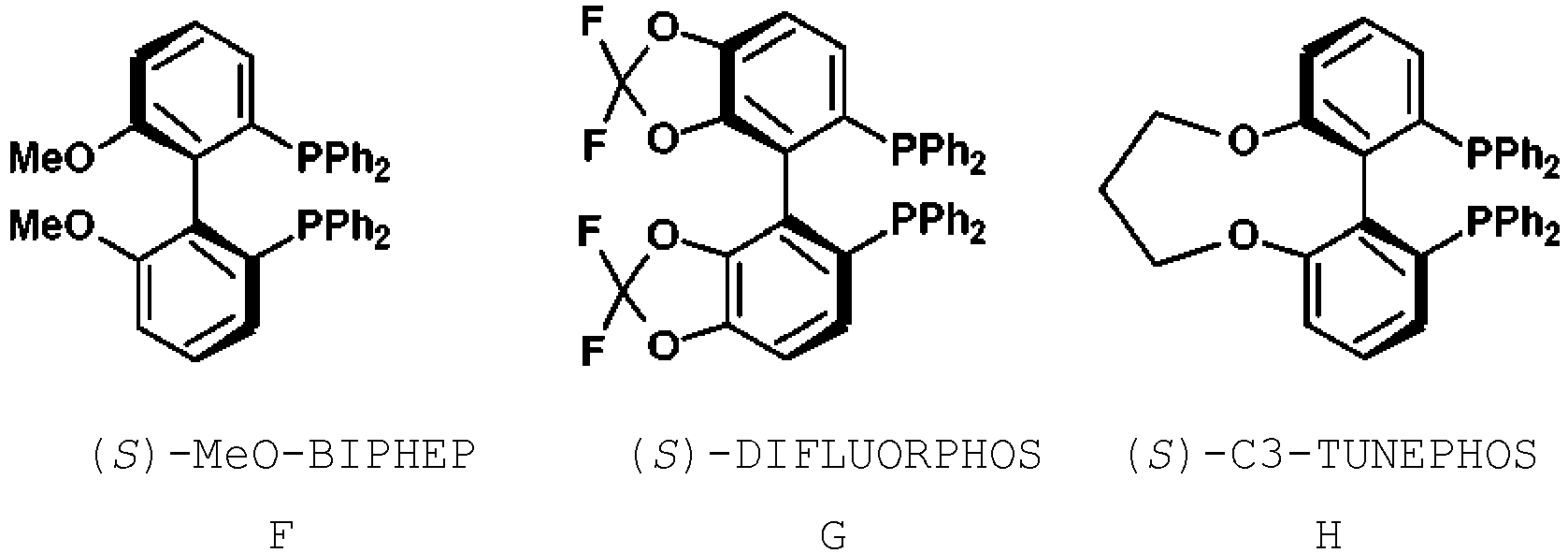
- the transition metal catalyst complex comprises at least one ligand selected from the formulae A to H and mixtures thereof
- the transition metal catalyst according to the invention can be employed in the form of a preformed metal complex, which comprises the metal compound and one or more ligands.
- the transition metal catalyst is formed in situ in the reaction medium by combining a metal compound, herein also termed pre-catalyst, with one or more suitable ligands to form a catalytically active metal complex in the reaction medium.
- the transition metal catalyst is formed in situ in the presence of an auxiliary ligand by combining a metal compound, herein also termed pre-catalyst, with one or more auxiliary ligands to form a catalytically active metal complex in the reaction medium.
- Suitable pre-catalysts are selected from neutral metal complexes, oxides and salts of metals of groups 7, 8, 9 and 10 of the periodic table of the elements.
- Preferred pre-catalysts are selected from metal complexes, oxides and salts of ruthenium, rhenium, iridium, nickel, platinum or palladium.
- Ruthenium compounds that are useful as pre-catalyst are, for example, [Ru(methylallyl) 2 COD], [Ru(p-cymene)Cl 2 ] 2 , [Ru(benzene)Cl 2 ] n , [Ru(CO) 2 Cl 2 ] n , [Ru(CO) 3 Cl 2 ] 2 , [Ru(COD)(allyl)], [RuCl 3 ⁇ H 2 O], [Ru(acetylacetonate) 3 ], [Ru(DMSO) 4 Cl 2 ], [Ru(PPh 3 ) 3 (CO)(H)Cl], [Ru(PPh 3 ) 3 (CO)Cl 2 ], [Ru(PPh 3 ) 3 (CO)(H) 2 ], [Ru(PPh 3 ) 3 Cl 2 ], [Ru(Cp)(PPh 3 ) 2 Cl], [Ru(Cp)(CO) 2 Cl], [Ru(Cp)(CO) 2 H], [Ru(Cp)(CO) 2
- Iridium compounds that are useful as pre-catalyst are, for example, [IrCl 3 ⁇ H 2 O], KIrCl 4 , K 3 IrCl 6 , [Ir(COD)Cl] 2 , [Ir(cyclooctene) 2 Cl] 2 , [Ir(ethene) 2 Cl] 2 , [Ir(Cp)Cl 2 ] 2 , [Ir(Cp*)Cl 2 ] 2 , [Ir(Cp)(CO) 2 ], [Ir(Cp*)(CO) 2 ], [Ir(PPh 3 ) 2 (CO)Cl] and [Ir(PPh 3 ) 3 Cl], of which [Ir(COD)Cl] 2 , [Ir(cyclooctene) 2 Cl] 2 and [Ir(Cp*)Cl 2 ] 2 are preferred.
- Nickel compounds that are useful as pre-catalyst are, for example, [Ni(COD) 2 ], Ni(CO) 4 , NiCl 2 , NiBr 2 , NiI 2 , Ni(OAc) 2 [Ni(AcAc) 2 ], [Ni(Cl) 2 (TMEDA)], [Ni(Cl) 2 (DME)], [Ni(Br) 2 (DME)], [Ni(Cl) 2 (PPh 3 ) 2 ], [Ni(CO) 2 (PPh 3 )], [Ni(Cl)(methallyl)] 2 , [Ni(CO 3 )], nickel(II)diemthylglyoxime, nickel(II)2-ethylhexanoate, nickel(II)hexafluroacetlyacetonate, bis(N,N'-di-t-butylacetamidinato)nickel(II), nickel(ll)oxalate, Ni
- Rhenium compounds that are useful as pre-catalyst are, for example, ammoniumperrhenate, chlorotricarbonyl(2,2'-bipyridine)rhenium(I), chlorotricarbonyl(4,4'-di-t-butyl-2,2'-bipyridine)rhenium(I), cyclopentadienylrhenium tricarbonyl, iododioxobis(triphenylphosphine)rhenium(V), methyltrioxorhenium(VII), pentamethylcyclopentadienylrhenium tricarbonyl, rhenium carbonyl, rhenium(V) chloride, rhenium pentacarbonyl bromide, trifluoromethylsulfonatotricarbonyl(2,2'-bipyridine)rhenium(I).
- ammoniumperrhenate chlorotricarbonyl(2,2'-bipyridine)rhenium(I
- Platinum compounds that are useful as pre-catalyst are, for example, ammonium tetrachloroplatinate(II), bis(tri-t-butylphosphine)platinum (0), bis(ethylenediamine)platinum(II) chloride, dibromo(1,5-cyclooctadiene)platinum(II), dichlorobis(benzonitrile)platinum(II), cis-dichlorobis(diethylsulfide)platinum(II), cis-dichlorobis(pyridine)platinum(ll), cis-dichlorobis(triethylphosphine)platinum(II), dichloro(1,5-cyclooctadiene)platinum(II), cis-dichlorodiammine platinum(II), di- ⁇ -chloro-dichlorobis(ethylene)diplatinum(II), dichloro(dicyclopen
- Palladium compounds that are useful as pre-catalyst are, for example, allyl(cyclopentadienyl)palladium(II), bis[(trimethylsilyl)methyl](1,5-cyclooctadiene)-palladium(II), allylpalladium chloride dimer, ammonium tetrachloropalladate(II), bis[1,2-bis(diphenylphosphino)ethane]palladium(0), bis(dibenzylideneacetone)palladium(0), trans-bis(dicyclohexylamine)bis(acetato)-palladium(II), bis(2-methylallyl)palladium chloride dimer, bis(tri-t-butylphosphine)-palladium(0), bis(tricyclohexylphosphine)palladium(0), bis(tri-o-tolylphosphine)-palladium(0), chloromethyl(1,5-cyclooc
- COD denotes 1,5-cyclooctadiene
- Cp denotes cyclopentadienyl
- Cp* denotes pentamethylcycopentadienyl
- binap denotes 2,2'-bis(diphenylphosphino)-1,1'-binaphthyl.
- a sub-stoichiometric amount of the catalyst is generally used with the amount of catalyst typically being not more than 50 mol%, frequently not more than 20 mol% and in particular not more than 10 mol% or not more than 5 mol%, based on the amount of L-Sorbose in the L-Sorbose comprising composition.
- the amount of the chiral ligand present in the process of the invention is at least 0.5 mol, in particular at least 0.8 mol, especially at least 1 mol per 1 mol of transition metal, e.g. in the range of 0.5 to 10 mol, in particular in the range of 0.8 to 8 mol and especially in the range from 1.0 to 5.0 mol per 1 mol of the transition metal.
- Suitable solvents are selected from aliphatic hydrocarbons, aromatic hydrocarbons, amides, ureas, nitriles, sulfoxides, sulfones, alcohols, esters, carbonates, ethers, water and mixtures thereof.
- Preferred solvents are
- mixtures of two or more of the aforementioned solvents can also be used.
- preferred solvent are alcohols, in particular C 1 -C 8 -alkanols, such as methanol, ethanol, propanol, isopropanol, 1-butanol, iso-butanol, 1-propanol, iso-propanol, 1-hexanol or water or mixtures thereof.
- alcohols in particular C 1 -C 8 -alkanols, such as methanol, ethanol, propanol, isopropanol, 1-butanol, iso-butanol, 1-propanol, iso-propanol, 1-hexanol or water or mixtures thereof.
- the hydrogenation can principally be performed according to all processes known to a person skilled in the art, which are suitable for the hydrogenation of a L-Sorbose comprising composition.
- the hydrogen used for the hydrogenation can be used in pure form or, if desired, also in the form of mixtures with other, preferably inert gases, such as nitrogen or argon. Preference is given to using hydrogen in undiluted form.
- the hydrogenation is typically carried out at a hydrogen pressure in the range from 0.1 to 300 bar, preferably in the range from 1 to 100 bar, more preferably in the range from 1 to 50 bar.
- the hydrogenation is typically carried out at a temperature in the range from -20 to 300°C.
- the hydrogenation is preferably carried out at a temperature of at least 50°C, in particular at least 80°C. Preferably, the temperature will not exceed 200°C, in particular 180°C.
- the hydrogenation is in particular carried out at a temperature in the range of 50°C to 200°C and particularly preferably in the range from 80°C to 180°C. Temperatures of at most 150°C, e.g. in the range from 50 to 150°C, in particular in the range from 80 to 150°C, are particularly advantageous.
- the hydrogenation can principally be performed continuously, semi-continuously or discontinuously. Preference is given to a continuous process.
- the hydrogenation can principally be performed in all reactors known by a person in the art for this type of reaction, and, therefore, will select the reactors accordingly.
- Suitable reactors are described for example in “ Ullmanns Enzyklopädie der ischen Chemie", Vol. 1, 3rd edition, 1951, page 743 ff .
- Suitable pressure-resistant reactors are also known to a person skilled in the art and are described, for example, in “ Ullmanns Enzyklopädie der ischen Chemie", Vol. 1, 3rd edition, 1951, page 769 ff .
- an autoclave is employed, which may have an internal stirrer and an internal lining.
- the work-up of the reaction mixture obtained in the hydrogenation of the inventive process and the isolation of L-lditol are effected in a customary manner, for example by filtration, an aqueous extractive work-up or by a distillative separation, for example under reduced pressure.
- the L-lditol may be obtained in sufficient purity by applying such measures or a combination thereof, obviating additional purification steps.
- further purification can be accomplished by methods commonly used in the art, such as chromatography.
- composition obtained in the hydrogenation process of the invention comprises L-lditiol as the main product besides other hexoses as minor products, such as D-Sorbitol or D-Manntiol.
- the obtained composition comprises L-lditiol as the main product and D-Sorbitol as the minor compound.
- the obtained composition is enriched in L-lditol and depleted in L-Sorbose, D-Manntiol and D-Sorbitol.
- the ratio of D-Sorbitol to L-lditol is in the range of 1:7 to 1:1.5, preferably in the range of 1:6.5 to 1:1.9.
- a further aspect of the invention is the use of a transition metal complex as defined above as hydrogenation catalyst for compositions comprising L-lditol or mixtures thereof.
- Comparative Example C1 was performed as a heterogeneous catalysis reaction. The same conditions were used as given in the general procedure, except that the amount of catalyst was different. The data are summarized in table 1.
- Table 1 metal complex ligand/additive conv.% a D-sorbitol/% a L-iditol/% a ratio b 1 [RuCl 2 (benzene)] 2 ( S )-SEGPHOS >99 17 71 1:4.2 2 Ru(OAc) 2 [( R )-SEGPHOS] - 96 24 47 1:2.0 3 [RuCl 2 (benzene)] 2 ( S )-SEGPHOS 99 17 67 1:4.0 4 [RuCl 2 (benzene)] 2 ( S )-DM-SEGPHOS 99 13 74 1:5.7 5 [RuCl 2 (benzene)] 2 ( S )-DTBM-SEGPHOS 99 13 81 1:6.2 6 [RuCl 2 (benzene)] 2 (
Landscapes
- Chemical & Material Sciences (AREA)
- Organic Chemistry (AREA)
- Inorganic Chemistry (AREA)
- Engineering & Computer Science (AREA)
- Materials Engineering (AREA)
- Chemical Kinetics & Catalysis (AREA)
- Organic Low-Molecular-Weight Compounds And Preparation Thereof (AREA)
Claims (13)
- Verfahren zur Herstellung von L-Iditol, das mindestens einen Reaktionsschritt umfasst, bei dem eine Zusammensetzung, die L-Sorbose und Wasserstoff umfasst, in Gegenwart eines Übergangsmetallkatalysatorkomplexes in homogener Lösung umgesetzt wird, wobei der Übergangsmetallkatalysatorkomplex mindestens einen chiralen Liganden mit mindestens einem Phosphoratom, das an das Übergangsmetall koordinieren kann, umfasst und wobei das Übergangsmetall aus Metallen der Gruppen 8, 9 und 10 des Periodensystems der Elemente gemäß IUPAC ausgewählt ist, wobei der chirale Ligand aus Verbindungen der Formel (I) ausgewählt ist:
 RA, RB, RC und RD unabhängig voneinander für Alkyl, Cycloalkyl, Heterocycloalkyl, Aryl oder Hetaryl stehen, wobei die Alkylreste 1, 2, 3, 4 oder 5 Substituenten tragen können, die aus Cycloalkyl, Heterocycloalkyl, Aryl, Hetaryl, Alkoxy, Cycloalkoxy, Heterocycloalkoxy, Aryloxy, Hetaryloxy, Hydroxy, Mercapto, Polyalkylenoxid, Polyalkylenimin, Carboxyl, SO3H, Sulfonat, NE1E2, NE1E2E3+X-, Halogen, Nitro, Formyl, Acetyl und Cyano ausgewählt sind, wobei E1, E2 und E3 gleich oder verschieden sind und aus Wasserstoff, Alkyl, Cycloalkyl und Aryl ausgewählt sind und X- für ein Anionäquivalent steht,und wobei die Cycloalkyl-, Heterocycloalkyl-, Aryl- und Hetarylreste RA, RB, RC und RD 1, 2, 3, 4 oder 5 Substituenten tragen können, die aus Alkyl und den oben für die Alkylreste RA, RB, RC und RD genannten Substituenten ausgewählt sind, oderRA und RB und/oder RC und RD zusammen mit dem P-Atom und, sofern vorhanden, den Gruppen X1, X2, X5 und X6, an die sie gebunden sind, für einen 5- bis 8-gliedrigen Heterocyclus stehen, der gegebenenfalls mit einer, zwei oder drei Gruppen, die aus Cycloalkyl, Heterocycloalkyl, Aryl und Heteroaryl ausgewählt sind, anelliert ist, wobei der Heterocyclus und, sofern vorhanden, die anellierten Gruppen unabhängig voneinander 1, 2, 3 oder 4 Substituenten tragen können, die aus Alkyl, Cycloalkyl, Heterocycloalkyl, Aryl, Hetaryl, Hydroxy, Mercapto, Polyalkylenoxid, Polyalkylenimin, Alkoxy, Halogen, Carboxyl, SO3H, Sulfonat, NE4E5, NE4E5E6+X-, Nitro, Alkoxycarbonyl, Formyl, Acyl und Cyano ausgewählt sind, wobei E4, E5 und E6 gleich oder verschieden sind und aus Wasserstoff, Alkyl, Cycloalkyl und Aryl ausgewählt sind und X- für ein Anionäquivalent steht,X1, X2, X3, X4, X5, X6, X7, X8 und X9 unabhängig voneinander für O, S, CRxRy, SiRxRy oder NRz stehen, wobei Rx, Ry undRz unabhängig voneinander für Wasserstoff, Alkyl, Cycloalkyl, Heterocycloalkyl, Aryl oder Heteroaryl stehen,Y für eine zweiwertige Brückengruppe, die Kohlenstoffatome enthält, steht,a, b, c, d, e und f unabhängig voneinander für 0 oder 1 stehen,mit der Maßgabe, dass der Ligand mindestens eine chirale Gruppierung trägt.
 - Verfahren nach Anspruch 1, wobei das Übergangsmetall aus der Gruppe bestehend aus Ruthenium, Rhenium, Iridium, Nickel, Platin und Palladium und Kombinationen davon ausgewählt ist.
- Verfahren nach Anspruch 1, wobei es sich bei dem Übergangsmetall um Ruthenium handelt.
- Verfahren nach einem der Ansprüche 1 bis 3, wobei der chirale Ligand aus Verbindungen der Formel (II) oder (III) ausgewählt ist:

 RA, RB, RC und RD eine der in Anspruch 1 definierten Bedeutungen haben,Y für eine zweiwertige Brückengruppe, die Kohlenstoffatome enthält, steht,Q1 und Q2 unabhängig voneinander für eine zweiwertige Brückengruppe der Formel (IV) stehen,
 wobei# die Anbindungsstellen an den Rest des Moleküls anzeigt, Re1, Re2, Re3, Re4, Re5, Re6, Re7 und Re8 unabhängig voneinander für Wasserstoff, jeweils unsubstituiertes oder substituiertes Alkyl, Alkoxy, Cycloalkyl, Cycloalkoxy, Heterocycloalkyl, Heterocycloalkoxy, Aryl, Aryloxy, Hetaryl, Hetaryloxy,Halogen, Hydroxy, Mercapto, Cyano, Nitro, Formyl, Acyl, Carboxy, Carboxylat, Alkylcarbonyloxy, Carbamoyl, SO3H, Sulfonate oder NE7E8 stehen, wobei E7 und E8 gleich oder verschieden sind und aus Wasserstoff, Alkyl, Cycloalkyl, Heterocycloalkyl, Aryl und Hetaryl ausgewählt sind, wobei zwei benachbarte Reste Re1 bis Re8 zusammen mit den Kohlenstoffatomen des Benzolrings, an den sie gebunden sind, auch für ein kondensiertes Ringsystem mit 1, 2 oder 3 weiteren Ringen stehen können, undA1 für eine Einfachbindung, O, S, NRa31, SiRa32Ra33 oder C1-C4-Alkylen steht, wobei C1-C4-Alkylen eine Doppelbindung aufweisen kann und/oder wobei C1-C4-Alkylen durch Alkyl, Cycloalkyl, Heterocycloalkyl, Aryl oder Hetaryl substituiert sein kann und/oder wobei C1-C4-Alkylen durch O, S, NRa31 oder SiRa32Ra33 unterbrochen sein kann, wobei Ra31, Ra32 und Ra33 unabhängig voneinander für Wasserstoff, Alkyl, Cycloalkyl, Heterocycloalkyl, Aryl oder Hetaryl stehen.
 - Verfahren nach einem der Ansprüche 1 bis 4, wobei der chirale Ligand aus Verbindungen der Formel (I) oder (II) ausgewählt ist, wobeiRA, RB, RC und RD unabhängig voneinander für Alkyl, Aryl oder Heteroaryl stehen, wobei der Alkylrest 1, 2, 3, 4 oder 5 Substituenten tragen kann, die aus Alkoxy, NE1E2 und NE1E2E3+X- ausgewählt sind, wobei E1, E2 und E3 gleich oder verschieden sind und aus Wasserstoff oder Alkyl ausgewählt sind und X- für ein Anionäquivalent steht, und die Aryl- oder Heteroarylreste 1, 2, 3, 4 oder 5 Substituenten tragen können, die aus Alkyl und den für die Alkylreste genannten Substituenten ausgewählt sind, Y für eine zweiwertige Brückengruppe, die Kohlenstoffatome enthält, steht unda, b, c, d, e und f für 0 stehen,mit der Maßgabe, dass mindestens eines der P-Atome chiral ist und/oder der Ligand der Formel (I) oder (II) axiale Chiralität aufweist.
- Verfahren nach einem der Ansprüche 1 bis 5, wobei der Ligand der Formeln (I), (II) oder (III) axiale Chiralität aufweist.
- Verfahren nach einem der Ansprüche 1 bis 6, wobei die asymmetrische zweiwertige Brückengruppe Y die Formel (V) oder (VI) aufweist:

 # die Anbindungsstellen an den Rest des Moleküls anzeigt, RI, RI', RII, RII', RIII, RIII', RIV, RIV', RV, RV', RVI, RVI', RVII, RVIII', RVIII, RIX, RX, RXI und RXII jeweils unabhängig voneinander für Wasserstoff, Alkyl, Cycloalkyl, Heterocycloalkyl, Aryl, Hetaryl, Hydroxy, Thiol, Polyalkylenoxid, Polyalkylenimin, Alkoxy, Halogen, SO3H, Sulfonat, NE1E2, Alkylen-NE1E2, Nitro, Alkoxycarbonyl, Carboxyl, Acyl oder Cyano stehen, wobei E1 und E2 gleich oder verschieden sind und aus Wasserstoff, Alkyl, Cycloalkyl und Aryl ausgewählt sind,wobei zwei benachbarte Reste RI', RII', RIII', RIV', RV', RVI', RVIII' zusammen mit den Kohlenstoffatomen des Benzolrings, an den sie gebunden sind, auch für ein kondensiertes Ringsystem mit 1, 2 oder 3 weiteren Ringen stehen können, wobei die Ringatome aus Kohlenstoff, Sauerstoff und Schwefel ausgewählt sind und wobei jeder der Ringe 1, 2 oder 3 Substituenten tragen kann, die aus Halogen, C1-C4-Alkyl und C1-C4-Alkoxy ausgewählt sind,wobei zwei Reste RIV' und RV' zusammen mit den Kohlenstoffatomen der zwei Benzolringe, an die sie gebunden sind, auch für ein kondensiertes Ringsystem stehen können, wobei die Ringatome aus Kohlenstoff, Sauerstoff und Schwefel ausgewählt sind und wobei jeder der Ringe 1, 2 oder 3 Substituenten tragen kann, die aus Halogen, C1-C4-Alkyl und C1-C4-Alkoxy ausgewählt sind.
 - Verfahren nach einem der vorhergehenden Ansprüche, wobei der Übergangsmetallkatalysatorkomplex mindestens einen Liganden umfasst, der aus den Formeln A bis H und Mischungen davon ausgewählt ist:


- Verfahren nach einem der vorhergehenden Ansprüche, wobei der Übergangsmetallkatalysatorkomplex in einer solchen Menge vorliegt, dass die Menge an Übergangsmetall im Bereich von 0,001 Mol-% bis 50 Mol-%, berechnet als elementares Übergangsmetall und bezogen auf die der Hydrierung unterworfene Menge an L-Sorbose, vorliegt.
- Verfahren nach einem der vorhergehenden Ansprüche, wobei der chirale Ligand in einer Menge von mindestens 0,5 mol pro 1 mol des vorhandenen Übergangsmetalls vorliegt.
- Verfahren nach einem der vorhergehenden Ansprüche, wobei die Umsetzung in Gegenwart eines aus aliphatischen Kohlenwasserstoffen, aromatischen Kohlenwasserstoffen, Amiden, Harnstoffen, Nitrilen, Sulfoxiden, Sulfonen, Alkoholen, Estern, Carbonaten, Ethern, Wasser und Mischungen davon ausgewählten Lösungsmittels durchgeführt wird.
- Verfahren nach einem der vorhergehenden Ansprüche, wobei das Verhältnis von D-Sorbitol zu L-Iditol im Bereich von 1:7 bis 1:1,5, vorzugsweise im Bereich von 1:6,5 bis 1:1,9, liegt.
- Verwendung eines wie in einem der Ansprüche 1 bis 8 definierten Übergangsmetallkomplexes als Hydrierkatalysator für die Hydrierung von Zusammensetzungen, die L-Sorbose oder Mischungen davon umfassen.
Applications Claiming Priority (2)
| Application Number | Priority Date | Filing Date | Title |
|---|---|---|---|
| EP20169315 | 2020-04-14 | ||
| PCT/EP2021/059497 WO2021209415A1 (en) | 2020-04-14 | 2021-04-13 | Hydrogenation of l-sorbose |
Publications (2)
| Publication Number | Publication Date |
|---|---|
| EP4136065A1 EP4136065A1 (de) | 2023-02-22 |
| EP4136065B1 true EP4136065B1 (de) | 2024-04-24 |
Family
ID=70289341
Family Applications (1)
| Application Number | Title | Priority Date | Filing Date |
|---|---|---|---|
| EP21717460.6A Active EP4136065B1 (de) | 2020-04-14 | 2021-04-13 | Hydrierung von l-sorbose |
Country Status (4)
| Country | Link |
|---|---|
| US (1) | US12559446B2 (de) |
| EP (1) | EP4136065B1 (de) |
| CN (1) | CN115397797A (de) |
| WO (1) | WO2021209415A1 (de) |
Family Cites Families (3)
| Publication number | Priority date | Publication date | Assignee | Title |
|---|---|---|---|---|
| ATE1578T1 (de) | 1978-05-25 | 1982-10-15 | Imperial Chemical Industries Plc | Verfahren zur reduktion von zuckern zu zuckeralkoholen. |
| FR2876693B1 (fr) | 2004-10-15 | 2007-01-26 | Roquette Freres | Procede de preparation de l-iditol |
| WO2008132057A1 (de) | 2007-04-25 | 2008-11-06 | Basf Se | Verfahren zur herstellung optisch aktiver carbonylverbindungen |
-
2021
- 2021-04-13 EP EP21717460.6A patent/EP4136065B1/de active Active
- 2021-04-13 WO PCT/EP2021/059497 patent/WO2021209415A1/en not_active Ceased
- 2021-04-13 US US17/918,634 patent/US12559446B2/en active Active
- 2021-04-13 CN CN202180027975.1A patent/CN115397797A/zh active Pending
Also Published As
| Publication number | Publication date |
|---|---|
| EP4136065A1 (de) | 2023-02-22 |
| WO2021209415A1 (en) | 2021-10-21 |
| CN115397797A (zh) | 2022-11-25 |
| US12559446B2 (en) | 2026-02-24 |
| US20230143448A1 (en) | 2023-05-11 |
Similar Documents
| Publication | Publication Date | Title |
|---|---|---|
| Noyori et al. | Electrochemical glycosylation method | |
| US10315975B2 (en) | Method for the hydroformylation of 2-substituted butadienes and the production of secondary products thereof, especially ambrox | |
| CN107580593B (zh) | 制备不饱和羧酸盐的方法 | |
| Smith et al. | Palladium methoxide and carbomethoxy complexes: synthesis and molecular structure of (bipy) Pd (CO2CH3) 2 | |
| ES2700427T3 (es) | Carbonilación de compuestos etilénicamente insaturados | |
| EP3854777A2 (de) | Verfahren zur herstellung von ungesättigten carbonsäuren durch carbonylierung acylierter allylalkohole | |
| Bai et al. | Lewis-acid assisted cross metathesis of acrylonitrile with functionalized olefins catalyzed by phosphine-free ruthenium carbene complex | |
| EP4136065B1 (de) | Hydrierung von l-sorbose | |
| US9174906B2 (en) | Process for producing optically active secondary alcohol | |
| US20140024854A1 (en) | Process for preparing carboxylic acid esters | |
| EP0061791B1 (de) | Verfahren zur Herstellung von Glykolaldehyd | |
| US12172953B2 (en) | Process for the production of acetals from carbon dioxide | |
| Zsigmond et al. | Selective hydrogenations on heterogenized ruthenium complexes | |
| EP4341236B1 (de) | Verfahren zur herstellung von l-iditol und rückführung des katalysators | |
| Stolyarov et al. | Catalytic hydroallylation of norbornadiene with allyl formate | |
| CN111269148B (zh) | 一种沙库比曲中间体的制备方法 | |
| van Rijn et al. | Remarkable activity of the isomerization catalyst [RuCp (PPh3) 2](OTs) in O-allylation of phenol with allyl alcohol | |
| EP4424661A1 (de) | Verfahren zur katalysierung von olefincarbonylierung | |
| JPWO2019017490A1 (ja) | ペンテン酸エステル誘導体の製造方法 | |
| JP2009173611A (ja) | β分岐アルコールの製造法 | |
| EP3558925B1 (de) | Verfahren zur herstellung von levulinatestern | |
| JP2015526414A (ja) | 脱水下でアルコールからカルボン酸エステルを製造する遷移金属カルベン錯体触媒法 | |
| NO138563B (no) | Fremgangsmaate til fremstilling av alfa-6-deoksytetracykliner | |
| CN109851635A (zh) | 一种新型烷基化单膦配体及其简单制备方法 | |
| JP2006282564A (ja) | ジアセトキシアリル化合物の異性化方法 |
Legal Events
| Date | Code | Title | Description |
|---|---|---|---|
| STAA | Information on the status of an ep patent application or granted ep patent |
Free format text: STATUS: UNKNOWN |
|
| STAA | Information on the status of an ep patent application or granted ep patent |
Free format text: STATUS: THE INTERNATIONAL PUBLICATION HAS BEEN MADE |
|
| PUAI | Public reference made under article 153(3) epc to a published international application that has entered the european phase |
Free format text: ORIGINAL CODE: 0009012 |
|
| STAA | Information on the status of an ep patent application or granted ep patent |
Free format text: STATUS: REQUEST FOR EXAMINATION WAS MADE |
|
| 17P | Request for examination filed |
Effective date: 20221114 |
|
| AK | Designated contracting states |
Kind code of ref document: A1 Designated state(s): AL AT BE BG CH CY CZ DE DK EE ES FI FR GB GR HR HU IE IS IT LI LT LU LV MC MK MT NL NO PL PT RO RS SE SI SK SM TR |
|
| DAV | Request for validation of the european patent (deleted) | ||
| DAX | Request for extension of the european patent (deleted) | ||
| GRAP | Despatch of communication of intention to grant a patent |
Free format text: ORIGINAL CODE: EPIDOSNIGR1 |
|
| STAA | Information on the status of an ep patent application or granted ep patent |
Free format text: STATUS: GRANT OF PATENT IS INTENDED |
|
| INTG | Intention to grant announced |
Effective date: 20231117 |
|
| GRAS | Grant fee paid |
Free format text: ORIGINAL CODE: EPIDOSNIGR3 |
|
| GRAA | (expected) grant |
Free format text: ORIGINAL CODE: 0009210 |
|
| STAA | Information on the status of an ep patent application or granted ep patent |
Free format text: STATUS: THE PATENT HAS BEEN GRANTED |
|
| AK | Designated contracting states |
Kind code of ref document: B1 Designated state(s): AL AT BE BG CH CY CZ DE DK EE ES FI FR GB GR HR HU IE IS IT LI LT LU LV MC MK MT NL NO PL PT RO RS SE SI SK SM TR |
|
| REG | Reference to a national code |
Ref country code: GB Ref legal event code: FG4D |
|
| REG | Reference to a national code |
Ref country code: CH Ref legal event code: EP |
|
| REG | Reference to a national code |
Ref country code: DE Ref legal event code: R096 Ref document number: 602021012286 Country of ref document: DE |
|
| REG | Reference to a national code |
Ref country code: IE Ref legal event code: FG4D |
|
| REG | Reference to a national code |
Ref country code: LT Ref legal event code: MG9D |
|
| REG | Reference to a national code |
Ref country code: NL Ref legal event code: FP |
|
| REG | Reference to a national code |
Ref country code: AT Ref legal event code: MK05 Ref document number: 1679464 Country of ref document: AT Kind code of ref document: T Effective date: 20240424 |
|
| PG25 | Lapsed in a contracting state [announced via postgrant information from national office to epo] |
Ref country code: IS Free format text: LAPSE BECAUSE OF FAILURE TO SUBMIT A TRANSLATION OF THE DESCRIPTION OR TO PAY THE FEE WITHIN THE PRESCRIBED TIME-LIMIT Effective date: 20240824 |
|
| PG25 | Lapsed in a contracting state [announced via postgrant information from national office to epo] |
Ref country code: BG Free format text: LAPSE BECAUSE OF FAILURE TO SUBMIT A TRANSLATION OF THE DESCRIPTION OR TO PAY THE FEE WITHIN THE PRESCRIBED TIME-LIMIT Effective date: 20240424 |
|
| PG25 | Lapsed in a contracting state [announced via postgrant information from national office to epo] |
Ref country code: HR Free format text: LAPSE BECAUSE OF FAILURE TO SUBMIT A TRANSLATION OF THE DESCRIPTION OR TO PAY THE FEE WITHIN THE PRESCRIBED TIME-LIMIT Effective date: 20240424 Ref country code: FI Free format text: LAPSE BECAUSE OF FAILURE TO SUBMIT A TRANSLATION OF THE DESCRIPTION OR TO PAY THE FEE WITHIN THE PRESCRIBED TIME-LIMIT Effective date: 20240424 |
|
| PG25 | Lapsed in a contracting state [announced via postgrant information from national office to epo] |
Ref country code: GR Free format text: LAPSE BECAUSE OF FAILURE TO SUBMIT A TRANSLATION OF THE DESCRIPTION OR TO PAY THE FEE WITHIN THE PRESCRIBED TIME-LIMIT Effective date: 20240725 |
|
| PG25 | Lapsed in a contracting state [announced via postgrant information from national office to epo] |
Ref country code: PT Free format text: LAPSE BECAUSE OF FAILURE TO SUBMIT A TRANSLATION OF THE DESCRIPTION OR TO PAY THE FEE WITHIN THE PRESCRIBED TIME-LIMIT Effective date: 20240826 |
|
| PG25 | Lapsed in a contracting state [announced via postgrant information from national office to epo] |
Ref country code: ES Free format text: LAPSE BECAUSE OF FAILURE TO SUBMIT A TRANSLATION OF THE DESCRIPTION OR TO PAY THE FEE WITHIN THE PRESCRIBED TIME-LIMIT Effective date: 20240424 |
|
| PG25 | Lapsed in a contracting state [announced via postgrant information from national office to epo] |
Ref country code: AT Free format text: LAPSE BECAUSE OF FAILURE TO SUBMIT A TRANSLATION OF THE DESCRIPTION OR TO PAY THE FEE WITHIN THE PRESCRIBED TIME-LIMIT Effective date: 20240424 |
|
| PG25 | Lapsed in a contracting state [announced via postgrant information from national office to epo] |
Ref country code: PL Free format text: LAPSE BECAUSE OF FAILURE TO SUBMIT A TRANSLATION OF THE DESCRIPTION OR TO PAY THE FEE WITHIN THE PRESCRIBED TIME-LIMIT Effective date: 20240424 |
|
| PG25 | Lapsed in a contracting state [announced via postgrant information from national office to epo] |
Ref country code: LV Free format text: LAPSE BECAUSE OF FAILURE TO SUBMIT A TRANSLATION OF THE DESCRIPTION OR TO PAY THE FEE WITHIN THE PRESCRIBED TIME-LIMIT Effective date: 20240424 |
|
| PG25 | Lapsed in a contracting state [announced via postgrant information from national office to epo] |
Ref country code: PT Free format text: LAPSE BECAUSE OF FAILURE TO SUBMIT A TRANSLATION OF THE DESCRIPTION OR TO PAY THE FEE WITHIN THE PRESCRIBED TIME-LIMIT Effective date: 20240826 Ref country code: PL Free format text: LAPSE BECAUSE OF FAILURE TO SUBMIT A TRANSLATION OF THE DESCRIPTION OR TO PAY THE FEE WITHIN THE PRESCRIBED TIME-LIMIT Effective date: 20240424 Ref country code: NO Free format text: LAPSE BECAUSE OF FAILURE TO SUBMIT A TRANSLATION OF THE DESCRIPTION OR TO PAY THE FEE WITHIN THE PRESCRIBED TIME-LIMIT Effective date: 20240724 Ref country code: LV Free format text: LAPSE BECAUSE OF FAILURE TO SUBMIT A TRANSLATION OF THE DESCRIPTION OR TO PAY THE FEE WITHIN THE PRESCRIBED TIME-LIMIT Effective date: 20240424 Ref country code: IS Free format text: LAPSE BECAUSE OF FAILURE TO SUBMIT A TRANSLATION OF THE DESCRIPTION OR TO PAY THE FEE WITHIN THE PRESCRIBED TIME-LIMIT Effective date: 20240824 Ref country code: HR Free format text: LAPSE BECAUSE OF FAILURE TO SUBMIT A TRANSLATION OF THE DESCRIPTION OR TO PAY THE FEE WITHIN THE PRESCRIBED TIME-LIMIT Effective date: 20240424 Ref country code: GR Free format text: LAPSE BECAUSE OF FAILURE TO SUBMIT A TRANSLATION OF THE DESCRIPTION OR TO PAY THE FEE WITHIN THE PRESCRIBED TIME-LIMIT Effective date: 20240725 Ref country code: FI Free format text: LAPSE BECAUSE OF FAILURE TO SUBMIT A TRANSLATION OF THE DESCRIPTION OR TO PAY THE FEE WITHIN THE PRESCRIBED TIME-LIMIT Effective date: 20240424 Ref country code: ES Free format text: LAPSE BECAUSE OF FAILURE TO SUBMIT A TRANSLATION OF THE DESCRIPTION OR TO PAY THE FEE WITHIN THE PRESCRIBED TIME-LIMIT Effective date: 20240424 Ref country code: BG Free format text: LAPSE BECAUSE OF FAILURE TO SUBMIT A TRANSLATION OF THE DESCRIPTION OR TO PAY THE FEE WITHIN THE PRESCRIBED TIME-LIMIT Effective date: 20240424 Ref country code: AT Free format text: LAPSE BECAUSE OF FAILURE TO SUBMIT A TRANSLATION OF THE DESCRIPTION OR TO PAY THE FEE WITHIN THE PRESCRIBED TIME-LIMIT Effective date: 20240424 Ref country code: RS Free format text: LAPSE BECAUSE OF FAILURE TO SUBMIT A TRANSLATION OF THE DESCRIPTION OR TO PAY THE FEE WITHIN THE PRESCRIBED TIME-LIMIT Effective date: 20240724 |
|
| PG25 | Lapsed in a contracting state [announced via postgrant information from national office to epo] |
Ref country code: DK Free format text: LAPSE BECAUSE OF FAILURE TO SUBMIT A TRANSLATION OF THE DESCRIPTION OR TO PAY THE FEE WITHIN THE PRESCRIBED TIME-LIMIT Effective date: 20240424 |
|
| PG25 | Lapsed in a contracting state [announced via postgrant information from national office to epo] |
Ref country code: EE Free format text: LAPSE BECAUSE OF FAILURE TO SUBMIT A TRANSLATION OF THE DESCRIPTION OR TO PAY THE FEE WITHIN THE PRESCRIBED TIME-LIMIT Effective date: 20240424 |
|
| PG25 | Lapsed in a contracting state [announced via postgrant information from national office to epo] |
Ref country code: CZ Free format text: LAPSE BECAUSE OF FAILURE TO SUBMIT A TRANSLATION OF THE DESCRIPTION OR TO PAY THE FEE WITHIN THE PRESCRIBED TIME-LIMIT Effective date: 20240424 |
|
| PG25 | Lapsed in a contracting state [announced via postgrant information from national office to epo] |
Ref country code: SK Free format text: LAPSE BECAUSE OF FAILURE TO SUBMIT A TRANSLATION OF THE DESCRIPTION OR TO PAY THE FEE WITHIN THE PRESCRIBED TIME-LIMIT Effective date: 20240424 Ref country code: RO Free format text: LAPSE BECAUSE OF FAILURE TO SUBMIT A TRANSLATION OF THE DESCRIPTION OR TO PAY THE FEE WITHIN THE PRESCRIBED TIME-LIMIT Effective date: 20240424 |
|
| REG | Reference to a national code |
Ref country code: DE Ref legal event code: R097 Ref document number: 602021012286 Country of ref document: DE |
|
| PG25 | Lapsed in a contracting state [announced via postgrant information from national office to epo] |
Ref country code: SM Free format text: LAPSE BECAUSE OF FAILURE TO SUBMIT A TRANSLATION OF THE DESCRIPTION OR TO PAY THE FEE WITHIN THE PRESCRIBED TIME-LIMIT Effective date: 20240424 |
|
| PG25 | Lapsed in a contracting state [announced via postgrant information from national office to epo] |
Ref country code: SM Free format text: LAPSE BECAUSE OF FAILURE TO SUBMIT A TRANSLATION OF THE DESCRIPTION OR TO PAY THE FEE WITHIN THE PRESCRIBED TIME-LIMIT Effective date: 20240424 Ref country code: SK Free format text: LAPSE BECAUSE OF FAILURE TO SUBMIT A TRANSLATION OF THE DESCRIPTION OR TO PAY THE FEE WITHIN THE PRESCRIBED TIME-LIMIT Effective date: 20240424 Ref country code: RO Free format text: LAPSE BECAUSE OF FAILURE TO SUBMIT A TRANSLATION OF THE DESCRIPTION OR TO PAY THE FEE WITHIN THE PRESCRIBED TIME-LIMIT Effective date: 20240424 Ref country code: EE Free format text: LAPSE BECAUSE OF FAILURE TO SUBMIT A TRANSLATION OF THE DESCRIPTION OR TO PAY THE FEE WITHIN THE PRESCRIBED TIME-LIMIT Effective date: 20240424 Ref country code: DK Free format text: LAPSE BECAUSE OF FAILURE TO SUBMIT A TRANSLATION OF THE DESCRIPTION OR TO PAY THE FEE WITHIN THE PRESCRIBED TIME-LIMIT Effective date: 20240424 Ref country code: CZ Free format text: LAPSE BECAUSE OF FAILURE TO SUBMIT A TRANSLATION OF THE DESCRIPTION OR TO PAY THE FEE WITHIN THE PRESCRIBED TIME-LIMIT Effective date: 20240424 |
|
| PLBE | No opposition filed within time limit |
Free format text: ORIGINAL CODE: 0009261 |
|
| STAA | Information on the status of an ep patent application or granted ep patent |
Free format text: STATUS: NO OPPOSITION FILED WITHIN TIME LIMIT |
|
| 26N | No opposition filed |
Effective date: 20250127 |
|
| PG25 | Lapsed in a contracting state [announced via postgrant information from national office to epo] |
Ref country code: SI Free format text: LAPSE BECAUSE OF FAILURE TO SUBMIT A TRANSLATION OF THE DESCRIPTION OR TO PAY THE FEE WITHIN THE PRESCRIBED TIME-LIMIT Effective date: 20240424 |
|
| PGFP | Annual fee paid to national office [announced via postgrant information from national office to epo] |
Ref country code: NL Payment date: 20250424 Year of fee payment: 5 |
|
| PGFP | Annual fee paid to national office [announced via postgrant information from national office to epo] |
Ref country code: DE Payment date: 20250428 Year of fee payment: 5 |
|
| PGFP | Annual fee paid to national office [announced via postgrant information from national office to epo] |
Ref country code: FR Payment date: 20250424 Year of fee payment: 5 |
|
| PGFP | Annual fee paid to national office [announced via postgrant information from national office to epo] |
Ref country code: CH Payment date: 20250501 Year of fee payment: 5 |
|
| PG25 | Lapsed in a contracting state [announced via postgrant information from national office to epo] |
Ref country code: SE Free format text: LAPSE BECAUSE OF FAILURE TO SUBMIT A TRANSLATION OF THE DESCRIPTION OR TO PAY THE FEE WITHIN THE PRESCRIBED TIME-LIMIT Effective date: 20240424 |
|
| PG25 | Lapsed in a contracting state [announced via postgrant information from national office to epo] |
Ref country code: LU Free format text: LAPSE BECAUSE OF NON-PAYMENT OF DUE FEES Effective date: 20250413 |
|
| PG25 | Lapsed in a contracting state [announced via postgrant information from national office to epo] |
Ref country code: MC Free format text: LAPSE BECAUSE OF FAILURE TO SUBMIT A TRANSLATION OF THE DESCRIPTION OR TO PAY THE FEE WITHIN THE PRESCRIBED TIME-LIMIT Effective date: 20240424 |
|
| REG | Reference to a national code |
Ref country code: BE Ref legal event code: MM Effective date: 20250430 |
|
| PG25 | Lapsed in a contracting state [announced via postgrant information from national office to epo] |
Ref country code: BE Free format text: LAPSE BECAUSE OF NON-PAYMENT OF DUE FEES Effective date: 20250430 |
|
| PGFP | Annual fee paid to national office [announced via postgrant information from national office to epo] |
Ref country code: GB Payment date: 20260225 Year of fee payment: 6 |
|
| PG25 | Lapsed in a contracting state [announced via postgrant information from national office to epo] |
Ref country code: IE Free format text: LAPSE BECAUSE OF NON-PAYMENT OF DUE FEES Effective date: 20250413 |
|
| PG25 | Lapsed in a contracting state [announced via postgrant information from national office to epo] |
Ref country code: IT Free format text: LAPSE BECAUSE OF NON-PAYMENT OF DUE FEES Effective date: 20250413 |