EP4137215A1 - Système, programme et procédé d'évaluation de stabilité - Google Patents
Système, programme et procédé d'évaluation de stabilité Download PDFInfo
- Publication number
- EP4137215A1 EP4137215A1 EP21788979.9A EP21788979A EP4137215A1 EP 4137215 A1 EP4137215 A1 EP 4137215A1 EP 21788979 A EP21788979 A EP 21788979A EP 4137215 A1 EP4137215 A1 EP 4137215A1
- Authority
- EP
- European Patent Office
- Prior art keywords
- index
- body motion
- wearer
- motion
- reference value
- Prior art date
- Legal status (The legal status is an assumption and is not a legal conclusion. Google has not performed a legal analysis and makes no representation as to the accuracy of the status listed.)
- Withdrawn
Links
- 238000011156 evaluation Methods 0.000 title claims description 56
- 238000000034 method Methods 0.000 title claims description 25
- 230000033001 locomotion Effects 0.000 claims abstract description 363
- 230000000087 stabilizing effect Effects 0.000 claims abstract description 60
- 230000008859 change Effects 0.000 claims abstract description 47
- 238000001514 detection method Methods 0.000 claims abstract description 41
- 238000006073 displacement reaction Methods 0.000 claims abstract description 31
- 208000027418 Wounds and injury Diseases 0.000 claims description 22
- 230000006378 damage Effects 0.000 claims description 22
- 208000014674 injury Diseases 0.000 claims description 22
- 238000000605 extraction Methods 0.000 claims description 18
- 230000010365 information processing Effects 0.000 claims description 9
- 238000012544 monitoring process Methods 0.000 claims description 9
- 238000012549 training Methods 0.000 abstract description 39
- 230000000386 athletic effect Effects 0.000 abstract description 5
- 238000012545 processing Methods 0.000 description 44
- 238000004458 analytical method Methods 0.000 description 36
- 230000009471 action Effects 0.000 description 29
- 230000006870 function Effects 0.000 description 28
- 238000004891 communication Methods 0.000 description 25
- 210000001624 hip Anatomy 0.000 description 23
- 230000001133 acceleration Effects 0.000 description 22
- 238000006243 chemical reaction Methods 0.000 description 16
- 230000001360 synchronised effect Effects 0.000 description 16
- 238000005259 measurement Methods 0.000 description 13
- 210000000689 upper leg Anatomy 0.000 description 11
- 238000010586 diagram Methods 0.000 description 10
- 239000000470 constituent Substances 0.000 description 9
- 238000010079 rubber tapping Methods 0.000 description 9
- 230000003252 repetitive effect Effects 0.000 description 8
- 210000002683 foot Anatomy 0.000 description 6
- 238000003745 diagnosis Methods 0.000 description 5
- 230000000694 effects Effects 0.000 description 5
- 239000000284 extract Substances 0.000 description 5
- 210000002414 leg Anatomy 0.000 description 5
- 230000002159 abnormal effect Effects 0.000 description 4
- 230000003247 decreasing effect Effects 0.000 description 4
- 230000006872 improvement Effects 0.000 description 4
- 230000002123 temporal effect Effects 0.000 description 4
- 239000012141 concentrate Substances 0.000 description 3
- 230000033764 rhythmic process Effects 0.000 description 3
- 230000006641 stabilisation Effects 0.000 description 3
- 238000011105 stabilization Methods 0.000 description 3
- 230000005856 abnormality Effects 0.000 description 2
- 230000006399 behavior Effects 0.000 description 2
- 230000009194 climbing Effects 0.000 description 2
- 238000012937 correction Methods 0.000 description 2
- 210000003127 knee Anatomy 0.000 description 2
- 230000004044 response Effects 0.000 description 2
- 230000005236 sound signal Effects 0.000 description 2
- 230000003068 static effect Effects 0.000 description 2
- 210000003423 ankle Anatomy 0.000 description 1
- 238000005452 bending Methods 0.000 description 1
- 230000005540 biological transmission Effects 0.000 description 1
- 230000001276 controlling effect Effects 0.000 description 1
- 230000007613 environmental effect Effects 0.000 description 1
- 210000004744 fore-foot Anatomy 0.000 description 1
- 238000003384 imaging method Methods 0.000 description 1
- 239000004973 liquid crystal related substance Substances 0.000 description 1
- 239000000463 material Substances 0.000 description 1
- 210000000452 mid-foot Anatomy 0.000 description 1
- 238000012986 modification Methods 0.000 description 1
- 230000004048 modification Effects 0.000 description 1
- 210000003205 muscle Anatomy 0.000 description 1
- 230000003287 optical effect Effects 0.000 description 1
- 210000004197 pelvis Anatomy 0.000 description 1
- 230000001144 postural effect Effects 0.000 description 1
- 230000001141 propulsive effect Effects 0.000 description 1
- 230000001105 regulatory effect Effects 0.000 description 1
- 238000012552 review Methods 0.000 description 1
- 230000007103 stamina Effects 0.000 description 1
- 230000007704 transition Effects 0.000 description 1
Images


Classifications
-
- A—HUMAN NECESSITIES
- A61—MEDICAL OR VETERINARY SCIENCE; HYGIENE
- A61B—DIAGNOSIS; SURGERY; IDENTIFICATION
- A61B5/00—Measuring for diagnostic purposes; Identification of persons
- A61B5/68—Arrangements of detecting, measuring or recording means, e.g. sensors, in relation to patient
- A61B5/6887—Arrangements of detecting, measuring or recording means, e.g. sensors, in relation to patient mounted on external non-worn devices, e.g. non-medical devices
- A61B5/6898—Portable consumer electronic devices, e.g. music players, telephones, tablet computers
-
- A—HUMAN NECESSITIES
- A63—SPORTS; GAMES; AMUSEMENTS
- A63B—APPARATUS FOR PHYSICAL TRAINING, GYMNASTICS, SWIMMING, CLIMBING, OR FENCING; BALL GAMES; TRAINING EQUIPMENT
- A63B24/00—Electric or electronic controls for exercising apparatus of preceding groups; Controlling or monitoring of exercises, sportive games, training or athletic performances
- A63B24/0062—Monitoring athletic performances, e.g. for determining the work of a user on an exercise apparatus, the completed jogging or cycling distance
-
- A—HUMAN NECESSITIES
- A61—MEDICAL OR VETERINARY SCIENCE; HYGIENE
- A61B—DIAGNOSIS; SURGERY; IDENTIFICATION
- A61B5/00—Measuring for diagnostic purposes; Identification of persons
- A61B5/0002—Remote monitoring of patients using telemetry, e.g. transmission of vital signals via a communication network
- A61B5/0015—Remote monitoring of patients using telemetry, e.g. transmission of vital signals via a communication network characterised by features of the telemetry system
- A61B5/0024—Remote monitoring of patients using telemetry, e.g. transmission of vital signals via a communication network characterised by features of the telemetry system for multiple sensor units attached to the patient, e.g. using a body or personal area network
-
- A—HUMAN NECESSITIES
- A61—MEDICAL OR VETERINARY SCIENCE; HYGIENE
- A61B—DIAGNOSIS; SURGERY; IDENTIFICATION
- A61B5/00—Measuring for diagnostic purposes; Identification of persons
- A61B5/103—Measuring devices for testing the shape, pattern, colour, size or movement of the body or parts thereof, for diagnostic purposes
- A61B5/11—Measuring movement of the entire body or parts thereof, e.g. head or hand tremor or mobility of a limb
- A61B5/1113—Local tracking of patients, e.g. in a hospital or private home
- A61B5/1114—Tracking parts of the body
-
- A—HUMAN NECESSITIES
- A61—MEDICAL OR VETERINARY SCIENCE; HYGIENE
- A61B—DIAGNOSIS; SURGERY; IDENTIFICATION
- A61B5/00—Measuring for diagnostic purposes; Identification of persons
- A61B5/103—Measuring devices for testing the shape, pattern, colour, size or movement of the body or parts thereof, for diagnostic purposes
- A61B5/11—Measuring movement of the entire body or parts thereof, e.g. head or hand tremor or mobility of a limb
- A61B5/1116—Determining posture transitions
-
- A—HUMAN NECESSITIES
- A61—MEDICAL OR VETERINARY SCIENCE; HYGIENE
- A61B—DIAGNOSIS; SURGERY; IDENTIFICATION
- A61B5/00—Measuring for diagnostic purposes; Identification of persons
- A61B5/103—Measuring devices for testing the shape, pattern, colour, size or movement of the body or parts thereof, for diagnostic purposes
- A61B5/11—Measuring movement of the entire body or parts thereof, e.g. head or hand tremor or mobility of a limb
- A61B5/1123—Discriminating type of movement, e.g. walking or running
-
- A—HUMAN NECESSITIES
- A61—MEDICAL OR VETERINARY SCIENCE; HYGIENE
- A61B—DIAGNOSIS; SURGERY; IDENTIFICATION
- A61B5/00—Measuring for diagnostic purposes; Identification of persons
- A61B5/22—Ergometry; Measuring muscular strength or the force of a muscular blow
- A61B5/221—Ergometry, e.g. by using bicycle type apparatus
- A61B5/222—Ergometry, e.g. by using bicycle type apparatus combined with detection or measurement of physiological parameters, e.g. heart rate
-
- A—HUMAN NECESSITIES
- A61—MEDICAL OR VETERINARY SCIENCE; HYGIENE
- A61B—DIAGNOSIS; SURGERY; IDENTIFICATION
- A61B5/00—Measuring for diagnostic purposes; Identification of persons
- A61B5/48—Other medical applications
- A61B5/486—Biofeedback
-
- A—HUMAN NECESSITIES
- A61—MEDICAL OR VETERINARY SCIENCE; HYGIENE
- A61B—DIAGNOSIS; SURGERY; IDENTIFICATION
- A61B5/00—Measuring for diagnostic purposes; Identification of persons
- A61B5/68—Arrangements of detecting, measuring or recording means, e.g. sensors, in relation to patient
- A61B5/6887—Arrangements of detecting, measuring or recording means, e.g. sensors, in relation to patient mounted on external non-worn devices, e.g. non-medical devices
- A61B5/6895—Sport equipment
-
- G—PHYSICS
- G01—MEASURING; TESTING
- G01P—MEASURING LINEAR OR ANGULAR SPEED, ACCELERATION, DECELERATION, OR SHOCK; INDICATING PRESENCE, ABSENCE, OR DIRECTION, OF MOVEMENT
- G01P13/00—Indicating or recording presence, absence, or direction, of movement
-
- G—PHYSICS
- G09—EDUCATION; CRYPTOGRAPHY; DISPLAY; ADVERTISING; SEALS
- G09B—EDUCATIONAL OR DEMONSTRATION APPLIANCES; APPLIANCES FOR TEACHING, OR COMMUNICATING WITH, THE BLIND, DEAF OR MUTE; MODELS; PLANETARIA; GLOBES; MAPS; DIAGRAMS
- G09B19/00—Teaching not covered by other main groups of this subclass
- G09B19/003—Repetitive work cycles; Sequence of movements
- G09B19/0038—Sports
-
- A—HUMAN NECESSITIES
- A61—MEDICAL OR VETERINARY SCIENCE; HYGIENE
- A61B—DIAGNOSIS; SURGERY; IDENTIFICATION
- A61B2503/00—Evaluating a particular growth phase or type of persons or animals
- A61B2503/10—Athletes
-
- A—HUMAN NECESSITIES
- A61—MEDICAL OR VETERINARY SCIENCE; HYGIENE
- A61B—DIAGNOSIS; SURGERY; IDENTIFICATION
- A61B5/00—Measuring for diagnostic purposes; Identification of persons
- A61B5/40—Detecting, measuring or recording for evaluating the nervous system
- A61B5/4005—Detecting, measuring or recording for evaluating the nervous system for evaluating the sensory system
- A61B5/4023—Evaluating sense of balance
-
- A—HUMAN NECESSITIES
- A63—SPORTS; GAMES; AMUSEMENTS
- A63B—APPARATUS FOR PHYSICAL TRAINING, GYMNASTICS, SWIMMING, CLIMBING, OR FENCING; BALL GAMES; TRAINING EQUIPMENT
- A63B24/00—Electric or electronic controls for exercising apparatus of preceding groups; Controlling or monitoring of exercises, sportive games, training or athletic performances
- A63B24/0062—Monitoring athletic performances, e.g. for determining the work of a user on an exercise apparatus, the completed jogging or cycling distance
- A63B2024/0068—Comparison to target or threshold, previous performance or not real time comparison to other individuals
-
- A—HUMAN NECESSITIES
- A63—SPORTS; GAMES; AMUSEMENTS
- A63B—APPARATUS FOR PHYSICAL TRAINING, GYMNASTICS, SWIMMING, CLIMBING, OR FENCING; BALL GAMES; TRAINING EQUIPMENT
- A63B71/00—Games or sports accessories not covered in groups A63B1/00 - A63B69/00
- A63B71/06—Indicating or scoring devices for games or players, or for other sports activities
- A63B71/0619—Displays, user interfaces and indicating devices, specially adapted for sport equipment, e.g. display mounted on treadmills
- A63B2071/065—Visualisation of specific exercise parameters
- A63B2071/0652—Visualisation or indication relating to symmetrical exercise, e.g. right-left performance related to spinal column
-
- A—HUMAN NECESSITIES
- A63—SPORTS; GAMES; AMUSEMENTS
- A63B—APPARATUS FOR PHYSICAL TRAINING, GYMNASTICS, SWIMMING, CLIMBING, OR FENCING; BALL GAMES; TRAINING EQUIPMENT
- A63B2220/00—Measuring of physical parameters relating to sporting activity
- A63B2220/80—Special sensors, transducers or devices therefor
- A63B2220/803—Motion sensors
-
- A—HUMAN NECESSITIES
- A63—SPORTS; GAMES; AMUSEMENTS
- A63B—APPARATUS FOR PHYSICAL TRAINING, GYMNASTICS, SWIMMING, CLIMBING, OR FENCING; BALL GAMES; TRAINING EQUIPMENT
- A63B2220/00—Measuring of physical parameters relating to sporting activity
- A63B2220/80—Special sensors, transducers or devices therefor
- A63B2220/83—Special sensors, transducers or devices therefor characterised by the position of the sensor
- A63B2220/836—Sensors arranged on the body of the user
-
- A—HUMAN NECESSITIES
- A63—SPORTS; GAMES; AMUSEMENTS
- A63B—APPARATUS FOR PHYSICAL TRAINING, GYMNASTICS, SWIMMING, CLIMBING, OR FENCING; BALL GAMES; TRAINING EQUIPMENT
- A63B2225/00—Miscellaneous features of sport apparatus, devices or equipment
- A63B2225/02—Testing, calibrating or measuring of equipment
-
- A—HUMAN NECESSITIES
- A63—SPORTS; GAMES; AMUSEMENTS
- A63B—APPARATUS FOR PHYSICAL TRAINING, GYMNASTICS, SWIMMING, CLIMBING, OR FENCING; BALL GAMES; TRAINING EQUIPMENT
- A63B2225/00—Miscellaneous features of sport apparatus, devices or equipment
- A63B2225/50—Wireless data transmission, e.g. by radio transmitters or telemetry
Definitions
- the present invention relates to a stability evaluation system, a program, and a method that detect body motion of a wearer and evaluate a stabilizing ability according to a change in the body motion, using a so-called smartphone, wearable type, or other information terminal devices.
- wearable information processing terminals so-called wearable terminals that can be attached to the body of a user are becoming widespread. Since such wearable terminals are lightweight and have a communication function with various sensors such as a heart rate sensor, in addition to a clock function and a GPS function, a system has been developed to record, monitor, and evaluate body motion by attaching the wearable terminals during sports training such as running, walking, and bicycle racing, exercising, and fitting (for example, Patent Literature 1).
- Patent Literature 1 by attaching a device that measures exercising parameters to a user, comparing the exercising parameters obtained by monitoring the exercising user during the exercise activity with basic baseline data, and changing music to be played or the like according to whether the comparison result is within an allowable range, it is possible to provide feedback to the user in real time during the exercise activity.
- Patent Literature 1 JP 2013-215590 A
- the present invention is to solve the above problems, and a purpose of the present invention is to provide a stability evaluation system, a program, and a method that appropriately evaluate a stabilizing ability, so-called stability, according to a change in body motion of a wearer to achieve effective training, coaching, and fitting of athletic equipment.
- the present invention is a stability evaluation system configured to detect body motion of a wearer and evaluate a stabilizing ability according to a change in the body motion, the system including a plurality of body motion sensors that is attached to the wearer or an arbitrary part of equipment to be used by the wearer and is capable of detecting three-dimensional displacement or rotation of each part, a body motion recording unit configured to record a detection result by the plurality of body motion sensors as body motion data, a storage unit configured to store index data holding a correlation between an amount of deviation from a stable reference value for evaluating reproducibility of the body motion and an index for evaluating the stabilizing ability, an index calculation unit configured to refer to the index data based on a reference value or a threshold acquired from the body motion data recorded in the body motion recording unit and calculate the index for evaluating the stabilizing ability, and an output device configured to display or output the index calculated by the index calculation unit.
- the present invention is a stability evaluation method to detect body motion of a wearer and evaluate a stabilizing ability according to a change in the body motion, the method including:
- a stability calculation step of calculating, by a stability calculation unit, a stable period during which a stable state of the body motion is continued, based on an amount of deviation from the acquired reference value, wherein
- the index calculation unit sets, as the reference value, a value selected from an average value, a maximum value, a minimum value, or an arbitrary representative value within the predetermined period based on a setting operation by an operator.
- the index data holds a correlation of the body motion of the wearer related to the bicycle movement during riding of a bicycle, the setting of the bicycle, the traveling speed or the traveling distance in bicycle racing, the input power transmitted to the wheels (or pedals), the cadence (rotation speed), and the like.
- the index data holds a correlation between the body motion of the wearer during competition (including all behaviors and actions involving body motion such as acting, playing, or training) and an incidence of injuries or failures during the competition.
- a cycle extraction unit configured to extract cyclical motion of each of the plurality of body motion sensors based on the body motion data recorded in the body-motion recording unit
- a stability calculation unit configured to set, as a stable reference value, a reference value acquired within a predetermined period based on a parameter related to the cyclical motion extracted by the cycle extraction unit and calculate, based on an amount of deviation from the stable reference value, a stable period during which a stable state of the cyclical motion is continued, in which the storage unit stores, as the index data, a correlation between the stable period calculated by the stability calculation unit, the amount of deviation after the stable period, and the index for evaluating the stabilizing ability, and the index calculation unit refers to the index data according to a calculation result by the stability calculation unit and calculates the index for evaluating the stabilizing ability.
- the present invention is a stability evaluation program to detect body motion of a wearer and evaluate a stabilizing ability according to a change in the body motion using a plurality of body motion sensors that is attached to the wearer or an arbitrary part of equipment to be used by the wearer and is capable of detecting three-dimensional displacement or rotation of each part, the stability evaluation program causing an information processing terminal to function as a body-motion recording unit configured to record a detection result by the plurality of body motion sensors as body motion data, a storage unit configured to store index data holding a correlation between an amount of deviation from a stable reference value for evaluating reproducibility of the body motion and an index for evaluating the stabilizing ability, an index calculation unit configured to refer to the index data based on a reference value or a threshold acquired from the body motion data recorded in the body-motion recording unit and calculate the index for evaluating the stabilizing ability, and an
- a system having the above functions can be constructed, and the method according to the present invention can be performed.
- a stabilizing ability according to a change in the body motion such as an amount of deviation from a stable reference value for evaluating reproducibility of the body motion of the wearer, so-called stability, and an evaluation index, and to achieve effective training, coaching, and fitting of athletic equipment.
- a stable reference value for evaluating the reproducibility of order of the parts that start to move and body motion in repetitive motion such as vertical motions in a state where a load is applied is obtained, and the stabilizing ability is evaluated by an amount of deviation from the stable reference value.
- the index data based on the number of proper body motions and the amount of deviation, it is possible to predict a possibility of occurrence of a failure such as an injury and take measures such as notifying the wearer of an alert in real time.
- the length of the stable period during which the reference value, the threshold, and the stable reference value are maintained is detected to evaluate whether the stability of the body motion is secured or the body motion is correctly reproduced. Therefore, by appropriately setting the reference value, the width of the threshold, or the like, it is possible to detect a small change before the form is visibly imbalanced and coach the wearer to make small correction to maintain the stability.
- the present invention using an information terminal device 100 is applied to loaded repetitive exercises such as weight training to provide a system that enables body motion measurement and coaching in such training.
- the embodiment described below exemplifies a device or the like for embodying the technical idea of the present invention, and the technical idea of the present invention does not specify the material, shape, structure, arrangement, and the like of each component to those described below.
- Various modifications can be made to the technical idea of the present invention within the scope of the claims.
- Fig. 1 is an explanatory diagram illustrating a usage mode of a stability evaluation system using the information terminal device 100 according to the present embodiment.
- Figs. 2 and 3 are examples of body-motion reproduction data acquired by the stability evaluation system according to the present embodiment.
- Fig. 4 is a block diagram illustrating an internal configuration of each device.
- the stability evaluation system includes the information terminal device 100 used by a wearer 1, and body motion sensors 40 (40a to 40d, or 40e and 40f) each attached to a body part of the wearer 1 and wirelessly connected to the information terminal device 100.
- these body motion sensors 40 are used to set a stable reference value for evaluating the reproducibility of body motion, and an index for evaluating a stabilizing ability based on the amount of deviation from the stable reference value is provided.
- This index is obtained by referring to index data, and the index data holds, for example, a correlation between body motion of a wearer during competition and an incidence of injuries or failures during the competition, the suitability of equipment to be used, such as a barbell for weight training, and the like.
- the index for evaluating a stabilizing ability is obtained by referring to the index data based on a reference value or a threshold acquired from body motion data.
- the reference value can be selected from an average value, a maximum value, a minimum value, or an arbitrary representative value within a predetermined period based on a setting operation by the wearer.
- the index data holds a correlation between body motion of a wearer during weight training and an incidence of injuries or failures during competition or training, and when the motion of the wearer during the training or competition includes something that causes injuries or failures, the wearer is notified of the fact by an alert or the like.
- a stable reference value for repetitive motion is calculated, and the index data is referred to by monitoring deviation from the stable reference value (for example, a difference from the first time in weight training, or the like) to calculate an incidence of injuries or failures according to the amount of deviation. Then, when the possibility of occurrence of injuries or the like increases, an abnormal value is notified to the wearer. At this time, an abnormal value may be eliminated through operation determination processing.
- the body motion sensors 40 may be attached to the bar, the back, the waist, and the thighs to evaluate the order of the parts that start to move in repetitive motion such as vertical motions, body motion data for each time, or a difference from the first time. Accordingly, it is possible to detect a case where the wearer is moving from a position different from the original motion as a starting position during weight training or a case where the wearer is moving to make a trigger by rotating the waist during squatting and record, as a result, the number of proper motions and the number of improper motions (the number of large changes, or the like). In particular, since differences in motions of the waist and the back can lead to injuries, such an amount of deviation and an index value are associated on the index data and referred to, in order to notify the wearer of an alert in real time.
- the body motion sensors 40a to 40d are sensors that are attached to parts of the wearer 1 or equipment, such as the barbell 1a, to be used by the wearer 1 to exercise, and detect three-dimensional displacement or rotation of each part.
- the body motion sensors 40 include right-leg/left-leg body motion sensors 40a and 40b to be attached to the right and left thighs of the wearer, and waist/back body motion sensors 40c and 40d to be attached to the median line of the body such as the waist, the back, the pelvis, and the like of the wearer 1.
- each body motion sensor 40a to 40d are each equipped with a three-axis accelerometer that measures acceleration of an object, a three-axis gyroscope that detects angular velocity of the object, and a three-axis magnetic sensor that measures the magnitude and direction of a magnetic field, and can detect motion in nine axes.
- each body motion sensor 40 can be attached to and detached from equipment such as shoes, a belt, clothes, or a barbell of the wearer by a member such as a clip, and each sensor is easily installed to perform measurement, which allows continuous measurement without a burden on the wearer.
- each of the body motion sensors 40 includes a wireless communication unit.
- the wireless communication unit has an antenna inside, and can perform communication processing with the information terminal device 100 by a function of executing a data communication protocol for near field communication by Bluetooth (registered trademark) Low Energy (BTLE), Bluetooth (registered trademark) 4.0, or the like.
- BTLE Bluetooth Low Energy
- the wireless communication unit of each body motion sensor 40 employs BTLE as a protocol for low power consumption communication, but can also employ, for example, ANT, ANT+, or the like.
- regular Bluetooth registered trademark
- the system can be basically constructed within a range of near field communication between the information terminal device 100 and the body motion sensors 40, and the system can be operated as a so-called offline standalone system without being connected to a server or the like on a communication network during actual measurement.
- Fig. 4 illustrates an internal configuration of the information terminal device according to the present embodiment.
- the information terminal device 100 according to the present embodiment is, for example, a small terminal device such as a smartphone and may be a general rectangular terminal device, and can employ various types of terminal devices of a wearable terminal such as a wristwatch type, a stationary type, a mount type to be attached to the handlebars of a bicycle, and the like.
- the information terminal device may be stored in a storage tool such as a bag when only recording body motion data during traveling.
- the information terminal device 100 includes a wireless interface 113, a control unit 117, a memory 114, an output interface 111, and an input interface 112. More specifically, the information terminal device 100 according to the present embodiment has a function of collecting detection results detected by the body motion sensors 40, and can acquire the detection results by the body motion sensors 40 by the wireless interface 113 mutually communicating with the body motion sensors 40.
- the memory 114 of the information terminal device 100 functions as a body-motion recording unit that records the detection results by the body motion sensors 40 as body motion data.
- the body motion data is raw data detected by various sensors, and data obtained by recording and analyzing the body motion data and extracting or correcting necessary information is body-motion reproduction data.
- the control unit 117 can determine from which body motion sensor 40 the detection result is acquired.
- the identification information includes attachment part information for identifying an attachment part of each sensor, and the body-motion reproduction data can be calculated based on the attachment part information.
- the body motion data further includes time information when the detection result is acquired from each body motion sensor 40.
- the wireless interface 113 is a module that controls transmission and reception of various types of information via a communication network and near field communication such as WiFi and Bluetooth (registered trademark), communicates with each body motion sensor 40 using various protocols, and transmits and receives data to and from the server device or the like using 3G communication.
- the information terminal device 100 further includes an output interface 111 and an input interface 112.
- the input interface 112 is a device for inputting a user operation, such as a mouse, a keyboard, an operation button, or a touch panel.
- the output interface 111 includes a device that outputs video or audio, such as a display or a speaker.
- the output interface 111 includes a display unit such as a liquid crystal display, and the display unit is superimposed on a touch panel which is an input interface.
- the display unit connected to the output interface 111 is an output device that displays or outputs an analysis result of the body-motion reproduction data, and displays display information generated by a display-information generation unit 117e through the output interface 111.
- the palm of a hand is displayed on a display built in the information terminal device 100 or an external display connected to the outside.
- the input interface 112 includes a moving-image acquisition unit 112a.
- the moving-image acquisition unit 112a is a module that acquires moving image data obtained by capturing and recording body motion of the wearer.
- the moving-image acquisition unit 112a is implemented by a general camera built in a smartphone or the like, and is used in order for the wearer to check a form by capturing an image of the wearer, and is also used to synchronize the body motion data acquired by a sensor as described later with a moving image captured by the camera.
- the moving image data acquired by the moving-image acquisition unit 112a includes video data in which a video is recorded, audio data recorded together with the video, and metadata such as time stamps of a capturing time, an end time, and time passage.
- the input interface 112 is connectable to a built-in camera 115 built in the information terminal device 100 and an external camera 20, and moving image data captured by these imaging means is acquired by the moving-image acquisition unit 112a, and accumulated in the memory 114 or used for processing in the control unit 117.
- the moving image data acquired from the external camera 20 includes, in addition to streaming data sequentially acquired in real time at the time of capturing, moving image data in a file format captured and accumulated by the external camera 20 and downloaded and acquired after capturing.
- the information terminal device 100 further has a function of analyzing the body motion of the wearer based on the body motion data acquired from each sensor and generating body-motion reproduction data.
- the information terminal device 100 includes the control unit 117, and the control unit 117 is an arithmetic processing device such as a CPU that performs various arithmetic operations necessary for controlling each unit.
- each function of the information terminal device 100 is virtually constructed on the control unit 117 by the control unit 117 executing a stability evaluation program of the present invention. More specifically, the control unit 117 executes a stability evaluation application to virtually construct a body-motion-data acquisition unit 117a, a body-motion calculation unit 117b, an analysis unit 117d, and a display-information generation unit 117e.
- the body-motion-data acquisition unit 117a is a module that acquires and records the body motion data from each body motion sensor 40 via the wireless interface 113.
- the body-motion-data acquisition unit 117a wirelessly communicates with each of the body motion sensors 40a to 40d to acquire the body motion data that is the detection results by them.
- the body-motion-data acquisition unit 117a functions as a body-motion-data recording unit, temporarily accumulates the body motion data in the memory 114, and transmits the detection result by each body motion sensor 40 to the body-motion calculation unit 117b.
- the body-motion calculation unit 117b is a module that calculates the body motion of the wearer as the body-motion reproduction data based on the detection result by each of the body motion sensors 40a to 40d accumulated in the memory 114 that is the body-motion recording unit, such as the displacement and rotation of each of the body motion sensors 40a to 40d, and the acceleration thereof.
- the detection result by each body motion sensor 40 is a value measured by a so-called 9-axis sensor and, in the present embodiment, is a direction and magnitude of acceleration (includes gravitational acceleration) acting on an object, an angular velocity (a magnitude, a direction, and a center position) of the object, and a magnitude and direction of a magnetic field.
- the calculated body motion includes, in the case of lifting weights in weight training, a movement or acceleration in the vertical direction, an angular velocity ⁇ of relative rotation of the waist and the back, a temporal change in the angular velocity ⁇ , and smoothness of the change.
- the body motion sensors 40a and 40b are attached to the left and right thighs, and the body motion (single motion and repetitive motion) detected by the sensors is rotation and vertical motion of the thighs, the waist, and the back as illustrated in Figs. 1 and 2 . The back moves up and down together with the waist and also performs rotational motion around the waist.
- the body-motion calculation unit 117b includes a reference-value setting unit 118 that sets a stable reference value for evaluating the reproducibility of the body motion based on the body-motion reproduction data accumulated in the memory 114, and a reproducibility extraction unit 117h that calculates an amount of deviation from the reference-value setting unit 118 to analyze the reproducibility of the body motion.
- the reference-value setting unit 118 sets, in an index calculation unit 117g, a value selected from an average value, a maximum value, a minimum value, or an arbitrary representative value within a predetermined period as a reference value based on the setting operation by the wearer 1.
- a value selected from an average value, a maximum value, a minimum value, or an arbitrary representative value within a predetermined period as a reference value based on the setting operation by the wearer 1.
- the average value, the minimum value, or the maximum value can be set, or the value at the time that the wearer 1 thinks the best can be set as an ideal value.
- any numerical value such as the ideal value of an advanced-level person or a professional can be input and set.
- a value calculated based on body motion when the weight of the barbell is decreased or increased may be calculated and set based on body motion measured when the weight is increased or decreased.
- the reference-value setting unit 118 includes, regarding the function, a parameter presentation unit 118a and a load determination unit 118b in the present embodiment.
- the parameter presentation unit 118a is a module that assists the wearer 1 in setting the reference value and the threshold described above, and if a parameter is appropriately input when the reference value or the threshold for stability evaluation is set, the parameter presentation unit 118a acquires the parameter as a setting parameter, and guides an operator to appropriately input and set a setting parameter through a graphical user interface (GUI). For example, an instruction to change the weight of the barbell in weight training or the training load amount in a bicycle racing is presented to the wearer through the graphical user interface (GUI).
- GUI graphical user interface
- the parameter presentation unit 118a guides the wearer to set the parameter obtained from the load and the body motion of the wearer with respect to the load as the reference value or the threshold.
- the load determination unit 118b is a module that monitors the setting parameter presented by the parameter presentation unit 118a during body motion detection to determine whether a certain load is applied. That is, the parameter presentation unit 118a described above specifies a parameter (change in the posture of the wearer, displacement/rotation of a predetermined body part, a weight of the barbell, vertical/horizontal displacement of the barbell, a speed, an acceleration, and the like) for applying a certain load to the wearer, and the load determination unit 118b monitors and determines whether the wearer is actually moving as specified.
- a parameter change in the posture of the wearer, displacement/rotation of a predetermined body part, a weight of the barbell, vertical/horizontal displacement of the barbell, a speed, an acceleration, and the like
- the reference-value setting unit 118 sets the reference value based on the body motion data related to the setting parameter in a state where the load determination unit 118b determines that the certain load is applied. For example, when the weight of the barbell is gradually increased by changing a parameter for applying the certain load, it is monitored whether the setting parameter such as the posture or the lifting pace of the wearer while the load is applied falls within a predetermined threshold, and the reference value for evaluating the stability is determined based on the body motion data when the threshold is exceeded.
- the index calculation unit 117g refers to the index data based on the reference value or the threshold set in this manner to calculate the index for evaluating the stabilizing ability.
- the parameter presentation unit 118a described above specifies a parameter (change in the posture of the wearer, displacement/rotation of a predetermined body part, an actual running speed of a bicycle, and the like) for applying the certain load to the wearer, and the load determination unit 118b monitors and determines whether the wearer is actually moving as specified.
- the reference-value setting unit 118 sets the reference value based on the body motion data related to the setting parameter in a state where the load determination unit 118b determines that the certain load is applied. For example, when the power to pedal the bicycle is gradually increased by changing the parameter for applying the certain load, it is monitored whether the setting parameter such as the posture or cadence of the wearer while the load is applied falls within a predetermined threshold, and the reference value for evaluating the stability is determined based on the body motion data when the threshold is exceeded. As a method of determining the reference value, there are various methods such as using a value immediately before the parameter exceeds the threshold as the reference value and setting a value at about 80% of the time when the parameter greatly changes.
- the index calculation unit 117g refers to the index data based on the reference value or the threshold set in this manner to calculate the index for evaluating the stabilizing ability.
- the body-motion calculation unit 117b calculates the body motion of the wearer as the body-motion reproduction data based on the detection result by each body motion sensor 40 and the amount of deviation from the reference value of the body motion sensor 40. At this time, specifically, the body-motion calculation unit 117b calculates the relative displacement, speed, acceleration, and rotation (angular momentum) between the body motion sensors 40 based on the three-dimensional coordinates, speed, and acceleration of each body motion sensor 40.
- the body-motion calculation unit 117b evaluates an instantaneous posture change in each of the left and right thighs of the wearer 1, relative displacement (distance or rotation) of the body parts, relative rotational motion of the back and the main parts, a timing of body motion, postural imbalance, and the like. Then, the body-motion reproduction data is calculated based on the trajectory of the displacement (body motion) of each body part calculated in this manner.
- the analysis unit 117d is a module that analyzes each element of the body motion of the wearer 1 for each item based on the body-motion reproduction data.
- the analysis unit 117d functions as a characteristic analysis unit that analyzes characteristics of angular velocity change, amplitude of swing, and fluctuation of each body part extracted by the body-motion calculation unit 117b.
- the characteristics analyzed here are expressed as waveforms on a timeline defined by, for example, amplitude-time, and are synchronized with video data in which the wearer is recorded during exercising and then displayed or output by the output device via the display-information generation unit 117e.
- the motion of lifting the barbell is analyzed.
- the motion of lifting the barbell is analyzed.
- the wearer performs a bending and stretching motion in a posture of bearing the barbell as illustrated in Figs. 1 and 2
- bench-press training in which the wearer lifts the barbell while lying on a training bench as illustrated in Fig.
- the body-motion reproduction data is analyzed based on the relative displacement of the sensors, a change in angular velocity and angular acceleration, the weight of the barbell, the build of the wearer 1, and the like, and a temporal change in power, an interval, a break (non-motion time), a change in an upper body angle, a change in an angular range of a thigh, and the displacement of the lifted barbell in the X direction and the Y direction are estimated.
- three-dimensional data in which the wearer 1 is three-dimensionally displayed may be generated, or two-dimensional data projected on an XY plane may be generated.
- body motion data serving as a model may be extracted from the memory 114 in which the body motion data serving as the model is accumulated, and compared with the body-motion reproduction data on the wearer to generate improvement data indicating a deviation from proper body motion or the like.
- user information such as the gender, height, weight, and age in advance
- analysis based on each user information may be performed. Then, the analysis unit 117d transmits an analysis result of the three-dimensional image data, the improvement data, and the like to the information terminal device 100.
- the analysis unit 117d has a synchronous processing function, and the synchronous processing function performs calibration processing in order to perform synchronous processing for matching a time axis for displaying the body motion data with a time axis for displaying a video captured by the camera.
- the synchronous processing function extracts a predetermined characteristic action (calibration action) by the wearer 1 who causes the body motion sensor 40 to react from the video or audio, extracts a characteristic reaction due to the characteristic action in the body motion data, and performs the synchronous processing by matching the timing of the extracted characteristic action with the timing of the characteristic reaction.
- the characteristic action includes, for example, an action of applying vibration a predetermined number of times to the body motion sensor 40 in a short time, such as vibration generated by the motion when placing a barbell 1a on a floor or a stand, tapping the bar of the barbell, or tapping or shaking the body motion sensor 40 itself a predetermined number of times.
- extraction processing of such a characteristic action by, for example, detecting displacement of a predetermined shape or color with a constant amplitude or rhythm within a predetermined time length by image recognition processing and recognizing that the wearer 1 is performing an action of "placing the barbell” or “tapping the bar", the capturing time of a frame in the video having the maximum displacement during the time length is read, and the time information is detected as a calibration signal.
- audio data is included in the moving image data, a sound of the wearer 1 tapping the bar may be extracted, and the extracted time information may be detected as the calibration signal.
- the characteristic action of the body motion sensor 40 described above is detected by scanning detection values of various sensors provided in the body motion sensor 40, such as the acceleration sensor, and extracting a point where a reaction of a certain amplitude or more is repeated a predetermined number of times within a predetermined time width. Note that either the characteristic action or the characteristic reaction may be detected first, and the detection processing may be executed by narrowing the scanning range of the other with reference to the time stamp detected for the one.
- the synchronization processing is performed by aligning the reproduction start times of both in such a manner that the time stamp (time information) at the time when the characteristic action described above has been performed and the time stamp at the time when the characteristic reaction has been detected are matched.
- the synchronization is performed by extending the reproduction time of the moving image or the length of the timeline of the body motion sensor and matching the reproduction start and end times of the moving image data and the body-motion reproduction data.
- the display-information generation unit 117e is a module that generates display information to be displayed on the output interface 111, and generates display information for displaying or outputting the body-motion reproduction data analyzed by the analysis unit 117d corresponding to the moving image.
- the display information displays the moving image captured by the built-in camera 115 or the external camera 20 in a window W1, and displays the moving image in synchronization with the body-motion reproduction data analyzed by the analysis unit 117d and the timeline in a comparable manner.
- the display information includes an audio signal and other output control signals together with the display data.
- the display screen includes a graphical user interface (GUI) for a touch operation, and an operation on the touch panel on which the GUI is displayed is input to the input interface 112 to switch the display by the display-information generation unit 117e.
- GUI graphical user interface
- a moving image of the wearer 1 captured by the built-in camera 115 or the external camera 20 can be displayed on the screen, and each motion parameter included in the body-motion reproduction data can be individually displayed on the timeline.
- a moving image of the wearer 1 captured from the front by the built-in camera 115 of the information terminal device 100 can be displayed, and each motion parameter included in the body-motion reproduction data can be superimposed and displayed on the timeline.
- various methods such as superimposing a timeline on a moving image and displaying it on the full screen can be adopted.
- the analysis unit 117d includes the index calculation unit 117g and a stability calculation unit 117f as modules related to stability evaluation processing.
- the stability calculation unit 117f is a module that calculates a stable reference value and evaluates the reproducibility of the body motion based on the amount of deviation from the stable reference value.
- the index calculation unit 117g is a module that refers to the index data based on the reference value or the threshold acquired from the recorded body motion data and calculates the index for evaluating the stabilizing ability.
- the index calculation unit 117g has a function of setting a value selected from an average value, a maximum value, a minimum value, or an arbitrary representative value within a predetermined period as the reference value based on a setting operation by the operator.
- the index data holds a correlation of the body motion of the wearer related to the bicycle movement during riding of a bicycle, the setting of the bicycle, the traveling speed or the traveling distance in bicycle racing, the input power transmitted to the wheels (or pedals), the cadence (rotation speed), and the like. Furthermore, the information held by the index data can include a correlation between the body motion of the wearer during competition (including all behaviors and actions involving body motion such as acting, playing, or training) and an incidence of injuries or failures during the competition.
- the memory 114 is a storage device that records various types of data, and identification information for identifying each information terminal device 100, attachment part information on each body motion sensor 40, a relative positional relation of the body motion sensor 40 attached to each part, the user information described above, the body motion data serving as a model, and the like are accumulated therein.
- the memory 114 functions as a storage unit that stores the index data, and the index data is table data that holds a correlation between a stable period calculated by the stability calculation unit 117f, the amount of deviation after the stable period, and the index for evaluating the stabilizing ability.
- the load in weight training directly includes the weight of a barbell itself, the number of times of lifting, and the like, and also includes parameters indirectly obtained by calculating or combining detection results of various sensors, such as the number of times of lifting per unit time, the required time per lifting, the vertical movement distance and speed, and horizontal displacement in the front-back or left-right direction due to vertical movement.
- the processing for presenting the setting parameter for "applying a certain load" includes, for example, specifying a gradual increase in barbell weight, specifying a sequential increase in the number of times of lifting per unit time, and regulating horizontal displacement during lifting.
- the parameter presentation unit 118a presents an instruction to change the weight of the barbell in weight training or the training load amount in bicycle racing to the wearer through a graphical user interface (GUI).
- GUI graphical user interface
- the wearer in order to sequentially change the weight of the barbell from a light weight to a heavy weight in weight training, by presenting the weight of the barbell to be attached to the bar in numerals or the like, such as "Please change to 5 kg” or "Please change to 10 kg", the wearer is requested to confirm whether the change has been completed.
- the number of times of lifting the barbell, the required time (pace) for each squatting (vertical movement), and the like are also presented to the wearer through the graphical user interface (GUI) to guide the wearer to achieve an appropriate load by displaying or acoustically outputting the number of times of lifting and the pace of squatting counted by the sensor that detects vertical movement.
- GUI graphical user interface
- the reference-value setting unit 118 sets the reference value based on the body motion data related to the setting parameter in a state where the load determination unit 118b determines that the certain load is applied. For example, when the weight of the barbell is gradually increased while the steady pace of squatting is maintained, it is monitored whether the posture or the squatting pace of the wearer while the load is applied falls within a predetermined threshold, and the reference value for evaluating the stability is determined based on the body motion data when the threshold is exceeded. As a method of determining the reference value, there are various methods such as using a value immediately before the parameter exceeds the threshold as the reference value and setting a value at about 80% of the time when the parameter greatly changes.
- the index calculation unit 117g refers to the index data based on the reference value or the threshold set in this manner to calculate the index for evaluating the stabilizing ability.
- SFR slow frequency revolutions
- the maximum torque that can be produced without changing the motion is defined as the upper limit of the optimal load, and this is used as the reference value to make the training more efficient and to reduce the risk of injury.
- the load in bicycle training such as the SFR is directly torque ⁇ cadence
- the indirect parameter can be indirectly obtained from static values, such as a tire circumferential length and a gear ratio, and dynamic values, such as an actual running speed of the bicycle.
- the processing for presenting the setting parameter for "applying a certain load" includes, for example, specifying a sequential increase or decrease in cadence, actual running speed, and input power by inputting the above static values such as a tire circumferential length and a gear ratio in advance, specifying a sequential increase or decrease in cadence per unit time, and changing the load according to the inclination by measuring the climbing inclination using an acceleration sensor or the like.
- the reference-value setting unit 118 sets the reference value or the threshold based on the body motion data related to the setting parameter in a state where the load determination unit 118b determines that the certain load is applied.
- the setting parameter such as the posture or the cadence of the wearer
- the reference value for evaluating the stability is determined based on the body motion data when the threshold is exceeded.
- the reference value there are various methods such as using a value immediately before the parameter exceeds the threshold as the reference value and setting a value at about 80% of the time when the parameter greatly changes.
- the index calculation unit 117g refers to the index data based on the reference value or the threshold set in this manner to calculate the index for evaluating the stabilizing ability.
- a stability evaluation method By operating the stability evaluation system having the above configuration, a stability evaluation method according to the present embodiment can be implemented.
- Fig. 5 illustrates a recording operation of the stability evaluation system
- Fig. 6 illustrates an operation at the time of data reproduction.
- the wearer 1 attaches the body motion sensors 40a to 40d (or 40e and 40f) to arbitrary body parts such as the thighs, the waist, and the back, and equipment to be used such as the barbell 1a.
- a camera built in an information terminal or an external camera is installed in such a manner as to capture an image of the wearer to capture the motion.
- an application which is a program of the present invention is started on the information terminal device 100, a measurement start operation is input to the application to acquire a detection result from each body motion sensor 40, and an image capturing start operation of the external camera 20 is performed (S201).
- the control unit 117 of the information terminal device 100 performs connection processing with each body motion sensor 40 (S101).
- each body motion sensor 40 starts detecting the motion of the wearer 1 (S102). Specifically, the body motion sensor 40 attached to each body part of the wearer detects three-dimensional displacement or acceleration of each part.
- each acquired detection result is transmitted to the wireless interface 113 of the information terminal device 100 by a weak radio wave via the wireless communication unit of each body motion sensor 40 (S103).
- the wireless interface 113 of the information terminal device 100 starts to acquire each detection result (S202)
- the memory 114 which is the body-motion recording unit starts to record the detection results by the body motion sensors 40a to 40d as the body motion data, and sequentially records the detection signals continuously transmitted from each body motion sensor 40 (S203).
- the operator performs a calibration operation as necessary before competition such as bicycle riding is started (S204). Specifically, the operator performs an action of applying vibration a predetermined number of times to the body motion sensor 40 in a short time, such as tapping the bar of the barbell 1a in front of the camera, or tapping or shaking the own body of the wearer 1 or the body motion sensor 40 itself a predetermined number of times.
- the competition is started, the detection values of the body motion sensors 40 are continuously acquired during the competition to continuously perform the recording processing, and they are recorded as the body motion data in the memory 114 or the like unless the measurement is terminated ("N" in S206).
- the moving image data captured by the built-in camera 115 built in the information terminal device 100 or the external camera 20 is acquired by the moving-image acquisition unit 112a, and accumulated in the memory 114 or used for processing in the control unit 117.
- the detection data by the body motion sensors 40 and the recorded video are analyzed in real time and displayed on the display unit of the information terminal device 100.
- the stability evaluation is performed on the recorded body motion data (S205).
- the end of the competition is detected by, for example, detecting vibration generated by the motion such as placing the barbell 1a on the floor or a stand 1b, the measurement is terminated ("Y" in S206), and the recording processing is stopped as necessary (S207). Then, the communication with each sensor is disconnected (S104).
- step S205 The stability evaluation in step S205 is described in detail.
- the body motion data is collected by the body-motion-data acquisition unit 117a, and the moving image data is collected by the moving-image acquisition unit 112a (S301).
- the reference value is set by the operation of the wearer 1 (S302).
- the reference-value setting unit 118 sets, in response to the operation of the wearer 1, the stable reference value for evaluating the reproducibility of the body motion based on the body-motion reproduction data accumulated in the memory 114.
- a value selected from an average value, a maximum value, a minimum value, or an arbitrary representative value within a predetermined period is set as the reference value.
- the reference value for example, by repeating the same motion several times at predetermined time intervals, and the average value, the minimum value, or the maximum value can be set, or the value at the time that the wearer 1 thinks the best can be set as an ideal value.
- any numerical value such as the ideal value of an advanced-level person or a professional can be input and set.
- a value calculated based on body motion when the weight of the barbell is increased may be calculated and set based on body motion measured when the weight is decreased.
- the body-motion calculation unit 117b and the analysis unit 117d calculate and analyze the body motion of the wearer as the body-motion reproduction data based on the detection results by the body motion sensors 40 accumulated in the memory 114 and the relative positional relation between the body motion sensors 40.
- a reproducibility analyzing step is performed based on the body motion data recorded in the memory 114 (S303).
- the reference value set by the operation by the user can be used as a stability reference value, and the reproducibility may be evaluated by comparing the amount of deviation from the stability reference value.
- an average value of the parameter related to the repetitive motion over a predetermined period (or a predetermined number of times) may be calculated as the stable reference value.
- an index calculation step, by the index calculation unit 117g, of referring to the index data according to the calculation result by the stability calculation unit 117f and calculating the index for evaluating the stabilizing ability is performed (S304).
- whether the amount of deviation from the stable reference value falls within a predetermined threshold may be monitored as needed, and a stable period during which the parameter of the body motion maintains the stable state may be calculated. For example, average values from the start of the competition are sequentially calculated, and the average value while the average values fall within a predetermined change amount is set as the stable reference value.
- the stable reference value is updated as needed, and an amount by which the current value deviates from the stable reference value is monitored as the amount of deviation as needed.
- predetermined diagnosis processing is performed based on the calculated index, and a result of the diagnosis processing and the index are displayed or output together with the moving image and the body-motion reproduction data synchronized with them in a comparable manner by the display of the information terminal device 100 or the audio such as a speaker (S306).
- the stability evaluation system and the stability evaluation method according to the present embodiment described above can be implemented by executing a stability evaluation program of the present invention described in a predetermined language on a computer as in the stability evaluation application described above. That is, by installing the program of the present invention in an IC chip or a memory device of a portable terminal device, a smartphone, a wearable terminal, a mobile PC, other information processing terminals, a general-purpose computer, such as a personal computer or a server computer, and executing the program by the CPU, a system having the above functions can be constructed, and the stability evaluation method can be performed.
- a stabilizing ability so-called stability, according to a change in body motion of a wearer can be appropriately evaluated to achieve effective training, coaching, and fitting of athletic equipment.
- a barbell squat it is possible to guide the wearer to have proper motion, a break, or the like or notify the wearer of an alert.
- the present invention is not limited to the above embodiment as it is, and the constituent elements can be modified and embodied without departing from the gist thereof in the implementation stage.
- various inventions can be formed by appropriately combining a plurality of constituent elements disclosed in the above embodiment. For example, some constituent elements may be deleted from all the constituent elements described in the embodiment.
- the present invention using the information terminal device 100 described above is applied to bicycle racing to provide a system that enables body motion measurement and coaching in bicycle racing.
- the gist of the present embodiment is, in addition to the configuration of the first embodiment described above, to extract a cyclical motion during body motion, set a reference value acquired within a predetermined period as a stable reference value based on a parameter related to the cyclical motion, and evaluate a stabilizing ability based on an amount of deviation from the stable reference value.
- the same constituent elements as those in the first embodiment described above are denoted by the same reference signs, the functions and the like thereof are the same unless otherwise specified, and the description thereof is omitted.
- Fig. 7 is an explanatory diagram illustrating a usage mode of a stability evaluation system using the information terminal device 100 according to the present embodiment.
- Fig. 8 is an example of body-motion reproduction data acquired by the stability evaluation system according to the present embodiment.
- Fig. 9 is a block diagram illustrating an internal configuration of each device.
- the stability evaluation system includes the information terminal device 100 to be attached to a wearer 1, and body motion sensors 40 (40a to 40d) that are each attached to a body part of the wearer 1 and wirelessly connected to the information terminal device 100.
- the system can be basically constructed within a range of near field communication between the information terminal device 100 and the body motion sensors 40, and the system can be operated as a so-called offline standalone system without being connected to a server or the like on a communication network during actual measurement.
- the body motion sensors 40a to 40d are sensors that are attached to the body parts of the wearer 1 to exercise, and detect three-dimensional displacement or rotation of each part.
- the body motion sensors 40 include a right-leg body motion sensor 40a to be attached to the instep of the right foot of the wearer, a left-leg body motion sensor 40b to be attached to the instep of the left foot of the wearer, a chest body motion sensor 40c and a waist body motion sensor 40d to be attached to the chest and the waist of the wearer.
- each body motion sensor 40a to 40d are each equipped with a three-axis accelerometer that measures acceleration of an object, a three-axis gyroscope that detects angular velocity of the object, and a three-axis magnetic sensor that measures the magnitude and direction of a magnetic field, and can detect motion in nine axes.
- each body motion sensor 40 can be attached to and detached from the shoes, belt, clothes of the wearer by a member such as a clip, and each sensor is easily attached to perform measurement, which makes continuous measurement easier without a burden on the wearer.
- each of the body motion sensors 40 includes a wireless communication unit.
- the wireless communication unit has an antenna inside, and can perform communication processing with the information terminal device 100 by a function of executing a data communication protocol for near field communication by Bluetooth (registered trademark) Low Energy (BTLE), Bluetooth (registered trademark) 4.0, or the like.
- BTLE Bluetooth Low Energy
- the wireless communication unit of each body motion sensor 40 employs BTLE as a protocol for low power consumption communication, but can also employ, for example, ANT, ANT+, or the like.
- regular Bluetooth registered trademark
- Fig. 9 illustrates an internal configuration of the information terminal device according to the present embodiment.
- the information terminal device 100 according to the present embodiment is basically the same as that described in the above embodiment.
- the information terminal device 100 according to the present embodiment also includes a control unit 117, and by executing a stability evaluation program according to the present invention, various functional modules are virtually constructed on the control unit 117.
- the control unit 117 executes a stability evaluation application to virtually construct a body-motion-data acquisition unit 117a, a body-motion calculation unit 117b, an analysis unit 117d, and a display-information generation unit 117e.
- the body-motion-data acquisition unit 117a is a module that acquires and records the body motion data from each body motion sensor 40 via the wireless interface 113.
- the body-motion-data acquisition unit 117a wirelessly communicates with each of the body motion sensors 40a to 40d to acquire the body motion data that is the detection results by them.
- the body-motion-data acquisition unit 117a functions as a body-motion-data recording unit, temporarily accumulates the body motion data in the memory 114, and transmits the detection result by each body motion sensor 40 to the body-motion calculation unit 117b.
- the body-motion calculation unit 117b is a module that calculates the body motion of the wearer as the body-motion reproduction data based on the detection result by each of the body motion sensors 40a to 40d accumulated in the memory 114 that is the body-motion recording unit, such as the displacement and rotation of each of the body motion sensors 40a to 40d, and the acceleration thereof.
- the detection result by each body motion sensor 40 is a value measured by a so-called 9-axis sensor and, in the present embodiment, is a direction and magnitude of acceleration (includes gravitational acceleration) acting on an object, an angular velocity (a magnitude, a direction, and a center position) of the object, and a magnitude and direction of a magnetic field.
- the calculated body motion includes an index of smoothness of pedaling, an angular velocity ⁇ of a pedal axis of a bicycle, a temporal change in the angular velocity ⁇ , and smoothness of the change.
- the body motion sensors 40a and 40b are attached to the right and left shoes.
- the rotational motion detected by the sensors is the rotation of the shoes, but the shoes rotate about the pedal axis in the case of pedaling a bicycle, and the angular velocity of the pedal axis is set to ⁇ .
- the chest body motion sensor 40c and the waist body motion sensor 40d are attached to the chest and the waist of the wearer, and swing left and right (in the horizontal direction) in a plane orthogonal to the rotation plane of the pedal following the pedaling motion.
- the body-motion calculation unit 117b in the present embodiment includes a cycle extraction unit 117c that extracts a cyclical change included in the body motion based on the body-motion reproduction data accumulated in the memory 114.
- the cyclical change includes not only a simple circular motion but also complicated free circular trajectories C1 to C4 that are three-dimensional and in which a figure-eight or wave-like motion is combined as illustrated in Fig. 8 , and this circular trajectory is output as a waveform represented by amplitude and time.
- the circular motion by the right-leg body motion sensor 40a attached to the instep of the right foot of the wearer 1 is extracted as C1
- the circular motion by the left-leg body motion sensor 40b attached to the instep of the left foot of the wearer is extracted as C2
- the swing of the chest of the wearer 1 is extracted as C3
- the swing of the waist is extracted as C4.
- the body-motion calculation unit 117b calculates the body motion of the wearer as the body-motion reproduction data based on the detection result by each body motion sensor 40 and the change characteristic of the circular motion of each body motion sensor 40. At this time, for example, the body-motion calculation unit 117b calculates three-dimensional free circular trajectories C1 to C4 of the body motion sensors 40 as illustrated in Fig. 8 . Then, the body-motion calculation unit 117b evaluates the circular motion of each of the left and right legs of the wearer and the amplitude, timing, imbalance, and the like of the swing of the main part based on the calculated characteristic changes in the free circular trajectories C1 to C4. Then, the body-motion reproduction data is calculated based on the free circular trajectories C1 to C4 calculated in this manner.
- the analysis unit 117d is a module that analyzes each element of the body motion of the wearer 1 for each item based on the body-motion reproduction data.
- the analysis unit 117d functions as a characteristic analysis unit that analyzes characteristics of angular velocity change, amplitude of swing, and fluctuation in the cyclical motion extracted by the body-motion calculation unit 117b.
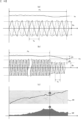
- the characteristics analyzed here are expressed as waveforms on a timeline defined by, for example, amplitude-time as illustrated in Fig. 11 , and are synchronized with video data in which the wearer is recorded during riding or the like and position information on the map, and then displayed or output by the output device via the display-information generation unit 117e.
- the motion of pedaling a bicycle is analyzed.
- the body-motion reproduction data is analyzed based on the relative displacement of the sensors, a change in angular velocity and angular acceleration, a pedal crank, the build of the wearer, and the like, and a temporal change in power, rhythm (cadence), a change in upper body angle (torso angle), a change in leg angular range (LAR) of a thigh, the displacement of right and left feet and knees in the X direction and the Y direction, and the displacement of the waist in the X direction and the Y direction are estimated.
- three-dimensional data in which the wearer 1 is three-dimensionally displayed may be generated, or two-dimensional data projected on an XY plane may be generated.
- body motion data serving as a model may be extracted from the memory 114 in which the body motion data serving as the model is accumulated, and compared with the body-motion reproduction data on the wearer to generate improvement data indicating a deviation from proper body motion or the like.
- user information such as the gender, height, weight, and age in advance
- analysis based on each user information may be performed. Then, the analysis unit 117d transmits an analysis result of the three-dimensional image data, the improvement data, and the like to the information terminal device 100.
- the analysis unit 117d has a synchronous processing function, and the synchronous processing function performs calibration processing in order to perform synchronous processing for matching a time axis for displaying the body motion data with a time axis for displaying a video captured by the camera.
- the synchronous processing function extracts a predetermined characteristic action (calibration action) by the wearer 1 who causes the body motion sensor 40 to react from the video or audio, extracts a characteristic reaction due to the characteristic action in the body motion data, and performs the synchronous processing by matching the timing of the extracted characteristic action with the timing of the characteristic reaction.
- the characteristic action includes, for example, an action of applying vibration a predetermined number of times to the body motion sensor 40 in a short time, such as tapping or shaking the own body of the wearer 1 or the body motion sensor 40 itself a predetermined number of times in front of the camera.
- extraction processing of such a characteristic action by, for example, detecting displacement of a predetermined shape or color with a constant amplitude or rhythm within a predetermined time length by image recognition processing and recognizing that the wearer 1 is performing an action of "tapping with a hand", the capturing time of a frame in the video having the maximum displacement during the time length is read, and the time information is detected as a calibration signal.
- audio data is included in the moving image data, a sound of the wearer 1 tapping the bar may be extracted, and the extracted time information may be detected as the calibration signal.
- the characteristic action of the body motion sensor 40 described above is detected by scanning detection values of various sensors provided in the body motion sensor 40, such as the acceleration sensor, and extracting a point where a reaction of a certain amplitude or more is repeated a predetermined number of times within a predetermined time width. Note that either the characteristic action or the characteristic reaction may be detected first, and the detection processing may be executed by narrowing the scanning range of the other with reference to the time stamp detected for the one.
- the synchronization processing is performed by aligning the reproduction start times of both in such a manner that the time stamp (time information) at the time when the characteristic action described above has been performed and the time stamp at the time when the characteristic reaction has been detected are matched.
- the synchronization is performed by extending the reproduction time of the moving image or the length of the timeline of the body motion sensor and matching the reproduction start and end times of the moving image data and the body-motion reproduction data.
- the display-information generation unit 117e is a module that generates display information to be displayed on the output interface 111, and generates display information for displaying or outputting the body-motion reproduction data analyzed by the analysis unit 117d corresponding to the moving image.
- the display information displays the moving image captured by the built-in camera 115 or the external camera 20 in a window on the display, expresses the body-motion reproduction data analyzed by the analysis unit 117d in a planar circle, and displays the moving image in synchronization with the body-motion reproduction data analyzed by the analysis unit 117d and the timeline to be displayed in a comparable manner.
- the display information includes an audio signal and other output control signals together with the display data.
- the display screen includes a graphical user interface (GUI) for a touch operation, and an operation on the touch panel on which the GUI is displayed is input to the input interface 112 to switch the display by the display-information generation unit 117e.
- GUI graphical user interface
- a moving image of the wearer 1 captured by the built-in camera 115 or the external camera 20 can be displayed on the screen, and each motion parameter included in the body-motion reproduction data can be individually displayed on the timeline.
- a moving image of the wearer 1 captured from the front by the built-in camera 115 of the information terminal device 100 can be displayed, and each motion parameter included in the body-motion reproduction data can be superimposed and displayed on the timeline.
- various methods such as superimposing a timeline on a moving image and displaying it on the full screen can be adopted.
- the analysis unit 117d includes the index calculation unit 117g and a stability calculation unit 117f as modules related to stability evaluation processing.
- the stability calculation unit 117f is a module that calculates an average value of the parameter related to the cyclical motion extracted by the cycle extraction unit 117c over a predetermined period as a stable reference value, and calculates a stable period during which the stable state of the cyclical motion is continued based on the amount of deviation from the stable reference value.
- the index calculation unit 117g is a module that refers to the index data according to the calculation result by the stability calculation unit 117f and calculates the index for evaluating the stabilization ability.
- the frame in the moving image at the time indicated by the timeline may be displayed.
- the reproduction point cursor can move on the timeline in synchronization with the reproduction of the moving image to display the time progression, and can designate the reproduction start point to start the reproduction of the moving image from that point, or can set a predetermined time width to repeatedly reproduce the moving image during that time.
- the memory 114 is a storage device that records various types of data, and identification information for identifying each information terminal device 100, attachment part information on each body motion sensor 40, a relative positional relation of the body motion sensor 40 attached to each part, the user information described above, the body motion data serving as a model, and the like are accumulated therein.
- the memory 114 functions as a storage unit that stores the index data, and the index data is table data that holds a correlation between a stable period calculated by the stability calculation unit 117f, the amount of deviation after the stable period, and the index for evaluating the stabilizing ability.
- Fig. 10 illustrates an operation at the time of data reproduction. Note that, in the present embodiment, the recording operation is similar to that in the first embodiment described above, as illustrated in Fig. 10 .
- the body motion data is collected by the body-motion-data acquisition unit 117a, and the moving image data is collected by the moving-image acquisition unit 112a (S401). Then, the body-motion calculation unit 117b and the analysis unit 117d calculate and analyze the body motion of the wearer as the body-motion reproduction data based on the detection results by the body motion sensors 40 accumulated in the memory 114 and the relative positional relation between the body motion sensors 40.
- a cycle extraction step of extracting a cyclical motion of each body motion sensor 40 is performed based on the body motion data recorded in the memory 114 (S402).
- an average value of the parameter related to the cyclical motion extracted by the cycle extraction unit 117c over a predetermined period is calculated as the stable reference value. For example, as illustrated in Fig. 11(a) , an average of the cycles while a stable cycle is maintained is calculated as a stable cycle Ts, an average of the amplitudes is calculated as a stable amplitude Bs, and a period (time length) during which stability is maintained is calculated as Ps.
- the moving speed of the wearer is also measured, and the speed is also measured as a stable speed Vs.
- a stability calculation step of monitoring as needed whether the amount of deviation ( ⁇ T, ⁇ B, and ⁇ V in the drawing) from the stable reference value (Ts, Bs, Vs, and the like) falls within a predetermined threshold and calculating the stable period Ps during which the parameter of the cyclical motion maintains the stable state is performed (S403).
- average values from the start of the competition are sequentially calculated, and the average value while the average values fall within a predetermined change amount is set as the stable reference value.
- the stable reference value is updated as needed, and an amount by which the current value deviates from the stable reference value is monitored as the amount of deviation as needed.
- an index calculation step, by the index calculation unit 117g, of referring to the index data according to the calculation result by the stability calculation unit 117f and calculating the index for evaluating the stabilizing ability is performed (S404).
- This index data holds a correlation between the initial stable period Ps calculated by the stability calculation unit 117f, the amount of deviation after the stable period Ps, and the index for evaluating the stabilizing ability.
- predetermined diagnosis processing is performed based on the calculated index (S405), and a result of the diagnosis processing and the index are displayed or output together with the moving image and the body-motion reproduction data synchronized with them in a comparable manner by the display of the information terminal device 100 or the audio such as a speaker (S406).
- the duration of the stable period and the transition of the amount of deviation may be displayed on maps M1 and M2 based on the diagnosis result and the speed every moment, as illustrated in Fig. 11(c) .
- index data examples include the following.
- the index data can be a correlation between body motion of the wearer during bicycle riding and fitting that is setting of the bicycle. More specifically, the fitting such as the height of the saddle of the bicycle, the position of the pedals, the height and angle of the handlebars, and the like is set while checking whether the form and the speed at the time of riding can be stably maintained for a certain period of time or more by referring to the time length in which the stable period Ps is continued.
- the body motion data is recorded while the wearer with the body motion sensor 40 is actually riding the bicycle, displacement in the chest and waist, an angle change, an angular velocity, an angular acceleration, and the like are monitored as parameters of the cyclical motion, and a change in a right-left difference in the angular ranges of the thighs (comparison of the sensor values) is monitored.
- the angle difference between the waist and the chest is continuously measured (environmental dependency is eliminated by taking the angle difference of the points) to check how much the initial value set in the bike fitting can be maintained.
- the stable period Ps during which the initial value can be continuously maintained that is, the stable period Ps during which the initial value falls within the upper and lower thresholds ( ⁇ %) is inspected, and the amount of deviation is measured. Then, by referring to the index data based on these, the wearer is urged to review the result of the original bike fitting when the initial value cannot be maintained.
- a difference between the angle of the head and the angle of the chest of the wearing vehicle may be monitored in order to maintain constant motion during bicycle racing.
- the body motion sensors 40 are attached to the waist, chest, and both thighs of the wearer, and the body motion is detected from the start of the bicycle riding.
- the wearer rides the bicycle in units of seconds at a stable location, and the initial stable period is repeatedly measured to set a more-stable initial stable reference value in units of seconds.
- the wearer starts long-distance actual riding, and the body motion data is monitored in real time. Then, when the amount of deviation from the stable reference value exceeds a predetermined threshold, an alert is output as abnormality detection.
- the amount of deviation ( ⁇ %) of the single sensor data from the initial value or the calculated value (MPI), the amount of deviation ( ⁇ %) from the initial value related to the mutual relation of the parameters from the sensors, and the like may be set by operation of the user without a cent.
- the best score of the athlete may be defined from the past data.
- the initial stable period is set based on riding in seconds, it is possible to perform measurement regardless of geographical features.
- the index data may hold a correlation between the body motion of the wearer during running and the stability of the form during running or an incidence of injuries or failures.
- running the stable reference value for repetitive motion is calculated, and the index data is referred to by monitoring deviation from the stable reference value. Then, an incidence of injuries or failures according to the amount of deviation is calculated, and when the possibility of occurrence of injuries or the like increases, an abnormal value is notified to the wearer. At this time, an abnormal value may be eliminated through operation determination processing.
- the body motion sensors 40 are attached to the back, the waist, the chest, and the thighs, and the angle of the knee adduction at the time of landing, the angle difference between the waist and the chest, the swing back angle of the legs, the manner of landing, and the like are monitored. Accordingly, by detecting an imbalanced form, such as lifting the chin, during running and notifying the wearer of an alert to coach the wearer to slow down and maintain the form.
- an imbalanced form such as lifting the chin
- the correlation of the stable period, the reference value, the amount of deviation, the excessive pace that is likely to lead to an injury, and the consumption of stamina is held in the index data, and the significant changes in the parameter values due to the imbalanced form when the wearer tries to increase the running speed beyond the capacity is detected to coach the wearer to stop trying to an unreasonable speed that cannot be maintained.
- a method of monitoring the "manner of landing" in running includes, for example, a method in which the body motion sensors are attached to the insteps of the left and right feet, and acceleration, angular velocity, and the like applied to each leg are detected to recognize the landing impact during running and the motion immediately after landing from the subsequent rotation of the body motion sensors. Accordingly, it is possible to detect a change in the form of the wearer due to fatigue or the like and a change in the manner of landing of the leg itself can also be detected. Specifically, in the monitoring of the running form, the area below the ankle that lands first is focused on.
- This manner of landing is classified into three types of toe landing (forefoot strike), flat landing (midfoot strike), and heel landing (rearfoot strike).
- vibration due to a landing impact, angular velocity at and after the landing, and rotational acceleration (gyro data) immediately after the landing are used to measure a change in running form, including landing, by comparing the amount of deviation of these parameters from the reference values and the threshold. Then, the degree of fatigue, an incidence of injuries, and the like are obtained by referring to the index data based on the comparison result of the amount of deviation and the threshold, and it is possible to properly coach the wearer and to notify the wearer of an alert.
- a value at the start of running, or an average value for a certain period of stable time a maximum value, or a minimum value may be used.
- the load may be varied by changing the climbing gradient or the running pace (speed), and each parameter at the time when the form is imbalanced may be set as the maximum or minimum threshold, or the average value of the period until that point may be set as the reference value.
- the stability evaluation system and the stability evaluation method according to the present embodiment described above can be implemented by executing a stability evaluation program of the present invention described in a predetermined language on a computer as in the stability evaluation application described above. That is, by installing the program of the present invention in an IC chip or a memory device of a portable terminal device, a smartphone, a wearable terminal, a mobile PC, other information processing terminals, a general-purpose computer, such as a personal computer or a server computer, and executing the program by the CPU, a system having the above functions can be constructed, and the stability evaluation method can be performed.
- a stabilizing ability so-called stability, according to a change in body motion of a wearer can be appropriately evaluated to achieve effective training, coaching, and fitting of athletic equipment.
- the length of the stable period during which the reference value, the threshold, and the stable reference value are maintained is detected to evaluate whether the stability of the body motion is secured or the body motion is correctly reproduced. Therefore, by appropriately setting the reference value, the width of the threshold, or the like, it is possible to detect a small change before the form is visibly imbalanced and coach the wearer to make small correction to maintain the stability.
- the stability evaluation program according to the present embodiment can be distributed via, for example, a communication line, and can be transferred as a packaged application that operates on a standalone computer by being recorded on a computer-readable recording medium.
- a magnetic recording medium such as a flexible disk or a cassette tape, an optical disk such as a CD-ROM or a DVD-ROM, or various recording media such as a RAM card can be used to record the program.
- the above system and method can be easily implemented using a general-purpose computer or a dedicated computer, and the program can be easily stored, transported, and installed.
- the present invention is not limited to the above embodiment as it is, and the constituent elements can be modified and embodied without departing from the gist thereof in the implementation stage.
- various inventions can be formed by appropriately combining a plurality of constituent elements disclosed in the above embodiment. For example, some constituent elements may be deleted from all the constituent elements described in the embodiment.
Landscapes
- Health & Medical Sciences (AREA)
- Life Sciences & Earth Sciences (AREA)
- Engineering & Computer Science (AREA)
- Physics & Mathematics (AREA)
- General Health & Medical Sciences (AREA)
- Surgery (AREA)
- Public Health (AREA)
- Animal Behavior & Ethology (AREA)
- Molecular Biology (AREA)
- Veterinary Medicine (AREA)
- Biophysics (AREA)
- Pathology (AREA)
- Biomedical Technology (AREA)
- Heart & Thoracic Surgery (AREA)
- Medical Informatics (AREA)
- Physiology (AREA)
- Oral & Maxillofacial Surgery (AREA)
- Dentistry (AREA)
- Physical Education & Sports Medicine (AREA)
- General Physics & Mathematics (AREA)
- Business, Economics & Management (AREA)
- Educational Administration (AREA)
- Entrepreneurship & Innovation (AREA)
- Multimedia (AREA)
- Educational Technology (AREA)
- Theoretical Computer Science (AREA)
- Biodiversity & Conservation Biology (AREA)
- Computer Networks & Wireless Communication (AREA)
- Cardiology (AREA)
- Measurement Of The Respiration, Hearing Ability, Form, And Blood Characteristics Of Living Organisms (AREA)
- Complex Calculations (AREA)
- Maintenance And Management Of Digital Transmission (AREA)
- Optical Communication System (AREA)
Applications Claiming Priority (2)
| Application Number | Priority Date | Filing Date | Title |
|---|---|---|---|
| JP2020071816A JP7209363B2 (ja) | 2020-04-13 | 2020-04-13 | スタビリティ評価システム、プログラム及び方法 |
| PCT/JP2021/014732 WO2021210461A1 (fr) | 2020-04-13 | 2021-04-07 | Système, programme et procédé d'évaluation de stabilité |
Publications (2)
| Publication Number | Publication Date |
|---|---|
| EP4137215A1 true EP4137215A1 (fr) | 2023-02-22 |
| EP4137215A4 EP4137215A4 (fr) | 2023-09-20 |
Family
ID=78079197
Family Applications (1)
| Application Number | Title | Priority Date | Filing Date |
|---|---|---|---|
| EP21788979.9A Withdrawn EP4137215A4 (fr) | 2020-04-13 | 2021-04-07 | Système, programme et procédé d'évaluation de stabilité |
Country Status (5)
| Country | Link |
|---|---|
| US (1) | US11660505B2 (fr) |
| EP (1) | EP4137215A4 (fr) |
| JP (1) | JP7209363B2 (fr) |
| AU (1) | AU2021257127B2 (fr) |
| WO (1) | WO2021210461A1 (fr) |
Cited By (1)
| Publication number | Priority date | Publication date | Assignee | Title |
|---|---|---|---|---|
| CN117135686A (zh) * | 2023-10-24 | 2023-11-28 | 深圳市蓝鲸智联科技股份有限公司 | 一种基于蓝牙的车载信息交互方法及系统 |
Families Citing this family (8)
| Publication number | Priority date | Publication date | Assignee | Title |
|---|---|---|---|---|
| US20110240840A1 (en) | 2009-12-11 | 2011-10-06 | Quest Diagnostics Investments Incorporated | Mass spectrometric determination of cookson-derivatized, non-metabolized vitamin d |
| US9261526B2 (en) * | 2010-08-26 | 2016-02-16 | Blast Motion Inc. | Fitting system for sporting equipment |
| CA3031040C (fr) | 2015-07-16 | 2021-02-16 | Blast Motion Inc. | Systeme de correlation d'evenements au moyen de plusieurs capteurs |
| US11565163B2 (en) | 2015-07-16 | 2023-01-31 | Blast Motion Inc. | Equipment fitting system that compares swing metrics |
| US12508472B2 (en) * | 2020-06-17 | 2025-12-30 | FitForm Technologies Inc. | Tracking three-dimensional motion during an activity |
| JP2024006322A (ja) * | 2022-07-01 | 2024-01-17 | リオモ インク | ランニングフォーム評価システム、プログラム及び方法 |
| WO2024205024A1 (fr) * | 2023-03-24 | 2024-10-03 | 삼성전자 주식회사 | Procédé de détection d'une chute d'un utilisateur, et dispositif électronique associé |
| KR102729442B1 (ko) * | 2024-05-08 | 2024-11-14 | 오제이 주식회사 | 운동 밸런스 측정 장치 |
Family Cites Families (20)
| Publication number | Priority date | Publication date | Assignee | Title |
|---|---|---|---|---|
| AU2002218496A1 (en) * | 2000-11-29 | 2002-06-11 | Art Haven 9 Co., Ltd. | Method and device for measuring body compositions |
| US7031872B2 (en) * | 2002-08-09 | 2006-04-18 | Matsushita Electric Industrial Co., Ltd. | Equilibrium state analyzing apparatus, equilbrium state analysis method, program and recording medium |
| EP3267228B1 (fr) | 2007-02-16 | 2020-05-27 | NIKE Innovate C.V. | Comparaison en temps réel d'informations athlétiques |
| US8998828B2 (en) | 2009-07-09 | 2015-04-07 | Nike, Inc. | Visualization testing and/or training |
| US9283429B2 (en) * | 2010-11-05 | 2016-03-15 | Nike, Inc. | Method and system for automated personal training |
| JP5612627B2 (ja) * | 2011-03-30 | 2014-10-22 | 株式会社デンソーアイティーラボラトリ | 身体能力判定装置及びデータ処理方法 |
| FR2991080B1 (fr) | 2012-05-23 | 2016-01-22 | Babolat Vs | Methode de calcul d'un indice de repetabilite lors de l'utilisation d'une raquette de tennis |
| JP2016524929A (ja) | 2013-05-30 | 2016-08-22 | アトラス ウェアラブルズ,インク. | ポータブルコンピューティングデバイス、及びそこから捕捉される個人データの解析 |
| CN105981083B (zh) * | 2014-02-24 | 2019-01-08 | 索尼公司 | 智能可穿戴设备和用于优化输出的方法 |
| US10065074B1 (en) * | 2014-12-12 | 2018-09-04 | Enflux, Inc. | Training systems with wearable sensors for providing users with feedback |
| KR101705787B1 (ko) * | 2015-01-29 | 2017-02-13 | 주식회사 크레타 | 코어안정화운동 관리 시스템 |
| US10357688B2 (en) * | 2016-11-18 | 2019-07-23 | MAD Apparel, Inc. | Exercise biofeedback using sensor-equipped athletic garments |
| KR101838194B1 (ko) * | 2016-04-28 | 2018-03-13 | 한국기계연구원 | 트레드밀 체감안정도 정량화방법 및 이를 이용한 트레드밀 제어방법 |
| JP6482106B2 (ja) | 2016-11-30 | 2019-03-13 | リオモ インクLEOMO, Inc. | モーションキャプチャシステム、モーションキャプチャプログラム及びモーションキャプチャ方法 |
| CN106859616A (zh) * | 2016-12-22 | 2017-06-20 | 深圳市元征科技股份有限公司 | 一种基于体域网的监测方法及终端 |
| US20180264320A1 (en) * | 2017-03-14 | 2018-09-20 | Lumo BodyTech, Inc | System and method for automatic location detection for wearable sensors |
| WO2019035444A1 (fr) | 2017-08-16 | 2019-02-21 | 日本電信電話株式会社 | Instrument de mesure de la pression d'une semelle de pied, dispositif de fourniture d'informations et procédé de fourniture d'informations |
| KR102031243B1 (ko) | 2019-07-17 | 2019-10-11 | 정재훈 | 스마트 프리웨이트 트레이닝 동작 인식 장치 및 그 방법 |
| JP7173102B2 (ja) * | 2020-07-01 | 2022-11-16 | カシオ計算機株式会社 | 情報処理装置、情報処理方法及びプログラム |
| US20230073679A1 (en) * | 2021-04-12 | 2023-03-09 | Medfit International Ag | System and method for functional stability measurement of knee joints |
-
2020
- 2020-04-13 JP JP2020071816A patent/JP7209363B2/ja active Active
-
2021
- 2021-04-07 AU AU2021257127A patent/AU2021257127B2/en not_active Ceased
- 2021-04-07 WO PCT/JP2021/014732 patent/WO2021210461A1/fr not_active Ceased
- 2021-04-07 EP EP21788979.9A patent/EP4137215A4/fr not_active Withdrawn
- 2021-04-07 US US17/917,556 patent/US11660505B2/en active Active
Cited By (2)
| Publication number | Priority date | Publication date | Assignee | Title |
|---|---|---|---|---|
| CN117135686A (zh) * | 2023-10-24 | 2023-11-28 | 深圳市蓝鲸智联科技股份有限公司 | 一种基于蓝牙的车载信息交互方法及系统 |
| CN117135686B (zh) * | 2023-10-24 | 2024-02-20 | 深圳市蓝鲸智联科技股份有限公司 | 一种基于蓝牙的车载信息交互方法及系统 |
Also Published As
| Publication number | Publication date |
|---|---|
| US20230123441A1 (en) | 2023-04-20 |
| EP4137215A4 (fr) | 2023-09-20 |
| WO2021210461A1 (fr) | 2021-10-21 |
| JP2021166683A (ja) | 2021-10-21 |
| AU2021257127A1 (en) | 2022-12-08 |
| US11660505B2 (en) | 2023-05-30 |
| JP7209363B2 (ja) | 2023-01-20 |
| AU2021257127B2 (en) | 2023-08-10 |
Similar Documents
| Publication | Publication Date | Title |
|---|---|---|
| AU2021257127B2 (en) | Stability evaluation system, program, and method | |
| Rana et al. | Wearable sensors for real-time kinematics analysis in sports: A review | |
| US20240091589A1 (en) | Integrated portable device and method implementing an accelerometer for analyzing biomechanical parameters of a stride | |
| US10684304B2 (en) | Foot exercise motion analysis device during moving exercise | |
| US11134865B2 (en) | Motion analysis system, motion analysis apparatus, motion analysis program, and motion analysis method | |
| JP6596945B2 (ja) | 運動解析方法、運動解析装置、運動解析システム及び運動解析プログラム | |
| JP7307447B2 (ja) | モーションキャプチャーシステム、モーションキャプチャープログラム及びモーションキャプチャー方法 | |
| CN105435438B (zh) | 运动解析装置以及运动解析方法 | |
| US10835778B2 (en) | Motion capture system, motion capture program and motion capture method | |
| WO2019043601A1 (fr) | Procédé et dispositif de récupération de paramètres biomécaniques d'une foulée | |
| WO2023195461A1 (fr) | Système, programme et procédé d'analyse de forme de course | |
| JP7256563B2 (ja) | 情報処理端末装置の連結機構及び連結方法 | |
| WO2023100565A1 (fr) | Système, programme et procédé d'évaluation de technique de course | |
| KR20260062905A (ko) | 복수의 관성 측정 장치를 이용한 스포츠 동작의 다중 신체 부위 분석, 자동 장단점 분류 및 사후 리포트 생성 방법, 장치 및 시스템 | |
| WO2024005183A1 (fr) | Système, programme et procédé d'évaluation de forme de course | |
| TW201904517A (zh) | 可攜式運動監視系統 | |
| Wixted | Robust Monitoring of Sport and Exercise |
Legal Events
| Date | Code | Title | Description |
|---|---|---|---|
| STAA | Information on the status of an ep patent application or granted ep patent |
Free format text: STATUS: THE INTERNATIONAL PUBLICATION HAS BEEN MADE |
|
| PUAI | Public reference made under article 153(3) epc to a published international application that has entered the european phase |
Free format text: ORIGINAL CODE: 0009012 |
|
| STAA | Information on the status of an ep patent application or granted ep patent |
Free format text: STATUS: REQUEST FOR EXAMINATION WAS MADE |
|
| 17P | Request for examination filed |
Effective date: 20221111 |
|
| AK | Designated contracting states |
Kind code of ref document: A1 Designated state(s): AL AT BE BG CH CY CZ DE DK EE ES FI FR GB GR HR HU IE IS IT LI LT LU LV MC MK MT NL NO PL PT RO RS SE SI SK SM TR |
|
| DAV | Request for validation of the european patent (deleted) | ||
| DAX | Request for extension of the european patent (deleted) | ||
| A4 | Supplementary search report drawn up and despatched |
Effective date: 20230818 |
|
| RIC1 | Information provided on ipc code assigned before grant |
Ipc: A61B 5/22 20060101ALI20230811BHEP Ipc: A61B 5/00 20060101ALI20230811BHEP Ipc: A63B 24/00 20060101ALI20230811BHEP Ipc: A61B 5/11 20060101ALI20230811BHEP Ipc: A63B 71/06 20060101ALI20230811BHEP Ipc: A63B 69/00 20060101AFI20230811BHEP |
|
| STAA | Information on the status of an ep patent application or granted ep patent |
Free format text: STATUS: THE APPLICATION IS DEEMED TO BE WITHDRAWN |
|
| 18D | Application deemed to be withdrawn |
Effective date: 20241101 |