EP4137460A1 - Verfahren zur festkörpersynthese von ni-reichem lithium-verbundmetalloxid-kathodenaktivmaterial - Google Patents
Verfahren zur festkörpersynthese von ni-reichem lithium-verbundmetalloxid-kathodenaktivmaterial Download PDFInfo
- Publication number
- EP4137460A1 EP4137460A1 EP21872963.0A EP21872963A EP4137460A1 EP 4137460 A1 EP4137460 A1 EP 4137460A1 EP 21872963 A EP21872963 A EP 21872963A EP 4137460 A1 EP4137460 A1 EP 4137460A1
- Authority
- EP
- European Patent Office
- Prior art keywords
- transition metal
- nickel
- lithium
- positive electrode
- active material
- Prior art date
- Legal status (The legal status is an assumption and is not a legal conclusion. Google has not performed a legal analysis and makes no representation as to the accuracy of the status listed.)
- Pending
Links
- 229910052744 lithium Inorganic materials 0.000 title claims abstract description 138
- WHXSMMKQMYFTQS-UHFFFAOYSA-N Lithium Chemical compound [Li] WHXSMMKQMYFTQS-UHFFFAOYSA-N 0.000 title claims abstract description 137
- 239000002245 particle Substances 0.000 title claims abstract description 61
- 239000002131 composite material Substances 0.000 title claims abstract description 47
- 229910000314 transition metal oxide Inorganic materials 0.000 title claims abstract description 44
- 238000000034 method Methods 0.000 title claims abstract description 32
- 230000015572 biosynthetic process Effects 0.000 title description 3
- 239000006182 cathode active material Substances 0.000 title 2
- 238000003786 synthesis reaction Methods 0.000 title 1
- PXHVJJICTQNCMI-UHFFFAOYSA-N Nickel Chemical compound [Ni] PXHVJJICTQNCMI-UHFFFAOYSA-N 0.000 claims abstract description 123
- 239000007774 positive electrode material Substances 0.000 claims abstract description 74
- 239000000843 powder Substances 0.000 claims abstract description 55
- 229910052759 nickel Inorganic materials 0.000 claims abstract description 51
- 229910052723 transition metal Inorganic materials 0.000 claims abstract description 50
- 150000003624 transition metals Chemical class 0.000 claims abstract description 50
- 239000002994 raw material Substances 0.000 claims abstract description 48
- 239000000203 mixture Substances 0.000 claims abstract description 27
- 238000005245 sintering Methods 0.000 claims abstract description 26
- 238000010532 solid phase synthesis reaction Methods 0.000 claims abstract description 23
- 238000005406 washing Methods 0.000 claims abstract description 18
- 239000012535 impurity Substances 0.000 claims abstract description 17
- QVGXLLKOCUKJST-UHFFFAOYSA-N atomic oxygen Chemical compound [O] QVGXLLKOCUKJST-UHFFFAOYSA-N 0.000 claims abstract description 15
- 239000001301 oxygen Substances 0.000 claims abstract description 15
- 229910052760 oxygen Inorganic materials 0.000 claims abstract description 15
- 238000002156 mixing Methods 0.000 claims abstract description 9
- 238000001816 cooling Methods 0.000 claims abstract description 7
- 238000003746 solid phase reaction Methods 0.000 claims abstract description 5
- WMFOQBRAJBCJND-UHFFFAOYSA-M Lithium hydroxide Chemical compound [Li+].[OH-] WMFOQBRAJBCJND-UHFFFAOYSA-M 0.000 claims description 16
- 239000011572 manganese Substances 0.000 claims description 15
- PWHULOQIROXLJO-UHFFFAOYSA-N Manganese Chemical compound [Mn] PWHULOQIROXLJO-UHFFFAOYSA-N 0.000 claims description 14
- 229910017052 cobalt Inorganic materials 0.000 claims description 14
- 239000010941 cobalt Substances 0.000 claims description 14
- GUTLYIVDDKVIGB-UHFFFAOYSA-N cobalt atom Chemical compound [Co] GUTLYIVDDKVIGB-UHFFFAOYSA-N 0.000 claims description 14
- 229910052748 manganese Inorganic materials 0.000 claims description 14
- GLXDVVHUTZTUQK-UHFFFAOYSA-M lithium;hydroxide;hydrate Chemical compound [Li+].O.[OH-] GLXDVVHUTZTUQK-UHFFFAOYSA-M 0.000 claims description 12
- NUJOXMJBOLGQSY-UHFFFAOYSA-N manganese dioxide Chemical compound O=[Mn]=O NUJOXMJBOLGQSY-UHFFFAOYSA-N 0.000 claims description 8
- XGZVUEUWXADBQD-UHFFFAOYSA-L lithium carbonate Chemical compound [Li+].[Li+].[O-]C([O-])=O XGZVUEUWXADBQD-UHFFFAOYSA-L 0.000 claims description 5
- 229910052808 lithium carbonate Inorganic materials 0.000 claims description 5
- 229910021503 Cobalt(II) hydroxide Inorganic materials 0.000 claims description 3
- 229910021446 cobalt carbonate Inorganic materials 0.000 claims description 3
- 229910000428 cobalt oxide Inorganic materials 0.000 claims description 3
- 229910000152 cobalt phosphate Inorganic materials 0.000 claims description 3
- 229910000361 cobalt sulfate Inorganic materials 0.000 claims description 3
- 229940044175 cobalt sulfate Drugs 0.000 claims description 3
- KTVIXTQDYHMGHF-UHFFFAOYSA-L cobalt(2+) sulfate Chemical compound [Co+2].[O-]S([O-])(=O)=O KTVIXTQDYHMGHF-UHFFFAOYSA-L 0.000 claims description 3
- ZOTKGJBKKKVBJZ-UHFFFAOYSA-L cobalt(2+);carbonate Chemical compound [Co+2].[O-]C([O-])=O ZOTKGJBKKKVBJZ-UHFFFAOYSA-L 0.000 claims description 3
- ZBDSFTZNNQNSQM-UHFFFAOYSA-H cobalt(2+);diphosphate Chemical compound [Co+2].[Co+2].[Co+2].[O-]P([O-])([O-])=O.[O-]P([O-])([O-])=O ZBDSFTZNNQNSQM-UHFFFAOYSA-H 0.000 claims description 3
- ASKVAEGIVYSGNY-UHFFFAOYSA-L cobalt(ii) hydroxide Chemical compound [OH-].[OH-].[Co+2] ASKVAEGIVYSGNY-UHFFFAOYSA-L 0.000 claims description 3
- IVMYJDGYRUAWML-UHFFFAOYSA-N cobalt(ii) oxide Chemical compound [Co]=O IVMYJDGYRUAWML-UHFFFAOYSA-N 0.000 claims description 3
- 239000011656 manganese carbonate Substances 0.000 claims description 3
- 235000006748 manganese carbonate Nutrition 0.000 claims description 3
- 229940093474 manganese carbonate Drugs 0.000 claims description 3
- 229940099594 manganese dioxide Drugs 0.000 claims description 3
- 229940099596 manganese sulfate Drugs 0.000 claims description 3
- 239000011702 manganese sulphate Substances 0.000 claims description 3
- 235000007079 manganese sulphate Nutrition 0.000 claims description 3
- MIVBAHRSNUNMPP-UHFFFAOYSA-N manganese(2+);dinitrate Chemical compound [Mn+2].[O-][N+]([O-])=O.[O-][N+]([O-])=O MIVBAHRSNUNMPP-UHFFFAOYSA-N 0.000 claims description 3
- 229910000016 manganese(II) carbonate Inorganic materials 0.000 claims description 3
- SQQMAOCOWKFBNP-UHFFFAOYSA-L manganese(II) sulfate Chemical compound [Mn+2].[O-]S([O-])(=O)=O SQQMAOCOWKFBNP-UHFFFAOYSA-L 0.000 claims description 3
- XMWCXZJXESXBBY-UHFFFAOYSA-L manganese(ii) carbonate Chemical compound [Mn+2].[O-]C([O-])=O XMWCXZJXESXBBY-UHFFFAOYSA-L 0.000 claims description 3
- 229910000480 nickel oxide Inorganic materials 0.000 claims description 3
- 229910000159 nickel phosphate Inorganic materials 0.000 claims description 3
- LGQLOGILCSXPEA-UHFFFAOYSA-L nickel sulfate Chemical compound [Ni+2].[O-]S([O-])(=O)=O LGQLOGILCSXPEA-UHFFFAOYSA-L 0.000 claims description 3
- JOCJYBPHESYFOK-UHFFFAOYSA-K nickel(3+);phosphate Chemical compound [Ni+3].[O-]P([O-])([O-])=O JOCJYBPHESYFOK-UHFFFAOYSA-K 0.000 claims description 3
- 229910000008 nickel(II) carbonate Inorganic materials 0.000 claims description 3
- 229910000363 nickel(II) sulfate Inorganic materials 0.000 claims description 3
- ZULUUIKRFGGGTL-UHFFFAOYSA-L nickel(ii) carbonate Chemical compound [Ni+2].[O-]C([O-])=O ZULUUIKRFGGGTL-UHFFFAOYSA-L 0.000 claims description 3
- BFDHFSHZJLFAMC-UHFFFAOYSA-L nickel(ii) hydroxide Chemical compound [OH-].[OH-].[Ni+2] BFDHFSHZJLFAMC-UHFFFAOYSA-L 0.000 claims description 3
- KBJMLQFLOWQJNF-UHFFFAOYSA-N nickel(ii) nitrate Chemical compound [Ni+2].[O-][N+]([O-])=O.[O-][N+]([O-])=O KBJMLQFLOWQJNF-UHFFFAOYSA-N 0.000 claims description 3
- GNRSAWUEBMWBQH-UHFFFAOYSA-N oxonickel Chemical compound [Ni]=O GNRSAWUEBMWBQH-UHFFFAOYSA-N 0.000 claims description 3
- 238000004519 manufacturing process Methods 0.000 abstract description 9
- 230000000052 comparative effect Effects 0.000 description 12
- OKTJSMMVPCPJKN-UHFFFAOYSA-N Carbon Chemical compound [C] OKTJSMMVPCPJKN-UHFFFAOYSA-N 0.000 description 8
- -1 sheets Substances 0.000 description 8
- 239000004020 conductor Substances 0.000 description 6
- 238000001878 scanning electron micrograph Methods 0.000 description 6
- 239000011230 binding agent Substances 0.000 description 5
- 229910052782 aluminium Inorganic materials 0.000 description 4
- 239000010410 layer Substances 0.000 description 4
- IIPYXGDZVMZOAP-UHFFFAOYSA-N lithium nitrate Chemical compound [Li+].[O-][N+]([O-])=O IIPYXGDZVMZOAP-UHFFFAOYSA-N 0.000 description 4
- 238000005259 measurement Methods 0.000 description 4
- 239000002033 PVDF binder Substances 0.000 description 3
- XAGFODPZIPBFFR-UHFFFAOYSA-N aluminium Chemical compound [Al] XAGFODPZIPBFFR-UHFFFAOYSA-N 0.000 description 3
- 239000007789 gas Substances 0.000 description 3
- XLYOFNOQVPJJNP-UHFFFAOYSA-M hydroxide Chemical compound [OH-] XLYOFNOQVPJJNP-UHFFFAOYSA-M 0.000 description 3
- 239000011164 primary particle Substances 0.000 description 3
- 230000008569 process Effects 0.000 description 3
- 239000011163 secondary particle Substances 0.000 description 3
- 229910001220 stainless steel Inorganic materials 0.000 description 3
- 239000010935 stainless steel Substances 0.000 description 3
- 239000000126 substance Substances 0.000 description 3
- 239000010936 titanium Substances 0.000 description 3
- 229910052719 titanium Inorganic materials 0.000 description 3
- 238000004448 titration Methods 0.000 description 3
- XLYOFNOQVPJJNP-UHFFFAOYSA-N water Substances O XLYOFNOQVPJJNP-UHFFFAOYSA-N 0.000 description 3
- BQCADISMDOOEFD-UHFFFAOYSA-N Silver Chemical compound [Ag] BQCADISMDOOEFD-UHFFFAOYSA-N 0.000 description 2
- RTAQQCXQSZGOHL-UHFFFAOYSA-N Titanium Chemical compound [Ti] RTAQQCXQSZGOHL-UHFFFAOYSA-N 0.000 description 2
- XLOMVQKBTHCTTD-UHFFFAOYSA-N Zinc monoxide Chemical compound [Zn]=O XLOMVQKBTHCTTD-UHFFFAOYSA-N 0.000 description 2
- 238000005054 agglomeration Methods 0.000 description 2
- 230000002776 aggregation Effects 0.000 description 2
- 239000006227 byproduct Substances 0.000 description 2
- 229910052799 carbon Inorganic materials 0.000 description 2
- 230000008859 change Effects 0.000 description 2
- 238000000975 co-precipitation Methods 0.000 description 2
- 229910052802 copper Inorganic materials 0.000 description 2
- 239000010949 copper Substances 0.000 description 2
- 239000011267 electrode slurry Substances 0.000 description 2
- 238000001879 gelation Methods 0.000 description 2
- 229910052738 indium Inorganic materials 0.000 description 2
- 239000011254 layer-forming composition Substances 0.000 description 2
- 229910052751 metal Inorganic materials 0.000 description 2
- 239000002184 metal Substances 0.000 description 2
- 239000012071 phase Substances 0.000 description 2
- 229920002981 polyvinylidene fluoride Polymers 0.000 description 2
- 238000002360 preparation method Methods 0.000 description 2
- 229910052709 silver Inorganic materials 0.000 description 2
- 239000004332 silver Substances 0.000 description 2
- 239000002002 slurry Substances 0.000 description 2
- 239000000243 solution Substances 0.000 description 2
- 229920000049 Carbon (fiber) Polymers 0.000 description 1
- BVKZGUZCCUSVTD-UHFFFAOYSA-L Carbonate Chemical compound [O-]C([O-])=O BVKZGUZCCUSVTD-UHFFFAOYSA-L 0.000 description 1
- 229920002134 Carboxymethyl cellulose Polymers 0.000 description 1
- 229910052684 Cerium Inorganic materials 0.000 description 1
- VEXZGXHMUGYJMC-UHFFFAOYSA-M Chloride anion Chemical compound [Cl-] VEXZGXHMUGYJMC-UHFFFAOYSA-M 0.000 description 1
- RYGMFSIKBFXOCR-UHFFFAOYSA-N Copper Chemical compound [Cu] RYGMFSIKBFXOCR-UHFFFAOYSA-N 0.000 description 1
- 229910052688 Gadolinium Inorganic materials 0.000 description 1
- VEXZGXHMUGYJMC-UHFFFAOYSA-N Hydrochloric acid Chemical compound Cl VEXZGXHMUGYJMC-UHFFFAOYSA-N 0.000 description 1
- 229920002153 Hydroxypropyl cellulose Polymers 0.000 description 1
- 229910002651 NO3 Inorganic materials 0.000 description 1
- NHNBFGGVMKEFGY-UHFFFAOYSA-N Nitrate Chemical compound [O-][N+]([O-])=O NHNBFGGVMKEFGY-UHFFFAOYSA-N 0.000 description 1
- 239000004698 Polyethylene Substances 0.000 description 1
- 229920000265 Polyparaphenylene Polymers 0.000 description 1
- 239000004743 Polypropylene Substances 0.000 description 1
- 239000004372 Polyvinyl alcohol Substances 0.000 description 1
- 229910052772 Samarium Inorganic materials 0.000 description 1
- 229920002472 Starch Polymers 0.000 description 1
- UCKMPCXJQFINFW-UHFFFAOYSA-N Sulphide Chemical compound [S-2] UCKMPCXJQFINFW-UHFFFAOYSA-N 0.000 description 1
- GWEVSGVZZGPLCZ-UHFFFAOYSA-N Titan oxide Chemical compound O=[Ti]=O GWEVSGVZZGPLCZ-UHFFFAOYSA-N 0.000 description 1
- KFDQGLPGKXUTMZ-UHFFFAOYSA-N [Mn].[Co].[Ni] Chemical compound [Mn].[Co].[Ni] KFDQGLPGKXUTMZ-UHFFFAOYSA-N 0.000 description 1
- 239000006230 acetylene black Substances 0.000 description 1
- 239000000853 adhesive Substances 0.000 description 1
- 230000001070 adhesive effect Effects 0.000 description 1
- 229910021383 artificial graphite Inorganic materials 0.000 description 1
- 230000008901 benefit Effects 0.000 description 1
- 229910052796 boron Inorganic materials 0.000 description 1
- 229910052791 calcium Inorganic materials 0.000 description 1
- 239000006229 carbon black Substances 0.000 description 1
- 239000004917 carbon fiber Substances 0.000 description 1
- 239000003575 carbonaceous material Substances 0.000 description 1
- 238000005266 casting Methods 0.000 description 1
- 239000006231 channel black Substances 0.000 description 1
- 229910052804 chromium Inorganic materials 0.000 description 1
- 239000011248 coating agent Substances 0.000 description 1
- 238000000576 coating method Methods 0.000 description 1
- SEVNKUSLDMZOTL-UHFFFAOYSA-H cobalt(2+);manganese(2+);nickel(2+);hexahydroxide Chemical compound [OH-].[OH-].[OH-].[OH-].[OH-].[OH-].[Mn+2].[Co+2].[Ni+2] SEVNKUSLDMZOTL-UHFFFAOYSA-H 0.000 description 1
- UBEWDCMIDFGDOO-UHFFFAOYSA-N cobalt(II,III) oxide Inorganic materials [O-2].[O-2].[O-2].[O-2].[Co+2].[Co+3].[Co+3] UBEWDCMIDFGDOO-UHFFFAOYSA-N 0.000 description 1
- 229920001940 conductive polymer Polymers 0.000 description 1
- 229920001577 copolymer Polymers 0.000 description 1
- NJLLQSBAHIKGKF-UHFFFAOYSA-N dipotassium dioxido(oxo)titanium Chemical compound [K+].[K+].[O-][Ti]([O-])=O NJLLQSBAHIKGKF-UHFFFAOYSA-N 0.000 description 1
- 238000009826 distribution Methods 0.000 description 1
- 238000001035 drying Methods 0.000 description 1
- 230000000694 effects Effects 0.000 description 1
- 239000008151 electrolyte solution Substances 0.000 description 1
- 239000000835 fiber Substances 0.000 description 1
- 229920001973 fluoroelastomer Polymers 0.000 description 1
- 239000006260 foam Substances 0.000 description 1
- 239000011888 foil Substances 0.000 description 1
- 239000006232 furnace black Substances 0.000 description 1
- 229910002804 graphite Inorganic materials 0.000 description 1
- 239000010439 graphite Substances 0.000 description 1
- 238000000227 grinding Methods 0.000 description 1
- 150000004820 halides Chemical class 0.000 description 1
- 239000001863 hydroxypropyl cellulose Substances 0.000 description 1
- 235000010977 hydroxypropyl cellulose Nutrition 0.000 description 1
- 229910052742 iron Inorganic materials 0.000 description 1
- 239000003273 ketjen black Substances 0.000 description 1
- 238000010030 laminating Methods 0.000 description 1
- 239000006233 lamp black Substances 0.000 description 1
- 229910052746 lanthanum Inorganic materials 0.000 description 1
- KWGKDLIKAYFUFQ-UHFFFAOYSA-M lithium chloride Chemical compound [Li+].[Cl-] KWGKDLIKAYFUFQ-UHFFFAOYSA-M 0.000 description 1
- 229910052749 magnesium Inorganic materials 0.000 description 1
- 239000000463 material Substances 0.000 description 1
- 229910044991 metal oxide Inorganic materials 0.000 description 1
- 150000004706 metal oxides Chemical class 0.000 description 1
- 229910052750 molybdenum Inorganic materials 0.000 description 1
- 229910021382 natural graphite Inorganic materials 0.000 description 1
- 229910021508 nickel(II) hydroxide Inorganic materials 0.000 description 1
- 229910052758 niobium Inorganic materials 0.000 description 1
- 239000004745 nonwoven fabric Substances 0.000 description 1
- 229920005569 poly(vinylidene fluoride-co-hexafluoropropylene) Polymers 0.000 description 1
- 229920002239 polyacrylonitrile Polymers 0.000 description 1
- 229920000573 polyethylene Polymers 0.000 description 1
- 229920000642 polymer Polymers 0.000 description 1
- 229920001155 polypropylene Polymers 0.000 description 1
- 229920002451 polyvinyl alcohol Polymers 0.000 description 1
- 235000019422 polyvinyl alcohol Nutrition 0.000 description 1
- 229920000036 polyvinylpyrrolidone Polymers 0.000 description 1
- 239000001267 polyvinylpyrrolidone Substances 0.000 description 1
- 235000013855 polyvinylpyrrolidone Nutrition 0.000 description 1
- 239000002243 precursor Substances 0.000 description 1
- 238000003825 pressing Methods 0.000 description 1
- 239000004627 regenerated cellulose Substances 0.000 description 1
- 238000005096 rolling process Methods 0.000 description 1
- 238000007086 side reaction Methods 0.000 description 1
- 239000002904 solvent Substances 0.000 description 1
- 229910052596 spinel Inorganic materials 0.000 description 1
- 239000011029 spinel Substances 0.000 description 1
- 239000008107 starch Substances 0.000 description 1
- 235000019698 starch Nutrition 0.000 description 1
- 229910052712 strontium Inorganic materials 0.000 description 1
- 229920003048 styrene butadiene rubber Polymers 0.000 description 1
- 229920005608 sulfonated EPDM Polymers 0.000 description 1
- BFKJFAAPBSQJPD-UHFFFAOYSA-N tetrafluoroethene Chemical group FC(F)=C(F)F BFKJFAAPBSQJPD-UHFFFAOYSA-N 0.000 description 1
- 239000006234 thermal black Substances 0.000 description 1
- OGIDPMRJRNCKJF-UHFFFAOYSA-N titanium oxide Inorganic materials [Ti]=O OGIDPMRJRNCKJF-UHFFFAOYSA-N 0.000 description 1
- 229910052721 tungsten Inorganic materials 0.000 description 1
- 229910052720 vanadium Inorganic materials 0.000 description 1
- 229910052725 zinc Inorganic materials 0.000 description 1
- 239000011701 zinc Substances 0.000 description 1
- 239000011787 zinc oxide Substances 0.000 description 1
- 229910052726 zirconium Inorganic materials 0.000 description 1
Images

Classifications
-
- C—CHEMISTRY; METALLURGY
- C01—INORGANIC CHEMISTRY
- C01G—COMPOUNDS CONTAINING METALS NOT COVERED BY SUBCLASSES C01D OR C01F
- C01G53/00—Compounds of nickel
- C01G53/40—Complex oxides containing nickel and at least one other metal element
- C01G53/42—Complex oxides containing nickel and at least one other metal element containing alkali metals, e.g. LiNiO2
- C01G53/44—Complex oxides containing nickel and at least one other metal element containing alkali metals, e.g. LiNiO2 containing manganese
- C01G53/50—Complex oxides containing nickel and at least one other metal element containing alkali metals, e.g. LiNiO2 containing manganese of the type (MnO2)n-, e.g. Li(NixMn1-x)O2 or Li(MyNixMn1-x-y)O2
-
- H—ELECTRICITY
- H01—ELECTRIC ELEMENTS
- H01M—PROCESSES OR MEANS, e.g. BATTERIES, FOR THE DIRECT CONVERSION OF CHEMICAL ENERGY INTO ELECTRICAL ENERGY
- H01M10/00—Secondary cells; Manufacture thereof
- H01M10/05—Accumulators with non-aqueous electrolyte
- H01M10/052—Li-accumulators
-
- H—ELECTRICITY
- H01—ELECTRIC ELEMENTS
- H01M—PROCESSES OR MEANS, e.g. BATTERIES, FOR THE DIRECT CONVERSION OF CHEMICAL ENERGY INTO ELECTRICAL ENERGY
- H01M4/00—Electrodes
- H01M4/02—Electrodes composed of, or comprising, active material
- H01M4/13—Electrodes for accumulators with non-aqueous electrolyte, e.g. for lithium-accumulators; Processes of manufacture thereof
- H01M4/131—Electrodes based on mixed oxides or hydroxides, or on mixtures of oxides or hydroxides, e.g. LiCoOx
-
- H—ELECTRICITY
- H01—ELECTRIC ELEMENTS
- H01M—PROCESSES OR MEANS, e.g. BATTERIES, FOR THE DIRECT CONVERSION OF CHEMICAL ENERGY INTO ELECTRICAL ENERGY
- H01M4/00—Electrodes
- H01M4/02—Electrodes composed of, or comprising, active material
- H01M4/36—Selection of substances as active materials, active masses, active liquids
-
- H—ELECTRICITY
- H01—ELECTRIC ELEMENTS
- H01M—PROCESSES OR MEANS, e.g. BATTERIES, FOR THE DIRECT CONVERSION OF CHEMICAL ENERGY INTO ELECTRICAL ENERGY
- H01M4/00—Electrodes
- H01M4/02—Electrodes composed of, or comprising, active material
- H01M4/36—Selection of substances as active materials, active masses, active liquids
- H01M4/48—Selection of substances as active materials, active masses, active liquids of inorganic oxides or hydroxides
- H01M4/50—Selection of substances as active materials, active masses, active liquids of inorganic oxides or hydroxides of manganese
- H01M4/505—Selection of substances as active materials, active masses, active liquids of inorganic oxides or hydroxides of manganese of mixed oxides or hydroxides containing manganese for inserting or intercalating light metals, e.g. LiMn2O4 or LiMn2OxFy
-
- H—ELECTRICITY
- H01—ELECTRIC ELEMENTS
- H01M—PROCESSES OR MEANS, e.g. BATTERIES, FOR THE DIRECT CONVERSION OF CHEMICAL ENERGY INTO ELECTRICAL ENERGY
- H01M4/00—Electrodes
- H01M4/02—Electrodes composed of, or comprising, active material
- H01M4/36—Selection of substances as active materials, active masses, active liquids
- H01M4/48—Selection of substances as active materials, active masses, active liquids of inorganic oxides or hydroxides
- H01M4/52—Selection of substances as active materials, active masses, active liquids of inorganic oxides or hydroxides of nickel, cobalt or iron
- H01M4/525—Selection of substances as active materials, active masses, active liquids of inorganic oxides or hydroxides of nickel, cobalt or iron of mixed oxides or hydroxides containing iron, cobalt or nickel for inserting or intercalating light metals, e.g. LiNiO2, LiCoO2 or LiCoOxFy
-
- C—CHEMISTRY; METALLURGY
- C01—INORGANIC CHEMISTRY
- C01P—INDEXING SCHEME RELATING TO STRUCTURAL AND PHYSICAL ASPECTS OF SOLID INORGANIC COMPOUNDS
- C01P2002/00—Crystal-structural characteristics
- C01P2002/50—Solid solutions
-
- C—CHEMISTRY; METALLURGY
- C01—INORGANIC CHEMISTRY
- C01P—INDEXING SCHEME RELATING TO STRUCTURAL AND PHYSICAL ASPECTS OF SOLID INORGANIC COMPOUNDS
- C01P2004/00—Particle morphology
- C01P2004/01—Particle morphology depicted by an image
- C01P2004/03—Particle morphology depicted by an image obtained by SEM
-
- C—CHEMISTRY; METALLURGY
- C01—INORGANIC CHEMISTRY
- C01P—INDEXING SCHEME RELATING TO STRUCTURAL AND PHYSICAL ASPECTS OF SOLID INORGANIC COMPOUNDS
- C01P2004/00—Particle morphology
- C01P2004/51—Particles with a specific particle size distribution
-
- C—CHEMISTRY; METALLURGY
- C01—INORGANIC CHEMISTRY
- C01P—INDEXING SCHEME RELATING TO STRUCTURAL AND PHYSICAL ASPECTS OF SOLID INORGANIC COMPOUNDS
- C01P2004/00—Particle morphology
- C01P2004/60—Particles characterised by their size
- C01P2004/61—Micrometer sized, i.e. from 1-100 micrometer
-
- C—CHEMISTRY; METALLURGY
- C01—INORGANIC CHEMISTRY
- C01P—INDEXING SCHEME RELATING TO STRUCTURAL AND PHYSICAL ASPECTS OF SOLID INORGANIC COMPOUNDS
- C01P2006/00—Physical properties of inorganic compounds
- C01P2006/40—Electric properties
-
- C—CHEMISTRY; METALLURGY
- C01—INORGANIC CHEMISTRY
- C01P—INDEXING SCHEME RELATING TO STRUCTURAL AND PHYSICAL ASPECTS OF SOLID INORGANIC COMPOUNDS
- C01P2006/00—Physical properties of inorganic compounds
- C01P2006/80—Compositional purity
-
- H—ELECTRICITY
- H01—ELECTRIC ELEMENTS
- H01M—PROCESSES OR MEANS, e.g. BATTERIES, FOR THE DIRECT CONVERSION OF CHEMICAL ENERGY INTO ELECTRICAL ENERGY
- H01M4/00—Electrodes
- H01M4/02—Electrodes composed of, or comprising, active material
- H01M2004/026—Electrodes composed of, or comprising, active material characterised by the polarity
- H01M2004/028—Positive electrodes
-
- Y—GENERAL TAGGING OF NEW TECHNOLOGICAL DEVELOPMENTS; GENERAL TAGGING OF CROSS-SECTIONAL TECHNOLOGIES SPANNING OVER SEVERAL SECTIONS OF THE IPC; TECHNICAL SUBJECTS COVERED BY FORMER USPC CROSS-REFERENCE ART COLLECTIONS [XRACs] AND DIGESTS
- Y02—TECHNOLOGIES OR APPLICATIONS FOR MITIGATION OR ADAPTATION AGAINST CLIMATE CHANGE
- Y02E—REDUCTION OF GREENHOUSE GAS [GHG] EMISSIONS, RELATED TO ENERGY GENERATION, TRANSMISSION OR DISTRIBUTION
- Y02E60/00—Enabling technologies; Technologies with a potential or indirect contribution to GHG emissions mitigation
- Y02E60/10—Energy storage using batteries
Definitions
- the present disclosure relates to a solid phase synthesis method of a positive electrode active material of nickel-rich lithium composite transition metal oxide in a form of a single particle, a positive electrode active material of nickel-rich lithium composite transition metal oxide in a form of a single particle formed therefrom and a positive electrode and a lithium secondary battery comprising the same.
- Attention is directed to a positive electrode active material of Ni-rich lithium composite transition metal oxide with high energy density, but with increasing nickel content, batteries' life stability sharply reduces.
- One of the causes of shortened lifespan is related with the structure the positive electrode active material of Ni-rich lithium composite transition metal oxide.
- the commonly used positive electrode active material of Ni-rich lithium composite transition metal oxide in the form of secondary particles formed by agglomeration of primary particles suffers cracks at the interface between the primary particles with increasing charge/discharge cycles, resulting in a short lifespan of batteries.
- a positive electrode active material of Ni-rich lithium composite transition metal oxide in the form of a single particle, not a secondary particle.
- the positive electrode active material in the form of a single particle having no grain boundary may significantly reduce the creation of micro/macro-cracks, thereby increasing the structural stability of the positive electrode active material of Ni-rich lithium composite transition metal oxide.
- the positive electrode active material of Ni-rich lithium composite transition metal oxide in the form of a single particle, there is an increase in residual lithium impurities, for example, lithium carbonate, and when reacting with an electrolyte solution, the impurities degrade the battery performance, produce gas and cause gelation in the preparation of an electrode slurry.
- lithium impurities for example, lithium carbonate
- the Ni-rich lithium positive electrode active material in the form of a single particle undergoes a process of washing with water after it is manufactured.
- the surface of the positive electrode material becomes chemically unstable, causing a variety of electrochemical side reactions.
- the positive electrode active material of Ni-rich lithium composite transition metal oxide is in the form of a single particle, the amount of lithium impurities removed during washing is small.
- the positive electrode active material of Ni-rich lithium composite transition metal oxide is manufactured by preparing a mixed transition metal hydroxide such as nickel manganese cobalt hydroxide using a coprecipitation method, mixing it with a lithium raw material and sintering.
- a mixed transition metal hydroxide such as nickel manganese cobalt hydroxide
- the method for manufacturing the positive electrode active material using the coprecipitation method is complicated.
- the present disclosure is directed to providing a solid phase synthesis method of a positive electrode active material of Ni-rich lithium composite transition metal oxide in the form of a single particle with low lithium impurity content without needing to perform a washing process.
- the present disclosure is further directed to providing a solid phase synthesis method of a positive electrode active material of Ni-rich lithium composite transition metal oxide in the form of a single particle in a relatively economical and easy manner.
- the present disclosure is further directed to providing a positive electrode active material of Ni-rich lithium composite transition metal oxide in the form of a single particle having the above-described features.
- the present disclosure is further directed to providing a positive electrode and a lithium secondary battery comprising the positive electrode active material of Ni-rich lithium composite transition metal oxide in the form of a single particle having the above-described features.
- a solid phase synthesis method of a positive electrode active material of nickel-rich lithium composite transition metal oxide in a form of a single particle comprises (S1) mixing each transition metal raw powder comprising a nickel raw powder in such an amount that a mole ratio of nickel to the total transition metal is 80 mol% or more with a first lithium raw material such that a mole ratio of lithium to the total transition metal is 0.95 to 1.02 to prepare a first mixture; (S2) carrying out primary sintering of the first mixture in an oxygen environment to cause solid phase reaction, and cooling; (S3) mixing a result of the (S2) with a second lithium raw material such that the total mole ratio of lithium to the total transition metal is 1.00 to 1.09 to prepare a second mixture: and (S4) carrying out secondary sintering of the second mixture in the oxygen environment.
- the second lithium raw material in the solid phase synthesis method according to the first embodiment, may be mixed in such an amount that the mole ratio of lithium of the second lithium raw material to the total transition metal is 0.01 to 0.07.
- each transition metal raw powder comprising the nickel raw powder may comprise a nickel raw powder, a cobalt raw powder and a manganese raw powder.
- the nickel raw powder may comprise at least one selected from the group consisting of nickel oxide, nickel carbonate, nickel sulfate, nickel hydroxide, nickel phosphate and nickel nitrate
- the cobalt raw powder may comprise at least one selected from the group consisting of cobalt oxide, cobalt carbonate, cobalt sulfate, cobalt hydroxide and cobalt phosphate
- the manganese raw powder may comprise at least one selected from the group consisting of manganese dioxide, manganese carbonate, manganese sulfate and manganese nitrate.
- cobalt raw powder and the manganese raw powder may be mixed, independently of each other, in such an amount that the mole ratio of cobalt and manganese to the total transition metal is 10 mol% or less, respectively, but is not limited thereto.
- each of the first lithium raw material and the second lithium raw material may comprise, independently of each other, at least one selected from the group consisting of lithium hydroxide, lithium hydroxide hydrate and lithium carbonate.
- a temperature of the primary sintering in the (S2) may be 760 to 900°C
- a temperature of the secondary sintering in the (S4) may be 760 to 900°C.
- the solid phase synthesis method of a positive electrode active material of nickel-rich lithium composite transition metal oxide in a form of a single particle may be performed by a non-washing process, and a lithium impurity content may be 1 weight% or less.
- the positive electrode active material of nickel-rich lithium composite transition metal oxide in a form of a single particle may have an average particle size (D50) of 3.0 to 8.0 ⁇ m.
- a positive electrode active material of nickel-rich lithium composite transition metal oxide in a form of a single particle manufactured by the solid phase synthesis method of the embodiments described above may be included as positive electrode active material of a positive electrode, and the positive electrode may be advantageously used in a lithium secondary battery.
- the solid phase synthesis method of the present disclosure it is possible to manufacture a positive electrode active material of Ni-rich lithium composite transition metal oxide in the form of a single particle with low lithium impurity content without needing to perform a washing process in a relatively straightforward manner.
- the positive electrode active material of Ni-rich lithium composite transition metal oxide in the form of a single particle according to the above-described manufacturing method may reduce gelation in the preparation of a positive electrode slurry and gas generation in batteries, and improve, especially, the initial capacity of lithium secondary batteries comprising the same.
- each transition metal raw powder comprising a nickel raw powder in such an amount that the mole ratio of nickel to the total transition metal of 80 mol% or more is mixed with a first lithium raw material such that the mole ratio of lithium to the total transition metal is 0.95 to 1.02 to prepare a first mixture (S1).
- the first lithium raw material may include, without limitation, a variety of lithium raw materials well known in the corresponding technical field, and may include, for example, a lithium containing carbonate (for example, a lithium carbonate), a lithium containing hydroxide (for example, lithium hydroxide hydrate (LiOH ⁇ H 2 O)), a lithium containing hydroxide (for example, lithium hydroxide), lithium containing nitrate (for example, lithium nitrate (LiNO 3 )) and a lithium containing chloride (for example, lithium chloride (LiCl)).
- the first lithium raw material may include at least one selected from the group consisting of lithium hydroxide, lithium hydroxide hydrate and lithium carbonate.
- Each transition metal raw powder comprising the nickel raw powder in such an amount that the mole ratio of nickel to the total transition metal of 80 mol% or more is mixed with the first lithium raw material. That is, in the mixture of the nickel raw powder and each transition metal raw powder, the amount of the nickel raw powder is adjusted such that the mole ratio of nickel to the total transition metal is 80 mol% or more.
- the nickel raw powder refers to a raw material powder comprising only nickel to provide nickel as a transition metal
- each transition metal raw powder refers to each raw material powder comprising only one type of transition metal, and for example, in the case of including cobalt and manganese as the transition metal, refers to a raw material powder comprising only cobalt as the transition metal and a raw powder comprising only manganese as the transition metal.
- Each transition metal raw powder comprising the nickel raw powder may comprise a nickel raw powder, a cobalt raw powder and a manganese raw powder.
- the nickel raw powder may include at least one selected from the group consisting of nickel oxide, nickel carbonate, nickel sulfate, nickel hydroxide, nickel phosphate and nickel nitrate
- the cobalt raw powder may include at least one selected from the group consisting of cobalt oxide, cobalt carbonate, cobalt sulfate, cobalt hydroxide and cobalt phosphate
- the manganese raw powder may include at least one selected from the group consisting of manganese dioxide, manganese carbonate, manganese sulfate and manganese nitrate.
- the cobalt raw powder and the manganese raw powder may be mixed, independently of each other, in such an amount of that the mole ratio of cobalt and manganese to the total transition metal is 10 mol% or less, respectively.
- the mix ratio of each transition metal raw powder comprising the first lithium raw material and the nickel raw powder in the first mixture is mixed such that the mole ratio of lithium to the total transition metal is 0.95 to 1.02.
- the mix mole ratio is less than 0.95, there is a problem with the formation of composite transition metal phase by solid phase synthesis, and when the mix mole ratio exceeds 1.02, residual lithium increases and the performance of the positive electrode active material degrades.
- the first mixture of (S1) may further comprise a doping raw material to improve the stability and properties of the positive electrode active material.
- the doping raw material may include oxide, hydroxide, sulfide, oxyhydroxide, halide or its mixture comprising at least one element selected from the group consisting of W, Cu, Fe, V, Cr, Ti, Zr, Zn, Al, In, Ta, Y, In, La, Sr, Ga, Sc, Gd, Sm, Ca, Ce, Nb, Mg, B and Mo.
- the first mixture undergoes primary sintering in an oxygen environment to cause a solid phase reaction, followed by cooling (S2).
- the primary sintering is performed in the oxygen environment.
- the oxygen environment refers to an environment (for example, atmospheric environment) in which all gases are, in substance, oxygen, or an environment containing a sufficient amount of oxygen for the primary sintering.
- the primary sintering is preferably performed in a condition that the partial pressure of oxygen is higher than the atmospheric environment.
- the temperature may be 760 to 900°C, and more preferably 780 to 870°C.
- the solid phase reaction between the lithium raw material and each transition metal raw powder forms a primary sintered mixture of seeds of lithium composite transition metal oxide having a spinel structure and lithium composite transition metal oxide having a layered structure. After the primary sintering, it usually stays still for natural cooling, but is not limited thereto.
- the result of the (S2) is further mixed with a second lithium raw material such that the total mole ratio of lithium to the total transition metal (the total mole ratio of the first lithium raw material and the second lithium raw material) is 1.00 to 1.09 to prepare a second mixture (S3).
- the inventors discovered that lithium impurities are significantly reduced by mixing the first lithium raw material with the transition metal raw powders at the predetermined mole ratio according to (S1), performing the primary sintering, further mixing with the second lithium raw material at the predetermined mole ratio, and performing the secondary sintering.
- the result of the (S2) may be ground or sieved, if necessary, and put into the secondary sintering step.
- the second lithium raw material may include the above-described first lithium raw materials.
- the above-described first lithium raw materials may be independently used.
- the second lithium raw material is mixed such that the total mole ratio of lithium to transition metal is less than 1.00, there is a problem with the formation of composite transition metal phase, and when the second lithium raw material is mixed such that the total mole ratio of lithium to transition metal exceeds 1.09, residual lithium increases.
- the second lithium raw material may be mixed in such an amount that the mole ratio of lithium of the second lithium raw material to the total transition metal is 0.01 to 0.07.
- the second mixture undergoes secondary sintering in an oxygen environment (S3).
- the temperature may be 760 to 900°C, and more preferably 780 to 870°C.
- the positive electrode active material of Ni-rich lithium composite transition metal oxide in the form of a single particle with low lithium impurity content of, for example, 1 weight% or less, without needing to perform a washing process.
- the "single particle" is at least 80% of single-crystalline or polycrystalline single particles having no grain boundary, not a secondary particle formed by agglomeration of primary particles.
- the average particle size D50 of the single particle may be 3.0 to 8 ⁇ m, but is not limited thereto.
- the average particle size D50 is defined as a particle size at 50% of the particle size distribution, and refers to a D50 value of a particle measured by laser diffraction.
- the single particles of the positive electrode active material of Ni-rich lithium composite transition metal oxide manufactured as described above may be coated on a positive electrode current collector, and may be used in a positive electrode by the below-described method.
- the positive electrode current collector is not limited to a particular type and may include any type of material having conductive properties without causing any chemical change to the battery, and for example, stainless steel, aluminum, nickel, titanium, sintered carbon or aluminum or stainless steel surface treated with carbon, nickel, titanium or silver.
- the positive electrode current collector may be generally 3 to 500 ⁇ m in thickness, and may have microtexture on the surface to improve the adhesion strength of the positive electrode active material.
- the positive electrode current collector may come in various forms, for example, films, sheets, foils, nets, porous bodies, foams and non-woven fabrics.
- the positive electrode active material layer may comprise a conductive material and optionally a binder if necessary.
- the positive electrode active material may be included in an amount of 80 to 99 weight%, and more specifically 85 to 98.5 weight% based on the total weight of the positive electrode active material layer. When the amount of the positive electrode active material is within the above-described range, the outstanding capacity characteristics may be manifested.
- the conductive material is used to impart conductivity to the electrode, and may include, without limitation, any type of conductive material having electron conductivity without causing any chemical change in the battery.
- a specific example of the conductive material may include graphite, for example, natural graphite or artificial graphite; carbon-based materials, for example, carbon black, acetylene black, ketjen black, channel black, furnace black, lamp black, thermal black and carbon fibers; metal powder or metal fibers, for example, copper, nickel, aluminum and silver; conductive whiskers, for example, zinc oxide and potassium titanate; conductive metal oxide, for example, titanium oxide; or conductive polymers, for example, polyphenylene derivatives, used alone or in combination.
- the conductive material may be included in an amount of 0.1 to 15 weight% based on the total weight of the positive electrode active material layer.
- the binder plays a role in improving the bonding between the positive electrode active material particles and the adhesive strength between the positive electrode active material and the current collector.
- a specific example of the binder may include polyvinylidene fluoride (PVDF), polyvinylidene fluoride-hexafluoropropylene copolymer (PVDF-co-HFP), polyvinylalcohol, polyacrylonitrile, carboxymethylcellulose (CMC), starch, hydroxypropyl cellulose, regenerated cellulose, polyvinylpyrrolidone, tetrafluoroethylene, polyethylene, polypropylene, ethylene-propylene-diene polymer (EPDM), sulfonated-EPDM, styrene butadiene rubber (SBR), fluoro rubber, or a variety of copolymers thereof, used alone or in combination.
- the binder may be included in an amount of 0.1 to 15 weight% based on the total weight of the positive electrode active material layer.
- the positive electrode may be manufactured by the commonly used positive electrode manufacturing method except that the above-described positive electrode active material is used. Specifically, the positive electrode may be manufactured by coating a positive electrode active material layer forming composition prepared by dissolving or dispersing the positive electrode active material and optionally, the binder and the conductive material in a solvent on the positive electrode current collector, following by drying and press rolling.
- the positive electrode may be manufactured by casting the positive electrode active material layer forming composition on a support, separating a film from the support and laminating the film on the positive electrode current collector.
- the positive electrode manufactured by the above-described method may be used in lithium secondary batteries.
- a positive electrode active material represented as Li[Ni 0.92 Co 0.04 Mn 0.04 ]O 2 in the form of a single particle is manufactured as below.
- Ni(OH) 2 , Co 3 O 4 and MnO 2 are mixed with the above-described target composite, and then mixed with lithium hydroxide hydrate (LiOH ⁇ H 2 O) as the first lithium raw material such that the mole ratio of lithium to transition metal is 1.00 to prepare a first mixture.
- lithium hydroxide hydrate LiOH ⁇ H 2 O
- the first mixture is put into a stainless steel furnace, and after increasing the temperature to 810°C while introducing oxygen at the rate of 3L/min, primary sintering is performed while maintaining the temperature for 10 hours, followed by cooling and grinding to break necking between particles.
- the obtained result is further mixed with a second lithium raw material (lithium hydroxide hydrate) such that the total mole ratio of lithium to the total transition metal is 1.05 to prepare a second mixture.
- a second lithium raw material lithium hydroxide hydrate
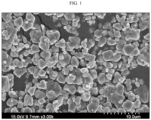
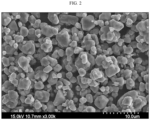
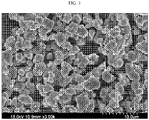
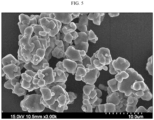
- FIGS. 1 to 5 each show SEM images of the positive electrode active material particles manufactured according to the above-described examples and comparative examples.
- the amount of lithium impurities remaining on the surface of the obtained positive electrode active material of each of example and comparative example is measured as below and the measurements are shown in Table 1.
- pH titration is performed.
- Metrohm is used, and after titration per 1 mL, pH is recorded.
- the amount of the lithium by-products on the surface of the positive electrode active material is measured by pH titration with 0.1N HCl using the Metrohm ph meter.
- the D50 of the particles is measured using laser diffraction.
- the positive electrode active material manufactured by examples and comparative examples a polyvinylidene fluoride binder and carbon black are dispersed in NMP solution at a weight ratio of 97.5 : 1.5 : 1.0 to prepare a slurry, and the slurry is coated on an Al current collector. Subsequently, roll pressing is performed to manufacture a positive electrode.
- a coin half cell is manufactured using a lithium metal as a counter electrode.
- the positive electrode active materials of Ni-rich lithium composite transition metal oxide of the examples exhibit low lithium impurity content and high initial capacity before washing. Meanwhile, comparative example 1 has low lithium impurity content but its initial capacity is low, and comparative examples 2 and 3 have high lithium impurity content, and accordingly, the batteries using the positive electrode active materials after washing have insufficient initial capacity.
Landscapes
- Chemical & Material Sciences (AREA)
- Chemical Kinetics & Catalysis (AREA)
- Electrochemistry (AREA)
- General Chemical & Material Sciences (AREA)
- Inorganic Chemistry (AREA)
- Organic Chemistry (AREA)
- Engineering & Computer Science (AREA)
- Manufacturing & Machinery (AREA)
- Materials Engineering (AREA)
- Battery Electrode And Active Subsutance (AREA)
- Inorganic Compounds Of Heavy Metals (AREA)
Applications Claiming Priority (2)
| Application Number | Priority Date | Filing Date | Title |
|---|---|---|---|
| KR20200124155 | 2020-09-24 | ||
| PCT/KR2021/013073 WO2022065935A1 (ko) | 2020-09-24 | 2021-09-24 | 고함량의 니켈 함유 리튬 복합전이금속 산화물 양극 활물질 단입자의 고상합성방법, 이로부터 형성된 고함량의 니켈 함유 리튬 복합전이금속 산화물 양극 활물질 단입자 및 이를 포함하는 양극 및 리튬 이차전지 |
Publications (2)
| Publication Number | Publication Date |
|---|---|
| EP4137460A1 true EP4137460A1 (de) | 2023-02-22 |
| EP4137460A4 EP4137460A4 (de) | 2024-02-28 |
Family
ID=80846721
Family Applications (1)
| Application Number | Title | Priority Date | Filing Date |
|---|---|---|---|
| EP21872963.0A Pending EP4137460A4 (de) | 2020-09-24 | 2021-09-24 | Verfahren zur festkörpersynthese von ni-reichem lithium-verbundmetalloxid-kathodenaktivmaterial |
Country Status (6)
| Country | Link |
|---|---|
| US (1) | US20230290942A1 (de) |
| EP (1) | EP4137460A4 (de) |
| JP (1) | JP7476344B2 (de) |
| KR (1) | KR102498355B1 (de) |
| CN (1) | CN115529825B (de) |
| WO (1) | WO2022065935A1 (de) |
Cited By (1)
| Publication number | Priority date | Publication date | Assignee | Title |
|---|---|---|---|---|
| EP4651236A4 (de) * | 2023-04-03 | 2026-04-22 | Lg Chemical Ltd | Kathodenaktivmaterial, kathode damit und lithiumsekundärbatterie |
Families Citing this family (14)
| Publication number | Priority date | Publication date | Assignee | Title |
|---|---|---|---|---|
| KR20240002815A (ko) * | 2022-06-30 | 2024-01-08 | 주식회사 엘지화학 | 양극 활물질, 이의 제조방법, 및 이를 포함하는 양극 및 리튬 이차전지 |
| KR102821378B1 (ko) * | 2022-09-02 | 2025-06-13 | 주식회사 엘지화학 | 양극 활물질 전구체, 이의 제조 방법, 이를 이용한 양극 활물질의 제조 방법 및 양극 활물질 |
| CN115632118B (zh) * | 2022-10-25 | 2025-12-19 | 广东凯金新能源科技股份有限公司 | 镍钴锰酸锂系正极材料、及其制备方法和应用 |
| KR102831980B1 (ko) * | 2022-12-28 | 2025-07-09 | 코스모신소재 주식회사 | 단결정 양극활물질의 제조방법 및 이에 의하여 제조된 단결정 양극활물질 |
| EP4657569A1 (de) * | 2023-04-03 | 2025-12-03 | Lg Chem, Ltd. | Kathodenaktivmaterial und kathode und lithiumsekundärbatterie damit |
| EP4693469A1 (de) * | 2023-05-18 | 2026-02-11 | LG Chem, Ltd. | Positivelektrodenmaterial und positivelektrode und lithiumsekundärbatterie damit |
| EP4708386A1 (de) * | 2023-06-02 | 2026-03-11 | LG Chem, Ltd. | Kathodenaktivmaterial, herstellungsverfahren dafür sowie kathode und lithiumsekundärbatterie damit |
| WO2024248571A1 (ko) * | 2023-06-02 | 2024-12-05 | 주식회사 엘지화학 | 양극 활물질, 이의 제조방법, 및 이를 포함하는 양극 및 리튬 이차전지 |
| EP4708399A1 (de) * | 2023-06-15 | 2026-03-11 | LG Chem, Ltd. | Positivelektrodenaktivmaterial und positivelektrode und lithiumsekundärbatterie damit |
| KR20250059101A (ko) * | 2023-10-24 | 2025-05-02 | (주)포스코퓨처엠 | 리튬 이차 전지용 양극 활물질, 이의 제조방법 및 이를 포함하는 리튬 이차 전지 |
| KR20250061682A (ko) * | 2023-10-27 | 2025-05-08 | 주식회사 지엘비이 | 공침을 포함하지 않는 리튬이차전지 양극소재의 제조 방법 |
| EP4730468A1 (de) * | 2023-11-01 | 2026-04-22 | LG Energy Solution, Ltd. | Lithiumsekundärbatterie |
| KR102858306B1 (ko) * | 2023-11-01 | 2025-09-18 | 주식회사 엘지에너지솔루션 | 리튬 이차 전지 |
| KR20260002235A (ko) * | 2024-06-28 | 2026-01-06 | 주식회사 엘지에너지솔루션 | 양극 및 이를 포함하는 리튬 이차 전지 |
Family Cites Families (20)
| Publication number | Priority date | Publication date | Assignee | Title |
|---|---|---|---|---|
| JP2002175808A (ja) * | 2000-12-08 | 2002-06-21 | Toyota Central Res & Dev Lab Inc | リチウム二次電池正極活物質用リチウム遷移金属複合酸化物およびその製造方法 |
| JP2002187722A (ja) * | 2000-12-19 | 2002-07-05 | Chuo Denki Kogyo Co Ltd | 非水電解質二次電池とその正極活物質および製造方法 |
| CN101916843A (zh) * | 2010-08-02 | 2010-12-15 | 中国科学院宁波材料技术与工程研究所 | 一种锂离子电池正极材料锂过渡金属复合氧化物的制备方法 |
| KR101452029B1 (ko) * | 2011-09-20 | 2014-10-23 | 주식회사 엘지화학 | 고용량 양극활물질 및 이를 포함하는 리튬이차전지 |
| KR101540673B1 (ko) * | 2012-08-03 | 2015-07-30 | 주식회사 엘지화학 | 이차전지용 양극 활물질 및 이를 포함하는 리튬 이차전지 |
| CN104157870A (zh) * | 2014-08-13 | 2014-11-19 | 青岛乾运高科新材料股份有限公司 | 一种两步高能球磨制备富锂锰酸锂固溶体正极材料的方法 |
| CN106450270B (zh) * | 2015-08-13 | 2020-08-11 | 中国科学院物理研究所 | 锂离子二次电池的正极活性材料及其制备方法和应用 |
| KR20200021564A (ko) * | 2015-09-08 | 2020-02-28 | 유미코아 | 충전식 배터리용 Li 전이 금속 산화물 캐소드의 제조를 위한 전구체 및 방법 |
| KR101913897B1 (ko) * | 2015-09-30 | 2018-12-28 | 주식회사 엘지화학 | 이차전지용 양극활물질 및 이를 포함하는 이차전지 |
| JP6341313B2 (ja) * | 2016-03-31 | 2018-06-13 | 日亜化学工業株式会社 | 非水系電解質二次電池用正極活物質の製造方法 |
| KR102199714B1 (ko) * | 2016-12-02 | 2021-01-07 | 삼성에스디아이 주식회사 | 리튬이차전지용 니켈계 활물질, 그 제조방법 및 이를 포함하는 양극을 함유한 리튬이차전지 |
| CN106910882B (zh) * | 2017-04-01 | 2019-04-23 | 济南大学 | 一种锂离子电池用大单晶层状正极材料的制备方法 |
| CN107403930B (zh) * | 2017-07-20 | 2019-03-15 | 湖南金富力新能源股份有限公司 | 镍钴铝酸锂正极材料及其制备方法和应用 |
| KR102302038B1 (ko) * | 2018-05-11 | 2021-09-15 | 주식회사 엘지화학 | 리튬 이차전지용 양극 활물질, 이의 제조방법, 이를 포함하는 리튬 이차전지용 양극 및 리튬 이차전지 |
| KR102204939B1 (ko) * | 2018-05-11 | 2021-01-19 | 주식회사 엘지화학 | 리튬 이차 전지용 양극재, 그 제조방법, 이를 포함하는 양극 및 리튬 이차 전지 |
| KR20190131842A (ko) * | 2018-05-17 | 2019-11-27 | 주식회사 엘지화학 | 이차전지용 양극 활물질, 그 제조방법 및 이를 포함하는 리튬 이차전지 |
| CN109279659B (zh) * | 2018-08-22 | 2021-04-27 | 中伟新材料股份有限公司 | 一种单晶三元正极材料制备方法 |
| US11152609B2 (en) * | 2018-10-20 | 2021-10-19 | Panasonic Corporation | Method for synthesizing nickel-cobalt-aluminum electrodes |
| JP7210367B2 (ja) | 2019-04-23 | 2023-01-23 | 株式会社ディスコ | 厚み計測装置、及び厚み計測装置を備えた加工装置 |
| CN110931768B (zh) * | 2019-11-17 | 2022-08-09 | 新乡天力锂能股份有限公司 | 一种高镍类单晶锂离子电池正极材料及制备方法 |
-
2021
- 2021-09-24 WO PCT/KR2021/013073 patent/WO2022065935A1/ko not_active Ceased
- 2021-09-24 US US18/019,921 patent/US20230290942A1/en active Pending
- 2021-09-24 CN CN202180032572.6A patent/CN115529825B/zh active Active
- 2021-09-24 JP JP2022560136A patent/JP7476344B2/ja active Active
- 2021-09-24 EP EP21872963.0A patent/EP4137460A4/de active Pending
- 2021-09-24 KR KR1020210126706A patent/KR102498355B1/ko active Active
Cited By (1)
| Publication number | Priority date | Publication date | Assignee | Title |
|---|---|---|---|---|
| EP4651236A4 (de) * | 2023-04-03 | 2026-04-22 | Lg Chemical Ltd | Kathodenaktivmaterial, kathode damit und lithiumsekundärbatterie |
Also Published As
| Publication number | Publication date |
|---|---|
| KR20220041032A (ko) | 2022-03-31 |
| US20230290942A1 (en) | 2023-09-14 |
| CN115529825B (zh) | 2024-03-08 |
| EP4137460A4 (de) | 2024-02-28 |
| WO2022065935A1 (ko) | 2022-03-31 |
| KR102498355B1 (ko) | 2023-02-10 |
| JP2023521317A (ja) | 2023-05-24 |
| JP7476344B2 (ja) | 2024-04-30 |
| CN115529825A (zh) | 2022-12-27 |
Similar Documents
| Publication | Publication Date | Title |
|---|---|---|
| US20230290942A1 (en) | Solid Phase Synthesis Method of Positive Electrode Active Material of Nickel-Rich Lithium Composite Transition Metal Oxide in a Form of a Single Particle, Positive Electrode Active Material of Nickel-Rich Lithium Composite Transition Metal Oxide in a Form of a Single Particle Formed Therefrom, Positive Electrode and Lithium Secondary Battery Containing the Same | |
| US11837724B2 (en) | Nickel-based active material precursor for lithium secondary battery, method of preparing the same, nickel-based active material for lithium secondary battery produced from the nickel-based active material precursor, and lithium secondary battery having cathode containing the nickel-based active material | |
| US11843116B2 (en) | Nickel active material precursor for lithium secondary battery, method for producing nickel active material precursor, nickel active material for lithium secondary battery produced by method, and lithium secondary battery having cathode containing nickel active material | |
| EP4471893A1 (de) | Ternärer positivelektrodenmaterialvorläufer, herstellungsverfahren dafür, ternäres positivelektrodenmaterial, lithium-ionen-batterie sowie positivelektrode und elektrische vorrichtung | |
| EP3522268B1 (de) | Positivelektrodenaktivmaterial für eine lithium-ionen-batterie, verfahren zur herstellung eines positivelektrodenaktivmaterials für eine lithium-ionen-batterie, positivelektrode für eine lithium-ionen-batterie sowie lithium-ionen-batterie | |
| US11201328B2 (en) | Nickel active material precursor for lithium secondary battery, method for producing nickel active material precursor, nickel active material for lithium secondary battery produced by method, and lithium secondary battery having cathode containing nickel active material | |
| EP3723172A2 (de) | Kathodenaktivmaterial für lithiumsekundärbatterie, herstellungsverfahren dafür und lithiumsekundärbatterie mit kathode damit | |
| EP4269362A1 (de) | Vorläufer für kathodenaktivmaterial und herstellungsverfahren dafür | |
| KR20220045813A (ko) | 고함량의 니켈 함유 리튬 복합전이금속 산화물 양극 활물질 입자 혼합물의 제조방법 | |
| KR20240007315A (ko) | 배향성 구조를 갖는 리튬전지용 양극활물질 및 이의 제조방법 | |
| KR20220055953A (ko) | 리튬 이차전지용 양극 활물질, 그 제조방법, 이를 포함하는 리튬 이차전지용 양극 및 리튬 이차전지 | |
| KR102006244B1 (ko) | 리튬 이차전지용 양극활물질 전구체, 이를 이용한 양극활물질 및 이를 포함하는 리튬 이차전지 | |
| EP4614604A1 (de) | Positivelektrodenaktivmaterial für natriumsekundärbatterie, verfahren zur herstellung davon und natriumsekundärbatterie damit | |
| KR102918463B1 (ko) | 고함량의 니켈 함유 리튬 복합전이금속 산화물 양극 활물질의 제조방법 및 이로부터 형성된 고함량의 니켈 함유 리튬 복합전이금속 산화물 양극 활물질 | |
| CN117423829A (zh) | 一种锂离子电池正极材料及其制备方法和应用 | |
| KR20220101287A (ko) | 리튬 이차전지용 양극 활물질의 제조방법, 이로부터 형성된 리튬 이차전지용 양극 활물질, 이를 포함하는 리튬 이차전지용 양극 및 리튬 이차전지 | |
| KR102930208B1 (ko) | 소듐 이차전지용 양극 활물질, 이의 제조방법 및 이를 포함하는 소듐 이차전지 | |
| EP4574768A1 (de) | Vorläufer für ein positivelektrodenaktivmaterial für eine lithiumsekundärbatterie, positivelektrodenaktivmaterial damit und verfahren zur herstellung eines positivaktivmaterials | |
| EP4614605A1 (de) | Kathodenaktivmaterial für natriumsekundärbatterie, verfahren zur herstellung davon und natriumsekundärbatterie damit | |
| KR102953585B1 (ko) | 리튬 이차전지용 양극 활물질의 제조방법, 이로부터 형성된 리튬 이차전지용 양극 활물질, 이를 포함하는 리튬 이차전지용 양극 및 리튬 이차전지 | |
| EP4613713A1 (de) | Kathodenaktivmaterial für natriumsekundärbatterie, herstellungsverfahren dafür und natriumsekundärbatterie damit | |
| EP4644329A1 (de) | Positivelektrodenaktivmaterialvorläufer für eine wiederaufladbare lithiumbatterie, herstellungsverfahren dafür und damit hergestellte lithiumbatterie | |
| WO2026097681A1 (zh) | 正极材料及其制备方法、锂离子电池和用电装置 | |
| KR20250045778A (ko) | 리튬 이차 전지용 양극 활물질 및 이의 제조 방법 | |
| KR20250032148A (ko) | 리튬 이차 전지용 양극 활물질 전구체, 양극 활물질 및 양극 활물질의 제조방법 |
Legal Events
| Date | Code | Title | Description |
|---|---|---|---|
| STAA | Information on the status of an ep patent application or granted ep patent |
Free format text: STATUS: THE INTERNATIONAL PUBLICATION HAS BEEN MADE |
|
| PUAI | Public reference made under article 153(3) epc to a published international application that has entered the european phase |
Free format text: ORIGINAL CODE: 0009012 |
|
| STAA | Information on the status of an ep patent application or granted ep patent |
Free format text: STATUS: REQUEST FOR EXAMINATION WAS MADE |
|
| 17P | Request for examination filed |
Effective date: 20221114 |
|
| AK | Designated contracting states |
Kind code of ref document: A1 Designated state(s): AL AT BE BG CH CY CZ DE DK EE ES FI FR GB GR HR HU IE IS IT LI LT LU LV MC MK MT NL NO PL PT RO RS SE SI SK SM TR |
|
| DAV | Request for validation of the european patent (deleted) | ||
| DAX | Request for extension of the european patent (deleted) | ||
| A4 | Supplementary search report drawn up and despatched |
Effective date: 20240126 |
|
| RIC1 | Information provided on ipc code assigned before grant |
Ipc: H01M 4/505 20100101ALI20240122BHEP Ipc: H01M 4/525 20100101ALI20240122BHEP Ipc: C01G 53/00 20060101AFI20240122BHEP |