EP4137557A1 - Dispositif de production de biomasse et ses dérivés - Google Patents
Dispositif de production de biomasse et ses dérivés Download PDFInfo
- Publication number
- EP4137557A1 EP4137557A1 EP21382765.2A EP21382765A EP4137557A1 EP 4137557 A1 EP4137557 A1 EP 4137557A1 EP 21382765 A EP21382765 A EP 21382765A EP 4137557 A1 EP4137557 A1 EP 4137557A1
- Authority
- EP
- European Patent Office
- Prior art keywords
- culture
- solids
- biomass
- culture medium
- liquids
- Prior art date
- Legal status (The legal status is an assumption and is not a legal conclusion. Google has not performed a legal analysis and makes no representation as to the accuracy of the status listed.)
- Pending
Links
- 239000002028 Biomass Substances 0.000 title claims abstract description 25
- 238000000034 method Methods 0.000 claims abstract description 61
- 230000008569 process Effects 0.000 claims abstract description 46
- 239000007787 solid Substances 0.000 claims abstract description 41
- 239000001963 growth medium Substances 0.000 claims abstract description 38
- XLYOFNOQVPJJNP-UHFFFAOYSA-N water Chemical compound O XLYOFNOQVPJJNP-UHFFFAOYSA-N 0.000 claims abstract description 31
- 239000007788 liquid Substances 0.000 claims abstract description 26
- 239000002054 inoculum Substances 0.000 claims abstract description 12
- 238000010924 continuous production Methods 0.000 claims abstract description 5
- 239000012530 fluid Substances 0.000 claims abstract description 5
- 239000008213 purified water Substances 0.000 claims abstract description 4
- 238000004519 manufacturing process Methods 0.000 claims description 35
- 244000005700 microbiome Species 0.000 claims description 24
- 230000001954 sterilising effect Effects 0.000 claims description 15
- MHAJPDPJQMAIIY-UHFFFAOYSA-N Hydrogen peroxide Chemical compound OO MHAJPDPJQMAIIY-UHFFFAOYSA-N 0.000 claims description 12
- 239000003570 air Substances 0.000 claims description 12
- 239000002609 medium Substances 0.000 claims description 11
- 239000003206 sterilizing agent Substances 0.000 claims description 5
- QVGXLLKOCUKJST-UHFFFAOYSA-N atomic oxygen Chemical compound [O] QVGXLLKOCUKJST-UHFFFAOYSA-N 0.000 claims description 4
- 238000006243 chemical reaction Methods 0.000 claims description 4
- 239000001301 oxygen Substances 0.000 claims description 4
- 229910052760 oxygen Inorganic materials 0.000 claims description 4
- 230000003213 activating effect Effects 0.000 claims description 2
- 239000007795 chemical reaction product Substances 0.000 claims description 2
- 238000011068 loading method Methods 0.000 claims description 2
- 239000007789 gas Substances 0.000 claims 1
- 230000002068 genetic effect Effects 0.000 claims 1
- 230000000977 initiatory effect Effects 0.000 claims 1
- 239000000047 product Substances 0.000 description 8
- 238000011282 treatment Methods 0.000 description 8
- 238000001914 filtration Methods 0.000 description 7
- 241000282414 Homo sapiens Species 0.000 description 6
- 238000002360 preparation method Methods 0.000 description 6
- 238000004659 sterilization and disinfection Methods 0.000 description 6
- IJGRMHOSHXDMSA-UHFFFAOYSA-N Atomic nitrogen Chemical compound N#N IJGRMHOSHXDMSA-UHFFFAOYSA-N 0.000 description 4
- 238000011081 inoculation Methods 0.000 description 4
- 230000002906 microbiologic effect Effects 0.000 description 4
- 238000009825 accumulation Methods 0.000 description 3
- 239000000654 additive Substances 0.000 description 3
- 238000011109 contamination Methods 0.000 description 3
- 238000013461 design Methods 0.000 description 3
- 238000011161 development Methods 0.000 description 3
- 238000005516 engineering process Methods 0.000 description 3
- 238000003306 harvesting Methods 0.000 description 3
- 239000000463 material Substances 0.000 description 3
- QGZKDVFQNNGYKY-UHFFFAOYSA-N Ammonia Chemical compound N QGZKDVFQNNGYKY-UHFFFAOYSA-N 0.000 description 2
- WQZGKKKJIJFFOK-GASJEMHNSA-N Glucose Natural products OC[C@H]1OC(O)[C@H](O)[C@@H](O)[C@@H]1O WQZGKKKJIJFFOK-GASJEMHNSA-N 0.000 description 2
- 238000013473 artificial intelligence Methods 0.000 description 2
- 230000004888 barrier function Effects 0.000 description 2
- 238000011138 biotechnological process Methods 0.000 description 2
- 238000004140 cleaning Methods 0.000 description 2
- 230000006835 compression Effects 0.000 description 2
- 238000007906 compression Methods 0.000 description 2
- 230000001276 controlling effect Effects 0.000 description 2
- 230000002255 enzymatic effect Effects 0.000 description 2
- 238000001704 evaporation Methods 0.000 description 2
- 239000008103 glucose Substances 0.000 description 2
- 238000012423 maintenance Methods 0.000 description 2
- 238000002156 mixing Methods 0.000 description 2
- 239000000203 mixture Substances 0.000 description 2
- 229910052757 nitrogen Inorganic materials 0.000 description 2
- 150000002978 peroxides Chemical class 0.000 description 2
- 239000002994 raw material Substances 0.000 description 2
- 230000009467 reduction Effects 0.000 description 2
- 238000001223 reverse osmosis Methods 0.000 description 2
- 238000000926 separation method Methods 0.000 description 2
- 241000894006 Bacteria Species 0.000 description 1
- OKTJSMMVPCPJKN-UHFFFAOYSA-N Carbon Chemical compound [C] OKTJSMMVPCPJKN-UHFFFAOYSA-N 0.000 description 1
- ZAMOUSCENKQFHK-UHFFFAOYSA-N Chlorine atom Chemical compound [Cl] ZAMOUSCENKQFHK-UHFFFAOYSA-N 0.000 description 1
- 102000004190 Enzymes Human genes 0.000 description 1
- 108090000790 Enzymes Proteins 0.000 description 1
- 241000233866 Fungi Species 0.000 description 1
- 102000003960 Ligases Human genes 0.000 description 1
- 108090000364 Ligases Proteins 0.000 description 1
- 240000004808 Saccharomyces cerevisiae Species 0.000 description 1
- 229930006000 Sucrose Natural products 0.000 description 1
- CZMRCDWAGMRECN-UGDNZRGBSA-N Sucrose Chemical compound O[C@H]1[C@H](O)[C@@H](CO)O[C@@]1(CO)O[C@@H]1[C@H](O)[C@@H](O)[C@H](O)[C@@H](CO)O1 CZMRCDWAGMRECN-UGDNZRGBSA-N 0.000 description 1
- 229910021529 ammonia Inorganic materials 0.000 description 1
- 150000003863 ammonium salts Chemical class 0.000 description 1
- 235000019728 animal nutrition Nutrition 0.000 description 1
- 230000001174 ascending effect Effects 0.000 description 1
- 238000011001 backwashing Methods 0.000 description 1
- 230000001580 bacterial effect Effects 0.000 description 1
- 239000000022 bacteriostatic agent Substances 0.000 description 1
- 230000031018 biological processes and functions Effects 0.000 description 1
- 230000015572 biosynthetic process Effects 0.000 description 1
- 238000004364 calculation method Methods 0.000 description 1
- 229910052799 carbon Inorganic materials 0.000 description 1
- 230000015556 catabolic process Effects 0.000 description 1
- 239000003054 catalyst Substances 0.000 description 1
- 230000008859 change Effects 0.000 description 1
- 239000013043 chemical agent Substances 0.000 description 1
- 239000003795 chemical substances by application Substances 0.000 description 1
- 239000000460 chlorine Substances 0.000 description 1
- 229910052801 chlorine Inorganic materials 0.000 description 1
- 239000000356 contaminant Substances 0.000 description 1
- 238000005260 corrosion Methods 0.000 description 1
- 230000007797 corrosion Effects 0.000 description 1
- 238000006731 degradation reaction Methods 0.000 description 1
- 230000002939 deleterious effect Effects 0.000 description 1
- 230000006866 deterioration Effects 0.000 description 1
- 238000010586 diagram Methods 0.000 description 1
- 235000013681 dietary sucrose Nutrition 0.000 description 1
- 238000004090 dissolution Methods 0.000 description 1
- 230000000694 effects Effects 0.000 description 1
- 238000005265 energy consumption Methods 0.000 description 1
- 230000007613 environmental effect Effects 0.000 description 1
- 230000008020 evaporation Effects 0.000 description 1
- 239000012467 final product Substances 0.000 description 1
- 239000006260 foam Substances 0.000 description 1
- 235000013305 food Nutrition 0.000 description 1
- 238000004108 freeze drying Methods 0.000 description 1
- 230000036541 health Effects 0.000 description 1
- 238000010438 heat treatment Methods 0.000 description 1
- 239000003999 initiator Substances 0.000 description 1
- 238000009630 liquid culture Methods 0.000 description 1
- 239000012263 liquid product Substances 0.000 description 1
- 230000007774 longterm Effects 0.000 description 1
- 238000011177 media preparation Methods 0.000 description 1
- 235000013336 milk Nutrition 0.000 description 1
- 239000008267 milk Substances 0.000 description 1
- 210000004080 milk Anatomy 0.000 description 1
- 235000013379 molasses Nutrition 0.000 description 1
- 235000015097 nutrients Nutrition 0.000 description 1
- 229920001542 oligosaccharide Polymers 0.000 description 1
- 150000002482 oligosaccharides Chemical class 0.000 description 1
- 238000005457 optimization Methods 0.000 description 1
- 238000013386 optimize process Methods 0.000 description 1
- 238000004806 packaging method and process Methods 0.000 description 1
- 230000002093 peripheral effect Effects 0.000 description 1
- 235000008476 powdered milk Nutrition 0.000 description 1
- 238000012545 processing Methods 0.000 description 1
- 238000005086 pumping Methods 0.000 description 1
- 238000003908 quality control method Methods 0.000 description 1
- 230000001105 regulatory effect Effects 0.000 description 1
- 238000000518 rheometry Methods 0.000 description 1
- 238000009738 saturating Methods 0.000 description 1
- 238000007790 scraping Methods 0.000 description 1
- 239000012265 solid product Substances 0.000 description 1
- 239000008223 sterile water Substances 0.000 description 1
- 229960004793 sucrose Drugs 0.000 description 1
- 235000000346 sugar Nutrition 0.000 description 1
- 239000006188 syrup Substances 0.000 description 1
- 235000020357 syrup Nutrition 0.000 description 1
- 235000013619 trace mineral Nutrition 0.000 description 1
- 239000011573 trace mineral Substances 0.000 description 1
- 238000002604 ultrasonography Methods 0.000 description 1
- 230000035899 viability Effects 0.000 description 1
Images

Classifications
-
- C—CHEMISTRY; METALLURGY
- C12—BIOCHEMISTRY; BEER; SPIRITS; WINE; VINEGAR; MICROBIOLOGY; ENZYMOLOGY; MUTATION OR GENETIC ENGINEERING
- C12M—APPARATUS FOR ENZYMOLOGY OR MICROBIOLOGY; APPARATUS FOR CULTURING MICROORGANISMS FOR PRODUCING BIOMASS, FOR GROWING CELLS OR FOR OBTAINING FERMENTATION OR METABOLIC PRODUCTS, i.e. BIOREACTORS OR FERMENTERS
- C12M23/00—Constructional details, e.g. recesses, hinges
- C12M23/42—Integrated assemblies, e.g. cassettes or cartridges
-
- C—CHEMISTRY; METALLURGY
- C12—BIOCHEMISTRY; BEER; SPIRITS; WINE; VINEGAR; MICROBIOLOGY; ENZYMOLOGY; MUTATION OR GENETIC ENGINEERING
- C12M—APPARATUS FOR ENZYMOLOGY OR MICROBIOLOGY; APPARATUS FOR CULTURING MICROORGANISMS FOR PRODUCING BIOMASS, FOR GROWING CELLS OR FOR OBTAINING FERMENTATION OR METABOLIC PRODUCTS, i.e. BIOREACTORS OR FERMENTERS
- C12M23/00—Constructional details, e.g. recesses, hinges
- C12M23/52—Mobile; Means for transporting the apparatus
Definitions
- the invention herein belongs to the area of processes and appliances used for the production of biomass and other biotechnological products. It is particularly related to the production of components that are of interest for the daily development of activities of human or animal nutrition. And more particularly, it is related to a process and device that allows the production of edible components through bioprocesses.
- Microorganisms are essential components of the terrestrial ecosystem, and they have a wide diversity that includes the entire already known biological niche.
- the exploitation of microorganisms and their active derivatives (for example, enzymes) by human beings has gone through all the stages of human development, and in some cases it was unnoticed by the users.
- this area started to be controlled by developing a system to increase the productivity of the biotechnological processes.
- said optimized processes were rarely adopted for their use at a family level, and the major part of this exploitation is done in industries, where full size equipment of complex operation is used.
- small-size fermenters are already known, they have not been intended to operate at a home environment with a little, or even no professional control. Additionally, they do not have systems that allow the remote control of the microbiological status of the culture. This control is done by using a system that receives images, or by analyzing the parameters of the process, so that alarms can be set to alert whenever there is a possible contamination with other microorganisms.
- Applying Artificial Intelligence (Al) and Internet-of-Things (IOT) makes it easier to implement this type of technologies to control complex processes. Additionally, the use of encryption systems such as block-chain would be useful for protecting the data related to the process.
- the optimization of the culture media is a fundamental part of those operations, which are intended to make this successful equipment real, because it allows the reduction of the containers scales, but mainly because it reduces the production cost when using this equipment at home or on a small scale.
- biotechnological derivatives for example, biomass or derivatives of biological processes
- the device that contains and dispenses the inoculum that initiates the culture includes a cassette that has multiple initiators of the culture, even enough to cover the lifetime of the equipment.
- the sterilizer is a water vapor generator or a vapor generator of H 2 O 2 , and a coupled reservoir.
- microprocessor includes Al instructions that control and improve every aspect of the production procedure.
- any source of electric power provides the adequate power to the equipment (for example but not limited to, 220 V - 50 Hz, 20 A or 110 V-60 Hz 40 A).
- the cassette has enough inoculum seeds either for the lifetime of the equipment, or until greater maintenance services are done.
- the inoculum is a microorganism, which has received a treatment that allows its maintenance at ambient temperature without significantly reducing its viability (for example, freeze-drying).
- the solids reservoir comprises 5 - 100 kg of solids to prepare the culture medium.
- the sterilizing agent is pressurized water vapor or H 2 O 2 vapor.
- the products obtained from the device according to this invention have the aim of decentralizing the production and providing access to all human beings, which is a completely possible and original fact.
- the electric power system, Internet and block-chain are only some examples of how the decentralization can improve the way in which human beings live, produce and interact.
- Producing biomass with a system of multiple little centers is the best way to take the product everywhere. Therefore, the need for transport would be reduced, and packaging would not be necessary. Furthermore, its production is sustainable, because it reduces the footprints of water and carbon.
- the device of this invention will allow any person to be able to prepare these productions of microorganisms in any place, such as, a family house, a school, a building, or a neighborhood.
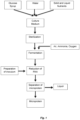
- the production process corresponds to a typical biotechnological process for producing biomass.
- the steps to follow towards the production process are outlined herein.
- all those components that in the industrial version can be used in liquid form have to be solid.
- a culture system that may require fluid milk would be replaced by powdered milk
- the glucose syrup would be replaced by solid glucose
- molasses would be replaced by saccharose, etc.
- the process for sterilizing the culture medium is done through filters or other sterilization system capable of processing liquids within the line of the production process.
- the complex gaseous additives are replaced by solid versions, such as the use of ammonia is replaced by ammonium salts or other component that adds nitrogen to the system.
- gaseous additives it is possible to find the air or gaseous fractions that are rich in oxygen or nitrogen deriving from the separation processes of the air.
- the preparation of inoculum or reaction agent is replaced by adding a tab or any other form characterized by its long-term stability (ideally for years).
- the equipment Before beginning with a new production cycle the equipment must be sterilized. The proceeding can be done by using physical or chemical agents (for example, temperature, vapor, H 2 O 2 or any other equivalent).
- physical or chemical agents for example, temperature, vapor, H 2 O 2 or any other equivalent.
- vapor is used as a sterilizer (high temperature, 121 °C and 1.2 bar of pressure)
- the equipment must have a vapor generator with sufficient capacity for the treatment of the tank and sterilizable peripherals (air filters, medium, etc.).
- the designs of the reservoir and filters must take into account the passage of the vapor for a fraction of the sterilization time, which would be ideally 10 minutes.
- the T-tank should be treated at 121°C for 20 minutes.
- H 2 O 2 If H 2 O 2 is used, the energy consumption is reduced, and the process is carried out at a normal pressure, but it will be necessary to load an extra supply to the equipment (H 2 O 2 ).
- the process consists of evaporating H 2 O 2 and making the vapor travel through all the system. This process must be validated because in general terms it is not used for this purpose. It may necessary to clean the system with water in order to prevent this from affecting the final product.
- the volume of preparation of each day strictly depends on the volume of the T-tank.
- the relationship is the volume of the T-tank multiplied for approximately 4.6, which is equal to the quantity of the culture medium per day.
- the quantity to be prepared per day will be approximately 70 liters.
- the velocity of the production of the medium must be enough to supply the medium to the T-tank continuously. That is to say, the consumption will be half per 0.0475 L.min -1 .
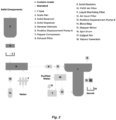
- the system for preparing the culture medium consists of:
- Preparing the culture medium consists of adding an equal quantity of solids to the dissolution system, adding the necessary quantity of traces and enough water, which is water produced by an accessory osmosis equipment. Once it is mixed, the pumping is done in a controlled manner, for example, through a metering pump capable of providing enough pressure to the T-tank through a sterilizing filter of the liquid culture medium at a rate of 70 liters per day.
- the process can start after two preparations of medium.
- the preparation should not take longer than 3 minutes per batch. It is considered that the preparation of a quantity to cover the first set of two bubblers of the T-tank is enough. In a preferred embodiment it would be about 5 liters.
- the inoculation of the T-tank is done every time a new process of 22-day production starts.
- a cartridge with tabs of the freeze-dried microorganism For the inoculation of the fermenter, in a preferred embodiment, it could be an option to use a cartridge with tabs of the freeze-dried microorganism.
- the cartridge must be designed in a way to keep the entirety of the tabs, and to make sure the tab falls in the culture medium inside the T-reactor in order to start the process. This operation must be done without letting external material in.
- the entrance of air begins at a rate of 30 liters per min -1 to maintain the necessary conditions of oxygen for the culture.
- the feeding initiates, and it will continue according to the expected volume, preferably 70 liters per day -1 .
- the production of the culture medium will be according to the production system, completing the volume of the reactor and producing the controlled overflow thereof once the 15 liters of volume are reached. It is estimated to last 3.5 hours after the 24 hours of start.
- the culture medium is mixed with the culture, where the microorganism of interest is multiplying by constant airing, temperature, and entering volume of medium.
- new culture medium enters the culture with biomass drains from the T-tank to the system of biomass harvesting.
- the culture which is composed of exhausted culture medium and biomass, is drained from the T-tank, it is rendered inactive by temperature in a system of rotary drum (small system).
- the outlet of material from the equipment must be designed in a way that the solids of the process do not deposit in the intermediate stages before reaching the rotary drum for the filtration. It may be possible to design a screw system to secure the cleaning of the outlet system of the grown culture.
- the culture medium falls on a rotary drum with a 10-micron filter, where vacuum is created, and the liquid travels to the effluents drain, while the solid is removed by a scraping system that directs it to the deposit pan.
- the drum is at a controlled temperature (for example, at about 64°C to produce the reduction of RNA).
- the time spent on the surface of the drum is regulated by the angular velocity of the drum (for example, 0.1 min-1) and the position of the system for removing solids.
- the biomass falls in the deposit pan in such a way that the solid is kept at a low temperature until being picked by the user.
- End of the culture (for example, +20 days for exhaustion of the medium or instability of the microorganism)
- the air is pushed forward by a "flapper-type" compression unit or any other type of compression unit suitable for the required volume. It has to be considered that the 30 L min -1 must be able to be aired out to prevent an increase in the pressure.
- the T-reactor must keep the temperature controlled at about 30 °C in a range capable for the equipment to operate. It could be possibly done through Peltier cells.
- the sterilizing system requires vapor at a rate of 20 kg of water per hour for 30 minutes.
- Preparing the culture medium in a continuous form demands to the sterilizing filters to meet a specific condition. Considering that the filters have absorbed the culture medium, any microorganism capable of growing in said medium will end up saturating the filter within a significant time.
- the filtration system must be capable of facing this situation.
- a filter with an associated device capable of eliminating contaminant microorganisms could be:
Landscapes
- Health & Medical Sciences (AREA)
- Organic Chemistry (AREA)
- Life Sciences & Earth Sciences (AREA)
- Engineering & Computer Science (AREA)
- Bioinformatics & Cheminformatics (AREA)
- Chemical & Material Sciences (AREA)
- Zoology (AREA)
- Wood Science & Technology (AREA)
- Sustainable Development (AREA)
- Microbiology (AREA)
- Biotechnology (AREA)
- Biomedical Technology (AREA)
- Biochemistry (AREA)
- General Engineering & Computer Science (AREA)
- General Health & Medical Sciences (AREA)
- Genetics & Genomics (AREA)
- Clinical Laboratory Science (AREA)
- Apparatus Associated With Microorganisms And Enzymes (AREA)
Priority Applications (1)
| Application Number | Priority Date | Filing Date | Title |
|---|---|---|---|
| EP21382765.2A EP4137557A1 (fr) | 2021-08-18 | 2021-08-18 | Dispositif de production de biomasse et ses dérivés |
Applications Claiming Priority (1)
| Application Number | Priority Date | Filing Date | Title |
|---|---|---|---|
| EP21382765.2A EP4137557A1 (fr) | 2021-08-18 | 2021-08-18 | Dispositif de production de biomasse et ses dérivés |
Publications (1)
| Publication Number | Publication Date |
|---|---|
| EP4137557A1 true EP4137557A1 (fr) | 2023-02-22 |
Family
ID=77520664
Family Applications (1)
| Application Number | Title | Priority Date | Filing Date |
|---|---|---|---|
| EP21382765.2A Pending EP4137557A1 (fr) | 2021-08-18 | 2021-08-18 | Dispositif de production de biomasse et ses dérivés |
Country Status (1)
| Country | Link |
|---|---|
| EP (1) | EP4137557A1 (fr) |
Citations (3)
| Publication number | Priority date | Publication date | Assignee | Title |
|---|---|---|---|---|
| US20130115588A1 (en) * | 2010-04-15 | 2013-05-09 | G & G Technologies, Inc. | Integrated bioreactor and separation system and methods of use therof |
| WO2020041261A1 (fr) * | 2018-08-20 | 2020-02-27 | Locus Ip Company, Llc | Systèmes répartis, tout-en-un, et portables de fermentation avec plateforme de support de ceux-ci |
| WO2021123248A1 (fr) * | 2019-12-19 | 2021-06-24 | Universität Für Bodenkultur Wien | Reconstitution continue de matériaux de traitement à partir de solides |
-
2021
- 2021-08-18 EP EP21382765.2A patent/EP4137557A1/fr active Pending
Patent Citations (3)
| Publication number | Priority date | Publication date | Assignee | Title |
|---|---|---|---|---|
| US20130115588A1 (en) * | 2010-04-15 | 2013-05-09 | G & G Technologies, Inc. | Integrated bioreactor and separation system and methods of use therof |
| WO2020041261A1 (fr) * | 2018-08-20 | 2020-02-27 | Locus Ip Company, Llc | Systèmes répartis, tout-en-un, et portables de fermentation avec plateforme de support de ceux-ci |
| WO2021123248A1 (fr) * | 2019-12-19 | 2021-06-24 | Universität Für Bodenkultur Wien | Reconstitution continue de matériaux de traitement à partir de solides |
Similar Documents
| Publication | Publication Date | Title |
|---|---|---|
| US20250059105A1 (en) | Soil enrichment systems and methods | |
| US7682823B1 (en) | Bioreactor systems | |
| US9163208B2 (en) | Method and system for bioreaction | |
| UA65616C2 (uk) | Твердотільний ферментер і спосіб твердотільної ферментації | |
| CZ303844B6 (cs) | Zpusob snizování poctu zivotaschopných mikrobiálních mikroorganismu a/nebo prionu, prítomných v organickém materiálu, zarízení na jeho provádení a jejich pouzití | |
| JP2003529316A (ja) | 固体状態発酵法 | |
| US20140099679A1 (en) | System and method for producing biomaterials | |
| HUT65380A (en) | Process for producing cell mass and/or fermentacion products in sterile conditions and device for implementing the process | |
| US20170175070A1 (en) | In Situ Biomass Generator with Automated Disinfection | |
| EP3737513B1 (fr) | Remédiant de sol et son procédé de production | |
| CN117529543A (zh) | 用于操作生物过程设备的方法 | |
| EP4137557A1 (fr) | Dispositif de production de biomasse et ses dérivés | |
| US20230056568A1 (en) | Device for producing biomass and its derivatives | |
| EP0546881A1 (fr) | Procédé et dispositif de multiplication de souches sélectionées, appliqués au traitement des graisses et des fécules | |
| CN106867878A (zh) | 一种发酵罐及酵素的成套生产设备 | |
| US11414332B2 (en) | Microorganism preparation feeding method, microorganism preparation automatic feeding apparatus, and wastewater processing system | |
| CN120794212A (zh) | 一种对虾种苗原水生物滤池处理装置 | |
| Kalaichelvan et al. | Bioprocess technology | |
| JP2004298677A (ja) | 糖質系嫌気性排水処理方法 | |
| TWI841528B (zh) | 微生物製劑的投入方法、微生物製劑的自動投入裝置及廢水處理系統 | |
| KR101212752B1 (ko) | 콩과 및 화본과 식물 재배수 정수처리시스템 | |
| KR101935688B1 (ko) | 호기성 미생물의 배양장치 | |
| CN109601460A (zh) | 一种工厂化养殖池的沉积生物絮团分离装置 | |
| CN1850963A (zh) | 微生物培养系统及应用该系统进行微生物培养的方法 | |
| CN109479777A (zh) | 一种工厂化克氏原螯虾养殖方法 |
Legal Events
| Date | Code | Title | Description |
|---|---|---|---|
| PUAI | Public reference made under article 153(3) epc to a published international application that has entered the european phase |
Free format text: ORIGINAL CODE: 0009012 |
|
| STAA | Information on the status of an ep patent application or granted ep patent |
Free format text: STATUS: THE APPLICATION HAS BEEN PUBLISHED |
|
| AK | Designated contracting states |
Kind code of ref document: A1 Designated state(s): AL AT BE BG CH CY CZ DE DK EE ES FI FR GB GR HR HU IE IS IT LI LT LU LV MC MK MT NL NO PL PT RO RS SE SI SK SM TR |
|
| RAP1 | Party data changed (applicant data changed or rights of an application transferred) |
Owner name: MYCOFOOD US LLC |
|
| RIN1 | Information on inventor provided before grant (corrected) |
Inventor name: GAGO, LUCAS MARTIN Inventor name: BLASCO, MARTIN Inventor name: HORACIO, ACERBO CLAUDIO |
|
| STAA | Information on the status of an ep patent application or granted ep patent |
Free format text: STATUS: REQUEST FOR EXAMINATION WAS MADE |
|
| 17P | Request for examination filed |
Effective date: 20230822 |
|
| RBV | Designated contracting states (corrected) |
Designated state(s): AL AT BE BG CH CY CZ DE DK EE ES FI FR GB GR HR HU IE IS IT LI LT LU LV MC MK MT NL NO PL PT RO RS SE SI SK SM TR |