EP4137626A1 - Procédé de fabrication d'un article de compression sans couture sur un métier à tricoter rectiligne - Google Patents
Procédé de fabrication d'un article de compression sans couture sur un métier à tricoter rectiligne Download PDFInfo
- Publication number
- EP4137626A1 EP4137626A1 EP22195608.9A EP22195608A EP4137626A1 EP 4137626 A1 EP4137626 A1 EP 4137626A1 EP 22195608 A EP22195608 A EP 22195608A EP 4137626 A1 EP4137626 A1 EP 4137626A1
- Authority
- EP
- European Patent Office
- Prior art keywords
- knitted
- elevations
- knitted fabric
- thread
- receptacle
- Prior art date
- Legal status (The legal status is an assumption and is not a legal conclusion. Google has not performed a legal analysis and makes no representation as to the accuracy of the status listed.)
- Granted
Links
Images


Classifications
-
- D—TEXTILES; PAPER
- D04—BRAIDING; LACE-MAKING; KNITTING; TRIMMINGS; NON-WOVEN FABRICS
- D04B—KNITTING
- D04B1/00—Weft knitting processes for the production of fabrics or articles not dependent on the use of particular machines; Fabrics or articles defined by such processes
- D04B1/22—Weft knitting processes for the production of fabrics or articles not dependent on the use of particular machines; Fabrics or articles defined by such processes specially adapted for knitting goods of particular configuration
- D04B1/24—Weft knitting processes for the production of fabrics or articles not dependent on the use of particular machines; Fabrics or articles defined by such processes specially adapted for knitting goods of particular configuration wearing apparel
- D04B1/26—Weft knitting processes for the production of fabrics or articles not dependent on the use of particular machines; Fabrics or articles defined by such processes specially adapted for knitting goods of particular configuration wearing apparel stockings
- D04B1/265—Surgical stockings
-
- A—HUMAN NECESSITIES
- A41—WEARING APPAREL
- A41B—SHIRTS; UNDERWEAR; BABY LINEN; HANDKERCHIEFS
- A41B11/00—Hosiery; Panti-hose
- A41B11/003—Hosiery with intermediate sections of different elasticity
-
- A—HUMAN NECESSITIES
- A41—WEARING APPAREL
- A41B—SHIRTS; UNDERWEAR; BABY LINEN; HANDKERCHIEFS
- A41B11/00—Hosiery; Panti-hose
- A41B11/005—Hosiery made essentially of a multi-ply construction
-
- A—HUMAN NECESSITIES
- A41—WEARING APPAREL
- A41D—OUTERWEAR; PROTECTIVE GARMENTS; ACCESSORIES
- A41D19/00—Gloves
- A41D19/0006—Gloves made of several layers of material
-
- A—HUMAN NECESSITIES
- A61—MEDICAL OR VETERINARY SCIENCE; HYGIENE
- A61F—FILTERS IMPLANTABLE INTO BLOOD VESSELS; PROSTHESES; DEVICES PROVIDING PATENCY TO, OR PREVENTING COLLAPSING OF, TUBULAR STRUCTURES OF THE BODY, e.g. STENTS; ORTHOPAEDIC, NURSING OR CONTRACEPTIVE DEVICES; FOMENTATION; TREATMENT OR PROTECTION OF EYES OR EARS; BANDAGES, DRESSINGS OR ABSORBENT PADS; FIRST-AID KITS
- A61F13/00—Bandages or dressings; Absorbent pads
- A61F13/06—Bandages or dressings; Absorbent pads specially adapted for feet or legs; Corn-pads; Corn-rings
- A61F13/08—Elastic stockings; for contracting aneurisms
-
- A—HUMAN NECESSITIES
- A61—MEDICAL OR VETERINARY SCIENCE; HYGIENE
- A61F—FILTERS IMPLANTABLE INTO BLOOD VESSELS; PROSTHESES; DEVICES PROVIDING PATENCY TO, OR PREVENTING COLLAPSING OF, TUBULAR STRUCTURES OF THE BODY, e.g. STENTS; ORTHOPAEDIC, NURSING OR CONTRACEPTIVE DEVICES; FOMENTATION; TREATMENT OR PROTECTION OF EYES OR EARS; BANDAGES, DRESSINGS OR ABSORBENT PADS; FIRST-AID KITS
- A61F13/00—Bandages or dressings; Absorbent pads
- A61F13/10—Bandages or dressings; Absorbent pads specially adapted for fingers, hands or arms; Finger-stalls; Nail-protectors
- A61F13/104—Bandages or dressings; Absorbent pads specially adapted for fingers, hands or arms; Finger-stalls; Nail-protectors for the hands or fingers
-
- A—HUMAN NECESSITIES
- A61—MEDICAL OR VETERINARY SCIENCE; HYGIENE
- A61F—FILTERS IMPLANTABLE INTO BLOOD VESSELS; PROSTHESES; DEVICES PROVIDING PATENCY TO, OR PREVENTING COLLAPSING OF, TUBULAR STRUCTURES OF THE BODY, e.g. STENTS; ORTHOPAEDIC, NURSING OR CONTRACEPTIVE DEVICES; FOMENTATION; TREATMENT OR PROTECTION OF EYES OR EARS; BANDAGES, DRESSINGS OR ABSORBENT PADS; FIRST-AID KITS
- A61F13/00—Bandages or dressings; Absorbent pads
- A61F13/10—Bandages or dressings; Absorbent pads specially adapted for fingers, hands or arms; Finger-stalls; Nail-protectors
- A61F13/104—Bandages or dressings; Absorbent pads specially adapted for fingers, hands or arms; Finger-stalls; Nail-protectors for the hands or fingers
- A61F13/105—Bandages or dressings; Absorbent pads specially adapted for fingers, hands or arms; Finger-stalls; Nail-protectors for the hands or fingers for the fingers; Finger-stalls; Nail-protectors
-
- D—TEXTILES; PAPER
- D04—BRAIDING; LACE-MAKING; KNITTING; TRIMMINGS; NON-WOVEN FABRICS
- D04B—KNITTING
- D04B1/00—Weft knitting processes for the production of fabrics or articles not dependent on the use of particular machines; Fabrics or articles defined by such processes
- D04B1/14—Other fabrics or articles characterised primarily by the use of particular thread materials
- D04B1/18—Other fabrics or articles characterised primarily by the use of particular thread materials elastic threads
-
- D—TEXTILES; PAPER
- D04—BRAIDING; LACE-MAKING; KNITTING; TRIMMINGS; NON-WOVEN FABRICS
- D04B—KNITTING
- D04B1/00—Weft knitting processes for the production of fabrics or articles not dependent on the use of particular machines; Fabrics or articles defined by such processes
- D04B1/22—Weft knitting processes for the production of fabrics or articles not dependent on the use of particular machines; Fabrics or articles defined by such processes specially adapted for knitting goods of particular configuration
- D04B1/24—Weft knitting processes for the production of fabrics or articles not dependent on the use of particular machines; Fabrics or articles defined by such processes specially adapted for knitting goods of particular configuration wearing apparel
- D04B1/28—Weft knitting processes for the production of fabrics or articles not dependent on the use of particular machines; Fabrics or articles defined by such processes specially adapted for knitting goods of particular configuration wearing apparel gloves
-
- D—TEXTILES; PAPER
- D04—BRAIDING; LACE-MAKING; KNITTING; TRIMMINGS; NON-WOVEN FABRICS
- D04B—KNITTING
- D04B7/00—Flat-bed knitting machines with independently-movable needles
- D04B7/30—Flat-bed knitting machines with independently-movable needles specially adapted for knitting goods of particular configuration
- D04B7/32—Flat-bed knitting machines with independently-movable needles specially adapted for knitting goods of particular configuration tubular goods
- D04B7/34—Flat-bed knitting machines with independently-movable needles specially adapted for knitting goods of particular configuration tubular goods gloves
-
- A—HUMAN NECESSITIES
- A41—WEARING APPAREL
- A41B—SHIRTS; UNDERWEAR; BABY LINEN; HANDKERCHIEFS
- A41B2500/00—Materials for shirts, underwear, baby linen or handkerchiefs not provided for in other groups of this subclass
- A41B2500/10—Knitted
-
- A—HUMAN NECESSITIES
- A41—WEARING APPAREL
- A41D—OUTERWEAR; PROTECTIVE GARMENTS; ACCESSORIES
- A41D2400/00—Functions or special features of garments
- A41D2400/32—Therapeutic use
-
- D—TEXTILES; PAPER
- D10—INDEXING SCHEME ASSOCIATED WITH SUBLASSES OF SECTION D, RELATING TO TEXTILES
- D10B—INDEXING SCHEME ASSOCIATED WITH SUBLASSES OF SECTION D, RELATING TO TEXTILES
- D10B2403/00—Details of fabric structure established in the fabric forming process
- D10B2403/02—Cross-sectional features
-
- D—TEXTILES; PAPER
- D10—INDEXING SCHEME ASSOCIATED WITH SUBLASSES OF SECTION D, RELATING TO TEXTILES
- D10B—INDEXING SCHEME ASSOCIATED WITH SUBLASSES OF SECTION D, RELATING TO TEXTILES
- D10B2501/00—Wearing apparel
- D10B2501/04—Outerwear; Protective garments
- D10B2501/041—Gloves
-
- D—TEXTILES; PAPER
- D10—INDEXING SCHEME ASSOCIATED WITH SUBLASSES OF SECTION D, RELATING TO TEXTILES
- D10B—INDEXING SCHEME ASSOCIATED WITH SUBLASSES OF SECTION D, RELATING TO TEXTILES
- D10B2501/00—Wearing apparel
- D10B2501/04—Outerwear; Protective garments
- D10B2501/043—Footwear
-
- D—TEXTILES; PAPER
- D10—INDEXING SCHEME ASSOCIATED WITH SUBLASSES OF SECTION D, RELATING TO TEXTILES
- D10B—INDEXING SCHEME ASSOCIATED WITH SUBLASSES OF SECTION D, RELATING TO TEXTILES
- D10B2509/00—Medical; Hygiene
- D10B2509/02—Bandages, dressings or absorbent pads
- D10B2509/028—Elastic support stockings or elastic bandages
Definitions
- the invention relates to a method for producing a seamless compression article on a flat knitting machine according to the preamble of claim 1.
- the compression glove consists of a base knit knitted either from a fingertip to the opening of the glove or from the opening to the fingertip, the base knit being on a rib knit structure basis using a stretch elastic yarn which is laid into the base knit in a tensioned state is knitted.
- the knitting is performed from the fingertip toward the opening, and the stretch elastic yarn is knotted at least at a point where the finger knitting starts and at a finger crotch part to prevent shedding of the stretch elastic yarn.
- the known compression glove is characterized by a high support effect (ie by a high compression pressure that the glove exerts on the hand of a wearer) and can therefore be used for compression therapy, for example for the treatment of lymphatic insufficiency in the hand.
- the well-known compression glove is difficult to put on due to its high level of support, which is essentially caused by the stretch elastic yarn integrated into the basic knitted fabric. In the area of the fingers in particular, it is difficult for a patient suffering from lymphatic insufficiency to pull the tight, compressive glove over the fingers.
- the invention is based on the object of demonstrating a method for producing a seamless compression article, such as a compression glove, a compression stocking or a compression foot, in which at least one tubular or pocket-shaped receptacle for at least one finger or at least one toe of a wearer of the Compression article is knitted in such that the knitted compression article is easier to put on and still has a high level of support and can apply a high and uniform compressive pressure to a body extremity of the wearer to which the compression article is applied.
- a seamless compression article such as a compression glove, a compression stocking or a compression foot
- the compression article is knitted seamlessly on a flat knitting machine with a front and a rear needle bed and has at least one tubular or pocket-shaped receptacle extending along a longitudinal direction for at least one finger or at least one toe of a wearer of the compression article and is on a body extremity of the wearer that extends at least essentially in the longitudinal direction, for example a hand or a foot.
- a plurality of rib-shaped elevations which run at least essentially parallel to one another and along the longitudinal direction of the respective receptacle, are knitted into the or each receptacle.
- the known seamless compression articles in particular the compression glove described at the outset, which are knitted on a flat knitting machine with the integration of an elastic weft thread into a basic knitted fabric, are difficult to put on because they have a high level of longitudinal stretch, i.e. a high stretchability in the longitudinal direction , exhibit.
- the longitudinal stretch is caused on the one hand by the formation of the basic knitted fabric and on the other hand by the use of an elastic knitting thread from which the basic knitted fabric is knitted.
- the use of an elastic knitting thread is useful for generating a high level of support or a high compression effect.
- the invention is based on the finding that the high longitudinal stretch of the known compression articles knitted seamlessly on a flat knitting machine can be reduced if, at least in the area of the or each receptacle of the compression article, which is intended to receive at least one finger or toe of the wearer, a plurality of of rib-shaped elevations that run parallel to each other and along the Extend longitudinally of the respective recording, are knitted into the base fabric.
- the rib-shaped elevations preferably project on the outside over the basic knitted fabric.
- the rib-shaped elevations that protrude over the basic knitted fabric are to be distinguished from the ribs that result when knitting the basic knitted fabric based on a rib knitting technique or a rib knitting pattern and extend over the entire surface of the basic knitted fabric knitted in the form of a rib knitting pattern.
- the basic knitted fabric of the compression article produced according to the invention can accordingly also be knitted with a rib knitting technique or with a rib knitting pattern, but then has in addition to the rib pattern of the basic knitted fabric formed by the rib knitting technique, which extends over the entire surface of the basic knitted fabric, also in Area of the or each recording for at least one finger or toe on a plurality of rib-shaped elevations, which, preferably on the outside, protrude over the base fabric.
- the compression article produced according to the invention expediently consists of a basic knitted fabric with an inner side facing this when worn on a body extremity and an outer side opposite the inner side.
- the basic knitted fabric is knitted along a wale direction and has rows of stitches running transversely to the wale direction.
- a receptacle can be provided to accommodate only one finger or toe or also to accommodate a plurality of fingers or toes.
- the formation of the rib-shaped elevations in such a way that they protrude above the basic knitted fabric on the outside of the compression article makes it easier to make up the compression article on a flat knitting machine and prevents this also that a wearer of the compression article could catch on the rib-shaped elevations with a fingernail or a toenail when putting it on.
- each tubular or pocket-shaped receptacle Depending on the circumference of the tubular or pocket-shaped mounts, up to 30 rib-shaped elevations can be knitted into each mount.
- Each receptacle preferably has between 3 and 7 rib-shaped elevations.
- the rib-shaped elevations preferably extend over at least three stitches in each row of stitches of the basic knitted fabric.
- an elastic weft thread is inserted or bound into the basic knitted fabric knitted from a knitting thread.
- a particularly high compression effect can be achieved if an elastic weft thread is inserted or tied into each row of stitches of the basic knitted fabric.
- the elevations which extend along the longitudinal direction of the respective receptacle for a finger or a toe, are arranged in the basic knit at a predetermined distance from one another in the direction of the stitch rows.
- the distance between adjacent elevations in a row of stitches can also extend over more than two stitches of the basic knitted fabric, for example over five to ten stitches.
- an elastic weft thread can also be provided only in every second row of stitches. Furthermore, it is possible in pressure-reduced areas of the basic knitted fabric, which extend over more than two consecutive rows of stitches in the wale direction, not to insert a weft thread in several consecutive rows of stitches.
- the formation of the rib-shaped elevations in the basic knitted fabric is expediently effected by floating the knitting thread of the basic knitted fabric and/or by forming tuck loops.
- the weft thread can be tied into the basic knitted fabric as a tuck between two elevations that follow one another in the direction of the rows of stitches.
- the weft thread is preferably tied into the basic knitted fabric as a tuck between two successive elevations in the stitch row direction in every second stitch of the basic knitted fabric.
- a demarcation of the elevations protruding over the basic knitted fabric can be formed by forming two consecutive tuck stitches of the weft thread in the edge regions of the elevations in the rows of stitches.
- the elevations in the longitudinal direction of the or each receptacle extend at least essentially over the entire length of the receptacle in the longitudinal direction.
- the compression article is knitted on a flat knitting machine with a front and a rear needle bed, whereby the basic knitted fabric of the compression article is thereby given a front layer which is knitted on the front needle bed and a back layer which is knitted on the rear needle bed, and thereby is formed tubular.
- the front and the back layer of the compression article are connected seamlessly to one another, ie knitted together.
- the front and the rear layer of the basic knitted fabric each contain a knitting thread, with the knitting thread forming floats to form the rib-shaped elevations and the points on which the knitting thread is floating, are arranged offset to one another by at least one stitch, preferably by one or two stitches, in successive rows of stitches in the direction of the wales.
- the width of the rib-shaped elevations i.e. their extent in the direction of the stitch rows) can be defined by the number of stitches by which the floats of the knitting thread are offset.
- the exemplary embodiments of a compression article illustrated and designed as compression sleeves have five receptacles 1, 1a, 1b, 1c, 1d for receiving the five fingers of a hand of a wearer of the compression sleeve, one receptacle 1 for receiving the thumb and the other receptacles 1a - 1d for receiving of the remaining fingers of the hand are provided.
- the receptacles which are identified below together with the reference number 1, extend along a longitudinal direction L, which corresponds to the longitudinal direction of the respective finger of the hand.
- the finger receptacles 1 are each open and have a cuff at the open end.
- the receptacles 1 can also be closed, ie designed with a closed fingertip.
- the cuff is omitted.
- rib-shaped elevations 2 are provided in the area of the receptacles 1, which run at least essentially parallel to one another and extend along the longitudinal direction L of the respective receptacle 1.
- a plurality of rib-shaped elevations 2 is arranged on each receptacle 1, with the rib-shaped elevations 2 extending at least substantially over the entire extent of the respective receptacle 1 in its longitudinal direction L.
- no elevations 2 are provided outside the areas of the receptacles 1 .
- rib-shaped elevations 2 ' are also provided in the areas outside of the shots, which are at least in Substantially extend along the longitudinal direction of the sleeve and run at least approximately parallel to each other.
- the rib-shaped elevations 2, 2' reduce the longitudinal stretching of the compression article in the area of the receptacles 1 or in the entire area of the compression article and thereby make it easier to put on the compression sleeve, in particular to pull the receptacles 1 over the fingers of the wearer's hand or over the wearer's entire hand and arm.
- the compression sleeves shown are, like all other embodiments of the compression articles, seamlessly knitted according to the invention on a flat knitting machine with a front and an opposite rear needle bed, the tubular or pocket-shaped receptacles 1, which are intended to receive at least one finger or a toe of the wearer and themselves extend along the longitudinal direction L can be seamlessly knitted into the compression article.
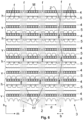
- the knitted fabric from which the compression articles can be produced using the method according to the invention comprises a base knitted fabric made of a knitting thread with an inner side facing this when the compression article is worn on a body extremity and an outer side opposite the inner side, the base knitted fabric being knitted along a wale direction and itself transverse to the wale direction running stitch rows.
- the knitted fabric includes a front layer v knitted on the front needle bed of the flat knitting machine and a back layer h knitted on the back needle bed.
- the rows of stitches of the front layer v and the back layer h are shown one above the other along the wale direction s.
- the formation of the basic knitted fabric of the front layer v and the rear layer h with the stitches M running in the rows m of the basic knitted fabric can be seen.
- the basic knitted fabric is formed from a knitting thread 4, which is knitted, for example, in a right-left knitted fabric or in a 1:1 binding to form the basic knitted fabric on the flat knitting machine.
- the basic knitted fabric is designed as a right-left knitted fabric.
- the knitting thread 4 can be an elastic or an at least largely inelastic knitting thread. For the development of a high compression effect, the use of an elastic knitting thread is preferable. If an elastic knitting thread 4 is used, it can be, for example, a covered yarn with an elastic core thread.
- an elastic weft thread 5 is integrated in each row of stitches m of the basic knitted fabric formed from the knitting thread 4 .
- the elastic weft thread 5 can be, for example, a wrapped yarn with a highly elastic core thread or an elastane or rubber thread.
- the core thread or the entire weft thread expediently has a thickness in the range from 200 to 1500 dtex.
- the weft thread 5 is usually (significantly) thicker than the knitting thread 4.
- the rib-shaped elevations 2, which are knitted in at least in the area of the receptacle 1 of the compression article, are formed by floats F of the knitting thread 4 in the rows m of the basic knitted fabric.
- the elevations 2 arranged at least essentially parallel to one another and at a predetermined distance d from one another in the direction of the stitch rows are represented by a gray field of lines.
- the extent of the elevations 2 in the direction of the rows of stitches m, ie their width b, results from the position of the floats F of the knitting thread 4, which are shown in the knitting pattern figure 1 are shown with reference numerals F, respectively.
- a predetermined number of stitches M of the knitting thread 4 is formed in the stitch row direction m between two successive elevations 2 .
- the number of stitches M that are located between two elevations 2 that are adjacent in the stitch row direction m determines the distance d between the mutually adjacent elevations 2 in the stitch row direction m.
- a weft thread 5 is integrated into each row of stitches m.
- the weft thread 5 forms tuck stitches f.
- the weft thread forms two immediately consecutive tuck stitches ff in the rows m inserted in the base fabric formed by the knitting thread 4.
- FIG 6 a further embodiment of a knitted fabric is shown, from which at least the regions of the receptacles 1 of the compression articles can be produced according to the invention.
- This embodiment differs from that in figure 1 knitted fabric shown in that the elevations 2 are formed by the formation of tuck loops f through the knitting thread 4.
- the knitting thread 4 in the embodiment of figure 1 Floats F forms, formed in place of the floats tuck loops f.
- the knitting thread 4 - just like the float points F of the embodiment of figure 1 - no stitches, resulting in elevations 2.
- a compression article from the in figure 1 or the in figure 6 The knitted fabric shown schematically is knitted in the method according to the invention in such a way that the rib-shaped elevations 2 protruding above the basic knitted fabric come to rest on the outside of the compression article, which faces away from a body extremity when it is placed on it.
- FIG 2 is the outside A and the inside I of the knitted fabric of figure 1 shown where Figure 2a the outside A and Figure 2b the inside I shows.
- the elevations 2 which extend in the longitudinal direction L and in the direction of the rows of stitches m at a distance d from one another and have a width b, can be seen.
- the elevations 2 protrude beyond the basic knitted fabric and thereby form rib-shaped elevations 2.
- the elevations 2 do not appear on the inside I of the knitted fabric. This has the advantage that the elevations 2 do not interfere when the compression article is put on and, in particular, the wearer of the compression article cannot catch on the elevations 2 with a fingernail or toenail.
- FIG. 4 shows further embodiments of compression articles which can be made in accordance with the invention.
- figure 4 shows two compression articles designed as compression gloves, with the in Figure 4a Compression glove shown are only provided in the region of the recordings 1 for the fingers of the wearer rib-shaped elevations 2, whereas in the in Figure 4b shown embodiment of a compression glove are also in the area outside of the shots 1 rib-shaped elevations 2 'arranged.
- FIG 5 compression articles which can be produced according to the invention for application to a leg or foot of a wearer are shown.
- a compression stocking is shown which can be put on a lower leg of a wearer.
- the lower leg compression stocking has receptacles 1, 1a, 1b, 1c, 1d for receiving the toes of the wearer.
- the recordings 1, 1a-1d are each designed to be open and contain a cuff at the open end.
- Elevations 2 are arranged, each extending in the longitudinal direction L of the respective receptacle 1 and transverse to the longitudinal direction at a predetermined distance d from one another and parallel to one another. No elevations 2 are provided outside of the receptacles 1 .
- This in Figure 5b The exemplary embodiment shown shows a footlet with receptacles 1 for receiving the wearer's toes. The footlet has a recess in the area of the instep and the ankle. This recess can also be omitted so that the foot of the wearer, including the instep and the ankle, is completely encompassed by the compression article in the form of a sock.
Landscapes
- Engineering & Computer Science (AREA)
- Health & Medical Sciences (AREA)
- Textile Engineering (AREA)
- General Health & Medical Sciences (AREA)
- Biomedical Technology (AREA)
- Heart & Thoracic Surgery (AREA)
- Vascular Medicine (AREA)
- Life Sciences & Earth Sciences (AREA)
- Animal Behavior & Ethology (AREA)
- Public Health (AREA)
- Veterinary Medicine (AREA)
- Dermatology (AREA)
- Knitting Of Fabric (AREA)
Applications Claiming Priority (2)
| Application Number | Priority Date | Filing Date | Title |
|---|---|---|---|
| DE202018102766.2U DE202018102766U1 (de) | 2018-05-17 | 2018-05-17 | Nahtloser Kompressionsartikel |
| EP19164052.3A EP3569749B1 (fr) | 2018-05-17 | 2019-03-20 | Article de compression sans couture |
Related Parent Applications (2)
| Application Number | Title | Priority Date | Filing Date |
|---|---|---|---|
| EP19164052.3A Division EP3569749B1 (fr) | 2018-05-17 | 2019-03-20 | Article de compression sans couture |
| EP19164052.3A Division-Into EP3569749B1 (fr) | 2018-05-17 | 2019-03-20 | Article de compression sans couture |
Publications (3)
| Publication Number | Publication Date |
|---|---|
| EP4137626A1 true EP4137626A1 (fr) | 2023-02-22 |
| EP4137626B1 EP4137626B1 (fr) | 2025-07-09 |
| EP4137626C0 EP4137626C0 (fr) | 2025-07-09 |
Family
ID=65894860
Family Applications (2)
| Application Number | Title | Priority Date | Filing Date |
|---|---|---|---|
| EP19164052.3A Active EP3569749B1 (fr) | 2018-05-17 | 2019-03-20 | Article de compression sans couture |
| EP22195608.9A Active EP4137626B1 (fr) | 2018-05-17 | 2019-03-20 | Procédé de fabrication d'un article de compression sans couture sur un métier à tricoter rectiligne |
Family Applications Before (1)
| Application Number | Title | Priority Date | Filing Date |
|---|---|---|---|
| EP19164052.3A Active EP3569749B1 (fr) | 2018-05-17 | 2019-03-20 | Article de compression sans couture |
Country Status (4)
| Country | Link |
|---|---|
| US (1) | US11021818B2 (fr) |
| EP (2) | EP3569749B1 (fr) |
| CA (1) | CA3039248C (fr) |
| DE (1) | DE202018102766U1 (fr) |
Families Citing this family (3)
| Publication number | Priority date | Publication date | Assignee | Title |
|---|---|---|---|---|
| CN113846408B (zh) * | 2021-08-27 | 2023-04-07 | 信泰(福建)科技有限公司 | 一种带有衬经组织的飞织织物及其编织方法 |
| FR3159506B1 (fr) * | 2024-02-28 | 2026-03-06 | Thuasne | Article tricoté comprenant au moins une protubérance |
| FR3159507B1 (fr) * | 2024-02-28 | 2026-03-06 | Thuasne | Dispositif de traitement d'affections cutanées et sous-cutanées tricoté comprenant une pluralité de protubérances |
Citations (4)
| Publication number | Priority date | Publication date | Assignee | Title |
|---|---|---|---|---|
| US2220803A (en) * | 1939-11-16 | 1940-11-05 | Unrivaled Hosiery Mill Inc | Hosiery |
| EP0905298A2 (fr) * | 1997-09-30 | 1999-03-31 | H. Stoll GmbH & Co. | Tricot comportant plusieurs structures tri-dimensionelles passants l'un dans l'autre pendant un procédé de tricotage continu |
| EP1679012A1 (fr) | 2003-10-10 | 2006-07-12 | Shima Seiki Mfg., Ltd | Gant sans couture a tres bon maintien |
| WO2017199520A1 (fr) * | 2016-05-19 | 2017-11-23 | 株式会社トレステック | Bandage cylindrique |
Family Cites Families (20)
| Publication number | Priority date | Publication date | Assignee | Title |
|---|---|---|---|---|
| US268734A (en) * | 1882-12-05 | Stocking and the method of making the same | ||
| US1075864A (en) * | 1913-10-14 | Scott & Williams Inc | Hosiery. | |
| US1715657A (en) * | 1928-03-19 | 1929-06-04 | Holden Knitting Company | Stocking and method of making the same |
| US1941508A (en) * | 1932-03-26 | 1934-01-02 | Zwicker Knitting Mills | Knitted mitten and method of making the same |
| DE705704C (de) * | 1937-03-05 | 1941-05-07 | Interwoven Stocking Company | Strumpfware und Verfahren zu ihrer Herstellung |
| US2252768A (en) * | 1940-02-15 | 1941-08-19 | Scott & Williams Inc | Knitted stocking and method for making the same |
| US3386270A (en) * | 1966-04-18 | 1968-06-04 | Alamance Ind Inc | Man's support sock and method of forming same |
| US3905212A (en) * | 1974-10-18 | 1975-09-16 | Alba Waldensian | Inspection toe for anti-embolism stocking |
| US4172456A (en) * | 1976-07-02 | 1979-10-30 | Zens Hosiery Mgf. Co., Inc. | Anti-embolism stocking |
| US4149274A (en) * | 1978-10-10 | 1979-04-17 | Alba-Waldensian, Incorporated | Anti-slip hosiery article and method |
| GB9910576D0 (en) * | 1999-05-08 | 1999-07-07 | Smith & Nephew | Compression gloves |
| US7434423B1 (en) * | 2004-04-30 | 2008-10-14 | Carolon Company | Impact protection and performance garment |
| DE102004036344B4 (de) | 2004-07-27 | 2007-05-24 | Bsn-Jobst Gmbh | Strickware zum Stützen und/oder Komprimieren und/oder Kompressionsbehandlung von Körperteilen und Verfahren zur Herstellung einer solchen Strickware |
| JP5064169B2 (ja) * | 2007-10-23 | 2012-10-31 | 岡本株式会社 | 靴下 |
| DE102007063148A1 (de) * | 2007-12-29 | 2009-07-02 | Medi Gmbh & Co. Kg | Nahtloses Kompressionsgestrick und Verfahren zu dessen Herstellung |
| DE102009050031B3 (de) * | 2009-10-21 | 2011-03-03 | Hermann Christiansen | Material für ein Produkt zur Kompression von Körperteilen sowie ein medizinischer Verband und ein Kleidungsstück aus diesem Material |
| WO2012067645A1 (fr) * | 2010-11-15 | 2012-05-24 | Flagship Brands, Llc | Chaussette tricotée comportant une zone de compression ciblée |
| EP2814349B1 (fr) * | 2012-02-13 | 2021-03-31 | Ansell Limited | Gant sans couture, renforcé par crête |
| DE202012004652U1 (de) * | 2012-05-11 | 2013-08-12 | Julius Zorn Gmbh | Bandage mit einer Öffnung zum Durchführen einer Gliedmaßenspitze |
| ES2935563T3 (es) * | 2016-05-19 | 2023-03-08 | Medi Gmbh & Co Kg | Pieza de tejido de punto |
-
2018
- 2018-05-17 DE DE202018102766.2U patent/DE202018102766U1/de active Active
-
2019
- 2019-03-20 EP EP19164052.3A patent/EP3569749B1/fr active Active
- 2019-03-20 EP EP22195608.9A patent/EP4137626B1/fr active Active
- 2019-04-04 CA CA3039248A patent/CA3039248C/fr active Active
- 2019-05-13 US US16/410,101 patent/US11021818B2/en active Active
Patent Citations (4)
| Publication number | Priority date | Publication date | Assignee | Title |
|---|---|---|---|---|
| US2220803A (en) * | 1939-11-16 | 1940-11-05 | Unrivaled Hosiery Mill Inc | Hosiery |
| EP0905298A2 (fr) * | 1997-09-30 | 1999-03-31 | H. Stoll GmbH & Co. | Tricot comportant plusieurs structures tri-dimensionelles passants l'un dans l'autre pendant un procédé de tricotage continu |
| EP1679012A1 (fr) | 2003-10-10 | 2006-07-12 | Shima Seiki Mfg., Ltd | Gant sans couture a tres bon maintien |
| WO2017199520A1 (fr) * | 2016-05-19 | 2017-11-23 | 株式会社トレステック | Bandage cylindrique |
Also Published As
| Publication number | Publication date |
|---|---|
| CA3039248A1 (fr) | 2019-11-17 |
| EP3569749A3 (fr) | 2020-07-01 |
| EP3569749B1 (fr) | 2023-09-06 |
| EP3569749C0 (fr) | 2023-09-06 |
| US11021818B2 (en) | 2021-06-01 |
| DE202018102766U1 (de) | 2019-08-21 |
| CA3039248C (fr) | 2021-11-02 |
| EP4137626B1 (fr) | 2025-07-09 |
| US20190350271A1 (en) | 2019-11-21 |
| EP3569749A2 (fr) | 2019-11-20 |
| EP4137626C0 (fr) | 2025-07-09 |
Similar Documents
| Publication | Publication Date | Title |
|---|---|---|
| DE1585117C3 (de) | Rundgestrickter Strumpf | |
| EP3214213B1 (fr) | Pièce tricotée sur métier tubulaire et son procédé de production | |
| EP3673878B1 (fr) | Article de contention tricoté | |
| DE2458649A1 (de) | Einteilige nahtlose unterhose und verfahren zur herstellung derselben | |
| DE7715721U1 (de) | Feuchtigkeitsabsorbierendes band | |
| EP3246439B1 (fr) | Piece tricotee | |
| DE102010046945A1 (de) | Kompressionsartikel mit Einsatz | |
| DE7833219U1 (de) | Strumpfhose | |
| EP3572570A1 (fr) | Article de compression | |
| EP3412816B1 (fr) | Tricot de compression d'un tricot de base et d'un fils de trame élastique introduit dans ledit tricot de base, article de contention incorporant ledit tricot de compression ainsi que procédé de fabrication d'un tricot de compression | |
| EP3569749B1 (fr) | Article de compression sans couture | |
| DE102007063148A1 (de) | Nahtloses Kompressionsgestrick und Verfahren zu dessen Herstellung | |
| EP3141644B1 (fr) | Piece tricotee compressive et procede de fabrication | |
| DE10084580C2 (de) | Gestickter Kompressionshandschuh und Verfahren zu seiner Herstellung | |
| DE2458251A1 (de) | Rundgestrickter, nahtloser strumpf, insbesondere medizinischer strumpf | |
| EP3699342B1 (fr) | Procédé de fabrication d'une pièce tricotée ainsi que pièce tricotée | |
| EP2202339A1 (fr) | Chausson en mailles et son procédé de fabrication | |
| EP0724869A1 (fr) | Bas contre la thrombose ou partie de bas d'un collant contre la thrombose et procédé pour leur fabrication | |
| DE2004198A1 (de) | Gestrickte Schlauchware,insbesondere Strumpf,und Verfahren zu ihrer Herstellung | |
| DE202016101785U1 (de) | Gestrickteil | |
| DE102018130930A1 (de) | Gestricktes Bekleidungsteil | |
| EP2199445A1 (fr) | Habillement de jambe tricoté et son procédé de fabrication | |
| DE102022121165A1 (de) | Kompressionsgestrick und Verfahren zur Herstellung eines Kompressionsgestricks, insbesondere zur Herstellung von gestrickten Stumpfstrümpfen mit kompressiver Wirkung | |
| DE202022104736U1 (de) | Kompressionsgestrick, insbesondere zur Herstellung von gestrickten Stumpfstrümpfen mit kompressiver Wirkung | |
| DE202018106924U1 (de) | Gestricktes Bekleidungsteil |
Legal Events
| Date | Code | Title | Description |
|---|---|---|---|
| PUAI | Public reference made under article 153(3) epc to a published international application that has entered the european phase |
Free format text: ORIGINAL CODE: 0009012 |
|
| STAA | Information on the status of an ep patent application or granted ep patent |
Free format text: STATUS: THE APPLICATION HAS BEEN PUBLISHED |
|
| AC | Divisional application: reference to earlier application |
Ref document number: 3569749 Country of ref document: EP Kind code of ref document: P |
|
| AK | Designated contracting states |
Kind code of ref document: A1 Designated state(s): AL AT BE BG CH CY CZ DE DK EE ES FI FR GB GR HR HU IE IS IT LI LT LU LV MC MK MT NL NO PL PT RO RS SE SI SK SM TR |
|
| STAA | Information on the status of an ep patent application or granted ep patent |
Free format text: STATUS: REQUEST FOR EXAMINATION WAS MADE |
|
| 17P | Request for examination filed |
Effective date: 20230822 |
|
| RBV | Designated contracting states (corrected) |
Designated state(s): AL AT BE BG CH CY CZ DE DK EE ES FI FR GB GR HR HU IE IS IT LI LT LU LV MC MK MT NL NO PL PT RO RS SE SI SK SM TR |
|
| STAA | Information on the status of an ep patent application or granted ep patent |
Free format text: STATUS: EXAMINATION IS IN PROGRESS |
|
| 17Q | First examination report despatched |
Effective date: 20240802 |
|
| GRAP | Despatch of communication of intention to grant a patent |
Free format text: ORIGINAL CODE: EPIDOSNIGR1 |
|
| STAA | Information on the status of an ep patent application or granted ep patent |
Free format text: STATUS: GRANT OF PATENT IS INTENDED |
|
| RIC1 | Information provided on ipc code assigned before grant |
Ipc: D04B 1/28 20060101ALN20250324BHEP Ipc: D04B 1/26 20060101AFI20250324BHEP |
|
| INTG | Intention to grant announced |
Effective date: 20250411 |
|
| GRAS | Grant fee paid |
Free format text: ORIGINAL CODE: EPIDOSNIGR3 |
|
| GRAA | (expected) grant |
Free format text: ORIGINAL CODE: 0009210 |
|
| STAA | Information on the status of an ep patent application or granted ep patent |
Free format text: STATUS: THE PATENT HAS BEEN GRANTED |
|
| AC | Divisional application: reference to earlier application |
Ref document number: 3569749 Country of ref document: EP Kind code of ref document: P |
|
| AK | Designated contracting states |
Kind code of ref document: B1 Designated state(s): AL AT BE BG CH CY CZ DE DK EE ES FI FR GB GR HR HU IE IS IT LI LT LU LV MC MK MT NL NO PL PT RO RS SE SI SK SM TR |
|
| REG | Reference to a national code |
Ref country code: GB Ref legal event code: FG4D Free format text: NOT ENGLISH |
|
| REG | Reference to a national code |
Ref country code: CH Ref legal event code: EP |
|
| REG | Reference to a national code |
Ref country code: IE Ref legal event code: FG4D Free format text: LANGUAGE OF EP DOCUMENT: GERMAN |
|
| REG | Reference to a national code |
Ref country code: DE Ref legal event code: R096 Ref document number: 502019013600 Country of ref document: DE |
|
| U01 | Request for unitary effect filed |
Effective date: 20250709 |
|
| U07 | Unitary effect registered |
Designated state(s): AT BE BG DE DK EE FI FR IT LT LU LV MT NL PT RO SE SI Effective date: 20250716 |
|
| PG25 | Lapsed in a contracting state [announced via postgrant information from national office to epo] |
Ref country code: IS Free format text: LAPSE BECAUSE OF FAILURE TO SUBMIT A TRANSLATION OF THE DESCRIPTION OR TO PAY THE FEE WITHIN THE PRESCRIBED TIME-LIMIT Effective date: 20251109 |
|
| PG25 | Lapsed in a contracting state [announced via postgrant information from national office to epo] |
Ref country code: NO Free format text: LAPSE BECAUSE OF FAILURE TO SUBMIT A TRANSLATION OF THE DESCRIPTION OR TO PAY THE FEE WITHIN THE PRESCRIBED TIME-LIMIT Effective date: 20251009 |
|
| PG25 | Lapsed in a contracting state [announced via postgrant information from national office to epo] |
Ref country code: HR Free format text: LAPSE BECAUSE OF FAILURE TO SUBMIT A TRANSLATION OF THE DESCRIPTION OR TO PAY THE FEE WITHIN THE PRESCRIBED TIME-LIMIT Effective date: 20250709 |
|
| PG25 | Lapsed in a contracting state [announced via postgrant information from national office to epo] |
Ref country code: GR Free format text: LAPSE BECAUSE OF FAILURE TO SUBMIT A TRANSLATION OF THE DESCRIPTION OR TO PAY THE FEE WITHIN THE PRESCRIBED TIME-LIMIT Effective date: 20251010 |
|
| PG25 | Lapsed in a contracting state [announced via postgrant information from national office to epo] |
Ref country code: PL Free format text: LAPSE BECAUSE OF FAILURE TO SUBMIT A TRANSLATION OF THE DESCRIPTION OR TO PAY THE FEE WITHIN THE PRESCRIBED TIME-LIMIT Effective date: 20250709 |
|
| PG25 | Lapsed in a contracting state [announced via postgrant information from national office to epo] |
Ref country code: RS Free format text: LAPSE BECAUSE OF FAILURE TO SUBMIT A TRANSLATION OF THE DESCRIPTION OR TO PAY THE FEE WITHIN THE PRESCRIBED TIME-LIMIT Effective date: 20251009 |
|
| PG25 | Lapsed in a contracting state [announced via postgrant information from national office to epo] |
Ref country code: ES Free format text: LAPSE BECAUSE OF FAILURE TO SUBMIT A TRANSLATION OF THE DESCRIPTION OR TO PAY THE FEE WITHIN THE PRESCRIBED TIME-LIMIT Effective date: 20250709 |
|
| REG | Reference to a national code |
Ref country code: CH Ref legal event code: U11 Free format text: ST27 STATUS EVENT CODE: U-0-0-U10-U11 (AS PROVIDED BY THE NATIONAL OFFICE) Effective date: 20260401 |
|
| PG25 | Lapsed in a contracting state [announced via postgrant information from national office to epo] |
Ref country code: SM Free format text: LAPSE BECAUSE OF FAILURE TO SUBMIT A TRANSLATION OF THE DESCRIPTION OR TO PAY THE FEE WITHIN THE PRESCRIBED TIME-LIMIT Effective date: 20250709 |
|
| PGFP | Annual fee paid to national office [announced via postgrant information from national office to epo] |
Ref country code: GB Payment date: 20260324 Year of fee payment: 8 |
|
| PG25 | Lapsed in a contracting state [announced via postgrant information from national office to epo] |
Ref country code: CZ Free format text: LAPSE BECAUSE OF FAILURE TO SUBMIT A TRANSLATION OF THE DESCRIPTION OR TO PAY THE FEE WITHIN THE PRESCRIBED TIME-LIMIT Effective date: 20250709 |
|
| PG25 | Lapsed in a contracting state [announced via postgrant information from national office to epo] |
Ref country code: SK Free format text: LAPSE BECAUSE OF FAILURE TO SUBMIT A TRANSLATION OF THE DESCRIPTION OR TO PAY THE FEE WITHIN THE PRESCRIBED TIME-LIMIT Effective date: 20250709 |