EP4137789A1 - Infraroterfassungsvorrichtung und widerstandsvariable folie damit - Google Patents
Infraroterfassungsvorrichtung und widerstandsvariable folie damit Download PDFInfo
- Publication number
- EP4137789A1 EP4137789A1 EP21788628.2A EP21788628A EP4137789A1 EP 4137789 A1 EP4137789 A1 EP 4137789A1 EP 21788628 A EP21788628 A EP 21788628A EP 4137789 A1 EP4137789 A1 EP 4137789A1
- Authority
- EP
- European Patent Office
- Prior art keywords
- variable resistance
- infrared
- sensing device
- irradiation
- infrared sensing
- Prior art date
- Legal status (The legal status is an assumption and is not a legal conclusion. Google has not performed a legal analysis and makes no representation as to the accuracy of the status listed.)
- Pending
Links
- 239000000463 material Substances 0.000 claims abstract description 100
- 230000004044 response Effects 0.000 claims abstract description 36
- 238000001514 detection method Methods 0.000 claims abstract description 12
- 238000002198 surface plasmon resonance spectroscopy Methods 0.000 claims abstract description 9
- 238000005259 measurement Methods 0.000 claims description 61
- 239000002105 nanoparticle Substances 0.000 claims description 40
- OMZSGWSJDCOLKM-UHFFFAOYSA-N copper(II) sulfide Chemical compound [S-2].[Cu+2] OMZSGWSJDCOLKM-UHFFFAOYSA-N 0.000 claims description 30
- 239000004065 semiconductor Substances 0.000 claims description 25
- 230000007423 decrease Effects 0.000 claims description 21
- 150000001875 compounds Chemical class 0.000 claims description 15
- 230000005284 excitation Effects 0.000 claims description 14
- QGLKJKCYBOYXKC-UHFFFAOYSA-N nonaoxidotritungsten Chemical compound O=[W]1(=O)O[W](=O)(=O)O[W](=O)(=O)O1 QGLKJKCYBOYXKC-UHFFFAOYSA-N 0.000 claims description 12
- 238000002834 transmittance Methods 0.000 claims description 12
- 229910001930 tungsten oxide Inorganic materials 0.000 claims description 12
- 239000010949 copper Substances 0.000 claims description 11
- 230000003287 optical effect Effects 0.000 claims description 11
- RYGMFSIKBFXOCR-UHFFFAOYSA-N Copper Chemical compound [Cu] RYGMFSIKBFXOCR-UHFFFAOYSA-N 0.000 claims description 7
- 229910052802 copper Inorganic materials 0.000 claims description 7
- 239000002356 single layer Substances 0.000 claims description 6
- 239000003575 carbonaceous material Substances 0.000 claims description 3
- QVGXLLKOCUKJST-UHFFFAOYSA-N atomic oxygen Chemical compound [O] QVGXLLKOCUKJST-UHFFFAOYSA-N 0.000 claims description 2
- 229910052798 chalcogen Inorganic materials 0.000 claims description 2
- 150000001787 chalcogens Chemical class 0.000 claims description 2
- 229910052760 oxygen Inorganic materials 0.000 claims description 2
- 239000001301 oxygen Substances 0.000 claims description 2
- 239000010408 film Substances 0.000 description 62
- 239000011358 absorbing material Substances 0.000 description 26
- 239000000758 substrate Substances 0.000 description 21
- 239000011230 binding agent Substances 0.000 description 20
- 230000006870 function Effects 0.000 description 16
- 239000011248 coating agent Substances 0.000 description 10
- 238000000576 coating method Methods 0.000 description 10
- 239000000243 solution Substances 0.000 description 10
- 125000000524 functional group Chemical group 0.000 description 9
- XLOMVQKBTHCTTD-UHFFFAOYSA-N Zinc monoxide Chemical compound [Zn]=O XLOMVQKBTHCTTD-UHFFFAOYSA-N 0.000 description 8
- 239000002585 base Substances 0.000 description 8
- 229910052980 cadmium sulfide Inorganic materials 0.000 description 8
- 238000000034 method Methods 0.000 description 8
- WUPHOULIZUERAE-UHFFFAOYSA-N 3-(oxolan-2-yl)propanoic acid Chemical compound OC(=O)CCC1CCCO1 WUPHOULIZUERAE-UHFFFAOYSA-N 0.000 description 7
- 239000002245 particle Substances 0.000 description 7
- 230000001052 transient effect Effects 0.000 description 7
- HLCPWBZNUKCSBN-UHFFFAOYSA-N 2-aminobenzonitrile Chemical compound NC1=CC=CC=C1C#N HLCPWBZNUKCSBN-UHFFFAOYSA-N 0.000 description 6
- WEVYAHXRMPXWCK-UHFFFAOYSA-N Acetonitrile Chemical compound CC#N WEVYAHXRMPXWCK-UHFFFAOYSA-N 0.000 description 6
- 239000011521 glass Substances 0.000 description 6
- QGLWBTPVKHMVHM-KTKRTIGZSA-N (z)-octadec-9-en-1-amine Chemical compound CCCCCCCC\C=C/CCCCCCCCN QGLWBTPVKHMVHM-KTKRTIGZSA-N 0.000 description 5
- -1 CuGaO2 Inorganic materials 0.000 description 5
- WQZGKKKJIJFFOK-GASJEMHNSA-N Glucose Natural products OC[C@H]1OC(O)[C@H](O)[C@@H](O)[C@@H]1O WQZGKKKJIJFFOK-GASJEMHNSA-N 0.000 description 5
- 230000015572 biosynthetic process Effects 0.000 description 5
- 239000008280 blood Substances 0.000 description 5
- 210000004369 blood Anatomy 0.000 description 5
- CXKCTMHTOKXKQT-UHFFFAOYSA-N cadmium oxide Inorganic materials [Cd]=O CXKCTMHTOKXKQT-UHFFFAOYSA-N 0.000 description 5
- CFEAAQFZALKQPA-UHFFFAOYSA-N cadmium(2+);oxygen(2-) Chemical compound [O-2].[Cd+2] CFEAAQFZALKQPA-UHFFFAOYSA-N 0.000 description 5
- 238000004364 calculation method Methods 0.000 description 5
- 239000008103 glucose Substances 0.000 description 5
- 239000010410 layer Substances 0.000 description 5
- 239000013049 sediment Substances 0.000 description 5
- VYMPLPIFKRHAAC-UHFFFAOYSA-N 1,2-ethanedithiol Chemical compound SCCS VYMPLPIFKRHAAC-UHFFFAOYSA-N 0.000 description 4
- HEDRZPFGACZZDS-UHFFFAOYSA-N Chloroform Chemical compound ClC(Cl)Cl HEDRZPFGACZZDS-UHFFFAOYSA-N 0.000 description 4
- LFQSCWFLJHTTHZ-UHFFFAOYSA-N Ethanol Chemical compound CCO LFQSCWFLJHTTHZ-UHFFFAOYSA-N 0.000 description 4
- 238000004847 absorption spectroscopy Methods 0.000 description 4
- 239000005001 laminate film Substances 0.000 description 4
- 229910052751 metal Inorganic materials 0.000 description 4
- 239000002184 metal Substances 0.000 description 4
- TVMXDCGIABBOFY-UHFFFAOYSA-N octane Chemical compound CCCCCCCC TVMXDCGIABBOFY-UHFFFAOYSA-N 0.000 description 4
- 239000011347 resin Substances 0.000 description 4
- 229920005989 resin Polymers 0.000 description 4
- WOCIAKWEIIZHES-UHFFFAOYSA-N ruthenium(iv) oxide Chemical compound O=[Ru]=O WOCIAKWEIIZHES-UHFFFAOYSA-N 0.000 description 4
- IRPLSAGFWHCJIQ-UHFFFAOYSA-N selanylidenecopper Chemical compound [Se]=[Cu] IRPLSAGFWHCJIQ-UHFFFAOYSA-N 0.000 description 4
- XSOKHXFFCGXDJZ-UHFFFAOYSA-N telluride(2-) Chemical compound [Te-2] XSOKHXFFCGXDJZ-UHFFFAOYSA-N 0.000 description 4
- 239000011787 zinc oxide Substances 0.000 description 4
- 229910000906 Bronze Inorganic materials 0.000 description 3
- 238000010521 absorption reaction Methods 0.000 description 3
- 239000010974 bronze Substances 0.000 description 3
- KUNSUQLRTQLHQQ-UHFFFAOYSA-N copper tin Chemical compound [Cu].[Sn] KUNSUQLRTQLHQQ-UHFFFAOYSA-N 0.000 description 3
- 229910003437 indium oxide Inorganic materials 0.000 description 3
- PJXISJQVUVHSOJ-UHFFFAOYSA-N indium(iii) oxide Chemical compound [O-2].[O-2].[O-2].[In+3].[In+3] PJXISJQVUVHSOJ-UHFFFAOYSA-N 0.000 description 3
- 229910000476 molybdenum oxide Inorganic materials 0.000 description 3
- PQQKPALAQIIWST-UHFFFAOYSA-N oxomolybdenum Chemical compound [Mo]=O PQQKPALAQIIWST-UHFFFAOYSA-N 0.000 description 3
- 239000000523 sample Substances 0.000 description 3
- 239000007787 solid Substances 0.000 description 3
- 239000002904 solvent Substances 0.000 description 3
- XOLBLPGZBRYERU-UHFFFAOYSA-N tin dioxide Chemical compound O=[Sn]=O XOLBLPGZBRYERU-UHFFFAOYSA-N 0.000 description 3
- 229910001887 tin oxide Inorganic materials 0.000 description 3
- 230000007704 transition Effects 0.000 description 3
- WFKWXMTUELFFGS-UHFFFAOYSA-N tungsten Chemical compound [W] WFKWXMTUELFFGS-UHFFFAOYSA-N 0.000 description 3
- 239000010937 tungsten Substances 0.000 description 3
- 229910052721 tungsten Inorganic materials 0.000 description 3
- IJGRMHOSHXDMSA-UHFFFAOYSA-N Atomic nitrogen Chemical compound N#N IJGRMHOSHXDMSA-UHFFFAOYSA-N 0.000 description 2
- OKTJSMMVPCPJKN-UHFFFAOYSA-N Carbon Chemical compound [C] OKTJSMMVPCPJKN-UHFFFAOYSA-N 0.000 description 2
- QPLDLSVMHZLSFG-UHFFFAOYSA-N Copper oxide Chemical compound [Cu]=O QPLDLSVMHZLSFG-UHFFFAOYSA-N 0.000 description 2
- 239000005751 Copper oxide Substances 0.000 description 2
- XFXPMWWXUTWYJX-UHFFFAOYSA-N Cyanide Chemical compound N#[C-] XFXPMWWXUTWYJX-UHFFFAOYSA-N 0.000 description 2
- OAKJQQAXSVQMHS-UHFFFAOYSA-N Hydrazine Chemical compound NN OAKJQQAXSVQMHS-UHFFFAOYSA-N 0.000 description 2
- MWUXSHHQAYIFBG-UHFFFAOYSA-N Nitric oxide Chemical group O=[N] MWUXSHHQAYIFBG-UHFFFAOYSA-N 0.000 description 2
- JCXJVPUVTGWSNB-UHFFFAOYSA-N Nitrogen dioxide Chemical compound O=[N]=O JCXJVPUVTGWSNB-UHFFFAOYSA-N 0.000 description 2
- JUJWROOIHBZHMG-UHFFFAOYSA-N Pyridine Chemical compound C1=CC=NC=C1 JUJWROOIHBZHMG-UHFFFAOYSA-N 0.000 description 2
- UCKMPCXJQFINFW-UHFFFAOYSA-N Sulphide Chemical compound [S-2] UCKMPCXJQFINFW-UHFFFAOYSA-N 0.000 description 2
- GWEVSGVZZGPLCZ-UHFFFAOYSA-N Titan oxide Chemical compound O=[Ti]=O GWEVSGVZZGPLCZ-UHFFFAOYSA-N 0.000 description 2
- 238000000862 absorption spectrum Methods 0.000 description 2
- 150000001450 anions Chemical class 0.000 description 2
- 125000004429 atom Chemical group 0.000 description 2
- 230000005540 biological transmission Effects 0.000 description 2
- 229910052792 caesium Inorganic materials 0.000 description 2
- TVFDJXOCXUVLDH-UHFFFAOYSA-N caesium atom Chemical compound [Cs] TVFDJXOCXUVLDH-UHFFFAOYSA-N 0.000 description 2
- 239000000969 carrier Substances 0.000 description 2
- 238000005119 centrifugation Methods 0.000 description 2
- 230000008859 change Effects 0.000 description 2
- 239000000460 chlorine Substances 0.000 description 2
- 238000004891 communication Methods 0.000 description 2
- 238000001816 cooling Methods 0.000 description 2
- 229910000431 copper oxide Inorganic materials 0.000 description 2
- 238000007598 dipping method Methods 0.000 description 2
- 230000000694 effects Effects 0.000 description 2
- 238000009413 insulation Methods 0.000 description 2
- 150000002500 ions Chemical class 0.000 description 2
- 239000003446 ligand Substances 0.000 description 2
- 239000007769 metal material Substances 0.000 description 2
- JKQOBWVOAYFWKG-UHFFFAOYSA-N molybdenum trioxide Chemical compound O=[Mo](=O)=O JKQOBWVOAYFWKG-UHFFFAOYSA-N 0.000 description 2
- 239000004745 nonwoven fabric Substances 0.000 description 2
- DYIZHKNUQPHNJY-UHFFFAOYSA-N oxorhenium Chemical compound [Re]=O DYIZHKNUQPHNJY-UHFFFAOYSA-N 0.000 description 2
- BASFCYQUMIYNBI-UHFFFAOYSA-N platinum Chemical compound [Pt] BASFCYQUMIYNBI-UHFFFAOYSA-N 0.000 description 2
- ZNNZYHKDIALBAK-UHFFFAOYSA-M potassium thiocyanate Chemical compound [K+].[S-]C#N ZNNZYHKDIALBAK-UHFFFAOYSA-M 0.000 description 2
- 229940116357 potassium thiocyanate Drugs 0.000 description 2
- 229910003449 rhenium oxide Inorganic materials 0.000 description 2
- 229910001925 ruthenium oxide Inorganic materials 0.000 description 2
- 150000003346 selenoethers Chemical class 0.000 description 2
- 230000035945 sensitivity Effects 0.000 description 2
- 238000005507 spraying Methods 0.000 description 2
- 239000000126 substance Substances 0.000 description 2
- 238000006467 substitution reaction Methods 0.000 description 2
- KDYFGRWQOYBRFD-UHFFFAOYSA-N succinic acid Chemical compound OC(=O)CCC(O)=O KDYFGRWQOYBRFD-UHFFFAOYSA-N 0.000 description 2
- 238000002411 thermogravimetry Methods 0.000 description 2
- ZMZDMBWJUHKJPS-UHFFFAOYSA-N thiocyanic acid Chemical compound SC#N ZMZDMBWJUHKJPS-UHFFFAOYSA-N 0.000 description 2
- OGIDPMRJRNCKJF-UHFFFAOYSA-N titanium oxide Inorganic materials [Ti]=O OGIDPMRJRNCKJF-UHFFFAOYSA-N 0.000 description 2
- 239000002759 woven fabric Substances 0.000 description 2
- UMAPFAAAQBMYNJ-UHFFFAOYSA-N 1-n,2-n-dimethylbenzene-1,2-diamine Chemical compound CNC1=CC=CC=C1NC UMAPFAAAQBMYNJ-UHFFFAOYSA-N 0.000 description 1
- CNXZMGRWEYQCOQ-UHFFFAOYSA-N 2-methoxy-3-phenylprop-2-enoic acid Chemical compound COC(C(O)=O)=CC1=CC=CC=C1 CNXZMGRWEYQCOQ-UHFFFAOYSA-N 0.000 description 1
- DKIDEFUBRARXTE-UHFFFAOYSA-N 3-mercaptopropanoic acid Chemical compound OC(=O)CCS DKIDEFUBRARXTE-UHFFFAOYSA-N 0.000 description 1
- ZCYVEMRRCGMTRW-UHFFFAOYSA-N 7553-56-2 Chemical compound [I] ZCYVEMRRCGMTRW-UHFFFAOYSA-N 0.000 description 1
- 229920000178 Acrylic resin Polymers 0.000 description 1
- 239000004925 Acrylic resin Substances 0.000 description 1
- WKBOTKDWSSQWDR-UHFFFAOYSA-N Bromine atom Chemical compound [Br] WKBOTKDWSSQWDR-UHFFFAOYSA-N 0.000 description 1
- UGFAIRIUMAVXCW-UHFFFAOYSA-N Carbon monoxide Chemical compound [O+]#[C-] UGFAIRIUMAVXCW-UHFFFAOYSA-N 0.000 description 1
- 229920002134 Carboxymethyl cellulose Polymers 0.000 description 1
- ZAMOUSCENKQFHK-UHFFFAOYSA-N Chlorine atom Chemical compound [Cl] ZAMOUSCENKQFHK-UHFFFAOYSA-N 0.000 description 1
- 229910018572 CuAlO2 Inorganic materials 0.000 description 1
- 229910016510 CuCrO2 Inorganic materials 0.000 description 1
- 229910002531 CuTe Inorganic materials 0.000 description 1
- PIICEJLVQHRZGT-UHFFFAOYSA-N Ethylenediamine Chemical compound NCCN PIICEJLVQHRZGT-UHFFFAOYSA-N 0.000 description 1
- PXGOKWXKJXAPGV-UHFFFAOYSA-N Fluorine Chemical compound FF PXGOKWXKJXAPGV-UHFFFAOYSA-N 0.000 description 1
- 229910000530 Gallium indium arsenide Inorganic materials 0.000 description 1
- 229910015675 MoO3−x Inorganic materials 0.000 description 1
- KFFQABQEJATQAT-UHFFFAOYSA-N N,N'-dibutylthiourea Chemical compound CCCCNC(=S)NCCCC KFFQABQEJATQAT-UHFFFAOYSA-N 0.000 description 1
- 239000005922 Phosphane Substances 0.000 description 1
- XYFCBTPGUUZFHI-UHFFFAOYSA-N Phosphine Chemical compound P XYFCBTPGUUZFHI-UHFFFAOYSA-N 0.000 description 1
- 239000004698 Polyethylene Substances 0.000 description 1
- 239000004793 Polystyrene Substances 0.000 description 1
- 239000004372 Polyvinyl alcohol Substances 0.000 description 1
- 229910019599 ReO2 Inorganic materials 0.000 description 1
- RTAQQCXQSZGOHL-UHFFFAOYSA-N Titanium Chemical compound [Ti] RTAQQCXQSZGOHL-UHFFFAOYSA-N 0.000 description 1
- XHCLAFWTIXFWPH-UHFFFAOYSA-N [O-2].[O-2].[O-2].[O-2].[O-2].[V+5].[V+5] Chemical compound [O-2].[O-2].[O-2].[O-2].[O-2].[V+5].[V+5] XHCLAFWTIXFWPH-UHFFFAOYSA-N 0.000 description 1
- DHKHKXVYLBGOIT-UHFFFAOYSA-N acetaldehyde Diethyl Acetal Natural products CCOC(C)OCC DHKHKXVYLBGOIT-UHFFFAOYSA-N 0.000 description 1
- 125000002777 acetyl group Chemical class [H]C([H])([H])C(*)=O 0.000 description 1
- 125000005595 acetylacetonate group Chemical group 0.000 description 1
- 239000000853 adhesive Substances 0.000 description 1
- 230000001070 adhesive effect Effects 0.000 description 1
- 239000002313 adhesive film Substances 0.000 description 1
- 230000002411 adverse Effects 0.000 description 1
- 229910052783 alkali metal Inorganic materials 0.000 description 1
- 150000001340 alkali metals Chemical class 0.000 description 1
- 125000000129 anionic group Chemical group 0.000 description 1
- 239000000427 antigen Substances 0.000 description 1
- 102000036639 antigens Human genes 0.000 description 1
- 108091007433 antigens Proteins 0.000 description 1
- 239000012298 atmosphere Substances 0.000 description 1
- 230000004888 barrier function Effects 0.000 description 1
- 230000008901 benefit Effects 0.000 description 1
- 239000007844 bleaching agent Substances 0.000 description 1
- 238000009529 body temperature measurement Methods 0.000 description 1
- GDTBXPJZTBHREO-UHFFFAOYSA-N bromine Substances BrBr GDTBXPJZTBHREO-UHFFFAOYSA-N 0.000 description 1
- 229910052794 bromium Inorganic materials 0.000 description 1
- 239000002041 carbon nanotube Substances 0.000 description 1
- 229910021393 carbon nanotube Inorganic materials 0.000 description 1
- 125000002915 carbonyl group Chemical group [*:2]C([*:1])=O 0.000 description 1
- 239000001768 carboxy methyl cellulose Substances 0.000 description 1
- 235000010948 carboxy methyl cellulose Nutrition 0.000 description 1
- 239000008112 carboxymethyl-cellulose Substances 0.000 description 1
- 239000000919 ceramic Substances 0.000 description 1
- 238000006243 chemical reaction Methods 0.000 description 1
- 229910052801 chlorine Inorganic materials 0.000 description 1
- 239000003086 colorant Substances 0.000 description 1
- 229920001940 conductive polymer Polymers 0.000 description 1
- 239000004020 conductor Substances 0.000 description 1
- OPQARKPSCNTWTJ-UHFFFAOYSA-L copper(ii) acetate Chemical compound [Cu+2].CC([O-])=O.CC([O-])=O OPQARKPSCNTWTJ-UHFFFAOYSA-L 0.000 description 1
- 239000013078 crystal Substances 0.000 description 1
- 230000003247 decreasing effect Effects 0.000 description 1
- 230000007547 defect Effects 0.000 description 1
- 238000011161 development Methods 0.000 description 1
- AJNVQOSZGJRYEI-UHFFFAOYSA-N digallium;oxygen(2-) Chemical compound [O-2].[O-2].[O-2].[Ga+3].[Ga+3] AJNVQOSZGJRYEI-UHFFFAOYSA-N 0.000 description 1
- 238000004090 dissolution Methods 0.000 description 1
- 210000000624 ear auricle Anatomy 0.000 description 1
- 238000005516 engineering process Methods 0.000 description 1
- 239000002657 fibrous material Substances 0.000 description 1
- 229910052731 fluorine Inorganic materials 0.000 description 1
- 239000011737 fluorine Substances 0.000 description 1
- 229910001195 gallium oxide Inorganic materials 0.000 description 1
- 239000007789 gas Substances 0.000 description 1
- 125000002791 glucosyl group Chemical group C1([C@H](O)[C@@H](O)[C@H](O)[C@H](O1)CO)* 0.000 description 1
- 229910002804 graphite Inorganic materials 0.000 description 1
- 239000010439 graphite Substances 0.000 description 1
- 230000005484 gravity Effects 0.000 description 1
- 125000005843 halogen group Chemical group 0.000 description 1
- 125000004435 hydrogen atom Chemical group [H]* 0.000 description 1
- 230000002209 hydrophobic effect Effects 0.000 description 1
- XLYOFNOQVPJJNP-UHFFFAOYSA-M hydroxide Chemical compound [OH-] XLYOFNOQVPJJNP-UHFFFAOYSA-M 0.000 description 1
- 230000006872 improvement Effects 0.000 description 1
- 238000010348 incorporation Methods 0.000 description 1
- WPYVAWXEWQSOGY-UHFFFAOYSA-N indium antimonide Chemical compound [Sb]#[In] WPYVAWXEWQSOGY-UHFFFAOYSA-N 0.000 description 1
- 238000002347 injection Methods 0.000 description 1
- 239000007924 injection Substances 0.000 description 1
- 150000002484 inorganic compounds Chemical class 0.000 description 1
- 229910010272 inorganic material Inorganic materials 0.000 description 1
- 230000003993 interaction Effects 0.000 description 1
- 229910052740 iodine Inorganic materials 0.000 description 1
- 239000011630 iodine Substances 0.000 description 1
- 125000001810 isothiocyanato group Chemical group *N=C=S 0.000 description 1
- 238000009940 knitting Methods 0.000 description 1
- 239000007788 liquid Substances 0.000 description 1
- 239000007791 liquid phase Substances 0.000 description 1
- 150000002739 metals Chemical class 0.000 description 1
- HZVOZRGWRWCICA-UHFFFAOYSA-N methanediyl Chemical compound [CH2] HZVOZRGWRWCICA-UHFFFAOYSA-N 0.000 description 1
- 229910052757 nitrogen Inorganic materials 0.000 description 1
- 229910052755 nonmetal Inorganic materials 0.000 description 1
- 150000002894 organic compounds Chemical class 0.000 description 1
- 125000000962 organic group Chemical group 0.000 description 1
- 239000003960 organic solvent Substances 0.000 description 1
- BHAAPTBBJKJZER-UHFFFAOYSA-N p-anisidine Chemical compound COC1=CC=C(N)C=C1 BHAAPTBBJKJZER-UHFFFAOYSA-N 0.000 description 1
- 239000003002 pH adjusting agent Substances 0.000 description 1
- 230000036961 partial effect Effects 0.000 description 1
- 229910000064 phosphane Inorganic materials 0.000 description 1
- 229920003023 plastic Polymers 0.000 description 1
- 239000004033 plastic Substances 0.000 description 1
- 229910052697 platinum Inorganic materials 0.000 description 1
- 229920000573 polyethylene Polymers 0.000 description 1
- 239000005020 polyethylene terephthalate Substances 0.000 description 1
- 229920000139 polyethylene terephthalate Polymers 0.000 description 1
- 229920002223 polystyrene Polymers 0.000 description 1
- 229920002689 polyvinyl acetate Polymers 0.000 description 1
- 239000011118 polyvinyl acetate Substances 0.000 description 1
- 229920002451 polyvinyl alcohol Polymers 0.000 description 1
- 229920000036 polyvinylpyrrolidone Polymers 0.000 description 1
- 239000001267 polyvinylpyrrolidone Substances 0.000 description 1
- 235000013855 polyvinylpyrrolidone Nutrition 0.000 description 1
- 125000002924 primary amino group Chemical group [H]N([H])* 0.000 description 1
- 238000012545 processing Methods 0.000 description 1
- 239000000047 product Substances 0.000 description 1
- 230000001681 protective effect Effects 0.000 description 1
- 238000010926 purge Methods 0.000 description 1
- UMJSCPRVCHMLSP-UHFFFAOYSA-N pyridine Natural products COC1=CC=CN=C1 UMJSCPRVCHMLSP-UHFFFAOYSA-N 0.000 description 1
- 239000002994 raw material Substances 0.000 description 1
- 230000006798 recombination Effects 0.000 description 1
- 238000005215 recombination Methods 0.000 description 1
- 230000002829 reductive effect Effects 0.000 description 1
- 230000000630 rising effect Effects 0.000 description 1
- 150000003839 salts Chemical class 0.000 description 1
- 229910052710 silicon Inorganic materials 0.000 description 1
- 239000010703 silicon Substances 0.000 description 1
- 230000003595 spectral effect Effects 0.000 description 1
- 238000003756 stirring Methods 0.000 description 1
- 239000001384 succinic acid Substances 0.000 description 1
- PXQLVRUNWNTZOS-UHFFFAOYSA-N sulfanyl Chemical class [SH] PXQLVRUNWNTZOS-UHFFFAOYSA-N 0.000 description 1
- 239000010414 supernatant solution Substances 0.000 description 1
- 239000004094 surface-active agent Substances 0.000 description 1
- 239000002562 thickening agent Substances 0.000 description 1
- 239000010409 thin film Substances 0.000 description 1
- 125000000858 thiocyanato group Chemical group *SC#N 0.000 description 1
- 239000010936 titanium Substances 0.000 description 1
- 229910052719 titanium Inorganic materials 0.000 description 1
- 231100000331 toxic Toxicity 0.000 description 1
- 230000002588 toxic effect Effects 0.000 description 1
- 238000000411 transmission spectrum Methods 0.000 description 1
- 229910001935 vanadium oxide Inorganic materials 0.000 description 1
- 229920002554 vinyl polymer Polymers 0.000 description 1
- 229910052724 xenon Inorganic materials 0.000 description 1
- FHNFHKCVQCLJFQ-UHFFFAOYSA-N xenon atom Chemical compound [Xe] FHNFHKCVQCLJFQ-UHFFFAOYSA-N 0.000 description 1
Images





Classifications
-
- H—ELECTRICITY
- H10—SEMICONDUCTOR DEVICES; ELECTRIC SOLID-STATE DEVICES NOT OTHERWISE PROVIDED FOR
- H10F—INORGANIC SEMICONDUCTOR DEVICES SENSITIVE TO INFRARED RADIATION, LIGHT, ELECTROMAGNETIC RADIATION OF SHORTER WAVELENGTH OR CORPUSCULAR RADIATION
- H10F30/00—Individual radiation-sensitive semiconductor devices in which radiation controls the flow of current through the devices, e.g. photodetectors
- H10F30/20—Individual radiation-sensitive semiconductor devices in which radiation controls the flow of current through the devices, e.g. photodetectors the devices having potential barriers, e.g. phototransistors
- H10F30/21—Individual radiation-sensitive semiconductor devices in which radiation controls the flow of current through the devices, e.g. photodetectors the devices having potential barriers, e.g. phototransistors the devices being sensitive to infrared, visible or ultraviolet radiation
-
- G—PHYSICS
- G01—MEASURING; TESTING
- G01J—MEASUREMENT OF INTENSITY, VELOCITY, SPECTRAL CONTENT, POLARISATION, PHASE OR PULSE CHARACTERISTICS OF INFRARED, VISIBLE OR ULTRAVIOLET LIGHT; COLORIMETRY; RADIATION PYROMETRY
- G01J5/00—Radiation pyrometry, e.g. infrared or optical thermometry
- G01J5/10—Radiation pyrometry, e.g. infrared or optical thermometry using electric radiation detectors
- G01J5/20—Radiation pyrometry, e.g. infrared or optical thermometry using electric radiation detectors using resistors, thermistors or semiconductors sensitive to radiation, e.g. photoconductive devices
- G01J5/22—Electrical features thereof
-
- G—PHYSICS
- G01—MEASURING; TESTING
- G01J—MEASUREMENT OF INTENSITY, VELOCITY, SPECTRAL CONTENT, POLARISATION, PHASE OR PULSE CHARACTERISTICS OF INFRARED, VISIBLE OR ULTRAVIOLET LIGHT; COLORIMETRY; RADIATION PYROMETRY
- G01J5/00—Radiation pyrometry, e.g. infrared or optical thermometry
- G01J5/02—Constructional details
- G01J5/04—Casings
- G01J5/046—Materials; Selection of thermal materials
-
- G—PHYSICS
- G01—MEASURING; TESTING
- G01J—MEASUREMENT OF INTENSITY, VELOCITY, SPECTRAL CONTENT, POLARISATION, PHASE OR PULSE CHARACTERISTICS OF INFRARED, VISIBLE OR ULTRAVIOLET LIGHT; COLORIMETRY; RADIATION PYROMETRY
- G01J5/00—Radiation pyrometry, e.g. infrared or optical thermometry
- G01J5/10—Radiation pyrometry, e.g. infrared or optical thermometry using electric radiation detectors
- G01J5/20—Radiation pyrometry, e.g. infrared or optical thermometry using electric radiation detectors using resistors, thermistors or semiconductors sensitive to radiation, e.g. photoconductive devices
-
- G—PHYSICS
- G01—MEASURING; TESTING
- G01J—MEASUREMENT OF INTENSITY, VELOCITY, SPECTRAL CONTENT, POLARISATION, PHASE OR PULSE CHARACTERISTICS OF INFRARED, VISIBLE OR ULTRAVIOLET LIGHT; COLORIMETRY; RADIATION PYROMETRY
- G01J5/00—Radiation pyrometry, e.g. infrared or optical thermometry
- G01J5/58—Radiation pyrometry, e.g. infrared or optical thermometry using absorption; using extinction effect
-
- H—ELECTRICITY
- H10—SEMICONDUCTOR DEVICES; ELECTRIC SOLID-STATE DEVICES NOT OTHERWISE PROVIDED FOR
- H10F—INORGANIC SEMICONDUCTOR DEVICES SENSITIVE TO INFRARED RADIATION, LIGHT, ELECTROMAGNETIC RADIATION OF SHORTER WAVELENGTH OR CORPUSCULAR RADIATION
- H10F30/00—Individual radiation-sensitive semiconductor devices in which radiation controls the flow of current through the devices, e.g. photodetectors
- H10F30/10—Individual radiation-sensitive semiconductor devices in which radiation controls the flow of current through the devices, e.g. photodetectors the devices being sensitive to infrared radiation, visible or ultraviolet radiation, and having no potential barriers, e.g. photoresistors
-
- H—ELECTRICITY
- H10—SEMICONDUCTOR DEVICES; ELECTRIC SOLID-STATE DEVICES NOT OTHERWISE PROVIDED FOR
- H10F—INORGANIC SEMICONDUCTOR DEVICES SENSITIVE TO INFRARED RADIATION, LIGHT, ELECTROMAGNETIC RADIATION OF SHORTER WAVELENGTH OR CORPUSCULAR RADIATION
- H10F77/00—Constructional details of devices covered by this subclass
- H10F77/40—Optical elements or arrangements
- H10F77/413—Optical elements or arrangements directly associated or integrated with the devices, e.g. back reflectors
Definitions
- the present invention relates to a device for detecting infrared or an infrared ray and a variable resistance film included in the device.
- infrared sensing devices are becoming more and more important in a wide range of fields such as information communication, temperature measurement, and living body detection.
- infrared sensing devices Devices using a material whose electrical resistance increases as the temperature thereof rises by irradiation with infrared rays is known as infrared sensing devices.
- metals such as platinum, titanium, and copper and oxide semiconductors such as vanadium oxide are commonly used as variable resistance materials.
- Infrared sensing devices including these materials are called bolometers, which have been under development for incorporation in, particularly, image formation apparatuses (e.g., Patent Literature 1).
- Patent Literature 1 JP 2001-013010 A
- bolometers disadvantageously have a complex structure because, to cancel the effect of heat from the surrounding environment, a standard resistor is provided in addition to a thermal resistor that detects an infrared ray.
- the present invention aims to provide a new infrared sensing device having a simple structure but being capable of detecting an infrared ray.
- the present inventor has found out that the electrical resistance of a material potentially absorbing an infrared ray by localized surface plasmon resonance (LSPR) (the material may be referred to as "LSPR-IR absorbing material” hereinafter) can quickly vary by irradiation with an infrared ray and that the electrical resistance of a portion to which voltage can be applied can quickly vary by supplying the portion with an electron and/or a hole generated in an LSPR-IR absorbing material by irradiation with an infrared ray.
- the present inventor has completed the present invention on the basis of these findings. These variations in electrical resistance can occur even at a constant temperature.
- an infrared sensing device including:
- the present invention also provides a variable resistance film including: a material potentially absorbing an infrared ray by localized surface plasmon resonance, wherein in the case where irradiation of the variable resistance film with an infrared ray starts and then stops during application of voltage to the variable resistance film, the electrical resistance increases in response to the start of the irradiation and the electrical resistance decreases in response to the stop of the irradiation, or the electrical resistance decreases in response to the start of the irradiation and the electrical resistance increases in response to the stop of the irradiation.
- variable resistance film is particularly useful as a variable resistance film for infrared sensing devices.
- the present invention also provides an infrared transmittance measurement apparatus including:
- the present invention can provide an infrared sensing device having a simple structure and being capable of quickly detecting an infrared ray.
- the device according to the present invention is used most effectively in the field of infrared detection, and can also be used, as shown in later-described examples, as a light sensing device capable of detecting shorter-wavelength light, namely, light in a visible region and an ultraviolet region, as well.
- infrared ray herein means an electromagnetic wave with a wavelength of 0.7 to 1000 ⁇ m.
- semiconductor as used herein includes not only common semiconductors but also doped semiconductors, semimetals, and degenerate semiconductors.
- semiconductor refers to a substance having a band structure in which a bottom portion of a conduction band and an upper portion of a valence band slightly overlap each other across the Fermi level due to distortion of a crystal structure, interaction between crystalline layers, or the like.
- degenerate semiconductor refers to a substance having a band structure in which a conduction band or a valence band and the Fermi level overlap each other.
- nanoparticle means a particle having a smallest diameter of less than 1 ⁇ m, for example, 0.1 nm or more and less than 1 ⁇ m.
- nanoparticle typically means a particle having a largest dimension of 5 ⁇ m or less, or even 3 nm to 2 ⁇ m.
- the "smallest diameter” of a particle is defined by the smallest dimension through the center of gravity of the particle, while the “largest dimension” of a particle is defined by the longest line segment that can be set in the particle.
- functional group as used herein includes a halogen atom too.
- the device according to the present invention may include an electrode group that applies voltage to a variable resistance portion.
- the electrode group may include a first electrode and a second electrode, the first electrode being electrically connected to a positive electrode of a power source, the second electrode being electrically connected to a negative electrode of the power source. Both the first electrode and the second electrode may be directly connected to the variable resistance portion and/or a carrier supply portion. Both the first electrode and the second electrode can be directly connected to the variable resistance portion even in an embodiment in which the carrier supply portion is included.
- the device according to the present invention may further include a power source that supplies voltage to the electrodes.
- the voltage may be supplied from a power source external to the device.
- the variable resistance portion may include an infrared-absorbing film including the above-described material and being a single-layer film.
- the variable resistance portion may include, as the above-described material, a compound including copper and a chalcogen element excluding oxygen. This compound is copper sulfide, copper selenide, or the like.
- the variable resistance portion may include, for example, nanoparticles of copper sulfide.
- the infrared sensing device may include the carrier supply portion, and the carrier supply portion and the variable resistance portion may form a laminate structure. Additionally, the carrier supply portion and the variable resistance portion may be formed of different semiconductor materials. Moreover, the variable resistance portion may include, as the above-described material, tungsten oxide doped with cesium (cesium-doped tungsten oxide). The variable resistance portion may include, for example, nanoparticles of cesium-doped tungsten oxide.
- variable resistance portion includes a semiconductor material that receives a carrier from the carrier supply portion including semiconductor nanoparticles, the carrier being an electron and/or a hole, the carrier being generated by irradiation of the carrier supply portion with an infrared ray.
- a relaxation time from localized surface plasmon excitation is several tens of femtoseconds to several hundreds of picoseconds for most of LSPR-IR absorbing materials (infrared response LSPR materials).
- LSPR-IR absorbing materials infrared response LSPR materials
- a long-lived component having a lifetime of 1 ns or longer is included in the relaxation time for, for example, copper sulfide and cesium-doped tungsten oxide. It is thought that infrared irradiation of LSPR-IR absorbing materials that can have such a long relaxation time causes a transient transition of electronic state and the transient transition contributes to an increase or decrease in electrical resistance.
- the LSPR-IR absorbing material is a material for which 1 ns or longer can be measured as a relaxation time from localized surface plasmon excitation.
- a later-described second material does not need to be used in an embodiment in which such a material is used.
- variable resistance portion includes a first material being the LSPR-IR absorbing material and a second material receiving a carrier being an electron and/or a hole, the carrier being generated by irradiation of the first material with an infrared ray.
- the first material and the second material are each a transparent electrically conductive oxide.
- This embodiment is suitable for providing a device that is transparent to visible light.
- a good transparency to visible light can be achieved also in an embodiment in which nanoparticles of copper sulfide are used.
- the variable resistance portion is a variable resistance film, and is particularly a single-layer film.
- the variable resistance film may be a laminate film including two or more layers.
- the variable resistance portion and the carrier supply portion may form the laminate film.
- a film formed by supplying a raw material more than once is also treated as a "single-layer film" as long as the film appears to be a single layer.
- the second material may be included in the form of nanoparticles.
- the first material may be included in the form of nanoparticles.
- the material potentially absorbing an infrared ray by localized surface plasmon resonance may be included in the form of nanoparticles in the present invention.
- the first material and the second material may each be semiconductor materials.
- the second material is preferably, but not particularly limited to, a semiconductor having a higher electrical resistivity than that of the first material.
- the first material and the second material may be semiconductor materials of the same type or may be semiconductor materials of different types.
- variable resistance portion is free of graphite and a carbon nanotube.
- the variable resistance portion does not need an electrically conductive carbon material, and may be free of an electrically conductive material such as an electrically conductive carbon material or a metal material.
- the variable resistance portion may be a portion whose electrical resistance increases or decreases before start of irradiation with an infrared ray substantially causes the temperature of the variable resistance portion to start rising.
- the device according to the present invention may be connected to a temperature controller having a cooling function or a member that is designed as a heat sink or that can function as a heat sink.
- the device may further include a heat sink, a member having the function of a heat sink, or a temperature controller as a heat release member that releases heat of the variable resistance portion to an outside of the device.
- the member having the function of a heat sink is, for example, a substrate for formation of a film including the variable resistance portion.
- the temperature controller having a cooling function is, for example, a Peltier device.
- the above specific examples of the heat release member are mentioned as examples, and the heat release member is not limited to these.
- the infrared sensing device further includes a cover portion that transmits at least a portion of an infrared ray with which the infrared sensing device is irradiated.
- the cover portion may include a base and at least one selected from the group consisting of an optical filter portion and a specimen placement portion, the at least one being supported by the base.
- the cover portion may block a portion of infrared rays with which the device is irradiated.
- the cover portion can block an infrared ray in its partial region or in a portion of the wavelength region.
- variable resistance portion can have a high transmittance in a visible region between wavelengths of 400 nm and 800 nm.
- the transmittance in the visible region is, for example, 65% or more, 70% or more, even 75% or more, and particularly 80% or more.
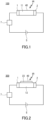
- An infrared sensing device 100 shown in FIG. 1 includes a variable resistance portion 11, a first electrode 1 and a second electrode 2 that apply voltage to the variable resistance portion 11. Voltage is supplied to the electrodes 1 and 2 from a power source 5.
- the power source 5 is, for example, a DC power source.
- An electrical circuit including the variable resistance portion 11, the electrodes 1 and 2, and the power source 5 is provided with a measurement portion 7.
- the device 100 may include an electronic component such as a switching device, a memory portion that memorizes a measurement result, a display portion that displays a measurement result, a control portion that controls a portion or a component, and the like, which are not illustrated.
- an electrical resistance variation in the variable resistance portion 11 is detected using the electrodes 1 and 2 and the measurement portion 7.
- a detection portion that detects an electrical resistance variation includes the measurement portion 7 and an electrode group including the electrodes 1 and 2.
- the variable resistance portion 11 is placed to be able to receive an infrared IR ray.
- An infrared IR ray is incident on an infrared-receiving face 40 of the variable resistance portion 11.
- the electrical resistance of the variable resistance portion 11 varies in response to the start of the irradiation of the infrared IR ray, and the measurement portion 7 detects a variation occurring in response to the electrical resistance variation.
- the measurement portion 7 detects the irradiation of the infrared IR ray, for example, on the basis of an electric current variation in the circuit or a potential variation at the location of the measurement portion 7.
- the measurement portion 7 also detects a variation occurring in response to stop of the irradiation of the infrared IR ray.
- the measurement portion 7 detects an IR- irradiated state and/or an IR-unirradiated state in this manner.
- Known electronic devices, known circuits, and the like can be used as the measurement portion 7 without any particular limitation.
- the measurement portion 7 basically detects an infrared ray while voltage is being supplied to the variable resistance portion 11 from the power source 5 through the electrodes 1 and 2.
- the device 100 may further include a calculation portion that calculates the intensity of the infrared IR ray, the temperature of a light source or heat source having emitted the infrared IR ray, and other values on the basis of a potential variation, etc. measured by the measurement portion 7.
- the calculation portion may have a function of measuring the infrared absorptance of a measurement specimen, the infrared-absorbing component content in a measurement specimen, and the like. particularly when the device 100 is designed to allow placement of a measurement specimen that absorbs a portion of infrared IR rays from a light source.
- the calculation portion can be formed by combining an MPU (micro-processing unit), a memory, and the like as appropriate.
- the measurement specimen may be a non-living object, or may be a living body, specifically a part of a living body.
- the variable resistance portion 11 may be formed as a variable resistance film.
- the variable resistance film may be arranged together with the electrodes 1 and 2 on a substrate which is not illustrated.
- the variable resistance film can be formed by a method not requiring a reduced pressure atmosphere, as shown in examples described later.
- the variable resistance film can be formed specifically by a liquid-phase film formation method such as application, dipping, or spraying.
- the substrate is suitably, for example, an insulating substrate formed of a glass, a resin, a ceramic, or the like.
- the substrate may be formed of a material capable of transmitting an infrared ray in a target wavelength region, and, specifically, a glass sheet, a resin sheet, or the like may be used.
- an additional heat release member such as a heat sink may be connected to the substrate, or heat release from the variable resistance portion may be promoted using a temperature controller such as a Peltier device or an air blower as an additional heat release member.
- the substrate may be formed of at least one material selected from the group consisting of a woven fabric, a non-woven fabric, a felt, a knitting, paper, and a film. Since these materials are light in weight and foldable, these materials are suitable for portable or wearable devices.
- the material of the substrate is not limited to the above materials.
- the substrate may be formed of a semiconductor typified by silicon, or may be a substrate including an insulating coating arranged on a surface of a metal plate that functions as a heat sink.
- a control circuit of the device 100 for example, may be arranged on the semiconductor substrate.
- the substrate should have, for improvement of the response speed, a heat-insulation structure, such as a beam structure, to which an MEMS technology is applied.
- a heat-insulation structure such as a beam structure
- the device 100 can achieve a sufficiently fast response speed without a complex heat-insulation structure.
- the first electrode 1 and the second electrode 2 are each directly connected to the variable resistance portion 11.
- the electrodes 1 and 2 are not necessarily in direct contact with the variable resistance portion 11 as long as voltage can be applied to the variable resistance portion 11 using the electrodes 1 and 2 and an electric current can flows through the variable resistance portion 11 by the voltage application.
- a layer serving as a carrier injection layer or a carrier transport layer is not necessarily present between the variable resistance portion 11 and the electrode 1 and between the variable resistance portion 11 and the electrode 2.
- the variable resistance portion 11 includes the LSPR-IR absorbing material.
- the variable resistance portion 11 includes the LSPR-IR absorbing material whose relaxation time from localized surface plasmon excitation can be 1 ns or longer, even 10 ns or longer, and particularly 100 ns or longer, an infrared-irradiation-induced transient transition of electronic state of the LSPR-IR absorbing material increases or decreases the electrical resistance of the variable resistance portion 11 to such a level that the increase or decrease can be sufficiently detected.
- variable resistance portion 11 does not include the LSPR-IR absorbing material whose relaxation time from localized surface plasmon excitation can be as long as the above, the variable resistance portion 11 desirably further includes the second material that receives a carrier being an electron and/or a hole generated by irradiation of the LSPR-IR absorbing material (the first material) by irradiation with an infrared ray.
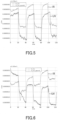
- a carrier supply portion 23 is placed in contact with a variable resistance portion 13 and not in contact with the electrodes 1 and 2.
- the electrodes 1 and 2 are directly in contact with the variable resistance portion 13.
- the variable resistance portion 13 and the carrier supply portion 23 may be in contact with each other to form a laminate film.
- the carrier supply portion 23 include the LSPR-IR absorbing material (the first material) and the variable resistance portion 13 include the second material.
- a carrier being an electron and/or a hole generated in the first material in response to start of irradiation of the carrier supply portion 23 is supplied to the second material of the variable resistance portion 13, and then the electrical resistance of the variable resistance portion 13 increases or decreases.
- variable resistance portion 13 and the carrier supplied from the carrier supply portion 23 are of the same type, i.e., both carriers are negative electrons or positive holes, the electrical resistance of the variable resistance portion 13 decreases with an increase of the major carrier, the increase being caused in response to the start of the irradiation with the infrared ray.
- a major carrier in the variable resistance portion 13 and the carrier supplied from the carrier supply portion 23 are of different types, i.e., one of the carriers is an electron and the other is a hole, the electrical resistance of the variable resistance portion 13 increases by carrier recombination in response to the start of the irradiation with the infrared ray.
- the electrical resistance of the variable resistance portion 13 basically returns to a state where the variable resistance portion 13 is not irradiated with an infrared ray. However, affected by, for example, a temperature rise, the electrical resistance of the variable resistance portion 13 does not return in some cases to the same resistance value as before the irradiation with the infrared ray.
- the device including the variable resistance portion 13 whose electrical resistance has not returned to the pre-irradiation state can also be used as a sensing device.
- an increase in electrical resistance is measured in the case where the electrical resistance decreases in response to the start of the irradiation with the infrared ray, while a decrease in electrical resistance is measured in the case where the electrical resistance increases in response to the start of the irradiation with the infrared ray.
- the device 100 shown in FIG. 1 can also experience the above variations in electrical resistance.
- a high responsivity of the LSPR-IR absorbing material allows the devices 100 and 300 to sufficiently quickly detect an electrical resistance increase or decrease caused in response to start and stop of irradiation with an infrared ray.
- a material having a long relaxation time from localized surface plasmon excitation is included in the variable resistance portion 11, it may take a little longer time for the device 100 to detect stop of irradiation with an infrared ray. However, also in this case, detection can be accomplished in the order of ⁇ s or a shorter time.
- the detection time can be made shorter also in the case where a material having a long relaxation time is included in the variable resistance portion 13.
- the device according to the present embodiment can detect start or stop of irradiation with an infrared ray, for example, in the order of ps or a shorter time.
- the device according to the present embodiment can operate in air at ordinary temperature.
- Bolometers which are so-called thermal sensing devices can operate at ordinary temperature, but are inherently disadvantageous in terms of response speed, as is obvious from the operating principle.
- some of so-called quantum sensing devices respond at high speed, but virtually do not operate unless the devices are cooled to low temperatures.
- the device according to the present embodiment including the LSPR-IR absorbing material is practically useful in that the device according to the present embodiment achieves a fast response speed and is usable in a wide variety of environments.
- the device according to the present embodiment can have wavelength selectivity; that is, the device according to the present embodiment has a relatively high sensitivity to irradiation with a near-infrared ray with a wavelength of up to 2.5 ⁇ m and a relatively low sensitivity to an infrared ray with a wavelength beyond 2.5 ⁇ m.
- wavelength selectivity is an advantageous characteristic in terms of reducing noise by thermal conduction.
- the second material is preferably a non-metal material, specifically a semiconductor material.
- the electrodes 1 and 2 being the electrode group are not in contact with the carrier supply portion 23 and are both in contact with the variable resistance portion 13.
- arrangement of the electrode group, the variable resistance portion, and the carrier supply portion is not limited to the embodiment shown in FIG. 2 as long as a carrier being an electron and/or a hole generated by start of irradiation of the carrier supply portion with an infrared ray can be supplied to the variable resistance portion.
- variable resistance portion 13 and the carrier supply portion 23 may be of the same type, or may be of different types. That is, since the device is required to be configured so that a carrier generated in the carrier supply portion 23 will be transferred to the variable resistance portion 13, a required configuration is different from one required of, for example, a solar cell in which a p-n junction or Schottky barrier junction is essential.
- the infrared sensing device may further include a cover portion 30 placed at a position through which an infrared ray IR to be incident on the inside of the device is transmitted.
- the cover portion 30 transmits at least a portion of infrared rays IR, and may block at least a portion of infrared rays IR.
- the cover portion 30 is placed to cover at least a portion of the infrared-receiving face 40 of the variable resistance portion 11.
- the cover portion 30 is placed to cover at least a portion of the infrared-receiving face 40 of the carrier supply portion 23.
- variable resistance portion 11 may be supported as a single-layer film by a substrate 10, and the variable resistance portion 13 and the carrier supply portion 23 may be supported as a laminate film by the substrate 10.
- the substrate 10 and the variable resistance portion 11, or the substrate 10, the variable resistance portion 13, and the carrier supply portion 23 form the variable resistance unit 50.
- the variable resistance portions 11 and 13 and the carrier supply portion 23 are each in the form of a film.
- the variable resistance unit 50 may include a film, such as a protective film, an underlayer film, an electrode film, or the like, functioning differently from the variable resistance portion and the carrier supply portion. Adoption of the flexible substrate 10 can impart flexibility to the variable resistance unit 50.
- the variable resistance unit 50 can be flexible enough, for example, to be wound around the outer circumference of a 10 cm-diameter tube without being broken. It is also possible to make the whole combination of the cover portion 30 and the variable resistance unit 50 as flexible as described above.
- the cover portion 30 is partially spaced from the variable resistance unit 50 such that a gap 60 is provided between the cover portion 30 and the receiving face 40 of the variable resistance portion 11 or that of the carrier supply portion 23.
- the gap 60 is not essential, and the cover portion 30 may be placed in close contact with the infrared-receiving face 40.
- the cover portion 30 may be detachably placed on the variable resistance unit 50.
- the infrared sensing device can be used as an absorptance measurement apparatus for measuring the infrared absorptance of a measurement specimen on the basis of a variation in infrared absorptance attributable to placement of the measurement specimen. It is also possible to measure an infrared-absorbing component content in the measurement specimen on the basis of the variation in infrared absorptance.
- the cover portion 30 desirably transmits at least a portion of infrared rays IR in an embodiment for measuring the infrared absorptance of a measurement specimen. In this case, the cover portion 30 may transmit at least a portion of infrared rays IR, or may transmit infrared rays IR in a substantially entire infrared region.
- the material of the cover portion 30 is not particularly limited, and examples thereof include fiber materials such as woven fabrics and non-woven fabrics and plastic materials such as films and resin sheets.
- An optical filter function e.g., a band-pass function that allows transmission of light in a given wavelength region including at least a portion of an infrared region, may be added to the cover portion 30.
- a surface of the cover portion 30 can be used as a placement or facing face 80 which a measurement specimen is placed on or faces.
- the face 80 is typically a placement face that is in contact with and supports a measurement specimen. However, a measurement specimen is held above the face 80 without contact with the face 80 depending on the shape and type of the measurement specimen.
- the face 80 can be regarded as a facing face that faces the measurement specimen held above the face 80.
- the placement or facing face 80 is not limited to a particular embodiment as long as a measurement specimen can be placed on the face 80 or above the face 80.
- the face 80 may be a face suitable for fixing a measurement specimen or may be a face forming a flow path through which a measurement specimen passes.
- the face 80 may be a face suitable for being preferentially bonded to a given component included in a measurement specimen to fix only the component.
- the state of a measurement specimen in contact with the face 80 is not limited to a particular one, either, and may be a solid, a liquid, or a gas.
- the cover portion 30 may include a base 31 and a specimen placement portion 32.
- the specimen placement portion 32 is supported by the base 31.
- the specimen placement portion 32 is placed to cover at least a portion of the infrared-receiving face 40 of the variable resistance portion 11.
- the specimen contact portion 32 is placed to cover at least a portion of the infrared-receiving face 40 of the carrier supply portion 23.
- At least a portion of a surface of the specimen placement portion 32 commonly functions as the placement face 80 supporting a measurement specimen.
- the specimen placement portion 32 may be placed on a side of the base 31 to face the gap 60, the side being far from a face where infrared light is incident.
- the specimen placement portion 32 is not particularly limited, and examples thereof include hydrophobic films, hydrophilic films, biocompatible films, films where antigens are fixed, films where antibodies are fixed, and adhesive films.
- the specimen contact portion 32 is selected according to the properties of a specimen to be measured.
- the specimen placement portion 32 itself is formed of a material transmitting at least a portion of infrared rays IR.
- the specimen placement portion may be placed not as a portion of the cover portion 30 but as a portion of the variable resistance unit 50.
- the specimen placement portion 32 is placed on a surface of the substrate 10, the surface being far from a surface where the variable resistance portion 11 is placed.
- the substrate 10 is formed of a material transmitting at least a portion of infrared rays IR.
- an exposed surface of the substrate 10 may be defined as the placement or facing face 80, the exposed surface not being provided with the specimen placement portion 32.
- the cover portion 30 may include an optical filter portion instead of the specimen placement portion 32 or in addition to the specimen placement portion 32.
- the optical filter portion can have the above-described optical filter function, namely, the band-pass function that allows transmission of light in a given wavelength region including at least a portion of an infrared region.
- the cover portion 30 may include the optical filter portion and the specimen placement portion in this order from the base side, or may have a portion having both the optical filter function and a specimen placement function.
- the cover portion 30 may include the base 31 and a portion 32 supported by the base 31 and functioning as an optical filter portion and/or a specimen placement portion.
- Each infrared sensing device described above can form an apparatus for measuring the infrared transmittance of a measurement specimen in combination with a light source.
- An infrared transmittance measurement apparatus 500 shown as an example in FIG. 18 includes an infrared sensing device 200 and a light source 400.
- the above-described sensing devices can be used as the infrared sensing device 200.
- a light source that emits light including an infrared ray i.e., a light source that can emit light in a wavelength region including an infrared region may be used as the light source 400.
- the wavelength region of the light emitted from the light source 400 does not need to span the entire infrared region, and is required to include an infrared ray that can be absorbed by a measurement specimen.
- the light may include ultraviolet light or visible light, or may be light including only a single-wavelength infrared ray, namely, so-called laser light.
- a measurement specimen is placed in a specimen holding space 600 between the device 200 and the light source 400.
- the measurement specimen may be placed in contact with the device 200 or may be spaced from the device 200.
- an infrared IR ray emitted from the light source 400 is transmitted through the measurement specimen to be incident on the device 200, and the incident infrared IR ray is measured by the measurement portion of the device 200.
- an infrared transmittance T1 of the measurement specimen is measured by the calculation portion of the device 200.
- the infrared absorptance of the measurement specimen is calculated from a difference (T1 - T2) from an infrared transmittance T2 measured and calculated in the same manner without the measurement specimen.
- the calculation portion may calculate the infrared-absorbing component content in the measurement specimen on the basis of T1 - T2.
- the measurement specimen is blood
- the infrared-absorbing component is glucose
- the measurement specimen may be a portion of a living body, for example, a fingertip or an earlobe.
- the blood glucose level in the blood can be calculated on the basis of the absorptance of an infrared ray around 1500 nm transmitted through a living body and characteristically absorbed by glucose, the absorptance being measured for a living body. That is, the infrared transmittance measurement apparatus 500 can be used as a blood glucose meter.
- This blood glucose meter is a so-called non-invasive sensor, and is also a sensor making use of an advantage, which is a capability of dealing also with a molecule whose concentration and concentration distribution in body vary at high speed, of the device 200.
- This apparatus can be easily made into a wearable sensor by making use of the flexibility of the variable resistance unit 50.
- the presence of LSPR of the LSPR-IR absorbing material can be confirmed, for example, by a method for revealing that a change in absorption peak wavelength is linear, the change being obtained by changing the refractive index of an ambient medium.
- the LSPR-IR absorbing material may be a semiconductor.
- the LSPR-IR absorbing material may include at least one selected from the group consisting of an oxide, a phosphide, a sulfide, a selenide, and a telluride, or may include at least one selected from the group consisting of a sulfide, a selenide, and a telluride.
- a material including an oxide is generally suited, for example, to applications where durability such as thermal resistance is required.
- the LSPR-IR absorbing material is preferably doped, and the type of doping is preferably doping with different elements, self-doping, defect doping, etc.
- the LSPR-IR absorbing material may include a transparent electrically conductive oxide.
- the transparent electrically conductive oxide include tin-doped indium oxide, aluminum-doped indium oxide, cerium-doped indium oxide, aluminum-doped zinc oxide, gallium-doped zinc oxide, indium-doped zinc oxide, indium-doped cadmium oxide, fluorine-indium-doped cadmium oxide, fluorine-doped cadmium oxide, chlorine-doped cadmium oxide, bromine-doped cadmium oxide, cesium-doped molybdenum oxide, antimony-doped tin oxide, fluorine-doped tin oxide, and titanium oxide.
- the LSPR-IR absorbing material may include at least one selected from the group consisting of copper sulfide, copper phosphide, copper telluride, copper selenide, ruthenium oxide, rhenium oxide, molybdenum oxide, tungsten oxide, tungsten bronze, and delafossite copper oxide, or may include copper sulfide and/or tungsten oxide. These materials are advantageous because, when these materials are used, it is unnecessary to use a highly toxic semiconductor, such as InGaAs, InSb, or PbS, used as a common infrared sensing device.
- a highly toxic semiconductor such as InGaAs, InSb, or PbS
- Examples of the copper sulfide include those represented by CuS and Cu 2-x S (0 ⁇ x ⁇ 1).
- examples of the copper phosphide include those represented by Cu 3-x P (0 ⁇ x ⁇ 1) and CuP
- examples of the copper telluride include those represented by CuTe and Cu 2-x Te (0 ⁇ x ⁇ 1)
- examples of the copper selenide include those represented by CuSe and Cu 2-x Se (0 ⁇ x ⁇ 1).
- Examples of the ruthenium oxide include those represented by RuO 2 and RuO 2-x (0 ⁇ x ⁇ 1). Similarly, examples of the rhenium oxide include those represented by ReO 2 and ReO 2-x (0 ⁇ x ⁇ 1), examples of the molybdenum oxide include those represented by MoO 3 and MoO 3-x (0 ⁇ x ⁇ 1), and examples of the tungsten oxide include those represented by WO 3 and WO 3-x (0 ⁇ x ⁇ 1).
- the tungsten bronze is a non-stoichiometric compound formed of tungsten oxide and a metal atom, such as an alkali metal, having entered the tungsten oxide at a non-stoichiometric ratio.
- a metal atom such as an alkali metal
- Specific examples of the tungsten bronze include Cs x WO 3 (0 ⁇ x ⁇ 1), LiWO 3 , LiCsWO 3 , LiRbWO 3 , and LiKWO 3 .
- Examples of the delafossite copper oxide include CuAlO 2 , CuGaO 2 , and CuCrO 2 .
- the LSPR-IR absorbing material is suitably a material whose relaxation time from localized surface plasmon excitation can be 1 ns or longer.
- the material having such a property is, for example, at least one selected from the group consisting of copper sulfide, copper selenide, and cesium-doped tungsten oxide.
- the material having such a property is not limited to these materials, and an appropriate material can be selected by measuring the relaxation time from localized surface plasmon excitation by time-resolved transient absorption spectroscopy.
- FIG. 3 shows an example of a result of measurement of the relaxation time from localized surface plasmon excitation by time-resolved transient absorption spectroscopy.
- FIG. 3 shows an absorption spectrum obtained 2.5 nanoseconds (ns), 6 ns, and 12.5 ns after the localized surface plasmon excitation.
- bleach (negative signal) by the localized surface plasmon excitation can be confirmed in a near-infrared region.
- the negative signal remains 2.5 ns, 6 ns, and even 12.5 ns later, which means that the relaxation time is at least 10 ns or longer.
- a material that can exhibit such a long relaxation time of an active carrier after the excitation of LSPR regardless of the wavelength and intensity of a pump light is suitable as the LSPR-IR absorbing material. It should be noted that the time-resolved transient absorption spectroscopy may be a direct method by which the entire duration of a phenomenon is directly measured.
- FIG. 3 shows the measurement result for copper sulfide. This measurement was performed by a pump-probe method using a chloroform solution of copper sulfide as a specimen, a picosecond laser with a wavelength of 1064 nm as a pump light, and a supercontinuum light source as a probe light.
- the laser light and the probe light are specifically as follows.
- this condition is an example, and an appropriate condition for measurement of the relaxation time from localized surface plasmon excitation can be set according to the material to be measured.
- the second material is desirably, for example, cadmium sulfide.
- the first material is tungsten oxide doped with cesium
- the second material is desirably, for example, zinc oxide, titanium oxide, tin oxide, or gallium oxide.
- the LSPR-IR absorbing material may be nanoparticles.
- the nanoparticles may be semiconductor nanoparticles, and specifically, may include any of the compounds described above as examples.
- the variable resistance portion desirably further includes a binder in addition to the nanoparticles.
- the binder can be present between the nanoparticles and impart a desirable property such as flexibility to the film.
- the binder may include a functional group that can be bonded to the nanoparticles, and the functional group is, for example, at least one selected from the group consisting of fluorine (F), chlorine (Cl), bromine (Br), iodine (I), cyanide (CN), thiocyanato (SCN), isothiocyanato (NCS), hydroxide (OH), mercapto (SH), carbonyl (CO), amino (NR 3 ), nitrosyl (NO), nitrito (NO 2 ), phosphane (PR 3 ), carbene (R 2 C), and pyridine (NC 5 H 5 ).
- the functional group may be an anionic functional group to be bonded to the nanoparticles as an anion, i.e., for example, F - .
- Each R is independently an optional organic group or a hydrogen atom.
- the functional group that can be bonded to the nanoparticles may be another functional group that can function as a ligand to a metal atom or an anion.
- the binder may be an inorganic compound or an organic compound.
- the binder may be an ion including or formed of any of the functional groups described above as examples, or may be a salt formed of the ion and its counterion.
- the binder may be a compound having two or more of the above functional groups, the compound being typified by hydrazine (H 2 NNH 2 ), ethylenediamine (H 2 NCH 2 CH 2 NH 2 ), 1,2-ethanedithiol (HSCH 2 CH 2 SH, EDT), mercaptopropionic acid (HSCH 2 CH 2 COOH), acetylacetonato (H 3 CCOCHCOCH 3 ), and aminobenzonitrile (NH 2 C 6 H 4 CN).
- the molecular weight of the binder is, for example, 280 or less, even 250 or less, preferably 200 or less, more preferably 100 or less, even more preferably 80 or less, and, in some cases, less than 65.
- the lower limit of the molecular weight is, for example, but not particularly limited to, 20 or more, or even 30 or more.
- the use of the binder having not too large a molecular weight is suitable for controlling distances between the nanoparticles to be narrow and controlling the electrical resistance, infrared absorption characteristics, and the like of the variable resistance portion within appropriate ranges.
- the amount of the binder may be adjusted as appropriate depending on the type of the binder.
- the amount of the binder may be, for example, 1% or more, even 2% or more, particularly 3% or more, in some cases 5% or more, and preferably 8% or more in a ratio of the mass of the binder to the sum of the amounts of the nanoparticles and the binder.
- the upper limit of the amount is not limited to a particular value, and is 30% or less, or even 20% or less.
- the above binder is suitable for coordination or adhesion to the nanoparticles.
- the binder may be a material other than such an adhesive compound.
- examples of such material include various types of resins, specifically, polyvinyl alcohol, polyvinyl acetal, polyvinylpyrrolidone, carboxymethyl cellulose, acrylic resin, polyvinyl acetate, polyethylene terephthalate, polystyrene, polyethylene, and the like.
- an organic solvent, an electrically conductive polymer, electrically conductive particles, a pH adjuster, a colorant, a thickener, a surfactant, and the like can be used depending on the necessity in film formation, the application, or the like.
- variable resistance portion 13 or the carrier supply portion 23 can be formed using the above binder or the like by application, spraying, dipping, or the like (hereinafter referred to as "application or the like").
- the binder may coordinate to the nanoparticles by ligand substitution.
- the variable resistance portion 13 or the carrier supply portion 23 as a coating film can be formed by application or the like more easily at a lower price than an infrared sensing device including a bulk semiconductor.
- the infrared sensing device can be produced at a low price and the size of the infrared sensing device can be easily increased.
- a flexible infrared sensing device can be produced by application or the like to a flexible material.
- the infrared sensing device can also be included in optical sensors, optical switching devices, and memory devices. These infrared sensing devices can be used for infrared communication. Moreover, the infrared sensing device can be included in thermal sensors, human detection sensors, infrared cameras, thermal imagers, and the like.
- the content of the three-neck flask was transferred into a centrifuge tube. After sufficient dissolution of the solids in the centrifuge tube was confirmed, 40 ml of ethanol was added thereto. Centrifugation was performed at 2000 rpm (rotations/minute) for 10 minutes, and the resulting supernatant solution was immediately discarded. Subsequently, the sediment was dissolved in 5 ml of octane, and 30 ml of ethanol was added thereto. Centrifugation was performed again at a rotational speed of 2000 rpm for 5 minutes, and then the resulting sediment was collected. The mass of the sediment was measured. On the basis of the mass of the sediment, octane was added thereto to a concentration of 200 mg/ml. Copper sulfide nanoparticles were dispersed therein to obtain a first ink.
- the first ink contains, in addition to the copper sulfide nanoparticles, oleylamine which is a compound that can coordinate to the copper sulfide nanoparticles.
- oleylamine which is a compound that can coordinate to the copper sulfide nanoparticles.
- TGA thermogravimetric analysis
- An amount of 50 ⁇ l of the first ink was applied using a spin coater onto a glass sheet where an interdigitated array electrode was formed in advance. A coating film was obtained thereby. Before the application, the concentration of the first ink was adjusted to 50 mg/ml.
- the glass sheet where an interdigitated array electrode was formed was used a commercially-available product (G-IDEU5 manufactured by DropSens) which had a digit width and a digit-to-digit interval of 5 ⁇ m or 10 ⁇ m, whose number of digits was 250 (in the case of 5-pm-wide digits) or 125 (in the case of 10- ⁇ m-wide digits), and which had a digit length of 6760 ⁇ m.
- An amount of 200 ⁇ l of a solution (a second ink) containing aminobenzonitrile was applied onto the coating film using a spin coater to obtain a thin film that functions as an infrared response sensor.
- the solvent of the solution was octane, and the aminobenzonitrile concentration was 0.3 mass%.
- At least a portion of the oleylamine (a first compound) being the compound coordinating to the copper sulfide nanoparticles was substituted by the aminobenzonitrile (a second compound; a binder) by contact with the second ink.
- the interdigitated array electrode on the glass sheet where the variable resistance film was arranged was connected to a Keithley 2450 source meter as a measurement portion and a 1 V DC power source.
- the variable resistance film in this state was irradiated with light emitted from a xenon lamp light source manufactured by Eagle Engineering at atmospheric pressure and room temperature, and a current value variation was measured using the source meter.
- the light emitted from the light source went through a band-pass filter, and the irradiation light was an infrared light with a wavelength of 800 nm or more.
- the light irradiation was performed using a shutter by repeatedly turning the shutter on and off every 20 seconds.
- FIG. 4 shows an on/off pattern.
- FIG. 5 shows a measured current value variation.
- FIG. 5 also shows a current value variation obtained when the irradiation light was an ultraviolet light with a wavelength of 450 nm or less.
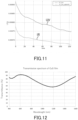
- Variable resistance films were formed in the same manner as in Example 1, except that the second compound included in the second ink was changed from aminobenzonitrile to compounds shown in Table 1. Each variable resistance film was measured for current value variations under irradiation of the film with infrared (IR) light and ultraviolet (UV) light. FIGS. 6 to 10 show the results.
- Table 1 collectively shows the results for Examples 1 to 7. Table 1 also shows resistance values of the variable resistance portions in a light-unirradiated state.
- Potassium thiocyanate (60.1) 1) 850 Increase ( FIG. 9 ) 6 CWO FIG. 1 Succinic acid (118.1) 14820 Decrease ( FIG. 10 ) 7 2) CuS FIG. 2 1 ,2-Ethanedithiol (94.2) 115 Decrease ( FIG. 11 ) 1) The molecular weight of potassium thiocyanate is of a thiocyanic acid part (SCN - ) only. 2)
- the measured resistance value variation was very small in some of Examples (e.g., FIG. 11 ). However, the small variation itself does not adversely affect use as a sensing device because the small variation can be amplified by a known method as needed.
- FIG. 12 shows the result.
- FIG. 12 confirms that there is an absorption region in a near-infrared region and that a transmittance of 80% or more is achieved in the visible region between the wavelengths of 400 and 800 nm.
Landscapes
- Physics & Mathematics (AREA)
- General Physics & Mathematics (AREA)
- Spectroscopy & Molecular Physics (AREA)
- Photometry And Measurement Of Optical Pulse Characteristics (AREA)
- Investigating Or Analysing Materials By Optical Means (AREA)
Applications Claiming Priority (2)
| Application Number | Priority Date | Filing Date | Title |
|---|---|---|---|
| JP2020071711 | 2020-04-13 | ||
| PCT/JP2021/015365 WO2021210593A1 (ja) | 2020-04-13 | 2021-04-13 | 赤外線センシングデバイス及びそれに用いる抵抗可変膜 |
Publications (2)
| Publication Number | Publication Date |
|---|---|
| EP4137789A1 true EP4137789A1 (de) | 2023-02-22 |
| EP4137789A4 EP4137789A4 (de) | 2023-10-11 |
Family
ID=78085187
Family Applications (1)
| Application Number | Title | Priority Date | Filing Date |
|---|---|---|---|
| EP21788628.2A Pending EP4137789A4 (de) | 2020-04-13 | 2021-04-13 | Infraroterfassungsvorrichtung und widerstandsvariable folie damit |
Country Status (4)
| Country | Link |
|---|---|
| US (1) | US12276550B2 (de) |
| EP (1) | EP4137789A4 (de) |
| CN (1) | CN116075700A (de) |
| WO (1) | WO2021210593A1 (de) |
Families Citing this family (1)
| Publication number | Priority date | Publication date | Assignee | Title |
|---|---|---|---|---|
| CN119805828B (zh) * | 2025-03-17 | 2025-07-15 | 中国人民解放军国防科技大学 | 一种光电耦合型lspr变红外发射率器件及其制备方法与应用 |
Family Cites Families (19)
| Publication number | Priority date | Publication date | Assignee | Title |
|---|---|---|---|---|
| JP2773730B2 (ja) * | 1996-03-07 | 1998-07-09 | 日本電気株式会社 | 光伝導型赤外線検出素子 |
| JPH1062239A (ja) | 1996-08-21 | 1998-03-06 | Mitsubishi Materials Corp | 赤外線検出素子 |
| JP4075222B2 (ja) | 1999-06-28 | 2008-04-16 | 株式会社豊田中央研究所 | 抵抗変化型赤外線検出器 |
| JP2001183230A (ja) | 1999-12-24 | 2001-07-06 | Kokusai Kiban Zairyo Kenkyusho:Kk | 光放射エネルギー強度測定装置 |
| JP4441578B2 (ja) * | 2006-10-11 | 2010-03-31 | パナソニック株式会社 | 電子デバイスおよびその制御方法 |
| JP2008139072A (ja) | 2006-11-30 | 2008-06-19 | Nec Corp | 赤外線検知器及びその温度制御方法 |
| JP2009175124A (ja) * | 2007-12-27 | 2009-08-06 | Rohm Co Ltd | プラズモン共鳴検出器 |
| JP2012164980A (ja) | 2011-01-21 | 2012-08-30 | Sumitomo Metal Mining Co Ltd | 光電変換装置とその製造方法 |
| EP2581721B1 (de) * | 2011-10-10 | 2019-05-08 | Samsung Electronics Co., Ltd | Infrarotwärmedetektor und Herstellungsverfahren dafür |
| KR101922119B1 (ko) * | 2011-12-22 | 2019-02-14 | 삼성전자주식회사 | 적외선 검출기 및 이를 사용하는 적외선 검출 방법 |
| KR102040149B1 (ko) * | 2013-02-01 | 2019-11-04 | 삼성전자주식회사 | 적외선 검출기 |
| JP6172522B2 (ja) * | 2013-12-04 | 2017-08-02 | ソニー株式会社 | 赤外線検出素子およびその検出方法、並びに電子機器 |
| JP6299559B2 (ja) | 2014-10-30 | 2018-03-28 | 住友金属鉱山株式会社 | 熱線遮蔽粒子、熱線遮蔽粒子分散液、熱線遮蔽粒子分散体、熱線遮蔽粒子分散体合わせ透明基材、赤外線吸収透明基材、熱線遮蔽粒子の製造方法 |
| FR3039531A1 (de) * | 2015-07-28 | 2017-02-03 | Nexdot | |
| US20200006582A1 (en) * | 2016-12-02 | 2020-01-02 | Kyoto University | Electronic device having photoelectric conversion function |
| CN119958702A (zh) | 2017-04-20 | 2025-05-09 | 特里纳米克斯股份有限公司 | 光学检测器 |
| JP6918591B2 (ja) | 2017-06-16 | 2021-08-11 | 株式会社豊田中央研究所 | 電磁波検出器およびその製造方法 |
| JP7232978B2 (ja) * | 2017-12-11 | 2023-03-06 | パナソニックIpマネジメント株式会社 | 赤外線センサおよび赤外線センサのボロメータ赤外線受光部を冷却する方法 |
| TWI679782B (zh) * | 2017-12-19 | 2019-12-11 | 財團法人工業技術研究院 | 感測裝置及其製造方法 |
-
2021
- 2021-04-13 EP EP21788628.2A patent/EP4137789A4/de active Pending
- 2021-04-13 CN CN202180027792.XA patent/CN116075700A/zh active Pending
- 2021-04-13 US US17/996,046 patent/US12276550B2/en active Active
- 2021-04-13 WO PCT/JP2021/015365 patent/WO2021210593A1/ja not_active Ceased
Also Published As
| Publication number | Publication date |
|---|---|
| CN116075700A (zh) | 2023-05-05 |
| US20230184592A1 (en) | 2023-06-15 |
| WO2021210593A1 (ja) | 2021-10-21 |
| EP4137789A4 (de) | 2023-10-11 |
| JPWO2021210593A1 (de) | 2021-10-21 |
| US12276550B2 (en) | 2025-04-15 |
Similar Documents
| Publication | Publication Date | Title |
|---|---|---|
| Kunwar et al. | Improved photoresponse of UV photodetectors by the incorporation of plasmonic nanoparticles on GaN through the resonant coupling of localized surface plasmon resonance | |
| Young et al. | Flexible ultraviolet photodetectors based on one-dimensional gallium-doped zinc oxide nanostructures | |
| Yoo et al. | High photosensitive indium–gallium–zinc oxide thin-film phototransistor with a selenium capping layer for visible-light detection | |
| Gogurla et al. | Multifunctional Au-ZnO plasmonic nanostructures for enhanced UV photodetector and room temperature NO sensing devices | |
| Yalagala et al. | ZnO nanowires based degradable high-performance photodetectors for eco-friendly green electronics | |
| Song et al. | Perovskite Solar Cell‐Gated Organic Electrochemical Transistors for Flexible Photodetectors with Ultrahigh Sensitivity and Fast Response | |
| Shewale et al. | Ti doped ZnO thin film based UV photodetector: Fabrication and characterization | |
| US20180374650A1 (en) | Narrow band perovskite single crystal photodetectors with tunable spectral response | |
| Huang et al. | Fast Near‐Infrared Photodetectors Based on Nontoxic and Solution‐Processable AgBiS2 | |
| Abbas et al. | Translucent photodetector with blended nanowires–metal oxide transparent selective electrode utilizing photovoltaic and pyro‐phototronic coupling effect | |
| Bianchi et al. | Near infrared photothermoelectric effect in transparent AZO/ITO/Ag/ITO thin films | |
| US12276550B2 (en) | Infrared sensing device and variable resistance film included in the same | |
| Huang et al. | A self-powered dual-functional hybrid Cu2O/SiNWs heterojunction with applications in broadband photodetectors and ozone gas sensors | |
| Kumar et al. | Ga-In nanoparticle induced UV plasmonic impact on heterojunction based deep UV photodetector | |
| Mahana et al. | Photo-sensing characteristics of CuO thin films synthesized by thermal oxidation of Cu metal films | |
| Kumar et al. | Effects of optical resonance on the performance of metal (Pd, Au)/CdSe quantum dots (QDs)/ZnO QDs optical cavity based spectrum selective photodiodes | |
| Garg et al. | FeVO 4-based solution-processed all oxide self-biased fast photodetectors | |
| Saimon et al. | Ag@ WO3 core–shell nanocomposite for wide range photo detection | |
| US20230361235A1 (en) | Heat blocking device, heat blocking film, and heat blocking composition | |
| Pei et al. | A self-powered photodetector of SnSeS/p-Si heterojunction with high-performance | |
| JP7837020B2 (ja) | 赤外線センシングデバイス及びそれに用いる抵抗可変膜 | |
| Esteves et al. | SnOx and a-Si thin-films based photodiode in a flexible substrate for visible spectral region | |
| US20240088320A1 (en) | Bio-sensing device with optoelectronic device | |
| EP0384564B1 (de) | Tunnel-Effekt-Photosensor | |
| Bogle et al. | Optical sensor developed from nano-silver/poly (vinyl alcohol) composite |
Legal Events
| Date | Code | Title | Description |
|---|---|---|---|
| STAA | Information on the status of an ep patent application or granted ep patent |
Free format text: STATUS: THE INTERNATIONAL PUBLICATION HAS BEEN MADE |
|
| PUAI | Public reference made under article 153(3) epc to a published international application that has entered the european phase |
Free format text: ORIGINAL CODE: 0009012 |
|
| STAA | Information on the status of an ep patent application or granted ep patent |
Free format text: STATUS: REQUEST FOR EXAMINATION WAS MADE |
|
| 17P | Request for examination filed |
Effective date: 20221031 |
|
| AK | Designated contracting states |
Kind code of ref document: A1 Designated state(s): AL AT BE BG CH CY CZ DE DK EE ES FI FR GB GR HR HU IE IS IT LI LT LU LV MC MK MT NL NO PL PT RO RS SE SI SK SM TR |
|
| DAV | Request for validation of the european patent (deleted) | ||
| DAX | Request for extension of the european patent (deleted) | ||
| A4 | Supplementary search report drawn up and despatched |
Effective date: 20230911 |
|
| RIC1 | Information provided on ipc code assigned before grant |
Ipc: H01L 31/09 20060101ALI20230905BHEP Ipc: H01L 31/0232 20140101ALI20230905BHEP Ipc: H01L 31/0264 20060101ALI20230905BHEP Ipc: H01L 31/02 20060101ALI20230905BHEP Ipc: G01J 1/42 20060101ALI20230905BHEP Ipc: G01J 1/02 20060101AFI20230905BHEP |