EP4137821B1 - Verfahren zum betrieb eines laborautomationssystems und laborautomationssystem - Google Patents
Verfahren zum betrieb eines laborautomationssystems und laborautomationssystem Download PDFInfo
- Publication number
- EP4137821B1 EP4137821B1 EP21192099.6A EP21192099A EP4137821B1 EP 4137821 B1 EP4137821 B1 EP 4137821B1 EP 21192099 A EP21192099 A EP 21192099A EP 4137821 B1 EP4137821 B1 EP 4137821B1
- Authority
- EP
- European Patent Office
- Prior art keywords
- queue
- spaces
- additional
- empty carrier
- transport system
- Prior art date
- Legal status (The legal status is an assumption and is not a legal conclusion. Google has not performed a legal analysis and makes no representation as to the accuracy of the status listed.)
- Active
Links
Images


Classifications
-
- G—PHYSICS
- G01—MEASURING; TESTING
- G01N—INVESTIGATING OR ANALYSING MATERIALS BY DETERMINING THEIR CHEMICAL OR PHYSICAL PROPERTIES
- G01N35/00—Automatic analysis not limited to methods or materials provided for in any single one of groups G01N1/00 - G01N33/00; Handling materials therefor
- G01N35/02—Automatic analysis not limited to methods or materials provided for in any single one of groups G01N1/00 - G01N33/00; Handling materials therefor using a plurality of sample containers moved by a conveyor system past one or more treatment or analysis stations
- G01N35/04—Details of the conveyor system
-
- G—PHYSICS
- G01—MEASURING; TESTING
- G01N—INVESTIGATING OR ANALYSING MATERIALS BY DETERMINING THEIR CHEMICAL OR PHYSICAL PROPERTIES
- G01N35/00—Automatic analysis not limited to methods or materials provided for in any single one of groups G01N1/00 - G01N33/00; Handling materials therefor
- G01N35/00584—Control arrangements for automatic analysers
- G01N35/0092—Scheduling
-
- G—PHYSICS
- G01—MEASURING; TESTING
- G01N—INVESTIGATING OR ANALYSING MATERIALS BY DETERMINING THEIR CHEMICAL OR PHYSICAL PROPERTIES
- G01N35/00—Automatic analysis not limited to methods or materials provided for in any single one of groups G01N1/00 - G01N33/00; Handling materials therefor
- G01N35/00584—Control arrangements for automatic analysers
- G01N35/0092—Scheduling
- G01N2035/0094—Scheduling optimisation; experiment design
-
- G—PHYSICS
- G01—MEASURING; TESTING
- G01N—INVESTIGATING OR ANALYSING MATERIALS BY DETERMINING THEIR CHEMICAL OR PHYSICAL PROPERTIES
- G01N35/00—Automatic analysis not limited to methods or materials provided for in any single one of groups G01N1/00 - G01N33/00; Handling materials therefor
- G01N35/02—Automatic analysis not limited to methods or materials provided for in any single one of groups G01N1/00 - G01N33/00; Handling materials therefor using a plurality of sample containers moved by a conveyor system past one or more treatment or analysis stations
- G01N35/04—Details of the conveyor system
- G01N2035/046—General conveyor features
- G01N2035/0462—Buffers [FIFO] or stacks [LIFO] for holding carriers between operations
Definitions
- the present disclosure refers to a method for operating a laboratory automation system. Further, the present disclosure refers to a laboratory automation system.
- Laboratory automation systems are applied, in particular, for determining samples, for example samples of a bodily fluid, essentially automatically.
- the samples are typically received in sample vessels or containers which are processed via a laboratory automation system.
- Laboratory automation systems can comprise several units.
- Laboratory automation systems usually comprise several laboratory devices such as, for example, a pre-analytical, an analytical and / or a post-analytical device.
- the containers are transported between different devices of the system via a sample distribution system / sample transportation system.
- the sample vessels may be moved along a line of processing for processing, wherein the sample vessels and / or sample vessel carriers are moved by means of a transport device having one or more actuators and actuator drivers or driving devices for driving the actuator(s).
- the sample vessels may be moved or relocated from a first working station to a second working station provided in the line of processing in the system.
- the working stations may also be referred to as working locations and may correspond to laboratory devices.
- Document WO 2016 / 188 752 A1 discloses a laboratory automation system, which comprises: a number of laboratory stations, a number of sample container carriers (e.g. 10 to 10000), wherein the sample container carriers are adapted to carry one or more sample containers, wherein the sample containers comprise samples to be processed by means of the laboratory stations, a transport plane, wherein the transport plane is adapted to support the sample container carriers, wherein the transport plane comprises a number of transfer areas, wherein a transfer area of the number of transfer areas is assigned to a corresponding laboratory station of the number of laboratory stations, wherein samples are transferred to the laboratory stations by moving the corresponding sample container carrier to the assigned transfer area, and drive means, wherein the drive means are adapted to move the sample container carriers on the transport plane simultaneously and independent from one another along individual transport paths.
- a laboratory automation system which comprises: a number of laboratory stations, a number of sample container carriers (e.g. 10 to 10000), wherein the sample container carriers are adapted to carry one or more sample containers, wherein the sample containers
- Document US 2015 / 0 369 832 A1 discloses an automation system for use in in-vitro diagnostics with an automation surface configured to provide one or more paths between a plurality of testing stations, which also includes a plurality of predetermined risk zones.
- a plurality of carriers include an onboard processor configured to make local trajectory decisions and to control the motion of each carrier into the plurality of predetermined risk zones in response to authority granted by a traffic manager.
- a traffic manager includes at least one processor configured to assign destinations to the plurality of carriers and grant authority to carriers to enter the plurality of predetermined risk zones.
- Each carrier can be configured to hold one or more fluid vessels and move the one or more fluid vessels to one of the plurality of testing stations.
- An automated sample inspection system is disclosed in document US 2019 / 0 170 780 A1 .
- the system comprises a conveyance line for conveying sample carriers; an empty sample carrier line for conveying empty sample carriers; and a buffer line for temporarily holding empty sample carriers supplied from the empty sample carrier line to the conveyance line.
- the number of empty sample carriers to be conveyed from the empty sample carrier line to the buffer line of each processing system, and the number of empty sample carriers to be conveyed from the empty sample carrier line of each processing system to the empty sample carrier line of another adjacent processing system are determined.
- a method for controlling an automated sample test system includes a samples conveyance line for conveying samples racks, each holding samples, to a plurality of processing units, and an empty-rack stock section in which to stock samples racks not holding a sample.
- the control method is designed to collect information on whether the processing units are in need of a supply of empty samples racks, and then supply empty samples racks from the empty-rack stock section to the processing units based on the information. Decreases in throughput can be prevented by leveling the number of empty samples racks supplied to the processing units that require empty samples racks.
- Document US 10 684 302 B2 refers to a specimen inspection automation system with: a processing unit which processes a specimen; a conveying line which conveys carriers; a control device which controls the conveying of the carriers; and external connection modules which deliver the carriers to and from external devices.
- the control device controls the number of carriers in the specimen inspection automation system within a fixed range on the basis of the number of carriers conveyed into and out of the system by the external connection modules.
- US 2018/246131 A1 discloses a specimen inspection automation system which is configured to manage the number of carriers with an external device.
- a method for operating a laboratory automation system according to the independent claim 1 is provided. Further, a laboratory automation system according to the independent claim 15 is provided. Further embodiments are disclosed in dependent claims.
- the laboratory automation system comprises a plurality of laboratory devices configured to apply at least one of pre-analytics, analytics, and post-analytics for a sample received in a sample container, and a transport system, comprising a plurality of carriers each configured to carry one or more sample containers on an automation track to at least one of the plurality of laboratory devices, a plurality of transport system interfaces, and a first empty carrier queue provided with a first fixed number of queue spaces which each can be assigned an empty carrier.
- the laboratory automation system further comprises a control device configured to control operation of the transport system.
- the method for operating the laboratory automation system comprises providing a plurality of additional queue spaces in the transport system, the additional queue spaces each assignable an empty carrier, assigning a first number of additional queue spaces from the plurality of additional queue spaces to the first empty carrier queue by the control device, operating the first empty carrier queue with the first fixed number of queue spaces plus the first number of additional queue spaces during runtime of the transport system, receiving operation data in the control device, the operation data being indicative of a first operation parameter for at least one of the transport system and the plurality of laboratory devices during runtime of the transport system, in response to receiving the operation data, assigning a second number of additional queue spaces from the plurality of additional queue spaces to the first empty carrier queue by the control device, wherein the second number of additional queue spaces is different from the first number of additional queue spaces, and operating the first empty carrier queue with the first fixed number of queue spaces plus the second number of additional queue spaces during runtime of the transport system.
- a laboratory automation system comprises a plurality of laboratory devices configured to apply at least one of pre-analytics, analytics, and post-analytics for a sample received in a sample container and a transport system, comprising a plurality of carriers each configured to carry one or more sample containers on an automation track to at least one of the plurality of laboratory devices, a plurality of transport system interfaces, and a first empty carrier queue provided with a first fixed number of queue spaces which each can be assigned an empty carrier.
- the laboratory automation system further comprises a control device configured to control operation of the transport system.
- the laboratory automation system is configured to provide a plurality of additional queue spaces in the transport system, the additional queue spaces each assignable an empty carrier, assign a first number of additional queue spaces from the plurality of additional queue spaces to the first empty carrier queue by the control device, operate the first empty carrier queue with the first fixed number of queue spaces plus the first number of additional queue spaces during runtime of the transport system, receive operation data in the control device, the operation data being indicative of a first operation parameter for at least one of the transport system and the plurality of laboratory devices during runtime of the transport system, in response to receiving the operation data, assign a second number of additional queue spaces from the plurality of additional queue spaces to the first empty carrier queue by the control device, wherein the second number of additional queue spaces is different from the first number of additional queue spaces, and operate the first empty carrier queue with the first fixed number of queue spaces plus the second number of additional queue spaces during runtime of the transport system.
- the method for operating a laboratory automation system for operating and the laboratory automation system are provided to apply improved operation or management for the empty carrier queue provided with the number of queue spaces which each can be assigned an empty carrier. Additional queue spaces are assigned dynamically depending on one or more operation parameters for at least one of the transport system and the plurality of laboratory devices. Thus, an operation dependent number of queue spaces is made available for operating the laboratory automation system most efficiently. For different operation parameters the empty carrier queue is operated differently by assigning different number of additional queue spaces.
- the transport system may comprise a transport plane assigned to the laboratory devices and providing support to the plurality of carriers.
- the sample container carriers can be placed on top of the transport plane for moving or travelling between plane locations or fields (automation track).
- the transport system may further comprise a driving device configured to move, in response to driving control signals, the plurality of carriers between plane positions or locations provided on the transport plane, in particular between laboratory devices.
- the transport plane may comprise a plurality of transport modules each provided with a transport surface. For example, 2 to 50 of laboratory devices may be provided. For example, 10 to 10000 (sample container) carriers may be provided.
- the transport plane may comprise at least one transport plane region divided into grid areas.
- the grid areas may be of identical size and / or may be arranged in a chessboard manner.
- the grid areas may be rectangles or squares.
- One or more grid areas may correspond to one or more transport surfaces / modules. Each transport surface / transport module may exactly form one grid area. It may be intended that only one carrier may sit on one / each grid area. In addition or alternative, each grid are may only be reserved by and / or assigned to one carrier. Reserved grid areas may be blocked for other carriers, i.e. other carries are not allowed to move onto and / or reserve the blocked grid areas. Each queue space may correspond to a respective grid area.
- the transport plane may be a two dimensional transport plane.
- the transport plane may be planar, in particular completely planar.
- the carriers can be driven actively or passively. For example, 10 to 10000 grid areas may
- the transport plane may comprise at least one transfer area located adjacent to a laboratory station (also called laboratory device) and / or an automatic transfer device.
- the transport plane may comprise 2 to 100 transfer areas.
- the transfer area may store a plurality of (container) carriers for sequentially processing by the laboratory device or the automatic transfer device.
- To each laboratory device one transfer area may be assigned.
- Two or more laboratory devices may be assigned to the same transfer area.
- One (each) transfer area may comprise one or more grid areas.
- a first transfer area may comprise the first fixed number of queue spaces, the plurality of additional queue spaces, the first number of additional queue spaces, and / or the second number of additional queue spaces.
- More than one transfer area (location) may be assigned to a corresponding (the same) laboratory device, in particular an output transfer area and an input transfer area.
- the transfer areas may be statically or dynamically assigned to the laboratory devices. In other words, during operation, the transfer areas may be changed, if necessary.
- the plurality of transport system interfaces may be assigned to the transport plane.
- the transport system interfaces may constitute the interfaces between the transport system (transport plane) and the laboratory devices. Via the transport system interfaces, empty carriers can be removed from the transport system (transport plane). Accordingly, empty carriers can be entirely removed from the transport system (transport plane) and / or can be loaded, e.g. with samples / containers.
- Each laboratory device may be assigned to one transport system interface. More than one laboratory device may be assigned to the same transport system interface.
- Each transport system interface may correspond to a transfer area. More than one transport system interface may correspond to the same transfer area.
- empty carriers may (only) be removable from the corresponding transfer areas, in particular from the first fixed number of queue spaces, the plurality of additional queue spaces, the first number of additional queue spaces, and / or the second number of additional queue spaces. Accordingly, in the corresponding transfer areas, the empty carriers can be entirely removed and / or can be loaded, e.g. with samples / containers.
- the control device may control the movement of the carriers, in particular, such that more than two carriers may be movable simultaneously and independently from one another (on the transport plane). Simultaneously may indicate that during a certain time interval at least two container carriers move. Independently may indicate that the container carriers may be moved, for example, in different directions, with different speeds, along different paths, and starting the movement at different points in time.
- the control device may be incorporated as a personal computer running control software.
- the control device may have information indicative of the positions of at least a part or all of the plurality of carriers.
- the carriers may be able to move in the two horizontal and the two vertical directions. Alternatively, the carriers may only move in one horizontal and one vertical direction from each grid area. However, the permitted directions of movement do not have to be the same for each grid area. For example, at a first grid area, the carriers can only move up and to the right, and at a second grid area, the carriers can only move down and to the left.
- Each queue space may constitute a destination grid area for a carrier path, i.e. the determined route for this carrier may end at this destination grid area.
- each queue space from the first fixed number of queue spaces, the plurality of additional queue spaces, the first number of additional queue spaces, and / or the second number of additional queue spaces may constitute a destination grid area for a carrier path.
- one of the first number of queue spaces plus the first or second number of additional queue spaces may constitute a destination grid area for a carrier path.
- the space constituting the end of the queue of the first fixed number of queue spaces plus the first or second number of additional queue spaces may constitute a destination grid area for a carrier path.
- the end of the queue may be the first unoccupied / unreserved space of the first fixed number of queue spaces plus the first or second number of additional queue spaces, wherein the queue spaces are reserved / blocked in a predefined manner.
- the assigning of the second number of additional queue spaces from the plurality of additional queue spaces to the first empty carrier queue may be conducted several times during runtime.
- the assigning may be conducted at regular intervals, in particular at regular time intervals. Consequently, the number of additional queue spaces assigned to the first empty carrier queue may be dynamic, in particular dynamically changed.
- the empty carrier queue may also be referred to output queue. From the output queue empty carriers go to the laboratory devices.
- the empty carrier (output) queue guarantees a constant supply of empty carrier at the loading positions in order to allow the laboratory devices to reach their stated performance regarding throughput.
- This empty carrier queue may not need random access, and it can be of type FIFO ("First In First Out") or LIFO ("Last In First Out").
- the method may further comprise, in the control device, receiving a request for queuing a first carrier in the first empty carrier queue, determining a travel time for the first carrier for travelling from a current location to the location of the of the first empty carrier queue in the transport system, and assigning the first carrier to one of the first number of additional queue spaces and the second number of additional queue spaces, if the travel time is exceeding a threshold travel time.
- the method may further comprise, in the control device, receiving a request for queuing a second carrier in the first empty carrier queue, determining a travel time for the second carrier for travelling from a current location to the location of the first empty carrier queue in the transport system, and assigning the first carrier to the first fixed number of queue spaces, if the travel time is not exceeding the threshold travel time.
- the threshold may be predetermined.
- the travel time may be indicative of the distance between the carrier's current location and its corresponding empty carrier queue.
- the travel time may also be indicative of the carrier's route and its travel speed.
- Assigning a carrier to the first fixed number of queue spaces may correspond to assigning this carrier to a first space of the first fixed number of queue spaces. Accordingly, for this carrier, the first space of the first fixed number of queue spaces may correspond to the carrier's destination. The first space of the first fixed number of queue spaces may be reserved for the corresponding carrier. Analogously, assigning a carrier to one of the first number of additional queue spaces and the second number of additional queue spaces may correspond to assigning this carrier to a first space of the first number of additional queue spaces or the second number of additional queue spaces. Accordingly, for this carrier, the first space of the first number of additional queue spaces or the second number of additional queue spaces may correspond to the carrier's destination. The first space of the first number of additional queue spaces or the second number of additional queue spaces may be reserved for the corresponding carrier.
- the current carrier location may be the carrier's location at the time of receiving the request for queuing the carrier or at the time of determining the travel time for this carrier.
- the current carrier location may be the carrier's location at the time the method starts, at the time of receiving the operation data, or at the time of assigning a second number of additional queue spaces from the plurality of additional queue spaces to the first empty carrier queue.
- the current location of the carrier can be (re-)determined when needed.
- the location of the first empty carrier queue can be defined by an unoccupied space of the first fixed number of queue spaces. If more than one space of the first fixed number of queue spaces are unoccupied, the unoccupied space being located closest to the respective device and / or transport system interface may be the location of the first empty carrier queue. Generally or if all spaces of the first fixed number of queue spaces are occupied, an unoccupied space of the first number of additional queue spaces or the second number of additional queue spaces may be the location of the first empty carrier queue. If more than one space of the first number of additional queue spaces or the second number of additional queue spaces are unoccupied, the unoccupied space being located closest to the respective device and / or transport system interface may be the location of the first empty carrier queue.
- the space of the first fixed number of queue spaces being located closest to the respective device and / or transport system interface may be the location of the first empty carrier queue.
- the respective device or transport system interface, the geometric center of the first fixed number of queue spaces, the geometric center of the first fixed number of queue spaces together with the first number of additional queue spaces or the second number of additional queue spaces, the geometric center of the first number of additional queue spaces or the second number of additional queue spaces, or the geometric center of the respective transfer area may be the location of the first empty carrier queue.
- Occupied spaces may be spaces that are physically occupied by other carriers and / or spaces that are reserved by other carriers.
- the providing of the plurality of additional queue spaces may further comprise providing a plurality of additional shared queue spaces shared between the first empty carrier queue and a second empty carrier queue of the transport system, the second empty carrier queue provided with a second fixed number of queue spaces which each can be assigned an empty carrier in the transport system.
- All of the plurality of additional queue spaces may be shared queue spaces.
- the providing of the plurality of additional queue spaces may further comprise providing a plurality of additional shared queue spaces shared between the first empty carrier queue and further empty carrier queues of the transport system, the further empty carrier queues provided with further fixed numbers of queue spaces, each assignable to an empty carrier in the transport system.
- the first empty carrier queue may be assigned to a first transport system interface and / or laboratory device and the second empty carrier queue may be assigned to a second transport system interface and / or laboratory device. Alternatively, the first and second empty carrier queue may both be assigned to the same transport system interface and / or laboratory device.
- the plurality of additional queue spaces may comprise two groups of queue spaces.
- the first group of queue spaces may correspond to the first empty carrier queue and the second group of queue spaces may correspond to the second empty carrier queue.
- the first group of queue spaces and the second group of queue spaces can have an intersection. Alternatively, the first group of queue spaces and the second group of queue spaces may not have an intersection.
- the method may further comprise dynamically assigning, by the control device, one or more additional shared queue spaces from the plurality of additional shared queue spaces to both the first empty carrier queue and the second empty carrier queue depending on at least one of the first operation parameter and a second operation parameter for at least one of the transport system and the plurality of laboratory devices at runtime.
- the receiving of the operation data in the control device may further comprise one of the first operation parameter and the second operation parameter being indicative of at least of the following operation parameters: (i) a physical filling level for at least one of the first empty carrier queue and the second empty carrier queue, the physical filling level indicating the number of empty carriers provided in the first empty carrier queue / second empty carrier queue, (ii) a virtual filling level for at least one of the first empty carrier queue and the second empty carrier queue, the virtual filling level indicating a total number of empty carriers assigned to the first empty carrier queue / second empty carrier queue, namely the number of empty carriers provided in the first empty carrier queue / second empty carrier queue plus a number of empty carriers travelling to the first empty carrier queue / second empty carrier queue, (iii) a first additional queue space capacity indicating a first remaining number of additional queue spaces from the first number of additional queue spaces not assigned by an empty carrier, (iv) a second additional queue space capacity indicating a second remaining number of additional queue spaces from the second number of additional queue spaces not assigned by
- the number of empty carriers which left one of the first empty carrier queue and the second empty carrier queue over an observation time period can correspond to the number of empty carriers which left one of the first empty carrier queue and the second empty carrier queue in an output direction via at least one of the first and second transport system interface per time unit.
- Leaving (empty) carriers may be (empty) carriers that are entirely leaving the transport system and / or transport plane, and / or (empty) carriers that are getting loaded.
- the first remaining number of additional queue spaces from the first number of additional queue spaces not assigned by an empty carrier may be indicative of additional queue spaces from the first number of additional queue spaces that are not physically occupied by carriers.
- the first remaining number of additional queue spaces from the first number of additional queue spaces not assigned by an empty carrier may be indicative of additional queue spaces from the first number of additional queue spaces that are not physically occupied by carriers and not reserved by carriers.
- the second remaining number of additional queue spaces from the second number of additional queue spaces not assigned by an empty carrier may be indicative of additional queue spaces from the second number of additional queue spaces that are not physically occupied by carriers.
- the second remaining number of additional queue spaces from the second number of additional queue spaces not assigned by an empty carrier may be indicative of additional queue spaces from the second number of additional queue spaces that are not physically occupied by carriers and not reserved by carriers.
- the first operation parameter and the second operation parameter may further be indicative of at least of the following operation parameters: (i) a first additional queue capacity being indicative of the first number of additional queue spaces corresponding to the first empty carrier queue and / or the second empty carrier queue, (ii) a second additional queue capacity being indicative of the second number of additional queue spaces corresponding to the first empty carrier queue and / or the second empty carrier queue, (iii) a physical filling level of the first number of additional queue spaces being indicative of carriers that are physically located on spaces of the first number of additional queue spaces, (iv) a physical filling level of the second number of additional queue spaces being indicative of carriers that are physically located on spaces of the second number of additional queue spaces, (v) a virtual filling level of the first number of additional queue spaces being indicative of a total number of (empty) carriers assigned to the first number of additional queue spaces, namely the number of (empty) carriers provided on spaces of the first number of additional queue spaces plus a number of (empty) carriers travelling to the first number of additional queue spaces,
- a virtual filling level of the second number of additional queue spaces being indicative of a total number of (empty) carriers assigned to the second number of additional queue spaces, namely the number of (empty) carriers provided on spaces of the second number of additional queue spaces plus a number of (empty) carriers travelling to the second number of additional queue spaces, i.e.
- the length of the carrier queues may be below 30, preferably between 8 and 25, more preferably 9, 10, 11, 12, or 13.
- the fixed number of queue spaces may define the (static) length of the corresponding empty carrier queue.
- the assigning of the first number of additional queue spaces may comprise at least one of the following: assigning a first number of additional queue spaces which is zero at the time of starting runtime, and assigning a first number of additional queue spaces which is non-zero.
- the method may further comprise, in the control device, at last one of the following: assigning the first empty carrier queue a first transport system interface from the plurality of transport system interfaces, and assigning the second empty carrier queue a second transport system interface from the plurality of transport system interfaces, wherein the second transport system interface is different from the first transport system interface.
- the time unit / interval may be, for example, 1 s (second) or 1 h (hour). However, other time units / intervals are also possible.
- a reference time may be determined.
- the unit of the time interval may be hour or seconds.
- a number of empty carriers ( N carrier , leaving ) leaving the first empty carrier queue in an output direction via the first transport system interface during the time interval may be determined.
- Q ⁇ TSIF may be calculated by dividing the number of empty carriers leaving the first empty carrier queue in an output direction via the first transport system interface during the time interval by the time interval, N carrier,leaving / ⁇ t current-reference .
- the reference time may be replaced by the current time in regular time periods. This replacement may correspond to a resetting of Q ⁇ TSIF .
- the regular time period t reset may be pre-defined and may be, for example, 360 s.
- a counter that successively counts the empty carriers that are leaving the first empty carrier queue in an output direction via the first transport system interface ( N' carrier,leaving ), and a timer that successively measures the elapsed time ( ⁇ t' ) may be provided.
- the timer may count hours or seconds.
- Each time the time period t reset expires, the counter and the timer may be set to zero. This may correspond to a resetting of Q ⁇ TSIF .
- Q ⁇ TSIF may also be calculated by N' carrier,leaving / ⁇ t' .
- Q ⁇ TSIF,max may be a pre-defined quantity.
- Q ⁇ TSIF,max may be fixed during runtime. However, Q ⁇ TSIF,max may be updated if the respective laboratory device / transport system interface has been replaced.
- Q ⁇ TSIF,max can be pre-set to a value between 10 and 10000 carriers per hour, preferably to a value between 500 and 3000 carriers per hour, more preferably to a value between 1000 and 2000 carriers per hour.
- D average,TSIF may be a pre-defined quantity.
- D average,TSIF may be fixed during runtime. However, D average,TSIF may be updated if the layout of the transport system has been amended.
- the distances between each of the other transport system interfaces to the transport system interface assigned to the first empty carrier queue can be determined. The mean, median, or mode of these distances can be determined and can define D average,TSIF .
- D average may be a pre-defined quantity.
- D average may be fixed during runtime. However, D average may be updated if the layout of the transport system has been amended. In particular, D average may be the average distance between all possible pairs of transport system interfaces from the plurality of transport system interfaces (without repetition). It is noted that D average may be the mean, median, or mode of the distances between (all possible) pairs of transport system interfaces from the plurality of transport system interfaces (without repetition).
- D max may be a pre-defined quantity.
- D max may be fixed during runtime. However, D max may be updated if the layout of the transport system has been amended.
- the method may further comprise limiting the second number of additional queue spaces ( L additional ) as follows: L additional ⁇ 2 ⁇ L additional,ref .
- the assigning of the second number of additional queue spaces may further comprise assigning the second number of additional queue spaces in response to an empty carrier leaving the first empty carrier queue.
- the assigning may be repeated each time an empty carrier is physically leaving one of the first fixed number of queue space and / or the second number of additional queue spaces and / or an empty carrier located on one of the first fixed number of queue space and / or the second number of additional queue spaces is getting loaded.
- the assigning of the second number of additional queue spaces may further comprise assigning the second number of additional queue spaces in response to an empty carrier reaching the first empty carrier queue and / or to an empty carrier being assigned to the first empty carrier queue.
- the assigning may be repeated each time an empty carrier is reaching the first empty carrier queue and / or an empty carrier is assigned to the first empty carrier queue.
- the assigning may be repeated each time an empty carrier is reaching and / or is assigned to one of the first fixed number of queue space and / or the second number of additional queue spaces.
- a carrier that is physically located at a certain space and / or that reserves a certain space may be assigned to that certain space.
- the assignment may be repeated in regular time intervals, for example, every second.
- the time interval can also be anywhere between 0.1 seconds and 1 minute.
- the method may further comprise providing the plurality of carriers with single sample container carriers.
- the operating of the first empty carrier queue may further comprise, in the control device, directing or guiding one or more empty carriers located distant from the first empty carrier queue to travel to the first empty carrier queue, if the second number of additional queue spaces is determined to be higher than the first number of additional queue spaces and / or the second additional queue space capacity is greater than zero.
- the operating of the first empty carrier queue may further comprise, in the control device, preventing one or more empty carriers located distant from the first empty carrier queue from traveling to the first empty carrier queue, if the second number of additional queue spaces is determined to be smaller than the first number of additional queue spaces and / or the second additional queue space capacity is zero.
- the operating of the first empty carrier queue may comprise, in the control device, not actively directing one or more empty carriers located distant from the first empty carrier queue to travel to the first empty carrier queue, if the second number of additional queue spaces is determined to be higher than the first number of additional queue spaces and / or the second additional queue space capacity is greater than zero.
- the operating of the first empty carrier queue may further comprise, in the control device, not actively preventing one or more empty carriers located distant from the first empty carrier queue from traveling to the first empty carrier queue, if the second number of additional queue spaces is determined to be smaller than the first number of additional queue spaces and / or the second additional queue space capacity is zero.
- Empty carriers in particular empty carriers newly introduced into the system, can be pushed to the empty carrier queue that needs them the most.
- the empty carrier(s), in particular the empty carrier(s) newly introduced into the system, may be pushed to the empty carrier queue with the highest additional queue space capacity.
- the operating of the first empty carrier queue may further comprise, in the control device, directing one or more empty carriers located distant from the first empty carrier queue to travel to the first empty carrier queue, if (i) the first empty carrier queue has the highest additional queue space capacity compared to its additional queue capacity of the plurality of empty carrier queues of the system and / or (ii) the first empty carrier queue has the highest number of empty spaces from the fixed number of queue spaces plus the first / second number of additional queue spaces compared to the total number of the fixed number of queue spaces plus the first / second number of additional queue spaces among the plurality of empty carrier queues of the system.
- the operating of the first empty carrier queue may further comprise, in the control device, preventing one or more empty carriers located distant from the first empty carrier queue from traveling to the first empty carrier queue, if (i) another empty carrier queue of the plurality of empty carrier queues of the system has higher additional queue space capacity compared to its additional queue capacity than the first empty carrier queue and / or (ii) the other empty carrier queue has the higher number of empty spaces from the fixed number of queue spaces plus the first / second number of additional queue spaces compared to the total number of the fixed number of queue spaces plus the first / second number of additional queue spaces.
- a factor can be determined for each empty carrier queue, indicative of the empty carrier need of each empty carrier queue.
- the empty carrier queue with the largest empty carrier need factor can be assigned to the next empty carrier.
- the distance of the entry point of the next empty carrier to respective empty carrier queues can have an inversely proportional effect on the corresponding empty carrier need factors.
- the empty carrier need factor of a certain empty carrier queue can increase more the nearer the entry point of the next carrier is to the certain empty carrier queue.
- the system may comprise a plurality of empty carrier queues.
- the above-described embodiments for the first empty carrier queue may analogously apply to any of the plurality of empty carrier queues.
- the total number of available queue spaces for an empty carrier may be given by the corresponding fixed number of queue spaces plus the corresponding first / second number of additional queue spaces.
- spaces of the first / second number of additional queue spaces assigned to carriers are only adjacent to spaces that are not assigned to carriers (corresponding to the same transport system interface). It may be provided that spaces of the first / second number of additional queue spaces physically occupied by carriers (corresponding to the same transport system interface) are only adjacent to spaces that are not physically occupied by other carriers (corresponding to the same transport system interface). Carriers corresponding to the same first / second number of additional queue spaces may not be (physically / virtually) located on adjacent spaces.
- An upper limit of the total number of (empty) carriers of the system may be provided.
- the following limitation on the total number of (empty) carriers may be provided: N carrier ⁇ min N SharedQueueFields , N TSIF ⁇ L Q , carrier , out + N SharedQueueFields 2 .
- N carrier is the total number of (empty) carriers.
- N SharedQueueFields is the total number of the plurality of additional shared queue spaces.
- N SharedQueueFields may be the number of all additional queue spaces.
- the total number of the plurality of additional shared queue spaces may correspond to the total number of the plurality of additional queue spaces.
- N TSIF is the total number of transport system interfaces of the system and L Q,carrier,out is the corresponding fixed number of queue spaces, for example, 11.
- N TSIF and L Q,carrier,out may be predefined and may be fixed values. For a given total number of (empty) carriers, the above inequality can provide a lower bound for the total number of the plurality of additional shared queue spaces.
- a lower limit of the total number of (empty) carriers of the system may be provided.
- the following limitation on the total number of (empty) carriers may be provided: N carrier ⁇ N TSIF ⁇ L Q , carrier , out .
- Both the upper and the lower limitation may apply.
- the lower limitation may especially apply for small transport systems.
- the above inequality can provide an upper bound for the total number of transport system interfaces of the system and the total number of the corresponding fixed number of queue spaces, respectively.
- N carrier 6.6 ⁇ N TSTM 0.88 .
- N TSTM is the total number of transport modules.
- the total number of transport modules can be, for example, between 24 to 1276.
- the transport module may each be provided with N x N (logical) fields of spaces which can be occupied by a carrier. For example, a number of 6 x 6 fields may be provided by each of the transport modules.
- the second number of additional queue spaces may be assigned to the first empty carrier queue, in particular if the second number of additional queue spaces is smaller than the first number of additional queue space. If neither the first fixed number of queue spaces nor the first / second number of additional queue spaces is occupied by any empty carrier prior to resetting Q ⁇ TSIF , Q ⁇ TSIF may be set to Q ⁇ TSIF,max when assigning the second number of additional queue spaces to the first empty carrier queue. After the resetting, the second number of additional queue spaces may not be assigned to the first empty carrier queue for a certain time span, for example, for the following 10 seconds.
- Each queue can have a predefined workflow that defines the order in which the carriers assigned to this queue leave the queue. Carriers of the queue, which according to workflow are the last to leave the queue, can form the end of the queue.
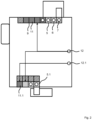
- Fig. 1 shows a graphical representation of a laboratory automation system with a first example of empty carrier queues.
- the laboratory automation system comprises a plurality of laboratory devices 1 configured to apply at least one of pre-analytics, analytics, and post-analytics for a sample received in a sample container.
- the system further comprises a transport system 2.
- the transport system 2 comprises a plurality of carriers 3 each configured to carry one or more sample containers on an automation track to at least one of the plurality of laboratory devices 1, a plurality of transport system interfaces 4, and a first empty carrier queue 5 provided with a first fixed number of queue spaces 6 which each can be assigned an empty carrier 7.
- the laboratory automation system comprises a control device 8 configured to control operation of the transport system 2.
- Fig. 1 also shows a second empty carrier queue 5.1 provided with a second fixed number of queue spaces 6.1 which each can be assigned an empty carrier 7.1.
- the first empty carrier queue 5 is assigned to the first laboratory device 1 and to the first transport system interface 4.
- the second empty carrier queue 5.1 is assigned to the second laboratory device 1.1 and to the second transport system interface 4.1.
- a length or extension of the first empty carrier queue 5, according to the example illustrated in Fig. 1 is three spaces. However, the length of the first empty carrier queue 5 is not limited to three spaces. Additional queue spaces 9 are provided.
- a first number of additional queue spaces 10 among the additional queue spaces 9 is assigned to the first empty carrier queue 5 .
- the first empty carrier queue 5 is operated with the first fixed number of queue spaces 6 plus the first number of additional queue spaces 10.
- a first number of additional queue spaces 10.1 is assigned to the second empty carrier queue 5.1 .
- the second empty carrier queue 5.1 is operated with the second fixed number of queue spaces 6.1 plus the first number of additional queue spaces 11.1 of the second empty carrier queue 5.1.
- the fixed number of queue spaces 6.1 of the second empty carrier queue 5.1 is the same as the fixed number of queue spaces 6 of the first empty carrier queue 5. However, the fixed number of queue spaces 6.1 of the second empty carrier queue 5.1 may be different from the fixed number of queue spaces 6 of the first empty carrier queue 5.
- the first number of additional queue spaces 10 assigned to the first empty carrier queue 5 is different, e.g. higher, than the first number of additional queue spaces 10.1 assigned to the second empty carrier queue 5.1.
- the first number of additional queue spaces 10 assigned to the first empty carrier queue 5 may be higher than the first number of additional queue spaces 10.1 assigned to the second empty carrier queue 5.1, since, for example, the laboratory device 1 / transport system interface 4 assigned to the first empty carrier queue 5 may have a higher empty carrier consumption and / or the laboratory device 1 / transport system interface 4 assigned to the first empty carrier queue 5 may be further away from the empty carrier source 12.
- the first number of additional queue spaces 10 assigned to the first empty carrier queue 5 and the first number of additional queue spaces 10.1 assigned to the second empty carrier queue 5.1 may be (repeatedly) re-assigned to the respective empty carrier queues 5, 5.1.
- the first number of additional queue spaces 10 assigned to the first empty carrier queue 5 and the first number of additional queue spaces 10.1 assigned to the second empty carrier queue 5.1 may change. The re-assignment may take place independently for the several empty carrier queues 5, 5.1.
- the transport system 2 has a transport plane 15.
- the transport plane 15 comprises a plurality of transport modules 14.
- the transport plane 15 is divided in logical fields, namely grid areas 13.
- Each transport module 14 can comprise exactly one or more than one grid areas 13.
- To each grid area 13 one carrier 3, in particular exclusively one carrier 3, may be assigned to.
- the carriers 3 can be moved on the transport plane 15 by being moved from one grid area 13 to another.
- Each grid area 13 can from one queue space, in particular exclusively one queue space.
- also loaded carriers 3 are provided.
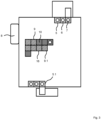
- Fig. 2 shows a graphical representation of a laboratory automation system with a second example of empty carrier queues and examples for traveling routes for empty carriers.
- operation data are determined. For example, it is determined that the empty carrier consumption of the first device 1 / transport system interface 4 increases.
- a second number of additional queue spaces 11 is determined. In this case, the second number of additional queue spaces 11 is higher than the first number of additional queue spaces 10.
- the first empty carrier queue 5 is then operated with the first fixed number of queue spaces 6 plus the second number of additional queue spaces 11. In other words, the second number of additional queue spaces 11 replaces the first number of additional queue spaces 10. It is further determined that that the empty carrier consumption of the second device 1.1 / transport system interface 4.1 stagnates.
- a second number of additional queue spaces 11.1 for the second empty carrier queue 5.1 is determined.
- the second number of additional queue spaces 11.1, in this case, is the same as the first number of additional queue spaces 10.1.
- the second empty carrier queue 5.1 is then operated with the second fixed number of queue spaces 6.1 plus the second number of additional queue spaces 11.1.
- the second number of additional queue spaces 11.1 of the second empty carrier queue 5.1 replaces the first number of additional queue spaces 10.1 of the second empty carrier queue 5.1.
- a second number of additional queue spaces 11 may not be assigned to the second fixed number of queue spaces 6.1.
- the second number of additional queue spaces 11, 11.1 may be assigned to the corresponding empty carrier queue 5, 5.1 whenever an empty carrier 7 leaves the corresponding empty carrier queue 5, 5.1.
- Fig. 2 also shows the case of a first empty carrier 12 being introduced into the system. It is then to be decided to which queue the newly introduced carriers 12 is to be sent / assigned to. The decision is based on the corresponding empty carrier queue 5. However, the decision may be based on the empty carrier need of each queue and the corresponding device 1 / transport system interface 4, respectively.
- the size of the corresponding queue 5 including the additional queue spaces 11 may be indicative of the empty carrier need of the corresponding device 1 / transport system interface 4. In particular, if a high number of spaces among the fixed number of queue spaces 6 and the additional number of queue spaces 11 is not occupied, the empty carrier need of the corresponding device 1 / transport system interface 4 is high. For each queue 6, an empty carrier need factor is determined.
- the newly introduced carrier 12 is then sent / assigned to the queue 5 with the highest empty carrier need factor.
- a ratio between occupied (by carriers 4) and unoccupied queue spaces may be indicative of the empty carrier need (factor).
- the fixed number of queue spaces, the additional (fist / second) number of queue spaces, or both the fixed number and the additional (fist / second) number of queue spaces of a certain queue may define the queue spaces of the certain queue.
- the empty carrier need (factor) of the second queue 5.1 is higher than the empty carrier need (factor) of the first queue 5.
- the newly introduced carrier 12 is thus sent / assigned to the second queue 5.1.
- the empty carrier need (factor) of a specific queue may be lowered, for example, proportional to the distance of the specific queue to the current position of the newly introduced carrier 12.
- the distance between the second queue 5.1 to the current position of the newly introduced carrier 12 is higher than the distance between the first queue 5 to the current position of the newly introduced carrier 12. This may lead to the newly introduced carrier 12 being sent / assigned to the first queue 5.
- a first empty carrier 12.1 is introduced to the system.
- a request for queuing the first empty carrier 12.1 in the corresponding queue 5.1 is received.
- a travel time between the first empty carrier 12.1 and the corresponding queue 5.1 is calculated. The travel time exceeds a threshold.
- the first empty carrier 12.1 is not assigned to a space of the fixed number of queue spaces but to the additional queue spaces of the corresponding queue 5.1.
- a second empty carrier 12 is introduced to the system.
- a request for queuing the second empty carrier 12 in the corresponding queue 5.1 is received.
- a travel time between the second empty carrier 12 and the corresponding queue 5.1 is calculated.
- the travel time does not exceed a threshold.
- the second empty carrier 12 is assigned to a space of the fixed number of queue spaces.
- the second empty carrier 12 may be introduced to the system after the first empty carrier 12.1. However, the second empty carrier 12 may reach the corresponding queue 5.1 prior to the first empty carrier 12.1.
- Fig. 3 shows a graphical representation of a laboratory automation system with a third example of empty carrier queues.
- Fig. 3 shows a plurality of additional queue spaces 9 for a first queue 5.
- Fig. 3 shows a plurality of additional queue spaces 9.1 for a second queue 5.1.
- a set of shared queue spaces 16 comprise the additional queue spaces 9 for a first queue 5 and the additional queue spaces 9.1 for a second queue 5.1.
- the additional queue spaces 9, 9.1 are separated from the corresponding number of fixed queue spaces 6, 6.1, i.e. they are not adjacent to each other. However, at least one space of the additional queue spaces 9, 9.1 may be adjacent to at least one of the spaces of the corresponding number of fixed queue spaces 6, 6.1.
- At least one space of the additional shared queue spaces 16 may be adjacent to at least one space of the first number of fixed queue spaces 6 and at least one space of the additional shared queue spaces 16 may be adjacent to at least one space of the second number of fixed queue spaces 6.1. At least one of the spaces of the first / second number of fixed queue spaces 6, 6.1 may be adjacent to the corresponding device 1, 1.1 / transport system interface 4, 4.1.
- the shared queue spaces 16 may comprise a first number of additional spaces exclusively assigned to the first number of fixed queue spaces 6, a second number of additional spaces exclusively assigned to the second number of fixed queue spaces 6.1, and / or a third number of additional spaces assigned to both the first and second number of fixed queue spaces 6, 6.1.
- the shared queue spaces 16 may comprise a fourth number of spaces not assigned to a number of fixed queue spaces 6, 6.1.
- the (fourth number of spaces of the) shared queue spaces 16 may comprise spaces reserved for the first, second, and / or third number of additional spaces.
- the shared queue spaces 16 comprise / consist of spaces reserved for the third number of additional spaces and the third number of additional spaces.
- the method comprises receiving operation data in the control device 24, the operation data being indicative of a first operation parameter for at least one of the transport system 2 and the plurality of laboratory devices 1 during runtime of the transport system 2, and, in response to receiving the operation data 24, assigning a second number of additional queue spaces from the plurality of additional queue spaces to the first empty carrier queue by the control device 25, wherein the second number of additional queue spaces 11 is different from the first number of additional queue spaces 10.
- the method further comprises operating the first empty carrier queue with the first fixed number of queue spaces plus the second number of additional queue spaces during runtime of the transport system 26.
Landscapes
- Physics & Mathematics (AREA)
- Health & Medical Sciences (AREA)
- Life Sciences & Earth Sciences (AREA)
- Chemical & Material Sciences (AREA)
- Analytical Chemistry (AREA)
- Biochemistry (AREA)
- General Health & Medical Sciences (AREA)
- General Physics & Mathematics (AREA)
- Immunology (AREA)
- Pathology (AREA)
- Control Of Position, Course, Altitude, Or Attitude Of Moving Bodies (AREA)
- Automatic Analysis And Handling Materials Therefor (AREA)
Claims (15)
- Verfahren zum Betreiben eines Laborautomationssystems, aufweisend:- eine Vielzahl von Laborvorrichtungen (1), die zum Anwenden mindestens einer von Voranalyse, Analyse und Nachanalyse für eine Probe, die in einem Probenbehälter aufgenommen ist, ausgebildet ist;- ein Transportsystem (2), umfassend- eine Vielzahl von Trägern (3), die jeweils zum Tragen eines oder mehrerer Probenbehälter auf einer Automationsstrecke zu mindestens einer der Vielzahl von Laborvorrichtungen (1) ausgebildet sind;- eine Vielzahl von Transportsystemschnittstellen (4) und- eine erste Warteschlange für leere Träger (5), die mit einer ersten feststehenden Anzahl von Warteschlangeplätzen (6) versehen ist, denen jeweils ein leerer Träger (7) zugeordnet werden kann; und- eine Steuerungsvorrichtung (8), die zum Steuern des Betriebs des Transportsystems (2) ausgebildet ist;wobei das Verfahren Folgendes umfasst:- Bereitstellen einer Vielzahl von zusätzlichen Warteschlangeplätzen (9) in dem Transportsystem (2), wobei den zusätzlichen Warteschlangeplätzen (9) jeweils ein leerer Träger zugeordnet werden kann;- Zuordnen einer ersten Anzahl von zusätzlichen Warteschlangeplätzen (10) aus der Vielzahl von zusätzlichen Warteschlangeplätzen (9) zu der ersten Warteschlange für leere Träger (5) mittels der Steuerungsvorrichtung (8);- Betreiben der ersten Warteschlange für leere Träger (5) mit der ersten feststehenden Anzahl von Warteschlangeplätzen (6) plus der ersten Anzahl von zusätzlichen Warteschlangeplätzen (10) während der Laufzeit des Transportsystems (2);dadurch gekennzeichnet, dass das Verfahren ferner umfasst:- Empfangen von Betriebsdaten in der Steuerungsvorrichtung (8), wobei die Betriebsdaten einen ersten Betriebsparameter für mindestens eines von dem Transportsystem (2) und der Vielzahl von Laborvorrichtungen (1) während der Laufzeit des Transportsystems (2) angeben;- Zuordnen einer zweiten Anzahl von zusätzlichen Warteschlangeplätzen (11) aus der Vielzahl von zusätzlichen Warteschlangeplätzen (9) zu der ersten Warteschlange für leere Träger (5) mittels der Steuerungsvorrichtung (8) als Reaktion auf das Empfangen der Betriebsdaten, wobei die zweite Anzahl von zusätzlichen Warteschlangeplätzen (11) verschieden ist von der ersten Anzahl von zusätzlichen Warteschlangeplätzen (10), und- Betreiben der ersten Warteschlange für leere Träger (5) mit der ersten feststehenden Anzahl von Warteschlangeplätzen (6) plus der zweiten Anzahl von zusätzlichen Warteschlangeplätzen (11) während der Laufzeit des Transportsystems (2).
- Verfahren nach Anspruch 1, ferner umfassend in der Steuerungsvorrichtung (8)- Empfangen einer Aufforderung, einen ersten Träger (12.1) in der ersten Warteschlange für leere Träger (5) warten zu lassen;- Bestimmen einer Fahrzeit für den ersten Träger (12.1) zum Fahren von einem aktuellen Standort zu dem Standort der ersten Warteschlange für leere Träger (5) in dem Transportsystem (2) und- Zuordnen des ersten Trägers (12.1) zu einer der ersten Anzahl von zusätzlichen Warteschlangeplätzen (10) und der zweiten Anzahl von zusätzlichen Warteschlangeplätzen (11), wenn die Fahrzeit eine Schwellenfahrzeit überschreitet.
- Verfahren nach Anspruch 1 oder 2, wobei das Bereitstellen der Vielzahl von zusätzlichen Warteschlangeplätzen ferner das Bereitstellen einer Vielzahl von zusätzlichen geteilten Warteschlangeplätzen (16), die von der ersten Warteschlange für leere Träger (5) und einem zweiten Wartefeld für leere Träger (5.1) des Transportsystems (2) geteilt werden, umfasst, wobei das zweite Wartefeld für leere Träger (5.1) mit einer zweiten feststehenden Anzahl von Warteschlangeplätzen (6.1), denen jeweils ein leerer Träger in dem Transportsystem (2) zugeordnet werden kann, versehen ist.
- Verfahren nach Anspruch 3, ferner umfassend das dynamische Zuordnen eines oder mehrerer zusätzlicher geteilter Wartefelder aus der Vielzahl von zusätzlichen geteilten Warteschlangeplätzen (16) sowohl zu der ersten Warteschlange für leere Träger (5) als auch der zweiten Warteschlange für leere Träger (5.1) mittels der Steuerungsvorrichtung (8) in Abhängigkeit von mindestens einem von dem ersten Betriebsparameter und einem zweiten Betriebsparameter für mindestens eines von dem Transportsystem (2) und der Vielzahl von Laborvorrichtungen (1) während der Laufzeit.
- Verfahren nach Anspruch 3 oder 4, wobei das Empfangen der Betriebsdaten in der Steuerungsvorrichtung (8) ferner umfasst, dass einer von dem ersten Betriebsparameter und einem zweiten Betriebsparameter mindestens einen der folgenden Betriebsparameter angibt:- einen physischen Füllstand für mindestens eine von der ersten Warteschlange für leere Träger (5) und der zweiten Warteschlange für leere Träger (5.1), wobei der physische Füllstand die Anzahl von leeren Trägern (7) angibt, die in der ersten Warteschlange für leere Träger (5) / zweiten Warteschlange für leere Träger (5.1) bereitgestellt sind;- einen virtuellen Füllstand für mindestens eine von der ersten Warteschlange für leere Träger (5) und der zweiten Warteschlange für leere Träger (5.1), wobei der virtuelle Füllstand eine Gesamtanzahl von leeren Trägern angibt, die der ersten Warteschlange für leere Träger (5) / zweiten Warteschlange für leere Träger (5.1) zugeordnet sind, nämlich die Anzahl von leeren Trägern, die in der ersten Warteschlange für leere Träger (5) / zweiten Warteschlange für leere Träger (5.1) bereitgestellt sind, plus eine Anzahl von leeren Trägern, die zu der ersten Warteschlange für leere Träger (5) / zweiten Warteschlange für leere Träger (5.1) fahren;- eine erste zusätzliche Warteplatzkapazität, die eine erste verbleibende Anzahl von zusätzlichen Warteschlangeplätzen aus der ersten Anzahl von zusätzlichen Warteschlangeplätzen (10), denen kein leerer Träger zugeordnet ist, angibt;- eine zweite zusätzliche Warteplatzkapazität, die eine zweite verbleibende Anzahl von zusätzlichen Warteschlangeplätzen aus der zweiten Anzahl von zusätzlichen Warteschlangeplätzen (11), denen kein leerer Träger zugeordnet ist, angibt, und- eine Anzahl von leeren Trägern, die eine von der ersten Warteschlange für leere Träger (5) und der zweiten Warteschlange für leere Träger (5.1) über einen Beobachtungszeitraum verlassen haben.
- Verfahren nach mindestens einem der vorstehenden Ansprüche, wobei das Zuordnen der ersten Anzahl von zusätzlichen Warteschlangeplätzen (10) mindestens eines von Folgendem umfasst:- Zuordnen einer ersten Anzahl von zusätzlichen Warteschlangeplätzen (10), die zum Zeitpunkt des Beginns der Laufzeit Null ist, und- Zuordnen einer ersten Anzahl von zusätzlichen Warteschlangeplätzen (10), die nicht Null ist.
- Verfahren nach Anspruch 3, 4 oder 5, ferner umfassend in der Steuerungsvorrichtung (8) mindestens eines von Folgendem:- Zuordnen einer ersten Transportsystemschnittstelle (4) aus der Vielzahl von Transportsystemschnittstellen zu der ersten Warteschlange für leere Träger (5) und- Zuordnen einer zweiten Transportsystemschnittstelle (4.1) aus der Vielzahl von Transportsystemschnittstellen zu der zweiten Warteschlange für leere Träger (5.1), wobei die zweite Transportsystemschnittstelle (4.1) verschieden ist von der ersten Transportsystemschnittstelle (4).
- Verfahren nach Anspruch 7, wobei das Zuordnen der zweiten Anzahl von zusätzlichen Warteschlangeplätzen (11) ferner in der Steuerungsvorrichtung (8) das Bestimmen der zweiten Anzahl von zusätzlichen Warteschlangeplätzen (Ladditional ) wie folgt umfasst:
 - Q̇TSIF die Anzahl von leeren Trägern ist, die die erste Warteschlange für leere Träger (5) in einer Ausgaberichtung über die erste Transportsystemschnittstelle pro Zeiteinheit verlassen;- Q̇TSIF,max die maximale Anzahl von leeren Trägern ist, die die erste Warteschlange für leere Träger (5) in einer Ausgaberichtung über die erste Transportsystemschnittstelle pro Zeiteinheit verlassen;- Daverage,TSIF der durchschnittliche Abstand zwischen der ersten Transportsystemschnittstelle, die der ersten Warteschlange für leere Träger (5) zugeordnet ist, und den anderen Transportsystemschnittstellen aus der Vielzahl von Transportsystemschnittstellen (4) ist;- Daverage der durchschnittliche Abstand zwischen Paaren von Transportsystemschnittstellen aus der Vielzahl von Transportsystemschnittstellen (4) ist und- Ladditional,ref eine Referenzanzahl von zusätzlichen Warteschlangeplätzen ist.
 - Verfahren nach Anspruch 8, wobei die Referenzanzahl von zusätzlichen Warteschlangeplätzen (Laverage,ref ) wie folgt bestimmt wird.

- Verfahren nach Anspruch 8 oder 9, ferner umfassend das Begrenzen der zweiten Anzahl von zusätzlichen Warteschlangeplätzen (Ladditional ) wie folgt:

- Verfahren nach mindestens einem der vorstehenden Ansprüche, wobei das Zuordnen der zweiten Anzahl von zusätzlichen Warteschlangeplätzen (11) ferner das Zuordnen der zweiten Anzahl von zusätzlichen Warteschlangeplätzen (11) als Reaktion darauf, dass ein leerer Träger die erste Warteschlange für leere Träger (5) verlässt, umfasst.
- Verfahren nach mindestens einem der vorstehenden Ansprüche, ferner umfassend das Bereitstellen der Vielzahl von Trägern (3) als eine Vielzahl von Probenbehälterträgern.
- Verfahren nach mindestens einem der vorstehenden Ansprüche, wobei das Betreiben der ersten Warteschlange für leere Träger (5) ferner in der Steuerungsvorrichtung (8) das Lenken eines oder mehrerer leerer Träger (12, 12.1), die sich entfernt von der ersten Warteschlange für leere Träger (5) befinden, derart, dass sie zu der ersten Warteschlange für leere Träger (5) fahren, wenn bestimmt wird, dass die zweite Anzahl von zusätzlichen Warteschlangeplätzen (11) höher ist als die erste Anzahl von zusätzlichen Warteschlangeplätzen (10), umfasst.
- Verfahren nach mindestens einem der vorstehenden Ansprüche, wobei das Betreiben der ersten Warteschlange für leere Träger (5) ferner in der Steuerungsvorrichtung (8) das Verhindern, dass einer oder mehrere leere Träger (12, 12.1), die sich entfernt von der ersten Warteschlange für leere Träger (5) befinden, zu der ersten Warteschlange für leere Träger (5) fahren, wenn bestimmt wird, dass die zweite Anzahl von zusätzlichen Warteschlangeplätzen (11) kleiner ist als die erste Anzahl von zusätzlichen Warteschlangeplätzen (10), umfasst.
- Laborautomationssystem, aufweisend:- eine Vielzahl von Laborvorrichtungen (1), die zum Anwenden mindestens einer von Voranalyse, Analyse und Nachanalyse für eine Probe, die in einem Probenbehälter aufgenommen ist, ausgebildet ist;- ein Transportsystem (2), umfassend- eine Vielzahl von Trägern (3), die jeweils zum Tragen eines oder mehrerer Probenbehälter auf einer Automationsstrecke zu mindestens einer der Vielzahl von Laborvorrichtungen (1) ausgebildet sind;- eine Vielzahl von Transportsystemschnittstellen (4) und- eine erste Warteschlange für leere Träger (5), die mit einer ersten feststehenden Anzahl von Warteschlangeplätzen (6) versehen ist, denen jeweils ein leerer Träger zugeordnet werden kann; und- eine Steuerungsvorrichtung (8), die zum Steuern des Betriebs des Transportsystems (2) ausgebildet ist;und zu Folgendem ausgebildet ist:- Bereitstellen einer Vielzahl von zusätzlichen Warteschlangeplätzen (9) in dem Transportsystem (2), wobei den zusätzlichen Warteschlangeplätzen (9) jeweils ein leerer Träger zugeordnet werden kann;- Zuordnen einer ersten Anzahl von zusätzlichen Warteschlangeplätzen (10) aus der Vielzahl von zusätzlichen Warteschlangeplätzen (9) zu der ersten Warteschlange für leere Träger (5) mittels der Steuerungsvorrichtung (8);- Betreiben der ersten Warteschlange für leere Träger (5) mit der ersten feststehenden Anzahl von Warteschlangeplätzen (6) plus der ersten Anzahl von zusätzlichen Warteschlangeplätzen (10) während der Laufzeit des Transportsystems (2);dadurch gekennzeichnet, dass die Steuerungsvorrichtung ferner zu Folgendem ausgebildet ist:- Empfangen von Betriebsdaten in der Steuerungsvorrichtung (8), wobei die Betriebsdaten einen ersten Betriebsparameter für mindestens eines von dem Transportsystem (2) und der Vielzahl von Laborvorrichtungen (1) während der Laufzeit des Transportsystems (2) angeben;- Zuordnen einer zweiten Anzahl von zusätzlichen Warteschlangeplätzen (11) aus der Vielzahl von zusätzlichen Warteschlangeplätzen (9) zu der ersten Warteschlange für leere Träger (5) mittels der Steuerungsvorrichtung (8) als Reaktion auf das Empfangen der Betriebsdaten, wobei die zweite Anzahl von zusätzlichen Warteschlangeplätzen (11) verschieden ist von der ersten Anzahl von zusätzlichen Warteschlangeplätzen (10), und- Betreiben der ersten Warteschlange für leere Träger (5) mit der ersten feststehenden Anzahl von Warteschlangeplätzen (6) plus der zweiten Anzahl von zusätzlichen Warteschlangeplätzen (11) während der Laufzeit des Transportsystems (2).
Priority Applications (4)
| Application Number | Priority Date | Filing Date | Title |
|---|---|---|---|
| EP21192099.6A EP4137821B1 (de) | 2021-08-19 | 2021-08-19 | Verfahren zum betrieb eines laborautomationssystems und laborautomationssystem |
| US17/815,585 US12292454B2 (en) | 2021-08-19 | 2022-07-28 | Method for operating a laboratory automation system and laboratory automation system |
| JP2022130655A JP2023029305A (ja) | 2021-08-19 | 2022-08-18 | 検査室自動化システムを動作させる方法および検査室自動化システム |
| CN202211002345.1A CN115932296A (zh) | 2021-08-19 | 2022-08-19 | 用于操作实验室自动化系统的方法以及实验室自动化系统 |
Applications Claiming Priority (1)
| Application Number | Priority Date | Filing Date | Title |
|---|---|---|---|
| EP21192099.6A EP4137821B1 (de) | 2021-08-19 | 2021-08-19 | Verfahren zum betrieb eines laborautomationssystems und laborautomationssystem |
Publications (2)
| Publication Number | Publication Date |
|---|---|
| EP4137821A1 EP4137821A1 (de) | 2023-02-22 |
| EP4137821B1 true EP4137821B1 (de) | 2024-07-17 |
Family
ID=77411609
Family Applications (1)
| Application Number | Title | Priority Date | Filing Date |
|---|---|---|---|
| EP21192099.6A Active EP4137821B1 (de) | 2021-08-19 | 2021-08-19 | Verfahren zum betrieb eines laborautomationssystems und laborautomationssystem |
Country Status (4)
| Country | Link |
|---|---|
| US (1) | US12292454B2 (de) |
| EP (1) | EP4137821B1 (de) |
| JP (1) | JP2023029305A (de) |
| CN (1) | CN115932296A (de) |
Family Cites Families (16)
| Publication number | Priority date | Publication date | Assignee | Title |
|---|---|---|---|---|
| DE102010028769A1 (de) * | 2010-05-07 | 2011-11-10 | Pvt Probenverteiltechnik Gmbh | System zum Transportieren von Behältern zwischen unterschiedlichen Stationen und Behälterträger |
| EP2623990B1 (de) | 2010-09-28 | 2019-03-27 | Hitachi High-Technologies Corporation | Automatisiertes probeninspektionssystem und verfahren zu seiner steuerung |
| EP2589968A1 (de) * | 2011-11-04 | 2013-05-08 | Roche Diagnostics GmbH | Laborprobenverteilungssystem, Laborsystem und Betriebsverfahren |
| US9446418B2 (en) * | 2011-11-07 | 2016-09-20 | Beckman Coulter, Inc. | Robotic arm |
| US20150369832A1 (en) | 2013-01-17 | 2015-12-24 | Siemens Healthcare Diagnostics Inc. | Hybrid method for collision avoidance and object carrier management |
| EP2927625A1 (de) * | 2014-03-31 | 2015-10-07 | Roche Diagniostics GmbH | Probenverteilungssystem und Laborautomatisierungssystem |
| EP2977842A1 (de) * | 2014-07-23 | 2016-01-27 | F. Hoffmann-La Roche AG | Laborprobenverteilungssystem und Laborautomatisierungssystem |
| EP3095739A1 (de) * | 2015-05-22 | 2016-11-23 | Roche Diagniostics GmbH | Verfahren zum betrieb eines laborprobenverteilungssystems, laborprobenverteilungssystem und laborautomatisierungssystem |
| EP3096145B1 (de) * | 2015-05-22 | 2019-09-04 | Roche Diagniostics GmbH | Verfahren zum betrieb eines laborautomatisierungssystems und laborautomatisierungssystem |
| EP3096144A1 (de) | 2015-05-22 | 2016-11-23 | Roche Diagnostics GmbH | Verfahren zum betrieb eines laborautomatisierungssystems und laborautomatisierungssystem |
| EP3096146A1 (de) * | 2015-05-22 | 2016-11-23 | Roche Diagniostics GmbH | Verfahren zum betrieb eines laborprobenverteilungssystems, laborprobenverteilungssystem und laborautomatisierungssystem |
| CN108027381B (zh) * | 2015-09-25 | 2020-12-08 | 株式会社日立高新技术 | 检体检查自动化系统 |
| EP3502709B1 (de) | 2016-08-18 | 2023-04-19 | Hitachi High-Tech Corporation | Automatisiertes probeninspektionssystem und verfahren zur steuerung davon |
| US10996232B2 (en) * | 2016-09-09 | 2021-05-04 | The Procter & Gamble Company | System and method for independently routing container-loaded vehicles to create different finished products |
| EP3537159B1 (de) * | 2018-03-07 | 2022-08-31 | Roche Diagnostics GmbH | Verfahren zum betrieb eines laborprobenverteilungssystems, laborprobenverteilungssystem und laborautomatisierungssystem |
| EP4187253B1 (de) * | 2021-11-24 | 2025-07-02 | F. Hoffmann-La Roche AG | Verteilungssystem |
-
2021
- 2021-08-19 EP EP21192099.6A patent/EP4137821B1/de active Active
-
2022
- 2022-07-28 US US17/815,585 patent/US12292454B2/en active Active
- 2022-08-18 JP JP2022130655A patent/JP2023029305A/ja active Pending
- 2022-08-19 CN CN202211002345.1A patent/CN115932296A/zh active Pending
Also Published As
| Publication number | Publication date |
|---|---|
| US20230059570A1 (en) | 2023-02-23 |
| CN115932296A (zh) | 2023-04-07 |
| JP2023029305A (ja) | 2023-03-03 |
| EP4137821A1 (de) | 2023-02-22 |
| US12292454B2 (en) | 2025-05-06 |
Similar Documents
| Publication | Publication Date | Title |
|---|---|---|
| CN106168629B (zh) | 操作实验室自动化系统的方法和实验室自动化系统 | |
| US10139422B2 (en) | Throughput optimizing reagent distribution | |
| US10001499B2 (en) | Modular workcells for lab automation | |
| EP3095739A1 (de) | Verfahren zum betrieb eines laborprobenverteilungssystems, laborprobenverteilungssystem und laborautomatisierungssystem | |
| EP2943787B1 (de) | Automatisierungssystem zur verwendung mit in vitro diagnostik | |
| JP2018522217A (ja) | ラボラトリ試料分配システムを操作する方法、ラボラトリ試料分配システムおよびラボラトリオートメーションシステム | |
| CN115461770A (zh) | 分配系统 | |
| WO2013151920A1 (en) | Virtual sample queues | |
| JP5401413B2 (ja) | 分析システム | |
| WO2016188752A1 (en) | Method of operating a laboratory automation system and laboratory automation system | |
| Lin et al. | A load-routeing problem in a tandem-configuration automated guided-vehicle system | |
| US20230160916A1 (en) | Distribution system | |
| EP4137821B1 (de) | Verfahren zum betrieb eines laborautomationssystems und laborautomationssystem | |
| US20250182041A1 (en) | Distribution system and method for distributing a plurality of carriers | |
| US20250224413A1 (en) | Method of operating a laboratory sample distribution system, laboratory sample distribution system, and laboratory automation system | |
| US20250147061A1 (en) | Method of operating a laboratory sample distribution system, laboratory sample distribution system, and laboratory automation system | |
| CN118575225A (zh) | 用于操作实验室系统的方法以及实验室系统 | |
| EP4562477A1 (de) | Dynamische routing-algorithmen für modulare analysatorsysteme | |
| US20250181083A1 (en) | Safe point pattern |
Legal Events
| Date | Code | Title | Description |
|---|---|---|---|
| PUAI | Public reference made under article 153(3) epc to a published international application that has entered the european phase |
Free format text: ORIGINAL CODE: 0009012 |
|
| STAA | Information on the status of an ep patent application or granted ep patent |
Free format text: STATUS: THE APPLICATION HAS BEEN PUBLISHED |
|
| AK | Designated contracting states |
Kind code of ref document: A1 Designated state(s): AL AT BE BG CH CY CZ DE DK EE ES FI FR GB GR HR HU IE IS IT LI LT LU LV MC MK MT NL NO PL PT RO RS SE SI SK SM TR |
|
| STAA | Information on the status of an ep patent application or granted ep patent |
Free format text: STATUS: REQUEST FOR EXAMINATION WAS MADE |
|
| 17P | Request for examination filed |
Effective date: 20230425 |
|
| RBV | Designated contracting states (corrected) |
Designated state(s): AL AT BE BG CH CY CZ DE DK EE ES FI FR GB GR HR HU IE IS IT LI LT LU LV MC MK MT NL NO PL PT RO RS SE SI SK SM TR |
|
| GRAP | Despatch of communication of intention to grant a patent |
Free format text: ORIGINAL CODE: EPIDOSNIGR1 |
|
| STAA | Information on the status of an ep patent application or granted ep patent |
Free format text: STATUS: GRANT OF PATENT IS INTENDED |
|
| RIC1 | Information provided on ipc code assigned before grant |
Ipc: G01N 35/00 20060101ALI20240129BHEP Ipc: G01N 35/04 20060101AFI20240129BHEP |
|
| INTG | Intention to grant announced |
Effective date: 20240219 |
|
| GRAS | Grant fee paid |
Free format text: ORIGINAL CODE: EPIDOSNIGR3 |
|
| GRAA | (expected) grant |
Free format text: ORIGINAL CODE: 0009210 |
|
| STAA | Information on the status of an ep patent application or granted ep patent |
Free format text: STATUS: THE PATENT HAS BEEN GRANTED |
|
| AK | Designated contracting states |
Kind code of ref document: B1 Designated state(s): AL AT BE BG CH CY CZ DE DK EE ES FI FR GB GR HR HU IE IS IT LI LT LU LV MC MK MT NL NO PL PT RO RS SE SI SK SM TR |
|
| REG | Reference to a national code |
Ref country code: CH Ref legal event code: EP |
|
| REG | Reference to a national code |
Ref country code: DE Ref legal event code: R096 Ref document number: 602021015716 Country of ref document: DE |
|
| REG | Reference to a national code |
Ref country code: IE Ref legal event code: FG4D |
|
| REG | Reference to a national code |
Ref country code: LT Ref legal event code: MG9D |
|
| REG | Reference to a national code |
Ref country code: NL Ref legal event code: MP Effective date: 20240717 |
|
| PG25 | Lapsed in a contracting state [announced via postgrant information from national office to epo] |
Ref country code: PT Free format text: LAPSE BECAUSE OF FAILURE TO SUBMIT A TRANSLATION OF THE DESCRIPTION OR TO PAY THE FEE WITHIN THE PRESCRIBED TIME-LIMIT Effective date: 20241118 |
|
| REG | Reference to a national code |
Ref country code: AT Ref legal event code: MK05 Ref document number: 1704612 Country of ref document: AT Kind code of ref document: T Effective date: 20240717 |
|
| PG25 | Lapsed in a contracting state [announced via postgrant information from national office to epo] |
Ref country code: NL Free format text: LAPSE BECAUSE OF FAILURE TO SUBMIT A TRANSLATION OF THE DESCRIPTION OR TO PAY THE FEE WITHIN THE PRESCRIBED TIME-LIMIT Effective date: 20240717 |
|
| PG25 | Lapsed in a contracting state [announced via postgrant information from national office to epo] |
Ref country code: PT Free format text: LAPSE BECAUSE OF FAILURE TO SUBMIT A TRANSLATION OF THE DESCRIPTION OR TO PAY THE FEE WITHIN THE PRESCRIBED TIME-LIMIT Effective date: 20241118 Ref country code: NL Free format text: LAPSE BECAUSE OF FAILURE TO SUBMIT A TRANSLATION OF THE DESCRIPTION OR TO PAY THE FEE WITHIN THE PRESCRIBED TIME-LIMIT Effective date: 20240717 |
|
| PG25 | Lapsed in a contracting state [announced via postgrant information from national office to epo] |
Ref country code: NO Free format text: LAPSE BECAUSE OF FAILURE TO SUBMIT A TRANSLATION OF THE DESCRIPTION OR TO PAY THE FEE WITHIN THE PRESCRIBED TIME-LIMIT Effective date: 20241017 |
|
| PG25 | Lapsed in a contracting state [announced via postgrant information from national office to epo] |
Ref country code: GR Free format text: LAPSE BECAUSE OF FAILURE TO SUBMIT A TRANSLATION OF THE DESCRIPTION OR TO PAY THE FEE WITHIN THE PRESCRIBED TIME-LIMIT Effective date: 20241018 Ref country code: FI Free format text: LAPSE BECAUSE OF FAILURE TO SUBMIT A TRANSLATION OF THE DESCRIPTION OR TO PAY THE FEE WITHIN THE PRESCRIBED TIME-LIMIT Effective date: 20240717 Ref country code: PL Free format text: LAPSE BECAUSE OF FAILURE TO SUBMIT A TRANSLATION OF THE DESCRIPTION OR TO PAY THE FEE WITHIN THE PRESCRIBED TIME-LIMIT Effective date: 20240717 |
|
| PG25 | Lapsed in a contracting state [announced via postgrant information from national office to epo] |
Ref country code: BG Free format text: LAPSE BECAUSE OF FAILURE TO SUBMIT A TRANSLATION OF THE DESCRIPTION OR TO PAY THE FEE WITHIN THE PRESCRIBED TIME-LIMIT Effective date: 20240717 |
|
| PG25 | Lapsed in a contracting state [announced via postgrant information from national office to epo] |
Ref country code: LV Free format text: LAPSE BECAUSE OF FAILURE TO SUBMIT A TRANSLATION OF THE DESCRIPTION OR TO PAY THE FEE WITHIN THE PRESCRIBED TIME-LIMIT Effective date: 20240717 |
|
| PG25 | Lapsed in a contracting state [announced via postgrant information from national office to epo] |
Ref country code: IS Free format text: LAPSE BECAUSE OF FAILURE TO SUBMIT A TRANSLATION OF THE DESCRIPTION OR TO PAY THE FEE WITHIN THE PRESCRIBED TIME-LIMIT Effective date: 20241117 Ref country code: AT Free format text: LAPSE BECAUSE OF FAILURE TO SUBMIT A TRANSLATION OF THE DESCRIPTION OR TO PAY THE FEE WITHIN THE PRESCRIBED TIME-LIMIT Effective date: 20240717 |
|
| PG25 | Lapsed in a contracting state [announced via postgrant information from national office to epo] |
Ref country code: HR Free format text: LAPSE BECAUSE OF FAILURE TO SUBMIT A TRANSLATION OF THE DESCRIPTION OR TO PAY THE FEE WITHIN THE PRESCRIBED TIME-LIMIT Effective date: 20240717 |
|
| PG25 | Lapsed in a contracting state [announced via postgrant information from national office to epo] |
Ref country code: ES Free format text: LAPSE BECAUSE OF FAILURE TO SUBMIT A TRANSLATION OF THE DESCRIPTION OR TO PAY THE FEE WITHIN THE PRESCRIBED TIME-LIMIT Effective date: 20240717 Ref country code: RS Free format text: LAPSE BECAUSE OF FAILURE TO SUBMIT A TRANSLATION OF THE DESCRIPTION OR TO PAY THE FEE WITHIN THE PRESCRIBED TIME-LIMIT Effective date: 20241017 |
|
| PG25 | Lapsed in a contracting state [announced via postgrant information from national office to epo] |
Ref country code: RS Free format text: LAPSE BECAUSE OF FAILURE TO SUBMIT A TRANSLATION OF THE DESCRIPTION OR TO PAY THE FEE WITHIN THE PRESCRIBED TIME-LIMIT Effective date: 20241017 Ref country code: PL Free format text: LAPSE BECAUSE OF FAILURE TO SUBMIT A TRANSLATION OF THE DESCRIPTION OR TO PAY THE FEE WITHIN THE PRESCRIBED TIME-LIMIT Effective date: 20240717 Ref country code: NO Free format text: LAPSE BECAUSE OF FAILURE TO SUBMIT A TRANSLATION OF THE DESCRIPTION OR TO PAY THE FEE WITHIN THE PRESCRIBED TIME-LIMIT Effective date: 20241017 Ref country code: LV Free format text: LAPSE BECAUSE OF FAILURE TO SUBMIT A TRANSLATION OF THE DESCRIPTION OR TO PAY THE FEE WITHIN THE PRESCRIBED TIME-LIMIT Effective date: 20240717 Ref country code: IS Free format text: LAPSE BECAUSE OF FAILURE TO SUBMIT A TRANSLATION OF THE DESCRIPTION OR TO PAY THE FEE WITHIN THE PRESCRIBED TIME-LIMIT Effective date: 20241117 Ref country code: HR Free format text: LAPSE BECAUSE OF FAILURE TO SUBMIT A TRANSLATION OF THE DESCRIPTION OR TO PAY THE FEE WITHIN THE PRESCRIBED TIME-LIMIT Effective date: 20240717 Ref country code: GR Free format text: LAPSE BECAUSE OF FAILURE TO SUBMIT A TRANSLATION OF THE DESCRIPTION OR TO PAY THE FEE WITHIN THE PRESCRIBED TIME-LIMIT Effective date: 20241018 Ref country code: FI Free format text: LAPSE BECAUSE OF FAILURE TO SUBMIT A TRANSLATION OF THE DESCRIPTION OR TO PAY THE FEE WITHIN THE PRESCRIBED TIME-LIMIT Effective date: 20240717 Ref country code: ES Free format text: LAPSE BECAUSE OF FAILURE TO SUBMIT A TRANSLATION OF THE DESCRIPTION OR TO PAY THE FEE WITHIN THE PRESCRIBED TIME-LIMIT Effective date: 20240717 Ref country code: BG Free format text: LAPSE BECAUSE OF FAILURE TO SUBMIT A TRANSLATION OF THE DESCRIPTION OR TO PAY THE FEE WITHIN THE PRESCRIBED TIME-LIMIT Effective date: 20240717 Ref country code: AT Free format text: LAPSE BECAUSE OF FAILURE TO SUBMIT A TRANSLATION OF THE DESCRIPTION OR TO PAY THE FEE WITHIN THE PRESCRIBED TIME-LIMIT Effective date: 20240717 |
|
| REG | Reference to a national code |
Ref country code: CH Ref legal event code: PL |
|
| PG25 | Lapsed in a contracting state [announced via postgrant information from national office to epo] |
Ref country code: SM Free format text: LAPSE BECAUSE OF FAILURE TO SUBMIT A TRANSLATION OF THE DESCRIPTION OR TO PAY THE FEE WITHIN THE PRESCRIBED TIME-LIMIT Effective date: 20240717 Ref country code: RO Free format text: LAPSE BECAUSE OF FAILURE TO SUBMIT A TRANSLATION OF THE DESCRIPTION OR TO PAY THE FEE WITHIN THE PRESCRIBED TIME-LIMIT Effective date: 20240717 Ref country code: DK Free format text: LAPSE BECAUSE OF FAILURE TO SUBMIT A TRANSLATION OF THE DESCRIPTION OR TO PAY THE FEE WITHIN THE PRESCRIBED TIME-LIMIT Effective date: 20240717 |
|
| PG25 | Lapsed in a contracting state [announced via postgrant information from national office to epo] |
Ref country code: LU Free format text: LAPSE BECAUSE OF NON-PAYMENT OF DUE FEES Effective date: 20240819 |
|
| REG | Reference to a national code |
Ref country code: DE Ref legal event code: R097 Ref document number: 602021015716 Country of ref document: DE |
|
| PG25 | Lapsed in a contracting state [announced via postgrant information from national office to epo] |
Ref country code: CH Free format text: LAPSE BECAUSE OF NON-PAYMENT OF DUE FEES Effective date: 20240831 Ref country code: EE Free format text: LAPSE BECAUSE OF FAILURE TO SUBMIT A TRANSLATION OF THE DESCRIPTION OR TO PAY THE FEE WITHIN THE PRESCRIBED TIME-LIMIT Effective date: 20240717 Ref country code: MC Free format text: LAPSE BECAUSE OF FAILURE TO SUBMIT A TRANSLATION OF THE DESCRIPTION OR TO PAY THE FEE WITHIN THE PRESCRIBED TIME-LIMIT Effective date: 20240717 |
|
| PG25 | Lapsed in a contracting state [announced via postgrant information from national office to epo] |
Ref country code: CZ Free format text: LAPSE BECAUSE OF FAILURE TO SUBMIT A TRANSLATION OF THE DESCRIPTION OR TO PAY THE FEE WITHIN THE PRESCRIBED TIME-LIMIT Effective date: 20240717 |
|
| PG25 | Lapsed in a contracting state [announced via postgrant information from national office to epo] |
Ref country code: SK Free format text: LAPSE BECAUSE OF FAILURE TO SUBMIT A TRANSLATION OF THE DESCRIPTION OR TO PAY THE FEE WITHIN THE PRESCRIBED TIME-LIMIT Effective date: 20240717 |
|
| PLBE | No opposition filed within time limit |
Free format text: ORIGINAL CODE: 0009261 |
|
| STAA | Information on the status of an ep patent application or granted ep patent |
Free format text: STATUS: NO OPPOSITION FILED WITHIN TIME LIMIT |
|
| 26N | No opposition filed |
Effective date: 20250422 |
|
| REG | Reference to a national code |
Ref country code: BE Ref legal event code: MM Effective date: 20240831 |
|
| PG25 | Lapsed in a contracting state [announced via postgrant information from national office to epo] |
Ref country code: BE Free format text: LAPSE BECAUSE OF NON-PAYMENT OF DUE FEES Effective date: 20240831 |
|
| PG25 | Lapsed in a contracting state [announced via postgrant information from national office to epo] |
Ref country code: IE Free format text: LAPSE BECAUSE OF NON-PAYMENT OF DUE FEES Effective date: 20240819 |
|
| PG25 | Lapsed in a contracting state [announced via postgrant information from national office to epo] |
Ref country code: SE Free format text: LAPSE BECAUSE OF FAILURE TO SUBMIT A TRANSLATION OF THE DESCRIPTION OR TO PAY THE FEE WITHIN THE PRESCRIBED TIME-LIMIT Effective date: 20240717 |
|
| PGFP | Annual fee paid to national office [announced via postgrant information from national office to epo] |
Ref country code: DE Payment date: 20250724 Year of fee payment: 5 |
|
| PGFP | Annual fee paid to national office [announced via postgrant information from national office to epo] |
Ref country code: GB Payment date: 20250725 Year of fee payment: 5 |
|
| PGFP | Annual fee paid to national office [announced via postgrant information from national office to epo] |
Ref country code: FR Payment date: 20250723 Year of fee payment: 5 |
|
| PG25 | Lapsed in a contracting state [announced via postgrant information from national office to epo] |
Ref country code: IT Free format text: LAPSE BECAUSE OF FAILURE TO SUBMIT A TRANSLATION OF THE DESCRIPTION OR TO PAY THE FEE WITHIN THE PRESCRIBED TIME-LIMIT Effective date: 20240717 Ref country code: CY Free format text: LAPSE BECAUSE OF FAILURE TO SUBMIT A TRANSLATION OF THE DESCRIPTION OR TO PAY THE FEE WITHIN THE PRESCRIBED TIME-LIMIT; INVALID AB INITIO Effective date: 20210819 |
|
| PG25 | Lapsed in a contracting state [announced via postgrant information from national office to epo] |
Ref country code: HU Free format text: LAPSE BECAUSE OF FAILURE TO SUBMIT A TRANSLATION OF THE DESCRIPTION OR TO PAY THE FEE WITHIN THE PRESCRIBED TIME-LIMIT; INVALID AB INITIO Effective date: 20210819 |