EP4138517B1 - Beleuchtungsvorrichtung mit leseerleichterung - Google Patents
Beleuchtungsvorrichtung mit leseerleichterung Download PDFInfo
- Publication number
- EP4138517B1 EP4138517B1 EP22200459.0A EP22200459A EP4138517B1 EP 4138517 B1 EP4138517 B1 EP 4138517B1 EP 22200459 A EP22200459 A EP 22200459A EP 4138517 B1 EP4138517 B1 EP 4138517B1
- Authority
- EP
- European Patent Office
- Prior art keywords
- lighting device
- light beam
- lighting
- activation
- permanent light
- Prior art date
- Legal status (The legal status is an assumption and is not a legal conclusion. Google has not performed a legal analysis and makes no representation as to the accuracy of the status listed.)
- Active
Links
Images
Classifications
-
- H—ELECTRICITY
- H05—ELECTRIC TECHNIQUES NOT OTHERWISE PROVIDED FOR
- H05B—ELECTRIC HEATING; ELECTRIC LIGHT SOURCES NOT OTHERWISE PROVIDED FOR; CIRCUIT ARRANGEMENTS FOR ELECTRIC LIGHT SOURCES, IN GENERAL
- H05B45/00—Circuit arrangements for operating light-emitting diodes [LED]
- H05B45/30—Driver circuits
- H05B45/37—Converter circuits
-
- A—HUMAN NECESSITIES
- A61—MEDICAL OR VETERINARY SCIENCE; HYGIENE
- A61B—DIAGNOSIS; SURGERY; IDENTIFICATION
- A61B5/00—Measuring for diagnostic purposes; Identification of persons
- A61B5/16—Devices for psychotechnics; Testing reaction times ; Devices for evaluating the psychological state
- A61B5/165—Evaluating the state of mind, e.g. depression, anxiety
-
- A—HUMAN NECESSITIES
- A61—MEDICAL OR VETERINARY SCIENCE; HYGIENE
- A61N—ELECTROTHERAPY; MAGNETOTHERAPY; RADIATION THERAPY; ULTRASOUND THERAPY
- A61N5/00—Radiation therapy
- A61N5/06—Radiation therapy using light
- A61N5/0613—Apparatus adapted for a specific treatment
- A61N5/0618—Psychological treatment
-
- A—HUMAN NECESSITIES
- A61—MEDICAL OR VETERINARY SCIENCE; HYGIENE
- A61N—ELECTROTHERAPY; MAGNETOTHERAPY; RADIATION THERAPY; ULTRASOUND THERAPY
- A61N5/00—Radiation therapy
- A61N5/06—Radiation therapy using light
- A61N5/0613—Apparatus adapted for a specific treatment
- A61N5/0622—Optical stimulation for exciting neural tissue
-
- F—MECHANICAL ENGINEERING; LIGHTING; HEATING; WEAPONS; BLASTING
- F21—LIGHTING
- F21S—NON-PORTABLE LIGHTING DEVICES; SYSTEMS THEREOF; VEHICLE LIGHTING DEVICES SPECIALLY ADAPTED FOR VEHICLE EXTERIORS
- F21S6/00—Lighting devices intended to be free-standing
- F21S6/002—Table lamps, e.g. for ambient lighting
- F21S6/003—Table lamps, e.g. for ambient lighting for task lighting, e.g. for reading or desk work, e.g. angle poise lamps
-
- G—PHYSICS
- G02—OPTICS
- G02B—OPTICAL ELEMENTS, SYSTEMS OR APPARATUS
- G02B27/00—Optical systems or apparatus not provided for by any of the groups G02B1/00 - G02B26/00, G02B30/00
- G02B27/02—Viewing or reading apparatus
- G02B27/021—Reading apparatus
-
- H—ELECTRICITY
- H05—ELECTRIC TECHNIQUES NOT OTHERWISE PROVIDED FOR
- H05B—ELECTRIC HEATING; ELECTRIC LIGHT SOURCES NOT OTHERWISE PROVIDED FOR; CIRCUIT ARRANGEMENTS FOR ELECTRIC LIGHT SOURCES, IN GENERAL
- H05B45/00—Circuit arrangements for operating light-emitting diodes [LED]
- H05B45/10—Controlling the intensity of the light
-
- H—ELECTRICITY
- H05—ELECTRIC TECHNIQUES NOT OTHERWISE PROVIDED FOR
- H05B—ELECTRIC HEATING; ELECTRIC LIGHT SOURCES NOT OTHERWISE PROVIDED FOR; CIRCUIT ARRANGEMENTS FOR ELECTRIC LIGHT SOURCES, IN GENERAL
- H05B45/00—Circuit arrangements for operating light-emitting diodes [LED]
- H05B45/30—Driver circuits
- H05B45/305—Frequency-control circuits
-
- H—ELECTRICITY
- H05—ELECTRIC TECHNIQUES NOT OTHERWISE PROVIDED FOR
- H05B—ELECTRIC HEATING; ELECTRIC LIGHT SOURCES NOT OTHERWISE PROVIDED FOR; CIRCUIT ARRANGEMENTS FOR ELECTRIC LIGHT SOURCES, IN GENERAL
- H05B47/00—Circuit arrangements for operating light sources in general, i.e. where the type of light source is not relevant
- H05B47/10—Controlling the light source
- H05B47/16—Controlling the light source by timing means
-
- F—MECHANICAL ENGINEERING; LIGHTING; HEATING; WEAPONS; BLASTING
- F21—LIGHTING
- F21Y—INDEXING SCHEME ASSOCIATED WITH SUBCLASSES F21K, F21L, F21S and F21V, RELATING TO THE FORM OR THE KIND OF THE LIGHT SOURCES OR OF THE COLOUR OF THE LIGHT EMITTED
- F21Y2115/00—Light-generating elements of semiconductor light sources
- F21Y2115/10—Light-emitting diodes [LED]
-
- Y—GENERAL TAGGING OF NEW TECHNOLOGICAL DEVELOPMENTS; GENERAL TAGGING OF CROSS-SECTIONAL TECHNOLOGIES SPANNING OVER SEVERAL SECTIONS OF THE IPC; TECHNICAL SUBJECTS COVERED BY FORMER USPC CROSS-REFERENCE ART COLLECTIONS [XRACs] AND DIGESTS
- Y02—TECHNOLOGIES OR APPLICATIONS FOR MITIGATION OR ADAPTATION AGAINST CLIMATE CHANGE
- Y02B—CLIMATE CHANGE MITIGATION TECHNOLOGIES RELATED TO BUILDINGS, e.g. HOUSING, HOUSE APPLIANCES OR RELATED END-USER APPLICATIONS
- Y02B20/00—Energy efficient lighting technologies, e.g. halogen lamps or gas discharge lamps
- Y02B20/40—Control techniques providing energy savings, e.g. smart controller or presence detection
Definitions
- the present invention relates to a lighting device.
- the invention relates more particularly to a lighting device facilitating the reading of content, in particular textual content, for people subject to dyslexia.
- Dyslexia is commonly defined as a set of reading disorders that appear in childhood. These are specific learning disorders whose causes appear complex and have been and continue to be the subject of numerous studies in various fields.
- the solutions provided to treat dyslexia disorders are based on work and fun activities according to the difficulties specific to each subject.
- the objective of such support is to provide the subject with disorders with autonomy in reading.
- the known methods are developed around work in fields such as psychology, psychomotor skills and orthoptics, for example.
- the invention makes it possible to improve at least some of the drawbacks of the prior art by proposing a lighting device adapted to facilitate the reading of content, such as graphic content, on any type of media, and in particular on a paper medium.
- the proposed device operates successive activation and deactivation or suppression periods of a light beam in the visible light spectrum.
- the light beam is thus activated and deactivated (suppressed) periodically from the lighting device according to successive cycles operated at a predetermined frequency within a range of values from 60 to 90 Hz, thanks to a tunable system then operating as an anti-visual clutter device.
- This system takes advantage of the Hebbian mechanisms in the neurons of the cortex.
- the successive activation periods each have a duration within a range of values from 15 to 30% of the total duration of the cycles operated.
- the invention relates more particularly to a lighting device comprising a control unit and a lighting module adapted to the generation of a light beam in a visible light spectrum, characterized in that said lighting device is configured to periodically activate and deactivate said lighting beam according to successive cycles operated at a predetermined frequency Fd, each cycle having a duration T and comprising a period of activation of the light beam of duration T1 preceded or followed by a period of deactivation of the light beam of duration T2, in that the frequency Fd is included in a range of values from 60 to 90 Hz, and in that the duration T1 of the periods of activation of the light beam is included in a range of values from 15 to 30% of the duration T of the cycles.
- deactivation of the light beam is understood to mean a total absence of emission of the light beam or an emission of power much lower than the emission level of the activation phase, such that the difference in perception resulting therefrom induces similar effects, on a dyslexic subject, to the effects discovered due to the absence of beams according to the cycles previously described.
- the deactivation of the light beam can therefore be total (the light beam is totally absent after deactivation) or partial.
- the predetermined frequency Fd of the light beam is defined by a user of the lighting device.
- the predetermined frequency of the beam is selected discretely, i.e. from a plurality of predetermined frequencies in the aforementioned frequency range.
- the frequency Fd varies over time, in order to further facilitate, in certain cases, the erasure of visual clutter and binocular stability.
- the frequency Fd varies by increasing in successive steps up to a maximum value according to a first speed, called the growth speed, then varies by decreasing in successive steps up to a minimum value according to a second speed, called the decrease speed, the increasing and decreasing variations repeating themselves iteratively over time.
- said rate of decrease is equal to said rate of growth.
- said successive steps are of equal duration.
- said successive steps vary in duration so that the value of said frequency Fd evolves according to a triangle, saw, or sinusoid waveform between said maximum value and said minimum value.
- the duration T1 of the periods of activation of the light beam varies over time.
- the beam produced in a visible light spectrum is generated from one or more LED-type elements.
- the use of a frequency range starting from 60 Hz makes it possible to avoid the effects of blinking perceptible to the human eye, the limit of perception of blinking by the eye being around 60 Hz, for humans (excluding consideration of animal species and insects).
- the alternation of periods of activation and deactivation (or suppression, or even significant attenuation, or even inhibition) of the light beam, established in the spectrum of visible light and applied to (oriented towards) a support allows a "focusing" of the brain of a subject looking at this illuminated support, on an image representative of the content represented on the observed support, then, a disappearance or quasi-disappearance of this same image from the subject's view before it is transmitted in the form of a mirror image between one cerebral hemisphere and the other cerebral hemisphere of this subject looking at this illuminated support.
- the time required for the brain to transmit an image, perceived by the eye, between one hemisphere and the other hemisphere, in the form of a mirror image for the latter is of the order of 10 ms.
- the brain favors the transmitted image over its mirror image, and the confusion existing in the subject who presents a strong similarity of the characteristics of his two foveas, is less or significantly reduced for the reading of the content (graphic and/or textual) represented on the support, in particular when this content is representative of one or more textual contents.
- the use of a switch configured to selectively obtain a permanent light beam (ordinary lighting) and a non-permanent light beam (lighting according to the invention) allows a user subject to dyslexic disorders to compare his usual reading performance (obtained with ordinary lighting) with his performance obtained under electronic control of the light beam according to the invention, after possible optimization of his own parameters (frequency and duty cycle parameters allowing the user to obtain better reading comfort).
- modules represented are functional units, which may or may not correspond to physically distinguishable units. For example, these modules or some of them are grouped into a single component. Conversely, according to other embodiments, some modules are composed of separate physical entities.
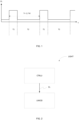
- FIG. 1 is a temporal representation of an EL signal for controlling the activation and deactivation (suppression) of a lighting beam in the visible light spectrum, in a LIGHT lighting device, according to a particular and non-limiting embodiment of the invention.
- the EL signal varies according to time t and periodically takes two successive states. According to the preferred embodiment, an assertion of the EL signal in the high state controls an activation of the lighting beam of the LIGHT lighting device capable of thus illuminating, discontinuously, graphic and/or textual content on any support, such as a book, for example.
- the EL signal deactivates (suppresses or inhibits) the light beam of the lighting module when it is positioned in the low state.
- T1 is the activation period of the light beam in the visible light spectrum, i.e. the period of illumination of a medium bearing a pattern representing graphic and/or textual content towards which the beam is oriented.
- T2 is the period, called the deactivation period, during which the beam is removed or made inactive, or in other words the period during which the graphic and/or textual content on a medium towards which the beam is oriented is no longer illuminated by the beam.
- graphics content are to be interpreted here as any content represented on any medium, in particular in paper format but not only, and consisting of elementary elements such as, for example, juxtaposed points or pixels, so that the content represents elements of various shapes and in particular one or more textual contents constructed from signs or symbols of one or more alphabets.
- textual content affixed to a medium corresponds here to content interpretable in one or more languages, capable of being read and interpreted by a subject, user of the lighting device, positioned so as to look at the medium thus illuminated for a reading or viewing operation.
- Such a device is, for example, a desk lamp, a torch, a headlamp, a pen-lamp, a flashlight, a telephone lamp, a smartphone lamp, a watch-lamp, a key ring lamp, a ceiling light, a floor lamp, a light bulb, a lighting tube, a projector, an automobile projector, an overhead projector, a luminous wall covering, a luminous carpet, a luminous bracelet, a luminous frame, a mini-lamp to be positioned on a book by means of a fastening system, a device configured for interior lighting (of a room) or a device configured for exterior lighting, urban or not. This list of examples is not exhaustive.
- the duty cycle T1/(T1+T2) between the periods of activation and deactivation (or inhibition) of the light beam, respectively of durations T1 and T2 has a value between 15% and 30% of the cycle, and the frequency Fd of variation of the EL signal is between 60 Hz and 90 Hz.
- the signal frequency is equal to 70 Hz or 84 Hz and the duty cycle T1 / (T1+T2) is equal to 20%.
- control signal EL can be easily forced for a long time into its state associated with an activation of the light beam, which corresponds to a disengagement of the lighting method implemented in the LIGHT device according to the invention. It would thus be possible not to implement the method for controlling a light beam, in a lighting device according to the invention, in the case where, for a non-dyslexic subject, visual discomfort would appear due to the discontinuity of activation of the lighting beam.
- FIG 2 is a structural representation of a LIGHT lighting device according to a particular and non-limiting embodiment of the invention.
- This figure represents the overall architecture of the LIGHT lighting device, also commonly called a "lamp".
- the LIGHT device comprises two main modules which are a CTRLU control unit and a LIMOD lighting module.
- the CTRLU control unit is the heart of the system in terms of control and comprises a conventional bistable (or chopper) circuit, suitable for generating the EL signal.
- the bistable chopping circuit of the CTRLU control unit delivers the EL signal characterized by the frequency Fd and by its duty cycle T1/(T1+T2).
- the CTRLU control unit comprises all the usual elements implemented in such an architecture, such as, by way of examples, one or more operational amplifiers, resistors and capacitors, one or more diodes, a power supply, a reset circuit, a power supply supervision circuit, a power interface, a current amplifier, the list of these elements is not exhaustive.
- the CTRLU module comprises a bistable circuit built around an operational amplifier, coupled to a current amplification circuit.
- a current amplifier makes it possible to obtain sufficient average energy for correct lighting although the light beam thus generated is discontinuous.
- the LIMOD lighting module is a lighting module suitable for generating a light beam in the visible light spectrum, or substantially wider.
- the beam can be more or less focused to then be configured for lighting a more or less large surface.
- Such focusing can be achieved by using optical elements (lenses) or mechanical elements (diaphragms), or both at the same time.
- the light beam is produced from one or more electroluminescent objects of the LED type, from the English acronym "Light-Emitting Diode” and which means “light-emitting diode”.
- the light beam can be produced from other luminous elements, as long as the deactivation of the beam can be sufficiently fast to respect the cycles including periods of illumination and inhibition of the beam (periods of non-illumination).
- beam inhibition should be interpreted here as a total disappearance of the beam or a significant reduction in the level of illumination produced by the beam.
- the CTRLU control unit includes an EL signal at its output for activating (or extinguishing/inhibiting) the lighting beam, connected to the input of the LIMOD lighting module.
- the variations of the control signal of the lighting beam EL, operated by the control unit CTRLU comprising a bistable circuit, at a frequency Fd make it possible to act on the lighting of a graphic content represented on any medium, so that this graphic content is successively lit then less (or not at all) lit, periodically, on the medium, according to successive cycles of total length T operated at a predetermined frequency Fd.
- the successive lighting periods T1 each have a duration included in an interval of values ranging from 15 to 30% of the duration T of said cycles.
- the frequency Fd of the cycles (each comprising a period of activation of the beam and a period of deactivation of the beam) is between 60 and 90 Hz.
- the frequency Fd is fixed.
- the frequency Fd varies over time.
- the frequency Fd varies by increasing successive steps up to a maximum value according to a first speed, called the growth speed, then varies by decreasing in successive steps to a minimum value according to a second speed, called the decrease speed, the increasing and decreasing variations repeating themselves iteratively over time.
- the rate of decrease is equal to the rate of growth.
- the successive steps are of equal duration.
- the successive steps vary in duration so that the value of said frequency Fd evolves according to a triangle, saw, or sinusoid waveform between said maximum value and said minimum value.
- the duration T1 of the activation periods varies over time by evolving continuously or discontinuously between limit values ranging from 15 to 30% of the duration T of the cycles.
- “continuously” is understood to mean an evolution by increment of successive steps of equal durations.
- the wobbling phenomenon thus created and applied to the predetermined frequency Fd makes it possible to scan a large number of frequencies between 60 Hz and 90 Hz, some of which will be more effective for reading assistance. These more effective frequencies vary depending on the dyslexic subject. By scanning all the frequencies between 60 and 90 Hz, the device of the invention does not require any prior adjustment and becomes effective for a large number of users. This wobbling phenomenon thus makes it possible, in certain cases, to further reduce problems linked to dyslexic disorders.
- the lighting device LIGHT is configured to generate a first continuous light beam throughout its duration of use and a mobile or filtering device, controlled or moved, periodically masks or inhibits the light beam so that a second beam is generated with frequency and duty cycle characteristics such as those previously described (Fd included in 60 Hz and 90 Hz and T1/(T1+T2) between 15 and 30%.
- a first beam can be interrupted cyclically by a rotating element having solid surfaces and empty surfaces, or opaque surfaces and translucent surfaces, adapted, by their rotation, to generate the second beam, the effect of which is then the same as that described in the first embodiment described above.
- the invention is not limited to the embodiments described above, but applies to any device for lighting graphic and/or textual content on any medium, implementing successive operations of activating a lighting beam and inhibiting this same beam, periodically, according to successive cycles operated at a predetermined frequency Fd between 60 Hz and 90 Hz such that the successive lighting periods T1 each have a duration included in an interval of values ranging from 15 to 30% of the duration T cycles operated.
Landscapes
- Health & Medical Sciences (AREA)
- Engineering & Computer Science (AREA)
- Life Sciences & Earth Sciences (AREA)
- Biomedical Technology (AREA)
- Physics & Mathematics (AREA)
- Psychiatry (AREA)
- Veterinary Medicine (AREA)
- Pathology (AREA)
- Animal Behavior & Ethology (AREA)
- General Health & Medical Sciences (AREA)
- Public Health (AREA)
- Biophysics (AREA)
- Psychology (AREA)
- Social Psychology (AREA)
- Child & Adolescent Psychology (AREA)
- Hospice & Palliative Care (AREA)
- Developmental Disabilities (AREA)
- Radiology & Medical Imaging (AREA)
- Nuclear Medicine, Radiotherapy & Molecular Imaging (AREA)
- Surgery (AREA)
- Molecular Biology (AREA)
- Heart & Thoracic Surgery (AREA)
- Medical Informatics (AREA)
- Educational Technology (AREA)
- General Physics & Mathematics (AREA)
- Optics & Photonics (AREA)
- Neurosurgery (AREA)
- General Engineering & Computer Science (AREA)
- Circuit Arrangement For Electric Light Sources In General (AREA)
- Facsimile Scanning Arrangements (AREA)
- Inspection Of Paper Currency And Valuable Securities (AREA)
- Push-Button Switches (AREA)
- Character Input (AREA)
- Electroluminescent Light Sources (AREA)
- Facsimile Heads (AREA)
Claims (15)
- Beleuchtungsvorrichtung (LIGHT) zur Leseerleichterung eines grafischen und/oder Textinhalts auf einem beliebigen Träger durch Legastheniker, wobei die Beleuchtungsvorrichtung eine Steuereinheit (CTRLU) umfasst, die zur Erzeugung eines Aktivierungs- und Deaktivierungssteuersignals (EL) eines nicht permanenten Lichtstrahls und eines Beleuchtungsmoduls (LIMOD), das zur Erzeugung des nicht permanenten Lichtstrahls in einem Spektrum sichtbaren Lichts angepasst ist, wobei die Beleuchtungsvorrichtung (LIGHT) durch das Aktivierungs- und Deaktivierungssteuersignal (EL) des nicht permanenten Lichtstrahls gesteuert ist,wobei die Beleuchtungsvorrichtung (LIGHT) dazu konfiguriert ist, periodisch den nicht permanenten Lichtstrahl gemäß aufeinanderfolgenden Zyklen zu aktivieren und zu deaktivieren, die mit einer vorbestimmten Frequenz Fd betrieben werden, die ein Kehrwert der Summe einer Aktivierungsperiode des nicht permanenten Lichtstrahls und einer Deaktivierungsperiode des nicht permanenten Lichtstrahls ist,wobei jeder Zyklus eine Dauer T aufweist und eine Aktivierungsperiode des nicht permanenten Lichtstrahls mit einer Dauer T1 umfasst, der eine Deaktivierungsperiode des nicht permanenten Lichtstrahls mit einer Dauer T2 vorausgeht oder folgt, wobei die vorbestimmte Frequenz Fd derart ist, dass Fd = 1/(T1+T2), wobei das Aktivierungs- und Deaktivierungssteuersignal (EL) des nicht permanenten Lichtstrahls durch die vorbestimmte Frequenz Fd und ihr zyklisches Verhältnis T1/(T1+T2) gekennzeichnet ist, wobei die vorbestimmte Frequenz Fd in einem Intervall von Werten liegt, die von 60 bis 90 Hz reichen, und die Dauer T1 der Aktivierungsperioden des nicht permanenten Lichtstrahls in einem Bereich von Werten liegen, der von 15 bis 30 % der Dauer T der Zyklen reicht, wobei die Vorrichtung dadurch gekennzeichnet ist, dass sie einen Schalter umfasst, der dazu konfiguriert ist, selektiv einen permanenten Lichtstrahl, als gewöhnliche Beleuchtung bezeichnet, und den nicht permanenten Lichtstrahl unter elektronischer Steuerung zu erhalten, um es einem Benutzer, der unter Legasthenie leidet, zu erlauben, seine üblichen Leseleistungen, die mit gewöhnlicher Beleuchtung erhalten werden, mit seinen Leistungen zu vergleichen, die unter elektronischer Steuerung des nicht permanenten Lichtstrahls erhalten werden.
- Beleuchtungsvorrichtung nach Anspruch 1, wobei die Steuereinheit (CTRLU) dazu konfiguriert ist, das Aktivierungs- und Deaktivierungssteuersignal (EL) des nicht permanenten Lichtstrahls durch aufeinander folgendes Annehmen eines hohen und eines niedrigen Zustands mit der Zeit zu variieren, wobei der nicht permanente Lichtstrahl im niedrigen Zustand deaktiviert und im hohen Zustand aktiviert ist.
- Beleuchtungsvorrichtung nach Anspruch 2, dadurch gekennzeichnet, dass die Steuereinheit (CTRLU) dazu konfiguriert ist, das Aktivierungs- und Deaktivierungssteuersignal (EL) des nicht permanenten Lichtstrahls auf verlängerte Art in einen Zustand zu zwingen, der einer Aktivierung des nicht permanenten Lichtstrahls zugeordnet ist, um ein Entkoppeln der Beleuchtung, die von der Beleuchtungsvorrichtung umgesetzt wird, zu erhalten.
- Beleuchtungsvorrichtung nach einem der Ansprüche 1 bis 3, wobei die vorbestimmte Frequenz Fd gleich 70 Hz oder 84 Hz ist, und das zyklische Verhältnis T1/(T1+T2) gleich 20 % ist.
- Beleuchtungsvorrichtung nach Anspruch 1 bis 4, wobei die Beleuchtungsvorrichtung (LIGHT) dazu konfiguriert ist, die vorbestimmte Frequenz Fd mit der Zeit zu variieren.
- Beleuchtungsvorrichtung nach Anspruch 4, wobei die vorbestimmte Frequenz Fd als Wobbelfrequenz bezeichnet wird, die die Hebbel-Mechanismen der Neuronen der Hirnrinde nutzt, und die Beleuchtungsvorrichtung (LIGHT) dazu konfiguriert ist, die vorbestimmte Frequenz Fd zu variieren, indem sie in aufeinanderfolgenden Schritten bis zu einem Höchstwert gemäß einer ersten Geschwindigkeit, der sogenannten Wachstumsgeschwindigkeit, ansteigt und dann in aufeinanderfolgenden Schritten bis zu einem Minimalwert gemäß einer zweiten Geschwindigkeit, der sogenannten Abklinggeschwindigkeit, abfällt, wobei die ansteigenden und abfallenden Variationen iterativ mit der Zeit wiederholt werden.
- Beleuchtungsvorrichtung nach Anspruch 6, wobei die Abklinggeschwindigkeit gleich der Wachstumsgeschwindigkeit ist.
- Beleuchtungsvorrichtung nach Anspruch 6, wobei die aufeinanderfolgenden Schritte gleiche Dauern aufweisen.
- Beleuchtungsvorrichtung nach Anspruch 6, wobei die Beleuchtungsvorrichtung (LIGHT) dazu konfiguriert ist, die aufeinanderfolgenden Schritte hinsichtlich der Dauer derart zu variieren, dass sich der Wert der vorbestimmten Frequenz Fd gemäß einer Dreiecks-, Säge- oder Sinuswellenform zwischen dem Höchstwert und dem Minimalwert entwickelt.
- Beleuchtungsvorrichtung nach einem der vorstehenden Ansprüche, wobei die Beleuchtungsvorrichtung (LIGHT) dazu konfiguriert ist, die Dauer T1 der Aktivierungsperioden des nicht permanenten Lichtstrahls mit der Zeit zu variieren.
- Beleuchtungsvorrichtung nach einem der vorstehenden Ansprüche, wobei der nicht permanente Lichtstrahl ausgehend von einem oder mehreren Elementen vom Typ LED erzeugt wird.
- Beleuchtungsvorrichtung nach einem der vorstehenden Ansprüche, dadurch gekennzeichnet, dass sie von einem Typ ist, der in der folgenden Liste enthalten ist: eine Bürolampe, eine Stablampe, eine Stirnlampe, eine Stiftlampe, eine Taschenlampe, eine Telefonlampe, eine Smartphone-Lampe, eine Uhr-Lampe, eine Schlüsselanhängerlampe, eine Deckenleuchte, eine Stehlampe, eine Glühbirne, ein Leuchtrohr, ein Projektor, ein Autoscheinwerfer, ein Overheadprojektor, eine leuchtende Wandverkleidung, ein Leuchtteppich, ein Leuchtarmband, ein Leuchtrahmen, eine Minilampe, die auf einem Buch positioniert wird, eine Vorrichtung, die für die Innenbeleuchtung konfiguriert ist, oder auch eine Vorrichtung, die für eine Außenbeleuchtung, städtisch oder nicht städtisch, konfiguriert ist.
- Beleuchtungsvorrichtung nach einem der vorstehenden Ansprüche, dadurch gekennzeichnet, dass es sich um eine Bürolampe oder eine auf einem Buch zu positionierende Minilampe handelt.
- Verfahren zur Leseerleichterung eines grafischen und/oder Textinhalts auf einem beliebigen Träger durch einen Legastheniker, dadurch gekennzeichnet, dass es eine Beleuchtungsvorrichtung nach einem der vorstehenden Ansprüche umfasst.
- Verfahren zum Erleichtern des Lesens eines grafischen und/oder Textinhalts nach Anspruch 14, wobei die vorbestimmte Frequenz Fd durch einen Benutzer der Beleuchtungsvorrichtung festgelegt wird.
Applications Claiming Priority (3)
| Application Number | Priority Date | Filing Date | Title |
|---|---|---|---|
| FR1701200A FR3074008B1 (fr) | 2017-11-20 | 2017-11-20 | Dispositif d'eclairage facilitant la lecture. |
| PCT/FR2018/052012 WO2019097128A1 (fr) | 2017-11-20 | 2018-08-03 | Dispositif d'eclairage facilitant la lecture |
| EP18762368.1A EP3714661B1 (de) | 2017-11-20 | 2018-08-03 | Beleuchtungsvorrichtung, die das lesen erleichtert |
Related Parent Applications (2)
| Application Number | Title | Priority Date | Filing Date |
|---|---|---|---|
| EP18762368.1A Division-Into EP3714661B1 (de) | 2017-11-20 | 2018-08-03 | Beleuchtungsvorrichtung, die das lesen erleichtert |
| EP18762368.1A Division EP3714661B1 (de) | 2017-11-20 | 2018-08-03 | Beleuchtungsvorrichtung, die das lesen erleichtert |
Publications (3)
| Publication Number | Publication Date |
|---|---|
| EP4138517A1 EP4138517A1 (de) | 2023-02-22 |
| EP4138517C0 EP4138517C0 (de) | 2025-03-05 |
| EP4138517B1 true EP4138517B1 (de) | 2025-03-05 |
Family
ID=60955085
Family Applications (2)
| Application Number | Title | Priority Date | Filing Date |
|---|---|---|---|
| EP18762368.1A Active EP3714661B1 (de) | 2017-11-20 | 2018-08-03 | Beleuchtungsvorrichtung, die das lesen erleichtert |
| EP22200459.0A Active EP4138517B1 (de) | 2017-11-20 | 2018-08-03 | Beleuchtungsvorrichtung mit leseerleichterung |
Family Applications Before (1)
| Application Number | Title | Priority Date | Filing Date |
|---|---|---|---|
| EP18762368.1A Active EP3714661B1 (de) | 2017-11-20 | 2018-08-03 | Beleuchtungsvorrichtung, die das lesen erleichtert |
Country Status (14)
| Country | Link |
|---|---|
| US (2) | US10631382B2 (de) |
| EP (2) | EP3714661B1 (de) |
| CN (1) | CN111543123B (de) |
| AU (1) | AU2018367297B2 (de) |
| BR (1) | BR112020010128B1 (de) |
| CA (1) | CA3082387A1 (de) |
| DK (1) | DK3714661T3 (de) |
| ES (2) | ES3029876T3 (de) |
| FI (1) | FI3714661T3 (de) |
| FR (1) | FR3074008B1 (de) |
| HU (1) | HUE061024T2 (de) |
| PL (1) | PL3714661T3 (de) |
| PT (1) | PT3714661T (de) |
| WO (1) | WO2019097128A1 (de) |
Families Citing this family (3)
| Publication number | Priority date | Publication date | Assignee | Title |
|---|---|---|---|---|
| FR3074008B1 (fr) | 2017-11-20 | 2021-05-21 | Floch Albert Le | Dispositif d'eclairage facilitant la lecture. |
| US12317386B2 (en) * | 2018-11-05 | 2025-05-27 | Aleddra Inc. | Lighting apparatus with invisible strobing |
| FR3139635A1 (fr) | 2022-09-08 | 2024-03-15 | D-Opto | Système de lunettes actives pour faciliter la lecture, et procédé correspondant. |
Family Cites Families (15)
| Publication number | Priority date | Publication date | Assignee | Title |
|---|---|---|---|---|
| US3842822A (en) * | 1973-07-16 | 1974-10-22 | H Levinson | Dysmetric dyslexia screening procedure |
| JP2006343500A (ja) * | 2005-06-08 | 2006-12-21 | Olympus Corp | 光源装置及び投影光学装置 |
| US9414458B2 (en) * | 2007-05-24 | 2016-08-09 | Federal Law Enforcement Development Services, Inc. | LED light control assembly and system |
| EP2263416B1 (de) * | 2008-03-06 | 2011-10-12 | Koninklijke Philips Electronics N.V. | Vorrichtung zur erzeugung von licht mit verschiedenen farben |
| CN101577994B (zh) * | 2008-05-06 | 2012-09-05 | 旭丽电子(广州)有限公司 | 用于校正照明设备的光感测装置与感测方法 |
| CN102890917B (zh) * | 2011-07-20 | 2015-09-02 | 乐金显示有限公司 | 背光驱动装置及其驱动方法、液晶显示设备及其驱动方法 |
| JP5884050B2 (ja) * | 2011-12-05 | 2016-03-15 | パナソニックIpマネジメント株式会社 | 点灯装置およびそれを備えた照明器具 |
| WO2013153476A1 (en) * | 2012-04-13 | 2013-10-17 | Koninklijke Philips N.V. | Method and device for visible light communication |
| US9039746B2 (en) * | 2013-02-08 | 2015-05-26 | Cree, Inc. | Solid state light emitting devices including adjustable melatonin suppression effects |
| US9037001B2 (en) * | 2013-03-14 | 2015-05-19 | Qualcomm Incorporated | Method and apparatus of decoding low-rate visible light communication signals |
| RU2671811C2 (ru) * | 2013-04-05 | 2018-11-07 | Филипс Лайтинг Холдинг Б.В. | Оборудование и способы для активируемых осветительных устройств |
| CN104252327A (zh) * | 2013-06-27 | 2014-12-31 | 腾讯科技(深圳)有限公司 | 阅读模式启用方法和装置 |
| US9661717B2 (en) * | 2014-03-31 | 2017-05-23 | Rakuten Kobo, Inc. | Multi-colored display illumination control for e-reading |
| US20160302271A1 (en) * | 2014-04-10 | 2016-10-13 | Clinton O. Fruitman | Power Conserving Method for Electric Lighting Supply |
| FR3074008B1 (fr) | 2017-11-20 | 2021-05-21 | Floch Albert Le | Dispositif d'eclairage facilitant la lecture. |
-
2017
- 2017-11-20 FR FR1701200A patent/FR3074008B1/fr active Active
-
2018
- 2018-01-30 US US15/883,233 patent/US10631382B2/en active Active
- 2018-08-03 ES ES22200459T patent/ES3029876T3/es active Active
- 2018-08-03 EP EP18762368.1A patent/EP3714661B1/de active Active
- 2018-08-03 CA CA3082387A patent/CA3082387A1/fr active Pending
- 2018-08-03 FI FIEP18762368.1T patent/FI3714661T3/fi active
- 2018-08-03 HU HUE18762368A patent/HUE061024T2/hu unknown
- 2018-08-03 AU AU2018367297A patent/AU2018367297B2/en active Active
- 2018-08-03 US US16/765,085 patent/US11134550B2/en active Active
- 2018-08-03 PT PT187623681T patent/PT3714661T/pt unknown
- 2018-08-03 WO PCT/FR2018/052012 patent/WO2019097128A1/fr not_active Ceased
- 2018-08-03 PL PL18762368.1T patent/PL3714661T3/pl unknown
- 2018-08-03 CN CN201880084790.2A patent/CN111543123B/zh active Active
- 2018-08-03 BR BR112020010128-1A patent/BR112020010128B1/pt active IP Right Grant
- 2018-08-03 DK DK18762368.1T patent/DK3714661T3/da active
- 2018-08-03 EP EP22200459.0A patent/EP4138517B1/de active Active
- 2018-08-03 ES ES18762368T patent/ES2938444T3/es active Active
Also Published As
| Publication number | Publication date |
|---|---|
| EP3714661B1 (de) | 2022-11-16 |
| PT3714661T (pt) | 2023-02-07 |
| FR3074008A1 (fr) | 2019-05-24 |
| FI3714661T3 (fi) | 2023-03-02 |
| BR112020010128A2 (pt) | 2020-11-10 |
| EP3714661A1 (de) | 2020-09-30 |
| FR3074008B1 (fr) | 2021-05-21 |
| AU2018367297B2 (en) | 2022-12-15 |
| EP4138517C0 (de) | 2025-03-05 |
| ES2938444T3 (es) | 2023-04-11 |
| US10631382B2 (en) | 2020-04-21 |
| CA3082387A1 (fr) | 2019-05-23 |
| US20190159324A1 (en) | 2019-05-23 |
| BR112020010128B1 (pt) | 2023-12-19 |
| CN111543123A (zh) | 2020-08-14 |
| ES3029876T3 (en) | 2025-06-25 |
| HUE061024T2 (hu) | 2023-05-28 |
| AU2018367297A1 (en) | 2020-06-18 |
| EP4138517A1 (de) | 2023-02-22 |
| PL3714661T3 (pl) | 2023-04-11 |
| CN111543123B (zh) | 2022-10-21 |
| DK3714661T3 (da) | 2023-02-06 |
| US20200359479A1 (en) | 2020-11-12 |
| US11134550B2 (en) | 2021-09-28 |
| WO2019097128A1 (fr) | 2019-05-23 |
Similar Documents
| Publication | Publication Date | Title |
|---|---|---|
| EP4138517B1 (de) | Beleuchtungsvorrichtung mit leseerleichterung | |
| US20100171441A1 (en) | Lighting system for creating a biological effect | |
| Frolov et al. | Postembryonic developmental changes in photoreceptors of the stick insect Carausius morosus enhance the shift to an adult nocturnal life-style | |
| CA3080726C (fr) | Dispositif optique facilitant la lecture | |
| EP3254538B1 (de) | Beleuchtungsvorrichtung mit optimaler stimulation von nichtvisuellen funktionen | |
| WO1991014399A1 (fr) | Papillometre | |
| CA3082378C (fr) | Methode d'affichage d'un contenu textuel, dispositif et programmes associes | |
| JP2003175109A (ja) | 照明装置、照明制御装置および照明制御方法 | |
| FR2833092A1 (fr) | Selection et detecteur de position et clavier virtuel, a l'aide de sources lumineuses | |
| Matteson | Effects of surround luminance on perceptual latency | |
| FR3128869A1 (fr) | Détection perfectionnée de potentiels évoqués | |
| FR3095493A1 (fr) | Dispositif d’éclairage | |
| US20140232989A1 (en) | Eye fixation system and method | |
| Mitchell | Driving Down I-75 at Night | |
| Dubois | Perceiving the world under the strobe of attention: psychophysical and electroencephalographical investigations |
Legal Events
| Date | Code | Title | Description |
|---|---|---|---|
| PUAI | Public reference made under article 153(3) epc to a published international application that has entered the european phase |
Free format text: ORIGINAL CODE: 0009012 |
|
| STAA | Information on the status of an ep patent application or granted ep patent |
Free format text: STATUS: REQUEST FOR EXAMINATION WAS MADE |
|
| 17P | Request for examination filed |
Effective date: 20221011 |
|
| AC | Divisional application: reference to earlier application |
Ref document number: 3714661 Country of ref document: EP Kind code of ref document: P |
|
| AK | Designated contracting states |
Kind code of ref document: A1 Designated state(s): AL AT BE BG CH CY CZ DE DK EE ES FI FR GB GR HR HU IE IS IT LI LT LU LV MC MK MT NL NO PL PT RO RS SE SI SK SM TR |
|
| RAP1 | Party data changed (applicant data changed or rights of an application transferred) |
Owner name: LE FLOCH, ALBERT Owner name: UNIVERSITE DE RENNES |
|
| REG | Reference to a national code |
Ref country code: DE Ref legal event code: R079 Free format text: PREVIOUS MAIN CLASS: H05B0045370000 Ipc: A61N0005060000 Ref country code: DE Ref legal event code: R079 Ref document number: 602018079981 Country of ref document: DE Free format text: PREVIOUS MAIN CLASS: H05B0045370000 Ipc: A61N0005060000 |
|
| RIC1 | Information provided on ipc code assigned before grant |
Ipc: F21Y 115/10 20160101ALI20240812BHEP Ipc: G02B 27/02 20060101ALI20240812BHEP Ipc: H05B 45/10 20200101ALI20240812BHEP Ipc: F21S 6/00 20060101ALI20240812BHEP Ipc: H05B 45/37 20200101ALI20240812BHEP Ipc: A61N 5/06 20060101AFI20240812BHEP |
|
| GRAP | Despatch of communication of intention to grant a patent |
Free format text: ORIGINAL CODE: EPIDOSNIGR1 |
|
| STAA | Information on the status of an ep patent application or granted ep patent |
Free format text: STATUS: GRANT OF PATENT IS INTENDED |
|
| RIC1 | Information provided on ipc code assigned before grant |
Ipc: F21Y 115/10 20160101ALI20240902BHEP Ipc: H05B 45/37 20200101ALI20240902BHEP Ipc: F21S 6/00 20060101ALI20240902BHEP Ipc: H05B 45/10 20200101ALI20240902BHEP Ipc: G02B 27/02 20060101ALI20240902BHEP Ipc: A61N 5/06 20060101AFI20240902BHEP |
|
| INTG | Intention to grant announced |
Effective date: 20241004 |
|
| GRAS | Grant fee paid |
Free format text: ORIGINAL CODE: EPIDOSNIGR3 |
|
| GRAA | (expected) grant |
Free format text: ORIGINAL CODE: 0009210 |
|
| STAA | Information on the status of an ep patent application or granted ep patent |
Free format text: STATUS: THE PATENT HAS BEEN GRANTED |
|
| AC | Divisional application: reference to earlier application |
Ref document number: 3714661 Country of ref document: EP Kind code of ref document: P |
|
| AK | Designated contracting states |
Kind code of ref document: B1 Designated state(s): AL AT BE BG CH CY CZ DE DK EE ES FI FR GB GR HR HU IE IS IT LI LT LU LV MC MK MT NL NO PL PT RO RS SE SI SK SM TR |
|
| REG | Reference to a national code |
Ref country code: GB Ref legal event code: FG4D Free format text: NOT ENGLISH |
|
| REG | Reference to a national code |
Ref country code: CH Ref legal event code: EP |
|
| REG | Reference to a national code |
Ref country code: IE Ref legal event code: FG4D Free format text: LANGUAGE OF EP DOCUMENT: FRENCH |
|
| REG | Reference to a national code |
Ref country code: DE Ref legal event code: R096 Ref document number: 602018079981 Country of ref document: DE |
|
| U01 | Request for unitary effect filed |
Effective date: 20250318 |
|
| U07 | Unitary effect registered |
Designated state(s): AT BE BG DE DK EE FI FR IT LT LU LV MT NL PT RO SE SI Effective date: 20250324 |
|
| REG | Reference to a national code |
Ref country code: ES Ref legal event code: FG2A Ref document number: 3029876 Country of ref document: ES Kind code of ref document: T3 Effective date: 20250625 |
|
| PG25 | Lapsed in a contracting state [announced via postgrant information from national office to epo] |
Ref country code: RS Free format text: LAPSE BECAUSE OF FAILURE TO SUBMIT A TRANSLATION OF THE DESCRIPTION OR TO PAY THE FEE WITHIN THE PRESCRIBED TIME-LIMIT Effective date: 20250605 |
|
| PG25 | Lapsed in a contracting state [announced via postgrant information from national office to epo] |
Ref country code: NO Free format text: LAPSE BECAUSE OF FAILURE TO SUBMIT A TRANSLATION OF THE DESCRIPTION OR TO PAY THE FEE WITHIN THE PRESCRIBED TIME-LIMIT Effective date: 20250605 |
|
| PG25 | Lapsed in a contracting state [announced via postgrant information from national office to epo] |
Ref country code: HR Free format text: LAPSE BECAUSE OF FAILURE TO SUBMIT A TRANSLATION OF THE DESCRIPTION OR TO PAY THE FEE WITHIN THE PRESCRIBED TIME-LIMIT Effective date: 20250305 |
|
| PG25 | Lapsed in a contracting state [announced via postgrant information from national office to epo] |
Ref country code: GR Free format text: LAPSE BECAUSE OF FAILURE TO SUBMIT A TRANSLATION OF THE DESCRIPTION OR TO PAY THE FEE WITHIN THE PRESCRIBED TIME-LIMIT Effective date: 20250606 |
|
| U20 | Renewal fee for the european patent with unitary effect paid |
Year of fee payment: 8 Effective date: 20250721 |
|
| PG25 | Lapsed in a contracting state [announced via postgrant information from national office to epo] |
Ref country code: SM Free format text: LAPSE BECAUSE OF FAILURE TO SUBMIT A TRANSLATION OF THE DESCRIPTION OR TO PAY THE FEE WITHIN THE PRESCRIBED TIME-LIMIT Effective date: 20250305 |
|
| PGFP | Annual fee paid to national office [announced via postgrant information from national office to epo] |
Ref country code: ES Payment date: 20250902 Year of fee payment: 8 |
|
| PG25 | Lapsed in a contracting state [announced via postgrant information from national office to epo] |
Ref country code: PL Free format text: LAPSE BECAUSE OF FAILURE TO SUBMIT A TRANSLATION OF THE DESCRIPTION OR TO PAY THE FEE WITHIN THE PRESCRIBED TIME-LIMIT Effective date: 20250305 |
|
| PGFP | Annual fee paid to national office [announced via postgrant information from national office to epo] |
Ref country code: GB Payment date: 20250723 Year of fee payment: 8 |
|
| PGFP | Annual fee paid to national office [announced via postgrant information from national office to epo] |
Ref country code: CH Payment date: 20250901 Year of fee payment: 8 |
|
| PG25 | Lapsed in a contracting state [announced via postgrant information from national office to epo] |
Ref country code: CZ Free format text: LAPSE BECAUSE OF FAILURE TO SUBMIT A TRANSLATION OF THE DESCRIPTION OR TO PAY THE FEE WITHIN THE PRESCRIBED TIME-LIMIT Effective date: 20250305 |
|
| PG25 | Lapsed in a contracting state [announced via postgrant information from national office to epo] |
Ref country code: SK Free format text: LAPSE BECAUSE OF FAILURE TO SUBMIT A TRANSLATION OF THE DESCRIPTION OR TO PAY THE FEE WITHIN THE PRESCRIBED TIME-LIMIT Effective date: 20250305 |
|
| PG25 | Lapsed in a contracting state [announced via postgrant information from national office to epo] |
Ref country code: IS Free format text: LAPSE BECAUSE OF FAILURE TO SUBMIT A TRANSLATION OF THE DESCRIPTION OR TO PAY THE FEE WITHIN THE PRESCRIBED TIME-LIMIT Effective date: 20250705 |
|
| PLBE | No opposition filed within time limit |
Free format text: ORIGINAL CODE: 0009261 |
|
| STAA | Information on the status of an ep patent application or granted ep patent |
Free format text: STATUS: NO OPPOSITION FILED WITHIN TIME LIMIT |
|
| REG | Reference to a national code |
Ref country code: CH Ref legal event code: L10 Free format text: ST27 STATUS EVENT CODE: U-0-0-L10-L00 (AS PROVIDED BY THE NATIONAL OFFICE) Effective date: 20260114 |
|
| 26N | No opposition filed |
Effective date: 20251208 |
|
| PG25 | Lapsed in a contracting state [announced via postgrant information from national office to epo] |
Ref country code: MC Free format text: LAPSE BECAUSE OF FAILURE TO SUBMIT A TRANSLATION OF THE DESCRIPTION OR TO PAY THE FEE WITHIN THE PRESCRIBED TIME-LIMIT Effective date: 20250305 |