EP4139820B1 - Dispositif de redémarrage pour un élément informatique et procédé de redémarrage d'un élément informatique - Google Patents
Dispositif de redémarrage pour un élément informatique et procédé de redémarrage d'un élément informatique Download PDFInfo
- Publication number
- EP4139820B1 EP4139820B1 EP21735212.9A EP21735212A EP4139820B1 EP 4139820 B1 EP4139820 B1 EP 4139820B1 EP 21735212 A EP21735212 A EP 21735212A EP 4139820 B1 EP4139820 B1 EP 4139820B1
- Authority
- EP
- European Patent Office
- Prior art keywords
- code
- software component
- protection
- booting
- hash
- Prior art date
- Legal status (The legal status is an assumption and is not a legal conclusion. Google has not performed a legal analysis and makes no representation as to the accuracy of the status listed.)
- Active
Links
Images



Classifications
-
- G—PHYSICS
- G06—COMPUTING OR CALCULATING; COUNTING
- G06F—ELECTRIC DIGITAL DATA PROCESSING
- G06F21/00—Security arrangements for protecting computers, components thereof, programs or data against unauthorised activity
- G06F21/50—Monitoring users, programs or devices to maintain the integrity of platforms, e.g. of processors, firmware or operating systems
- G06F21/57—Certifying or maintaining trusted computer platforms, e.g. secure boots or power-downs, version controls, system software checks, secure updates or assessing vulnerabilities
- G06F21/575—Secure boot
-
- G—PHYSICS
- G06—COMPUTING OR CALCULATING; COUNTING
- G06F—ELECTRIC DIGITAL DATA PROCESSING
- G06F9/00—Arrangements for program control, e.g. control units
- G06F9/06—Arrangements for program control, e.g. control units using stored programs, i.e. using an internal store of processing equipment to receive or retain programs
- G06F9/44—Arrangements for executing specific programs
- G06F9/4401—Bootstrapping
-
- H—ELECTRICITY
- H04—ELECTRIC COMMUNICATION TECHNIQUE
- H04L—TRANSMISSION OF DIGITAL INFORMATION, e.g. TELEGRAPHIC COMMUNICATION
- H04L9/00—Cryptographic mechanisms or cryptographic arrangements for secret or secure communications; Network security protocols
- H04L9/32—Cryptographic mechanisms or cryptographic arrangements for secret or secure communications; Network security protocols including means for verifying the identity or authority of a user of the system or for message authentication, e.g. authorization, entity authentication, data integrity or data verification, non-repudiation, key authentication or verification of credentials
- H04L9/3236—Cryptographic mechanisms or cryptographic arrangements for secret or secure communications; Network security protocols including means for verifying the identity or authority of a user of the system or for message authentication, e.g. authorization, entity authentication, data integrity or data verification, non-repudiation, key authentication or verification of credentials using cryptographic hash functions
- H04L9/3242—Cryptographic mechanisms or cryptographic arrangements for secret or secure communications; Network security protocols including means for verifying the identity or authority of a user of the system or for message authentication, e.g. authorization, entity authentication, data integrity or data verification, non-repudiation, key authentication or verification of credentials using cryptographic hash functions involving keyed hash functions, e.g. message authentication codes [MACs], CBC-MAC or HMAC
-
- G—PHYSICS
- G06—COMPUTING OR CALCULATING; COUNTING
- G06F—ELECTRIC DIGITAL DATA PROCESSING
- G06F2221/00—Indexing scheme relating to security arrangements for protecting computers, components thereof, programs or data against unauthorised activity
- G06F2221/03—Indexing scheme relating to G06F21/50, monitoring users, programs or devices to maintain the integrity of platforms
- G06F2221/034—Test or assess a computer or a system
Definitions
- the present invention relates to a boot device for a computer element for booting the computer element. Furthermore, the present invention relates to a computer element with a boot device and a method for booting a computer element.
- the boot process also called the "start process”
- start process the boot process of the computer element secure in order to ensure that the expected functionality is realized when booting.
- the next software loaded is integer.
- a digital signature, a hash value or the like of the loaded software can be determined and checked before it is executed.
- the protection method used to check the loaded software as well as the digital signature, the hash value or the like used can form an unchangeable program code of the boot device, which is specified by the manufacturer of the boot device.
- the relevant state of the art is in US8560823 to find.
- an object of the present invention is to enable improved booting of a computer element.
- the protection code can be changed at least partially from outside the boot device, a user of the boot device (for example an end user of the boot device or a machine manufacturer who integrates the computer element into his machine) has in particular the possibility of opting for a specific cryptographic protection method.
- the user of the boot device can implement his own protection solution without having to rely on the solution implemented by the manufacturer of the boot device.
- a separate implementation for the authentication, integrity check and/or confidentiality protection of the boot device can be defined.
- the protection code is updatable and can, for example, be modified so that a new (modified) protection code also offers protection against new technologies, such as quantum computer technologies. This can enable cryptoagility and increase the protection offered by the protection code.
- the boot device can be part of the computer element. It can also be referred to as a processing device, computing device or process device.
- the boot device is particularly suitable for booting the computer element.
- the boot device can be a processor chip, in particular a closed processor chip.
- the boot device is in particular a non-destructively accessible component that can only be accessed non-destructively via permitted interfaces, for example.
- the protection value is a trustworthy piece of information that is used to check the integrity of the software component by the protection unit.
- the component hash value is in particular a hash value of the software component that is assigned to the software component or is determined by the protection unit.
- the comparison hash value can be a hash value that is part of the protection code and is used for comparison with the component hash value. If the component hash value is identical to the comparison hash value, the protection unit determines, for example, that the software component is integer.
- the protection code comprises a changeable cryptographic code, in particular a changeable hash code, wherein the protection unit is suitable for executing the changeable hash code during the integrity check of the software component in order to carry out a hash value comparison and/or executing the changeable cryptographic code in order to carry out a cryptographic encryption, decryption and/or checking.
- the hash code defines in particular how a hash value check of the software component is carried out. During the hash value check, a hash value of the software component (component hash value) is determined in accordance with the hash code and compared with a comparison hash value.
- the boot device only allows the change in one of the cases mentioned above. If the boot device detects a change attempt that does not follow a permitted change process, the boot device can prohibit the change and/or issue a warning signal that warns of an unauthorized change (or a potential attack). These measures can increase the security of the Boot setup must be increased because only authorized users can make changes to the protection code.
- the manufacturer of the boot device can, for example, stipulate that changes to the protection code may only be made via an interface of the protection unit provided by a manufacturer of the boot device (for example via JTAG, Joint Test Action Group, whereby the interface can be deactivated during operation of the boot device, for example by eFuses), only according to a predetermined standard, using a predetermined change file provided by the manufacturer, with a predetermined configuration device provided by the manufacturer (for example via JTAG) and/or once (for this purpose the memory unit can include a one-time writable area, also known as OTP - one time programmable area). It is also possible to only allow writing to the memory unit and changing the protection code when the computer element is in configuration mode and the eFuse has not yet been burned.
- a change requirement code can be stored in the storage unit as program code, which is executed to check the admissibility of the change.
- the change requirement code cannot be changed and is determined in particular by the manufacturer of the boot device. It is also conceivable that the storage unit itself has properties that only allow certain changes to the protection code.
- the boot device is designed as a computer chip.
- the computer chip is in particular a processor chip (CPU).
- the computer element comprises a computer, an IO module, a CPU module or an FPGA system that is configurable as a software component when booting using a bit stream.
- the software component comprises hardware and/or software and is in particular a first bootloader stage.
- a computer element with a boot device according to the first aspect or according to an embodiment of the first aspect is proposed.
- a computer program product comprising instructions which, when the program is executed by a boot device (in particular by a boot device according to the first aspect or according to an embodiment of the first aspect), cause the boot device to carry out the method according to the third aspect is proposed.
- a computer program product such as a computer program means
- the Fig. 1 shows a computer element 1 with a boot device 2 according to a first embodiment.
- the computer element 1 comprises, in addition to the boot device 2, a software component 6.
- the computer element comprises a memory unit 3 for storing a protection code 4 and a protection unit 5.
- the arrow in the Fig. 1 indicates that the protection unit 5 has access to the software component 6.
- the computer element 1 of the Fig. 1 is an industrial automation system.
- the boot device 2 is designed as a processor (CPU) and serves, among other things, to start up (boot) the computer element 1.
- the method step S0 designates the start of the method described.
- the protection code 4 is stored in the memory unit 3.
- the protection code 4 is originally stored by a manufacturer of the processor 2.
- the protection code 4 is a program that is executed by the protection unit 5 when the computer element 1 is booted to check the integrity of the software component 6. It is also possible that the manufacturer of the processor 2 does not store an initial protection code 4, but merely provides storage space in the memory unit 3 that the user of the processor 2 can use for the protection code 4.
- the protection code 4 is at least partially modified from outside the processor 2.
- a user of the processor 2 accesses the storage unit 3 in the field and modifies the previously stored protection code 4 so that it meets desired requirements.
- the user can modify both cryptographic keys, hash values or the like that are used in the integrity check of the software component 6, as well as program parts that define the integrity check process itself.
- the user may use a device provided by the manufacturer of the processor 2 for this purpose.
- the protection unit 3 carries out an integrity check of the software component 6. To do this, the protection unit 3 executes the protection code 4 and applies it to information that is part of the software of the software component 6.
- the processor 2 of the Fig. 1 enables the user to flexibly change the protection code 4, which means that the integrity check of the software component 6 is carried out with greater security. This makes the entire boot process more secure.
- the Fig. 3 shows a method for booting the computer element 1 of the Fig. 1 according to a second embodiment.
- the method of the figure comprises - as well as the method of Fig. 2 - steps S0 to S3.
- the method of Fig. 3 the additional steps S4, S5 and S6.
- step S5 Depending on whether the protection unit 5 determines in the integrity check step S3 that the software component 6 is integer or not (step S4), either step S5 or step S6 is carried out. If it is determined in steps S3 and S4 that the software component 6 is integer, the software component 6 is booted by the protection unit 5 or by an additional boot unit (in the Fig. 1 not shown) is executed (step S5). If it is determined in steps S3 and S4 that the software component 6 is not integer, a corresponding warning signal is issued in step S6.
- the Fig. 4 shows a computer element 1 with a boot device 2 according to a second embodiment.
- a signature verification can be updated in the first boot step and, if necessary, replaced by a quantum computer-resistant signature method.
- a hash code 8 is stored in the protection unit 5, which is designed as a boot ROM. This hash code is a program with which the protection unit 5 carries out a hash value test on the software component 6.
- the software component 6 is in the example of Fig. 4 stored in an internal memory 9 of the computer element 1.
- the software component 6 comprises an associated component signature 6a and an associated component key 6b, which is a public key.
- the memory unit 3 comprises several eFuses 7a - 7c, which are provided empty by the manufacturer of the processor 2 and can be programmed by the user of the processor 2 and form at least part of the protection code 4.
- the user burns protection values into the eFuses 7a - 7c. This is preferably done in a secure environment.
- the user has burned a public key hash value into the eFuse 7a and a signature verification code hash value into the eFuse 7b.
- the eFuse 7c and other eFuses include additional public key hash values and signature verification code hash values. Old hash values can be invalidated either automatically or by burning a dedicated eFuse 7a - 7c.
- the signature verification code 10 In parallel with updating the hash values, the signature verification code 10, the component signature 6a and the component key 6b are also updated.
- the updates made by the processor 2 according to the second embodiment ( Fig. 4 ) are particularly relevant when the crypto algorithm (for example an asymmetric signature method) of the signature verification code 10 is broken or has vulnerabilities, but not the hash code 8.
- the Fig. 5 shows a method for booting the computer element 1 of the Fig. 4
- the process starts with step S0.
- the protection unit 5 receives the signature verification code 10 from the memory 9 (in the Fig. 4 represented by an arrow) and hashes it with the pre-stored hash code 8, thereby obtaining a first hash result (component hash value).
- step S8 this first hash result is compared with the signature verification code hash value of the eFuse 7b. If the comparison shows that the hash values are not identical, an error is reported in step S9 and the method is terminated. If the comparison in step S8 shows that the hash values are identical, the process continues with step S9.
- the protection unit 5 receives access to the software component 6 with the component signature 6a and the component key 6b.
- step S10 the protection unit 5 hashes the public key 6b, thereby obtaining a second hash result.
- step S11 it is checked whether the second hash result and the public key hash value in the eFuse 7a are identical. If they are not identical, an error is reported in step S9 and the process is terminated.
- step S12 the signature verification code 10 is used to check whether the component signature 6a is valid. If it is determined in step S12 that the component signature 6a is not valid, an error is reported in step S9 and the method is terminated. If it is determined in step S12 that the component signature 6a is valid, the software component is executed in step S5.
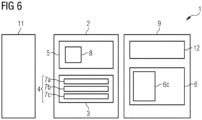
- the Fig. 6 shows a computer element 1 with a boot device 2 according to a third embodiment and relates to the know-how protection of FPGA bit streams. Symmetric cryptographic encryption methods are usually used for this, which are firmly integrated into the hardware by the hardware manufacturer.
- the processor 2 of the Fig. 6 it allows the use of a user-implemented method for authenticated decryption. To do this, the user burns the secret key into eFuses. This is explained in more detail below.
- the computer element 1 here is an FPGA system with an FPGA 11, a processor 2 and a memory 9.
- An FPGA bit stream 6 is stored in the memory 9 as a software component, which comprises authentication information 6c (“Authentication tag”) and an authenticated decryption code 12.
- the FPGA bit stream 6 is encrypted and is decrypted by the boot device 2 when the computer element 1 is started and used to configure the FPGA 11.
- the processor 2 of the Fig. 6 is identical to processor 2 from the Fig. 4 However, the protection values stored in the eFuses 7a - 7b are different.
- the protection values stored in the eFuses 7a - 7b are different.
- the eFuse 7c and further eFuses (not shown) contain further secret symmetric keys and authenticated decryption code hash values.
- the protection values contained in the eFuses 7a - 7c can be set in the field from outside the processor 2. Old hash values and keys can be invalidated either automatically or by burning a dedicated eFuse 7a - 7c.
- the secret symmetric key In contrast to the boot device of the second embodiment ( Fig. 4 ), in symmetric cryptography the secret symmetric key must be stored completely in eFuses 7a - 7c (not readable from outside). Therefore, a variable length is preferably possible for the secret symmetric key, since the key length depends on the selected method and the selected security level.
- the Fig. 7 shows a method for booting the computer element 1 of the Fig. 6
- the process starts with step S0.
- the authenticated decryption code 12 is hashed with the hash code 8, thereby obtaining a third hash result.
- step S14 the third hash result is compared with the authenticated decryption code hash value from the eFuse 7b. If the hash values compared in step S14 are not identical, an error is reported in step S9 and the method is terminated. If the hash values compared in step S14 are identical, the protection unit 5 receives access to the FPGA bit stream 6 and the authentication information 6c contained therein (step S15 of the Fig. 7 ).
- a step S16 the protection unit 5 decrypts the FPGA bit stream 6 based on the authenticated decryption key 12 using the secret symmetric key in the eFuse 7a and calculates comparison authentication information.
- the protection unit 5 compares the authentication information 6c with the comparison authentication information (checking the authentication information). If the check in step S17 shows a discrepancy, an error is reported in step S9 and the method is terminated. If the check in step S17 shows that the authentication information 6c is identical to the comparison authentication information, the protection unit 5 configures the FPGA 11 with the decrypted FPGA bit stream 6 in step S18.
- the Fig. 8 shows a computer element 1 with a boot device 2 according to a fourth embodiment.
- the memory unit 3 comprises several memory areas 3a, 3b, of which in the Fig. 8 only two are shown.
- the hash code 8, a cryptographic code, the signature verification code 10, the authenticated decryption code 12 or general "root-of-trust functions" can be defined and changed in these memory areas 3a, 3b from outside the boot device 2.
- the memory areas 3a, 3b can be written to once and can be designed, for example, as programmable read-only memories (PROM). Alternatively, rewritable memories can be used, which are particularly restricted to write access.
- the memory areas 3a, 3b only allow changes, for example, if the change is made in accordance with a permitted change process. namely, for example, only via an interface provided by a manufacturer of the boot device (for example via JTAG, Joint Test Action Group, where the interface can be deactivated during operation of the boot device, for example by eFuses); only according to a predetermined standard, using a predetermined change file provided by the manufacturer; only with a predetermined configuration device provided by the manufacturer (for example via JTAG) and/or only once. It is also possible to only allow writing to the memory unit 5 and changing the protection code 4 when the computer element 1 is in configuration mode and the eFuse 7a - 7c has not yet been burned.
- FIG. 8 A signature verification code 10 and an associated public key are stored in the memory area 3a. Booting is carried out using the processor 2 of the Fig. 8 analogous to the Fig. 4 to 7 described boot processes.
- the memory 9 described is part of the boot device 2 (internal memory), but it can also be present outside the boot device 2 (external memory).
Landscapes
- Engineering & Computer Science (AREA)
- Computer Security & Cryptography (AREA)
- Software Systems (AREA)
- Theoretical Computer Science (AREA)
- General Engineering & Computer Science (AREA)
- Computer Hardware Design (AREA)
- Physics & Mathematics (AREA)
- General Physics & Mathematics (AREA)
- Power Engineering (AREA)
- Computer Networks & Wireless Communication (AREA)
- Signal Processing (AREA)
- Storage Device Security (AREA)
Claims (14)
- Dispositif de démarrage (2) pour un élément d'ordinateur (1) pour démarrer l'élément d'ordinateur (1), dans lequel le dispositif de démarrage (2) comprend :une unité de mémoire (3) pour enregistrer un code de protection (4) ; etune unité de protection (5) pour vérifier l'intégrité d'un composant logiciel (6) de l'élément d'ordinateur (1) à l'aide du code de protection (4), dans lequel le dispositif de démarrage (2) est approprié pour exécuter le composant logiciel (6) pour démarrer l'élément d'ordinateur (1) ; dans lequelle code de protection (4) peut être modifié au moins partiellement depuis l'extérieur du dispositif de démarrage (2), dans lequel le dispositif de démarrage est configuré pour autoriser uniquement la modification du code de protection (4) depuis l'extérieur du dispositif de démarrage (2), si :le dispositif de démarrage (2) reconnaît que la modification du code de protection (4) se fait par le biais d'une interface, prévue par un fabricant du dispositif de démarrage (2), de l'unité de protection (5) ; et/oule dispositif de démarrage (2) reconnaît que la modification du code de protection (4) se fait avec un appareil de configuration prédéterminé du fabricant ; et/oule dispositif de démarrage (2) autorise uniquement une seule modification d'une zone respective du code de protection (4) et le dispositif de démarrage (2) reconnaît qu'il s'agit lors de la modification de la première modification du code de protection (4) de la zone respective.
- Dispositif de démarrage selon la revendication 1, dans lequel l'unité de mémoire (3) comprend au moins un fusible électronique (7a - 7c), et dans lequel le code de protection (4) peut être décrit une seule fois en gravant une valeur de protection dans le fusible électronique (7a - 7c).
- Dispositif de démarrage selon la revendication 2, dans lequel la valeur de protection comprend une valeur de hachage de comparaison et/ou une clé cryptographique, et
dans lequel l'unité de protection (5) est appropriée, lors de la vérification d'intégrité du composant logiciel (6) :pour comparer une valeur de hachage de composant du composant logiciel (6) à la valeur de hachage de comparaison, et/oupour décoder et/ou pour vérifier une information protégée cryptographiquement affectée au composant logiciel (6) à l'aide de la clé cryptographique. - Dispositif de démarrage selon l'une des revendications 1 à 3, dans lequel le code de protection (4) comprend un code cryptographique modifiable, plus particulièrement un code de hachage modifiable, et dans lequel l'unité de protection (5) est appropriée pour exécuter le code de hachage modifiable lors de la vérification d'intégrité du composant logiciel (6), pour effectuer une comparaison de valeur de hachage et/ou exécuter le code cryptographique modifiable, pour effectuer un codage, un décodage et/ou une vérification cryptographique.
- Dispositif de démarrage selon l'une des revendications 1 à 4, qui est configuré pour autoriser la modification du code de protection (4) depuis l'extérieur du dispositif de démarrage (2), uniquement si
le dispositif de démarrage (2) reconnaît que la modification du code de protection (4) se fait selon une norme prédéterminée et/ou à l'aide d'un fichier de modification prédéterminé qui sont prédéfinis par le fabricant du dispositif de démarrage (2). - Dispositif de démarrage selon l'une des revendications 1 à 5, lequel est conçu comme une puce d'ordinateur.
- Dispositif de démarrage selon l'une des revendications 1 à 6, dans lequel l'élément d'ordinateur (1) comprend un ordinateur, un module IO, un module CPU, ou un système FPGA, qui peut être configuré lors du démarrage à l'aide d'un train de bits comme composant logiciel (6).
- Dispositif de démarrage selon l'une des revendications 1 à 7, dans lequel le composant logiciel (6) comprend du matériel et/ou logiciel et est, plus particulièrement, une première étape de chargement de démarrage (en anglais : «first bootloader stage»).
- Dispositif de démarrage selon l'une des revendications 1 à 8, comprenant, en outre :
une unité de démarrage pour exécuter le composant logiciel (6), si l'unité de protection (5) détermine par la vérification de l'intégrité, que le composant logiciel (6) remplit toutes les exigences d'intégrité. - Dispositif de démarrage selon l'une des revendications 1 à 9, dans lequel l'unité de protection (5) est appropriée pour vérifier l'intégrité du composant logiciel (6) :pour hacher un code de vérification de signature (10) avec un code de hachage (8) du dispositif de démarrage (2), pour obtenir un premier résultat de hachage ;pour comparer le premier résultat de hachage à une valeur de hachage de code de vérification de signature de l'unité de mémoire (3) ;s'il résulte de la comparaison du premier résultat de hachage à la valeur de hachage du code de vérification de signature que le premier résultat de hachage et la valeur de hachage du code de vérification de signature sont identiques :obtenir le composant logiciel (6) incluant une signature (6a) du composant logiciel (6) et une clé publique (6b) du composant logiciel (6) ;hacher la clé publique (6b) du composant logiciel (6) avec le code de hachage du dispositif de démarrage (2) afin d'obtenir un deuxième résultat de hachage ;comparer le deuxième résultat de hachage à une valeur de hachage de clé publique de l'unité de mémoire (3) ;s'il résulte de la comparaison du deuxième résultat de hachage à la valeur de hachage de clé publique, que le deuxième résultat de hachage et la valeur de hachage de clé publique sont identiques, vérifier la signature (6a) du composant logiciel (6) à l'aide du code de vérification de signature (10) ; ets'il résulte de la vérification de la signature (6a) du composant logiciel (6) que la signature est correcte, exécuter le composant logiciel (6).
- Dispositif de démarrage selon l'une des revendications 1 à 9, dans lequel l'élément d'ordinateur (1) est un système FPGA et l'unité de protection (5) est appropriée pour vérifier l'intégrité et/ou le décodage du composant logiciel (6) :pour hacher un code de décodage authentifié (12) avec un code de hachage (8) du dispositif de démarrage (2) afin d'obtenir un troisième résultat de hachage ;pour comparer le troisième résultat de hachage à une valeur de hachage de code de décodage authentifié de l'unité de mémoire (3) ;s'il résulte de la comparaison du troisième résultat de hachage à la valeur de hachage de code de décodage authentifié que le troisième résultat de hachage et la valeur de hachage de code de décodage authentifié sont identiques :obtenir le composant logiciel (6), lequel est conçu comme un train de bits FPGA, incluant une information d'authentification (6c) du composant logiciel (6) par le dispositif de démarrage (2) ;décoder le train de bits FPGA (6) à l'aide du code de décodage authentifié (12) ;vérifier l'information d'authentification (6c) du composant logiciel (6) : etsi la vérification de l'information d'authentification (6c) est fructueuse, configurer un FPGA (11) du système FPGA (1) avec le train de bits décodé (6).
- Élément d'ordinateur (1) avec un dispositif de démarrage (2) selon l'une des revendications 1 à 11.
- Procédé de démarrage d'un élément d'ordinateur (1) avec un dispositif de démarrage (2) selon l'une des revendications 1 à 11, dans lequel le procédé comprend :l'enregistrement (S1) d'un code de protection (4) ;la réalisation (S3) d'une vérification d'intégrité d'un composant logiciel (6) de l'élément d'ordinateur (1) exécuté lors du démarrage de l'élément d'ordinateur (1) à l'aide du code de protection (4) ; etla modification au moins partielle (S2) du code de protection (4) depuis l'extérieur du dispositif de démarrage (2) .
- Produit de programme informatique, comprenant des instructions qui, lors de l'exécution du programme par un dispositif de démarrage (2), incitent celui-ci à exécuter le procédé selon la revendication 13.
Applications Claiming Priority (2)
| Application Number | Priority Date | Filing Date | Title |
|---|---|---|---|
| EP20181627.9A EP3929784A1 (fr) | 2020-06-23 | 2020-06-23 | Dispositif de redémarrage pour un élément informatique et procédé de redémarrage d'un élément informatique |
| PCT/EP2021/066442 WO2021259759A1 (fr) | 2020-06-23 | 2021-06-17 | Dispositif de démarrage pour élément d'ordinateur et procédé de démarrage pour élément d'ordinateur |
Publications (3)
| Publication Number | Publication Date |
|---|---|
| EP4139820A1 EP4139820A1 (fr) | 2023-03-01 |
| EP4139820B1 true EP4139820B1 (fr) | 2024-10-09 |
| EP4139820C0 EP4139820C0 (fr) | 2024-10-09 |
Family
ID=71138526
Family Applications (2)
| Application Number | Title | Priority Date | Filing Date |
|---|---|---|---|
| EP20181627.9A Withdrawn EP3929784A1 (fr) | 2020-06-23 | 2020-06-23 | Dispositif de redémarrage pour un élément informatique et procédé de redémarrage d'un élément informatique |
| EP21735212.9A Active EP4139820B1 (fr) | 2020-06-23 | 2021-06-17 | Dispositif de redémarrage pour un élément informatique et procédé de redémarrage d'un élément informatique |
Family Applications Before (1)
| Application Number | Title | Priority Date | Filing Date |
|---|---|---|---|
| EP20181627.9A Withdrawn EP3929784A1 (fr) | 2020-06-23 | 2020-06-23 | Dispositif de redémarrage pour un élément informatique et procédé de redémarrage d'un élément informatique |
Country Status (4)
| Country | Link |
|---|---|
| US (1) | US20230252154A1 (fr) |
| EP (2) | EP3929784A1 (fr) |
| CN (1) | CN115769204A (fr) |
| WO (1) | WO2021259759A1 (fr) |
Families Citing this family (3)
| Publication number | Priority date | Publication date | Assignee | Title |
|---|---|---|---|---|
| WO2023212698A1 (fr) * | 2022-04-28 | 2023-11-02 | Automaton, Inc. | Systèmes, dispositifs et procédés de démarrage sécurisé de capteurs rfid |
| DE102022116869A1 (de) * | 2022-07-06 | 2024-01-11 | Infineon Technologies Ag | Verfahren zum ausführen eines programms auf einer datenverarbeitungsvorrichtung |
| US12526140B2 (en) * | 2023-06-30 | 2026-01-13 | University Of Florida Research Foundation, Incorporated | System and method for secure cloud FPGA deployment |
Family Cites Families (45)
| Publication number | Priority date | Publication date | Assignee | Title |
|---|---|---|---|---|
| EP1372068A3 (fr) * | 2002-06-11 | 2006-02-08 | Seiko Epson Corporation | Système, méthode et programme pour réinscrire une mémoire flash |
| CN1553315A (zh) * | 2003-06-06 | 2004-12-08 | 微软公司 | 在安全引导装载程序中使用散列技术 |
| US20050138409A1 (en) * | 2003-12-22 | 2005-06-23 | Tayib Sheriff | Securing an electronic device |
| US7330977B2 (en) * | 2003-12-30 | 2008-02-12 | Lenovo Pte Ltd | Apparatus, system, and method for secure mass storage backup |
| US20080061817A1 (en) * | 2004-12-17 | 2008-03-13 | International Business Machines Corporation | Changing Chip Function Based on Fuse States |
| US7071533B1 (en) * | 2005-02-04 | 2006-07-04 | Polar Semiconductor, Inc. | Bipolar junction transistor antifuse |
| US8201240B2 (en) * | 2005-09-16 | 2012-06-12 | Nokia Corporation | Simple scalable and configurable secure boot for trusted mobile phones |
| US7921303B2 (en) * | 2005-11-18 | 2011-04-05 | Qualcomm Incorporated | Mobile security system and method |
| US20070162964A1 (en) * | 2006-01-12 | 2007-07-12 | Wang Liang-Yun | Embedded system insuring security and integrity, and method of increasing security thereof |
| US8291226B2 (en) * | 2006-02-10 | 2012-10-16 | Qualcomm Incorporated | Method and apparatus for securely booting from an external storage device |
| US7594104B2 (en) * | 2006-06-09 | 2009-09-22 | International Business Machines Corporation | System and method for masking a hardware boot sequence |
| DE102006046456B4 (de) * | 2006-09-29 | 2009-11-05 | Infineon Technologies Ag | Schaltkreis-Anordnung, Verfahren zum Hochfahren einer Schaltkreis-Anordnung, Verfahren zum Betreiben einer Schaltkreis-Anordnung und Computerprogrammprodukte |
| US8560823B1 (en) * | 2007-04-24 | 2013-10-15 | Marvell International Ltd. | Trusted modular firmware update using digital certificate |
| US20090024784A1 (en) * | 2007-07-20 | 2009-01-22 | Wang Liang-Yun | Method for writing data into storage on chip and system thereof |
| KR20090037712A (ko) * | 2007-10-12 | 2009-04-16 | 삼성전자주식회사 | 보안 부트-업되는 전자 장치, 그것의 해쉬값 계산 방법 및부트-업 방법 |
| RU2396594C2 (ru) * | 2008-08-06 | 2010-08-10 | Закрытое акционерное общество "Аладдин Р.Д." | Способ защищенной загрузки операционной системы компьютера с проверкой целостности |
| EP2372538A1 (fr) * | 2010-03-23 | 2011-10-05 | ST-Ericsson SA | CI de traitement dotée d'une mémoire non volatile intégrée |
| EP2856379B1 (fr) * | 2012-05-30 | 2016-10-12 | Freescale Semiconductor, Inc. | Dispositif semi-conducteur et procédé de fabrication de dispositif semi-conducteur |
| US9230112B1 (en) * | 2013-02-23 | 2016-01-05 | Xilinx, Inc. | Secured booting of a field programmable system-on-chip including authentication of a first stage boot loader to mitigate against differential power analysis |
| KR102108838B1 (ko) * | 2013-06-18 | 2020-05-11 | 삼성전자주식회사 | 임베디드 메모리 장치 및 그것을 포함한 메모리 컨트롤러 |
| US9471785B2 (en) * | 2013-08-30 | 2016-10-18 | Freescale Semiconductor, Inc. | Systems and methods for secure boot ROM patch |
| US9270469B2 (en) * | 2014-02-20 | 2016-02-23 | Xilinx, Inc. | Authentication using public keys and session keys |
| US9940048B2 (en) * | 2014-02-26 | 2018-04-10 | Macronix International Co., Ltd. | Nonvolatile memory data protection using nonvolatile protection codes and volatile protection codes |
| US9659191B2 (en) * | 2014-04-09 | 2017-05-23 | Seagate Technology Llc | Encryption key storage and modification in a data storage device |
| US10440000B2 (en) * | 2014-07-11 | 2019-10-08 | Cryptography Research, Inc. | Secure data provisioning |
| US9715601B2 (en) * | 2015-04-28 | 2017-07-25 | Atmel Corporation | Secure access in a microcontroller system |
| US10885196B2 (en) * | 2016-04-29 | 2021-01-05 | Hewlett Packard Enterprise Development Lp | Executing protected code |
| US10855462B2 (en) * | 2016-06-14 | 2020-12-01 | Honeywell International Inc. | Secure in-band upgrade using key revocation lists and certificate-less asymmetric tertiary key pairs |
| US10210333B2 (en) * | 2016-06-30 | 2019-02-19 | General Electric Company | Secure industrial control platform |
| CN106452783B (zh) * | 2016-09-26 | 2021-02-09 | 上海兆芯集成电路有限公司 | 计算机系统及安全执行的方法 |
| CN108021812B (zh) * | 2016-10-28 | 2020-08-18 | 深圳市中兴微电子技术有限公司 | 一种芯片的安全启动方法及装置 |
| TWI615732B (zh) * | 2016-12-27 | 2018-02-21 | 瑞昱半導體股份有限公司 | 電子裝置之電子元件、啟動電子裝置的方法及加密方法 |
| US10678927B2 (en) * | 2017-08-31 | 2020-06-09 | Texas Instruments Incorporated | Randomized execution countermeasures against fault injection attacks during boot of an embedded device |
| CN109614798B (zh) * | 2017-09-30 | 2022-12-27 | 华为技术有限公司 | 安全启动方法、装置及终端设备 |
| US11880468B2 (en) * | 2018-01-12 | 2024-01-23 | Unm Rainforest Innovations | Autonomous, self-authenticating and self-contained secure boot-up system and methods |
| JP7104525B2 (ja) * | 2018-02-21 | 2022-07-21 | 日立Astemo株式会社 | 電子制御装置、構成メモリのエラー検出方法 |
| JP6852009B2 (ja) * | 2018-03-20 | 2021-03-31 | 株式会社東芝 | 情報処理装置及び情報処理方法 |
| US11347861B2 (en) * | 2018-04-10 | 2022-05-31 | Raytheon Company | Controlling security state of commercial off the shelf (COTS) system |
| US10984107B2 (en) * | 2018-04-24 | 2021-04-20 | Mellanox Technologies, Ltd. | Secure boot |
| US10776488B2 (en) * | 2018-09-24 | 2020-09-15 | Dell Products L.P. | Extend root of trust to include firmware of individual components of a device |
| US10878100B2 (en) * | 2018-10-17 | 2020-12-29 | Intel Corporation | Secure boot processor with embedded NVRAM |
| US11468170B2 (en) * | 2018-12-07 | 2022-10-11 | Intel Corporation | Techniques for processor boot-up |
| TWI696113B (zh) * | 2019-01-02 | 2020-06-11 | 慧榮科技股份有限公司 | 用來進行組態管理之方法以及資料儲存裝置及其控制器 |
| CN110187920B (zh) * | 2019-04-01 | 2022-06-10 | 深圳市德明利技术股份有限公司 | 基于otp的主控芯片的boot代码扩展方法 |
| US11520891B1 (en) * | 2019-12-11 | 2022-12-06 | Amazon Technologies, Inc. | Secure boot of an integrated circuit |
-
2020
- 2020-06-23 EP EP20181627.9A patent/EP3929784A1/fr not_active Withdrawn
-
2021
- 2021-06-17 EP EP21735212.9A patent/EP4139820B1/fr active Active
- 2021-06-17 CN CN202180044958.9A patent/CN115769204A/zh active Pending
- 2021-06-17 WO PCT/EP2021/066442 patent/WO2021259759A1/fr not_active Ceased
- 2021-06-17 US US18/012,650 patent/US20230252154A1/en active Pending
Also Published As
| Publication number | Publication date |
|---|---|
| US20230252154A1 (en) | 2023-08-10 |
| CN115769204A (zh) | 2023-03-07 |
| EP4139820A1 (fr) | 2023-03-01 |
| EP4139820C0 (fr) | 2024-10-09 |
| EP3929784A1 (fr) | 2021-12-29 |
| WO2021259759A1 (fr) | 2021-12-30 |
Similar Documents
| Publication | Publication Date | Title |
|---|---|---|
| EP4139820B1 (fr) | Dispositif de redémarrage pour un élément informatique et procédé de redémarrage d'un élément informatique | |
| EP3136285B1 (fr) | Procédé et module de stockage pour des processus d'écriture et/ou processus de lecture protégés sur le module de stockage | |
| DE602005001497T2 (de) | Aktualisierung von Speicherinhalt in einem Datenverarbeitungssystem | |
| EP2727277B1 (fr) | Système de transmission sécurisée de données et procédé | |
| DE102009013384A1 (de) | System und Verfahren zur Bereitstellung einer sicheren Anwendungsfragmentierungsumgebung | |
| WO2011054639A1 (fr) | Module matériel cryptographique et procédé d'actualisation d'une clé cryptographique | |
| EP3811260B1 (fr) | Module cryptographique et procédé de fonctionnement | |
| DE102021104326A1 (de) | Sichere speicherverbesserungen für authentifizierungssysteme | |
| DE102016210788B4 (de) | Komponente zur Verarbeitung eines schützenswerten Datums und Verfahren zur Umsetzung einer Sicherheitsfunktion zum Schutz eines schützenswerten Datums in einer solchen Komponente | |
| DE102022129538A1 (de) | Datenintegritätsvalidierung von externem speicher | |
| EP4430501B1 (fr) | Procédés et systèmes informatiques associés pour sécuriser l'intégrité de données | |
| EP4150492B1 (fr) | Procédé et élément sécurisé de détection d'un ensemble électronique de confiance | |
| EP3819804A1 (fr) | Vérification de l'intégrité d'un contenu de registre | |
| EP3667529B1 (fr) | Procédé et dispositif d'authentification d'une configuration du réseau prédiffusé programmable par l'utilisateur fpga | |
| EP3924807A1 (fr) | Procédé et dispositif de traitement de données enregistrées dans un dispositif de mémoire | |
| DE102018211139A1 (de) | Steuergerät sowie Verfahren zu dessen Betrieb | |
| EP3798873B1 (fr) | Procédé de protection d'une application mise en uvre par ordinateur contre la manipulation | |
| EP3690690B1 (fr) | Procédé de vérification d'une validité des données et dispositif mis en uvre sur ordinateur destiné au traitement des données | |
| EP4297334B1 (fr) | Procédé de mise en oeuvre et d'utilisation de matériau cryptographique dans au moins un composant de système d'un système informatique | |
| DE102013223234A1 (de) | Zugriff auf einen Speicher | |
| EP3876123B1 (fr) | Agencement et procédé de fonctionnement pour un démarrage sécurisé d'un dispositif électronique | |
| DE102010040259A1 (de) | Transferverfahren zum kontrollierten Transfer von Daten zwischen Domänen und Verfahren zum Bereitstelleneines ausführbaren Transferprogrammcodes für ein Transferprogramm sowie eine entsprechende Transfervorrichtung und ein zugehöriges Sicherheitsmodul | |
| DE102015207004A1 (de) | Verfahren zum geschützten Zugriff auf Sicherheitsfunktionen eines Sicherheitsmoduls eines Hostsystems | |
| EP3893431A1 (fr) | Authentification d'une configuration d'un agencement de grille logique programmable sur le terrain | |
| EP4700625A1 (fr) | Vérification d'admissibilité de superposition de fichiers par un système de fichiers superposés |
Legal Events
| Date | Code | Title | Description |
|---|---|---|---|
| STAA | Information on the status of an ep patent application or granted ep patent |
Free format text: STATUS: UNKNOWN |
|
| STAA | Information on the status of an ep patent application or granted ep patent |
Free format text: STATUS: THE INTERNATIONAL PUBLICATION HAS BEEN MADE |
|
| PUAI | Public reference made under article 153(3) epc to a published international application that has entered the european phase |
Free format text: ORIGINAL CODE: 0009012 |
|
| STAA | Information on the status of an ep patent application or granted ep patent |
Free format text: STATUS: REQUEST FOR EXAMINATION WAS MADE |
|
| 17P | Request for examination filed |
Effective date: 20221124 |
|
| AK | Designated contracting states |
Kind code of ref document: A1 Designated state(s): AL AT BE BG CH CY CZ DE DK EE ES FI FR GB GR HR HU IE IS IT LI LT LU LV MC MK MT NL NO PL PT RO RS SE SI SK SM TR |
|
| DAV | Request for validation of the european patent (deleted) | ||
| DAX | Request for extension of the european patent (deleted) | ||
| GRAP | Despatch of communication of intention to grant a patent |
Free format text: ORIGINAL CODE: EPIDOSNIGR1 |
|
| STAA | Information on the status of an ep patent application or granted ep patent |
Free format text: STATUS: GRANT OF PATENT IS INTENDED |
|
| INTG | Intention to grant announced |
Effective date: 20240118 |
|
| GRAJ | Information related to disapproval of communication of intention to grant by the applicant or resumption of examination proceedings by the epo deleted |
Free format text: ORIGINAL CODE: EPIDOSDIGR1 |
|
| STAA | Information on the status of an ep patent application or granted ep patent |
Free format text: STATUS: REQUEST FOR EXAMINATION WAS MADE |
|
| GRAP | Despatch of communication of intention to grant a patent |
Free format text: ORIGINAL CODE: EPIDOSNIGR1 |
|
| INTC | Intention to grant announced (deleted) | ||
| STAA | Information on the status of an ep patent application or granted ep patent |
Free format text: STATUS: GRANT OF PATENT IS INTENDED |
|
| INTG | Intention to grant announced |
Effective date: 20240613 |
|
| GRAS | Grant fee paid |
Free format text: ORIGINAL CODE: EPIDOSNIGR3 |
|
| GRAA | (expected) grant |
Free format text: ORIGINAL CODE: 0009210 |
|
| STAA | Information on the status of an ep patent application or granted ep patent |
Free format text: STATUS: THE PATENT HAS BEEN GRANTED |
|
| AK | Designated contracting states |
Kind code of ref document: B1 Designated state(s): AL AT BE BG CH CY CZ DE DK EE ES FI FR GB GR HR HU IE IS IT LI LT LU LV MC MK MT NL NO PL PT RO RS SE SI SK SM TR |
|
| REG | Reference to a national code |
Ref country code: CH Ref legal event code: EP |
|
| REG | Reference to a national code |
Ref country code: DE Ref legal event code: R096 Ref document number: 502021005438 Country of ref document: DE |
|
| REG | Reference to a national code |
Ref country code: IE Ref legal event code: FG4D Free format text: LANGUAGE OF EP DOCUMENT: GERMAN |
|
| U01 | Request for unitary effect filed |
Effective date: 20241009 |
|
| U07 | Unitary effect registered |
Designated state(s): AT BE BG DE DK EE FI FR IT LT LU LV MT NL PT RO SE SI Effective date: 20241025 |
|
| PG25 | Lapsed in a contracting state [announced via postgrant information from national office to epo] |
Ref country code: HR Free format text: LAPSE BECAUSE OF FAILURE TO SUBMIT A TRANSLATION OF THE DESCRIPTION OR TO PAY THE FEE WITHIN THE PRESCRIBED TIME-LIMIT Effective date: 20241009 Ref country code: IS Free format text: LAPSE BECAUSE OF FAILURE TO SUBMIT A TRANSLATION OF THE DESCRIPTION OR TO PAY THE FEE WITHIN THE PRESCRIBED TIME-LIMIT Effective date: 20250209 |
|
| PG25 | Lapsed in a contracting state [announced via postgrant information from national office to epo] |
Ref country code: ES Free format text: LAPSE BECAUSE OF FAILURE TO SUBMIT A TRANSLATION OF THE DESCRIPTION OR TO PAY THE FEE WITHIN THE PRESCRIBED TIME-LIMIT Effective date: 20241009 |
|
| PG25 | Lapsed in a contracting state [announced via postgrant information from national office to epo] |
Ref country code: NO Free format text: LAPSE BECAUSE OF FAILURE TO SUBMIT A TRANSLATION OF THE DESCRIPTION OR TO PAY THE FEE WITHIN THE PRESCRIBED TIME-LIMIT Effective date: 20250109 |
|
| PG25 | Lapsed in a contracting state [announced via postgrant information from national office to epo] |
Ref country code: GR Free format text: LAPSE BECAUSE OF FAILURE TO SUBMIT A TRANSLATION OF THE DESCRIPTION OR TO PAY THE FEE WITHIN THE PRESCRIBED TIME-LIMIT Effective date: 20250110 |
|
| PG25 | Lapsed in a contracting state [announced via postgrant information from national office to epo] |
Ref country code: PL Free format text: LAPSE BECAUSE OF FAILURE TO SUBMIT A TRANSLATION OF THE DESCRIPTION OR TO PAY THE FEE WITHIN THE PRESCRIBED TIME-LIMIT Effective date: 20241009 |
|
| PG25 | Lapsed in a contracting state [announced via postgrant information from national office to epo] |
Ref country code: RS Free format text: LAPSE BECAUSE OF FAILURE TO SUBMIT A TRANSLATION OF THE DESCRIPTION OR TO PAY THE FEE WITHIN THE PRESCRIBED TIME-LIMIT Effective date: 20250109 |
|
| PG25 | Lapsed in a contracting state [announced via postgrant information from national office to epo] |
Ref country code: SM Free format text: LAPSE BECAUSE OF FAILURE TO SUBMIT A TRANSLATION OF THE DESCRIPTION OR TO PAY THE FEE WITHIN THE PRESCRIBED TIME-LIMIT Effective date: 20241009 |
|
| PG25 | Lapsed in a contracting state [announced via postgrant information from national office to epo] |
Ref country code: SK Free format text: LAPSE BECAUSE OF FAILURE TO SUBMIT A TRANSLATION OF THE DESCRIPTION OR TO PAY THE FEE WITHIN THE PRESCRIBED TIME-LIMIT Effective date: 20241009 |
|
| PG25 | Lapsed in a contracting state [announced via postgrant information from national office to epo] |
Ref country code: CZ Free format text: LAPSE BECAUSE OF FAILURE TO SUBMIT A TRANSLATION OF THE DESCRIPTION OR TO PAY THE FEE WITHIN THE PRESCRIBED TIME-LIMIT Effective date: 20241009 |
|
| U20 | Renewal fee for the european patent with unitary effect paid |
Year of fee payment: 5 Effective date: 20250620 |
|
| PLBE | No opposition filed within time limit |
Free format text: ORIGINAL CODE: 0009261 |
|
| STAA | Information on the status of an ep patent application or granted ep patent |
Free format text: STATUS: NO OPPOSITION FILED WITHIN TIME LIMIT |
|
| 26N | No opposition filed |
Effective date: 20250710 |
|
| REG | Reference to a national code |
Ref country code: CH Ref legal event code: H13 Free format text: ST27 STATUS EVENT CODE: U-0-0-H10-H13 (AS PROVIDED BY THE NATIONAL OFFICE) Effective date: 20260127 |
|
| PG25 | Lapsed in a contracting state [announced via postgrant information from national office to epo] |
Ref country code: MC Free format text: LAPSE BECAUSE OF FAILURE TO SUBMIT A TRANSLATION OF THE DESCRIPTION OR TO PAY THE FEE WITHIN THE PRESCRIBED TIME-LIMIT Effective date: 20241009 |
|
| GBPC | Gb: european patent ceased through non-payment of renewal fee |
Effective date: 20250617 |
|
| PG25 | Lapsed in a contracting state [announced via postgrant information from national office to epo] |
Ref country code: GB Free format text: LAPSE BECAUSE OF NON-PAYMENT OF DUE FEES Effective date: 20250617 |
|
| PG25 | Lapsed in a contracting state [announced via postgrant information from national office to epo] |
Ref country code: IE Free format text: LAPSE BECAUSE OF NON-PAYMENT OF DUE FEES Effective date: 20250617 |
|
| PG25 | Lapsed in a contracting state [announced via postgrant information from national office to epo] |
Ref country code: CH Free format text: LAPSE BECAUSE OF NON-PAYMENT OF DUE FEES Effective date: 20250630 |