EP4140149B1 - Détection de positions d'utilisation de système audio portable - Google Patents
Détection de positions d'utilisation de système audio portable Download PDFInfo
- Publication number
- EP4140149B1 EP4140149B1 EP21724979.6A EP21724979A EP4140149B1 EP 4140149 B1 EP4140149 B1 EP 4140149B1 EP 21724979 A EP21724979 A EP 21724979A EP 4140149 B1 EP4140149 B1 EP 4140149B1
- Authority
- EP
- European Patent Office
- Prior art keywords
- audio system
- wearable audio
- active portion
- user
- use position
- Prior art date
- Legal status (The legal status is an assumption and is not a legal conclusion. Google has not performed a legal analysis and makes no representation as to the accuracy of the status listed.)
- Active
Links
Images

Classifications
-
- H—ELECTRICITY
- H04—ELECTRIC COMMUNICATION TECHNIQUE
- H04R—LOUDSPEAKERS, MICROPHONES, GRAMOPHONE PICK-UPS OR LIKE ACOUSTIC ELECTROMECHANICAL TRANSDUCERS; ELECTRIC HEARING AIDS; PUBLIC ADDRESS SYSTEMS
- H04R5/00—Stereophonic arrangements
- H04R5/033—Headphones for stereophonic communication
-
- G—PHYSICS
- G02—OPTICS
- G02C—SPECTACLES; SUNGLASSES OR GOGGLES INSOFAR AS THEY HAVE THE SAME FEATURES AS SPECTACLES; CONTACT LENSES
- G02C11/00—Non-optical adjuncts; Attachment thereof
- G02C11/06—Hearing aids
-
- H—ELECTRICITY
- H04—ELECTRIC COMMUNICATION TECHNIQUE
- H04R—LOUDSPEAKERS, MICROPHONES, GRAMOPHONE PICK-UPS OR LIKE ACOUSTIC ELECTROMECHANICAL TRANSDUCERS; ELECTRIC HEARING AIDS; PUBLIC ADDRESS SYSTEMS
- H04R1/00—Details of transducers, loudspeakers or microphones
- H04R1/10—Earpieces; Attachments therefor ; Earphones; Monophonic headphones
- H04R1/1041—Mechanical or electronic switches, or control elements
-
- G—PHYSICS
- G02—OPTICS
- G02C—SPECTACLES; SUNGLASSES OR GOGGLES INSOFAR AS THEY HAVE THE SAME FEATURES AS SPECTACLES; CONTACT LENSES
- G02C11/00—Non-optical adjuncts; Attachment thereof
- G02C11/10—Electronic devices other than hearing aids
-
- H—ELECTRICITY
- H04—ELECTRIC COMMUNICATION TECHNIQUE
- H04R—LOUDSPEAKERS, MICROPHONES, GRAMOPHONE PICK-UPS OR LIKE ACOUSTIC ELECTROMECHANICAL TRANSDUCERS; ELECTRIC HEARING AIDS; PUBLIC ADDRESS SYSTEMS
- H04R2460/00—Details of hearing devices, i.e. of ear- or headphones covered by H04R1/10 or H04R5/033 but not provided for in any of their subgroups, or of hearing aids covered by H04R25/00 but not provided for in any of its subgroups
- H04R2460/03—Aspects of the reduction of energy consumption in hearing devices
Definitions
- This disclosure relates to detecting when wearable audio devices are in a proper use position.
- Wearable audio devices that are part of a wearable audio system are carried on the head, torso, or shoulders of a user. Wearable audio devices should begin full operation when they are put in their proper use position.
- the present invention relates to a method according to claim 1.
- Advantageous embodiments are set forth in dependent claims of the appended claim set.
- a method includes transmitting sound from a first active portion of a wearable audio system, receiving the transmitted sound at a second active portion of a wearable audio system, and estimating from the received sound whether the first active portion of a wearable audio system is in a use position carried on a user's body on a first side of the mid-sagittal plane and the second active portion of the wearable audio system is in a use position carried on the user's body on a second side of the mid-sagittal plane.
- a proximity sensor is used to determine if the first and second active portions of the wearable audio system are in the use position.
- an orientation sensor is used to determine if the first and second active portions of the wearable audio system are in the use position.
- the first and second active portions of the wearable audio system are open audio devices.
- the first and second active portions of the wearable audio system each comprise an off-ear headphone that comprises an audio driver that is configured to output sound proximate but not in an ear of the user.
- the first active portion of the wearable audio system is part of a first temple piece of eyeglass headphones and the second active portion of the wearable audio system is part of a second temple piece of the eyeglass headphones.
- the first and second active portions of the wearable audio system each comprise an audio driver and a microphone.
- the first active portion of the wearable audio system comprises an audio driver and the second active portion of the wearable audio system comprises a microphone.
- estimating from the received sound whether the first active portion of the wearable audio system is in a use position carried on a user's body on a first side of the mid-sagittal plane and the second active portion of the wearable audio system is in a use position carried on the user's body on a second side of the mid-sagittal plane comprises detecting whether the transmitted sound was received at the second active portion of the wearable audio system.
- estimating from the received sound whether the first active portion of the wearable audio system is in a use position carried on a user's body on a first side of the mid-sagittal plane and the second active portion of the wearable audio system is in a use position carried on the user's body on a second side of the mid-sagittal plane further comprises determining a level of the received sound. In an example determining a level of the received sound comprises determining whether the level of received sound is less than a threshold level. In an example the threshold level comprises a level of received sound when neither of the first and second active portions of the wearable audio system are in the use position.
- determining a relative level of the received sound comprises determining an acoustic transfer function between an audio driver of the first active portion of the wearable audio system and a microphone of the second active portion of the wearable audio system.
- a level of the transfer function is determined for at least one frequency above a threshold frequency.
- the threshold frequency is 1 kHz.
- estimating from the received sound whether the first active portion of the wearable audio system is in a use position carried on a user's body on a first side of the mid-sagittal plane and the second active portion of the wearable audio system is in a use position carried on the user's body on a second side of the mid-sagittal plane comprises comparing a level of the received sound to a threshold level determined when neither of the first and second active portions of the wearable audio system are in the use position.
- the transmitted sound is in an ultrasonic range.
- estimating from the received sound whether the first active portion of the wearable audio system is in a use position carried on a user's body on a first side of the mid-sagittal plane and the second active portion of the wearable audio system is in a use position carried on the user's body on a second side of the mid-sagittal plane comprises performing discrete Fourier transforms on received ultrasonic sounds.
- a method in another aspect includes transmitting sound from a first temple piece of eyeglass headphones, wherein the first temple piece comprises an audio driver that is configured to output sound proximate but not in an ear of the user, receiving the transmitted sound at a microphone of a second temple piece of the eyeglass headphones, wherein the second temple piece comprises an audio driver that is configured to output sound proximate but not in an ear of the user and a microphone, detecting whether the transmitted sound was received at the microphone, and determining a level of the received sound, to determine whether the eyeglass headphones are in a use position with the first temple piece proximate a first ear of the user and the second temple piece proximate a second ear of the user.
- a wearable audio device in another aspect includes a first off-ear headphone that comprises a first audio driver that is configured to output sound proximate but not in a first ear of a user, and a second off-ear headphone that comprises a second audio driver that is configured to output sound proximate but not in a second ear of the user, and a microphone having an output.
- a processor is configured to estimate from the microphone output whether the first off-ear headphone is in a use position proximate or on the first ear of the user and the second off-ear headphone is in a use position proximate or on the second ear of the user.
- estimating from the microphone output whether the first off-ear headphone is in a use position proximate or on the first ear of the user and the second off-ear headphone is in a use position proximate or on the second ear of the user comprises comparing a level of the microphone output to a threshold level determined when neither of the first and second off-ear headphones are in the use position.
- the first off-ear headphone is part of a first temple piece of eyeglass headphones and the second off-ear headphone is part of a second temple piece of the eyeglass headphones.
- a wearable audio system includes two active portions. In the proper use position one active portion is on one side of the mid-sagittal plane and the second active portion is on the other side of the mid-sagittal plane.
- the active portions are both open audio devices.
- the first open audio device includes a first off-ear headphone that comprises an audio driver that is configured to output sound proximate but not in a first ear of the user
- the second open audio device includes a second off-ear headphone that comprises a microphone and an audio driver that is configured to output sound proximate but not in a second ear of the user.
- a processor is used to estimate from the microphone output whether the off-ear headphones are in their use positions, with one proximate or on one ear of the user and the other proximate or on the other ear of the user.
- Such a wearable audio system can be used to accomplish a method for detecting whether the active portions of the wearable audio system are in their proper use positions.
- sound is transmitted from one active portion and is received at the other active portion.
- the method involves estimating from the received sound whether the active portions are in their use positions, with one of them carried on a user's body on one side of the mid-sagittal plane and the other one also carried on the user's body but on the other side of the mid-sagittal plane. This estimation can be based on detecting whether the transmitted sound was received at the receiving active portion, and determining the level of the received sound. The level of the received sound can be compared to a threshold level.
- the threshold level is the level of the received sound when neither of the active portions are in their use positions.
- the level of sound transmitted from a driver on one side of the head and received by a microphone on the other side of the head will, at least at higher frequencies, be less than a threshold level that is determined when the active portions are off the head and spaced apart by about the same distance as when they are on the head. This is because the head effectively attenuates frequencies greater than about 1000Hz.
- Open audio devices have one or more electro-acoustic transducers (i.e., audio drivers) that are located off of the ear canal opening.
- the open audio devices also include one or more microphones; the microphones can be used to pick up the user's voice and/or for noise cancellation.
- Open audio devices are further described in U.S. Patent 10,397,681 , the entire disclosure of which is incorporated herein by reference for all purposes.
- a headphone refers to a device that typically fits around, on, or in an ear and that radiates acoustic energy into the ear canal. Headphones are sometimes referred to as earphones, earpieces, headsets, earbuds, or sport headphones, and can be wired or wireless.
- a headphone includes an electro-acoustic transducer (driver) to transduce electrical audio signals to acoustic energy.
- the acoustic driver may or may not be housed in an earcup.
- a headphone may be a single stand-alone unit or one of a pair of headphones (each including at least one acoustic driver), one for each ear.
- a headphone may be connected mechanically to another headphone, for example by a headband and/or by leads that conduct audio signals to an acoustic driver in the headphone.
- a headphone may include components for wirelessly receiving audio signals.
- a headphone may include components of an active noise reduction (ANR) system. Headphones may also include other functionality, such as a microphone.
- ANR active noise reduction
- the headphone may include a headband or other support structure and at least one housing or other structure that contains a transducer and is arranged to sit on or over or proximate an ear of the user.
- the headband can be collapsible or foldable, and can be made of multiple parts.
- Some headbands include a slider, which may be positioned internal to the headband, that provides for any desired translation of the housing.
- Some headphones include a yoke pivotably mounted to the headband, with the housing pivotally mounted to the yoke, to provide for any desired rotation of the housing.
- An open audio device includes but is not limited to an off-ear headphone, i.e., a device that has one or more electro-acoustic transducers that are coupled to the head or ear (typically by a support structure) but do not occlude the ear canal opening.
- the open audio device is depicted as an off-ear headphone comprising audio eyeglasses, but that is not a limitation of the disclosure as the electro-acoustic transducer and the receiving microphone can be used in any device that is configured to deliver sound to one or both ears of the wearer where there are typically no ear cups and no ear buds.
- the wearable audio systems contemplated herein may include a variety of devices that include an over-the-ear hook, such as a wireless headset, hearing aid, eyeglasses, a protective hard hat, and other open ear audio devices.
- wearable audio systems including wearable audio devices in various form factors.
- active portion of a wearable audio system includes headphones and various other types of wearable audio devices such as head, shoulder or body-worn acoustic devices (e.g., audio eyeglasses or other head-mounted audio devices) that include one more acoustic transducers to receive and/or produce sound, with or without contacting the ears of a user.
- head, shoulder or body-worn acoustic devices e.g., audio eyeglasses or other head-mounted audio devices
- acoustic transducers to receive and/or produce sound, with or without contacting the ears of a user.
- Fig. 1 illustrates wearable audio system 10 that includes first active portion 20 and second active portion 40.
- portions 20 and 40 are functionally identical, although they do not need to be.
- active portion 20 is on one side of the mid-sagittal plane (e.g., on or near one ear) and the second active portion is on the other side of the mid-sagittal plane (e.g., on or near the other ear).
- Second active portion 40 includes audio driver 42 that receives audio signals from processor 46.
- Input audio signals are received by communications module 48, which can be enabled to receive signals wirelessly or via a wire, as is known in the field. Received signals are passed to processor 46.
- Other hardware that is typically included in a headphone such as amplifiers and filters) is not depicted, simply for the sake of clarity.
- active portion 40 further includes microphone 44 that provides received audio signals to processor 46.
- IMU 50 is optional, and a use of it is explained below.
- Proximity sensor 52 is also optional, and a use of it is explained below.
- Power source 54 (which is typically a battery power source) supplies power to all components that require power.
- Fig. 2 illustrates an exemplary method 55 for determining if the two active portions of a wearable audio system are in their proper use positions.
- this estimation is determined by transmitting sound from the audio driver of one active portion, step 56, receiving sound at the other active portion, step 57, and estimating, from a determination of whether the sound was received at the other active portion, whether the two active portions are in their proper use positions, step 58.
- the sound can be audio that is played during normal use of the audio system (such as listening to music or a podcast), or the sound can be specific for the purpose of estimating if the active portions are in their use positions.
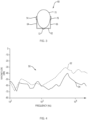
- Fig. 3 is a top view of eyeglass headphones 60 in their proper use position on head 70.
- Bridge 62 lies across the face and over nose 72.
- Right temple piece 64 extends from bridge 62 and sits over right ear 74.
- Left temple piece 66 extends from bridge 62 and sits over left ear 76.
- the two active portions of the wearable audio device are each part of one temple piece.
- each temple piece includes an audio driver that is configured to deliver sound from one or more openings in a temple piece, where an opening is close to but not in the ear canal opening of the ear over which the temple piece sits.
- Fig. 4 illustrates the magnitude across a frequency range of the acoustic transfer function between a driver of one temple piece of the eyeglass headphones of Fig. 3 to a microphone on the other temple piece.
- a processor is used to determine the acoustic transfer function between a driver in one temple piece and a microphone in the other temple piece.
- Processing can be accomplished by one or more processors that are part of the active portions of the wearable audio system, such as shown in Fig. 1 . Additionally or alternatively processing can be done by processor(s) of related devices, such as by a smartphone that is in communication with an active portion and/or cloud-based processing when the wearable audio system or a smartphone running an app is configured to communicate with the cloud.
- processor(s) of related devices such as by a smartphone that is in communication with an active portion and/or cloud-based processing when the wearable audio system or a smartphone running an app is configured to communicate with the cloud.
- the system can classify the eyeglass headphones (and active portions of other types of wearable audio devices) as either in place or not (e.g., on or off the ears, on or off of the head, or on or off of the shoulders or torso).
- a threshold transfer function at a single frequency e.g., a threshold of about -50dB at 10,000Hz
- Frequency-dependent bounds of multiple frequencies could also be used, which may provide multiple data points that can be compared and thus may help with the reliability of the on/off determination. Long-term averaging of results can be used to help avoid false positives or negatives.
- the transmitted sound is in the ultrasonic range so that it won't be heard by the user and so does not interfere with normal use of the wearable audio system. Sounds can be transmitted continuously or intermittently. Intermittent sound transmission will use less battery power, but the sound should be transmitted often enough to be useful as a means to determine whether the audio system is being worn or not. Pulses at discrete frequencies and at known time intervals can be used, and Fourier transforms can be performed on the received sound for the transfer function estimates.
- An efficient real-time implementation could leverage the well-known Goertzel algorithm, which is lean enough to run in the typical processors used in eyeglass headphones and other open audio devices and off-ear headphones that run off battery power.
- the audio system could be configured to automatically enter/exit a standby mode, to extend battery life. Music could automatically pause when the audio system is taken off, and resume when the system is put back on. Telephony control could automatically be transferred from a smartphone to the audio system when the system is donned, and transferred back to the phone when the system was doffed. Active noise reduction technology could automatically be enabled when the system was donned and disabled when the system was doffed.
- the gain of the system (e.g., when the system comprises a hearing assist product) could automatically decrease when the system is taken off and then increase back to normal when the system is put on; this could mitigate howling feedback instabilities that sometimes occur when hearing assistance products are donned and doffed.
- an orientation sensor and a proximity sensor can be used to assist in the determination of whether or not the active portions of the wearable audio device are in their proper use IMUs 30 and 50, Fig. 1 , can be used as orientation sensors, e.g., by using one or more accelerometers to determine the orientation relative to the Earth's gravitational field.
- the orientation can be used as a threshold for operating the received sound based use-position determination described above.
- the orientation sensing can be used as a check on the sound-based determination, or as a backup in case there is a problem with the sound-based determination.
- a proximity sensor such as an infrared sensor or a conductivity sensor can be used to determine when an active portion of the wearable audio system is near or on the skin or the head.
- sensors can be used as a threshold, as a check, or as a backup to the sound-based determination, as described for the orientation sensor.
- an accelerometer e.g., that is part of an IMU
- Some accelerometers operate in a frequency range above 1000Hz and so can be used in place of or as a backup to a microphone for sensing sound used in determining whether the active portions of the wearable audio system are in their proper use positions.
- Examples of the personal audio devices, systems and methods described herein comprise computer components and computer-implemented steps that will be apparent to those skilled in the art.
- the computer-implemented steps may be stored as computer-executable instructions on a computer-readable medium such as, for example, floppy disks, hard disks, optical disks, Flash ROMS, nonvolatile ROM, and RAM.
- the computer-executable instructions may be executed on a variety of processors such as, for example, microprocessors, digital signal processors, gate arrays, etc.
Landscapes
- Physics & Mathematics (AREA)
- Acoustics & Sound (AREA)
- Engineering & Computer Science (AREA)
- Signal Processing (AREA)
- Health & Medical Sciences (AREA)
- Otolaryngology (AREA)
- General Health & Medical Sciences (AREA)
- General Physics & Mathematics (AREA)
- Ophthalmology & Optometry (AREA)
- Optics & Photonics (AREA)
- Circuit For Audible Band Transducer (AREA)
- Headphones And Earphones (AREA)
- Stereophonic System (AREA)
Claims (15)
- Procédé (55), comprenant :la transmission (56) de son à partir d'une première partie active (20) d'un système audio portable (10) ;la réception (57) du son transmis au niveau d'une seconde partie active (40) du système audio portable ; etl'estimation (58) à partir du son reçu si la première partie active du système audio portable est dans une position d'utilisation portée sur le corps d'un utilisateur sur un premier côté du plan sagittal médian et la seconde partie active du système audio portable est dans une position d'utilisation portée sur le corps de l'utilisateur sur un second côté du plan sagittal médian.
- Procédé (55) selon la revendication 1, dans lequel les première et seconde parties actives du système audio portable sont des dispositifs audio ouverts.
- Procédé (55) selon la revendication 2, dans lequel les premier et second dispositifs audio ouverts comprennent chacun un écouteur hors oreille qui comprend un pilote audio qui est configuré pour émettre du son à proximité mais pas dans une oreille de l'utilisateur.
- Procédé (55) selon la revendication 1, dans lequel la première partie active du système audio portable fait partie d'une première pièce de tempe d'écouteurs de lunettes et la seconde partie active du système audio portable fait partie d'une seconde pièce de tempe des écouteurs de lunettes.
- Procédé (55) selon la revendication 1, dans lequel les première et seconde parties actives du système audio portable comprennent chacune un pilote audio et un microphone.
- Procédé (55) selon la revendication 1, dans lequel la première partie active du système audio portable comprend un pilote audio et la seconde partie active du système audio portable comprend un microphone.
- Procédé (55) selon la revendication 1, dans lequel l'estimation à partir du son reçu si la première partie active du système audio portable est dans une position d'utilisation portée sur le corps d'un utilisateur sur un premier côté du plan sagittal médian et la seconde partie active du système audio portable est dans une position d'utilisation portée sur le corps d'un utilisateur sur un second côté du plan sagittal médian comprend la détection si le son transmis a été reçu au niveau de la seconde partie active du système audio portable.
- Procédé (55) selon la revendication 7, dans lequel l'estimation à partir du son reçu si la première partie active du système audio portable est dans une position d'utilisation portée sur le corps d'un utilisateur sur un premier côté du plan sagittal médian et la seconde partie active du système audio portable est dans une position d'utilisation portée sur le corps d'un utilisateur sur un second côté du plan sagittal médian comprend en outre la détermination d'un niveau du son reçu.
- Procédé (55) selon la revendication 8, dans lequel la détermination d'un niveau du son reçu comprend la détermination si le niveau du son reçu est inférieur à un niveau seuil.
- Procédé (55) selon la revendication 9, dans lequel le niveau seuil comprend un niveau de son reçu lorsque aucune des première et seconde parties actives du système audio portable n'est dans la position d'utilisation.
- Procédé (55) selon la revendication 8, dans lequel la détermination d'un niveau du son reçu comprend la détermination d'une fonction de transfert acoustique entre un pilote audio de la première partie active du système audio portable et un microphone de la seconde partie active du système audio portable.
- Procédé (55) selon la revendication 11, dans lequel un niveau de la fonction de transfert est déterminé pour au moins une fréquence au-dessus d'une fréquence seuil.
- Procédé (55) selon la revendication 12, dans lequel la fréquence seuil est de 1 kHz.
- Procédé (55) selon la revendication 1, dans lequel le son transmis est dans une plage ultrasonique.
- Procédé (55) selon la revendication 14, dans lequel l'estimation à partir du son reçu si la première partie active du système audio portable est dans une position d'utilisation portée sur le corps d'un utilisateur sur un premier côté du plan sagittal médian et la seconde partie active du système audio portable est dans une position d'utilisation portée sur le corps d'un utilisateur sur un second côté du plan sagittal médian comprend la réalisation de transformations de Fourier discrètes sur des sons ultrasoniques reçus.
Applications Claiming Priority (2)
| Application Number | Priority Date | Filing Date | Title |
|---|---|---|---|
| US16/857,462 US11064282B1 (en) | 2020-04-24 | 2020-04-24 | Wearable audio system use position detection |
| PCT/US2021/028832 WO2021216995A1 (fr) | 2020-04-24 | 2021-04-23 | Détection de positions d'utilisation de système audio portable |
Publications (2)
| Publication Number | Publication Date |
|---|---|
| EP4140149A1 EP4140149A1 (fr) | 2023-03-01 |
| EP4140149B1 true EP4140149B1 (fr) | 2025-03-05 |
Family
ID=75888300
Family Applications (1)
| Application Number | Title | Priority Date | Filing Date |
|---|---|---|---|
| EP21724979.6A Active EP4140149B1 (fr) | 2020-04-24 | 2021-04-23 | Détection de positions d'utilisation de système audio portable |
Country Status (3)
| Country | Link |
|---|---|
| US (1) | US11064282B1 (fr) |
| EP (1) | EP4140149B1 (fr) |
| WO (1) | WO2021216995A1 (fr) |
Families Citing this family (2)
| Publication number | Priority date | Publication date | Assignee | Title |
|---|---|---|---|---|
| CN115314804A (zh) * | 2021-05-07 | 2022-11-08 | 华为技术有限公司 | 佩戴检测方法、可穿戴设备及存储介质 |
| US20240284140A1 (en) * | 2023-02-17 | 2024-08-22 | Bose Corporation | Cornering correction for spatial audio head tracking |
Family Cites Families (10)
| Publication number | Priority date | Publication date | Assignee | Title |
|---|---|---|---|---|
| US8109629B2 (en) * | 2003-10-09 | 2012-02-07 | Ipventure, Inc. | Eyewear supporting electrical components and apparatus therefor |
| EP2002438A2 (fr) * | 2006-03-24 | 2008-12-17 | Koninklijke Philips Electronics N.V. | Dispositif et procede pour traiter les donnees pour un appareil pouvant etre porte |
| US9838812B1 (en) * | 2016-11-03 | 2017-12-05 | Bose Corporation | On/off head detection of personal acoustic device using an earpiece microphone |
| US10397681B2 (en) | 2016-12-11 | 2019-08-27 | Base Corporation | Acoustic transducer |
| CN108882078B (zh) * | 2017-05-09 | 2021-01-26 | 腾讯科技(深圳)有限公司 | 头戴式耳机以及检测头戴式耳机佩戴的方法 |
| GB2596953B (en) * | 2017-10-10 | 2022-09-07 | Cirrus Logic Int Semiconductor Ltd | Headset on ear state detection |
| US11070912B2 (en) * | 2018-06-22 | 2021-07-20 | Facebook Technologies, Llc | Audio system for dynamic determination of personalized acoustic transfer functions |
| US10957299B2 (en) * | 2019-04-09 | 2021-03-23 | Facebook Technologies, Llc | Acoustic transfer function personalization using sound scene analysis and beamforming |
| US10848891B2 (en) * | 2019-04-22 | 2020-11-24 | Facebook Technologies, Llc | Remote inference of sound frequencies for determination of head-related transfer functions for a user of a headset |
| US11526589B2 (en) * | 2019-07-30 | 2022-12-13 | Meta Platforms Technologies, Llc | Wearer identification based on personalized acoustic transfer functions |
-
2020
- 2020-04-24 US US16/857,462 patent/US11064282B1/en active Active
-
2021
- 2021-04-23 EP EP21724979.6A patent/EP4140149B1/fr active Active
- 2021-04-23 WO PCT/US2021/028832 patent/WO2021216995A1/fr not_active Ceased
Also Published As
| Publication number | Publication date |
|---|---|
| WO2021216995A1 (fr) | 2021-10-28 |
| US11064282B1 (en) | 2021-07-13 |
| EP4140149A1 (fr) | 2023-03-01 |
Similar Documents
| Publication | Publication Date | Title |
|---|---|---|
| US12212912B2 (en) | Wearable audio device placement detection | |
| CN110326305B (zh) | 入耳式耳机的离头检测 | |
| EP3400720B1 (fr) | Prothèse auditive binaurale | |
| WO2020092989A1 (fr) | Commande de volume dans un dispositif audio ouvert | |
| CN113826157A (zh) | 用于耳戴式播放设备的音频系统和信号处理方法 | |
| CN114450745B (zh) | 用于耳戴式播放设备的音频系统和信号处理方法 | |
| US11058165B2 (en) | Wearable audio device with brim-mounted microphones | |
| CN109565626A (zh) | 具有主动降噪功能的声学开放式耳机 | |
| US11523229B2 (en) | Hearing devices with eye movement detection | |
| WO2021183356A1 (fr) | Traitement audio faisant appel à un modèle d'apprentissage automatique distribué | |
| US11540043B1 (en) | Active noise reduction earbud | |
| KR20230056726A (ko) | 골전도 이어폰의 작동상태를 최적화하기 위한 방법 | |
| EP4140149B1 (fr) | Détection de positions d'utilisation de système audio portable | |
| US11889257B2 (en) | Wearable audio device zero-crossing based parasitic oscillation detection | |
| US11882405B2 (en) | Acoustic earwax detection | |
| CN113994423A (zh) | 用于耳戴式播放设备的语音活动检测的音频系统和信号处理方法 | |
| WO2024010795A1 (fr) | Détection de placement de dispositif audio portable | |
| CN114007163A (zh) | 一种tws耳机自适应人体医学听力保护系统及使用方法 |
Legal Events
| Date | Code | Title | Description |
|---|---|---|---|
| STAA | Information on the status of an ep patent application or granted ep patent |
Free format text: STATUS: UNKNOWN |
|
| STAA | Information on the status of an ep patent application or granted ep patent |
Free format text: STATUS: THE INTERNATIONAL PUBLICATION HAS BEEN MADE |
|
| PUAI | Public reference made under article 153(3) epc to a published international application that has entered the european phase |
Free format text: ORIGINAL CODE: 0009012 |
|
| STAA | Information on the status of an ep patent application or granted ep patent |
Free format text: STATUS: REQUEST FOR EXAMINATION WAS MADE |
|
| 17P | Request for examination filed |
Effective date: 20221024 |
|
| AK | Designated contracting states |
Kind code of ref document: A1 Designated state(s): AL AT BE BG CH CY CZ DE DK EE ES FI FR GB GR HR HU IE IS IT LI LT LU LV MC MK MT NL NO PL PT RO RS SE SI SK SM TR |
|
| DAV | Request for validation of the european patent (deleted) | ||
| DAX | Request for extension of the european patent (deleted) | ||
| GRAP | Despatch of communication of intention to grant a patent |
Free format text: ORIGINAL CODE: EPIDOSNIGR1 |
|
| STAA | Information on the status of an ep patent application or granted ep patent |
Free format text: STATUS: GRANT OF PATENT IS INTENDED |
|
| RIC1 | Information provided on ipc code assigned before grant |
Ipc: G02C 11/00 20060101ALN20241126BHEP Ipc: H04R 5/033 20060101ALI20241126BHEP Ipc: G02C 11/06 20060101ALI20241126BHEP Ipc: H04R 1/10 20060101AFI20241126BHEP |
|
| INTG | Intention to grant announced |
Effective date: 20241205 |
|
| GRAS | Grant fee paid |
Free format text: ORIGINAL CODE: EPIDOSNIGR3 |
|
| GRAA | (expected) grant |
Free format text: ORIGINAL CODE: 0009210 |
|
| STAA | Information on the status of an ep patent application or granted ep patent |
Free format text: STATUS: THE PATENT HAS BEEN GRANTED |
|
| AK | Designated contracting states |
Kind code of ref document: B1 Designated state(s): AL AT BE BG CH CY CZ DE DK EE ES FI FR GB GR HR HU IE IS IT LI LT LU LV MC MK MT NL NO PL PT RO RS SE SI SK SM TR |
|
| REG | Reference to a national code |
Ref country code: GB Ref legal event code: FG4D |
|
| REG | Reference to a national code |
Ref country code: CH Ref legal event code: EP |
|
| REG | Reference to a national code |
Ref country code: IE Ref legal event code: FG4D |
|
| REG | Reference to a national code |
Ref country code: DE Ref legal event code: R096 Ref document number: 602021027146 Country of ref document: DE |
|
| PG25 | Lapsed in a contracting state [announced via postgrant information from national office to epo] |
Ref country code: RS Free format text: LAPSE BECAUSE OF FAILURE TO SUBMIT A TRANSLATION OF THE DESCRIPTION OR TO PAY THE FEE WITHIN THE PRESCRIBED TIME-LIMIT Effective date: 20250605 |
|
| PG25 | Lapsed in a contracting state [announced via postgrant information from national office to epo] |
Ref country code: FI Free format text: LAPSE BECAUSE OF FAILURE TO SUBMIT A TRANSLATION OF THE DESCRIPTION OR TO PAY THE FEE WITHIN THE PRESCRIBED TIME-LIMIT Effective date: 20250305 |
|
| PGFP | Annual fee paid to national office [announced via postgrant information from national office to epo] |
Ref country code: DE Payment date: 20250423 Year of fee payment: 5 |
|
| REG | Reference to a national code |
Ref country code: NL Ref legal event code: MP Effective date: 20250305 |
|
| PG25 | Lapsed in a contracting state [announced via postgrant information from national office to epo] |
Ref country code: ES Free format text: LAPSE BECAUSE OF FAILURE TO SUBMIT A TRANSLATION OF THE DESCRIPTION OR TO PAY THE FEE WITHIN THE PRESCRIBED TIME-LIMIT Effective date: 20250305 |
|
| REG | Reference to a national code |
Ref country code: LT Ref legal event code: MG9D |
|
| PG25 | Lapsed in a contracting state [announced via postgrant information from national office to epo] |
Ref country code: NO Free format text: LAPSE BECAUSE OF FAILURE TO SUBMIT A TRANSLATION OF THE DESCRIPTION OR TO PAY THE FEE WITHIN THE PRESCRIBED TIME-LIMIT Effective date: 20250605 |
|
| PG25 | Lapsed in a contracting state [announced via postgrant information from national office to epo] |
Ref country code: HR Free format text: LAPSE BECAUSE OF FAILURE TO SUBMIT A TRANSLATION OF THE DESCRIPTION OR TO PAY THE FEE WITHIN THE PRESCRIBED TIME-LIMIT Effective date: 20250305 |
|
| PG25 | Lapsed in a contracting state [announced via postgrant information from national office to epo] |
Ref country code: LV Free format text: LAPSE BECAUSE OF FAILURE TO SUBMIT A TRANSLATION OF THE DESCRIPTION OR TO PAY THE FEE WITHIN THE PRESCRIBED TIME-LIMIT Effective date: 20250305 |
|
| PG25 | Lapsed in a contracting state [announced via postgrant information from national office to epo] |
Ref country code: GR Free format text: LAPSE BECAUSE OF FAILURE TO SUBMIT A TRANSLATION OF THE DESCRIPTION OR TO PAY THE FEE WITHIN THE PRESCRIBED TIME-LIMIT Effective date: 20250606 Ref country code: BG Free format text: LAPSE BECAUSE OF FAILURE TO SUBMIT A TRANSLATION OF THE DESCRIPTION OR TO PAY THE FEE WITHIN THE PRESCRIBED TIME-LIMIT Effective date: 20250305 |
|
| REG | Reference to a national code |
Ref country code: AT Ref legal event code: MK05 Ref document number: 1774055 Country of ref document: AT Kind code of ref document: T Effective date: 20250305 |
|
| PG25 | Lapsed in a contracting state [announced via postgrant information from national office to epo] |
Ref country code: NL Free format text: LAPSE BECAUSE OF FAILURE TO SUBMIT A TRANSLATION OF THE DESCRIPTION OR TO PAY THE FEE WITHIN THE PRESCRIBED TIME-LIMIT Effective date: 20250305 |
|
| PG25 | Lapsed in a contracting state [announced via postgrant information from national office to epo] |
Ref country code: SE Free format text: LAPSE BECAUSE OF FAILURE TO SUBMIT A TRANSLATION OF THE DESCRIPTION OR TO PAY THE FEE WITHIN THE PRESCRIBED TIME-LIMIT Effective date: 20250305 |
|
| PG25 | Lapsed in a contracting state [announced via postgrant information from national office to epo] |
Ref country code: SM Free format text: LAPSE BECAUSE OF FAILURE TO SUBMIT A TRANSLATION OF THE DESCRIPTION OR TO PAY THE FEE WITHIN THE PRESCRIBED TIME-LIMIT Effective date: 20250305 |
|
| PG25 | Lapsed in a contracting state [announced via postgrant information from national office to epo] |
Ref country code: PT Free format text: LAPSE BECAUSE OF FAILURE TO SUBMIT A TRANSLATION OF THE DESCRIPTION OR TO PAY THE FEE WITHIN THE PRESCRIBED TIME-LIMIT Effective date: 20250707 |
|
| PG25 | Lapsed in a contracting state [announced via postgrant information from national office to epo] |
Ref country code: PL Free format text: LAPSE BECAUSE OF FAILURE TO SUBMIT A TRANSLATION OF THE DESCRIPTION OR TO PAY THE FEE WITHIN THE PRESCRIBED TIME-LIMIT Effective date: 20250305 Ref country code: IT Free format text: LAPSE BECAUSE OF FAILURE TO SUBMIT A TRANSLATION OF THE DESCRIPTION OR TO PAY THE FEE WITHIN THE PRESCRIBED TIME-LIMIT Effective date: 20250305 |
|
| PG25 | Lapsed in a contracting state [announced via postgrant information from national office to epo] |
Ref country code: AT Free format text: LAPSE BECAUSE OF FAILURE TO SUBMIT A TRANSLATION OF THE DESCRIPTION OR TO PAY THE FEE WITHIN THE PRESCRIBED TIME-LIMIT Effective date: 20250305 |
|
| PG25 | Lapsed in a contracting state [announced via postgrant information from national office to epo] |
Ref country code: EE Free format text: LAPSE BECAUSE OF FAILURE TO SUBMIT A TRANSLATION OF THE DESCRIPTION OR TO PAY THE FEE WITHIN THE PRESCRIBED TIME-LIMIT Effective date: 20250305 Ref country code: CZ Free format text: LAPSE BECAUSE OF FAILURE TO SUBMIT A TRANSLATION OF THE DESCRIPTION OR TO PAY THE FEE WITHIN THE PRESCRIBED TIME-LIMIT Effective date: 20250305 |
|
| PG25 | Lapsed in a contracting state [announced via postgrant information from national office to epo] |
Ref country code: RO Free format text: LAPSE BECAUSE OF FAILURE TO SUBMIT A TRANSLATION OF THE DESCRIPTION OR TO PAY THE FEE WITHIN THE PRESCRIBED TIME-LIMIT Effective date: 20250305 |
|
| PG25 | Lapsed in a contracting state [announced via postgrant information from national office to epo] |
Ref country code: SK Free format text: LAPSE BECAUSE OF FAILURE TO SUBMIT A TRANSLATION OF THE DESCRIPTION OR TO PAY THE FEE WITHIN THE PRESCRIBED TIME-LIMIT Effective date: 20250305 |
|
| PG25 | Lapsed in a contracting state [announced via postgrant information from national office to epo] |
Ref country code: IS Free format text: LAPSE BECAUSE OF FAILURE TO SUBMIT A TRANSLATION OF THE DESCRIPTION OR TO PAY THE FEE WITHIN THE PRESCRIBED TIME-LIMIT Effective date: 20250705 |
|
| REG | Reference to a national code |
Ref country code: CH Ref legal event code: H13 Free format text: ST27 STATUS EVENT CODE: U-0-0-H10-H13 (AS PROVIDED BY THE NATIONAL OFFICE) Effective date: 20251125 |
|
| REG | Reference to a national code |
Ref country code: DE Ref legal event code: R097 Ref document number: 602021027146 Country of ref document: DE |
|
| PG25 | Lapsed in a contracting state [announced via postgrant information from national office to epo] |
Ref country code: LU Free format text: LAPSE BECAUSE OF NON-PAYMENT OF DUE FEES Effective date: 20250423 |
|
| PG25 | Lapsed in a contracting state [announced via postgrant information from national office to epo] |
Ref country code: MC Free format text: LAPSE BECAUSE OF FAILURE TO SUBMIT A TRANSLATION OF THE DESCRIPTION OR TO PAY THE FEE WITHIN THE PRESCRIBED TIME-LIMIT Effective date: 20250305 |
|
| REG | Reference to a national code |
Ref country code: BE Ref legal event code: MM Effective date: 20250430 |
|
| PLBE | No opposition filed within time limit |
Free format text: ORIGINAL CODE: 0009261 |
|
| STAA | Information on the status of an ep patent application or granted ep patent |
Free format text: STATUS: NO OPPOSITION FILED WITHIN TIME LIMIT |
|
| PG25 | Lapsed in a contracting state [announced via postgrant information from national office to epo] |
Ref country code: DK Free format text: LAPSE BECAUSE OF FAILURE TO SUBMIT A TRANSLATION OF THE DESCRIPTION OR TO PAY THE FEE WITHIN THE PRESCRIBED TIME-LIMIT Effective date: 20250305 |
|
| REG | Reference to a national code |
Ref country code: CH Ref legal event code: L10 Free format text: ST27 STATUS EVENT CODE: U-0-0-L10-L00 (AS PROVIDED BY THE NATIONAL OFFICE) Effective date: 20260114 |
|
| PG25 | Lapsed in a contracting state [announced via postgrant information from national office to epo] |
Ref country code: BE Free format text: LAPSE BECAUSE OF NON-PAYMENT OF DUE FEES Effective date: 20250430 |
|
| PG25 | Lapsed in a contracting state [announced via postgrant information from national office to epo] |
Ref country code: CH Free format text: LAPSE BECAUSE OF NON-PAYMENT OF DUE FEES Effective date: 20250430 |
|
| 26N | No opposition filed |
Effective date: 20251208 |
|
| PGFP | Annual fee paid to national office [announced via postgrant information from national office to epo] |
Ref country code: GB Payment date: 20260319 Year of fee payment: 6 |
|
| PG25 | Lapsed in a contracting state [announced via postgrant information from national office to epo] |
Ref country code: IE Free format text: LAPSE BECAUSE OF NON-PAYMENT OF DUE FEES Effective date: 20250423 |
|
| PGFP | Annual fee paid to national office [announced via postgrant information from national office to epo] |
Ref country code: FR Payment date: 20260320 Year of fee payment: 6 |