EP4141117A1 - Nanostructures arn et procédés de fabrication et d'utilisation de nanostructures arn - Google Patents
Nanostructures arn et procédés de fabrication et d'utilisation de nanostructures arn Download PDFInfo
- Publication number
- EP4141117A1 EP4141117A1 EP22172228.3A EP22172228A EP4141117A1 EP 4141117 A1 EP4141117 A1 EP 4141117A1 EP 22172228 A EP22172228 A EP 22172228A EP 4141117 A1 EP4141117 A1 EP 4141117A1
- Authority
- EP
- European Patent Office
- Prior art keywords
- rna
- seq
- certain embodiments
- rna nanostructure
- nanostructure
- Prior art date
- Legal status (The legal status is an assumption and is not a legal conclusion. Google has not performed a legal analysis and makes no representation as to the accuracy of the status listed.)
- Withdrawn
Links
Images















Classifications
-
- C—CHEMISTRY; METALLURGY
- C12—BIOCHEMISTRY; BEER; SPIRITS; WINE; VINEGAR; MICROBIOLOGY; ENZYMOLOGY; MUTATION OR GENETIC ENGINEERING
- C12N—MICROORGANISMS OR ENZYMES; COMPOSITIONS THEREOF; PROPAGATING, PRESERVING, OR MAINTAINING MICROORGANISMS; MUTATION OR GENETIC ENGINEERING; CULTURE MEDIA
- C12N15/00—Mutation or genetic engineering; DNA or RNA concerning genetic engineering, vectors, e.g. plasmids, or their isolation, preparation or purification; Use of hosts therefor
- C12N15/09—Recombinant DNA-technology
- C12N15/11—DNA or RNA fragments; Modified forms thereof; Non-coding nucleic acids having a biological activity
- C12N15/117—Nucleic acids having immunomodulatory properties, e.g. containing CpG-motifs
-
- B—PERFORMING OPERATIONS; TRANSPORTING
- B82—NANOTECHNOLOGY
- B82Y—SPECIFIC USES OR APPLICATIONS OF NANOSTRUCTURES; MEASUREMENT OR ANALYSIS OF NANOSTRUCTURES; MANUFACTURE OR TREATMENT OF NANOSTRUCTURES
- B82Y5/00—Nanobiotechnology or nanomedicine, e.g. protein engineering or drug delivery
-
- C—CHEMISTRY; METALLURGY
- C12—BIOCHEMISTRY; BEER; SPIRITS; WINE; VINEGAR; MICROBIOLOGY; ENZYMOLOGY; MUTATION OR GENETIC ENGINEERING
- C12N—MICROORGANISMS OR ENZYMES; COMPOSITIONS THEREOF; PROPAGATING, PRESERVING, OR MAINTAINING MICROORGANISMS; MUTATION OR GENETIC ENGINEERING; CULTURE MEDIA
- C12N2310/00—Structure or type of the nucleic acid
- C12N2310/50—Physical structure
- C12N2310/51—Physical structure in polymeric form, e.g. multimers, concatemers
Definitions
- RNA has also emerged as a unique, programmable material.
- these nanostructures often contain dozens or hundreds of distinct components and often have undesirable defects such as missing or incorrectly incorporated or synthesized component strands. Additionally, due to the number of components, these nanostructures are often not replicable or cost-efficient.
- nucleic acid nanostructures are needed.
- RNA nanostructures are needed.
- RNA nanostructure comprising at least one single-stranded RNA (ssRNA) molecule, wherein the ssRNA molecule forms at least one paranemic cohesion crossover, and wherein the RNA nanostructure has immunomodulatory properties (e.g., immuno-stimulatory).
- ssRNA single-stranded RNA
- the term "single stranded RNA” or "ssRNA” refers to an RNA molecule that under denaturing conditions is single-stranded. Under alternative conditions, the RNA molecule may self-form into a secondary structure (e.g., a complex secondary structure).
- RNA nanostructure comprising at least one single-stranded RNA (ssRNA) molecule, wherein the at least one ssRNA molecule comprises a plurality of regions of double helices and at least one paranemic crossover operably linked between two regions of double helices, and wherein the RNA nanostructure has immunomodulatory properties (e.g., immuno-stimulatory).
- ssRNA single-stranded RNA
- RNA nanostructure comprising one single-stranded RNA (ssRNA) molecule, wherein the ssRNA molecule forms at least one paranemic cohesion crossover, and wherein the RNA nanostructure has immunomodulatory (e.g., immuno-stimulatory) properties.
- ssRNA single-stranded RNA
- RNA nanostructure comprising one single-stranded RNA (ssRNA) molecule, wherein the ssRNA molecule comprises a plurality of regions of double helices and at least one paranemic crossover operably linked between two regions of double helices, and wherein the RNA nanostructure has immunomodulatory (e.g., immuno-stimulatory) properties.
- ssRNA single-stranded RNA
- RNA nanostructure comprising at least one single-stranded RNA (ssRNA) molecule, wherein the RNA nanostructure comprises at least two structural repeating units, wherein each structural repeating unit is 33 nucleotides in length, and wherein each structural repeating unit comprises, in order:
- RNA nanostructure comprising at least one single-stranded RNA (ssRNA) molecule, wherein the RNA nanostructure comprises at least two structural repeating units of 33 nucleotides in length, and wherein each structural repeating unit comprises, in order: a first double helix 8 nucleotides in length, a first paranemic cohesion crossover 8 nucleotides in length, a second double helix 9 nucleotides in length, and a second paranemic cohesion crossover 8 nucleotides in length.
- ssRNA single-stranded RNA
- RNA nanostructure comprising a nucleic acid sequence having at least about 75% sequence identity to SEQ ID NO:1, SEQ ID NO:2, SEQ ID NO:3, SEQ ID NO:4, SEQ ID NO:5, SEQ ID NO:6, SEQ ID NO:7, SEQ ID NO:8, SEQ ID NO:9, SEQ ID NO:10, SEQ ID NO:11, SEQ ID NO:12 or SEQ ID NO:13.
- Certain embodiments provide a single strand of RNA rationally designed to self-assemble into an RNA nanostructure comprising at least one paranemic cohesion crossover, wherein the RNA nanostructure has immunomodulatory (e.g., immuno-stimulatory) properties.
- immunomodulatory e.g., immuno-stimulatory
- Certain embodiments provide a complex comprising an RNA nanostructure described herein, and at least one diagnostic agent operably linked to the RNA nanostructure.
- Certain embodiments provide a complex comprising an RNA nanostructure described herein, and at least one therapeutic agent operably linked to the RNA nanostructure.
- Certain embodiments provide a method of inducing an immune response in a subject (e.g., a mammal, such as a human), comprising administering to the subject an effective amount of an RNA nanostructure, complex or composition as described herein.
- Certain embodiments provide a method of enhancing/increasing pro-inflammatory cytokines in a subject (e.g., a mammal, such as a human), comprising administering to the subject a therapeutically effective amount of an RNA nanostructure, complex or composition as described herein. Certain embodiments provide a method of activating immune cells by specific triggering of TLR3 signaling pathway in a subject (e.g., a mammal, such as a human), comprising administering to the subject a therapeutically effective amount of an RNA nanostructure, complex or composition as described herein.
- Certain embodiments provide a method of slowing or suppressing tumor growth in a subject, comprising administering to the subject a therapeutically effective amount of an RNA nanostructure, complex or composition as described herein.
- Certain embodiments provide a method of elevating levels of anti-tumor proinflammatory cytokines in a subject, comprising administering to the subject a therapeutically effective amount of an RNA nanostructure, complex or composition as described herein.
- Certain embodiments provide a method to decrease levels of anti- inflammatory cytokines in a subject comprising administering to the subject a therapeutically effective amount of an RNA nanostructure, complex or composition as described herein.
- Certain embodiments provide a method of treating a disease or disorder in a subject, comprising administering to the subject a therapeutically effective amount of an RNA nanostructure, complex or composition as described herein.
- the disease or disorder to be treated is a hyperproliferative disorder, including tumors, cancers, and neoplastic tissue, along with pre-malignant and non-neoplastic or non-malignant hyperproliferative disorders.
- Certain embodiments provide the use of an RNA nanostructure, complex or composition as described herein for the manufacture of a medicament for inducing an immune response in a subject (e.g., a mammal, such as a human).
- a subject e.g., a mammal, such as a human.
- Certain embodiments provide an RNA nanostructure, complex or composition as described herein for inducing an immune response.
- Certain embodiments provide the use of an RNA nanostructure, complex or composition as described herein for the manufacture of a medicament for treating a disease or disorder in a subj ect.
- Certain embodiments provide an RNA nanostructure, complex or composition as described herein for the prophylactic or therapeutic treatment a disease or disorder.
- kits comprising an RNA nanostructure, complex or composition as described herein and instructions for administering the RNA nanostructure/composition to a subject to induce an immune response or to treat a disease or disorder.
- Certain embodiments also provide processes that are useful for preparing an RNA nanostructure described herein.
- the methods comprise incubating one or more RNA molecules under conditions that result in the formation of a nanostructure.
- RNA nanostructures comprising at least one single-stranded RNA (ssRNA) molecule, wherein the ssRNA molecule forms at least one paranemic cohesion crossover, as well as methods of making and using such nanostructures.
- ssRNA single-stranded RNA
- the RNA molecule(s) is rationally designed to fold into an any user-defined shape (e.g., an arbitrarily desired shape or a shape designed with a specific function or structural purpose) using simple base pairing rules through intrinsic self-complementarity, which guides the nucleic acid folding process.
- the RNA is rationally designed to assemble into a "chain” that includes a hairpin loop as well as paired regions (e.g., "regions of a double helix") and unpaired regions (e.g., portions of the "paranemic cohesion crossovers” or portions of peripheral loop regions located at one or more ends of a double helix within the RNA nanostructure), which direct the nucleic acid chain to further assemble into the final nanostructure.
- the nanostructures have high structural complexity while maintaining knotting simplicity (e.g., an unknotted structure or a structure having a crossing number of zero).
- RNA nanostructures have also been shown to have immunomodulatory properties.
- certain RNA nanostructures have also been shown to have immuno-stimulatory properties, and as such may be used as an adjuvant (e.g., an anti-cancer adjuvant) ( see, the Examples).
- an adjuvant e.g., an anti-cancer adjuvant
- certain RNA nanostructures described herein may be used as anti-tumor agents and/or other beneficial uses, including but not limited to therapeutic, diagnostic, and drug delivery purposes.
- certain RNA nanostructures described herein possess certain desirable properties:
- RNA nanostructures comprising at least one single-stranded RNA (ssRNA) molecule, wherein the ssRNA molecule forms at least one paranemic cohesion crossover.
- ssRNA single-stranded RNA
- certain RNA nanostructures have immunomodulatory properties; such RNA nanostructures are configured to exhibit the immunomodulatory properties (e.g., immuno-stimulatory).
- immunomodulatory properties refers to the ability of the RNA nanostructure to modify the immune response or the functioning of the immune system (e.g., by stimulating or inhibiting the expression or activity of immune system cells).
- the term "is configured to exhibit" a particular property means that the referenced subject matter is configured to exhibit and does exhibit the referenced property.
- certain embodiments provide an RNA nanostructure described herein having immuno-stimulatory properties.
- certain embodiments provide an RNA nanostructure comprising at least one single-stranded RNA (ssRNA) molecule, wherein the ssRNA molecule forms at least one paranemic cohesion crossover, and wherein the RNA nanostructure has immuno-stimulatory properties.
- ssRNA single-stranded RNA
- Certain other embodiments provide an RNA nanostructure described herein having immuno-inhibitory properties.
- an RNA nanostructure comprising at least one single-stranded RNA (ssRNA) molecule, wherein the ssRNA molecule forms at least one paranemic cohesion crossover, and wherein the RNA nanostructure has immuno-inhibitory properties.
- ssRNA single-stranded RNA
- RNA nanostructure comprising at least one single-stranded RNA (ssRNA) molecule, wherein the at least one ssRNA molecule comprises a plurality of regions of double helices and at least one paranemic crossover operably linked between two regions of double helices, and wherein the RNA nanostructure has immunomodulatory (e.g., immuno-stimulatory) properties.
- ssRNA single-stranded RNA
- RNA nanostructure refers to a nanoscale structure made of RNA, wherein the RNA has a designed sequence and is folded into a structure with geometrical features, and wherein the nanostructure can serve as a structural and/or functional element. In certain embodiments, the RNA within the nanostructure acts both as a structural and functional element. As used herein, the term “RNA nanostructure” and “RNA origami” may be used interchangeably.
- paranemic cohesion crossover refers to a multi-stranded (e.g., 2, 3, 4 strands) nucleic acid complex comprising a central dyad axis that relates flanking parallel double helices (one example of which is described in Zhang et al. J. Am Chem. Soc. 2002 ).
- the strands within the crossover may be held together by Watson-Crick base pairing interactions or other non-canonical binding interactions.
- selective crossovers may operably link regions of adjacent parallel double helices.
- reciprocal crossover points flank the central dyad axis at major or minor groove separation.
- the paranemic cohesion crossover is a four-stranded nucleic acid complex comprising a central dyad axis that relates two flanking parallel or anti-parallel double helices.
- paranemic cohesion crossover and “locking domain” may be used interchangeably.
- RNA nanostructures comprising at least one ssRNA molecule (e.g., one or more oligonucleotides/polynucleotides) may be prepared using methods described herein, as well as, with respect to certain embodiments, using techniques known in the art.
- the assembly of such RNA nanostructures may be based on base-pairing principles or other non-canonical binding interactions. For example, while no specific RNA sequence is required, regions of complementary within a single RNA molecule or between multiple RNA molecules may be used for assembly. Persons of ordinary skill in the art will readily understand and appreciate that the optimal sequence for any given RNA nanostructure will depend on the desired or intended shape, size, nucleic acid content, and intended use of such RNA structure.
- each ssRNA molecule may have a region that is complementary to a region on another ssRNA molecule to enable hybridization of the strands and assembly of the nanostructure.
- the nanostructure consists of a single ssRNA molecule (i.e., a single unimolecular RNA oligonucleotide/polynucleotide) regions within the molecule may be complementary to certain other regions within the molecule to enable hybridization and assembly of the nanostructure.
- RNA nanostructures produced in accordance with the present disclosure are typically nanometer-scale structures (e.g., having length scale of 1 to 1000 nanometers), although, in some instances, the term "nanostructure” herein may refer to micrometer-scale structures (e.g., assembled from more than one nanometer-scale or micrometer-scale structure).
- a RNA nanostructure described herein has a length scale of 1 to 1000 nm, 1 to 900 nm, 1 to 800 nm, 1 to 700 nm, 1 to 600 nm, 1 to 500 nm, 1 to 400 nm, 1 to 300 nm, 1 to 200 nm, 1 to 100 nm or 1 to 50 nm.
- a RNA nanostructure described herein has a length scale of greater than 1000 nm.
- a RNA nanostructure described herein has a length scale of 1 micrometer to 2 micrometers.
- the RNA nanostructure comprises, consists essentially of, or consists of multiple ssRNA molecules (e.g., more than one oligonucleotide/polynucleotide strands, such as two or more ssRNA molecules).
- the RNA nanostructure comprises two or more ssRNA molecules, which are capable of self-assembling (or configured to self-assemble) into a nanostructure.
- the RNA nanostructure is assembled from two or more ssRNA molecules through paranemic cohesion crossovers.
- the RNA nanostructure comprises two or more ssRNA molecules, wherein the ssRNA molecules self-assemble to form at least one paranemic cohesion crossover.
- the RNA nanostructure comprises, consists essentially of, or consists of a single ssRNA molecule (i.e., one unimolecular oligonucleotide/polynucleotide strand).
- the RNA nanostructure is assembled using one ssRNA molecule (e.g., in certain embodiments one and only one, exactly one, or greater than zero and less than two).
- the RNA nanostructure is comprised of one ssRNA molecule, which is capable of self-assembling into a nanostructure.
- the RNA nanostructure consists of one ssRNA molecule, which is capable of self-assembling into a nanostructure.
- the RNA nanostructure is assembled from one ssRNA molecule through paranemic cohesion crossovers.
- the RNA nanostructure comprises one single-stranded RNA (ssRNA) molecule, wherein the ssRNA molecule forms at least one paranemic cohesion crossover.
- each RNA strand within an RNA nanostructure is variable and depends on, for example, the type, size, geometric, and/or intended use of nanostructure to be formed. It is to be understood, that if a particular RNA nanostructure comprises more than one ssRNA molecule, the length of each RNA molecule can be selected independently of one another.
- the at least one ssRNA molecule is about 10 nucleotides in length to about 200,000 nucleotides in length
- the at least one ssRNA molecule i.e., oligonucleotide or RNA strand
- the at least one ssRNA molecule is about 10 nucleotides in length to about 90,000 nucleotides in length, about 10 to about 80,000 nucleotides in length, about 10 to about 70,000 nucleotides in length, about 10 to about 60,000 nucleotides in length, about 10 to about 50,000 nucleotides in length, about 10 to about 40,000 nucleotides in length, about 10 to about 30,000 nucleotides in length, about 10 to about 25,000 nucleot
- the at least one ssRNA molecule is about 15 nucleotides in length to about 20,000 nucleotides in length
- the ssRNA molecule i.e., oligonucleotide or RNA strand
- the ssRNA molecule (i.e., oligonucleotide or RNA strand) is about 100, about 200, about 300, about 400, about 500, about 600, about 700, about 800, about 900, about 1000, about 1100, about 1200, about 1300, about 1400, about 1500, about 1600, about 1700, about 1800, about 1900, about 2000, about 2100, about 2200, about 2300, about 2400, about 2500, about 2600, about 2700, about 2800, about 2900, about 3000, about 3100, about 3200, about 3300, about 3400, about 3500, about 3600, about 3700, about 3800, about 3900, about 4000, about 4100, about 4200, about 4300, about 4400, about 4500, about 4600, about 4700, about 4800, about 4900, about 5000, about 5100, about 5200, about 5300, about 5400, about 5500, about 5600, about 5700, about 5800, about 5900,
- an ssRNA molecule used in an RNA nanostructure described herein is synthesized de novo using any number of procedures well known in the art.
- the cyanoethyl phosphoramidite method Beaucage, S. L., and Caruthers, M. H., Tet. Let. 22:1859,1981
- the nucleoside H-phosphonate method Garegg et al., Tet. Let. 27:4051-4054,1986 ; Froehler et al., Nucl. Acid. Res. 14:5399-5407, 1986 ; Garegg et al., Tet. Let.
- an ssRNA molecule used in an RNA nanostructure described herein may comprise one or more modifications. Such modifications include, but are not limited to, base modifications, sugar modifications, and backbone modifications.
- the ssRNA molecule may contain natural or synthetic nucleotides (e.g., modified nucleotides).
- the ssRNA nanostructure comprises one or more modified nucleotides (e.g., one or more inosine residues).
- ssRNA molecules described herein may have a homogenous backbone (e.g., entirely phosphodiester or entirely phosphorothioate) or a heterogeneous (or chimeric) backbone.
- Modified nucleotides include, by example and not by way of limitation, alkylated purines and/or pyrimidines; acylated purines and/or pyrimidines; or other heterocycles. These classes of pyrimidines and purines are known in the art and include, pseudoisocytosine; N4, N4-ethanocytosine; 8-hydroxy-N6-methyladenine; 4-acetylcytosine, 5-(carboxyhydroxylmethyl) uracil; 5-fluorouracil; 5-bromouracil; 5-carboxymethylaminomethyl-2-thiouracil; 5-carboxymethylaminomethyl uracil; dihydrouracil; inosine; N6-isopentyl-adenine; 1-methyladenine; 1-methylpseudouracil; 1-methylguanine; 2,2-dimethylguanine; 2-methyladenine; 2-methylguanine; 3-methylcytosine; 5-methylcytos
- the synthetic nucleotide base-pairs are also described by Eric Kool (Stanford), Floyd Romesburg (Scripps Research Inst.) or Steven Benner (Florida) and may be used.
- Backbone modifications are similarly known in the art, and include, chemical modifications to the phosphate linkage (e.g., phosphorodiamidate, phosphorothioate (PS), N3'phosphoramidate (NP), boranophosphate, 2',5'phosphodiester, amide-linked, phosphonoacetate (PACE), morpholino, peptide nucleic acid (PNA) and inverted linkages (5'-5' and 3'-3' linkages)) and sugar modifications (e.g., 2'-O-Me, UNA, LNA).
- phosphate linkage e.g., phosphorodiamidate, phosphorothioate (PS), N3'phosphoramidate (NP), boranophosphate, 2',5'phosphodiester,
- the at least one ssRNA molecule does not comprise a transcription termination sequence (e.g., in the middle of the strand). In certain embodiments, the at least one ssRNA molecule does not comprise an AUCUGUU sequence.
- an RNA nanostructure described herein has knotting simplicity.
- “knotting” refers to nucleic acid that is intertwined many times and tied into knots (see, e.g., Buck D, Proceedings of Symposia in Applied Mathematics 2009; 66: 1- 33 ; Rybenkov VV et al. Proc Natl Acad Sci USA. 1993; 90(11): 5307-5311 ).
- Knotting simplicity enables the RNA molecule(s) to avoid being kinetically trapped during the folding process, which can prevent proper folding into a user-defined target shape.
- the crossing number of the nanostructure is zero and the nanostructure is unknotted.
- a crossing number is a knot invariant that shows the smallest number of crossings in any diagram of the knot, representing the topological complexity of a knot.
- RNA nanostructure comprising at least one single-stranded RNA (ssRNA) molecule, wherein the ssRNA molecule forms at least one paranemic cohesion crossover.
- the RNA nanostructure may comprise single stranded regions (e.g., a portion of a paranemic cohesion crossover or a loop region) and double-stranded regions (e.g., double helices), which are the result of binding interactions between various sequences in the ssRNA molecule(s).
- double stranded region refers to a region in the RNA nanostructure in which two adjacent RNA sequences are base paired to one another.
- the term “single stranded region” refers to a region in the RNA nanostructure having a sequence that is not base paired to a second sequence.
- At least about 20% of the assembled RNA nanostructure is comprised of double stranded regions. In certain embodiments, at least about, e.g., 25%, 30%, 35%, 40%, 45%, 50%, 55%, 60%, 65%, 70%, 75%, 80%, 85%, 90%, 95% of the assembled RNA nanostructure is comprised of double stranded regions. In certain embodiment, about 60-99% of the RNA nanostructure is comprised of double stranded regions and about 1- 40% of the RNA nanostructure is comprised of single stranded regions. In certain embodiments, a majority if the structure is comprised of double stranded regions (e.g., ⁇ 95%) and only a small portion of the structure is comprised of single stranded regions (e.g., ⁇ 5%).
- an RNA nanostructure described herein comprises at least one paranemic cohesion crossover.
- the RNA nanostructure comprises a plurality of paranemic cohesion crossovers.
- the term "plurality" means two or more.
- the RNA nanostructure comprises at least one to about 200 paranemic cohesion crossovers.
- the RNA nanostructure comprises one paranemic cohesion crossover.
- the RNA nanostructure comprises between about 1 to about 2000 paranemic cohesion crossovers.
- the RNA nanostructure comprises between about 1 to about 1500 paranemic cohesion crossovers.
- the RNA nanostructure comprises between about 1 to about 1000 paranemic cohesion crossovers. In certain embodiments, the RNA nanostructure comprises between about 1 to about 500 paranemic cohesion crossovers. In certain embodiments, the RNA nanostructure comprises between about 1 to about 200 paranemic cohesion crossovers. In certain embodiments, the RNA nanostructure comprises 2000 paranemic cohesion crossovers. In certain embodiments, the RNA nanostructure comprises 1800 paranemic cohesion crossovers. In certain embodiments, the RNA nanostructure comprises 1600 paranemic cohesion crossovers. In certain embodiments, the RNA nanostructure comprises 1400 paranemic cohesion crossovers.
- the RNA nanostructure comprises 1200 paranemic cohesion crossovers. In certain embodiments, the RNA nanostructure comprises 1000 paranemic cohesion crossovers. In certain embodiments, the RNA nanostructure comprises 800 paranemic cohesion crossovers. In certain embodiments, the RNA nanostructure comprises 600 paranemic cohesion crossovers. In certain embodiments, the RNA nanostructure comprises 400 paranemic cohesion crossovers. In certain embodiments, the RNA nanostructure comprises 200 paranemic cohesion crossovers. In certain embodiments, the RNA nanostructure comprises 1-175 paranemic cohesion crossovers. In certain embodiments, the RNA nanostructure comprises 1-150 paranemic cohesion crossovers.
- the RNA nanostructure comprises 1-125 paranemic cohesion crossovers. In certain embodiments, the RNA nanostructure comprises 1-100 paranemic cohesion crossovers. In certain embodiments, the RNA nanostructure comprises 1-75 paranemic cohesion crossovers. In certain embodiments, the RNA nanostructure comprises 1-50 paranemic cohesion crossovers. In certain embodiments, the RNA nanostructure comprises 1-25 paranemic cohesion crossovers. In certain embodiments, the RNA nanostructure comprises 1-20 paranemic cohesion crossovers. In certain embodiments, the RNA nanostructure comprises 1-15 paranemic cohesion crossovers. In certain embodiments, the RNA nanostructure comprises 1-10 paranemic cohesion crossovers.
- the RNA nanostructure comprises 9 paranemic cohesion crossovers. In certain embodiments, the RNA nanostructure comprises 8 paranemic cohesion crossovers. In certain embodiments, the RNA nanostructure comprises 7 paranemic cohesion crossovers. In certain embodiments, the RNA nanostructure comprises 6 paranemic cohesion crossovers. In certain embodiments, the RNA nanostructure comprises 5 paranemic cohesion crossovers. In certain embodiments, the RNA nanostructure comprises 4 paranemic cohesion crossovers. In certain embodiments, the RNA nanostructure comprises 3 paranemic cohesion crossovers. In certain embodiments, the RNA nanostructure comprises 2 paranemic cohesion crossovers.
- the RNA nanostructure comprises at least 12 to about 100 paranemic cohesion crossovers. In certain embodiments, the RNA nanostructure comprises at least 20 to about 80 paranemic cohesion crossovers. In certain embodiments, the RNA nanostructure comprises at least 40 to about 60 paranemic cohesion crossovers.
- the single strand regions that contribute to a paranemic cohesion crossover are typically located in the same layer or plane. It should be understood, however, that single-strand regions of the paranemic cohesion crossovers of one layer may bind pair with single strand regions of paranemic cohesion crossovers of another layer to "lock" multiple layers together.
- the length of a given paranemic cohesion crossover may vary. Additionally, all of the paranemic cohesion crossovers in a nanostructure, or in a single layer of a nanostructure, need not be the same length relative to one another, although in some embodiments, they are. The number and relative lengths of the paranemic cohesion crossovers may depend on the desired shape and size (e.g., any desired and/or arbitrary shape or size) of the nanostructure.
- the paranemic cohesion crossover has a length of about 4 to 15 nucleotides (or base pairs). In some embodiments, a paranemic cohesion crossover has a length of 4, 5, 6, 7, 8, 9, 10, 11, 12, 13, 14 or 15 nucleotides (or base pairs). In some embodiments, a paranemic cohesion crossover has a length of 8 nucleotides (or base pairs).
- the paranemic cohesion crossover comprises 16 base pairings. In certain embodiments, the at least one paranemic cohesion crossover comprises between about 2 to about 14 GC base pairs. In certain embodiments, the at least one paranemic cohesion crossover comprises between about 2, 3, 4, 5, 6, 7, 8, 9, 10, 11, 12, 13, and 14 GC base pairs.
- the at least ssRNA molecule comprises a sequence that forms internal loops that remain unpaired prior to forming the at least paranemic cohesion crossover.
- an RNA nanostructure described herein comprises two or more double helices (e.g., a plurality of double helices).
- double helix refers to a paired region of an RNA strand that forms a helix.
- region of a double helix refers to a subunit, region, or domain within a referenced "double helix.”
- region of a double helix and “helical domain” may be used interchangeably.
- the single strand regions that contribute to a paired helix are typically located in the same layer.
- the length of a double helix or a region of a double helix may vary. Additionally, all of the double helices or regions of a double helix in a nanostructure, or in a single layer of a nanostructure, need not be the same length relative to one another, although in some embodiments, they are.
- a double helix or a region of a double helix has a length of 5 to 100 nucleotides.
- a double helix or a region of a double helix may have a length of 5 to 90, 5 to 80, 5 to 70, 5 to 60, 5 to 50, 5 to 40, 5 to 30, 5 to 25, 5 to 20, or 5 to 15.
- a double helix or a region of a double helix has a length of 5, 6, 7, 8, 9, 10, 11, 12, 13, 14 or 15 nucleotides.
- a region of a double helix has a length of 8 nucleotides. In certain embodiments, a region of a double helix has a length of 9 nucleotides. In certain embodiments, a RNA nanostructure comprises a plurality of regions of double helices having a length of 8 nucleotides and a plurality of regions of double helices having a length of 9 nucleotides.
- the ssRNA molecule comprises at least two parallel double helices. In certain embodiments, the ssRNA molecules comprises 2, 3, 4, 5, 6, 7, 8, 9, 10, 11, 12, 13, 14, 15, 16, 17, 18, 19, or 20 double helices (e.g., parallel double helices). In some embodiments, the nanostructure contains only parallel crossovers.
- the nanostructure contains continuous ⁇ - ⁇ stacking along greater than 50% (e.g., greater than 60%, greater than 70%, greater than 80%, greater than 85%, greater than 90%, greater than 95%, or greater than 98%) of the double helices or of regions of the double helices of the nanostructure.
- an RNA nanostructure described herein further comprises at least one loop region (e.g., a peripheral loop region located at an end of one of the double helices included within the RNA nanostructure).
- loop regions connect one end of a double helix to another end of a double helix.
- loops regions are relatively short and are located on the edges of an RNA nanostructure.
- the loop regions are located on two edges (e.g., in a nanostructure shaped as a rectangle).
- the RNA nanostructure comprises 2 or more loop regions (e.g., a plurality of loop regions).
- the RNA nanostructure comprises between about 1 to about 100 loop regions.
- the RNA nanostructure comprises between about 1 to about 90 loop regions. In certain embodiments, the RNA nanostructure comprises between about 1 to about 80 loop regions. In certain embodiments, the RNA nanostructure comprises between about 1 to about 70 loop regions. In certain embodiments, the RNA nanostructure comprises between about 1 to about 60 loop regions. In certain embodiments, the RNA nanostructure comprises between about 1 to about 50 loop regions. In certain embodiments, the RNA nanostructure comprises between about 1 to about 40 loop regions. In certain embodiments, the RNA nanostructure comprises between about 1 to about 30 loop regions. In certain embodiments, the RNA nanostructure comprises between about 1 to about 20 loop regions. In certain embodiments, the RNA nanostructure comprises between about 1 to about 15 loop regions. In certain embodiments, the RNA nanostructure comprises 1, 2, 3, 4, 5, 6, 7, 8, 9, 10, 11, 12, 13, 14 or 15 loop regions.
- the length of a loop region may vary. Additionally, all the loop regions in a nanostructure, or in a single layer of a nanostructure, need not be the same length relative to one another, although in some embodiments, they are.
- the loop region has a length of about 2 to about 100 nucleotides. In certain embodiments, the loop region has a length of about 2 to about 50 nucleotides. In certain embodiments, the loop region is between about 2 to about 25 nucleotides in length. In certain embodiments, the loop region is between about 2 to about 20 nucleotides in length. In certain embodiments, the loop region is between about 2 to about 15 nucleotides in length.
- the loop region is between about 2 to about 10 nucleotides in length. In certain embodiments, the loop region is between about 3 to about 10 nucleotides in length. In certain embodiments, the loop region is about 4 nucleotides in length. In certain embodiments, the loop region is about 5 nucleotides in length. In certain embodiments, the loop region is about 6 nucleotides in length. In certain embodiments, the loop region is about 7 nucleotides in length. In certain embodiments, the loop region is about 8 nucleotides in length. In certain embodiments, the loop region is about 9 nucleotides in length. In certain embodiments, the loop region is about 10 nucleotides in length.
- the loop region is "G rich” (i.e., a majority of the nucleotides within the loop region are G). In certain embodiments, the loop region is "C rich” (i.e., a majority of the nucleotides within the loop region are C). In certain embodiments, the loop region is "A rich” (i.e., a majority of the nucleotides within the loop region are A). In certain embodiments, the loop region is "U rich" (i.e., a majority of the nucleotides within the loop region are U). In certain embodiments, the loop region comprises or consists of the sequence 'UUUC'. In certain embodiments, the loop region comprises or consists of the sequence 'GGGAGGG'.
- the loop region comprises or consists of the sequence 'CCCUCCC'. In certain embodiments, the loop region comprises or consists of the sequence 'AAAGAAA'. In certain embodiments, the loop region comprises or consists of the sequence 'UUUCUUU'.
- regions of double helices and paranemic cohesion crossovers can be, but are not necessarily, arranged in an alternating pattern.
- each layer may have regions of double helices separated by paranemic cohesion crossovers (internally) or double helices (of which regions of double helices are a part) may be separated by loop regions (peripherally).
- at least two regions of a double helix of an RNA nanostructure described herein may be separated from each other by a (or at least one) paranemic cohesion crossover and/or at least two double helices of an RNA nanostructure may be linked or coupled by at least one paranemic cohesion crossover.
- 10%, 20%, 30%, 40%, 50%, 60%, 70%, 80%, 90%, 95%, 98%, or 100% of the regions of double helices of an RNA nanostructure may be separated from each other by a (or at least one) paranemic cohesion crossover.
- the RNA nanostructure comprises a structural repeating unit.
- the structural unit is repeated 2 or more times.
- the structural unit is repeated a plurality of times within an RNA nanostructure described herein.
- the structural repeating unit comprises, in order: a first region of a double helix, a first paranemic cohesion crossover, a second region of a double helix, and a second paranemic cohesion crossover.
- the structural repeating unit is 33 total base pairs (bp) in length.
- the RNA nanostructure is based on the 8-8-9-8 design, as described in Example 1.
- the RNA nanostructure comprises a structural repeating unit of 33 bp, which contains two regions of a double helix (one 8 nucleotide region of a double helix and one 9 nucleotide region of a double helix), interspersed with two 8 nucleotide paranemic cohesion crossovers.
- an RNA nanostructure described herein comprises a structural repeating unit comprising, in order, a first region of a double helix that is 8 nucleotides in length, a first paranemic cohesion crossover that is 8 nucleotides in length, a second region of a double helix that is 9 nucleotides in length, and a second paranemic cohesion crossover that is 8 nucleotides in length.
- RNA nanostructure comprising at least one single-stranded RNA (ssRNA) molecule, wherein the RNA nanostructure comprises at least two structural repeating units of 33 nucleotides in length, and wherein each structural repeating unit comprises, in order: a first region of a double helix 8 nucleotides in length, a first paranemic cohesion crossover 8 nucleotides in length, a second region of a double helix 9 nucleotides in length, and a second paranemic cohesion crossover 8 nucleotides in length.
- ssRNA single-stranded RNA
- an RNA nanostructure comprises at least one single-stranded RNA (ssRNA) molecule, wherein the RNA nanostructure comprises at least two structural repeating units of 33 nucleotides in length.
- each structural repeating unit comprises, in order: a first region of a double helix wherein the first region is 9 or fewer nucleotides in length, 8 or fewer nucleotides in length, 7 or fewer nucleotides in length, or 6 or fewer nucleotides in length; a first paranemic cohesion crossover of 7 or greater nucleotides in length, 8 or greater nucleotides in length, 9 or greater nucleotides in length, or 10 or greater nucleotides in length; a second region of a double helix wherein the second region is 10 or fewer nucleotides in length, 9 or fewer nucleotides in length, 8 or fewer nucleotides in length, 7 or fewer nucleotides in
- an RNA nanostructure described herein does not comprise a structural repeating unit having a 10-6-11-6 design (i.e., containing two regions of a double helix (one 10 nucleotide region of a double helix and one 11 nucleotide region of a double helix), interspersed with two 6 nucleotide paranemic cohesion crossovers.
- HD 1 and HD 2 independently comprise from about 5 to about 50 ribonucleotides. In certain embodiments, HD 1 and HD 2 independently comprise from about 5 to about 40 ribonucleotides. In certain embodiments, HD 1 and HD 2 independently comprise from about 5 to about 30 ribonucleotides. In certain embodiments, HD 1 and HD 2 independently comprise from about 5 to about 25 ribonucleotides. In certain embodiments, HD 1 and HD 2 independently comprise from about 5 to about 20 ribonucleotides. In certain embodiments, HD 1 and HD 2 independently comprise from about 5 to about 15 ribonucleotides. In certain embodiments, HD 1 and HD 2 independently comprise from about 5 to about 10 ribonucleotides. In certain embodiments, HD 1 comprises about 8 ribonucleotides. In certain embodiments, HD 2 comprises about 9 ribonucleotides.
- LD 1 and LD 2 independently comprise from about 4 to about 15 ribonucleotides. In certain embodiments, LD 1 and LD 2 independently comprise from about 4 to about 12 ribonucleotides. In certain embodiments, LD 1 and LD 2 independently comprise from about 4, 5, 6, 7, 8, 9, 10, 11 or 12 ribonucleotides. In certain embodiments, LD 1 comprises about 8 ribonucleotides. In certain embodiments, LD 2 comprises about 8 ribonucleotides.
- (HD 1 -LD 1 -HD 2 -LD 2 ) 1 is 33 ribonucleotides.
- the immunomodulatory (e.g., immuno-stimulatory) biopolymer having a three-dimensional structure comprising: (HD 1 -LD 1 -HD 2 -LD 2 ),
- Certain embodiments provide a biopolymer having a three-dimensional structure, comprising: (HD 1 -LD 1 -HD 2 -LD 2 ) n
- RNA e.g., a ssRNA molecule
- An RNA may be designed to assemble into a double-stranded chain, resembling a large hairpin structure. That hairpin structure then assembles to form a structure containing paired double helices (or regions thereof) and paranemic cohesion crossovers.
- a "layer" of an RNA nanostructure refers to a planar arrangement of a portion of the RNA chain.
- an RNA nanostructure comprises 2 or more layers.
- an RNA nanostructure may contain 2, 3, 4, 5, 6, 7, 8, 9, 10, or more layers, depending on the desired shape of the nanostructure.
- the paranemic cohesion crossovers direct the RNA chain to further assemble into the final structure.
- the paranemic cohesion crossovers within the bottom layer are designed to (or configured or sequence-coded to) base pair with their corresponding paranemic cohesion crossovers within the top layer, but without traversing through each other.
- a nanostructure comprises a first layer comprising a plurality of double helices and a plurality of paranemic cohesion crossovers, wherein at least two regions of double helices of the first layer are separated from each other by a paranemic cohesion crossover, and a second layer comprising a plurality of double helices and a plurality of paranemic cohesion crossovers, wherein at least two regions of double helices of the second layer are separated from each other by a paranemic cohesion crossover, wherein a paranemic cohesion crossover of the first layer is hybridized to a paranemic cohesion crossover of the second layer.
- RNA nanostructures described herein are programmable structures, which may be designed to assemble into various sizes, shapes, nucleic acid contents, and configurations.
- the shape of the RNA nanostructure can include or exclude a polyhedron, a tube, a spheroid, or an elliptoid.
- the polyhedron can include or exclude a rectangle, diamond, tetrahedron, or triangle.
- the shape of the RNA nanostructure is, for example, a rectangle, a diamond, a tetrahedron, a triangle, or any other user-defined geometric shape.
- the shape of the RNA nanostructure is a rectangle.
- the RNA nanostructure is an RNA rectangle nanostructure, self-assembled from one single-stranded RNA molecule through paranemic cohesion crossover.
- the rectangle RNA nanostructure comprises at least one loop region (e.g., 13 loops regions).
- the loop regions comprise or consist of a sequence selected from the group consisting of UUUC, GGGAGGG, CCCUCCC, AAAGAAA and UUUCUUU.
- at least 25% of the loop regions may comprise or consist of UUUC, of GGGAGGG, of CCCUCCC, of AAAGAAA or of UUUCUUU.
- At least 50% of the loop regions may comprise or consist of UUUC, of GGGAGGG, of CCCUCCC, of AAAGAAA or of UUUCUUU. In certain embodiments, at least 75% of the loop regions may comprise or consist of UUUC, of GGGAGGG, of CCCUCCC, of AAAGAAA or of UUUCUUU. In certain embodiments, all of the loop regions may comprise or consist of UUUC, of GGGAGGG, of CCCUCCC, of AAAGAAA or of UUUCUUU.
- the RNA nanostructure is a rectangle RNA nanostructure comprising a nucleic acid sequence having at least about 60% sequence identity to SEQ ID NO: 1 (see, e.g., Figure 39 and Example 2).
- the RNA nanostructure comprises a nucleic acid sequence having at least about 61%, 62%, 63%, 64%, 65%, 66%, 67%, 68%, 69%, 70%, 71%, 72%, 73%, 74%, 75%, 76%, 77%, 78%, 79%, 80%, 81%, 82%, 83%, 84%, 85%, 86%, 87%, 88%, 89%, 90%, 91%, 92%, 93%, 94%, 95%, 96%, 97%, 98%, 99% or 100% sequence identity to SEQ ID NO:1.
- the RNA nanostructure consists of a nucleic acid sequence having at least about 61%, 62%, 63%, 64%, 65%, 66%, 67%, 68%, 69%, 70%, 71%, 72%, 73%, 74%, 75%, 76%, 77%, 78%, 79%, 80%, 81%, 82%, 83%, 84%, 85%, 86%, 87%, 88%, 89%, 90%, 91%, 92%, 93%, 94%, 95%, 96%, 97%, 98%, 99% or 100% sequence identity to SEQ ID NO:1.
- the RNA nanostructure comprises SEQ ID NO:1.
- the RNA nanostructure consists of SEQ ID NO:1.
- the UUUC tetraloops in SEQ ID NO:1 are replaced with alternative loop regions, such as G-rich loop sequences, C-rich loop sequences, A-rich loop sequences or other U-rich loop sequences.
- the loop regions in SEQ ID NO:1 are replaced with G-rich loops:
- the RNA nanostructure is a rectangle RNA nanostructure comprising a nucleic acid sequence having at least about 60% sequence identity to SEQ ID NO:3.
- the RNA nanostructure comprises a nucleic acid sequence having at least about 61%, 62%, 63%, 64%, 65%, 66%, 67%, 68%, 69%, 70%, 71%, 72%, 73%, 74%, 75%, 76%, 77%, 78%, 79%, 80%, 81%, 82%, 83%, 84%, 85%, 86%, 87%, 88%, 89%, 90%, 91%, 92%, 93%, 94%, 95%, 96%, 97%, 98%, 99% or 100% sequence identity to SEQ ID NO:3.
- the RNA nanostructure consists of a nucleic acid sequence having at least about 61%, 62%, 63%, 64%, 65%, 66%, 67%, 68%, 69%, 70%, 71%, 72%, 73%, 74%, 75%, 76%, 77%, 78%, 79%, 80%, 81%, 82%, 83%, 84%, 85%, 86%, 87%, 88%, 89%, 90%, 91%, 92%, 93%, 94%, 95%, 96%, 97%, 98%, 99% or 100% sequence identity to SEQ ID NO:3.
- the RNA nanostructure comprises SEQ ID NO:3.
- the RNA nanostructure consists of SEQ ID NO:3.
- the loop regions in SEQ ID NO:1 are replaced with C-rich loops:
- the RNA nanostructure is a rectangle RNA nanostructure comprising a nucleic acid sequence having at least about 60% sequence identity to SEQ ID NO:4.
- the RNA nanostructure comprises a nucleic acid sequence having at least about 61%, 62%, 63%, 64%, 65%, 66%, 67%, 68%, 69%, 70%, 71%, 72%, 73%, 74%, 75%, 76%, 77%, 78%, 79%, 80%, 81%, 82%, 83%, 84%, 85%, 86%, 87%, 88%, 89%, 90%, 91%, 92%, 93%, 94%, 95%, 96%, 97%, 98%, 99% or 100% sequence identity to SEQ ID NO:4.
- the RNA nanostructure consists of a nucleic acid sequence having at least about 61%, 62%, 63%, 64%, 65%, 66%, 67%, 68%, 69%, 70%, 71%, 72%, 73%, 74%, 75%, 76%, 77%, 78%, 79%, 80%, 81%, 82%, 83%, 84%, 85%, 86%, 87%, 88%, 89%, 90%, 91%, 92%, 93%, 94%, 95%, 96%, 97%, 98%, 99% or 100% sequence identity to SEQ ID NO:4.
- the RNA nanostructure comprises SEQ ID NO:4.
- the RNA nanostructure consists of SEQ ID NO:4.
- loop regions in SEQ ID NO: 1 are replaced with A-rich loops:
- the RNA nanostructure is a rectangle RNA nanostructure comprising a nucleic acid sequence having at least about 60% sequence identity to SEQ ID NO:5.
- the RNA nanostructure comprises a nucleic acid sequence having at least about 61%, 62%, 63%, 64%, 65%, 66%, 67%, 68%, 69%, 70%, 71%, 72%, 73%, 74%, 75%, 76%, 77%, 78%, 79%, 80%, 81%, 82%, 83%, 84%, 85%, 86%, 87%, 88%, 89%, 90%, 91%, 92%, 93%, 94%, 95%, 96%, 97%, 98%, 99% or 100% sequence identity to SEQ ID NO:5.
- the RNA nanostructure consists of a nucleic acid sequence having at least about 61%, 62%, 63%, 64%, 65%, 66%, 67%, 68%, 69%, 70%, 71%, 72%, 73%, 74%, 75%, 76%, 77%, 78%, 79%, 80%, 81%, 82%, 83%, 84%, 85%, 86%, 87%, 88%, 89%, 90%, 91%, 92%, 93%, 94%, 95%, 96%, 97%, 98%, 99% or 100% sequence identity to SEQ ID NO:5.
- the RNA nanostructure comprises SEQ ID NO:5.
- the RNA nanostructure consists of SEQ ID NO:5.
- the loop regions in SEQ ID NO:1 are replaced with U-rich loops:
- the RNA nanostructure is a rectangle RNA nanostructure comprising a nucleic acid sequence having at least about 60% sequence identity to SEQ ID NO:6.
- the RNA nanostructure comprises a nucleic acid sequence having at least about 61%, 62%, 63%, 64%, 65%, 66%, 67%, 68%, 69%, 70%, 71%, 72%, 73%, 74%, 75%, 76%, 77%, 78%, 79%, 80%, 81%, 82%, 83%, 84%, 85%, 86%, 87%, 88%, 89%, 90%, 91%, 92%, 93%, 94%, 95%, 96%, 97%, 98%, 99% or 100% sequence identity to SEQ ID NO:6.
- the RNA nanostructure consists of a nucleic acid sequence having at least about 61%, 62%, 63%, 64%, 65%, 66%, 67%, 68%, 69%, 70%, 71%, 72%, 73%, 74%, 75%, 76%, 77%, 78%, 79%, 80%, 81%, 82%, 83%, 84%, 85%, 86%, 87%, 88%, 89%, 90%, 91%, 92%, 93%, 94%, 95%, 96%, 97%, 98%, 99% or 100% sequence identity to SEQ ID NO:6.
- the RNA nanostructure comprises SEQ ID NO:6.
- the RNA nanostructure consists of SEQ ID NO:6.
- the RNA nanostructure is a rectangle RNA nanostructure comprising a nucleic acid sequence having at least about 60% sequence identity to SEQ ID NO:7 (see, e.g., Figure 40 ): 5'
- the RNA nanostructure comprises a nucleic acid sequence having at least about 61%, 62%, 63%, 64%, 65%, 66%, 67%, 68%, 69%, 70%, 71%, 72%, 73%, 74%, 75%, 76%, 77%, 78%, 79%, 80%, 81%, 82%, 83%, 84%, 85%, 86%, 87%, 88%, 89%, 90%, 91%, 92%, 93%, 94%, 95%, 96%, 97%, 98%, 99% or 100% sequence identity to SEQ ID NO:7.
- the RNA nanostructure consists of a nucleic acid sequence having at least about 61%, 62%, 63%, 64%, 65%, 66%, 67%, 68%, 69%, 70%, 71%, 72%, 73%, 74%, 75%, 76%, 77%, 78%, 79%, 80%, 81%, 82%, 83%, 84%, 85%, 86%, 87%, 88%, 89%, 90%, 91%, 92%, 93%, 94%, 95%, 96%, 97%, 98%, 99% or 100% sequence identity to SEQ ID NO:7.
- the RNA nanostructure comprises SEQ ID NO:7.
- the RNA nanostructure consists of SEQ ID NO:7.
- the RNA nanostructure is a rectangle RNA nanostructure comprising a nucleic acid sequence having at least about 60% sequence identity to SEQ ID NO:8 (see, e.g., Figure 41 ): 5'
- the RNA nanostructure comprises a nucleic acid sequence having at least about 61%, 62%, 63%, 64%, 65%, 66%, 67%, 68%, 69%, 70%, 71%, 72%, 73%, 74%, 75%, 76%, 77%, 78%, 79%, 80%, 81%, 82%, 83%, 84%, 85%, 86%, 87%, 88%, 89%, 90%, 91%, 92%, 93%, 94%, 95%, 96%, 97%, 98%, 99% or 100% sequence identity to SEQ ID NO:8.
- the RNA nanostructure consists of a nucleic acid sequence having at least about 61%, 62%, 63%, 64%, 65%, 66%, 67%, 68%, 69%, 70%, 71%, 72%, 73%, 74%, 75%, 76%, 77%, 78%, 79%, 80%, 81%, 82%, 83%, 84%, 85%, 86%, 87%, 88%, 89%, 90%, 91%, 92%, 93%, 94%, 95%, 96%, 97%, 98%, 99% or 100% sequence identity to SEQ ID NO:8.
- the RNA nanostructure comprises SEQ ID NO:8.
- the RNA nanostructure consists of SEQ ID NO:8.
- the RNA nanostructure is a rectangle RNA nanostructure comprising a nucleic acid sequence having at least about 60% sequence identity to SEQ ID NO:9 (see, e.g., Example 1, sense version): 5'
- the RNA nanostructure comprises a nucleic acid sequence having at least about 61%, 62%, 63%, 64%, 65%, 66%, 67%, 68%, 69%, 70%, 71%, 72%, 73%, 74%, 75%, 76%, 77%, 78%, 79%, 80%, 81%, 82%, 83%, 84%, 85%, 86%, 87%, 88%, 89%, 90%, 91%, 92%, 93%, 94%, 95%, 96%, 97%, 98%, 99% or 100% sequence identity to SEQ ID NO:9.
- the RNA nanostructure consists of a nucleic acid sequence having at least about 61%, 62%, 63%, 64%, 65%, 66%, 67%, 68%, 69%, 70%, 71%, 72%, 73%, 74%, 75%, 76%, 77%, 78%, 79%, 80%, 81%, 82%, 83%, 84%, 85%, 86%, 87%, 88%, 89%, 90%, 91%, 92%, 93%, 94%, 95%, 96%, 97%, 98%, 99% or 100% sequence identity to SEQ ID NO:9.
- the RNA nanostructure comprises SEQ ID NO:9.
- the RNA nanostructure consists of SEQ ID NO:9.
- the RNA nanostructure is a rectangle RNA nanostructure comprising a nucleic acid sequence having at least about 60% sequence identity to SEQ ID NO: 10 (see, e.g., Example 1, anti-sense version): 5'
- the RNA nanostructure comprises a nucleic acid sequence having at least about 61%, 62%, 63%, 64%, 65%, 66%, 67%, 68%, 69%, 70%, 71%, 72%, 73%, 74%, 75%, 76%, 77%, 78%, 79%, 80%, 81%, 82%, 83%, 84%, 85%, 86%, 87%, 88%, 89%, 90%, 91%, 92%, 93%, 94%, 95%, 96%, 97%, 98%, 99% or 100% sequence identity to SEQ ID NO:10.
- the RNA nanostructure consists of a nucleic acid sequence having at least about 61%, 62%, 63%, 64%, 65%, 66%, 67%, 68%, 69%, 70%, 71%, 72%, 73%, 74%, 75%, 76%, 77%, 78%, 79%, 80%, 81%, 82%, 83%, 84%, 85%, 86%, 87%, 88%, 89%, 90%, 91%, 92%, 93%, 94%, 95%, 96%, 97%, 98%, 99% or 100% sequence identity to SEQ ID NO: 10.
- the RNA nanostructure comprises SEQ ID NO:10.
- the RNA nanostructure consists of SEQ ID NO: 10.
- the shape of the RNA nanostructure is a diamond.
- the RNA nanostructure is a diamond RNA nanostructure comprising a nucleic acid sequence having at least about 60% sequence identity to SEQ ID NO:11 ( see, e.g., Figure 42 ): 5'
- the RNA nanostructure comprises a nucleic acid sequence having at least about 61%, 62%, 63%, 64%, 65%, 66%, 67%, 68%, 69%, 70%, 71%, 72%, 73%, 74%, 75%, 76%, 77%, 78%, 79%, 80%, 81%, 82%, 83%, 84%, 85%, 86%, 87%, 88%, 89%, 90%, 91%, 92%, 93%, 94%, 95%, 96%, 97%, 98%, 99% or 100% sequence identity to SEQ ID NO:11.
- the RNA nanostructure consists of a nucleic acid sequence having at least about 61%, 62%, 63%, 64%, 65%, 66%, 67%, 68%, 69%, 70%, 71%, 72%, 73%, 74%, 75%, 76%, 77%, 78%, 79%, 80%, 81%, 82%, 83%, 84%, 85%, 86%, 87%, 88%, 89%, 90%, 91%, 92%, 93%, 94%, 95%, 96%, 97%, 98%, 99% or 100% sequence identity to SEQ ID NO: 11.
- the RNA nanostructure comprises SEQ ID NO:11.
- the RNA nanostructure consists of SEQ ID NO:11.
- the shape of the RNA nanostructure is a tetrahedron.
- the RNA nanostructure is a tetrahedron RNA nanostructure comprising a nucleic acid sequence having at least about 60% sequence identity to SEQ ID NO:12: 5'
- the RNA nanostructure comprises a nucleic acid sequence having at least about 61%, 62%, 63%, 64%, 65%, 66%, 67%, 68%, 69%, 70%, 71%, 72%, 73%, 74%, 75%, 76%, 77%, 78%, 79%, 80%, 81%, 82%, 83%, 84%, 85%, 86%, 87%, 88%, 89%, 90%, 91%, 92%, 93%, 94%, 95%, 96%, 97%, 98%, 99% or 100% sequence identity to SEQ ID NO:12.
- the RNA nanostructure consists of a nucleic acid sequence having at least about 61%, 62%, 63%, 64%, 65%, 66%, 67%, 68%, 69%, 70%, 71%, 72%, 73%, 74%, 75%, 76%, 77%, 78%, 79%, 80%, 81%, 82%, 83%, 84%, 85%, 86%, 87%, 88%, 89%, 90%, 91%, 92%, 93%, 94%, 95%, 96%, 97%, 98%, 99% or 100% sequence identity to SEQ ID NO: 12.
- the RNA nanostructure comprises SEQ ID NO: 12.
- the RNA nanostructure consists of SEQ ID NO:12.
- the shape of the RNA nanostructure is a rhombus.
- the RNA nanostructure is a rhombus RNA nanostructure comprising a nucleic acid sequence having at least about 60% sequence identity to SEQ ID NO:13 (see, e.g., Example 1):
- the RNA nanostructure comprises a nucleic acid sequence having at least about 61%, 62%, 63%, 64%, 65%, 66%, 67%, 68%, 69%, 70%, 71%, 72%, 73%, 74%, 75%, 76%, 77%, 78%, 79%, 80%, 81%, 82%, 83%, 84%, 85%, 86%, 87%, 88%, 89%, 90%, 91%, 92%, 93%, 94%, 95%, 96%, 97%, 98%, 99% or 100% sequence identity to SEQ ID NO:13.
- the RNA nanostructure consists of a nucleic acid sequence having at least about 61%, 62%, 63%, 64%, 65%, 66%, 67%, 68%, 69%, 70%, 71%, 72%, 73%, 74%, 75%, 76%, 77%, 78%, 79%, 80%, 81%, 82%, 83%, 84%, 85%, 86%, 87%, 88%, 89%, 90%, 91%, 92%, 93%, 94%, 95%, 96%, 97%, 98%, 99% or 100% sequence identity to SEQ ID NO:13.
- the RNA nanostructure comprises SEQ ID NO:13.
- the RNA nanostructure consists of SEQ ID NO:13.
- nucleic acid sequence e.g., a nucleic acid configured to assemble into an RNA nanostructure based on its configured sequence and resulting pairing interactions, wherein the nucleic acid comprises a nucleic acid sequence
- the nucleic acid comprises a nucleic acid sequence
- the nucleic acid sequence has at least about 61%, 62%, 63%, 64%, 65%, 66%, 67%, 68%, 69%, 70%, 71%, 72%, 73%, 74%, 75%, 76%, 77%, 78%, 79%, 80%, 81%, 82%, 83%, 84%, 85%, 86%, 87%, 88%, 89%, 90%, 91%, 92%, 93%, 94%, 95%, 96%, 97%, 98%, 99% or 100% sequence identity to SEQ ID NO:1, SEQ ID NO:2, SEQ ID NO:3, SEQ ID NO:4, SEQ ID NO:5, SEQ ID NO:6, SEQ ID NO:7, SEQ ID NO:8, SEQ ID NO:9, SEQ ID NO:10, SEQ ID NO:11, SEQ ID NO:12 or SEQ ID NO:13.
- the nucleic acid comprises SEQ ID NO:1, SEQ ID NO:2, SEQ ID NO:3, SEQ ID NO:4, SEQ ID NO:5, SEQ ID NO:6, SEQ ID NO:7, SEQ ID NO:8, SEQ ID NO:9, SEQ ID NO:10, SEQ ID NO:11, SEQ ID NO:12 or SEQ ID NO:13.
- the nucleic acid consists of SEQ ID NO:1, SEQ ID NO:2, SEQ ID NO:3, SEQ ID NO:4, SEQ ID NO:5, SEQ ID NO:6, SEQ ID NO:7, SEQ ID NO:8, SEQ ID NO:9, SEQ ID NO:10, SEQ ID NO:11, SEQ ID NO:12 or SEQ ID NO:13.
- the nucleic acid forms an RNA nanostructure.
- the RNA nanostructure is immunomodulatory.
- the RNA nanostructure is immuno-stimulatory.
- the RNA nanostructure is immuno-inhibitory.
- sequences described herein can include or exclude two or three flanking G nucleotides at the 3' or 5' terminae.
- RNA nanostructures may be designed using methods described herein, as well as, in certain embodiments, methods known in the art.
- RNA nanostructures may be designed using ASU's proprietary Tiamat RNA software, which facilitates the visualization of RNA double helices and structure units (see, e.g., the Examples).
- the design process involves (and methods for generating or designing an RNA nanostructure described herein may comprise) the following:
- certain embodiments provide a method of designing an RNA nanostructure described herein using a computer-implemented method (e.g., Tiamat RNA software).
- the method comprises: 1) creating an RNA tile as a building block for any target structure (i.e., a structural repeating unit as described herein); 2) creating target shapes and a routing pathway into ssRNA; and 3) designing or generating the RNA sequence.
- the sequence of the ssRNA is optimized through manual modification.
- the Tiamat software will typically control the overall GC content of the ssRNA sequence. Therefore, the paranemic cohesion regions may have high or low GC content, which may be further adjusted.
- a particular paranemic cohesion crossing may have 16 base pairings.
- the GC content of the paranemic cohesion crossing may be adjusted to contain about 6 to about 10 GC base pairs (e.g., 6, 7, 8, 9 or 10 GC base pairs).
- the paranemic cohesion crossing is formed from two internal loops (where internal loops, here, refers to unpaired regions of the RNA molecule prior to folding).
- internal loops here, refers to unpaired regions of the RNA molecule prior to folding.
- the sequence of the at least one ssRNA may be modified to ensure the internal loops remain unpaired before forming the paranemic cohesion crossing.
- the nucleotide composition will be manually changed so that the internal loops remain unpaired.
- sequence of the ssRNA may also contain a transcription termination sequence (e.g., AUCUGUU). If present, this sequence may be removed and/or modified to a different sequence.
- a transcription termination sequence e.g., AUCUGUU
- certain embodiments provide a method of designing an RNA nanostructure using a method described herein.
- Certain embodiments also provide a method of producing an RNA nanostructure, the method comprising incubating at least one ssRNA molecule under conditions that result in the formation of the nanostructure (e.g., self-assembly through pairing interactions).
- the conditions are conditions described herein (e.g., in the Examples).
- the ssRNA molecule has a sequence described herein (e.g., any of SEQ ID NOs:1-13).
- RNA nanostructure is formed using are conditions described herein (e.g., in the Examples).
- an Echo Chilling Incubator is used for the assembly of an RNA nanostructure described herein.
- a pH range including but not limited to, about 7.0 to about 8.0 is used.
- ionic conditions including but not limited to, 50-250mM of monovalent salt (e.g. NaCl) is used.
- a pH of about 7.4 and 150mM monovalent salt is used.
- an RNA nanostructure described herein has increased nuclease resistance (e.g., as compared to a control, such as an unfolded ssRNA molecule comprising the same nucleic acid sequence as the RNA nanostructure) (see, e.g., Figure 7 ).
- nuclease resistance of the RNA nanostructure is about 10%, 20%, 30%, 40%, 50%, 60%, 70%, 80%, 90%, 95% or more than a control. Methods of evaluating nuclease resistance are described herein and known in the art. Accordingly, in certain embodiments, the nuclease resistance of an RNA nanostructure described herein is evaluated using an assay described herein.
- RNA nanostructures described herein may have immuno-stimulatory (or otherwise immunomodulatory) properties and may be used an adjuvant (e.g., an anti-cancer adjuvant). Additionally, these experiments indicated that the RNA nanostructures described herein can be used as anti-tumor (anti-cancer) agents. Finally, these experiments indicated that the RNA nanostructures described herein have certain advantages over previously known TLR3 ligands.
- Double-stranded RNA is a by-product of viral infection. It is a natural ligand of Toll-like receptor 3 (TLR3) and a potent stimulator for activating innate and adaptive immunity.
- PolyIC is a synthetic dsRNA analogue and has been widely explored for anti-cancer immunotherapy. PolyIC, however, is associated with high toxicity, primarily due to excessive production of cytokines, which subsequently could lead to cytokinemia.
- the dosage is greater than zero and: less than about 5 mg/kg, less than about 4 mg/kg, less than about 3 mg/kg, less than about 2 mg/kg, less than about 1 mg/kg, or less than about 0.8 mg/kg. In certain embodiments, the dosage is 1 to 10 mg/kg; 1 to 100 mg/kg; .1 to 10 mg/kg; or .1 to 1 mg/kg.
- RNA nanostructure can be used as effective and safe adjuvants. Further, it was demonstrated that the RNA nanostructures disclosed herein exhibit potent anti-tumor activity, but without apparent toxicity.
- TLR3 ligands have multiple modes of action in cancer therapy. They can be used as inducers of apoptosis/neprotosis in cancer cells. They are strong activators for the production of type-I interferon in a wide range of cell types, including host immune cells and cancer cells, via two major pathways: TLR3 (endo-lysosome) and MDA/RIG (present in cytoplasm). TLR3 ligands exhibit synergistic effects in combination with chemotherapeutics, apoptosis enhancers, other TLR ligands, tumor antigens, and checkpoint inhibitors (e.g., anti-PD1, CTLA4 or PD-L1). The same ligands can be used for both murine models and for humans.
- PolyIC Current TLR3 ligands include PolyIC, Poly A:U and ARNAX.
- PolyIC There are three types of PolyIC: (1) standard Poly-IC, which is rapidly inactivated by serum; (2) Poly-IC/poly-lysine (polyICLC, Hiltonol, Oncovir), which has been studied in 12 clinical trials for many malignant tumors; and (3) Poly(I:C12U) (Ampiligen), which has been studied in clinical trials for OVC and peritoneal tumors.
- PolyIC has been tested in humans since the late 1970s as anti-cancer adjuvants. PolyIC, however, was found to be quickly inactivated by serum.
- polyIC causes intolerable adversity, due to excessive production of cytokines. It is believed that polyIC activates both TLR3 and MDA5/RIG signaling pathways. The latter has been linked to systemic toxicity. Instead, polyIC has been explored as a part of cancer vaccines by mixing with tumor-specific antigens, which were delivered locally. In addition, double-stranded poly A:U was tested in early 1980s in clinical studies. Due to its low efficacy (possibly labile) and poor cellular uptake, the efforts were discontinued.
- ARNAX is phosphorothioate ODN-guided dsRNA (sODN-dsRNA) that resembles PolyA:U. It exhibits ODN-mediated cellular uptake ( Matsumoto, M. et al. 2015. Nature Communications.6:6280 ).
- RNA nanostructures described herein are advantageous over previously known TLR3 ligands for many reasons. For example, they are scalable in terms of quantity for production with relatively low cost. They are well-defined structure and uniformity for reproducibility. The particulate size and intrinsic nanoparticle structure is superior for better internalization by immune cells without additional packaging to promote phagocytosis, in contrast to the processes involved in polyIC, dsRNA or the synthetic oligo-DNA-RNA hybrid (i.e., ARNAX). They are highly stable so as to be feasible for in vivo applications.
- RNA nanostructures described herein have better safety as they may selectively activate a pathway (TLR3) that is required for an induction of adaptive cellular immunity (anti-cancer or anti-viral), but not MDA5/RIG pathway, and therefore are less likely to induce cytokine storm.
- TLR3 a pathway
- the RNA nanostructure are configured to selectively activate the TLR3 pathway while not activating the MDA5 and/or RIG pathways. They have well-defined structure and uniformity for reproducibility, unlike heterogenous population of polyIC (low vs high molecular weight) with different functional activities. Thus, they have better stability, uptake, homogeneity, selectivity and low toxicity.
- RNA nanostructures as a therapeutic anti-cancer adjuvant.
- In vitro studies highlighted that the RNA nanostructure was able to elicit various immune cells to promote the innate and adaptive immune response and provoke the release of immuno-active cytokines, all of which can mostly be attributed to the RNA nanostructure's initiation of the TLR3 pathway. All of these components were evident in the comparisons done with Poly(I:C), which has already been established as an immuno-adjuvant. As seen in Table 1, the comparison between Poly(I:C) and the RNA nanostructure was promising.
- RNA nanostructure performed better than Poly(I:C).
- the RNA nanostructure's inability to activate these might play in its favor due to these features of Poly(I:C) possibly contributing to the toxicity levels that are reported with it when used at high concentrations. This could be due to the overexpression of certain immune responses which end up being toxic to the host, thus giving the RNA nanostructures disclosed herein a more favorable appeal over Poly(I:C).
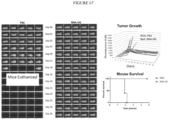
- RNA nanostructure effected the growth of the cancer, especially if the treatments were performed earlier on (primarily day one treated).
- RNA nanostructure elicited an immune response that prevented the growth of the CT26 cell, where they were eliminated before detection could be achieved from the imager.
- clear tumor regression was observable.
- the tumor development was initially seen both visually by the enlarging of the abdominal region and by the fluorescent detection from the imager, but as time went on and the mice were treated, the tumor eventually regressed.
- the RNA nanostructure could lead to tumor growth delay, usually in the delayed treatment studies (day three and day five treated). This was seen in comparison to the PBS group which had the mice reach their endpoint much faster that the mice treated with the RNA nanostructure, thus demonstrating the potential effects the stimulation of the immune system had on tumor progression.
- RNA nanostructure treated mice showed that MDSC were present at reduced levels as well as cytokines such as TGFb ⁇ 1, TGF ⁇ 2, IL-10, and IL-4, which are known to regulate and suppress immune-stimulation. Even more validation for the RNA nanostructure's aptitude to interact with the immune system was seen with both the tumor re-challenge group and the adoptive transfer group.
- the in vivo trials also supported some of the findings in the initial in vitro studies by illustrating that the RNA nanostructure could stimulate T-cells, promote the secretion of the similar cytokines found in the in vitro studies, and cause the production of IFN-gamma, a vital cytokine that helps upregulate the both the innate and adaptive immune system.
- an RNA nanostructure that is immuno-stimulatory.
- an immuno-stimulatory RNA nanostructure stimulates the immune system thereby inducing activation or increasing activity of any components of the immune system.
- the immune-stimulatory RNA structures described herein stimulate immune cell activation, boost anti-tumor immunity, increase anti-tumor (pro-inflammatory) cytokines and/or reduce immunosuppressive cytokines.
- immuno-stimulatory RNA structures described herein activate immune cells, e.g., T helper cells, T cells (including CD69+ activated T cells), dendritic cells, natural killer cells, macrophages, reprogram the cytokine microenvironment by, for example, decreasing levels of immunosuppressive cytokines e.g., TGF beta (TGF ⁇ 1, TGF ⁇ 2, IL10, and IL4 and/or increasing production of anti-tumor (pro-inflammatory) cytokines, for example, interferon gamma and TNF-alpha; inhibit or suppress tumor growth, cause tumor regression and/or induce tumor immunity; stimulate splenic B and T cells; or activate the TLR3- signaling pathway.
- TGF beta TGF ⁇ 1, TGF ⁇ 2, IL10, and IL4
- anti-tumor pro-inflammatory cytokines
- the RNA nanostructure having immunomodulatory properties comprises a ssRNA molecule comprising SEQ ID NO:1, SEQ ID NO:2, SEQ ID NO:3, SEQ ID NO:4, SEQ ID NO:5, SEQ ID NO:6, SEQ ID NO:7, SEQ ID NO:8, SEQ ID NO:9, SEQ ID NO:10, SEQ ID NO:11, SEQ ID NO:12 or SEQ ID NO:13.
- the RNA nanostructure having immuno-stimulatory properties comprises a ssRNA molecule comprising SEQ ID NO:1, SEQ ID NO:2, SEQ ID NO:3, SEQ ID NO:4, SEQ ID NO:5, SEQ ID NO:6, SEQ ID NO:7, SEQ ID NO:8, SEQ ID NO:9, SEQ ID NO:10, SEQ ID NO:11, SEQ ID NO:12 or SEQ ID NO:13.
- the single stranded RNA molecule is SEQ ID NO:1, as described in Example 2.
- this nanostructure may be used as an immune-adjuvant to boost an immune response, including inducing anti-tumor immunity.
- this adjuvant may be easily scaled up by biochemical production.
- the immuno-stimulatory activity of an RNA nanostructure as described herein is more potent than the immuno-stimulatory activity of PolyIC.
- the immunomodulatory properties of the RNA nanostructure may be altered by the shape of the RNA nanostructure. In certain embodiments, the immunomodulatory properties of the RNA nanostructure may be altered by the sequence of the ssRNA (e.g., the nucleotide composition at a loop region).
- the immuno-stimulatory properties of the RNA nanostructure may be altered by the shape of the RNA nanostructure. In certain embodiments, the immuno-stimulatory properties of the RNA nanostructure may be altered by the sequence of the ssRNA (e.g., the nucleotide composition at a loop region).
- the RNA nanostructure is an agonist of a pattern recognition receptor.
- pattern recognition receptor or “PRR” refer to proteins expressed by cells of the innate immune system, such as dendritic cells, macrophages, monocytes, neutrophils and epithelial cells, to identify two classes of molecules: pathogen-associated molecular patterns (PAMPs), which are associated with microbial pathogens, and damage-associated molecular patterns (DAMPs), which are associated with components of host's cells that are released during cell damage or death.
- PAMPs pathogen-associated molecular patterns
- DAMPs damage-associated molecular patterns
- PRRs also mediate the initiation of antigen-specific adaptive immune response and release of inflammatory cytokines.
- the PRR is a toll-like receptor (TLR) (e.g., TLR3 or TLR7).
- RNA nanostructure TLR3 agonist comprising at least one single-stranded RNA (ssRNA) molecule, wherein the ssRNA molecule forms at least one paranemic cohesion crossover, and wherein the RNA nanostructure has immuno-stimulatory properties.
- ssRNA single-stranded RNA
- RNA nanostructures may also serve as a scaffold for the formation of other structures.
- the RNA nanostructures themselves may consist of a single ssRNA molecule folded into a desired shape; however, as described herein the RNA nanostructures may comprise agents or other molecules that are added to or attached to the folded nanostructure.
- RNA nanostructure described herein wherein the RNA nanostructure comprises at least one diagnostic agent operably linked to the RNA nanostructure.
- Certain embodiments also provide an RNA nanostructure described herein, wherein the RNA nanostructure comprises at least one therapeutic agent operably linked to the RNA nanostructure.
- Certain embodiments also provide a complex comprising an RNA nanostructure described herein and at least one diagnostic and/or therapeutic agent operably linked to the RNA nanostructure.
- one or more agents may be operably linked to the RNA nanostructure, such as diagnostic agents or therapeutic agents.
- at least one diagnostic agent is operably linked to the RNA nanostructure.
- at least one therapeutic agent is operably linked to the RNA nanostructure.
- at least one diagnostic agent and at least one therapeutic agent are operably linked to the RNA nanostructure.
- Diagnostic agents are known in the art and include imaging agents, e.g., fluorophores, radioisotopes, and colorimetric indicators.
- the term "therapeutic agent” includes agents that provide a therapeutically desirable effect when administered to a subject (e.g., a mammal, such as a human).
- the agent may be of natural or synthetic origin.
- it may be a nucleic acid, a polypeptide, a protein, a peptide, a radioisotope, saccharide or polysaccharide or an organic compound, such as a small molecule.
- small molecule includes organic molecules having a molecular weight of less than about, e.g., 1000 daltons. In one embodiment a small molecule can have a molecular weight of less than about 800 daltons. In another embodiment a small molecule can have a molecular weight of less than about 500 daltons.
- the therapeutic agent is an immuno-stimulatory agent, a radioisotope, a chemotherapeutic drug (e.g., doxorubicin) or an immuno-therapy agent, such as antibody or an antibody fragment.
- the therapeutic agent is a vaccine, such as a cancer vaccine.
- the therapeutic agent is a tumor targeting agent, such as a monoclonal tumor-specific antibody, a tumor targeting peptide or an aptamer.
- the therapeutic agent is an antibody (e.g., a monoclonal antibody, e.g., an anti-PDl antibody).
- the therapeutic agent is an antigen (e.g., a tumor associated antigen or a tumor specific antigen).
- the therapeutic agent is a tumor antigen peptide(s).
- the diagnostic or therapeutic agent is targeting agent, which can specifically target and/or bind a particular cell of interest. Accordingly, such a targeting agent may be used to deliver an RNA nanostructure to a particular type of cell.
- the targeting agent is a tumor targeting agent.
- a tumor targeting agent is an agent that can target and/or bind to a tumor cell. Accordingly, such a tumor targeting agent may be used to deliver an RNA nanostructure to a tumor site.
- a tumor targeting agent is a tumor targeting peptide (TTP).
- the diagnostic or therapeutic agent is a peptide comprising a positively-charged moiety.
- the positively-charged moiety is a peptide comprising from about 5 to 20 positively-charged amino acids.
- the positively-charged moiety is a peptide comprising from about 8 to 12 positively-charged amino acids.
- the positively-charged moiety is a peptide comprising from about 10 positively-charged amino acids.
- the positively-charged moiety is a peptide comprising 10 lysine residues.
- the peptide is a tumor targeting peptide (TTP), a tumor antigen peptide, a human cancer peptide, an infectious agent peptide, or calreticulin protein.
- the infectious agent peptide comprises specific epitopes for CD8+ T cells involved in the immunity against influenza, HIV, HCV, and other infectious agents.
- the peptide is calreticulin protein.
- Calreticulin protein allows the RNA-origami to engage interactions between tumor cells and macrophages or dendritic cells for enhanced antigen presentation and stimulation of antigen-specific T cells.
- the peptide is human cancer peptide NY-ESO-1 or Muc1.
- the at least one therapeutic agent is a tumor antigen peptide (e.g., a tumor-specific antigen; e.g., for use as a cancer vaccine).
- a component of an RNA nanostructure complex of the present invention is a tumor-specific antigen.
- the tumor-specific antigen is TKD. It is understood that the tumor-specific antigens may be modified to enhance complex formation, to modulate RNA nanostructure: tumor specific antigen ratios and to operably link one or more agents.
- the tumor-specific antigen is TKD modified to add a C at the N-terminus.
- the tumor-specific antigen is TKD modified to add from 1 to 15 lysine residues at the C-terminus. In certain embodiments, the tumor-specific antigen is TKD modified to add 10 lysine residues at the C-terminus. In certain embodiments, the tumor-specific antigen is TKD modified to add a C at the N-terminus and from 1 to 15 lysine at the C-terminus. In certain embodiments, the tumor-specific antigen is TKD modified to add a C at the N-terminus and 10 lysine at the C-terminus. In certain embodiments, the peptide is CTKD-K10 (CTKDNNLLGRFELSGGGSK 10 (SEQ ID NO:18)).
- the at least one agent is operably linked to the RNA nanostructure through a linkage to a single-stranded linker or "handle” or “antihandle” (short, e.g., 5 to 50 nt single-stranded nucleic acids: a handle is at least partially complementary, and may be wholly complementary, to an antihandle).
- the linkage between the agent(s) and the RNA nanostructure is not critical and may be any group that can connect the RNA nanostructure and the agent using known chemistry, provided that is does not interfere with the function of the agent or the RNA nanostructure.
- Chemistries that can be used to link the agent to an oligonucleotide are known in the art, such as disulfide linkages, amino linkages, covalent linkages, etc.
- aliphatic or ethylene glycol linkers that are well known to those with skill in the art can be used.
- phosphodiester, phosphorothioate and/or other modified linkages are used.
- the linker is a binding pair.
- the "binding pair” refers to two molecules which interact with each other through any of a variety of molecular forces including, for example, ionic, covalent, hydrophobic, van der Waals, and hydrogen bonding, so that the pair have the property of binding specifically to each other.
- Specific binding means that the binding pair members exhibit binding to each other under conditions where they do not bind to another molecule.
- binding pairs are biotin-avidin, hormone-receptor, receptor-ligand, enzyme-substrate probe, IgG-protein A, antigen-antibody, aptamer-target and the like.
- a first member of the binding pair comprises avidin or streptavidin and a second member of the binding pair comprises biotin.
- Certain embodiments also provide a composition comprising an RNA nanostructure described herein and a carrier. Certain embodiments provide a composition comprising an RNA nanostructure complex described herein and a carrier. In certain embodiments, the composition comprises a plurality of RNA nanostructures, and a carrier. In certain embodiments, the composition further comprises at least one therapeutic agent described herein.
- the composition is pharmaceutical composition and the carrier is a pharmaceutically acceptable carrier.
- the pharmaceutical composition further comprises at least one therapeutic agent (e.g., a therapeutic agent described herein).
- the at least one therapeutic agent is a chemotherapeutic drug, such as doxorubicin or cyclophosphamide.
- a vaccine comprising an RNA nanostructure complex as described herein.
- kits for practicing the present methods comprising an RNA nanostructure or RNA nanostructure complex described herein and instructions for administering the RNA nanostructure to induce an immune response (e.g., anti-tumor immunity) or to treat a disease or condition.
- the kit further comprises a therapeutic agent described herein and instructions for administering the therapeutic agent in combination (e.g., simultaneously or sequentially) with the RNA nanostructure or RNA nanostructure complex.
- a kit comprising a composition described herein and instructions for administering the composition to induce an immune response (e.g., anti-tumor immunity) or to treat a disease or condition.
- the kit further comprises a therapeutic agent described herein and instructions for administering the therapeutic agent in combination (e.g., simultaneously or sequentially) with the composition.
- an RNA nanostructure, RNA nanostructure complex or composition described herein may be used as an immune-adjuvant to boost an immune response (e.g., inducing anti-tumor immunity).
- certain embodiments provide a method of inducing an immune response in a subject (e.g., a mammal, such as a human), comprising administering to the subject an effective amount of an RNA nanostructure, RNA nanostructure complex, or composition as described herein.
- the administration increases an immune response by at least about, e.g., 20%, 30%, 40%, 50%, 60%, 70%, 80%, 90%, or more (e.g., as compared to a control).
- Methods of measuring an immune response are known in the art, for example using an assay described in the Example.
- the phrase "inducing an immune response” refers to the activation of an immune cell.
- Methods of measuring an immune response are known in the art, for example using an assay described in the Example.
- the phrase "effective amount” means an amount of an RNA nanostructure or RNA nanostructure complex described herein that induces an immune response.
- Certain embodiments also provide a method of treating a disease or disorder in a subject, comprising administering to the subject a therapeutically effective amount of an RNA nanostructure, RNA nanostructure complex, or a composition as described herein.
- Certain embodiments provide a method, wherein the method further comprises administering at least one therapeutic agent to the subject.
- the at least one therapeutic agent may be administered in combination with the RNA nanostructure, RNA nanostructure complex or composition.
- the phrase "in combination” refers to the simultaneous or sequential administration of the RNA nanostructure, RNA nanostructure complex or composition and the at least one therapeutic agent.
- the RNA nanostructure RNA nanostructure complex or composition and the at least one therapeutic agent may be present in a single composition or may be separate (e.g., may be administered by the same or different routes).
- Certain embodiments provide an RNA nanostructure, RNA nanostructure complex, or a composition as described herein for use in medical therapy.
- Certain embodiments provide the use of an RNA nanostructure, RNA nanostructure complex, or a composition as described herein for the manufacture of a medicament for inducing an immune response in a subject (e.g., a mammal, such as a human).
- a subject e.g., a mammal, such as a human.
- Certain embodiments provide the use of an RNA nanostructure, RNA nanostructure complex, or a composition as described herein for the manufacture of a medicament for inducing an immune response in a subject (e.g., a mammal, such as a human), in combination with at least one therapeutic agent.
- a subject e.g., a mammal, such as a human
- Certain embodiments provide an RNA nanostructure, RNA nanostructure complex, or a composition as described herein for inducing an immune response.
- Certain embodiments provide an RNA nanostructure, RNA nanostructure complex, or a composition as described herein for inducing an immune response, in combination with at least one therapeutic agent.
- Certain embodiments provide the use of an RNA nanostructure, RNA nanostructure complex, or a composition as described herein for the manufacture of a medicament for treating a disease or disorder in a subject.
- Certain embodiments provide the use of an RNA nanostructure, RNA nanostructure complex, or a composition as described herein for the manufacture of a medicament for treating a disease or disorder in a subject, in combination with at least one therapeutic agent.
- Certain embodiments provide an RNA nanostructure, RNA nanostructure complex, or a composition as described herein for the prophylactic or therapeutic treatment a disease or disorder.
- Certain embodiments provide an RNA nanostructure, RNA nanostructure complex, or a composition as described herein for the prophylactic or therapeutic treatment of a disease or disorder, in combination with at least one therapeutic agent.
- the disease or disorder is a condition that requires a boost of the host immunity.
- the disease or disorder is a hyperproliferative disorder, such as cancer.
- the disease or disorder is an infectious disease.
- the cancer is carcinoma, lymphoma, blastoma, sarcoma, or leukemia. In certain embodiments, the cancer is a solid tumor cancer.
- the cancer is squamous cell cancer, small-cell lung cancer, non-small cell lung cancer, adenocarcinoma of the lung, squamous carcinoma of the lung, cancer of the peritoneum, hepatocellular cancer, renal cell carcinoma, gastrointestinal cancer, gastric cancer, esophageal cancer, pancreatic cancer, glioma, cervical cancer, ovarian cancer, liver cancer, bladder cancer, hepatoma, breast cancer (e.g., endocrine resistant breast cancer), colon cancer, rectal cancer, lung cancer, endometrial or uterine carcinoma, salivary gland carcinoma, kidney cancer, liver cancer, prostate cancer, vulval cancer, thyroid cancer, hepatic carcinoma, melanoma, leukemia, or head and neck cancer.
- the cancer is breast cancer.
- the cancer is colon cancer.
- the cancer is colorectal cancer.
- the cancer is lymphoma.
- the therapeutic agent is a therapeutic agent described herein.
- the therapeutic agent is an immuno-stimulatory agent, a radioisotope, a chemotherapeutic drug (e.g., doxorubicin) or an immuno-therapy agent, such as antibody or an antibody fragment.
- the therapeutic agent is a vaccine, such as a cancer vaccine.
- the therapeutic agent is a tumor targeting agent, such as a monoclonal tumor-specific antibody or an aptamer.
- the therapeutic agent is an antibody (e.g., a monoclonal antibody, e.g., an anti-PDl antibody).
- the therapeutic agent is an antigen (e.g., a tumor associated antigen or a tumor specific antigen).
- the therapeutic agent is a tumor antigen peptide(s).
- Certain embodiments provide a method of enhancing/increasing pro-inflammatory cytokines in a subject (e.g., a mammal, such as a human), comprising administering to the subject an effective amount of an RNA nanostructure, complex or composition as described herein.
- Certain embodiments provide a method of activating immune cells by specific triggering of toll-like receptor 3 (TLR3) signaling pathway in a subject (e.g., a mammal, such as a human), comprising administering to the subject an effective amount of an RNA nanostructure, complex or composition as described herein.
- TLR3 toll-like receptor 3
- Certain embodiments provide a method of slowing or suppressing tumor growth in a subject (e.g., a mammal, such as a human) as compared to a control subject, comprising administering to the subject an effective amount of an RNA nanostructure, complex or composition as described herein.
- a control subject is a subject that is not administered an effective amount of an RNA nanostructure, complex or composition as described herein.
- Certain embodiments provide a method to elevate levels of anti-tumor proinflammatory cytokines in a subject (e.g., a mammal, such as a human) with a tumor as compared to a control subject, comprising administering to the subject an effective amount of an RNA nanostructure, complex or composition as described herein.
- a subject e.g., a mammal, such as a human
- administering comprising administering to the subject an effective amount of an RNA nanostructure, complex or composition as described herein.
- Certain embodiments provide a method to decrease levels of anti-inflammatory cytokines in a subject (e.g., a mammal, such as a human) with a tumor as compared to a control subject, comprising administering to the subject an effective amount of an RNA nanostructure, complex or composition as described herein.
- a subject e.g., a mammal, such as a human
- administering comprising administering to the subject an effective amount of an RNA nanostructure, complex or composition as described herein.
- Certain embodiments provide an effective amount of an RNA nanostructure, complex or composition as described herein for use in enhancing/increasing pro-inflammatory cytokines in a subject (e.g., a mammal, such as a human).
- a subject e.g., a mammal, such as a human.
- Certain embodiments provide an effective amount of an RNA nanostructure, complex or composition as described herein for use in activating immune cells by specific triggering of toll-like receptor 3 (TLR3) signaling pathway in a subject (e.g., a mammal, such as a human).
- a subject e.g., a mammal, such as a human.
- Certain embodiments provide an effective amount of an RNA nanostructure, complex or composition as described herein for use in slowing or suppressing tumor growth in a subject (e.g., a mammal, such as a human) as compared to a control subject.
- a subject e.g., a mammal, such as a human
- Certain embodiments provide an effective amount of an RNA nanostructure, complex or composition as described herein for use in elevating levels of anti-tumor proinflammatory cytokines in a subject (e.g., a mammal, such as a human) with a tumor as compared to a control subj ect.
- a subject e.g., a mammal, such as a human
- a tumor as compared to a control subj ect.
- Certain embodiments provide an effective amount of an RNA nanostructure, complex or composition as described herein for use in decreasing levels of anti-inflammatory cytokines in a subject (e.g., a mammal, such as a human) with a tumor as compared to a control subject.
- a subject e.g., a mammal, such as a human
- a tumor as compared to a control subject.
- methods may comprise administering an RNA nanostructure described herein, and optionally, a therapeutic agent to a subject.
- a therapeutic agent i.e., an RNA nanostructure and/or therapeutic agent
- Such compounds may be formulated as a pharmaceutical composition and administered to a mammalian host, such as a human patient in a variety of forms adapted to the chosen route of administration, i.e., orally or parenterally, by intravenous, intramuscular, intraperitoneal or topical or subcutaneous routes.
- the compounds may be systemically administered, e.g., orally, in combination with a pharmaceutically acceptable vehicle such as an inert diluent or an assimilable edible carrier. They may be enclosed in hard or soft-shell gelatin capsules, may be compressed into tablets, or may be incorporated directly with the food of the patient's diet.
- a pharmaceutically acceptable vehicle such as an inert diluent or an assimilable edible carrier.
- the active compound may be combined with one or more excipients and used in the form of ingestible tablets, buccal tablets, troches, capsules, elixirs, suspensions, syrups, wafers, and the like.
- Such compositions and preparations should contain at least 0.1% of active compound.
- compositions and preparations may, of course, be varied and may conveniently be between about 2 to about 60% of the weight of a given unit dosage form.
- the amount of active compound in such therapeutically useful compositions is such that an effective dosage level will be obtained.
- the tablets, troches, pills, capsules, and the like may also contain the following: binders such as gum tragacanth, acacia, corn starch or gelatin; excipients such as dicalcium phosphate; a disintegrating agent such as corn starch, potato starch, alginic acid and the like; a lubricant such as magnesium stearate; and a sweetening agent such as sucrose, fructose, lactose or aspartame or a flavoring agent such as peppermint, oil of wintergreen, or cherry flavoring may be added.
- binders such as gum tragacanth, acacia, corn starch or gelatin
- excipients such as dicalcium phosphate
- a disintegrating agent such as
- the unit dosage form When the unit dosage form is a capsule, it may contain, in addition to materials of the above type, a liquid carrier, such as a vegetable oil or a polyethylene glycol. Various other materials may be present as coatings or to otherwise modify the physical form of the solid unit dosage form. For instance, tablets, pills, or capsules may be coated with gelatin, wax, shellac or sugar and the like.
- a syrup or elixir may contain the active compound, sucrose or fructose as a sweetening agent, methyl and propylparabens as preservatives, a dye and flavoring such as cherry or orange flavor.
- any material used in preparing any unit dosage form should be pharmaceutically acceptable and substantially non-toxic in the amounts employed.
- the active compound may be incorporated into sustained-release preparations and devices.
- the active compound may also be administered intravenously or intraperitoneally by infusion or injection.
- Solutions of the active compound or its salts can be prepared in water, optionally mixed with a nontoxic surfactant.
- Dispersions can also be prepared in glycerol, liquid polyethylene glycols, triacetin, and mixtures thereof and in oils. Under ordinary conditions of storage and use, these preparations contain a preservative to prevent the growth of microorganisms.
- the pharmaceutical dosage forms suitable for injection or infusion can include sterile aqueous solutions or dispersions or sterile powders comprising the active ingredient which are adapted for the extemporaneous preparation of sterile injectable or infusible solutions or dispersions, optionally encapsulated in liposomes.
- the ultimate dosage form should be sterile, fluid and stable under the conditions of manufacture and storage.
- the liquid carrier or vehicle can be a solvent or liquid dispersion medium comprising, for example, water, ethanol, a polyol (for example, glycerol, propylene glycol, liquid polyethylene glycols, and the like), vegetable oils, nontoxic glyceryl esters, and suitable mixtures thereof.
- the proper fluidity can be maintained, for example, by the formation of liposomes, by the maintenance of the required particle size in the case of dispersions or by the use of surfactants.
- the prevention of the action of microorganisms can be brought about by various antibacterial and antifungal agents, for example, parabens, chlorobutanol, phenol, sorbic acid, thimerosal, and the like.
- isotonic agents for example, sugars, buffers or sodium chloride may be included.
- Prolonged absorption of the injectable compositions can be brought about by the use in the compositions of agents delaying absorption, for example, aluminum monostearate and gelatin.
- Sterile injectable solutions are prepared by incorporating the active compound in the required amount in the appropriate solvent with various of the other ingredients enumerated above, as required, followed by filter sterilization.
- methods of preparation include vacuum drying and the freeze-drying techniques, which yield a powder of the active ingredient plus any additional desired ingredient present in the previously sterile-filtered solutions.
- the present compounds may be applied in pure form, i.e., when they are liquids. However, it will generally be desirable to administer them to the skin as compositions or formulations, in combination with a dermatologically acceptable carrier, which may be a solid or a liquid.
- Useful solid carriers include finely divided solids such as talc, clay, microcrystalline cellulose, silica, alumina and the like.
- Useful liquid carriers include water, alcohols or glycols or water-alcohol/glycol blends, in which the present compounds can be dissolved or dispersed at effective levels, optionally with the aid of non-toxic surfactants.
- Adjuvants such as fragrances and additional antimicrobial agents can be added to optimize the properties for a given use.
- the resultant liquid compositions can be applied from absorbent pads, used to impregnate bandages and other dressings, or sprayed onto the affected area using pump-type or aerosol sprayers.
- Thickeners such as synthetic polymers, fatty acids, fatty acid salts and esters, fatty alcohols, modified celluloses or modified mineral materials can also be employed with liquid carriers to form spreadable pastes, gels, ointments, soaps, and the like, for application directly to the skin of the user.
- Examples of useful dermatological compositions which can be used to deliver a compound to the skin are known to the art; for example, see Jacquet et al. (U.S. Pat. No. 4,608,392 ), Geria (U.S. Pat. No. 4,992,478 ), Smith et al. (U.S. Pat. No. 4,559,157 ) and Wortzman (U.S. Pat. No. 4,820,508 ).
- Useful dosages of compounds can be determined by comparing their in vitro activity, and in vivo activity in animal models. Methods for the extrapolation of effective dosages in mice, and other animals, to humans are known to the art; for example, see U.S. Pat. No. 4,938,949 .
- the amount of the compound, or an active salt or derivative thereof, required for use in treatment will vary not only with the particular salt selected but also with the route of administration, the nature of the condition being treated and the age and condition of the patient and will be ultimately at the discretion of the attendant physician or clinician.
- the compound may be conveniently formulated in unit dosage form.
- Certain embodiments provide a composition comprising a compound formulated in such a unit dosage form.
- the desired dose may conveniently be presented in a single dose or as divided doses administered at appropriate intervals, for example, as two, three, four or more sub-doses per day.
- the sub-dose itself may be further divided, e.g., into a number of discrete loosely spaced administrations; such as multiple inhalations from an insufflator or by application of a plurality of drops into the eye.
- “Operably-linked” refers to the association two chemical moieties so that the function of one is affected by the other, e.g., an arrangement of elements wherein the components so described are configured so as to perform their usual function.
- nucleic acid refers to deoxyribonucleotides or ribonucleotides and polymers thereof in either single- or double-stranded form, made of monomers (nucleotides) containing a sugar, phosphate and a base that is either a purine or pyrimidine. Unless specifically limited, the term encompasses nucleic acids containing known analogs of natural nucleotides that have similar binding properties as the reference nucleic acid and are metabolized in a manner similar to naturally occurring nucleotides. Unless otherwise indicated, a particular nucleic acid sequence also encompasses conservatively modified variants thereof (e.g., degenerate codon substitutions) and complementary sequences, as well as the sequence explicitly indicated. Specifically, degenerate codon substitutions may be achieved by generating sequences in which the third position of one or more selected (or all) codons is substituted with mixed-base and/or deoxyinosine residues.
- nucleotide sequence and “nucleic acid sequence” and “nucleic acid strand” refer to a sequence of bases (purines and/or pyrimidines) in a polymer of DNA or RNA, which can be single-stranded or double-stranded, optionally containing synthetic, non-natural or altered nucleotide bases capable of incorporation into DNA or RNA polymers, and/or backbone modifications (e.g., a modified oligomer, such as a morpholino oligomer, phosphorodiamate morpholino oligomer or vivo-mopholino).
- backbone modifications e.g., a modified oligomer, such as a morpholino oligomer, phosphorodiamate morpholino oligomer or vivo-mopholino.
- oligo oligonucleotide
- oligomer may be used interchangeably and refer to such sequences of purines and/or pyrimidines.
- modified oligos modified oligonucleotides or “modified oligomers” may be similarly used interchangeably, and refer to such sequences that contain synthetic, non-natural or altered bases and/or backbone modifications (e.g., chemical modifications to the internucleotide phosphate linkages and/or to the backbone sugar).
- oligonucleotides described herein may be synthesized using standard solid or solution phase synthesis techniques that are known in the art.
- the oligonucleotides are synthesized using solid-phase phosphoramidite chemistry ( U.S. Patent No. 6,773,885 ) with automated synthesizers.
- Chemical synthesis of nucleic acids allows for the production of various forms of the nucleic acids with modified linkages, chimeric compositions, and nonstandard bases or modifying groups attached in chosen places through the nucleic acid's entire length.
- Certain embodiments encompass isolated or substantially purified nucleic acid compositions.
- An "isolated” or “purified” DNA molecule or RNA molecule is a DNA molecule or RNA molecule that exists apart from its native environment and is therefore not a product of nature.
- An isolated DNA molecule or RNA molecule may exist in a purified form or may exist in a non-native environment such as, for example, a transgenic host cell.
- an "isolated” or “purified” nucleic acid molecule is substantially free of other cellular material or culture medium when produced by recombinant techniques, or substantially free of chemical precursors or other chemicals when chemically synthesized.
- an "isolated" nucleic acid is free of sequences that naturally flank the nucleic acid (i.e., sequences located at the 5' and 3' ends of the nucleic acid) in the genomic DNA of the organism from which the nucleic acid is derived.
- portion or fragment as it relates to a nucleic acid molecule, sequence or segment, when it is linked to other sequences for expression, is meant a sequence having at least 80 nucleotides, at least 150 nucleotides, or at least 400 nucleotides. If not employed for expressing, a "portion” or “fragment” means at least 9, at least 12, at least 15, or at least 20, consecutive nucleotides, e.g., probes and primers (oligonucleotides), corresponding to the nucleotide sequence of the nucleic acid molecules described herein.
- Recombinant DNA molecule is a combination of DNA sequences that are joined together using recombinant DNA technology and procedures used to join together DNA sequences as described, for example, in Sambrook and Russell, Molecular Cloning: A Laboratory Manual, Cold Spring Harbor, NY: Cold Spring Harbor Laboratory Press (3rd edition, 2001 ).
- RNA or polypeptide sequences are “homologous” to each other when the sequences exhibit at least about 75% to 85% (including 75%, 76%, 77%, 78%, 79%, 80%, 81%, 82%, 83%, 84%, and 85%), at least about 90%, or at least about 95% to 99% (including 95%, 96%, 97%, 98%, 99%) contiguous sequence identity over a defined length of the sequences.
- sequence relationships between two or more nucleotide sequences are used to describe the sequence relationships between two or more nucleotide sequences: (a) “reference sequence,” (b) “comparison window,” (c) “sequence identity” (d) “percentage of sequence identity,” (e) “substantial identity” and (f) “complementarity”.
- Computer implementations of these mathematical algorithms can be utilized for comparison of sequences to determine sequence identity or complementarity. Such implementations include, but are not limited to: CLUSTAL in the PC/Gene program (available from Intelligenetics, Mountain View, Calif.); the ALIGN program (Version 2.0) and GAP, BESTFIT, BLAST, FASTA, and TFASTA in the Wisconsin Genetics Software Package, Version 8 (available from Genetics Computer Group (GCG), 575 Science Drive, Madison, Wis., USA). Alignments using these programs can be performed using the default parameters.
- the CLUSTAL program is well described by Higgins et al. ( Higgins et al., CABIOS, 5, 151 (1989 )); Corpet et al.
- HSPs high scoring sequence pairs
- a scoring matrix is used to calculate the cumulative score. Extension of the word hits in each direction are halted when the cumulative alignment score falls off by the quantity X from its maximum achieved value, the cumulative score goes to zero or below due to the accumulation of one or more negative-scoring residue alignments, or the end of either sequence is reached.
- the BLAST algorithm In addition to calculating percent sequence identity, the BLAST algorithm also performs a statistical analysis of the similarity between two sequences.
- One measure of similarity provided by the BLAST algorithm is the smallest sum probability (P(N)), which provides an indication of the probability by which a match between two nucleotide or amino acid sequences would occur by chance.
- P(N) the smallest sum probability
- a test nucleic acid sequence is considered similar to a reference sequence if the smallest sum probability in a comparison of the test nucleic acid sequence to the reference nucleic acid sequence is less than about 0.1, less than about 0.01, or even less than about 0.001.
- Gapped BLAST in BLAST 2.0
- PSI-BLAST in BLAST 2.0
- the default parameters of the respective programs e.g., BLASTN for nucleotide sequences, BLASTX for proteins
- the BLASTN program for nucleotide sequences
- W wordlength
- E expectation
- the BLASTP program uses as defaults a wordlength (W) of 3, an expectation (E) of 10, and the BLOSUM62 scoring matrix. Alignment may also be performed manually by inspection.
- comparison of nucleotide sequences for determination of percent sequence identity may be made using the BlastN program (version 1.4.7 or later) with its default parameters or any equivalent program.
- equivalent program is intended any sequence comparison program that, for any two sequences in question, generates an alignment having identical nucleotide or amino acid residue matches and an identical percent sequence identity when compared to the corresponding alignment generated by the program.
- sequence comparison typically one sequence acts as a reference sequence to which test sequences are compared.
- test and reference sequences are input into a computer, subsequence coordinates are designated if necessary, and sequence algorithm program parameters are designated.
- sequence comparison algorithm then calculates the percent sequence identity for the test sequence(s) relative to the reference sequence, based on the designated program parameters.
- nucleotide sequences are substantially identical if two molecules hybridize to each other under stringent conditions.
- stringent conditions are selected to be about 5°C lower than the thermal melting point (T m ) for the specific sequence at a defined ionic strength and pH.
- T m thermal melting point
- stringent conditions encompass temperatures in the range of about 1°C to about 20°C, depending upon the desired degree of stringency as otherwise qualified herein.
- Nucleic acids that do not hybridize to each other under stringent conditions are still substantially identical if the polypeptides they encode are substantially identical. This may occur, e.g., when a copy of a nucleic acid is created using the maximum codon degeneracy permitted by the genetic code.
- One indication that two nucleic acid sequences are substantially identical is when the polypeptide encoded by the first nucleic acid is immunologically cross reactive with the polypeptide encoded by the second nucleic acid.
- stringent hybridization conditions refers to conditions under which a nucleic acid will hybridize to its target sequence, typically in a complex mixture of nucleic acids, but to no other sequences. Stringent conditions are sequence-dependent and will be different in different circumstances. Longer sequences hybridize specifically at higher temperatures. An extensive guide to the hybridization of nucleic acids is found in Tij ssen, Techniques in Biochemistry and Molecular Biology-Hybridization with Nucleic Probes, "Overview of principles of hybridization and the strategy of nucleic acid assays” (1993 ). Generally, stringent conditions are selected to be about 5-10° C. lower than the thermal melting point (T m ) for the specific sequence at a defined ionic strength pH.
- T m thermal melting point
- the T m is the temperature (under defined ionic strength, pH, and nucleic concentration) at which 50% of the probes complementary to the target hybridize to the target sequence at equilibrium (as the target sequences are present in excess, at T m , 50% of the probes are occupied at equilibrium).
- Stringent conditions may also be achieved with the addition of destabilizing agents such as formamide.
- a positive signal is at least two times background, preferably 10 times background hybridization.
- Exemplary stringent hybridization conditions can be as follows: 50% formamide, 5 ⁇ SSC, and 1% SDS, incubating at 42° C., or, 5 ⁇ SSC, 1% SDS, incubating at 65° C., with wash in 0.2 ⁇ SSC, and 0.1% SDS at 65° C.
- a temperature of about 36° C. is typical for low stringency amplification, although annealing temperatures may vary between about 32° C. and 48° C. depending on primer length.
- a temperature of about 62° C. is typical, although high stringency annealing temperatures can range from about 50° C. to about 65° C., depending on the primer length and specificity.
- Typical cycle conditions for both high and low stringency amplifications include a denaturation phase of 90° C.-95° C. for 30 sec.-2 min., an annealing phase lasting 30 sec.-2 min., and an extension phase of about 72° C. for 1-2 min. Protocols and guidelines for low and high stringency amplification reactions are provided, e.g., in Innis et al., PCR Protocols, A Guide to Methods and Applications, Academic Press, Inc. N.Y. (1990 ).
- Nucleic acids that do not hybridize to each other under stringent conditions are still substantially identical if the polypeptides which they encode are substantially identical. This occurs, for example, when a copy of a nucleic acid is created using the maximum codon degeneracy permitted by the genetic code. In such cases, the nucleic acids typically hybridize under moderately stringent hybridization conditions.
- Exemplary "moderately stringent hybridization conditions” include a hybridization in a buffer of 40% formamide, 1 M NaCl, 1% SDS at 37° C., and a wash in 1 ⁇ SSC at 45° C. A positive hybridization is at least twice background.
- Those of ordinary skill will readily recognize that alternative hybridization and wash conditions can be utilized to provide conditions of similar stringency. Additional guidelines for determining hybridization parameters are provided in numerous references, e.g., Current Protocols in Molecular Biology, Ausubel et al., eds .
- hybridizing specifically to refers to the binding, duplexing, or hybridizing of a molecule only to a particular nucleotide sequence under stringent conditions when that sequence is present in a complex mixture (e.g., total cellular) DNA or RNA.
- Bod(s) substantially refers to complementary hybridization between a probe nucleic acid and a target nucleic acid and embraces minor mismatches that can be accommodated by reducing the stringency of the hybridization media to achieve the desired detection of the target nucleic acid sequence.
- complementary refers to the broad concept of complementary base pairing between two nucleic acids aligned in an antisense position in relation to each other.
- nucleotide position in both of the molecules is occupied by nucleotides normally capable of base pairing with each other, then the nucleic acids are considered to be complementary to each other at this position.
- two nucleic acids are substantially complementary to each other when at least about 50%, at least about 60%, or at least about 80% of corresponding positions in each of the molecules are occupied by nucleotides which normally base pair with each other (e.g., A:T (A:U for RNA) and G:C nucleotide pairs).
- nucleotide molecule As used herein, the term “derived” or “directed to” with respect to a nucleotide molecule means that the molecule has complementary sequence identity to a particular molecule of interest.
- subject refers to humans, higher non-human primates, rodents, domestic, cows, horses, pigs, sheep, dogs and cats. In certain embodiments, the subject is a human.
- terapéuticaally effective amount in reference to treating a disease state/condition, refers to an amount of a therapeutic agent that is capable of having any detectable, positive effect on any symptom, aspect, or characteristics of a disease state/condition when administered as a single dose or in multiple doses. Such effect need not be absolute to be beneficial.
- treat and “treatment” refer to both therapeutic treatment and prophylactic or preventative measures, wherein the object is to prevent or decrease an undesired physiological change or disorder.
- beneficial or desired clinical results include, but are not limited to, alleviation of symptoms, diminishment of extent of disease, stabilized (i.e., not worsening) state of disease, delay or slowing of disease progression, amelioration or palliation of the disease state, and remission (whether partial or total), whether detectable or undetectable.
- Treatment can also mean prolonging survival as compared to expected survival if not receiving treatment.
- Those in need of treatment include those already with the condition or disorder as well as those prone to have the condition or disorder or those in which the condition or disorder is to be prevented.
- terapéuticaally effective amount means an amount of a compound, RNA nanostructure or composition described herein that (i) treats the particular disease, condition, or disorder, (ii) attenuates, ameliorates, or eliminates one or more symptoms of the particular disease, condition, or disorder, or (iii) prevents or delays the onset of one or more symptoms of the particular disease, condition, or disorder described herein.
- the therapeutically effective amount of the RNA nanostructure/therapeutic agent may reduce the number of cancer cells; reduce the tumor size; inhibit (i.e., slow to some extent and preferably stop) cancer cell infiltration into peripheral organs; inhibit (i.e., slow to some extent and preferably stop) tumor metastasis; inhibit, to some extent, tumor growth; and/or relieve to some extent one or more of the symptoms associated with the cancer.
- the RNA nanostructure/therapeutic agent may prevent growth and/or kill existing cancer cells, it may be cytostatic and/or cytotoxic.
- efficacy can be measured, for example, by assessing the time to disease progression and/or determining the response rate (RR).
- cancer and “cancerous” refer to or describe the physiological condition in mammals that is typically characterized by unregulated cell growth.
- a “tumor” comprises one or more cancerous cells. Examples of cancer include, but are not limited to, carcinoma, lymphoma, blastoma, sarcoma, and leukemia or lymphoid malignancies.
- squamous cell cancer e.g., epithelial squamous cell cancer
- lung cancer including small- cell lung cancer, non-small cell lung cancer ("NSCLC"), adenocarcinoma of the lung and squamous carcinoma of the lung, cancer of the peritoneum, hepatocellular cancer, gastric or stomach cancer including gastrointestinal cancer, pancreatic cancer, glioblastoma, cervical cancer, ovarian cancer, liver cancer, bladder cancer, hepatoma, breast cancer, colon cancer, rectal cancer, colorectal cancer, endometrial or uterine carcinoma, salivary gland carcinoma, kidney or renal cancer, prostate cancer, vulval cancer, thyroid cancer, hepatic carcinoma, anal carcinoma, penile carcinoma, as well as head and neck cancer.
- Gastric cancer includes stomach cancer, which can develop in any part of the stomach and may spread throughout the stomach and to other organs; particularly the esophagus, lungs, lymph nodes, and
- a “chemotherapeutic agent” is a biological (large molecule) or chemical (small molecule) compound useful in the treatment of cancer, regardless of mechanism of action.
- Classes of chemotherapeutic agents include, but are not limited to alkylating agents, antimetabolites, spindle poison plant alkaloids, cytotoxic/antitumor antibiotics, topoisomerase inhibitors, proteins, antibodies, photosensitizers, and kinase inhibitors.
- Chemotherapeutic agents include compounds used in "targeted therapy” and non-targeted conventional chemotherapy.
- the term "synergistic” as used herein refers to a therapeutic combination that is more effective than the additive effects of the two or more single agents.
- the combination therapy may provide “synergy” and prove “synergistic", i.e., the effect achieved when the active ingredients used together is greater than the sum of the effects that results from using the compounds separately.
- a synergistic effect may be attained when the active ingredients are: (1) co-formulated and administered or delivered simultaneously in a combined, unit dosage formulation; (2) delivered by alternation or in parallel as separate formulations; or (3) by some other regimen.
- a synergistic effect may be attained when the compounds are administered or delivered sequentially, e.g., by different injections in separate syringes.
- an effective dosage of each active ingredient is administered sequentially, i.e., serially
- effective dosages of two or more active ingredients are administered together.
- Certain embodiments provide a complex comprising an RNA nanostructure and at least one diagnostic and/or therapeutic agent operably linked to the RNA nanostructure.
- the RNA nanostructure comprises one single-stranded RNA (ssRNA) molecule, wherein the ssRNA molecule forms at least one paranemic cohesion crossover, and wherein the RNA nanostructure has immuno-stimulatory properties.
- ssRNA single-stranded RNA
- the RNA nanostructure comprises one single-stranded RNA (ssRNA) molecule, wherein the ssRNA molecule comprises a plurality of regions of double helices and at least one paranemic crossover operably linked between two regions of double helices, and wherein the RNA nanostructure has immuno-stimulatory properties.
- ssRNA single-stranded RNA
- the ssRNA molecule comprises at least two parallel double helices.
- RNA nanostructure in certain embodiments, about 60-99% of the RNA nanostructure is double stranded and about 1- 40% of the RNA nanostructure is single stranded.
- RNA nanostructure is double stranded and about 5% of the RNA nanostructure is single stranded.
- the RNA nanostructure comprises rectangular origami nanostructure.
- the RNA nanostructure comprises a nucleic acid sequence about 1500 to about 2500 nucleotides in length.
- the RNA nanostructure comprises a nucleic acid sequence having at least about 75% sequence identity to SEQ ID NO:1.
- the RNA nanostructure comprises a nucleic acid sequence having at least about 85% sequence identity to SEQ ID NO:1.
- the RNA nanostructure comprises a nucleic acid sequence having at least about 90% sequence identity to SEQ ID NO:1 .
- the RNA nanostructure comprises a nucleic acid sequence having at least about 95% sequence identity to SEQ ID NO:1.
- the RNA nanostructure comprises a nucleic acid sequence having at least about 95% sequence identity to SEQ ID NO:1.
- the RNA nanostructure comprises SEQ ID NO:1.
- the RNA nanostructure consists of SEQ ID NO:1.
- the nucleic acid sequence of the RNA nanostructure is about 1500 to about 2500 nucleotides in length.
- the RNA nanostructure comprises at least one paranemic cohesion crossover.
- the diagnostic or therapeutic agent is a peptide that comprises a positively-charged moiety.
- the positively-charged moiety is a peptide comprising from about 5 to 20 positively-charged amino acids.
- the positively-charged moiety is a peptide comprising from about 8 to 12 positively-charged amino acids.
- the positively-charged moiety is a peptide comprising from about 10 positively-charged amino acids.
- the positively-charged moiety is a peptide comprising 10 lysine residues.
- the peptide is tumor targeting peptide (TTP), a human cancer peptide, an infectious agent peptide, or calreticulin protein.
- the infectious agent peptide is specific for epitopes for CD8+ T cells involved in the immunity against influenza, HIV, HCV, and other infectious agents.
- the protein is calreticulin protein.
- Calreticulin protein allows the RNA-origami to engage interactions between tumor cells and macrophages or dendritic cells for enhanced antigen presentation and stimulation of antigen-specific T cells.
- the protein is Human cancer peptide NY-ESO-1 or Muc1.
- the at least one therapeutic agent is a tumor antigen peptide.
- the TTP is CTKD-K10 (CTKDNNLLGRFELSGGGSK 10 (SEQ ID NO:18)).
- a component of an RNA nanostructure complex is a tumor-specific antigen.
- the tumor-specific antigen is TKD. It is understood that the tumor-specific antigens may be modified to enhance complex formation, to modulate RNA nanostructure: tumor specific antigen ratios and to operably link one or more agents.
- the tumor-specific antigen is TKD modified to add a C at the N-terminus. In certain embodiments, the tumor-specific antigen is TKD modified to add from 1 to 15 lysine residues at the C-terminus. In certain embodiments, the tumor-specific antigen is TKD modified to add 10 lysine residues at the C-terminus.
- the tumor-specific antigen is TKD modified to add a C at the N-terminus and from 1 to 15 lysine at the C-terminus. In certain embodiments, the tumor-specific antigen is TKD modified to add a C at the N-terminus and 10 lysine at the C-terminus.
- Certain embodiments provide a pharmaceutical composition comprising the complex described herein and a pharmaceutically acceptable carrier.
- Certain embodiments provide a pharmaceutical composition described herein and further comprising at least one therapeutic agent.
- the at least one therapeutic agent is a chemotherapeutic drug.
- the chemotherapeutic drug is doxorubicin.
- Certain embodiments provide a method of inducing an immune response a subject (e.g., a mammal, such as a human), comprising administering to the subject an effective amount of a complex or a composition as described herein.
- a subject e.g., a mammal, such as a human
- Certain embodiments provide a method of treating a disease or disorder in a subject, comprising administering to the subject a therapeutically effective amount of a complex or a composition as described herein.
- the disease or disorder is cancer.
- the cancer is breast cancer.
- the cancer is colon cancer.
- the cancer is lymphoma.
- the method further comprises administering at least one therapeutic agent to the subject.
- the at least one therapeutic agent is a tumor targeting agent.
- the tumor-targeting agent is a monoclonal tumor specific antibody or an aptamer.
- Certain embodiments provide a method of enhancing/increasing pro-inflammatory cytokines in a subject (e.g., a mammal, such as a human), comprising administering to the subject an effective amount of a complex or a composition as described herein.
- a subject e.g., a mammal, such as a human
- Certain embodiments provide a method of activating immune cells by specific triggering of TLR3 signaling pathway in a subject (e.g., a mammal, such as a human), comprising administering to the subject an effective amount of a complex or a composition as described herein.
- a subject e.g., a mammal, such as a human
- Certain embodiments provide a method of slowing or suppressing tumor growth in a subject (e.g., a mammal, such as a human) as compared to a control subject, comprising administering to the subject an effective amount of a complex or a composition as described herein.
- a subject e.g., a mammal, such as a human
- administering comprising administering to the subject an effective amount of a complex or a composition as described herein.
- Certain embodiments provide a method of elevate levels of anti-tumor proinflammatory cytokines in a subject (e.g., a mammal, such as a human) with a tumor as compared to a control subject, comprising administering to the subject an effective amount of a complex or a composition as described herein.
- a subject e.g., a mammal, such as a human
- administering comprising administering to the subject an effective amount of a complex or a composition as described herein.
- Certain embodiments provide a method to decrease levels of anti- inflammatory cytokines in a subject (e.g., a mammal, such as a human) with a tumor as compared to a control subject, comprising administering to the subject an effective amount of a complex or a composition as described herein.
- a subject e.g., a mammal, such as a human
- administering comprising administering to the subject an effective amount of a complex or a composition as described herein.
- Certain embodiments provide the use of a complex or a composition as described herein for the manufacture of a medicament for inducing an immune response in a subject (e.g., a mammal, such as a human).
- a subject e.g., a mammal, such as a human.
- Certain embodiments provide a complex or a composition as described herein for inducing an immune response.
- Certain embodiments provide a use of a complex or a composition as described herein for the manufacture of a medicament for treating a disease or disorder in a subject.
- Certain embodiments provide a complex or a composition as described herein for the prophylactic or therapeutic treatment a disease or disorder.
- kits comprising a complex or a composition as described herein and instructions for administering the RNA nanostructure/composition to a subject to induce an immune response or to treat a disease or disorder.
- the kit further comprises at least one therapeutic agent.
- the RNA nanostructure is a nanostructure as described in the Examples or Figures.
- RNA nanostructure comprising one single-stranded RNA (ssRNA) molecule, wherein the ssRNA molecule forms at least one paranemic cohesion crossover, and wherein the RNA nanostructure has immuno-stimulatory properties.
- ssRNA single-stranded RNA
- the RNA nanostructure is an RNA rectangle origami nanostructure.
- the RNA nanostructure comprises a nucleic acid sequence about 1500 to about 2500 nucleotides in length.
- RNA nanostructure comprising a nucleic acid sequence having at least about 75% sequence identity to SEQ ID NO:1.
- the nucleic acid sequence has at least about 85% sequence identity to SEQ ID NO:1.
- the nucleic acid sequence has at least about 95% sequence identity to SEQ ID NO:1.
- the nucleic acid sequence has at least about 99% sequence identity to SEQ ID NO:1.
- the RNA nanostructure comprises SEQ ID NO:1.
- the RNA nanostructure consists of SEQ ID NO:1.
- the nucleic acid sequence is about 1500 to about 2500 nucleotides in length.
- the RNA nanostructure comprises at least one paranemic cohesion crossover.
- the RNA nanostructure is an RNA rectangle origami nanostructure.
- the RNA nanostructure is an agonist of a pattern recognition receptor.
- At least one diagnostic agent is operably linked to the RNA nanostructure.
- At least one therapeutic agent is operably linked to the RNA nanostructure.
- the at least one therapeutic agent is a tumor antigen peptide.
- Certain embodiments provide a pharmaceutical composition comprising the RNA nanostructure described herein and a pharmaceutically acceptable carrier.
- the pharmaceutical composition further comprises at least one therapeutic agent.
- the at least one therapeutic agent is a chemotherapeutic drug (e.g., doxorubicin).
- a chemotherapeutic drug e.g., doxorubicin
- Certain embodiments provide a method of inducing an immune response a subject (e.g., a mammal, such as a human), comprising administering to the subject an effective amount of an RNA nanostructure as described herein or a composition as described herein.
- a subject e.g., a mammal, such as a human
- Certain embodiments provide a method of treating a disease or disorder in a subject, comprising administering to the subject a therapeutically effective amount of an RNA nanostructure as described herein or a composition as described herein.
- the disease or disorder is cancer.
- the cancer is breast cancer.
- the method further comprises administering at least one therapeutic agent to the subject.
- the at least one therapeutic agent is a tumor targeting agent (e.g., a monoclonal tumor-specific antibody or an aptamer).
- a tumor targeting agent e.g., a monoclonal tumor-specific antibody or an aptamer.
- Certain embodiments provide a use of an RNA nanostructure as described herein or a composition as described herein for the manufacture of a medicament for inducing an immune response in a subject (e.g., a mammal, such as a human).
- a subject e.g., a mammal, such as a human.
- Certain embodiments provide an RNA nanostructure as described herein or a composition as described herein for inducing an immune response.
- Certain embodiments provide an RNA nanostructure as described herein or a composition as described herein for the manufacture of a medicament for treating a disease or disorder in a subj ect.
- Certain embodiments provide an RNA nanostructure as described herein or a composition as described herein for the prophylactic or therapeutic treatment a disease or disorder.
- kits comprising an RNA nanostructure as described herein or a composition as described herein and instructions for administering the RNA nanostructure/composition to a subject to induce an immune response or to treat a disease or disorder.
- the kit further comprises at least one therapeutic agent.
- the RNA nanostructure comprises a nucleic acid sequence about 15 to about 20000 nucleotides in length.
- the RNA nanostructure comprises a nucleic acid sequence about 1000 to about 12000 nucleotides in length.
- the RNA nanostructure comprises a nucleic acid sequence about 1000 to about 10000 nucleotides in length.
- RNA nanostructure comprising one single-stranded RNA (ssRNA) molecule, wherein the at least one ssRNA molecule comprises a plurality of regions of double helices and at least one paranemic crossover operably linked between two regions of double helices, and wherein the RNA nanostructure has immuno-stimulatory properties.
- ssRNA single-stranded RNA
- the ssRNA molecule comprises at least two parallel double helices.
- the ssRNA molecule comprises at least seven parallel double helices.
- the RNA nanostructure is a RNA rectangle origami nanostructure.
- the RNA nanostructure comprises a nucleic acid sequence about 1500 to about 2500 nucleotides in length.
- RNA nanostructure comprising a nucleic acid sequence having at least about 75% sequence identity to SEQ ID NO: 1.
- the nucleic acid sequence has at least about 85% sequence identity to SEQ ID NO:1.
- the nucleic acid sequence has at least about 95% sequence identity to SEQ ID NO:1.
- the nucleic acid sequence has at least about 99% sequence identity to SEQ ID NO:1.
- the RNA nanostructure comprises SEQ ID NO:1.
- the RNA nanostructure consists of SEQ ID NO:1.
- the nucleic acid sequence is about 1500 to about 2500 nucleotides in length.
- the RNA nanostructure comprises at least one paranemic cohesion crossover.
- the RNA nanostructure is an RNA rectangle origami nanostructure.
- the RNA nanostructure is an agonist of a pattern recognition receptor.
- Certain embodiments provide a complex comprising the RNA nanostructure described herein, and at least one diagnostic agent operably linked to the RNA nanostructure.
- Certain embodiments provide a complex comprising the RNA nanostructure described herein, wherein at least one therapeutic agent is operably linked to the RNA nanostructure.
- Certain embodiments provide a complex comprising the RNA nanostructure described herein, wherein the at least one therapeutic agent is a tumor antigen peptide.
- the pharmaceutical composition further comprises at least one therapeutic agent.
- the at least one therapeutic agent is a chemotherapeutic drug.
- the chemotherapeutic drug is doxorubicin.
- Certain embodiments provide a method of inducing an immune response a subject (e.g., a mammal, such as a human), comprising administering to the subject an effective amount of an RNA nanostructure as described herein or the complex described herein, or a composition described herein.
- a subject e.g., a mammal, such as a human
- Certain embodiments provide a method of treating a disease or disorder in a subject, comprising administering to the subject a therapeutically effective amount of an RNA nanostructure as described herein or the complex described herein, or a composition as described herein.
- the disease or disorder is cancer.
- the cancer is breast cancer.
- the cancer is colon cancer.
- the method further comprises administering at least one therapeutic agent to the subject.
- the at least one therapeutic agent is a tumor targeting agent.
- the tumor targeting agent is a monoclonal tumor specific antibody or an aptamer.
- Certain embodiments provide a method of enhancing/increasing pro-inflammatory cytokines in a subject (e.g., a mammal, such as a human), comprising administering to the subject an effective amount of an RNA nanostructure as described herein or the complex described herein, or a composition as described herein.
- a subject e.g., a mammal, such as a human
- Certain embodiments provide a method of activating immune cells by specific triggering of TLR3 signaling pathway in a subject (e.g., a mammal, such as a human), comprising administering to the subject an effective amount of an RNA nanostructure as described herein or the complex described herein, or a composition as described herein.
- a subject e.g., a mammal, such as a human
- Certain embodiments provide a method of slowing or suppressing tumor growth in a subject (e.g., a mammal, such as a human) as compared to a control subject, comprising administering to the subject an effective amount of an RNA nanostructure as described herein or the complex described herein, or a composition as described herein.
- a subject e.g., a mammal, such as a human
- administering comprising administering to the subject an effective amount of an RNA nanostructure as described herein or the complex described herein, or a composition as described herein.
- Certain embodiments provide a method of elevate levels of anti-tumor proinflammatory cytokines in a subject (e.g., a mammal, such as a human) with a tumor as compared to a control subject, comprising administering to the subject an effective amount of an RNA nanostructure as described herein or the complex described herein, or a composition as described herein.
- Certain embodiments provide a method to decrease levels of anti-inflammatory cytokines in a subject (e.g., a mammal, such as a human) with a tumor as compared to a control subject, comprising administering to the subject an effective amount of an RNA nanostructure as described herein or the complex described herein, or a composition as described herein.
- Certain embodiments provide a use of an RNA nanostructure as described herein or the complex described herein, or a composition as described for the manufacture of a medicament for inducing an immune response in a subject (e.g., a mammal, such as a human).
- a subject e.g., a mammal, such as a human.
- Certain embodiments provide an RNA nanostructure as described herein or the complex described herein, or a composition as described herein for inducing an immune response.
- Certain embodiments provide a use of an RNA nanostructure as described herein or the complex described herein, or a composition as described herein for the manufacture of a medicament for treating a disease or disorder in a subject.
- Certain embodiments provide an RNA nanostructure as described herein or the complex described herein, or a composition as described herein for the prophylactic or therapeutic treatment a disease or disorder.
- kits comprising an RNA nanostructure as described herein or the complex described herein, or a composition as described herein and instructions for administering the RNA nanostructure/composition to a subject to induce an immune response or to treat a disease or disorder.
- the kit further comprises at least one therapeutic agent.
- the diagnostic or therapeutic agent is a peptide that comprises a positively-charged moiety.
- the positively-charged moiety is a peptide comprising from about 5 to 20 positively-charged amino acids.
- the positively-charged moiety is a peptide comprising from about 8 to 12 positively-charged amino acids.
- the positively-charged moiety is a peptide comprising from about 10 positively-charged amino acids.
- the positively-charged moiety is a peptide comprising 10 lysine residues.
- the peptide is tumor targeting peptide (TTP), a human cancer peptide, an infectious agent peptide, or calreticulin protein.
- the infectious agent peptide is specific epitopes for CD8+ T cells involved in the immunity against influenza, HIV, HCV, and other infectious agents.
- the protein is calreticulin protein.
- Calreticulin protein allows the RNA-origami to engage interactions between tumor cells and macrophages or dendritic cells for enhanced antigen presentation and stimulation of antigen-specific T cells.
- the protein is Human cancer peptide NY-ESO-1 or Mucl.
- the at least one therapeutic agent is a tumor antigen peptide.
- the TTP is CTKD-K10 (CTKDNNLLGRFELSGGGSK 10 (SEQ ID NO:18)).
- a component of an RNA nanostructure complex of the present invention is a tumor-specific antigen.
- the tumor-specific antigen is TKD. It is understood that the tumor-specific antigens may be modified to enhance complex formation, to modulate RNA nanostructure: tumor specific antigen ratios and to operably link one or more agents.
- the tumor-specific antigen is TKD modified to add a C at the N-terminus. In certain embodiments, the tumor-specific antigen is TKD modified to add from 1 to 15 lysine residues at the C-terminus. In certain embodiments, the tumor-specific antigen is TKD modified to add 10 lysine residues at the C-terminus.
- the tumor-specific antigen is TKD modified to add a C at the N-terminus and from 1 to 15 lysine at the C-terminus. In certain embodiments, the tumor-specific antigen is TKD modified to add a C at the N-terminus and 10 lysine at the C-terminus.
- RNA nanostructure comprising at least one single-stranded RNA (ssRNA) molecule, wherein the ssRNA molecule forms at least one paranemic cohesion crossover, and wherein the RNA nanostructure has immunomodulatory (e.g., immuno-stimulatory) properties.
- ssRNA single-stranded RNA
- RNA nanostructure comprising at least one single-stranded RNA (ssRNA) molecule, wherein the at least one ssRNA molecule comprises a plurality of regions of double helices and at least one paranemic crossover operably linked between two regions of double helices, and wherein the RNA nanostructure has immunomodulatory (e.g., immuno-stimulatory) properties.
- ssRNA single-stranded RNA
- the RNA nanostructure described herein comprises one ssRNA molecule.
- the RNA nanostructure described herein consists of one ssRNA molecule.
- the at least one ssRNA molecule is about 10 to about 100,000 nucleotides in length.
- the at least one ssRNA molecule is about 10 to about 20,000 nucleotides in length.
- the at least one ssRNA molecule is about 10 to about 10,000 nucleotides in length.
- the at least one ssRNA molecule does not comprise a transcription termination sequence.
- the at least one ssRNA molecule does not comprise an AUCUGUU sequence.
- RNA nanostructure is comprised of double stranded regions and about 1- 40% of the RNA nanostructure is comprised of single stranded regions.
- RNA nanostructure is comprised of double stranded regions and about 5% of the RNA nanostructure is comprised of single stranded regions.
- the RNA nanostructure comprises at least two parallel double helices.
- the RNA nanostructure comprises at least seven parallel double helices.
- a double helix or a region of a double helix has a length of about 5 to about 50 nucleotides.
- a double helix or a region of a double helix has a length of about 5 to about 25 nucleotides.
- a double helix or a region of a double helix has a length of 8 or 9 nucleotides.
- the RNA nanostructure comprises a plurality of regions of double helices having a length of 8 nucleotides and a plurality of regions of double helices having a length of 9 nucleotides.
- the RNA nanostructure comprises between about 1 to about 200 paranemic cohesion crossovers.
- the RNA nanostructure comprises a plurality of paranemic cohesion crossovers.
- the at least one paranemic cohesion crossover has a length of about 4 to about 15 nucleotides.
- the at least one paranemic cohesion crossover has a length of about 8 nucleotides.
- the paranemic cohesion crossover comprises 16 base pairings.
- the at least one paranemic cohesion crossover comprises between about 6 to about 10 GC base pairs.
- the at least one ssRNA molecule comprises a sequence that forms internal loops that remain unpaired prior to forming the at least one paranemic cohesion crossover.
- the RNA nanostructure comprises at least one loop region that connects one double helix to another double helix, and wherein the at least one loop region is located along an edge of the RNA nanostructure.
- the RNA nanostructure comprises a plurality of loop regions.
- the at least one loop region has a length of about 2 to about 100 nucleotides.
- the at least one loop region has a length of about 2 to about 50 nucleotides.
- the RNA nanostructure comprises a structural repeating unit of 33 nucleotides.
- the structural repeating unit comprises, in order: a first region of a double helix, a first paranemic cohesion crossover, a second region of a double helix, and a second paranemic cohesion crossover.
- the first region of a double helix is 8 nucleotides in length
- the first paranemic cohesion crossover is 8 nucleotides in length
- the second region of a double helix is 9 nucleotides in length
- the second paranemic cohesion crossover is 8 nucleotides in length.
- the RNA nanostructure comprises:
- the RNA nanostructure has a crossing number of zero, and wherein the RNA nanostructure is unknotted.
- the RNA nanostructure comprises only parallel crossovers.
- the RNA nanostructure comprises continuous ⁇ - ⁇ stacking along greater than 50% of the double helices of the nanostructure.
- the RNA nanostructure has a rectangular shape, a diamond shape or a tetrahedron shape.
- the RNA nanostructure has a rectangular shape.
- RNA nanostructure comprising at least one single-stranded RNA (ssRNA) molecule, wherein the RNA nanostructure comprises at least two structural repeating units of 33 nucleotides in length, and wherein each structural repeating unit comprises, in order: a first region of a double helix 8 nucleotides in length, a first paranemic cohesion crossover 8 nucleotides in length, a second region of a double helix 9 nucleotides in length, and a second paranemic cohesion crossover 8 nucleotides in length.
- ssRNA single-stranded RNA
- RNA nanostructure comprising a nucleic acid sequence having at least about 75% sequence identity to SEQ ID NO:1, SEQ ID NO:2, SEQ ID NO:3, SEQ ID NO:4, SEQ ID NO:5, SEQ ID NO:6, SEQ ID NO:7, SEQ ID NO:8, SEQ ID NO:9, SEQ ID NO:10, SEQ ID NO:11, SEQ ID NO:12 or SEQ ID NO:13.
- the nucleic acid sequence has at least about 85% sequence identity to SEQ ID NO:1, SEQ ID NO:2, SEQ ID NO:3, SEQ ID NO:4, SEQ ID NO:5, SEQ ID NO:6, SEQ ID NO:7, SEQ ID NO:8, SEQ ID NO:9, SEQ ID NO:10 or SEQ ID NO:11, SEQ ID NO:12 or SEQ ID NO:13.
- the nucleic acid sequence has at least about 95% sequence identity to SEQ ID NO:1, SEQ ID NO:2, SEQ ID NO:3, SEQ ID NO:4, SEQ ID NO:5, SEQ ID NO:6, SEQ ID NO:7, SEQ ID NO:8, SEQ ID NO:9, SEQ ID NO:10 or SEQ ID NO:11, SEQ ID NO:12 or SEQ ID NO:13.
- the nucleic acid sequence has at least about 99% sequence identity to SEQ ID NO:1, SEQ ID NO:2, SEQ ID NO:3, SEQ ID NO:4, SEQ ID NO:5, SEQ ID NO:6, SEQ ID NO:7, SEQ ID NO:8, SEQ ID NO:9, SEQ ID NO:10 or SEQ ID NO:1 1, SEQ ID NO:12 or SEQ ID N0:13.
- the RNA nanostructure described herein comprises SEQ ID NO:1.
- the RNA nanostructure described herein consists of SEQ ID NO:1.
- the RNA nanostructure described herein comprises at least one paranemic cohesion crossover.
- the RNA nanostructure has a rectangular, diamond or tetrahedron shape.
- the RNA nanostructure has immuno-stimulatory properties
- the RNA nanostructure is an agonist of a pattern recognition receptor.
- At least one diagnostic agent is operably linked to the RNA nanostructure.
- At least one therapeutic agent is operably linked to the RNA nanostructure.
- Certain embodiments provide a complex comprising an RNA nanostructure described herein, and at least one diagnostic agent operably linked to the RNA nanostructure.
- Certain embodiments provide a complex comprising an RNA nanostructure described herein, and at least one therapeutic agent operably linked to the RNA nanostructure.
- the diagnostic or therapeutic agent is a peptide comprising a positively-charged moiety.
- the positively-charged moiety is a peptide comprising from about 5 to 20 positively-charged amino acids.
- the positively-charged moiety is a peptide comprising from about 8 to 12 positively-charged amino acids.
- the positively-charged moiety is a peptide comprising from about 10 positively-charged amino acids.
- the positively-charged moiety is a peptide comprising 10 lysine residues.
- the peptide is a tumor targeting peptide (TTP), a human cancer peptide, an infectious agent peptide, tumor antigen peptide or calreticuln protein.
- TTP tumor targeting peptide
- human cancer peptide an infectious agent peptide
- tumor antigen peptide tumor antigen peptide or calreticuln protein.
- the infectious agent peptide comprises specific epitopes for CD8+ T cells involved in the immunity against influenza, HIV, HCV, or other infectious agents.
- the peptide is calreticuln protein.
- the peptide is human cancer peptide NY-ESO-1 or Mucl.
- the peptide is a tumor antigen peptide.
- the peptide is CTKD-K10 (CTKDNNLLGRFELSGGGSK 10 (SEQ ID NO:18)).
- Certain embodiments provide a pharmaceutical composition comprising an RNA nanostructure or complex described herein and a pharmaceutically acceptable carrier.
- the pharmaceutical composition described herein further comprises at least one therapeutic agent.
- the at least one therapeutic agent is a chemotherapeutic drug (e.g., doxorubicin).
- a chemotherapeutic drug e.g., doxorubicin
- Certain embodiments provide a method of inducing an immune response a subject (e.g., a mammal, such as a human), comprising administering to the subject an effective amount of an RNA nanostructure, complex or composition as described herein.
- a subject e.g., a mammal, such as a human
- Certain embodiments provide a method of treating a disease or disorder in a subject, comprising administering to the subject a therapeutically effective amount of an RNA nanostructure, complex or composition described herein.
- the disease or disorder is cancer.
- the cancer is breast cancer, colorectal cancer or lymphoma.
- a method described herein further comprises administering at least one therapeutic agent to the subject.
- the at least one therapeutic agent is a tumor targeting agent (e.g., a monoclonal tumor-specific antibody or an aptamer).
- a tumor targeting agent e.g., a monoclonal tumor-specific antibody or an aptamer.
- Certain embodiments provide a method of enhancing/increasing pro-inflammatory cytokines in a subject (e.g., a mammal, such as a human), comprising administering to the subject an effective amount of an RNA nanostructure, complex or composition described herein.
- Certain embodiments provide a method of activating immune cells by specific triggering of toll-like receptor 3 (TLR3) signaling pathway in a subject (e.g., a mammal, such as a human), comprising administering to the subject an effective amount of an RNA nanostructure, complex or composition as described herein.
- TLR3 toll-like receptor 3
- Certain embodiments provide a method of slowing or suppressing tumor growth in a subject (e.g., a mammal, such as a human) as compared to a control subject, comprising administering to the subject an effective amount of an RNA nanostructure, complex or composition as described herein.
- Certain embodiments provide a method to elevate levels of anti-tumor proinflammatory cytokines in a subject (e.g., a mammal, such as a human) with a tumor as compared to a control subject, comprising administering to the subject an effective amount of an RNA nanostructure, complex or composition as described herein.
- a subject e.g., a mammal, such as a human
- administering comprising administering to the subject an effective amount of an RNA nanostructure, complex or composition as described herein.
- Certain embodiments provide a method to decrease levels of anti-inflammatory cytokines in a subject (e.g., a mammal, such as a human) with a tumor as compared to a control subject, comprising administering to the subject an effective amount of an RNA nanostructure, complex or composition as described herein.
- a subject e.g., a mammal, such as a human
- administering comprising administering to the subject an effective amount of an RNA nanostructure, complex or composition as described herein.
- Certain embodiments provide the use of an RNA nanostructure, complex or composition as described herein for the manufacture of a medicament for inducing an immune response in a subject (e.g., a mammal, such as a human).
- a subject e.g., a mammal, such as a human.
- Certain embodiments provide an RNA nanostructure, complex or composition as described herein for inducing an immune response.
- Certain embodiments provide the use of an RNA nanostructure, complex or composition as described herein for the manufacture of a medicament for treating a disease or disorder in a subj ect.
- Certain embodiments provide the RNA nanostructure, complex or composition as described herein for the prophylactic or therapeutic treatment a disease or disorder.
- kits comprising an RNA nanostructure, complex or composition as described herein and instructions for administering the RNA nanostructure, complex or composition to a subject to induce an immune response or to treat a disease or disorder.
- a kit as described herein further comprises at least one therapeutic agent.
- Certain embodiments provide a single strand of RNA rational-designed to self-assemble into an RNA nanostructure comprising at least one paranemic cohesion crossover, wherein the RNA nanostructure has immuno-stimulatory properties.
- Certain embodiments provide a nucleic acid having at least about 75% identity to SEQ ID NO:1, SEQ ID NO:2, SEQ ID NO:3, SEQ ID NO:4, SEQ ID NO:5, SEQ ID NO:6, SEQ ID NO:7, SEQ ID NO:8, SEQ ID NO:9, SEQ ID NO:10, SEQ ID NO:11, SEQ ID NO:12 or SEQ ID NO:13.
- nucleic acid of claim 85 wherein the nucleic acid has at least about 90% identity to SEQ ID NO:1, SEQ ID NO:2, SEQ ID NO:3, SEQ ID NO:4, SEQ ID NO:5, SEQ ID NO:6, SEQ ID NO:7, SEQ ID NO:8, SEQ ID NO:9, SEQ ID NO:10, SEQ ID NO:11, SEQ ID NO:12 or SEQ ID NO:13.
- the nucleic acid forms an RNA nanostructure.
- RNA nanostructure comprising at least one single-stranded RNA (ssRNA) molecule, wherein the RNA nanostructure comprises at least two structural repeating units of 33 nucleotides in length, and wherein each structural repeating unit comprises, in order: a first region of a double helix 8 nucleotides in length, a first paranemic cohesion crossover 8 nucleotides in length, a second region of a double helix 9 nucleotides in length, and a second paranemic cohesion crossover 8 nucleotides in length.
- ssRNA single-stranded RNA
- the RNA nanostructure described herein comprises one ssRNA molecule.
- the RNA nanostructure described herein consists of one ssRNA molecule.
- the at least one ssRNA molecule is about 10 to about 100,000 nucleotides in length.
- the at least one ssRNA molecule is about 10 to about 20,000 nucleotides in length.
- the at least one ssRNA molecule is about 10 to about 10,000 nucleotides in length.
- the at least one ssRNA molecule does not comprise a transcription termination sequence.
- the at least one ssRNA molecule does not comprise an AUCUGUU sequence.
- RNA nanostructure is comprised of double stranded regions and about 1- 40% of the RNA nanostructure is comprised of single stranded regions.
- RNA nanostructure is comprised of double stranded regions and about 5% of the RNA nanostructure is comprised of single stranded regions.
- the RNA nanostructure comprises at least two parallel double helices.
- the RNA nanostructure comprises at least seven parallel double helices.
- the RNA nanostructure comprises between about 2 to about 100 of the structural repeating units.
- the RNA nanostructure comprises a plurality of the structural repeating units.
- the RNA nanostructure comprises between about 2 to about 200 paranemic cohesion crossovers.
- the RNA nanostructure comprises a plurality of paranemic cohesion crossovers.
- the paranemic cohesion crossover comprises 16 base pairings.
- the at least one paranemic cohesion crossover comprises between about 6 to about 10 GC base pairs.
- the at least ssRNA molecule comprises a sequence that forms internal loops that remain unpaired prior to forming the at least paranemic cohesion crossover.
- the RNA nanostructure comprises at least one loop region (e.g., a peripheral loop region) that connects one end of a double helix to another end of a double helix, and wherein the at least one loop region is located along an edge of the RNA nanostructure.
- at least one loop region e.g., a peripheral loop region
- the RNA nanostructure comprises a plurality of loop regions.
- the at least one loop region has a length of about 2 to about 100 nucleotides.
- the at least one loop region has a length of about 2 to about 50 nucleotides.
- the RNA nanostructure has a crossing number of zero, and wherein the RNA nanostructure is unknotted.
- the RNA nanostructure comprises only parallel crossovers.
- the RNA nanostructure comprises continuous ⁇ - ⁇ stacking along greater than 50% of the double helices or regions of double helices of the nanostructure.
- the RNA nanostructure has a rectangular shape, a diamond shape or a tetrahedron shape.
- the RNA nanostructure has a rectangular shape.
- RNA nanostructure comprising a nucleic acid sequence having at least about 75% sequence identity to SEQ ID NO: 1, SEQ ID NO:2, SEQ ID NO:3, SEQ ID NO:4, SEQ ID NO:5, SEQ ID NO:6, SEQ ID NO:7, SEQ ID NO:8, SEQ ID NO:9, SEQ ID NO:10, SEQ ID NO:11, SEQ ID NO:12 or SEQ ID NO:13.
- the nucleic acid sequence has at least about 85% sequence identity to SEQ ID NO:1, SEQ ID NO:2, SEQ ID NO:3, SEQ ID NO:4, SEQ ID NO:5, SEQ ID NO:6, SEQ ID NO:7, SEQ ID NO:8, SEQ ID NO:9, SEQ ID NO:10 or SEQ ID NO:11, SEQ ID NO:12 or SEQ ID NO:13.
- the nucleic acid sequence has at least about 95% sequence identity to SEQ ID NO:1, SEQ ID NO:2, SEQ ID NO:3, SEQ ID NO:4, SEQ ID NO:5, SEQ ID NO:6, SEQ ID NO:7, SEQ ID NO:8, SEQ ID NO:9, SEQ ID NO:10 or SEQ ID NO:11, SEQ ID NO:12 or SEQ ID NO:13.
- the nucleic acid sequence has at least about 99% sequence identity to SEQ ID NO:1, SEQ ID NO:2, SEQ ID NO:3, SEQ ID NO:4, SEQ ID NO:5, SEQ ID NO:6, SEQ ID NO:7, SEQ ID NO:8, SEQ ID NO:9, SEQ ID NO:10 or SEQ ID NO:11, SEQ ID NO:12 or SEQ ID NO:13.
- the RNA nanostructure of claim 30, comprising SEQ ID NO:1.
- the RNA nanostructure of claim 30, consisting of SEQ ID NO:1.
- the RNA nanostructure has a rectangular, diamond or tetrahedron shape.
- the RNA nanostructure has immuno-stimulatory properties.
- the RNA nanostructure is an agonist of a pattern recognition receptor.
- At least one diagnostic agent is operably linked to the RNA nanostructure.
- At least one therapeutic agent is operably linked to the RNA nanostructure.
- Certain embodiments provide a complex comprising an RNA nanostructure as described herein, and at least one diagnostic agent operably linked to the RNA nanostructure.
- Certain embodiments provide a complex comprising an RNA nanostructure described herein, and at least one therapeutic agent operably linked to the RNA nanostructure.
- the diagnostic or therapeutic agent is a peptide comprising a positively-charged moiety.
- the positively-charged moiety is a peptide comprising from about 5 to 20 positively-charged amino acids.
- the positively-charged moiety is a peptide comprising from about 8 to 12 positively-charged amino acids.
- the positively-charged moiety is a peptide comprising from about 10 positively-charged amino acids.
- the positively-charged moiety is a peptide comprising 10 lysine residues.
- the peptide is a tumor targeting peptide (TTP), a human cancer peptide, an infectious agent peptide, tumor antigen peptide, or calreticuln protein.
- TTP tumor targeting peptide
- human cancer peptide an infectious agent peptide
- tumor antigen peptide an infectious agent peptide
- calreticuln protein an infectious agent peptide
- the infectious agent peptide comprises specific epitopes for CD8+ T cells involved in the immunity against influenza, HIV, HCV, and other infectious agents.
- the peptide is calreticuln protein.
- the peptide is human cancer peptide NY-ESO-1 or Mucl.
- the peptide agent is a tumor antigen peptide.
- the peptide is CTKD-K10 (CTKDNNLLGRFELSGGGSK 10 (SEQ ID NO:18)).
- Certain embodiments provide a pharmaceutical composition comprising the RNA nanostructure or complex described herein and a pharmaceutically acceptable carrier.
- a pharmaceutical composition described herein further comprises at least one therapeutic agent.
- the at least one therapeutic agent is a chemotherapeutic drug (e.g., doxorubicin).
- a chemotherapeutic drug e.g., doxorubicin
- Certain embodiments provide a method of inducing an immune response a subject (e.g., a mammal, such as a human), comprising administering to the subject an effective amount of an RNA nanostructure, complex or composition as described herein.
- a subject e.g., a mammal, such as a human
- Certain embodiments provide a method of treating a disease or disorder in a subject, comprising administering to the subject a therapeutically effective amount of an RNA nanostructure, complex or composition as described herein.
- the disease or disorder is cancer.
- the cancer is breast cancer, colorectal cancer or lymphoma.
- a method described herein further comprises administering at least one therapeutic agent to the subject.
- the at least one therapeutic agent is a tumor targeting agent (e.g., a monoclonal tumor-specific antibody or an aptamer).
- a tumor targeting agent e.g., a monoclonal tumor-specific antibody or an aptamer.
- Certain embodiments provide a method of enhancing/increasing pro-inflammatory cytokines in a subject (e.g., a mammal, such as a human), comprising administering to the subject an effective amount of an RNA nanostructure, complex or composition as described herein.
- Certain embodiments provide a method of activating immune cells by specific triggering of toll-like receptor 3 (TLR3) signaling pathway in a subject (e.g., a mammal, such as a human), comprising administering to the subject an effective amount of an RNA nanostructure, complex or composition as described herein.
- TLR3 toll-like receptor 3
- Certain embodiments provide a method of slowing or suppressing tumor growth in a subject (e.g., a mammal, such as a human) as compared to a control subject, comprising administering to the subject an effective amount of an RNA nanostructure, complex or composition as described herein.
- Certain embodiments provide a method to elevate levels of anti-tumor proinflammatory cytokines in a subject (e.g., a mammal, such as a human) with a tumor as compared to a control subject, comprising administering to the subject an effective amount of an RNA nanostructure, complex or composition as described herein.
- a subject e.g., a mammal, such as a human
- administering comprising administering to the subject an effective amount of an RNA nanostructure, complex or composition as described herein.
- Certain embodiments provide a method to decrease levels of anti-inflammatory cytokines in a subject (e.g., a mammal, such as a human) with a tumor as compared to a control subject, comprising administering to the subject an effective amount of an RNA nanostructure, complex or composition as described herein.
- a subject e.g., a mammal, such as a human
- administering comprising administering to the subject an effective amount of an RNA nanostructure, complex or composition as described herein.
- Certain embodiments provide the use of an RNA nanostructure, complex or composition as described herein for the manufacture of a medicament for inducing an immune response in a subject (e.g., a mammal, such as a human).
- a subject e.g., a mammal, such as a human.
- Certain embodiments provide an RNA nanostructure, complex or composition as described herein for inducing an immune response.
- Certain embodiments provide the use of an RNA nanostructure, complex or composition as described herein for the manufacture of a medicament for treating a disease or disorder in a subj ect.
- Certain embodiments provide an RNA nanostructure, complex or composition as described herein for the prophylactic or therapeutic treatment a disease or disorder.
- kits comprising an RNA nanostructure, complex or composition as described herein and instructions for administering the RNA nanostructure, complex or composition to a subject to induce an immune response or to treat a disease or disorder.
- a kit described herein further comprises at least one therapeutic agent.
- Certain embodiments provide a nucleic acid having at least about 75% identity to SEQ ID NO:1, SEQ ID NO:2, SEQ ID NO:3, SEQ ID NO:4, SEQ ID NO:5, SEQ ID NO:6, SEQ ID NO:7, SEQ ID NO:8, SEQ ID NO:9, SEQ ID NO:10, SEQ ID NO:11, SEQ ID NO:12 or SEQ ID NO:13.
- the nucleic acid has at least about 90% identity to SEQ ID NO:1, SEQ ID NO:2, SEQ ID NO:3, SEQ ID NO:4, SEQ ID NO:5, SEQ ID NO:6, SEQ ID NO:7, SEQ ID NO:8, SEQ ID NO:9, SEQ ID NO:10, SEQ ID NO:11, SEQ ID NO:12 or SEQ ID NO:13.
- the nucleic acid forms an RNA nanostructure.
- Certain embodiments provide a method of making an RNA nanostructure using a procedure described herein.
- Self-folding of an information-carrying polymer into a defined structure is foundational to biology and offers attractive potential as a synthetic strategy.
- multicomponent self-assembly has produced complex synthetic nanostructures, unimolecular folding only sees limited progress.
- Described herein is a framework to design and synthesize a single RNA strand to self-fold into a complex yet unknotted structure that approximates an arbitrary user-prescribed shape.
- Diverse multi-kilobase single-stranded structures were experimentally constructed, including a ⁇ 6000-nt RNA structure. Facile replication of the strand was demonstrated in vitro and in living cells. The work here thus establishes unimolecular folding as a general strategy for constructing complex and replicable nucleic acid nanostructures and expands the design space and material scalability for bottom-up nanotechnology.
- nucleic acids Using nucleic acids' specific base pairing, complex nanostructures have been created with DNA and RNA (1-27), enabling diverse applications (28-40). Particularly noteworthy are multi-kilobase, megadalton-scale nanoparticles with arbitrary user-prescribed geometry that are self-assembled from hundreds of synthetic DNA strands, with and without the assistance of a central organizing scaffold strand (that is, scaffolded DNA origami (4, 8-10, 13, 20-23) and DNA bricks (14, 15)).
- scaffolded DNA origami (4, 8-10, 13, 20-23) and DNA bricks (14, 15)
- ssDNA single-stranded DNA
- ssRNA RNA
- a 1700-nt DNA strand was folded into an octahedron structure (3).
- the simple ssDNA structures (41-43) as well as the 1700-nt scaffold for the octahedron (3) can be replicated in vitro (3, 41-43), and these simple single-stranded structures were cloned and replicated in living cells (43, 45).
- the 660-nt RNA structure can be transcribed from DNA template and folds isothermally (44).
- RNA self-assembly Compared to multi-stranded RNA structures formed via self-assembly, ssRNA nanostructures formed via self-folding offer greater potential of being amplifiable, replicable, and clonable, and hence the opportunity for cost-efficient, large-scale production using enzymatic and biological replication, as well as the possibility for using in vitro evolution to produce sophisticated phenotypes and functionalities.
- unimolecular folding process is independent of the reactant concentration and thus, in principle, offers higher formation yield and more robust folding kinetics than multi-stranded structures produced with concentration-dependent intermolecular self-assembly.
- a single-stranded structure could, in principle, be synthesized as a homogeneous system with high purity (for example, via enzymatic production of monoclonal strands (46)).
- a general design and synthesis framework for folding a multi-kilobase ssRNA strand into a complex user-prescribed shape is described herein.
- the key innovation is to use partially complemented RNA strands, which form double stranded regions, and parallel crossover cohesion(s) (3, 47-50) to construct a structurally complex yet knot-free structure that can be folded smoothly from a single strand.
- These structures are called ssRNA origami, RNA ssOrigami, or ssRNA nanostructures.
- the versatility of the strategy was experimentally validated by constructing a variety of space-filling, compact shapes (for example, rhombus ( i.e. diamond) tetrahedron and rectangle shapes).
- the space-filling nature of the structure and the unique base-resolution addressability along the strand enables the creation of user-prescribed patterns of protruding hairpins or loops on the structure surface, and such loops can be used as "handles" to attach other moieties.
- the strategy produces structures with an architecture that is amenable to amplification and replication; it was experimentally demonstrated that a folded RNA ssOrigami structure can be melted and used as a template for amplification by polymerases in vitro and that the RNA ssOrigami strand can be replicated and amplified via clonal production in living cells.
- the design is also scalable.
- RNA has been used to construct synthetic nanostructures (44, 51-54) and offers unique application potentials over DNA structures (for example, functional diversity, economical production via genetic expression, and amenability for intracellular applications) (44).
- synthetic RNA nanostructures remain comparatively simple: The largest discrete structure demonstrated is the aforementioned 660-nt ssRNA tile (44).
- RNA ssOrigami structures with user-prescribed shapes were generated (for example, rhombus and rectangle shapes), including a 6000-nt RNA structure that represents a 10-fold increase in complexity for RNA nanotechnology.
- the generality and adaptability of the RNA ssOrigami architecture is additionally revealed by the successful folding of two identical target shapes by both the sense and antisense RNA strands transcribed from the same dsDNA template.
- RNA ssOrigami Although various DNA nanostructures have been created in a multi-stranded format, simply breaking and reconnecting strands from existing origami designs would not solve a key challenge in designing RNA ssOrigami, which is to create an RNA ssOrigami structure with minimal knotting complexity to avoid being kinetically trapped during the folding process.
- an open-chain linear RNA strand can be converted into a closed loop by connecting its 5' and 3' ends, and then characterize the topological complexity of this closed loop, which can be treated as mathematical knots.
- Two RNA knots are homotopic if they can be transformed into each other through a continuous deformation, which means that strands cannot be cut during any operation (55).
- Such rules also apply to ssOrigami because the nucleic acid backbone cannot be cut or intersected during the folding process.
- the knotting complexity of ssOrigami designs can be approximately described by the crossing number, a knot invariant defined as the smallest number of crossings found in any diagram of the knot (56, 57).
- a knot has a crossing number of zero, then it is topologically equivalent to an unknotted circle (also referred as an unknot).
- an unknotted circle also referred as an unknot.
- most of the RNA and protein structures have a crossing number of 0, and only in rare cases, some proteins may have very small crossing number (58-61).
- ssOrigami designs derived from traditional origami structures e.g., DNA
- RNA strands need to run through the central plane that contains all the parallel RNA helical axes, like threading a needle through a piece of fabric.
- RNA strands do not go through this plane, which could reduce the knotting complexity of the structure.
- RNA molecules were synthesized as two fragments.
- the two DNA fragments were subcloned into a vector through Eco RI and Hind III restriction sites and amplified in E. coli.
- the purified plasmids were then linearized by Eco RI and Hind III, and transcribed using T7 RNA polymerase and/or T3 RNA polymerase (see Fig. 1B , which depicts both).
- the in vitro transcribed RNA molecules were then purified, self-folded from 65°C to 25°C with a 1°C per 15 minutes ramp.
- the RNA molecules were, characterized with AFM.
- a design of an 8 nt helical domain, followed by an 8 nt locking domain, followed by a 9 nt helical domain, followed by an 8 nt locking domain (i.e., an 8-8-9-8 structure) was designed, which gives three turns per 33-bp repeating unit ( Fig. 1A ).
- an 1868-nt rectangle ( Fig. 1 , C and D ) and a 6337-nt 9 ⁇ 9 rhombus ( Fig. 1E )
- the RNA strand for 1868-nt rectangle from both the sense strand ( Fig. 1C ) and the antisense strand ( Fig. 1D ) were tested and both produced expected and identical shapes under AFM.
- the 6337-nt rhombus RNA ssOrigami is 10 times larger than any previous synthetic discrete RNA nanostructure (44).
- ssOrigami structures were constructed from ssRNA with synthetic sequence ranging in length from ⁇ 1000 to ⁇ 10,000 nt, which represents the largest unimolecular folding of a synthetic nucleic acid structure that has been achieved to date.
- the RNA ssOrigami uses no auxiliary strands and can be designed to form a wide variety of space-filling compact shapes.
- the design strategies can be applied to RNA ssOrigami because it is not limited by RNA kissing-loop interactions (64).
- ssOrigami is a purely de novo designed structure that does not rely on the availability of highly sequence specific, naturally occurring molecular interaction motifs with defined geometrical arrangements (for example, the RNA kissing loops) and thus promises, in principle, better designability and scalability, as reflected in practice by construction of a 6000-nt ssRNA structure.
- Previous work demonstrates the self-assembly of complex structures from hundreds of distinct components (with and without the assistance of a scaffold), and the RNA ssOrigami work here demonstrates the folding of complex structures from a single strand. Therefore, previous multicomponent assembly work (scaffolded origami and DNA bricks) and the current unimolecular folding work represent two extremes for engineering synthetic nucleic acid nanostructures, and together promise a vast design space in between.
- RNA Clean and Concentrator-25 was purchased from Zymo Research (www.zymoresearch.com).
- RNA ssOrigami structures were designed with the Tiamat software (66). Sequence generation of RNA ssOrigami structures uses the following criteria in the software: (1) Unique sequence limit: 8-10; (2) Repetition limit: 8; (3) G repletion limit: 4; (4) G/C percentage: 0.38-0.5. For ssRNA origami sequences, T7/T3 promoter sequences followed with two or three consecutive Gs were added to the end to facilitate efficient in vitro transcription reactions.
- the DNA templates for transcribing ssRNAs were divided into two DNA sequences with both T7 and T3 promoter sequences added to the ends, and ordered as gene synthesis products from BioBasic Inc. The two fragments were then subcloned into pUC19 vector using the same restriction sites as ssDNA origami.
- the final plasmids were linearized by EcoRI and HindIII, and transcribed by T7 or T3 RNA polymerase following manufacturer's instruction (New England Biolabs).
- the transcription reaction mixture was purified by RNA Clean and Concentrator kit as described in the manufacturer's instruction (Zymo Research). After purification, the ssRNA was annealed using the same program as ssDNA origami.
- the sample (15 mL) was deposited onto a freshly cleaved mica surface (Ted Pella, Inc.) and left to adsorb for 1 minute. 40 mL 1 ⁇ TAE-Mg2+ and 2-15 mL 100 mM NiCl2 was added onto the mica, and the sample wasscanned on a Veeco 5 Multimode AFM in the Scanasyst in Fluid mode using scanasyst in fluid+ tips (Veeco, Inc.).
- the DNA templates for transcribing ssRNAs were divided into two DNA sequences with both T7 and T3 promoter sequences added to the ends, and ordered as gene synthesis products from BioBasic Inc. The two fragments were then subcloned into pUC19 vector using the same restriction sites as ssDNA origami.
- the final plasmids were linearized by EcoRI and HindIII, and transcribed by T7 or T3 RNA polymerase following manufacturer's instruction (New England Biolabs).
- the transcription reaction mixture was purified by RNA Clean & Concentrator kit as described in the manufacturer's instruction (Zymo Research). After purification, the ssRNA was annealed using the same program as ssDNA origami, and characterized by AFM. ( Fig. 2A and 2B ).
- RNA ssOrigamis 8-8-9-8 were melting the well-formed origamis, and measuring the absorbance changes at 260 nm as a function of temperature in 1 ⁇ TAE/Mg 2+ buffer. The samples were heated from 15 °C to 90 °C at a rate of +0.05 °C/min. The results of the melting assay for RNA ssOrigami 8-8-9-8 are plotted in Figs. 3A-B.
- RNA origami has the structural characteristics of being capable of forming programmable structures varying in size, shape and configurations ( see, e.g., Figure 47 ). RNA origami is compact and forms uniformly dispersed nanostructures. As described in Figure 6 , a plasmid containing an ssRNA origami gene was linearized and the ssRNA was in vitro transcribed using T7 RNA polymerase. The purified RNA molecule was then self-assembled into the ssRNA origami nanostructure (RNA-Rec). The RNA origami had an intact structure, even without cations.
- RNA origami The properly-folded RNA origami was shown to be resistant to nuclease digestion and contained regions of both dsRNA and ssRNA, which may serve as pathogen associated molecular patterns. Specifically, in vitro RNase digestion experiments were conducted, and the RNA origami was found to exhibit higher nuclease resistance than the unfolded ssRNA with the same sequence as the RNA origami ( Figure 7 , 51). In addition, the immuno-stimulating effects of RNA origami was tested using an ex vivo splenocyte stimulation assay and enhanced stimulatory activity mediated by RNA origami over PolyIC was observed ( Figures 8-10 ). Similar to the in vitro findings on stimulation, an intraveneous injection of RNA origami through a retro-orbital route resulted in a transient elevation of IFNa/b in mice ( Figure 11 ).
- RNA origami Upon prolonged incubation, the RNA origami were also found to reduce the viability of some tumor cells in vitro ( Figure 12 ). As shown in Figure 13 , the RNA origami acted as a TLR3 agonist in the HEK-Blue TM -mTLR3 reporter cell line. Finally, anti-tumor immunity was evaluated in vivo using an A20-iRFP model, which allowed tumor growth to be tracked in vivo ( Figures 14-15 ). In these experiments, mice were either administered an anti-PDl antibody alone or the anti-PDl antibody in combination with RNA origami. As shown in Figures 14 and 15 , tumor reduction was observed upon treatment with RNA origami, which was greater than with the administration of antibody alone.
- RNA origami can function as agonists of pattern recognition receptors, such as TLR3 and TLR7 in immune cells, and could potentially serve as a new line of adjuvants.
- pattern recognition receptors such as TLR3 and TLR7
- this platform may be further explored for the construction of tumor-specific vaccines. Additionally, this RNA origami is conducive to scalable production.
- RNA rectangle origami nanostructure and RNA sequence were designed using the Tiamat software (Yanlab.asu.edu/Tiamat.exe), which facilitates the visualization of DNA/RNA helices. Artificial RNA sequence was generated by using the following criteria in the Tiamat software: (1) Unique sequence limit: 8 nt; (2) Repetition limit: 6-8 nt; (3) G repetition limit: 4 nt; (4) GC content: 0.45-0.55. Once sequences were generated, a few nucleotides were adjusted to eliminate the restriction enzyme targeting sequences (e.g. by EcoRI, EcoRV, HindIII and XbaI) for cloning purposes.
- EcoRI EcoRI
- EcoRV HindIII
- XbaI XbaI
- a T7 promoter sequence followed with three consecutive Gs were manually incorporated onto the 5' end of the DNA template in order to facilitate efficient in vitro transcription reaction.
- the dsDNA template was synthesized by BioBasic Inc. and cloned into the pUC19 vector through EcoRI and HindIII restriction sites.
- the plasmid containing the ssRNA nanostructure gene was linearized by using a HindIII enzyme (New England Biolabs) and the linear plasmid was purified by using a Phenol/chloroform extraction and ethanol precipitation.
- the in vitro transcription reaction was carried out by using the T7 RiboMAX Express Large Scale RNA Production System (Promega), following the manufacturer's instructions.
- T7 RiboMAX Express Large Scale RNA Production System Promega
- additional 5 mM Inosine-5'-triphosphate TriLink BioTechnologies
- the RNA molecules were then purified via a RNA Clean & Concentrator-25 kit (Zymo Research).
- the purified RNA molecule was diluted to 20-250 nM in 1 ⁇ PBS buffer (20 mM Sodium phosphate, 130 mM Sodium chloride, pH 7.4). The resulting solution was annealed from 65°C to 25°C with a cooling ramp of 1°C per 20 minutes to form the desired structures.
- RNA origami was imaged in "ScanAsyst mode in fluid," using a Dimension FastScan microscope with PEAKFORCE-HiRs-F-A tips (Bruker Corporation). After annealing, 2 ⁇ l of each sample was deposited onto a freshly cleaved mica surface (Ted Pella, Inc.), and left to adsorb for 1 minute. Then, 80 ⁇ l of 1 ⁇ TAE-Mg buffer and 2 ⁇ l 100 mM of a NiCl 2 solution was added onto the mica, and 40 ⁇ l of the same buffer was deposited onto the microscope tip. The samples were then scanned by following the manufacturer's instructions.
- mice Female BALB/c mice were obtained from Charles River Laboratories and maintained in a pathogen-free animal facility at the Arizona State University Animal Resource Center. All mice were handled in accordance with the Animal Welfare Act and Arizona State University Institutional Animal Care and Use Committee (IACUC). Before experimental treatment, the mice were randomly distributed in cages and allowed to acclimate for at least 1 week prior to vaccination.
- IACUC Animal Welfare Act and Arizona State University Institutional Animal Care and Use Committee
- mice were euthanized with carbon dioxide asphyxia, and the spleens were removed and sterilized by quickly dipping in 70% ethanol for 1 s before transfer to sterile RPMI-1640 medium supplemented with 10% fetal bovine serum (FBS) in the biosafety cabinet. Spleen was cut on one end, and a thin, sealed L-shaped glass tube was used to push spleen marrows out.
- FBS fetal bovine serum
- the extracted spleen cells were pelleted and washed by spinning at 380 ⁇ g for 3 min in the sterile RPMI-1640 medium described above, and red blood cells were depleted by ACT lysis buffer (combination of 0.16M NH 4 Cl and 0.17 M Tris [pH 7.65] at a volume ratio of 9:1, pH adjusted to 7.2 with 1 M HCl, and filter sterilized). After washing twice in RPMI-1640 medium supplemented with 10% FBS and antibiotics, the splenocytes were seeded in 12-well plates at a density of 4 ⁇ 10 6 cells/mL.
- RNA origami, Inosine-incorporated RNA origami, or other adjuvants are added into each well at desired concentrations (5 ⁇ g/mL, 0.5 ⁇ g/mL, or 0.05 ⁇ g/mL), 50ng/mL lipopolysaccharide (LPS) was added to the positive control well and Polymyxin B (PMB) is added into each well except for the LPS alone well at final concentration of 100 ⁇ g/mL to prevent endotoxin contamination. 24 hours or 48 hours after stimulation, cells were harvested, labelled for surface markers, and analysed by flow cytometry.
- LPS lipopolysaccharide
- PMB Polymyxin B
- Stimulated splenocytes were harvested by spinning down at 380 ⁇ g for 3 min, and supernatants were saved for cytokine analysis. Pelleted cells were washed once with IX PBS, and labeled with Zombie Violet viability dye (Biolegend) at room temperature for 15min.
- Cytokine release in ex vivo splenocyte cell culture supernatant was measured by the mouse Procarta IFN 2-plex featured assay of Eve Technologies (catalog no. MIFN-02-103).
- 100uL of RNA origami (25 ⁇ g), PolyIC (25 ⁇ g) or IX PBS were i.v. injected to naive mice through retro-orbital route, and mouse serum were collected at 3hr, 6hr, and 24hr post injection by cheek-vein bleeding. Blood was spin down at 7000 rpm for 10 min at 4°C, and measured by the mouse Procarta IFN 2-plex featured assay of Eve Technologies (catalog no. MIFN-02-103).
- RNA origami Viability of cells after incubation with RNA origami was analyzed by MTT assay, (Vybrant ® MTT cell proliferation assay kit from Thermo Fisher) following manufacture's protocol. Camptothecin (Sigma-Aldrich, catalog no. C9911) at final concentration of 5 ⁇ M served as the positive control, as it is known to induce apoptosis.
- a reporter cell line expressing mouse TLR3, HEK-Blue TM mTLR3 cells was purchased from Invivogen. Agonist activity of RNA origami and other adjuvants were quantified by the absorbance of HEK-Blue medium after co-incubation of these adjuvants with cells, following manufacture's protocol. ssRNA40/LyoVec TM purchased from Invivogen served as negative control.
- Cell-sorting was carried out on BD FACSAria II at Biodesign Institute, Arizona State University, to isolate A20-iRFP cells with the top 1% fluorescent intensity for subsequent cell culture.
- Bright and stable expression of iRFP in A20 cells were confirmed by flow cytometry and Pearl small animal imaging system (LI-COR, San Diego, CA).
- mice were injected with 25ug RNA origami in 50uL PBS, or 50uL PBS through intratumor injection on day 0.
- Anti-PDl antibody Biolegend, catalog no. 114108
- mice were injected into mouse tumors on day 2 and day 4, at a dose of 2.5ug per injection. Tumor growth were tracked every other day and tumor size was quantified by measuring the near-infrared fluorescent intensity using Image Studio TM software from LI-COR.
- TLR3 and TLR7/8 HEK-293T reporter lines were used to study whether RNA-origami (e.g., SEQ ID NO:1) could activate TLR3-signaling pathway and/or the TLR7 pathway.
- RNA-origami e.g., SEQ ID NO:1
- the stimulatory activity observed was independent of transfection, which suggests that RNA-origami could be taken up by HEK-293T cells to trigger TLR3-signaling pathway, rather than mediated through cytoplasmic RNA sensors, i.e., MDA5/RIG.
- RNA-origami and polyIC displayed a comparable level of activation in TLR3-reporter line, much more potent activation of splenocytes was found by RNA-origmai than polyIC ( see, Fig. 8 and Fig. 9 ). This finding suggests that antigen presenting cells present in the spleen can uptake RNA-origami for the activation of these immune cells.
- RNA origami or low molecular weight polyIC that is in the same size range as the present RNA-origami.
- cytokine profile in RNA-origami mice showed high levels of IL12, chemokines, but low and moderate levels of TNFa and IL6, respectively ( Fig. 17 ).
- PolyIC used in this example has low molecular weight, whereas the one used in Takeda's report likely are high molecular weight PolyIC, which is associated with high toxicity.
- HMW high molecular weight
- PolyIC-HMW polyIC
- LMW low molecular weight
- PolyIC-LMW polyIC-LMW
- PolyIC-HMW is usually used as vaccination adjuvants and its systemic application is associated with toxicity.
- TNFa and IL-6 shown in Takeda's study, the levels of these cytokines induced by RNA-origami are at the range of those induced by two ARNAX, i.e., have low toxicity.
- the present RNA-origami may function more like ARNAX.
- elevation of three chemokines, CXCL9, CXCL10 and CCL2 are known to play important roles to recruit CD8-T and NK cells to mount anti-tumor immunity.
- CT26 peritoneal colon carcinoma model was used, which has been explored as a peritoneal metastatic model, to test whether RNA-origami can reduce tumor growth in the peritoneal cavity.
- a gene iRFP was introduced into CT26 cells, which codes for a near infrared fluorescence protein, such that the growth of tumor cells is measured by iRFP fluorescence intensity. A higher fluorescence intensity is indicative of a larger tumor mass.
- mice were treated with RNA-origami or control PBS on day 1, 3 and 7 at 16 microgram/dose, and tumor cells in peritoneal cavity was monitored by iRFP fluorescence intensity using LI-COR Pearl Small Animal Imaging System. It was found that while the mice injected with PBS developed tumor quickly (with 10-12 days), the mice treated with RNA-origami showed a significant reduction in tumor growth ( Fig. 18 ). Thus, at rather low doses used in the experiment, RNA-origami suppressed tumor growth.
- cytokines produced from ascites fluid that were accumulated within tumor cells present in the peritoneal cavity were analyzed, it was found that the ascites contained very high levels of immunosuppressive cytokines, including TGFb1, TGFb2, IL-10 and IL-4 ( Fig. 19 ). In contrast, for the tumor-bearing mice treated with RNA-origami, they had much lower levels of immunosuppressive cytokines, but elevated levels of anti-tumor proinflammatory cytokines, which correlates with the small tumor load in the treated mice.
- CT26 immunity assessment in murine models The presence of anti-tumor immunity was tested by re-challenging RNA treated mice that had shown regression. Four mice were used, two mice were tested 49 days after the last RNA origami treatment, and two mice were tested 36 days after last RNA origami treatment. These mice were injected a second time with 500,000 CT26-iRFP cells subcutaneously on the abdomen of the mice. No treatments were given here, and the results are shown in Figure 20 . Out of the four mice, only one grew a tumor, and even this mouse's tumor regressed, illustrating the possibility of a recall response from the T- cells.
- NA nanotechnology has developed tremendously over the past 30 years and numerous DNA and RNA nanostructures have been rationally designed and characterized. Previous studies have demonstrated a few in vivo biological applications of NA nanostructures, mainly serving as drug delivery vehicles and scaffolds for functional molecules such as vaccine design.
- ssRNA replicable single-stranded RNA
- RNA-OG RNA-origami
- RNA-OG stimulates a potent immune response primarily through a Toll-like-receptor 3 (TLR3) pathway.
- TLR3 Toll-like-receptor 3
- the intraperitoneal injected RNA-OG significantly induced tumor retardation or regression.
- the RNA-OG treatment did not trigger systemic production of type-I interferons, implicating lower toxicity, and therefore, safer for its in vivo application.
- RNA-OG is able to reprogram the tumor peritoneal environment to reverse immunosuppression.
- MDSCs myeloid derived suppression cells
- Nucleic acid (NA) molecules have been shown to be excellent materials to build nanostructures with precise shapes and geometries 1, 2 .
- novel methods and strategies have been developed for fabricating synthetic architectures based on DNA/RNA self-assembly, such as DNA origami 3 , ssDNA tile (SST) nanostructures 4 , and single-stranded DNA/RNA origami 5 .
- DNA origami 3 DNA origami 3
- SST ssDNA tile
- Single-stranded DNA/RNA origami 5 single-stranded DNA/RNA origami 5 .
- numerous 2D and 3D DNA/RNA nanostructures with various geometries were successfully constructed and characterized 5-11 .
- One major challenge of nanotechnology is to control and organize matter with nanometer precision 12 .
- the DNA/RNA nanostructures were constructed to host guest molecules (such as DNA, RNA or proteins) successfully and precisely 2 .
- DNA/RNA nanostructures can be efficiently loaded with siRNAs 13 , proteins 14 , and drugs 15 to be delivered into specific cells or locations to treat cancers.
- siRNAs 13 proteins 14 , and drugs 15 to be delivered into specific cells or locations to treat cancers.
- DNA nanostructure as a synthetic vaccine, which precisely organizes antigens and adjuvants 16 .
- TLR Toll-like-receptors
- Cytoplasmic receptors such as retinoic acid-inducible gene I (RIG-I) and Melanoma Differentiation-Associated protein 5 (MDA5), also sense dsRNA and trigger strong immune responses 22 .
- the CpG DNA is a well characterized and popular immune adjuvant 23 .
- one of the disadvantages of CpG DNA is that it does not induce a substantial immune response in Homo sapiens, due to the limited cellular distribution of TLR9 in humans 24 .
- Polyinosinic-polycytidylic acid (PolyIC), a synthetic dsRNA analog has been studied and employed as an immune adjuvant for decades 25 .
- a recently developed dsRNA adjuvant which is a synthetic DNA-dsRNA hybrid molecule consisting of 140 bp dsRNA and a 5' GpC DNA oligo, was reported to only induce TLR3 activation, thus providing a safer immune-stimulatory effect 30 .
- the ARNAX is still in the early stages of development and construction/identification of stable, potent, and safe RNA adjuvant is still attractive.
- Our recently developed single-stranded RNA origami (RNA-OG) is a synthetic nanostructure containing compact dsRNA regions 5 .
- the RNA-OG is capable of being conveniently produced in a large quantity with high accuracy, which overcomes the disadvantages of traditional DNA origami nanostructures.
- the stability tests demonstrated that it exhibits strong RNase I resistance and excellent stability in serum, and holds a long shelf-life.
- the RNA-OG induces potent immune-stimulatory effects primarily through TLR3 pathway, which behaves similarly to ARNAX 31 .
- the cytokine profile analysis indicated that the in vivo administration of RNA-OG does not induce substantial systemic type-I interferon release, suggesting it is a safer immune adjuvant than polyIC.
- RNA-OG When administered intraperitoneally (IP) into mice with a metastasized colorectal cancer model, the RNA-OG dramatically reduces tumor growth or causes tumor regression. Further analysis also reveals that the RNA-OG treatment changed the peritoneal environment by increasing the production of proinflammatory cytokines (IFN ⁇ and TNF ⁇ ), but reducing the level of immunosuppressive cytokines (TGF ⁇ , IL10, and IL4) and the number of myeloid derived suppressor cells (MDSCs).
- IFN ⁇ and TNF ⁇ proinflammatory cytokines
- TGF ⁇ , IL10, and IL4 immunosuppressive cytokines
- MDSCs myeloid derived suppressor cells
- the ssRNA origami was designed to self-assemble a long ssRNA molecule in a programmable manner.
- the DNA template was cloned and replicated in a plasmid DNA.
- the RNA molecule can be conveniently produced in a large quantity through in vitro transcription reactions ( Figure 21B ), with a typical yield over 5 mg per ml transcription mixture.
- Figure 21B in vitro transcription reactions
- the uniform RNA-OG was self-assembled via a simple annealing process in 1 ⁇ PBS buffer without any addition of divalent cations, indicating it is highly thermostable.
- RNA-OG To prove its thermostability, UV melting assay was employed to measure its melting temperature. Two transition temperatures were observed at ⁇ 76°C and ⁇ 84°C, corresponding to the melting of the paranemic cohesion and the remaining hybridized dsRNA regions respectively (Supplementary Figure 28 ), similar to our previous findings 5 . With a 76°C as its first melting temperature without divalent cations in the buffer, the RNA-OG definitely exhibits superior thermostability than DNA origami nanostructures 32 . To demonstrate its overall stability, the assembled RNA-OG was stored at 4°C for four months, and its integrity remained as shown in the gel electrophoresis as well as AFM images ( Figure 21C ).
- RNA-OG is resistant to RNase I digestion ( Figure 29A ) and remains intact in the mouse serum for an overnight incubation ( Figure 21E lanes 1-4 & Figure 29B ).
- Figure 21E lanes 1-4 & Figure 29B we speculate that such high stability might be attributed to its intrinsic properties: very compact structure without internal nick positions.
- the polyIC-high molecular weight (PolyIC-H) a well-studied dsRNA immune adjuvant, however, is reduced into lower molecular weight upon 30 min incubation in the mouse serum ( Figure 21D , lane 6).
- a comprehensive stability comparison was also performed in the human plasma with RNA-OG, polyIC, and polyAU.
- RNA-OG While RNA-OG remained intact with only a slight down-shift after overnight incubation ( Figure 21E , compare lanes 1-5 to lane 6), both polyIC and polyAU were susceptible to degradation over time and eventually vanished ( Figure 21E , lanes 12&18). In summary, the RNA-OG exhibits extremely high thermostability and excellent enzymatic stability.
- RNA-OG consists of dsRNA regions as the major structure and a few small single-stranded RNA loops hanging on both sides. Both of these RNA components have the potential to stimulate innate immunity through different receptors.
- the immuno-stimulating effect of RNA-OG was first examined in a mouse macrophage cell line, RAW 264.7, measuring the upregulation of CD40, a co-stimulatory molecule expressed on the surface of immune cells upon activation 16 .
- RNA-OG induced more potent activation of the cells than the groups treated with polyIC-H and polyIC low molecular weight (polyIC-L) ( Figure 22A ).
- the stimulation could be detected as early as 30 min post the RNA-OG addition, indicating a rapid interaction of RNA-OG, but not polyIC, with the cells ( Figure 30 ).
- the scavenger receptor A has been reported to facilitate cellular uptake of extracellular nucleic acids, including dsRNA and unmethylated CpG oligonucleotides (ODNs).
- ODNs unmethylated CpG oligonucleotides
- phosphorothioate CpG (B/C type TLR9 agonist) or GpC (TLR9 non-agonist) was found to inhibit polyIC-mediated activation of TLR3, presumably by blocking cellular binding and uptake of polyIC 34,35 .
- RNA-OG-mediated stimulation although it only caused a moderate, but a significant reduction in the cellular interaction and internalization of RNA-OG ( Figures 31 and 32A-G). Furthermore, we tested the stimulatory activity of RNA-OG on naive splenocytes.
- RNA-OG is effective in activating APCs, which will help initiate the adaptive immunity.
- RNA-OG contains dsRNA regions and ssRNA loops, it may work possibly through PRRs that recognize dsRNA or ssRNA.
- Murine TLR3 and TLR7 reporter cell lines HEK-Blue TM mTLR3 and HEK-Blue TM mTLR7, respectively, were employed for the evaluation. Similar to polyIC-H and polyIC-L, an incubation with RNA-OG leads to an increased level of reporter signal in HEK-Blue TM mTLR3, but not HEK-Blue TM mTLR7 cells ( Figure 22C ), indicating that RNA-OG stimulate cells through TLR3, but not likely TLR7.
- PRR recognizing dsRNA signals includes cytoplasmic RNA sensors RIG-I and MDA5.
- A549-Dual TM reporter line with wild type MAVS
- A549-Dual TM KO-MAVS cell line in which MAVS, the signal adaptor in RIG-I/MDA5 pathway, was knocked out, to test whether RNA-OG functions through the MAVS pathway that is downstream of the RIG-1 and MDA-5 sensors.
- polyIC that is known to trigger the RIG-I/MDA5 pathway, induced a strong activation in wild type MAVS A549 reporter line, but not so in KO-MAVS mutant cell line ( Figure 22D ).
- RNA-OG is not a potent agonist of RIG-I/MDA5 dsRNA sensors, which may warrant its less likelihood to inflict systemic cytokine reaction.
- RNA-OG showed potent stimulation of co-stimulatory molecules in vitro and ex vivo
- cytokine profile of immune cells was collected for cytokine analysis. Consistent with the stimulation profile of splenocytes observed in Figure 22B , RNA-OG induced higher, although modest, production of type-I IFN than PIC-H and PIC-L ( Figure 23A ) from activated immune cells.
- CXCL10 a chemokine involved in recruiting T cells into tumor environment 36 , has been associated with good prognosis in colorectal cancer patients 37 .
- RNA-OG RNA-OG mediated stimulatory activity varies greatly, depending on the length of polyIC polymer chain and the type of target cells 38, 39 . Nevertheless, as compared to polyIC-H, IP injection of RNA-OG could induce systemic production of CXCL10, but not IFN- ⁇ / ⁇ . This in vivo cytokine pattern is very similar to those induced by ARNAX and polyAU 40, Gatti, 2013 #79,41 , implicating a safe profile of RNA-OG if used in vivo. Next, we explored the potential of RNA-OG in cancer immunotherapy.
- RNA-OG via an intraperitoneal administration route can retard tumor progression of peritoneal metastasis (PM) and peritoneal carcinomatosis (PC), since PM/PC is considered advanced stages and fatal diseases with poor prognosis and limited therapeutic options 42 .
- PM peritoneal metastasis
- PC peritoneal carcinomatosis
- iRFP near infrared fluorescent protein
- RNA-OG demonstrates the anti-tumor activity comparable to the one induced PolyIC.
- MTT assay was performed to evaluate RNA-OG mediated cellular toxicity.
- cell viability was not significantly affected by either RNA-OG or polyIC ( Figures 34A-34B ), implying that RNA-OG exerts no direct anti-tumor effect.
- RNA-OG was initiated 3 days post tumor inoculation and continued biweekly ( Figure 25A ). All untreated control mice developed tumor by day 14 ( Figure 25B ), and reached the endpoint before day 21. In the mice treated with RNA-OG, visible tumor did grow out initially on day 10 when the mice receiving two doses of RNA-OG. Then, the tumor cluster gradually disappeared overtime in four of the five treated mice, and the mice remained tumor-free for an extended time ( Figure 25B and 25C ).
- RNA-OG could induce an effective tumor-inhibitory effect when the tumor burden is relatively low in the peritoneal compartment, which resembles a scenario with residual disease condition after cytoreductive surgery or hyperthermal intraperitoneal hyperthermic chemotherapy (HIPEC), which are the current therapeutic modality for managing patients with PM/MC 44 .
- HIPEC hyperthermal intraperitoneal hyperthermic chemotherapy
- mice were re-challenged with IP injections of CT26-iRFP on day 47 ( Figure 25A ).
- a control group also received the same number of CT26-iRFP cells via IP.
- iRFP fluorescence appeared in all naive control mice but not in any of the re-challenged mice ( Figure 25D ).
- tumor cells were administered subcutaneously, none of the re-challenged mice showing tumor growth whereas four out of five naive mice succumbed to tumor formation ( Figure 35A ).
- the tumor-bearing mice treated with RNA-OG developed a systemic and long-term anti-tumor immunity.
- RNA-OG requires the presence of T cells to induce anti-tumor immunity.
- RNA-OG mediated reprograming tumor microenvironment from immunosuppression to pro-inflammatory reaction
- the peritoneal cavity of intraperitoneal malignancies constitutes an excellent environment for tumor progression since it consists of various types of tumor-supporting cells, stromal cells and immunosuppressor cells, like myeloid derived suppressor cells (MDSCs), and is highly rich in tumor promoting and immune-inhibitory factors, such as VEGF, TGF ⁇ and IL10 45 .
- MDSCs myeloid derived suppressor cells
- VEGF myeloid derived suppressor cells
- RNA-OG treatment resulted in shift of tumor environment from pro-tumor immunosuppressive to anti-tumor immune reactive status. This finding is in line with the cellular analysis of peritoneal cells recovered from the ascites and peritoneal lavages.
- RNA-OG Based on the gating of Ly6C and Ly6G in CD11b+ peritoneal cells, the percentage of MDSCs, that express Ly6C and/or Ly6G, reaches to 91% in the tumor-bearing mouse that received PBS injection, whereas that number was found significantly reduced in the mice treated with RNA-OG ( Figures 27C and 27D ). Taken together, by stimulating the TLR3 signaling pathway, RNA-OG could activate NK and T-cell dependent anti-tumor immunity, and also reprogram the peritoneal cavity from immunosuppressive environment into immune-reactive milieu to sustain the immunity.
- RNA-OG functions as a potent TLR3 agonist to activate immune cells in vitro and exert anti-tumor activity in vivo.
- TLR3-reporter line and RIG/MDA5-responsive or knockout cell lines we demonstrated that RNA-OG preferentially activates TLR3-signaling pathway.
- the folds of the activation with RNA-OG in the HEK-TLR3 reporter line is slightly lower than the one with polyIC-H, RNA-OG exhibits much stronger activation than polyIC in its stimulation of immune cells, as revealed in both a RAW264 macrophage line and primary splenocyte culture ( Figures 22A &B).
- RNA-OG The potent stimulation displayed by RNA-OG could be attributed to its higher structural stability than polyIC in serum-containing medium, as shown in Figures 21D &E).
- immune cells may take up more RNA-OG than polyIC for their activation in the immune cells, as compared to those non-immune cells, e.g., the two reporter lines used on this study (HEK, human embryonic kidney cells and A549, lung epithelial carcinoma cells). These two scenarios are not mutually exclusive.
- RNA-OG RNA-OG
- ODNs CpG or GpC oligonucleotides
- RNA-OG As compared to polyIC, RNA-OG possesses several advantages. First, RNA-OGs are monodispersed and highly uniformed nanostructures with well-defined geometry. The structural uniformity of RNA-OG makes it possible to make consistent and reproducible characterization of structure/function relationship, unlike polyIC that are heterogeneous in sizes, which causes variabilities in its functions and mode of actions 38 . For in vivo application, polyIC with high molecular weight (i.e., polyIC-H) was reported to be more potent than the polyIC with low molecular weight (polyIC-L) and therefore polyIC-H was used here as a positive control ( Figures 22A-D and 23A-B).
- polyIC-H polyIC with high molecular weight
- polyIC-L polyIC with low molecular weight
- RNA-OG is highly stable, demonstrated by its long shelf-life (>10 months) kept in PBS, a physiological solution without cations, and resistance to the nuclease present in serum/plasma, more so than polyAU and polyIC-H ( Figure 22D ).
- RNA-OG is highly stable, demonstrated by its long shelf-life (>10 months) kept in PBS, a physiological solution without cations, and resistance to the nuclease present in serum/plasma, more so than polyAU and polyIC-H ( Figure 22D ).
- the high stability of RNA-OG is likely attributed to its highly-compact structure, which makes it less accessible for the serum RNases for degradation.
- RNA-OG structures without being complexed with any other components, such as lipid or polymers, can function as a strong TLR3 agonist to stimulate immune cells in vitro, which is more potent than polyIC-H ( Figures 22A and 22D ).
- RNA-OG administered in vivo also induces strong production of CXCL10, at a level comparable to the one stimulated by polyIC-H ( Figure 23 ), indicating that RNA-OG, having a single chemical entity, possess potent adjuvant activity.
- RNA-OG did not trigger a systemic production of type-I Interferons.
- dsRNAs other than polyIC have also been tested to search for effective and safe adjuvants.
- polyAU and a synthetic dsRNA structure, known as ARNAX 50 have been shown to function primarily as a TLR3 agonists and they exhibit no systemic production of type-I interferons 51,52 .
- dsRNA analogues with an exclusive usage of the TLR3-signaling pathway without activating cytoplasmic RNA sensors, such as RIG-I and MDA5 seem to correlate with their inability to induce systemic cytokine storm in vivo 40 .
- dsRNA analogues that trigger exclusively the TLR3 signaling pathway may constitute a line of adjuvants that are effective and safe 30 .
- Figures 22A-D Based on their stimulatory profiles in vitro ( Figures 22A-D) and cytokine production in vivo ( Figures 23A
- RNA-OGs likely fall into this category of dsRNA adjuvants.
- RNA-OG could induce strong tumor retardation or tumor regression ( Figures 24A-B).
- the tumor-bearing mice treated with RNA-OG developed a systemic and long-term immunity as they were resistant to the second challenge of tumor cells ( Figures 25A-D).
- the generation of this anti-tumor immunity is dependent on the presence of both NK cells and CD8+ T cells as missing either one of the two cell types compromised the ability of RNA-OG to elicit anti-tumor immunity ( Figures 35B-D).
- RNA-OG mediated immune cell activation and anti-tumor immunity resembles many features previously reported for polyIC and ARNAX, i.e., activating innate immune cells, including DCs, macrophages and NK cells, which in turn help recruit and prime cytotoxic T lymphocytes to attack tumor cells 30 , as well as mitigating immunosuppressive environment 53 .
- RNA-OG represents a new line of dsRNA adjuvants that are structurally monodispersed and stable, and functionally effective and safe, which are ideal for in vivo application.
- PM peritoneal metastasis
- PC peritoneal carcinomatosis
- the current therapeutic modalities for treating PM/PC relies on cytoreductive surgery and intraperitoneal hyperthermal chemotherapy, which are ineffective and sometime not applicable to certain patients 44 .
- intraperitoneal injection of polyIC was tested in animal models for treating PM/PC, the systemic application of the stabilized polyICLC in clinical trials was found intolerable and associated with high toxicity 49 . It is conceivable that RNA-OG, that was demonstrated in this study to induce strong local anti-tumor activity without inflicting systemic reactions, could serve as an ideal immunotherapeutics for treating PM/PC.
- RNA-OG design, sequence generation, and DNA template cloning were carried out as previously described.
- the DNA plasmid was linearized by EcoRI restriction enzyme and followed by phenol/chloroform extraction and ethanol precipitation.
- the large scale RNA production was performed with 0.05 mg/ml linear plasmid template in the 1 ⁇ transcription reaction buffer (80 mM HEPES, pH 7.5, 24 mM MgCl 2 , 40 mM DTT, and 2 mM spermidine) supplemented with 20 mM NTP mix, 400 U/ml SUPERase IN (ThermoFisher Scientific), 1 U/ml pyrophosphatase, inorganic (New England Biolabs), and 0.01 mg/ml homemade T7 RNA polymerase.
- 1 ⁇ transcription reaction buffer 80 mM HEPES, pH 7.5, 24 mM MgCl 2 , 40 mM DTT, and 2 mM spermidine
- RNA-OG was self-assembled in 1 ⁇ PBS buffer from 65°C to 25°C at a ramp of -1°C per 15 minutes.
- RNase I digestion was performed with 1 ⁇ g RNA-OG mixed with 1 U of RNase I (ThermoFisher Scientific) in 10 ⁇ l IX PBS buffer. The reaction was incubated at room temperature for 20 minutes followed by 1% agarose gel electrophoresis. The serum/plasma stability test was carried out by supplementing 1 ⁇ g of RNA-OG or polyIC-H (Invivogen) or polyAU (Invivogen) with 10% mouse serum/human plasma in 10 ⁇ l IX PBS buffer. The mixtures were incubated at 37°C with various time points and terminated by addition of IX purple gel loading dye (New England Biolabs).
- the UV thermal curves were measured in quartz cuvettes (Starna Cells) using a CARY 300BIO UV-vis spectrometer with temperature control accessories.
- the RNA-OG was pre-annealed in 1 ⁇ PBS buffer and diluted to A260 ⁇ 0.9.
- the RNA-OG (135 ⁇ L) was pipetted in the cuvette and 300 ⁇ L of mineral oil was layered on top of the strands mixture to prevent sample evaporation during the temperature ramps.
- the UV absorbance of RNA at 260 nm (A260) was recorded at 1-min intervals throughout the thermal program. 1 ⁇ PBS buffer was used as the background reference. The sample was held at 15°C for 10 min and heated to 90°C at +0.1 °C/min.
- RAW 264.7 cells were cultured in DMEM medium supplemented with 10% heat-inactivated FBS. Cells were seeded in a 24-well plate with 2 ⁇ 10 5 cells per well and incubated at 37 °C overnight. The medium was replaced and PBS, dextran sulfate (200 ⁇ g/mL), or phosphorothioate-bond human GpC (50 ⁇ g/mL) were added as inhibitors. After incubation at 37 °C for 30 minutes, RNA-OG, PIC-H, or PIC-L (5 ⁇ g/mL) were added as a stimulator and the cells were incubated at 37 °C for additional 60 minutes.
- the cells were recovered from the plate and collected by centrifugation for 5 minutes at 380x g. They were washed once in PBS, once in staining buffer (1 ⁇ PBS, 2% BSA, 0.01% sodium azide) and then stained with PE anti-mouse CD40 for 30 minutes at 4 °C. Following twice wash with staining buffer and resuspension in 200 ⁇ L PBS, the cell samples were analyzed on a FACSAria II instrument. The mean fluorescent intensity (MFI) of each sample was employed to evaluate the activation.
- MFI mean fluorescent intensity
- mice Female BALB/c mice were obtained from Charles River Laboratories and maintained in a pathogen-free animal facility at the Arizona State University Animal Resource Center. All mice were handled in accordance with the Animal Welfare Act and Arizona State University Institutional Animal Care and Use Committee (IACUC). Before experimental treatment, the mice were randomly distributed in cages and allowed to acclimate for at least 1 week prior to treatments. At 8 weeks of age, the mice received 5 ⁇ 10 5 CT26-iRFP cells on day 0 via IP injection in 100 ⁇ L sterile PBS. Treatments of PBS, RNA-OG, and polyIC-H began at day 1, 3, or 5. IP treatments were given 4-6 times biweekly and contained 16 ⁇ g of nucleic acids suspended in 100 uL of sterile PBS.
- Tumor progress was monitored via the fluorescence of iRFP (ex: 690 nm, em: 713 nm) on a LI-COR Biosciences Pearl Impulse small animal imager using inhaled isoflurane (Henry Schein) to anesthetize the mice.
- Nude female athymic BALB/c mice were handled according to the IACUC protocols.
- the PBS and RNA-OG groups were treated in the same manner as the immunocompetent mice described above.
- the adoptive transfer groups received 1.1 ⁇ 10 7 splenocytes from either a naive, immunocompetent female BALB/c or a CT26-iRFP-immune female BALB/c that had been treated with RNA-OG after its initial CT26-iRFP challenge and confirmed to be immune with a second CT26-iRFP challenge.
- the splenocytes were suspended in 100 ⁇ L of sterile PBS and injected IP. They were obtained and isolated according to the splenocyte isolation procedure below, but were suspended in PBS for injection instead of in RPMI for culturing.
- mice were injected IP with 250 ug/dose monoclonal rat anti-mouse CD8b, control IgG (clone Lyt 3.2 and TNP6A7, Bio X cell) or 50 ul of polyclonal rabbit anti-mouse NK cells antibody (Ultra-LEAF TM Purified anti-Asialo-GMl Antibody, Poly21460, Biolegend) on day 0, 4, 7 and 11, i.e., one day before each injection of RNA-OG.
- monoclonal rat anti-mouse CD8b control IgG (clone Lyt 3.2 and TNP6A7, Bio X cell) or 50 ul of polyclonal rabbit anti-mouse NK cells antibody (Ultra-LEAF TM Purified anti-Asialo-GMl Antibody, Poly21460, Biolegend) on day 0, 4, 7 and 11, i.e., one day before each injection of RNA-OG.
- mice were euthanized with carbon dioxide asphyxia, and the spleens were removed and sterilized by quickly dipping in 70% ethanol for 1 second before being transferred to sterile RPMI-1640 medium supplemented with 10% fetal bovine serum (FBS) in the biosafety cabinet.
- FBS fetal bovine serum
- the extracted spleen cells were pelleted and washed by spinning at 380 ⁇ g for 3 min in the sterile RPMI-1640 medium described above, and red blood cells were depleted by ACT lysis buffer (combination of 0.16 M NH 4 Cl and 0.17 M Tris [pH 7.65] at a volume ratio of 9:1, pH adjusted to 7.2 with 1 M HCl, and filter sterilized). After washing twice in RPMI-1640 medium supplemented with 10% FBS and antibiotics, the splenocytes were seeded in 12-well plates at a density of 4 ⁇ 10 6 cells/mL.
- RNA origami, PolyIC or PBS controls were added into each well at desired concentrations, 50 ng/mL lipopolysaccharide (LPS) was added to the positive control well and Polymyxin B (PMB) was added into each well except for the LPS alone well at a final concentration of 100 ⁇ g/mL to prevent endotoxin contamination. 24 hours after stimulation, cells were harvested, stained with antibody cocktails, and analyzed by flow cytometry.
- LPS lipopolysaccharide
- PMB Polymyxin B
- Stimulated splenocytes were harvested by spinning down at 380 ⁇ g for 3 min, and supernatants were saved for cytokine analysis. Pelleted cells were washed once with 1 ⁇ PBS, and labeled with Zombie Violet viability dye (Biolegend, Cat# 423114) at room temperature for 15 minutes.
- NK cells and CD69+ NK cells were based on the gating for CD49+B220-CD3- and CD69+CD49b+B220-CD3- populations, respectively, which are displayed as percentages of total live splenocytes.
- Plasmacytoid dendritic cells (pDC) were defined as CD11b-CD11c+B220+ live cells, and conventional dendritic cells (cDC) were defined as CD11b+CD11c+ cells.
- Mean fluorescent intensity of CD86 in each DC cell population was plotted as an indicator of DC stimulation status.
- the cell culture supernatants from ex vivo splenocyte culture were examined for a panel of 13 cytokines, using the BioLegend's LEGENDplex TM bead-based Mouse Anti-Virus Response Panel (13-plex, Cat. 740621) array that allows simultaneous quantification of 13 mouse proteins, including IFN- ⁇ , CXCL1 (KC), TNF- ⁇ , CCL2 (MCP-1), IL-12p70, CCL5 (RANTES), IL-1 ⁇ , CXCL10 (IP-10), GM-CSF, IL-10, IFN- ⁇ , IFN- ⁇ , IL-6.
- the analysis was performed, according to the manufacture's instruction, including cytokine staining, flow cytometry analysis, and data acquisition for quantification.
- RNA-OG 16 ⁇ g
- PolyIC 16 ⁇ g
- 1 ⁇ PBS 1 ⁇ PBS
- mice 100 ⁇ L of RNA-OG (16 ⁇ g), PolyIC (16 ⁇ g) or 1 ⁇ PBS were I.P. injected to naive 8-10 weeks old mice, and mouse blood was collected at 3hrs and 24 hrs post injection from mouse facial vein and serum was recovered from the blood samples by spinning at 7000 rpm for 10 minutes at 4°C.
- the serum was analyzed using the same Biolegend's LEGENDplex TM cytokine array with slight modification designed for the serum analysis. Jason Lehmann from Biolegend provided assistance in the data analysis.
- the ascites fluid recovered from the tumor-bearing mice that were treated with either PBS or RNA-OG (which had a very low amount of ascites fluid), the ascites supernatant was sent to Eve Technologies for testing both TGF-beta 3-Plex (TGFB1-3) and Mouse Cytokine Array Proinflammatory Focused 10-plex (MDF10).
- TGFB1-3 TGF-beta 3-Plex
- MDF10 Mouse Cytokine Array Proinflammatory Focused 10-plex
- the latter detects GM-CSF, IFNy, IL-1B, IL-2, IL-4, IL-6, IL-10, IL-12p70, MCP-1 and TNF- ⁇ .
- RNA origami Viability of cells after incubation with RNA origami was analyzed by MTT assay, (Vybrant ® MTT cell proliferation assay kit from Thermo Fisher) following manufacture's protocol. Camptothecin (Sigma-Aldrich, catalog no. C9911) at a final concentration of 5 ⁇ M served as the positive control, as it is known to induce apoptosis.
- a reporter cell line expressing mouse TLR3, HEK-Blue TM mTLR3 cells was purchased from Invivogen. Agonist activity of RNA origami and other adjuvants were quantified by the absorbance of HEK-Blue medium after co-incubation of these adjuvants with cells, following manufacture's protocol. ssRNA40/LyoVec TM purchased from Invivogen served as negative control.
- RNA origami Three different rectangle shapes and one diamond shape RNA origami were designed, all of which had U rich loops ( see, Figures 39-42 ; SEQ ID NOs:1, 7-8 and 10).
- the immuno-stimulating effect of RNA nanostructures was examined in a mouse macrophage cell line, RAW 264.7, measuring the upregulation of CD40, a co-stimulatory molecule expressed on the surface of immune cells upon activation. Different doses of RNA nanostructures were incubated with RAW 264.7 cells for 20 hours. The cells were then stained with PE anti-mouse CD40 antibody and analyzed with a flow cytometer.
- the original rectangle nanostructure (the structure formed by SEQ ID NO:1) exhibited higher mean fluorescent intensity (MFI), implying stronger immune-stimulating effect ( Figure 43 ).
- RNA nanostructures described herein may comprise double-stranded RNA as a major part of the structure along with short loops on two edges.
- Original rectangle RNA nanostructure contains 13 tetraloops with sequence 'UUUC' (SEQ ID NO:1).
- the loop was modified to other sequences listed as follows: 'G rich': 'GGGAGGG'; 'C rich': 'CCCUCCC'; 'A rich': 'AAAGAAA' and 'U rich': 'UUUCUUU' ( see, SEQ ID NOs:2-5).
- the immuno-stimulating effect of RNA nanostructures was examined using a method described previously in Example 4.
- RNA origami with 'C rich' and 'U rich' loops showed similar immuno-stimulating effect to the original one which contains 'UUUC' loops, while the 'G rich' and 'A rich' loops were slightly less effective ( Figure 44 ).
- RNA origami SEQ ID NO:1
- Tumor cells were injected on day -10 to form tumor nodules. The treatment was started on day 0, followed by two additional injections intratumorally. Injections were subcutaneous in the A20 tumor.
- anti-PDl a similar treatment schedule was followed, except that anti-PDl was delivered 2-days post RNA-OG treatment, and only two rounds of anti-PDl were given. The black arrows indicate the injection of RNA-OG. Figure 45 .
- a further experiment was performed in which anti-PDl was combined with RNA-origami, where both tumor growth and mouse survival were monitored.
- RNA-Rec SEQ ID NO:1
- RNA-Rec is a potent stimulator to activate B cells (revealed by increased CD69 expression); 2) RNA-Rec induces upregulation of CD69 in T cells; 3) RNA-Rec does not appear to directly inhibit tumor cell growth. Additionally, the experiments indicated that the other RNA-origamis that were tested induced less potent activation of B and T cells.
- RNA-Rec induces local production of IFN-alpha and IFN-beta.
- Cell culture supernatant were collected at 24-hr or 48-hr post co-culture of RNA-Rec and mouse splenocytes, and IFN-alpha and IFN-beta level of RNA-Rec group was elevated compared to other groups ( Figure 10 ).
- RNA-Rec When administered through retro-orbital route in mouse, RNA-Rec induced elevated production of IFN-alpha and IFN-beta in mouse serum ( Figure 11 ).
- RNA-Rec induced tumor regression.
- Ascites fluid was collected from tumor bearing mice that were treated with RNA-Rec or PBS, and cytokine profile of these ascites fluid reveal that anti-tumor (pro-inflammatory) cytokine level was increased in RNA Rec-treated mice, while immunosuppressive (anti-inflammatory) cytokine level was reduced in RNA Rec-treated mice ( Figure 19 ).
- checkpoint inhibitor anti-PDl antibody
- RNA-rec RNA-rec+anti-PD1 antibody
- RNA-OG refers to the RNA nanostructure comprising SEQ ID NO: 1.
- Figure 46A A schematic showing the experimental design that was used to evaluate the effect of the depletion of CD8 or NK cells using anti-CD8 or anti-NK monoclonal antibodies, respectively, is shown in Figure 46A .
- the antibody was injected on the same day of, but 4hrs post tumor injection.
- RNA-OG was administered one day post antibody treatment (100 ug/dose for total four doses).
- An irrelevant IgG was included as a negative control for CD8/NK depletion.
- Figure 46B tumor growth monitored by measuring iRFP fluorescence intensity in mice receiving various treatments.
- Single-stranded RNA (ssRNA) and double-stranded RNA (dsRNA) can be detected by pattern recognition receptors in mammalian cells.
- Synthetic ssRNA and synthetic dsRNA have been explored as immunostimulating adjuvants ( Alexopoulou, et al., 2001. Nature 413:732-738 .).
- polyinosinic polycytidylic acid (polyIC), a synthetic analog of dsRNA, has been widely studied as an adjuvant in treating diseases such as upper respiratory tract infections and tumors, therefore, allowing it to be explored as an adjuvant in flu and cancer vaccines.
- RNA nanostructures described herein may have immuno-stimulatory and/or nuclease resistant properties. The methods used to perform the experiment described below were similar to those described in Example 4.
- RNA-OG SEQ ID NO:1
- RNA origami stimulated TLR3 reporter lines ( Figures 52-53 ), functioning as a potent TLR3 ligand. It also stimulated A549 reporter lines ( Figure 54 ).
- RAW-264 was stimulated by different RNA-OGs ( Figures 55-56 ). The cell lines were activated in a dose-dependent fashion ( Figures 57-58 ).
- RNA-OGs have much more potent stimulatory activity than PolyIC, which may be dependent on the shape of RNA-origami and/or the nucleotide composition at the loop of the RNA-rectangle.
- RNA-OG does not activate the cytoplasmic RIG/MDA5 signaling pathway (unlike polyIC). Similar to the finding in TLR3-reporter line, the stimulation of RAW cells could be inhibited by GpC-ODNs, presumably via blocking cellular uptake of RNA-OGs.
- RNA-OGs induce a higher production of pro-inflammatory cytokines in stimulated splenocytes than PolyIC ( Figure 61 ). As shown in Figure 62 , the RNA-OGs did not show a direct inhibition on tumor growth in several murine tumor lines.
- RNA-OG Low levels of pro-inflammatory cytokines are produced in vivo in response to RNA-OG, making it safer adjuvant than polyIC.
- PolyIC-H induced both TLR3 and MDA5/RIG pathways. The latter has been implicated to toxicity ( Figure 63 ).
- Experimental data show that lower levels of IL6, TNFa and IFNb produced by ARNAX than PolyIC, but comparable levels of IP-10 (also known as CXCL-10) ( Figure 64A-B).
- IP-10 also known as CXCL-10
- RNA-OG does not activate RIG/MDA5 pathway that has been linked to systemic cytokine toxicity, therefore representing its better safety profile than polyIC ( Figure 65 ).
- RNA-OGs inhibited tumor growth ( Figure 66-69 ). Repetitive injections of low dose (16 ⁇ g/dose) result in delay and regression of tumor growth. The observed anti-tumor activity is dependent on the intact adaptive immune system.
- RNA-OGs are effective as anti-tumor immunotherapeutics. They have potent adjuvant activity without systemic cytokine profile. The induction of tumor regression is dependent on T-cell mediated immunity.
- Heat shock proteins with the molecular weights of approximately 70 and 90 kDa have the capacity to stimulate antitumor immune responses as carriers for antigenic peptides.
- Heat Shock Protein-70 (HSP70) and derived peptides function as chaperones. Functionally, they can act as tumor-specific antigens and as immunogens. Linking HSP70 to nanoparticles allows for the capture of tumor cell lysates to present antigens to dendritic cells (DCs).
- HSP70 protein and derived peptides can pre-activate NK cells for direct killing of HSP-70 + tumor cells. Dose-dependent and saturable enhancement was found at 0.2-2.0 ⁇ g/ml for activation, and at >4 ⁇ g/ml no responses.
- HSP70 induced the proliferation of tumor cells, induced NK cell migration toward HSP70 + tumor cells, the lysis of HSP70 + tumor cells by binding to granzymes and inducing apoptosis of target cells, and increased CD94 expression that can associate with NKG2A and bind to HSP70 to engage with tumor cells. HSP70 also increase DC maturation and cross-presentation, increased Th1 and CTL activity, and increased M1 activity.
- HSP70/TKD moved to clinical trials (I& II), where one out of 12 patients with brain tumor showed CR, who showed increased Th1 and reduced Treg, and where 7 out of 12 patients with HCV-HCC showed CR or SD after receiving HSP70-mRNA transfected to DC.
- Nucleic acid-based Toll-like receptor ligands such as poly IC, ssRNA and CpG oligonucleotides are potent adjuvants via activation ofTLR3, TLR7/8 and TLR9 signaling pathways, respectively. Tumor-specific antigens in combination with these TLR ligands have been explored as cancer vaccines to reduce tumor growth.
- RNA origami as a TLR3 ligand discussed above, peptide-tagged RNA-origami complexes were constructed, and the complexes were shown to be stable and able to induce strong anti-tumor immunity.
- Heat shock protein 70 is a cellular stress response protein, presumably protecting cells from toxic agents and harsh environment.
- HSP70 because of its chaperon function in associated with tumor specific or tumor-associated antigens (TSAs or TAAs), HSP70 has also been explored as a TAA. It was reported to induce multifaceted responses against cancer cells, including both innate and adaptive immunity.
- TAAs or TAAs tumor specific or tumor-associated antigens
- TKD peptide one peptide derived from the C-terminus of HSP70, known as TKD peptide, has been demonstrated (1) to activate NK cells, (2) to direct tumor-targeted binding and internalization, and (3) to promote DC cross-presentation and ultimately induction of cytotoxic T cell responses toward tumor cells. It was investigated whether the combination of this peptide with RNA-origami would constitute a potent cancer vaccine.
- RNA-origami was complexed with tumor targeting peptide (TPP) TKD-peptide.
- TPP tumor targeting peptide
- TKD (TPP)-peptide has the sequence TKDNNLLGRFELSG (SEQ ID NO: 19) (C-terminal region of human HSP70), which is highly homologous to murine HSP70 sequence TRDNNLLGRFELSG (SEQ ID NO:20).
- the TKD was modified by adding a cystine (C) at the N-terminus and adding 10 lysine residues to the C-terminus of the TKD peptide, thus creating CTKD-K10: CTKDNNLLGRFELSGGGSK 10 (SEQ ID NO:18).
- C cystine
- the C residue allows peptide-dimerization to promote peptide binding to and clustering of HSP70 on the surface of tumor cells.
- Pre-incubation of CTKD-K10 with splenocytes can activate NK cells, which in turn kill tumor cells.
- CTKD-K10 can also bind to many tumor cells, known as tumor penetrating peptide (TPP) and upon binding, it can induce internalization of the peptides, possibly via HSP70 oligomerization, reaching to endosome, lysosome and even mitochondria.
- TPP tumor penetrating peptide
- RNA-origami are negatively charged structure, so the positive charge of polylysine on the TKD-K peptides enables direct, non-covalent complex formation with the RNA-origami.
- the complex formation was demonstrated by gel electrophoresis ( Figure 71 ). Depending on the RNA:peptide ratios, the size of the complexes is increased and some become aggregated. Different RNA-OG/TTP ratios lead to different sizes of complexes. The complex appears stable after its formation as the old and new complexes formed at 1:200 ratios displayed similar pattern of mobility ( Figure 71 , lane 3 and lane 7).
- RNA-OG-peptide complex exhibit different binding/internalization profiles, as shown by flow cytometry ( Figure 72 ). It was observed that the internalization of RNA-OG-peptide complex could be hindered if more peptides associated with the RNA. It was found that at RNA-OG:peptide ratio of 1:100 or 1:200, the complex size was slightly shifted up, but could still be taken up by both CT-26 colon cancer cell line and RAW-264 macrophage line ( Figure 72 ). Higher internalization of RNA-OG by RAW cells than CT-26. Upon increase amount of the peptide, there was lower level of binding to both CT-26 and RAW cells. It was predicted that the combination of the RNA-origami and TKD peptide would further enhance and integrate TLR3 activation, NK-activation, antigen-cross presentation for effective induction of cytotoxic T cell responses.
- RNA-OG--peptide complex was tested at the 1:100 ratio. Interestingly, a single injection of this complex into a mouse-bearing tumor led to complete tumor regression ( Figure 73 ). Fluorescence positive tumor cells were inoculated at day 0 and tumor nodule formed on day 9 (i.e., pre-treatment). These mice were then treated with a single injection of different types of RNA structures, free RNA or RNA-origami coated with tumor-targeting peptide (TTP). The mice were monitored for more than 20 days, and tumor regression was found in the mouse receiving the RNA-Origami polymer, but not other groups (including RNA-origami only group).
- RNA-OG-peptide complex (1:200 ratio) were also injected intraperitoneally, where the intraperitoneal colon tumor cells were inoculated ( Figure 74A ).
- RNA-OG/TPP and RNA-OG out of five treated mice showed tumor regression, whereas all the control groups, including the mice receiving free RNA, succumbed to tumor growth.
- the adaptive immunity of splenocytes recovered from the tumor-free mouse treated with RNA-OG/TPP were further tested and it was found that these cells could be reactivated in vitro by the co-culture with TPP, but not when administered irrelevant KLH peptides ( Figures 74B-74C ).
- tumor-targeted adaptive immunity was elicited by the RNA-OG-TPP complexes.
- RNA-OG/TPP Stimulation of antigen-specific immunity (AG-specific immunity), wherein the antigen is TPP.
- A-specific immunity antigen-specific immunity
- TPP antigen-specific immunity
- Anti-tumor activity of RNA-OG/TPP complexes were studied.
- the mice treated with RNA/TPP did show an elevated number of ELISPOTs specific to TPP, which reflects TPP-specific T cell responses.
- the RNA-OG/TPP demonstrated its potential as at therapeutic agent ( Figure 75 ).
- RNA-OG is complexed with peptides, such as the HSP70 peptide.
- peptides such as the HSP70 peptide.
- a stable association of RNA-OG with lysine-linked peptides is formed.
- the cellular uptake of RNA-Pep complexes is dependent on RNA:peptide ratios ( Figure 72 ).
- an RNA-OG/peptide polymer is formed.
- the complex can be internalized, inducing stimulation.
- RNA-OG/TPP (or RNA-OG) complexes retain the similar stimulatory activity to RNA-OG ( Figure 76 ).
- In vivo anti-tumor effects of RNA-OG complexed with TPP were observed ( Figure 77 ).
- the combination of RNA-OG and TPP further delays tumor growth. Anti-tumor activity correlates with tumor-specific IFNg production.
- RNA has emerged as a unique polymeric material, having its own distinct advantages for nano-construction. Unlike DNA, RNA has its inherent architectural potential to form a variety of distinct interaction far beyond the Watson-Crick family (14, 15). Numerous naturally existing 3D molecules and RNA building blocks/tiles at atomic resolution can be modified and have provided a versatile toolkit to build a variety of structures. In addition, functionalities associated with RNA molecules, such as catalysis (16), gene regulation (17) and organizing proteins into large machineries (18), enable potential applications in biomedical and material sciences. However, it remains one of the primary challenges in RNA nanotechnology that rational designing objects with comparable size or complexity to natural RNA machines, or current highly sophisticated DNA nanostructures with heavy molecule weights. The recent discovery of single-stranded RNA (ssRNA) origami method pushed forward the ability to scale up RNA assembly and enabled creating large RNA tiles up to 660 nucleotides, marked as a record of programmed synthetic RNA assemblies (19).
- ssRNA single-stranded RNA
- RNA rectangle was constructed with 1.7k bases to test the approach and designed structures were successfully obtained, confirmed by high-resolution atomic force microscope (AFM) images.
- AFM atomic force microscope
- diamond-shape RNA objects were generated with unprecedented size of 6.3k bases, and demonstrating the generality of the approach for scaling up ssRNA origami structures.
- the design strategy allows the building, in principle, of any arbitrary shapes in 2D and can be adapted to form more complex 3D architectures.
- the design strategies presented here together with the customized top-down design tools could enable efficient screening of large RNA molecular objects and functional nano-devices.
- the work not only enriched the toolbox of RNA de novo design and but also advanced nanoscale fabrication abilities that allow the building of structures and functions with increasing size and complexity.
- Figure 78A shows how to route a long ssRNA into geometric shapes in two steps. First, half-length of one ssRNA will fold back to partially pair with the other half, leaving several unpaired single stranded regions. Second, those designed free regions will match each other by paranemic cohesive interactions and finally fold the target architecture ( Fig. 78A illustrates the formation of one paranemic cohesion).
- RNA motif was first constructed as the modular building block. Two key parameters needed to be determined: how many bases for paranemic cohesion, and how long for the stem of a region of a double helix.
- the second parameter determines the flatness of final assembled structures of motifs.
- the arrangement of building blocks was planned as a periodic isogonal tiling, laying rows of rectangles with vertical offsets.
- Each building block contains a pair of double stranded helices. Every two vertical rows of building blocks shift half unit as well as one helix to each other, One block consists of 17 base pairs long helix, representing one editable pixel in the design canvas. Selecting identical blocks in same row automatically generates continuous one long dsRNA.
- a pair of adjacent blocks represents one paranemic RNA motif, displaying as an X-shape line.
- the next step is routing all the helices into one single strand. Given the fact that each click highlights one module and creates zero or two more ends, the total number of terminals of lines in any shape will be even. Looping any construction with 2N ends to single line needs N-1 linkages. Additionally, the spatial accessibility also needs to be considered when linking neighboring ends. It was enforced that the linkage only can be created between two adjacent ends in the same vertical column. Thus, appropriated adjustments for the length of terminals may be needed to facilitate effective linking. For example, the tilting edge of a triangular shape may yield odd number of helices ending in one vertical row, where the length of one helix must be adjusted to promote possible linkage.
- the final step is to create an ssRNA cap (loop) at one end of this line to produce an ssRNA strand.
- Feasible scaffold paths for one structure can be various.
- the next step in the design procedure is to assign appropriated sequence for long ssRNA with structural complexity, which can be truly challenging.
- the built-in sequence generating algorithm is similar with software Tiamat, in which three constraints applied to any randomly generated sequence: unique sequence limit, repetition limit (G repetitions were listed separately), and GC percentage. This format of output can be used to assign an ssDNA structure.
- the ideal percentage range of GC content in all regions of the RNA sequences is between 30% and 70% since any peaks outside of this range will adversely affect RNA synthesis.
- bases used to form the crossovers were checked to make sure the position of crossover is stable.
- the GC percentage in each paranemic cohesion regions were examined separately after generating a sequence that satisfied the requirement of overall GC content, such that all paranemic cohesions for the second step folding have relatively consistent melting temperature.
- the ssRNA were obtained by dividing the full-length RNA sequence into two segments and individually synthesizing and cloning them. With optimized RNA sequences, neither segment will contain strong secondary structures. They are thus very easy to synthesize and clone into plasmid vectors. After the two RNA segments are completely synthesized and cloned into the plasmid vector, RNA sequencing will be carried out to ensure accuracy. If mutations are identified, site-directed mutagenesis can be performed to correct the mutations. After the correct clones were obtained, sub-cloning will be performed to combine the two segments into a single vector using the designed restriction enzyme sites.
- the set of design tools presented here could enable the construction of any arbitrary shapes in 2D.
- the method also can be adapted to crested 3D subjects.
- the versatility of the method is demonstrated by constructing a wire-frame polyhedral mesh.
- the present approach enabled robustly scaling up RNA into unprecedented size and complexity.
- the first step folding of the present structure is transforming an ssRNA scaffold into a large hairpin that contains double-stranded RNA (dsRNA) region in more than half of its length, which enabled splitting the original long ssRNA into two shorter ssRNA to obtain the scaffold.
- dsRNA double-stranded RNA
- Each of those two ssRNA can be synthesized relatively easily since there is no predesigned long dsRNA domain or significant secondary structure.
- the present folding process is stepwise and hierarchical, which facilitates the formation of large and complex structures with high efficiency.
- the first step folding is easily accomplished since it highly preferred undergoing a zipping mechanism.
- the second step decreases the complexity of assembly by converting folding thousands of individual bases into matching tens of paranemic cohesive interactions.
- Third, arbitrary geometric shapes were converted into modular blocks.
- the present top-down design procedure allows formation of various geometries by repeating one designed robust modular building block, which minimizes potential topological or kinetic traps during assembling.
- the present sequence-generating program optimizes the specificity of recognition in two-step folding with fewer spurious interactions.
- ssRNA origamis with a variety of functionalities. Similar with DNA nanostructures, the ssRNA could be used as templates to organize other functional materials by introducing loops protruding out of structures. Kissing-loop interaction can be used for binding other materials.
- biologically active RNA motifs exist, notably ribozymes of various kinds, siRNA, and natural RNA aptamers embedded in riboswitches. The unique functionality manifest in natural RNA complexes could be implemented into large ssRNA origami structures to produce biologically active nano-devices.
Landscapes
- Health & Medical Sciences (AREA)
- Genetics & Genomics (AREA)
- Life Sciences & Earth Sciences (AREA)
- Engineering & Computer Science (AREA)
- Biomedical Technology (AREA)
- General Engineering & Computer Science (AREA)
- Wood Science & Technology (AREA)
- Organic Chemistry (AREA)
- Chemical & Material Sciences (AREA)
- Biotechnology (AREA)
- Molecular Biology (AREA)
- Zoology (AREA)
- Bioinformatics & Cheminformatics (AREA)
- Immunology (AREA)
- Microbiology (AREA)
- Plant Pathology (AREA)
- Biophysics (AREA)
- Biochemistry (AREA)
- General Health & Medical Sciences (AREA)
- Physics & Mathematics (AREA)
- Pharmaceuticals Containing Other Organic And Inorganic Compounds (AREA)
- Medicinal Preparation (AREA)
- Medicines That Contain Protein Lipid Enzymes And Other Medicines (AREA)
Applications Claiming Priority (9)
| Application Number | Priority Date | Filing Date | Title |
|---|---|---|---|
| US201762552183P | 2017-08-30 | 2017-08-30 | |
| US201762594473P | 2017-12-04 | 2017-12-04 | |
| US201762594471P | 2017-12-04 | 2017-12-04 | |
| US201762596697P | 2017-12-08 | 2017-12-08 | |
| US201862625965P | 2018-02-02 | 2018-02-02 | |
| US201862630020P | 2018-02-13 | 2018-02-13 | |
| US201862637807P | 2018-03-02 | 2018-03-02 | |
| PCT/US2018/048973 WO2019147308A2 (fr) | 2017-08-30 | 2018-08-30 | Nanostructures arn et méthodes de fabrication et d'utilisation de nanostructures arn |
| EP18880040.3A EP3676380B1 (fr) | 2017-08-30 | 2018-08-30 | Nanostructures arn et méthodes de fabrication et d'utilisation de nanostructures arn |
Related Parent Applications (1)
| Application Number | Title | Priority Date | Filing Date |
|---|---|---|---|
| EP18880040.3A Division EP3676380B1 (fr) | 2017-08-30 | 2018-08-30 | Nanostructures arn et méthodes de fabrication et d'utilisation de nanostructures arn |
Publications (1)
| Publication Number | Publication Date |
|---|---|
| EP4141117A1 true EP4141117A1 (fr) | 2023-03-01 |
Family
ID=66589869
Family Applications (2)
| Application Number | Title | Priority Date | Filing Date |
|---|---|---|---|
| EP22172228.3A Withdrawn EP4141117A1 (fr) | 2017-08-30 | 2018-08-30 | Nanostructures arn et procédés de fabrication et d'utilisation de nanostructures arn |
| EP18880040.3A Active EP3676380B1 (fr) | 2017-08-30 | 2018-08-30 | Nanostructures arn et méthodes de fabrication et d'utilisation de nanostructures arn |
Family Applications After (1)
| Application Number | Title | Priority Date | Filing Date |
|---|---|---|---|
| EP18880040.3A Active EP3676380B1 (fr) | 2017-08-30 | 2018-08-30 | Nanostructures arn et méthodes de fabrication et d'utilisation de nanostructures arn |
Country Status (5)
| Country | Link |
|---|---|
| US (3) | US11254941B2 (fr) |
| EP (2) | EP4141117A1 (fr) |
| CA (1) | CA3074113A1 (fr) |
| TW (1) | TW201932100A (fr) |
| WO (2) | WO2019147308A2 (fr) |
Families Citing this family (8)
| Publication number | Priority date | Publication date | Assignee | Title |
|---|---|---|---|---|
| US11168320B2 (en) | 2016-08-09 | 2021-11-09 | Arizona Board Of Regents On Behalf Of Arizona State University | Structure assisted directed evolution of multivalent aptamers |
| US10987373B2 (en) | 2017-03-09 | 2021-04-27 | Arizona Board Of Regents On Behalf Of Arizona State University | DNA origami nanostructures for treatment of acute kidney injury |
| US11254941B2 (en) | 2017-08-30 | 2022-02-22 | Arizona Board Of Regents On Behalf Of Arizona State University | RNA nanostructures and methods of making and using RNA nanostructures |
| WO2019140140A1 (fr) | 2018-01-10 | 2019-07-18 | Arizona Board Of Regents On Behalf Of Arizona State University | Robots doubles nanostructurés par de l'arn et leurs méthodes d'utilisation |
| WO2019152957A1 (fr) | 2018-02-02 | 2019-08-08 | Arizona Board Of Regents On Behalf Of Arizona State University | Lymphocytes t de type adn-récepteur antigénique chimérique pour immunothérapie |
| KR102654379B1 (ko) | 2019-08-28 | 2024-04-04 | 주식회사 엔에이백신연구소 | 신규한 핵산을 기반으로 하는 인플루엔자 백신 조성물 |
| WO2025049691A1 (fr) * | 2023-08-31 | 2025-03-06 | Arizona Board Of Regents On Behalf Of Arizona State University | Molécules de revêtement à base de peptides pour stabiliser des nanostructures d'adn et conférer une activité biologique |
| WO2026015812A1 (fr) * | 2024-07-12 | 2026-01-15 | Purdue Research Foundation | Nanocomplexes d'origami d'adn pour une administration sélective d'agents d'imagerie et thérapeutiques à des cellules cancéreuses pancréatiques mutantes kras |
Citations (9)
| Publication number | Priority date | Publication date | Assignee | Title |
|---|---|---|---|---|
| US4559157A (en) | 1983-04-21 | 1985-12-17 | Creative Products Resource Associates, Ltd. | Cosmetic applicator useful for skin moisturizing |
| US4608392A (en) | 1983-08-30 | 1986-08-26 | Societe Anonyme Dite: L'oreal | Method for producing a non greasy protective and emollient film on the skin |
| US4820508A (en) | 1987-06-23 | 1989-04-11 | Neutrogena Corporation | Skin protective composition |
| US4938949A (en) | 1988-09-12 | 1990-07-03 | University Of New York | Treatment of damaged bone marrow and dosage units therefor |
| US4992478A (en) | 1988-04-04 | 1991-02-12 | Warner-Lambert Company | Antiinflammatory skin moisturizing composition and method of preparing same |
| US20030219790A1 (en) * | 2002-02-22 | 2003-11-27 | New York University | Polynucleic acid nanomechanical device controlled by hybridization topology |
| US6773885B1 (en) | 2000-09-29 | 2004-08-10 | Integrated Dna Technologies, Inc. | Compositions and methods for visual ribonuclease detection assays |
| US20060035255A1 (en) * | 2004-08-02 | 2006-02-16 | New York University | Polynucleotide nanomechanical device that acts as an artificial ribosome and translates DNA signals into polymer assembly instructions |
| WO2015196146A2 (fr) * | 2014-06-19 | 2015-12-23 | University Of Kentucky Research Foundation | Compositions à base d'arn et adjuvants pour traitement prophylactique et thérapeutique |
Family Cites Families (19)
| Publication number | Priority date | Publication date | Assignee | Title |
|---|---|---|---|---|
| JP2956639B2 (ja) | 1997-02-19 | 1999-10-04 | 日本電気株式会社 | Pvc切替システム |
| US8685894B2 (en) | 2006-05-25 | 2014-04-01 | Arizona Board Of Regents, A Body Corporate Of The State Of Arizona Acting For And On Behalf Of Arizona State University | Modified nucleic acid nanoarrays and uses therefor |
| US8440811B2 (en) | 2008-10-03 | 2013-05-14 | Arizona Board of Regents, a body corporate acting for and on behalf of Arizona State University | DNA nanostructures that promote cell-cell interaction and use thereof |
| WO2011049750A1 (fr) | 2009-10-20 | 2011-04-28 | Arizona Board Of Regents, A Body Corporate Of The State Of Arizona Acting For And On Behalf Of Arizona State University | Nanostructures aptamère - acide nucléique multifonctionnelles pour la mort ciblée des tumeurs |
| US9202867B2 (en) | 2011-10-04 | 2015-12-01 | Arizona Board Of Regents | Nanocrystals containing CdTe core with CdS and ZnS coatings |
| US9944923B2 (en) | 2013-06-12 | 2018-04-17 | Arizona Board Of Regents On Behalf Of Arizona State University | Methods for obtaining information from single cells within populations using DNA origami nanostructures without the need for single cell sorting |
| WO2015130805A1 (fr) | 2014-02-26 | 2015-09-03 | Arizona Board Of Regents On Behalf Of Arizona State University | Compositions de grille d'adn et procédés |
| WO2016144755A1 (fr) * | 2015-03-07 | 2016-09-15 | President And Fellows Of Harvard College | Nanostructures d'adn simple brin |
| WO2017189870A1 (fr) * | 2016-04-27 | 2017-11-02 | Massachusetts Institute Of Technology | Ensembles d'acides nucléiques nanométriques stables et procédés associés |
| US10669534B2 (en) | 2016-07-13 | 2020-06-02 | Arizona Board Of Regents On Behalf Of Arizona State University | Nanocaged enzymes with enhanced catalytic activity and increased stability |
| US12077750B2 (en) | 2016-07-13 | 2024-09-03 | Arizona Board Of Regents On Behalf Of Arizona State University | Nanocaged enzymes with enhanced catalytic activity and increased stability |
| US11168320B2 (en) | 2016-08-09 | 2021-11-09 | Arizona Board Of Regents On Behalf Of Arizona State University | Structure assisted directed evolution of multivalent aptamers |
| US10987373B2 (en) | 2017-03-09 | 2021-04-27 | Arizona Board Of Regents On Behalf Of Arizona State University | DNA origami nanostructures for treatment of acute kidney injury |
| US11254941B2 (en) * | 2017-08-30 | 2022-02-22 | Arizona Board Of Regents On Behalf Of Arizona State University | RNA nanostructures and methods of making and using RNA nanostructures |
| US20190240248A1 (en) | 2017-12-07 | 2019-08-08 | Arizona Board Of Regents On Behalf Of Arizona State University | Dna nanorobot and methods of use thereof |
| WO2019109707A1 (fr) | 2017-12-07 | 2019-06-13 | Arizona Board Of Regents On Behalf Of Arizona State University | Nanorobot d'adn et procédés d'utilisation associés |
| WO2019140140A1 (fr) * | 2018-01-10 | 2019-07-18 | Arizona Board Of Regents On Behalf Of Arizona State University | Robots doubles nanostructurés par de l'arn et leurs méthodes d'utilisation |
| WO2019152957A1 (fr) | 2018-02-02 | 2019-08-08 | Arizona Board Of Regents On Behalf Of Arizona State University | Lymphocytes t de type adn-récepteur antigénique chimérique pour immunothérapie |
| WO2020036654A2 (fr) | 2018-04-27 | 2020-02-20 | Arizona Board Of Regents On Behalf Of Arizona State University | Topologies moléculaires hautement nouées à partir d'acides nucléiques monocaténaires |
-
2018
- 2018-08-30 US US16/642,792 patent/US11254941B2/en active Active
- 2018-08-30 WO PCT/US2018/048973 patent/WO2019147308A2/fr not_active Ceased
- 2018-08-30 CA CA3074113A patent/CA3074113A1/fr active Pending
- 2018-08-30 EP EP22172228.3A patent/EP4141117A1/fr not_active Withdrawn
- 2018-08-30 EP EP18880040.3A patent/EP3676380B1/fr active Active
- 2018-08-30 WO PCT/US2018/048976 patent/WO2019147309A2/fr not_active Ceased
- 2018-08-30 TW TW107130416A patent/TW201932100A/zh unknown
-
2021
- 2021-11-05 US US17/520,113 patent/US12473553B2/en active Active
-
2025
- 2025-10-02 US US19/348,588 patent/US20260078383A1/en active Pending
Patent Citations (9)
| Publication number | Priority date | Publication date | Assignee | Title |
|---|---|---|---|---|
| US4559157A (en) | 1983-04-21 | 1985-12-17 | Creative Products Resource Associates, Ltd. | Cosmetic applicator useful for skin moisturizing |
| US4608392A (en) | 1983-08-30 | 1986-08-26 | Societe Anonyme Dite: L'oreal | Method for producing a non greasy protective and emollient film on the skin |
| US4820508A (en) | 1987-06-23 | 1989-04-11 | Neutrogena Corporation | Skin protective composition |
| US4992478A (en) | 1988-04-04 | 1991-02-12 | Warner-Lambert Company | Antiinflammatory skin moisturizing composition and method of preparing same |
| US4938949A (en) | 1988-09-12 | 1990-07-03 | University Of New York | Treatment of damaged bone marrow and dosage units therefor |
| US6773885B1 (en) | 2000-09-29 | 2004-08-10 | Integrated Dna Technologies, Inc. | Compositions and methods for visual ribonuclease detection assays |
| US20030219790A1 (en) * | 2002-02-22 | 2003-11-27 | New York University | Polynucleic acid nanomechanical device controlled by hybridization topology |
| US20060035255A1 (en) * | 2004-08-02 | 2006-02-16 | New York University | Polynucleotide nanomechanical device that acts as an artificial ribosome and translates DNA signals into polymer assembly instructions |
| WO2015196146A2 (fr) * | 2014-06-19 | 2015-12-23 | University Of Kentucky Research Foundation | Compositions à base d'arn et adjuvants pour traitement prophylactique et thérapeutique |
Non-Patent Citations (163)
| Title |
|---|
| A. CHWOROS ET AL.: "Building programmable jigsaw puzzles with RNA", SCIENCE, vol. 306, 2004, pages 2068 - 2072, XP002396595, DOI: 10.1126/science.1104686 |
| A. GOPINATHE. MIYAZONOA. FARAONP. W. K. ROTHEMUND: "Engineering and mapping nanocavity emission via precision placement of DNA origami", NATURE, vol. 535, 2016, pages 401 - 405, XP055898390, DOI: 10.1038/nature18287 |
| A. KUZYK ET AL.: "DNA-based self-assembly of chiral plasmonic nanostructures with tailored optical response", NATURE, vol. 483, 2012, pages 311 - 314, XP055198901, DOI: 10.1038/nature10889 |
| A. RAJENDRANM. ENDOY. KATSUDAK. HIDAKAH. SUGIYAMA: "Programmed two-dimensional self-assembly of multiple DNA origami jigsaw pieces", ACS NANO, vol. 5, 2011, pages 665 - 671 |
| A. V. PINHEIROD. R. HANW. M. SHIHH. YAN: "Challenges and opportunities for structural DNA nanotechnology", NAT NANOTECHNOL, vol. 6, 2011, pages 763 - 772, XP002700067, DOI: 10.1038/nnano.2011.187 |
| ALEXOPOULOU, L.HOLT, A. C.MEDZHITOV, R.FLAVELL, R. A.: "Recognition of double-stranded RNA and activation of NF-kappa B by Toll-like receptor 3", NATURE, vol. 413, 2001, pages 732 - 738, XP002968529, DOI: 10.1038/35099560 |
| ALTSCHUL ET AL., JMB, vol. 215, 1990, pages 403 |
| BALL, P.: "Nanosystems - Molecular Machinery, Manufacturing, and Computation - Drexler,Ke", NATURE, vol. 362, 1993, pages 123 - 123 |
| BEAUCAGE, S. L.CARUTHERS, M. H., TET. LET., vol. 22, 1981, pages 1859 |
| BUCK D, PROCEEDINGS OF SYMPOSIA IN APPLIED MATHEMATICS, vol. 66, 2009, pages 1 - 33 |
| C. DUCANIC. KAULM. MOCHEW. M. SHIHB. HOGBERG: "Enzymatic production of 'monoclonal stoichiometric' single stranded DNA oligonucleotides", NAT. METHODS, vol. 10, 2013, pages 647 - 652 |
| C. J. DELEBECQUEA. B. LINDNERP. A. SILVERF. A. ALDAYE: "Organization of intracellular reactions with rationally designed RNA assemblies", SCIENCE, vol. 333, 2011, pages 470 - 474 |
| C. LINM. XIEJ. J. L. CHENY. LIUH. YAN: "Rolling-circle amplification of a DNA nanojunction", ANGEW. CHEM. INT. ED., vol. 45, 2006, pages 7537 - 7539 |
| C. LINX. WANGY. LIUN. C. SEEMANH. YAN: "Rolling circle enzymatic replication of a complex multi-crossover DNA nanostructure", J. AM. CHEM. SOC., vol. 129, 2007, pages 14475 - 14481, XP002694877, DOI: 10.1021/ja0760980 |
| C. X. LIN ET AL.: "In vivo cloning of artificial DNA nanostructures", PROC. NATL. ACAD. SCI. U.S.A., vol. 105, 2008, pages 17626 - 17631, XP055601477, DOI: 10.1073/pnas.0805416105 |
| CASTRO-MESTA, J. F.GONZALEZ-GUERRERO, J. F.BARROPS-SANCHEZ, P.G., V.-C.: "Bases and foundations of the treatment of peritoneal carcinomatosis: Review article", MEDICINA UNIVERSITARIA, vol. 18, 2016, pages 98 - 104 |
| CHRISTOPHER, M. E.WONG, J. P.: "Use of Toll-Like Receptor 3 Agonists Against Respiratory Viral Infections", ANTI-LNFLAMM. & ANTI-ALLERGY AGENTS IN MED. CHEM., vol. 10, 2011, pages 327 - 338, XP002681043, DOI: 10.2174/187152111800194434 |
| COCCOLINI, F. ET AL.: "Peritoneal carcinomatosis", WORLD J GASTROENTEROL, vol. 19, 2013, pages 6979 - 6994 |
| CODY GEARY ET AL: "A single-stranded architecture for cotranscriptional folding of RNA nanostructures", SCIENCE, vol. 345, no. 6198, 14 August 2014 (2014-08-14), US, pages 799 - 804, XP055601659, ISSN: 0036-8075, DOI: 10.1126/science.1254295 * |
| CORPET ET AL., NUCL. ACIDS RES., vol. 16, 1988, pages 10881 |
| CURRENT PROTOCOLS IN MOLECULAR BIOLOGY |
| D. HAN ET AL.: "DNA gridiron nanostructures based on four-arm junctions", SCIENCE, vol. 339, 2013, pages 1412 - 1415, XP055675850, DOI: 10.1126/science.1232252 |
| D. HAN ET AL.: "DNA origami with complex curvatures in three dimensional space", SCIENCE, vol. 332, 2011, pages 342 - 346 |
| D. HANS. JIANGA. SAMANTAY. LIUH. YAN: "Unidirectional scaffold-strand arrangement in DNA origami", ANGEW. CHEM. INT. ED., vol. 52, 2013, pages 9031 - 9034, XP055602185, DOI: 10.1002/anie.201302177·Source: |
| D. LIUG. CHENU. AKHTERT. CRONINY. WEIZMANN: "Creating complex molecular topologies by configuring DNA four-way junctions", NAT. CHEM., vol. 8, 2016, pages 907 - 914 |
| D. N. KIMF. KILCHHERRH. DIETZM. BATHE: "Quantitative prediction of 3D solution shape and flexibility of nucleic acid nanostructures", NUCLEIC ACIDS RES, vol. 40, 2012, pages 2862 - 2868, XP055804144, DOI: 10.1093/nar/gkr1173 |
| DIEBOLD, S. S.KAISHO, T.HEMMI, H.AKIRA, S.SOUSA, C. R. E.: "Innate antiviral responses by means of TLR7-mediated recognition of single-stranded RNA", SCIENCE, vol. 303, 2004, pages 1529 - 1531, XP002675306, DOI: 10.1126/science.1093616 |
| DIETZ, H.DOUGLAS, S. M.SHIH, W. M.: "Folding DNA into Twisted and Curved Nanoscale Shapes", SCIENCE, vol. 325, 2009, pages 725 - 730, XP055246576, DOI: 10.1126/science.1174251 |
| DONGRAN HAN ET AL: "Single-stranded DNA and RNA origami", SCIENCE, vol. 358, no. 6369, 14 December 2017 (2017-12-14), US, pages eaao2648, XP055579860, ISSN: 0036-8075, DOI: 10.1126/science.aao2648 * |
| DOUGLAS, S. M. ET AL.: "Self-assembly of DNA into nanoscale three-dimensional shapes", NATURE, vol. 459, 2009, pages 414 - 418, XP002690757, DOI: 10.1038/nature08016 |
| E. A. DOHERTYJ. A. DOUDNA: "Ribozyme structures and mechanisms", ANNU REV BIOPH BIOM, vol. 30, 2001, pages 457 - 475 |
| E. BENSON ET AL.: "DNA rendering of polyhedral meshes at the nanoscale", NATURE, vol. 523, 2015, pages 441 - U139 |
| E. D. DEMAINEJ. O'ROURKE: "Geometric Folding Algorithms: Linkages, Origami, Polyhedra", 2007, CAMBRIDGE UNIV. PRESS |
| E. S. ANDERSEN ET AL.: "DNA origami design of dolphin-shaped structures with flexible tails", ACS NANO, vol. 2, 2008, pages 1213 - 1218 |
| E. S. ANDERSEN ET AL.: "Self-assembly of a nanoscale DNA box with a controllable lid", NATURE, vol. 459, 2009, pages 73 - 76, XP055246572, DOI: 10.1038/nature07971 |
| E. WINFREEF. LIUL. WENZLERN. SEEMAN: "Design and self-assembly of two-dimensional DNA crystals", NATURE, vol. 394, 1998, pages 539 - 544, XP000938946, DOI: 10.1038/28998 |
| EMIL F. KHISAMUTDINOV ET AL: "Enhancing immunomodulation on innate immunity by shape transition among RNA triangle, square and pentagon nanovehicles", NUCLEIC ACIDS RESEARCH, vol. 42, no. 15, 4 August 2014 (2014-08-04), pages 9996 - 10004, XP055609521, ISSN: 0305-1048, DOI: 10.1093/nar/gku516 * |
| F. A. ALDAYEA. L. PALMERH. F. SLEIMAN: "Assembling materials with DNA as the guide", SCIENCE, vol. 321, 2008, pages 1795 - 1799, XP055224718, DOI: 10.1126/science.1154533 |
| F. KILCHHERR ET AL.: "Single-molecule dissection of stacking forces in DNA", SCIENCE, vol. 353, 2016, pages aaf5508, XP055501174, DOI: 10.1126/science.aaf5508 |
| F. TAKUSAGAWAS. KAMITORI: "A real knot in protein", J. AM. CHEM. SOC., vol. 118, 1996, pages 8945 - 8946 |
| F. ZHANG ET AL.: "Complex wireframe DNA origami nanostructures with multi-arm junction vertices", NAT. NANOTECHNOL., vol. 10, 2015, pages 779 - 784, XP055618438, DOI: 10.1038/nnano.2015.162 |
| F. ZHANGJ. NANGREAVEY. LIUH. YAN: "Structural DNA Nanotechnology: State of the Art and Future Perspective", JAM CHEM SOC, vol. 136, 2014, pages 11198 - 11211, XP055537358, DOI: 10.1021/ja505101a |
| FROEHLER ET AL., NUCL. ACID. RES., vol. 14, 1986, pages 5399 - 5407 |
| G. P. ACUNA ET AL.: "Fluorescence enhancement at docking sites of DNA-directed self-assembled nanoantennas", SCIENCE, vol. 338, 2012, pages 506 - 510 |
| G. TIKHOMIROVP. PETERSONL. QIAN: "Programmable disorder in random DNA tilings", NAT. NANOTECHNOL., vol. 12, 2017, pages 251 - 259, XP055858422, DOI: 10.1038/nnano.2016.256 |
| GAFFNEY ET AL., TET. LET., vol. 29, 1988, pages 2619 - 2622 |
| GAREGG ET AL., TET. LET., vol. 27, 1986, pages 4055 - 4058 |
| GATTI, G. ET AL.: "Direct effect of dsRNA mimetics on cancer cells induces endogenous IFN-b production capable of improving dendritic cell function", EUR. J. IMMUNOL, vol. 43, 2013, pages 1849 - 1861, XP071226491, DOI: 10.1002/eji.201242902 |
| GEARY, C.ROTHEMUND, P. W. K.ANDERSEN, E. S.: "A single-stranded architecture for cotranscriptional folding of RNA nanostructures", SCIENCE, vol. 345, 2014, pages 799 - 804 |
| GITLIN, L. ET AL.: "Essential role of mda-5 in type I IFN responses to polyriboinosinic:polyribocytidylic acid and encephalomyocarditis picornavirus", PROC NATL ACAD SCI USA, vol. 103, 2006, pages 8459 - 8464, XP002633798, DOI: 10.1073/pnas.0603082103 |
| GUNGOR, B. ET AL.: "CpG ODN Nanorings Induce IFN alpha from Plasmacytoid Dendritic Cells and Demonstrate Potent Vaccine Adjuvant Activity", SCIENCE TRANSLATIONAL MEDICINE, vol. 6, 2014 |
| H. DIETZS. M. DOUGLASW. M. SHIH: "Folding DNA into twisted and curved nanoscale shapes", SCIENCE, vol. 325, 2009, pages 725 - 730, XP055246576, DOI: 10.1126/science.1174251 |
| H. GUJ. CHAOS.-J. XIAON. C. SEEMAN: "Dynamic patterning programmed by DNA tiles captured on a DNA origami substrate", NAT. NANOTECHNOL., vol. 4, 2009, pages 245 - 248, XP055129087, DOI: 10.1038/nnano.2009.5 |
| H. LEEE. POPODIH. TANGP. L. FOSTER: "Rate and molecular spectrum of spontaneous mutations in the bacterium Escherichia coli as determined by whole-genome sequencing", PROC. NATL. ACAD. SCI. U.S.A., vol. 109, 2012, pages E2774 - E2783 |
| HAHN, J.WICKHAM, S. F. J.SHIH, W. M.PERRAULT, S. D.: "Addressing the Instability of DNA Nanostructures in Tissue Culture", ACS NANO, vol. 8, 2014, pages 8765 - 8775 |
| HAN, D. R. ET AL.: "DNA Gridiron Nanostructures Based on Four-Arm Junctions", SCIENCE, vol. 339, 2013, pages 1412 - 1415, XP055675850, DOI: 10.1126/science.1232252 |
| HAN, D. R. ET AL.: "DNA Origami with Complex Curvatures in Three-Dimensional Space", SCIENCE, vol. 332, 2011, pages 342 - 346 |
| HAN, D. R. ET AL.: "Single-stranded DNA and RNA origami", SCIENCE, vol. 358, 2017, XP055579860, DOI: 10.1126/science.aao2648 |
| HEIL, F. ET AL.: "Species-specific recognition of single-stranded RNA via toll-like receptor 7 and 8", SCIENCE, vol. 303, 2004, pages 1526 - 1529, XP002775831, DOI: 10.1126/science.1093620 |
| HEMMI, H. ET AL.: "A Toll-like receptor recognizes bacterial DNA", NATURE, vol. 408, 2000, pages 740 - 745, XP002221246, DOI: 10.1038/35047123 |
| HIGGINS ET AL., CABIOS, vol. 5, 1989, pages 151 |
| HOCK, A. K.: "iRFP is a sensitive marker for cell number and tumor growth in high-throughput systems", CELL CYCLE, vol. 13, 2014, pages 220 - 226 |
| HUANG ET AL., CABIOS, vol. 8, 1992, pages 155 |
| IRIBARREN, K. ET AL.: "Trial Watch: Immunostimulation with Toll-like receptor agonists in cancer therapy", ONCOIMMUNOLOGY, vol. 5, 2016, pages el088631 |
| IRINA NOVIKOVA ET AL: "Paranemic and Receptor-Loop RNA Motifs: Versatile Interactions for Biosensing Platforms and Nanotechnology Scaffolds", December 2010 (2010-12-01), XP055601521, Retrieved from the Internet <URL:https://etd.ohiolink.edu/!etd.send_file?accession=bgsu1288300501&disposition=inline> * |
| ITOH, K.WATANABE, A.FUNAMI, K.SEYA, T.MATSUMOTO, M.MATSUMOTO M.: "The clathrin-mediated endocytic pathway participates in dsRNA-induced IFN-g production", J. IMMUNOL., vol. 181, 2008, pages 5222 - 5229 |
| J. B. KNUDSEN ET AL.: "Routing of individual polymers in designed patterns", NAT. NANOTECHNOL., vol. 10, 2015, pages 892 - 898 |
| J. CHENN. C. SEEMAN: "Synthesis from DNA of a molecule with the connectivity of a cube", NATURE, vol. 350, 1991, pages 631 - 633, XP001247440, DOI: 10.1038/350631a0 |
| J. FU ET AL.: "Multi-enzyme complexes on DNA scaffolds capable of substrate channelling with an artificial swinging arm", NAT. NANOTECHNOL., vol. 9, 2014, pages 531 - 536, XP055904524, DOI: 10.1038/nnano.2014.100 |
| J. N. ZADEH ET AL.: "NUPACK: Analysis and Design of Nucleic Acid Systems", J COMPUT CHEM, vol. 32, 2011, pages 170 - 173, XP055748051, DOI: 10.1002/jcc.21596 |
| J. R. WAGNERJ. S. BRUNZELLEK. T. FORESTR. D. VIERSTRA: "A light sensing knot revealed by the structure of the chromophore binding domain of phytochrome", NATURE, vol. 438, 2005, pages 325 - 331, XP055228959, DOI: 10.1038/nature04118 |
| J. W. ALEXANDER: "Topological invariants of knots and links", TRANS. AM. MATH. SOC., vol. 30, 1928, pages 275 - 306 |
| J. W. ALEXANDERG. B. BRIGGS: "On types of knotted curves", THE ANNALS OF MATHEMATICS, SECOND SERIES (ANNALS OF MATHEMATICS, 1926, pages 562 - 586, XP055210219, DOI: 10.2307/1968399 |
| J. ZHENG ET AL.: "From molecular to macroscopic via the rational design of a self-assembled 3D DNA crystal", NATURE, vol. 461, 2009, pages 74 - 77, XP055414281, DOI: 10.1038/nature08274 |
| JIANG, Q. ET AL.: "DNA Origami as a Carrier for Circumvention of Drug Resistance", JOURNAL OF THE AMERICAN CHEMICAL SOCIETY, vol. 134, 2012, pages 13396 - 13403, XP002761052 |
| K. E. DUNN ET AL.: "Guiding the folding pathway of DNA origami", NATURE, vol. 525, 2015, pages 82 - 86 |
| K. MURASUGI: "Knot Theory and Its Applications", SPRINGER SCIENCE AND BUSINESS MEDIA, 2007 |
| KARLINALTSCHUL, PROC. NATL. ACAD. SCI. USA, vol. 87, 1990, pages 2264 |
| KARLINALTSCHUL, PROC. NATL. ACAD. SCI. USA, vol. 90, 1993, pages 5873 |
| KATO, H. ET AL.: "Differential roles of MDA5 and RIG-I helicases in the recognition of RNA viruses", NATURE, vol. 441, 2006, pages 101 - 105, XP003017391, DOI: 10.1038/nature04734 |
| KATO, H. ET AL.: "Length-dependent recognition of doublestranded ribonucleic acids by retinoic acid - inducible gene-I and melanoma diff erentiation - associated gene 5", J. EXP. MED., vol. 205, 2008, pages 1601 - 1610 |
| KAWAI, T.AKIRA, S.: "Innate immune recognition of viral infection", NATURE IMMUNOLOGY, vol. 7, 2006, pages 131 - 137, XP037135317, DOI: 10.1038/ni1303 |
| KIRILL A. AFONIN ET AL: "Specific RNA Self-Assembly with Minimal Paranemic Motifs", JOURNAL OF THE AMERICAN CHEMICAL SOCIETY, vol. 130, no. 1, 12 December 2007 (2007-12-12), pages 93 - 102, XP055601481, ISSN: 0002-7863, DOI: 10.1021/ja071516m * |
| KISTNER, L.DOLL, D.HOLTORF, A.NITSCHE, U.JANSSEN, K.-P.: "Interferon-inducible CXC-chemokines are crucial immune modulators and survival predictors in colorectal cancer", ONCOTARGET, vol. 8, 2017, pages 89998 - 90012 |
| KLINMAN, D. M.: "Immunotherapeutic uses of CpG oligodeoxynucleotides", NATURE REVIEWS IMMUNOLOGY, vol. 4, 2004, pages 248 - 257 |
| L. JAEGERA. CHWOROS: "The architectonics of programmable RNA and DNA nanostructures", CURR. OPIN. STRUCT. BIOL., vol. 16, 2006, pages 531 - 543 |
| L. JAEGERN. B. LEONTIS: "Tecto-RNA: One-dimensional self-assembly through tertiary interactions", ANGEW. CHEM. INT. ED., vol. 39, 2000, pages 2521 - 2524 |
| LACOUR, J. ET AL.: "Adjuvant Treatment with Polyadenylic-Polyuridylic Acid in Operable Breast-Cancer - Updated Results of a Randomized Trial", BRITISH MEDICAL JOURNAL, vol. 288, pages 589 - 592 |
| LEE, H. ET AL.: "Molecularly self-assembled nucleic acid nanoparticles for targeted in vivo siRNA delivery", NATURE NANOTECHNOLOGY, vol. 7, 2012, pages 389 - 393, XP002752154, DOI: 10.1038/nnano.2012.73 |
| LI, S. P. ET AL.: "A DNA nanorobot functions as a cancer therapeutic in response to a molecular trigger in vivo", NATURE BIOTECHNOLOGY, vol. 36, 2018, pages 258, XP055686416, DOI: 10.1038/nbt.4071 |
| LIMMON, G. V. ET AL.: "Scavenger receptor class-A is a novel cell surface receptor for double-stranded RNA", FASEB J, vol. 22, 2008, pages 159 - 167 |
| LIU, X. W. ET AL.: "A DNA Nanostructure Platform for Directed Assembly of Synthetic Vaccines", NANO LETTERS, vol. 12, 2012, pages 4254 - 4259, XP055142037, DOI: 10.1021/nl301877k |
| M. L. MANSFIELD: "Are there knots in proteins", NAT. STRUCT. MOL. BIOL., vol. 1, 1994, pages 213 - 214 |
| MATSUMOTO, M. ET AL.: "Defined TLR3-specific adjuvant that induces NK and CTL activation without significant cytokine production in vivo", NATURE COMMUNICATIONS, vol. 6, 2015, pages 6280, XP055579462, DOI: 10.1038/ncomms7280 |
| MATSUMOTO, M.TAKEDA, Y.TATEMATSU, M.SEYA, T.: "Toll-Like Receptor 3 Signal in Dendritic Cells Benefits Cancer Immunotherapy", FRONTIERS IN IMMUNOLOGY, vol. 8, 2017 |
| MATSUMOTO, M.TATEMATSU, M.: "Cell type-specific role of Raftlin in the regulation of endosomal TLR signaling", INFLAMMATION AND CELL SIGNALING, vol. 3, 2016, pages 1 - 8 |
| MEGUMI TATEMATSU ET AL: "Beyond dsRNA: Toll-like receptor 3 signalling in RNA-induced immune responses", BIOCHEMICAL JOURNAL, vol. 458, no. 2, 14 February 2014 (2014-02-14), pages 195 - 201, XP055609785, ISSN: 0264-6021, DOI: 10.1042/BJ20131492 * |
| MIKULA-PIETRASIK, J.URUSKI, P.TYKARSKI, A.KSIAZEK, K.: "The peritoneal ''soil'' for a cancerous ''seed'': a comprehensive review of the pathogenesis of intraperitoneal cancer metastases", CELLMOLLIFE SCI, vol. 75, 2018, pages 509 - 525, XP036389457, DOI: 10.1007/s00018-017-2663-1 |
| MYERSMILLER, CABIOS, vol. 4, 1988, pages 11 |
| N. A. W. BELLU. F. KEYSER: "Digitally encoded DNA nanostructures for multiplexed, single-molecule protein sensing with nanopores", NAT. NANOTECHNOL., vol. 11, 2016, pages 645 - 651, XP055575588, DOI: 10.1038/nnano.2016.50 |
| N. AVAKYAN ET AL.: "Reprogramming the assembly of unmodified DNA with a small molecule", NAT. CHEM., vol. 8, 2016, pages 368 - 376 |
| N. B. LEONTISE. WESTHOF: "Geometric nomenclature and classification of RNA base pairs", RNA, vol. 7, 2001, pages 499 - 512, XP002396883, DOI: 10.1017/S1355838201002515 |
| N. C. SEEMAN: "De NovoDesign of Sequences for Nucleic Acid Structural Engineering", JOURNAL OFBIOMOLECULAR STRUCTURE AND DYNAMICS, vol. 8, 1990, pages 573 - 581 |
| N. C. SEEMAN: "Nanomaterials Based on DNA", ANNU REV BIOCHEM, vol. 79, 2010, pages 65 - 87 |
| N. C. SEEMAN: "The design and engineering of nucleic acid nanoscale assemblies", CURR. OPIN. STRUCT. BIOL., vol. 6, 1996, pages 519 - 526 |
| NEEDLEMANWUNSCH, JMB, vol. 48, 1970, pages 443 |
| P. C. NICKELS ET AL.: "Molecular force spectroscopy with a DNA origami-based nanoscopic force clamp", SCIENCE, vol. 354, 2016, pages 305 - 307 |
| PEARSON ET AL., METH. MOL. BIOL., vol. 24, 1994, pages 307 |
| PEARSONLIPMAN, PROC. NATL. ACAD. SCI. USA, vol. 85, 1988, pages 2444 |
| PINHEIRO, A. V.HAN, D. R.SHIH, W. M.YAN, H.: "Challenges and opportunities for structural DNA nanotechnology", NATURE NANOTECHNOLOGY, vol. 6, 2011, pages 763 - 772, XP002700067, DOI: 10.1038/nnano.2011.187 |
| R. F. SERVICE: "DNA Nanotechnology Grows Up", SCIENCE, vol. 332, 2011, pages 1140 - 1142 |
| R. IINUMA ET AL.: "Polyhedra self-assembled from DNA tripods and characterized with 3D DNA-PAINT", SCIENCE, vol. 344, 2014, pages 65 - 69, XP055380109, DOI: 10.1126/science.1250944 |
| R. M. ZADEGANM. L. NORTON: "Structural DNA Nanotechnology: From Design to Applications", SCI, vol. 13, 2012, pages 7149 - 7162 |
| R. VENEZIANO ET AL.: "Designer nanoscale DNA assemblies programmed from the top down", SCIENCE, vol. 352, 2016, pages 1534, XP055392399, DOI: 10.1126/science.aaf4388 |
| RANJITH-KUMAR, C. T. ET AL.: "Single-Stranded oligonucleodides can inhibit cytokine production induced by human Toll-like receptor 3", MOL. CELL. BIOL., vol. 28, 2008, pages 4507 - 4519 |
| ROBINSON, R. A. ET AL.: "A Phase I-Π trial of multiple-dose polyriboinosic-polyribocytidylic acid in patients with leukemia or solid tumors", J. NATL. CANCER. INST., vol. 57, 1976, pages 599 - 602 |
| ROTHEMUND, P. W. K.: "Folding DNA to create nanoscale shapes and patterns", NATURE, vol. 440, 2006, pages 297 - 302 |
| RYBENKOV VV ET AL., PROC NATL ACAD SCI USA., vol. 90, no. 11, 1993, pages 5307 - 5311 |
| S. DOUGLASI. BACHELETG. M. CHURCH: "A logic-gated nanorobot for targeted transport of molecular payloads", SCIENCE, vol. 335, 2012, pages 831 - 834 |
| S. E. BUTCHERA. M. PYLE: "The Molecular Interactions That Stabilize RNA Tertiary Structure: RNA Motifs, Patterns, and Networks", ACCOUNTS CHEM RES, vol. 44, 2011, pages 1302 - 1311 |
| S. HORIYA ET AL.: "RNA LEGO: Magnesium-dependent formation of specific RNA assemblies through kissing interactions", CHEM. BIOL., vol. 10, 2003, pages 645 - 654 |
| S. L. SPARVATHC. W. GEARYE. S. ANDERSEN: "Computer-aided design of RNA origami structures", METHODS MOL. BIOL., vol. 1500, 2017, pages 51 - 80 |
| S. M. DOUGLAS ET AL.: "Rapid prototyping of 3D DNA-origami shapes with caDNAno", NUCLEIC ACIDS RES, vol. 37, 2009, pages 5001 - 5006, XP002694878, DOI: 10.1093/nar/gkp436 |
| S. M. DOUGLASJ. J. CHOUW. M. SHIH: "DNA-nanotube-induced alignment of membrane proteins for NMR structure determination", PROC. NATL. ACAD. SCI. U.S.A., vol. 104, 2007, pages 6644 - 6648, XP055031227, DOI: 10.1073/pnas.0700930104 |
| S. M. ELBASHIR ET AL.: "Duplexes of 21-nucleotide RNAs mediate RNA interference in cultured mammalian cells", NATURE, vol. 411, 2001, pages 494 - 498, XP002529540, DOI: 10.1038/35078107 |
| S. WILLIAMS ET AL., TIAMAT: A THREE-DIMENSIONAL EDITING TOOL FOR COMPLEX DNA STRUCTURES, vol. 5347, 2009, pages 90 - 101 |
| S. WILLIAMSK. LUNDC. LINP. WONKAS. LINDSAYH. YAN: "International Workshop on DNA-Based Computers", 2008, SPRINGER, article "Tiamat: A three-dimensional editing tool for complex DNA structures", pages: 90 - 101 |
| S. WOOP. W. K. ROTHEMUND: "Programmable molecular recognition based on the geometry of DNA nanostructures", NAT. CHEM., vol. 3, 2011, pages 620 - 627 |
| SCHLEE M.HARTMANN, G.: "Discriminating self from non-self in nucleic acid sensing", NAT REV IMMUNOL, vol. 16, 2016, pages 566 - 580, XP037065556, DOI: 10.1038/nri.2016.78 |
| SEYA, T.TAKEDA, Y.MATSUMOTO, M.: "Tumor vaccines with dsRNA adjuvant ARNAX induces antigen-specific tumor shrinkage without cytokinemia", ONCOIMMUNOLOGY, vol. 5, 2016, pages e1043506 |
| SHEVTSOV M.MULTHOFF G.: "Heat Shock Protein-Peptide and HSP-Based Immunotherapies for the Treatment of Cancer", FRONTIERS IN IMMUNOLOGY, vol. 7, 29 April 2016 (2016-04-29), pages 171 |
| SHIME, H. ET AL.: "Toll-like receptor 3 signaling converts tumor-supporting myeloid cells to tumoricidal effectors", PROC NATL ACAD SCI USA, vol. 109, 2012, pages 2066 - 2071 |
| SMITH ET AL., ADV. APPL. MATH., vol. 2, 1981, pages 482 |
| T. G. MARTIN ET AL.: "Design of a molecular support for cryo-EM structure determination", PROC. NATL. ACAD. SCI. U.S.A., vol. 113, 2016, pages E7456 - E7463 |
| T. GERLINGK. WAGENBAUERA. NEUNERH. DIETZ: "Dynamic DNA devices and assemblies formed by shape-complementary, non-base pairing 3D components", SCIENCE, vol. 347, 2015, pages 1446 - 1452 |
| TAKEDA ET AL.: "A TLR3-Specific Adjuvant Relieves Innate Resistance to PD-L1 Blockade without Cytokine Toxicity in Tumor Vaccine Immunotherapy", CELL REP, vol. 19, no. 9, 30 May 2017 (2017-05-30), pages 1874 - 1887, XP055579456, DOI: 10.1016/j.celrep.2017.05.015 |
| TAKEDA, Y. ET AL., CELL REPORTS, 2017 |
| TAKEDA, Y. ET AL.: "A TLR3-Specific Adjuvant Relieves Innate Resistance to PD-L1 Blockade without Cytokine Toxicity in Tumor Vaccine Immunotherapy", CELL REP, vol. 19, 2017, pages 1874 - 1887, XP055579456, DOI: 10.1016/j.celrep.2017.05.015 |
| TAKEDA, Y. ET AL.: "Vaccine immunotherapy with ARNAX induces tumor-specific memory T cells and durable anti-tumor immunity in mouse models", CANCER SCI, vol. 109, 2018, pages 2119 - 2129 |
| TATEMATSU, M.NISHIKAWA, F.SEYA, T.MATSUMOTO, M.: "Toll-like receptor 3 recognizes incomplete stem structures in single-stranded viral RNA", NAT COMMUN, vol. 4, 2013, pages 1833, XP055671108, DOI: 10.1038/ncomms2857 |
| TATEMATSU, M.SEYA, T.MATSUMOTO, M.: "Beyond dsRNA: Toll-like receptor 3 signalling in RNA-induced immune responses", BIOCHEM J, vol. 458, 2014, pages 195 - 201, XP055609785, DOI: 10.1042/BJ20131492 |
| TIJ SSEN: "Overview of principles of hybridization and the strategy of nucleic acid assays", TECHNIQUES IN BIOCHEMISTRY AND MOLECULAR BIOLOGY-HYBRIDIZATION WITH NUCLEIC PROBES, 1993 |
| TSUKASA SEYA ET AL: "Targeting TLR3 with no RIG-I/MDA5 activation is effective in immunotherapy for cancer", EXPERT OPINION ON THERAPEUTIC TARGETS, vol. 17, no. 5, 18 February 2013 (2013-02-18), UK, pages 533 - 544, XP055609784, ISSN: 1472-8222, DOI: 10.1517/14728222.2013.765407 * |
| VAN BAAL, J. ET AL.: "Development of Peritoneal Carcinomatosis in Epithelial Ovarian Cancer: A Review", JHISTOCHEM CYTOCHEM, vol. 66, 2018, pages 67 - 83 |
| W. R. TAYLOR: "A deeply knotted protein structure and how it might fold", NATURE, vol. 406, 2000, pages 916 - 919 |
| W. SHIHJ. QUISPEG. JOYCE: "A 1.7-kilobase single-stranded DNA that folds into a nanoscale octahedron", NATURE, vol. 427, 2004, pages 618 - 621, XP055609402, DOI: 10.1038/nature02307 |
| W. SUN ET AL.: "Casting inorganic structures with DNA molds", SCIENCE, vol. 346, 2014, pages 1258361, XP055378885, DOI: 10.1126/science.1258361 |
| WEI, B.DAI, M. J.YIN, P.: "Complex shapes self-assembled from single-stranded DNA tiles", NATURE, vol. 485, 2012, pages 623 - 626, XP055082868, DOI: 10.1038/nature11075 |
| WEI, X. X.NANGREAVE, J.JIANG, S. X.YAN, H.LIU, Y.: "Mapping the Thermal Behavior of DNA Origami Nanostructures", JOURNAL OF THE AMERICAN CHEMICAL SOCIETY, vol. 135, 2013, pages 6165 - 6176 |
| X. ZHANGH. YANZ. SHENN. SEEMAN: "Paranemic cohesion of topologically-closed DNA molecules", J. AM. CHEM. SOC., vol. 124, 2002, pages 12940 - 12941 |
| Y. HE ET AL.: "Hierarchical self-assembly of DNA into symmetric supramolecular polyhedra", NATURE, vol. 452, 2008, pages 198 - 201, XP002692005, DOI: 10.1038/nature06597 |
| Y. KE ET AL.: "DNA brick crystals with prescribed depths", NAT. CHEM., vol. 6, 2014, pages 994 - 1002, XP055369524, DOI: 10.1038/nchem.2083 |
| Y. KEL. L. ONGW. M. SHIHP. YIN: "Three-dimensional structures self-assembled from DNA bricks", SCIENCE, vol. 338, 2012, pages 1177 - 1183, XP055082782, DOI: 10.1126/science.1227268 |
| Z. JIN ET AL.: "Metallized DNA nanolithography for encoding and transferring spatial information for graphene patterning", NAT. COMMUN., vol. 4, 2013, pages 1663 |
| Z. LI ET AL.: "A replicable tetrahedral nanostructure self assembled from a single DNA strand", J. AM. CHEM. SOC., vol. 131, 2009, pages 13093 - 13098, XP002694876, DOI: 10.1021/ja903768f |
| Z. SHAJANIM. T. SYKESJ. R. WILLIAMSON: "Assembly of Bacterial Ribosomes", ANNUAL REVIEW OF BIOCHEMISTRY, vol. 80, no. 80, 2011, pages 501 - 526 |
| Z. SHENH. YANT. WANGN. SEEMAN: "Paranemic crossover DNA: A generalized Holliday structure with applications in nanotechnology", J. AM. CHEM. SOC., vol. 126, 2004, pages 1666 - 1674, XP055601474, DOI: 10.1021/ja038381e |
| ZHANG ET AL., J. AM CHEM. SOC., 2002 |
| ZHANG, F. ET AL.: "Complex wireframe DNA origami nanostructures with multi-arm junction vertices", NATURE NANOTECHNOLOGY, vol. 10, 2015, pages 779, XP055618438, DOI: 10.1038/nnano.2015.162 |
| ZHANG, F., NANGREAVE, J., LIU, Y. & YAN, H.: "Structural DNA Nanotechnology: State of the Art and Future Perspective", JOURNAL OF THE AMERICAN CHEMICAL SOCIETY, vol. 136, 2014, pages 11198 - 11211, XP055537358, DOI: 10.1021/ja505101a |
| ZHOU, Y. ET AL.: "TLR3 activation efficiency by high or low molecular mass poly I:C", INNATE IMMUN, vol. 19, 2013, pages 184 - 192 |
| ZHOU, Y. ET AL.: "TLR3 activation efficiency by high or low molecular mass Poly I:C", INNATE IMMUNITY, vol. 19, 2012, pages 184 - 192, XP055595671, DOI: 10.1177/1753425912459975 |
| ZHU, X. ET AL.: "Poly-ICLC promotes the infiltration of effector T cells into intracranial gliomas via induction of CXCL10 in IFN-alpha and IFN-gamma dependent manners", CANCER IMMUNOL IMMUNOTHER, vol. 59, 2010, pages 1401 - 1409 |
Also Published As
| Publication number | Publication date |
|---|---|
| US20210246452A1 (en) | 2021-08-12 |
| WO2019147309A2 (fr) | 2019-08-01 |
| US20220056450A1 (en) | 2022-02-24 |
| WO2019147309A9 (fr) | 2019-10-10 |
| CA3074113A1 (fr) | 2019-08-01 |
| EP3676380A2 (fr) | 2020-07-08 |
| US11254941B2 (en) | 2022-02-22 |
| WO2019147308A2 (fr) | 2019-08-01 |
| US20260078383A1 (en) | 2026-03-19 |
| US12473553B2 (en) | 2025-11-18 |
| EP3676380B1 (fr) | 2022-05-18 |
| WO2019147308A9 (fr) | 2019-09-06 |
| TW201932100A (zh) | 2019-08-16 |
| WO2019147308A3 (fr) | 2019-12-19 |
| WO2019147309A3 (fr) | 2019-09-19 |
Similar Documents
| Publication | Publication Date | Title |
|---|---|---|
| US12473553B2 (en) | RNA nanostructures and methods of making and using RNA nanostructures | |
| JP7847568B2 (ja) | 合成rig-i様受容体アゴニスト | |
| US12312589B2 (en) | RNA-nanostructured double robots and methods of use thereof | |
| EP2491123B1 (fr) | Nanoparticules d'acide nucléique monomoléculaires | |
| Fan et al. | Inhalable pH-responsive DNA tetrahedron nanoplatform for boosting anti-tumor immune responses against metastatic lung cancer | |
| CN108602849A (zh) | 用于通过rna纳米技术将治疗剂特异性递送至细胞的rna配体展示外来体 | |
| EP2700414B1 (fr) | Acide nucléique auto-gélatinisable | |
| CN106795517A (zh) | 基于rna的组合物及用于预防性和治疗性疗法的佐剂 | |
| JP6536964B2 (ja) | 免疫賦活活性を有する核酸多糖複合体の抗腫瘍薬としての応用 | |
| JP7048102B2 (ja) | 免疫賦活活性を有する核酸多糖複合体の抗腫瘍薬としての応用 | |
| CN120225205A (zh) | Dna桶状纳米结构疫苗 | |
| US20250090567A1 (en) | 5-fu and rnaog combined immunochemotherapy for pancreatic cancer treatment | |
| TWI701047B (zh) | 具有免疫賦活活性之核酸多醣複合體作為抗腫瘤藥之應用 | |
| TWI725494B (zh) | 具有免疫賦活活性之核酸多醣複合體作為抗腫瘤藥之應用 | |
| del Villar | The Adjuvant Properties of RNA Origami for Immunotherapy in a CT26 Cancer Model |
Legal Events
| Date | Code | Title | Description |
|---|---|---|---|
| PUAI | Public reference made under article 153(3) epc to a published international application that has entered the european phase |
Free format text: ORIGINAL CODE: 0009012 |
|
| STAA | Information on the status of an ep patent application or granted ep patent |
Free format text: STATUS: THE APPLICATION HAS BEEN PUBLISHED |
|
| AC | Divisional application: reference to earlier application |
Ref document number: 3676380 Country of ref document: EP Kind code of ref document: P |
|
| AK | Designated contracting states |
Kind code of ref document: A1 Designated state(s): AL AT BE BG CH CY CZ DE DK EE ES FI FR GB GR HR HU IE IS IT LI LT LU LV MC MK MT NL NO PL PT RO RS SE SI SK SM TR |
|
| STAA | Information on the status of an ep patent application or granted ep patent |
Free format text: STATUS: THE APPLICATION IS DEEMED TO BE WITHDRAWN |
|
| 18D | Application deemed to be withdrawn |
Effective date: 20230902 |