EP4141523A1 - Imagerie d'iris à décalage d'inclinaison - Google Patents
Imagerie d'iris à décalage d'inclinaison Download PDFInfo
- Publication number
- EP4141523A1 EP4141523A1 EP22200614.0A EP22200614A EP4141523A1 EP 4141523 A1 EP4141523 A1 EP 4141523A1 EP 22200614 A EP22200614 A EP 22200614A EP 4141523 A1 EP4141523 A1 EP 4141523A1
- Authority
- EP
- European Patent Office
- Prior art keywords
- iris
- lens
- axis
- plane
- imaging device
- Prior art date
- Legal status (The legal status is an assumption and is not a legal conclusion. Google has not performed a legal analysis and makes no representation as to the accuracy of the status listed.)
- Pending
Links
Images


Classifications
-
- G—PHYSICS
- G02—OPTICS
- G02B—OPTICAL ELEMENTS, SYSTEMS OR APPARATUS
- G02B27/00—Optical systems or apparatus not provided for by any of the groups G02B1/00 - G02B26/00, G02B30/00
- G02B27/01—Head-up displays
- G02B27/017—Head mounted
- G02B27/0172—Head mounted characterised by optical features
-
- G—PHYSICS
- G06—COMPUTING OR CALCULATING; COUNTING
- G06V—IMAGE OR VIDEO RECOGNITION OR UNDERSTANDING
- G06V10/00—Arrangements for image or video recognition or understanding
- G06V10/10—Image acquisition
- G06V10/12—Details of acquisition arrangements; Constructional details thereof
- G06V10/14—Optical characteristics of the device performing the acquisition or on the illumination arrangements
- G06V10/147—Details of sensors, e.g. sensor lenses
-
- G—PHYSICS
- G06—COMPUTING OR CALCULATING; COUNTING
- G06V—IMAGE OR VIDEO RECOGNITION OR UNDERSTANDING
- G06V40/00—Recognition of biometric, human-related or animal-related patterns in image or video data
- G06V40/10—Human or animal bodies, e.g. vehicle occupants or pedestrians; Body parts, e.g. hands
- G06V40/18—Eye characteristics, e.g. of the iris
- G06V40/19—Sensors therefor
-
- G—PHYSICS
- G02—OPTICS
- G02B—OPTICAL ELEMENTS, SYSTEMS OR APPARATUS
- G02B27/00—Optical systems or apparatus not provided for by any of the groups G02B1/00 - G02B26/00, G02B30/00
- G02B27/01—Head-up displays
- G02B27/0101—Head-up displays characterised by optical features
- G02B2027/0138—Head-up displays characterised by optical features comprising image capture systems, e.g. camera
-
- G—PHYSICS
- G02—OPTICS
- G02B—OPTICAL ELEMENTS, SYSTEMS OR APPARATUS
- G02B27/00—Optical systems or apparatus not provided for by any of the groups G02B1/00 - G02B26/00, G02B30/00
- G02B27/01—Head-up displays
- G02B27/017—Head mounted
- G02B2027/0178—Eyeglass type
Definitions
- This application relates to imaging systems and methods for biometric recognition and identification.
- the imaging systems and methods are generally applicable to iris recognition and identification in a one-to-one verification of identity, but can also be used in one-to-many identification situations. Specifically, off-axis imaging of the iris may be accomplished using these systems and methods.
- Biometrics is a process by which an individual's unique physical traits or characteristics are detected and recorded as a means of determining or confirming identity. Fingerprints, voice patterns, facial patterns, and retinal blood vessel patterns are several examples of distinguishing physical traits currently in use. Scanning of the human iris is also a well-known biometric method.
- Iris verification is a one-to-one process by which a computed biometric code, called a "template", from an individual is compared to a previously stored biometric code to determine if the person is who he or she claims to be.
- template a computed biometric code
- iris identification is a one-to-many process in which a computed biometric template from an individual is compared to a database of many different biometric templates with the objective of determining the identity of the individual from a known population.
- the iris of the eye has a visible pattern that is unique to each person, including genetically identical individuals (i.e., identical twins). It also has a data-rich physical structure with sufficient information content to be used for discrimination between individuals.
- One advantage of using iris patterns as unique identifiers is that they are only weakly affected by aging, and thus can be used over the lifetime of an individual.
- iris code which is a standard biometric template derived from the iris image, is then typically stored along with other data associated with a particular individual in a database, thereby completing an enrollment process. Later, when that same person needs to be verified, a new image of the eye is obtained in the same manner employed for enrollment, and used to compute an iris code which is then compared with the iris code on file. While this procedure is satisfactory for some applications, the need for self-alignment of the iris to adequately focus it for imaging prevents it from being sufficiently quick for certain other access control activities. Furthermore, if implemented in a head-mounted system such as glasses or goggles, this type of imager would block the user's view of the actual world.
- the Raguin et al. system uses information from both the right and left iris of a person to enroll, identify, or verify the person. Additionally, the system includes a processor that uses images of the two eyes to determine a head tilt angle between a virtual line extending between the two eyes, and rotates the left and right iris images in accordance with the angle to substantially remove head tilt, if present.
- the user or the imaging device must translate along the axis of the imaging device to adjust the focus of the iris.
- iris detection system which is described in U.S. 8,064 , 647 to Bazakos et al. , and which does not require self-alignment of the iris, multiple regions of the iris are imaged and subjected to segmentation algorithms that are capable of outlining the iris. If the initial regional images are not appropriately oriented or sufficiently focused, additional images are taken, and those images processed to obtain a numeric code.
- the imaging technique disclosed by Bazakos et al. may be useful when the iris is remote from the camera, but also may not be rapid enough for certain applications requiring user identification.
- a mirror is provided on a tilting frame in an automated teller machine (ATM) system so that it can be adjusted to receive light reflected from the iris and then direct the reflected light to a camera for generating an iris image.
- ATM automated teller machine
- the Van Sant et al. system does not require cooperation by the user or placement of the iris in line with a camera, but it may only be useful in larger electromechanical devices such as ATMs.
- iris recognition systems are generally limited in their application because they either require actual cooperation by the user and/or require that the user places his or her eye or eyes for a few seconds in line with the imaging device. As previously stated, this may be sufficient for some access control applications but not fast enough for others. Additionally, the requirement for the iris to be in line (on-axis) with the imaging device may not be feasible in some identification systems, e.g., identification systems for use with head-mounted technologies.
- imaging systems capable of imaging the iris quickly and accurately.
- Systems that provide off-axis imaging of the iris would also be beneficial.
- Methods of using the iris imaging systems for access control would also be useful.
- the systems generally include an off-axis (i.e., off center of the eye or iris) imager attached to an optical device.
- the off-axis imager typically comprises a lens and an imager/camera body.
- Exemplary optical devices include without limitation, head-mounted devices such as eyeglasses and goggles, as well as devices comprising one or more eyepieces such as a monocle, binoculars, a telescope, a microscope, other types of viewing scopes, or any other compound optical system used for viewing (e.g., digital SLR cameras).
- the off-axis imager is capable of obtaining images without being attached to an optical device.
- the off-axis imager may be a digital camera.
- the pictures taken by the digital camera may be configured to include information relating to the identity of the person taking the picture.
- the off-axis imager may be mounted to the lower rim of a pair of eyeglasses.
- the lens of the off-axis imaging device may be provided with a degree of tilt that adjusts the angle of the plane of focus to be parallel with the plane of the object being imaged, e.g., the plane of the iris, as well as a shift offset.
- the methods generally include providing an optical device having an off-axis imager attached thereto and imaging an iris of an individual using the off-axis imager.
- the iris images may be used to obtain biometric information from the individual.
- a processor included with the systems may be used to process the biometric information using iris algorithms to convert it to iris codes, which may then be used to verify the identity of the individual.
- the systems and methods may employ an off-axis imager to image the iris and subsequently extract biometric information as a means of verifying the identity of the user with a high degree of accuracy.
- the lens of the off-axis imager is tilted and/or shifted to appropriately position the camera lens for iris imaging.
- iris imaging can be used as a powerful means of biometric identification.
- the pattern of muscle fibers in the iris of the eye forms a stable and unique pattern for each person.
- Biometric accuracy generally relies on how well the iris image is resolved, focused, segmented, and extracted.
- the number of "on-iris” pixels, iris exposure, dynamic range, and focus must all be sufficiently precise to produce a high quality image that captures the intricacy of the iris tissue structure.
- a camera near to the eye of the target is used to make an image of the iris from which identifying features can then be extracted.
- the camera is close and the iris plane and focal plane are parallel to each other, but the need for a very short focal length (f) makes imaging very difficult, as the necessary aperture makes the effective depth of field very small.
- the camera is located right in front of the eye, which would block the user's field of view if implemented in a head-mounted system such as goggles or a pair of eyeglasses.
- the camera or imager is located off-axis (i.e., off center of the eye or iris), as would be the case in a head-mounted system, and as shown in FIG. 2 , a problem may be created where the plane of the iris (which is flat) and the focal plane are not parallel. Given a small depth of field imager, the result would be blurring and distortion for a large and potentially unacceptable fraction of the iris.
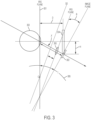
- the camera with a tilt-shift lens that would adjust the angle of the plane of focus to be parallel with the plane of the iris, as illustrated in FIG. 3 .
- the lens (300) of an off-axis camera or imager (302) is tilted (rotated) to change the focal plane of the imager to be parallel with the plane of the iris.
- tilt can be used to control the orientation of the plane of focus.
- a camera lens can provide sharp focus on only a single plane.
- the iris image is taken on a focal plane that runs parallel to the lens/imager (and which is perpendicular to the lens axis); objects in sharp focus are all at the same distance from the camera, as measured parallel to the axis normal to both the lens and the imager, while others at different distances from the camera are blurry.
- an eye (303) is shown that is to be imaged with an off-axis imager comprising a lens (300) and an imager/camera body (302).
- Imager body (302) is attached near or to the lower edge of a display (304).
- the display can be a transparent display such as the lens of a pair of eyeglasses.
- the lens (300) is tilted (e.g., by tilt angle ( ⁇ ), (305)) so that the plane of focus is restored to be parallel to the plane of the iris (301).
- Objects lying in this plane, though at different distances from the camera, can all be sharply focused onto the imager body (302).
- the off-axis imagers described herein may include a lens configured with a tilt (tilt angle) ranging from between about 2.0 to about 8.5 degrees (lens angle relative to the imager plane).
- a tilt tilt angle
- the amount of lens tilt (lens angle relative to the imager plane) may be about 2.0 degrees, about 2.5 degrees, about 3.0 degrees, about 3.5 degrees, about 4.0 degrees, about 4.5 degrees, about 5.0 degrees, about 5.5 degrees, about 6.0 degrees, about 6.5 degrees, about 7.0 degrees, about 8.0 degrees, or about 8.5 degrees.
- the degree of tilt may be smaller or larger depending on other values used when applying the Scheimpflug rule, which is a known geometric rule that describes the orientation of the plane of focus of an optical system when the lens plane is not parallel to the image plane.
- the off-axis imagers include a lens with a fixed degree of tilt; however, in some instances the off-axis imager may have a lens configured with an adjustable tilt.
- the off-axis imagers may include a lens configured to provide a shift offset.
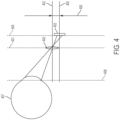
- lens shift refers to a displacement (406, measurement between 405 and 402) of the lens (400) such that the displacement is both confined to the plane (401) of the lens (400), and such that the plane of the lens is kept parallel to the plane (404) of the imager body (403).
- Such a displacement leaves the focal plane (408) of the lens (400) also parallel to the lens and imager planes (401 and 404, respectively).
- shift offset allows adjustment of the position of the iris in the image area without changing the imager (camera) angle; in effect the imager can be aimed at the eye (407) and then a shift offset (406) or movement applied as an alternative to reorienting the imager body (403).
- Shifting a lens may also allow different portions of the iris image to be cast onto the image plane, similar to cropping an area along the edge of an image. Adding a shift function to a lens will generally permit the focal plane of the imager to remain parallel to the plane of the iris while still taking in the full height of the iris, as illustrated in FIG. 4 . This will allow vertical lines in the iris to be perfectly vertical in the resultant photographed image, and more generally to eliminate one important form of distortion from the resulting image.
- the off-axis imagers described herein may be configured to have a (lens) shift ranging from between about 1.0 and about 2.5 mm.
- the amount of shift may be about 1.0 mm, about 1.1 mm, about 1.2 mm, about 1.3 mm, about 1.4 mm, about 1.5 mm, about 1.6 mm, about 1.7 mm, about 1.8 mm, about 1.9 mm, about 2.0 mm, about 2.1 mm, about 2.2 mm, about 2.3 mm, about 2.4 mm, or about 2.5 mm. Similar to tilt, it is understood that the amount of shift may be smaller or larger depending on other values used when applying the Scheimpflug rule.
- the off-axis imagers also generally include a lens where the shift offset is fixed; however, in some instances the off-axis imager may have a lens configured to have an adjustable amount of shift.
- the head-mounted system is a pair of eyeglasses comprising a transparent display (lens or lenses of the eyeglasses), an upper rim (upper frame), a lower rim (lower frame), and an imager attached or mounted to the lower rim about 20 mm below the optic axis (of the eye in rest position).
- the depth to the iris may range between 15 to 30 mm.
- the amount of lens tilt may be between 2.1 and 8.2 degrees (lens angle relative to the imager plane), or the shift offset between 1.1 and 2.3 mm (as calculated using the Scheimflug equation).
- the tilt angle may be fixed between about 2.1 and about 8.2 degrees, or the shift offset may be fixed between about 1.1 and about 2.3 mm.
- a combined implementation in which both the tilt and shift are utilized is also possible.
- the iris imaging system is generally sized or otherwise configured for minimal or no interference with a user's field of view of the actual world.
- the imaging system may be only a few millimeters on each side, e.g., about 5.0 to 8.0 mm on each side, and a few millimeters deep.
- the camera body for imaging the iris includes a plurality of chip-level cameras mounted on or carried by a flexible substrate, for instance, a flexible printed circuit board substrate.
- the flexible substrate may be put over an anvil and potted with potting compound, to inexpensively form an essentially wide angle lens.
- tiny cameras may be built with a layer approach, using wafer level technology.
- the digitized image may be passed to a processor to compute an iris code in any suitable manner, e.g., as defined by U.S. Pat. No. 5,291,560 to Daugman , or by various segmentation methods, e.g. as defined by U.S. 8,064,647 to Bazakos et al.
- the computed iris code is then compared to the iris code which corresponds to the user. If the codes match, the user's identity is verified. Verification or identification processing may be performed at a remote location, and it is understood that in these instances the iris code may be securely transmitted to and/or from the head-mounted device.
- the segmentation approach may be a useful and relatively straightforward process of edge detection and circular fitting.
- the iris biometric approach may include using a POSE TM (i.e., Honeywell International Inc.-polar segmentation) technique to move virtually immediately the analysis to a polar domain and execute a 1-D segmentation of the iris borders, using one or more symmetry properties to detect one or more non-occluded areas of the iris.
- POSE TM i.e., Honeywell International Inc.-polar segmentation
- non-symmetric regions can correspond to areas partially covered by eyelashes, eyelids, etc.
- the invention may relate to any of the following items:
Landscapes
- Engineering & Computer Science (AREA)
- Physics & Mathematics (AREA)
- General Physics & Mathematics (AREA)
- Theoretical Computer Science (AREA)
- General Health & Medical Sciences (AREA)
- Health & Medical Sciences (AREA)
- Multimedia (AREA)
- Optics & Photonics (AREA)
- Human Computer Interaction (AREA)
- Ophthalmology & Optometry (AREA)
- Vascular Medicine (AREA)
- Measurement Of The Respiration, Hearing Ability, Form, And Blood Characteristics Of Living Organisms (AREA)
- Image Input (AREA)
- Collating Specific Patterns (AREA)
- Studio Devices (AREA)
- Cameras In General (AREA)
- Eye Examination Apparatus (AREA)
Applications Claiming Priority (3)
| Application Number | Priority Date | Filing Date | Title |
|---|---|---|---|
| US201562164257P | 2015-05-20 | 2015-05-20 | |
| PCT/US2016/033336 WO2016187457A2 (fr) | 2015-05-20 | 2016-05-19 | Imagerie d'iris à décalage par inclinaison |
| EP16797320.5A EP3298452B1 (fr) | 2015-05-20 | 2016-05-19 | Imagerie d'iris à décalage par inclinaison |
Related Parent Applications (1)
| Application Number | Title | Priority Date | Filing Date |
|---|---|---|---|
| EP16797320.5A Division EP3298452B1 (fr) | 2015-05-20 | 2016-05-19 | Imagerie d'iris à décalage par inclinaison |
Publications (1)
| Publication Number | Publication Date |
|---|---|
| EP4141523A1 true EP4141523A1 (fr) | 2023-03-01 |
Family
ID=57320845
Family Applications (2)
| Application Number | Title | Priority Date | Filing Date |
|---|---|---|---|
| EP16797320.5A Active EP3298452B1 (fr) | 2015-05-20 | 2016-05-19 | Imagerie d'iris à décalage par inclinaison |
| EP22200614.0A Pending EP4141523A1 (fr) | 2015-05-20 | 2016-05-19 | Imagerie d'iris à décalage d'inclinaison |
Family Applications Before (1)
| Application Number | Title | Priority Date | Filing Date |
|---|---|---|---|
| EP16797320.5A Active EP3298452B1 (fr) | 2015-05-20 | 2016-05-19 | Imagerie d'iris à décalage par inclinaison |
Country Status (11)
| Country | Link |
|---|---|
| US (1) | US20160342835A1 (fr) |
| EP (2) | EP3298452B1 (fr) |
| JP (3) | JP6873918B2 (fr) |
| KR (2) | KR102626799B1 (fr) |
| CN (1) | CN108027509A (fr) |
| AU (1) | AU2016264503B2 (fr) |
| CA (1) | CA2986144A1 (fr) |
| HK (1) | HK1252588A1 (fr) |
| IL (2) | IL255734B2 (fr) |
| NZ (1) | NZ737343A (fr) |
| WO (1) | WO2016187457A2 (fr) |
Cited By (1)
| Publication number | Priority date | Publication date | Assignee | Title |
|---|---|---|---|---|
| EP4467063A1 (fr) * | 2023-05-24 | 2024-11-27 | Ziemer Ophthalmic Systems AG | Dispositif d'imagerie ophtalmique |
Families Citing this family (29)
| Publication number | Priority date | Publication date | Assignee | Title |
|---|---|---|---|---|
| US10092232B2 (en) | 2015-06-14 | 2018-10-09 | Facense Ltd. | User state selection based on the shape of the exhale stream |
| US10076250B2 (en) | 2015-06-14 | 2018-09-18 | Facense Ltd. | Detecting physiological responses based on multispectral data from head-mounted cameras |
| US10136856B2 (en) | 2016-06-27 | 2018-11-27 | Facense Ltd. | Wearable respiration measurements system |
| US9968264B2 (en) | 2015-06-14 | 2018-05-15 | Facense Ltd. | Detecting physiological responses based on thermal asymmetry of the face |
| US10064559B2 (en) | 2015-06-14 | 2018-09-04 | Facense Ltd. | Identification of the dominant nostril using thermal measurements |
| US10076270B2 (en) | 2015-06-14 | 2018-09-18 | Facense Ltd. | Detecting physiological responses while accounting for touching the face |
| US10130308B2 (en) | 2015-06-14 | 2018-11-20 | Facense Ltd. | Calculating respiratory parameters from thermal measurements |
| US10154810B2 (en) | 2015-06-14 | 2018-12-18 | Facense Ltd. | Security system that detects atypical behavior |
| US10113913B2 (en) | 2015-10-03 | 2018-10-30 | Facense Ltd. | Systems for collecting thermal measurements of the face |
| US10523852B2 (en) | 2015-06-14 | 2019-12-31 | Facense Ltd. | Wearable inward-facing camera utilizing the Scheimpflug principle |
| US10136852B2 (en) | 2015-06-14 | 2018-11-27 | Facense Ltd. | Detecting an allergic reaction from nasal temperatures |
| DE102016110903A1 (de) | 2015-06-14 | 2016-12-15 | Facense Ltd. | Head-Mounted-Devices zur Messung physiologischer Reaktionen |
| US10045726B2 (en) | 2015-06-14 | 2018-08-14 | Facense Ltd. | Selecting a stressor based on thermal measurements of the face |
| US10151636B2 (en) | 2015-06-14 | 2018-12-11 | Facense Ltd. | Eyeglasses having inward-facing and outward-facing thermal cameras |
| US10045699B2 (en) | 2015-06-14 | 2018-08-14 | Facense Ltd. | Determining a state of a user based on thermal measurements of the forehead |
| US10085685B2 (en) | 2015-06-14 | 2018-10-02 | Facense Ltd. | Selecting triggers of an allergic reaction based on nasal temperatures |
| US10159411B2 (en) | 2015-06-14 | 2018-12-25 | Facense Ltd. | Detecting irregular physiological responses during exposure to sensitive data |
| US10216981B2 (en) | 2015-06-14 | 2019-02-26 | Facense Ltd. | Eyeglasses that measure facial skin color changes |
| US10130299B2 (en) | 2015-06-14 | 2018-11-20 | Facense Ltd. | Neurofeedback eyeglasses |
| US10130261B2 (en) | 2015-06-14 | 2018-11-20 | Facense Ltd. | Detecting physiological responses while taking into account consumption of confounding substances |
| US10299717B2 (en) | 2015-06-14 | 2019-05-28 | Facense Ltd. | Detecting stress based on thermal measurements of the face |
| US10045737B2 (en) | 2015-06-14 | 2018-08-14 | Facense Ltd. | Clip-on device with inward-facing cameras |
| US10080861B2 (en) | 2015-06-14 | 2018-09-25 | Facense Ltd. | Breathing biofeedback eyeglasses |
| US11619814B1 (en) * | 2018-06-04 | 2023-04-04 | Meta Platforms Technologies, Llc | Apparatus, system, and method for improving digital head-mounted displays |
| DE102019126419A1 (de) * | 2019-05-08 | 2020-11-12 | Docter Optics Se | Vorrichtung zum optischen Abbilden von Merkmalen einer Hand |
| GB202010326D0 (en) * | 2020-07-06 | 2020-08-19 | Palakollu Vamsee Krishna | A virtual reality headset |
| US11803237B2 (en) | 2020-11-14 | 2023-10-31 | Facense Ltd. | Controlling an eye tracking camera according to eye movement velocity |
| CN118707789A (zh) * | 2021-06-08 | 2024-09-27 | 核心光电有限公司 | 用于使超微距图像的焦平面倾斜的方法和电子移动设备 |
| SE546866C2 (en) * | 2023-03-02 | 2025-03-04 | Tobii Ab | Eye tracking glasses |
Citations (10)
| Publication number | Priority date | Publication date | Assignee | Title |
|---|---|---|---|---|
| US647A (en) | 1838-03-21 | Improved fishing-seine for deep water | ||
| US8064A (en) | 1851-04-29 | Spbibtg-saddle | ||
| US5291560A (en) | 1991-07-15 | 1994-03-01 | Iri Scan Incorporated | Biometric personal identification system based on iris analysis |
| US6320610B1 (en) | 1998-12-31 | 2001-11-20 | Sensar, Inc. | Compact imaging device incorporating rotatably mounted cameras |
| US20050008200A1 (en) * | 2002-09-13 | 2005-01-13 | Takeo Azuma | Iris encoding method, individual authentication method, iris code registration device, iris authentication device, and iris authentication program |
| US20110058712A1 (en) * | 2008-07-24 | 2011-03-10 | Universidad Complutense De Madrid | Biometric recognition through examination of the surface map of the second ocular dioptric |
| US8064647B2 (en) | 2006-03-03 | 2011-11-22 | Honeywell International Inc. | System for iris detection tracking and recognition at a distance |
| US8317325B2 (en) | 2008-10-31 | 2012-11-27 | Cross Match Technologies, Inc. | Apparatus and method for two eye imaging for iris identification |
| US20130241805A1 (en) * | 2012-03-15 | 2013-09-19 | Google Inc. | Using Convergence Angle to Select Among Different UI Elements |
| US20140307077A1 (en) * | 2013-04-10 | 2014-10-16 | Delta ID Inc. | Apparatuses and methods for iris imaging |
Family Cites Families (42)
| Publication number | Priority date | Publication date | Assignee | Title |
|---|---|---|---|---|
| TW410524B (en) * | 1994-07-14 | 2000-11-01 | Advantest Corp | LCD panel image quality examining device and LCD image sampling method |
| US6714665B1 (en) * | 1994-09-02 | 2004-03-30 | Sarnoff Corporation | Fully automated iris recognition system utilizing wide and narrow fields of view |
| GB9515311D0 (en) * | 1995-07-26 | 1995-09-20 | 3D Scanners Ltd | Stripe scanners and methods of scanning |
| JP3676472B2 (ja) * | 1996-01-19 | 2005-07-27 | オリンパス株式会社 | 接眼光学系 |
| JPH10179520A (ja) * | 1996-12-26 | 1998-07-07 | Canon Inc | 視線検出方法及び装置並びに記憶媒体 |
| GB9907515D0 (en) * | 1999-04-01 | 1999-05-26 | Ncr Int Inc | Self service terminal |
| JP3664937B2 (ja) * | 2000-03-27 | 2005-06-29 | 株式会社ニデック | 眼科装置 |
| EP1357831A2 (fr) * | 2001-02-09 | 2003-11-05 | Sensomotoric Instruments GmbH | Systeme de mesure de position de l'oeil et de poursuite oculaire a dimensions multiples pour le diagnostic et le traitement de l'oeil |
| US20030169334A1 (en) * | 2001-08-06 | 2003-09-11 | Michael Braithwaite | Iris capture device having expanded capture volume |
| US6836337B2 (en) * | 2001-09-20 | 2004-12-28 | Visual Pathways, Inc. | Non-invasive blood glucose monitoring by interferometry |
| US7145726B2 (en) * | 2002-08-12 | 2006-12-05 | Richard Geist | Head-mounted virtual display apparatus for mobile activities |
| US7319780B2 (en) * | 2002-11-25 | 2008-01-15 | Eastman Kodak Company | Imaging method and system for health monitoring and personal security |
| JP4527088B2 (ja) * | 2003-07-04 | 2010-08-18 | パナソニック株式会社 | 生体眼判定方法および生体眼判定装置 |
| US7428320B2 (en) * | 2004-12-07 | 2008-09-23 | Aoptix Technologies, Inc. | Iris imaging using reflection from the eye |
| KR100658425B1 (ko) * | 2005-01-31 | 2006-12-15 | 김신호 | 하이브리드형 홍채줌카메라 촬영장치 및 그 방법 |
| JP2007006393A (ja) * | 2005-06-27 | 2007-01-11 | Institute Of Physical & Chemical Research | 情報提示システム |
| JP4411547B2 (ja) * | 2006-03-20 | 2010-02-10 | ソニー株式会社 | 画像表示装置 |
| JP2008090483A (ja) | 2006-09-29 | 2008-04-17 | Oki Electric Ind Co Ltd | 個人認証システム及び個人認証方法 |
| JP5173260B2 (ja) * | 2007-05-28 | 2013-04-03 | キヤノン株式会社 | ズームレンズおよびそれを有する撮像装置 |
| US20140063055A1 (en) * | 2010-02-28 | 2014-03-06 | Osterhout Group, Inc. | Ar glasses specific user interface and control interface based on a connected external device type |
| US20110213664A1 (en) * | 2010-02-28 | 2011-09-01 | Osterhout Group, Inc. | Local advertising content on an interactive head-mounted eyepiece |
| US8254768B2 (en) * | 2010-12-22 | 2012-08-28 | Michael Braithwaite | System and method for illuminating and imaging the iris of a person |
| US9185352B1 (en) * | 2010-12-22 | 2015-11-10 | Thomas Jacques | Mobile eye tracking system |
| EP2751609B1 (fr) | 2011-08-30 | 2017-08-16 | Microsoft Technology Licensing, LLC | Dispositif d'affichage monté sur la tête avec profilage par balayage de l'iris |
| US8929589B2 (en) * | 2011-11-07 | 2015-01-06 | Eyefluence, Inc. | Systems and methods for high-resolution gaze tracking |
| CN104094197B (zh) * | 2012-02-06 | 2018-05-11 | 索尼爱立信移动通讯股份有限公司 | 利用投影仪的注视追踪 |
| WO2014043142A1 (fr) * | 2012-09-11 | 2014-03-20 | Augmented Vision, Inc. | Appareil compact d'imagerie d'œil et de suivi d'œil |
| JP6229260B2 (ja) * | 2012-11-20 | 2017-11-15 | セイコーエプソン株式会社 | 虚像表示装置 |
| CN104903818B (zh) * | 2012-12-06 | 2018-12-14 | 谷歌有限责任公司 | 眼睛跟踪佩戴式设备和使用方法 |
| US9195890B2 (en) * | 2012-12-10 | 2015-11-24 | Sri International | Iris biometric matching system |
| US9788714B2 (en) * | 2014-07-08 | 2017-10-17 | Iarmourholdings, Inc. | Systems and methods using virtual reality or augmented reality environments for the measurement and/or improvement of human vestibulo-ocular performance |
| US9370302B2 (en) * | 2014-07-08 | 2016-06-21 | Wesley W. O. Krueger | System and method for the measurement of vestibulo-ocular reflex to improve human performance in an occupational environment |
| US20140327754A1 (en) * | 2013-05-06 | 2014-11-06 | Delta ID Inc. | Method and apparatus for compensating for sub-optimal orientation of an iris imaging apparatus |
| US9979547B2 (en) * | 2013-05-08 | 2018-05-22 | Google Llc | Password management |
| US20140341441A1 (en) * | 2013-05-20 | 2014-11-20 | Motorola Mobility Llc | Wearable device user authentication |
| CN105682539B (zh) * | 2013-09-03 | 2018-03-16 | 托比股份公司 | 便携式眼睛追踪设备 |
| US9360935B2 (en) * | 2013-12-20 | 2016-06-07 | Hong Kong Applied Science And Technology Research Institute Co. Ltd. | Integrated bi-sensing optical structure for head mounted display |
| US9579060B1 (en) * | 2014-02-18 | 2017-02-28 | Orbitol Research Inc. | Head-mounted physiological signal monitoring system, devices and methods |
| EP3140780B1 (fr) * | 2014-05-09 | 2020-11-04 | Google LLC | Systèmes et procédés de discernement de signaux oculaires et d'identification biométrique continue |
| US9747500B2 (en) * | 2015-01-30 | 2017-08-29 | Raytheon Company | Wearable retina/iris scan authentication system |
| CN104573676B (zh) * | 2015-02-02 | 2018-01-05 | 深圳眼神智能科技有限公司 | 防眼镜反光干扰的虹膜识别装置 |
| US9823474B2 (en) * | 2015-04-02 | 2017-11-21 | Avegant Corp. | System, apparatus, and method for displaying an image with a wider field of view |
-
2016
- 2016-05-19 AU AU2016264503A patent/AU2016264503B2/en active Active
- 2016-05-19 IL IL255734A patent/IL255734B2/en unknown
- 2016-05-19 KR KR1020177036623A patent/KR102626799B1/ko active Active
- 2016-05-19 CN CN201680042252.8A patent/CN108027509A/zh active Pending
- 2016-05-19 JP JP2017560251A patent/JP6873918B2/ja active Active
- 2016-05-19 NZ NZ737343A patent/NZ737343A/en unknown
- 2016-05-19 CA CA2986144A patent/CA2986144A1/fr active Pending
- 2016-05-19 HK HK18111902.4A patent/HK1252588A1/zh unknown
- 2016-05-19 IL IL303125A patent/IL303125B2/en unknown
- 2016-05-19 US US15/159,289 patent/US20160342835A1/en not_active Abandoned
- 2016-05-19 WO PCT/US2016/033336 patent/WO2016187457A2/fr not_active Ceased
- 2016-05-19 EP EP16797320.5A patent/EP3298452B1/fr active Active
- 2016-05-19 EP EP22200614.0A patent/EP4141523A1/fr active Pending
- 2016-05-19 KR KR1020247001391A patent/KR102869808B1/ko active Active
-
2021
- 2021-04-21 JP JP2021071878A patent/JP7196224B2/ja active Active
-
2022
- 2022-12-14 JP JP2022199309A patent/JP7479440B2/ja active Active
Patent Citations (10)
| Publication number | Priority date | Publication date | Assignee | Title |
|---|---|---|---|---|
| US647A (en) | 1838-03-21 | Improved fishing-seine for deep water | ||
| US8064A (en) | 1851-04-29 | Spbibtg-saddle | ||
| US5291560A (en) | 1991-07-15 | 1994-03-01 | Iri Scan Incorporated | Biometric personal identification system based on iris analysis |
| US6320610B1 (en) | 1998-12-31 | 2001-11-20 | Sensar, Inc. | Compact imaging device incorporating rotatably mounted cameras |
| US20050008200A1 (en) * | 2002-09-13 | 2005-01-13 | Takeo Azuma | Iris encoding method, individual authentication method, iris code registration device, iris authentication device, and iris authentication program |
| US8064647B2 (en) | 2006-03-03 | 2011-11-22 | Honeywell International Inc. | System for iris detection tracking and recognition at a distance |
| US20110058712A1 (en) * | 2008-07-24 | 2011-03-10 | Universidad Complutense De Madrid | Biometric recognition through examination of the surface map of the second ocular dioptric |
| US8317325B2 (en) | 2008-10-31 | 2012-11-27 | Cross Match Technologies, Inc. | Apparatus and method for two eye imaging for iris identification |
| US20130241805A1 (en) * | 2012-03-15 | 2013-09-19 | Google Inc. | Using Convergence Angle to Select Among Different UI Elements |
| US20140307077A1 (en) * | 2013-04-10 | 2014-10-16 | Delta ID Inc. | Apparatuses and methods for iris imaging |
Non-Patent Citations (1)
| Title |
|---|
| ALPA: "Parallel shift and Scheimpflug lens tilt - The use and ideal design of technical cameras", 1 June 2012 (2012-06-01), XP055427124, Retrieved from the Internet <URL:https://www.alpa.ch/_files/ALPA_Tilt-201206_E.pdf> [retrieved on 20171121] * |
Cited By (1)
| Publication number | Priority date | Publication date | Assignee | Title |
|---|---|---|---|---|
| EP4467063A1 (fr) * | 2023-05-24 | 2024-11-27 | Ziemer Ophthalmic Systems AG | Dispositif d'imagerie ophtalmique |
Also Published As
| Publication number | Publication date |
|---|---|
| JP6873918B2 (ja) | 2021-05-19 |
| JP2018514882A (ja) | 2018-06-07 |
| JP7479440B2 (ja) | 2024-05-08 |
| EP3298452A4 (fr) | 2018-05-30 |
| JP7196224B2 (ja) | 2022-12-26 |
| IL255734B2 (en) | 2023-10-01 |
| JP2023036710A (ja) | 2023-03-14 |
| AU2016264503B2 (en) | 2021-10-28 |
| NZ737343A (en) | 2023-06-30 |
| IL255734B1 (en) | 2023-06-01 |
| US20160342835A1 (en) | 2016-11-24 |
| WO2016187457A3 (fr) | 2017-03-23 |
| KR20180009773A (ko) | 2018-01-29 |
| AU2016264503A1 (en) | 2017-12-07 |
| JP2021121933A (ja) | 2021-08-26 |
| EP3298452A2 (fr) | 2018-03-28 |
| CA2986144A1 (fr) | 2016-11-24 |
| CN108027509A (zh) | 2018-05-11 |
| KR102626799B1 (ko) | 2024-01-17 |
| IL303125A (en) | 2023-07-01 |
| KR102869808B1 (ko) | 2025-10-13 |
| WO2016187457A2 (fr) | 2016-11-24 |
| IL255734A (en) | 2018-01-31 |
| HK1252588A1 (zh) | 2019-05-31 |
| EP3298452B1 (fr) | 2022-11-02 |
| KR20240009542A (ko) | 2024-01-22 |
| IL303125B2 (en) | 2024-07-01 |
| IL303125B1 (en) | 2024-03-01 |
Similar Documents
| Publication | Publication Date | Title |
|---|---|---|
| JP7479440B2 (ja) | 傾斜シフト虹彩撮像 | |
| US8170293B2 (en) | Multimodal ocular biometric system and methods | |
| US9336438B2 (en) | Iris cameras | |
| US8317325B2 (en) | Apparatus and method for two eye imaging for iris identification | |
| EP1241614A2 (fr) | Appareil et méthode d'ajustement de la position de focalisation dans un système de reconaissance d'iris | |
| EP0865637A1 (fr) | Systeme et procede de reconnaissance a champ de vision grand angulaire et petit angulaire | |
| KR101635602B1 (ko) | 홍채 인식 방법 및 장치 | |
| JP5092120B2 (ja) | 眼球運動計測装置 | |
| KR101731972B1 (ko) | 검안기의 자동 포커싱 장치 및 그 방법 | |
| KR101122513B1 (ko) | 3차원 위치정보를 이용한 안구위치 추정시스템 및 안구위치추정방법 | |
| Singla et al. | Challenges at different stages of an iris based biometric system. | |
| KR101723989B1 (ko) | 검안기의 자동 트랙킹 장치 및 그 방법 | |
| Chuang et al. | Autofocus of iris patterns using a triangle aperture | |
| KR20150085418A (ko) | 보조 카메라를 이용한 단말기에서의 홍채 영상 획득 장치 및 그 방법 |
Legal Events
| Date | Code | Title | Description |
|---|---|---|---|
| PUAI | Public reference made under article 153(3) epc to a published international application that has entered the european phase |
Free format text: ORIGINAL CODE: 0009012 |
|
| STAA | Information on the status of an ep patent application or granted ep patent |
Free format text: STATUS: THE APPLICATION HAS BEEN PUBLISHED |
|
| AC | Divisional application: reference to earlier application |
Ref document number: 3298452 Country of ref document: EP Kind code of ref document: P |
|
| AK | Designated contracting states |
Kind code of ref document: A1 Designated state(s): AL AT BE BG CH CY CZ DE DK EE ES FI FR GB GR HR HU IE IS IT LI LT LU LV MC MK MT NL NO PL PT RO RS SE SI SK SM TR |
|
| STAA | Information on the status of an ep patent application or granted ep patent |
Free format text: STATUS: REQUEST FOR EXAMINATION WAS MADE |
|
| 17P | Request for examination filed |
Effective date: 20230831 |
|
| RBV | Designated contracting states (corrected) |
Designated state(s): AL AT BE BG CH CY CZ DE DK EE ES FI FR GB GR HR HU IE IS IT LI LT LU LV MC MK MT NL NO PL PT RO RS SE SI SK SM TR |
|
| STAA | Information on the status of an ep patent application or granted ep patent |
Free format text: STATUS: EXAMINATION IS IN PROGRESS |
|
| 17Q | First examination report despatched |
Effective date: 20250212 |