EP4141584A1 - Simulationssystem und simulationsverfahren sowie epidemisches deduktionssimulationssystem und simulationsverfahren - Google Patents
Simulationssystem und simulationsverfahren sowie epidemisches deduktionssimulationssystem und simulationsverfahren Download PDFInfo
- Publication number
- EP4141584A1 EP4141584A1 EP21792125.3A EP21792125A EP4141584A1 EP 4141584 A1 EP4141584 A1 EP 4141584A1 EP 21792125 A EP21792125 A EP 21792125A EP 4141584 A1 EP4141584 A1 EP 4141584A1
- Authority
- EP
- European Patent Office
- Prior art keywords
- behavior
- patients
- moving
- simulation
- disease
- Prior art date
- Legal status (The legal status is an assumption and is not a legal conclusion. Google has not performed a legal analysis and makes no representation as to the accuracy of the status listed.)
- Withdrawn
Links
Images

Classifications
-
- G—PHYSICS
- G16—INFORMATION AND COMMUNICATION TECHNOLOGY [ICT] SPECIALLY ADAPTED FOR SPECIFIC APPLICATION FIELDS
- G16H—HEALTHCARE INFORMATICS, i.e. INFORMATION AND COMMUNICATION TECHNOLOGY [ICT] SPECIALLY ADAPTED FOR THE HANDLING OR PROCESSING OF MEDICAL OR HEALTHCARE DATA
- G16H50/00—ICT specially adapted for medical diagnosis, medical simulation or medical data mining; ICT specially adapted for detecting, monitoring or modelling epidemics or pandemics
- G16H50/50—ICT specially adapted for medical diagnosis, medical simulation or medical data mining; ICT specially adapted for detecting, monitoring or modelling epidemics or pandemics for simulation or modelling of medical disorders
-
- G—PHYSICS
- G16—INFORMATION AND COMMUNICATION TECHNOLOGY [ICT] SPECIALLY ADAPTED FOR SPECIFIC APPLICATION FIELDS
- G16H—HEALTHCARE INFORMATICS, i.e. INFORMATION AND COMMUNICATION TECHNOLOGY [ICT] SPECIALLY ADAPTED FOR THE HANDLING OR PROCESSING OF MEDICAL OR HEALTHCARE DATA
- G16H50/00—ICT specially adapted for medical diagnosis, medical simulation or medical data mining; ICT specially adapted for detecting, monitoring or modelling epidemics or pandemics
- G16H50/80—ICT specially adapted for medical diagnosis, medical simulation or medical data mining; ICT specially adapted for detecting, monitoring or modelling epidemics or pandemics for detecting, monitoring or modelling epidemics or pandemics, e.g. flu
-
- G—PHYSICS
- G06—COMPUTING OR CALCULATING; COUNTING
- G06F—ELECTRIC DIGITAL DATA PROCESSING
- G06F30/00—Computer-aided design [CAD]
- G06F30/10—Geometric CAD
- G06F30/15—Vehicle, aircraft or watercraft design
-
- G—PHYSICS
- G06—COMPUTING OR CALCULATING; COUNTING
- G06F—ELECTRIC DIGITAL DATA PROCESSING
- G06F30/00—Computer-aided design [CAD]
- G06F30/20—Design optimisation, verification or simulation
- G06F30/27—Design optimisation, verification or simulation using machine learning, e.g. artificial intelligence, neural networks, support vector machines [SVM] or training a model
-
- G—PHYSICS
- G06—COMPUTING OR CALCULATING; COUNTING
- G06F—ELECTRIC DIGITAL DATA PROCESSING
- G06F2111/00—Details relating to CAD techniques
- G06F2111/10—Numerical modelling
Definitions
- the present disclosure generally relates to the field of artificial intelligence, and more particularly, to a data-driven simulation system and simulation method, and an epidemic deduction simulation system and simulation method.
- Simulation is an approximation or imitation of how a process or a system works.
- a simulator is a kind of software that has an ability to simulate an operation of a process or a system over time. The simulator needs to extract key states involved in the operation of the system, and use a program to simulate changes of these states (which can be called behaviors of the system). The simulator can be used for system simulation, analysis, tuning, testing, teaching, etc., and has a wide range of applications.
- a traditional simulator abstracts system behaviors into mathematical formulas or solutions of mathematical problems through domain knowledge, while determines parameters involved in the mathematical formulas or problems, and further converts them into computer-understandable codes, thereby realizing a simulation function.
- the mathematical formulas (problems) and their corresponding codes may be simply referred to as rules, and the rules may involve corresponding parameters.
- a speed state of the vehicle can be updated by simulating an acceleration process of the vehicle using an acceleration formula
- an electromagnetic simulator system states such as electric field intensity and magnetic field intensity can be obtained by solving Maxwell's equations.
- the key states are the speed of the vehicle and the intensity of the electromagnetic field, respectively.
- the system behaviors are abstracted into the acceleration formula or solving Maxwell's equations.
- the involved parameters are an acceleration of the vehicle or a dielectric constant of a medium.
- the traditional simulator relies on rules and parameters provided by domain knowledge, but in actual situations, the following situations may be encountered: 1. Domain knowledge about rules is lacking. For example, in a supply chain scenario, it is necessary to simulate an order arrival behavior, but the order arrival is a result of the mutual influence of various factors, and the process is too complicated to be abstracted into simple rules. 2. Domain knowledge about parameters is lacking. For example, in an epidemic deduction scenario, a key parameter of an infection number (how many susceptible people can be infected by one infected person) needs to be determined, but the estimation of the infection number needs to wait for a detailed long-term study of the infectious disease, and the estimation may be inaccurate.
- the simulator may simulate a target system at a certain level of abstraction.
- the vehicle simulator can simulate the acceleration process of the vehicle from a higher level (such as using acceleration parameters and applying the acceleration formula), or it can simulate from a lower level (such as considering a series of complex underlying mechanisms such as fuel combustion, pushing pistons, force transmission, etc.). Therefore, under the premise of a given abstraction level, the traditional simulator cannot utilize useful data available in reality, and the accuracy of the traditional simulator (the ability to reflect a real system) is limited by accuracy and completeness of domain knowledge.
- Exemplary embodiments of the present disclosure aim to overcome the above drawbacks of the traditional simulator that is limited due to lack of rules or parameters and limited in precision.
- a system including at least one computing device and at least one storing device, wherein the at least one storing device stores instructions that, when executed by the at least one computing device, cause the at least one computing device to perform a simulation method
- the simulation method includes: receiving an external input; controlling a behavior described in a preset simulation logic program based on the external input, wherein the preset simulation logic program describes a state in a simulated item and a behavior that drives a change in the state in code, wherein when the external input includes a learnable parameter, an optimized value of the learnable parameter is obtained, and the step of controlling the behavior described in the preset simulation logic program based on the external input is performed by using the optimized value as a value of the learnable parameter; in response to the controlling, running the preset simulation logic program; optimizing the value of the learnable parameter based on output simulation result data.
- a simulation method performed by a system including at least one computing device and at least one storing device stores instructions that, when executed by the at least one computing device, cause the at least one computing device to perform the simulation method
- the simulation method includes: receiving an external input; controlling a behavior described in a preset simulation logic program based on the external input, wherein the preset simulation logic program describes a state in a simulated item and a behavior that drives a change in the state in code, wherein when the external input includes a learnable parameter, an optimized value of the learnable parameter is obtained, and the step of controlling the behavior described in the preset simulation logic program based on the external input is performed by using the optimized value as a value of the learnable parameter; in response to the controlling, running the preset simulation logic program; optimizing the value of the learnable parameter based on output simulation result data.
- a simulation system includes: a user interface module configured to receive an external input; a control module configured to control a behavior described in a preset simulation logic program based on the external input, wherein the preset simulation logic program describes a state in a simulated item and a behavior that drives a change in the state in code, wherein when the external input includes a learnable parameter, an optimized value of the learnable parameter is obtained, and the step of controlling the behavior described in the preset simulation logic program based on the external input is performed by using the optimized value as a value of the learnable parameter; a simulation module configured to run the preset simulation logic program in response to the controlling; an optimization module configured to optimize the value of the learnable parameter based on output simulation result data.
- a system including at least one computing device and at least one storing device, wherein the at least one storing device stores instructions that, when executed by the at least one computing device, cause the at least one computing device to perform a simulation method
- the simulation method includes: receiving an external input; controlling a behavior described in a preset simulation logic program based on the external input, wherein the preset simulation logic program describes a state in epidemic development and a behavior that drives a change in the state in the epidemic development in code, wherein when the external input includes a learnable parameter, an optimized value of the learnable parameter is obtained, and the step of controlling the behavior described in the preset simulation logic program based on the external input is performed by using the optimized value as a value of the learnable parameter; in response to the controlling, running the preset simulation logic program; optimizing the value of the learnable parameter based on output simulation result data.
- a simulation method performed by a system including at least one computing device and at least one storing device stores instructions that, when executed by the at least one computing device, cause the at least one computing device to perform the simulation method
- the simulation method includes: receiving an external input; controlling a behavior described in a preset simulation logic program based on the external input, wherein the preset simulation logic program describes a state in epidemic development and a behavior that drives a change in the state in the epidemic development in code, wherein when the external input includes a learnable parameter, an optimized value of the learnable parameter is obtained, and the step of controlling the behavior described in the preset simulation logic program based on the external input is performed by using the optimized value as a value of the learnable parameter; in response to the controlling, running the preset simulation logic program; optimizing the value of the learnable parameter based on output simulation result data.
- a epidemic deduction simulation system includes: a user interface module configured to receive an external input; a control module configured to control a behavior described in a preset simulation logic program based on the external input, wherein the preset simulation logic program describes a state in epidemic development and a behavior that drives a change in the state in the epidemic development in code, wherein when the external input includes a learnable parameter, an optimized value of the learnable parameter is obtained, and the step of controlling the behavior described in the preset simulation logic program based on the external input is performed by using the optimized value as a value of the learnable parameter; a simulation module configured to run the preset simulation logic program in response to the controlling; an optimization module configured to optimize the value of the learnable parameter based on output simulation result data.
- a computer readable storage medium storing instructions that, when executed by at least one computing device, cause the at least one computing device to perform the simulation method according to the present disclosure.
- real data for example, historical data
- real data can be utilized to determine parameters required for simulation that cannot be obtained from domain knowledge temporarily by fitting the real data, thereby reducing the dependence of the simulation system on domain knowledge, expanding the applicable field and scope of the simulation system, meeting the simulation requirements of many different scenarios, and improving the simulation accuracy.
- epidemic deduction simulation system and simulation method suitable for epidemic deduction scenarios of the present disclosure compared with traditional epidemic models (e.g., SIR, SEIR), a more complex epidemic deduction simulation logic can be realized, and real epidemic data can be utilized to determine epidemic deduction parameters required for simulation that cannot be obtained from epidemic domain knowledge temporarily by fitting the real epidemic data, so as to obtain more accurate epidemic deduction simulation results.
- traditional epidemic models e.g., SIR, SEIR
- “at least one of several items” in the present disclosure all means including three parallel situations of "any one of the several items", “a combination of any of the several items” and “the whole of the several items”.
- “and/or” all means at least one of two or more items connected by it.
- “including at least one of A and B” and “including A and/or B” include the following three parallel situations: (1) including A; (2) including B; (3) including A and B.
- “performing at least one of step 1 and step 2", “performing step 1 and/or step 2” means the following three parallel situations: (1) performing step 1; (2) performing step 2; (3) performing step 1 and step 2. That is, “A and/or B" can also be expressed as “at least one of A and B", and “performing step 1 and/or step 2" can also be expressed as "performing at least one of step 1 and step 2".
- the basic idea of the present disclosure is to use a data-driven approach to reduce the dependence of the simulation system on domain knowledge, thereby expanding the scope of application of the simulation system and improving the accuracy of the simulation system.
- a general simulation system framework is proposed and may be applied to epidemic deduction scenarios.
- the simulation system framework can include three basic parts, namely, a simulation module for running a data-driven based simulation logic, a control module for flexibly intervening the simulation logic, and an optimization module for learning some parameters required for simulation in a data-driven way. Therefore, when designing the simulation system framework, the three parts may be designed independently on the premise of clarifying the overall design (such as sorting out available domain knowledge and data, determining abstraction levels of the simulation system, etc.).
- Such a simulation system framework is developed using the processes of start development, overall design, three-part independent design development, testing and iteration, and development completion.
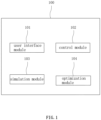
- FIG. 1 is a block diagram illustrating a simulation system according to an exemplary embodiment of the present disclosure.
- a simulation system 100 may include a user interface module 101, a control module 102, a simulation module 103 and an optimization module 104.
- the user interface module 101 is a module for receiving data input from the outside.
- the user interface module 101 may also receive any other external user input, control input, and the like.
- the simulation module 103 is a module for storing and running a preset simulation logic program.
- the preset simulation logic program describes a state in a simulated item and a behavior that drives a change in the state in code.
- the state in the simulated item may include one or more states, and the behavior that drives the change in the state may also include one or more behaviors, the behavior involves at least one of a rule, a parameter and data.
- the preset simulation logic program describes a state in a change of a vehicle speed (e.g., a speed of a vehicle) and a behavior that drives a change in the state in the change of the vehicle speed in code (e.g., an acceleration of the vehicle).
- the preset simulation logic program describes a state in epidemic development (for example, a number of confirmed patients, etc.) and a behavior that drives a change in the state in the epidemic development in code (e.g., a confirmed behavior, etc.).
- the control module 102 is a module for finely controlling the simulation logic program by a user or developer.
- the control module 102 may convert an external input received through the user interface module 101 into rules, parameters and data required by the simulation logic program according to its own logic based on the external input, or the control module 102 may directly intervene (e.g., modify) the state or the behavior in the simulation logic program.
- the control module 102 may also perform a corresponding control according to other users' input or control input.
- the optimization module 104 is a module for optimizing learnable parameters required by the simulation system 100 to improve the simulation accuracy of the simulation system 100.
- the process of optimizing the parameter is a process of learning the parameter, through which the optimized parameter can be obtained.
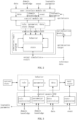
- FIG. 2 is a logical schematic diagram illustrating a simulation system 100 according to an exemplary embodiment of the present disclosure.
- the user interface module 101 may receive an external input.
- the external input may include at least one of domain knowledge, data and an event related to a simulated item.
- the external input may also include a learnable parameter.
- the learnable parameter refers to at least one parameter related to the simulated item that cannot be directly obtained from the domain knowledge, the data, or the event.
- the control module 102 may control the behavior described in the preset simulation logic program based on the external input received through the user interface module 101.
- the simulation module 103 may run the preset simulation logic program in response to the control of the control module 102.
- the optimization module 104 may optimize the value of the learnable parameter based on the simulation result data output by the simulation module 103.
- the control module 102 converts the external input (e.g., at least one of the domain knowledge, the data, the event and the learnable parameter) into at least one of the rule, the parameter and the data involved in the behavior described in the preset simulation logic program and sends the converted at least one of the rule, the parameter and the data to the simulation module 103.
- the simulation module 103 can apply the converted at least one of the rule, the parameter and the data to the preset simulation logic program and running the preset simulation logic program, to obtain and output the simulation result data.
- the control module 102 may also directly intervene the behavior described in the simulation logic program.
- the user interface module 101 may also receive a user input for modifying the behavior in the simulation logic program.
- the control module 102 may modify at least one of the rule, the parameter and the data according to the user input and send the modified at least one of the rule, the parameter and the data to the simulation module 103.
- the simulation module 103 may apply the modified at least one of the rule, the parameter and the data to the preset simulation logic program and running the preset simulation logic program, to obtain and output the simulation result data.
- control module 102 may also directly intervene a change of the state described in the simulation logic program.
- the user interface module 101 may also receive a user input for modifying the state described in the simulation logic program.
- the control module 102 may modify a change in at least one of the states described in the simulation logic program based on the user input.
- FIG. 3 is a schematic diagram illustrating a relationship between the control module 102 and the simulation logic program according to an exemplary embodiment of the present disclosure.
- the control module 102 may include one or more controllers, for example, may include at least one of a rule controller, a parameter controller, a data controller, and a state controller.
- the rule controller may convert at least one of domain knowledge and a learnable parameter in an external input into a rule involved in the behavior in the simulation logic program, or may intervene (e.g., modify) the rule involved in the behavior in the simulation logic program based on a user input.
- the parameter controller can convert at least one of domain knowledge and a learnable parameter in an external input into a parameter involved in the behavior in the simulation logic program, or may intervene (e.g., modify) the parameter involved in the behavior in the simulation logic program based on a user input.
- the data controller can convert at least one of data and a learnable parameter in an external input into a parameter involved in the behavior in the simulated logic program, or can intervene (e.g., modify) data involved in the behavior in the simulation logic program based on a user input.
- the simulation module 103 can run the simulation logic program in response to the control of the rule controller, the parameter controller and the data controller.
- the rule, the parameter and the data involved in the behavior of the simulation logic program can drive the state in the simulation logic program to change from a current state to a next state based on the control of the rule controller, the parameter controller and the data controller.
- the state controller may directly intervene the change in the state in the simulation logic program (i.e., directly modify the converted state) based on at least one of an event and a learnable parameter in a user input.
- the above relationship is an exemplary, and the present application does not limit the input, internal structure and conversion logic of the control module 102.
- the user interface module 101 may also receive a user input for initializing the simulation system 100 according to an exemplary embodiment of the present disclosure.
- the control module 102 may set an initial value of the state in the simulation logic program according to the user input.
- the control module 102 may set the value of the learnable parameter according to the user input.
- the initial value of the state in the simulation logic program cannot be directly obtained from the domain knowledge, the data or the event, the initial value of the state in the simulation logic program may be used as a learnable parameter.
- the simulation module 103 can run the simulation logic program, such that the behavior in the simulation logic program drives the state in the simulation logic program to change from an initial state to a next state. Therefore, the simulation module 103 may output the changed state as simulation result data.
- the optimization module 104 may optimize the value of the learnable parameter based on the simulation result data output by the simulation module 103.
- the user interface module 101 may re-receive an external input (e.g., re-receive at least one of domain knowledge, data, and events), and the control module 102 may obtain the re-received external input from the user interface module 101, obtain the optimized value of the learnable parameter from the optimization module 104 and control the behavior in the simulation logic program based on the re-received external input by using the optimized value as the value of the learnable parameter in the external input. Then, the simulation module 103 can run the simulation logic program again and output the simulation result data, based on this control of the control module 102, and the optimization module 104 can optimize the current value of the learnable parameter based on the simulation result data again. So on and so forth.
- an external input e.g., re-receive at least one of domain knowledge, data, and events
- the control module 102 may obtain the re-received external input from the user interface module 101, obtain the optimized value of the learnable parameter from the optimization module 104 and
- an operation mode of the simulation system 100 may include an optimization mode and a simulation mode.
- the optimization mode the user interface module 101, the control module 102, the simulation module 103, and the optimization module 104 may perform operations iteratively to obtain a final optimized value of the learnable parameter.
- the control module 102 performs the step of controlling the behavior described in the preset simulation logic program based on the external input by taking the final optimized value of the learnable parameter as the value of the learnable parameter, and in response to the control of the control module 102, the simulation module 103 may run the preset simulation logic program, and output accurate simulation result data.
- the simulation system 100 may need some parameters (i.e., learnable parameters) that cannot be obtained directly or through simple operations from domain knowledge or data, the values of these parameters may be manually set first, and then the optimized values of these parameters may be obtained through simulation and optimization of the simulation system 100, so that the simulation result of the simulation system 100 tend to be accurate.
- the data-driven method is used to reduce the dependence of the simulation system 100 on domain knowledge or data and improve the accuracy of the simulation system 100.
- the user interface module 101 can receive an external input in real time, the control module 102 controls the behavior described in the preset simulation logic program based on the real-time external input, and in response to the control of the control module 102, the simulation module 103 runs the preset simulation logic program in real time, and the optimization module 104 optimizes the value of the learnable parameter based on the simulation result data output by the simulation module 103 in real time.
- the user interface module 101, the control module 102, the simulation module 103, and the optimization module 104 may perform operations iteratively at a predetermined time interval.
- the user interface module 101, the control module 102 and the simulation module 103 may perform operations at a first predetermined time interval, and the optimization module 104 may perform operations at a second predetermined time interval, wherein the second predetermined time interval is longer than the first predetermined time interval.
- the user interface module 101, the control module 102 and the simulation module 103 can perform operations every day, and the epidemic simulation result data is output every day, while the optimization module 104 can perform operations every ten days, that is, the optimization module 104 can optimize the learnable parameter based on the ten-day epidemic simulation result data, which will be described in detail later.
- the user interface module 101 may also receive reference data of the simulated item, such as historical data or real data of the simulated item.
- the optimization module 104 can calculate an optimization target based on the simulation result data output by the simulation module 103 and the reference data of the simulated item, and optimize the optimization target through an optimization algorithm, thereby tuning the value of the learnable parameter.
- the learnable parameter may include a type and a value range, where the type is used to describe the type of the learnable parameter, for example, an integer (1, 2, 3), a floating-point number (3 .1415926 ), a string (such as "+" "-"), the value range is a range of all possible values of the learnable parameter corresponding to the type (for example , the type of the learnable parameter is a floating-point number, and the value range is [ 0, 100] ).
- the type is used to describe the type of the learnable parameter, for example, an integer (1, 2, 3), a floating-point number (3 .1415926 ), a string (such as "+" "-")
- the value range is a range of all possible values of the learnable parameter corresponding to the type (for example , the type of the learnable parameter is a floating-point number, and the value range is [ 0, 100] ).
- the optimization target is a value that may be quantitatively calculated and influenced by the learnable parameter.
- the calculation of the optimization target may involve, but is not limited to simulation result, data, and domain knowledge. This application does not limit the calculation method.
- the optimization algorithm is an algorithm that maximizes/minimizes the optimization target as needed by tuning the learnable parameter ("decision variable" for optimization algorithms).
- Different optimizers can adopt different optimization algorithms to solve different problems (determined by learnable parameters and optimization targets).
- Optimization algorithms include, but not limited to, gradient descent algorithms, Bayesian optimization algorithms, evolutionary algorithms, and machine learning algorithms. This application does not limit the optimization algorithm.
- the learnable parameter may be a parameter involved in a machine learning model
- the optimization target may be a loss function related to the machine learning model
- the optimization algorithm may be a training algorithm corresponding to the machine learning model.
- the optimization module 104 compares the simulation result data output by the simulation module 103 with the reference data of the simulated item, and based on the comparison result as the optimization target, optimizes the learnable parameter through an optimization algorithm.
- the simulation system 100 may include a data management module 105 and a data management interface module 106 in addition to the user interface module 101, the control module 102, the simulation module 103 and the optimization module 104.
- the simulation system 100 may also include a computation and storage engine module 107.
- FIG. 4 shows an architectural diagram of a simulation system 100 according to an exemplary embodiment of the present disclosure.
- the user interface module 101 may receive a control input.
- the control input includes at least one of a start simulation input for starting a simulation, a simulation intervention input for intervening a simulation, a pause (or end) simulation input for pausing (or ending) a simulation, a data import input for importing data, a switch mode input for switching an optimization mode and a simulation mode and a result display input for displaying a result, but not limited to this.
- the user interface module 101 may transmit the received control input to the control module 102, and the control module 102 performs a corresponding control according to the received control input.
- the user interface module 101 may directly perform a corresponding control according to the received control input.
- the user interface module 101 can also be used as a display module for displaying a user interface.
- the user interface module 101 may also be implemented by a touch-sensitive screen.
- the user interface displayed by the user interface module 101 may include a button for receiving the control input, data received by the user interface module 101, and simulation-related data.
- the data received by the user interface module 101 may include any input data such as the external input, the user input for modifying the behavior or state, the initial value of the state and the value of the learnable parameter as described above, and the like.
- the simulation-related data may include at least one of a current mode (e.g., an optimization mode or a simulation mode), simulation result data, and reference data of the simulated item.
- the data management module 105 may store and manage data related to the simulation system 100.
- these data may include preset data, real-time data, and user data.
- the preset data may refer to data used by the developer when developing the simulation system 100, which may be provided to the customer together with the simulation system 100.
- the real-time data may refer to data that changes over time and is continuously updated during the use of the simulation system 100.
- the user data may refer to data provided by a user. These data may be received through the user interface module 101, or may be pre-stored, or may be transmitted and received through a network, etc., which is not limited in this application.
- the data management interface module 106 can import at least one piece of data in the data management module 105 into the control module 102.
- the data management module 105 may store and manage external inputs received through the user interface module 101 and for example, in response to a control input through the user interface module 101, the data management interface module 106 imports the external input to the control module 102.
- the computation and storage engine module 107 may support computing and storage requirements of the simulation system 100.
- the computation and storage engine module 107 may provide the simulation system 100 with underlying resources, including computing resources and storage resources.
- the computing resources may include algorithm libraries, computing frameworks, computing hardware, and the like.
- the storage resources may include database software, memory hardware, distributed storage servers, and the Internet and so on.
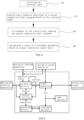
- FIG. 5 is a flowchart illustrating a simulation method according to an exemplary embodiment of the present disclosure.
- the simulation method according to the exemplary embodiment of the present disclosure may be implemented by the simulation system 100 according to the exemplary embodiment of the present disclosure as described above, and may also be implemented by a system including at least one computing device and at least one storage device storing instructions.
- an external input may be received.
- the external input may include at least one of domain knowledge, data, and an event related to a simulated item.
- the external input may also include a learnable parameter.
- the learnable parameter refers to at least one parameter related to the simulated item that cannot be directly obtained from the domain knowledge, the data, or the event.
- a behavior described in a preset simulation logic program may be controlled based on the external input, wherein the preset simulation logic program describes a state in a simulated item and a behavior that drives a change in the state in code.
- the behavior may involve at least one of a rule, a parameter and data.
- the preset simulation logic program describes a state in a change of a vehicle speed (e.g., a speed of a vehicle) and a behavior that drives a change in the state in the change of the vehicle speed in code (e.g., an acceleration of the vehicle).
- the preset simulation logic program describes a state in epidemic development (for example, a number of confirmed patients, etc.) and a behavior that drives a change in the state in the epidemic development in code (e.g., a confirmed behavior, etc.).
- step 503 the preset simulation logic program may be run in response to the controlling.
- a value of the learnable parameter may be optimized based on output simulation result data.
- the external input e.g., at least one of the domain knowledge, the data, the event and the learnable parameter
- the external input may be converted into at least one of the rule, the parameter and the data involved in the behavior in the preset simulation logic program.
- the converted at least one of the rule, the parameter and the data may be applied to the preset simulation logic program and the preset simulation logic program is run to obtain and output the simulation result data.
- the behavior described in the simulation logic program may be directly intervened.
- a user input for modifying the behavior in the simulation logic program may be received.
- at least one of the rule, the parameter and the data may be modified according to the user input.
- the modified at least one of the rule, the parameter and the data may be applied to the preset simulation logic program and the preset simulation logic program is run to obtain and output the simulation result data.
- a change in the state described in the simulation logic program For example, a user input for modifying the state described in the simulation logic program may be received. Subsequently, a change in at least one of the state may be modified based on the user input.
- the simulation system 100 or the above-described system may be initialized. For example, a user input for initialization may be received. Then, an initial value of the state described in the simulation logic program and a value of the learnable parameter may be set according to the user input. In addition, when the initial value of the state in the simulation logic program cannot be directly obtained from the domain knowledge, the data or the event, the initial value of the state in the simulation logic program may be used as the learnable parameter.
- the learnable parameter may be optimized.
- reference data for the simulated item may be received.
- the output simulation result data is compared with the reference data of the simulated item, and based on the comparison result, the learnable parameter is optimized by an optimization algorithm.
- the simulation logic program may be run such that the behavior in the simulation logic program drives the state in the simulation logic program to change from an initial state to a next state, so that the changed state may be output as the simulation result data.
- the external input includes the learnable parameter
- the value of the learnable parameter may be optimized based on the simulation result data output by the simulation module 103.
- an external input may be re-received(for example, at least one of domain knowledge, data, and an event may be re-received), and the optimized value of the learnable parameter after the last optimization may be obtained, and the behavior in the simulation logic program is controlled based on the re-received external input by using the optimized value as the value of the learnable parameter. Then, based on this control, the simulation logic program may be run again to output the simulation result data, and the current value of the learnable parameter may be optimized again based on the simulation result data. So on and so forth.
- an operation mode of the simulation system 100 or the above-described system may include an optimization mode and a simulation mode.
- the receiving step, the controlling step, the running step, and the optimizing step are iteratively performed to obtain a final optimized value of the learnable parameter.
- the step of controlling the behavior described in the preset simulation logic program based on an external input may be performed by taking the final optimized value of the learnable parameter as the value of the learnable parameter, and the preset simulation logic program may be run in response to the controlling, and the accurate simulation result data is output.
- the external input may be received in real time; the behavior described in the preset simulation logic program may be controlled based on the real-time external input; and the preset simulation logic program may be run in real time in response to the control of the control module 102; the value of the learnable parameter may be optimized based on the simulation result data output by the simulation module in real time.
- the receiving step, the controlling step, the running step, and the optimizing step may be performed iteratively at predetermined time intervals.
- the receiving step, the controlling step, and the running step may be performed at a first predetermined time interval, while the optimizing step may be performed at a second predetermined time interval, wherein the second predetermined time interval is longer than the first predetermined time interval.
- the receiving step, the controlling step and the running step may be executed every day, and the epidemic simulation result data may be output every day, while the optimizing step may be executed every ten days, that is, the learnable parameter may be optimized based on the ten-day epidemic simulation result data, which will be described in detail later.
- a control input may be received, and a corresponding control may be performed according to the control input.
- the control input includes at least one of a start simulation input for starting a simulation, a simulation intervention input for intervening a simulation, a pause (or end) simulation input for pausing (or ending) a simulation, a data import input for importing data, a switch mode input for switching an optimization mode and a simulation mode, and a result display input for displaying a result, but not limited to this.
- a user interface may be displayed.
- the user interface may include a button for receiving a control input, received data, and simulation related data.
- the received data may include any input data such as the external input, the user input for modifying the behavior or the state, the initial value of the state and the value of the learnable parameter as described above, etc.
- the simulation related data may include at least one of a current mode (e.g., the optimization mode or the simulation mode), the simulation result data, and the reference data of the simulated item.
- the simulation system 100 may be applied as a vehicle speed simulation system 100.
- the vehicle speed simulation system 100 is used to simulate a change in a vehicle speed. Therefore, in a simulation logic program of the vehicle speed simulation system 100, the vehicle speed v may be set as a state, and an acceleration of the vehicle may be set as a behavior that drives a change in the state.
- a time period of the simulation (a time interval between two adjacent states) may be set to t.
- the user interface module 101 of the vehicle speed simulation system 100 may receive an external input, where the external input may include at least one of domain knowledge, data, and an event related to the change in the vehicle speed.
- the data related to the change in the vehicle speed in the external input may include data related to the goods loaded by the vehicle, such as a type, quantity and unit mass of the goods.
- the control module 102 may use the data related to the goods loaded by the vehicle to calculate the total mass of the vehicle.
- the traction force F of the vehicle may not be directly obtained due to some factors (e.g., the age of the vehicle), the traction force F of the vehicle may be set as a learnable parameter, and the optimizing may be performed by the optimization module 104.
- the type and quantity of the goods loaded by the vehicle can usually be obtained, but the unit mass of the goods cannot be directly obtained. Therefore, the unit mass of the goods may be set as a learnable parameter, and the optimizing may be performed by the optimization module 104.
- the control module 102 can directly adjust at least one of the rule, the parameter and the quantity involved in the acceleration behavior according to the user input.
- the user can modify the acceleration formula through the user interface module 101, so the control module 102 can modify the acceleration formula in the simulation logic program according to the user input.
- control module 102 can directly adjust a change in the vehicle speed according to the user input or the emergency, for example, directly modify a next state of the vehicle speed to 0.
- the vehicle speed simulation system 100 involves three learnable parameters, that is, (1) the calculation symbol in the acceleration formula, whose type is a string, and the value range is four arithmetic symbols "+, -, ⁇ , ⁇ "; (2) the vehicle traction F, whose type is a floating-point number, and the value range is [0,10000] Newton; (3) the unit mass of goods, whose type is a floating-point number, whose value range is [0,1000] Kilogram.
- the optimization module 104 may perform optimizing on the above three learnable parameters. Specifically, in an initialization stage of the vehicle speed simulation system 100, an initial value of the vehicle speed state and values of the three learnable parameters may be set. Under the control of the control module 102, the change in the vehicle speed state after a predetermined time interval t(e.g., 10 seconds) is simulated by the simulation module 103 and the next state of the simulated vehicle speed is output (e.g., after 10 seconds, the vehicle speed is accelerated from the initial speed of 0 to v m/s).
- t e.g. 10 seconds
- the optimization module 104 can compare the simulation result data v with the real reference data 10m/s, for example, calculate a simulation error as an optimization target, such as (v - 10) 2 .
- the vehicle speed may be simulated every predetermined time interval t, and the learnable parameters may be optimized once.
- the vehicle speed may be simulated every predetermined time interval t, and the learnable parameters may be optimized once with ten times of simulation results every predetermined time interval 10t. For example, a mean squared error between the ten times of simulation results and real data may be calculated to optimize the learnable parameters.
- the simulation system 100 may be applied as an epidemic game simulation system 100.
- the epidemic deduction simulation system 100 is used to simulate development of an epidemic.
- the epidemic deduction simulation system 100 may perform a simulation of the development of the epidemic in a predetermined area (e.g., one of a world, a continent, a country, a province, a city, a district, and a community), in a predetermined simulation time period (e.g., one of day, month, and year).
- a predetermined area e.g., one of a world, a continent, a country, a province, a city, a district, and a community
- a predetermined simulation time period e.g., one of day, month, and year.
- FIG. 6 is a schematic diagram illustrating an epidemic deduction simulation logic according to an exemplary embodiment of the present disclosure.
- the simulation logic in FIG. 6 is applicable to each province, city, district, and community, as well as for each day in a simulation process.
- a city is taken as an example to be described, but it is not limited to this.
- the dotted box represents a boundary of the city
- the solid boxes represent states involved in the simulation logic
- the arrows represent behaviors involved in the simulation logic.
- moving-in infected population and moving-in normal population are the sum of all corresponding populations who migrated to the city (from different cities).
- a state related to the development of the epidemic may be set as the state, and a behavior related to the development of the epidemic may be set as the behavior that drives the change in the state.
- the state related to the development of the epidemic may include at least one of a number of normal population, a number of moving-in/moving-out normal population, a number of moving-in/moving-out infected population, a number of incubation patients, a number of disease patients, a number of quarantined patients, a number of confirmed patients, a number of dead patients, and a number of cured patients, within a predetermined area (such as a city).
- the behavior related to the development of the epidemic may include at least one of an internal infection behavior, a migration infection behavior, a disease behavior, an quarantined behavior, a confirmed behavior, a dead behavior, a cured behavior, a moving-in behavior and a moving-out behavior.
- the user interface module 101 of the epidemic deduction simulation system 100 may receive an external input, where the external input may include at least one of domain knowledge, data, and an event related to the development of the epidemic.
- the control module 102 of the epidemic deduction simulation system 100 can control the behavior described in the simulation logic program based on the external input.
- the control module 102 may convert the external input into a rule (e.g., the formula for the state change as described above), a parameter (e.g., at least one of a disease infectivity capability value, an internal infectivity correction coefficient for the predetermined area, a migration infectivity correction coefficient for the predetermined area, a proportion of disease patients, an incubation period time, a probability distribution of incubation patients, a disease characteristic and a medical resource) and data (e.g., at least one of internal population flow data, the total number of moving-in population and the total number of moving-out population) involved in the behavior as described above.
- the control module 102 may include a plurality of controllers, each controller handling one behavior, and may also include a controller for modifying the behavior and/or a controller for modifying the state.
- control module 102 may set a rule involved in the moving-in behavior as:
- control module 102 may set a rule involved in the moving-out behavior as:
- control module 102 can set a rule involved in the internal infection behavior as:
- control module 102 may set a rule involved in the migration infection behavior as:
- control module 102 may set a rule involved in the disease behavior as:
- the control module 102 may set a rule involved in the quarantined behavior as:
- control module 102 may set a rule involved in the confirmed behavior as:
- the control module 102 may set a rule involved in the dead behavior as:
- control module 102 may set a rule involved in the cured behavior as:
- control module 102 may further set a behavior rule that drives changes of the states described above based on the above behavior rule:
- the simulation logic program can also set any other states and behaviors according to user requirements, and the control module 102 can also set any other rules , parameters and data.
- the simulation module 103 may run the simulation logic program in response to the above control of the control module 104, and output the epidemic simulation result.
- the control module 102 can directly adjust at least one of the rule, parameter and data involved in the above behavior according to the user input.
- the user can modify a rule function related to the migration infection behavior through the user interface module 101, so the control module 102 can modify the rule function related to the migration infection behavior in the simulation logic program according to the user input.
- control module 102 can directly modify a change in the state according to the user input or the emergency. For example, the number of new disease patients may be directly modified to 200.
- the at least one of the disease infectivity capability value, the initial value of the number of incubation patients in the predetermined area, the internal infectivity correction coefficient for the predetermined area, the migration infectivity correction coefficient for the predetermined area range, and the disease characteristic involved in the above rule therefore, the at least one of the disease infectivity capability value, the initial value of the number of incubation patients in the predetermined area, the internal infectivity correction coefficient for the predetermined area, the migration infectivity correction coefficient for the predetermined area range, and the disease characteristic is set as a learnable parameter, and may be optimized by the optimization module 104.
- the initial value of the state as described above and the value of the learnable parameter as described above may be received through the user interface module 101.
- the user can set the initial value of the normal population to the total population within the predetermined area; set the initial values of the number of moving-in/moving-out normal population, the number of moving-in/moving-out infected population, the number of incubation patients, the number of disease patients, the number of quarantined patients, the number of confirmed patients, the number of dead patients and the number of cured patients based on an epidemic start date and a simulation start date.
- the initial value of the number of incubation patients may be set to a non-zero value and the initial values of the number of moving-in/moving-out normal population, the number of moving-in/moving-out infected population, the number of disease patients, the number of quarantined patients, the number of confirmed patients, the number of dead patients and the number of cured patients may be set to zero, based on the epidemic start date and the simulation start date.
- the user can set a value of at least one of the disease infectivity capability value, the internal infectivity correction coefficient for the predetermined area, the migration infectivity correction coefficient for the predetermined area, and the disease characteristic according to domain knowledge and prior knowledge.
- the simulation module 103 simulates changes in the states as described above after a predetermined time interval t (e.g., one day), and outputs simulated epidemic data.
- t e.g., one day
- reference data about the development of the epidemic that is, real epidemic data of the current day may be received through the user interface module 101. Therefore, the optimization module 104 can compare the simulated epidemic data with the real epidemic data, for example, calculate a simulation error as an optimization target, and minimize the optimization target by adjusting the learnable parameter as described above, so as to achieve the purpose for optimizing the above learnable parameter.
- the development of the epidemic may be simulated once a day by using the daily updated external input, and the learnable parameter may be optimized once a day .
- the development of the epidemic may be simulated once a day by using the daily updated external input, and the learnable parameter is optimized once every predetermined number of days (e.g., ten days) by using the simulation results for the predetermined number of days.
- the simulated epidemic data may be the simulated number of confirmed patients within the predetermined area that is output every day, and the real epidemic data may be the actual number of confirmed patients within the predetermined area every day.
- the optimization module 104 may calculate a mean squared error between the simulated number of confirmed patients and the actual number of confirmed patients for the predetermined number of days (e.g., ten days), and perform optimizing the learnable parameter through an evolutionary algorithm based on the calculated mean squared error.
- the development of the epidemic may be simulated once a day by using the external input updated every day and the learnable parameter that is finally optimized.
- the user interface module 101 may receive a control input.
- the control input includes at least one of a start button for starting a simulation, a intervention button for intervening a simulation, a pause button for pausing (or ending) a simulation, an import button for importing data, a switch button for switching an optimization mode and a simulation mode and a display button for displaying a result, but not limited to this.
- the control module 102 may perform a corresponding control according to the control input.
- the user interface module 101 may also be used as a display module for displaying a user interface under the control of the control module 102.
- the user interface module 101 may also be implemented by a touch-sensitive screen.
- the user interface displayed by the user interface module 101 may include a button for receiving the control input, data received by the user interface module 101, and simulation-related data.
- the data received by the user interface module 101 may include any input data such as the external input, the user input for modifying the behavior or state, the initial value of the state and the value of the learnable parameter as described above, and the like.
- the simulation-related data may include at least one of a current mode, simulation result data, and reference data of the epidemic development.
- the data management module 105 may store and manage data related to the epidemic deduction simulation system 100.
- these data may include preset data, real-time data, and user data.
- the preset data may refer to data used by the developer when developing the epidemic deduction simulation system 100, which may be provided to the customer together with the epidemic deduction simulation system 100.
- the real-time data may refer to data that changes with time, which is continuously updated during the use of the epidemic deduction simulation system 100.
- the user data may refer to data provided by a user. These data may be received through the user interface module 101, or may be pre-stored, or may be transmitted and received through a network, etc., which is not limited in the disclosure.
- the data management interface module 106 may import at least one piece of data in the data management module 105 into the control module 102.
- the data management module 105 may store and manage the external input received through the user interface module 101 and import the external input to the control module 102 through the data management interface module 106 in response to, for example, a control input through the user interface module
- the computation and storage engine module 107 may support computing and storage requirements of the epidemic deduction simulation system 100.
- the computation and storage engine module 107 may provide the epidemic deduction simulation system 100 with underlying resources, including computing resources and storage resources.
- the computing resources may include algorithm libraries, computing frameworks, computing hardware, and the like.
- the storage resources may include database software, memory hardware, distributed storage servers, and the Internet and so on.
- the systems, devices, and units illustrated in FIG. 1 may be respectively configured as software, hardware, firmware, or any combination thereof to execute specific functions.
- these systems, devices, or units may correspond to dedicated integrated circuits, may also correspond to pure software codes, or may correspond to modules combining software and hardware.
- one or more functions implemented by these systems, devices, or units may also be uniformly executed by components in a physical entity device (for example, a processor, a client, or a server, etc.).
- the method described with reference to FIG. 5 may be implemented by a program (or instruction) recorded on a computer-readable storage medium.
- a computer-readable storage medium for simulating may be provided, wherein the computer-readable storage medium has a computer program (or instruction) for executing the simulation method described with reference to FIG. 5 recorded thereon.
- the computer program (or instruction) may be used to execute the following method steps: receiving an external input; controlling a behavior described in a preset simulation logic program based on the external input, wherein the preset simulation logic program describes a state in a simulated item and a behavior that drives a change in the state in code, wherein when the external input includes a learnable parameter, an optimized value of the learnable parameter is obtained, and the step of controlling the behavior described in the preset simulation logic program based on the external input is performed by using the optimized value as a value of the learnable parameter; in response to the controlling, running the preset simulation logic program; optimizing the value of the learnable parameter based on output simulation result data.
- a computer-readable storage medium for epidemic deduction simulation may be provided, wherein the computer-readable storage medium has a computer program (or instruction) for executing a simulation method in an epidemic deduction scenario recorded thereon.
- the simulation method may include: receiving an external input; controlling a behavior described in a preset simulation logic program based on the external input, wherein the preset simulation logic program describes a state in development of an epidemic and a behavior that drives a change in the state in the development of the epidemic in code, wherein when the external input includes a learnable parameter, an optimized value of the learnable parameter is obtained, and the step of controlling the behavior described in the preset simulation logic program based on the external input is performed by using the optimized value as a value of the learnable parameter; in response to the controlling, running the preset simulation logic program; optimizing the value of the learnable parameter based on output simulation result data.
- the computer program in the above computer-readable storage medium may run in an environment deployed in computer devices such as a client, a host, an agent device and a server. It should be noted that the computer program may also be used to execute additional steps in addition to the above steps, or execute more specific processing when executing the above steps. These additional steps and further processed content have been mentioned in the description of the related method with reference to FIGS. 5 and 6 , and thus will not be repeated here in order to avoid repetition.
- simulation system may completely rely on the running of the computer program to implement corresponding functions, that is, respective units correspond to respective steps in the functional architecture of the computer program, so that the entire system is called through a special software package (for example, lib library) to implement the corresponding functions.
- lib library for example, lib library
- respective devices illustrated in FIG. 1 may also be implemented by hardware, software, firmware, middleware, microcode, or any combination thereof.
- a program code or code segment used to perform a corresponding operation may be stored in a computer-readable storage medium such as a storage medium, so that a processor may read and execute the corresponding program code or code segment to perform the corresponding operation.
- the exemplary embodiments of the present disclosure may also be implemented as a computing device, which includes a storage component and a processor.
- the storage component stores a set of computer-executable instructions, and when the set of computer-executable instructions is executed by the processor, the simulation method according to the exemplary embodiments of the present disclosure is executed.
- the computing device may be deployed in a server or a client, and may also be deployed on a node device in a distributed network environment.
- the computing device may be a PC computer, a tablet device, a personal digital assistant, a smart phone, a web application, or other devices capable of executing the above set of instructions.
- the computing device does not have to be a single computing device, but may also be an assembly of any device(s) or circuit(s) that may execute the above instructions (or set of instructions) separately or jointly.
- the computing device may also be a part of an integrated control system or a system manager, or may be configured as a portable electronic device interconnecting with a local or remote (for example, via wireless transmission) interface.
- the processor may include a central processing unit (CPU), a graphics processing unit (GPU), a programmable logic device, a dedicated processor system, a microcontroller, or a microprocessor.
- the processor may also include an analog processor, a digital processor, a microprocessor, a multi-core processor, a processor array, a network processor, etc.
- Some operations described in the simulation method according to the exemplary embodiments of the present disclosure may be implemented by software, and some operations may be implemented by hardware. In addition, these operations may also be implemented by a combination of software and hardware.
- the processor may execute instructions or codes stored in one of the storage components, wherein the storage component may also store data. Instructions and data may also be sent and received via a network through a network interface device, wherein the network interface device may adopt any known transmission protocol.
- the storage component may be integrated with the processor, for example, an RAM or flash memory is arranged in an integrated circuit microprocessor, etc.
- the storage component may include an independent device, such as an external disk drive, a storage array, or any other storage device that may be used by a database system.
- the storage component and the processor may be operatively coupled, or may communicate with each other, for example, through an I/O port, a network connection, etc., so that the processor may read files stored in the storage component.
- the computing device may also include a video display (such as a liquid crystal display) and a user interaction interface (such as a keyboard, a mouse, a touch input device, etc.). All components of the computing device may be connected to each other via at least one of a bus and a network.
- a video display such as a liquid crystal display
- a user interaction interface such as a keyboard, a mouse, a touch input device, etc.
- a system including at least one computing device and at least one storage device storing instructions.
- the instructions when executed by at least one computing device, cause the at least one computing device to perform a simulation method according to the exemplary embodiment of the present disclosure.
- the at least one computing device is a computing device for simulating according to the exemplary embodiment of the present disclosure, and a set of computer-executable instructions is stored in the storage device.
- the set of computer-executable instructions is executed by the at least one computing device, the following steps are executed: receiving an external input; controlling a behavior described in a preset simulation logic program based on the external input, wherein the preset simulation logic program describes a state in a simulated item and a behavior that drives a change in the state in code, wherein when the external input includes a learnable parameter, an optimized value of the learnable parameter is obtained, and the step of controlling the behavior described in the preset simulation logic program based on the external input is performed by using the optimized value as a value of the learnable parameter; in response to the controlling, running the preset simulation logic program; optimizing the value of the learnable parameter based on output simulation result data.
- a system including at least one computing device and at least one storage device storing instructions.
- the instructions when executed by at least one computing device, cause the at least one computing device to perform a epidemic deduction simulation method according to the exemplary embodiment of the present disclosure.
- the at least one computing device is a computing device for simulating according to the exemplary embodiment of the present disclosure, and a set of computer-executable instructions is stored in the storage device.
- the epidemic deduction simulation method is executed, including: receiving an external input; controlling a behavior described in a preset simulation logic program based on the external input, wherein the preset simulation logic program describes a state in development of an epidemic and a behavior that drives a change in the state in the development of the epidemic in code, wherein when the external input includes a learnable parameter, an optimized value of the learnable parameter is obtained, and the step of controlling the behavior described in the preset simulation logic program based on the external input is performed by using the optimized value as a value of the learnable parameter; in response to the controlling, running the preset simulation logic program; optimizing the value of the learnable parameter based on output simulation result data.
- real data for example, historical data
- real data can be used to determine parameters required for simulation that cannot be obtained from domain knowledge temporarily by fitting the real data, thereby reducing the dependence of the simulation system on domain knowledge, expanding the applicable field and scope of the simulation system, meeting the simulation requirements of many different scenarios, and improving the simulation accuracy.
- epidemic deduction simulation system and simulation method suitable for epidemic deduction scenarios of the present disclosure compared with traditional epidemic models (e.g., SIR, SEIR), a more complex epidemic deduction simulation logic can be realized, and real epidemic data can be utilized to determine epidemic deduction parameters required for simulation that cannot be obtained from epidemic domain knowledge temporarily by fitting the real epidemic data, so as to obtain more accurate epidemic deduction simulation results.
- traditional epidemic models e.g., SIR, SEIR
Landscapes
- Engineering & Computer Science (AREA)
- Public Health (AREA)
- Health & Medical Sciences (AREA)
- Medical Informatics (AREA)
- Physics & Mathematics (AREA)
- Theoretical Computer Science (AREA)
- Evolutionary Computation (AREA)
- Geometry (AREA)
- General Physics & Mathematics (AREA)
- Data Mining & Analysis (AREA)
- Primary Health Care (AREA)
- General Health & Medical Sciences (AREA)
- Epidemiology (AREA)
- Pathology (AREA)
- Databases & Information Systems (AREA)
- General Engineering & Computer Science (AREA)
- Computer Hardware Design (AREA)
- Biomedical Technology (AREA)
- Software Systems (AREA)
- Computer Vision & Pattern Recognition (AREA)
- Artificial Intelligence (AREA)
- Automation & Control Theory (AREA)
- Aviation & Aerospace Engineering (AREA)
- Computational Mathematics (AREA)
- Mathematical Analysis (AREA)
- Mathematical Optimization (AREA)
- Pure & Applied Mathematics (AREA)
- Management, Administration, Business Operations System, And Electronic Commerce (AREA)
Applications Claiming Priority (3)
| Application Number | Priority Date | Filing Date | Title |
|---|---|---|---|
| CN202010322898.XA CN111522255B (zh) | 2020-04-22 | 2020-04-22 | 仿真系统和仿真方法 |
| CN202010322919.8A CN111540478B (zh) | 2020-04-22 | 2020-04-22 | 疫情推演仿真系统和仿真方法 |
| PCT/CN2021/084557 WO2021213166A1 (zh) | 2020-04-22 | 2021-03-31 | 仿真系统及仿真方法、疫情推演仿真系统及仿真方法 |
Publications (2)
| Publication Number | Publication Date |
|---|---|
| EP4141584A1 true EP4141584A1 (de) | 2023-03-01 |
| EP4141584A4 EP4141584A4 (de) | 2023-10-11 |
Family
ID=78270270
Family Applications (1)
| Application Number | Title | Priority Date | Filing Date |
|---|---|---|---|
| EP21792125.3A Withdrawn EP4141584A4 (de) | 2020-04-22 | 2021-03-31 | Simulationssystem und simulationsverfahren sowie epidemisches deduktionssimulationssystem und simulationsverfahren |
Country Status (3)
| Country | Link |
|---|---|
| US (1) | US20230170098A1 (de) |
| EP (1) | EP4141584A4 (de) |
| WO (1) | WO2021213166A1 (de) |
Families Citing this family (3)
| Publication number | Priority date | Publication date | Assignee | Title |
|---|---|---|---|---|
| CN113457149B (zh) * | 2021-06-30 | 2024-05-28 | 网易(杭州)网络有限公司 | 游戏的信息处理方法、装置、电子设备及存储介质 |
| CN117172501B (zh) * | 2023-09-21 | 2024-09-06 | 奇点数联(北京)科技有限公司 | 一种基于数据挖掘的物资分配系统 |
| CN117131810B (zh) * | 2023-10-26 | 2024-01-26 | 长沙市规划勘测设计研究院 | 基于系统动力学的雨洪调蓄模拟系统与方法 |
Family Cites Families (12)
| Publication number | Priority date | Publication date | Assignee | Title |
|---|---|---|---|---|
| JP3904645B2 (ja) * | 1996-12-26 | 2007-04-11 | 株式会社東芝 | ハードウェア/ソフトウェア協調シミュレーション装置 |
| JP2004500664A (ja) * | 2000-03-29 | 2004-01-08 | バイオメドウェア インコーポレイテッド | モデル伝染感度分析システム及び方法 |
| GB0121990D0 (en) * | 2001-09-11 | 2001-10-31 | Beach Solutions Ltd | Emulation system & method |
| EP3859746B1 (de) * | 2009-10-19 | 2024-10-16 | Labrador Diagnostics LLC | Integriertes system zur erfassung und analyse von gesundheitsdaten |
| CN102637224A (zh) * | 2012-03-19 | 2012-08-15 | 西北工业大学 | 一种采用iosem接口方式的紧耦合仿真通用模型实现方法 |
| US20200004904A1 (en) * | 2015-10-28 | 2020-01-02 | Fractal Industries, Inc. | System and method for multi-model generative simulation modeling of complex adaptive systems |
| US10923234B2 (en) * | 2016-03-30 | 2021-02-16 | Jacob Barhak | Analysis and verification of models derived from clinical trials data extracted from a database |
| CN109284280B (zh) * | 2018-09-06 | 2020-03-24 | 百度在线网络技术(北京)有限公司 | 仿真数据优化方法、装置及存储介质 |
| CN110705078B (zh) * | 2019-09-25 | 2023-04-21 | 哈尔滨工程大学 | 一种核动力装置的仿真模型开发系统及分析方法 |
| CN110837697A (zh) * | 2019-10-25 | 2020-02-25 | 华南理工大学 | 一种智能车的智能交通仿真系统及其仿真方法 |
| CN111522255B (zh) * | 2020-04-22 | 2022-09-23 | 第四范式(北京)技术有限公司 | 仿真系统和仿真方法 |
| CN111540478B (zh) * | 2020-04-22 | 2023-10-10 | 第四范式(北京)技术有限公司 | 疫情推演仿真系统和仿真方法 |
-
2021
- 2021-03-31 US US17/921,025 patent/US20230170098A1/en active Pending
- 2021-03-31 WO PCT/CN2021/084557 patent/WO2021213166A1/zh not_active Ceased
- 2021-03-31 EP EP21792125.3A patent/EP4141584A4/de not_active Withdrawn
Also Published As
| Publication number | Publication date |
|---|---|
| EP4141584A4 (de) | 2023-10-11 |
| US20230170098A1 (en) | 2023-06-01 |
| WO2021213166A1 (zh) | 2021-10-28 |
Similar Documents
| Publication | Publication Date | Title |
|---|---|---|
| CN111540478B (zh) | 疫情推演仿真系统和仿真方法 | |
| EP4141584A1 (de) | Simulationssystem und simulationsverfahren sowie epidemisches deduktionssimulationssystem und simulationsverfahren | |
| Alzantot et al. | Rstensorflow: Gpu enabled tensorflow for deep learning on commodity android devices | |
| JP7262571B2 (ja) | 知識グラフのベクトル表現生成方法、装置及び電子機器 | |
| CN114743196B (zh) | 文本识别的方法及装置、神经网络的训练方法 | |
| CN113762502B (zh) | 神经网络模型的训练方法及装置 | |
| JP2015510195A (ja) | スパイキングニューラル計算のための方法および装置 | |
| CN118940686A (zh) | 芯片验证方法及装置、设备和介质 | |
| CN114444718B (zh) | 机器学习模型的训练方法、信号控制方法和装置 | |
| EP3575990A2 (de) | Beobachter zur simulationsprüfung und -verifizierung | |
| US20240249192A1 (en) | Multi-Layer Perceptron Architecture For Times Series Forecasting | |
| CN111522255B (zh) | 仿真系统和仿真方法 | |
| CN120525692B (zh) | 一种基于知识图谱和虚拟仿真的智慧教学系统及构建方法 | |
| CN115510203A (zh) | 问题答案确定方法、装置、设备、存储介质及程序产品 | |
| Haugdal et al. | An open source power system simulator in python for efficient prototyping of wampac applications | |
| WO2022240893A1 (en) | Transforming a model in a first language to a surrogate in a second language for simulation | |
| CN118113977A (zh) | 由运算装置执行的运算方法、运算装置、设备及介质 | |
| CN112765975B (zh) | 分词岐义处理方法、装置、设备以及介质 | |
| CN115762515B (zh) | 用于语音识别的神经网络的处理和应用方法、装置及设备 | |
| EP4548262A1 (de) | Maschinenlernmodell zur berechnung von merkmalsvektoren zur codierung von marginalverteilungen | |
| CN113836712B (zh) | 车道级导航的室内仿真方法、装置、设备和介质 | |
| CN116956714A (zh) | 一种基于描述语言的直流保护建模与直流保护功能实现方法 | |
| Crosbie et al. | Simulation software for teaching dynamic system behavior | |
| JP2024161486A (ja) | テキスト処理タスクの類似性を確定する方法、装置、機器、および媒体 | |
| WO2017189649A1 (en) | Distributed application based off of stateful desktop application |
Legal Events
| Date | Code | Title | Description |
|---|---|---|---|
| STAA | Information on the status of an ep patent application or granted ep patent |
Free format text: STATUS: THE INTERNATIONAL PUBLICATION HAS BEEN MADE |
|
| PUAI | Public reference made under article 153(3) epc to a published international application that has entered the european phase |
Free format text: ORIGINAL CODE: 0009012 |
|
| STAA | Information on the status of an ep patent application or granted ep patent |
Free format text: STATUS: REQUEST FOR EXAMINATION WAS MADE |
|
| 17P | Request for examination filed |
Effective date: 20221116 |
|
| AK | Designated contracting states |
Kind code of ref document: A1 Designated state(s): AL AT BE BG CH CY CZ DE DK EE ES FI FR GB GR HR HU IE IS IT LI LT LU LV MC MK MT NL NO PL PT RO RS SE SI SK SM TR |
|
| DAV | Request for validation of the european patent (deleted) | ||
| DAX | Request for extension of the european patent (deleted) | ||
| REG | Reference to a national code |
Ref country code: DE Ref legal event code: R079 Free format text: PREVIOUS MAIN CLASS: G05B0017020000 Ipc: G16H0050500000 |
|
| A4 | Supplementary search report drawn up and despatched |
Effective date: 20230908 |
|
| RIC1 | Information provided on ipc code assigned before grant |
Ipc: G05B 17/02 20060101ALI20230904BHEP Ipc: G16H 50/80 20180101ALI20230904BHEP Ipc: G16H 50/50 20180101AFI20230904BHEP |
|
| STAA | Information on the status of an ep patent application or granted ep patent |
Free format text: STATUS: THE APPLICATION HAS BEEN WITHDRAWN |
|
| 18W | Application withdrawn |
Effective date: 20250409 |