EP4141909A2 - Amélioration de plage dynamique - Google Patents
Amélioration de plage dynamique Download PDFInfo
- Publication number
- EP4141909A2 EP4141909A2 EP22201649.5A EP22201649A EP4141909A2 EP 4141909 A2 EP4141909 A2 EP 4141909A2 EP 22201649 A EP22201649 A EP 22201649A EP 4141909 A2 EP4141909 A2 EP 4141909A2
- Authority
- EP
- European Patent Office
- Prior art keywords
- ions
- groups
- data
- data sets
- ion
- Prior art date
- Legal status (The legal status is an assumption and is not a legal conclusion. Google has not performed a legal analysis and makes no representation as to the accuracy of the status listed.)
- Pending
Links
- 150000002500 ions Chemical class 0.000 claims abstract description 1043
- 238000000034 method Methods 0.000 claims abstract description 106
- 229920006395 saturated elastomer Polymers 0.000 claims abstract description 88
- 238000004458 analytical method Methods 0.000 claims abstract description 23
- 238000001871 ion mobility spectroscopy Methods 0.000 claims abstract description 16
- 238000004949 mass spectrometry Methods 0.000 claims abstract description 16
- 238000009825 accumulation Methods 0.000 claims description 100
- 238000005040 ion trap Methods 0.000 claims description 97
- 230000005540 biological transmission Effects 0.000 claims description 81
- 230000037230 mobility Effects 0.000 description 129
- 238000000926 separation method Methods 0.000 description 111
- 230000035508 accumulation Effects 0.000 description 96
- 230000000694 effects Effects 0.000 description 44
- 239000000126 substance Substances 0.000 description 42
- 238000001228 spectrum Methods 0.000 description 34
- 238000013467 fragmentation Methods 0.000 description 28
- 238000006062 fragmentation reaction Methods 0.000 description 28
- 101100204059 Caenorhabditis elegans trap-2 gene Proteins 0.000 description 20
- 239000012491 analyte Substances 0.000 description 19
- 230000003595 spectral effect Effects 0.000 description 18
- 230000003993 interaction Effects 0.000 description 17
- 238000011144 upstream manufacturing Methods 0.000 description 17
- 238000006243 chemical reaction Methods 0.000 description 16
- 238000010884 ion-beam technique Methods 0.000 description 15
- 238000001914 filtration Methods 0.000 description 12
- 238000012545 processing Methods 0.000 description 12
- 150000001768 cations Chemical class 0.000 description 11
- 239000003153 chemical reaction reagent Substances 0.000 description 11
- 238000004587 chromatography analysis Methods 0.000 description 10
- 238000001077 electron transfer detection Methods 0.000 description 10
- 239000012634 fragment Substances 0.000 description 10
- 239000000203 mixture Substances 0.000 description 10
- 230000001133 acceleration Effects 0.000 description 9
- 238000001514 detection method Methods 0.000 description 9
- 230000001965 increasing effect Effects 0.000 description 9
- 238000001819 mass spectrum Methods 0.000 description 9
- 238000003795 desorption Methods 0.000 description 8
- 238000010494 dissociation reaction Methods 0.000 description 8
- 230000005593 dissociations Effects 0.000 description 8
- 239000007789 gas Substances 0.000 description 8
- 239000002243 precursor Substances 0.000 description 7
- 238000013459 approach Methods 0.000 description 6
- 238000004811 liquid chromatography Methods 0.000 description 6
- 230000007935 neutral effect Effects 0.000 description 6
- 238000005036 potential barrier Methods 0.000 description 5
- 230000000717 retained effect Effects 0.000 description 5
- 239000002131 composite material Substances 0.000 description 4
- 230000008569 process Effects 0.000 description 4
- 230000003068 static effect Effects 0.000 description 4
- 238000004885 tandem mass spectrometry Methods 0.000 description 4
- 102000036675 Myoglobin Human genes 0.000 description 3
- 108010062374 Myoglobin Proteins 0.000 description 3
- 150000001450 anions Chemical class 0.000 description 3
- 238000000605 extraction Methods 0.000 description 3
- GVEPBJHOBDJJJI-UHFFFAOYSA-N fluoranthrene Natural products C1=CC(C2=CC=CC=C22)=C3C2=CC=CC3=C1 GVEPBJHOBDJJJI-UHFFFAOYSA-N 0.000 description 3
- 238000001802 infusion Methods 0.000 description 3
- 238000000951 ion mobility spectrometry-mass spectrometry Methods 0.000 description 3
- 239000011159 matrix material Substances 0.000 description 3
- 238000005070 sampling Methods 0.000 description 3
- 230000001360 synchronised effect Effects 0.000 description 3
- UFWIBTONFRDIAS-UHFFFAOYSA-N Naphthalene Chemical compound C1=CC=CC2=CC=CC=C21 UFWIBTONFRDIAS-UHFFFAOYSA-N 0.000 description 2
- DZBUGLKDJFMEHC-UHFFFAOYSA-N acridine Chemical compound C1=CC=CC2=CC3=CC=CC=C3N=C21 DZBUGLKDJFMEHC-UHFFFAOYSA-N 0.000 description 2
- MWPLVEDNUUSJAV-UHFFFAOYSA-N anthracene Chemical compound C1=CC=CC2=CC3=CC=CC=C3C=C21 MWPLVEDNUUSJAV-UHFFFAOYSA-N 0.000 description 2
- 230000002238 attenuated effect Effects 0.000 description 2
- -1 azobenzene anions Chemical class 0.000 description 2
- CUFNKYGDVFVPHO-UHFFFAOYSA-N azulene Chemical compound C1=CC=CC2=CC=CC2=C1 CUFNKYGDVFVPHO-UHFFFAOYSA-N 0.000 description 2
- 230000009286 beneficial effect Effects 0.000 description 2
- 238000004364 calculation method Methods 0.000 description 2
- 238000002045 capillary electrochromatography Methods 0.000 description 2
- 239000000919 ceramic Substances 0.000 description 2
- WDECIBYCCFPHNR-UHFFFAOYSA-N chrysene Chemical compound C1=CC=CC2=CC=C3C4=CC=CC=C4C=CC3=C21 WDECIBYCCFPHNR-UHFFFAOYSA-N 0.000 description 2
- 230000001419 dependent effect Effects 0.000 description 2
- 238000000688 desorption electrospray ionisation Methods 0.000 description 2
- 230000001066 destructive effect Effects 0.000 description 2
- IYYZUPMFVPLQIF-UHFFFAOYSA-N dibenzothiophene Chemical compound C1=CC=C2C3=CC=CC=C3SC2=C1 IYYZUPMFVPLQIF-UHFFFAOYSA-N 0.000 description 2
- 238000000375 direct analysis in real time Methods 0.000 description 2
- 230000005686 electrostatic field Effects 0.000 description 2
- 238000000105 evaporative light scattering detection Methods 0.000 description 2
- 238000002474 experimental method Methods 0.000 description 2
- 238000010265 fast atom bombardment Methods 0.000 description 2
- 238000004992 fast atom bombardment mass spectroscopy Methods 0.000 description 2
- 238000011049 filling Methods 0.000 description 2
- 238000009616 inductively coupled plasma Methods 0.000 description 2
- 230000014759 maintenance of location Effects 0.000 description 2
- 230000000737 periodic effect Effects 0.000 description 2
- YNPNZTXNASCQKK-UHFFFAOYSA-N phenanthrene Chemical compound C1=CC=C2C3=CC=CC=C3C=CC2=C1 YNPNZTXNASCQKK-UHFFFAOYSA-N 0.000 description 2
- 125000005575 polycyclic aromatic hydrocarbon group Chemical group 0.000 description 2
- 108090000765 processed proteins & peptides Proteins 0.000 description 2
- 102000004196 processed proteins & peptides Human genes 0.000 description 2
- BBEAQIROQSPTKN-UHFFFAOYSA-N pyrene Chemical compound C1=CC=C2C=CC3=CC=CC4=CC=C1C2=C43 BBEAQIROQSPTKN-UHFFFAOYSA-N 0.000 description 2
- 230000005855 radiation Effects 0.000 description 2
- 230000002441 reversible effect Effects 0.000 description 2
- 150000003384 small molecules Chemical class 0.000 description 2
- 241000894007 species Species 0.000 description 2
- 238000000411 transmission spectrum Methods 0.000 description 2
- WPTCSQBWLUUYDV-UHFFFAOYSA-N 2-quinolin-2-ylquinoline Chemical compound C1=CC=CC2=NC(C3=NC4=CC=CC=C4C=C3)=CC=C21 WPTCSQBWLUUYDV-UHFFFAOYSA-N 0.000 description 1
- ZPTVNYMJQHSSEA-UHFFFAOYSA-N 4-nitrotoluene Chemical compound CC1=CC=C([N+]([O-])=O)C=C1 ZPTVNYMJQHSSEA-UHFFFAOYSA-N 0.000 description 1
- FCNCGHJSNVOIKE-UHFFFAOYSA-N 9,10-diphenylanthracene Chemical compound C1=CC=CC=C1C(C1=CC=CC=C11)=C(C=CC=C2)C2=C1C1=CC=CC=C1 FCNCGHJSNVOIKE-UHFFFAOYSA-N 0.000 description 1
- 102100022704 Amyloid-beta precursor protein Human genes 0.000 description 1
- ROFVEXUMMXZLPA-UHFFFAOYSA-N Bipyridyl Chemical group N1=CC=CC=C1C1=CC=CC=N1 ROFVEXUMMXZLPA-UHFFFAOYSA-N 0.000 description 1
- 208000035699 Distal ileal obstruction syndrome Diseases 0.000 description 1
- 102000004190 Enzymes Human genes 0.000 description 1
- 108090000790 Enzymes Proteins 0.000 description 1
- 238000004252 FT/ICR mass spectrometry Methods 0.000 description 1
- PXGOKWXKJXAPGV-UHFFFAOYSA-N Fluorine Chemical compound FF PXGOKWXKJXAPGV-UHFFFAOYSA-N 0.000 description 1
- 101000823051 Homo sapiens Amyloid-beta precursor protein Proteins 0.000 description 1
- DGAQECJNVWCQMB-PUAWFVPOSA-M Ilexoside XXIX Chemical compound C[C@@H]1CC[C@@]2(CC[C@@]3(C(=CC[C@H]4[C@]3(CC[C@@H]5[C@@]4(CC[C@@H](C5(C)C)OS(=O)(=O)[O-])C)C)[C@@H]2[C@]1(C)O)C)C(=O)O[C@H]6[C@@H]([C@H]([C@@H]([C@H](O6)CO)O)O)O.[Na+] DGAQECJNVWCQMB-PUAWFVPOSA-M 0.000 description 1
- WHXSMMKQMYFTQS-UHFFFAOYSA-N Lithium Chemical compound [Li] WHXSMMKQMYFTQS-UHFFFAOYSA-N 0.000 description 1
- FYYHWMGAXLPEAU-UHFFFAOYSA-N Magnesium Chemical compound [Mg] FYYHWMGAXLPEAU-UHFFFAOYSA-N 0.000 description 1
- ZLMJMSJWJFRBEC-UHFFFAOYSA-N Potassium Chemical compound [K] ZLMJMSJWJFRBEC-UHFFFAOYSA-N 0.000 description 1
- XUIMIQQOPSSXEZ-UHFFFAOYSA-N Silicon Chemical compound [Si] XUIMIQQOPSSXEZ-UHFFFAOYSA-N 0.000 description 1
- SLGBZMMZGDRARJ-UHFFFAOYSA-N Triphenylene Natural products C1=CC=C2C3=CC=CC=C3C3=CC=CC=C3C2=C1 SLGBZMMZGDRARJ-UHFFFAOYSA-N 0.000 description 1
- YUWBVKYVJWNVLE-UHFFFAOYSA-N [N].[P] Chemical compound [N].[P] YUWBVKYVJWNVLE-UHFFFAOYSA-N 0.000 description 1
- 239000008186 active pharmaceutical agent Substances 0.000 description 1
- 239000000443 aerosol Substances 0.000 description 1
- 229910052783 alkali metal Inorganic materials 0.000 description 1
- 150000001340 alkali metals Chemical class 0.000 description 1
- DZHSAHHDTRWUTF-SIQRNXPUSA-N amyloid-beta polypeptide 42 Chemical compound C([C@@H](C(=O)N[C@@H](C)C(=O)N[C@@H](CCC(O)=O)C(=O)N[C@@H](CC(O)=O)C(=O)N[C@H](C(=O)NCC(=O)N[C@@H](CO)C(=O)N[C@@H](CC(N)=O)C(=O)N[C@@H](CCCCN)C(=O)NCC(=O)N[C@@H](C)C(=O)N[C@H](C(=O)N[C@@H]([C@@H](C)CC)C(=O)NCC(=O)N[C@@H](CC(C)C)C(=O)N[C@@H](CCSC)C(=O)N[C@@H](C(C)C)C(=O)NCC(=O)NCC(=O)N[C@@H](C(C)C)C(=O)N[C@@H](C(C)C)C(=O)N[C@@H]([C@@H](C)CC)C(=O)N[C@@H](C)C(O)=O)[C@@H](C)CC)C(C)C)NC(=O)[C@H](CC=1C=CC=CC=1)NC(=O)[C@@H](NC(=O)[C@H](CC(C)C)NC(=O)[C@H](CCCCN)NC(=O)[C@H](CCC(N)=O)NC(=O)[C@H](CC=1N=CNC=1)NC(=O)[C@H](CC=1N=CNC=1)NC(=O)[C@@H](NC(=O)[C@H](CCC(O)=O)NC(=O)[C@H](CC=1C=CC(O)=CC=1)NC(=O)CNC(=O)[C@H](CO)NC(=O)[C@H](CC(O)=O)NC(=O)[C@H](CC=1N=CNC=1)NC(=O)[C@H](CCCNC(N)=N)NC(=O)[C@H](CC=1C=CC=CC=1)NC(=O)[C@H](CCC(O)=O)NC(=O)[C@H](C)NC(=O)[C@@H](N)CC(O)=O)C(C)C)C(C)C)C1=CC=CC=C1 DZHSAHHDTRWUTF-SIQRNXPUSA-N 0.000 description 1
- XOYSEKDQVVSNNB-UHFFFAOYSA-N anthracene-2-carbonitrile Chemical compound C1=CC=CC2=CC3=CC(C#N)=CC=C3C=C21 XOYSEKDQVVSNNB-UHFFFAOYSA-N 0.000 description 1
- KEQZHLAEKAVZLY-UHFFFAOYSA-N anthracene-9-carbonitrile Chemical compound C1=CC=C2C(C#N)=C(C=CC=C3)C3=CC2=C1 KEQZHLAEKAVZLY-UHFFFAOYSA-N 0.000 description 1
- PYKYMHQGRFAEBM-UHFFFAOYSA-N anthraquinone Natural products CCC(=O)c1c(O)c2C(=O)C3C(C=CC=C3O)C(=O)c2cc1CC(=O)OC PYKYMHQGRFAEBM-UHFFFAOYSA-N 0.000 description 1
- 150000004056 anthraquinones Chemical class 0.000 description 1
- 238000000065 atmospheric pressure chemical ionisation Methods 0.000 description 1
- 230000004888 barrier function Effects 0.000 description 1
- 230000008901 benefit Effects 0.000 description 1
- 229910052792 caesium Inorganic materials 0.000 description 1
- TVFDJXOCXUVLDH-UHFFFAOYSA-N caesium atom Chemical compound [Cs] TVFDJXOCXUVLDH-UHFFFAOYSA-N 0.000 description 1
- 238000005251 capillar electrophoresis Methods 0.000 description 1
- 230000015556 catabolic process Effects 0.000 description 1
- 230000008859 change Effects 0.000 description 1
- 238000000451 chemical ionisation Methods 0.000 description 1
- 238000001360 collision-induced dissociation Methods 0.000 description 1
- 230000008878 coupling Effects 0.000 description 1
- 238000010168 coupling process Methods 0.000 description 1
- 238000005859 coupling reaction Methods 0.000 description 1
- 238000006731 degradation reaction Methods 0.000 description 1
- 238000010586 diagram Methods 0.000 description 1
- 238000012063 dual-affinity re-targeting Methods 0.000 description 1
- 230000005684 electric field Effects 0.000 description 1
- 230000005264 electron capture Effects 0.000 description 1
- 238000001211 electron capture detection Methods 0.000 description 1
- 238000000132 electrospray ionisation Methods 0.000 description 1
- 239000003480 eluent Substances 0.000 description 1
- 238000010828 elution Methods 0.000 description 1
- 230000002708 enhancing effect Effects 0.000 description 1
- 238000001976 enzyme digestion Methods 0.000 description 1
- 229910052731 fluorine Inorganic materials 0.000 description 1
- 239000011737 fluorine Substances 0.000 description 1
- 238000011010 flushing procedure Methods 0.000 description 1
- 230000004907 flux Effects 0.000 description 1
- 229910052730 francium Inorganic materials 0.000 description 1
- KLMCZVJOEAUDNE-UHFFFAOYSA-N francium atom Chemical compound [Fr] KLMCZVJOEAUDNE-UHFFFAOYSA-N 0.000 description 1
- 238000004817 gas chromatography Methods 0.000 description 1
- 238000000608 laser ablation Methods 0.000 description 1
- 238000000091 laser ablation electrospray ionisation Methods 0.000 description 1
- 238000001698 laser desorption ionisation Methods 0.000 description 1
- 229910052744 lithium Inorganic materials 0.000 description 1
- 239000011777 magnesium Substances 0.000 description 1
- 229910052749 magnesium Inorganic materials 0.000 description 1
- 238000000816 matrix-assisted laser desorption--ionisation Methods 0.000 description 1
- 238000005259 measurement Methods 0.000 description 1
- 238000002552 multiple reaction monitoring Methods 0.000 description 1
- PXHVJJICTQNCMI-RNFDNDRNSA-N nickel-63 Chemical compound [63Ni] PXHVJJICTQNCMI-RNFDNDRNSA-N 0.000 description 1
- 230000001151 other effect Effects 0.000 description 1
- 238000004150 penning trap Methods 0.000 description 1
- 125000002080 perylenyl group Chemical group C1(=CC=C2C=CC=C3C4=CC=CC5=CC=CC(C1=C23)=C45)* 0.000 description 1
- CSHWQDPOILHKBI-UHFFFAOYSA-N peryrene Natural products C1=CC(C2=CC=CC=3C2=C2C=CC=3)=C3C2=CC=CC3=C1 CSHWQDPOILHKBI-UHFFFAOYSA-N 0.000 description 1
- XQZYPMVTSDWCCE-UHFFFAOYSA-N phthalonitrile Chemical compound N#CC1=CC=CC=C1C#N XQZYPMVTSDWCCE-UHFFFAOYSA-N 0.000 description 1
- 229920001184 polypeptide Polymers 0.000 description 1
- 238000012805 post-processing Methods 0.000 description 1
- 229910052700 potassium Inorganic materials 0.000 description 1
- 239000011591 potassium Substances 0.000 description 1
- 108090000623 proteins and genes Proteins 0.000 description 1
- 102000004169 proteins and genes Human genes 0.000 description 1
- 238000011002 quantification Methods 0.000 description 1
- 230000002285 radioactive effect Effects 0.000 description 1
- 230000002829 reductive effect Effects 0.000 description 1
- 229910052701 rubidium Inorganic materials 0.000 description 1
- IGLNJRXAVVLDKE-UHFFFAOYSA-N rubidium atom Chemical compound [Rb] IGLNJRXAVVLDKE-UHFFFAOYSA-N 0.000 description 1
- 230000035945 sensitivity Effects 0.000 description 1
- 229910052710 silicon Inorganic materials 0.000 description 1
- 239000010703 silicon Substances 0.000 description 1
- 229910052708 sodium Inorganic materials 0.000 description 1
- 239000011734 sodium Substances 0.000 description 1
- 239000002904 solvent Substances 0.000 description 1
- 239000000758 substrate Substances 0.000 description 1
- 239000004032 superbase Substances 0.000 description 1
- 150000007525 superbases Chemical class 0.000 description 1
- 238000004808 supercritical fluid chromatography Methods 0.000 description 1
- 125000005580 triphenylene group Chemical group 0.000 description 1
Images

Classifications
-
- H—ELECTRICITY
- H01—ELECTRIC ELEMENTS
- H01J—ELECTRIC DISCHARGE TUBES OR DISCHARGE LAMPS
- H01J49/00—Particle spectrometers or separator tubes
- H01J49/02—Details
- H01J49/025—Detectors specially adapted to particle spectrometers
-
- H—ELECTRICITY
- H01—ELECTRIC ELEMENTS
- H01J—ELECTRIC DISCHARGE TUBES OR DISCHARGE LAMPS
- H01J49/00—Particle spectrometers or separator tubes
- H01J49/0027—Methods for using particle spectrometers
-
- H—ELECTRICITY
- H01—ELECTRIC ELEMENTS
- H01J—ELECTRIC DISCHARGE TUBES OR DISCHARGE LAMPS
- H01J49/00—Particle spectrometers or separator tubes
- H01J49/0027—Methods for using particle spectrometers
- H01J49/0031—Step by step routines describing the use of the apparatus
-
- H—ELECTRICITY
- H01—ELECTRIC ELEMENTS
- H01J—ELECTRIC DISCHARGE TUBES OR DISCHARGE LAMPS
- H01J49/00—Particle spectrometers or separator tubes
- H01J49/0027—Methods for using particle spectrometers
- H01J49/0036—Step by step routines describing the handling of the data generated during a measurement
-
- H—ELECTRICITY
- H01—ELECTRIC ELEMENTS
- H01J—ELECTRIC DISCHARGE TUBES OR DISCHARGE LAMPS
- H01J49/00—Particle spectrometers or separator tubes
- H01J49/02—Details
- H01J49/06—Electron- or ion-optical arrangements
-
- H—ELECTRICITY
- H01—ELECTRIC ELEMENTS
- H01J—ELECTRIC DISCHARGE TUBES OR DISCHARGE LAMPS
- H01J49/00—Particle spectrometers or separator tubes
- H01J49/26—Mass spectrometers or separator tubes
- H01J49/34—Dynamic spectrometers
- H01J49/42—Stability-of-path spectrometers, e.g. monopole, quadrupole, multipole, farvitrons
- H01J49/426—Methods for controlling ions
- H01J49/4265—Controlling the number of trapped ions; preventing space charge effects
Definitions
- the present invention relates generally to mass and/or ion mobility spectrometry and in particular to mass and/or ion mobility spectrometers and methods of mass and/or ion mobility spectrometry.
- US-7683314 discloses a technique in which a continuous ion beam is attenuated in a low transmission mode by rapidly gating the beam ON and OFF using a periodic gating electrode so as to form discontinuous beam of ions.
- this technique is relatively complex since, for example, it is necessary to form a continuous or semi-continuous beam of ions from the discontinuous beam of ions before presenting it to the orthogonal acceleration Time of Flight mass spectrometer so that the flux or density of ions sampled into the flight tube of the mass spectrometer during an orthogonal acceleration will be reduced in the low transmission mode.
- This is achieved by passing the discontinuous beam through a downstream gas filled region of the mass spectrometer such that the discontinuous beam is merged into a continuous or semi-continuous beam.
- the periodic gating typically has a cycle time of less than 1 ms so that the discontinuous beam can be efficiently merged into a continuous or semi-continuous beam in the high pressure region.
- a method of mass and/or ion mobility spectrometry comprising:
- One or more first groups of ions may be formed by, for each of the first groups of ions, accumulating ions for a first period of time in an accumulation region, and one or more second groups of ions may be formed by, for each of the second groups of ions, accumulating ions for a second, shorter period of time in an accumulation region.
- the first and second groups of ions may be analysed so as to generate first and second data sets, and any saturated and/or distorted data in the first data set may be replaced by corresponding data from the second data set.
- the filling time of an accumulation region may be altered to reduce the number of ions transmitted to the detector, rather than reducing the transmission of a continuous (non-trapped) ion beam. Since there is no requirement to produce a low transmission continuous ion beam in accordance with various embodiments, the complexities of the known techniques, such as the necessity of forming a continuous or semi-continuous beam of ions from a discontinuous beam of ions, and/or the mass to charge ratio discrimination problem that can be encountered when using a simple defocusing lens to reduce the transmission of the ion beam, can beneficially be avoided.
- the amount of time for which ions are allowed to enter an accumulation region can be controlled precisely (e.g. using an electrode) so that the number of ions in the high and low transmission modes can be very precisely controlled.
- the trapping and release of ions according to various embodiments can also be synchronised with one or more downstream devices (e.g. such as an ion mobility separator).
- the method may comprise generating ions
- the step of generating the ions may comprise generating a substantially continuous beam of the ions.
- the step of generating the ions may comprise ionising a sample to generate the ions; and/or ionising a sample to generate parent or precursor ions and then fragmenting or reacting the parent or precursor ions to generate the ions.
- the method may comprise accumulating the ions so as to form one or more of the one or more first and/or second groups of ions and at the same time analysing one or more (other) of the one or more first and/or second groups of ions. This has the effect of increasing the duty cycle.
- the method may comprise accumulating the ions so as to form a particular first and/or second group of ions; and accumulating the ions so as to form another first and/or second group of ions and at the same time analysing the particular first and/or second group of ions.
- Each of the one or more second groups of ions may comprise fewer ions than each of the one or more first groups of ions.
- the method may comprise forming n of the first groups of ions; and forming m of the second groups of ions; wherein n is greater than or equal to m.
- the method may comprise forming relatively more of the first groups of ions than the second groups of ions in a given period of time.
- the method may comprise forming plural first groups of ions and/or forming plural second groups of ions in the given period of time.
- the method may comprise on average forming relatively more first groups of ions than second groups of ions.
- the step of accumulating ions for the first period of time one or more times may comprise repeatedly accumulating ions for the first period of time so as to form a plurality of first groups of ions; and/or the step of accumulating ions for the second period of time one or more times may comprise repeatedly accumulating ions for the second period of time so as to form a plurality of second groups of ions.
- the method may comprise repeatedly switching between the step of accumulating ions for the first period of time and the step of accumulating ions for the second period of time.
- the rate at which alternate first and second groups of ions are accumulated and analysed may be such that the composition of consecutive first and second groups of ions are substantially the same.
- the method may comprise accumulating the ions so as to form one or more of the one or more first and/or second groups of ions and at the same time separating according to one or more first physico-chemical properties one or more (other) of the one or more first and/or second groups of ions. This has the effect of increasing the duty cycle.
- the method may comprise accumulating the ions so as to form a particular first and/or second group of ions; and accumulating the ions so as to form another first and/or second group of ions and at the same time separating according to one or more first physico-chemical properties the particular first and/or second group of ions.
- the method may comprise separating the one or more first groups of ions and/or the one or more second groups of ions according to one or more first physico-chemical properties before the step of analysing the one or more first groups of ions and/or the one or more second groups of ions.
- the step of separating ions according to the one or more first physico-chemical properties may comprise operating a separation device in a cyclical manner so as to repeatedly separate groups of ions according to the one or more first physico-chemical properties; and the steps of accumulating and analysing the ions may be performed repeatedly in synchronism with the cycle time of the separation device.
- the one or more first physico-chemical properties may comprise ion mobility and/or mass to charge ratio.
- the one or more first physico-chemical properties may comprise ion mobility and/or collision cross section and/or interaction cross section and/or mass to charge ratio.
- the step of separating the one or more first groups of ions and/or the one or more second groups of ions according to the one or more first physico-chemical properties may comprise separating the one or more first groups of ions and/or the one or more second groups of ions during a third period of time.
- the third period of time may be greater than the second period of time; and/or the third period of time may be greater than or equal to the first period of time; and/or the third period of time may be concurrent with the first and/or second period of time.
- Ions may be separated according to mass to charge ratio using an analytical ion trap or other mass to charge ratio separator.
- the method may comprise accumulating the ions so as to form one or more of the one or more first and/or second groups of ions and at the same time filtering according to one or more second physico-chemical properties one or more (other) of the one or more first and/or second groups of ions. This has the effect of increasing the duty cycle.
- the method may comprise accumulating the ions so as to form a particular first and/or second group of ions; and accumulating the ions so as to form another first and/or second group of ions and at the same time filtering according to one or more second physico-chemical properties the particular first and/or second group of ions.
- the method may comprise filtering the one or more first groups of ions and/or the one or more second groups of ions according to one or more second physico-chemical properties before the step of analysing the one or more first groups of ions and/or the one or more second groups of ions.
- the one or more second physico-chemical properties may comprise ion mobility and/or mass to charge ratio and/or collision cross section.
- the one or more second physico-chemical properties may comprise ion mobility and/or collision cross section and/or interaction cross section and/or mass to charge ratio.
- Ions may be filtered according to mass to charge ratio using a quadrupole mass filter or other mass to charge ratio filter.
- the step of accumulating ions may comprise accumulating the ions in an ion trap or accumulation region.
- the ion trap or accumulation region may comprise a mass-selective ion trap or a non-mass-selective ion trap.
- the method may comprise ejecting the one or more first groups of ions and/or the one or more second groups of ions from the ion trap or accumulation region before the step(s) of separating, filtering and/or analysing the one or more first groups of ions and/or the one or more second groups of ions.
- the step of ejecting the one or more first groups of ions and/or the one or more second groups of ions from the ion trap or accumulation region may comprise ejecting the one or more first groups of ions and/or the one or more second groups of ions from the ion trap or accumulation region during a fourth period of time.
- the fourth period of time may immediately follow and/or precede the first period of time and/or the second period of time and/or the third period of time.
- the step of analysing the one or more first groups of ions and/or the one or more second groups of ions may comprise:
- the step of determining the mass to charge ratio of the one or more first groups of ions and/or the one or more second groups of ions may comprise separating the ions according to their mass to charge ratio.
- the step of determining the ion mobility, collision cross section and/or interaction cross section of the one or more first groups of ions and/or the one or more second groups of ions may comprise separating the ions according to their ion mobility, collision cross section and/or interaction cross section.
- the step of analysing the one or more first groups of ions and/or the one or more second groups of ions may comprise determining the mass to charge ratio of the one or more first groups of ions and/or the one or more second groups of ions using a Time of Flight mass analyser.
- the step of determining whether the one or more first data sets comprises saturated and/or distorted data may comprise:
- the step of replacing the saturated and/or distorted data from the one or more first data sets with the corresponding data from the one or more second data sets may comprise:
- the step of replacing the saturated and/or distorted data from the one or more first data sets with the corresponding data from the one or more second data sets may comprise:
- the step of determining whether the one or more first data sets comprises saturated and/or distorted data may comprise comparing data from the one or more first data sets with data from the one or more second data sets.
- a method of mass and/or ion mobility spectrometry comprising:
- the method may comprise:
- the method may comprise:
- the one or more first devices may be selected from the group consisting of: (i) one or more ion gating devices; (ii) one or more electrodes; and (iii) one or more ion lenses.
- the step of determining whether the one or more first data sets comprises saturated and/or distorted data by comparing data from the one or more first data sets with data from the one or more second data sets may comprise determining whether the data from the one or more first data sets differs from the data from the one or more second data sets in an unexpected manner.
- the step of determining whether the one or more first data sets comprises saturated and/or distorted data by comparing the data from the one or more first data sets with the data from the one or more second data sets may comprise determining whether the data from the one or more first data sets differs from the data from the one or more second data sets in a manner other than by an expected intensity scaling factor.
- the expected intensity scaling factor may approximately correspond to the ratio between the number of ions in one or more of the one or more first groups of ions to the number of ions in one or more of the one or more second groups of ions.
- the step of determining whether the one or more first data sets comprises saturated and/or distorted data by comparing the data from the one or more first data sets with the data from the one or more second data sets may comprise determining whether the data from the one or more first data sets differs from the data from the one or more second data sets in terms of: (i) one or more masses or mass to charge ratios; (ii) one or more ion mobilities, ion mobility drift times, collision cross sections or interaction cross sections; (iii) an intensity ratio or difference between two or more isotope or other ion peaks within a data set; and/or (iv) an unexpected intensity scaling factor.
- the step of comparing data from the one or more first data sets with data from the one or more second data sets may comprise comparing data from the one or more first data sets with corresponding data from the one or more second data sets.
- a mass and/or ion mobility spectrometer comprising:
- the spectrometer may comprise an ion source for generating the ions.
- the ion source may be operable to generate a substantially continuous beam of the ions.
- the spectrometer may comprise a collision, reaction or fragmentation device for generating the ions.
- the spectrometer may be configured to accumulate the ions so as to form one or more of the one or more first and/or second groups of ions at the same time as analysing one or more (other) of the one or more first and/or second groups of ions.
- the spectrometer may be configured to accumulate the ions so as to form a particular first and/or second group of ions; and to accumulate the ions so as to form another first and/or second group of ions at the same time as analysing the particular first and/or second group of ions.
- Each of the one or more second groups of ions may comprise fewer ions than each of the one or more first groups of ions.
- the spectrometer may be configured to form n of the first groups of ions and m of the second groups of ions, wherein n is greater than or equal to m, in a given period of time.
- n may be greater than m.
- n and m may be positive integers.
- n and/or m may be greater than 1.
- the spectrometer may be configured to form relatively more of the first groups of ions than the second groups of ions in a given period of time.
- the spectrometer may be configured to form plural first groups of ions and/or plural second groups of ions in the given period of time.
- the spectrometer may be configured to form on average relatively more of the first groups of ions than the second groups of ions.
- the spectrometer may be configured to repeatedly accumulate ions for the first period of time so as to form a plurality of first groups of ions; and/or to repeatedly accumulate ions for the second period of time so as to form a plurality of second groups of ions.
- the spectrometer may be configured to repeatedly switch between accumulating ions for the first period of time and accumulating ions for the second period of time.
- the rate at which alternate first and second groups of ions are accumulated and analysed may be such that the composition of consecutive first and second groups of ions are substantially the same.
- the spectrometer may be configured to accumulate the ions so as to form one or more of the one or more first and/or second groups of ions at the same time as separating according to one or more first physico-chemical properties one or more (other) of the one or more first and/or second groups of ions.
- the spectrometer may be configured to accumulate the ions so as to form a particular first and/or second group of ions; and accumulate the ions so as to form another first and/or second group of ions at the same time as separating according to one or more first physico-chemical properties the particular first and/or second group of ions.
- the spectrometer may be configured to separate the one or more first groups of ions and/or the one or more second groups of ions according to one or more first physico-chemical properties before analysing the one or more first groups of ions and/or the one or more second groups of ions.
- the spectrometer may be configured to separate ions according to the one or more first physico-chemical properties by operating a separation device in a cyclical manner so as to repeatedly separate groups of ions according to the one or more first physico-chemical properties; and the spectrometer may be configured to accumulate and analyse the ions repeatedly in synchronism with the cycle time of the separation device.
- the one or more first physico-chemical properties may comprise ion mobility and/or mass to charge ratio.
- the one or more first physico-chemical properties may comprise ion mobility and/or collision cross section and/or interaction cross section and/or mass to charge ratio.
- the spectrometer may comprise an analytical ion trap or other mass to charge ratio separator for separating ions according to their mass to charge ratio.
- the spectrometer may be configured to separate the one or more first groups of ions and/or the one or more second groups of ions during a third period of time.
- the third period of time may be greater than the second period of time; and/or the third period of time may be greater than or equal to the first period of time; and/or the third period of time may be concurrent with the first and/or second period of time.
- the spectrometer may be configured to accumulate the ions so as to form one or more of the one or more first and/or second groups of ions at the same time as filtering according to one or more second physico-chemical properties one or more (other) of the one or more first and/or second groups of ions.
- the spectrometer may be configured to accumulate the ions so as to form a particular first and/or second group of ions; and accumulate the ions so as to form another first and/or second group of ions at the same time as filtering according to one or more second physico-chemical properties the particular first and/or second group of ions.
- the spectrometer may be configured to filter the one or more first groups of ions and/or the one or more second groups of ions according to one or more second physico-chemical properties before analysing the one or more first groups of ions and/or the one or more second groups of ions.
- the one or more second physico-chemical properties may comprise ion mobility and/or mass to charge ratio and/or collision cross section.
- the one or more second physico-chemical properties may comprise ion mobility and/or collision cross section and/or interaction cross section and/or mass to charge ratio.
- the spectrometer may comprise a quadrupole mass filter or other mass to charge ratio filter for filtering ions according to their mass to charge ratio.
- the spectrometer and/or the device may comprise an ion trap or accumulation region for accumulating the ions.
- the ion trap or accumulation region may comprise a mass-selective ion trap or a non-mass-selective ion trap.
- the spectrometer may be configured to eject the one or more first groups of ions and/or the one or more second groups of ions from the ion trap or accumulation region before separating, filtering and/or analysing the one or more first groups of ions and/or the one or more second groups of ions.
- the spectrometer may be configured to eject the one or more first groups of ions and/or the one or more second groups of ions from the ion trap or accumulation region during a fourth period of time.
- the fourth period of time may immediately follow and/or precede the first period of time and/or the second period of time and/or the third period of time.
- the spectrometer and/or analyser may be configured to determine the mass to charge ratio of the one or more first groups of ions and/or the one or more second groups of ions; and/or determine the ion mobility, collision cross section and/or interaction cross section of the one or more first groups of ions and/or the one or more second groups of ions.
- the spectrometer and/or analyser may be configured to determine the mass to charge ratio of the one or more first groups of ions and/or the one or more second groups of ions by separating the ions according to their mass to charge ratio.
- the spectrometer and/or analyser may be configured to determine the ion mobility, collision cross section and/or interaction cross section of the one or more first groups of ions and/or the one or more second groups of ions by separating the ions according to their ion mobility, collision cross section and/or interaction cross section.
- the spectrometer and/or analyser may comprise a Time of Flight mass analyser for determining the mass to charge ratio of the ions.
- the spectrometer, control system, control circuitry and/or processing circuitry may be configured to determine whether the one or more first data sets comprises saturated and/or distorted data by:
- the spectrometer, control system, control circuitry and/or processing circuitry may be configured to replace the saturated and/or distorted data from the one or more first data sets with the corresponding data from the one or more second data sets by:
- the spectrometer, control system, control circuitry and/or processing circuitry may be configured to replace the saturated and/or distorted data from the one or more first data sets with the corresponding data from the one or more second data sets by:
- the spectrometer, control system, control circuitry and/or processing circuitry may be configured to determine whether the one or more first data sets comprises saturated and/or distorted data by comparing data from the one or more first data sets with data from the one or more second data sets.
- a mass and/or ion mobility spectrometer comprising:
- the spectrometer may comprise one or more devices configured to form the one or more first groups of ions by, for each of the one or more first groups of ions, accumulating ions for a first period of time; and to form the one or more second groups of ions by, for each of the one or more second groups of ions, accumulating ions for a second period of time, wherein the second period of time is less that the first period of time.
- the spectrometer may comprise one or more first devices, and the spectrometer may be configured to:
- the one or more first devices may be selected from the group consisting of: (i) one or more ion gating devices; (ii) one or more electrodes; and (iii) one or more ion lenses.
- the spectrometer, control system, control circuitry and/or processing circuitry may be configured to determine whether the one or more first data sets comprises saturated and/or distorted data by determining whether the data from the one or more first data sets differs from the data from the one or more second data sets in an unexpected manner.
- the spectrometer, control system, control circuitry and/or processing circuitry may be configured to determine whether the one or more first data sets comprises saturated and/or distorted data by determining whether the data from the one or more first data sets differs from the data from the one or more second data sets in a manner other than by an expected intensity scaling factor.
- the expected intensity scaling factor may approximately correspond to the ratio between the number of ions in one or more of the one or more first groups of ions to the number of ions in one or more of the one or more second groups of ions.
- the spectrometer, control system, control circuitry and/or processing circuitry may be configured to determine whether the one or more first data sets comprises saturated and/or distorted data by determining whether the data from the one or more first data sets differs from the data from the one or more second data sets in terms of: (i) one or more masses or mass to charge ratios; (ii) one or more ion mobilities, ion mobility drift times, collision cross section or interaction cross sections; (iii) an intensity ratio or difference between two or more isotope or other ion peaks in a data set; and/or (iv) an unexpected intensity scaling factor.
- the spectrometer, control system, control circuitry and/or processing circuitry may be configured to compare data from the one or more first data sets with data from the one or more second data sets by comparing data from the one or more first data sets with corresponding data from the one or more second data sets.
- a method of mass and/or ion mobility spectrometry comprising:
- a method of mass and/or ion mobility spectrometry comprising:
- a mass and/or ion mobility spectrometer comprising:
- Forming each second group of ions may comprise extracting or separating a portion (less than all) of the ions from an initial group of ions.
- Forming each of the one or more second groups of ions may comprise (spatially) separating or isolating the second group of ions from an initial group of ions within an ion trap, trapping region or accumulation region.
- Forming each of the one or more second groups of ions may comprise passing to a downstream device only the second group of ions from an initial group of ions within an ion trap, trapping region or accumulation region.
- Forming each of the one or more second groups of ions may comprise ejecting only the second group of ions from the initial group of ions within the ion trap, trapping region or accumulation region.
- the plurality of initial groups of ions may be formed by repeatedly accumulating ions for a fixed period of time.
- the plurality of initial groups of ions may be formed by repeatedly accumulating ions for a constant period of time.
- the step of forming a plurality of initial groups of ions may comprise:
- the one or more first groups of ions may be formed from the one or more first initial groups of ions; and/or the one or more second groups of ions may be formed from the one or more second initial groups of ions.
- the spectrometer may comprise an ion source selected from the group consisting of: (i) an Electrospray ionisation (“ESI”) ion source; (ii) an Atmospheric Pressure Photo lonisation (“APPI”) ion source; (iii) an Atmospheric Pressure Chemical Ionisation (“APCI”) ion source; (iv) a Matrix Assisted Laser Desorption lonisation (“MALDI”) ion source; (v) a Laser Desorption lonisation (“LDI”) ion source; (vi) an Atmospheric Pressure lonisation (“API”) ion source; (vii) a Desorption lonisation on Silicon (“DIOS”) ion source; (viii) an Electron Impact ("El”) ion source; (ix) a Chemical Ionisation ("CI”) ion source; (x) a Field lonisation (“Fl”) ion source; (xi) a Field Desorption (“FD”) ion source
- the spectrometer may comprise one or more continuous or pulsed ion sources.
- the spectrometer may comprise one or more ion guides.
- the spectrometer may comprise one or more ion mobility separation devices and/or one or more Field Asymmetric Ion Mobility Spectrometer devices.
- the spectrometer may comprise one or more ion traps or one or more ion trapping regions.
- the spectrometer may comprise one or more collision, fragmentation or reaction cells selected from the group consisting of: (i) a Collisional Induced Dissociation (“CID”) fragmentation device; (ii) a Surface Induced Dissociation (“SID”) fragmentation device; (iii) an Electron Transfer Dissociation (“ETD”) fragmentation device; (iv) an Electron Capture Dissociation (“ECD”) fragmentation device; (v) an Electron Collision or Impact Dissociation fragmentation device; (vi) a Photo Induced Dissociation (“PID”) fragmentation device; (vii) a Laser Induced Dissociation fragmentation device; (viii) an infrared radiation induced dissociation device; (ix) an ultraviolet radiation induced dissociation device; (x) a nozzleskimmer interface fragmentation device; (xi) an in-source fragmentation device; (xii) an in-source Collision Induced Dissociation fragmentation device; (xiii) a thermal or temperature source fragment
- the spectrometer may comprise a mass analyser selected from the group consisting of: (i) a quadrupole mass analyser; (ii) a 2D or linear quadrupole mass analyser; (iii) a Paul or 3D quadrupole mass analyser; (iv) a Penning trap mass analyser; (v) an ion trap mass analyser; (vi) a magnetic sector mass analyser; (vii) Ion Cyclotron Resonance ("ICR”) mass analyser; (viii) a Fourier Transform Ion Cyclotron Resonance (“FTICR”) mass analyser; (ix) an electrostatic mass analyser arranged to generate an electrostatic field having a quadro-logarithmic potential distribution; (x) a Fourier Transform electrostatic mass analyser; (xi) a Fourier Transform mass analyser; (xii) a Time of Flight mass analyser; (xiii) an orthogonal acceleration Time of Flight mass analyser; and (xiv) a linear acceleration
- the spectrometer may comprise one or more energy analysers or electrostatic energy analysers.
- the spectrometer may comprise one or more ion detectors.
- the spectrometer may comprise one or more mass filters selected from the group consisting of: (i) a quadrupole mass filter; (ii) a 2D or linear quadrupole ion trap; (iii) a Paul or 3D quadrupole ion trap; (iv) a Penning ion trap; (v) an ion trap; (vi) a magnetic sector mass filter; (vii) a Time of Flight mass filter; and (viii) a Wien filter.
- mass filters selected from the group consisting of: (i) a quadrupole mass filter; (ii) a 2D or linear quadrupole ion trap; (iii) a Paul or 3D quadrupole ion trap; (iv) a Penning ion trap; (v) an ion trap; (vi) a magnetic sector mass filter; (vii) a Time of Flight mass filter; and (viii) a Wien filter.
- the spectrometer may comprise a device or ion gate for pulsing ions; and/or a device for converting a substantially continuous ion beam into a pulsed ion beam.
- the spectrometer may comprise a C-trap and a mass analyser comprising an outer barrel-like electrode and a coaxial inner spindle-like electrode that form an electrostatic field with a quadro-logarithmic potential distribution, wherein in a first mode of operation ions are transmitted to the C-trap and are then injected into the mass analyser and wherein in a second mode of operation ions are transmitted to the C-trap and then to a collision cell or Electron Transfer Dissociation device wherein at least some ions are fragmented into fragment ions, and wherein the fragment ions are then transmitted to the C-trap before being injected into the mass analyser.
- the spectrometer may comprise a stacked ring ion guide comprising a plurality of electrodes each having an aperture through which ions are transmitted in use and wherein the spacing of the electrodes increases along the length of the ion path, and wherein the apertures in the electrodes in an upstream section of the ion guide have a first diameter and wherein the apertures in the electrodes in a downstream section of the ion guide have a second diameter which is smaller than the first diameter, and wherein opposite phases of an AC or RF voltage are applied, in use, to successive electrodes.
- the spectrometer may comprise a device arranged and adapted to supply an AC or RF voltage to the electrodes.
- the AC or RF voltage optionally has an amplitude selected from the group consisting of: (i) about ⁇ 50 V peak to peak; (ii) about 50-100 V peak to peak; (iii) about 100-150 V peak to peak; (iv) about 150-200 V peak to peak; (v) about 200-250 V peak to peak; (vi) about 250-300 V peak to peak; (vii) about 300-350 V peak to peak; (viii) about 350-400 V peak to peak; (ix) about 400-450 V peak to peak; (x) about 450-500 V peak to peak; and (xi) > about 500 V peak to peak.
- the AC or RF voltage may have a frequency selected from the group consisting of: (i) ⁇ about 100 kHz; (ii) about 100-200 kHz; (iii) about 200-300 kHz; (iv) about 300-400 kHz; (v) about 400-500 kHz; (vi) about 0.5-1.0 MHz; (vii) about 1.0-1.5 MHz; (viii) about 1.5-2.0 MHz; (ix) about 2.0-2.5 MHz; (x) about 2.5-3.0 MHz; (xi) about 3.0-3.5 MHz; (xii) about 3.5-4.0 MHz; (xiii) about 4.0-4.5 MHz; (xiv) about 4.5-5.0 MHz; (xv) about 5.0-5.5 MHz; (xvi) about 5.5-6.0 MHz; (xvii) about 6.0-6.5 MHz; (xviii) about 6.5-7.0 MHz; (xix) about 7.0-7.5 MHz; (xx) about 7.5-8.0 MHz
- the spectrometer may comprise a chromatography or other separation device upstream of an ion source.
- the chromatography separation device may comprise a liquid chromatography or gas chromatography device.
- the separation device may comprise: (i) a Capillary Electrophoresis (“CE”) separation device; (ii) a Capillary Electrochromatography (“CEC”) separation device; (iii) a substantially rigid ceramic-based multilayer microfluidic substrate (“ceramic tile”) separation device; or (iv) a supercritical fluid chromatography separation device.
- the ion guide may be maintained at a pressure selected from the group consisting of: (i) ⁇ about 0.0001 mbar; (ii) about 0.0001-0.001 mbar; (iii) about 0.001-0.01 mbar; (iv) about 0.01-0.1 mbar; (v) about 0.1-1 mbar; (vi) about 1-10 mbar; (vii) about 10-100 mbar; (viii) about 100-1000 mbar; and (ix) > about 1000 mbar.
- Analyte ions may be subjected to Electron Transfer Dissociation ("ETD") fragmentation in an Electron Transfer Dissociation fragmentation device.
- ETD Electron Transfer Dissociation
- Analyte ions may be caused to interact with ETD reagent ions within an ion guide or fragmentation device.
- analyte ions are fragmented or are induced to dissociate and form product or fragment ions upon interacting with reagent ions; and/or (b) electrons are transferred from one or more reagent anions or negatively charged ions to one or more multiply charged analyte cations or positively charged ions whereupon at least some of the multiply charged analyte cations or positively charged ions are induced to dissociate and form product or fragment ions; and/or (c) analyte ions are fragmented or are induced to dissociate and form product or fragment ions upon interacting with neutral reagent gas molecules or atoms or a non-ionic reagent gas; and/or (d) electrons are transferred from one or more neutral, non-ionic or uncharged basic gases or vapours to one or more multiply charged analyte cations or positively charged ions whereupon at least some of the multiply charged analy
- the multiply charged analyte cations or positively charged ions may comprise peptides, polypeptides, proteins or biomolecules.
- the reagent anions or negatively charged ions are derived from a polyaromatic hydrocarbon or a substituted polyaromatic hydrocarbon; and/or (b) the reagent anions or negatively charged ions are derived from the group consisting of: (i) anthracene; (ii) 9,10 diphenyl-anthracene; (iii) naphthalene; (iv) fluorine; (v) phenanthrene; (vi) pyrene; (vii) fluoranthene; (viii) chrysene; (ix) triphenylene; (x) perylene; (xi) acridine; (xii) 2,2' dipyridyl; (xiii) 2,2' biquinoline; (xiv) 9-anthracenecarbonitrile; (xv) dibenzothiophene; (xvi) 1,10'-phenanthroline;
- the process of Electron Transfer Dissociation fragmentation may comprise interacting analyte ions with reagent ions, wherein the reagent ions comprise dicyanobenzene, 4-nitrotoluene or azulene.
- a chromatography detector may be provided, wherein the chromatography detector comprises either:
- a substantially continuous beam of ions is generated.
- the beam of ions may be generated, for example, by ionising a sample (e.g. using an ion source) and/or by ionising a sample to generate parent or precursor ions and then fragmenting or reacting the parent or precursor ions (e.g. using a fragmentation, collision or reaction device) to generate the ions, etc.
- a first group of ions is effectively formed by accumulating ions from the ion beam for a first continuous period of time T1.
- a second group of ions may then be effectively formed by accumulating ions from the ion beam for a second continuous period of time T2.
- the ions may be accumulated in an ion trap or in an ion accumulation region, such as a mass selective ion trap or a non-mass selective ion trap, or an accumulation region of an ion mobility separation device.
- the second continuous period of time T2 may be substantially less that the first continuous period of time T1 (i.e. the first time T1 is substantially longer than the second time T2) such that the second group of ions comprises fewer ions than the first group of ions.
- a plurality of first groups of ions is effectively formed in this way, by repeatedly accumulating ions for the first period of time T1, and a plurality of second groups of ions is effectively formed in this way by repeatedly accumulating ions for the second period of time T2.
- the method may alternate between forming a single first group of ions and a single second group of ions, etc. Additionally or alternatively, one or more first groups of ions may be formed, followed by one or more second groups of ions, followed by one or more first groups of ions, and so on.
- each of the one or more first groups of ions is analysed so as to generate one or more "high intensity" (first) data sets
- each of the one or more second groups of ions is analysed so as to generate one or more "low intensity” (second) data sets.
- This may involve determining the mass to charge ratio of the ions (e.g. using a Time of Flight mass analyser), and/or determining the ion mobility, collision cross section and/or interaction cross section of the ions (e.g. using an ion mobility separator).
- the rate at which alternate high and low intensity spectra are recorded is such that the composition of the sampled ion beam will be substantially the same for consecutive high and low intensity spectra. This ensures that the data sets are comparable.
- the ions are generated by ionising analyte from a chromatography system (e.g. ionising eluent from a liquid chromatography device), and the rate at which alternate high and low intensity spectra are recorded is set such that individual chromatography peaks will typically be sampled one or more times in each of the high and low intensity modes of operation.
- the one or more high intensity data sets comprise saturated and/or distorted data.
- Saturated data may arise where, for example, a data set comprises data having a value greater than or equal to the saturation level of the detector.
- Distorted data may arise, for example, due to space charge effects, e.g. when a large number of ions are trapped together in a small region (e.g. in the ion trap or accumulation region, or another, e.g. downstream, device), or otherwise.
- the saturated and/or distorted data from the one or more high intensity data sets is replaced with corresponding data from the one or more low intensity data sets.
- One or more individual data values may be replaced (for example, where a limited number of ion peak(s) in the data set meet or exceed the saturation level or are affected by space charge effects), or one or more entire data sets may be replaced (e.g. where space charge effects cause the entire data set(s) to be distorted), as appropriate.
- the corresponding data from the low intensity data set is appropriately scaled before it is added to the high intensity data set.
- the resulting composite spectrum will have an enhanced dynamic range.
- one or more or all of the groups of ions are separated according to one or more physico-chemical properties such as ion mobility and/or mass to charge ratio before they are analysed. This may involve ejecting the accumulated ions from the ion trap or accumulation region (e.g. where the trap or accumulation region comprises a mass selective or analytical ion trap, wherein ions are ejected from the ion trap in order or reverse order of their mass to charge ratio) and/or passing the ions to a separation device, and then separating the ions in the separation device (e.g. where the separation device comprises an ion mobility separator). In various embodiments, this process is performed repeatedly for each group of ions as it is formed.
- the separation device is operated to separate ions in a cyclical manner.
- Each cycle of the separation device may involve the separation device receiving a group of ions (i.e. ions being injected into the separation device) over a certain (fourth) period of time T inj , and then the separation device separating the received ions over a separation (third) time T ims that in various embodiments substantially immediately follows the fourth period of time.
- the separation device receives a further group of ions in a further fourth period of time Tinj which may substantially immediately follow the separation (third) time T ims , and so on.
- the separation device may be operable to perform multiple repeating cycles of separation, where each cycle of separation is performed during a fixed, repeating time period (cycle time) (Tinj +T ims ).
- the ions may also be filtered according to, e.g. mass to charge ratio or otherwise, before they are analysed.
- a quadrupole mass filter or other filtering device may be provided for this purpose.
- the processes of accumulating and analysing ions are performed repeatedly in synchronism with the cycle time of the separation device.
- a first or second group of ions is accumulated during (at the same time as) the (third) period T ims and the group of ions may then be ejected from the ion trap or accumulation region into the separation device during the fourth period of time Tinj.
- Accumulating a set of ions at the same time as separating the previously accumulated set of ions has the effect of increasing duty cycle.
- the mass and/or ion mobility spectrometer is repeatedly switched between a first mode of operation in which the time in which a population of ions is allowed to enter an ion trapping region, optionally prior to a first ion mobility separation or set of ion mobility separations, is a first fixed time T1, and a second mode of operation in which the time in which ions are allowed to enter the trapping region, optionally prior to a second ion mobility separation or set of ion mobility separations, is a second (shorter) fixed time T2.
- First ion mobility and/or mass spectral data may be obtained during the first mode of operation, and second ion mobility and/or mass spectral data may be obtained during the second mode of operation.
- ion mobility-mass to charge ratio (“IMS-m/z”) data may be recorded for one or more populations of ions which have been accumulated in an upstream RF confined trapping region for a first accumulation time T1, and one or more subsequent ion mobility-mass to charge ratio (“IMS-m/z”) data sets may be recorded for one or more populations of ions which have been accumulated for a second fixed time T2, where in various embodiments T1>T2.
- the trap accumulation time optionally prior to ion mobility separation, may be alternated between two or more predetermined values to produce a high and low transmission or intensity, two dimensional, ion mobility-mass to charge ratio (“IMS-m/z”) data set.
- the accumulation time T2 may be set to be less than the time period during which the ions are traversing the ion mobility ("IMS") drift region T ims , thereby reducing the intensity of ions delivered to the ion detector.
- IMS ion mobility
- a pre-determined sequence of ion population control operations may be repeatedly performed so as to provide alternating high and low intensity data sets. Since each data set is collected over a deterministic time period, the data sets can then be "stitched together" or combined in post-processing in a relatively straightforward manner. This is particularly beneficial, e.g., where the ions are generated by ionising analyte from a chromatography device, e.g. such that each chromatography peak may be sampled one or more times in each of the high and low intensity data modes.
- At least some of the second ion mobility and/or mass spectral data may be used instead of at least some of the first ion mobility and/or mass spectral data if it is determined that at least some of the first data has been affected by saturation or distortion. Portions of data which exceed the dynamic range of the detection system in the higher transmission data set may be replaced by corresponding data from the low transmission data set scaled by a suitable factor.
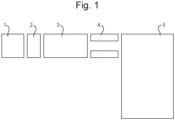
- Fig. 1 shows schematically a mass and/or ion mobility spectrometer in accordance with various embodiments.
- the mass and/or ion mobility spectrometer may comprise an ion source 1, an ion accumulation region or ion trap 2 arranged downstream of the ion source 1, an ion mobility separation device 3 arranged downstream of the ion accumulation region 2, an optional quadrupole mass filter 4 arranged downstream of the ion mobility separation device 3 and a mass analyser 5 (such as an orthogonal acceleration Time of Flight mass analyser) arranged downstream of the quadrupole mass filter 4.
- a mass analyser 5 such as an orthogonal acceleration Time of Flight mass analyser
- ions may be produced in the ion source 1 and then accumulated in the accumulation region 2 before optionally being pulsed into the ion mobility separation device 3. As ions travel within the ion mobility separation device 3 a subsequent population of ions may be accumulated in the ion accumulation region 2.
- Ions exiting the ion mobility separation device 3 may enter the quadrupole mass filter 4 which may be set to transmit substantially all the ions exiting ion mobility device 3 (i.e. in a so-called "RF only" mode).
- the mass filter 4 may be set to transmit ions over a narrow mass to charge ratio range (e.g. on application of an appropriate resolving DC voltage).
- the mass to charge ratio ("m/z") range transmitted by the quadrupole mass filter 4 may be altered in synchronization with the elution of specific ions from the ion mobility separation device 3. Ions which exit the quadrupole mass filter 4 are mass analysed by the mass analyser 5.
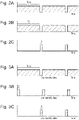
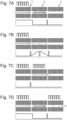
- Figs. 2A-C and Figs. 3A-3C show timing diagrams illustrating the operation of the mass and/or ion mobility spectrometer in accordance with various embodiments.
- Figs. 2A-2C and Figs. 3A-3C show the sequence of events within the mass and/or ion mobility spectrometer resulting in the alternating high and low transmission or intensity data sets according to various embodiments.
- Figs. 2A-2C illustrate the high transmission or intensity cycle according to various embodiments.
- Fig. 2A illustrates the time allowed for a population of ions to travel along (to be separated by) the ion mobility separation device 3.
- each ion mobility separation cycle has a fixed duration of T ims . It should be noted, however, that this duration may be varied, e.g. depending on the application, in accordance with various other embodiments.
- Fig. 2B illustrates the time T1 during which ions are accumulated in the accumulation region 2 prior to ion mobility separation.
- the time T1 during which ions are accumulated within the ion accumulation region 2 is substantially the same as the time taken for a population of ions to travel through the ion mobility separation device 3. According to various embodiments, these times need not be the same (e.g. T1 could be less than T ims ) but setting these times to being substantially the same maximises the number of ions that are subsequently introduced into the ion mobility separation device 3 in each cycle.
- Fig. 2C illustrates the time Tinj during which ions are ejected from the ion accumulation device 2 and are injected into the ion mobility separation device 3. According to various embodiments T inj ⁇ T ims . In various embodiments, during the time Tinj no ions enter the ion accumulation region 2.
- Figs. 3A-3C illustrate the low transmission or intensity mode of operation in accordance with various embodiments.
- Fig. 3A illustrates the time T ims allowed for a population of ions to travel along (to be separated by) the ion mobility separation device 3.
- the time T ims for one ion mobility separation cycle is fixed.
- Fig. 3B illustrates the time T2 during which ions are accumulated in the accumulation region 2 prior to ion mobility separation.
- the time T2 during which ions are accumulated within the ion accumulation region 2 may be less than the time T ims taken for a population of ions to travel through the ion mobility separation device 3 i.e. in various embodiments T2 ⁇ T ims .
- the accumulation time T2 is less than T ims , but the ions are effectively trapped during the separation time T ims , before they are released for separation. That is, the accumulation time T2 is different to the total trapping time for the ions.
- Fig. 3C illustrates the time Tinj during which ions are ejected from the ion accumulation device 2 and are injected into the ion mobility separation device 3. In various embodiments during this time T inj a further population of ions does not enter the ion accumulation region 2.
- the ratio of DC2 to DC1 may be set to between around 1% and 10%. This provides a particularly useful dynamic range enhancement. However, any other suitable ratio may be used as desired.
- the accumulation time or mode of operation may be switched or altered between ion mobility separation cycles. Accordingly, the duty cycle of the system may be alternated between the above fixed and predetermined values between single ion mobility (“IMS") separations or between sets of multiple ion mobility separations.
- IMS single ion mobility
- the mode of operation may be switched between every ion mobility separation cycle. This results in a data set where the system is operating in the high transmission mode for around 50% of the total experimental time.
- IMS-m/z ion mobility-mass to charge ratio
- the time allocated to acquiring data in the high transmission mode of operation and the low transmission mode of operation may be altered to optimize the overall duty cycle of the system. For example, 15 ion mobility cycles in the high transmission mode of operation may be summed followed by 5 ion mobility cycles in the low transmission mode of operation. As the time during which the system acquires data in the high transmission mode of operation is greater than the time during which the system acquires data in the low transmission mode of operation, the overall duty cycle is increased e.g. from approximately 50% to approximately 75%. Any suitable number of high transmission and low transmission cycles may be performed as desired.
- n first groups of ions are effectively formed, and m groups of second ions are effectively formed, where n is greater than m.
- first groups of ions are effectively formed, and m groups of second ions are effectively formed, where n is greater than m.
- second groups of ions are effectively formed, where n is greater than m.
- n may be equal to or less than m.
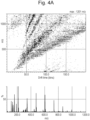
- Figs. 4A-4C illustrate the process of combining the high and low transmission data to produce a high dynamic range spectrum according to various embodiments.
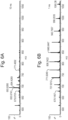
- Fig. 4A shows a mass to charge ratio ("m/z") versus ion mobility ("IMS") drift time heat map plot from a high transmission mode of operation and a corresponding mass spectrum.
- the mass spectrum below the heat map plot shows the same data as in the plot above but collapsed or summed in the mobility dimension. Significant distortion of the larger peaks in the spectrum has occurred due to detection system saturation.
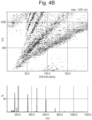
- Fig. 4B shows a two dimensional mass to charge ratio ("m/z") versus ion mobility ("IMS") drift time heat map and corresponding mass spectrum taken immediately after the spectra shown in Fig. 4A at a duty cycle of approximately 5% of the duty cycle utilised to obtain the data shown in Fig. 4A .
- Each spectrum was acquired over 100 ms from the summation of ten ion mobility separations of 10 ms duration. Lower detection system saturation is observed in this data as indicated by the markedly different relative ratios of the larger peaks in the mass spectrum.
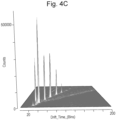
- Fig. 4C shows a three dimensional plot of ion mobility drift time ("DT") versus mass to charge ratio ("m/z") for a combined data set which was generated by replacing data which exceeded the dynamic range of the detection system in the data shown in Fig. 4A with corresponding ion mobility-drift time (“IMS-DT”) points from the data shown in Fig. 4B , with its intensity multiplied by 20 times.
- DT ion mobility drift time
- m/z mass to charge ratio
- the resultant combined spectrum has a dynamic range of approximately ten times that of the spectra shown in Figs. 4A and 4B .
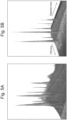
- Fig. 5A shows a drift time versus liquid chromatography (“LC”) retention time plot for a liquid chromatography ion mobility mass spectrometry (“LC-IMS-MS”) separation of small molecules at an acquisition rate of 10 spectra per second.
- LC liquid chromatography ion mobility mass spectrometry
- Fig. 5B shows the enhanced dynamic range spectra formed by combining 100% transmission and 5% transmission data in accordance with various embodiments.
- the combined data is from two consecutive 100 ms acquisitions, the final spectral rate of the stitched high dynamic range data is 5 spectra per second, with an increase in dynamic range of 10x.
- the approach of the embodiments described above may be used to improve the dynamic range when coupling a mass selective ion trap to an orthogonal acceleration Time of Flight system e.g. to facilitate high duty cycle comprehensive MS-MS operation.
- a separate upstream accumulation region may be provided prior to the mass selective trap, with the ion accumulation time optionally alternating between two or more values, e.g. as described above.
- the time over which ions are accumulated directly into the analytical ion trap may be alternated between one or more different times, e.g. as described above. Again, the fill times may be predetermined prior to the start of the acquisition.
- low intensity and high intensity two dimensional mass to charge ratio versus mass to charge ratio data sets may be produced.
- a composite data set may be produced with higher dynamic range using the methods of the embodiments described herein.
- the same approach may be taken for arrangements wherein ions are trapped and then released to a mass analyser (e.g. to an orthogonal acceleration Time of Flight ("ToF") mass spectrometer, optionally without passing through a separation device).
- a mass analyser e.g. to an orthogonal acceleration Time of Flight (“ToF") mass spectrometer, optionally without passing through a separation device.
- EDC enhanced duty cycle mode
- target enhancement mode ions may be firstly trapped, and the release of the ions may be synchronized with the orthogonal sampling pulse of the mass analyser to give high duty cycle over a limited mass to chare ratio ("m/z”) range.
- a mass selective ion trap may be provided upstream of a time of flight mass analyser.
- a non-mass selective ion trap may be provided upstream of a mass selective ion trap which may be provided upstream of a time of flight mass analyser.
- a non-mass selective ion trap may be provided upstream of a mass selective ion trap which may be provided upstream of a scanning quadrupole which may be provided upstream of a time of flight mass analyser.
- the scanning quadrupole may be operated in synchronism with the time of flight mass analyser for high sensitivity and high duty-cycle comprehensive MS-MS.
- the techniques described herein may be applied to apparatus in which ions are trapped and released in reverse mass to charge ratio ("m/z") order and converge simultaneously at an orthogonal acceleration sampling electrode, thereby resulting in high duty cycle for the entire mass to charge ratio range (e.g. as described in US-6794640 (Micromass )). Alternating the trap fill time and subsequently combining the time of flight data can improve the overall dynamic range of the data produced.
- m/z mass to charge ratio
- Alternating the trap fill time and subsequently combining the time of flight data can improve the overall dynamic range of the data produced.
- ions may be accumulated in an accumulation region or ion trap, and then may be mass selectively ejected from the accumulation region or ion trap, and then filtered by a quadrupole mass filter.
- ions may be accumulated in an accumulation region or ion trap, and then may be mass selectively ejected from another downstream analytical ion trap, and then filtered by a quadrupole mass filter.
- the mass to charge ratio transmission window of the quadrupole mass filter may be altered (scanned) substantially in synchronism with the mass to charge ratio of the ions as they are mass selectively ejected from the ion trap.
- the high intensity data set may be used or retained, or alternatively the low intensity data set may be combined with the high intensity data set, and the combined data set may be used.
- more than two different fill times may be used in a corresponding manner to that described above.
- one or more third and/or further groups of ions may be formed by, for each of the one or more third and/or further groups of ions, accumulating ions for a third and/or further different period of time.
- the one or more third and/or further groups of ions may be analysed to generate one or more third and/or further data sets, which may be used in the manner of the embodiments described above.
- the highest intensity or duty cycle data set that is not determined to be distorted or saturated may be retained or used.
- a or the (e.g. first) data set comprises distorted data resulting from space charge effects. According to various embodiments this may be done based on the total ion current ("TIC"). In various embodiments, if the total ion current ("TIC") recorded in the high intensity data set is such that it is at a level at which it is known that the mass and/or ion mobility spectrometer (e.g. ion mobility (“IMS”)) performance may be distorted due e.g. to space charge effects (e.g. such that it is above a threshold value), then it may be determined that the data set comprises distorted data, and the entire high intensity data set (e.g. ion mobility-mass to charge ratio (“IMS-m/z”) data set) may then be replaced by data from the corresponding low intensity data set.
- TIC total ion current
- the accumulation time switching method is effectively used to produce a data set which is less distorted due to space charge effects, e.g. in the ion mobility separation device 3 and/or accumulation region 2, rather than less distorted due to detection system saturation effects.
- the recorded signals or spectra may not give a suitable indication of the amount of charge accumulated e.g. in the ion trap or accumulation region. This may be primarily due to the imperfect transmission of a particular device or combination of devices between the ion trap or accumulation region and the acquisition (detector) system. In many cases, this transmission factor may be unknown or known only to a limited precision. This can lead to miscalculations of the accumulated charge in the ion trap or accumulation region where the calculation is based on the measured signal or spectra (e.g. TIC).
- the measured signal or spectra e.g. TIC
- the transmission may also vary as a function of mass, mass to charge ratio, ion mobility or charge state, etc.
- the transmission may vary as a result of the mass to charge ratio ("m/z") transmission profile of a Time of Flight ("ToF") mass spectrometer such as an orthogonal acceleration Time of Flight (“OA-ToF) mass analyser, as a result of one or more RF devices and/or as a result of the mass to charge ratio ("m/z”) and/or charge transmission profiles of one or more electrostatic lenses.
- ToF Time of Flight
- OA-ToF orthogonal acceleration Time of Flight
- the detection efficiency can also be mass, mass to charge ratio ("m/z”) and/or charge state dependent, leading to similar effects.
- the mass filter 4 may be set to resolve a particular parent or precursor ion after ion mobility separation in the ion mobility separation device 3.
- the parent or precursor ion may then be dissociated to form product ions which may then be mass analysed using the mass analyser 5.
- the composition of the recorded mass spectrum will not represent the population of ions in the pre-ion mobility separation accumulation region 2, and therefore cannot directly be used to adjust the fill time of the accumulation device to avoid spectral distortion due to space charge effects in the accumulation region or IMS device.
- a high intensity (first) data set comprises distorted data resulting from space charge effects based on a comparison of the high intensity (first) data set and the corresponding low intensity (second) data set.
- Qualitative and/or quantitative differences between the high intensity data set and the low intensity data set may be determined and used to do this.
- the high intensity data set and the corresponding low intensity data set should be relatively similar where the only difference is a scaling factor that relates to e.g. the difference in the fill time between the two data sets (or more generally to the difference between the number of ions acquired for each data set).
- the high intensity data set and the corresponding low intensity data set are significantly different in some other way, then it may be determined that space charge effects are present.
- differences in the data sets in terms of some peaks being suppressed relative to others, mass to charge ratio ("m/z") changes, etc. may be indicative of the presence of space charge effects.
- the expected scaling factor between the data sets and the corresponding experimentally determined scaling factor may be compared to determine the presence of space charge effects. If, for example, a 10x scaling factor is expected based on the fill time or otherwise, but a factor of more or less than this is measured, this may indicate the presence of space charge effects.
- individual distorted peaks and/or the entire distorted spectra may be replaced when space charge effects are determined to be present.
- the above described transmission effects may effectively be cancelled out by switching the fill time or duty cycle of ions entering an ion trap or accumulation region between two or more known values, e.g. as described above.
- the duty cycle values are known, the effect on the final data set is predictable in the absence of space charge effects e.g. each component in the spectra should be simply scaled by the relative transmission factors.
- Figs. 6A and 6B shows the results of an infusion of a horse heart myoglobin sample which was ionised by an Electrospray ion source and wherein the subsequently generated ions were then analysed using an ion mobility separation Time of Flight ("IMS-ToF") instrument with pre-ion mobility separation trapping in accordance with various embodiments.
- IMS-ToF ion mobility separation Time of Flight
- the trap fill time was switched between two values, 10 ms and 1 ms, to generate a high intensity data set (as shown in Fig. 6A ) and a low intensity data set (as shown in Fig. 6B ).
- the two data sets are clearly qualitatively different.
- the two spectra or data sets may be compared taking in to account the known duty cycle factor (e.g. as described above). If the data sets are determined to differ significantly (i.e. in a way which does not simply relate to the differences in intensities), then data associated with the lower duty cycle (the low intensity data set) may be retained (i.e. in place of the distorted high intensity data set) in the manner as described above.
- the comparison step may be achieved by simply comparing the total ion current ("TIC") values or by comparing TIC values in one or more regions of the mass to charge ratio (“m/z") range, or by more computationally intensive point to point comparisons.
- the comparison may also take place after mass spectral and/or ion mobility spectral peak detection, where detected peaks may be compared individually or in bulk.
- the intensity difference between the data sets produced using the different accumulation times may be compared to the known difference in accumulation time (or otherwise) between the two data sets, which in various embodiments enables distortions due to space charge effects, prior to the mass filter 4, to be recognised. If the spectra are deemed to differ significantly the data set associated with the lower duty cycle or lower accumulation time may be retained (i.e. in place of the high intensity data set).
- the comparison may involve determining the presence of local or bulk drift time shifts for the same species between the high and low intensity or transmission data sets.
- Space charge effects in the ion mobility separation device may cause such local or bulk drift time shifts for the same species between the high and low transmission data sets.
- This distortion may be used to recognise corruption of a (e.g. IMS-MS) data set or spectrum and may be used to determine that data from the corresponding low transmission cycle should be utilised in its place, e.g. as described above.
- the approach of these embodiments may also be used to control and account for other effects related to total charge in a or the ion trap or accumulation region such as ion-ion or ion-neutral reactions.
- the retained data may be taken from the highest duty cycle data set that is determined not to differ from the next lowest duty cycle data set.
- the data sets associated with two or more duty cycle values may be combined.
- the transmission of a device may be switched between high transmission and low transmission modes of operation to produce corresponding high intensity and low intensity data sets.
- the transmission of a device upstream of the ion trap or ion accumulation region may be switched between two or more known values, to thereby achieve similar effects to those described above.
- a transmission altering device may be provided upstream of an ion trap, e.g. such that instead of altering the accumulation time (as discussed above), the transmission is altered, e.g. with a constant trapping time. That is, an ion trap may be configured to accept ions at all times, but the ion beam upstream of the ion trap may be thinned out or chopped, e.g. with a known duty cycle. In these embodiments, any chopping of the ion beam should be synchronised to the start and end times of the ion accumulation in the ion trap.
- the approach according to various embodiments can be applied to feedback modes of operation.
- the approach of comparing two data sets to decide which to utilise can also be applied to "ToF only" DRE experiments that do not necessarily involve ion traps.
- the mass to charge ratio (“m/z”) values measured for individual peaks may be compared between the high and low transmission data sets. If the mass to charge ratio ("m/z") differs significantly for individual peaks (i.e. within statistical tolerances), it can in various embodiments be inferred that the data associated with this mass to charge ratio ("m/z") in the high transmission spectra has exceeded the dynamic range of the system e.g. due to space charge effects. Data for this mass to charge ratio (“m/z”) value may then be taken from the low transmission data set scaled by the appropriate factor.
- the ratio of intensities in the high and low transmission spectra for individual peaks may be calculated and compared to the known attenuation ratio. This information may then be used to select data from the high and low transmission data sets or spectra to combine into a composite high dynamic range data set or spectrum.
- the ratio of the isotope peaks in each data set or spectrum may be compared between the high and low transmission data sets, and may be used in the manner of the embodiments described above, i.e. to determine whether saturated and/or distorted data is present.
- first and second groups of ions rather than forming first and second groups of ions by varying the accumulation time in respect of the first and second groups of ions, plural initial groups of ions comprising substantially equal or similar numbers of ions may be formed, e.g. by accumulating or trapping groups of ions for substantially equal times (or otherwise), and then first and second groups of ions comprising differing numbers of ions may be formed from the initial groups of ions, e.g. by extracting or otherwise separating different portions (e.g. different percentages) of ions from different ones of the initial groups of ions.
- a dynamic range enhancement By extracting or separating different amounts of ions from each of plural different initial groups of ions, a dynamic range enhancement (DRE) can be effected in a corresponding manner to that described above.
- DRE dynamic range enhancement
- the first and the second groups of ions may be more representative, thereby reducing spectral distortion and quantitative errors in the data.
- the initial groups of ions may be extracted or otherwise separated from the ion trap, trapping or accumulation region in any suitable and desired manner.
- an initial group of ions may be spatially separated or segmented within an ion trap, trapping or accumulation region. This may be achieved, for example, by raising a DC barrier inside the ion trap, trapping or accumulation region so as to segment the initial group of ions into two (or more) differently sized portions. The appropriate portion of ions may then be accelerated into a downstream device (e.g. separation (IMS) device), for analysis, etc., e.g. as described above.
- IMS separation
- only a portion of an initial group of ions may be ejected from an ion trap, trapping or accumulation region.
- This may be achieved, for example, by trapping ions within an ion trap, trapping or accumulation region that has at least one relatively extended dimension (e.g. length, width or height), and by allowing ions to exit the ion trap, trapping or accumulation region only through a relatively compact (in the at least one dimension) exit aperture or region.
- ions may be ejected from the ion trap, trapping or accumulation region using a pusher electrode that is relatively compact (in the at least one dimension).
- an initial group of ions may be trapped within a linear or planar ion trap, trapping or accumulation region, wherein the line (linear trapping region) or plane (planar trapping region) in which ions are trapped is relatively extended in comparison to an exit aperture or region of the trap and/or in comparison to a pusher electrode.
- an initial group of ions may be trapped within an ion trap, trapping or accumulation region that has at least one relatively extended dimension (e.g. length, width or height) relative to an entrance aperture or acceptance area of a downstream device (e.g. IMS device).
- a downstream device e.g. IMS device
- an initial group of ions may be trapped within a linear or planar ion trap, trapping or accumulation region, wherein the line (linear trapping region) or plane (planar trapping region) in which ions are trapped is relatively extended in comparison to an entrance aperture or acceptance area of a downstream device.
- a central axis of the line (linear trapping region) or plane (planar trapping region) may be orthogonal to a central axis of the downstream device (e.g. IMS device).
- Some or all of the ions in the ion trap, trapping or accumulation region may be accelerated or otherwise ejected from the ion trap, trapping or accumulation region into the downstream device, e.g. such that only a portion of the ions are received or onwardly transmitted by the downstream device (e.g. IMS device).
- the downstream device e.g. IMS device
- the ejected portion of ions may then be analysed (separated, etc.), e.g. as described above.
- the unused portion(s) of the initial groups of ions may be discarded or otherwise.
- each of the initial groups of ions may be beneficial to wait for each of the initial groups of ions to become fully distributed throughout the ion trap, trapping or accumulation region in which the initial groups of ions are formed before extracting or otherwise separating the ions, e.g. to avoid any IMS-type separation effects, i.e. so that each of the first and second groups of ions is representative of the initial group of ions.
- a plurality of initial groups of ions are formed by, e.g., for each of the initial groups of ions, accumulating ions for a period of time in an ion trap or other accumulation region.
- One or more first groups of ions may then be formed by, for each of the first groups of ions extracting or separating a first portion or all of the ions from an initial group of ions, and one or more second groups of ions may be formed by, for each of the second groups of ions extracting or separating a second different portion (i.e. less than all) of the ions from an initial group of ions.
- the one or more first groups of ions may be analysed to generate one or more first data sets, and the one or more second groups of ions may be analysed to generate one or more second data sets, e.g. as described above. It may then be determined whether the one or more first data sets comprise saturated and/or distorted data, e.g. as described above. If (when) it is determined that the one or more first data sets comprise saturated and/or distorted data, then the saturated and/or distorted data from the one or more first data sets may be replaced with corresponding data from the one or more second data sets, e.g. as described above.
- Each of the initial groups of ions may comprise a substantially equal quantity of ions, and the second portion may be less than the first portion, i.e. such that each of the one or more second groups of ions may comprise fewer ions than each of the one or more first groups of ions.
- Ion may be allowed to disperse equally throughout the ion trap, trapping or accumulation region in which the initial groups of ions are formed before they are extracted or separated, e.g. such that the first and/or second groups of ions are representative of the initial group of ions.
- relatively more of the high transmission (first) groups of ions may be formed than the low transmission (second) groups of ions.
- the rate at which alternate first and second groups of ions are accumulated and analysed may be such that the composition of consecutive first and second groups of ions are substantially the same, e.g. as described above.
- a group of ions may be separated according to one or more first physico-chemical properties before they are analysed, e.g. as described above.
- a group of ions may be formed (e.g. accumulated and/or extracted or separated) at the same time as analysing one or more other groups of ions, e.g. as described above.
- a group of ions may be formed (e.g. accumulated and/or extracted or separated) at the same time as separating according to one or more first physico-chemical properties one or more other groups of ions, e.g. as described above.
- a separation device may be operated in a cyclical manner so as to repeatedly separate respective groups of ions according to the one or more first physico-chemical properties, and ions may be accumulated (and extracted or separated) and analysed repeatedly in synchronism with the cycle time of the separation device, e.g. as described above.
- a group of ions may be filtered according to one or more second physico-chemical properties before being analysed, e.g. as described above.
- a group of ions may be formed (e.g. accumulated and/or extracted or separated) at the same time as filtering according to one or more second physico-chemical properties another groups of ions, e.g. as described above.
- Data from the one or more first data sets may be compared with data from the one or more second data sets in order to determine whether the one or more first data sets comprises saturated and/or distorted data, e.g. as described above.
- ions may be accumulated in an ion trap, e.g. for each of plural repeating fixed time periods, i.e. so as to form substantially corresponding populations of ions (e.g. having the same or similar quantities of ions). A different portion or percentage of each of the populations may then be released into a downstream device (e.g. separator) and the remaining ions within the ion trap may be discarded or directed elsewhere.
- a downstream device e.g. separator
- 100% of the ions of an initial group of ions may be released from the ion trap, e.g. into the downstream separator, so as to form a "first" group of ions.
- the separation device As the first group of ions is separated by the separation device, another initial group of ions may be accumulated in the ion trap. At the end of this second accumulation, 10% of the group of ions may be released, e.g. into the downstream separator, so as to form a "second" group of ions.
- This may be repeated multiple times, i.e. from initial group of ions to initial group of ions, or one or plural first groups of ions may be formed followed by one or plural second groups of ions, and so on, e.g. as described above.
- the first and second groups of ions may be analysed, e.g. as described above.
- Data recorded from analysis of the first group(s) of ions and data recorded from analysis of the second group(s) of ions may then be combined into a single high dynamic range data set, e.g. after appropriate scaling, e.g. as described above. For example, where the portions respectively comprise 100% and 10% of the ions, the data derived from the second group of ions may be scaled by a factor of 10 times.
- Fig. 7 illustrates the operation of a mass and/or ion mobility spectrometer in accordance with various embodiments.
- an ion trap or trapping region 2 is operable to isolate a small percentage of the total ion population accumulated within the trapping region 2 (e.g. so as to form a "second" (low intensity) group of ions), and to subsequently deliver the isolated ions to a downstream separator 3.
- the mass and/or ion mobility spectrometer may comprise an ion guide or ion guide region 6, an ion trap or trapping region 2 downstream of the ion guide or ion guide region 6, and a separation device or separation region 3 downstream of the ion trap or trapping region 2.
- Each of these may comprise a separate, distinct device, or they may be formed as a single ion guide comprising multiple regions or stages.
- the ion guide or ion guide region 6, the ion trap or trapping region 2, and the separation device or separation region 3 may be in the form of one or more stacked ring ion guides, i.e. comprising plural electrodes each having an aperture or opening through which ions may travel in use.
- One or more RF voltages sources may be provided that may be configured to apply one or more RF voltages to the electrodes so as to confine ions radially within the ion guide(s). Opposite phases of the RF voltage may be applied to axially adjacent electrodes. Other arrangements would be possible.
- Fig. 7 also illustrates various DC potentials which may be applied to the electrodes at different points in the operation of the mass and/or ion mobility spectrometer, e.g. during the trapping and release of ions, in accordance with various embodiments.
- an initial group of ions e.g. from an upstream ion source 1, may be accumulated within the trapping region 2. This may be achieved by transporting (e.g. forcing) ions from the ion guide 6 into the trapping region 2, e.g. by using one or more travelling DC waves and/or one or more static DC fields applied to electrodes of the ion guide 6.
- a DC gate voltage may be applied to an electrode at the downstream end of the trapping region 2 so as to prevent ions leaving the trapping region 2.
- ions may be prevented from entering the trap 2, e.g. by applying a DC voltage to a gate electrode upstream of the trapping region 2.
- the composition of the population of ions should be substantially constant throughout the length of the trap 2. This may be achieved (where necessary) by allowing the ions to remain in the ion trap 2 for a suitable period of time such that they become distributed throughout the ion trap 2.
- the applied DC voltages may be adjusted to form a relatively small trapping region within the trap 2. That is, one or more DC voltages may be applied to the electrodes of the trapping region 2 such that an DC potential well is formed inside the ion trap 2, e.g. at or close to the centre of the trap.
- Ions outside of the trapping region or well may be ejected from the ion trap 2. As shown in Fig. 7B , this may be achieved by applying DC voltages to the electrodes of the trap 2 such that the ions outside of the well experience a linear field that cause the ions to be expelled from the trap 2, and e.g. eventually outside the electrode structure.
- the dotted arrows in Fig. 7B show the path of the ions during this operation.
- Fig. 7C This may be achieved, for example, using one or more travelling DC waves and/or one or more static DC fields, etc., e.g. so as to move ions from one region to another.
- This (“second”) group may then be separated in the separation region 3, e.g. by forcing the ions through the separation region 3 using one or more travelling DC waves and/or one or more static DC fields applied to the electrodes of the separation region 3.
- a further population of ions may be accumulated in the trapping region 2.
- a “first” or “second” group of ions may then be formed from this population of ions as desired. This has the effect of increasing the duty cycle.
- first (high intensity) groups of ions may be formed by omitting the step of forming a relatively small trapping region or well within the trap 2 or by forming a relatively large trapping region or well within the trap 2 (e.g. in a corresponding manner to that discussed above).
- Fig. 8 illustrates the operation of a mass and/or ion mobility spectrometer in accordance with various other embodiments.
- an exit electrode 7 of a trapping region 2 may be segmented such that when ions are extracted from the trapping region 2, one or more potential barriers 8 may be formed so as to allow only a proportion of the ions to exit the trapping region 2 and to enter the downstream separation region 3, while preventing the remaining portion of the ions within the trapping region 2 exiting the trapping region 2 and entering the downstream separation region 3.
- ions may be accumulated into a trapping region 2, e.g. from an upstream ion guide or ion guiding region 2 or otherwise.
- one or more DC potential barriers 8 may be formed on the segmented exit electrode 7 of the ion trapping region 2, and one or more voltages (e.g. one or more travelling DC waves and/or one or more static DC fields, etc.) may be applied to the ion trap region 2 so as to expel some of the ions from the ion trap 2, while some ions remain within the ion trap 2 due to the one or more DC potential barriers 8.
- the ejected ("second") group of ions may then be separated in the separation region 3, e.g. as described above.
- the remaining ions may be flushed out of the trapping region 2, e.g. by known methods.
- first (high intensity) groups of ions may be formed by omitting the DC potential barriers 8 or by forming relatively smaller or narrower DC potential barriers 8.
- variable accumulation time techniques and the variable ion population extraction techniques described herein may be used to produce the attenuated data.
- Combining these techniques can allow significantly more overall attenuation of the ion beam at the detector, e.g. compared to either technique alone. For example, a combination of a 1% accumulation time, and a 1% final extraction proportion will give a total attenuation of 0.01%.
- the attenuation factor for different trap exit conditions may be appropriately characterised and calibrated.
Landscapes
- Chemical & Material Sciences (AREA)
- Analytical Chemistry (AREA)
- Other Investigation Or Analysis Of Materials By Electrical Means (AREA)
Applications Claiming Priority (3)
| Application Number | Priority Date | Filing Date | Title |
|---|---|---|---|
| GBGB1508197.9A GB201508197D0 (en) | 2015-05-14 | 2015-05-14 | Trap fill time dynamic range enhancement |
| PCT/GB2016/051395 WO2016181167A1 (fr) | 2015-05-14 | 2016-05-13 | Amélioration de plage dynamique de temps de remplissage de piège |
| EP16723487.1A EP3295469B1 (fr) | 2015-05-14 | 2016-05-13 | Amélioration de plage dynamique de temps de remplissage de piège à ions |
Related Parent Applications (2)
| Application Number | Title | Priority Date | Filing Date |
|---|---|---|---|
| EP16723487.1A Division EP3295469B1 (fr) | 2015-05-14 | 2016-05-13 | Amélioration de plage dynamique de temps de remplissage de piège à ions |
| EP16723487.1A Division-Into EP3295469B1 (fr) | 2015-05-14 | 2016-05-13 | Amélioration de plage dynamique de temps de remplissage de piège à ions |
Publications (2)
| Publication Number | Publication Date |
|---|---|
| EP4141909A2 true EP4141909A2 (fr) | 2023-03-01 |
| EP4141909A3 EP4141909A3 (fr) | 2023-07-26 |
Family
ID=53489574
Family Applications (2)
| Application Number | Title | Priority Date | Filing Date |
|---|---|---|---|
| EP16723487.1A Active EP3295469B1 (fr) | 2015-05-14 | 2016-05-13 | Amélioration de plage dynamique de temps de remplissage de piège à ions |
| EP22201649.5A Pending EP4141909A3 (fr) | 2015-05-14 | 2016-05-13 | Amélioration de plage dynamique |
Family Applications Before (1)
| Application Number | Title | Priority Date | Filing Date |
|---|---|---|---|
| EP16723487.1A Active EP3295469B1 (fr) | 2015-05-14 | 2016-05-13 | Amélioration de plage dynamique de temps de remplissage de piège à ions |
Country Status (5)
| Country | Link |
|---|---|
| US (3) | US10522336B2 (fr) |
| EP (2) | EP3295469B1 (fr) |
| CN (2) | CN107690691B (fr) |
| GB (4) | GB201508197D0 (fr) |
| WO (1) | WO2016181167A1 (fr) |
Families Citing this family (7)
| Publication number | Priority date | Publication date | Assignee | Title |
|---|---|---|---|---|
| GB2562690B (en) * | 2016-09-27 | 2022-11-02 | Micromass Ltd | Post-separation mobility analyser |
| GB2558221B (en) * | 2016-12-22 | 2022-07-20 | Micromass Ltd | Ion mobility separation exit transmission control |
| CN110310882B (zh) * | 2019-07-03 | 2021-03-12 | 清华大学深圳研究生院 | 一种改善离子迁移谱中bn门歧视效应的离子门控制方法 |
| GB202011470D0 (en) | 2020-07-24 | 2020-09-09 | Micromass Ltd | ION mobility separation |
| CN117795643A (zh) * | 2021-08-05 | 2024-03-29 | Dh科技发展私人贸易有限公司 | Tof-ms中的空间电荷减少 |
| WO2023111850A1 (fr) * | 2021-12-17 | 2023-06-22 | Dh Technologies Development Pte. Ltd. | Procédé d'exploitation d'un spectromètre de masse pour contrer les effets de charge spatiale |
| US20250273453A1 (en) * | 2022-04-25 | 2025-08-28 | Dh Technologies Development Pte. Ltd. | Detection Saturation Correction and De-Coalescence by Ion Beam Modulation |
Citations (3)
| Publication number | Priority date | Publication date | Assignee | Title |
|---|---|---|---|---|
| US6794640B2 (en) | 2001-11-22 | 2004-09-21 | Micromass Uk Limited | Mass spectrometer |
| US7038197B2 (en) | 2001-04-03 | 2006-05-02 | Micromass Limited | Mass spectrometer and method of mass spectrometry |
| US7683314B2 (en) | 2004-04-05 | 2010-03-23 | Micromass Uk Limited | Mass spectrometer |
Family Cites Families (24)
| Publication number | Priority date | Publication date | Assignee | Title |
|---|---|---|---|---|
| US6744043B2 (en) * | 2000-12-08 | 2004-06-01 | Mds Inc. | Ion mobilty spectrometer incorporating an ion guide in combination with an MS device |
| GB2388704B (en) * | 2002-05-17 | 2004-08-11 | * Micromass Limited | Mass spectrometer and method of mass spectrometry |
| EP1365437B1 (fr) * | 2002-05-17 | 2014-08-20 | Micromass UK Limited | Spectromètre de masse et méthode associée |
| US6872939B2 (en) * | 2002-05-17 | 2005-03-29 | Micromass Uk Limited | Mass spectrometer |
| US7157698B2 (en) * | 2003-03-19 | 2007-01-02 | Thermo Finnigan, Llc | Obtaining tandem mass spectrometry data for multiple parent ions in an ion population |
| GB2428876B (en) * | 2004-04-05 | 2008-10-01 | Micromass Ltd | Mass spectrometer |
| GB2417125B (en) * | 2004-04-05 | 2006-08-09 | Micromass Ltd | Mass spectrometer |
| DE102005039560B4 (de) * | 2005-08-22 | 2010-08-26 | Bruker Daltonik Gmbh | Neuartiges Tandem-Massenspektrometer |
| WO2007030948A1 (fr) * | 2005-09-15 | 2007-03-22 | Phenomenome Discoveries Inc. | Procede et appareil pour spectrometrie de masse icr-ftms |
| US7847248B2 (en) * | 2007-12-28 | 2010-12-07 | Mds Analytical Technologies, A Business Unit Of Mds Inc. | Method and apparatus for reducing space charge in an ion trap |
| GB0809488D0 (en) * | 2008-05-23 | 2008-07-02 | Electrophoretics Ltd | Mass spectrometric analysis |
| GB0810599D0 (en) | 2008-06-10 | 2008-07-16 | Micromass Ltd | Mass spectrometer |
| US7838826B1 (en) * | 2008-08-07 | 2010-11-23 | Bruker Daltonics, Inc. | Apparatus and method for parallel flow ion mobility spectrometry combined with mass spectrometry |
| GB201007210D0 (en) * | 2010-04-30 | 2010-06-16 | Verenchikov Anatoly | Time-of-flight mass spectrometer with improved duty cycle |
| CN103270575B (zh) * | 2010-12-17 | 2016-10-26 | 塞莫费雪科学(不来梅)有限公司 | 用于质谱法的数据采集系统和方法 |
| JP5543912B2 (ja) * | 2010-12-27 | 2014-07-09 | 日本電子株式会社 | 質量分析装置 |
| US8581177B2 (en) | 2011-04-11 | 2013-11-12 | Thermo Finnigan Llc | High duty cycle ion storage/ion mobility separation mass spectrometer |
| US8969791B2 (en) * | 2011-10-28 | 2015-03-03 | Shimadzu Corporation | Quantitative analysis method using mass spectrometer |
| EP2786399B1 (fr) * | 2011-11-29 | 2019-10-09 | Thermo Finnigan LLC | Procédé pour le contrôle et le réglage automatiques de l'étalonnage d'un spectromètre de masse |
| CN104508475B (zh) * | 2012-07-31 | 2018-05-04 | 莱克公司 | 具有高吞吐量的离子迁移率谱仪 |
| US8653446B1 (en) * | 2012-12-31 | 2014-02-18 | Agilent Technologies, Inc. | Method and system for increasing useful dynamic range of spectrometry device |
| GB201304588D0 (en) | 2013-03-14 | 2013-05-01 | Micromass Ltd | Improved method of data dependent control |
| GB201307404D0 (en) | 2013-04-24 | 2013-06-05 | Micromass Ltd | Improved ion mobility spectrometer |
| GB201316164D0 (en) * | 2013-09-11 | 2013-10-23 | Thermo Fisher Scient Bremen | Targeted mass analysis |
-
2015
- 2015-05-14 GB GBGB1508197.9A patent/GB201508197D0/en not_active Ceased
-
2016
- 2016-05-13 GB GB2118444.5A patent/GB2598871B/en active Active
- 2016-05-13 GB GB1718546.3A patent/GB2555266B/en active Active
- 2016-05-13 GB GB2115219.4A patent/GB2597619B/en active Active
- 2016-05-13 EP EP16723487.1A patent/EP3295469B1/fr active Active
- 2016-05-13 EP EP22201649.5A patent/EP4141909A3/fr active Pending
- 2016-05-13 CN CN201680033245.1A patent/CN107690691B/zh active Active
- 2016-05-13 CN CN202010085328.3A patent/CN111312577B/zh active Active
- 2016-05-13 WO PCT/GB2016/051395 patent/WO2016181167A1/fr not_active Ceased
- 2016-05-13 US US15/574,116 patent/US10522336B2/en active Active
-
2019
- 2019-12-24 US US16/726,519 patent/US10957525B2/en active Active
-
2021
- 2021-02-17 US US17/177,892 patent/US11488815B2/en active Active
Patent Citations (3)
| Publication number | Priority date | Publication date | Assignee | Title |
|---|---|---|---|---|
| US7038197B2 (en) | 2001-04-03 | 2006-05-02 | Micromass Limited | Mass spectrometer and method of mass spectrometry |
| US6794640B2 (en) | 2001-11-22 | 2004-09-21 | Micromass Uk Limited | Mass spectrometer |
| US7683314B2 (en) | 2004-04-05 | 2010-03-23 | Micromass Uk Limited | Mass spectrometer |
Also Published As
| Publication number | Publication date |
|---|---|
| GB2597619A (en) | 2022-02-02 |
| US20180350580A1 (en) | 2018-12-06 |
| GB2598871B (en) | 2022-06-08 |
| EP3295469A1 (fr) | 2018-03-21 |
| GB2597619B (en) | 2022-06-08 |
| GB2555266A (en) | 2018-04-25 |
| GB2598871A (en) | 2022-03-16 |
| CN111312577B (zh) | 2023-02-03 |
| CN107690691A (zh) | 2018-02-13 |
| US10522336B2 (en) | 2019-12-31 |
| GB201718546D0 (en) | 2017-12-27 |
| US20200144041A1 (en) | 2020-05-07 |
| US10957525B2 (en) | 2021-03-23 |
| GB201508197D0 (en) | 2015-06-24 |
| GB2555266B (en) | 2021-12-08 |
| CN111312577A (zh) | 2020-06-19 |
| GB202115219D0 (en) | 2021-12-08 |
| US11488815B2 (en) | 2022-11-01 |
| EP4141909A3 (fr) | 2023-07-26 |
| US20210202226A1 (en) | 2021-07-01 |
| EP3295469B1 (fr) | 2022-11-23 |
| WO2016181167A1 (fr) | 2016-11-17 |
| CN107690691B (zh) | 2020-03-06 |
Similar Documents
| Publication | Publication Date | Title |
|---|---|---|
| US11488815B2 (en) | Trap fill time dynamic range enhancment | |
| EP2989454B1 (fr) | Spectromètre à mobilité ionique | |
| US10354848B2 (en) | Method of mass analysis using ion filtering | |
| JP2017519984A (ja) | 2次元ms/ms取得モード | |
| US10371665B2 (en) | Mobility selective attenuation | |
| CN111710588A (zh) | 在离子阱中分离离子 | |
| US20170047212A1 (en) | Mass Spectrometer With Interleaved Acquistion | |
| US9881781B2 (en) | Optimized multiple reaction monitoring or single ion recording method | |
| CN106550609A (zh) | 组合式串级质谱法和离子迁移率质谱法 | |
| US10304674B2 (en) | Time of flight mass spectrometer | |
| US10041907B2 (en) | Accurate mobility chromatograms | |
| WO2018060690A1 (fr) | Analyseur de mobilité post-séparation et procédé de détermination de sections transversales de collision d'ions | |
| GB2534431A (en) | Mobility selective attenuation | |
| US10068761B2 (en) | Fast modulation with downstream homogenisation | |
| US11733206B2 (en) | Multiplexing method for separators | |
| GB2525709A (en) | Optimized multiple reaction monitoring or single ion recording method | |
| GB2533835A (en) | Fast modulation with downstream homogenisation | |
| GB2534252A (en) | Time of flight mass spectrometer |
Legal Events
| Date | Code | Title | Description |
|---|---|---|---|
| PUAI | Public reference made under article 153(3) epc to a published international application that has entered the european phase |
Free format text: ORIGINAL CODE: 0009012 |
|
| STAA | Information on the status of an ep patent application or granted ep patent |
Free format text: STATUS: THE APPLICATION HAS BEEN PUBLISHED |
|
| AC | Divisional application: reference to earlier application |
Ref document number: 3295469 Country of ref document: EP Kind code of ref document: P |
|
| AK | Designated contracting states |
Kind code of ref document: A2 Designated state(s): AL AT BE BG CH CY CZ DE DK EE ES FI FR GB GR HR HU IE IS IT LI LT LU LV MC MK MT NL NO PL PT RO RS SE SI SK SM TR |
|
| PUAL | Search report despatched |
Free format text: ORIGINAL CODE: 0009013 |
|
| AK | Designated contracting states |
Kind code of ref document: A3 Designated state(s): AL AT BE BG CH CY CZ DE DK EE ES FI FR GB GR HR HU IE IS IT LI LT LU LV MC MK MT NL NO PL PT RO RS SE SI SK SM TR |
|
| RIC1 | Information provided on ipc code assigned before grant |
Ipc: H01J 49/00 20060101ALI20230616BHEP Ipc: H01J 49/42 20060101ALI20230616BHEP Ipc: H01J 49/06 20060101ALI20230616BHEP Ipc: H01J 49/02 20060101AFI20230616BHEP |
|
| STAA | Information on the status of an ep patent application or granted ep patent |
Free format text: STATUS: REQUEST FOR EXAMINATION WAS MADE |
|
| 17P | Request for examination filed |
Effective date: 20240122 |
|
| RBV | Designated contracting states (corrected) |
Designated state(s): AL AT BE BG CH CY CZ DE DK EE ES FI FR GB GR HR HU IE IS IT LI LT LU LV MC MK MT NL NO PL PT RO RS SE SI SK SM TR |