EP4142088A1 - Prédiction de fréquence de réseau - Google Patents
Prédiction de fréquence de réseau Download PDFInfo
- Publication number
- EP4142088A1 EP4142088A1 EP21382776.9A EP21382776A EP4142088A1 EP 4142088 A1 EP4142088 A1 EP 4142088A1 EP 21382776 A EP21382776 A EP 21382776A EP 4142088 A1 EP4142088 A1 EP 4142088A1
- Authority
- EP
- European Patent Office
- Prior art keywords
- plural
- measurement values
- frequency
- wind park
- utility grid
- Prior art date
- Legal status (The legal status is an assumption and is not a legal conclusion. Google has not performed a legal analysis and makes no representation as to the accuracy of the status listed.)
- Ceased
Links
Images
Classifications
-
- H—ELECTRICITY
- H02—GENERATION; CONVERSION OR DISTRIBUTION OF ELECTRIC POWER
- H02J—ELECTRIC POWER NETWORKS; CIRCUIT ARRANGEMENTS OR SYSTEMS FOR SUPPLYING OR DISTRIBUTING ELECTRIC POWER; SYSTEMS FOR STORING ELECTRIC ENERGY
- H02J3/00—Circuit arrangements for AC mains or AC distribution networks
- H02J3/004—Generation forecast, e.g. methods or systems for forecasting future energy generation
-
- F—MECHANICAL ENGINEERING; LIGHTING; HEATING; WEAPONS; BLASTING
- F03—MACHINES OR ENGINES FOR LIQUIDS; WIND, SPRING, OR WEIGHT MOTORS; PRODUCING MECHANICAL POWER OR A REACTIVE PROPULSIVE THRUST, NOT OTHERWISE PROVIDED FOR
- F03D—WIND MOTORS
- F03D7/00—Controlling wind motors
- F03D7/02—Controlling wind motors the wind motors having rotation axis substantially parallel to the air flow entering the rotor
- F03D7/04—Automatic control; Regulation
- F03D7/042—Automatic control; Regulation by means of an electrical or electronic controller
- F03D7/048—Automatic control; Regulation by means of an electrical or electronic controller controlling wind farms
-
- F—MECHANICAL ENGINEERING; LIGHTING; HEATING; WEAPONS; BLASTING
- F03—MACHINES OR ENGINES FOR LIQUIDS; WIND, SPRING, OR WEIGHT MOTORS; PRODUCING MECHANICAL POWER OR A REACTIVE PROPULSIVE THRUST, NOT OTHERWISE PROVIDED FOR
- F03D—WIND MOTORS
- F03D7/00—Controlling wind motors
- F03D7/02—Controlling wind motors the wind motors having rotation axis substantially parallel to the air flow entering the rotor
- F03D7/028—Controlling wind motors the wind motors having rotation axis substantially parallel to the air flow entering the rotor controlling wind motor output power
- F03D7/0284—Controlling wind motors the wind motors having rotation axis substantially parallel to the air flow entering the rotor controlling wind motor output power in relation to the state of the electric grid
-
- G—PHYSICS
- G01—MEASURING; TESTING
- G01R—MEASURING ELECTRIC VARIABLES; MEASURING MAGNETIC VARIABLES
- G01R19/00—Arrangements for measuring currents or voltages or for indicating presence or sign thereof
- G01R19/25—Arrangements for measuring currents or voltages or for indicating presence or sign thereof using digital measurement techniques
- G01R19/2513—Arrangements for monitoring electric power systems, e.g. power lines or loads; Logging
-
- F—MECHANICAL ENGINEERING; LIGHTING; HEATING; WEAPONS; BLASTING
- F05—INDEXING SCHEMES RELATING TO ENGINES OR PUMPS IN VARIOUS SUBCLASSES OF CLASSES F01-F04
- F05B—INDEXING SCHEME RELATING TO WIND, SPRING, WEIGHT, INERTIA OR LIKE MOTORS, TO MACHINES OR ENGINES FOR LIQUIDS COVERED BY SUBCLASSES F03B, F03D AND F03G
- F05B2270/00—Control
- F05B2270/10—Purpose of the control system
- F05B2270/103—Purpose of the control system to affect the output of the engine
- F05B2270/1033—Power (if explicitly mentioned)
-
- F—MECHANICAL ENGINEERING; LIGHTING; HEATING; WEAPONS; BLASTING
- F05—INDEXING SCHEMES RELATING TO ENGINES OR PUMPS IN VARIOUS SUBCLASSES OF CLASSES F01-F04
- F05B—INDEXING SCHEME RELATING TO WIND, SPRING, WEIGHT, INERTIA OR LIKE MOTORS, TO MACHINES OR ENGINES FOR LIQUIDS COVERED BY SUBCLASSES F03B, F03D AND F03G
- F05B2270/00—Control
- F05B2270/30—Control parameters, e.g. input parameters
- F05B2270/337—Electrical grid status parameters, e.g. voltage, frequency or power demand
-
- F—MECHANICAL ENGINEERING; LIGHTING; HEATING; WEAPONS; BLASTING
- F05—INDEXING SCHEMES RELATING TO ENGINES OR PUMPS IN VARIOUS SUBCLASSES OF CLASSES F01-F04
- F05B—INDEXING SCHEME RELATING TO WIND, SPRING, WEIGHT, INERTIA OR LIKE MOTORS, TO MACHINES OR ENGINES FOR LIQUIDS COVERED BY SUBCLASSES F03B, F03D AND F03G
- F05B2270/00—Control
- F05B2270/70—Type of control algorithm
- F05B2270/709—Type of control algorithm with neural networks
-
- H—ELECTRICITY
- H02—GENERATION; CONVERSION OR DISTRIBUTION OF ELECTRIC POWER
- H02J—ELECTRIC POWER NETWORKS; CIRCUIT ARRANGEMENTS OR SYSTEMS FOR SUPPLYING OR DISTRIBUTING ELECTRIC POWER; SYSTEMS FOR STORING ELECTRIC ENERGY
- H02J2101/00—Supply or distribution of decentralised, dispersed or local electric power generation
- H02J2101/20—Dispersed power generation using renewable energy sources
-
- H—ELECTRICITY
- H02—GENERATION; CONVERSION OR DISTRIBUTION OF ELECTRIC POWER
- H02J—ELECTRIC POWER NETWORKS; CIRCUIT ARRANGEMENTS OR SYSTEMS FOR SUPPLYING OR DISTRIBUTING ELECTRIC POWER; SYSTEMS FOR STORING ELECTRIC ENERGY
- H02J2101/00—Supply or distribution of decentralised, dispersed or local electric power generation
- H02J2101/20—Dispersed power generation using renewable energy sources
- H02J2101/28—Wind energy
Definitions
- the present invention relates to a method and to a corresponding arrangement of predicting a frequency value of a utility grid to which a wind park is connected. Furthermore, the present invention relates to a wind park comprising the arrangement.
- a wind park comprising plural wind turbines is conventionally connected to a utility grid which provides electric energy to plural consumers.
- the grid frequency i.e. the electrical frequency of the AC power or the AC voltage of the utility grid, is at a nominal value, for example 50 Hz or 60 Hz.
- the electrical grid frequency may change.
- TSO transmission system operators
- balancing power (reserve)
- the TSO may specify (for example by means of a grid code) how the individual generators including the wind turbines connected to the grid should support the grid during a frequency event, such as an underfrequency event or an overfrequency event.
- a method of predicting a frequency value of a utility grid to which a wind park is connected comprising obtaining plural utility grid measurement values pertaining to a predetermined time range before and until a present point in time; obtaining plural wind park measurement values (for example active power and/or reactive power and/or voltage) pertaining to the time range; feeding the plural utility grid measurement values and the plural wind park measurement values into a recurrent neural network trained to output the frequency value at at least one next point in time, the next point in time being in particular between 0.5 s and 2 s after the present point in time.
- the method may for example be performed by a module of a wind park controller or a park pilot. In other embodiments, the method may be performed by a utility grid operator. The method may be implemented in software and/or hardware. The method may be performed during power production by the wind park.
- the wind park may comprise plural wind turbines which are connected at a point of common coupling, wherein the output power of the individual wind turbines may be supplied to the point of common coupling.
- the wind turbines may be connected via respective wind turbine transformers to the point of common coupling.
- the point of common coupling may be connected via one or more wind park transformers to the utility grid.
- the utility grid may be associated with a nominal frequency, for example 50 Hz or 60 Hz representing the electrical frequency of the AC voltage and/or AC current and/or AC power.
- the utility grid measurement values may pertain to one or more electrical parameters of the utility grid, in particular frequency and/or voltage.
- plural values may be provided pertaining or relating to the predetermined time range, for example comprising sample measurement values across the predetermined time range.
- the time range covers points in time in the past up to the present point in time.
- the plural wind park measurement values may comprise plural wind park power measurement values.
- the plural wind park measurement values may e.g. represent values of one or more electrical parameters of one or more wind turbines or the entire wind park, in particular electrical power output parameter values.
- the plural wind park measurement values in particular may represent values of one or more electrical parameters of only one wind turbine comprising only one generator or one or more electrical parameters of a single wind farm.
- Each of the wind park parameters may comprise measurement values covering the time range, i.e. pertaining to different points in time within the time range.
- the wind park power parameters may influence the frequency value of the utility grid.
- the accuracy of the method may be improved by including as input data the wind park measurement values.
- the utility grid parameters and respective measurement values thereof may have a predictive value for the frequency value of the utility grid at the next point in time. According to embodiments of the present invention, other input values are utilized for improving the prediction.
- the method employs a recurrent neural network which is appropriately trained.
- a recurrent neural network is a class of artificial neural networks where connections between nodes form a directed graph along a temporal sequence. Thereby, the recurrent neural network allows to model a temporal dynamic behaviour.
- the recurrent neural network may receive for each of the utility grid parameters, a (time) sequence of inputs, corresponding to the measurement values across the predetermined time range. Furthermore, the recurrent neural network may also receive for each of the wind park parameters respective measurement values presenting a sequence of inputs, e.g. representing a time series of respective measurement values across the predetermined time range.
- recurrent neural network refers to two broad classes of networks with a similar general structure, where one is finite impulse and the other is infinite impulse.
- a finite impulse recurrent network is a directed acyclic graph that can be unrolled and replaced with a strictly feedforward neural network, while an infinite impulse recurrent network is a directed cyclic graph that cannot be unrolled.
- the recurrent neural network may for example comprise an input layer which receives the measurement values of the utility grid parameters and the measurement values of the wind park power parameters.
- the network may further comprise one or more intermediate layers, for example two or more LSTM layers.
- the network may comprise a fully connected layer representing an output layer for example.
- the recurrent neural network is different from a simple artificial neural network model as used in the reference as cited above, due to the following reasons:
- the RNN may work on the principle of saving the output of a layer and feeding this back to the input in order to predict the output of the layer.
- RNN may consider the current input and the previously received inputs and may memorize previous inputs due to its internal memory. As a result, RNN may implicitly take time dependence of time series into account and may improve results of predictions.
- the next point in time may be a point in time in the future and thus may be different from any point in time for which measurement values of the utility grid parameter and the wind park power parameter(s) have been utilized.
- the method may allow a precise and accurate forecast of the utility grid frequency. Precise forecast of the grid frequency may assist the (i) TSO to optimize the amount of required balance (reserve) power, (ii) power plant operators to optimize the power flow to/from the energy storage in a hybrid power plant and (iii) with predictive control, power plants including wind farms can provide faster frequency response.
- the frequency event in a utility grid may be defined as a transition from the normal-frequency state when the frequency is in the normal range to the frequency-deviation state, when the frequency is below or above the normal frequency limits.
- Embodiments of the present invention may allow frequency and frequency deviation event predictions in a time interval from one to few seconds using historical grid frequency and wind park data.
- the plural utility grid measurement values contain a, across the time range, time series of values of at least one of the grid frequency as measured at one or more locations; a grid voltage as measured at one or more locations, in particular measured at a wind park grid connection node.
- the time series of the values may correspond to measurement values of plural subsequent points in time before and up to the present point in time.
- the grid frequency may be measured at one or more locations within the utility grid, for example may be measured at a connection node where the wind park is connected to the utility grid.
- the grid frequency may be measured at a primary side or a secondary side of a wind farm transformer, for example.
- the grid frequency may be measured for example by a grid measurement station.
- the grid voltage may also be measured at one or more locations, for example at a connection node where the utility grid is connected to the wind park, for example at a primary side of a wind farm transformer (the grid voltage may then be derived from the transformation ratio of the transformer) or a secondary side of the wind park transformer. Thereby, reliable measurement values may be obtained.
- Considering the grid frequency at plural points in time before and up to a present point in time may enable to accurately predict the frequency value of the utility grid at a next point in time. The same may hold for the grid voltage.
- further parameters characterizing the utility grid may also be included or additionally be included as input values for the recurrent neural network.
- Prediction of an accurate grid frequency may enable to initiate countermeasures or procedures, in order to counteract potential deviations from the nominal grid frequency.
- the plural wind park measurement values contain a, across the time range, time series of values of at least one of an active output power of the wind park; a reactive output power of the wind park.
- the electrical power fed from the wind park to the utility grid may also influence the frequency of the utility grid at the next point in time.
- the prediction may be improved by also considering the wind park measurement values including for example active output power and/or reactive output power of the wind park. Thereby, the prediction accuracy may be improved.
- the method further comprises classifying the frequency value output from the recurrent neural network as at least one of a normal frequency value, if the frequency value is within a predetermined frequency range; an underfrequency value, if the frequency value is below the predetermined frequency range or below a low frequency threshold value; an overfrequency value, if the frequency value is above the predetermined frequency range or above a high frequency threshold value.
- Classifying the frequency value which has been derived by the recurrent neural network may utilize at least two thresholds, in particular a low frequency threshold value and a high frequency threshold value. Thereby, a qualitative output value representing the frequency of the utility grid is provided, simplifying the interpretation of the result.
- the predetermined frequency range may for example be the range between the low frequency threshold value and the high frequency threshold value.
- the time range amounts to between 30 s and 200 s, and/or wherein a number of measurement values across the time range is between 30 and 200, and/or wherein a time step is between 0.5 s and 2 s.
- Other values for the time range, the number of measurement values and the time step are possible. If the time range is relatively restricted, the amount of data needed to be processed may be restricted. The same may hold for the number of measurement values.
- the method is continuously performed by implementing the predetermined time range by a sliding time range that slides with one timestep shift.
- the time range may be shifted by one time step in the direction of a later time.
- Those measurement values of the previous time range already fed into the recurrent neural network do not need to again input into the recurrent neural network. Only the additional measurement value, being the previous next point in time or the measurement value pertaining to the previous next point in time may additionally be fed in. Only the measurement value corresponding to the measurement value of the previous next point in time need to be additionally fed into the recurrent neural network. Thereby, data transmission rate may be reduced. Furthermore, the frequency may continuously be predicted.
- the recurrent neural network has previously been trained with training data, the training data comprising plural wind park measurement values and plural utility grid measurement values, when the frequency has a normal frequency value; plural other wind park measurement values and plural other the utility grid measurement values, when the frequency has an underfrequency value; plural still other wind park measurement values and plural still other the utility grid measurement values, when the frequency has an overfrequency value.
- the training data are utilized in order to set up plural values for plural parameters of the recurrent neural network.
- the plural parameter values of the recurrent neural network may define, how the frequency value as output by the neural network is calculated from the plural input values.
- the neural network parameters may comprise for example weighting parameters, defining weights and/or biases (offsets) for the plural different inputs and also weights and/or biases of one or more intermediate layers or intermediate nodes. These weighting parameters may be derived during the neural network training using the training data.
- the training data may comprise the plural wind park measurement values and the plural utility grid measurement values, when the frequency has a normal frequency value, since this is the normal situation for the utility grid.
- a smaller number of respective measurement values may be available for the case of an underfrequency event or overfrequency event. However, this may be compensated by applying appropriate weights for those measurement values pertaining to an underfrequency event and/or overfrequency event.
- the plural other wind park measurement values and the plural other the utility grid measurement values when the frequency has an underfrequency value, are weighted with another weight, in particular between 5 and 15, that is higher than a weight used for the plural wind park measurement values and plural the utility grid measurement values, when the frequency has a normal frequency value, the other weight being in particular determined in dependence on the number of the other measurement values.
- the plural still other wind park measurement values and the plural still other the utility grid measurement values when the frequency has an overfrequency value, are weighted with still another weight, in particular between 30 and 50, that is higher than a weight used for the plural wind park measurement values and plural the utility grid measurement values, when the frequency has a normal frequency value, the still other weight being in particular determined in dependence on the number of the still other measurement values.
- the method may be improved, leading to an improvement of the accuracy of the prediction of the grid frequency.
- the recurrent neural network is implemented as a long short-term memory (LSTM) network.
- the long short-term memory (LSTM) is an artificial recurrent neural network (RNN) architecture used in the field of deep learning, conventionally.
- the LSTM has feedback connections unlike standard feedforward neural networks.
- the LSTM can process entire frequencies of data, such as the time series of the measurement values of the grid parameters and/or wind park power parameters.
- a common LSTM unit is composed of a cell, an input gate, an output gate and a forget gate. The cell may remember values over arbitrary time intervals and the three gates may regulate the flow of information into and out of the cell.
- the LSTM networks may be well suited to classifying, processing and making predictions based on time series data, as represented by the measurement values of the grid parameters and/or wind park power parameters.
- the frequency values at plural subsequent next points in time are output, the plural subsequent next points in particular covering between 1 s and 15 s.
- predictions for several points in time in the future are enabled.
- operating the utility grid and/or the wind park may potentially be improved.
- the method further comprises employing plural recurrent networks, each being trained to output, upon feeding in the plural the utility grid measurement values and the plural wind park measurement values, the frequency value at a particular one of plural subsequent next points in time.
- a respective recurrent network For each point in time (in the future, i.e. after the present point in time) for which the frequency value of the grids is to be determined or predicted, a respective recurrent network may be employed.
- a first recurrent network may be employed.
- a first recurrent network may therefore predict, from the first previous points in time up to the fist present point in time or from the measurement values relating to the first previous points in time and up to the first present point in time, the respective frequency value of the grid at the first next point in time.
- a second recurrent network may be employed which, depending on the measurement values relating to the plural second previous points in time up to the second present point in time (being equal to the first next point in time), the frequency value at the second next point in time (being equal to the second time step after the first present point in time).
- prediction accuracy may be improved compared to the situation, where only a single recurrent network is utilized.
- an arrangement for predicting a frequency value of a utility grid to which a wind park is connected comprising an input module adapted to receive: plural utility grid measurement values pertaining to a predetermined time range before and until a present point in time; and plural wind park measurement values pertaining to the time range; a recurrent neural network trained to output the frequency value at at least one next point in time upon feeding in the plural utility grid measurement values and the plural wind park measurement values.
- the arrangement may be implemented in software and/or hardware.
- the arrangement may for example be comprised in a wind park controller or a utility grid operator equipment.
- a wind park comprising plural wind turbines connected to a utility grid; a wind park measurement station; a utility grid measurement station; and an arrangement according to the preceding embodiment communicatively connected to the wind turbines, to the measurement station and to the utility grid measurement station.
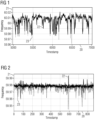
- Figs. 1, 2 and 3 depict prediction values of a grid frequency as obtained according to embodiments of the present invention
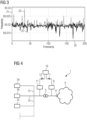
- Fig. 4 schematically illustrates a wind park according to an embodiment of the present invention, including an arrangement for predicting a frequency value according to an embodiment of the present invention.
- Embodiments of the present invention use a machine learning model, namely a recurrent neural network, to predict the grid frequency and also to predict a possible frequency deviation from a nominal grid frequency.
- FIG. 4 One embodiment of a wind park 1 is schematically illustrated in Fig. 4 .
- the wind park comprises plural wind turbines 2a, 2b, 2c which are connected to a utility grid 3.
- the wind turbines 2a, 2b, 2c, ..., 2n are connected to a common electrical conductor 15 (e.g. busbar) which is connected, via a wind park transformer 5, to the point of common coupling 4 which is connected to the utility grid 3.
- a common electrical conductor 15 e.g. busbar
- the wind park 1 comprises a utility grid measurement station 6 which is adapted to acquire plural utility grid measurement values 7 which pertain to a particular time range.
- the wind park 1 further comprises an arrangement 10 according to an embodiment of the present invention for predicting a frequency value of the utility grid 3.
- the wind park further comprises a wind park measurement station 11 which is adapted to acquire wind park measurement values (in particular wind park power measurement values) 12 which pertain to a particular time range.
- the plural utility grid measurement values 7 as well as the plural wind park measurement values 12 are supplied to a respective input module of the arrangement 10.
- the arrangement 10 comprises or has implemented a recurrent neural network which receives the measurement values 7, 12 as input values.
- the recurrent neural network then predicts from the measurement values pertaining to the particular time range, the frequency value of the utility grid 3 at at least one next point in time.
- the recurrent neural network model may in particular embodiments have the following input and output values:
- As model input the values of the frequency and the measurements from the wind farm (for example active power, reactive power, voltage) during a certain time period (input window) until the present time.
- the model input may also be extended with measurements from other nodes in the electrical network 3, in order to further improve the accuracy of the model.
- Input window size defined by the number of timestamps in the input window may be subject to an optimization.
- the model output may include the value of the frequency of the grid in the next timestamp or in several timestamps after the input window. Depending on the output value or frequency, the prediction result may be classified as normal frequency, underfrequency or overfrequency event.
- next-timestamp prediction presented here may be the simplest approach of the predictions. Prediction horizon may be extended to several timestamps, although the model accuracy is expected to be the best for the next-timestamp prediction.
- the data used for the model training and evaluation may have granularity of 1 s., i.e. each second, a measurement value may be acquired and utilized for training.
- a sample for the model input may be selected using all timestamps with the frequency in the normal range. As a result of this selection, only data in the normal frequency range or just before frequency deviation events occur, may be used.
- Sliding windows of the input window size may be created with one-timestamp sliding shift.
- One requirement may be applied for the sliding windows in that the data should be continuous (no difference larger than several seconds between two sequent timestamps). This may guarantee that there are no large gaps between timestamps in the input windows.
- the number of timestamps in the input window may be chosen to be between 40 and 70, for example 60, but may also be subject to optimization.
- the value of 60 may correspond to one minute of data taking and processing.
- frequency values during the next timestamps after the input sliding windows are selected.
- the output may contain normal frequency values, underfrequency values or overfrequency values.
- a network architecture that takes time dependence into account is utilized as an implementation of the recurrent network.
- the long short-term memory (LSTM) architecture described in Sepp Hochreiter; Jürgen Schmidhuber (1997). "Long short-term memory”. Neural Computation. 9 (8): 1735-1780 may be used according to embodiments of the present invention for frequency predictions.
- the tensor flow framework with the Keras application interface may be utilized.
- frequency deviation events may be rare, or, the frequency prediction model may learn mostly the behaviour in the normal frequency range.
- weights may be introduced for deviation-related data samples.
- a possibility to train models with weights available in Keras may be implemented. For data samples with underfrequency values, weights equal to 10 may be used, whereas for data samples with overfrequency values, weights may be set to 40 to account for more seldom overfrequency events. Selection of weights may be subject to optimization.
- Figs. 1, 2 and 3 depict in graphs having as an abscissa 20 indicating the timestamp and having as an ordinate 21 indicating the frequency value, some examples of frequency predictions in comparison with the true values. Thereby, for all graphs, an independent data set is utilized. Thereby, a comparison between frequency predictions (solid lines 22) and measurements (dashed lines 23) are presented in Fig. 1 for all frequencies, in Fig. 2 for low frequency events and in Fig. 3 for high frequency events, thus in Fig. 2 , 3 only for timestamps where the frequency was respectively below or above the normal frequency range.
- the accuracy of the model predictions may allow the classification of the predicted frequency to three classes: normal-frequency states, underfrequency deviation events and overfrequency deviation events.
- Table 1 Confusion matrix for underfrequency event predictions Underfrequency event no event underfrequency predicted TP: 96.53 % FP: 1.74 % no event predicted FN: 3.47 % TN: 97.42 %
- Table 2 Confusion matrix for overfrequency event predictions Overfrequency event no event overfrequency predicted TP: 87.62 % FP: 0.85 % no event predicted FN: 12.38 % TN: 97.42 %
- the model demonstrates a high true positive and low false positive rate in the frequency event classification.
- the use of different weights may allow further optimizations of the model performance depending on possible requirements on the numbers of true positives and false positives.
- Embodiments of the present invention may provide a prediction model which considers as input both the grid frequency and measurements from the wind park such as the active power. Time dependence of the model input may be considered for the frequency predictions.
- the grid frequency and the wind farm data may be combined in order to provide input for the neural network model. The use of combined information may allow to improve accuracy of the frequency predictions.
- the neural network model uses time dependence, namely the long short-term memory neural network (LSTM) model intrinsically takes into account time dependency of the grid frequency and wind park data according to embodiments of the present invention.
- LSTM long short-term memory neural network
- Precise prediction of the frequency and frequency deviations may be used for example in a wind park control algorithm or power plant operational planning in order to improve control of the wind park and/or the utility grid.
Landscapes
- Engineering & Computer Science (AREA)
- Mechanical Engineering (AREA)
- Life Sciences & Earth Sciences (AREA)
- Sustainable Development (AREA)
- Sustainable Energy (AREA)
- Chemical & Material Sciences (AREA)
- Combustion & Propulsion (AREA)
- General Engineering & Computer Science (AREA)
- Power Engineering (AREA)
- Physics & Mathematics (AREA)
- General Physics & Mathematics (AREA)
- Management, Administration, Business Operations System, And Electronic Commerce (AREA)
- Wind Motors (AREA)
Priority Applications (5)
| Application Number | Priority Date | Filing Date | Title |
|---|---|---|---|
| EP21382776.9A EP4142088A1 (fr) | 2021-08-23 | 2021-08-23 | Prédiction de fréquence de réseau |
| CN202280057747.3A CN117882261A (zh) | 2021-08-23 | 2022-08-09 | 预测电网频率 |
| EP22764683.3A EP4331069B1 (fr) | 2021-08-23 | 2022-08-09 | Prédiction de fréquence de réseau |
| US18/681,899 US12448949B2 (en) | 2021-08-23 | 2022-08-09 | Predicting grid frequency |
| PCT/EP2022/072315 WO2023025587A1 (fr) | 2021-08-23 | 2022-08-09 | Prédiction de fréquence de réseau |
Applications Claiming Priority (1)
| Application Number | Priority Date | Filing Date | Title |
|---|---|---|---|
| EP21382776.9A EP4142088A1 (fr) | 2021-08-23 | 2021-08-23 | Prédiction de fréquence de réseau |
Publications (1)
| Publication Number | Publication Date |
|---|---|
| EP4142088A1 true EP4142088A1 (fr) | 2023-03-01 |
Family
ID=77543455
Family Applications (2)
| Application Number | Title | Priority Date | Filing Date |
|---|---|---|---|
| EP21382776.9A Ceased EP4142088A1 (fr) | 2021-08-23 | 2021-08-23 | Prédiction de fréquence de réseau |
| EP22764683.3A Active EP4331069B1 (fr) | 2021-08-23 | 2022-08-09 | Prédiction de fréquence de réseau |
Family Applications After (1)
| Application Number | Title | Priority Date | Filing Date |
|---|---|---|---|
| EP22764683.3A Active EP4331069B1 (fr) | 2021-08-23 | 2022-08-09 | Prédiction de fréquence de réseau |
Country Status (4)
| Country | Link |
|---|---|
| US (1) | US12448949B2 (fr) |
| EP (2) | EP4142088A1 (fr) |
| CN (1) | CN117882261A (fr) |
| WO (1) | WO2023025587A1 (fr) |
Cited By (1)
| Publication number | Priority date | Publication date | Assignee | Title |
|---|---|---|---|---|
| CN116760071A (zh) * | 2023-08-15 | 2023-09-15 | 陕西思极科技有限公司 | 一种高压箱储能方法及系统 |
Families Citing this family (1)
| Publication number | Priority date | Publication date | Assignee | Title |
|---|---|---|---|---|
| EP4102059A1 (fr) * | 2021-06-09 | 2022-12-14 | Siemens Gamesa Renewable Energy Innovation & Technology S.L. | Estimation d'une courbe de puissance mise à niveau |
Citations (3)
| Publication number | Priority date | Publication date | Assignee | Title |
|---|---|---|---|---|
| CN109787236A (zh) * | 2019-01-28 | 2019-05-21 | 云南电网有限责任公司 | 一种基于深度学习的电力系统频率态势预测方法 |
| CN108123438B (zh) * | 2017-12-29 | 2019-12-20 | 国家电网公司华中分部 | 一种考虑风电和储能的电网频率态势在线预测方法 |
| US20200210824A1 (en) * | 2018-12-28 | 2020-07-02 | Utopus Insights, Inc. | Scalable system and method for forecasting wind turbine failure with varying lead time windows |
Family Cites Families (9)
| Publication number | Priority date | Publication date | Assignee | Title |
|---|---|---|---|---|
| US9018787B2 (en) * | 2012-04-24 | 2015-04-28 | General Electric Company | System and method of wind turbine control using a torque setpoint |
| ITRM20130272A1 (it) * | 2013-05-08 | 2014-11-09 | Consiglio Nazionale Ricerche | Metodo e relativo sistema per la conversione di energia meccanica, proveniente da un generatore comandato da una turbina, in energia elettrica. |
| CA3007812C (fr) * | 2015-12-18 | 2022-10-18 | S&C Electric Company | Systemes electriques et procedes de detection d'ilotage associes |
| WO2018177520A1 (fr) * | 2017-03-29 | 2018-10-04 | Innogy Se | Procédé de fonctionnement d'un réseau électrique |
| DE102017205713A1 (de) * | 2017-04-04 | 2018-10-04 | Siemens Aktiengesellschaft | Verfahren und Steuereinrichtung zum Steuern eines technischen Systems |
| US20200063710A1 (en) * | 2018-08-23 | 2020-02-27 | BluWave Inc. | System and methods for hyper short-term wind power prediction using real-time wind parameter measurements |
| DE102018125465A1 (de) * | 2018-10-15 | 2020-04-16 | Wobben Properties Gmbh | Verfahren und Windpark zum Einspeisen elektrischer Leistung in ein elektrisches Versorgungsnetz |
| DE102018008700A1 (de) * | 2018-11-06 | 2020-05-07 | Senvion Gmbh | Windpark-Energieparameterwert-Prognose |
| DK3741991T3 (da) * | 2019-05-23 | 2022-02-14 | E On Digital Tech Gmbh | Fremgangsmåde til dynamisk realtidsoptimering af ydeevnen af en vindmøllepark og vindmøllepark |
-
2021
- 2021-08-23 EP EP21382776.9A patent/EP4142088A1/fr not_active Ceased
-
2022
- 2022-08-09 WO PCT/EP2022/072315 patent/WO2023025587A1/fr not_active Ceased
- 2022-08-09 EP EP22764683.3A patent/EP4331069B1/fr active Active
- 2022-08-09 CN CN202280057747.3A patent/CN117882261A/zh active Pending
- 2022-08-09 US US18/681,899 patent/US12448949B2/en active Active
Patent Citations (3)
| Publication number | Priority date | Publication date | Assignee | Title |
|---|---|---|---|---|
| CN108123438B (zh) * | 2017-12-29 | 2019-12-20 | 国家电网公司华中分部 | 一种考虑风电和储能的电网频率态势在线预测方法 |
| US20200210824A1 (en) * | 2018-12-28 | 2020-07-02 | Utopus Insights, Inc. | Scalable system and method for forecasting wind turbine failure with varying lead time windows |
| CN109787236A (zh) * | 2019-01-28 | 2019-05-21 | 云南电网有限责任公司 | 一种基于深度学习的电力系统频率态势预测方法 |
Non-Patent Citations (3)
| Title |
|---|
| KAUR SIMARJIT ET AL: "Power Grid Frequency Prediction Using ANN Considering the Stochasticity of Wind Power", 2013 5TH INTERNATIONAL CONFERENCE ON COMPUTATIONAL INTELLIGENCE AND COMMUNICATION NETWORKS, IEEE, 27 September 2013 (2013-09-27), pages 311 - 315, XP032525101, DOI: 10.1109/CICN.2013.71 * |
| S. KAURS. AGRAWALY. P. VERMA: "Power Grid Frequency Prediction Using ANN Considering the Stochas-ticity of Wind Power", 2013 5TH INTERNATIONAL CONFERENCE AND COMPUTATIONAL INTELLIGENCE AND COMMUNICATION NETWORKS, 2013, pages 311 - 315 |
| SEPP HOCHREITERJTIRGEN SCHMIDHUBER: "Long short-term memory", NEURAL COMPUTATION, vol. 9, no. 8, 1997, pages 1735 - 1780 |
Cited By (2)
| Publication number | Priority date | Publication date | Assignee | Title |
|---|---|---|---|---|
| CN116760071A (zh) * | 2023-08-15 | 2023-09-15 | 陕西思极科技有限公司 | 一种高压箱储能方法及系统 |
| CN116760071B (zh) * | 2023-08-15 | 2023-11-03 | 陕西思极科技有限公司 | 一种高压箱储能方法及系统 |
Also Published As
| Publication number | Publication date |
|---|---|
| EP4331069B1 (fr) | 2026-04-08 |
| EP4331069A1 (fr) | 2024-03-06 |
| US20240318632A1 (en) | 2024-09-26 |
| CN117882261A (zh) | 2024-04-12 |
| US12448949B2 (en) | 2025-10-21 |
| WO2023025587A1 (fr) | 2023-03-02 |
Similar Documents
| Publication | Publication Date | Title |
|---|---|---|
| US11409347B2 (en) | Method, system and storage medium for predicting power load probability density based on deep learning | |
| CN120150194B (zh) | 基于ai智能调控的混合储能系统优化调度方法 | |
| Chen et al. | Real-time multi-stability risk assessment and visualization of power systems: A graph neural network-based method | |
| EP4331069B1 (fr) | Prédiction de fréquence de réseau | |
| CN118763723B (zh) | 柔性互联配电网的多运行模态切换控制方法 | |
| Kubayev et al. | Adaptive islanding detection in microgrids using deep learning and fuzzy logic for enhanced stability and accuracy | |
| CN120511654A (zh) | 一种基于人工智能的工业园区负荷预测方法 | |
| Liu et al. | A comparison of machine learning methods for frequency nadir estimation in power systems | |
| Baruzzi et al. | Analysis and improvement of an algorithm for the online inertia estimation in power grids with RES | |
| Sarwar et al. | Deep reinforcement learning framework for short-term voltage stability improvement | |
| Neupane et al. | Dynamic droop setting of smart inverters in active distribution grid using neural networks | |
| CN119965856B (zh) | 一种基于光储用一体化新能源微电网的供发电调控方法 | |
| CN115764928B (zh) | 基于广域量测信息的频率偏差极值在线预测方法和装置 | |
| CN115879570B (zh) | 电网负荷预测模型的建立方法及计算机可读储存介质 | |
| Giraldo et al. | Optimal operation of community energy storage using stochastic gradient boosting trees | |
| Rinaldi et al. | Distributed super-twisting sliding mode observers for fault reconstruction and mitigation in power networks | |
| Li et al. | A DRL-based approach for system frequency response model calibration | |
| Islam et al. | Analysing the Electricity Load and Production by Means of Different Machine Learning Methods: A Case Study of a MG System | |
| Cheng et al. | Exploration of multi-element collaborative research and application for modern power system based on generative large models | |
| Wei et al. | Frequency prediction of synchronous generators in a multi-machine power system with a photovoltaic plant using a cellular computational network | |
| Gulraiz et al. | Pattern recognition approach to predict renewable energy consumption | |
| CN117408535B (zh) | 一种基于深度学习的新能源爬坡事件滚动预警方法及系统 | |
| CN120528114B (zh) | 新能源高渗透场景下的电网脆弱性实时诊断方法及系统 | |
| Shen et al. | Frequency Behaviour Prediction Based on Machine Learning for Future Low-Inertia Power Systems | |
| Sandelic et al. | Long-Term Forecasting Method for Power Electronics-Based System Design |
Legal Events
| Date | Code | Title | Description |
|---|---|---|---|
| PUAI | Public reference made under article 153(3) epc to a published international application that has entered the european phase |
Free format text: ORIGINAL CODE: 0009012 |
|
| STAA | Information on the status of an ep patent application or granted ep patent |
Free format text: STATUS: THE APPLICATION HAS BEEN PUBLISHED |
|
| AK | Designated contracting states |
Kind code of ref document: A1 Designated state(s): AL AT BE BG CH CY CZ DE DK EE ES FI FR GB GR HR HU IE IS IT LI LT LU LV MC MK MT NL NO PL PT RO RS SE SI SK SM TR |
|
| STAA | Information on the status of an ep patent application or granted ep patent |
Free format text: STATUS: THE APPLICATION HAS BEEN REFUSED |
|
| 18R | Application refused |
Effective date: 20230323 |